For nearly forty years, Henry had listened to clocks.
Not occasionally.
Not in passing.
Every day.
Every season.
Every year.
The sound had become such a constant presence in his life that he barely noticed it anymore.
Yet visitors always did.
The moment they stepped inside his workshop, they paused.
Their attention immediately drawn to the soft chorus of ticking that filled the room.
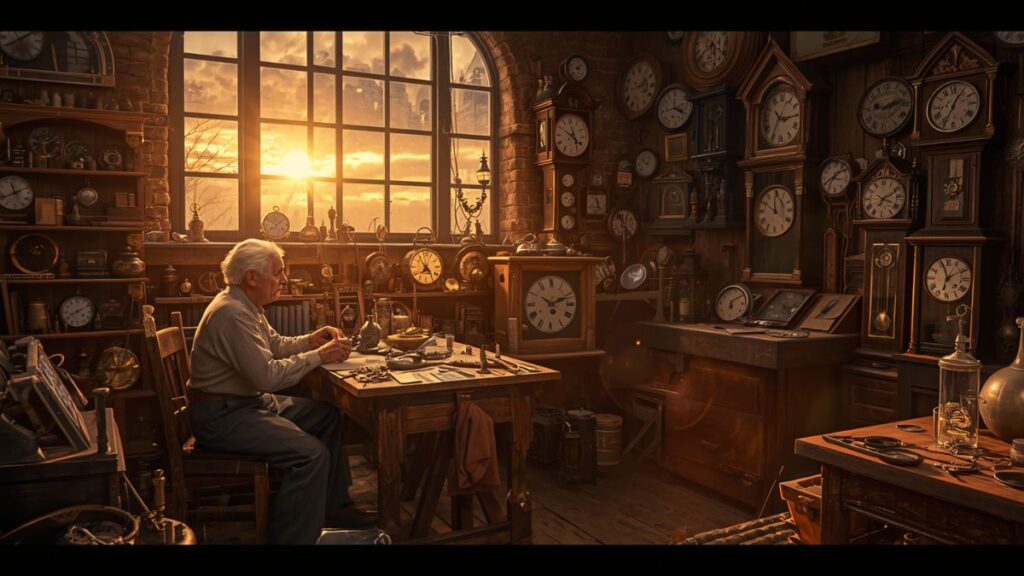
Large clocks.
Small clocks.
Wall clocks.
Mantel clocks.
Pocket watches.
Each kept its own rhythm.
Some ticked slowly.
Others quickly.
Together they created a gentle symphony of time passing.
Most people found the sound unusual.
Henry found it comforting.
His workshop stood on a quiet street in a small town where life still moved at a patient pace.
The building itself was old.
Older than Henry.
Older than many of the clocks resting on its shelves.
The wooden floors creaked softly.
The windows overlooked a narrow cobblestone road lined with flower boxes and stone cottages.
Sunlight entered each afternoon and settled across the room like a familiar guest.
It was a peaceful place.
A place built for careful work.
And careful thinking.
Henry arrived there every morning before most people were awake.
He unlocked the door.
Made a cup of tea.
Opened the curtains.
Then spent the day repairing clocks.
Some required simple adjustments.
Others demanded hours of patience.
Tiny gears.
Delicate springs.
Intricate mechanisms.
The work required focus.
Precision.
Respect.
Henry loved it.
Not because it was easy.
Because it rewarded patience.
A clock could not be rushed.
Neither could many worthwhile things in life.
On this particular evening, autumn had settled comfortably over the town.
Golden leaves drifted along the street outside.
The air carried a pleasant coolness.
The sky glowed softly as the sun prepared to set.
Inside the workshop, Henry was finishing the final repair of the day.
An antique mantel clock sat on his workbench.
The brass casing had been polished recently.
Its wooden frame carried the gentle wear of age.
For decades, the clock had belonged to the same family.
Three generations had listened to its familiar ticking.
Recently it stopped working.
Now Henry was bringing it back to life.
Carefully, he adjusted a small gear.
Then another.
Finally, he wound the mechanism.
For a moment, the room remained silent.
Then the clock ticked.
Once.
Twice.
Three times.
Steady.
Reliable.
Alive again.
Henry smiled.
The feeling never grew old.
Each repaired clock felt like a small victory.
Not dramatic.
Not world-changing.
Yet meaningful.
The clock resumed its purpose.
And that mattered.
He placed it gently on a nearby shelf and removed his glasses.
The day was finished.
Most evenings followed the same pattern.
Henry tidied his workbench.
Organized tools.
Swept the floor.
Closed account books.
Simple routines.
Familiar routines.
The kind that created a sense of order.
Outside, the street gradually grew quieter.
Shops closed.
People returned home.
Lights appeared behind windows.
The town settled into evening.
Henry enjoyed this time of day.
The transition felt peaceful.
The world seemed to slow down.
The workshop became especially calm.
Without customers or conversation, the ticking of the clocks grew more noticeable.
Not loud.
Just present.
A gentle reminder of passing moments.
He walked toward the kettle and prepared another cup of tea.
The steam rose softly into the air.
The scent filled the room.
Warm.
Comforting.
He carried the mug to a chair near the front window and sat down.
This had become his evening ritual.
A few quiet minutes before heading home.
No work.
No tasks.
Just observation.
The street outside looked beautiful beneath the fading light.
Leaves moved gently along the cobblestones.
A cyclist passed slowly.
An elderly couple walked hand in hand.
The ordinary scenes brought him unexpected happiness.
Perhaps because he understood something he had spent years learning.
Life was mostly made of ordinary moments.
Not extraordinary ones.
The extraordinary moments were memorable.
But the ordinary moments filled the majority of our days.
Learning to appreciate them changed everything.
Henry took a sip of tea.
The clocks continued ticking around him.
The sound inspired reflection.
As it often did.
People frequently spoke about time as though it were an enemy.
There wasn’t enough time.
Time moved too quickly.
Time slipped away.
Henry understood those feelings.
Yet working with clocks had taught him something different.
Time itself wasn’t rushing.
People were.
The clocks simply measured movement.
They weren’t responsible for it.
Some of the happiest people Henry knew seemed to understand that.
They paid attention.
Not constantly.
But intentionally.
They noticed seasons changing.
They enjoyed conversations without checking the time.
They appreciated simple routines.
Small pleasures.
Quiet evenings.
Moments that many others hurried past.
A soft smile crossed his face.
The lesson had taken years to learn.
When he was younger, he often lived differently.
Always focused on the future.
The next achievement.
The next project.
The next goal.
There was always something ahead demanding attention.
He believed happiness existed somewhere in the distance.
Waiting.
Eventually, he arrived at many of those destinations.
And discovered something surprising.
The feeling never lasted.
Every accomplishment quickly became another starting point.
Another objective.
Another reason to hurry.
For a while, that realization frustrated him.
Then one evening, many years ago, he noticed something.
A sunset.
Nothing remarkable.
Just a sunset viewed through the workshop window.
Yet for several minutes he stopped working and watched.
The colors.
The light.
The quiet beauty.
When the moment ended, he felt unexpectedly peaceful.
Not because anything significant happened.
Because he had fully experienced it.
That evening changed him more than he realized.
Gradually, he began noticing other moments.
Morning sunlight.
Rain against windows.
Conversations with customers.
The satisfaction of repairing a clock.
Life became richer.
Not because circumstances changed.
Because attention changed.
The clocks continued their steady rhythm.
Tick.
Tick.
Tick.
Each sound represented another moment.
Another opportunity to notice.
To appreciate.
To be present.
Henry glanced around the workshop.
Hundreds of clocks surrounded him.
Each measured time differently.
Yet none seemed concerned about it.
Only people worried about time.
The clocks simply continued ticking.
Steadily.
Patiently.
Faithfully.
Perhaps there was wisdom in that.
Outside, twilight deepened.
Streetlights flickered on.
Their warm glow reflected on the cobblestones.
The town looked peaceful.
Comfortable.
The kind of place where people still greeted neighbors and remembered familiar faces.
Henry felt grateful.
Not because life had been perfect.
It certainly hadn’t.
There had been difficult years.
Losses.
Disappointments.
Unexpected challenges.
Every life contained them.
Yet there had also been kindness.
Friendships.
Meaningful work.
Quiet evenings.
Thousands of small moments worth remembering.
Those moments deserved attention too.
A clock on the wall chimed softly.
The sound echoed through the workshop.
Then faded.
Silence followed briefly.
Or as close to silence as a room filled with clocks could manage.
Henry laughed quietly to himself.
Even silence sounded different there.
Eventually, he stood.
The tea was finished.
The day was complete.
He walked through the workshop one final time.
Checking windows.
Turning off lamps.
Ensuring everything remained in order.
The familiar routine felt comforting.
At the door, he paused.
The clocks continued ticking behind him.
Steady as ever.
The sound followed him briefly as he stepped outside.
The evening air felt cool and fresh.
Above, the first stars appeared.
The town rested peacefully beneath the darkening sky.
Henry locked the door and slipped the key into his pocket.
Then he began the short walk home.
Leaves rustled beneath his shoes.
A gentle breeze moved through the trees.
Everything felt calm.
Balanced.
Exactly as it should.
Tomorrow morning, he would return.
The clocks would still be there.
Waiting.
Ticking.
Measuring another day.
And Henry would once again spend his time caring for them.
Not because clocks mattered more than people.
Because they reminded him of something important.
Time is valuable.
Not because it is scarce.
Because it is happening right now.
In this moment.
And this one.
And the next.
The lesson seemed simple.
Yet perhaps the most important lesson of all.
Reflection
Bedtime stories for adults to fall asleep free often focus on gentle reflection rather than excitement. The Clockmaker’s Evening reminds us that life is made of countless ordinary moments. When we slow down and pay attention, those moments reveal a quiet beauty that has been there all along.