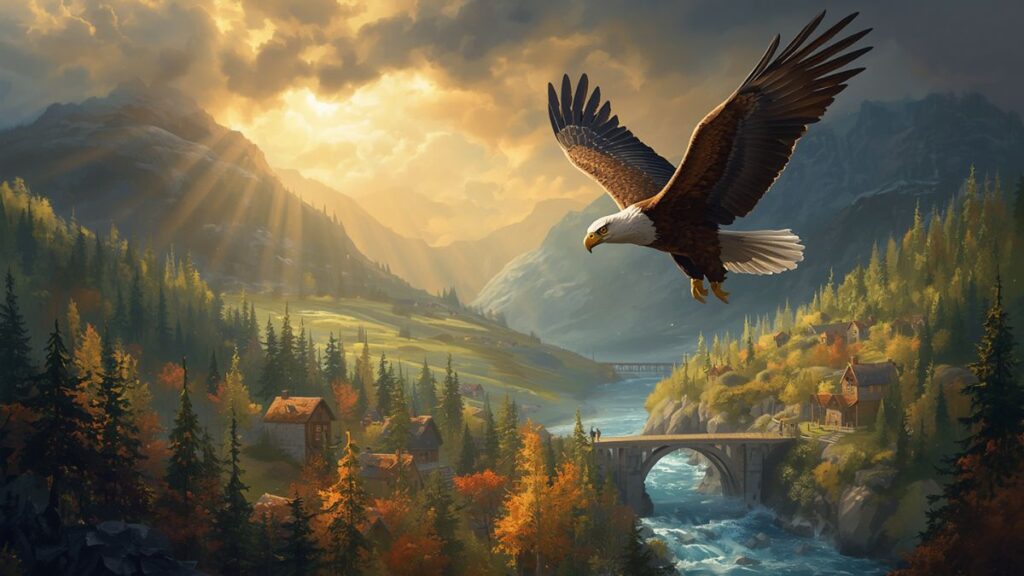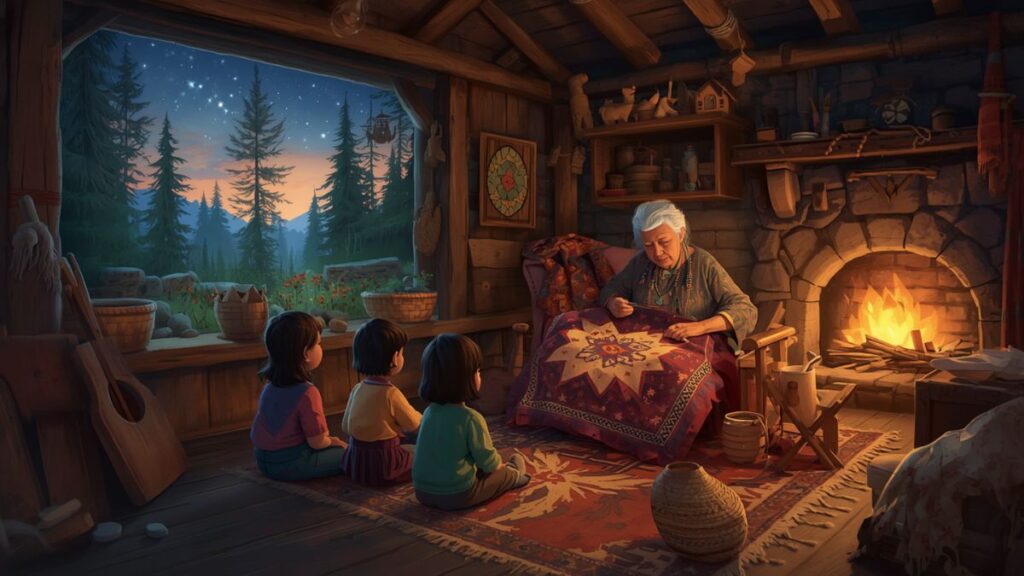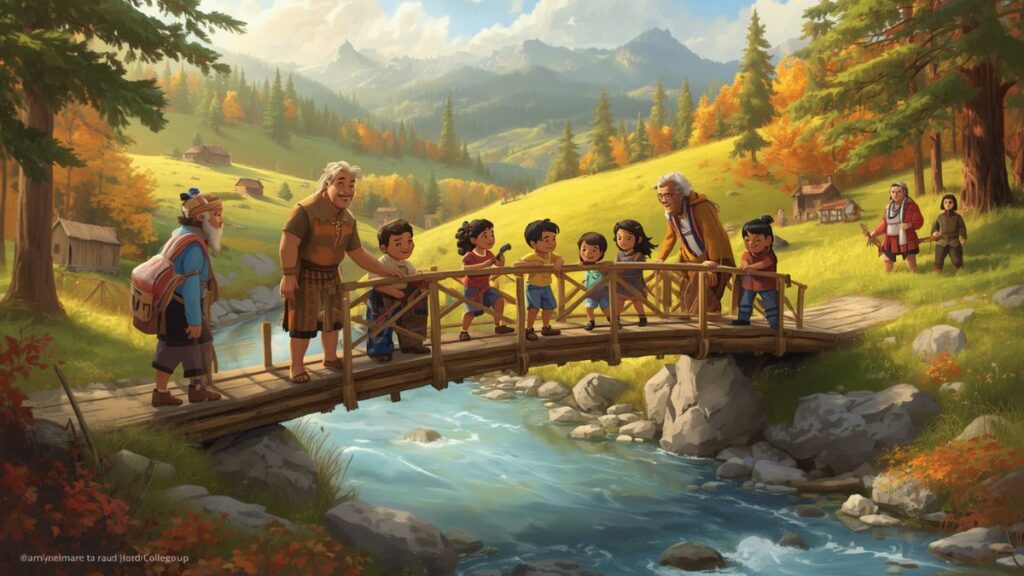
Long ago, a wide river flowed through a beautiful valley surrounded by towering cedar forests, rolling hills, and colorful meadows. The river gave fresh water to every village, nourished the plants and animals, and reflected the bright blue sky each morning. Although the river brought life to the valley, it also separated two neighboring villages that lived on opposite banks.
The people had known one another for many generations. They traded food, shared stories, and visited during seasonal celebrations. But over time, the river became harder to cross. Heavy spring rains often damaged the small wooden crossing, and eventually it disappeared altogether.
Without a bridge, visits became less frequent.
Children who had once played together could only wave from opposite sides of the river.
Families celebrated important gatherings apart instead of together.
As the years passed, many young people from each village no longer knew the friends their parents had grown up with.
Among the children was a cheerful boy named Mato, who lived on the eastern side of the river. He often climbed the tallest hill near his home and looked across the sparkling water toward the western village.
“I wonder what it’s like over there,” he said one afternoon.
On the opposite bank lived a kind girl named Aiyana. She often sat beneath a large cedar tree, watching birds fly freely across the river.
“I wish people could cross as easily as the birds,” she told her grandmother.
The grandmother smiled.
“Perhaps one day they will.”
As autumn approached, excitement filled both villages. Native American Day was only a few weeks away, and everyone hoped to celebrate together for the first time in many years.
The village elders gathered to discuss possible solutions.
“We could build another bridge,” suggested one elder.
“But it would take many hands,” another replied.
Some people worried the task would be too difficult before the celebration.
Others believed it was impossible.
Mato listened quietly from outside the meeting.
That evening, he walked to the riverbank and noticed Aiyana standing across the water.
They waved to one another.
Neither could hear the other’s voice over the rushing current, but both shared the same wish.
The next morning, Mato gathered several friends.
“What if we begin ourselves?” he asked.
“We’re only children,” one friend replied.
“We can’t build an entire bridge.”
“No,” Mato agreed.
“But we can build the first step.”
Meanwhile, across the river, Aiyana had gathered her own group of friends.
“I think the people across the river want the same thing we do,” she said.
Her friends nodded.
Together, both groups began clearing fallen branches near the riverbanks.
They gathered smooth stones, trimmed small bushes, and marked the safest place for a future crossing.
When the adults noticed what the children were doing, they smiled.
“They’ve already started.”
Soon, skilled woodworkers from both villages joined the effort.
Carpenters selected strong cedar logs that had naturally fallen during previous storms.
No healthy trees were cut down unnecessarily.
The elders reminded everyone to use only what nature had already provided.
For several days, the valley echoed with the sounds of teamwork.
Some people shaped wooden beams.
Others carried ropes woven from sturdy plant fibers.
Children gathered small stones to strengthen the riverbanks.
Women prepared meals for the workers.
The oldest villagers shared advice based on bridges they had helped build many years before.
Every person contributed in some way.
One afternoon, heavy rain suddenly swept across the valley.
The river rose quickly, carrying branches downstream.
Several workers worried that the unfinished bridge might be damaged.
“Perhaps we should wait until next year,” someone suggested.
Mato looked disappointed.
“We’ve come so far.”
Just then, Aiyana stepped forward.
“If we stop now, the river will continue separating us.”
Her words inspired everyone.
The builders carefully reinforced the bridge supports before the water rose any higher.
Together they protected everything they had already completed.
When the storm finally passed, the bridge remained standing.
Everyone cheered.
Day after day, the structure slowly stretched farther across the river.
Children eagerly measured the remaining distance.
“Only a few more logs!”
“Just one more section!”
Finally, on the morning before Native American Day, the last cedar plank was carefully placed into position.
The bridge was complete.
For the first time in many years, families walked safely from one village to the other.
Grandparents embraced old friends they had not seen in a long time.
Children laughed together as if they had always known one another.
The river still flowed peacefully beneath the bridge, but it no longer divided the valley.
That afternoon, the Native American Day celebration began.
People shared music, storytelling, dancing, games, and handmade crafts.
Instead of two separate gatherings, there was one joyful community.
The village elder stood beside the new cedar bridge.
“This bridge is made from wood,” he said.
“But its true foundation is friendship.”
Everyone applauded.
Later that evening, Mato and Aiyana sat together on the bridge, watching the sunset reflect across the water.
“I’m glad we waved that day,” Mato said.
“So am I,” Aiyana replied.
“If we hadn’t believed this was possible, none of this would have happened.”
An old carpenter overheard their conversation.
“You two built something much larger than a bridge.”
The children looked surprised.
“We only gathered stones.”
The carpenter smiled.
“Sometimes the smallest actions inspire the greatest changes.”
As years passed, the cedar bridge became much more than a way to cross the river.
Children from both villages walked across it to attend festivals, share stories, and learn new skills.
Artists traded ideas.
Farmers exchanged seeds.
Storytellers visited both communities.
Whenever repairs were needed, everyone worked together without being asked.
The bridge belonged to everyone.
One spring morning, a young boy asked the village elder,
“Why is it called the Bridge of Friendship?”
The elder gently rested his hand on the smooth cedar railing.
“Because it reminds us that understanding begins when we choose to meet one another.”
The boy smiled.
“I want to help care for it.”
“And by caring for the bridge,” the elder replied, “you also care for your neighbors.”
Generations passed, but the story was never forgotten.
Parents brought their children to the bridge each year before the Native American Day celebration.
They explained that the strongest bridges are not always made from wood or stone.
They are built with trust.
With kindness.
With cooperation.
With respect.
Even today, when people cross a bridge to visit friends, help neighbors, or welcome new families, they continue a tradition that is much older than the bridge itself.
Every step reminds us that differences become smaller when we choose to work together.
And just like the sturdy cedar bridge stretching across the peaceful river, friendship grows stronger each time people reach out to one another with open hearts.
Moral of the Story
Friendship is built through trust, kindness, and cooperation. When people work together and respect one another, they can overcome any distance that separates them.