The desert had a way of making every person feel small.
Its endless dunes stretched beyond the horizon like golden waves frozen in time. During the day, the sun blazed relentlessly. At night, the stars appeared so numerous that the sky seemed almost alive.
For twenty-nine-year-old Yusuf Rahman, the desert was not a place of fear.
It was a place of service.
For the past four years, Yusuf had volunteered with a humanitarian organization that delivered food, clean water, medicine, and blankets to isolated villages across the region. Many of the communities were too remote for regular aid convoys, especially after seasonal sandstorms damaged roads.
Friends often asked why he accepted such difficult assignments.
Yusuf always smiled.
“The Prophet, peace be upon him, taught us that the best people are those who benefit others.”
That simple belief guided every decision he made.
Yusuf had grown up in a modest family where faith was quietly woven into everyday life.
His father owned a small grocery shop.
His mother taught children to read the Qur’an after school.
They never possessed great wealth, but generosity always found a place at their dinner table.
His mother often reminded him, “Allah looks at what is in the heart before what is in the hands.”
Those words stayed with him into adulthood.
Although Yusuf prayed regularly and tried to live according to Islamic values, he often felt he could do better.
Sometimes he delayed prayers because of work.
Sometimes he became impatient under stress.
Sometimes he worried more about career plans than about strengthening his relationship with Allah.
Like many people, he believed there would always be more time.
On a cool autumn morning, Yusuf and two fellow volunteers loaded their four-wheel-drive vehicle with medical supplies, flour, bottled water, and children’s clothing.
Their destination was Al-Nour, a small village nearly eighty miles beyond the nearest paved road.
The weather forecast predicted clear skies until evening.
The journey began peacefully.
Golden sunlight illuminated endless dunes.
Camels wandered across distant ridges.
Occasionally they passed shepherds guiding small flocks through the barren landscape.
After several hours, the convoy stopped at a small roadside mosque.
The volunteers performed Dhuhr prayer together.
Yusuf lingered afterward, quietly making du’a.
“O Allah, accept whatever little good I can do today.”
He felt an unusual sense of peace.
The journey continued.
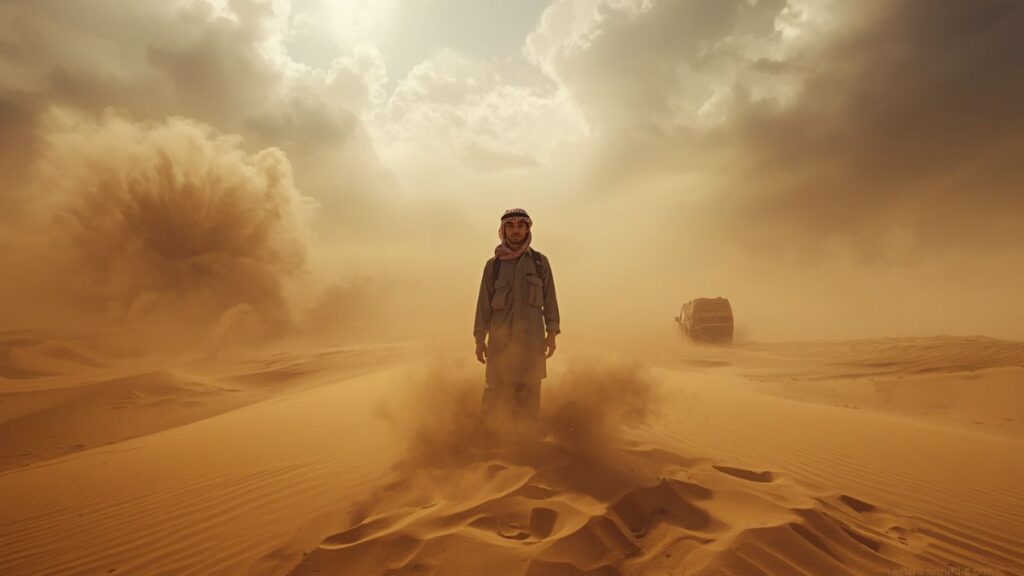
By late afternoon, dark clouds of blowing sand appeared on the western horizon.
The oldest driver frowned.
“That storm is moving faster than expected.”
They increased their pace.
The village was still nearly an hour away.
Within minutes, the wind intensified dramatically.
Fine sand swept across the road.
Visibility dropped.
The sky transformed from brilliant blue into a swirling wall of brown.
The drivers switched on emergency lights.
Communication radios crackled with static.
The storm struck with astonishing force.
Sand hammered against the vehicles like heavy rain.
The convoy slowed to a crawl.
Then disaster struck.
One vehicle became stuck in deep drifting sand.
The second attempted to assist.
Its rear tires also sank.
Yusuf climbed out carrying a tow rope.
The wind nearly knocked him off balance.
He wrapped a scarf tightly across his face.
Together the volunteers struggled against the storm.
The sand shifted beneath every step.
Visibility fell to only a few feet.
As Yusuf secured the tow cable, an enormous gust swept across the dunes.
The force threw him sideways.
He rolled down a steep sandy slope.
When he finally stopped, the world had disappeared.
The storm erased every landmark.
Every tire track.
Every voice.
He shouted.
No answer.
He climbed the nearest dune.
Nothing.
Only endless walls of blowing sand.
His companions were gone.
Yusuf knew wandering aimlessly would only worsen his situation.
He sheltered beside a rocky outcrop and waited.
Minutes became an hour.
The storm intensified.
His water bottle emptied.
The cold desert evening approached rapidly.
Despite his training, fear slowly entered his heart.
He performed tayammum using clean sand and prayed Asr while seated behind the rocks.
His voice nearly vanished beneath the howling wind.
After completing the prayer, he whispered quietly,
“Hasbunallahu wa ni’mal wakeel.”
Allah is sufficient for us, and He is the best disposer of affairs.
Night arrived.
The temperature dropped sharply.
His flashlight batteries weakened.
His body became exhausted.
He continued making dhikr softly.
“SubhanAllah.”
“Alhamdulillah.”
“Allahu Akbar.”
Eventually, fatigue overcame him.
He leaned against the rocks.
His breathing slowed.
The storm continued raging around him.
Then everything changed.
The wind disappeared.
The cold vanished.
The darkness surrounding him slowly transformed into a gentle golden light.
Yusuf opened his eyes.
The desert remained.
Yet it looked entirely different.
Every grain of sand shimmered softly.
The sky glowed with peaceful light unlike sunrise or sunset.
The silence felt alive.
It carried comfort instead of loneliness.
His thirst disappeared.
His exhaustion faded.
Every ache left his body.
Then he heard it.
The Adhan.
But unlike any adhan he had ever heard.
The voice was neither loud nor distant.
It seemed to come from every direction at once.
Every word filled his heart with overwhelming peace.
Allahu Akbar… Allahu Akbar…
The call was impossibly beautiful.
Each phrase seemed to carry mercy itself.
Tears filled Yusuf’s eyes.
He instinctively wanted to answer.
Not merely with words.
With his entire life.
As the adhan continued, memories surrounded him.
He saw himself as a little boy standing beside his father in the mosque.
His father gently placing a hand on his shoulder while teaching him how to straighten the prayer rows.
He remembered memorizing Surah Al-Fatihah with his mother.
The first Ramadan he completed successfully.
The excitement of Eid mornings.
Then came later memories.
The prayers he had rushed.
The moments he delayed salah because meetings seemed more important.
The evenings he felt too tired to read Qur’an.
Small choices.
Nothing dramatic.
Yet now he realized how easily worldly concerns had distracted him.
Unexpectedly, he also witnessed moments of kindness.
Helping an elderly neighbor carry groceries.
Buying meals for migrant workers during Ramadan.
Quietly paying school fees for an orphan without revealing his identity.
Smiling at strangers.
Comforting grieving families.
Many acts he had completely forgotten.
He realized Allah had forgotten none of them.
He then experienced those moments through the hearts of others.
The orphan’s relief.
The old man’s gratitude.
The comfort brought by simple words spoken sincerely.
No act of kindness had disappeared.
Every sincere intention had continued beyond the moment itself.
Then another realization settled deeply into his heart.
Allah’s mercy was greater than every mistake he had ever carried.
Not because mistakes were insignificant.
But because sincere repentance was always welcomed.
He remembered the verse:
“Indeed, the mercy of Allah is near to the doers of good.”
His heart filled with hope unlike anything he had known before.
The peaceful light expanded.
Ahead appeared a beautiful oasis unlike any place on earth.
Crystal-clear water flowed gently beneath towering date palms.
The air carried the fragrance of fresh rain.
Birds sang softly.
Everything reflected harmony.
He sensed a presence nearby.
He could not see anyone.
Yet he felt completely known.
Every hidden fear.
Every private du’a.
Every tear shed during difficult nights.
Nothing was unknown to Allah.
The awareness overwhelmed him with gratitude.
He fell to his knees.
“Ya Allah…”
No further words came.
They were unnecessary.
His heart itself became a prayer.
Then he heard another familiar voice.
His grandfather.
Not speaking from a distance.
Standing beside him.
His grandfather had died nearly ten years earlier after a long illness.
Now he appeared healthy.
Peaceful.
Smiling.
“My grandson.”
Yusuf embraced him.
The reunion felt completely real.
“I’ve missed you.”
“I know.”
“I tried to follow what you taught me.”
His grandfather nodded gently.
“Keep walking.”
They walked together through the peaceful oasis.
His grandfather reminded him of countless hadith he had learned as a child.
About sincerity.
Patience.
Trust in Allah.
Serving people quietly.
Seeking forgiveness daily.
Eventually they reached the edge of an extraordinary light beyond anything Yusuf could describe.
Every part of him longed to continue.
The peace there surpassed every earthly happiness.
His grandfather smiled.
“It is not your time.”
“I don’t want to leave.”
“There are people still waiting for your help.”
“The children.”
“The villages.”
“Your parents.”
“They still need you.”
The beautiful light slowly faded.
Its warmth remained.
Then came another sound.
At first distant.
Then growing louder.
Voices shouting.
“Yusuf!”
Flashlights.
Vehicle engines.
His companions.
Pain rushed back into his body.
Cold returned.
The sandstorm had weakened.
Search teams had followed emergency locator signals from the vehicles and expanded the search before dawn.
One volunteer spotted Yusuf’s scarf partially buried beneath drifting sand.
He was unconscious but alive.
Doctors later explained that dehydration, exposure, and exhaustion had pushed his body dangerously close to failure.
His survival amazed everyone involved.
Recovery took several weeks.
Physically, Yusuf healed.
Spiritually, he returned home transformed.
He no longer delayed prayer unnecessarily.
Not out of fear.
Out of gratitude.
Every salah became a gift.
He began reading Qur’an every morning before work.
Not because someone instructed him.
Because his heart longed for the peace he had experienced.
His humanitarian work also changed.
He no longer measured success by the number of aid deliveries completed.
Instead, he focused on every individual person.
Learning children’s names.
Listening to elderly villagers.
Praying with families before leaving.
His compassion became quieter.
Deeper.
Years later, Yusuf was invited to speak at a youth conference about humanitarian service.
Many expected stories about dangerous journeys.
Instead, he shared something simple.
“We spend much of life preparing for tomorrow.”
He smiled gently.
“But none of us knows if tomorrow belongs to us.”
“So never delay repentance.”
“Never postpone kindness.”
“And never think a sincere prayer goes unheard.”
He ended every talk with a reminder from the Qur’an:
“Indeed, with hardship comes ease.”
The audience often left in thoughtful silence.
Many approached afterward asking how to strengthen their faith.
Yusuf always gave the same answer.
“Start with the next prayer.”
“Pray it as though it were a gift.”
Because one day in the desert, when every direction had disappeared beneath a storm, Yusuf discovered that the truest guidance had never come from roads, maps, or distant horizons.
It came from answering the call that had always been waiting within his heart.
And from that day forward, every time the adhan echoed from a nearby mosque, he paused for a brief moment before walking toward prayer.
Not because it had become a habit.
But because he remembered hearing a call beyond the desert storm that forever changed the direction of his soul.