
Sometimes, the best way to end a long day is to slow down, put away your phone, and enjoy a peaceful story before closing your eyes. Reading calming stories before bed can help create a relaxing nighttime routine, quiet your thoughts, and make bedtime feel more enjoyable.
Stories to read to fall asleep are gentle, comforting tales designed to help readers unwind, escape everyday worries, and gradually prepare for a restful night. They often feature peaceful settings, warm characters, beautiful nighttime scenery, and simple plots without unnecessary tension or excitement.
Whether you enjoy stories about quiet villages, moonlit gardens, sleepy animals, unexpected friendships, or heartwarming moments, the right bedtime story can make your evenings more relaxing.
In this collection, you will discover peaceful bedtime stories for adults, romantic nighttime tales, short stories for a quick read, and comforting stories that are perfect for reading just before sleep.
What Are the Best Stories to Read to Fall Asleep?
The best stories to read to fall asleep are gentle, easy-to-follow tales with relaxing descriptions, positive emotions, and peaceful endings. Stories about nature, friendship, love, childhood memories, and quiet adventures are particularly suitable for bedtime reading.
Here are some popular types of bedtime stories:
- Peaceful nature stories: Tales about moonlit forests, gardens, rivers, and quiet villages.
- Heartwarming stories: Gentle narratives about friendship, kindness, family, and love.
- Romantic bedtime stories: Sweet stories featuring affection, thoughtful gestures, and emotional connections.
- Animal bedtime stories: Comforting tales about sleepy cats, friendly dogs, rabbits, and other animals.
- Short bedtime stories: Simple stories that can be enjoyed in five to ten minutes.
- Fantasy bedtime stories: Magical worlds, talking stars, friendly clouds, and peaceful imaginary places.
The goal is not to keep readers guessing until the last moment. Instead, a good sleep story should make them feel comfortable, relaxed, and ready to rest.
Stories to Read to Fall Asleep
1. The Little House Beside the Moonlit Lake

A peaceful bedtime story about love, solitude, nature, and finding comfort in life’s quiet moments.
There was once a little wooden house beside a beautiful lake, far away from the noise of crowded streets and busy towns. It stood at the edge of a quiet forest, surrounded by tall pine trees, wildflowers, and soft green grass.
During the daytime, sunlight danced across the lake, birds sang from the branches, and gentle breezes carried the sweet fragrance of flowers through the open windows.
But the house was especially beautiful at night.
When the sun disappeared behind the distant hills, the sky slowly changed from golden orange to deep blue. One by one, the stars appeared, and the moon rose above the trees. Its silver light spread across the lake, making the water look like a giant mirror filled with tiny diamonds.
Inside the little house lived an old woman named Clara.
Clara had moved there many years ago after spending most of her life in a noisy city. She had worked in a small school, taught hundreds of children, and spent countless evenings preparing lessons and correcting notebooks.
When she finally retired, she decided that she wanted something different.
She wanted quiet mornings, peaceful evenings, and a place where she could listen to the wind without hearing traffic.
One spring morning, she discovered the little wooden house beside the lake.
It had an old red roof, two small bedrooms, a kitchen with a brick fireplace, and a wooden porch overlooking the water. The garden was slightly overgrown, and the windows needed cleaning, but Clara immediately fell in love with it.
She bought the house and slowly made it her home.
She planted lavender near the front door, placed colorful flowers beside the windows, and hung a small wooden birdhouse from an apple tree.
In the living room, she arranged comfortable chairs around the fireplace. A soft blue blanket rested on her favorite armchair, and a little bookshelf stood beside it, filled with novels, poetry collections, and old family photographs.
Her days followed a gentle routine.
She woke up early, prepared a cup of tea, and sat on the porch to watch the morning light spread across the lake.
Sometimes she fed the ducks. Sometimes she watered the flowers. On rainy afternoons, she baked apple pies and listened to the gentle sound of raindrops touching the roof.
And every evening, she waited for the moon.
It had become her favorite part of the day.
The Evening Visitor
One autumn evening, Clara was sitting beside the fireplace when she heard a soft scratching sound near the front door.
At first, she thought it was a branch moving in the wind.
But when the sound came again, she stood up and walked toward the door.
She opened it carefully.
Standing on the porch was a small gray cat.
Its fur was slightly wet, its paws were muddy, and its green eyes looked tired.
“Oh, hello there,” Clara whispered.
The cat looked at her without moving.
Clara crouched and gently extended her hand.
“Have you lost your way, little one?”
The cat slowly approached and rubbed its head against her fingers.
Clara smiled.
“Well, you look as though you could use a warm place to sleep.”
She brought the cat inside, dried its fur with a soft towel, and placed a small bowl of milk and some food near the kitchen.
The cat ate quietly before curling up beside the fireplace.
Clara watched it for a moment.
“You certainly know how to make yourself comfortable,” she said with a little laugh.
That night, the cat slept on a cushion beside her favorite chair.
The following morning, Clara opened the door, expecting the little visitor to disappear into the forest.
Instead, the cat followed her into the garden.
It stayed close while she watered the flowers and sat beside her as she drank her morning tea.
By lunchtime, Clara had decided that the cat needed a name.
She called it Moonbeam.
The name seemed perfect because the little cat had appeared on a moonlit evening and had a beautiful silver-gray coat.
From that day onward, the house no longer felt quite so empty.
A Home Filled With Small Joys
As the weeks passed, Moonbeam became part of Clara’s everyday life.
Every morning, the cat waited outside her bedroom door.
When Clara walked into the kitchen, Moonbeam followed closely behind, hoping for breakfast.
After breakfast, it usually found a sunny place near the window and watched the birds outside.
Sometimes it chased fallen leaves in the garden. Sometimes it climbed onto the porch railing and stared at the ducks swimming across the lake.
Clara often talked to Moonbeam as though it understood every word.
She told it about the children she had taught, the places she had visited, and the little things she remembered from her younger days.
She also shared stories about her husband, Daniel, who had passed away many years earlier.
Daniel had loved peaceful places just as much as Clara did.
When they were younger, they had dreamed of owning a small cottage near a lake. They imagined drinking tea on a wooden porch, watching the sunset, and spending their evenings reading books together.
Life had taken them in different directions, and they had never managed to fulfill that dream.
After Daniel passed away, Clara sometimes wondered what their quiet life together might have looked like.
But now, sitting beside Moonbeam in her little house, she felt that perhaps a small part of that dream had finally come true.
One evening, she took an old photograph from the bookshelf.
It showed Daniel standing beside a lake, smiling at the camera.
She placed it on the table and looked at it for a long time.
“Look, Moonbeam,” she said softly. “I think he would have liked this place.”
The cat jumped onto the chair beside her and settled down.
Clara smiled.
Outside, the moon was rising.
The Night the Stars Disappeared
Winter arrived slowly.
The trees lost their leaves, the mornings became colder, and a thin layer of frost covered the garden.
Clara began spending more time indoors.
She kept the fireplace burning, prepared warm soups, and knitted a long woolen scarf.
Moonbeam developed a habit of sleeping near the fireplace during the afternoon and sitting beside the window at night.
One evening, dark clouds covered the sky.
The wind grew stronger, and rain began falling heavily against the windows.
Clara closed the curtains and checked that the doors were locked.
Moonbeam seemed restless.
It walked from one window to another, occasionally looking outside.
“Don’t worry,” Clara whispered. “It’s only a storm.”
But the storm became stronger.
The wind shook the trees, and branches moved wildly above the roof. Thunder rumbled in the distance.
Suddenly, the lights went out.
The little house became completely dark.
Clara paused for a moment before reaching for the candles in the kitchen drawer.
She lit two candles and placed them on the living room table.
Their warm golden light filled the room.
Moonbeam jumped onto her lap.
Clara wrapped the blue blanket around herself and the little cat.
“Well, it seems we have to spend the evening without electricity.”
She looked toward the window.
There was no moonlight, no shining stars, and no silver reflection across the lake.
Everything outside was hidden beneath the darkness.
For a few moments, Clara felt strangely lonely.
Then she remembered something Daniel used to say.
“The stars don’t disappear just because clouds cover them.”
She smiled at the memory.
“You’re right, Daniel,” she whispered.
She opened a book and began reading aloud.
Her voice was soft, almost like a lullaby.
Moonbeam slowly closed its eyes.
Outside, the storm continued, but inside the little house, everything felt warm and safe.
Clara read until her candle burned low.
Eventually, she placed the book on the table and carried Moonbeam to the bedroom.
The storm gradually became quieter.
Before falling asleep, Clara looked toward the dark window.
She knew that somewhere above the clouds, the stars were still shining.
The First Snowfall
A few weeks later, winter brought the first snowfall.
Clara woke up early and noticed something unusual.
The garden looked completely white.
Snow covered the wooden porch, the roof, the branches of the pine trees, and the little path leading toward the lake.
Even the water seemed different. A thin layer of ice had formed near the edges, while the middle remained dark and still.
Clara put on her warm coat and stepped outside.
Moonbeam followed her, carefully placing its paws on the fresh snow.
The cat looked surprised.
It lifted one paw, shook it gently, and then stepped forward again.
Clara laughed.
“Have you never seen snow before?”
Moonbeam jumped toward a small snow-covered bush.
For the next few minutes, Clara watched the cat explore the garden.
It chased a falling snowflake, jumped over a little mound of snow, and finally returned to the porch.
Clara brought out a small bowl of warm water and placed it near the door.
Then she went inside and prepared breakfast.
She made oatmeal with honey, toasted two slices of bread, and brewed a fresh pot of tea.
After breakfast, she sat near the window with Moonbeam beside her.
The snow continued falling.
Large white flakes floated gently through the air, covering the garden with a soft blanket.
There was something deeply comforting about watching the world become quiet.
No cars passed outside. No voices disturbed the peaceful morning. Even the birds seemed to have found warm places to rest.
Clara opened her diary and wrote:
“Today, the world is covered in white. The lake is quiet, the trees are sleeping, and my little house feels warmer than ever. Sometimes happiness is not something extraordinary. Sometimes it is simply a warm cup of tea, a sleeping cat, and a beautiful winter morning.”
She closed the diary and placed it beside her chair.
Moonbeam stretched, yawned, and curled up against her.
Clara gently stroked its back.
A Letter From the Past
One afternoon, while cleaning an old wooden cupboard, Clara discovered a small envelope hidden behind a stack of books.
It was yellow with age.
Her name was written on the front in familiar handwriting.
She immediately recognized it.
It was Daniel’s handwriting.
Clara carefully opened the envelope.
Inside was a letter she had never seen before.
It was dated many years earlier, shortly before Daniel became seriously ill.
She sat down and began reading.
“My dearest Clara,
I know how much you love peaceful places. I also know how often we have talked about having a little house beside a lake.
Perhaps we will find that place someday. Perhaps we won’t.
But I want you to remember something.
A peaceful home is not made of beautiful furniture, expensive things, or perfect surroundings.
It is made of the little moments we share.
A cup of tea in the morning. Your laughter from the kitchen. The sound of rain against the windows. An evening spent reading beside each other.
If one day you find yourself living in that little house, I hope you will sit by the window and watch the moonlight on the water.
And when you do, remember that somewhere, in some way, I am smiling with you.
With all my love,
Daniel.”
Clara read the letter twice.
Her eyes filled with tears, but there was a gentle smile on her face.
She walked toward the living room and placed the letter beside Daniel’s photograph.
Moonbeam jumped onto the chair and rested its head against her arm.
Clara stroked the little cat.
“I think we found our little house, Daniel,” she whispered.
Outside, the afternoon light slowly faded.
The Most Beautiful Moonlit Night
Spring eventually returned.
The snow melted, flowers began appearing in the garden, and the lake reflected the soft colors of the evening sky.
The apple tree near the porch developed fresh green leaves.
Birds returned to the branches, and the ducks began swimming near the shore again.
Clara felt younger whenever she watched the garden come alive.
One evening, she decided to prepare a special dinner.
She baked a small apple pie, made vegetable soup, and placed a white tablecloth on the kitchen table.
She also brought Daniel’s photograph from the bookshelf and placed it near the window.
Moonbeam watched her preparations with great interest.
“Tonight is a special evening,” Clara told the cat.
When dinner was ready, she carried everything to the porch.
The sky was clear.
A beautiful full moon had risen above the distant forest, spreading its silver light across the lake.
The water shimmered gently.
A soft breeze moved through the trees, carrying the fragrance of fresh flowers.
Clara sat in her favorite chair with a warm cup of tea.
Moonbeam settled beside her.
For a long time, neither of them moved.
They simply watched the moonlight dancing on the water.
Clara thought about all the years that had passed.
She remembered her childhood, her teaching days, her marriage, the difficult moments, and the unexpected happiness of finding Moonbeam.
She realized that life had never been exactly as she had imagined.
Some dreams had taken longer to arrive. Some had changed completely. Some had disappeared before she could hold them.
But new moments had always found their way into her life.
The little house had become more than a place to live.
It was a home filled with memories, quiet discoveries, and simple happiness.
Clara looked at Moonbeam.
The cat was almost asleep, its eyes half closed.
“Do you know something?” she whispered. “I used to think that happiness meant having everything I wished for.”
Moonbeam slowly moved its tail.
“But now I think happiness is learning to love what we already have.”
She smiled and leaned back in her chair.
The moon climbed higher.
The stars shone brightly.
Somewhere in the forest, an owl called softly. The lake remained peaceful, and the little wooden house glowed warmly beneath the night sky.
The House That Never Felt Empty Again
As the years passed, Clara continued living beside the lake.
Her hair became completely white, and her steps grew slower, but she never stopped enjoying her peaceful routine.
Every morning, she opened the curtains and welcomed the sunlight.
Every afternoon, she read beside the fireplace.
Every evening, she sat on the porch with Moonbeam and watched the moon rise.
She continued writing in her diary, collecting beautiful memories, and taking care of her little garden.
Sometimes, travelers walking through the forest noticed the warm lights coming from the cottage.
They wondered who lived there.
Occasionally, someone stopped to ask for directions or request a glass of water.
Clara always welcomed them with a smile.
She would offer them tea, tell them about the lake, and remind them to enjoy the beautiful surroundings.
“People spend so much time rushing from one place to another,” she would say. “Sometimes they forget that the journey is just as beautiful as the destination.”
And whenever evening arrived, Clara returned to her chair.
Moonbeam would curl up beside her.
The fireplace would crackle softly.
The curtains would move gently in the evening breeze.
Outside, the moon would paint the lake with silver light.
The little house remained just as it had been when Clara first discovered it: simple, warm, and full of quiet beauty.
One particularly peaceful night, Clara looked toward the stars and whispered:
“Thank you for this little home.”
She closed her eyes for a moment and listened.
The gentle movement of the water.
The soft rustling of leaves.
The quiet breathing of her sleeping cat.
Everything felt exactly as it should.
And beneath the beautiful moonlit sky, the little house beside the lake rested peacefully, holding its stories within its wooden walls.
The End.
2. The Little Bookshop That Stayed Open for the Stars
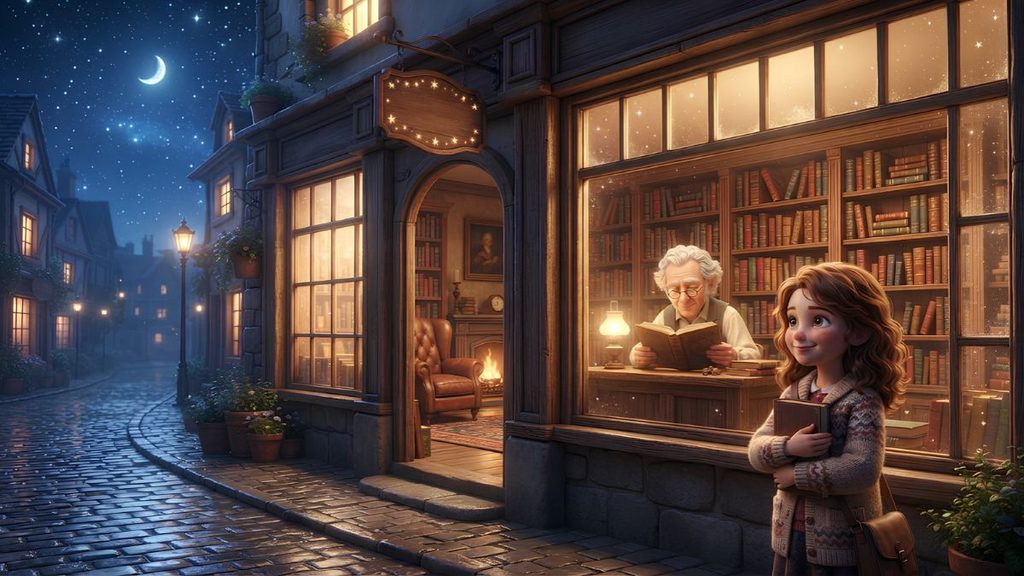
A peaceful bedtime story about kindness, forgotten dreams, friendship, and the quiet magic hidden inside books.
In a quiet little town surrounded by green hills and winding streets, there stood a small bookshop called The Midnight Pages.
It was an unusual shop.
During the day, the town was filled with people rushing to work, children walking to school, shopkeepers arranging their displays, and buses stopping at the crowded marketplace. The little bookshop remained open like every other store, welcoming readers who came looking for novels, poetry, fairy tales, and old-fashioned adventure stories.
But when evening arrived, something different happened.
Most shops closed their doors before sunset. Restaurants turned off their outdoor lights, shopkeepers pulled down their shutters, and the streets gradually became empty.
The little bookshop, however, stayed open.
Its windows continued to glow with warm golden light, and a small wooden sign hanging above the entrance displayed these words:
OPEN UNTIL THE LAST STAR FALLS ASLEEP.
Nobody in town quite understood why.
Some people believed the owner was simply fond of working late. Others thought he was waiting for someone special. A few children imagined that the bookshop was enchanted and that its books came alive after midnight.
The truth was much simpler, although it was just as beautiful.
The owner, a gentle old man named Oliver, believed that nighttime was the best time for reading.
He thought that books deserved to be read when the world became quiet, when people stopped worrying about their daily responsibilities, and when their minds could wander freely.
And so, every night, he kept the little bookshop open for anyone who needed a peaceful place.
The Man Behind the Bookshelves
Oliver had owned The Midnight Pages for nearly forty years.
He had inherited the shop from his father, who had opened it when the town was still a small village.
Back then, the shop had only three wooden shelves, a tiny counter, and a window overlooking the main street.
Over the years, Oliver had filled it with thousands of books.
There were adventure novels for curious minds, poetry collections for dreamers, illustrated fairy tales for children, travel journals for people who wanted to explore the world, and old mysteries for those who enjoyed solving puzzles.
Every book had a special place.
Oliver knew where each one belonged, and he remembered many of the people who had purchased them.
He could tell visitors which books were perfect for rainy afternoons, which stories were best enjoyed with a cup of tea, and which novels could make someone forget their worries for a little while.
He never hurried his customers.
If someone spent an hour choosing a book, Oliver happily waited.
If someone wanted to discuss a story, he listened.
And if a visitor had no money, he sometimes allowed them to borrow a book without paying anything.
“Stories are meant to be shared,” he often said. “They should never be locked away from someone who needs them.”
Oliver lived in a small apartment above the bookshop.
His bedroom window overlooked the rooftops, and from there he could see the stars on clear nights.
Every evening, after preparing a simple dinner, he would walk downstairs, unlock the shop, switch on the lamps, and place a fresh pot of tea near the reading corner.
Then he would wait.
Sometimes nobody came.
Sometimes a traveler entered looking for directions.
Sometimes a student arrived to finish a chapter before going home.
And sometimes, someone walked through the door carrying a sadness that no book could immediately explain.
Oliver welcomed everyone.
The Girl Who Could Not Sleep
One cold autumn evening, a young girl named Sophie was walking home after visiting her grandmother.
She was twelve years old and had recently moved to the town with her parents.
Everything felt unfamiliar.
Her new school was larger than her old one, her classmates already had their own friendship groups, and she often missed the little neighborhood where she had grown up.
That evening, Sophie had been feeling particularly lonely.
She walked slowly along the cobblestone street, watching the warm lights inside houses and listening to the wind moving through the trees.
As she passed the little bookshop, she noticed its golden windows.
She stopped and read the wooden sign.
“Open until the last star falls asleep,” she whispered.
She looked up at the sky.
A few stars were already visible.
Curiosity made her step closer.
She pushed the little door, and a tiny bell rang above her head.
Oliver looked up from his desk.
“Good evening,” he said with a smile. “Welcome to The Midnight Pages.”
Sophie looked around.
The shop was smaller than the library she remembered, but it felt much warmer.
Wooden bookshelves reached almost to the ceiling. A comfortable armchair stood near the fireplace, and a little round table held a teapot, two cups, and a plate of biscuits.
“What are you looking for tonight?” Oliver asked.
Sophie shrugged.
“I don’t know. Maybe a book.”
“That’s a wonderful place to begin.”
He walked toward one of the shelves.
“Do you like adventures?”
“Sometimes.”
“Fairy tales?”
“A little.”
“Stories about friendship?”
Sophie paused.
“I think I need one of those.”
Oliver looked at her kindly.
He selected a small illustrated book about a young girl who traveled through a magical forest and discovered that friendship could appear in the most unexpected places.
He placed it on the counter.
“I think this one might be just right.”
Sophie opened the first page.
The illustrations showed a beautiful forest filled with glowing flowers, tiny cottages, and silver streams.
She began reading.
For the first few minutes, she forgot about the cold weather outside.
Then she forgot about her school.
Soon, she was completely absorbed in the story.
Oliver quietly returned to his desk.
When Sophie finished the first chapter, she looked up.
“Can I borrow this?”
“Of course,” Oliver replied. “You can bring it back whenever you like.”
Sophie reached into her pocket.
“I don’t have enough money.”
Oliver smiled.
“Then tonight, the book belongs to you as a gift.”
Her eyes widened.
“Really?”
“Really. But I have one small request.”
“What is it?”
“When you finish reading it, tell me which character you liked the most.”
Sophie smiled for the first time that evening.
“I promise.”
She left the shop carrying the book close to her chest.
Oliver watched her disappear into the quiet street.
Then he looked up at the stars.
Another little story had found its way to someone who needed it.
The Secret of the Midnight Reading Corner
Over the following weeks, Sophie became a regular visitor.
She often arrived after dinner, when the streets were quiet and the sky was filled with stars.
Sometimes she borrowed adventure stories. Sometimes she read poetry. On other evenings, she simply sat near the fireplace and listened to Oliver talk about books.
One night, she noticed a small door behind the tallest bookshelf.
It was painted dark blue and decorated with tiny silver stars.
“What’s behind that door?” she asked.
Oliver looked in the direction she was pointing.
“Ah, you’ve discovered something.”
He stood up, walked toward the bookshelf, and carefully opened the little door.
Behind it was a narrow staircase leading upward.
Sophie looked surprised.
“Is there another room?”
“Something rather special,” Oliver replied.
He climbed the stairs slowly, carrying a small lantern. Sophie followed him.
At the top was a tiny reading room beneath the roof.
It had a round window overlooking the town, several cushions on the floor, a wooden rocking chair, and shelves filled with old books.
But the most beautiful feature was the glass ceiling.
Through it, visitors could see the night sky.
Hundreds of stars seemed to shine directly above the little room.
Sophie stood silently.
“It’s beautiful,” she whispered.
Oliver nodded.
“My father built this room many years ago. He believed that reading beneath the stars made every story feel a little more magical.”
“Do people come here?”
“Not many. Most people don’t know it exists.”
“Why not?”
“Perhaps they haven’t discovered that some of the best places in the world are hidden behind ordinary doors.”
Sophie smiled.
She walked toward the window and looked outside.
The town seemed different from above.
The streets were peaceful, the houses looked smaller, and the distant hills formed dark shapes beneath the silver moon.
For the first time in weeks, Sophie felt completely comfortable.
She chose a book from the shelf and settled onto a cushion.
Oliver placed a small lamp beside her.
“You may read here whenever you like,” he said.
And from that night onward, the little reading room became Sophie’s favorite place in the world.
The Travelers Who Found Their Way Inside
News about The Midnight Pages slowly spread through the town.
A young university student named Daniel began visiting because he needed somewhere quiet to study.
He usually arrived carrying a notebook and several textbooks.
Oliver allowed him to use the reading room whenever it was free.
Daniel was preparing for an important examination, and he often struggled to concentrate at home.
The little bookshop gave him something he could not find elsewhere.
Silence.
No television, no loud conversations, and no constant interruptions.
Only the soft ticking of an old clock and the occasional sound of pages turning.
Another regular visitor was a woman named Eleanor.
She had recently lost her husband and found it difficult to sleep.
For many years, they had shared the habit of reading together before bedtime.
After he passed away, the evenings became especially lonely.
One night, she entered the shop and asked Oliver whether he had any poetry collections.
“Something gentle,” she explained. “Something that reminds me of beautiful things.”
Oliver showed her a collection of poems about gardens, seasons, love, and the passage of time.
Eleanor sat near the fireplace and began reading.
She returned the following evening.
And the evening after that.
Sometimes she brought homemade biscuits to share with Oliver.
Sometimes she talked about her husband.
Sometimes she simply read quietly.
The bookshop never demanded that anyone explain their feelings.
It offered a chair, a warm drink, and a little space to breathe.
Soon, more people began discovering it.
A traveling musician stopped by after missing the last bus.
An elderly carpenter visited because he enjoyed old adventure novels.
A young mother came with her daughter, who loved illustrated fairy tales.
Even the town’s postman occasionally stopped for a cup of tea after finishing his evening deliveries.
The little shop became a place where different lives met without needing anything in common except a love for quiet moments.
The Night the Stars Disappeared
One winter evening, the weather changed suddenly.
Dark clouds gathered over the town, and a cold wind swept through the streets.
Rain began falling heavily.
The little bookshop remained open, but the sky outside was completely hidden.
Oliver was arranging a shelf of old novels when Sophie entered.
She was wearing a warm knitted scarf and carrying a small paper bag.
“Good evening!” she said.
“Good evening, Sophie. What have you brought?”
“Some biscuits. My mother made too many.”
Oliver laughed.
“Then we shall have to help her.”
They placed the biscuits on the little table and prepared two cups of hot chocolate.
Sophie looked toward the glass ceiling of the reading room.
“There’s no moon tonight,” she observed.
“Not every night gives us the same view,” Oliver replied.
“But the stars aren’t there either.”
Oliver looked outside.
The clouds were thick and dark.
“Perhaps they’re resting behind the clouds.”
Sophie thought about that.
“Do you think they can still see us?”
“I believe so.”
“Even when we can’t see them?”
“Especially then.”
They sat quietly for a while.
Then Sophie asked a question that had been troubling her.
“Mr. Oliver, why do you keep this shop open so late? Don’t you ever get tired?”
Oliver smiled and looked toward the shelves.
“Of course I get tired. My knees remind me of that every morning.”
Sophie giggled.
“But why?”
He thought for a moment.
“When I was young, my father used to tell me that nighttime belonged to people who needed a little extra kindness. Some people cannot sleep because they are worried. Some are lonely. Some have spent the entire day taking care of everyone else and finally have a moment for themselves.”
He paused.
“I think a bookshop should be there for those people too.”
Sophie looked around the room.
“So you stay open for people who cannot sleep?”
“Yes. And for people who simply enjoy the stars.”
She smiled.
“I think that’s a wonderful reason.”
That night, they spent several hours reading beside the fireplace.
Outside, the rain continued falling.
Inside, the little bookshop remained warm and peaceful.
A Difficult Decision
As the years passed, Oliver grew older.
His hair became completely white, his hands moved more slowly, and climbing the stairs to the reading room became increasingly difficult.
Still, he refused to close the shop.
One afternoon, Sophie arrived carrying some exciting news.
She had been accepted into a university in another city.
She was going to study literature.
Oliver was delighted.
“That’s wonderful!”
Sophie smiled.
“I think I want to become a writer.”
“Then you must write.”
“I want to write stories that make people feel less alone.”
Oliver looked at her with pride.
“Then you already understand what makes a good story.”
But Sophie soon became quiet.
“I’ll have to leave next month.”
Oliver nodded.
“New adventures often require us to leave familiar places.”
“But what about the bookshop?”
Oliver looked toward the window.
For the first time, he did not answer immediately.
He had been thinking about the future.
The shop required repairs. The roof had begun leaking during heavy rain, and several shelves needed replacing.
His savings were not enough to maintain everything.
He had considered closing the bookshop after the winter.
He had not told anyone.
Sophie noticed the sadness in his expression.
“What’s wrong?”
Oliver hesitated.
Then he explained.
The bookshop might have to close.
Sophie looked around the room.
The shelves, the fireplace, the wooden counter, and the little reading room beneath the stars.
She could not imagine the town without it.
“Can’t we do something?” she asked.
Oliver smiled gently.
“Some things become difficult when we grow older.”
“But this place means so much to everyone.”
“I know.”
Sophie left that evening with a worried heart.
But she had an idea.
The Night of a Thousand Stories
Sophie decided that the bookshop deserved a celebration.
She contacted everyone who had ever visited The Midnight Pages.
She wrote letters, made phone calls, and spoke to people around the town.
She told them about Oliver, the little reading room, and the countless evenings the shop had offered comfort to people who needed it.
Then she invited everyone to a special gathering.
A Night of a Thousand Stories.
The event would take place on the last Saturday before winter.
Visitors would bring their favorite books, share memories, read poems, and tell stories about the little shop.
Sophie also suggested that everyone contribute whatever they could toward repairing the building.
At first, she worried that nobody would respond.
But the town surprised her.
Daniel, the university student, offered to organize the event.
Eleanor volunteered to prepare food.
The carpenter promised to repair the shelves.
The postman printed invitations and delivered them across the town.
Local children created colorful decorations shaped like stars, moons, and books.
A young artist painted a beautiful sign for the entrance.
And several former customers offered donations to help keep the shop running.
On the evening of the event, Oliver stood near the doorway, looking at the gathering crowd.
He could hardly believe what he was seeing.
People filled the little shop.
They sat between the bookshelves, gathered near the fireplace, and climbed the stairs to the reading room.
Some read their favorite poems.
Others shared memories of books they had discovered there.
Eleanor spoke about how the shop had helped her through lonely evenings.
Daniel explained how the peaceful reading corner had helped him complete his studies.
A young mother told everyone that her daughter had learned to love reading because Oliver had once given her a picture book.
Then Sophie stepped forward.
She held a small notebook in her hands.
“I want to read something,” she announced.
She opened the notebook.
It was the first story she had ever written.
She had titled it The Little Bookshop That Stayed Open for the Stars.
The story described a quiet shop where people could find warmth, friendship, and comfort whenever the world felt too busy.
As Sophie read, Oliver stood beside the counter with tears in his eyes.
When she finished, the room filled with applause.
Oliver slowly walked toward her.
“That is a beautiful story,” he whispered.
Sophie smiled.
“It’s your story, Mr. Oliver.”
“No,” he replied. “It’s ours.”
A New Beginning for The Midnight Pages
The celebration changed everything.
The money collected was enough to repair the roof, replace damaged shelves, and improve the little reading room.
But something even more important happened.
The people of the town decided that the bookshop should never depend on Oliver alone.
They formed a small volunteer group to help manage evening hours.
Daniel returned during his university holidays to organize reading sessions.
Eleanor began hosting poetry evenings.
The carpenter repaired furniture whenever it needed attention.
Sophie, although studying in another city, continued writing stories and sending them to the shop.
Oliver was finally able to rest.
He still opened the shop most evenings, but he no longer had to do everything himself.
He spent more time reading, talking to visitors, and enjoying the stars through the little glass ceiling.
The bookshop had become more than a business.
It had become a home for stories and people.
The Last Star of the Night
Years passed.
Sophie completed her studies and became a published writer.
Her first book was dedicated to Oliver.
On the first page, she wrote:
For the man who taught me that a small light can make a dark night feel less lonely.
When the book arrived, Oliver placed a copy in the front window.
He was proud of her.
Very proud.
One quiet evening, Sophie returned to the town for a visit.
The little bookshop looked almost the same.
The wooden sign still hung above the entrance, the golden windows still glowed, and the shelves were still filled with thousands of stories.
Oliver was sitting in his favorite chair near the fireplace.
He looked older now, but his smile remained unchanged.
“Sophie!” he exclaimed.
She walked toward him and gave him a warm hug.
“I missed this place.”
“And we missed you.”
They spent the evening talking about her work, the places she had visited, and the stories she hoped to write next.
Later, they climbed the stairs to the little reading room.
The sky was clear.
The moon shone above the rooftops, and countless stars sparkled through the glass ceiling.
Sophie chose a cushion near the window.
Oliver sat in his rocking chair.
Neither spoke for a while.
They simply watched the beautiful night sky.
After some time, Sophie asked:
“Do you still stay open until the last star falls asleep?”
Oliver smiled.
“Of course.”
“But why?”
He looked at the shelves, then at the window.
“Because somewhere out there, someone might be awake tonight, searching for a little comfort. Perhaps they need a story. Perhaps they need a quiet place. Perhaps they simply want to watch the stars.”
He paused.
“And I think there should always be a light waiting for them.”
Sophie rested her head against the cushion.
The little room was peaceful.
Downstairs, the clock ticked softly.
A gentle breeze moved through the curtains, and the pages of an open book fluttered slightly.
Outside, the town slept beneath the stars.
Inside The Midnight Pages, the golden lamps continued to shine.
And somewhere between the shelves, the stories waited patiently for their next readers.
As the night grew quieter, Oliver closed his eyes.
Sophie picked up a book and began reading softly.
The little bookshop remained open.
Not because anyone demanded it.
Not because it was profitable.
But because kindness, like a beautiful story, should never have a closing time.
And beneath the endless sky, The Midnight Pages welcomed another peaceful night.
The End.
3. The Cat Who Loved Rainy Nights

A heartwarming bedtime story about a little cat, a lonely artist, unexpected friendship, and the quiet beauty of rainy nights.
In a quiet town surrounded by green hills and old trees, there stood a little blue cottage with white windows and a red-tiled roof. A narrow stone pathway led from the front gate to the wooden door, and a beautiful garden filled with roses surrounded the house.
The cottage belonged to a young artist named Amelia.
Amelia loved painting landscapes, collecting old books, and drinking warm tea while listening to soft music. She especially enjoyed the peaceful hours of the evening when the sunlight disappeared and the town slowly became quiet.
But there was one thing Amelia loved more than anything else.
Rain.
She loved the sound of raindrops touching the roof, the smell of wet earth, and the way the garden looked after a gentle shower. Rainy evenings made her feel calm, as though the world had finally decided to slow down.
Unfortunately, Amelia had not always enjoyed such peaceful evenings.
A few years earlier, she had moved to the little cottage after leaving a busy city job. She wanted to become a full-time artist, but building a new life was more difficult than she had imagined.
Some paintings sold, while others remained untouched in her studio.
Some days she felt confident, and on other days she wondered whether she had made the right decision.
Her friends lived far away, and most evenings she spent alone.
Still, she continued painting.
Every night, she sat beside her bedroom window, watched the rain, and filled her sketchbook with little pictures of clouds, trees, flowers, and quiet streets.
One autumn evening, something unexpected happened.
As Amelia was preparing a cup of chamomile tea, she heard a soft scratching sound near the back door.
She walked toward it and opened the door.
A small orange-and-white cat was sitting on the doorstep.
Its fur was wet, its whiskers were covered with tiny raindrops, and its bright green eyes looked directly at her.
“Oh, hello there,” Amelia whispered.
The cat meowed softly.
Amelia looked around the garden, but there was no sign of its owner.
“Are you lost, little one?”
The cat stepped forward and rubbed its head against her ankle.
Amelia smiled.
“Well, I suppose you could come inside until the rain stops.”
She brought a soft towel from the kitchen and gently dried the cat’s fur.
Then she placed a small bowl of food near the fireplace.
The little visitor ate happily before curling up on a cushion.
Amelia watched it with a smile.
“You certainly seem comfortable here.”
The cat closed its eyes.
Outside, the rain continued falling.
And that was how Amelia met Oliver, the little cat who would change her evenings forever.
The Cat Who Loved the Rain
Amelia expected Oliver to leave the following morning.
She opened the back door and stepped into the garden, hoping the cat might recognize its way home.
But Oliver simply stretched, yawned, and followed her outside.
He explored the flowerbeds, sniffed the lavender plants, and eventually settled beneath a wooden bench.
When Amelia returned indoors, he followed her.
At lunchtime, he was still there.
By evening, he had claimed the soft cushion near the fireplace as his favorite sleeping place.
Amelia decided that the little cat could stay until its owner appeared.
But days passed, and nobody came looking for him.
She asked the neighbors whether anyone had lost an orange-and-white cat. She placed a small notice near the village shop and checked with the local animal shelter.
Nobody recognized him.
Eventually, Amelia adopted him.
She named him Oliver.
Oliver quickly became familiar with the little cottage.
He followed Amelia from room to room, slept beside her painting desk, and occasionally sat on her sketchbooks as though he wanted to participate in her work.
But there was something unusual about him.
Oliver loved rainy nights.
Most cats seemed to prefer warm, dry places when the weather turned wet.
Oliver, however, became especially cheerful whenever dark clouds appeared in the sky.
He would sit beside the window and watch the raindrops sliding down the glass.
Sometimes he pressed his little nose against the window.
Sometimes he followed the movement of water droplets with his green eyes.
And sometimes, when Amelia opened the back door, he would step onto the covered porch and sit there for several minutes, listening to the rain.
He never seemed frightened by thunder or distant lightning.
He simply enjoyed the sound of water falling.
Amelia found this amusing.
“You are the strangest little cat I have ever met,” she told him one evening.
Oliver responded with a gentle purr.
A New Evening Routine
As the weeks passed, Amelia and Oliver developed a comfortable routine.
Every morning, Amelia woke up early and prepared breakfast.
Oliver waited beside his bowl, occasionally rubbing against her legs.
After breakfast, Amelia opened the curtains and watered the plants.
Oliver usually followed her into the garden, where he enjoyed watching butterflies and small birds.
During the afternoon, Amelia painted in her studio.
Oliver slept on a chair beside the window or stretched across the rug.
When evening arrived, Amelia made tea, turned on a small lamp, and settled near the fireplace.
Oliver always joined her.
But rainy evenings were special.
As soon as the first raindrops touched the windows, Oliver would wake from his afternoon nap.
He walked toward the window, climbed onto the wooden sill, and settled into his favorite position.
Amelia often sat beside him with her sketchbook.
She began drawing the little cat watching the rain.
At first, the drawings were simple.
An orange tail curled around a small body.
Two bright eyes looking through a window.
Tiny paws resting against the wooden sill.
But soon, Amelia started creating entire paintings inspired by Oliver.
She painted him beneath a rainy streetlamp, sitting beside a flowerpot during a storm, and sleeping near a window covered with raindrops.
Her paintings became softer and more expressive.
People who visited her studio noticed the change.
One woman who purchased a landscape painting commented that it seemed to capture the feeling of a peaceful evening at home.
Amelia smiled.
Perhaps it did.
After all, she had finally found something beautiful in her everyday life.
The Secret Behind Oliver’s Favorite Window
One rainy afternoon, Amelia was cleaning the little cottage when she discovered an old photograph inside a wooden drawer.
It showed a small orange-and-white kitten sitting on a windowsill.
The photograph looked familiar.
She turned it over.
On the back, someone had written:
“Oliver, enjoying the rain, April 2019.”
Amelia stared at the photograph.
It was definitely her little cat.
But how had it ended up in her cottage?
She looked more carefully at the picture.
Behind the kitten was a window with a distinctive wooden frame.
It was the same window that Oliver loved sitting beside.
Amelia felt curious.
The photograph must have belonged to someone who had lived in the cottage before her.
She continued searching through the drawer and found a few old letters, a garden notebook, and a small envelope.
Inside the envelope was a handwritten note.
It read:
“To whoever finds this,
If you have discovered the little orange cat who visits the back porch, please be kind to him.
His name is Oliver. He belongs to no one in particular, yet he seems to make every house his home.
He loves rainy afternoons and spends hours watching water fall from the roof.
I hope someone will give him a warm place to sleep.
With kindness,
Margaret.”
Amelia read the note twice.
She wondered whether Oliver had once lived with Margaret, the previous owner of the cottage.
Perhaps he had spent his early years in the same house.
She looked toward the window.
Oliver was sitting there, watching the rain.
Amelia smiled.
“So this is your old home, isn’t it?”
Oliver turned his head.
She gently stroked his back.
“Don’t worry. You can stay as long as you like.”
The cat began purring.
For the first time, Amelia felt that Oliver had not simply wandered into her life.
In some quiet way, he had returned to a place he already knew.
The Rainy Night That Changed Everything
Winter arrived, bringing cold winds and long evenings.
The garden became quieter, and the trees lost most of their leaves.
Amelia spent more time indoors, painting near the fireplace.
Oliver continued enjoying the rain.
One particular evening, a heavy storm arrived unexpectedly.
Dark clouds covered the sky, and strong winds moved through the trees.
Rain struck the roof with a steady rhythm.
Amelia had been working on a large painting for an upcoming exhibition.
She had spent several weeks preparing it, but she was unhappy with the result.
Every brushstroke seemed wrong.
The colors did not match the picture in her imagination.
She stepped away from the canvas and sighed.
“I don’t think I can finish this.”
Oliver was sleeping on his cushion.
Amelia walked to the kitchen and prepared tea.
When she returned, the cat had moved to the window.
He was watching the rain as though it were the most wonderful thing in the world.
Amelia sat beside him.
“How do you do that, Oliver?”
The cat blinked slowly.
“How do you always seem so happy doing absolutely nothing?”
She laughed softly.
Then she looked outside.
Rain was running down the window in tiny streams. The garden lights reflected against the wet leaves, and the branches moved gently in the wind.
The whole world seemed blurred and beautiful.
Amelia suddenly noticed something.
She had spent so much time trying to paint a perfect picture that she had forgotten to enjoy the simple beauty around her.
She returned to the studio.
Instead of continuing the unfinished painting, she took a fresh canvas.
She dipped her brush into a mixture of warm orange, soft gray, and deep blue.
Then she began painting Oliver.
Not as a perfect cat.
Not as a carefully arranged subject.
She painted him exactly as he was: sitting beside the window, watching the rain with peaceful green eyes.
She painted the reflections on the glass, the warm light inside the cottage, and the little cushion beneath his paws.
She did not rush.
She did not worry about whether anyone would buy it.
She simply painted.
Hours passed.
The storm gradually became quieter.
When Amelia finally stepped back, she smiled.
For the first time in weeks, she loved what she had created.
She named the painting A Place to Watch the Rain.
A Visitor at the Door
A few days later, Amelia received an unexpected visitor.
An elderly woman was standing near the garden gate.
She wore a dark green coat and carried a small handbag.
Amelia recognized her from the photograph.
It was Margaret.
“Hello,” the woman said gently. “I hope I’m not disturbing you.”
“Not at all. Please come in.”
Margaret entered the cottage and looked around.
“It hasn’t changed much,” she said with a smile.
Amelia offered her a cup of tea.
They sat near the fireplace and talked about the house.
Margaret explained that she had lived there many years earlier.
She had loved gardening, painting flowers, and listening to rain.
Oliver had been a little kitten at the time.
“He always came running whenever it rained,” Margaret said. “I never understood why he loved it so much.”
Amelia laughed.
“He still does.”
Margaret looked toward the window.
There was Oliver, sitting in his favorite place.
Her eyes softened.
“I wondered whether he had found a home.”
Amelia nodded.
“He has.”
Margaret smiled.
“Then I am happy.”
She explained that she had moved closer to her daughter several years earlier and had occasionally wondered what had happened to the little cat.
She had kept the photograph and note because she never wanted to forget him.
Before leaving, Margaret gave Amelia an old wooden picture frame.
Inside was another photograph of Oliver sleeping beside a flowerpot.
“Keep this,” she said. “I think he would like to know that someone remembers his rainy days.”
Amelia thanked her.
When Margaret left, Oliver jumped onto the chair beside the fireplace.
Amelia placed the photograph on the shelf.
“Look, Oliver. Someone from your past came to visit.”
The cat stretched and settled down.
Perhaps he remembered Margaret.
Perhaps he did not.
But he seemed perfectly content.
The Painting That Found a Home
Spring arrived slowly.
The garden filled with fresh flowers, and the cottage became brighter as sunlight returned.
Amelia prepared several paintings for a small local exhibition.
She included landscapes, flower studies, and her favorite painting of Oliver watching the rain.
She placed it near the entrance.
The painting attracted attention immediately.
Visitors stopped to admire the soft colors and peaceful expression of the little cat.
Some people smiled.
Others said it reminded them of their own pets.
One visitor stood in front of the painting for several minutes.
She was an art collector named Clara.
“I love this,” she told Amelia.
“Thank you.”
“There’s something very comforting about it. It feels like coming home after a long day.”
Amelia looked at the painting.
She understood exactly what Clara meant.
After a short conversation, Clara purchased it.
Amelia was delighted.
It was the first time one of her personal paintings had received so much attention.
The following week, a small art magazine published a photograph of the painting with an article about her work.
More people began visiting her studio.
Amelia received invitations to participate in exhibitions and requests for new paintings.
Her career slowly began improving.
But the most important thing was that she had found her confidence again.
She no longer painted because she was afraid of failing.
She painted because she loved it.
And every evening, when the rain arrived, Oliver remained beside the window.
The Little Cat’s Favorite Season
Years passed.
Oliver grew older, although he never lost his love for rainy nights.
His movements became slower, and he slept more often near the fireplace.
Amelia made sure he always had a comfortable place to rest.
She placed a soft blanket beside the window, bought him a warm bed, and kept his favorite treats in a little wooden container.
Whenever it rained, she still sat beside him.
Sometimes she painted.
Sometimes she read.
Sometimes she simply watched the water running down the glass.
On one particularly peaceful autumn evening, Amelia noticed that Oliver was unusually quiet.
He was curled up on his blanket, listening to the rain.
She sat beside him and gently stroked his head.
“Do you remember the first night you came here?” she whispered.
Oliver opened his eyes.
“You were completely wet, and I thought you were lost.”
The cat moved closer to her hand.
“I suppose we were both a little lost back then.”
Amelia smiled.
She remembered the difficult days before Oliver arrived.
She remembered the empty evenings, the unfinished paintings, and the uncertainty she had felt about her future.
Now, the little cottage felt different.
It was filled with paintings, books, flowers, and memories.
But most importantly, it was filled with companionship.
Oliver slowly closed his eyes.
Amelia continued stroking his fur.
Outside, the rain fell gently over the garden.
The sound was soft and steady, like a lullaby.
A Peaceful Night at the Little Cottage
One evening, Amelia decided to do something special.
She prepared a comfortable corner beside the window.
She placed a soft cushion there, arranged a small blanket, and brought her favorite chair close to Oliver’s bed.
Then she made herself a cup of chamomile tea.
The sky was cloudy, and a gentle rain had begun falling.
Oliver was already sitting near the window.
Amelia joined him.
For a long time, they watched the raindrops moving across the glass.
She thought about how much had changed since that first autumn evening.
She had discovered a friend, rediscovered her creativity, and found a sense of peace she had once believed was impossible.
She looked at Oliver.
“Thank you for choosing my little cottage,” she whispered.
Oliver answered with a soft purr.
Amelia leaned back in her chair.
The fireplace crackled quietly.
The curtains moved gently in the breeze.
The rain continued its peaceful song.
Soon, Oliver fell asleep on his blanket.
Amelia opened a book and began reading.
Outside, the garden rested beneath the gentle rain.
The flowers closed their petals, the trees swayed softly, and the little pathway glistened beneath the porch light.
Inside, everything was warm.
Amelia eventually closed her book and switched off the lamp.
Only the soft light from the fireplace remained.
She looked at Oliver one final time.
The little cat was sleeping peacefully, his paws tucked beneath his body and his tail curled around him.
Amelia smiled.
She knew that tomorrow would bring another morning, another cup of tea, and perhaps another beautiful painting.
But tonight, nothing needed to be done.
There was no unfinished work to worry about.
No distant place to reach.
No reason to hurry.
There was only a little cottage, a sleeping cat, and the gentle music of rain.
And as the night grew deeper, Amelia closed her eyes.
The rain continued falling outside, washing the garden beneath the moonless sky.
Oliver dreamed peacefully beside the window.
For him, rainy nights were never cold or lonely.
They were simply another reason to feel at home.
The End.
4. The Lighthouse Keeper’s Quiet Nights

A soothing bedtime story about an old lighthouse keeper, the endless sea, unexpected friendship, and finding peace in life’s quiet moments.
Far away from the crowded streets and busy towns, where the land slowly disappeared into the endless blue sea, stood an old lighthouse on a rocky hill.
It was tall and white, with a red roof and a golden lantern at its very top. During the day, it watched over the quiet coastline, while at night, its bright light traveled across the dark ocean, guiding passing ships safely through the waters.
Beside the lighthouse stood a small stone cottage with blue windows, a wooden front door, and a garden filled with wildflowers.
The cottage belonged to an old lighthouse keeper named Arthur.
Arthur had lived beside the sea for more than forty years. He knew the sound of every changing wind, the movement of the waves, and the different colors the sky took on before a storm.
He could tell when rain was approaching simply by watching the distant horizon. He knew which birds visited the rocks during summer and which ones disappeared when winter arrived.
But what Arthur loved most were the quiet nights.
Every evening, he climbed the narrow spiral staircase inside the lighthouse, checked the lantern, polished the glass, and made sure the great light was working properly.
Then he would stand near the window and look across the ocean.
Sometimes he saw fishing boats returning toward the harbor. Sometimes he watched the moonlight spreading across the waves. On particularly clear nights, he could see hundreds of stars shining above the water.
Arthur never felt bored.
To him, the sea was a wonderful storyteller.
Every wave carried a different rhythm, every breeze brought a new sound, and every night offered something beautiful to notice.
Although he lived alone, Arthur rarely felt lonely.
He had his lighthouse, his little garden, his books, and the endless ocean for company.
And every night, when the rest of the coastline became quiet, he made sure that his light continued shining.
The Routine of a Lighthouse Keeper
Arthur’s days followed a simple routine.
He woke shortly after sunrise, opened the blue curtains of his bedroom, and welcomed the morning light.
The first thing he did was prepare a cup of tea.
He preferred strong black tea with a little honey, which he drank beside the kitchen window while watching the waves.
After breakfast, he walked around the lighthouse to check its condition.
He inspected the doors, cleaned the windows, and made sure the garden path was free from fallen branches.
Sometimes he repaired a wooden fence or painted a small section of the cottage.
During the afternoon, Arthur usually read a book in his favorite armchair.
His bookshelf contained old adventure novels, collections of sea stories, poetry, and several weather journals that he had maintained throughout his years as a lighthouse keeper.
He also kept a small notebook in which he recorded interesting things he noticed.
One entry read:
“Tuesday. The sea was unusually calm this morning. Three white birds rested on the rocks near the eastern shore. The wind carried the smell of rain, although the sky remained clear.”
Another entry said:
“Thursday. A beautiful sunset. The clouds turned pink, and the lighthouse windows reflected the last golden light of the day.”
Arthur enjoyed recording such moments.
He believed that ordinary days often contained the most beautiful memories.
As evening approached, he prepared a simple dinner, washed his dishes, and filled the little lantern beside his bed.
Then came the most important part of his day.
He climbed the lighthouse staircase and prepared the great light for another night.
A Mysterious Sound Near the Shore
One autumn evening, Arthur noticed something unusual.
The wind was gentle, the sea was calm, and the sky was filled with soft gray clouds.
He had just finished checking the lighthouse lantern when he heard a faint sound coming from below.
It sounded like a small cry.
Arthur paused.
He listened carefully.
There it was again.
A soft, repeated sound coming from somewhere near the rocks.
He picked up his lantern, put on his warm coat, and walked down the lighthouse steps.
The evening air was cool, and the smell of salt filled his lungs.
As he approached the shore, he noticed a small movement near a cluster of rocks.
It was a little white dog.
The animal was sitting beside a wooden fishing box, looking frightened and tired.
Arthur crouched carefully.
“Well, hello there, little fellow.”
The dog looked at him with large brown eyes.
Arthur noticed that one of its paws was slightly muddy, but it did not appear seriously injured.
“Have you lost your way?”
The dog wagged its tail weakly.
Arthur looked around, hoping to see someone searching for it.
There was nobody nearby.
He gently picked up the little dog and carried it back toward the cottage.
Inside, he placed a soft towel near the fireplace and brought the animal a bowl of fresh water.
The dog drank eagerly before curling up beside the warm hearth.
Arthur smiled.
“Looks like we have a visitor tonight.”
He decided to call the dog Captain.
The name seemed appropriate for a little creature discovered beside the sea.
That night, Captain slept near Arthur’s armchair while the lighthouse light continued turning above them.
For the first time in many years, Arthur did not spend the entire evening alone.
A Small Friend With a Big Heart
Captain quickly became part of Arthur’s daily life.
Every morning, the little dog followed him into the garden. While Arthur watered the flowers, Captain explored the grass, chased butterflies, and occasionally barked at the seagulls flying overhead.
Arthur enjoyed having someone to talk to.
He told Captain stories about ships he had seen, storms he had experienced, and beautiful sunsets he had watched from the lighthouse.
Captain listened with great attention, although he sometimes fell asleep halfway through a story.
At lunchtime, Arthur prepared fish soup or vegetable stew. He always kept a little portion aside for his new companion.
In the afternoon, they walked along the narrow coastal path.
Captain loved running across the grass, but he never wandered too far. Whenever Arthur stopped to admire the sea, the little dog returned and sat beside him.
One afternoon, Arthur discovered something amusing.
Captain had developed a habit of carrying a small seashell back to the cottage.
Every day, he found a different shell near the shore and placed it beside the front door.
Soon, a little collection began growing near the entrance.
Arthur laughed when he noticed it.
“Are you collecting treasures for us, Captain?”
The dog wagged his tail proudly.
Arthur arranged the shells on a wooden shelf beside the kitchen window.
Some were pale white, some were soft pink, and others had beautiful spiral patterns.
Whenever he looked at them, he remembered their peaceful walks along the shore.
The little cottage began feeling warmer than ever.
The Old Photograph
One evening, while searching through an old wooden cupboard, Arthur discovered a photograph he had not seen in many years.
It showed a younger version of himself standing beside the lighthouse.
A little girl with curly brown hair was holding his hand.
Arthur sat down and studied the photograph.
The girl was his daughter, Lily.
She had visited the lighthouse frequently during her childhood. She loved the sea, collected seashells, and often asked her father to tell her stories about distant ships.
Whenever she visited, Arthur would take her to the top of the lighthouse and let her watch the golden light moving across the ocean.
They had spent many beautiful evenings together.
But Lily had grown up and moved to a distant city.
She now had a family of her own, a busy job, and two young children.
They spoke occasionally on the telephone, but Arthur missed having her nearby.
He looked at the photograph for a long time.
Captain climbed onto the chair beside him and rested his head against Arthur’s knee.
Arthur gently stroked his ears.
“Do you think she remembers these evenings?” he asked.
Captain looked up.
Arthur smiled.
“I suppose memories are like little lights. Even when people are far away, they remain somewhere inside us.”
He placed the photograph on the shelf beside the seashell collection.
That night, while climbing the lighthouse staircase, he found himself thinking about Lily.
He wondered whether she would visit again someday.
The Night of the Gentle Storm
Winter approached, and the evenings became longer.
The ocean turned a deeper shade of blue, the wind grew colder, and the waves began crashing more strongly against the rocks.
Arthur was familiar with winter storms.
He knew when the weather was changing and always made sure the lighthouse was prepared.
One evening, thick clouds gathered over the sea.
The wind moved through the grass, and distant thunder rolled across the horizon.
Arthur checked the lantern and inspected the windows.
Captain followed him everywhere.
When the first drops of rain touched the cottage roof, the little dog ran toward his favorite blanket.
Arthur laughed.
“Not so fond of the rain tonight, are you?”
Captain curled up near the fireplace.
The storm grew stronger.
Rain struck the lighthouse windows, and the wind made the old wooden door creak.
Arthur climbed the spiral staircase and entered the lantern room.
He checked the great lamp and watched its steady glow sweep across the dark water.
Far away, a small fishing boat was making its way toward the harbor.
Its lights appeared and disappeared between the waves.
Arthur watched carefully until the boat passed beyond the rocky headland.
Then he checked the lantern again.
Everything was working properly.
Satisfied, he descended the stairs and returned to the cottage.
Captain was waiting beside the fireplace.
Arthur removed his wet coat and made himself a cup of tea.
He sat in his favorite chair, wrapped a woolen blanket around his shoulders, and listened to the storm.
The little dog climbed beside him.
For several minutes, they remained quiet.
Arthur watched the flames moving inside the fireplace.
He thought about how many storms he had witnessed during his years beside the ocean.
Some had been frightening.
Some had been beautiful.
But most had simply passed.
The sea always returned to its peaceful rhythm eventually.
Arthur smiled.
“Perhaps that’s something we should remember, Captain. Even the strongest storms do not last forever.”
The dog closed his eyes.
Outside, the lighthouse continued shining.
A Letter From Lily
The following morning, Arthur discovered an envelope resting on the kitchen table.
It had arrived with the morning post.
His daughter’s handwriting was written across the front.
Arthur opened it carefully.
Inside was a letter from Lily.
“Dear Dad,
I hope you are doing well. The children have been asking me about the lighthouse again.
Yesterday, I showed them an old photograph of you standing beside the tower. They wanted to know whether the light still shines every night.
I told them it does.
They would love to visit you during the winter holidays. We have been talking about spending a few days by the sea.
I know it has been a long time since our last visit, and I am sorry we haven’t come more often.
We miss you.
Love,
Lily.”
Arthur read the letter twice.
A warm smile appeared on his face.
Captain barked softly, noticing his excitement.
“Well, Captain, it seems we are going to have visitors!”
The little dog jumped around the kitchen.
Arthur laughed.
He immediately began thinking about everything he needed to prepare.
He would clean the spare bedroom, repair the loose garden gate, and make sure there were enough blankets.
He also planned to bake Lily’s favorite apple cake.
It had been years since he had made one.
That afternoon, he walked into town and bought fresh apples, flour, butter, and cinnamon.
On his way home, he stopped near the harbor to watch the fishing boats.
For the first time in a long while, the coming winter seemed especially exciting.
The Little Visitors
A few weeks later, on a bright winter morning, Arthur heard a car approaching the cottage.
He stepped outside.
A blue car stopped near the garden gate.
The door opened, and two children jumped out.
“Grandpa!”
Arthur barely had time to put down his walking stick before they ran toward him.
Lily followed, smiling.
Arthur hugged his daughter and then bent down to greet his grandchildren.
Their names were Emma and Noah.
Emma was eight years old, curious, and full of questions.
Noah was five and loved animals.
The moment he noticed Captain, he crouched down.
“Can I pet him?”
“Of course,” Arthur replied. “But be gentle. He is our little captain.”
Noah carefully stroked the dog’s back.
Captain wagged his tail enthusiastically.
Within minutes, the children were exploring the garden.
Emma discovered the seashell collection beside the door, while Noah followed Captain toward the flowerbeds.
Lily entered the cottage and looked around.
“It feels exactly the same,” she said.
Arthur smiled.
“Some things are worth keeping.”
They spent the afternoon talking, drinking tea, and sharing stories.
Arthur showed the children his old photographs and weather journals.
He told them about the ships he had seen and the birds that visited the coastline.
Emma wanted to know how the lighthouse worked.
Noah wanted to know whether Captain had ever chased a seagull.
Arthur answered every question patiently.
That evening, he prepared dinner for everyone.
Afterward, he invited the children to climb the lighthouse staircase.
Lily joined them.
At the top, the lantern room offered a beautiful view of the ocean.
The sun was setting, painting the clouds in shades of pink and orange.
Arthur pointed toward the distant horizon.
“Look carefully. When the evening becomes dark, the lighthouse will begin shining across the sea.”
Emma pressed her hands against the window.
“It’s like a giant star!”
Arthur smiled.
“Perhaps it is. A star that helps people find their way home.”
The Secret of the Lighthouse
During their stay, Emma became fascinated by the lighthouse.
Every evening, she asked her grandfather to explain something new about it.
One afternoon, while Arthur was repairing a wooden chair, Emma discovered an old notebook on his desk.
Its cover was faded, and several pages had become yellow with age.
“Grandpa, what is this?”
Arthur looked up.
“That’s my lighthouse journal.”
“Can I read it?”
“Of course.”
Emma opened the notebook.
Inside were handwritten observations about the weather, the sea, passing ships, and the many years Arthur had spent keeping the lighthouse.
One page caught her attention.
It contained a drawing of a small sailing boat beneath a bright moon.
Beside it, Arthur had written:
“Somewhere beyond the horizon, someone is always looking for a light to guide them home.”
Emma read the sentence aloud.
“What does that mean?”
Arthur put down his tools and sat beside her.
“Sometimes people feel lost, even when they know where they are going. They may be worried, tired, or unsure about the future. A little kindness can help them find their way again.”
Emma thought about this.
“Like when you helped Captain?”
Arthur smiled.
“Exactly.”
She looked toward the lighthouse window.
“Then your lighthouse helps people and your kindness helps people too.”
Arthur gently touched her shoulder.
“I suppose that is a lovely way of looking at it.”
The Last Evening Together
The days passed quickly.
Soon, Lily and the children had to return home.
On their final evening, Arthur prepared a special dinner.
They ate together, shared stories, and laughed about Captain’s habit of collecting seashells.
After dinner, everyone walked outside.
The sky was perfectly clear.
A beautiful full moon had risen above the ocean, and thousands of stars sparkled across the dark blue sky.
The lighthouse beam moved slowly across the water.
Emma held her grandfather’s hand.
“Grandpa, does the lighthouse ever get lonely?”
Arthur looked at the tall white tower.
“Perhaps it does sometimes.”
“Then why doesn’t it go somewhere else?”
Arthur laughed softly.
“Because it has an important job. It must stay here so that ships can find their way safely.”
Emma looked toward the ocean.
“I think it must be happy when people see its light.”
Arthur nodded.
“I think so too.”
Noah was busy playing with Captain near the cottage.
Lily stood beside her father, watching the waves.
After a while, she gently held his arm.
“I wish we could visit more often.”
Arthur smiled.
“You don’t have to promise anything extraordinary. Just come whenever you can.”
Lily looked at him.
“We will.”
They remained outside for a little longer, enjoying the peaceful evening.
When it was finally time to go inside, Arthur tucked the children into bed and wished them goodnight.
Emma asked him to tell one last story.
He told her about a little sailing boat that followed the lighthouse light through a beautiful night until it reached a safe harbor.
By the end of the story, Emma was asleep.
Noah was already dreaming.
Arthur quietly closed the bedroom door.
A New Tradition
After Lily and the children returned home, Arthur noticed that the cottage felt different.
It was quiet again, but it no longer felt quite as empty.
He now had fresh memories to enjoy.
Emma had left a little drawing of the lighthouse on his kitchen table.
Noah had placed a seashell beside Captain’s bed.
Lily had left a photograph of the family standing together near the lighthouse.
Arthur placed the photograph beside the old picture of himself and Lily.
Every Sunday evening, he began calling his daughter.
Sometimes they talked for ten minutes.
Sometimes they talked for an hour.
Emma often asked about the weather, while Noah wanted to know what Captain had been doing.
Arthur answered their questions and told them about his little adventures beside the sea.
He also began writing letters to his grandchildren.
He sent them stories about the stars, the changing seasons, and the different creatures living near the coastline.
Emma collected every letter in a small blue box.
She called it her grandfather’s lighthouse collection.
And every time the family visited, Arthur took them to the top of the lighthouse.
The children never grew tired of watching the golden beam sweep across the water.
The Quietest Night
Many more seasons passed.
The garden grew fuller, the wooden cottage became older, and Captain’s fur gradually turned gray around his nose.
Arthur also grew slower.
He no longer walked as far along the coastal path, and climbing the lighthouse staircase required more frequent rests.
But he continued caring for the lighthouse.
Every evening, he checked its equipment, inspected the lantern, and made sure everything was working properly.
He believed that as long as he could perform his duties, he should continue.
One particularly beautiful summer evening, Arthur finished his work earlier than usual.
He climbed to the top of the lighthouse and stood beside the glass windows.
The sea was calm.
The sky was painted in soft shades of purple and gold, and the first stars were beginning to appear.
He watched a distant fishing boat returning toward the harbor.
Its small lights shimmered across the water.
Arthur smiled.
He thought about his many years beside the sea.
He remembered his younger days, when he had first arrived at the lighthouse with a suitcase and a heart full of excitement.
He remembered the storms, the peaceful mornings, the beautiful sunsets, and the countless nights spent watching the horizon.
He remembered Lily as a little girl collecting seashells.
He remembered the first night Captain had appeared near the rocks.
And he remembered the happiness of hearing his grandchildren call him Grandpa.
He realized that his life had been filled with more beautiful moments than he had ever counted.
Arthur looked toward the ocean.
“Thank you,” he whispered.
He wasn’t sure exactly who he was thanking.
Perhaps the sea.
Perhaps the stars.
Perhaps life itself.
But he felt grateful.
The Light That Kept Shining
Years later, when Arthur finally retired, the lighthouse was carefully maintained by the local coastal service.
Its light continued shining every evening, just as it always had.
Arthur moved into a comfortable little house closer to the village, where he could still see the ocean from his bedroom window.
Captain remained beside him.
They enjoyed their mornings together, took gentle walks, and spent their evenings resting near the fireplace.
Sometimes, Arthur visited the old lighthouse.
He would stand near the garden gate and look up at the tall white tower.
Its golden light continued moving across the water.
Whenever Emma and Noah visited, he took them there too.
They were older now, but they still loved hearing his stories.
One evening, Emma brought a notebook of her own.
She had started writing little stories about the sea.
“Grandpa,” she said, “I want to write stories that make people feel peaceful.”
Arthur smiled.
“Then write about the things you love. The ocean, the stars, the wind, and the little moments that make you happy.”
Emma opened her notebook.
On the first page, she had written a title:
The Lighthouse Keeper’s Quiet Nights.
Arthur read the words and smiled.
He looked toward the ocean.
The sun had disappeared, and the sky was becoming dark.
The first stars were appearing above the horizon.
The lighthouse beam swept slowly across the water.
Captain rested beside Arthur’s feet.
A gentle breeze moved through the grass.
Everything was peaceful.
And Arthur understood something he had spent many years learning.
A lighthouse does not need to follow every ship to help it find its way.
It simply needs to keep its light shining.
Perhaps people are much the same.
Sometimes we help others through grand gestures, but often it is the small things that matter most.
A kind word.
A warm welcome.
A little patience.
A light left on for someone returning home.
Arthur closed his eyes and listened to the waves.
The sea continued its gentle song.
The stars shone above the quiet coastline.
And somewhere in the distance, the lighthouse continued shining through the night, guiding ships safely home.
In his little house beside the ocean, Arthur rested peacefully with Captain sleeping nearby.
There was nothing left to hurry toward.
Nothing left to worry about tonight.
Only the gentle sea, the beautiful stars, and the comforting knowledge that somewhere, a light was always shining.
The End.
5. The Girl Who Followed the Fireflies

Beyond a range of gentle green hills, past a winding river and a forest filled with tall old trees, there was a little village called Willowbrook.
It was unlike any other village in the world.
Its houses had colorful roofs, its gardens were filled with flowers, and its narrow streets were lined with beautiful old trees. A small river flowed beside the village, making a gentle sound as it passed beneath a wooden bridge.
During the daytime, Willowbrook was full of life.
Children played near the village fountain, farmers worked in their fields, bakers prepared fresh bread, and shopkeepers welcomed their customers with warm smiles.
Birds sang from the rooftops, butterflies floated above the flowerbeds, and the smell of freshly baked cinnamon rolls filled the morning air.
But Willowbrook was especially famous for something unusual.
Every night, everyone in the village slept peacefully.
The children fell asleep without worrying about tomorrow. The elderly villagers rested comfortably in their warm beds. Farmers slept soundly after their long days, and even the village animals seemed to settle down happily.
There were no sleepless nights, no restless wandering, and no endless hours spent staring at the ceiling.
As soon as the moon appeared above the hills, a gentle calm spread across Willowbrook.
The village seemed to breathe slowly.
The streets became quiet, the windows glowed softly, and the sound of the river became the only music anyone could hear.
Visitors often wondered how such a peaceful place existed.
Some believed it was because the villagers lived simple lives.
Others thought the fresh air and beautiful surroundings helped them rest.
But the oldest residents knew that Willowbrook had a little secret.
And that secret began many years ago with a mysterious woman named Evelyn.
The Woman Who Loved Quiet Evenings
Long ago, Evelyn had arrived in Willowbrook carrying a small suitcase and a wooden box filled with books.
Nobody knew much about her past.
She had rented a tiny cottage near the river and spent most of her days tending flowers, reading books, and preparing herbal tea.
She was a gentle woman with silver hair, kind eyes, and a habit of smiling at everyone she met.
The villagers liked her immediately.
She helped the baker carry flour sacks, brought fresh flowers to the schoolteacher, and often prepared warm soup for elderly neighbors.
But Evelyn had one unusual habit.
Every evening, shortly before sunset, she walked through the village carrying a small silver lantern.
She visited the gardens, stopped near the river, and occasionally sat beneath the old willow tree in the village square.
She never hurried.
She never appeared worried.
And she always seemed to know exactly when the village needed a little quiet.
One evening, a young mother named Rose approached her.
Rose looked exhausted.
Her baby had been waking frequently during the night, and she had spent several evenings trying different ways to help him sleep.
“Good evening, Evelyn,” Rose said.
“Good evening, dear. You look tired.”
Rose smiled weakly.
“My little boy refuses to sleep. I have tried singing, rocking him, and reading stories, but he keeps waking up.”
Evelyn looked toward the baby.
He was resting against his mother’s shoulder, watching the evening sky.
“Perhaps he needs a little more quiet,” Evelyn suggested.
“What do you mean?”
“Sometimes the world becomes so busy that even the smallest minds forget how to rest.”
Evelyn took a small cloth pouch from her pocket.
Inside were dried lavender flowers.
“Place these near his bedroom, where he cannot reach them, and keep the room comfortable and calm. More importantly, give yourself permission to slow down too.”
Rose thanked her.
That night, she followed Evelyn’s suggestion and created a gentle bedtime routine.
She dimmed the lights, sang a familiar lullaby, and stopped worrying about making everything perfect.
Her baby gradually settled.
The following morning, Rose visited Evelyn again.
“He slept so peacefully!” she exclaimed.
Evelyn smiled.
“Sometimes, a little calm is all we need.”
The Secret of the Silver Lantern
As the months passed, Evelyn became known throughout Willowbrook for helping people find peaceful evenings.
She never claimed to possess magical powers.
She simply encouraged the villagers to make their nights gentler.
She suggested that families finish their work before sunset whenever possible.
She encouraged children to listen to bedtime stories instead of playing noisy games late into the evening.
She reminded adults to leave their worries outside the bedroom whenever they could.
She also encouraged neighbors to help one another during difficult days.
“If someone has a heavy heart,” she often said, “a kind conversation can make the evening lighter.”
The villagers slowly adopted these habits.
The baker began closing his shop earlier.
The schoolteacher introduced a quiet storytelling hour for children.
Farmers started sharing their work so that nobody had to finish everything alone.
Neighbors began checking on elderly residents before nightfall.
And every evening, people gathered near the village fountain to enjoy the last golden light of the day.
Evelyn continued walking through the streets with her silver lantern.
Its light was soft and warm, almost like a little star.
People began calling her the Keeper of Quiet Nights.
One day, a curious little girl named Lily asked her:
“Evelyn, what makes your lantern so special?”
Evelyn looked at the silver lantern.
“Would you like to know a secret?”
Lily nodded excitedly.
“This lantern does not create peace,” Evelyn explained. “It only reminds people to make room for it.”
Lily looked confused.
Evelyn smiled.
“Peace comes from the way we treat each other, the way we care for our homes, and the way we allow ourselves to rest.”
Lily thought about this.
“Then everyone can have a lantern?”
“Of course,” Evelyn replied. “Some lanterns are made of silver, but the brightest ones are made of kindness.”
The Village That Forgot to Rest
For many years, Willowbrook remained peaceful.
But eventually, the village began to change.
A new road was built, bringing more visitors and merchants.
New shops opened near the market square.
The farmers began selling more produce, the baker started receiving large orders, and the school introduced additional activities.
At first, everyone was delighted.
The village became busier, and people earned more money.
But gradually, something unexpected happened.
The villagers began staying awake later.
The baker worked long after sunset.
The shopkeepers kept their lights on until midnight.
Children started playing outside long after their usual bedtime.
Adults worried about unfinished work, upcoming expenses, and the growing demands of everyday life.
The evening gatherings near the fountain became less frequent.
The river still flowed peacefully, the stars still appeared above the hills, and the old trees still moved gently in the breeze.
But the village had forgotten how to enjoy these things.
Soon, people began complaining about tired mornings.
The children became less cheerful.
Farmers struggled to wake up early.
The elderly villagers found it difficult to rest because the streets remained noisy late into the night.
Even the village animals seemed unsettled.
Willowbrook was slowly losing the peaceful quality that had once made it special.
Evelyn noticed the change.
She continued walking through the village every evening, but fewer people stopped to talk to her.
One night, she sat beneath the old willow tree and looked at the silver lantern in her hands.
She wondered how the village had become so busy that people no longer noticed the beauty surrounding them.
She knew that something had to change.
The Night the Stars Went Missing
One autumn evening, something unusual happened.
Thick clouds covered the sky.
Not a single star could be seen.
The wind moved through the trees, and a soft mist settled over the village.
The villagers were already tired from their busy days, but they continued working.
The baker was preparing another batch of bread.
The shopkeeper was arranging his shelves.
The farmers were discussing tomorrow’s work.
Even the children were still awake.
Evelyn walked through the village carrying her silver lantern.
She stopped outside the bakery.
“Good evening, Thomas.”
The baker looked up.
“Good evening, Evelyn. I’m sorry, but I have too much work tonight.”
Evelyn nodded.
“Remember that tomorrow will bring another morning. You do not need to finish everything tonight.”
Thomas looked at the long list of orders.
He sighed.
“I suppose you’re right.”
She continued toward the market.
The shopkeeper was still counting money.
Evelyn gently reminded him that the village needed him rested more than it needed another hour of bookkeeping.
Then she visited the schoolteacher, who was preparing lessons long after the children had gone home.
One by one, she encouraged the villagers to close their doors, turn down their lights, and spend the evening quietly.
Some listened immediately.
Others hesitated.
But slowly, the village began settling down.
The baker closed his shop.
The shopkeeper finished his work.
The children returned home.
Families prepared warm drinks and sat together.
Windows began glowing softly instead of brightly.
The village fountain became quiet.
Evelyn finally reached the old willow tree.
She placed her silver lantern beside her and looked toward the cloudy sky.
There were still no stars.
But she smiled.
She knew that peace did not depend on beautiful weather.
It began with the small choices people made.
The Little Girl With the Important Question
The following afternoon, Lily visited Evelyn’s cottage.
She was now a little older and had become very curious about the world.
She found Evelyn arranging flowers near the window.
“Can I ask you something?”
“Of course, dear.”
“Why do people keep worrying even when they know they should rest?”
Evelyn placed a flower in a vase.
“Because sometimes our minds keep working even when our bodies are tired.”
“How do we stop that?”
Evelyn thought for a moment.
“We cannot always stop every thought. But we can learn to treat ourselves gently.”
She invited Lily inside.
They sat near the fireplace, where a kettle was slowly warming.
Evelyn poured two cups of warm milk.
“Tell me, Lily. What makes you happy?”
Lily thought carefully.
“I like listening to stories. I like playing in the garden. I like when my mother sings while preparing dinner.”
Evelyn smiled.
“And do you enjoy those things when you are worrying about tomorrow?”
Lily shook her head.
“No.”
“That is why we should sometimes put tomorrow aside and enjoy today.”
Lily took a sip of her warm milk.
“I think I understand.”
Evelyn reached for a small notebook.
Inside were several short bedtime stories she had written over the years.
She gave the notebook to Lily.
“Perhaps you could read these stories to the younger children in the village.”
Lily opened the first page.
It described a little rabbit who discovered a beautiful garden where flowers closed their petals at night and opened again every morning.
Lily smiled.
“I would love to.”
The Return of Peaceful Evenings
Lily began visiting families throughout the village.
She read Evelyn’s stories to younger children and encouraged them to spend the final hour of the evening quietly.
Soon, other children joined her.
They began gathering in the village square before bedtime.
Their parents brought comfortable cushions and small blankets.
The schoolteacher sometimes joined them and read stories about forests, oceans, and distant lands.
The baker occasionally brought warm milk and little cinnamon biscuits.
The elderly villagers enjoyed listening to the children read.
Even the shopkeeper began closing his store earlier so he could attend.
Something beautiful was happening.
The village was slowly rediscovering its evenings.
Families started eating dinner together without rushing.
Neighbors began helping one another with household work.
Children spent more time outdoors during the day and less time playing late at night.
People also learned that they did not need to solve every problem before going to bed.
Some things could wait until morning.
The village became quieter.
The streets were no longer filled with unnecessary noise.
The lights in the windows grew softer.
And the gentle sound of the river once again became the most familiar evening music.
Evelyn’s Final Gift
One winter morning, Evelyn did not come outside.
The villagers noticed that her cottage remained unusually quiet.
Lily went to check on her.
She found Evelyn resting peacefully in her armchair beside the fireplace.
The silver lantern stood on the table.
Evelyn looked tired but smiled when Lily entered.
“Good morning, dear.”
Lily approached her.
“Are you feeling well?”
“Just a little tired,” Evelyn replied.
Lily noticed a small wooden box beside the lantern.
“What is inside?”
Evelyn opened it carefully.
Inside were dozens of little paper stars.
Each one had a short message written on it.
Some said:
“Be gentle with yourself.”
“Tomorrow is another beginning.”
“Leave a little room for happiness.”
“Kindness makes every home warmer.”
“Rest is not wasted time.”
Evelyn handed the box to Lily.
“I would like you to give these to the villagers.”
Lily looked at the paper stars.
“Why?”
“Because everyone needs a little reminder sometimes.”
Lily held the box carefully.
“I will.”
Evelyn smiled.
“And remember something, Lily. The village does not need me to keep its nights peaceful. It only needs people who care about one another.”
Lily nodded.
She understood.
That evening, the villagers gathered beneath the old willow tree.
Lily placed Evelyn’s silver lantern in the center of the square.
Then she distributed the little paper stars.
Everyone received one.
The baker received a star that said, “You have done enough for today.”
The schoolteacher received one that said, “Let tomorrow bring its own lessons.”
The elderly carpenter received one that said, “Your stories are always welcome here.”
And Lily received a star that said, “Carry kindness wherever you go.”
The villagers looked at their little messages and smiled.
They understood what Evelyn had been trying to teach them all along.
A peaceful night was not something that simply happened.
It was something people could create together.
The Village Beneath the Moon
Years passed, and Willowbrook remained a beautiful place.
The village grew, new families arrived, and children who had once listened to Lily’s stories became parents themselves.
But one tradition never disappeared.
Every evening, just before sunset, the villagers gathered near the fountain.
Sometimes they shared stories.
Sometimes they listened to music.
Sometimes they simply sat together and watched the sky change colors.
When night arrived, the children returned home.
The baker closed his doors.
The shopkeepers turned off their lights.
Families prepared warm drinks and settled into their comfortable homes.
The river continued flowing beside the village.
The trees swayed gently.
The stars appeared above the green hills.
And every house seemed to glow with a soft golden light.
Near the village square, Evelyn’s silver lantern remained inside a small glass shelter.
It was no longer carried through the streets, but its gentle light reminded everyone of the woman who had taught them the value of peaceful evenings.
Lily eventually became the village storyteller.
She continued sharing Evelyn’s stories with children and wrote many of her own.
Her favorite story was about a little village where everyone learned to sleep peacefully.
Whenever she read it, the children listened with wide eyes.
They imagined the colorful houses, the silver lantern, the old willow tree, and the quiet river.
And when the story ended, their parents gently tucked them into bed.
One particularly beautiful night, Lily stood outside her home and looked across Willowbrook.
The moon was shining brightly.
A gentle breeze moved through the flowers.
Somewhere, a small dog was sleeping near a fireplace.
A little baby rested in a wooden cradle.
The baker had finished his work.
The schoolteacher had closed her books.
The farmers were resting after a long day.
And the entire village was wrapped in the peaceful silence of the night.
Lily smiled and whispered:
“Goodnight, Willowbrook.”
The stars seemed to sparkle a little brighter.
The river continued its gentle song.
The trees moved softly in the breeze.
And beneath the beautiful moonlit sky, the little village settled into another peaceful night.
Every window held a warm glow.
Every home held a quiet moment.
Every heart had permission to rest.
And as the night slowly passed, Willowbrook slept peacefully, knowing that morning would arrive with fresh sunlight, new opportunities, and another beautiful day.
The End.
6. The Train Station at the Edge of the Village

A peaceful bedtime story about unexpected friendships, forgotten dreams, and a magical journey through the quiet countryside.
At the edge of a small countryside village stood an old railway station called Willowbrook Station.
It was not a busy place. Only a handful of trains passed through each day, and most travellers rarely stopped there for more than a few minutes.
The station had a little wooden ticket office, a red brick waiting room, and a clock that was almost always five minutes slow. Wildflowers grew between the railway tracks, and an enormous oak tree provided shade for the wooden benches.
Every evening, just before sunset, a small blue train arrived at the station.
Its name was Bluebell.
Bluebell was not particularly fast, nor was it especially modern. Its blue paint had faded in several places, and its brass bell made a slightly crooked sound whenever the driver pulled the little handle.
But everyone in the village loved it.
For many years, Bluebell had carried farmers, schoolchildren, shopkeepers, and visitors between the neighbouring towns.
Its driver was an elderly gentleman named Arthur.
Arthur had silver hair, a neatly trimmed moustache, and kind brown eyes. He had been driving trains for nearly forty years, and he knew every bend, bridge, tunnel, and little station along the railway line.
He also knew something about Bluebell that nobody else seemed to understand.
The train had a special way of making people feel better.
Sometimes a tired traveller would board with a worried expression and leave smiling. Sometimes someone carrying a heavy heart would spend the journey looking through the window and arrive feeling a little lighter.
Arthur believed that Bluebell did not simply carry passengers.
It carried their stories, too.
The Evening Without Passengers
One chilly autumn evening, Arthur arrived at Willowbrook Station earlier than usual.
He checked the wheels, polished the brass bell, and filled his little thermos with warm tea.
Everything was ready for the evening journey.
But when the departure time arrived, nobody appeared.
The platform remained empty.
There were no hurried footsteps, no suitcases being dragged across the ground, and no children asking whether they could sit beside the window.
Arthur looked at the station clock.
“Well, Bluebell,” he said, “it seems we have a quiet evening ahead.”
He climbed into the driver’s cabin and looked along the empty platform.
Just as he was about to close the door, he noticed a small figure standing near the station entrance.
It was a little girl wearing a yellow coat and carrying a red suitcase.
She looked around twelve years old.
Her name was Lily.
Arthur recognised her immediately. She lived with her grandmother in a cottage near the village bakery.
“Good evening, Lily!” Arthur called. “Are you travelling somewhere tonight?”
The girl walked slowly toward him.
“Not exactly,” she replied.
Arthur smiled.
“Then perhaps you’re simply looking for a little adventure?”
Lily looked at the blue train.
“Can I sit by the window for a while?”
“Of course,” Arthur answered. “There’s always room for someone who needs a quiet place.”
Lily climbed aboard and chose a seat near the window.
She placed her red suitcase beside her and looked outside.
Arthur noticed that she seemed unusually thoughtful, but he decided not to ask too many questions.
He rang the brass bell.
Bluebell gave its familiar little whistle.
And the train began its evening journey.
A Letter Hidden Inside the Suitcase
The countryside slowly moved past Lily’s window.
She watched green fields turn golden beneath the setting sun. Sheep rested near wooden fences, and distant farmhouses glowed warmly in the evening light.
After a while, Arthur walked through the carriage carrying two small cups of tea.
“Would you like some warm milk instead?” he asked.
Lily nodded.
Arthur returned with a cup of warm milk and a little packet of biscuits.
“Thank you,” she whispered.
As she reached for the biscuits, a folded piece of paper slipped from her suitcase.
Arthur noticed it lying beside her shoes.
“Did you drop something?”
Lily quickly picked it up.
“It’s an old letter.”
“Someone special?”
“My mother wrote it.”
Arthur nodded gently.
Lily unfolded the paper and looked at the familiar handwriting.
Her mother had passed away two years earlier, but Lily still carried little reminders of her everywhere.
The letter was written on a birthday when Lily had been feeling unhappy about growing older.
It contained only a few lines.
My darling Lily,
Never be afraid of the dreams that seem too big for you. Life will sometimes take you along unexpected roads, but that doesn’t mean you have lost your way. Keep your heart curious, and remember that there is always something beautiful waiting beyond the next turn.
With all my love,
Mum.
Lily read the letter quietly.
Arthur sat opposite her.
“Your mother sounds like she knew something about journeys,” he said.
Lily smiled faintly.
“She loved travelling. She always wanted to visit the mountains.”
“Perhaps one day you will.”
“I don’t know. Everything feels different without her.”
Arthur looked out of the window.
“That is understandable. Sometimes the people we miss most are the ones who taught us how to see the world.”
Lily carefully folded the letter and placed it back inside her suitcase.
For the first time that evening, she leaned against the window and smiled.
The Man Waiting at Pinewood Bridge
Bluebell continued through the countryside until it reached Pinewood Bridge.
The bridge crossed a narrow river surrounded by tall pine trees.
Arthur slowed the train as it approached.
Something unusual caught his attention.
A man was standing beside the little wooden shelter near the railway crossing.
He was holding a large brown suitcase and looking toward the approaching train.
Arthur recognised him.
It was Mr. Edward, the village watchmaker.
He was nearly seventy years old and had owned a small clock shop for most of his life.
Arthur stopped the train.
“Good evening, Edward! Are you travelling tonight?”
The old watchmaker climbed aboard.
“Just a short journey, if you don’t mind.”
“Not at all. We have plenty of time.”
Edward placed his suitcase on the luggage rack and settled into a seat across from Lily.
He noticed the red suitcase beside her.
“Going somewhere interesting?” he asked.
Lily shook her head.
“Not really. Just travelling.”
Edward laughed softly.
“Sometimes that’s the most interesting kind of journey.”
He opened his brown suitcase and took out a small wooden box.
Inside were several old pocket watches.
“I used to repair these every day,” he explained. “Some belonged to people who have been gone for many years.”
He picked up a golden watch.
“This one belonged to my wife.”
Lily looked at it carefully.
“Does it still work?”
Edward smiled.
“Not anymore. But I never wanted to repair it.”
“Why?”
“Because it reminds me of the afternoons we spent together. She always said that time was precious, but the moments we shared were even more valuable.”
He placed the watch back inside the box.
“I suppose I spent so many years fixing clocks that I forgot to enjoy the time they were measuring.”
Arthur chuckled from the driver’s cabin.
“That sounds like something the river might teach you.”
Edward smiled.
The three travellers continued through the countryside.
Outside, the first stars appeared in the evening sky.
The Village of Sleeping Gardens
After passing Pinewood Bridge, Bluebell travelled toward a little settlement known as Fernhill.
It was famous for its beautiful gardens.
Every cottage had flowers growing near its windows, and the narrow lanes were lined with lavender bushes and climbing roses.
During summer, visitors came from distant towns to admire the gardens.
But tonight, Fernhill was quiet.
The shops had closed, the garden gates were locked, and soft yellow lights shone behind the curtains.
As the train approached the station, Arthur noticed a young woman standing on the platform.
She wore a green scarf and carried a basket filled with flowers.
Her name was Emma.
She worked as a gardener and lived in a small cottage near the station.
Arthur opened the carriage door.
“Good evening, Emma. Would you like a lift?”
Emma looked surprised.
“I thought Bluebell had already left.”
“We’re making a little longer journey tonight.”
Emma climbed aboard.
She placed her basket carefully beside the window.
The scent of fresh flowers filled the carriage.
Lily leaned forward.
“They’re beautiful!”
Emma smiled.
“They’re lavender and white roses. I picked them from the garden this afternoon.”
“Who are they for?” Edward asked.
Emma looked down at the flowers.
“My father. He loved roses.”
She explained that her father had taught her how to care for plants when she was a little girl.
He had passed away several years earlier, but she still tended the garden they had planted together.
“Sometimes I feel as though I’m continuing a conversation with him,” she said.
“How so?” Lily asked.
“Every time a new flower opens, I remember something he taught me. He always said that a garden doesn’t grow beautifully because someone watches it every day. It grows because someone cares for it patiently.”
Arthur listened from the front.
He liked that thought.
Perhaps people were a little like gardens.
They needed kindness, patience, and enough time to become themselves.
The Unexpected Stop Beneath the Stars
By now, the countryside had become completely dark.
Bluebell travelled beneath a sky filled with stars.
The passengers were comfortable in their seats, and the gentle movement of the train made the journey feel almost like floating.
Then Arthur noticed something unusual.
A small lantern was glowing beside an old railway cottage.
He slowed Bluebell and stopped.
“Is something wrong?” Lily asked.
“Not at all,” Arthur replied. “I think someone might need our help.”
He stepped down onto the platform.
An elderly woman stood beside the cottage holding a little basket.
Her name was Margaret.
She lived alone near the railway line and rarely travelled anywhere.
Arthur approached her.
“Good evening, Margaret. Are you waiting for someone?”
Margaret smiled.
“Actually, I was hoping you might stop.”
“Of course. Is everything all right?”
“Yes, dear. I simply baked too many apple pies, and I wondered whether your passengers might enjoy a little treat.”
Arthur laughed.
“That is a very good reason to stop a train.”
Margaret climbed aboard with her basket.
Inside were several small apple pies wrapped in clean white cloth.
She offered one to each passenger.
Lily took a bite and immediately smiled.
“It tastes wonderful!”
Margaret looked pleased.
“My grandmother taught me the recipe. She used to bake these whenever the family gathered.”
Edward accepted a second helping.
“Some traditions are worth keeping.”
“Indeed,” Margaret replied.
She looked around the carriage.
“Where is everyone going tonight?”
Nobody had a clear answer.
Lily was simply enjoying the journey. Edward wanted to remember his wife. Emma was carrying flowers and memories of her father.
Margaret smiled.
“Perhaps you don’t always need a destination.”
Arthur heard her words and nodded.
He had been saying something similar for years.
The Little Station With No Name
A little later, Bluebell approached a station that did not appear on modern railway maps.
It was an old wooden platform surrounded by tall grass and wildflowers.
There was no ticket office, no waiting room, and no station clock.
Only a small wooden sign stood beside the track.
It read:
Somewhere Special.
Lily looked at it with curiosity.
“Where are we?”
Arthur smiled.
“Somewhere many people pass without noticing.”
“Why isn’t it on the map?”
“Because everyone finds something different here.”
He brought Bluebell to a gentle stop.
The passengers stepped outside.
A soft breeze moved through the grass. The sky was filled with stars, and the moon rested above the distant hills.
There was a little wooden bench beneath an old tree.
The passengers sat together.
For a while, nobody spoke.
Then Lily looked toward Arthur.
“Do you think my mother would have liked this place?”
Arthur considered the question.
“I think she would have loved it.”
Lily looked down.
“I miss her every day.”
Emma gently placed a hand on Lily’s shoulder.
“Missing someone doesn’t mean you have to stop enjoying beautiful things.”
Edward nodded.
“Perhaps the people we love would want us to keep discovering the world.”
Lily looked up at the moon.
She thought about her mother’s letter.
There were dreams she had once shared with her mother. She wanted to visit the mountains, learn photography, and see the ocean.
For a long time, those dreams had felt too distant.
But tonight, sitting beneath the stars, they seemed possible again.
She took a deep breath.
Perhaps she could begin with something small.
Perhaps she could take her camera on a walk the following morning.
Perhaps that would be enough for now.
The Last Cup of Tea
When everyone returned to Bluebell, Arthur prepared the last of his tea.
He poured it into small cups and passed them around.
The train began moving again.
The passengers were quieter now, but it was a comfortable silence.
Emma rested her head against the window.
Edward carefully held his wooden watch box.
Margaret sat with her empty basket on her lap.
And Lily looked through the glass at the stars.
Arthur walked through the carriage once more.
“Is everyone comfortable?”
Everyone nodded.
“Good,” he said. “We should be reaching Willowbrook soon.”
Lily looked surprised.
“Already?”
“Time moves rather quickly when nobody is watching the clock.”
Edward laughed.
“That may be the wisest thing you’ve said all evening.”
Arthur smiled.
Outside, the railway tracks stretched into the darkness.
The trees moved gently in the breeze, and distant farmhouses appeared like little islands of light.
Bluebell travelled steadily toward home.
The Journey Back to Willowbrook
Eventually, the familiar lights of Willowbrook Station appeared in the distance.
The little blue train slowed as it approached the platform.
Arthur gently pulled the brake.
The wheels made a soft sound against the tracks, and Bluebell came to a peaceful stop.
Nobody seemed eager to leave.
Lily picked up her red suitcase.
Edward carefully closed his wooden box.
Emma gathered her basket of flowers, and Margaret adjusted her shawl.
One by one, they stepped onto the platform.
“Thank you for the journey,” Emma said.
“It was lovely,” Margaret added.
Edward shook Arthur’s hand.
“I think I shall take another little trip soon.”
Arthur smiled.
“Bluebell will be here whenever you need her.”
Lily stood near the train for a moment.
She looked at Arthur.
“Can I come again tomorrow?”
“Certainly. We leave at the same time every evening.”
She smiled.
“Then I’ll bring my camera.”
Arthur nodded.
“That sounds like a wonderful idea.”
Lily walked toward the village with her red suitcase.
For the first time in a long while, she felt excited about the morning.
A Dream Waiting for Tomorrow
After the passengers had left, Arthur returned to the driver’s cabin.
He checked the controls, turned off the lights, and rang the brass bell one final time.
Bluebell stood quietly beneath the station lamps.
Arthur looked at the empty seats.
He thought about Lily and her mother’s letter.
He thought about Edward’s pocket watch, Emma’s flowers, and Margaret’s apple pies.
Each passenger had brought something different aboard.
Some had brought memories.
Others had brought worries, hopes, or little pieces of their everyday lives.
But they had all left with something gentle.
A little more peace.
A little more courage.
And perhaps a new reason to look forward to tomorrow.
Arthur stepped down from the train and covered the driver’s seat.
“Goodnight, Bluebell,” he whispered.
The little train stood silently beneath the stars.
Its blue windows reflected the moonlight, and its brass bell rested peacefully beside the driver’s cabin.
Arthur walked toward his cottage, carrying his empty thermos.
Before closing his front door, he looked back toward the station.
He could see Bluebell waiting patiently on the tracks.
He smiled.
Tomorrow, there would be another evening journey.
There might be new passengers, new conversations, and new stories waiting to be discovered.
But for now, everything was quiet.
The flowers rested in their gardens.
The old watchmaker slept beside his memories.
Margaret’s cottage glowed softly beneath the moon.
And Lily placed her mother’s letter beside her pillow, already thinking about the photographs she would take in the morning.
The village slowly drifted into sleep.
Far away, the stars continued shining above the countryside.
And at Willowbrook Station, the little blue train waited peacefully for another day.
Perhaps tomorrow it would carry someone somewhere special.
Perhaps it would simply remind another traveller that life did not always need to move quickly.
Sometimes, it was enough to sit beside a window, watch the world pass gently by, and enjoy the journey.
The End.
7. The Little Bell That Rang at Midnight

A heartwarming bedtime story about the comforting smell of fresh bread, unexpected friendships, and the quiet happiness of making someone’s day a little brighter.
The Bakery on Willow Street
On a quiet street in a small countryside village stood an old bakery called The Golden Crust. It was a little shop with a green wooden door, flower boxes beneath its windows, and a tiny golden bell hanging above the entrance.
For more than forty years, the bakery had belonged to an elderly woman named Margaret. She was known throughout the village for her delicious cinnamon rolls, warm apple pies, and freshly baked bread.
Every morning, Margaret woke before sunrise, tied her blue apron around her waist, and began preparing the dough. The smell of fresh bread travelled through the quiet streets, inviting sleepy villagers to start their day.
But there was something unusual about the bakery.
Every night, precisely at midnight, its little golden bell rang.
Nobody knew why.
The shop was always locked, the windows were closed, and Margaret lived alone in the small apartment above it.
Some villagers believed it was the wind. Others thought the old building made strange noises. A few children even imagined that friendly little ghosts visited the bakery after everyone had gone to sleep.
Margaret never explained the mysterious bell.
She simply smiled whenever someone mentioned it.
The Boy Who Loved Cinnamon Rolls
One autumn afternoon, a young boy named Oliver entered the bakery.
He was around ten years old, with messy brown hair, bright eyes, and a red scarf wrapped loosely around his neck.
Oliver lived with his father, who worked long hours at the railway station. Since his mother had passed away two years earlier, the little boy often spent his afternoons wandering around the village.
He loved the smell of Margaret’s bakery, but he rarely bought anything because his father was trying to save money.
That afternoon, Oliver stood near the counter, watching Margaret arrange freshly baked cinnamon rolls.
“Would you like one, sweetheart?” Margaret asked.
Oliver looked at the golden pastries.
“They smell wonderful,” he replied. “But I only came to look.”
Margaret noticed the sadness behind his smile.
She placed a cinnamon roll inside a small paper bag and handed it to him.
“Sometimes looking isn’t enough. Some things are meant to be enjoyed.”
Oliver hesitated.
“I don’t have money today.”
“Then consider it a gift from the bakery.”
The boy thanked her and hurried outside, holding the warm paper bag carefully in both hands.
Before leaving, he turned around.
“Why does your bell ring at midnight?”
Margaret looked towards the little golden bell above the door.
“Perhaps it remembers someone,” she whispered.
Oliver didn’t understand, but he carried the strange answer home.
A Secret Behind the Golden Bell
The following evening, Oliver returned to the bakery.
This time, he brought a small envelope.
Inside was a handwritten note.
Dear Margaret,
Thank you for the cinnamon roll. It reminded me of the ones my mother used to make. She always added too much cinnamon, but I loved them anyway.
I hope I can visit again.
Your friend, Oliver.
Margaret read the note twice.
For a moment, her eyes filled with tears.
She carefully folded the paper and placed it inside an old wooden box beneath the counter.
Oliver noticed the box.
“What’s inside?” he asked.
“Memories,” Margaret replied.
She opened it and showed him several old photographs, handwritten letters, and a small silver key.
One photograph showed a young woman standing outside the bakery with a baby in her arms.
“That was my daughter, Eleanor,” Margaret explained. “She loved this bakery more than anyone.”
“Where is she now?” Oliver asked.
Margaret smiled gently.
“She lives far away. We haven’t spoken in many years.”
Oliver looked at the photograph.
“Do you miss her?”
“Every single day.”
Margaret closed the box.
Then she pointed towards the golden bell.
“That bell was a gift from Eleanor. When she was little, she used to ring it every night before going to bed. She believed it helped send good wishes to everyone in the village.”
“Why does it still ring at midnight?”
Margaret looked towards the staircase leading to her apartment.
“Because I still give it a little ring every night. It reminds me that love doesn’t disappear just because someone is far away.”
Oliver thought about that for a moment.
Then he smiled.
“Maybe your daughter remembers it too.”
Margaret didn’t answer, but her smile became warmer.
The Midnight Visitor
A few nights later, something unexpected happened.
Oliver couldn’t sleep.
Outside, the wind gently moved the branches of the trees, and the moonlight spread across his bedroom floor.
He looked at the clock.
It was almost midnight.
Suddenly, he remembered Margaret’s mysterious bell.
Curiosity filled his mind.
He quietly put on his red scarf, slipped downstairs, and walked towards Willow Street.
The village was silent.
Most of the houses were dark, and only a few streetlights illuminated the empty road.
When Oliver reached the bakery, he noticed a warm light shining through the upstairs window.
He stood near the entrance.
At exactly midnight, the little golden bell rang.
Oliver looked up.
A moment later, he noticed an elderly woman standing behind the upstairs curtain.
It was Margaret.
But she wasn’t alone.
A younger woman stood beside her.
The two women were holding each other, smiling through their tears.
Oliver couldn’t hear their conversation, but he understood that something wonderful had happened.
The bakery door opened a few minutes later.
Margaret stepped outside.
“Oliver? What are you doing here at this hour?”
The boy looked embarrassed.
“I wanted to hear the bell.”
Margaret laughed softly.
“Well, tonight you heard something special.”
“Who was the woman upstairs?”
Margaret looked back towards the window.
“My daughter.”
The Letter That Changed Everything
The next morning, Margaret invited Oliver into the bakery.
She told him that after many years of silence, Eleanor had finally written to her.
The letter had arrived two days earlier.
Eleanor explained that she had been living in another town, raising her own daughter, and struggling with the guilt of leaving home after an argument many years ago.
She had kept the old photograph of the bakery throughout her life.
She remembered the smell of cinnamon, the wooden counter, and the golden bell that rang every night.
Most importantly, she remembered her mother’s kindness.
For years, Eleanor had wanted to return but never found the courage.
Then, while cleaning her house, she discovered an old handwritten recipe from Margaret.
At the bottom of the page was a little message:
No matter how far you travel, there will always be a warm place waiting for you here.
Those words gave Eleanor the courage to write.
Margaret had replied immediately.
And the previous night, Eleanor had finally come home.
“She rang the bell herself,” Margaret told Oliver. “Just like she used to when she was a little girl.”
Oliver smiled.
“That’s why it rang differently last night.”
Margaret nodded.
“Some sounds are more beautiful when they bring someone home.”
A New Tradition at the Bakery
Over the following weeks, the bakery became busier than ever.
Eleanor decided to stay in the village for a while. She began helping her mother prepare bread, decorate cakes, and serve customers.
Oliver became their regular afternoon visitor.
Sometimes he helped arrange the paper bags. Other times, he watered the flowers outside the shop or carried small boxes to the storage room.
In return, Margaret taught him how to prepare cinnamon rolls.
His first attempt was far from perfect.
The dough was too sticky, the rolls were uneven, and he accidentally added twice as much sugar as the recipe required.
Eleanor laughed when she tasted one.
“They’re certainly sweet!”
Oliver looked disappointed.
But Margaret placed another roll on a plate.
“Never be embarrassed by your first attempt. Every good baker has made a terrible loaf at least once.”
They all laughed.
Slowly, Oliver became better.
He learned how to knead dough, measure ingredients, and wait patiently while bread rose beneath a clean kitchen towel.
More importantly, he began to feel that the bakery was a second home.
The Little Bell’s New Meaning
Winter arrived, covering the village rooftops with a soft layer of snow.
The bakery windows glowed warmly against the cold evening air.
Margaret, Eleanor, and Oliver spent their afternoons preparing festive treats. Cinnamon rolls filled the shelves, apple pies cooled near the windows, and freshly baked bread rested in woven baskets.
One evening, Oliver brought his father to the bakery.
He wanted him to meet the two women who had made his afternoons happier.
His father thanked Margaret for looking after Oliver and listened as the boy proudly explained everything he had learned.
Before leaving, Oliver’s father purchased a large box of cinnamon rolls.
“They remind me of my wife’s baking,” he said quietly.
Margaret placed an extra pastry inside.
“For someone you miss,” she replied.
That night, as the village settled into sleep, Margaret stood beneath the golden bell.
Eleanor joined her, and Oliver watched from the staircase.
Together, they gently rang it.
The familiar sound travelled through the quiet street, passing sleeping houses and snow-covered gardens.
It was no longer a bell that remembered someone who was missing.
It was a bell that celebrated the people who had found their way back.
Oliver smiled as he listened.
He finally understood the secret of the little golden bell.
It wasn’t magic.
It was love, kindness, and the beautiful reminder that even after long silences, some doors can still open.
And sometimes, all it takes is one small sound to bring happiness home.
The End
8. The Cloud That Wanted to Be a Blanket
A gentle bedtime story about a little cloud who discovers that the greatest comfort comes from caring for others.

A Little Cloud in the Big Sky
High above a peaceful countryside village, where green hills rolled gently toward the horizon and rivers shone beneath the sunlight, lived a little white cloud named Fluffy.
Fluffy was smaller than most of the other clouds.
The large clouds travelled in wide groups, stretching across the sky like enormous floating mountains. Some were tall and grey, some were golden in the evening sunlight, and others were so wide that they seemed to cover the entire world.
But Fluffy was different.
He was soft, round, and light as a feather. His edges curled like the corners of a freshly washed blanket, and his little shape changed whenever the wind tickled him.
Fluffy loved watching the world below.
He enjoyed seeing birds flying between trees, children playing in gardens, farmers walking through their fields, and little boats moving slowly along the rivers.
But there was one thing Fluffy loved more than anything else.
He loved blankets.
Whenever he floated past a house with an open window, he would peek inside and watch people preparing for bedtime.
He saw mothers placing warm blankets over their children. He watched grandfathers folding quilts at the foot of their beds. He noticed sleepy cats curling into soft cushions and dogs resting on comfortable rugs.
Every evening, Fluffy watched the village grow quiet.
He would see bedroom lights disappear one by one, until only the moon and stars remained awake.
Then he would sigh.
“I wish I could be a blanket,” he whispered.
The wind heard him but said nothing.
Fluffy repeated his wish the following night.
“I wish I could cover someone with warmth and help them sleep peacefully.”
He did not want to become a rain cloud or a storm cloud. He did not dream of growing bigger than the mountains.
He simply wanted to make someone feel safe and comfortable.
And he wondered whether a little cloud could ever become something as wonderful as a blanket.
The Moon Gives Him an Idea
One evening, as the sun disappeared behind the hills, Fluffy floated toward the highest part of the sky.
The moon had just appeared.
It was round and bright, surrounded by tiny stars that sparkled like little silver lamps.
Fluffy moved closer.
“Good evening, Moon,” he said politely.
“Good evening, little cloud,” replied the Moon.
Fluffy smiled.
“May I ask you something?”
“Of course.”
“How does it feel to watch over the world every night?”
The Moon thought for a moment.
“It feels peaceful. I cannot touch the people below, but I can give them a little light when the night becomes dark.”
Fluffy looked down at the village.
“I wish I could do something like that. I want to make people feel warm, just as their blankets do.”
The Moon smiled gently.
“Perhaps you already can.”
Fluffy looked surprised.
“But I am only a cloud. I cannot wrap around someone like a blanket.”
“That is true,” said the Moon. “But there are many ways to offer comfort. A blanket keeps someone warm, but a gentle breeze can cool a warm evening. A little shade can help a tired traveller. Soft rain can help a garden grow. You may not be able to become a blanket, but you can still make the world feel cared for.”
Fluffy listened carefully.
He had never thought about it that way.
The Moon continued.
“Sometimes, little one, we spend so much time wishing to become something else that we forget to notice what we can already do.”
Fluffy looked at his soft white edges.
Perhaps there was something special about being a cloud after all.
Still, he wanted to try.
The First Attempt
The next morning, Fluffy decided to practise being a blanket.
He floated down toward a little meadow where a young shepherd named Daniel was resting beneath a tree.
Daniel had spent the morning looking after his sheep. Now he was lying on the grass, using his folded jacket as a pillow.
The sun was warm, and the meadow smelled of fresh flowers.
Fluffy looked at Daniel.
“This is my chance,” he whispered.
He slowly moved between the sun and the meadow, spreading himself as wide as he could.
A soft shadow covered Daniel.
The shepherd opened his eyes.
“Oh, that’s nice,” he murmured.
He turned onto his side and closed his eyes again.
Fluffy was delighted.
“I did it! I made a little blanket!”
He stayed above the meadow, keeping the sunlight gentle.
A few sheep moved closer to the shade. One settled beside Daniel, while another lowered its head into the grass.
Fluffy felt wonderfully useful.
But after a while, the wind began to blow.
It carried him away from the meadow and pushed him toward the hills.
“Wait!” Fluffy called. “I am not finished!”
The wind was not being unkind. It simply had its own journey to follow.
Fluffy drifted away, watching Daniel disappear beneath the trees.
Although his first attempt had been short, he felt happy.
He had not become a real blanket, but he had helped someone rest.
And that was a lovely beginning.
The Little Girl by the Window
Later that afternoon, Fluffy floated above a small cottage with a red roof.
Inside lived a little girl named Lily.
Lily was spending the day with her grandmother while her parents worked in a nearby town.
She loved drawing pictures, reading stories, and collecting smooth stones from the garden.
But today she was feeling tired.
She sat beside her bedroom window, looking at the sky.
Her grandmother had made her a warm cup of milk and placed a soft quilt on the bed.
“Would you like to rest for a while, dear?” her grandmother asked.
“Maybe later,” Lily replied.
She was waiting for her parents to return.
Fluffy watched from outside the window.
He noticed the little girl rubbing her eyes.
“She looks sleepy,” he whispered.
He remembered the Moon’s advice.
Perhaps he could help her feel comfortable.
Fluffy floated slowly across the sky and settled in front of the sun.
His soft shadow moved over Lily’s bedroom.
The sunlight became gentler.
Lily looked outside.
“What a lovely cloud,” she said.
Fluffy was pleased.
He changed his shape, making himself round and fluffy.
Lily smiled.
“You look just like my blanket.”
Fluffy’s little heart seemed to glow.
She pulled her quilt around her shoulders and climbed onto the bed.
For a few minutes, she watched the cloud drifting outside.
Then her eyes began to close.
Her grandmother entered quietly, noticed her sleeping, and gently placed another corner of the quilt over her feet.
Fluffy watched the room grow peaceful.
He felt happier than ever.
He had not touched the quilt or covered Lily himself.
But perhaps he had helped create the perfect moment for rest.
A Journey Through the Evening Sky
As the afternoon passed, Fluffy continued travelling.
He moved above fields, forests, rivers, and little villages.
Everywhere he went, he looked for small ways to make the day more comfortable.
When he passed over a group of children playing in a garden, he offered them a patch of shade.
When he drifted above a farmer working in the fields, he softened the bright sunlight for a few minutes.
When he floated over a pond, he watched the ducks resting beneath the trees.
He was beginning to understand that comfort did not always need to be large or dramatic.
Sometimes, a little shade was enough.
Sometimes, a quiet moment was enough.
Sometimes, simply being nearby could make someone smile.
As evening approached, Fluffy met a group of older clouds.
They were travelling toward the distant mountains, where the sky was painted with orange and pink.
One large cloud noticed Fluffy following them.
“Where are you going, little one?” it asked.
“I am looking for someone who needs a blanket.”
The large cloud chuckled kindly.
“A blanket? You are a cloud, not a piece of cloth.”
Fluffy lowered his eyes.
“I know. But I want to help people feel comfortable.”
The large cloud softened its voice.
“That is a lovely wish. But do not forget to enjoy being a cloud, too.”
Fluffy looked toward the mountains.
He was beginning to realise that his journey was teaching him more than he had expected.
The Garden That Needed Rain
Just before sunset, Fluffy reached a small village garden.
It was filled with roses, daisies, lavender, and little yellow flowers.
But something was wrong.
The soil had become dry, and several flowers were bending toward the ground.
An old gardener named Martha was standing beside the flowerbeds with an empty watering can.
She looked at the sky.
“We could use a little rain,” she said.
Fluffy stopped.
He looked at the thirsty flowers.
He remembered that clouds could do more than provide shade.
Perhaps he could help in another way.
He gathered a little moisture from the cool evening air.
Then he released a gentle shower.
Tiny raindrops fell over the garden.
They landed softly on the leaves, petals, and soil.
Martha looked up in surprise.
“Oh, what a blessing!”
The flowers slowly lifted their heads.
The garden smelled fresh and sweet, and the little drops of water shone like tiny pearls.
Fluffy smiled.
He had never felt so useful.
He had wanted to become a blanket because he thought blankets were the only things that could bring comfort.
Now he understood that the world needed many kinds of comfort.
The garden needed rain.
The shepherd needed shade.
The little girl needed a peaceful afternoon.
And each of those things could be offered by a cloud.
The Night the Stars Looked Cold
Night arrived.
The sky became deep blue, and the first stars began to appear.
Fluffy was tired from his journey, but he was happy.
He floated toward the Moon, who was waiting above the hills.
“How was your day?” asked the Moon.
“Wonderful!” Fluffy replied. “I helped a shepherd rest, made a little girl smile, and gave a garden some rain.”
The Moon smiled.
“Then you have done very well.”
Fluffy looked at the stars.
“They look so far away,” he said. “Do you think they ever feel lonely?”
The Moon considered this.
“Perhaps they do sometimes. But they shine together, and that makes the night beautiful.”
Fluffy looked at the wide sky.
He had spent so much time thinking about the people below that he had forgotten there were other things to care for above.
He noticed a tiny star near the edge of the horizon.
It seemed faint and distant.
“Hello, little star,” he called.
The star twinkled.
“Hello, Fluffy.”
“Are you all right?”
“I’m fine,” the star replied. “I’m just a little tired tonight.”
Fluffy moved closer.
He could not cover the star with a blanket, but he could float nearby.
He spread his soft white shape beside it, making a gentle cloud cushion against the dark sky.
The star seemed to glow a little brighter.
“Thank you,” it whispered.
Fluffy felt a warm happiness.
Perhaps even the stars enjoyed a little company.
The Blanket He Could Finally Become
As the night grew deeper, Fluffy began to feel sleepy.
He had travelled across the countryside, watched over gardens, and shared quiet moments with strangers.
He wanted to find a peaceful place to rest.
Then he remembered Lily.
He drifted back toward the little cottage with the red roof.
Her bedroom window was slightly open.
Inside, Lily was sleeping beneath her quilt.
Her favourite teddy bear rested beside her pillow, and a little storybook lay on the bedside table.
The room was quiet.
Fluffy settled above the cottage.
He spread himself gently across the sky, making a soft white shape that resembled a large, fluffy blanket.
The Moon shone through his edges, creating a beautiful silver glow.
From her bedroom, Lily stirred.
She opened her eyes for a moment and looked toward the window.
There was the little cloud again.
It seemed to be floating just for her.
Lily smiled sleepily.
“Goodnight, little cloud,” she whispered.
Fluffy heard her.
“Goodnight, Lily.”
She closed her eyes and pulled her quilt closer.
Fluffy remained above the cottage.
He could not enter the room, but he could watch over the quiet house while the moonlight filled the garden.
For the first time, he did not wish to become something else.
He was happy being Fluffy.
A cloud could bring shade, rain, soft shapes, and a little beauty to the sky.
A cloud could remind someone to look outside and smile.
A cloud could be a quiet companion on a peaceful night.
And perhaps that was its own kind of blanket.
A Dream Above the Village
As midnight approached, the village became completely still.
The flowers rested beneath their leaves.
The sheep slept in the meadow.
The river moved gently past the old wooden bridge.
Lily dreamed of flying through a sky filled with silver stars.
In her dream, she sat on top of a huge white cloud, wrapped in a blanket of soft moonlight.
Fluffy floated beside her.
Together, they travelled over green hills, quiet gardens, and little cottages with glowing windows.
They passed the shepherd sleeping beneath his favourite tree.
They passed Martha’s garden, where the flowers stood tall and fresh.
They even visited the tiny star that had been feeling tired.
Everywhere they went, the world looked peaceful.
Lily laughed softly in her sleep.
Fluffy smiled.
He had once believed that becoming a blanket would make him happy.
But now he knew something better.
He did not need to change his shape or become something he was not.
He could simply be himself and offer whatever kindness he had.
The Moon watched over him.
“Have you found what you were looking for?” it asked.
Fluffy looked down at the sleeping village.
“Yes,” he whispered.
“What was it?”
“A way to make the world feel a little softer.”
The Moon smiled.
“Then you have found something wonderful.”
Fluffy settled into a comfortable shape.
The wind carried him gently across the night sky.
He no longer worried about being too small or different from the other clouds.
He was exactly where he belonged.
And as the stars shimmered above the quiet village, the little cloud drifted peacefully through the darkness, carrying one simple wish wherever he went:
May everyone find a little warmth, a little comfort, and a peaceful place to rest.
The End.
Why Should You Read Stories Before Sleeping?
Reading a bedtime story can be a simple way to make your nighttime routine more enjoyable. It gives your mind something gentle to focus on instead of the day’s unfinished tasks.
Here are some potential benefits of reading before bed.
Helps You Relax After a Busy Day
A peaceful story can provide a mental break from work, responsibilities, and everyday stress. Following a gentle narrative may help you shift your attention away from daily concerns.
Creates a Consistent Bedtime Routine
Reading for 10 to 15 minutes every night can become a relaxing habit. Repeating the same calming activity before bed may help signal that it is time to wind down.
Reduces Dependence on Screen-Based Entertainment
Choosing a printed book or an e-reader with suitable lighting instead of scrolling through social media can make bedtime less stimulating.
Encourages Imagination
Stories about peaceful landscapes, magical gardens, distant villages, and friendly characters allow readers to explore different worlds without needing to leave their beds.
Provides Emotional Comfort
Heartwarming stories about friendship, kindness, family, and love can leave readers with pleasant thoughts before sleeping.
Remember: Reading can support relaxation, but it is not a guaranteed treatment for insomnia or other sleep disorders.
What Types of Stories Are Best for Adults Before Bed?
Adults often prefer bedtime stories that are emotionally meaningful without being overly complicated or suspenseful.
Some particularly suitable choices include:
| Story type | Why it works well before bed |
|---|---|
| Romantic stories | Offer warmth, affection, and emotional comfort |
| Nature stories | Create peaceful mental imagery |
| Nostalgic stories | Bring back comforting memories |
| Animal stories | Provide gentle and heartwarming entertainment |
| Inspirational stories | End the day with positive thoughts |
| Fantasy stories | Offer an escape into imaginative worlds |
| Short stories | Make bedtime reading easy and convenient |
For adults, the best bedtime stories are not necessarily childish. They can explore mature emotions, relationships, memories, and life experiences while maintaining a gentle atmosphere.
How to Choose the Right Bedtime Story
Not every story is suitable for nighttime reading. A thrilling mystery or emotionally intense drama might keep you awake when your goal is to relax.
Consider these tips when choosing your next bedtime story:
- Choose simple plots: Avoid stories with too many characters or complicated storylines.
- Look for peaceful endings: Stories that conclude with comfort, hope, or happiness are ideal.
- Avoid excessive suspense: Save intense thrillers and horror stories for another time.
- Prefer shorter chapters: A story that takes 5 to 15 minutes to read can fit naturally into your routine.
- Choose enjoyable themes: Read about subjects you genuinely find comforting.
- Keep your reading environment comfortable: Use soft lighting and a comfortable reading position.
You can also revisit your favorite stories. Familiar narratives can be particularly comforting because you already know what happens.
How Long Should You Read Before Going to Sleep?
For most people, 10 to 20 minutes of bedtime reading is a practical starting point.
You do not need to finish an entire story every night. Even a few pages can help you establish a consistent evening routine.
Here is a simple reading schedule:
| Reading time | Best choice |
|---|---|
| 5 minutes | Very short bedtime stories |
| 10 minutes | Gentle short stories |
| 15 minutes | Heartwarming stories with simple plots |
| 20 minutes | Longer romantic or nature stories |
| 30 minutes | Relaxing story collections or chapters |
Choose a duration that feels comfortable rather than forcing yourself to read for a specific amount of time.
Frequently Asked Questions About Stories to Read to Fall Asleep
What are the best stories to read to fall asleep?
The best stories to read to fall asleep include peaceful nature stories, romantic bedtime tales, animal stories, heartwarming family stories, and gentle fantasy adventures. Stories with simple plots and comforting endings are especially suitable.
Are bedtime stories good for adults?
Yes. Bedtime stories are not only for children. Adults can enjoy reading peaceful stories to unwind, reduce mental stimulation, establish a relaxing nighttime routine, and enjoy a few quiet moments before sleep.
What is a good short story to read before sleeping?
A good short bedtime story is one with a simple storyline, gentle characters, and a peaceful ending. Stories such as The Cat Who Loved Rainy Nights and The Cloud That Wanted to Be a Blanket are suitable examples.
Can reading stories help you sleep faster?
Reading a relaxing story may help some people unwind and transition into bedtime. However, it does not guarantee faster sleep. Maintaining a consistent sleep schedule and limiting stimulating activities before bed can also help.
Should I read bedtime stories on my phone or in a book?
A printed book is a good option because it does not expose you to a bright screen. If you prefer reading on your phone, use a comfortable brightness level, avoid notifications, and consider an appropriate night display setting.
Are romantic stories good for bedtime?
Yes. Gentle romantic stories featuring affection, thoughtful gestures, emotional connections, and happy endings can be enjoyable bedtime reading choices.
What should I avoid reading before bed?
If your goal is relaxation, consider avoiding horror, intense thrillers, disturbing stories, emotionally upsetting content, and complicated plots that make you want to keep reading for hours.
Can I listen to bedtime stories instead of reading them?
Absolutely. Audiobooks and narrated bedtime stories can be convenient alternatives, especially when you prefer listening with your eyes closed. Choose a calm narrator, comfortable volume, and a sleep timer.
Conclusion
The best part of bedtime reading is that it gives you a few moments to step away from the busy world and enjoy something peaceful.
Whether you choose a story about a moonlit lake, a sleepy cat, a magical garden, or a little village where everyone rests peacefully, the right story can make your nighttime routine more enjoyable.
You do not need an exciting adventure or a complicated plot to enjoy a good story. Sometimes, the simplest moments make the most beautiful bedtime memories.
So, choose a comfortable place, open a story, slow down, and let the quiet moments of the night take over.
Because every day deserves a peaceful ending, and every night is another opportunity to rest, dream, and begin again tomorrow.