Short stories about mothers can explore some of the most meaningful experiences in family life, including love, sacrifice, patience, encouragement, protection, and the quiet ways mothers support their children. These stories can be emotional without being overly complicated, making them suitable for children, teenagers, and adults depending on the characters, language, and themes.
A well-written story about a mother does not need to focus only on dramatic events. Sometimes, the most powerful stories come from ordinary moments: preparing a child’s favorite meal, waiting for a child to come home, offering advice after a difficult day, supporting a child’s dream, or making a difficult sacrifice without expecting anything in return.
This collection can include different types of short stories about mothers, from heartwarming family stories to emotional lessons, inspirational experiences, and stories about the special bond between mothers and their children.
Why Stories About Mothers Are Meaningful
Mothers often play an important role in a family’s emotional and practical life. They may encourage children when they feel discouraged, help them learn from mistakes, and provide comfort during difficult moments.
Stories about mothers allow writers to explore these relationships through simple situations and relatable characters.
A story might show:
- A mother supporting her child’s dream
- A child learning to appreciate their mother
- A mother making a difficult sacrifice
- A mother helping her child overcome failure
- A child remembering an important lesson from their mother
- A mother and child rebuilding their relationship
- A family overcoming a difficult situation together
- A mother quietly helping someone without asking for recognition
These situations can create stories that are emotional while still being easy to understand.
Short Stories About Mothers
The Lunchbox on the Kitchen Table

Daniel was twelve years old when he first started feeling embarrassed by his mother’s lunchboxes.
Every morning, before the sun had fully risen, his mother would wake up, walk quietly into the kitchen, and begin preparing his lunch.
Their apartment was small, and the kitchen was even smaller. There was barely enough space for two people to stand comfortably beside the counter. Yet Daniel’s mother somehow managed to prepare breakfast, pack his lunch, make tea for herself, and get everything ready before he left for school.
She had done it for years.
When Daniel was younger, he had loved those mornings.
He liked waking up to the smell of toasted bread or warm rice. Sometimes his mother packed noodles. Sometimes she made sandwiches with vegetables and cheese. On special days, she added a small piece of cake or a few cookies.
Daniel never thought much about where the food came from.
It was simply there.
His lunchbox was always ready.
His water bottle was always filled.
His school uniform was always clean.
His homework was always checked.
His mother seemed to know what he needed before he asked.
But things began to change when Daniel entered middle school.
He became more aware of what other students had.
Some of his classmates brought expensive snacks.
Others had colorful lunchboxes covered with popular characters.
Some students bought food from the school cafeteria every day.
Daniel’s mother did not have much extra money.
She worked long hours at a small tailoring shop near their apartment. She repaired clothes, adjusted dresses, replaced buttons, and sometimes stayed late to finish urgent orders.
She earned enough to support the family, but there was little money left for unnecessary things.
Daniel knew this.
But knowing something and feeling comfortable about it were not always the same.
The First Embarrassing Day
One Monday morning, Daniel opened his lunchbox during the school lunch break.
Inside was rice, vegetables, and a small piece of chicken.
His friend Ryan sat beside him.
“What did you bring today?” Ryan asked.
Daniel shrugged.
“Just lunch.”
Ryan looked inside.
“Again?”
“What do you mean?”
“You always have the same kind of food.”
Daniel looked around.
Several students were eating sandwiches, burgers, and packaged snacks.
One boy had a large box of fried chicken.
Another student had bought pizza from the cafeteria.
Daniel suddenly felt uncomfortable.
Ryan smiled.
“My mom gives me money for lunch. I just buy whatever I want.”
Daniel closed his lunchbox.
“That’s nice.”
Ryan looked at him.
“Why aren’t you eating?”
“I’m not hungry.”
But Daniel was hungry.
He simply didn’t want anyone looking at his food.
When he returned home that afternoon, his mother was sitting at the kitchen table repairing a shirt.
“How was school?” she asked.
“Fine.”
“Did you eat your lunch?”
“Yes.”
His mother smiled.
“Did you like the chicken?”
Daniel hesitated.
“Yes.”
She looked relieved.
“I was worried it might be too dry.”
Daniel said nothing.
He went to his room.
That evening, his mother prepared his lunch for the next day.
She placed rice, vegetables, and chicken into the lunchbox.
Then she added two homemade cookies.
She smiled quietly.
Daniel saw her from the doorway.
For a moment, he wanted to tell her that he didn’t want the lunch anymore.
But he didn’t.
The New Request
A few weeks later, Daniel’s school announced that students would have longer lunch breaks.
The school cafeteria introduced several new meals.
Daniel became excited.
The next morning, he approached his mother while she was preparing breakfast.
“Mom?”
“Yes?”
“Can I have money for lunch?”
She looked at him.
“Money?”
“Yes. I want to buy lunch at school.”
His mother stopped cutting vegetables.
“Is there something wrong with the lunch I make?”
Daniel felt uncomfortable.
“No.”
“Then why do you want to buy food?”
“Everyone does.”
His mother was quiet for a moment.
Daniel immediately regretted the way he had said it.
She looked at the lunchbox on the counter.
“Okay,” she said.
Daniel was surprised.
“Really?”
“Yes.”
She opened her purse and took out some money.
“Here.”
Daniel took it.
“Thanks.”
His mother smiled.
“You’re welcome.”
The next morning, there was no lunchbox on the kitchen table.
For the first time in years, Daniel left for school without one.
He felt strangely free.
At lunchtime, he bought a burger, fries, and a drink.
He sat with his friends.
Nobody asked what his mother had packed.
Nobody laughed at his food.
Daniel felt happy.
But the feeling did not last.
The food was expensive.
It also wasn’t as good as he had expected.
By the end of the week, Daniel realized something.
He missed his mother’s food.
But he didn’t want to admit it.
A Quiet Change
Over the next few months, Daniel continued buying lunch at school.
His mother stopped preparing his lunch.
She never complained.
She simply gave him money whenever she could.
But Daniel began noticing small things.
His mother sometimes skipped buying things for herself.
She wore the same old shoes for months.
When she needed a new jacket, she repaired her old one instead.
One evening, Daniel saw her counting money at the kitchen table.
She had several bills and a few coins in front of her.
She wrote something down on a piece of paper.
Daniel walked past without saying anything.
The next morning, his mother handed him lunch money.
Daniel looked at it.
“Are you sure?”
She smiled.
“Of course.”
He took it.
But for the first time, he wondered whether she could afford it.
The School Trip
One Friday, Daniel’s teacher announced a school trip.
The students would spend three days at a nature camp.
Everyone was excited.
Daniel was excited too.
Until he saw the cost.
The trip was expensive.
When he told his mother, she smiled.
“That sounds wonderful.”
“I want to go.”
“Then you should.”
“But it’s expensive.”
His mother waved her hand.
“We’ll figure it out.”
Daniel knew what that meant.
She would find a way.
For the next few weeks, his mother worked extra hours.
She came home later than usual.
Sometimes Daniel woke up at night and saw the light still on in the kitchen.
His mother would be sitting there sewing.
She looked tired.
One night, Daniel walked into the kitchen.
“Mom?”
She looked up.
“You’re still awake?”
“Yes.”
“What are you doing?”
“Finishing a few orders.”
Daniel looked at the pile of clothes.
“You’ve been working all evening.”
She smiled.
“Just a little longer.”
Daniel stood there silently.
Then he noticed something.
On the kitchen table was a small notebook.
He opened it.
There were household expenses written on every page.
Rent.
Electricity.
Groceries.
School expenses.
Transportation.
Daniel suddenly understood.
His mother had been carefully managing every dollar.
And yet she had still given him money for lunch.
The Lunchbox Returns
The morning of the school trip arrived.
Daniel’s backpack was packed.
His clothes were ready.
His mother stood at the door.
“Do you have everything?”
“Yes.”
“Your phone?”
“Yes.”
“Your toothbrush?”
“Yes.”
She smiled.
“Okay.”
Daniel picked up his backpack.
Then he stopped.
“Mom?”
“Yes?”
“Can you make me lunch?”
His mother looked surprised.
“You want a lunchbox?”
Daniel nodded.
“Yes.”
“What happened to buying lunch?”
“I don’t want to.”
His mother smiled.
“Are you sure?”
“Yes.”
She walked into the kitchen.
Daniel followed her.
“What would you like?”
“Anything you make.”
His mother laughed.
“That’s not very specific.”
“Maybe rice and chicken.”
“Okay.”
She began preparing the food.
Daniel watched her.
The movements were familiar.
She washed the rice.
Cut the vegetables.
Prepared the chicken.
Packed everything carefully.
Then she added two homemade cookies.
Daniel smiled.
“You still make those?”
“Of course.”
“They’re my favorite.”
His mother looked at him.
“I thought you didn’t like them anymore.”
Daniel felt something tighten in his chest.
“I always liked them.”
She smiled.
Neither of them said anything else.
The Trip
At the camp, Daniel opened his lunchbox.
His friends noticed.
“Hey, you’re eating homemade food again?”
Daniel smiled.
“Yes.”
Ryan looked at the food.
“That actually looks good.”
“It is.”
“Did your mom make it?”
Daniel nodded.
Ryan took a bite of his own sandwich.
“My mom never cooks.”
Daniel laughed.
For the first time, he wasn’t embarrassed.
He was proud.
He looked at the lunchbox.
It wasn’t expensive.
It wasn’t colorful.
It didn’t have a famous brand on it.
But his mother had woken up early to prepare it.
She had chosen the ingredients carefully.
She had packed it while he was sleeping.
Suddenly, the lunchbox felt more valuable than anything he could have bought at the cafeteria.
Growing Older
Years passed.
Daniel finished school.
Then college.
Then he found a job in another city.
As he became older, his relationship with his mother changed.
They spoke less often.
Not because they loved each other less.
Life simply became busier.
Daniel worked long hours.
He made new friends.
He moved into his own apartment.
He started cooking occasionally.
At first, he ordered food most days.
Then one evening, he decided to make rice and chicken.
He remembered his mother’s recipe.
He tried to copy it.
The result was terrible.
The rice was too dry.
The chicken was overcooked.
Daniel laughed.
He called his mother.
“Mom?”
“Yes?”
“Can you tell me how you make your chicken?”
She laughed.
“You finally want the recipe?”
“Yes.”
“I’ve been waiting for this day.”
Daniel smiled.
She explained everything.
He wrote it down.
Then he tried again.
This time, it tasted much better.
Not exactly like his mother’s cooking.
But close.
The Old Lunchbox
Several years later, Daniel returned to his childhood home to help his mother clean the apartment.
She had decided to move into a smaller place.
There were boxes everywhere.
Daniel opened a cupboard in the kitchen.
Inside, he found an old lunchbox.
He recognized it immediately.
It was the lunchbox his mother had used when he was twelve.
He picked it up.
There were scratches on the lid.
The handle was slightly loose.
The color had faded.
But it was still there.
His mother walked into the kitchen.
“What did you find?”
Daniel held up the lunchbox.
“This.”
She smiled.
“I wondered where that went.”
“You kept it?”
“I keep too many things.”
Daniel opened it.
Inside was nothing.
Of course.
But he could almost smell the food.
Rice.
Chicken.
Vegetables.
Cookies.
He remembered sitting at the school lunch table.
He remembered feeling embarrassed.
He remembered asking his mother for money.
He remembered the night he saw her counting bills.
He remembered the school trip.
And he remembered the moment he finally understood.
The lunchbox had never really been about food.
It had been about care.
The Conversation
Daniel sat at the kitchen table.
“Mom?”
“Yes?”
“I was terrible when I was younger.”
His mother laughed.
“Everyone is.”
“No. I mean about the lunches.”
She looked at him.
“You don’t have to apologize.”
“I do.”
He looked down at the lunchbox.
“I was embarrassed by the food you made.”
His mother smiled gently.
“I know.”
Daniel looked up.
“You knew?”
“Of course.”
“How?”
“I’m your mother.”
Daniel laughed.
Then he became quiet.
“I didn’t understand how much you were doing for me.”
His mother reached across the table and touched his hand.
“You were a child.”
“But I should have appreciated it.”
“You do now.”
Daniel nodded.
“Yes.”
His mother smiled.
“That is enough.”
A New Generation
A few years later, Daniel had a daughter of his own.
Her name was Sophie.
One morning, Daniel prepared her lunch before school.
He packed a sandwich.
Some fruit.
A small packet of crackers.
And two homemade cookies.
Sophie looked inside.
“Dad, can I buy lunch at school?”
Daniel smiled.
“You can.”
“Really?”
“Yes.”
She looked surprised.
“Are you angry?”
“No.”
Daniel remembered his own childhood.
He understood now.
Children didn’t always recognize the meaning behind small acts of love.
Sometimes they needed years to understand.
Sophie closed the lunchbox.
“I’ll take this today.”
Daniel smiled.
“Okay.”
She picked up her backpack.
Before leaving, she turned around.
“Dad?”
“Yes?”
“Can you make the cookies again tomorrow?”
Daniel laughed.
“Of course.”
After she left, Daniel stood in the kitchen.
On the counter was the old lunchbox from his childhood.
He had brought it home with him.
He kept it there as a reminder.
Not of embarrassment.
Not of childhood.
But of his mother’s quiet sacrifices.
The Meaning of the Lunchbox
Daniel eventually understood that love was not always expressed through big speeches or expensive gifts.
Sometimes love was waking up early.
Sometimes it was working late.
Sometimes it was counting money carefully.
Sometimes it was repairing an old jacket instead of buying a new one.
Sometimes it was packing a simple lunch before the rest of the family woke up.
His mother had never told him how difficult those years had been.
She had simply continued doing what needed to be done.
And Daniel had been too young to understand.
Now he did.
Years later, when his mother was older, Daniel often visited her.
Sometimes they cooked together.
Sometimes they sat at the kitchen table and talked.
Sometimes she packed food for him even though he was a grown man.
“You still need to eat properly,” she would say.
Daniel would laugh.
“I know, Mom.”
And every time she handed him a container of homemade food, he accepted it with a smile.
Because now he understood what it meant.
It wasn’t just food.
It was a message.
I thought about you.
I wanted you to be okay.
I wanted you to have something good.
I took care of you.
And even after all those years, Daniel knew there was no gift more valuable than that.
Useful Vocabulary
- Embarrassed
Feeling ashamed or uncomfortable because of something.
Example: Daniel felt embarrassed by his simple lunch. - Tailoring
The work of making or repairing clothes.
Example: Daniel’s mother worked at a small tailoring shop. - Sacrifice
Giving up something valuable for someone else’s benefit.
Example: His mother made many sacrifices for her son. - Appreciate
To understand and value something or someone.
Example: Daniel eventually learned to appreciate his mother’s efforts. - Homemade
Made at home rather than bought from a store.
Example: Daniel loved his mother’s homemade cookies. - Expenses
Money that must be spent on something.
Example: His mother carefully managed the family’s expenses. - Unconditional
Given without expecting anything in return.
Example: His mother’s love was unconditional. - Childhood
The period of someone’s life when they are a child.
Example: Daniel remembered many moments from his childhood. - Valuable
Something that is important or worth a lot.
Example: The old lunchbox became valuable because of its memories. - Generous
Willing to give or help others.
Example: Daniel realized how generous his mother had always been.
Reading Comprehension Questions
- Why did Daniel initially become embarrassed by his lunch?
- What kind of food did his mother usually prepare?
- Why did Daniel ask his mother for lunch money?
- What did Daniel notice about his mother’s financial situation?
- Why was the school trip important to Daniel?
- What made Daniel change his feelings about his mother’s lunches?
- Why did Daniel keep the old lunchbox?
- What did Daniel learn when he became an adult?
- How did Daniel’s experience influence the way he raised his daughter?
- What did the lunchbox ultimately represent to Daniel?
Discussion Questions
- Have you ever appreciated something more as you became older?
- What are some small ways mothers show love to their children?
- Why do children sometimes fail to notice their parents’ sacrifices?
- Is homemade food more meaningful than expensive food? Why?
- What is something your family did for you that you understand better now?
- How can adults show appreciation to their parents?
Lesson From the Story
The Lunchbox on the Kitchen Table shows that a mother’s love is often expressed through ordinary actions that children may not fully understand at the time. Daniel initially saw his mother’s lunches as something embarrassing, but as he grew older, he realized that every meal represented her time, effort, sacrifice, and concern for him.
The story also reminds us that appreciation sometimes comes with age. Things that seem ordinary during childhood can become some of our most meaningful memories later in life.
For adults learning English, the story provides practical vocabulary and expressions related to family, childhood, food, work, money, sacrifice, memories, appreciation, and relationships.
The Dress in the Window

Emma had always loved the small sewing shop on the corner of Maple Street.
It was not a large shop. There was no bright sign above the door, and the windows were not filled with expensive clothes. Instead, the front window displayed a few simple dresses, scarves, and jackets that Emma’s mother had made by hand.
Her mother, Clara, was a seamstress.
She had worked with fabric for as long as Emma could remember.
Every morning, Clara opened the shop at eight o’clock. She would sweep the floor, arrange the rolls of fabric, check her sewing machines, and prepare the day’s orders.
By nine o’clock, customers usually began arriving.
Some needed dresses altered.
Others brought trousers that were too long or jackets that needed repairs.
Sometimes people asked Clara to make something completely new.
Clara was good at her work.
She could look at a piece of fabric and immediately imagine what it could become.
Emma often watched her mother work.
She admired the way Clara could transform a flat piece of cloth into something beautiful.
But there was something Emma did not know.
Her mother had a dream.
A Dream Behind the Shop
One rainy afternoon, Emma came home from school earlier than usual.
She entered the house and called for her mother.
“Mom?”
There was no answer.
She walked through the kitchen and into the small room where Clara kept her sewing supplies.
The room was usually full of activity.
There were pieces of fabric on the table, threads hanging from shelves, scissors, measuring tapes, and sketches pinned to the wall.
That afternoon, however, everything was quiet.
Emma noticed that the door to a small storage closet was slightly open.
She walked toward it.
She had rarely entered the closet because her mother usually kept it locked.
Emma pushed the door open.
Inside were several boxes.
She moved one box aside.
Then she saw something hanging behind it.
It was a dress.
Emma stopped.
The dress was beautiful.
It was made from soft blue fabric with delicate white details around the sleeves and waist.
Emma had never seen anything like it in their home.
She carefully touched the fabric.
“Mom made this?”
She looked closer.
The dress was unfinished.
One sleeve was complete, but the other had not been sewn.
Several pieces of fabric were still attached with pins.
There were also pencil marks along the edges.
Emma pulled the dress out carefully.
Underneath it was a large envelope.
Inside were several sketches.
Emma opened the first one.
It was a drawing of a woman wearing the same dress.
At the bottom of the page, Clara had written:
My Own Design
Emma looked at the sketches.
There were five.
Some showed dresses.
Others showed jackets and coats.
Each one was carefully drawn.
Emma suddenly realized something.
Her mother had not simply made clothes for other people.
She had wanted to design clothes herself.
The Competition
That evening, Clara came home from the shop.
Emma was sitting at the kitchen table.
She wanted to ask about the dress, but she was unsure how.
Finally, she said:
“Mom, can I ask you something?”
Clara looked up.
“Of course.”
“Do you still want to become a designer?”
Clara became quiet.
Emma knew immediately that she had asked an important question.
“Where did you hear that?”
“I found your sketches.”
Clara smiled faintly.
“You found those?”
“Yes.”
Clara sat down.
For a moment, she looked toward the window.
“When I was younger, I dreamed about becoming a fashion designer.”
“Why didn’t you?”
Clara smiled.
“Life happened.”
“What does that mean?”
“It means I had responsibilities.”
She explained that she had wanted to study fashion after finishing school.
But her family had not had enough money.
Later, she had married and had children.
She needed to work.
So she became a seamstress.
“I don’t regret taking care of my family,” Clara said.
“But what about the dress?”
Emma pointed toward the hallway.
Clara looked surprised.
“I found it in the closet.”
“I started making it years ago.”
“Why didn’t you finish it?”
Clara smiled.
“I kept thinking I would finish it when I had more time.”
Emma understood.
Her mother had spent years helping other people create beautiful clothes.
But she had never finished creating something for herself.
Then Emma noticed one of the sketches on the table.
At the top was a printed announcement.
Annual Maple Street Fashion Competition
Emma picked it up.
“You entered?”
“No.”
“Why not?”
Clara laughed softly.
“I haven’t finished the dress.”
“When is the competition?”
“Three weeks from now.”
Emma looked at her mother.
“Then finish it.”
Clara smiled.
“It’s not that easy.”
“Why?”
“Because I work all day. I have customers. I have orders. And I’m tired in the evening.”
Emma thought for a moment.
“Then I’ll help you.”
Clara laughed.
“You don’t know how to sew.”
“I can learn.”
Her mother looked at her.
“You really want to help?”
“Yes.”
Clara smiled.
“Okay.”
Starting Again
The next Saturday morning, Emma woke up early.
She went into the sewing room.
Her mother was already there.
The unfinished blue dress was lying on the table.
Emma looked at it.
“Where do we start?”
Clara laughed.
“You’re serious.”
“Yes.”
Clara showed her how to organize the fabric.
She explained the difference between different types of stitches.
Emma learned how to thread a needle.
At first, she was terrible at it.
Her stitches were uneven.
Sometimes she pulled the thread too tightly.
Sometimes she left it too loose.
Once, she accidentally stitched two pieces of fabric together incorrectly.
“Oh no.”
Clara looked at it.
“Don’t worry.”
“But I ruined it.”
“You didn’t ruin anything. You made a mistake.”
“How do I fix it?”
“Carefully.”
Clara showed her how to remove the stitches.
Emma tried again.
This time, she did better.
By lunchtime, she had learned how to sew a simple seam.
It wasn’t much.
But it was a beginning.
Over the next few days, Emma continued helping her mother.
After school, she would visit the shop.
She watched Clara work.
When there were no customers, Clara worked on the dress.
Emma helped whenever she could.
Sometimes she cut pieces of fabric.
Sometimes she organized thread.
Sometimes she simply sat nearby and kept her mother company.
The dress slowly began to take shape.
A New Problem
Two weeks before the competition, Clara received several large orders.
A local hotel needed uniforms for its staff.
A restaurant wanted new curtains.
Three customers brought dresses that needed urgent alterations.
The sewing shop became extremely busy.
Clara worked from morning until late evening.
The blue dress was pushed into a corner.
Emma noticed.
“Mom, when are you going to work on your dress?”
Clara sighed.
“I don’t know.”
“You only have two weeks.”
“I know.”
“You still want to enter the competition?”
Clara looked at the unfinished dress.
“I do.”
“But?”
Clara hesitated.
“I don’t think I can finish it.”
Emma didn’t answer immediately.
She understood why her mother was tired.
Clara had responsibilities.
She could not simply stop working.
That evening, Emma went to bed thinking about the dress.
The next morning, she had an idea.
A Family Project
Emma made a list.
First, she would organize the sewing room.
Then she would prepare the materials.
She would help her mother finish small customer orders whenever possible.
She also asked her father to help.
“Dad, can you help Mom get more time to work on her dress?”
Her father smiled.
“How?”
“We can do some of the things she usually does at home.”
He understood.
That weekend, Emma and her father cleaned the house.
Emma cooked dinner.
Her father handled several errands.
Clara suddenly had a few extra hours.
She spent them working on the blue dress.
The unfinished sleeve was completed.
Then the waist was adjusted.
The white details were carefully added.
The dress began to look almost complete.
Clara stood back and looked at it.
“I can’t believe it.”
Emma smiled.
“It looks beautiful.”
Clara touched the fabric.
“I haven’t made something like this in years.”
“You should make more.”
Clara laughed.
“Maybe I should.”
A Difficult Decision
Five days before the competition, Clara faced another problem.
The blue fabric was not enough.
She needed a small amount of matching material to finish the lower part of the dress.
She searched through the shop.
Nothing matched perfectly.
“We could buy more,” Emma suggested.
“I can’t afford another roll.”
“What about the fabric store?”
“I’ve already checked.”
Emma looked at the dress.
Then she noticed something.
The inside lining was made from plain blue fabric.
“What if we use the same material?”
Clara thought about it.
“It might work.”
They carefully removed some of the lining.
Clara used it to complete the lower section.
It wasn’t perfect.
But it looked beautiful.
Emma smiled.
“You did it.”
Clara shook her head.
“We did it.”
The Night Before
The night before the competition, the dress was finally finished.
Clara hung it near the window.
Under the light, the blue fabric seemed to glow.
Emma stood beside her mother.
“You should be proud.”
Clara smiled.
“I am.”
“Are you nervous?”
“Very.”
“Why?”
“What if people don’t like it?”
Emma thought about that.
“They might not.”
Clara looked at her.
Emma continued.
“But that doesn’t mean it isn’t beautiful.”
Clara smiled.
“You’re right.”
Emma touched her mother’s hand.
“You made something that you wanted to make for years.”
Clara looked at the dress.
“That is enough.”
The Competition
The competition took place in the town hall.
Several local designers had entered.
Some were professionals.
Others were hobbyists.
There were colorful dresses, modern jackets, formal suits, and creative costumes.
Clara felt nervous when she saw the other entries.
Some looked extremely expensive.
She looked at her blue dress.
It was simple.
It had been made in a small sewing shop.
It had no expensive decorations.
No famous designer’s name was attached to it.
For a moment, Clara wondered if she should leave.
Emma noticed.
“Mom.”
“Yes?”
“Don’t compare your dress with theirs.”
Clara smiled.
“Where did you hear that?”
“I learned it from you.”
Clara laughed.
The judges walked around the room.
They examined each entry carefully.
They asked designers about their ideas.
When they reached Clara’s dress, one judge stopped.
“This is beautiful.”
“Thank you.”
“Did you design it yourself?”
“Yes.”
“What’s the inspiration?”
Clara looked at Emma.
Then she looked at the dress.
“My dream.”
The judge smiled.
“Tell me about it.”
Clara explained that she had wanted to design clothes for many years.
She talked about the dress she had started but never finished.
She explained that her daughter had encouraged her to complete it.
The judge looked at Emma.
“You helped?”
Emma smiled.
“A little.”
The judge nodded.
“That makes the story even more special.”
The Results
At the end of the competition, everyone gathered near the stage.
The organizers announced the winners.
Third place went to a designer from a nearby town.
Second place went to a local clothing company.
Then came the first-place announcement.
“The winner of this year’s Maple Street Fashion Competition is…”
Clara held her breath.
“The Blue Dream Dress by Clara Bennett.”
Emma shouted.
“Mom!”
Clara covered her mouth.
She looked shocked.
The audience applauded.
Emma hugged her.
“You won!”
Clara laughed and cried at the same time.
When she walked onto the stage, she looked at the dress.
For years, it had been an unfinished dream hidden in a closet.
Now it stood in front of hundreds of people.
Clara accepted the award.
She thanked the judges.
Then she looked at Emma.
“And I want to thank my daughter,” she said.
Emma smiled.
“She reminded me that dreams don’t always disappear. Sometimes they simply wait for us to return to them.”
The audience applauded.
Clara looked down at her daughter.
She felt proud.
Not because she had won a competition.
But because she had finally allowed herself to believe in her own dream again.
A New Beginning
After the competition, people began asking Clara about the dress.
Several customers wanted similar designs.
A local clothing store offered to display some of her work.
A fashion teacher asked if she would consider teaching a weekend class.
Clara was surprised by all the attention.
But she did not rush.
She continued running her sewing shop.
She continued helping her customers.
But now she also made time for herself.
She began designing again.
One dress became two.
Two became five.
Soon, the wall of her sewing room was covered with new sketches.
Emma watched her mother work.
One evening, Clara showed her a new design.
“What do you think?”
Emma smiled.
“I think you should make it.”
Clara laughed.
“I think I will.”
Emma looked at the sketches.
“Do you think I could learn more about sewing?”
“Of course.”
“Maybe one day I can design something too.”
Clara smiled.
“I would love that.”
Years later, Emma would remember those evenings.
She would remember the sound of the sewing machine.
The smell of fabric.
The little pieces of thread on the floor.
Her mother’s tired smile.
And the blue dress hanging beside the window.
She would remember that her mother had taught her something more important than sewing.
She had taught her that dreams could survive difficult years.
Sometimes people put their dreams aside because they have responsibilities.
Sometimes they believe it is too late.
Sometimes they are afraid to try.
But a dream does not always disappear simply because life becomes difficult.
Sometimes it waits quietly.
And sometimes all it needs is someone to say:
“Finish what you started.”
Useful Vocabulary
- Seamstress
A woman who makes or repairs clothes by sewing. - Designer
A person who creates plans or styles for clothing or other products. - Fabric
Material used to make clothes and other items. - Unfinished
Something that has not yet been completed. - Sketch
A simple drawing used to show an idea or design. - Competition
An event in which people compete to win a prize. - Inspiration
An idea or feeling that encourages someone to create or do something. - Responsibility
Something that a person is expected or required to take care of. - Encouragement
Words or actions that give someone confidence to continue. - Dream
A strong hope or ambition that someone wants to achieve.
Reading Comprehension Questions
- What was Clara’s profession?
- What did Emma discover in the storage closet?
- Why had Clara never finished the blue dress?
- What did Emma decide to do?
- What problem did Clara face before the competition?
- How did Emma and her father help Clara?
- Why did Clara become nervous at the competition?
- What did Clara say inspired the dress?
- What happened at the fashion competition?
- How did the competition change Clara’s life?
Discussion Questions
- Have you ever helped someone achieve a dream?
- Why do people sometimes give up on their dreams?
- Can family encouragement make a difference?
- Is it ever too late to pursue a dream?
- What dream would you like to achieve?
- How can people balance responsibilities with personal goals?
Lesson From the Story
The Dress in the Window shows that family support can give people the courage to return to dreams they once put aside. Clara had spent years caring for her family and working for her customers, leaving little time for her own ambitions.
Emma’s encouragement helped her mother realize that her dream was still important. By working together, they completed the dress and gave Clara the confidence to pursue her creativity again.
The story reminds us that support does not always have to be something big. Sometimes, a few encouraging words, a helping hand, or simply believing in someone can give them the motivation they need to take another step toward their dreams.
Mom’s Old Bicycle

Sophie had seen the bicycle many times, but she had never paid much attention to it.
It stood in the back of the garage beneath an old gray cover.
The tires were flat.
The metal frame was covered with dust.
One handlebar grip was cracked.
The bell no longer worked.
For years, Sophie had assumed it was simply an old bicycle that her mother had forgotten about.
One Saturday morning, while cleaning the garage, Sophie decided to move it.
She pulled the cover away.
“Mom,” she called. “Why do we still have this?”
Her mother, Laura, came outside.
She stopped when she saw the bicycle.
For a moment, she said nothing.
Then she smiled.
“I haven’t seen that bicycle in years.”
“You used to ride it?”
“All the time.”
Sophie looked at the bicycle again.
“You?”
Her mother laughed.
“Yes. Me.”
“I can’t imagine you riding this thing.”
Laura smiled.
“That’s because you only know the older version of me.”
Sophie looked at the rusty bicycle.
“Was it yours when you were young?”
“It was.”
“How young?”
“About your age.”
Sophie sat on an old wooden box.
“Tell me about it.”
Laura looked at the bicycle.
“I have a lot of stories about that bicycle.”
The First Ride
Laura had received the bicycle when she was nineteen.
It wasn’t new.
A friend of hers had been moving away and offered it to her for a small amount of money.
The bicycle was already several years old.
The paint was faded, and the seat was slightly damaged.
But Laura didn’t care.
She needed transportation.
At that time, she had just started working at a small office on the other side of town.
The bus was unreliable.
Sometimes it arrived late.
Sometimes it was too crowded.
A bicycle seemed like the perfect solution.
The first morning she rode it to work, she left home early.
She was nervous.
She had not ridden a bicycle regularly since childhood.
The road seemed much busier than she remembered.
Cars passed beside her.
Buses stopped unexpectedly.
People crossed the street without looking.
Laura held the handlebars tightly.
When she finally reached the office, she was exhausted.
But she was smiling.
“I did it,” she told herself.
The journey had taken forty minutes.
By the end of the month, she could make the trip in twenty-five.
She became stronger.
She became more confident.
And the bicycle became part of her daily life.
Difficult Years
A few years later, Laura got married.
Then she had her first child.
Life became more complicated.
She had work.
She had a baby.
She had a home to manage.
She was often tired.
But she continued riding the bicycle.
She used it to go to work.
She used it to visit the market.
Sometimes she rode it to the library with her baby sitting safely in a child seat.
Then came another child.
And another.
Laura laughed as she remembered those years.
“I don’t know how I did everything.”
Sophie smiled.
“You were probably stronger than you think.”
Laura looked at her daughter.
“Maybe.”
She continued.
“There were days when I didn’t feel strong at all.”
She remembered one winter morning in particular.
It was cold and raining.
She had to get to work.
The roads were wet.
She stood near the door and looked outside.
“I don’t want to go,” she thought.
But she had no choice.
She put on her coat, covered the bicycle seat with a plastic bag, and left.
The rain became heavier halfway to work.
Her shoes became wet.
Her hands became cold.
She wanted to turn around.
But she continued.
When she finally arrived, she was tired and uncomfortable.
Her manager looked at her.
“You came all the way here on a bicycle?”
Laura nodded.
“I had to.”
The manager smiled.
“You’re very determined.”
Laura hadn’t thought of herself that way.
She was simply doing what needed to be done.
The Hill
Sophie looked at the bicycle.
“Was it difficult to ride?”
“Sometimes.”
“Why?”
Laura pointed toward the road outside the house.
“There was a hill near my old workplace.”
“How big?”
“Big enough to make me hate it.”
Sophie laughed.
“Really?”
“Absolutely.”
Every morning, Laura could ride down the hill easily.
But every afternoon, she had to climb it.
The first few times, she stopped halfway.
She would get off the bicycle and walk.
She felt embarrassed.
Other cyclists passed her.
Some seemed to climb the hill without any trouble.
Laura began comparing herself with them.
“Why can’t I do this?”
She almost decided to find another way home.
But she kept trying.
One afternoon, she made it farther than usual.
The next day, she went a little farther.
Eventually, she reached the top without stopping.
She stood there, breathing heavily.
She was exhausted.
But she felt proud.
That hill taught her something.
“You don’t always become stronger by doing something once,” Laura told Sophie. “You become stronger by trying again.”
Sophie nodded.
A Lesson Sophie Needed
Sophie was quiet.
Laura noticed.
“What’s wrong?”
“Nothing.”
“You’re thinking about something.”
Sophie sighed.
She had recently started studying for an important professional exam.
She had failed the first test.
She had taken it again and received a better score.
But she still had not passed.
Her third attempt was only six weeks away.
“I don’t know if I can do it,” Sophie said.
Laura understood immediately.
“You’re thinking about giving up.”
Sophie looked down.
“Maybe.”
“Why?”
“Because I’ve already tried twice.”
Laura smiled.
“I tried to climb that hill dozens of times.”
“That’s different.”
“How?”
“It’s just a bicycle.”
Laura laughed.
“Exactly.”
Sophie looked confused.
Laura continued.
“Big problems and small problems can teach the same lesson.”
She pointed toward the old bicycle.
“I didn’t reach the top of that hill because I was naturally good at cycling. I reached it because I kept going.”
Sophie was silent.
“What if I fail again?” she asked.
“You might.”
Sophie looked surprised.
Her mother continued.
“And you might pass.”
“What if I don’t?”
“Then you learn something and try again.”
Sophie smiled slightly.
“You make it sound easy.”
“It isn’t easy.”
Laura looked at her.
“But difficult doesn’t mean impossible.”
Restoring the Bicycle
After their conversation, Sophie looked at the bicycle differently.
“Can we fix it?”
Laura smiled.
“You want to?”
“Yes.”
“Why?”
“I don’t know. I just think it deserves another chance.”
They took the bicycle out of the garage.
Sophie cleaned the frame.
Laura checked the brakes.
They replaced the flat tires.
They bought new handlebar grips.
The seat was repaired.
They cleaned the chain and added oil.
Finally, Laura replaced the old bell.
Sophie pressed it.
Ring!
They both laughed.
“It works.”
Laura smiled.
“It hasn’t made that sound in years.”
The First Ride Together
The following Sunday, Sophie and Laura took the bicycles outside.
Sophie had her own modern bicycle.
Laura rode the restored old one.
They began slowly.
At first, Laura was nervous.
She had not ridden it for years.
“Are you okay?” Sophie asked.
“I think so.”
They continued down the street.
The old bicycle moved smoothly.
Laura smiled.
“I remember this.”
“What?”
“The feeling.”
They rode through the neighborhood.
They passed the park.
They passed the bakery.
They crossed a small bridge.
Then they reached a hill.
Sophie looked at her mother.
“Is this like the old hill?”
Laura laughed.
“Not even close.”
They climbed it together.
This time, Laura didn’t stop.
At the top, they both laughed.
Sophie looked at her mother.
“You still have it.”
Laura smiled.
“Maybe I do.”
The Exam
The next six weeks were difficult for Sophie.
She studied every evening.
Sometimes she understood the material quickly.
Sometimes she spent hours on one topic.
There were days when she wanted to stop.
But whenever she felt discouraged, she remembered the bicycle.
She divided her studying into small sections.
Instead of thinking about the entire exam, she focused on one chapter.
Then one group of questions.
Then one practice test.
She stopped comparing herself with other students.
She focused on her own progress.
Her mother never pressured her.
Instead, Laura would occasionally ask:
“How did studying go today?”
Sophie would answer honestly.
“Not great.”
“That’s okay.”
Or:
“I finally understood that difficult chapter.”
“That’s wonderful.”
Sometimes they rode their bicycles together.
Those rides became a small tradition.
They didn’t always talk about the exam.
Sometimes they discussed work.
Sometimes they talked about family.
Sometimes they simply enjoyed the ride.
The Third Attempt
The day of the exam arrived.
Sophie woke up early.
She felt nervous.
She ate breakfast and checked her bag.
Everything was ready.
Before leaving, she looked at her mother.
“I’m scared.”
Laura smiled.
“That’s normal.”
“What if I fail?”
“Do your best.”
“And then?”
“Whatever happens, we’ll deal with it.”
Sophie hugged her.
“Thanks, Mom.”
When Sophie arrived at the examination center, she remembered something.
She did not need to be perfect.
She simply needed to take one step at a time.
Question by question.
Page by page.
She took a deep breath.
Then she began.
The Result
Three weeks later, Sophie received her result.
She opened the email with shaking hands.
She read it once.
Then again.
She had passed.
She stared at the screen.
For several seconds, she couldn’t move.
Then she ran to find her mother.
“Mom!”
Laura looked up.
“What happened?”
“I passed!”
Laura immediately hugged her.
“I knew you could do it.”
Sophie laughed.
“I almost gave up.”
“But you didn’t.”
Sophie thought about the bicycle.
“I think I understand now.”
“Understand what?”
“What you meant.”
Laura smiled.
“About the hill?”
“Yes.”
Sophie looked at her mother.
“You didn’t become successful because things were easy. You kept going when they were difficult.”
Laura nodded.
“That’s the lesson.”
Years Later
Many years passed.
The old bicycle remained in the garage.
Eventually, Sophie moved to another city.
She started a successful career.
She got married.
She had children of her own.
But she never forgot the bicycle.
Whenever she visited her mother, she would sometimes see it in the garage.
One day, Sophie brought her young daughter to visit.
The little girl noticed the bicycle.
“Grandma, what’s that?”
Laura smiled.
“That’s an old friend.”
Sophie laughed.
“Mom, you’re still calling it that?”
“Of course.”
Her daughter looked at the bicycle.
“Can I ride it?”
Laura shook her head.
“It’s too old for you.”
“Why?”
“Because it has already done enough work.”
Sophie smiled.
She knew what her mother meant.
The bicycle had carried Laura to work.
It had carried her through rain.
It had climbed difficult hills.
It had been part of her mother’s hardest years.
It had witnessed a young woman becoming a mother.
And somehow, years later, it had helped another woman understand how to keep moving forward.
One Step at a Time
That evening, Sophie and her mother sat outside the house.
The old bicycle rested beside them.
Sophie looked at it.
“I used to think success meant reaching the top quickly.”
Laura smiled.
“What do you think now?”
“I think success means continuing even when the top feels far away.”
Laura nodded.
“And what happens if you have to stop?”
“Rest.”
“And then?”
“Keep going.”
Laura smiled.
“That sounds right.”
Sophie looked at the bicycle again.
The paint was still faded.
The frame still showed signs of age.
But it no longer looked like an abandoned object.
It looked like a reminder.
A reminder that progress does not always happen quickly.
A reminder that difficult journeys can make people stronger.
A reminder that someone can fail and still continue.
And a reminder that the lessons parents teach their children are not always spoken directly.
Sometimes they are hidden inside ordinary objects.
An old bicycle.
A family photograph.
A recipe.
A worn-out pair of shoes.
A small house.
These things can carry memories.
And sometimes, those memories become the strength we need when our own road becomes difficult.
Sophie stood up.
“Mom?”
“Yes?”
“Want to ride tomorrow?”
Laura laughed.
“Of course.”
“Even the hill?”
“Especially the hill.”
They smiled at each other.
The old bicycle remained beside them.
Its wheels were still.
But the lesson it carried was always moving forward.
Useful Vocabulary
- Bicycle
A vehicle with two wheels that is moved by pedaling. - Garage
A building or part of a house where vehicles and other belongings are kept. - Determined
Having a strong decision to continue doing something. - Perseverance
The ability to continue trying despite difficulties. - Resilience
The ability to recover from difficulties and continue moving forward. - Challenge
Something difficult that requires effort to accomplish. - Progress
Movement toward a goal or improvement over time. - Discouraged
Feeling that you do not have the confidence or hope to continue. - Achievement
Something successfully completed through effort. - Restore
To repair something and bring it back to a usable or original condition.
Reading Comprehension Questions
- Where did the old bicycle stay for many years?
- Why did Laura originally need the bicycle?
- What problem did Laura face when riding to work?
- Why was the hill difficult for her?
- What lesson did Laura learn from climbing the hill?
- Why was Sophie considering giving up her studies?
- How did Sophie and Laura restore the bicycle?
- How did the bicycle help Sophie during her exam preparation?
- What happened when Sophie took the exam for the third time?
- What did Sophie learn from her mother’s experience?
Discussion Questions
- Have you ever wanted to give up on something difficult?
- What helps you continue when you face a challenge?
- Do you think small steps can lead to big achievements?
- Have you learned an important lesson from your parents?
- Why is comparing yourself with others sometimes discouraging?
- What does perseverance mean to you?
Lesson From the Story
Mom’s Old Bicycle shows that progress does not always happen quickly. Laura struggled to climb a difficult hill, but she continued trying until she eventually reached the top. Years later, that same lesson helped Sophie when she faced repeated difficulties with her exam.
The story reminds us that failure does not mean we should stop. Sometimes the most important thing is simply to continue, one step at a time.
For adults learning English, the story provides practical vocabulary related to family, challenges, perseverance, work, education, personal growth, and everyday conversations.
The Recipe in Her Handwriting
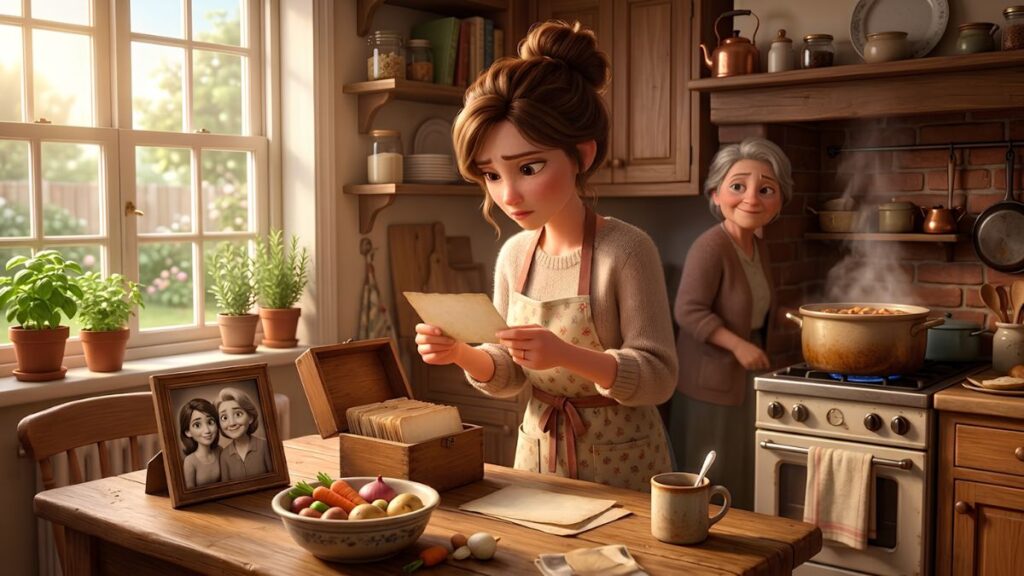
Lily had spent most of Saturday cleaning the kitchen.
She had started with the cupboards, then moved to the drawers, and finally began sorting through a collection of old cooking utensils that had belonged to her mother.
Her mother had always been the heart of the family kitchen.
She cooked without measuring cups, remembered recipes without looking at books, and somehow knew exactly when a dish needed more salt, another spoonful of flour, or a little extra time on the stove.
Lily had never understood how she did it.
“Cooking is mostly about paying attention,” her mother used to say.
Lily would laugh.
“You always say that.”
“And you never listen.”
Her mother would smile and continue cooking.
Now, several years later, Lily was standing alone in the same kitchen.
The house was quiet.
Her mother had moved to a smaller apartment after retiring, and Lily had recently decided to clean and reorganize the old family home before putting it on the market.
As she opened the bottom kitchen drawer, she found an old wooden box.
She recognized it immediately.
It had belonged to her mother.
Lily placed the box on the counter and opened it.
Inside were several handwritten recipes.
Some were written on small pieces of paper.
Others were written on the backs of envelopes, old shopping lists, and even a birthday card.
Lily smiled.
Her mother had never been interested in keeping things perfectly organized.
Then she found a folded piece of paper at the bottom of the box.
She carefully opened it.
The handwriting was immediately familiar.
It was her mother’s.
At the top of the page was a simple title:
Grandmother’s Sunday Stew
Lily read the ingredients.
Beef.
Potatoes.
Carrots.
Onions.
Tomatoes.
Salt.
Pepper.
A few herbs.
Everything looked ordinary.
But underneath the ingredients were several handwritten instructions.
Lily began reading.
“Do not rush the onions.”
She smiled.
That sounded exactly like her mother.
Then she read the next line.
“Let the meat rest before cutting.”
The next instruction was stranger.
“Add one spoonful of water from the kettle when the house becomes too quiet.”
Lily stopped.
She read it again.
“One spoonful of water from the kettle when the house becomes too quiet.”
“What does that mean?”
She laughed to herself.
Her mother had always included unusual instructions in her recipes.
But this one seemed different.
At the bottom of the page was another sentence.
“Serve it on Sunday, when everyone is home.”
Lily looked at the date written in the corner.
It was more than thirty years old.
She sat down at the kitchen table.
For several minutes, she simply stared at the recipe.
Then she remembered something.
When she was a child, her mother used to prepare a large pot of stew every Sunday.
The whole family would sit around the dining table.
Her father would talk about work.
Her brother would complain about vegetables.
Lily would usually try to avoid the carrots.
Her mother would laugh.
Those Sundays had seemed ordinary at the time.
Now they felt precious.
Lily looked at the recipe again.
She decided to make the stew.
A Trip to the Market
The following morning, Lily went to the local market.
She bought everything on the list.
At the vegetable stall, she selected potatoes, carrots, and onions.
At the butcher’s shop, she bought fresh beef.
She also bought a small bunch of herbs.
As she walked home, she wondered about the recipe.
Why had her mother written those strange instructions?
What did the water from the kettle mean?
And why had the recipe been hidden in an old wooden box?
When Lily returned home, she placed the ingredients on the kitchen counter.
She took out the recipe.
She began preparing the onions.
Then she remembered the first instruction.
“Do not rush the onions.”
She smiled.
Her mother had always cooked slowly.
When Lily was younger, she had often complained.
“Why does dinner take so long?”
Her mother would reply:
“Because good things need time.”
Lily had never understood that either.
Now she did.
She placed the onions in the pan and cooked them slowly.
The smell filled the kitchen.
For a moment, Lily felt as though her mother were standing beside her.
The First Mystery
After preparing the meat and vegetables, Lily reached the unusual instruction.
“Add one spoonful of water from the kettle when the house becomes too quiet.”
She looked toward the kettle.
She wasn’t sure what to do.
Was it simply an old cooking trick?
Maybe adding a little hot water prevented the stew from becoming too dry.
But why had her mother written it in such a strange way?
Lily decided to follow the instruction.
She boiled some water.
Then she added one spoonful to the pot.
Nothing unusual happened.
The stew continued cooking.
Lily laughed.
“That’s it?”
She returned to the recipe.
The next line was written in smaller handwriting.
“Your grandmother taught me this when I was sixteen.”
Lily stopped.
She had never heard this story.
Her grandmother had died when Lily was young.
She remembered very little about her.
She knew only that her grandmother had lived in a small village before moving to the city.
Lily continued reading.
“My mother believed food was not only about feeding people. It was about bringing them together.”
Lily felt a lump in her throat.
She read the sentence again.
Her grandmother had apparently taught her mother to make the stew when she was sixteen.
That meant the recipe was much older than Lily had realized.
Perhaps it had been passed down through generations.
The Photograph
While waiting for the stew to cook, Lily opened the wooden box again.
She searched through the papers.
At the bottom, she found an old photograph.
It showed a teenage girl standing beside a woman in front of a small kitchen.
Lily recognized her mother immediately.
She looked about sixteen.
The older woman must have been her grandmother.
Lily turned the photograph over.
There was writing on the back.
Summer, 1972. First stew. Mother says I am finally learning patience.
Lily smiled.
She had never seen the photograph before.
She placed it beside the recipe.
Suddenly, the strange instructions made more sense.
Her mother had not simply written a recipe.
She had written memories into it.
The Family Gathering
That evening, Lily decided to invite her brother and father for dinner.
She called her brother first.
“Are you free tomorrow?”
“For dinner?”
“Yes.”
“What are you cooking?”
“Stew.”
There was silence.
Then her brother laughed.
“Mom’s stew?”
“Exactly.”
“I haven’t had that in years.”
“Come over.”
“I’ll be there.”
Lily called her father afterward.
He sounded surprised.
“You’re making the old recipe?”
“Yes.”
“Your mother hasn’t made that in years.”
“I found the recipe.”
Her father was quiet for a moment.
Then he said:
“She’ll be happy to know you’re making it.”
Lily smiled.
“I hope so.”
Her Mother’s Story
The next afternoon, Lily’s mother came to the house.
Lily had decided not to tell her about the recipe.
She wanted to surprise her.
When her mother entered the kitchen, she immediately smelled the stew.
She stopped.
“What are you cooking?”
Lily smiled.
“Something you used to make.”
Her mother walked toward the stove.
She lifted the lid.
The smell brought a smile to her face.
“I haven’t made this in years.”
“I found your recipe.”
Her mother looked surprised.
“Where?”
“In the wooden box.”
She pointed toward the counter.
Her mother picked up the old recipe.
She read the title.
Then she laughed.
“You still have this?”
“I found it yesterday.”
Her mother shook her head.
“I thought I had lost it.”
Lily pointed to the strange instruction.
“What does this mean?”
Her mother read it.
Then she laughed again.
“Oh, that.”
“Yes. That.”
Her mother sat down.
“When I was young, my mother used to make this stew whenever the family had a difficult week.”
Lily listened.
“She believed that cooking together could make people feel better.”
“What about the water?”
Her mother smiled.
“That was her idea.”
“What did it mean?”
“She used to say that when everyone stopped talking, the kitchen became too quiet.”
Lily waited.
“So she would add a spoonful of water and tell everyone to stay in the kitchen until the conversation started again.”
Lily laughed.
“That was the secret?”
“Yes.”
Her mother smiled.
“She believed silence was sometimes a sign that people were carrying worries they weren’t talking about.”
Lily looked at the recipe.
“That is actually beautiful.”
Her mother nodded.
“She was a wise woman.”
The Real Recipe
Her mother continued telling the story.
“When I was sixteen, your grandmother and I had a difficult year. Your grandfather had lost his job. Money was tight. We argued a lot.”
Lily listened carefully.
“Your grandmother made this stew one Sunday.”
“Just like you did?”
“Yes.”
“What happened?”
“We sat around the table.”
Her mother smiled.
“She asked us to tell each other one good thing that had happened that week.”
“Really?”
“Yes.”
“What did you say?”
Her mother laughed.
“I said I had passed a difficult mathematics test.”
Lily smiled.
“That sounds like you.”
“It does.”
“What did Grandma say?”
“She said she was proud of me.”
Lily became quiet.
Her mother continued.
“That was the first time I understood what the recipe was really for.”
Lily looked at the pot.
“It wasn’t about the stew.”
“No.”
“It was about bringing everyone together.”
“Exactly.”
The Dinner
That evening, Lily’s father and brother arrived.
They sat around the dining table.
Lily served the stew.
Her brother took one bite.
He closed his eyes.
“This tastes exactly like Mom’s.”
Lily smiled.
Her mother looked pleased.
Her father took a spoonful.
He nodded.
“Very good.”
They began talking.
They talked about old family memories.
They laughed about childhood mistakes.
Her brother remembered how he used to hide carrots under his napkin.
Lily remembered how their mother always discovered them.
Her father told stories they had never heard before.
The conversation continued for hours.
At one point, everyone became quiet.
Lily looked at the recipe.
She remembered the strange instruction.
“Add one spoonful of water from the kettle when the house becomes too quiet.”
She smiled.
She stood up.
Her mother watched her.
“What are you doing?”
“Following the recipe.”
Everyone laughed.
Lily went into the kitchen and returned with the kettle.
She added one spoonful of water to the remaining stew.
Her mother laughed.
“I haven’t seen anyone do that in years.”
The Story Behind the Recipe
After dinner, Lily asked her mother one more question.
“Why did you keep this recipe?”
Her mother looked at the old paper.
“Because it reminded me of my mother.”
“Do you ever miss her?”
“Every day.”
Lily reached across the table and held her mother’s hand.
Her mother smiled.
“I suppose every generation thinks they are simply cooking dinner.”
She looked around the table.
“But sometimes they are doing much more.”
Lily nodded.
The recipe had traveled from her grandmother to her mother.
Now it had come to her.
It was not simply a list of ingredients.
It was a record of family history.
A reminder of difficult years.
A lesson about patience.
And a way of bringing people together.
An Old Habit
A few weeks later, Lily was cleaning the kitchen again.
She found the wooden box on a shelf.
Inside were the old recipes.
She carefully placed the stew recipe in a plastic cover to protect it.
Then she added something.
A new note.
She wrote:
Made this with Mom, Dad, and Daniel. We talked for three hours. The stew was good, but the conversation was better.
She placed the note behind the original recipe.
Then she closed the box.
Passing It Forward
Years later, Lily had children of her own.
One Sunday afternoon, her daughter entered the kitchen.
“What are you making?”
“Stew.”
“Can I help?”
Lily smiled.
“Of course.”
She opened the wooden box.
Her daughter looked at the old recipe.
“Whose handwriting is that?”
“Your grandmother’s.”
“She wrote this?”
“Yes.”
“What does this sentence mean?”
Lily smiled.
“It’s a long story.”
Her daughter sat down.
“I want to hear it.”
So Lily told her.
She told her about her mother.
She told her about her grandmother.
She told her about the difficult year in 1972.
She told her about the old kitchen.
She told her about the photograph.
And she told her about the spoonful of water.
Her daughter laughed.
“That’s strange.”
“Maybe.”
“Does it really make the stew taste better?”
Lily smiled.
“No.”
“Then why do it?”
“Because sometimes people need a reason to stay at the table.”
Her daughter thought about that.
Then she smiled.
“I like that.”
Lily handed her the spoon.
“Then help me cook.”
Together, they prepared the stew.
They talked.
They laughed.
They tasted the sauce.
They adjusted the seasoning.
And when the kitchen became quiet, Lily added one spoonful of water.
Not because the recipe required it.
But because she understood what it meant.
The Meaning of Ordinary Things
Years later, the recipe became one of the most valuable things Lily owned.
It was only a piece of paper.
The corners were worn.
The ink had faded.
There were small food stains near the bottom.
But Lily never wanted to replace it with a cleaner copy.
The imperfections were part of its history.
Each mark told a story.
The faded ink belonged to her mother.
The original instructions belonged to her grandmother.
The photograph belonged to another time.
And every time Lily cooked the stew, she added another memory.
She finally understood something her mother had tried to teach her years ago.
Ordinary things could carry extraordinary meaning.
A recipe could contain a family’s history.
A kitchen could become a place where people healed.
A meal could become an opportunity to talk.
And a simple handwritten note could survive long after the person who wrote it was gone.
The recipe had begun with Lily’s grandmother.
It had passed to her mother.
Then it had passed to Lily.
And one day, it would belong to Lily’s daughter.
The ingredients might remain the same.
But the stories would continue to grow.
Because the real recipe had never been about beef, potatoes, carrots, or onions.
It had always been about family.
And the simple decision to sit down together.
Useful Vocabulary
- Recipe
A set of instructions for preparing a particular dish.
Example: Lily found an old recipe written by her mother. - Handwriting
The way someone writes by hand.
Example: Lily immediately recognized her mother’s handwriting. - Ingredient
One of the foods or substances used to make a dish.
Example: The recipe contained several simple ingredients. - Generations
Groups of people born and living around the same time within a family.
Example: The recipe had been passed down through several generations. - Patience
The ability to wait or continue calmly without becoming frustrated.
Example: Lily learned that good cooking required patience. - Tradition
A custom or practice passed from one generation to another.
Example: Sunday dinner became an important family tradition. - Memory
Something remembered from the past.
Example: The recipe brought back many childhood memories. - Ordinary
Normal or not special in appearance or character.
Example: The recipe looked like an ordinary piece of paper. - Precious
Very valuable or important, especially emotionally.
Example: The old photograph was precious to Lily. - Gathering
A meeting or occasion when people come together.
Example: Lily prepared the stew for a family gathering.
Reading Comprehension Questions
- Where did Lily find the old recipe?
- What dish did the recipe describe?
- Who originally taught Lily’s mother how to make the stew?
- What unusual instruction did Lily find in the recipe?
- What did the spoonful of water really represent?
- What did Lily discover about her mother’s childhood?
- Why was the old photograph important?
- Why did Lily invite her family for dinner?
- How did Lily eventually pass the recipe to the next generation?
- What did Lily learn about the true meaning of the recipe?
Discussion Questions
- Do you have a family recipe with a special story behind it?
- Why can food be connected to strong memories?
- Are there traditions in your family that have been passed down through generations?
- Can ordinary objects become emotionally valuable? Why?
- Why is spending time together important for families?
- What object from your childhood would you want to keep forever?
Lesson From the Story
The Recipe in Her Handwriting shows that ordinary objects can hold extraordinary memories. A simple handwritten recipe becomes a connection between three generations of women and reminds Lily that family traditions are often about much more than the activity itself.
The story also highlights the importance of patience, communication, family traditions, and spending time together. The stew is only part of the tradition. The real value comes from the conversations and memories created around the table.
For adults learning English, the story provides practical vocabulary related to food, cooking, family relationships, memories, traditions, emotions, and everyday conversations.
The Empty Seat at the School Play

Noah had been practicing for the school play for almost two months.
The play was called The Secret Garden, and Noah had been given the role of Daniel, one of the main characters.
At first, he had been nervous about performing in front of a large audience.
He had never acted on a stage before.
During the first rehearsal, he had forgotten two lines.
During the second rehearsal, he had spoken too quietly.
By the third rehearsal, however, he had become more confident.
His teacher, Mrs. Carter, often told him:
“You’re doing a wonderful job, Noah. Just speak clearly and don’t be afraid to look at the audience.”
Noah practiced at home every evening.
He stood in front of the mirror and repeated his lines.
Sometimes he practiced while eating breakfast.
Sometimes he whispered his lines before going to sleep.
His mother noticed how seriously he was taking the play.
“You’re really enjoying this, aren’t you?” she asked one evening.
“Yes,” Noah replied.
“Are you nervous?”
“A little.”
“That means it matters to you.”
Noah smiled.
His mother always knew what to say when he was worried.
She had promised that she would attend the performance.
“Of course I’ll be there,” she said.
Noah believed her.
He had already imagined what it would be like to stand on the stage and look into the audience.
He imagined seeing his mother sitting near the front.
He imagined her smiling.
He imagined hearing her clap when the play ended.
That thought made him excited.
The Week Before the Play
The week before the performance was extremely busy.
The students practiced almost every afternoon.
They worked on costumes.
They painted scenery.
They arranged chairs.
They tested the microphones.
Mrs. Carter reminded everyone to stay calm.
“The play doesn’t have to be perfect,” she told them.
“What matters is that you work together and enjoy the experience.”
Noah tried to remember that.
Still, he wanted everything to go well.
On Wednesday afternoon, his mother picked him up from school.
“How was rehearsal?” she asked.
“Good.”
“Did you remember all your lines?”
“All of them.”
“I’m proud of you.”
Noah smiled.
“Are you definitely coming on Friday?”
His mother looked at him.
“Absolutely.”
“What time will you arrive?”
“Before the play starts.”
“Promise?”
She smiled.
“I promise.”
Noah felt relieved.
He had been thinking about the performance constantly.
Now he knew his mother would be there.
Friday Morning
Friday arrived.
Noah woke up earlier than usual.
He immediately remembered the play.
He got dressed quickly and went downstairs.
His mother was already preparing breakfast.
“Good morning, actor.”
Noah laughed.
“Don’t call me that.”
“Why not?”
“It makes me nervous.”
His mother smiled.
“You’ll be great.”
After breakfast, Noah checked his school bag three times.
His costume was packed.
His script was packed.
His shoes were packed.
Everything was ready.
Before leaving the house, his mother hugged him.
“Have a good day.”
“See you tonight.”
“I’ll be there.”
Noah smiled.
“Okay.”
Something Unexpected
At school, everything seemed normal at first.
Students were excited.
Teachers were busy.
Parents were expected to arrive in the evening.
But around lunchtime, Mrs. Carter received a phone call.
She stepped outside the classroom.
When she returned, she looked concerned.
Noah noticed.
“Is everything okay?”
“Yes,” she said.
“Just a small problem.”
Noah didn’t think much about it.
After school, the students stayed behind to prepare.
Noah checked the seats in the auditorium.
He imagined where his mother would sit.
He hoped she would be close enough for him to see her.
Then he noticed Mrs. Carter speaking quietly with another teacher.
Something seemed wrong.
Noah walked over.
“Mrs. Carter?”
She turned.
“Yes?”
“Is everything okay?”
“Yes, Noah.”
She paused.
“Your mother called the school.”
Noah’s smile disappeared.
“Why?”
“She won’t be able to arrive on time.”
“What?”
“She had an unexpected problem at work.”
Noah stared at her.
“But she promised.”
“I know.”
“Is she still coming?”
Mrs. Carter hesitated.
“She is trying to.”
Noah looked toward the auditorium.
He imagined the empty chair where his mother should have been.
“She’ll come,” he said.
Mrs. Carter nodded.
“I’m sure she will try her best.”
But Noah was upset.
He had spent weeks imagining his mother watching him.
Now he wasn’t sure.
The Performance Begins
At 6:30, the auditorium began filling with people.
Parents entered.
Grandparents found their seats.
Children talked excitedly.
Teachers checked the lights.
Noah stood backstage wearing his costume.
He felt nervous.
Then he looked toward the audience.
He searched for his mother.
He couldn’t see her.
The lights dimmed.
The audience became quiet.
The curtain opened.
The play began.
Noah’s first scene went well.
He remembered every line.
His second scene went even better.
He heard the audience laughing at one of his jokes.
For a moment, he forgot that his mother wasn’t there.
Then he looked toward the audience again.
There was an empty seat near the front.
It was the seat he had imagined his mother sitting in.
His confidence disappeared.
He missed one line.
Another actor quietly reminded him.
Noah continued.
But his mind was somewhere else.
Why wasn’t she there?
Didn’t she understand how important this was?
Had work really been more important than him?
He became angry.
After the Play
The play ended after nearly an hour.
The audience applauded.
The students bowed.
Noah smiled because everyone else was smiling.
But inside, he felt disappointed.
Backstage, parents began meeting their children.
Noah watched as his classmates hugged their families.
One father gave his daughter flowers.
A grandmother took photographs of her grandson.
Noah stood alone.
Mrs. Carter approached him.
“You did very well.”
“Thanks.”
“Your mother called again.”
Noah looked away.
“I don’t want to talk about it.”
“She was very worried.”
“I don’t care.”
Mrs. Carter knew he was upset.
“Sometimes adults have problems they can’t explain immediately.”
Noah didn’t answer.
A few minutes later, his mother arrived.
She looked tired.
Her hair was messy.
She was still wearing her work clothes.
“Noah.”
He turned around.
She smiled.
“I made it.”
Noah looked at her.
“You missed the whole thing.”
“I know.”
“You promised.”
“I know.”
“You said you’d be there.”
His mother took a breath.
“I tried.”
“You always say that.”
Noah picked up his bag.
“I don’t want to talk.”
He walked away.
His mother didn’t stop him.
The Silent Ride Home
The car ride home was quiet.
Usually, Noah talked about school.
That night, he stared out the window.
His mother drove silently.
After several minutes, she said:
“I know you’re disappointed.”
Noah didn’t answer.
“I wanted to be there.”
“You weren’t.”
“I know.”
“Everyone else’s parents were there.”
His mother looked at him through the mirror.
“I know.”
“You said it was important.”
“It is important.”
“Then why didn’t you come?”
His mother was silent for a moment.
“Because something happened at work.”
“What happened?”
“I can’t explain everything right now.”
Noah felt angry.
“You could have tried harder.”
His mother looked hurt.
“I did try.”
Noah crossed his arms.
“I don’t believe you.”
She didn’t argue.
She simply continued driving.
The Next Morning
Noah woke up still angry.
He avoided his mother during breakfast.
She didn’t force him to talk.
Instead, she placed a plate on the table.
“There’s breakfast.”
Noah nodded.
Before leaving for work, she said:
“I’ll see you tonight.”
Noah didn’t answer.
At school, Mrs. Carter asked him how he was feeling.
“Fine.”
“You’re still upset.”
“Yes.”
“That’s understandable.”
Noah looked at her.
“Did my mother really call you?”
“Yes.”
“What did she say?”
“She said she was trying to get there.”
Noah looked down.
“She sounded very worried.”
That made him think.
If his mother didn’t care, why would she have called the school?
Something He Didn’t Know
That afternoon, Noah’s father called him.
His parents had separated several years earlier, but they remained in contact.
“Your mother told me about the play.”
Noah was quiet.
“She said she missed it.”
“She did.”
“She feels terrible.”
“She should.”
His father paused.
“Noah, there’s something you should know.”
“What?”
“Your mother had a serious problem at work.”
“What kind of problem?”
“One of her coworkers became sick suddenly.”
Noah listened.
“Your mother stayed because she was the only person who knew how to handle the situation.”
“Oh.”
“She tried to leave.”
“Then why didn’t she?”
“Because she couldn’t.”
Noah felt uncomfortable.
He had assumed his mother had simply chosen work.
He hadn’t considered that she might have been unable to leave.
His father continued.
“She called me after the play.”
“What did she say?”
“She said she wished she could turn back time.”
Noah became quiet.
The Envelope
That evening, Noah’s mother came home with a small envelope.
She placed it on the table.
“I brought something for you.”
Noah opened it.
Inside was a photograph.
It showed the school auditorium.
Noah was standing on the stage.
The photograph had been taken during the final scene.
He looked surprised.
“You took this?”
“No.”
“Then who did?”
His mother smiled.
“I couldn’t be there in person.”
She paused.
“But I still wanted to see you.”
Noah looked confused.
“I asked your teacher if she could record the play.”
“You watched it?”
“Yes.”
“When?”
“Last night.”
Noah stared at her.
His mother had watched the entire performance on her phone after getting home.
“I saw your first scene.”
“You did?”
“I saw when you forgot your line.”
Noah laughed despite himself.
“I didn’t forget it.”
“You paused.”
“I was thinking.”
His mother smiled.
“I know.”
Noah looked at the photograph.
“You really watched?”
“Every minute.”
The Truth
Noah sat down.
“Why didn’t you tell me?”
“I didn’t want you to worry before the performance.”
“But I thought you didn’t care.”
His mother’s expression changed.
“That hurt.”
Noah looked down.
“I’m sorry.”
She sat beside him.
“I wanted to be there more than anything.”
“What happened at work?”
She explained what had happened.
One of her coworkers had suddenly become seriously ill during the afternoon.
There was nobody else available to handle an important situation.
She had tried to leave several times, but each time another problem appeared.
She called the school because she wanted Noah to know she was trying.
“I was afraid you would think I had forgotten.”
“I did think that.”
“I know.”
She put her hand on his shoulder.
“But I never forgot.”
Noah felt tears in his eyes.
“I was really angry.”
“You had every right to be disappointed.”
“I said you didn’t care.”
“I know.”
“I’m sorry.”
His mother hugged him.
“You don’t have to apologize for being hurt.”
Noah hugged her back.
The Empty Seat
The next morning, Noah looked at the photograph again.
He remembered the empty seat.
For the first time, he thought about it differently.
The seat had been empty.
But that didn’t mean his mother had been absent from his life.
She had listened to him practice.
She had helped him memorize his lines.
She had packed his costume.
She had promised to come.
She had called the school.
And even when she couldn’t physically be there, she had watched the performance afterward.
Noah realized that he had judged her based on one evening.
He had forgotten everything she had done before it.
A Second Performance
A week later, the school announced that the students would perform the play again at a community center.
This time, Noah’s mother arrived early.
She found a seat near the front.
When Noah walked onto the stage, he saw her immediately.
She smiled.
He smiled back.
The play began.
Noah spoke every line clearly.
He wasn’t nervous.
During the final scene, he looked toward his mother.
She was watching him proudly.
When the curtain closed, the audience applauded.
His mother stood up.
She clapped louder than anyone.
Backstage, Noah ran toward her.
“You came!”
“I promised.”
He hugged her.
“I know.”
What Noah Learned
On the way home, Noah talked about the second performance.
He told his mother about everything that had happened during rehearsals.
She listened.
Then Noah said:
“I learned something.”
“What?”
“Sometimes you think you know why someone did something.”
His mother smiled.
“But you don’t know the whole story.”
“Exactly.”
He looked out the window.
“I shouldn’t have decided that you didn’t care.”
His mother reached over and squeezed his hand.
“Sometimes we all make that mistake.”
Noah smiled.
Years Later
Years passed.
Noah eventually graduated from school.
He went to college.
He started working.
He became busy.
But he never forgot the school play.
One day, while cleaning an old box, he found the photograph his mother had given him.
He looked at it for a long time.
He remembered being angry.
He remembered the empty seat.
He remembered believing that his mother had chosen work over him.
Now he understood the situation differently.
He realized that love was not always visible.
Sometimes it looked like a parent sitting in the audience.
Sometimes it looked like a packed lunch.
Sometimes it looked like a phone call.
Sometimes it looked like staying late at work because another person needed help.
And sometimes it looked like watching a school play alone on a phone because you couldn’t physically be there.
Noah smiled.
He placed the photograph back in the box.
Then he called his mother.
“Hi, Mom.”
“Hi, Noah.”
“What are you doing?”
“Nothing. Why?”
“I just wanted to talk.”
His mother smiled.
“I’m glad you called.”
They talked for nearly an hour.
There was no special reason.
No emergency.
No important news.
Just a simple conversation.
And Noah realized that sometimes the smallest conversations were the ones people remembered most.
Useful Vocabulary
- Performance
An event in which people act, sing, dance, or present something to an audience.
Example: Noah was excited about his school performance. - Audience
The people watching or listening to a performance.
Example: The audience applauded when the play ended. - Rehearsal
A practice before a performance.
Example: Noah attended rehearsals for several weeks. - Disappointed
Feeling unhappy because something did not happen as expected.
Example: Noah was disappointed when his mother missed the play. - Promise
A statement that someone will definitely do something.
Example: Noah’s mother promised that she would attend. - Unexpected
Something that happens without being planned or predicted.
Example: His mother had an unexpected problem at work. - Misunderstanding
A situation in which someone understands something incorrectly.
Example: Noah’s anger was caused by a misunderstanding. - Support
Help or encouragement given to someone.
Example: Noah’s mother continued to support him. - Absent
Not present in a particular place.
Example: Noah thought his mother was absent from his important moment. - Appreciate
To recognize the value or importance of someone or something.
Example: Noah learned to appreciate the support his mother had always given him.
Reading Comprehension Questions
- What role did Noah have in the school play?
- Why was the performance important to Noah?
- What did Noah’s mother promise?
- Why couldn’t she arrive at the beginning of the play?
- How did Noah feel when he saw the empty seat?
- Why did Noah become angry with his mother?
- What did Noah discover about what had happened at her workplace?
- How had his mother supported him even though she missed the performance?
- What happened when the school performed the play again?
- What important lesson did Noah learn?
Discussion Questions
- Have you ever been disappointed because someone could not attend an important event?
- Why is it sometimes dangerous to assume why another person did something?
- How can parents show support even when they cannot physically be present?
- Have you ever misunderstood someone’s actions?
- Why is communication important when there is a misunderstanding?
- What are some small ways families can show love and support?
Lesson From the Story
The Empty Seat at the School Play shows how easily disappointment can turn into misunderstanding. Noah initially believes that his mother does not care because she misses his performance. Later, he discovers that she was dealing with an unexpected problem and had still made every effort to support him.
The story reminds readers that love is not always shown in the way we expect. Before judging someone’s actions, it is important to understand the circumstances and communicate openly.
For adults learning English, the story provides practical vocabulary and expressions related to family relationships, school activities, emotions, communication, disappointment, misunderstanding, work, and emotional support.
The Garden Behind the House

Clara had not visited her childhood home in almost three years.
The house stood at the end of a quiet road, surrounded by tall trees and small fields that looked different in every season. When she was a child, the house had seemed enormous. The hallway had felt long, the ceilings impossibly high, and the garden behind the house had seemed like an entire world.
Now, standing outside the familiar front door, Clara realized how small everything looked.
The windows were still the same.
The old wooden steps were still slightly uneven.
The front gate still made the same squeaking sound when she pushed it open.
But her mother was no longer there.
Clara stood quietly for a moment before taking out her keys.
She had come back because she needed to prepare the house for sale.
It was not an easy decision.
After her mother’s death, Clara had avoided thinking about what would happen to the house. She had returned for the funeral, stayed for several days, and then gone back to the city.
She had packed some important belongings.
She had closed the curtains.
She had locked the doors.
Then she had left.
She had told herself that she would return when she was ready.
Three years had passed.
Now the house needed repairs, and Clara had finally decided that she could not leave it empty forever.
She unlocked the door and stepped inside.
The smell immediately brought back memories.
Old wooden furniture.
Books.
Her mother’s lavender soap.
The faint smell of dust from rooms that had not been used for a long time.
Clara closed her eyes.
For a moment, she could almost hear her mother moving around in the kitchen.
“Clara, breakfast is ready.”
The memory was so clear that Clara opened her eyes quickly.
The house was silent.
She placed her bag on the table.
“I miss you, Mom,” she whispered.
No one answered.
The Old Garden
The following morning, Clara began walking through the house and making a list of things that needed to be repaired.
The roof needed attention.
Several windows were damaged.
The kitchen cabinets were old.
There were boxes in almost every room.
By the afternoon, she decided to take a break.
She walked toward the back door.
When she opened it, she stopped.
Behind the house was the garden.
Or what remained of it.
When Clara was a child, the garden had been full of life.
There had been roses near the fence.
Tomatoes grew beside the small wooden shed.
Her mother had planted lavender along the path.
There had been sunflowers in summer.
Clara remembered sitting under an apple tree and reading books while her mother worked nearby.
Now the garden looked completely different.
The grass had grown wild.
Weeds covered most of the flower beds.
The old wooden fence was beginning to fall apart.
The rose bushes were dry and tangled.
The path was almost impossible to see.
Clara walked slowly through the garden.
She remembered how carefully her mother had once taken care of every plant.
Her mother had never been wealthy.
She had worked long hours and had always been careful with money.
But she had loved the garden.
“Plants teach you something,” her mother used to say.
Clara had never understood what she meant.
When she was young, she simply wanted to play.
She remembered one summer when she had asked:
“Why don’t you just buy bigger plants?”
Her mother had laughed.
“Because growing takes time.”
Clara had rolled her eyes.
“I don’t want to wait.”
“You will learn.”
At the time, Clara had thought her mother was talking only about plants.
Now, standing in the neglected garden, she wondered if there had been something more behind those words.
A Small Beginning
Clara found an old pair of gardening gloves inside the shed.
They were dusty and cracked, but she recognized them immediately.
They had belonged to her mother.
Clara put them on.
She looked at the garden.
There was too much work to do.
For a moment, she thought about leaving it alone.
The garden was not part of the house she needed to repair.
Nobody had asked her to restore it.
She could simply leave it as it was.
But something made her stay.
She picked up a small garden tool.
Then she pulled out the first weed.
It came out easily.
She smiled.
“One plant,” she said.
Then she pulled out another.
And another.
After an hour, she had cleared only a small area.
Her back hurt.
Her hands were dirty.
She was tired.
But the small patch of soil looked better.
Clara sat on the ground and looked at it.
She remembered her mother saying:
“You don’t have to finish everything today.”
Clara smiled.
That sounded exactly like something her mother would have said.
The next morning, Clara returned to the garden.
She cleared another section.
Then another.
She repaired part of the fence.
She removed dead branches from the rose bushes.
She swept the old path.
Every day, she worked for a few hours.
The garden slowly began to change.
But something else was changing too.
Clara was remembering.
The Apple Tree
Near the center of the garden stood an old apple tree.
It had been there for as long as Clara could remember.
When she was six years old, her mother had helped her plant a small tree near the back fence.
“This one will take a long time to grow,” her mother had said.
“How long?”
“Several years.”
Clara had looked disappointed.
“That’s too long.”
Her mother smiled.
“You won’t notice the time passing.”
Clara had watered the tree every morning that summer.
She had placed small stones around it.
She had even talked to it.
Her mother had laughed whenever she saw her.
“You’re making friends with the tree?”
“Yes.”
“Then you should probably be polite.”
Clara had nodded seriously.
Years passed.
The tree grew.
Eventually, it became large enough to provide shade.
By the time Clara was a teenager, she rarely thought about the little tree she had planted.
She was busy with school.
Then university.
Then work.
Life became complicated.
She moved to another city.
She visited home less often.
But her mother continued taking care of the garden.
Now Clara stood beneath the old apple tree.
She placed one hand against its trunk.
“I guess you grew up after all,” she said.
The tree, of course, said nothing.
But Clara smiled.
A Forgotten Notebook
While cleaning the garden shed, Clara found a small wooden box.
Inside were several old gardening tools and a notebook.
She recognized the notebook.
It had belonged to her mother.
Clara sat on an old chair and opened it.
The first pages contained notes about plants.
When to plant tomatoes.
How often to water roses.
Which flowers needed sunlight.
Which vegetables grew best in certain seasons.
Clara turned the pages.
Then she found something unexpected.
There were short notes about Clara.
“Clara planted her first sunflower today.”
Clara smiled.
She continued reading.
“Clara is angry because the sunflower hasn’t grown yet.”
Another page said:
“She checked the soil three times today.”
Clara laughed softly.
She could remember doing that.
The next page said:
“Clara says the sunflower is too slow.”
Clara turned another page.
Her mother had written:
“I told her that some things cannot be rushed.”
Clara stopped.
She read the sentence again.
Some things cannot be rushed.
She continued turning the pages.
There were notes from different years.
“Clara is studying very hard.”
“She received her university acceptance letter today.”
“She called me from the city. She sounded nervous.”
“She has started her first job.”
“She says she is too busy to come home this weekend.”
Clara’s eyes filled with tears.
She kept reading.
“She sounded tired today.”
“I wish she would remember that she doesn’t always have to do everything alone.”
Clara closed the notebook.
She held it against her chest.
For the first time in years, she allowed herself to cry.
The Things Her Mother Had Taught Her
Over the next few days, Clara continued restoring the garden.
She planted new flowers.
She repaired the flower beds.
She cleaned the old pots.
She watered the plants every morning.
As she worked, she remembered things her mother had taught her.
Her mother had taught her how to plant seeds.
How to recognize healthy leaves.
How to protect young plants from strong winds.
How to wait.
Clara had never thought of these things as important lessons.
They had simply been ordinary moments from childhood.
But now she understood.
Her mother had taught her patience without giving her a lecture about patience.
She had taught her responsibility by giving her a small garden to care for.
She had taught her that growth was not always visible.
Sometimes a seed remained underground for weeks.
Nothing seemed to happen.
But beneath the soil, something was changing.
Clara thought about her own life.
She had often felt frustrated when progress was slow.
She had wanted quick answers.
Quick success.
Quick solutions.
She had become impatient with herself.
Maybe her mother had understood something Clara had forgotten.
Not everything important happened quickly.
A Conversation From the Past
One evening, Clara sat beneath the apple tree.
The sun was setting.
The garden looked peaceful.
She remembered one particular conversation from many years earlier.
She had been twenty-two.
She had just finished university and was trying to decide what to do next.
“I don’t know what I’m doing,” Clara had told her mother.
Her mother had been planting flowers.
“You don’t have to know everything.”
“But everyone else seems to know what they want.”
“Do they?”
Clara had sighed.
“I feel like I’m behind.”
Her mother had put down her gardening tool.
“Clara, look at this plant.”
She had pointed toward a small green plant.
“Do you think it worries about whether the plant next to it is growing faster?”
Clara had laughed.
“Plants don’t think like that.”
“Exactly.”
Her mother had smiled.
“Then don’t spend your life comparing your growth with someone else’s.”
At the time, Clara had thought the advice was simple.
Now she understood how valuable it had been.
The Garden Returns
By the end of the second week, the garden looked completely different.
It was not perfect.
Some areas were still overgrown.
The fence still needed repairs.
But flowers had begun to appear.
The roses had been carefully trimmed.
The path was visible again.
The lavender was growing.
The apple tree stood proudly in the center.
Clara took a photograph.
She wanted to remember the moment.
Then she noticed something near the back of the garden.
A small wooden sign was partly covered by weeds.
She pulled the weeds away.
The sign read:
“Things grow when you care for them.”
Clara stared at it.
She remembered the sign.
Her mother had made it years ago.
Clara had completely forgotten.
She touched the words with her fingers.
Then she smiled.
“I remember now.”
A Visit From an Old Friend
One afternoon, Clara’s childhood friend Sarah came to visit.
Sarah had lived in the same town all her life.
They walked through the garden together.
“It looks amazing,” Sarah said.
“It still needs work.”
“Your mother would be proud.”
Clara smiled.
“I think she would.”
Sarah looked at the flowers.
“She loved this garden.”
“I know.”
“You used to spend hours here.”
“I remember.”
Sarah smiled.
“You were always impatient.”
Clara laughed.
“I still am.”
“No, you’re different now.”
“How?”
Sarah looked around.
“You stayed.”
Clara thought about that.
She had almost left the garden untouched.
She had almost walked away from the house because the memories were too painful.
But she had stayed.
She had planted flowers.
She had repaired the fence.
She had allowed herself to remember.
Maybe healing was like gardening.
You could not force it.
You could only care for it little by little.
The Decision
After several weeks, Clara finished preparing the house.
A real estate agent came to inspect the property.
The house was ready to be sold.
But when the agent asked about the garden, Clara hesitated.
“Would you like to keep it?”
Clara looked through the back window.
The garden was full of flowers.
“No,” she said.
The agent looked surprised.
“No?”
“I don’t think I want to sell the house anymore.”
She had spent weeks thinking about it.
The house was more than a building.
The garden was more than a collection of plants.
It was where she had grown up.
It was where her mother had spent countless mornings.
It was where Clara had learned some of the most important lessons of her life.
She didn’t need to live there permanently.
But she didn’t want to erase it from her life.
So she decided to keep the house.
She would visit when she could.
She would take care of the garden.
She would continue what her mother had started.
A New Season
Months later, Clara returned to the house in spring.
The garden had changed again.
New flowers had appeared.
The apple tree had produced small blossoms.
The roses were beginning to grow.
Clara walked along the path with a watering can.
She stopped beside a small flower that had only recently opened.
She remembered her mother.
“Look at this,” she whispered.
She wished her mother could see it.
But then Clara realized something.
Her mother had already given her the ability to see it.
She had taught Clara to notice small things.
To appreciate slow growth.
To care for something even when the result was not immediate.
To understand that love was often expressed through ordinary actions.
A meal prepared in the kitchen.
A repaired bicycle.
A carefully planted seed.
A cup of tea.
A quiet conversation.
A garden watered every morning.
Clara sat beneath the apple tree.
The afternoon sun warmed her face.
She opened her mother’s old notebook.
On the final page, there was a short sentence.
Clara had not noticed it before.
It said:
“Whatever happens, keep growing.”
Clara read it twice.
Then she smiled.
She closed the notebook.
The garden was quiet around her.
But it no longer felt empty.
Her mother was gone.
Clara knew that.
She would always miss her.
But grief had changed.
It was no longer only a painful absence.
It had become something softer.
A collection of memories.
A voice in her mind.
A lesson remembered at the right moment.
A garden that continued to grow.
Clara stood up and picked up the watering can.
There was still work to do.
There always was.
A few weeds needed to be removed.
Some flowers needed water.
The fence needed another repair.
Clara smiled.
She knew her mother would have approved.
She walked slowly down the garden path.
One step at a time.
Just as her mother had taught her.
Useful Vocabulary
- Neglected
Not given enough care or attention.Example: The garden had become neglected after Clara’s mother died. - Restore
To repair something and bring it back to a good condition.Example: Clara decided to restore the old garden. - Patience
The ability to wait calmly without becoming frustrated.Example: Her mother taught Clara the importance of patience. - Resilience
The ability to recover from difficulties and continue moving forward.Example: Clara showed resilience while dealing with her grief. - Grief
Deep sadness caused by the loss of someone or something important.Example: Clara was still experiencing grief after her mother’s death. - Influence
The effect that someone or something has on another person.Example: Clara realized how much her mother had influenced her life. - Blossom
A flower that appears on a tree or plant.Example: The apple tree began to produce blossoms in spring. - Neglect
To fail to give something the care or attention it needs.Example: The garden had been neglected for several years. - Growth
The process of becoming larger, stronger, or more developed.Example: Clara learned that personal growth takes time. - Healing
The process of becoming emotionally or physically stronger after pain or difficulty.Example: Restoring the garden became part of Clara’s emotional healing.
Reading Comprehension Questions
- Why did Clara return to her childhood home?
- What had happened to the garden while Clara was away?
- What did Clara find inside the garden shed?
- Why was the old apple tree important to Clara?
- What did Clara discover in her mother’s notebook?
- What lesson had Clara’s mother taught her about plants?
- Why did Clara begin to understand the importance of patience?
- How did restoring the garden affect Clara emotionally?
- Why did Clara decide not to sell the house?
- What did her mother’s final message, “Whatever happens, keep growing,” mean to Clara?
Discussion Questions
- Have you ever had a place that reminded you strongly of someone you love?
- Why can ordinary objects bring back powerful memories?
- Do you think gardening can teach people patience? Why?
- How can people deal with grief in healthy ways?
- What lessons have you learned from your parents or grandparents?
- Why is it sometimes difficult to appreciate someone’s efforts until they are gone?
- Can a person’s influence continue even after they are no longer alive?
- What does “keep growing” mean in your own life?
Lesson From the Story
The Garden Behind the House shows that a mother’s influence can remain long after she is gone. Clara initially returns home because she needs to deal with the property, but restoring the neglected garden helps her reconnect with her childhood memories and understand the lessons her mother quietly taught her.
Her mother never needed long speeches to teach patience, resilience, or responsibility. She taught these values through everyday actions: planting seeds, caring for flowers, waiting for plants to grow, and encouraging Clara when life felt uncertain.
The garden becomes a symbol of Clara’s healing. Just as plants need time, care, and patience to grow, people also need time to recover from difficult experiences.
For adults learning English, the story provides practical vocabulary and expressions related to family, memories, grief, gardening, personal growth, patience, emotions, and relationships.
The Phone Call at Midnight

Michael had always been close to his mother.
When he was a child, she was the person he went to whenever he was worried, excited, confused, or simply wanted someone to talk to.
As he grew older, however, life became busy.
After finishing university, Michael moved to another city for work. His new job demanded long hours, frequent meetings, and occasional business trips. At first, he called his mother every evening.
Then the calls became less frequent.
Once a week became twice a month.
Sometimes several weeks passed before they spoke.
His mother never complained.
Whenever Michael called, she simply asked about his work, his health, and whether he was eating properly.
“I’m fine, Mom,” Michael would usually say.
“Are you getting enough sleep?”
“Yes.”
“Are you eating well?”
“Yes.”
“Good.”
Their conversations rarely lasted more than a few minutes.
Michael always had another meeting, another email, or another task waiting.
“I’ll call you this weekend,” he would promise.
Sometimes he did.
Sometimes he forgot.
A Busy Life
Michael worked for a growing technology company.
His career was going well.
He had recently been promoted to a management position, and his responsibilities had increased.
His apartment was comfortable.
He had good friends.
He traveled for work.
From the outside, everything seemed perfect.
But his schedule was always full.
His phone was constantly filled with notifications.
Emails arrived early in the morning.
Messages continued late into the evening.
Even during weekends, he often checked his work phone.
His mother lived several hours away in the small town where Michael had grown up.
She still lived in the same house.
The same kitchen.
The same garden.
The same bedroom Michael had used as a child.
Whenever Michael visited, she always seemed surprised by how quickly he had grown up.
“You’re getting thinner,” she would say.
“I’m not.”
“You are.”
“Mom, I eat.”
“You eat when you’re here.”
Michael would laugh.
She would smile.
Those moments were simple.
But Michael rarely noticed how valuable they were.
The Missed Calls
One Friday evening, Michael was sitting at his desk.
It was almost 10:00 p.m.
He had planned to leave work two hours earlier.
His phone vibrated.
It was his mother.
Michael looked at the screen.
He was tired.
He had several unfinished emails.
He let the call ring.
A few seconds later, the screen went dark.
Michael returned to his work.
A minute later, his phone vibrated again.
His mother was calling.
He sighed.
“Something must be wrong.”
He answered.
“Hi, Mom.”
“Michael?”
“Yes.”
“Are you busy?”
“I’m working.”
“Oh. I’m sorry.”
“It’s okay. What’s wrong?”
“Nothing is wrong.”
Michael looked at his computer.
“I have a lot of work tonight.”
“I understand.”
There was a short silence.
“I just wanted to hear your voice,” his mother said.
Michael stopped typing.
For a moment, he didn’t know what to say.
“You could have called tomorrow,” he said.
“I know.”
Another silence followed.
“How was your day?” she asked.
“Busy.”
“You’re always busy.”
Michael smiled.
“That’s work.”
They talked for a few minutes.
His mother told him about a neighbor who had adopted a dog.
Michael told her about an important meeting he had that morning.
Then he said:
“Mom, I really need to finish this.”
“Of course.”
“Let’s talk this weekend.”
“All right.”
“Good night.”
“Good night, Michael.”
The call ended.
Michael looked at his phone.
He felt slightly guilty.
But after a few seconds, he returned to his computer.
Saturday Morning
The next morning, Michael woke up late.
He had slept for only five hours.
His phone showed several work messages.
He spent most of the morning answering them.
Around noon, he remembered his promise.
“I should call Mom.”
He picked up his phone.
Before he could call, another message arrived.
A colleague needed his help.
Michael put the phone down.
“I’ll call her later.”
Later became evening.
Evening became night.
By midnight, Michael was still awake.
He was sitting on his sofa, watching television without really paying attention.
His phone rang.
The screen showed his mother’s name.
12:03 a.m.
Michael immediately sat up.
His mother never called this late.
Something must be wrong.
He answered quickly.
“Mom?”
“Michael?”
Her voice sounded calm.
“Are you okay?”
“Yes.”
“What’s wrong?”
“Nothing is wrong.”
Michael frowned.
“Then why are you calling me at midnight?”
His mother laughed softly.
“I couldn’t sleep.”
Michael relaxed.
“You scared me.”
“I’m sorry.”
“Is everything really okay?”
“Yes.”
There was a short pause.
Then his mother said:
“I was looking through some old photographs.”
Michael smiled.
“Which photographs?”
“The ones from when you were a child.”
“Oh.”
“I found one of you on your bicycle.”
Michael laughed.
“I remember that bicycle.”
“You fell off it every other day.”
“I did not.”
“You did.”
“I was learning.”
“You were very determined.”
Michael smiled.
He could almost see the old bicycle.
It had been red.
The paint had been scratched.
One of the handles was slightly loose.
His mother had bought it for him when he was eight.
He had wanted to learn how to ride immediately.
“I remember you holding the back of the seat,” he said.
“I did.”
“You told me not to look down.”
“And you didn’t listen.”
“I was nervous.”
“You were terrified.”
Michael laughed.
His mother laughed too.
For a few moments, they were both quiet.
Then his mother said:
“I remember that day very clearly.”
“So do I.”
“You kept falling.”
“I eventually learned.”
“Yes.”
“You were patient with me.”
“I had to be.”
Michael smiled.
“Thank you.”
“For what?”
“For teaching me.”
His mother didn’t answer immediately.
Then she said:
“You were always going to learn.”
An Unexpected Conversation
The conversation continued.
For the first time in months, neither of them seemed interested in ending the call.
His mother told him about the old photographs she had found.
There was one from his first day of school.
Another from his tenth birthday.
Another from a family holiday.
Michael remembered some of them.
Others had almost disappeared from his memory.
“Do you remember the blue sweater you wore in this one?” his mother asked.
“No.”
“You refused to wear anything else that winter.”
Michael laughed.
“I probably thought I looked good.”
“You did.”
“Really?”
“You always looked good to me.”
Michael became quiet.
His mother’s voice sounded warm and familiar.
He suddenly realized how much he had missed these conversations.
Not important conversations.
Not conversations about money, work, or problems.
Just ordinary conversations.
They talked about the weather.
They talked about food.
They talked about the garden.
His mother complained about a broken kitchen drawer.
Michael told her about a restaurant he had discovered.
She asked whether he was still planning to take a vacation.
He said he wasn’t sure.
“You should take one,” she said.
“I will.”
“You always say that.”
“I mean it this time.”
“Good.”
They laughed.
When Michael looked at the clock, it was almost 1:00 a.m.
They had been talking for nearly an hour.
The Question
Before ending the call, Michael asked:
“Mom?”
“Yes?”
“Why did you really call tonight?”
His mother was quiet.
“I told you. I couldn’t sleep.”
“I know.”
Another pause.
“Sometimes,” she said, “I just miss talking to you.”
Michael looked down.
He felt something tighten in his chest.
“I miss talking to you too.”
“I know you’re busy.”
“I’m sorry.”
“You don’t have to apologize.”
“I should call more often.”
His mother smiled through the phone.
“I’d like that.”
“I mean it.”
“I know.”
They said good night.
This time, Michael didn’t immediately put his phone down.
He sat quietly for several minutes.
The apartment was silent.
He thought about his mother sitting alone in her house, looking through old photographs.
He thought about all the times she had called and he had said he was too busy.
He thought about all the conversations he had postponed.
He realized something uncomfortable.
He had been treating time with his mother as if there would always be more of it.
Sunday Visit
The next morning, Michael woke up with an idea.
He checked his work schedule.
Then he booked a train ticket.
His mother lived several hours away.
It wasn’t an easy trip, but it was possible.
He packed a small bag and left.
When he arrived at his mother’s house, she opened the door.
She looked surprised.
“What are you doing here?”
“I came to visit.”
“Today?”
“Yes.”
“You didn’t tell me.”
“I wanted to surprise you.”
She smiled.
“I suppose you did.”
Michael hugged her.
She held him tightly.
“You look tired.”
“I am.”
“You’re working too much.”
“I know.”
She stepped aside.
“Come inside.”
The house looked exactly as he remembered.
The old clock was still on the wall.
Family photographs covered the hallway.
The kitchen table had the same wooden surface.
Michael sat down.
His mother brought him tea.
“You don’t have to do that,” he said.
“I know.”
She smiled.
“You’re still my son.”
Michael smiled back.
An Ordinary Afternoon
They spent the afternoon doing almost nothing.
They cooked lunch.
They washed dishes.
They looked through old photographs.
They talked about neighbors.
They talked about family.
They talked about things that didn’t matter.
And somehow, those conversations mattered more than anything.
At one point, Michael noticed an old photograph on the table.
It showed him as a child, standing beside his mother.
He picked it up.
“I don’t remember this.”
“You were six.”
“What were we doing?”
“We were waiting for your father.”
Michael looked at the photograph.
His mother was smiling.
He was holding her hand.
“Why do you keep all these photographs?”
She looked at him.
“Because memories disappear if you don’t keep them.”
Michael thought about that sentence.
Memories disappear.
Time disappears too.
A Change in Routine
After that weekend, Michael made a small change.
He didn’t quit his job.
He didn’t suddenly become free every evening.
His life remained busy.
But he started calling his mother regularly.
Sometimes he called on his way home from work.
Sometimes he called during his lunch break.
Sometimes they talked for five minutes.
Sometimes they talked for an hour.
There was no strict schedule.
The important thing was that he called.
His mother began expecting the calls.
One Tuesday evening, she answered.
“Hi, Michael.”
“Hi, Mom.”
“You’re early.”
“Early?”
“You usually call later.”
Michael laughed.
“I wanted to talk to you.”
“What happened?”
“Nothing.”
“Are you sure?”
“Yes.”
“Then you really are becoming responsible.”
Michael laughed.
They talked about dinner.
His mother had made soup.
Michael had ordered noodles.
She complained that he should cook more.
He promised he would.
She didn’t believe him.
They laughed.
It was an ordinary conversation.
But Michael no longer considered ordinary conversations unimportant.
Years Later
Years passed.
Michael changed jobs.
He moved to a larger apartment.
His career continued to grow.
His life became even busier.
But one habit remained.
He called his mother.
Sometimes every day.
Sometimes every few days.
Whenever he was traveling, he called.
Whenever something important happened, she was one of the first people he told.
And whenever she had something to share, he listened.
One evening, many years after that midnight call, Michael found himself sitting alone in his apartment.
He looked at his phone.
He smiled.
He remembered the night his mother had called at 12:03 a.m.
At the time, he had thought something was wrong.
Nothing had been wrong.
His mother had simply wanted to hear his voice.
That realization had changed his life.
The Midnight Call
Michael never forgot that phone call.
It had reminded him that love did not always arrive through dramatic events.
Sometimes it appeared in a simple question.
“How was your day?”
Sometimes it sounded like:
“Are you eating properly?”
Sometimes it was:
“I just wanted to hear your voice.”
Those small conversations had seemed ordinary.
But years later, Michael understood that they had been some of the most important moments of his life.
Time with loved ones is easy to postpone.
Work can wait.
Emails can wait.
Many problems can wait.
But time does not.
Michael learned that lesson because his mother called him one night at midnight.
She had not needed anything.
She had not wanted money.
She had not needed help.
She simply missed her son.
And sometimes, that is reason enough to pick up the phone.
Useful Vocabulary
- Busy
Having many things to do or not having much free time.
Example: Michael was always busy with work. - Postpone
To delay something until a later time.
Example: Michael often postponed calling his mother. - Memories
Things remembered from the past.
Example: His mother was looking through old memories and photographs. - Ordinary
Normal or not unusual.
Example: They enjoyed talking about ordinary things. - Responsibility
Something that you are expected to take care of or deal with.
Example: Michael had many responsibilities at work. - Guilty
Feeling bad because you believe you have done something wrong.
Example: Michael felt guilty for not calling his mother more often. - Patient
Able to wait calmly or deal with something without becoming upset.
Example: His mother had been patient while teaching him to ride a bicycle. - Familiar
Something that is known because you have experienced it before.
Example: His mother’s voice sounded warm and familiar. - Appreciate
To understand the value or importance of someone or something.
Example: Michael learned to appreciate his conversations with his mother. - Connection
A relationship or bond between people.
Example: The phone calls helped Michael maintain his connection with his mother.
Reading Comprehension Questions
- Why did Michael call his mother less often as he became older?
- What kind of work did Michael do?
- Why was Michael surprised when his mother called at midnight?
- What was his mother doing before she called him?
- What childhood memory did they discuss?
- Why did Michael feel guilty after the midnight conversation?
- Why did Michael visit his mother the next day?
- What change did Michael make after the visit?
- Why did ordinary conversations become important to Michael?
- What lesson did Michael learn from the midnight phone call?
Discussion Questions
- How often do you talk to your parents or other family members?
- Why do people sometimes become too busy to stay in touch with loved ones?
- Do you think short conversations can be meaningful?
- Have you ever remembered an old childhood experience during a conversation?
- Why do people sometimes appreciate someone more when they are far away?
- Is it difficult to balance work and family relationships?
- What can people do to stay connected with family members who live far away?
Lesson From the Story
The Phone Call at Midnight shows that meaningful family connections are often built through simple, everyday conversations. Michael was so focused on his career that he gradually stopped making time for his mother. Her unexpected midnight call reminded him that relationships cannot always be postponed.
For adults learning English, the story provides practical vocabulary and expressions related to family relationships, communication, work, memories, emotions, time, and everyday conversations. It also encourages readers to think about the importance of making time for people they love.
Different Types of Short Stories About Mothers
There is no single format for a mother-centered story. Different story types can focus on different emotions and experiences.
1. Heartwarming Stories About Mothers
Heartwarming stories usually focus on love, kindness, family connection, and appreciation.
For example, a child may discover that a seemingly ordinary habit their mother has maintained for years actually has a deeper meaning.
These stories often end with a moment of understanding or appreciation.
2. Emotional Stories About Mothers
Emotional stories can explore separation, difficult circumstances, loss, sacrifice, or memories.
The emotional impact should come from the characters and their experiences rather than simply trying to make the reader sad.
A mother waiting for her child, a child remembering advice from childhood, or an adult returning to the home where they grew up can provide powerful situations.
3. Inspirational Stories About Mothers
Inspirational stories can show mothers overcoming challenges while supporting their families.
The mother might face financial difficulties, career challenges, personal setbacks, or uncertainty while continuing to encourage her children.
The central message can focus on determination, courage, patience, or hope.
4. Stories About a Mother’s Sacrifice
Sacrifice is one of the most common themes in stories about mothers.
However, the sacrifice does not always have to be dramatic.
A mother may give up her free time to help her child, postpone a personal goal, work extra hours to support the family, or quietly make an important decision for her child’s future.
Small sacrifices can sometimes create stronger emotional stories because they feel realistic.
5. Stories About Mother and Child Relationships
These stories focus primarily on the relationship between a mother and her child.
The child could be young, a teenager, or an adult.
The relationship might include disagreements, misunderstandings, growing independence, or reconciliation.
This gives the story room to show how relationships change over time.
6. Stories About Single Mothers
Stories about single mothers can explore responsibility, resilience, independence, and family relationships.
A good story should avoid portraying every single mother as helpless or constantly struggling. Instead, the character can have a complete personality, personal ambitions, strengths, weaknesses, friendships, and challenges.
The story can show how she balances different responsibilities while maintaining her relationship with her child.
7. Funny Stories About Mothers
Not every story about mothers needs to be serious.
Comedy can come from everyday family situations.
For example, a mother might misunderstand a child’s unusual excuse, discover a teenager’s secret hobby, or try to use unfamiliar technology.
Funny stories can still contain meaningful lessons while keeping the tone light and entertaining.
Common Themes in Stories About Mothers
Strong stories often have a central theme rather than simply describing a mother and child.
Some useful themes include:
Love
Love is the most obvious theme, but it can be shown through actions rather than repeatedly stating that a character loves someone.
A mother preparing food, listening carefully, remembering an important date, or encouraging a nervous child can communicate love naturally.
Sacrifice
A mother may give up something important to help her child.
The story can show both the difficulty of the decision and its eventual effect.
Patience
Children and parents do not always understand each other.
A story about patience can show a mother giving her child time to learn, mature, or recognize a mistake.
Forgiveness
Family relationships can involve misunderstandings and mistakes.
A story can explore how a mother and child move beyond an argument or painful experience.
Gratitude
Children sometimes recognize their mother’s efforts only after becoming older.
This can create a powerful story structure in which the character gradually understands what their mother had done for them.
Courage
A mother may need courage to make a difficult decision, protect her family, start over, or encourage her child to face a challenge.
Family
Some stories can focus less on the mother-child relationship alone and more on the role of the mother in bringing a family together.
Creating Relatable Mother Characters
A mother character should feel like a person rather than simply a symbol of kindness.
Give her:
- Personal goals
- Strengths
- Weaknesses
- Fears
- Interests
- Opinions
- Memories
- Relationships outside the family
- Difficult decisions to make
For example, instead of simply writing, “Maria was a loving mother,” show Maria staying awake because her daughter is preparing for an important examination.
The reader understands her personality through what she does.
Creating a Strong Child Character
The child should also have a meaningful role in the story.
The child might be:
- Curious
- Independent
- Nervous
- Ambitious
- Stubborn
- Kind
- Confused
- Afraid of failure
- Learning from a mistake
The relationship becomes more interesting when the child has their own perspective.
For example, a teenager may believe that their mother does not understand them. Later, the teenager may discover that the mother has been trying to protect or support them in a different way.
Everyday Situations Can Make Powerful Stories
A common mistake is assuming that a story about a mother needs a huge event.
It doesn’t.
Simple situations can provide strong storytelling opportunities.
Examples include:
- A mother preparing breakfast before work
- A child forgetting an important school event
- A mother finding an old photograph
- A child returning home after years away
- A mother teaching a child how to cook
- A teenager receiving disappointing exam results
- A mother helping a child prepare for a job interview
- A child discovering an old letter
- A mother and daughter taking a long walk together
- A son realizing how much his mother has done for him
The emotional meaning comes from why the moment matters to the characters.
Building Conflict Into Mother Stories
Even a heartwarming story needs some form of conflict.
The conflict does not have to involve villains or danger.
It can be emotional.
For example:
- Misunderstanding: A child thinks their mother does not support their dream.
- Fear: A mother worries that her child is making a dangerous decision.
- Distance: A grown child moves away and gradually loses contact with their mother.
- Failure: A child fails at something important and believes they have disappointed their mother.
- Change: A teenager wants independence while the mother struggles to accept that the child is growing up.
- Regret: An adult realizes they did not appreciate their mother when they were younger.
These conflicts give the characters something to overcome.
The Importance of Dialogue
Dialogue can make mother-and-child stories feel natural.
Instead of explaining every emotion through narration, allow characters to speak.
For example, a mother might ask: “Are you sure you want to give up?”
The child could respond: “I’ve tried three times. Maybe I’m just not good enough.”
The mother’s response can reveal her personality: “Failing three times doesn’t tell me what you can become. It only tells me what happened three times.”
Short exchanges like this can communicate encouragement, conflict, and personality without lengthy explanations.
Using Memories in Stories About Mothers
Memories can be particularly effective in stories about mothers.
An adult character might remember:
- A childhood birthday
- A first day of school
- A difficult family period
- A favorite meal
- A childhood conversation
- A mother’s advice
- A family tradition
- A special holiday
The memory can connect the character’s past with their present.
For example, an adult returning to their childhood home might discover an object that reminds them of something their mother taught them years earlier.
The Role of Objects and Memories
Ordinary objects can become important symbols in mother-centered stories.
Examples include:
- An old photograph
- A handwritten recipe
- A scarf
- A childhood toy
- A family book
- A letter
- A sewing box
- A recipe card
- A piece of jewelry
- An old kitchen utensil
The object itself does not need to be valuable.
Its emotional importance comes from the memory attached to it.
Lessons That Stories About Mothers Can Teach
Mother-centered stories can communicate meaningful lessons without becoming overly instructional.
Possible lessons include:
- Appreciate people while they are with you.
- Kindness can be shown through small actions.
- Family relationships require communication.
- Success is not always measured by money or achievement.
- Mistakes do not define a person.
- Listening can be more valuable than giving advice.
- People sometimes express love through actions rather than words.
- Forgiveness can help repair relationships.
- Difficult circumstances do not eliminate hope.
- A mother’s support can have a lasting influence.
The lesson should naturally emerge from the story rather than being forced into every scene.
Writing Stories for Different Age Groups
The language and themes should match the intended audience.
For Young Children
Stories can use:
- Simple vocabulary
- Short sentences
- Familiar family situations
- Clear emotional lessons
- Gentle conflicts
- Positive endings
For Older Children
Stories can introduce:
- More complex relationships
- School challenges
- Friendship
- Independence
- Responsibility
- Family disagreements
For Teenagers
Stories can explore:
- Identity
- Independence
- Academic pressure
- Career choices
- Family expectations
- Communication problems
- Changing relationships
For Adults
Adult stories can explore:
- Childhood memories
- Parenthood
- Aging parents
- Regret
- Family responsibilities
- Separation
- Forgiveness
- Appreciation
- Sacrifice
- Reconciliation
This flexibility makes short stories about mothers suitable for a wide range of readers.
How to Make These Stories Emotionally Powerful
The strongest emotional moments are usually earned gradually.
Instead of immediately telling the reader that a mother is deeply loved, establish the relationship through several small moments.
For example:
A mother always leaves breakfast on the kitchen table.
Her child rarely notices.
Years later, when the child lives alone, they wake up one morning and instinctively expect to find breakfast waiting.
That small memory can suddenly make the character understand what they once took for granted.
This approach creates emotion through recognition rather than exaggerated drama.
Avoiding Common Clichés
Stories about mothers can easily become predictable.
To make them more original:
- Give the mother a personality beyond motherhood.
- Avoid making her perfect.
- Give the child realistic flaws.
- Use specific situations rather than generic emotional statements.
- Include unexpected details.
- Allow characters to disagree.
- Give the story a meaningful turning point.
- Avoid forcing a lesson into every paragraph.
- Use natural dialogue.
- Let the ending grow from the events of the story.
A mother can be loving while still being impatient, ambitious, humorous, stubborn, adventurous, or imperfect.
That makes her feel real.
Story Structure for Short Stories About Mothers
A simple structure can help keep a story focused.
- Beginning: Introduce the mother, child, setting, and central situation.
- Rising Conflict: Introduce a problem, misunderstanding, challenge, or emotional distance.
- Turning Point: Something happens that changes how one or both characters understand the situation.
- Resolution: The characters respond to the problem and their relationship changes.
- Ending: Finish with a meaningful moment that reinforces the story’s central theme.
The ending does not always need to be completely happy. It should feel emotionally satisfying and appropriate to the story.
Why Short Stories About Mothers Work Well Online
Short mother-centered stories can be effective online because they are easy to read and share.
Readers may connect with stories involving:
- Family relationships
- Childhood memories
- Parenting
- Nostalgia
- Everyday kindness
- Personal growth
- Emotional moments
- Life lessons
Keeping individual stories focused also allows readers to finish them in one sitting.
Final Thoughts
Short stories about mothers can be simple, emotional, funny, inspirational, or deeply reflective. Their strength comes from the relationships they explore rather than from complicated plots.
A memorable mother character should feel human. She can be loving and supportive while also having her own dreams, frustrations, mistakes, and challenges. Likewise, children should have their own personalities and perspectives.
The most effective stories often focus on ordinary moments that reveal extraordinary meaning. A meal, a conversation, an old photograph, a handwritten note, or a familiar family routine can become the foundation for a story about love, sacrifice, gratitude, forgiveness, and the lasting influence of a mother.