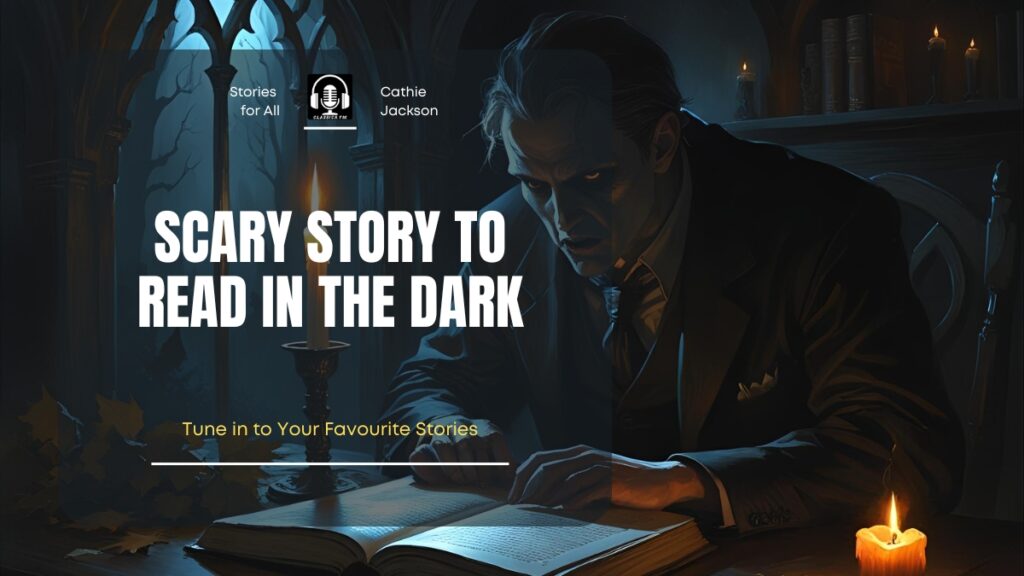
Few things are as thrilling as reading a scary story late at night.
The lights are off. The room is silent. Every creak of the floor and every shadow on the wall suddenly feels important. Even familiar surroundings can seem unsettling when darkness takes over.
That is why horror stories remain one of the most popular forms of entertainment. They allow us to experience fear, suspense, and mystery from the safety of our homes while challenging our imagination in ways few other genres can.
If you’re looking for a scary story to read in the dark, you’re about to discover one that may make you think twice before investigating strange noises at night.
But first, let’s explore why horror stories affect us so deeply.
Why People Love Reading Scary Stories
Fear is a powerful emotion.
Although most people avoid real danger, they often enjoy experiencing fear through books, movies, and stories. Horror creates excitement while allowing readers to remain safe. It offers a thrilling experience that combines suspense, mystery, and curiosity, keeping readers engaged from beginning to end.
Scary stories also allow people to explore the unknown from a comfortable distance. Readers can experience tension and excitement without facing actual danger, making horror both entertaining and memorable.
The Fear of the Unknown
One of the strongest elements of horror is uncertainty.
A closed door is often scarier than an open one. A mysterious sound in an empty hallway can be more frightening than seeing what caused it. When answers are hidden, our imagination fills in the blanks, often creating possibilities far worse than reality.
This fear of the unknown is what keeps readers turning pages, eager to discover what lies ahead while simultaneously dreading the answer.
Darkness Amplifies Suspense
Darkness naturally increases tension.
Without clear visibility, people become more aware of sounds and movements around them. Every creak, whisper, or unexpected noise suddenly feels important. This heightened awareness makes horror stories feel more immersive and realistic.
That is why many readers prefer enjoying scary stories at night, when the atmosphere itself contributes to the sense of suspense.
Ordinary Places Become Terrifying
Many memorable horror stories take place in familiar settings.
- Homes.
- Schools.
- Hotels.
- Neighborhoods.
Because readers can easily imagine themselves in these environments, the fear feels more personal. A strange event occurring in an ordinary place is often far more unsettling than something happening in a distant fantasy world.
This sense of familiarity helps readers connect with the story and imagine how they would react if the same events happened to them.
Elements of a Truly Scary Story
Not every horror story leaves a lasting impression.
Some stories may provide a brief scare, but the most effective ones stay in a reader’s mind long after they have finished reading. These stories create a sense of unease that lingers, making readers think about them long after the final chapter.
The best horror stories often share several important ingredients that work together to create suspense, mystery, and fear.
A Mysterious Setting
A strong setting is often the foundation of a great horror story.
An isolated house, abandoned building, forgotten road, or empty hotel immediately creates curiosity and tension. These locations make readers wonder what happened there and what secrets may still be hidden within them.
A mysterious setting also helps establish the atmosphere, making every strange event feel more believable and unsettling.
Gradual Suspense
Great horror stories build fear slowly rather than revealing everything at once.
Instead of immediately showing the danger, they introduce small clues and unexplained events that gradually increase tension. A strange noise, an unusual warning, or a mysterious sighting can create anticipation and keep readers engaged.
This slow buildup allows fear to grow naturally, making the eventual reveal far more effective.
Unanswered Questions
Sometimes what remains unexplained is far more frightening than what is revealed.
When readers do not have all the answers, their imagination begins filling in the gaps. They continue wondering about the mystery even after the story ends, which makes the experience more memorable.
Many classic horror stories rely on this technique because uncertainty often creates stronger fear than complete explanations.
Psychological Fear
The strongest horror often comes from anticipation rather than direct danger.
Readers become frightened because they don’t know what might happen next. The feeling that something is wrong, even when there is no obvious threat, can create powerful suspense.
Psychological horror focuses on tension, atmosphere, and the fear of the unknown, making readers question what is real and what may be lurking just out of sight.
Scary Story to Read in The Dark
If you’re reading this in the dark, you may want to leave a light on. Some stories have a way of following readers long after the final page.
The Last Call from Room 313
Chapter 1: The Night Shift
Twenty-nine-year-old Ryan Cooper never believed in ghost stories.
As the overnight manager of the old Crestwood Hotel, he spent most nights dealing with maintenance issues, late check-ins, guest complaints, and paperwork. The job was rarely exciting, but Ryan preferred it that way.
The Crestwood Hotel had been standing for nearly seventy years. Once considered one of the finest hotels in the city, it now carried an old-world charm that attracted travelers looking for something different. Antique chandeliers hung from the ceilings, faded photographs lined the walls, and the wooden floors creaked beneath almost every step.
Guests occasionally shared strange experiences.
Some claimed they heard footsteps in empty hallways.
Others reported hearing voices late at night.
A few insisted doors opened by themselves.
Ryan always laughed off such stories.
Old buildings made strange noises.
People imagined things.
There was always a reasonable explanation.
At least, that was what he believed until he discovered Room 313.
Chapter 2: The Empty Room
Room 313 had been closed for years.
Officially, management claimed the room required renovations.
Unofficially, nobody wanted to discuss it.
Whenever Ryan asked questions, longtime employees exchanged uncomfortable glances and quickly changed the subject.
One evening, curiosity finally got the better of him.
Shortly after midnight, he retrieved the master key and made his way to the third floor.
The hallway felt unusually quiet.
Even the usual sounds of the hotel seemed absent.
Room 313 sat at the far end beneath a flickering light.
Dust covered the door.
The brass room number had become dull with age.
Ryan inserted the key.
The lock clicked.
The door slowly opened.
The room was completely empty.
No bed.
No dresser.
No curtains.
No decorations.
Nothing.
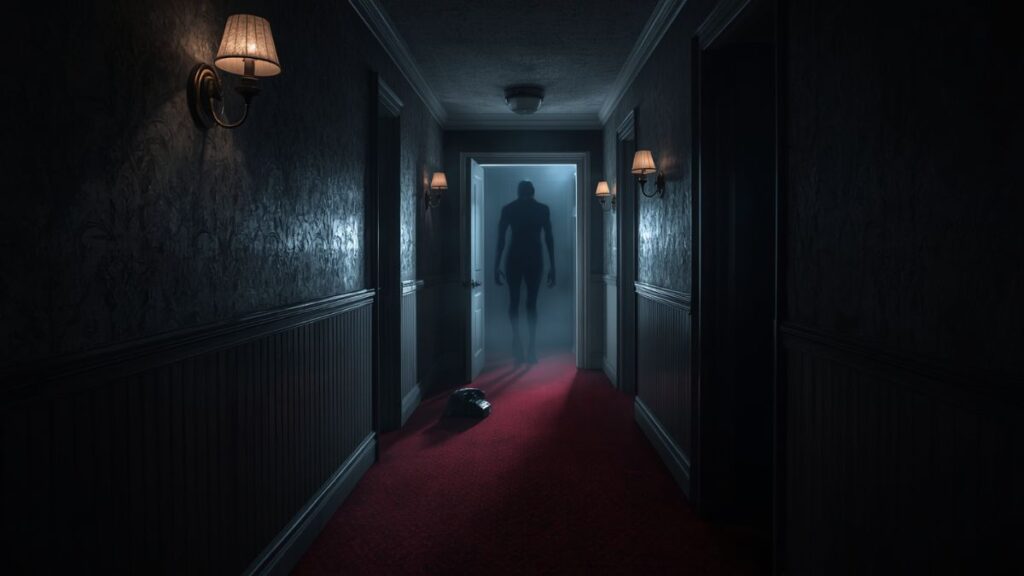
Except a black telephone sitting alone in the center of the floor.
Ryan stared at it.
The sight felt strangely unsettling.
The phone looked ordinary.
Yet somehow it seemed completely out of place.
As though it had been left there for a reason.
Waiting.
Chapter 3: The First Ring
At exactly 2:13 a.m., the phone rang.
The sharp sound echoed through the empty room and nearly made Ryan jump.
He stared at it.
The ringing continued.
Persistent.
Impossible.
Earlier that evening, Ryan had checked the hotel’s records.
The phone line to Room 313 had been disconnected years ago.
There was no way it should be working.
Yet it kept ringing.
Against his better judgment, Ryan picked up the receiver.
“Hello?”
Silence.
For several seconds, all he could hear was static.
Then a whisper emerged.
Soft.
Weak.
Almost frightened.
“Don’t let him in.”
The line immediately went dead.
Ryan slowly lowered the receiver.
For the first time since beginning his job at the Crestwood Hotel, he felt genuinely uneasy.
Chapter 4: The Hotel Records
The next day, Ryan began researching the hotel’s history.
Deep inside a dusty storage room, he found decades of employee records, newspaper clippings, and maintenance reports.
One article immediately caught his attention.
Thirty years earlier, a businessman staying in Room 313 had disappeared without a trace.
His luggage remained untouched.
His wallet remained in the room.
The bed appeared recently used.
Yet the guest himself was gone.
Police searched extensively but never found any evidence.
The case eventually faded from public attention.
Ryan continued reading.
Then he discovered something even stranger.
Over the following decades, several additional disappearances had occurred within the hotel.
Different guests.
Different rooms.
Different circumstances.
Yet every case shared one disturbing detail.
Each victim had reportedly received a mysterious phone call shortly before vanishing.
Ryan felt a chill.
The pattern was impossible to ignore.
Chapter 5: The Second Call
The following night, Ryan returned to Room 313.
At exactly 2:13 a.m., the phone rang again.
This time he answered immediately.
The same voice returned.
But now it sounded more desperate.
“He’s getting closer.”
Ryan’s heart raced.
“Who?”
For several moments, only static filled the line.
Then the voice whispered:
“The hallway.”
The call ended.
Ryan stood frozen.
Something about the voice felt familiar.
Later that evening, he reviewed an old television interview connected to the disappearance from thirty years earlier.
The missing guest briefly appeared in the footage.
Ryan replayed the clip several times.
His stomach tightened.
The voice from the phone sounded exactly like him.
Chapter 6: The Hallway
Disturbed by the discovery, Ryan began reviewing security camera footage.
Everything appeared normal until 2:13 a.m.
Then he noticed something unusual.
A figure stood at the far end of the third-floor hallway.
The image was blurry.
The shape barely looked human.
Yet it was clearly there.
Standing motionless.
Facing Room 313.
Ryan watched carefully.
The next camera frame appeared.
The figure was closer.
Another frame.
Closer still.
His blood ran cold.
The figure never walked.
It never moved.
It simply appeared nearer each time the camera refreshed.
Eventually, the footage ended.
The figure vanished completely.
Chapter 7: More Than a Legend
Ryan decided to speak with Harold, the hotel’s oldest employee.
Harold had worked at the Crestwood for nearly forty years.
When Ryan showed him the footage, the old man’s face turned pale.
“I hoped I’d never see that again,” Harold said quietly.
“What is it?”
Harold hesitated.
“No one knows.”
The old man explained that several employees over the years had reported seeing the same figure.
Always after 2:13 a.m.
Always near Room 313.
And always before something terrible happened.
Ryan suddenly realized the stories surrounding the room were far older than he imagined.
Chapter 8: The Third Call
The following night, the phone rang again.
Ryan answered immediately.
The voice sounded terrified.
“Listen carefully.”
“I’m listening.”
“You must not open the door.”
Ryan frowned.
“What door?”
Before the voice could answer, the line filled with static.
Then came another sound.
A slow knock.
Three times.
Knock.
Knock.
Knock.
The sound echoed through the room itself.
Ryan turned toward the entrance.
Someone was standing outside.
Chapter 9: The Door Opens
The knocking returned.
Louder.
Slower.
More deliberate.
Ryan stared at the handle.
The phone remained pressed against his ear.
The voice whispered urgently.
“Don’t let him in.”
The handle slowly began turning.
Ryan backed away.
His pulse hammered in his chest.
The door creaked open.
Darkness filled the hallway beyond.
Then a tall figure stepped into view.
Its face remained hidden beneath shadow.
Its arms seemed unnaturally long.
Its posture looked wrong.
As though it wasn’t entirely human.
The temperature inside the room dropped instantly.
The hallway lights flickered.
The figure took one step forward.
Then the phone screamed.
Not rang.
Screamed.
A piercing, unnatural sound exploded through the room.
The figure stopped.
For several seconds, nobody moved.
Then every light on the floor went dark.
Chapter 10: The Missing Floor
When the lights returned, the figure was gone.
Ryan rushed into the hallway.
Everything appeared normal.
Yet something felt wrong.
He examined old building plans the next day.
While reviewing blueprints, he discovered a hidden section behind Room 313.
A narrow area that no longer appeared on modern layouts.
A forgotten maintenance passage.
That night, Ryan located the concealed entrance.
Beyond it stretched a dark corridor untouched for decades.
Dust covered every surface.
The air felt freezing.
At the far end sat another telephone.
Identical to the one inside Room 313.
Chapter 11: The Truth
Beside the telephone rested dozens of guest records.
Every missing person’s file had been hidden there.
Photos.
Personal belongings.
Identification cards.
Even old police reports.
Ryan realized someone had deliberately concealed evidence for years.
Then he noticed something else.
Every disappearance occurred at exactly the same time.
2:13 a.m.
For reasons nobody could explain.
The hidden corridor appeared connected to every case.
Yet there was no sign of who created it.
Or why.
Chapter 12: The Final Call
Ryan returned to Room 313 one last time.
At exactly 2:13 a.m., the phone rang again.
He answered.
The familiar voice returned.
But now it sounded calm.
Relieved.
“You found it.”
Ryan swallowed nervously.
“What was that thing?”
Several seconds passed.
Then the voice responded.
“I don’t know.”
The answer somehow felt more frightening than any explanation.
The line grew quiet.
Finally, the voice spoke once more.
“Thank you.”
The connection ended.
The phone never rang again.
Chapter 13: What Happened Next
Ryan resigned the following week.
The hotel permanently sealed Room 313.
The hidden corridor was closed.
The telephones disappeared.
For several months, no unusual incidents occurred.
Business returned to normal.
Guests stopped reporting strange sounds.
Employees stopped sharing ghost stories.
Everything seemed over.
Then one winter evening, a newly installed security camera captured something unusual.
At exactly 2:13 a.m., a tall figure appeared briefly at the end of the third-floor hallway.
Standing motionless.
Watching.
Before vanishing seconds later.
The footage was never publicly released.
Final Thoughts
Some mysteries are frightening because they reveal terrible truths.
Others are frightening because they reveal nothing at all.
The mystery of Room 313 was never fully explained.
No one learned the true origin of the phone calls.
No one discovered the identity of the figure in the hallway.
And no one could explain why everything happened at exactly 2:13 a.m.
Perhaps some questions are meant to remain unanswered.
Perhaps some doors should never be opened.
And perhaps, if a disconnected phone ever rings in the middle of the night, the safest choice is to let it keep ringing.
Why This Story Is So Effective
Stories like The Last Call from Room 313 create fear because they combine several classic horror elements that keep readers engaged from beginning to end.
Isolation
A nearly empty hotel late at night creates an immediate sense of vulnerability. With long hallways, silent rooms, and very few people around, every strange event feels more unsettling and difficult to explain.
Mystery
The unexplained phone calls are at the heart of the story’s suspense. Each call raises new questions, encouraging readers to keep reading as they search for answers about the hotel’s dark secret.
Gradual Escalation
The story doesn’t reveal everything at once. It begins with a simple phone call, then slowly introduces disturbing discoveries, mysterious warnings, and an unknown presence. This steady buildup makes the tension more effective.
Fear of the Unseen
The creature is never fully explained or described in detail. By leaving parts of the mystery unresolved, the story allows readers’ imaginations to fill in the gaps, often creating something far more frightening.
A Familiar Object Becomes Terrifying
Telephones are everyday objects that most people use without a second thought. By turning a ringing phone into a source of dread, the story transforms something ordinary into something deeply unsettling.
Unanswered Questions
Even after the story ends, readers are left wondering about the true nature of the figure, the origin of the phone calls, and what really happened in Room 313. These lingering questions help the story stay memorable long after it has been read.
Final Thoughts
The most frightening stories are often the ones that leave questions unanswered.
They stay in our minds long after we’ve finished reading because they allow our imagination to continue the story. Even after the final page, we find ourselves wondering what really happened, what secrets were left undiscovered, and whether the danger truly ended.
Perhaps that’s why scary stories remain so popular across generations. They tap into universal fears such as isolation, uncertainty, and the unknown. They remind us that not every mystery has a clear explanation and that some questions may never be fully answered.
Stories like The Last Call from Room 313 are especially unsettling because they transform ordinary objects and familiar places into sources of fear. A hotel room, a telephone, or an empty hallway may seem harmless during the day, but under the right circumstances, they can become deeply unsettling.
The best horror stories do more than frighten us in the moment. They create an atmosphere that lingers in our minds, making us look twice at dark corners, listen more carefully to unexpected sounds, and question things we would normally ignore.
And sometimes, the most terrifying thing isn’t what you see in the dark.
It’s what might be waiting for you to answer the phone.