Oliver was an eight-year-old boy who always wanted to do everything perfectly.
He carefully colored inside every line, checked his homework more than once, and practiced his handwriting until every letter looked exactly the same. His teachers appreciated how hard he worked, and his parents admired his determination.
But there was one problem.
Whenever Oliver made a mistake, he became upset.
If he misspelled a word, he erased it so many times that the paper almost tore.
If he lost a game, he thought he wasn’t good enough.
If he answered a question incorrectly in class, he stayed quiet for the rest of the lesson because he felt embarrassed.
Oliver believed that making mistakes meant he had failed.
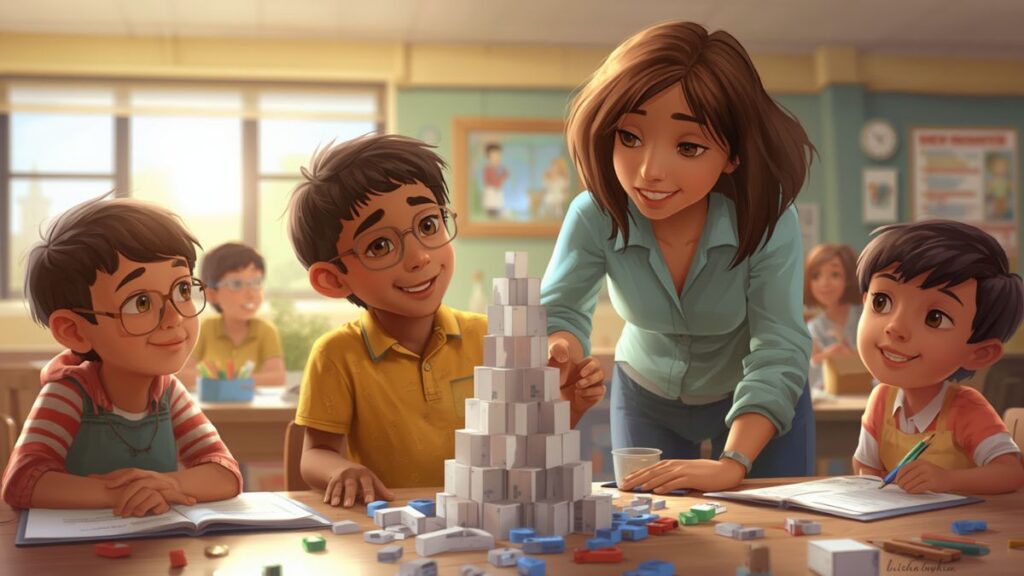
One Monday morning, Mrs. Parker, his teacher, announced an exciting activity.
“Today,” she said, “everyone is going to build the tallest paper tower using only paper and tape.”
The classroom buzzed with excitement.
Oliver immediately began folding his paper carefully. He measured every piece and made sure each fold was perfect.
Meanwhile, his classmates experimented with different ideas. Some towers leaned over. Others fell apart within minutes. The children laughed, adjusted their designs, and tried again.
Oliver watched them with surprise.
“They keep making mistakes,” he thought.
“But they don’t seem upset.”
When it was time to test the towers, Oliver gently placed his creation on the table.
For a moment, it stood tall.
Then…
It slowly tipped to one side and collapsed.
Oliver stared at the pile of paper.
His eyes filled with tears.
“I failed,” he whispered.
Mrs. Parker walked over and knelt beside him.
“Did you fail?” she asked gently.
“My tower fell.”
Mrs. Parker smiled kindly.
“So did almost everyone’s.”
Oliver looked around.
Several students were already laughing and rebuilding their towers.
Mrs. Parker picked up one of Oliver’s paper pieces.
“What do you think this mistake can teach us?”
Oliver shrugged.
“I don’t know.”
“It teaches us that this design didn’t work,” she said. “Now you have a chance to discover one that does.”
Oliver thought about her words.
Instead of throwing his project away, he tried a different design.
His second tower stood much longer than the first.
It wasn’t the tallest tower in the class, but it stayed standing.
Oliver smiled.
That afternoon, Mrs. Parker wrote a sentence on the board:
Mistakes help us learn.
She asked the class what they thought it meant.
Emily raised her hand.
“If we never make mistakes, we never learn new things.”
Jacob added,
“When I learned to ride my bike, I fell lots of times.”
Mrs. Parker nodded.
“Every mistake teaches us something valuable.”
Oliver listened carefully.
The next day during math class, Oliver solved a difficult problem on the board.
When Mrs. Parker checked his work, she noticed one small mistake.
Instead of feeling embarrassed, Oliver took a deep breath.
He looked at the problem again.
“Oh,” he said.
“I forgot to carry the one.”
He corrected it and smiled.
Mrs. Parker smiled back.
“Excellent.”
“You fixed your mistake.”
Oliver realized that finding a mistake wasn’t something to fear.
It was part of learning.
Later that week, Oliver helped his father bake muffins.
He carefully measured the flour, sugar, and milk.
When they placed the muffins in the oven, they forgot to set the timer.
A little while later, they noticed the tops had become darker than expected.
Oliver sighed.
“We ruined them.”
His father laughed.
“They’re a little overcooked, but let’s see how they taste.”
The muffins were still delicious.
His father smiled.
“Not every mistake ruins the whole experience.”
Oliver laughed too.
“I guess you’re right.”
A few days later, Oliver joined his friends for a soccer game during recess.
He kicked the ball toward the goal.
Instead, it rolled far to the side.
“I missed,” he said quietly.
His friend Noah smiled.
“So what? You’ll get another chance.”
A few minutes later, Oliver tried again.
This time he scored.
His teammates cheered.
“If I had stopped after my first mistake,” Oliver thought, “I never would have scored.”
One Friday, Mrs. Parker brought a puzzle to class.
It had hundreds of tiny pieces.
She divided the students into groups.
Some pieces didn’t fit where they expected.
Others had to be moved several times.
Every wrong guess helped them find the correct place.
When the puzzle was finished, Mrs. Parker asked,
“Did anyone solve it without making mistakes?”
The class laughed.
“No!”
“And yet,” she said, “you completed the puzzle.”
Oliver understood.
Mistakes were part of the process, not the end of it.
Over the following weeks, Oliver began noticing mistakes everywhere.
His older sister accidentally planted flower seeds too close together.
She simply moved them.
His grandfather made a wrong turn while driving.
He turned around and found the correct road.
Even Mrs. Parker sometimes made small spelling mistakes on the board.
Whenever it happened, she smiled, erased the word, and corrected it.
She never seemed embarrassed.
Oliver realized something surprising.
Even grown-ups made mistakes.
The difference was that they learned from them instead of giving up.
One afternoon, the class started learning how to paint with watercolors.
Oliver had never used them before.
As he painted a tree, too much water spread across the paper.
The green paint mixed with the blue sky.
At first he frowned.
Then he remembered Mrs. Parker’s words.
“What can this mistake teach me?”
He experimented with the colors.
Soon the painting looked like a beautiful sunset reflected on a lake.
Mrs. Parker admired his artwork.
“What a creative effect!”
Oliver smiled proudly.
His “mistake” had become one of his favorite paintings.
Near the end of the school year, the class prepared for the annual talent show.
Oliver decided to play a song on the piano.
During rehearsals, he hit the wrong note several times.
Instead of becoming frustrated, he practiced calmly.
Each mistake showed him which part needed more attention.
On the night of the performance, Oliver played the entire song beautifully.
His parents applauded proudly.
Afterward, his mother hugged him.
“You’ve worked so hard.”
Oliver smiled.
“I made lots of mistakes while practicing.”
“And that’s exactly why you improved,” she replied.
A few weeks later, a new student named Leo joined the class.
Leo struggled with reading aloud.
Whenever he made a mistake, he wanted to stop.
Oliver remembered how he used to feel.
He smiled encouragingly.
“It’s okay.”
“I used to think mistakes meant I wasn’t smart.”
Leo looked surprised.
“Really?”
Oliver nodded.
“But every mistake helps us learn.”
Leo took a deep breath and continued reading.
Little by little, he became more confident.
Mrs. Parker watched from across the room with a proud smile.
Oliver had learned one of the most important lessons of all.
Mistakes weren’t something to hide.
They were opportunities to grow.
On the last day of school, Mrs. Parker handed each student a certificate with a special message.
Oliver’s certificate read:
“Keep trying, keep learning, and never be afraid of mistakes.”
He smiled as he read the words.
Looking back, Oliver realized how much he had changed.
He still worked hard.
He still wanted to do his best.
But now he understood that nobody is perfect.
Every artist paints outside the lines sometimes.
Every athlete misses a shot.
Every reader stumbles over a word.
Every scientist learns from experiments that don’t go as planned.
Making mistakes didn’t mean giving up.
It meant learning, improving, and becoming stronger.
From that day forward, whenever Oliver made a mistake, he no longer felt embarrassed.
Instead, he smiled, took a deep breath, and asked himself,
“What can I learn from this?”
And each answer helped him grow into a more confident, resilient, and happy learner.
Moral: Everyone makes mistakes. They are not signs of failure but opportunities to learn, improve, and become stronger.