Harper was a bright and energetic eight-year-old who loved soccer, drawing colorful pictures, and spending time with her friends. She enjoyed trying new games and was always excited to participate in classroom activities.
Most days, Harper smiled and laughed easily.
But sometimes her feelings became very big.
If a game didn’t go the way she expected, if someone accidentally bumped into her, or if she couldn’t finish something right away, she felt anger rush through her like a fast-moving storm.
When that happened, Harper sometimes raised her voice, crossed her arms, argued with others, or stomped away without explaining how she felt.
Afterward, she often wished she had handled things differently.
Her teacher, Mrs. Johnson, knew Harper wasn’t trying to upset anyone.
She simply needed helpful ways to manage those big feelings.
One Monday morning, the class played a math game in small groups.
Each team took turns answering questions.
The team with the most correct answers would earn extra reading time.
Harper loved math.
She was determined to win.
During the final round, her friend Liam answered a question incorrectly.
The other team won by one point.
Harper felt her face grow warm.
“This isn’t fair!” she shouted.
Several classmates became quiet.
Liam looked down at the floor.
Mrs. Johnson calmly walked over.
“I can see you’re feeling upset.”
Harper crossed her arms.
“We should have won.”
Mrs. Johnson nodded.
“It’s okay to feel disappointed.”
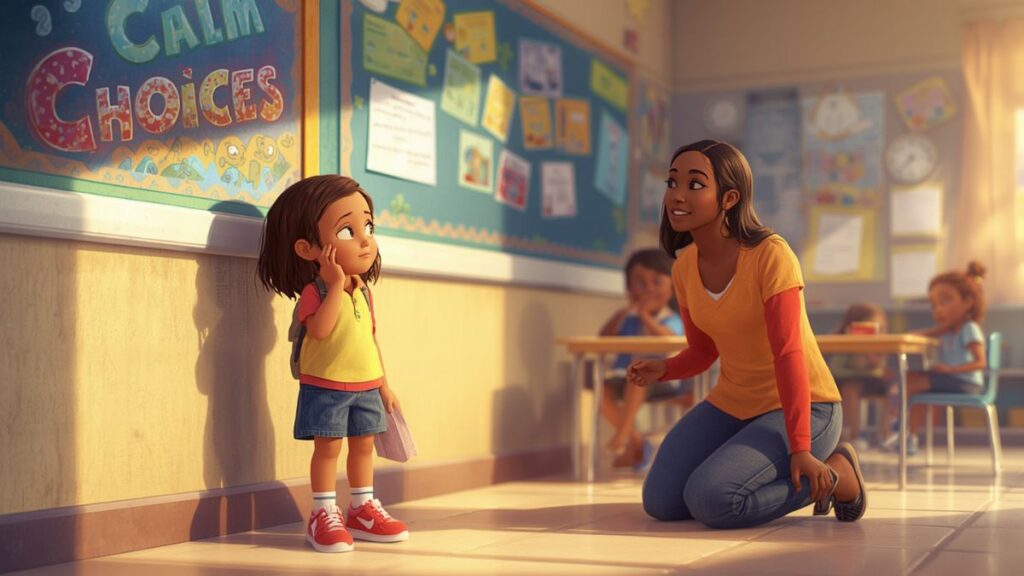
She pointed to a colorful poster on the classroom wall titled Calm Choices.
It listed four simple strategies:
- Stop and take three slow breaths.
- Count slowly to ten.
- Use kind words to explain your feelings.
- Take a short calming break if needed.
Mrs. Johnson smiled gently.
“Would you like to try one of these?”
Harper looked at the poster.
She took three slow breaths.
Her shoulders relaxed a little.
Then she quietly said,
“I’m disappointed because I wanted our team to win.”
Mrs. Johnson smiled.
“Thank you for telling us how you feel.”
Liam looked at Harper.
“I’m sorry I got the question wrong.”
Harper shook her head.
“It’s okay.”
“We all make mistakes.”
The class continued with the next activity.
That afternoon, Harper thought about the Calm Choices poster.
Taking a few deep breaths had helped more than she expected.
The next day during recess, Harper and her friends played soccer.
The score was tied.
Harper kicked the ball toward the goal.
It bounced off the goalpost instead of going in.
Another team scored moments later.
The game ended.
Harper felt frustration building again.
She wanted to throw the ball.
Then she remembered the poster.
She stopped.
She counted slowly.
One…
Two…
Three…
By the time she reached ten, her breathing had slowed.
Her friend Emma walked over.
“You played really well.”
Harper smiled.
“Thanks.”
“We can play again tomorrow.”
Instead of leaving the field upset, Harper congratulated the other team.
They smiled and thanked her.
Later that week, Mrs. Johnson introduced a classroom activity called Feelings Toolbox.
She placed several picture cards on a table.
Each card showed a calming strategy.
Deep breathing.
Stretching.
Drawing.
Reading quietly.
Talking to a trusted adult.
Counting slowly.
Taking a short walk.
Mrs. Johnson explained,
“Different strategies help different people.”
“The important thing is finding healthy choices that help you feel calm.”
Each student created a personal toolbox by choosing the strategies they liked best.
Harper chose:
Deep breathing.
Counting to ten.
Drawing.
Talking with her teacher.
She decorated her toolbox with colorful stars and rainbows.
At home that evening, Harper’s younger brother Noah accidentally knocked over the tower she had built with blocks.
The blocks scattered across the floor.
For a moment, Harper felt the familiar wave of anger.
She almost shouted.
Then she stopped.
She closed her eyes.
She took three deep breaths.
“I’m upset because my tower fell,” she said calmly.
“I’m sorry,” Noah replied.
“I didn’t mean to bump it.”
Harper smiled.
“Let’s build it together.”
The new tower became even taller than the first.
Her mom smiled proudly.
“I noticed how calmly you handled that.”
Harper grinned.
“My toolbox helped.”
A few weeks later, the class prepared for Field Day.
Harper loved running races.
She hoped to win the ribbon for the obstacle course.
When the race began, Harper started quickly.
Halfway through, she tripped over a small hurdle.
Several classmates ran past her.
She felt disappointed.
But instead of giving up, she stood up, brushed off her knees, and finished the race with a smile.
Mrs. Johnson applauded.
“You didn’t let one mistake stop you.”
Harper smiled.
“I remembered my calm choices.”
After the race, another student named Zoe looked upset because she had also lost an event.
Harper sat beside her.
“I felt disappointed too.”
“What helped you?” Zoe asked.
“I took deep breaths and reminded myself that I could try again another time.”
Zoe smiled.
“I’ll try that.”
Mrs. Johnson noticed the conversation.
She smiled.
“Now you’re helping someone else.”
As the school year continued, Harper became better at recognizing her feelings before they became too overwhelming.
She noticed when her hands felt tight.
She noticed when her voice wanted to become louder.
Those were signs that she needed to use one of her calming strategies.
Sometimes she counted to ten.
Sometimes she drew quietly for a few minutes.
Sometimes she talked with Mrs. Johnson.
Each choice helped her return to learning and playing.
One afternoon, the class worked together on a giant mural.
Everyone shared paint, brushes, and ideas.
At one point, another student accidentally painted over part of Harper’s drawing.
Harper looked at the mural.
She felt upset.
She took one deep breath.
Then another.
Finally she smiled.
“We can paint it again.”
Her classmate looked relieved.
“Thank you.”
Together they created an even more colorful picture.
Near the end of the school year, Mrs. Johnson asked the class,
“What have you learned about your feelings?”
Hands filled the air.
“We all have different feelings,” one student said.
“It’s okay to ask for help,” another answered.
Harper raised her hand.
“I learned that feeling angry isn’t wrong.”
“It’s what I choose to do next that matters.”
Mrs. Johnson smiled proudly.
“Exactly.”
“Every feeling is okay.”
“We can choose safe and respectful ways to respond.”
On the final day of school, each student received a certificate.
Harper’s read:
“Calm Problem Solver.”
Mrs. Johnson smiled warmly.
“Harper has learned to recognize big feelings and make thoughtful choices that help herself and others.”
The class applauded.
Harper held her certificate with pride.
Looking back, she realized she hadn’t stopped having big feelings.
She still became disappointed sometimes.
She still felt frustrated when things didn’t go as planned.
But now she knew she had choices.
She could stop.
She could breathe.
She could count.
She could use kind words.
She could ask for help.
Those simple strategies helped her stay in control, solve problems, and enjoy time with her friends.
From then on, whenever Harper noticed anger growing inside her, she reminded herself,
“My feelings are important, and I can choose calm actions.”
That simple reminder helped her become more confident, more patient, and a kinder friend every single day.
Moral: Big feelings are normal. Taking deep breaths, using calm words, and choosing positive coping strategies helps solve problems and build stronger relationships.