Near-death experiences, often abbreviated as NDEs, are among the most fascinating and emotionally powerful experiences people report after coming close to death. Some describe seeing a bright light, feeling completely peaceful, meeting deceased loved ones, or watching events from outside their bodies. Others report mysterious voices, vivid memories, encounters with unfamiliar places, or a profound sense that they were given another chance at life.
The subject of near-death experiences sits at the intersection of personal testimony, spirituality, psychology, neuroscience, and medical science. While some people interpret NDEs as evidence of consciousness continuing beyond physical death, researchers continue to debate how these experiences arise and what they mean.
This article explores the world of best near death experience stories without presenting the individual stories themselves. Instead, it explains what NDEs are, why people find them so compelling, the experiences commonly reported, how scientists study them, and what readers should consider when exploring accounts of people who have survived life-threatening situations.
What Is a Near Death Experience?
A near-death experience is a profound subjective experience reported by some people who have been close to death or have experienced a serious medical crisis.
NDEs have been reported following situations such as:
- Cardiac arrest
- Serious accidents
- Major injuries
- Near-drowning incidents
- Complications during surgery
- Severe illness
- Blood loss
- Respiratory emergencies
- Traumatic events
- Life-threatening medical conditions
Not everyone who comes close to death reports an NDE. In fact, many people remember nothing unusual about the period surrounding their medical crisis.
For those who do experience one, however, the memory can be remarkably vivid and emotionally significant.
Some survivors describe the experience as more vivid than ordinary dreams. Others say it changed their understanding of life, death, relationships, spirituality, or personal priorities.
Best Near Death Experience Stories
Below are seven original near-death experience stories, each built around a different emotional and mysterious theme. The characters, events, and experiences are fictional.
1. The Light Beyond the Rain
Daniel Brooks had always been afraid of storms.
It was not the ordinary kind of fear that made someone close a window when thunder rolled across the sky. Daniel’s fear went deeper. When he was a child, a violent storm had knocked down a tree near his family’s house, crushing the garden shed where he used to keep his bicycle. Nobody had been hurt, but the sound of the tree falling had stayed with him.
As an adult, Daniel learned to live with storms.
He checked weather forecasts before long drives. He kept an umbrella in his car. He avoided unnecessary travel when roads became dangerous.
But on one autumn evening, none of that was enough.
Daniel had stayed late at work.
By the time he left the office, the sky had turned almost black. Heavy clouds covered the horizon, and rain was already falling against the windshield.
He looked at the clock.
8:47 p.m.
His daughter, Lily, would probably still be awake.
Before leaving work, he had promised her that he would read her favorite story before bedtime.
“Don’t forget,” she had told him.
“I won’t,” Daniel had replied.
Now, as he drove through the rain, he smiled at the memory.
The road ahead was nearly empty.
Water streamed across the windshield faster than the wipers could clear it. Daniel slowed down.
Then thunder shook the car.
He tightened his grip on the steering wheel.
“It’s just a storm,” he whispered.
A few minutes later, he approached a section of road beside a small river.
He had driven this road hundreds of times.
But that night, the river had overflowed.
Water covered part of the pavement.
Daniel slowed even further.
The tires suddenly lost traction.
The car slid sideways.
Daniel turned the steering wheel.
Nothing happened.
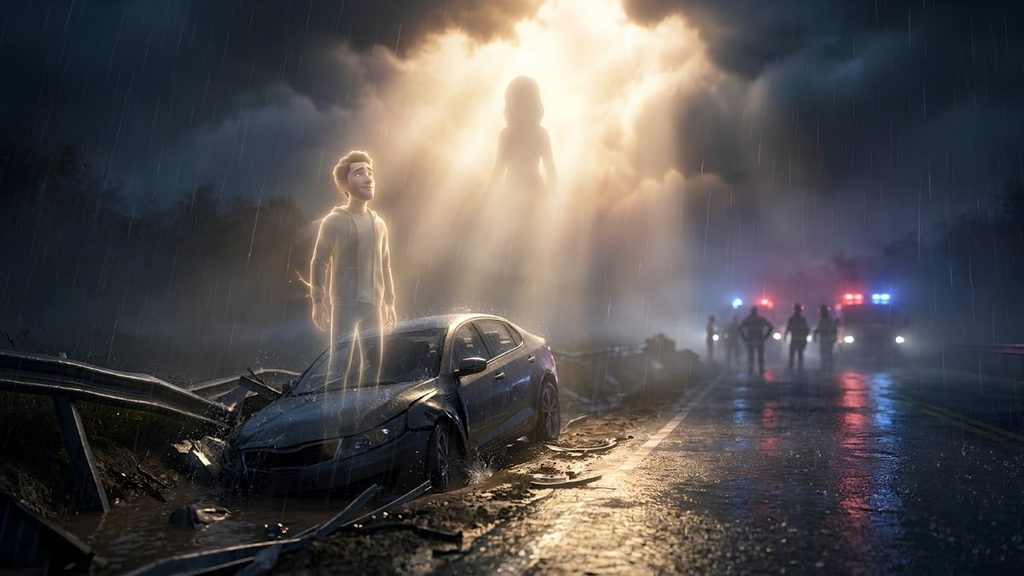
The vehicle crossed the center of the road, smashed through a metal barrier, and plunged down the muddy slope.
For a moment, Daniel saw only rain, darkness, and headlights.
Then the car hit the water.
A terrible crash filled the vehicle.
The windshield shattered.
Cold water rushed inside.
Daniel tried to open his door.
It would not move.
He pulled at his seat belt.
His hands were shaking.
The water climbed from his feet to his knees.
He tried again.
The belt finally released.
Daniel pushed against the door.
Nothing.
The water reached his chest.
He could no longer breathe normally.
“Lily.”
Her name escaped his lips.
He thought about the promise he had made.
He had promised to read her a story.
He had promised to be home.
He tried to reach the window.
His fingers slipped.
The world became darker.
Then something changed.
The panic disappeared.
Daniel could no longer feel the cold water.
He could no longer hear the rain.
Everything became completely silent.
And then he was standing beside the road.
Daniel looked around.
The storm was still raging.
But something was wrong.
He could see everything with extraordinary clarity.
The rain seemed frozen in the air.
The trees were perfectly still.
The headlights of his car illuminated the ditch below.
Daniel looked down.
His car was lying partially submerged in the water.
He could see rescue lights approaching in the distance.
Then he noticed something that made no sense.
Inside the vehicle was a man.
Daniel stared.
The man was trapped behind the steering wheel.
Then he realized the truth.
The man was himself.
Daniel stepped backward.
“No.”
He looked at his hands.
They were there.
His arms.
His clothes.
Everything looked normal.
But he felt strangely weightless.
He tried to touch the ground.
His feet did not seem to make any sound.
He looked toward the road.
Several people were running toward the wreck.
A rescue vehicle stopped.
People shouted instructions.
Daniel tried to speak.
“Help me!”
No one responded.
He shouted again.
Still nothing.
Then he heard something behind him.
It was faint at first.
A sound like wind moving through trees.
Daniel turned.
Far across the dark landscape, a small light appeared.
It was not the light of a vehicle.
It was warmer.
Golden.
Almost alive.
Daniel stared at it.
The fear he had felt only moments earlier was gone.
He began walking toward it.
With every step, the storm seemed farther away.
The golden light grew brighter.
Daniel felt something he had not experienced in years.
Peace.
Not happiness.
Not excitement.
Something deeper.
A complete absence of fear.
His shoulders relaxed.
His breathing no longer mattered.
His body no longer mattered.
He simply felt present.
Then memories began appearing around him.
At first, they came slowly.
Daniel saw himself as a little boy.
He was sitting on the kitchen floor while his mother prepared dinner.
He remembered the smell of bread.
He remembered the yellow curtains.
He remembered his mother singing quietly.
The memory felt so real that he could almost hear her voice.
Then another memory appeared.
His first day of school.
His father holding his hand.
Then his first bicycle.
His first day at university.
His wedding.
The birth of Lily.
Daniel smiled.
He had forgotten how small she had been.
A tiny bundle wrapped in a white blanket.
His wife had cried.
Daniel had cried too.
He remembered pretending that he had something in his eye.
Then the memories changed.
Daniel saw himself older.
Busier.
More distracted.
He saw himself sitting at his desk while his wife tried to talk to him.
He saw himself checking his phone during dinner.
He saw himself telling Lily, “Maybe tomorrow.”
He saw a birthday he had missed.
He saw a friend calling him several times.
He saw himself ignoring the calls because he was working.
Then came a memory he had almost completely forgotten.
His father had been sitting on the porch.
Daniel had been visiting.
His father wanted to talk.
Daniel had been impatient.
“I have to go,” Daniel had said.
His father had nodded.
Daniel had left.
That was the last long conversation they ever had.
Daniel felt a deep sadness.
But there was no voice telling him he was a bad person.
Instead, he seemed to understand something.
Every action had consequences.
Not just the large decisions.
The small ones too.
A kind word could stay with someone for years.
A careless word could do the same.
A few minutes spent listening could matter more than an expensive gift.
Daniel suddenly understood that his life was not measured by achievements.
It was measured by moments.
The light became brighter.
Daniel looked toward it.
Someone seemed to be standing within it.
At first, he could not see the person’s face.
Then the figure became clearer.
His mother.
Daniel froze.
She had been dead for twelve years.
He remembered the day she died.
He remembered sitting beside her bed.
He remembered holding her hand.
Now she was standing in front of him.
She looked exactly as she had when Daniel was young.
Healthy.
Peaceful.
Smiling.
“Mom?”
She did not answer with words.
Yet Daniel somehow understood her.
He felt her love.
It was stronger than any spoken sentence.
Daniel wanted to run toward her.
He wanted to tell her everything.
How much he missed her.
How often he thought about her.
How sorry he was that he had not visited more during her final year.
But before he could speak, another thought entered his mind.
Lily.
His daughter.
The promise.
“I can’t stay,” Daniel said.
His mother smiled.
“You know that.”
Daniel looked around.
The golden light seemed endless.
He felt drawn toward it.
But something inside him resisted.
He thought about his daughter.
He imagined her sitting in bed, waiting for him to return.
He imagined her favorite book lying beside her pillow.
He imagined the disappointment on her face if he never came home.
Then he heard another voice.
It was soft.
“You’re not finished yet.”
Daniel turned.
The light suddenly became impossibly bright.
For a moment, he felt as though everything he had ever loved was present at once.
His mother.
His father.
His wife.
His daughter.
His childhood.
His memories.
His entire life seemed connected.
Then something pulled him backward.
The peaceful feeling disappeared.
The storm returned.
The cold returned.
The darkness returned.
Daniel opened his eyes.
He was underwater.
A rescue worker was pulling him through the broken window.
Daniel tried to breathe.
He coughed violently.
Hands grabbed his shoulders.
Someone shouted.
“He’s alive!”
Daniel could barely understand the words.
He was lifted onto the riverbank.
Rain struck his face.
Emergency workers surrounded him.
An ambulance arrived.
Daniel heard someone asking questions.
“Can you hear me?”
He nodded.
“What’s your name?”
“Daniel.”
“Do you know where you are?”
Daniel looked toward the road.
“Home,” he whispered.
The paramedic frowned.
“You’re being taken to the hospital.”
Daniel closed his eyes.
For the first time in his life, the sound of rain did not frighten him.
He woke the next morning in a hospital room.
His wife was sitting beside the bed.
Her eyes were red from crying.
Daniel looked at her.
“Where’s Lily?”
“At my sister’s.”
“Is she okay?”
“Yes.”
Daniel nodded.
Then his daughter entered the room.
She ran toward him.
Daniel opened his arms.
She hugged him carefully.
“You came back,” she whispered.
Daniel closed his eyes.
“Yes.”
She pulled away.
“You promised you’d read me a story.”
Daniel smiled.
“I remember.”
That evening, Daniel kept his promise.
He was still weak.
His voice was quiet.
But he read every page.
Lily fell asleep halfway through the story.
Daniel looked at her for several minutes.
He realized how close he had come to never seeing her again.
Over the following weeks, doctors treated his injuries.
His recovery was slow.
He had bruised ribs, a damaged shoulder, and severe exhaustion.
But physically, he survived.
The experience affected him in ways his doctors could not measure.
Daniel stopped rushing through conversations.
When Lily talked, he listened.
When his wife asked about his day, he put his phone away.
He called old friends.
He visited his father’s grave.
One afternoon, he found the courage to speak about what had happened.
His wife listened quietly as Daniel described the road, the wreck, the golden light, and his mother.
“Do you think you died?” she asked.
Daniel thought about the question.
“I don’t know.”
“Do you think it was real?”
He looked out the window.
“I know that I experienced it.”
That was enough for him.
Daniel never claimed to understand what had happened.
He did not tell people that he had discovered proof of heaven.
He did not insist that his experience had a single explanation.
Instead, he carried one lesson with him.
Life could change in a moment.
A conversation could be postponed forever.
A promise could become an unfinished sentence.
A person could believe there would always be another tomorrow.
Until suddenly there wasn’t.
Several months later, Daniel and Lily finally took their trip to the seaside.
They walked along the shore as the sun disappeared beneath the horizon.
Lily held his hand.
“Are you still afraid of storms?” she asked.
Daniel looked at the clouds gathering far away.
“A little.”
She smiled.
“Me too.”
Daniel laughed.
Then he looked at the ocean.
He remembered the golden light.
He remembered his mother’s face.
He remembered the words he had heard.
You’re not finished yet.
Daniel squeezed his daughter’s hand.
For years, he had believed that surviving meant simply continuing to breathe.
Now he understood something different.
Surviving meant being given another opportunity to live deliberately.
To listen.
To forgive.
To love.
To keep promises.
To notice ordinary moments before they became memories.
That night, when they returned to the hotel, Daniel found Lily already asleep.
He quietly pulled a blanket over her.
Then he stood beside the window.
Outside, distant thunder rolled across the sky.
Daniel watched the clouds.
He no longer saw the storm as something that had almost taken his life.
He saw it as the storm that had taught him how valuable his life was.
And somewhere inside him, the golden light remained.
Not as an answer to the mystery of death.
But as a reminder of what mattered most while he was alive.
2. The Room Above the Hospital
Emily Carter had never considered herself a particularly spiritual person.
She believed in science, medicine, and things that could be measured. If something could not be explained, she usually assumed there was an explanation waiting to be discovered.
She did not believe in ghosts.
She had never been interested in stories about heaven.
And she certainly had never imagined that she would one day tell people she had experienced something she could not explain.
Emily was thirty-four years old when everything changed.
She had been preparing for a routine medical procedure after several weeks of worsening symptoms. The doctors had reassured her that the procedure was common and that serious complications were unusual.
Emily believed them.
That morning, she joked with her younger brother, Nathan, while waiting to be taken into the operating room.
“Don’t look so worried,” she told him.
“I’m not worried.”
“You’ve been walking around the waiting room for twenty minutes.”
Nathan looked at the floor.
“I’m thinking.”
“That’s usually dangerous.”
He laughed.
Emily smiled.
It was an ordinary conversation.
Neither of them knew that it would become one of the memories Emily would treasure most.
Before she was taken away, Nathan squeezed her hand.
“I’ll be here when you wake up.”
Emily nodded.
“I know.”
The hospital room was bright and quiet.
A nurse checked her identification.
Another medical professional explained the procedure.
Emily answered questions.
Everything seemed normal.
Then the medication began taking effect.
The ceiling lights became blurry.
Emily heard voices around her.
Someone asked her to relax.
She closed her eyes.
The last thing she remembered was thinking about Nathan.
Then everything disappeared.
There was no dream.
No images.
No sound.
Just darkness.
Emily did not know how long she remained in that darkness.
Seconds?
Minutes?
Hours?
She had no sense of time.
Then something strange happened.
She opened her eyes.
At least, she believed she opened her eyes.
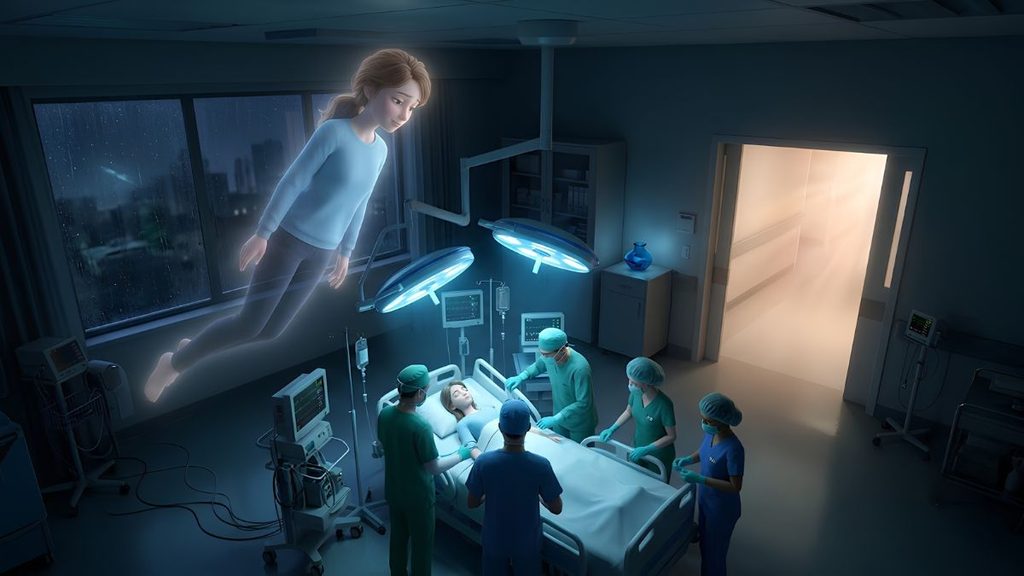
She was standing.
Emily looked down.
She was wearing the same hospital clothing.
Her hands looked normal.
Her feet were touching nothing she could feel.
She looked around.
The room was unfamiliar.
There was a large window.
A medical monitor.
A bed.
Several people moving quickly.
Then she noticed the person lying on the bed.
A woman.
Emily stared.
The woman looked familiar.
Then the truth hit her.
It was her.
Emily stepped backward.
“No.”
She looked at her hands.
Then at the bed.
Then at the doctors.
She could hear everything clearly.
A monitor was making a repetitive sound.
Someone was giving instructions.
Another person was preparing equipment.
Emily tried to speak.
“Can you hear me?”
Nobody reacted.
She shouted.
“What’s happening?”
Still nothing.
She walked toward the bed.
Her physical body looked strangely distant.
There was no pain.
That was the first thing she noticed.
She remembered being worried about the procedure.
She remembered the fear she had tried to hide.
But now there was no fear.
She felt calm.
Almost impossibly calm.
Emily looked toward the ceiling.
Something inside her told her that she could move.
She thought about going upward.
Suddenly, she was closer to the ceiling.
She had not climbed.
She had simply moved.
She looked down.
The room appeared smaller.
She could see the medical team.
She could see the bed.
She could see the floor.
She could see the doorway.
Everything seemed extraordinarily clear.
Then she noticed a shelf near the far wall.
There was a small blue object sitting on it.
Emily stared at it.
It appeared to be some kind of decorative piece.
She wondered why she had noticed it.
Then the room began fading.
The walls disappeared.
The medical equipment disappeared.
The sounds disappeared.
Emily found herself surrounded by darkness.
But it was not frightening.
It was different from the darkness she had experienced earlier.
This darkness felt peaceful.
Then a light appeared.
At first, it was tiny.
A single point in the distance.
Emily watched it grow.
The light became brighter.
But strangely, it did not hurt her eyes.
Instead, she felt warmth.
A feeling of safety spread through her.
Emily began moving toward it.
She did not know whether she was walking.
It felt more like being drawn forward.
The closer she came, the more peaceful she became.
All the anxiety she had carried for years seemed to disappear.
Her worries about work.
Bills.
Relationships.
The future.
Her mistakes.
Everything became unimportant.
She felt completely accepted.
Then she heard music.
It was soft.
Beautiful.
She could not identify the instrument.
It seemed familiar and unfamiliar at the same time.
Emily stopped.
Someone was standing within the light.
She could not see the person’s face clearly.
But she felt that she knew them.
There was no spoken conversation.
Yet Emily understood the message.
You are safe.
She felt tears forming in her eyes.
“I don’t want to leave.”
The figure seemed to move closer.
“You don’t have to be afraid.”
Emily wanted to stay.
For the first time in her life, she felt as though she had found a place where she belonged completely.
Then she thought of Nathan.
Her brother’s face appeared in her mind.
She remembered their childhood.
They had shared a bedroom.
They had fought over television shows.
They had secretly eaten cookies after their parents went to bed.
She remembered the day their father died.
Nathan had been the one who stayed beside her all night.
She remembered his hand holding hers that morning.
I’ll be here when you wake up.
Emily suddenly realized she had promised nothing in return.
But she wanted to go back.
The moment she thought about Nathan, the light began moving farther away.
Emily tried to follow it.
“Wait.”
The figure remained still.
Emily felt herself being pulled backward.
The peacefulness began disappearing.
The darkness returned.
Then the hospital came rushing toward her.
She heard voices.
A machine.
Someone shouting.
Her body felt heavy.
Pain returned.
Cold returned.
She opened her eyes.
A ceiling appeared above her.
Someone was speaking.
“Emily?”
She tried to answer.
Her throat was dry.
“Where…”
“You are in the hospital.”
She looked around.
Nathan was standing beside the bed.
His eyes were red.
He grabbed her hand.
“You’re awake.”
Emily stared at him.
“You stayed.”
Nathan laughed nervously.
“I told you I would.”
Emily closed her eyes.
She was exhausted.
But she felt an overwhelming sense of gratitude.
Over the next few days, Emily recovered.
The doctors explained that she had experienced a serious complication during the procedure.
Her condition had become unstable.
The medical team had worked quickly to stabilize her.
Emily listened carefully.
She wanted to understand what had happened.
But there was one question she kept thinking about.
The room.
The blue object.
She eventually asked a nurse whether she could see the operating area.
The nurse explained that Emily had been moved between rooms during the emergency.
Emily asked about the room she remembered.
After several conversations, she was shown a general layout of the department.
Emily pointed toward one area.
“Was there a room like this?”
The nurse nodded.
“Yes.”
Emily looked at the wall.
“Was there a shelf?”
The nurse thought for a moment.
“There may have been.”
“And a small blue object?”
The nurse looked surprised.
“What kind of object?”
“I don’t know. It looked like a little blue decoration.”
The nurse left the room.
Several minutes later, she returned.
“I think I know what you’re talking about.”
Emily stared at her.
The nurse explained that a small blue decorative item had been kept on a shelf in one of the nearby rooms.
Emily could not tell whether the object had been visible from anywhere she had physically been.
She did not know if she had seen it before the procedure.
She did not know whether she had noticed it subconsciously.
She did not know whether her memory had formed later.
And that uncertainty stayed with her.
Emily began asking questions.
She researched medical explanations.
She read about altered states of consciousness.
She learned about anesthesia awareness.
She studied out-of-body experiences.
She discovered that some researchers believed unusual brain activity could produce vivid perceptions.
Others suggested that NDEs were more complicated.
Emily became fascinated.
She had entered the experience believing that everything could be divided into two categories.
Real.
Not real.
Afterward, she understood that human experience was more complicated.
Something could be subjectively real even when its ultimate explanation remained uncertain.
Her family noticed another change.
Emily became quieter.
Not depressed.
Just more attentive.
She stopped checking her phone during meals.
She began visiting Nathan every weekend.
She called her mother more often.
She started walking in the evenings.
She watched sunsets.
She noticed small things.
The sound of rain.
The smell of coffee.
The laughter of children.
The warmth of sunlight through a window.
Before the experience, she had considered these things ordinary.
Now they felt precious.
One afternoon, several months after the procedure, Emily returned to the hospital.
She walked through the same corridor.
She remembered the fear she had felt before the operation.
But the memory no longer frightened her.
She stood near the room she believed she had seen.
There was no golden light.
No mysterious music.
No supernatural figure.
Just a hospital room.
White walls.
A bed.
Medical equipment.
Ordinary fluorescent lighting.
Emily smiled.
She realized that she did not need the hospital to look mysterious.
The mystery already existed inside her.
She still did not know exactly what had happened.
Maybe her brain had created an extraordinarily vivid experience during a period of extreme physiological stress.
Maybe her memories had been assembled from fragments of sounds, images, expectations, and later conversations.
Maybe there was something about consciousness that science had not yet fully understood.
Emily did not pretend to know.
But she knew what the experience had done to her.
It had changed the way she lived.
A year after the procedure, Emily was sitting with Nathan at a small café.
He was telling her a story about his job.
Emily laughed.
Then she looked at him.
“Thank you.”
Nathan frowned.
“For what?”
“For staying.”
He smiled.
“I told you I would.”
Emily nodded.
“I know.”
She looked out the window.
People were walking down the street.
Cars passed.
A woman carried groceries.
A child chased a pigeon.
Nothing extraordinary was happening.
And yet Emily felt something she had rarely felt before.
Wonder.
She had once believed that the greatest mysteries were hidden in distant galaxies, ancient civilizations, or unexplained phenomena.
Now she believed that one of the greatest mysteries was sitting beside her.
Being alive.
That evening, Emily returned home.
She opened a notebook.
On the first page, she wrote:
I don’t know what happened to me.
Then she wrote:
But I know what happened afterward.
She continued writing.
She wrote about fear.
She wrote about love.
She wrote about her brother.
She wrote about the light.
She wrote about the room.
She wrote about the blue object.
And finally, she wrote about the lesson she had carried away from the experience.
She did not know whether consciousness could exist outside the body.
She did not know whether the light represented something spiritual.
She did not know whether the experience had been created entirely by her brain.
But she knew that before the experience, she had spent too much time worrying about the future.
Afterward, she wanted to be present.
Years passed.
Emily eventually became a counselor who worked with people recovering from traumatic medical experiences.
She never told every patient about her NDE.
She did not want to influence their beliefs.
Instead, she listened.
When someone told her they were frightened by something they had experienced during unconsciousness, she never dismissed them.
She simply said:
“You don’t have to understand everything immediately.”
Sometimes that was enough.
One evening, many years after her own experience, Emily stood beside an open window during a thunderstorm.
Rain fell against the glass.
Thunder rolled across the sky.
She remembered the hospital.
The darkness.
The light.
The figure.
Her brother.
The blue object.
She still did not know what had happened.
But she no longer needed an answer.
Some mysteries were not meant to be solved in a single lifetime.
Some were meant to be carried.
And some experiences did not give people certainty.
They gave them perspective.
Emily closed the window.
Then she called Nathan.
“What are you doing?”
“Nothing.”
“Good.”
He laughed.
“Why?”
“Because I want to talk.”
And they talked for the next two hours.
Not about death.
Not about the afterlife.
Not about mysteries.
They talked about life.
And for Emily, that was the greatest gift the experience had given her.
3. The Man at the Station
Thomas Reed had spent twelve years carrying the same regret.
It was not something anyone could see.
He did not talk about it at family gatherings. He never mentioned it to friends. Even his wife knew only part of the story.
The regret had a name.
Michael.
Michael had been Thomas’s older brother by three years. When they were children, they had been inseparable. They built forts in the backyard, rode bicycles through their neighborhood, played football until their mother called them inside, and spent summer evenings lying on the grass and trying to identify shapes in the clouds.
As adults, however, they became different people.
Michael was spontaneous and adventurous.
Thomas was cautious and ambitious.
Their lives gradually moved in different directions.
They still loved each other, but they talked less often.
Then came the argument.
It happened on an ordinary Tuesday evening.
Michael had called Thomas about something Thomas no longer remembered clearly.
Thomas had been working late.
He was tired.
Michael wanted to discuss their father’s health and a family trip they had been planning.
Thomas had been impatient.
“Can we talk about this another time?”
Michael had sighed.
“You always say that.”
Thomas had snapped.
“Because I have a life, Michael.”
Silence followed.
Michael eventually said, “So do I.”
Thomas ended the call.
Neither brother knew it would be their last conversation.
Two days later, Michael died in a road accident.
Thomas received the phone call at six in the morning.
For several minutes, he could not understand the words.
His brother was gone.
There would be no second conversation.
No apology.
No explanation.
No chance to say that he had not meant what he said.
Thomas attended the funeral.
He stood beside Michael’s coffin and tried to speak.
Nothing came out.
Afterward, he returned to work.
Then he returned to ordinary life.
But something inside him had changed.
He kept hearing Michael’s final words.
So do I.
Twelve years passed.
Thomas married.
He had two children.
He built a successful career.
He traveled.
He bought a house.
From the outside, everything looked normal.
But whenever someone asked him whether he had any regrets, he thought about his brother.
Then, one winter evening, Thomas’s heart stopped.
He had been at home when he suddenly felt pressure in his chest.
His wife called emergency services.
Thomas remembered falling to the floor.
He heard his wife shouting his name.
Then everything went black.
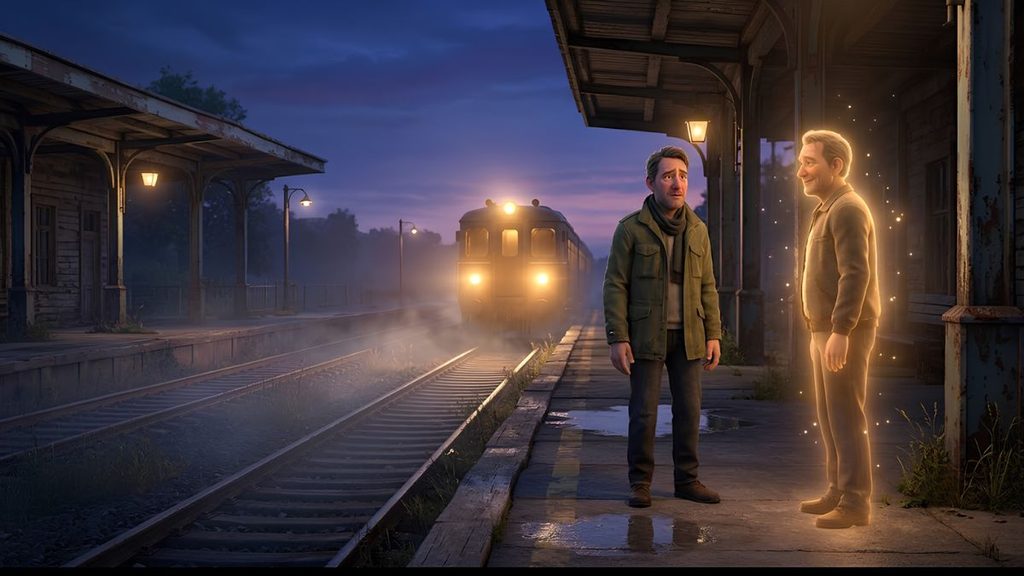
When he opened his eyes again, he was standing on a railway platform.
Thomas looked around.
The platform was completely empty.
There were no passengers.
No employees.
No advertisements.
No clocks.
Only long rows of benches and a set of railway tracks disappearing into the distance.
The air was cool.
A gentle mist covered the ground.
Thomas looked behind him.
There was no building.
No road.
No city.
Just the platform.
He checked his hands.
They looked normal.
He touched his face.
Everything felt real.
More real than a dream.
He walked toward a bench.
Someone was sitting there.
Thomas stopped.
His heart seemed to freeze.
The man turned.
Thomas recognized him immediately.
Michael.
His brother looked exactly as he had twelve years earlier.
The same hair.
The same smile.
The same jacket Thomas remembered.
Thomas could barely speak.
“Michael?”
His brother smiled.
Thomas took a step forward.
“You’re dead.”
Michael laughed softly.
“I know.”
Thomas began crying.
He had imagined seeing his brother countless times.
In dreams.
In old photographs.
In memories.
But this was different.
Michael looked real.
Thomas sat beside him.
For a moment, neither spoke.
Then Thomas said the words he had carried for twelve years.
“I’m sorry.”
Michael looked at him.
“For what?”
“For our last conversation.”
Michael smiled.
“You’ve been carrying that for a long time.”
“I shouldn’t have said those things.”
“You were angry.”
“I should have called you.”
“You thought there would be another day.”
Thomas looked down.
“That’s the problem.”
Michael nodded.
“Yes.”
A distant sound echoed through the station.
A train whistle.
Thomas looked toward the tracks.
Far away, a small light appeared.
The light grew larger.
A train was approaching.
Thomas felt something change.
The station no longer seemed empty.
He could sense other people nearby, although he could not see them.
Michael stood.
Thomas stood too.
“Where are you going?”
Michael looked toward the approaching train.
“Home.”
Thomas felt panic.
“Can I come?”
Michael smiled.
“You don’t need to.”
Thomas stared at him.
“I don’t want to lose you again.”
“You haven’t lost me.”
The train drew closer.
Thomas could see its lights.
There were no visible passengers through the windows.
The doors remained closed.
Michael turned toward him.
“Thomas.”
“Yes?”
“You have a family.”
Thomas looked away.
He thought about his wife.
His children.
His parents.
His home.
The life he had built.
“But I’m tired,” he whispered.
Michael stepped closer.
“You’ve been tired for a long time.”
Thomas looked at him.
“What happens if I go with you?”
Michael did not answer.
He simply looked at the train.
Thomas understood.
The train was waiting.
He felt drawn toward it.
For the first time since Michael’s death, Thomas felt that he could be with his brother again.
No regrets.
No arguments.
No distance.
Just the two of them.
He took one step toward the train.
Then another.
Michael watched quietly.
Thomas reached the edge of the platform.
The train doors opened.
Warm light spilled onto the ground.
Thomas could see the inside.
It looked peaceful.
Almost beautiful.
He wanted to enter.
Then he heard a voice.
“Thomas!”
He turned.
Michael was standing several meters away.
“What?”
Michael pointed toward the darkness behind Thomas.
Thomas looked.
Suddenly, images appeared.
His daughter learning to ride a bicycle.
His son falling asleep on his shoulder.
His wife laughing in their kitchen.
His mother calling him on Sundays.
His father’s old chair.
The family dog.
A Christmas morning.
A summer vacation.
A thousand ordinary moments.
Thomas began crying.
He realized something.
He had been so focused on the life he had lost that he had forgotten about the life he still had.
Michael seemed to understand.
“You’re not finished.”
Thomas looked at his brother.
“Will I see you again?”
Michael smiled.
“Someday.”
The train whistle sounded again.
Thomas wanted to stay.
But the images of his family became stronger.
His daughter was calling his name.
His wife was crying.
His son was standing beside her.
Thomas felt himself being pulled backward.
The station began to disappear.
Michael remained where he was.
Thomas shouted.
“I love you!”
Michael smiled.
“I know.”
Then everything went white.
Thomas woke in a hospital.
The first thing he heard was a machine.
The second thing he heard was his wife’s voice.
“Thomas?”
He opened his eyes.
She was sitting beside him.
Her face was wet with tears.
Thomas tried to speak.
His throat hurt.
“Where are the children?”
“They’re outside.”
“Bring them.”
His wife touched his hand.
“They’re here.”
Thomas closed his eyes.
He had returned.
Doctors later explained that his heart had stopped for several minutes.
Emergency treatment had restored his circulation.
His recovery would take time.
But he was alive.
For weeks, Thomas struggled to describe what had happened.
He told his wife about the station.
He told her about Michael.
He told her about the train.
But he was careful.
He did not say that he had discovered proof of an afterlife.
He did not know what the experience meant.
Maybe his brain had produced an extraordinarily vivid experience during a medical crisis.
Maybe memories, emotions, and unconscious perceptions had combined.
Maybe there was something about consciousness that science did not yet understand.
Thomas accepted that he might never know.
But one part of the experience remained completely clear.
He had been given another opportunity.
After leaving the hospital, Thomas made changes.
He started with small things.
He stopped answering emails during dinner.
He stopped saying, “Maybe next week.”
He began taking his children to school whenever his schedule allowed.
He called his mother every evening.
He visited his father’s grave.
And he began talking about Michael.
For years, he had avoided his brother’s name because it hurt.
Now he understood that remembering someone was not the same as remaining trapped in grief.
One Saturday afternoon, Thomas found an old box in the attic.
Inside were photographs.
He sat on the floor and began looking through them.
There was Michael at age ten.
Michael at sixteen.
Michael holding a fishing rod.
Michael wearing an oversized graduation gown.
Michael standing beside Thomas at their parents’ house.
Thomas laughed.
Then he cried.
His daughter found him there.
“Dad?”
Thomas wiped his eyes.
“Come here.”
She sat beside him.
“Who is that?”
“My brother.”
“What was he like?”
Thomas smiled.
“He was annoying.”
She laughed.
“Really?”
“Very.”
Thomas showed her the photographs.
He told her stories.
How Michael once convinced him that eating green apples before bed would make him wake up with green teeth.
How they had built a treehouse that collapsed after three days.
How Michael had secretly taken Thomas’s bicycle without asking.
How they had once stayed outside during a meteor shower until their mother dragged them indoors.
His daughter listened.
For the first time, Michael became part of the family story again.
Not just a dead person.
A brother.
An uncle.
A son.
A friend.
Someone who had lived.
Years later, Thomas returned to the town where he and Michael had grown up.
There was an old railway station there.
It had been closed for decades.
Thomas walked along the empty platform.
The place looked nothing like the station from his experience.
There were weeds between the tracks.
The paint was peeling.
The windows were broken.
A bird flew across the roof.
Thomas stood quietly.
He wondered whether the mind created familiar environments when confronting death.
Perhaps his memory had chosen a railway station because Michael had once loved trains.
Perhaps the station represented departure.
Perhaps it represented transition.
Perhaps it meant nothing at all.
Thomas smiled.
He no longer needed to know.
He sat on an old bench.
For a moment, he imagined Michael sitting beside him.
Thomas looked toward the tracks.
“I kept going,” he whispered.
A gentle breeze moved through the station.
Thomas closed his eyes.
He remembered the train.
The warm light.
The open door.
The feeling of being invited somewhere beyond fear.
Then he remembered Michael’s final message.
You’re not finished.
Thomas opened his eyes.
He stood.
He walked away from the platform.
He returned home that evening to his wife and children.
Dinner was waiting.
His daughter was telling a long story about school.
His son was arguing about a football match.
His wife was laughing.
Thomas sat down.
He listened.
Really listened.
He realized that the most important part of his experience had not been the mysterious railway station.
It had not been the train.
It had not even been his encounter with Michael.
It was the realization that life was made of ordinary moments that people often failed to notice.
A conversation.
A meal.
A child’s laughter.
A hand held during a difficult night.
A phone call made before it was too late.
Thomas never stopped wondering about the station.
But he stopped fearing it.
Because the experience had taught him something he had spent twelve years forgetting.
Goodbyes matter.
Love matters.
And while there is still time, people should not wait for tomorrow to say what they mean today.
4. The Library of Forgotten Things
Sophie Miller had always believed that every important question had an answer.
Sometimes the answer was difficult to find.
Sometimes it required years of study.
Sometimes it required asking the right person.
But Sophie believed there was always an explanation.
She had grown up surrounded by books.
Her father had been a history teacher, and their small house contained bookshelves in almost every room. There were books about ancient civilizations, astronomy, philosophy, psychology, mathematics, and literature.
When Sophie was a child, she would sit on the living-room floor while her father read to her.
“Books remember things,” he once told her.
Sophie had laughed.
“Books can’t remember.”
Her father smiled.
“People forget. Books help us remember.”
She never forgot those words.
As an adult, Sophie became a librarian.
She loved the quietness of libraries.
She loved the smell of paper.
She loved helping people find books they needed.
Most of all, she loved the idea that knowledge could survive the people who created it.
Sophie was thirty-nine when her life changed.
It happened on a rainy afternoon.
She was driving home from work when another vehicle crossed an intersection against a red light.
Sophie saw the headlights.
She pressed the brakes.
The collision happened almost instantly.
Metal crashed against metal.
Glass shattered.
The world spun.
Then darkness.
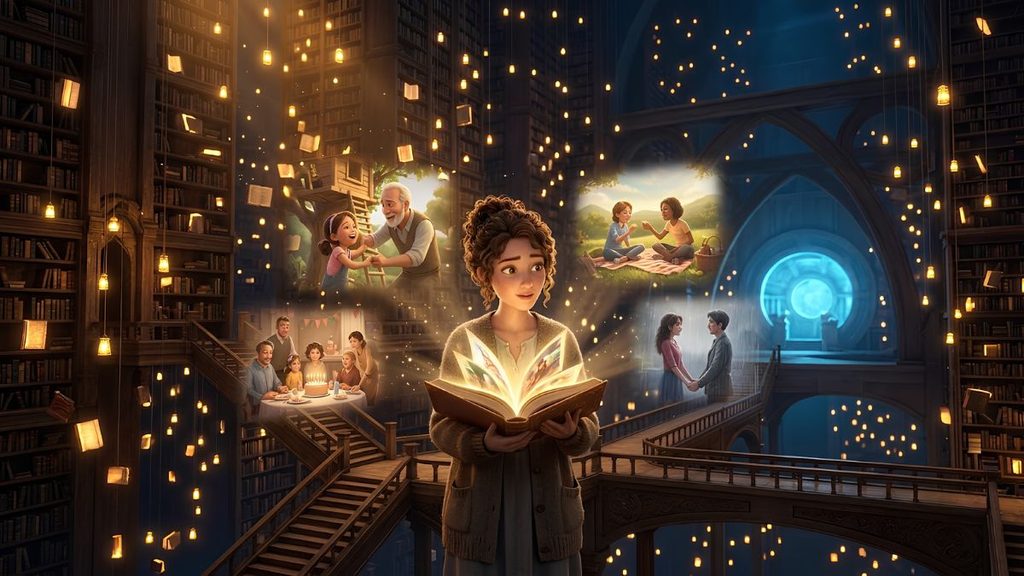
When Sophie opened her eyes, she was standing in a library.
At first, she thought she was dreaming.
The library was enormous.
The ceiling disappeared into darkness.
Rows of bookshelves stretched farther than she could see.
There were staircases leading upward.
Bridges crossed the space between shelves.
Thousands of small lamps floated in the air, illuminating the books.
Sophie turned slowly.
“What is this?”
Her voice echoed.
She walked toward the nearest bookshelf.
There were no titles.
Every book had a blank cover.
Sophie picked one up.
It was heavier than she expected.
She opened it.
The first page contained a memory.
Sophie froze.
She was looking at herself as a child.
She was sitting beneath the kitchen table.
Her mother was cooking nearby.
The memory was so vivid that Sophie could hear the sound of a spoon hitting a metal bowl.
She could smell cinnamon.
She could hear her mother humming.
Sophie closed the book.
She stared at it.
Then she opened it again.
The same memory appeared.
She put the book back.
Another book caught her attention.
She opened it.
This time, she saw herself at sixteen.
She was standing beside her father.
He was teaching her how to repair an old bookshelf.
She had forgotten that afternoon completely.
Her father was laughing.
“You don’t need to be perfect,” he said.
“You always say that.”
“Because you always need to hear it.”
Sophie smiled.
She remembered.
Then she realized what the library contained.
Her memories.
She walked deeper into the shelves.
Every book seemed to hold another part of her life.
Her first day at school.
Her first friendship.
Her first heartbreak.
Her first day at the library.
Her mother’s birthday.
Her father’s illness.
Her graduation.
Her wedding.
Her divorce.
Her happiest days.
Her worst days.
Nothing was missing.
Sophie found herself fascinated.
She began pulling books from the shelves.
She wanted to see everything.
She opened another book.
A memory appeared.
She was twenty-three.
She had been walking through a city with her best friend, Rachel.
They were laughing about something Sophie could no longer remember.
The memory made her smile.
Then she opened another.
She was twenty-eight.
She was sitting beside her father in a hospital room.
He looked weak.
Sophie remembered that day.
She had been afraid.
But the memory showed something she had forgotten.
Her father had been smiling.
“You’re going to be okay,” he had told her.
Sophie had laughed.
“You’re the one in the hospital.”
Her father had smiled.
“I know.”
The memory ended.
Sophie closed the book.
She felt tears on her face.
She had spent years remembering her father’s death.
She had forgotten the smile.
She continued walking.
The library seemed endless.
Then she found a section where the books were darker.
She pulled one from the shelf.
The cover felt cold.
When she opened it, she saw herself at thirty-two.
She was sitting at a restaurant.
Across the table was a woman she barely recognized.
It took Sophie several seconds to realize who it was.
A former colleague.
They had argued years earlier.
Sophie had left the conversation angry.
She had never spoken to the woman again.
Now she saw the moment from the other person’s perspective.
The memory changed.
Sophie could suddenly feel what the woman had been feeling.
Fear.
Embarrassment.
Loneliness.
Sophie closed the book.
She whispered:
“I didn’t know.”
Another book.
Another memory.
A man standing at a bus stop.
Sophie had walked past him without noticing.
The memory showed his face.
He had been crying.
Sophie had never known why.
Another book.
A friend she had ignored.
Another.
A child she had comforted.
Another.
A stranger she had helped.
Sophie began to understand.
The library was not simply showing her what she had done.
It was showing her what those moments meant.
She sat on the floor.
For years, Sophie had thought of her life as a collection of events.
Now she saw it as a network of consequences.
A word.
A smile.
A rejection.
A moment of patience.
A moment of anger.
Everything touched someone else.
She looked down at her hands.
“Why are you showing me this?”
A voice answered.
“You wanted to remember.”
Sophie looked around.
Nobody was there.
“Who are you?”
There was no answer.
She stood.
The library seemed brighter.
At the center of the enormous space, she saw a circular room.
Sophie walked toward it.
Inside was a large table.
On the table was a single book.
Unlike the others, this book had a title.
Your Life
Sophie reached for it.
She hesitated.
Then she opened the cover.
The pages were blank.
She turned another page.
Blank.
Another.
Nothing.
Sophie frowned.
“Why is this empty?”
The voice returned.
“Because it is not finished.”
Sophie stared at the pages.
Suddenly, she understood.
The library contained the past.
But the book on the table represented the future.
Her future.
Or the future she had not yet lived.
Sophie felt a strange sense of urgency.
She looked around.
The library was beautiful.
She did not want to leave.
But something inside her told her that she had to.
She returned to the shelves.
She began opening books.
This time, she did not look for happy memories.
She looked for moments when she had failed.
She found many.
She had been selfish.
Impatient.
Proud.
Afraid.
She had avoided difficult conversations.
She had judged people too quickly.
She had allowed work to become more important than relationships.
She had assumed there would always be time.
Then she found another book.
It contained her mother sitting alone at a kitchen table.
Sophie had promised to visit.
She had cancelled.
Her mother had said it was fine.
The memory showed that it was not.
Sophie cried.
“I should have gone.”
The voice answered:
“You still have time.”
Sophie looked up.
The library began changing.
The shelves became distant.
The lights dimmed.
A bright glow appeared at the far end of the room.
Sophie understood.
She was leaving.
“No.”
She held onto the table.
“I don’t want to go.”
The voice was gentle.
“You are not being punished.”
“Then why?”
“Because you are not finished.”
Sophie looked at the blank book.
She suddenly understood what she wanted.
She wanted another chapter.
She wanted to call her mother.
She wanted to tell Rachel she was sorry.
She wanted to forgive herself.
She wanted to experience ordinary mornings.
She wanted to sit in a library.
She wanted to watch the seasons change.
She wanted more time.
The library disappeared.
Sophie opened her eyes.
Bright hospital lights filled her vision.
Someone was speaking.
“She’s waking up.”
Sophie tried to breathe.
Her chest hurt.
Her head felt heavy.
A paramedic leaned over her.
“Can you hear me?”
She nodded.
“What’s your name?”
“Sophie.”
“Good.”
She closed her eyes again.
This time, she slept.
When Sophie woke several hours later, her mother was sitting beside her hospital bed.
Sophie stared at her.
Her mother looked older than she remembered.
Sophie reached for her hand.
“Mom.”
Her mother smiled.
“I’m here.”
Sophie began crying.
Her mother became worried.
“Are you in pain?”
Sophie shook her head.
“No.”
She squeezed her mother’s hand.
“I just want you to stay.”
Her mother smiled.
“I’m not going anywhere.”
Sophie closed her eyes.
For the first time, she realized that she had been treating time as if it were unlimited.
It wasn’t.
After leaving the hospital, Sophie changed.
Not dramatically at first.
She simply became more present.
She stopped checking emails while eating.
She started calling her mother every evening.
She contacted Rachel.
Their first conversation was awkward.
Then they laughed.
They talked for hours.
Sophie also contacted her former colleague.
She apologized.
The woman accepted.
Neither of them tried to pretend the past had not happened.
They simply decided not to carry it forever.
Sophie returned to the library where she worked.
Her colleagues noticed the difference.
She listened more.
She smiled more.
She stopped rushing.
One afternoon, a young boy approached the desk.
“Can you help me find a book?”
Sophie smiled.
“Of course.”
“What kind?”
He thought carefully.
“A really good one.”
Sophie laughed.
“That’s a difficult request.”
The boy looked serious.
“Do you have one about adventures?”
Sophie looked at the shelves.
She suddenly thought about her own mysterious library.
She wondered whether every person carried an invisible collection of memories.
Every conversation.
Every decision.
Every kindness.
Every regret.
She handed the boy a book.
“I think this one might work.”
He took it.
“Thank you.”
“You’re welcome.”
He ran away.
Sophie watched him disappear between the shelves.
She smiled.
Years later, Sophie still remembered the library.
She never claimed that it had been heaven.
She never claimed that she had visited another dimension.
She did not know whether the experience had been caused by her brain during the accident, by memory, by unconscious perception, or by something beyond scientific explanation.
She accepted uncertainty.
What mattered to her was what the experience had taught her.
People often think their lives are made from major events.
Graduations.
Marriages.
Promotions.
Birthdays.
Deaths.
But perhaps life is also made from smaller moments.
A conversation.
A hand held.
A smile offered to a stranger.
A promise kept.
An apology delayed.
A parent waiting at a window.
A child asking for a story.
A friend hoping you will call.
Those moments might seem insignificant when they happen.
But later, they may become the memories that matter most.
Sophie kept a blank notebook beside her bed.
Every night, she wrote one sentence.
Sometimes it was something beautiful.
Sometimes it was something ordinary.
Sometimes it was something she regretted.
She called the notebook The Next Chapter.
One evening, her mother asked her about it.
“Why do you write every night?”
Sophie smiled.
“Because I don’t want to forget.”
Her mother nodded.
“Forget what?”
Sophie thought for a moment.
“That I’m still writing.”
Her mother kissed her forehead.
“Then keep writing.”
Sophie closed the notebook.
Outside, rain began falling against the window.
She listened.
For a moment, she remembered the library.
The endless shelves.
The blank books.
The memories.
The mysterious voice.
The book titled Your Life.
She remembered its empty pages.
And she understood why they had been empty.
They were waiting for her.
Waiting for every conversation she had yet to have.
Every person she had yet to meet.
Every mistake she had yet to make.
Every kindness she had yet to offer.
Every ordinary morning she had yet to notice.
Sophie smiled.
Then she turned off the light.
Tomorrow, another page would begin.
5. The Garden With No Shadows

Marcus Hale had never considered himself a spiritual person.
He believed in things that could be measured, tested, and repeated.
If someone told him they had seen a ghost, Marcus would listen politely but remain skeptical.
If someone described a vision of heaven, he would assume there was probably a psychological explanation.
He did not dislike spiritual people.
He simply preferred facts.
Marcus worked as a financial analyst in London. His days were filled with spreadsheets, meetings, deadlines, and phone calls.
He was good at his job.
Very good.
He had spent years building his career.
He often worked late.
He frequently canceled dinner plans because of meetings.
He postponed vacations.
He told himself he would slow down someday.
Someday, when he had saved enough money.
Someday, when he received the promotion he wanted.
Someday, when work became less demanding.
His wife, Claire, occasionally complained that he was never really present.
“You are here,” she would say, “but your mind is somewhere else.”
Marcus usually smiled.
“I’m doing this for us.”
Claire would shake her head.
“I know.”
But she rarely argued further.
They loved each other.
Their marriage was strong.
They simply had different ideas about what mattered.
Claire valued time.
Marcus valued security.
Their eight-year-old daughter, Emma, valued neither.
She simply wanted her father to come home in time for dinner.
One Friday evening, Marcus promised that he would.
He had been working on a major project for several weeks.
But that afternoon, he closed his laptop earlier than usual.
“I’ll be home by seven,” he told Claire.
“Really?”
“Really.”
Emma heard him.
“Can we play the board game?”
Marcus smiled.
“Tonight.”
She ran over and hugged him.
“Promise?”
“Promise.”
It was a simple promise.
But it would become one of the most important promises Marcus had ever made.
That evening, Marcus drove home through heavy traffic.
He was thinking about the presentation scheduled for Monday.
He was already planning what he would say.
Then he felt something strange.
A sudden pressure spread across his chest.
He tried to breathe.
The road blurred.
He pulled the car toward the side of the road.
His hands became weak.
He managed to stop the vehicle.
Then everything went dark.
The next thing Marcus knew, he was standing in a garden.
He looked around.
There were flowers everywhere.
Tall trees.
Green grass.
A narrow stream winding through the landscape.
The sky was a color he had never seen before.
It was blue, but deeper.
Brighter.
Almost luminous.
Marcus took a step.
He felt no pain.
No pressure in his chest.
No weakness.
He looked down at his hands.
They looked normal.
He touched his face.
Everything felt real.
He took another step.
The grass moved beneath his feet.
A breeze passed through the trees.
He could smell flowers.
Somehow, he knew the garden was enormous.
But there were no walls.
No fences.
No roads.
No buildings.
Just an endless landscape.
Marcus walked toward the stream.
The water was perfectly clear.
He could see smooth stones beneath the surface.
Birds flew above the trees.
He listened.
There was music.
Not music coming from a particular place.
It seemed to be everywhere.
A soft harmony carried by the wind.
Marcus sat beside the stream.
For the first time in years, he felt completely still.
His mind was silent.
There were no deadlines.
No emails.
No meetings.
No financial reports.
No responsibilities.
He closed his eyes.
He felt peaceful.
Then he noticed something unusual.
There were no shadows.
The trees had no shadows.
The flowers had no shadows.
Marcus looked at himself.
He had no shadow either.
He stood.
He walked toward a large tree.
Sunlight streamed through its branches.
Yet the ground beneath it remained perfectly illuminated.
Marcus stared.
“This isn’t possible.”
A voice behind him answered.
“You have always wanted explanations.”
Marcus turned.
A woman was standing several meters away.
She looked familiar.
Marcus could not immediately identify her.
She smiled.
He suddenly recognized her.
His grandmother.
She had died when Marcus was fifteen.
He had not seen her face in more than twenty years.
Yet he knew her instantly.
“Grandma?”
She smiled.
Marcus walked toward her.
He wanted to hug her.
When he did, he felt an overwhelming warmth.
Not physical warmth.
Something deeper.
A feeling of being completely known.
His grandmother looked at him.
“You’ve been very busy.”
Marcus laughed through tears.
“Yes.”
“Too busy.”
He looked down.
“I was trying to build a good life.”
“You were.”
She touched his hand.
“But you forgot to live it.”
Marcus became quiet.
He wanted to argue.
But he couldn’t.
Because he knew she was right.
His grandmother led him through the garden.
They passed flowers of colors Marcus could not name.
They crossed a small wooden bridge.
They walked beside a lake.
The surface of the water was completely still.
Marcus saw reflections in it.
But they were not his reflection.
He saw moments from his life.
His wedding day.
Emma’s birth.
His first promotion.
A vacation with Claire.
His father teaching him to ride a bicycle.
His mother laughing in the kitchen.
Then the images changed.
Marcus saw himself working late.
Claire eating dinner alone.
Emma sitting beside a window waiting for him.
His wife looking at her phone.
A birthday party Marcus had missed.
A school performance he had promised to attend.
He remembered saying:
“I’ll make it up to you.”
Then another memory appeared.
Emma had been five.
She was holding a drawing.
“Daddy, look.”
Marcus had been reading an email.
“That’s great, sweetheart.”
He had barely looked.
Now he saw the moment differently.
Emma’s smile had disappeared.
Marcus covered his face.
“I didn’t realize.”
His grandmother stood beside him.
“You were there.”
“But I wasn’t really there.”
She nodded.
The garden became brighter.
Marcus felt tears on his face.
“I wasted so much time.”
His grandmother shook her head.
“You misunderstood time.”
“What does that mean?”
“You thought time was something you possessed.”
She looked toward the lake.
“It is something you are given.”
Marcus stared at the water.
A memory appeared.
The night he had proposed to Claire.
He had been nervous.
His hands had been shaking.
Claire had laughed when she saw the ring.
Then she had cried.
Marcus smiled.
He remembered every detail.
The garden seemed to respond to the memory.
Flowers opened.
The music became louder.
Marcus felt the same happiness he had felt that night.
Then another memory appeared.
Emma’s first steps.
Marcus had been there.
He remembered cheering.
He remembered Claire crying.
He remembered holding his daughter.
“I forgot this,” he whispered.
His grandmother looked at him.
“You forgot many things.”
Marcus turned.
“Can I stay?”
She did not answer immediately.
He knew what he meant.
The garden was peaceful.
He had never felt so safe.
There was no pain here.
No fear.
No pressure.
No expectations.
He wanted to remain.
His grandmother looked at him with sadness.
“You can rest here.”
Marcus felt relief.
“But you cannot stay.”
The words struck him.
“Why?”
“You have unfinished things.”
Marcus thought about Emma.
Claire.
His parents.
His friends.
He suddenly felt pulled in two directions.
Part of him wanted to remain in the garden.
Another part wanted to return.
His grandmother pointed toward the far side of the garden.
There was a path.
At the end of it stood a brilliant light.
Marcus could not see beyond the light.
He felt that if he continued walking, he would not return.
He looked at his grandmother.
“What’s beyond there?”
She smiled.
“You already know what you believe.”
Marcus shook his head.
“I don’t know what I believe.”
“That’s okay.”
She hugged him.
“Understanding can wait.”
Marcus looked back at the garden.
It was beautiful.
He could hear the stream.
He could smell the flowers.
He could feel the peace.
He wanted to stay.
Then he heard something.
A distant voice.
“Marcus!”
He looked around.
“Claire?”
The voice came again.
“Marcus!”
The garden began fading.
His grandmother stepped backward.
“No.”
Marcus reached for her.
“Wait.”
“You have to go.”
“I don’t want to lose you.”
“You never did.”
She smiled.
“Go home.”
The light became brighter.
The garden disappeared.
Marcus felt himself falling.
Then everything became cold.
Pain returned.
Noise returned.
He heard machines.
Voices.
Someone was saying:
“Stay with us.”
Marcus opened his eyes.
A bright hospital light was above him.
A medical professional was leaning over him.
“Marcus?”
He tried to speak.
Nothing came out.
“Can you hear me?”
He nodded.
The medical team continued working.
Marcus closed his eyes.
The garden was gone.
But the feeling remained.
He spent several days in the hospital.
Doctors explained that he had suffered a serious cardiac event.
He had been fortunate to receive treatment quickly.
Marcus listened carefully.
Then he asked how long he had been unconscious.
The doctor gave him an answer.
It was only a short period.
Marcus was surprised.
The garden had seemed like hours.
Perhaps days.
Time had felt different.
When Claire entered his room, Marcus looked at her.
She was crying.
He reached for her hand.
“I’m sorry.”
Claire sat beside him.
“For what?”
“For being here without being here.”
She smiled through tears.
“You scared me.”
“I know.”
“No, you don’t.”
Marcus squeezed her hand.
“You’re right.”
They sat quietly.
After a while, Marcus said:
“I want to go home.”
Claire smiled.
“You will.”
He shook his head.
“Not just home.”
She looked at him.
“I mean I want to really go home.”
She understood.
Marcus spent the following months recovering.
He changed his schedule.
He stopped working late every night.
He took his unused vacation days.
He began having breakfast with Emma.
He attended school events.
He started walking with Claire every evening.
At first, his colleagues were confused.
“What happened to you?”
Marcus would smile.
“Nothing.”
But something had happened.
He had discovered that his life was not waiting for him somewhere in the future.
It was happening now.
One afternoon, Emma asked him to come outside.
“Dad, look!”
She pointed toward a patch of flowers she had planted.
Marcus knelt beside her.
“They’re beautiful.”
“You actually looked this time.”
Marcus smiled.
“Yes.”
She hugged him.
“I love you.”
“I love you too.”
That evening, Marcus told Claire about the garden.
He had avoided describing it because he was afraid she would think he had become someone else.
But Claire listened carefully.
When he finished, she asked:
“Do you think it was heaven?”
Marcus looked out the window.
“I don’t know.”
“Do you believe it was real?”
Marcus thought about the question.
“I believe I experienced it.”
Claire nodded.
“That’s enough.”
Years passed.
Marcus never became obsessed with proving what had happened.
He did not write a book.
He did not appear on television.
He did not claim to know what comes after death.
He simply lived differently.
He kept a photograph of his family on his desk.
Not an expensive photograph.
Not a professionally staged portrait.
It was a simple picture taken one Sunday morning.
Everyone was laughing.
Emma’s hair was messy.
Claire was holding a coffee cup.
Marcus was wearing an old sweatshirt.
Nothing about the photograph was perfect.
That was why he loved it.
One evening, years after his experience, Marcus and Claire walked through a botanical garden.
The sun was setting.
Long shadows stretched across the grass.
Marcus stopped.
He looked at the shadows.
Claire noticed.
“What?”
“Nothing.”
He smiled.
He remembered the garden.
The flowers.
The stream.
His grandmother.
The strange light.
The absence of shadows.
He had once wondered why the garden had no shadows.
Now he understood that perhaps the absence of shadows had not been about physics.
Perhaps it had been about fear.
In that garden, there had been nothing to hide from.
No regrets that could not be understood.
No mistakes that could not be forgiven.
No future that needed to be controlled.
Just peace.
Marcus took Claire’s hand.
“Ready?”
She smiled.
“Ready.”
They continued walking.
The shadows grew longer behind them.
Marcus did not fear them.
He understood that shadows were part of life.
So were mistakes.
So were difficult days.
So were losses.
But so were laughter, friendship, family, sunlight, and ordinary evenings.
The garden had shown him something he had spent his entire life overlooking.
Life did not have to be perfect to be meaningful.
It only had to be lived.
And as Marcus walked home beside the woman he loved, he no longer thought about someday.
He thought about tonight.
Dinner.
A conversation.
Emma calling from the next room.
The sound of laughter.
Another ordinary evening.
Another gift.
Another page.
And for the first time, Marcus understood that he had never needed to find eternity.
He only needed to learn how to notice the moment he was already living.
6. The Dark Place
Rachel Morgan had always been afraid of the dark.
As a child, she slept with a small lamp beside her bed.
As an adult, she told herself that she had outgrown the fear.
She hadn’t.
She simply learned to hide it.
Rachel was forty-two and worked as a primary school teacher in a quiet English town. Her students loved her because she remembered small things about them.
She remembered which children hated reading aloud.
She remembered who needed extra encouragement.
She remembered birthdays.
She remembered the names of pets.
Her colleagues often joked that Rachel remembered everything.
But there were things she deliberately tried not to remember.
Her relationship with her father had been difficult.
He had died eight years earlier.
They had loved each other, but they had spent much of their final decade misunderstanding one another.
Rachel had always believed she would eventually find the right words.
She never did.
Her father died before they had the final conversation she had imagined.
Rachel carried that regret quietly.
She also carried another problem.
She had become very good at saying yes.
Yes to extra work.
Yes to helping friends.
Yes to solving other people’s problems.
Yes to staying late.
Yes to doing things she did not want to do.
When people asked how she was, Rachel usually smiled.
“I’m fine.”
She said it so often that eventually she believed it.
Then came the accident.
It happened on a cold November morning.
Rachel was driving to school when thick fog settled over the road.
Visibility was poor.
She slowed down.
A vehicle suddenly appeared ahead.
Rachel turned the steering wheel.
Her car left the road.
There was a loud impact.
The world spun.
Then everything became silent.
Rachel did not know how long she remained unconscious.
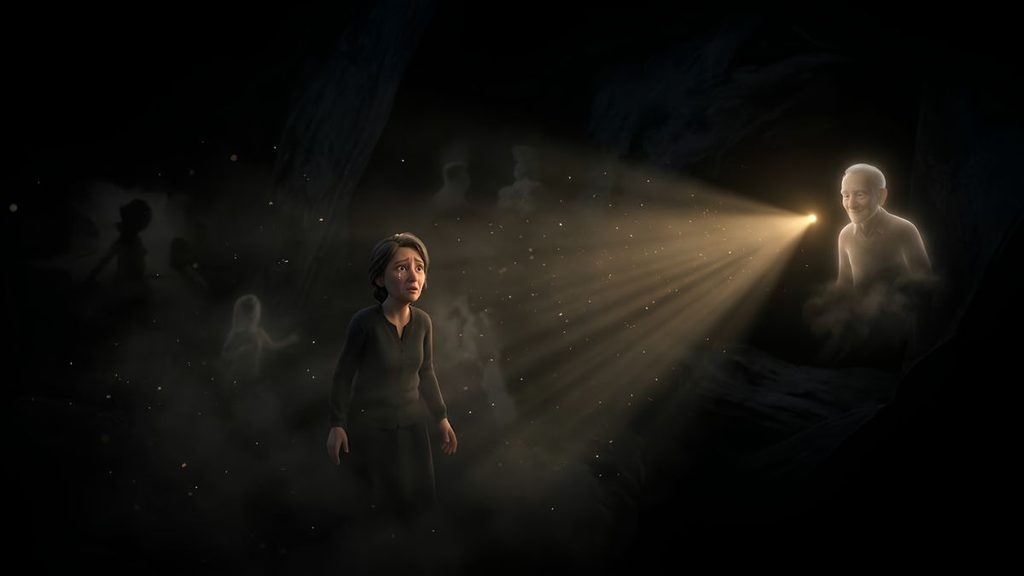
When she opened her eyes, there was nothing around her.
No road.
No car.
No hospital.
No sky.
Just darkness.
Rachel tried to move.
She could not tell whether she was standing.
She could not feel the ground.
She could not feel her body.
“Hello?”
Her voice disappeared into the darkness.
No echo returned.
Rachel became frightened.
“Is anyone there?”
Nothing.
She began walking.
At least she thought she was walking.
There was no sense of direction.
She could not see her hands.
She could not see her feet.
She could not see anything.
The darkness seemed endless.
Rachel tried to remain calm.
“This is a dream.”
She said it aloud.
“This is a dream.”
But the darkness felt different from any dream she had experienced.
It felt completely real.
She continued forward.
Then she heard something.
A faint sound.
At first, she thought it was wind.
Then she realized it was crying.
A child.
Rachel stopped.
“Hello?”
The crying continued.
It sounded close.
Rachel followed it.
The darkness seemed to shift around her.
The crying became louder.
She reached out.
Her hand touched something.
A wall.
Rachel recoiled.
She could feel rough stone beneath her fingers.
She was standing in some kind of narrow passage.
The crying was coming from farther ahead.
She moved forward.
“Hello?”
No answer.
She heard a child’s voice.
“Please don’t leave me.”
Rachel froze.
The voice sounded familiar.
She knew it.
But she could not remember where she had heard it.
She continued walking.
The passage opened into a larger space.
Still no light.
Still no visible walls.
But she could hear voices.
Hundreds of them.
Whispering.
Some were angry.
Some were sad.
Some were frightened.
Rachel covered her ears.
The voices grew louder.
Then she heard her own name.
“Rachel.”
She turned.
“Who are you?”
“Rachel.”
Again.
She began running.
She did not know where she was going.
She only wanted to escape.
The darkness seemed to follow.
Then memories began appearing.
Not as images.
As feelings.
She felt the embarrassment of being criticized in front of her classmates when she was a child.
She felt the loneliness of sitting alone at lunch.
She felt the anger she had experienced when her father refused to listen to her.
She felt the guilt of words she had spoken years earlier.
Everything she had pushed away came back at once.
Rachel fell to her knees.
“Stop.”
The memories continued.
She saw her father.
Not as he had been at the end.
As he had been when she was young.
He was teaching her to ride a bicycle.
She was laughing.
He was running behind her.
Then another memory.
Her father sitting at the kitchen table.
They were arguing.
Rachel was shouting.
Her father was silent.
Then he said:
“You’re going to regret speaking to me like this.”
Rachel had replied:
“Maybe I will.”
The memory disappeared.
Rachel cried.
“I didn’t mean it.”
The darkness remained.
She saw another memory.
Her father was in the hospital.
Rachel was sitting beside him.
He wanted to talk.
She was angry.
She had told herself she needed time.
She had left.
She never returned.
Rachel covered her face.
“I should have stayed.”
A voice answered.
“Yes.”
Rachel looked up.
Someone was standing in the darkness.
She could not see the face.
“What do you want?”
The figure remained still.
Rachel felt fear.
“Are you here to punish me?”
“No.”
The answer was quiet.
“Then why am I here?”
“Because you are afraid.”
Rachel shook her head.
“I’ve always been afraid.”
“Yes.”
“What am I supposed to do?”
The figure did not answer.
Rachel looked around.
The darkness seemed endless.
Then she realized something.
She had been running from it.
But there was nowhere to run.
She closed her eyes.
She stopped moving.
She stopped fighting.
She took a slow breath.
For the first time since entering the darkness, she became still.
The voices began fading.
The memories became quieter.
Rachel opened her eyes.
The figure was gone.
A tiny light appeared in the distance.
It was barely visible.
Rachel stared.
The light grew.
She took one step toward it.
Then another.
The darkness did not disappear.
It simply became less frightening.
Rachel realized that the darkness itself had never been the thing she feared most.
She had feared what she might find inside it.
Her regrets.
Her guilt.
Her unfinished conversations.
Her own mistakes.
She walked toward the light.
With every step, she remembered something else.
Her mother’s laugh.
Her students’ faces.
Her best friend’s terrible jokes.
The smell of rain.
The taste of tea.
Her father’s hands on the bicycle.
A summer afternoon.
A Christmas morning.
A thousand small moments.
The light grew brighter.
Rachel felt warmth.
Then she heard her father’s voice.
“Rachel.”
She stopped.
The voice was gentle.
She turned.
Her father stood behind her.
He looked younger.
Healthy.
Peaceful.
Rachel began crying.
“I’m sorry.”
He smiled.
“I know.”
“I should have stayed.”
“You were angry.”
“I should have come back.”
“You didn’t know there wouldn’t be another day.”
Rachel walked toward him.
“I miss you.”
“I know.”
She wanted to touch him.
But before she could, the light became brighter.
Her father stepped backward.
“Wait.”
“You have to go.”
“Where?”
“Back.”
Rachel shook her head.
“I don’t want to.”
Her father smiled.
“You still have work to do.”
Rachel thought about her students.
Her mother.
Her friends.
The people who depended on her.
She realized that she wanted to return.
The darkness began disappearing.
The light surrounded her.
Then everything became white.
Rachel woke to the sound of a siren.
She opened her eyes.
The ceiling of an ambulance was above her.
Someone was speaking.
“Rachel, stay with us.”
She tried to move.
Pain spread through her body.
She groaned.
“That’s good,” someone said.
“You’re awake.”
Rachel closed her eyes again.
The next time she woke, she was in a hospital.
Her mother was sitting beside her.
Rachel looked at her.
“Mom?”
Her mother leaned forward.
“Yes.”
Rachel reached for her hand.
Her mother held it.
“You scared me.”
Rachel began crying.
“I’m sorry.”
Her mother shook her head.
“Don’t apologize.”
Rachel looked at her.
“I need to tell you something.”
“What?”
“I love you.”
Her mother smiled through tears.
“I know.”
Rachel spent several weeks recovering.
Her injuries were serious but treatable.
Doctors told her she had been fortunate.
Rachel thought about the word.
Fortunate.
She had never thought of herself as fortunate before.
She had spent years focusing on what she lacked.
What had gone wrong.
What she had failed to do.
Now she saw things differently.
She had survived.
She had another morning.
Another conversation.
Another opportunity.
That was enough.
After leaving the hospital, Rachel visited her father’s grave.
It was raining.
She stood quietly.
“I was angry,” she said.
“I was young.”
“I thought I had more time.”
She wiped rain from her face.
“I wish I had stayed.”
The wind moved through the trees.
Rachel did not expect an answer.
She did not need one.
She had finally said the words.
Then she walked away.
Her life changed gradually.
She did not suddenly become fearless.
She still worried.
She still became impatient.
She still made mistakes.
But she stopped pretending that she had unlimited time.
She began saying what she meant.
When she loved someone, she said so.
When she was sorry, she apologized.
When she needed help, she asked.
When she was tired, she rested.
She stopped saying yes to everything.
At school, her students noticed that she seemed different.
One afternoon, a little boy stayed behind after class.
“Mrs. Morgan?”
“Yes?”
“Are you okay?”
Rachel smiled.
“Yes.”
The boy looked uncertain.
“You seem happier.”
Rachel laughed.
“I think I am.”
He nodded.
“Good.”
Then he ran outside.
Rachel watched him go.
She thought about the darkness.
For years, she had believed darkness meant danger.
Now she understood something else.
Sometimes darkness simply meant that you could not yet see what was ahead.
It did not necessarily mean that something terrible was waiting.
Sometimes you had to stand still.
Breathe.
Wait.
Then take one step.
One evening, Rachel sat beside her bedroom window.
The room was dark.
She did not turn on the lamp.
Rain tapped against the glass.
She looked into the darkness.
It no longer frightened her.
She remembered the place she had experienced during the accident.
She still did not know what it had been.
Perhaps it had been a neurological response to trauma.
Perhaps it had been an unusual state of consciousness.
Perhaps her mind had transformed memories and emotions into a vivid experience.
Perhaps there was something more.
Rachel did not claim to know.
But she knew what the experience had taught her.
Fear could become a prison.
Regret could become a prison.
Silence could become a prison.
And sometimes the only way out was to stop running.
Rachel looked at the dark room.
Then she smiled.
The darkness had once seemed endless.
Now she understood that darkness was not the opposite of light.
It was simply the place where light had not yet arrived.
She turned toward the hallway.
Her mother was visiting that evening.
They were going to make tea.
Rachel stood.
She walked toward the door.
She did not switch on the light.
She didn’t need to.
She knew the way.
7. The Last Photograph
Daniel Reeves had always been the person behind the camera.
At family gatherings, he was the one asking everyone to stand closer.
At birthdays, he was the one adjusting the lighting.
On vacations, he carried a camera even when everyone else had switched to their phones.
He liked photographs because they preserved moments.
His wife, Anna, used to tease him about it.
“You photograph everything except yourself.”
Daniel would laugh.
“Someone has to take the pictures.”
“One day,” Anna would say, “there will be hundreds of photographs of us and almost none of you.”
Daniel never took the warning seriously.
He should have.
Daniel was forty-six when the accident happened.
He had been driving home after photographing a wedding.
The weather had been clear all afternoon, but heavy rain suddenly began as evening approached.
Daniel slowed down.
He was tired, but he was thinking about the wedding.
There had been a photograph he had taken near sunset.
A bride standing beneath an old tree.
Her father beside her.
The light behind them had created a beautiful golden glow.
Daniel was already imagining how he would edit it.
Then another vehicle lost control.
There was a flash of headlights.
A violent impact.
The sound of breaking glass.
Then silence.
When Daniel opened his eyes, he was standing in his own house.
He knew immediately that something was wrong.
The house looked exactly as he remembered it.
The furniture was in the right places.
The photographs were on the walls.
The clock was ticking.
But everything seemed strangely quiet.
“Anna?”
No answer.
He walked through the hallway.
“Anna?”
Still nothing.
Then he noticed a photograph sitting on the dining table.
It was one he had never seen before.
Daniel picked it up.
The photograph showed his family.
Anna was standing in the garden.
Their daughter, Lily, was beside her.
Lily looked about ten years old.
Daniel stared.
He had taken thousands of photographs.
He knew every image in his collection.
This one was unfamiliar.
He turned it over.
There was nothing written on the back.
He looked at the image again.
Something about it felt important.
He walked toward the garden.
The door opened easily.
Outside, the sky was unusually bright.
There were no clouds.
No wind.
The garden looked perfect.
Anna was sitting beneath a tree.
Daniel froze.
“Anna?”
She looked up.
She smiled.
Daniel ran toward her.
But when he reached out, his hand passed through her.
He stepped backward.
“What is happening?”
Anna continued smiling.
She looked exactly as she had when she was younger.
Daniel suddenly understood that this was not really his house.
It was something else.
A memory.
Or perhaps something created from memory.
Anna looked toward the garden gate.
Daniel followed her gaze.
Lily appeared.
She was now a teenager.
Then the scene changed.
Lily was twenty.
Then twenty-five.
Then thirty.
Daniel watched as his daughter grew older.
He saw birthdays.
Graduations.
A wedding.
A child.
His granddaughter.
Daniel’s heart tightened.
He realized he was watching years that he had never seen.
Years he had not yet lived.
He looked at Anna.
“Are you showing me the future?”
She didn’t answer.
The garden changed again.
Daniel saw himself.
Older.
Much older.
He was sitting in a chair beside Anna.
His hair was gray.
Anna was holding his hand.
Daniel smiled.
Then the scene changed.
Anna was gone.
Daniel was alone.
He watched himself looking at an empty chair.
Then the scene disappeared.
Daniel felt an unbearable sadness.
He turned away.
“I don’t want to see this.”
The garden became still.
Then he heard a voice.
“You wanted to remember.”
Daniel turned.
A woman stood near the tree.
His mother.
She had died when Daniel was twenty-eight.
“Mom?”
She smiled.
“You always took photographs because you were afraid of forgetting.”
Daniel nodded.
“I don’t want to forget.”
“Neither does anyone.”
His mother walked toward him.
“You thought photographs stopped time.”
“Don’t they?”
“No.”
She pointed toward the garden.
“They remind you that time passed.”
Daniel looked at the strange photograph in his hand.
“Why was this one taken?”
His mother smiled.
“Because you finally stood in the picture.”
Daniel looked confused.
“I don’t understand.”
She pointed toward the photograph.
He looked again.
This time, the image had changed.
Daniel was standing in the garden beside Anna and Lily.
He was smiling.
Everyone was looking at the camera.
But there was no camera in the image.
Daniel stared.
He realized something.
The photograph had not been taken from outside.
It had been taken from within the moment.
He began crying.
“I want to go back.”
His mother looked at him.
“Back where?”
“Home.”
She smiled.
“You know where home is.”
Daniel looked at the photograph.
The garden began fading.
He heard Anna’s voice.
“Daniel.”
He turned.
She was standing beneath the tree.
He ran toward her.
This time, she did not disappear.
He could feel her hand.
Warm.
Real.
“I love you,” he said.
“I know.”
“I don’t want to leave.”
“You don’t have to.”
Daniel looked at her.
“What does that mean?”
“You have another photograph to take.”
The garden vanished.
Daniel woke to shouting.
Bright lights.
Machines.
Someone was calling his name.
He tried to open his eyes.
“Daniel?”
He heard the voice of a paramedic.
“Daniel, can you hear me?”
He opened his eyes.
The world returned.
Pain.
Noise.
Rain.
Sirens.
Daniel had survived.
His injuries were severe, but the medical team had managed to stabilize him.
He spent weeks recovering.
During that time, he kept thinking about the photograph.
The strange photograph.
The one showing his family.
The one where he was finally in the picture.
After leaving the hospital, Daniel went home.
Anna opened the door.
She hugged him tightly.
Daniel held her for a long time.
Neither said anything.
Then Daniel whispered:
“I need a photograph.”
Anna laughed through tears.
“Now?”
“Now.”
She called Lily.
Within an hour, they were all standing in the garden.
Daniel placed his camera on a tripod.
He set the timer.
Then he ran toward his family.
For once, he was not behind the camera.
The shutter clicked.
Daniel laughed.
“Again.”
They took another.
Then another.
They took photographs until the light disappeared.
Later that night, Daniel looked through the images.
One photograph stopped him.
It was ordinary.
Anna was smiling.
Lily was laughing.
Daniel stood between them.
Nothing supernatural.
Nothing mysterious.
Just his family.
But Daniel stared at it for a long time.
He realized that this was the photograph he had been missing all his life.
Not because it was perfect.
Because he was finally inside the moment.
Over the following months, Daniel changed the way he photographed people.
He still loved beautiful compositions.
He still cared about lighting.
He still carried his camera everywhere.
But now he photographed ordinary things.
Anna drinking coffee.
Lily laughing at the kitchen table.
His daughter’s messy bedroom.
Rain on the window.
His own reflection.
Family dinners.
Sunday mornings.
Small moments.
Moments nobody would normally consider worth photographing.
One day, Lily asked him why.
“Why do you photograph everything now?”
Daniel smiled.
“Because I finally understand what photographs are for.”
“What?”
“Not to stop time.”
He looked at her.
“To notice it.”
Years passed.
Daniel never forgot his experience.
He never claimed that it proved an afterlife.
He understood that there were many possible explanations.
A medical crisis could affect perception.
The brain could create vivid imagery.
Memory could combine with emotion.
The strange garden might have been a symbolic experience created by his unconscious mind.
Or perhaps it had been something more.
Daniel didn’t know.
And eventually, he stopped trying to decide.
The meaning mattered more than the explanation.
The experience had taught him that life was not a collection of major events.
It was made from photographs nobody thought to take.
The quiet breakfast.
The phone call.
The hug before leaving the house.
The conversation in the car.
The laughter in the kitchen.
The ordinary evening that seemed forgettable at the time.
Those were the moments that became precious later.
One evening, many years after the accident, Daniel was going through old photographs.
He found the image from the garden.
The original photograph from his experience.
He had never physically taken it.
Yet somehow, he remembered it perfectly.
Daniel looked at the photograph.
Then he noticed something.
At the very edge of the image was a small reflection in a window.
It showed the camera.
And behind the camera was someone standing there.
Daniel.
But not the Daniel in the photograph.
The older Daniel.
The one he had seen sitting beside Anna.
He stared.
He had never noticed that detail before.
For a moment, he felt the same strange warmth he had experienced in the garden.
Then he smiled.
Maybe it meant something.
Maybe it didn’t.
He placed the photograph back in the box.
Then he walked into the living room.
Anna was sitting on the sofa.
Daniel sat beside her.
“Do you remember our first photograph together?”
Anna laughed.
“The terrible one?”
“The very terrible one.”
She leaned against his shoulder.
“How could I forget?”
Daniel looked at her.
“Good.”
“Why?”
“Because I want you to remember.”
She smiled.
“We will.”
Daniel reached for her hand.
Outside, evening light slowly disappeared.
The room became darker.
But Daniel was not afraid.
He had spent his life trying to preserve moments.
Now he understood that the best way to preserve a moment was not always to photograph it.
Sometimes it was enough to be there.
Fully.
Completely.
Without thinking about tomorrow.
Without trying to control the future.
Without standing outside the moment and watching it happen through a lens.
Daniel closed his eyes.
He listened to Anna breathing beside him.
He heard the faint laughter of Lily in the next room.
He smelled dinner cooking.
He felt the warmth of his wife’s hand.
It was an ordinary evening.
Nothing extraordinary was happening.
And that was exactly why it mattered.
Because somewhere in the future, Daniel knew, this ordinary evening would become a memory.
And perhaps that was what the mysterious photograph had been trying to teach him all along.
We do not get to keep time.
We only get to live it.
And sometimes the most important photograph is the one we never realize we are taking.
Why Are Near Death Experience Stories So Fascinating?
The popularity of NDE accounts comes partly from the questions they raise.
People naturally wonder what happens when the human body approaches death. Medical science can describe many physiological processes associated with critical illness, but individual experiences during these events can be difficult to understand completely.
NDE stories often raise questions such as:
- What does a person experience when they are close to death?
- Why do some people report seeing a bright light?
- Why do some describe leaving their bodies?
- Why do people sometimes encounter deceased relatives?
- Why do some survivors experience an overwhelming sense of peace?
- Can consciousness exist independently of the body?
- Why do certain themes appear repeatedly in unrelated accounts?
- How can a person remember an experience that occurred during a medical emergency?
- Why do some NDEs completely change a person’s life?
These questions make near-death experiences interesting not only to spiritual communities but also to psychologists, neuroscientists, physicians, philosophers, and researchers studying consciousness.
Common Elements of Near Death Experiences
Although every NDE is different, researchers and historians of the subject have identified several recurring themes.
A Sense of Leaving the Body
Some people report feeling as though their consciousness separated from their physical body.
They may describe observing themselves from above or seeing doctors, family members, or their surroundings from what feels like an external perspective.
These accounts are commonly referred to as out-of-body experiences.
They are particularly interesting because some individuals believe they perceived details about their surroundings while they were unconscious or critically ill.
Such claims remain a subject of investigation and debate.
A Bright Light
A bright light is one of the most recognizable features associated with NDEs.
People may describe the light as:
- Warm
- Peaceful
- Loving
- Intelligent
- Comforting
- Beautiful
- Extremely bright without being painful
The interpretation varies considerably.
Some people understand the light as a spiritual presence, while others interpret it as a neurological or psychological phenomenon.
Feelings of Peace
Many NDE accounts describe an extraordinary sense of calm.
People who were experiencing serious physical trauma sometimes report feeling free from pain, fear, and anxiety.
This peaceful sensation can be one of the most memorable aspects of the experience.
For some survivors, the contrast between their physical condition and their subjective experience is particularly striking.
Encounters With Loved Ones
Another recurring feature is the perception of meeting people who have already died.
These may include:
- Parents
- Grandparents
- Spouses
- Friends
- Siblings
- Other relatives
Some people report recognizing these individuals immediately.
Others describe encounters with figures they cannot identify.
Interpretations differ depending on a person’s cultural background, religious beliefs, personal history, and understanding of consciousness.
A Life Review
Some people describe experiencing important moments from their lives in a short period of time.
A life review may involve memories of:
- Childhood
- Family relationships
- Major decisions
- Acts of kindness
- Regrets
- Personal achievements
- Moments when they hurt or helped someone else
In some accounts, people feel as though they are not simply remembering events but emotionally experiencing their consequences from different perspectives.
This can lead to profound changes in values after recovery.
A Feeling of Being Somewhere Else
Some NDE survivors describe entering a beautiful or unfamiliar environment.
Descriptions can involve:
- Gardens
- Landscapes
- Brilliant colors
- Open spaces
- Music
- Buildings
- Natural environments
- A feeling of limitless space
These experiences are highly individual and should not automatically be treated as literal descriptions of an afterlife.
A Boundary or Point of No Return
Some accounts describe reaching a particular boundary.
This might be represented as:
- A doorway
- A river
- A bridge
- A wall
- A landscape
- A point in space
- A simple feeling that they could not go farther
The person may then experience a realization that crossing this boundary would mean permanently leaving their physical life.
Returning to the Body
Many NDE accounts end with a sudden or gradual return to ordinary consciousness.
Some survivors describe returning because:
- They felt they had unfinished responsibilities.
- They wanted to return to their families.
- They were told they had to go back.
- They encountered a boundary they could not cross.
- They suddenly became aware of their physical body.
- Their medical condition improved.
The transition back to ordinary awareness can sometimes be described as confusing or uncomfortable.
Positive and Distressing Near Death Experiences
Near-death experiences are not always peaceful.
Popular culture often portrays NDEs as beautiful encounters involving light, love, and deceased relatives. However, some people report frightening or deeply disturbing experiences.
Distressing NDE accounts may involve:
- Fear
- Darkness
- Isolation
- Confusion
- A feeling of being trapped
- Unpleasant environments
- Anxiety
- A sense of separation from loved ones
These experiences deserve attention because they demonstrate how varied NDEs can be.
A person’s experience may also change during the event. Someone might initially experience fear and later describe peace, or the reverse.
Near Death Experiences and Spirituality
For many survivors, an NDE becomes a deeply spiritual event.
Some people report becoming more interested in spirituality after their experience. Others become less concerned with organized religion while retaining a strong belief in a higher power or universal consciousness.
Common changes may include:
- Greater appreciation for life
- Reduced fear of death
- Stronger compassion for others
- Increased interest in spirituality
- Less emphasis on material possessions
- Greater focus on relationships
- A desire to help other people
- A stronger sense of purpose
However, an NDE does not necessarily lead everyone toward the same religious or spiritual interpretation.
People from different cultural and religious backgrounds can describe very different experiences.
What Does Science Say About Near Death Experiences?
Scientific research into NDEs is complicated because the experience is subjective and usually occurs during an unusual medical condition.
Researchers have proposed several possible explanations.
Brain Activity
One area of research focuses on changes in brain activity during extreme physiological stress.
Reduced oxygen, altered carbon dioxide levels, changes in blood flow, medications, neurological activity, and other physiological processes may influence perception and memory.
Scientists continue to investigate how these factors could contribute to experiences reported during medical emergencies.
Memory and Dream-Like Processes
Another possibility is that some NDEs involve unusual combinations of memory, perception, imagination, and dream-like processes.
A person recovering from unconsciousness may reconstruct memories surrounding the event, potentially blending actual observations with internally generated experiences.
This does not necessarily make the experience meaningless. It simply highlights the complexity of human memory.
Psychological Factors
Fear, expectation, personal beliefs, previous experiences, and cultural background may also influence how a person interprets a near-death event.
Two people experiencing similar medical emergencies might describe their experiences differently because they interpret unusual sensations through different psychological and cultural frameworks.
Consciousness Research
NDEs are particularly interesting to researchers studying consciousness because they raise difficult questions about awareness during extreme medical conditions.
Researchers continue to investigate whether reported perceptions can be connected to measurable physiological events and whether certain aspects of NDEs can be studied objectively.
Importantly, the existence of NDE reports does not by itself establish that consciousness survives death. At the same time, the experiences are real subjective events for the people who report them and remain worthy of careful study.
Famous Near Death Experience Accounts
Over the years, a number of individuals have become widely known because of their accounts of near-death experiences.
Some accounts became popular through books, interviews, documentaries, medical discussions, or research publications.
When exploring famous NDE accounts, readers should distinguish between:
- The person’s original testimony
- Later interpretations of the testimony
- Media adaptations
- Spiritual interpretations
- Scientific explanations
- Claims added by secondary sources
This distinction is important because stories can become increasingly dramatic as they are repeated.
The most compelling approach is to examine what the person actually reported and then consider different explanations separately.
Near Death Experience Stories and the Fear of Death
One of the most frequently discussed effects of NDEs is a reduced fear of death.
Some survivors say that after their experience, death no longer seemed as frightening.
This does not necessarily mean that they wanted to die.
Instead, they may have developed a stronger appreciation for life while becoming less anxious about the possibility of death.
For many people, this becomes one of the most important long-term consequences of an NDE.
How NDEs Can Change People’s Lives
A near-death experience can become a psychological turning point.
After recovery, some survivors reassess what matters most to them.
They may decide to:
- Spend more time with family
- Repair damaged relationships
- Change careers
- Volunteer
- Become more compassionate
- Stop pursuing unnecessary material goals
- Travel
- Explore spirituality
- Become more open about their emotions
- Focus on personal happiness
These changes are often described as a renewed appreciation for life.
Why Some NDE Memories Remain So Vivid
People sometimes remember NDEs decades after they occurred.
The emotional intensity of an experience may contribute to the strength of the memory.
However, vividness does not automatically prove that every detail occurred exactly as remembered.
Human memory can feel extremely certain while still changing over time.
For this reason, researchers carefully consider factors such as:
- When the account was first recorded
- How many times the person retold it
- Whether other people independently confirmed details
- What medications were involved
- The person’s medical condition
- The timing of consciousness
- The possibility of memory reconstruction
This approach allows NDE accounts to be appreciated without automatically accepting every interpretation as scientifically established.
Near Death Experiences vs. Dreams
NDEs are sometimes compared with dreams because both can contain vivid imagery, unfamiliar environments, people, sounds, and emotional experiences.
However, many people who report NDEs strongly distinguish them from ordinary dreams.
They often describe NDEs as:
- Exceptionally vivid
- Highly coherent
- Emotionally intense
- Easy to remember
- More real than ordinary dreams
Researchers continue to examine how NDEs differ from dreams, hallucinations, anesthesia-related experiences, and other altered states of consciousness.
Near Death Experiences vs. Hallucinations
The terms “NDE” and “hallucination” should not automatically be treated as interchangeable.
A hallucination generally refers to a perception occurring without an external sensory stimulus.
An NDE is a broader description of an unusual experience associated with a life-threatening situation.
Some researchers may propose that certain NDE elements involve hallucination-like neurological mechanisms, while others focus on the broader psychological experience.
The terminology and interpretation remain subjects of ongoing discussion.
Cultural Differences in NDE Accounts
Near-death experiences are reported across many cultures.
However, the details people describe can vary.
Cultural background may influence:
- The identity of perceived figures
- Religious imagery
- Interpretation of light
- Ideas about heaven or the afterlife
- The meaning assigned to the experience
- How the story is later communicated
This makes cross-cultural research especially important.
It also cautions against assuming that every NDE follows one universal script.
Are Near Death Experiences Proof of an Afterlife?
This is one of the biggest questions surrounding NDEs.
There is currently no scientific consensus that NDEs prove the existence of an afterlife.
People interpret these experiences in different ways.
- Spiritual Interpretation: From a spiritual perspective, some people view NDEs as evidence that consciousness may continue after physical death.
- Neurological Interpretation: From a neurological perspective, researchers investigate whether brain activity and physiological changes can explain some or all aspects of NDEs.
- Psychological Interpretation: A psychological perspective considers memory, expectation, personality, emotion, and the mind’s response to extreme circumstances.
- Philosophical Interpretation: A philosophical approach asks broader questions about consciousness, identity, perception, and what it means to be alive.
Readers can explore all of these perspectives without assuming that one interpretation has conclusively answered every question.
How to Read Near Death Experience Stories Responsibly
When reading NDE accounts online, it is useful to approach them with both curiosity and critical thinking.
Consider:
- Who originally told the story?
- When was the account recorded?
- Was the person medically unconscious?
- What medical information is available?
- Is the account based on firsthand testimony?
- Has the story changed through repeated retelling?
- Are claims supported by independent evidence?
- Is the source presenting a spiritual interpretation as established fact?
- Are scientific explanations being represented accurately?
This approach helps readers appreciate the human experience without confusing personal testimony with scientific proof.
What Makes a Good Near Death Experience Story?
The best NDE accounts are not necessarily the most dramatic ones. A compelling account usually has several qualities.
- Authentic Personal Perspective: The story should clearly communicate what the survivor personally experienced.
- Emotional Depth: The strongest accounts often explain how the experience affected the person’s feelings, relationships, and worldview.
- Context: Readers benefit from understanding what happened before the experience and what occurred afterward.
- Specificity: Details can make an account easier to understand, although specific details should not automatically be treated as proof.
- Balanced Interpretation: A strong presentation distinguishes between what the person experienced and what researchers or spiritual communities believe the experience means.
- Long-Term Impact: The aftermath can be just as fascinating as the NDE itself.
A person’s transformation, relationships, career decisions, and attitude toward life can provide important context.
Why People Search for the Best Near Death Experience Stories
People may search for NDE stories for very different reasons.
Some are interested in consciousness.
Others want to understand death.
Some are fascinated by unexplained experiences.
Others have personally experienced a medical emergency and want to compare their experience with those of other survivors.
People may also read NDE stories because they:
- Enjoy mystery and unexplained phenomena
- Want philosophical perspectives on death
- Are interested in spirituality
- Study psychology
- Study consciousness
- Want emotionally powerful human stories
- Are researching the subject for a project
- Want reassurance after a frightening experience
Because motivations differ, a good collection should present diverse perspectives rather than promoting one interpretation.
Important Questions to Explore
A detailed collection of near-death experience accounts can explore questions such as:
Do all NDEs involve a bright light?
No. Experiences vary considerably, and not everyone reports the same features.
Do people always meet deceased relatives?
No. Some report encounters with deceased people, while others describe different experiences or no identifiable figures.
Are NDEs always peaceful?
No. Some experiences are described as frightening, confusing, or distressing.
Do NDEs happen only during cardiac arrest?
No. Reports occur in connection with many different life-threatening circumstances.
Do NDEs prove an afterlife?
They provide powerful personal experiences, but they do not by themselves establish a scientifically proven afterlife.
Can NDEs change someone’s personality?
Yes. Some survivors report substantial changes in priorities, relationships, spirituality, and attitudes toward death.
The Human Side of Near Death Experiences
Beyond debates about science and spirituality, NDEs are ultimately stories about people.
They often involve moments of extreme vulnerability.
A person may suddenly confront the possibility of losing everything familiar: family, memories, plans, ambitions, possessions, and identity.
Surviving such an event can produce a powerful psychological shift.
For some people, the experience becomes a reminder that everyday life can be valuable precisely because it is temporary.
That message is one reason NDE accounts continue to attract readers across generations and cultures.
What to Expect From a Collection of the Best Near Death Experience Stories
A carefully developed collection can include a wide variety of accounts rather than repeating the same familiar pattern.
Future stories can explore themes such as:
- Experiences during cardiac arrest
- Near-drowning experiences
- Survival after serious accidents
- Experiences during surgery
- Encounters with deceased relatives
- Out-of-body experiences
- Life reviews
- Experiences involving bright lights
- Distressing NDEs
- Childhood near-death experiences
- Spiritual transformations
- Medical professionals who experienced NDEs
- People whose priorities changed afterward
- Accounts involving unexplained perceptions
- Stories of people who became less afraid of death
Presenting different types of accounts makes the collection more engaging and gives readers a broader understanding of the subject.
Final Thoughts
Best Near Death Experience Stories offer a fascinating look into some of the most mysterious experiences associated with human consciousness and life-threatening situations.
Whether readers interpret NDEs through science, psychology, spirituality, philosophy, or personal belief, the subject raises profound questions about consciousness, memory, mortality, and the meaning people assign to life.
The individual experiences can be extraordinary, but they should be presented carefully. Personal testimony can be emotionally powerful without automatically becoming scientific evidence.
A balanced collection should therefore allow readers to experience the emotional depth of each account while also recognizing the unanswered questions surrounding NDEs.
Ultimately, perhaps the most universal message found across many near-death experience accounts is not about death itself, but about how people choose to live after coming close to it.