
There is something wonderfully calming about ending the day with a good story. When the lights are dimmed, the day’s responsibilities are finally over, and everything becomes quieter, reading a gentle story can help create the right atmosphere for rest.
Stories to read to fall asleep are usually different from stories designed to keep readers awake with intense suspense or complicated plots. They tend to use calm settings, comforting characters, gentle emotions, and predictable or satisfying endings.
Whether you enjoy romantic stories, peaceful adventures, cozy fantasy, funny tales, or simple stories about everyday life, the right bedtime reading can become a relaxing part of your nightly routine.
This guide explores what makes a good sleep story, how to choose one, and how to create a relaxing reading environment before bed.
What Are Stories to Read to Fall Asleep?
Stories to read to fall asleep are relaxing narratives designed to be enjoyed during the final part of the day.
They can be short enough to finish in a few minutes or long enough to accompany a longer bedtime routine.
Unlike action-packed stories, bedtime reading generally works best when the narrative does not demand too much mental effort.
Common themes include:
- Peaceful journeys
- Gentle romance
- Cozy homes
- Quiet villages
- Friendly animals
- Magical forests
- Beautiful landscapes
- Nostalgic memories
- Family relationships
- Friendship
- Simple adventures
- Hopeful endings
- Everyday moments
- Dreamlike fantasy
The purpose is not necessarily to make the reader fall asleep immediately.
Instead, a good bedtime story can help transition the mind from daytime activity toward a quieter state.
Stories for Adults to Read to Fall Asleep
1. The Last Train to Willow Station
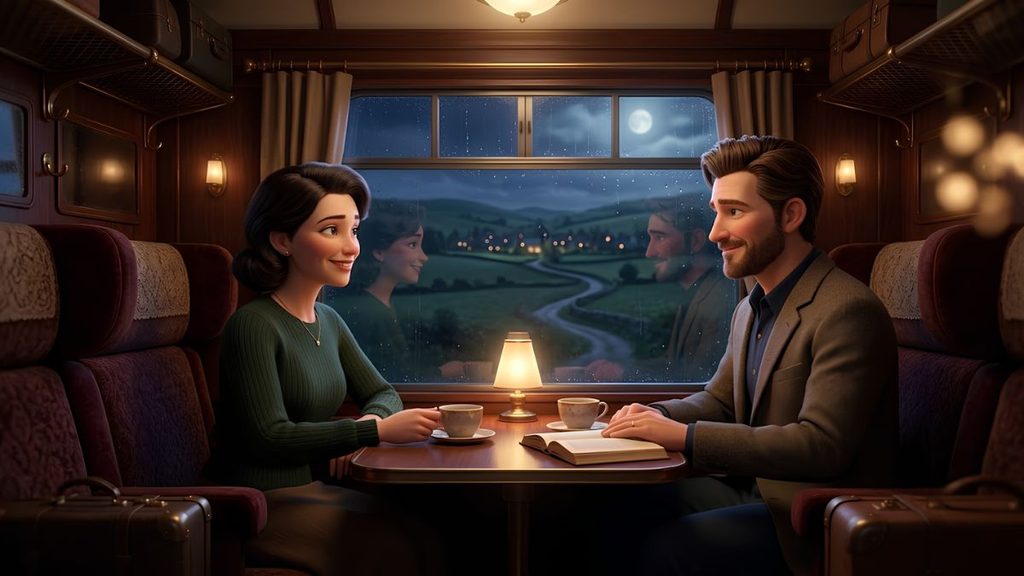
Type: Romantic Bedtime Story
Eleanor had always believed that some journeys were meant to be remembered.
Not because they took you somewhere extraordinary, but because of the people you met along the way.
For years, she had traveled by train without paying much attention to the passengers around her. She would sit beside the window, open her laptop, answer messages, read documents, and occasionally look up long enough to watch the countryside disappear behind the glass.
That evening was different.
It was late autumn, and Eleanor had just finished a long week in London. She was traveling to Willow Station, a small countryside stop where she planned to spend the weekend with her aunt.
The station was nearly empty when she arrived.
A cold wind moved across the platform.
The electronic board announced that her train was delayed by twelve minutes.
Eleanor sighed.
She pulled her coat tighter and checked her phone.
There were several unanswered messages.
She decided not to reply.
For once, she wanted a quiet evening.
When the train finally arrived, she stepped inside and found a nearly empty carriage.
She chose a window seat.
The doors closed.
The train began moving.
London slowly disappeared behind her.
Tall buildings gave way to smaller houses.
Then fields.
Then dark stretches of countryside illuminated occasionally by distant village lights.
Eleanor rested her head against the window.
She had forgotten how peaceful trains could feel at night.
A few minutes later, someone entered the carriage.
She didn’t look up immediately.
The person walked down the aisle.
Then stopped.
“Eleanor?”
She looked up.
For a moment, she couldn’t speak.
The man standing beside her seat was Daniel.
Daniel Morgan.
Her university friend.
Her almost-something.
The person she hadn’t seen in twelve years.
“Daniel?”
He smiled.
“Well, this is unexpected.”
Eleanor laughed nervously.
“Very.”
Daniel looked around the empty carriage.
“Can I sit here?”
She moved her bag.
“Of course.”
He sat opposite her.
For several seconds, neither said anything.
The train continued through the darkness.
Finally Daniel smiled.
“You haven’t changed much.”
Eleanor laughed.
“That’s not true.”
“It is.”
“I have changed a lot.”
“Maybe.”
He looked at her carefully.
“But I would still recognize you anywhere.”
Eleanor looked out the window.
She wasn’t sure whether she wanted to smile or pretend she hadn’t heard him.
“So,” she said, “where are you going?”
“Willow Station.”
She turned toward him.
“You’re joking.”
“No.”
“Why?”
“My sister lives nearby.”
Eleanor laughed.
“Of course she does.”
Daniel smiled.
“What about you?”
“My aunt.”
“The same aunt who used to send us homemade biscuits?”
Eleanor’s expression softened.
“You remember?”
“I remember everything.”
The train moved steadily into the countryside.
Their conversation became easier.
They talked about university.
About old friends.
About the professors they had disliked.
About the café where they used to study.
About the terrible coffee they drank.
They laughed about things that had once seemed important.
Eventually, Eleanor asked the question that had remained quietly between them.
“Why did we lose touch?”
Daniel looked toward the window.
“I don’t really know.”
“You stopped calling.”
“You moved.”
“You could have called.”
“I know.”
She smiled faintly.
“I waited.”
Daniel looked at her.
“So did I.”
The train passed through a tunnel.
For a few seconds, their reflections appeared in the dark window.
When they emerged, moonlight returned.
Daniel looked down at his hands.
“I thought you wanted to move on.”
“I thought you did.”
Neither spoke.
The silence wasn’t uncomfortable.
It felt more like two people finally understanding something they should have understood years ago.
After a while, Daniel said:
“Do you remember the night before graduation?”
Eleanor smiled.
“We sat on the university steps until two in the morning.”
“You said you were afraid of the future.”
“I was.”
“You asked me what I thought we’d be doing ten years later.”
Eleanor laughed.
“And what did you say?”
“I said we’d probably still be sitting on those steps.”
“That sounds like you.”
Daniel smiled.
“What did you say?”
“I said we’d probably be strangers.”
Daniel looked at her.
“That part wasn’t supposed to happen.”
The train slowed as it approached a small station.
They checked the sign.
Not Willow.
They still had forty minutes.
Eleanor leaned back.
“Do you still write?”
Daniel smiled.
“Sometimes.”
“You used to write stories.”
“I still do.”
“Have you published anything?”
“Nothing important.”
“I’d like to read something.”
“I’ll send you one.”
She nodded.
“I’d like that.”
The train continued.
Outside, the countryside was almost completely dark.
Occasionally, a farmhouse appeared.
A light glowed in a kitchen window.
Then it disappeared behind them.
Eleanor realized that she hadn’t checked her phone for nearly an hour.
She didn’t miss it.
Daniel noticed.
“You’re not answering your messages.”
“No.”
“Everything okay?”
“Everything is fine.”
She smiled.
“I just don’t want to be anywhere else tonight.”
Daniel looked at her.
“Neither do I.”
Eventually, the conductor announced that Willow Station was approaching.
They gathered their things.
Eleanor suddenly felt that the journey had gone too quickly.
When the train stopped, they stepped onto the platform.
Willow Station was tiny.
Two lamps illuminated the platform.
A small wooden shelter stood beside the tracks.
Beyond it were fields and distant hills.
Daniel looked around.
“Still the same.”
“You’ve been here before?”
“When I was younger.”
Eleanor smiled.
“Of course.”
They began walking toward the station exit.
Then Daniel stopped.
“There’s a café nearby.”
“At this hour?”
“There’s one that stays open late.”
“How do you know?”
“I used to come here.”
Eleanor smiled.
“Lead the way.”
They walked through the quiet village.
The streets were almost empty.
Warm lights glowed from houses.
A bakery stood on one corner.
A bookstore stood on another.
Finally, they reached a small café.
Inside, only two tables were occupied.
A woman behind the counter smiled.
“Tea?”
Daniel looked at Eleanor.
“Tea?”
She nodded.
“Tea.”
They sat beside the window.
Outside, rain began to fall.
The sound against the glass was soft.
Eleanor wrapped both hands around her cup.
“This feels strange.”
“What does?”
“Being here with you.”
Daniel smiled.
“Good strange?”
She thought about it.
“Yes.”
They talked for another hour.
Not about the past this time.
About the future.
Eleanor told him about her work.
Daniel told her about the small publishing company he had started.
They talked about places they wanted to visit.
Books they wanted to read.
Things they had postponed.
Dreams they had quietly forgotten.
Eventually, the café owner came over.
“We’re closing soon.”
They apologized and stood.
Outside, the rain had stopped.
The village was quiet.
Daniel looked at Eleanor.
“I don’t want tonight to end.”
She smiled.
“Neither do I.”
He hesitated.
“Would you like to walk?”
She nodded.
They walked along the empty street.
No music.
No dramatic moment.
Just two people walking beneath warm streetlights after twelve years apart.
At the corner, Eleanor stopped.
“My aunt’s house is this way.”
Daniel pointed in the opposite direction.
“My sister’s is that way.”
Neither moved.
Then Daniel laughed.
“This is where we say goodbye again.”
Eleanor smiled.
“Apparently.”
He looked at her.
“Can I see you tomorrow?”
She didn’t answer immediately.
Instead, she smiled.
“Tomorrow is good.”
Daniel’s face brightened.
“Coffee?”
“Coffee.”
“Ten?”
“Ten.”
He nodded.
Then they finally said goodnight.
Eleanor walked toward her aunt’s house.
She looked back once.
Daniel was still standing beneath the streetlight.
He waved.
She waved back.
The next morning, Eleanor woke earlier than usual.
Sunlight filled the room.
For a moment, she wondered whether the previous evening had really happened.
Then she saw the message on her phone.
Daniel: Ten o’clock. Don’t make me wait twelve years again.
She laughed.
She replied:
Eleanor: I won’t.
At ten, they met at the café.
Then they walked through the village.
They visited the old bookstore.
They sat beside the river.
They talked.
They laughed.
Neither tried to decide what their relationship would become.
They simply enjoyed being together.
Over the next few weeks, they stayed in touch.
Messages became phone calls.
Phone calls became weekend visits.
And eventually, weekends became part of their lives.
Months later, Eleanor asked Daniel something.
“Do you ever wonder what would have happened if we hadn’t lost touch?”
Daniel smiled.
“Sometimes.”
“What do you think?”
“I think we would have missed all the things that happened between then and now.”
Eleanor looked at him.
“Would that have been better?”
Daniel shook his head.
“No.”
He took her hand.
“I think we met again at exactly the right time.”
Eleanor smiled.
Outside, a train passed through the station.
Its windows glowed warmly against the evening darkness.
Eleanor watched it disappear into the distance.
She thought about the night they had met again.
The empty carriage.
The rain.
The quiet village.
The little café.
The conversation they had waited twelve years to have.
She realized that sometimes life doesn’t take us directly where we want to go.
Sometimes it sends us through unexpected places.
Sometimes it makes us wait.
Sometimes it separates people who care about each other.
But occasionally, when the timing is right, life places those people on the same train again.
And when that happens, all we can do is recognize the opportunity.
Years later, Eleanor would still remember that first journey to Willow Station.
She would remember the sound of the train.
The reflection of moonlight on the window.
Daniel’s smile when he recognized her.
And the feeling that something unfinished had finally been given another chance.
That night, as she and Daniel sat together beside the window of their home, rain tapped softly against the glass.
Daniel closed his book.
“Do you remember our first train ride?”
Eleanor smiled.
“Of course.”
“Do you ever wish you had taken a different train?”
She shook her head.
“No.”
“Why?”
She leaned against his shoulder.
“Because that train brought me back to you.”
Daniel kissed the top of her head.
Outside, the rain continued.
Inside, everything was warm and quiet.
And for Eleanor, that was the perfect ending to the longest journey she had ever taken.
2. The Little Bookshop That Stayed Open Late
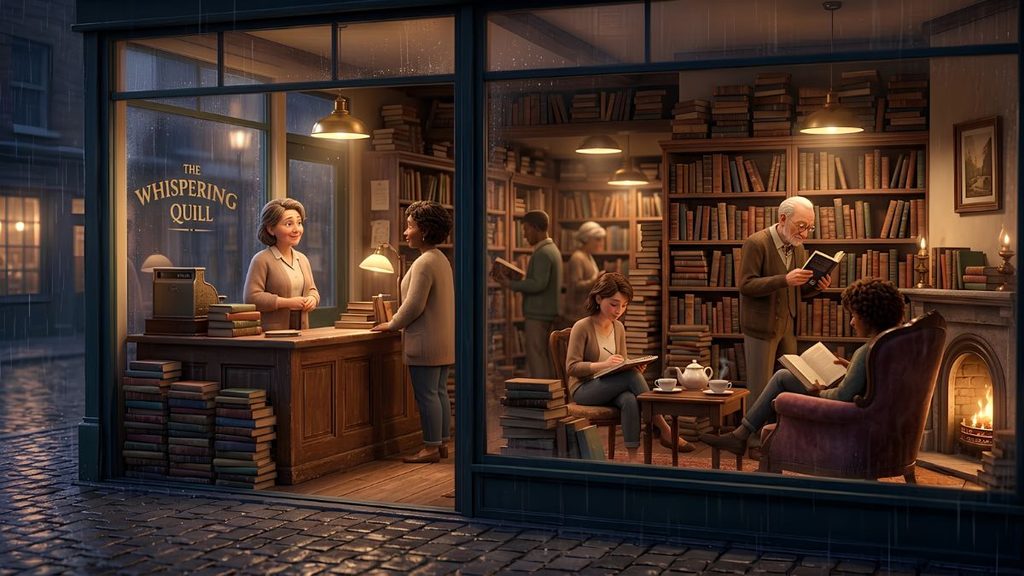
Type: Cozy Story
Rain began just before seven in the evening.
At first, it was only a light tapping against the windows of the little bookshop on Maple Street. By half past seven, the tapping had become a steady rhythm, and by eight, the narrow street outside had turned glossy beneath the yellow glow of the lamps.
Oliver stood behind the counter and looked through the front window.
The sign above the door read:
HARTLEY’S SECONDHAND BOOKS
The letters were faded.
The paint was beginning to peel.
Oliver had often thought about replacing the sign.
But he never did.
He liked the way it looked.
The bookshop had belonged to his father before him, and before that, to his grandfather. It was not large. Two people carrying umbrellas could barely pass one another in the entrance. The shelves reached almost to the ceiling, and books were stacked in places where shelves had long ago run out.
There were books on the floor.
Books beneath the counter.
Books on the windowsill.
Books beside the old armchair near the fireplace.
Oliver knew where almost everything was.
Almost.
Occasionally, a customer would ask for a book, and Oliver would spend ten minutes searching before discovering that it had somehow moved to a shelf on the opposite side of the shop.
He blamed the books.
“They rearrange themselves at night,” he often said.
Nobody believed him.
Oliver closed at nine every evening.
Except when it rained.
Rainy nights were different.
Years ago, his grandfather had made a habit of leaving the shop open for one additional hour during heavy rain.
“People should always have somewhere dry to wait,” his grandfather had once told him.
Oliver had continued the tradition.
At eight o’clock, he turned the small sign in the window around.
Instead of CLOSING AT 9, the other side read:
COME IN. THE RAIN CAN WAIT.
He smiled and returned to the counter.
A few minutes later, the bell above the door rang.
A woman entered carrying a black umbrella.
She folded it carefully and looked around.
She appeared to be in her thirties.
Her coat was damp around the shoulders, and she looked exhausted.
“Good evening,” Oliver said.
“Hello.”
“Terrible weather.”
She glanced toward the window.
“I think the weather is enjoying itself.”
Oliver laughed.
“Fair point.”
She walked slowly toward the fiction shelves.
Oliver returned to sorting a box of donated books.
Five minutes later, she approached the counter.
“Do you have anything comforting?”
Oliver looked up.
“That’s a broad category.”
“I know.”
She smiled slightly.
“I’ve had a long day.”
Oliver nodded as if he understood exactly what she meant.
He walked toward one of the shelves.
After a moment, he pulled out a small hardcover novel.
“What about this?”
She read the title.
“What’s it about?”
“A man who moves to a village, tries to live quietly, and accidentally becomes responsible for everyone else’s problems.”
The woman smiled.
“That sounds comforting?”
“It’s funny.”
“Better.”
She took the book.
“I’ll think about it.”
Before Oliver could return to the counter, the bell rang again.
This time, an elderly man entered.
He wore a brown hat and carried an umbrella that looked older than Oliver’s bookshop.
The man shook the rain from his coat.
“Evening, Mr. Hartley.”
“Good evening, Arthur.”
Arthur Bennett was one of Oliver’s regular customers.
Every Thursday, he visited the bookshop and bought a mystery novel.
Every Friday, he returned it.
Not because he had finished reading it quickly.
Arthur simply enjoyed returning books to the shelves.
“I need another mystery,” Arthur announced.
“Already?”
“The detective discovered the murderer on page two.”
Oliver frowned.
“That’s impossible.”
Arthur smiled.
“Exactly. Poor writing.”
Oliver led him toward the mystery section.
“You’ll like this one.”
Arthur examined the book.
“Does the detective survive?”
“I’m not telling you.”
“Then I’ll assume he doesn’t.”
“You’ll have to read it.”
Arthur carried the book toward the armchair near the fireplace.
The fire wasn’t real.
It was a small electric heater designed to look like one.
Arthur knew that.
But he still called it the fireplace.
The woman with the comforting novel sat in another chair nearby.
Rain continued outside.
The bookshop grew warmer.
At twenty past eight, the bell rang again.
A young man entered.
He carried a sketchbook beneath his arm.
Water dripped from his hair.
Oliver pointed toward the umbrella stand.
“You can put that anywhere you like.”
The young man looked confused.
“I don’t have an umbrella.”
“Then you’re going to need one.”
The young man laughed.
“I’m looking for a book about painting.”
Oliver nodded.
“Specific?”
“Not really.”
“That’s my favorite kind of request.”
Oliver led him toward the art section.
While they searched, the woman in the chair began reading.
Arthur turned a page in his mystery novel.
The young man found a book about landscapes.
“I’ll take this one,” he said.
Oliver looked at the cover.
“Good choice.”
“Have you read it?”
“No.”
The young man smiled.
“Then how do you know?”
Oliver pointed toward the shelves.
“I have confidence in my books.”
The young man walked toward the armchair.
All three customers were now reading.
Oliver looked around.
He liked moments like this.
The rain.
The warmth.
The sound of pages turning.
The quiet feeling that everyone had somewhere else to be but, for the moment, had decided to stay.
Then the bell rang again.
A woman entered.
She was older than the first woman and carried no bag, umbrella, or book.
She simply stepped inside and stood near the door.
Oliver smiled.
“Can I help you find something?”
She hesitated.
“Actually, I was just waiting for the rain to slow down.”
Oliver pointed toward the chairs.
“You’re welcome to wait.”
“Oh, I don’t want to disturb anyone.”
“You’re not.”
Arthur looked up.
“Sit down before you catch cold.”
The woman smiled.
“Thank you.”
She sat near the fireplace.
Oliver walked behind the counter.
A few minutes passed.
Then the young man with the sketchbook spoke.
“Does anyone mind if I draw?”
Arthur didn’t look up.
“Only if you make me look younger.”
The first woman laughed.
The older woman smiled.
The young man opened his sketchbook.
For several minutes, he drew quietly.
Oliver continued sorting books.
Then there was a loud rumble of thunder.
Everyone looked toward the window.
The rain grew heavier.
The first woman closed her book.
“Looks like we’re staying.”
Oliver smiled.
“The rain has excellent taste.”
Arthur closed his mystery novel.
“I’ve solved it.”
Oliver looked surprised.
“Already?”
Arthur nodded.
“The gardener.”
“There is no gardener.”
“Exactly.”
The young man laughed so hard that his pencil rolled beneath a shelf.
He knelt to retrieve it.
Then stopped.
“There’s something under here.”
Oliver walked over.
“What?”
The young man pulled out an old photograph.
It was covered in dust.
Everyone gathered around.
The photograph showed the bookshop many years earlier.
The shelves were the same.
The counter was the same.
Even the old armchair was there.
But the people in the photograph were strangers to Oliver.
Except for one.
His grandfather stood behind the counter.
Beside him was a group of people holding cups of tea.
Oliver turned the photograph over.
There was writing on the back.
Rainy Night, October 1987.
Oliver smiled.
Arthur adjusted his glasses.
“I remember that night.”
Everyone turned.
“You do?”
Arthur nodded.
“I was there.”
Oliver stared.
Arthur pointed toward a younger man in the photograph.
“That’s me.”
“You had hair.”
Arthur looked offended.
“I still have hair.”
“Some.”
Arthur ignored him.
“It rained all night.”
He looked at the photograph.
“Your grandfather kept the shop open.”
“What happened?”
Arthur smiled.
“About eight people got trapped inside.”
“Like tonight?”
“Exactly.”
The older woman leaned closer.
“Did you know everyone?”
“No.”
“Then what did you do?”
Arthur looked toward the fireplace.
“Talked.”
Oliver waited.
Arthur continued.
“We talked about books. Then music. Then food. Someone brought biscuits. Someone else found an old board game.”
Oliver looked around.
“Where’s the board game?”
Arthur pointed toward a shelf.
“Second shelf from the bottom.”
Oliver walked over.
Sure enough, an old wooden box was sitting behind several books.
He pulled it out.
Dust covered the lid.
The young man smiled.
“Should we play?”
The first woman looked at her book.
Then at the rain.
“Why not?”
The older woman nodded.
Arthur smiled.
“I was unbeatable in 1987.”
Oliver placed the game on a table.
“You lost, according to my grandfather.”
Arthur frowned.
“He exaggerated.”
Soon, the four customers were playing.
Oliver joined them after closing the cash register.
Nobody seemed interested in leaving.
The rain continued.
They learned each other’s names.
The first woman was Anna.
She was a teacher at a nearby school.
The young man was Leo.
He was an artist who had recently moved into the city.
The older woman was Margaret.
She had once worked in the town library.
Arthur, of course, needed no introduction.
“I’m Arthur,” he said.
“I read mysteries and judge people who write bad endings.”
Everyone laughed.
The game continued.
Anna lost first.
She accused Arthur of cheating.
“I don’t need to cheat.”
“You moved your piece.”
“I adjusted it.”
“After rolling the dice.”
“Technical detail.”
Leo sketched everyone while they played.
Oliver watched them.
The bookshop had changed.
A few hours earlier, it had been a quiet room filled with strangers.
Now it sounded like a small gathering among old friends.
At half past nine, Oliver made tea.
He found a tin of biscuits.
Arthur opened it.
“These are good.”
“They’re three months old.”
Arthur stopped chewing.
Oliver smiled.
“I’m joking.”
At least, Anna hoped he was.
After tea, Margaret walked toward one of the shelves.
She pulled out a book.
Then stopped.
“What is it?” Oliver asked.
She opened it carefully.
“A photograph.”
Inside was an old black-and-white picture.
It showed two children standing outside the bookshop.
On the back was written:
Margaret and Daniel, Summer 1969.
Margaret covered her mouth.
“That’s me.”
Everyone gathered around again.
Oliver looked at the photograph.
“Who’s Daniel?”
“My brother.”
“Where is he now?”
Margaret smiled sadly.
“Far away. We haven’t spoken in years.”
Arthur looked at her.
“You should call him.”
Margaret laughed softly.
“After all this time?”
Arthur shrugged.
“That’s what phones are for.”
Anna nodded.
“He’s right.”
Margaret looked at the photograph.
“Maybe.”
The rain began slowing around ten.
Nobody noticed immediately.
They were too busy talking.
Leo had finished his drawing.
It showed everyone around the table.
Oliver stood in the background holding a teapot.
“That’s wonderful,” Anna said.
Leo smiled.
“It’s yours.”
He handed the drawing to Oliver.
Oliver stared at it.
“I’ll put it on the wall.”
“You should.”
Arthur pointed toward the photograph from 1987.
“Put them together.”
Oliver looked at both pictures.
He smiled.
“Good idea.”
Eventually, the rain became a light drizzle.
One by one, the customers stood.
Anna bought her novel.
Arthur bought his mystery.
Leo bought the art book.
Margaret chose nothing.
Instead, she stood beside the counter for a moment.
“Thank you.”
Oliver smiled.
“For what?”
“For keeping the door open.”
Oliver looked toward the window.
“The rain can wait.”
She nodded.
Then she left.
After everyone had gone, Oliver locked the door.
The bookshop was quiet again.
He collected the cups.
He placed the board game back on the shelf.
Then he noticed something on the counter.
A folded piece of paper.
He opened it.
It was from Margaret.
I’m going to call my brother tomorrow.
Below that, she had written:
Thank you for keeping the door open.
Oliver smiled.
He placed the note beside the cash register.
Then he looked at the two photographs.
One from 1987.
One from tonight.
Both showed strangers brought together by rain.
Oliver switched off the lights.
The bookshop became dark except for the lamp in the window.
Outside, the street was wet and shining.
Oliver locked the door and stood beneath the awning.
He looked at the sign.
COME IN. THE RAIN CAN WAIT.
Tomorrow morning, he would turn it around.
The shop would return to normal.
Customers would browse.
Books would be bought.
Arthur would probably complain about another mystery novel.
But Oliver knew something.
The shop wasn’t really just a place where books were sold.
Sometimes it was a place where people waited.
Sometimes it was a place where strangers met.
Sometimes it was a place where an old memory was found between dusty shelves.
And sometimes, all a person needed was a warm room and an open door.
Oliver walked home beneath the quiet night sky.
Behind him, the little bookshop stood peacefully on Maple Street.
Rainwater reflected the streetlamps.
Somewhere in the distance, a train passed.
The city was slowly becoming quiet.
Oliver smiled.
Tomorrow would bring another ordinary day.
But ordinary days, he had learned, could become memorable when someone decided to leave the door open a little longer.
3. The Garden Above the Clouds

Type: Gentle Fantasy Story
Mara had always been fascinated by places that seemed to exist somewhere between imagination and reality.
As a child, she used to believe that the moon followed her home.
When she was older, she stopped believing that.
Mostly.
She became an architect, moved to a busy city, and spent most of her days designing buildings, reviewing plans, answering emails, and sitting in meetings.
Her life was comfortable.
Her apartment was pleasant.
Her work was successful.
But somewhere along the way, everything had become hurried.
She ate breakfast while checking messages.
She walked while making phone calls.
She watched sunsets through office windows.
Even weekends became lists of things that needed to be completed.
One Friday evening, Mara returned home later than usual.
She placed her bag beside the door.
She removed her shoes.
Then she stood quietly in the middle of her apartment.
For the first time that day, there was no noise.
No traffic.
No phone calls.
No emails.
Just silence.
Mara walked toward the window.
The city stretched below her.
Thousands of lights filled the streets.
She watched them for several minutes.
Then she noticed something strange.
A small staircase stood behind the apartment building.
She had lived there for six years.
She had never seen it before.
Mara frowned.
She stepped outside.
The staircase was narrow and made of old stone.
It disappeared upward between two walls.
There was no sign.
No door.
No explanation.
Just stairs.
Mara looked back toward her apartment.
Then toward the staircase.
She should have gone inside.
Instead, she climbed.
The first few steps were ordinary.
Then the city sounds began fading.
The traffic became quieter.
The wind became softer.
Mara continued.
The staircase seemed to go on much longer than it should have.
She passed the fifth floor.
Then the tenth.
Then the twentieth.
But her apartment building didn’t have twenty floors.
She stopped.
She looked down.
The staircase behind her seemed to disappear into mist.
Mara turned around.
Above her was a soft golden light.
She continued climbing.
At last, she reached a small wooden door.
She pushed it open.
And stopped.
She was standing above the clouds.
There was a garden.
Not a rooftop garden.
Not a balcony.
A real garden floating in the night sky.
Trees grew from patches of silver soil.
Flowers glowed softly.
Small streams flowed between moss-covered stones.
Lanterns drifted through the air without strings.
Beyond the garden, clouds stretched toward the horizon.
The moon appeared enormous.
Mara stared.
She forgot to breathe for a moment.
“Beautiful, isn’t it?”
She turned.
An elderly man stood beside a flowering tree.
He wore a simple green coat.
His silver hair moved gently in the wind.
“Who are you?” Mara asked.
“My name is Elias.”
“Where am I?”
Elias smiled.
“That’s a difficult question.”
“Is this real?”
“Does it matter?”
Mara looked around.
“No.”
“Then perhaps it’s real enough.”
She laughed softly.
“I think I’m dreaming.”
“Many people say that.”
“Who are the other people?”
“There aren’t any tonight.”
Mara looked surprised.
“Then why are you here?”
“I take care of the garden.”
Elias walked toward a row of flowers.
“Would you like to see something?”
Mara followed.
The flowers were unlike anything she had ever seen.
Some were blue.
Some silver.
Others were almost transparent.
One flower looked like it contained a tiny sunrise.
Another seemed filled with stars.
“What are they?”
“Memories.”
Mara frowned.
“Memories?”
Elias nodded.
“This garden grows where people remember something important.”
Mara looked at the flowers again.
“Whose memories?”
“Anyone who has visited.”
Mara touched one gently.
The flower brightened.
Suddenly, she heard laughter.
A child’s laughter.
She pulled her hand away.
“What was that?”
“A memory.”
Mara looked at Elias.
“Whose?”
“Yours.”
She stared at the flower.
Another sound came from it.
Her mother’s voice.
Mara’s eyes widened.
She hadn’t heard that voice in years.
The memory was from when she was eight.
Her mother was teaching her how to plant flowers.
They were kneeling in a small garden behind their old house.
Mara remembered the sunlight.
The smell of soil.
Her mother’s hands.
She smiled.
“I had forgotten this.”
Elias nodded.
“That’s why the garden exists.”
Mara walked slowly between the flowers.
Every few steps, another memory appeared.
Her father reading beside the fireplace.
Her grandmother baking bread.
A childhood friend riding bicycles with her.
A summer afternoon beside a lake.
Her first day at university.
Her first apartment.
A rainy evening spent talking with someone she had once loved.
Mara stopped.
She hadn’t thought about that memory in years.
The person was gone from her life now.
But the memory remained.
She smiled.
“Why do we forget these things?”
Elias sat on a wooden bench.
“Because life becomes noisy.”
Mara sat beside him.
“That sounds true.”
“People often remember what they need to remember.”
“What about things they want to remember?”
“Those sometimes require attention.”
Mara looked toward the flowers.
“I’ve been too busy.”
Elias nodded.
“Many people are.”
They sat quietly.
A breeze moved through the garden.
Tiny silver leaves drifted through the air.
Mara watched one land beside her.
“What happens here during the day?”
“The garden sleeps.”
“And at night?”
“It remembers.”
Mara smiled.
“That sounds peaceful.”
“It is.”
Elias stood.
“Would you like to see the lake?”
“There is a lake?”
“Of course.”
He led her down a winding path.
They passed trees whose branches were covered in tiny lights.
Soon, they reached a small lake.
The water was perfectly still.
The moon reflected across its surface.
Mara looked into it.
Instead of seeing her reflection, she saw herself as a child.
She was running through a field.
Then she saw herself as a teenager.
Then as a young woman.
Then herself now.
All the different versions of her seemed to exist together.
Mara felt strangely emotional.
“Which one is me?”
Elias smiled.
“All of them.”
She watched the water.
“I’ve spent so much time trying to become someone else.”
“Who?”
“Someone successful.”
“And are you?”
“Yes.”
“Then why do you look tired?”
Mara laughed.
“Because success is exhausting.”
Elias sat beside the lake.
“Perhaps you have confused being busy with being alive.”
Mara thought about that.
She couldn’t disagree.
For years, she had measured her days by accomplishments.
Emails answered.
Projects completed.
Meetings attended.
Deadlines met.
She had forgotten to measure other things.
Conversations.
Walks.
Meals.
Sunsets.
Laughter.
Silence.
“How do I change that?” she asked.
Elias smiled.
“Start small.”
“How small?”
“Notice one thing every day.”
“One thing?”
“One thing you would normally overlook.”
Mara nodded.
She liked the idea.
They returned to the garden.
The night was beginning to fade.
A soft light appeared along the horizon.
“Dawn,” Elias said.
Mara looked toward the clouds.
“I have to go?”
“Yes.”
She felt strangely disappointed.
“Can I come back?”
Elias smiled.
“The staircase appears when you need it.”
“When I need it?”
“Not when you’re bored.”
Mara laughed.
“Fair enough.”
Elias walked toward one particular flower.
It was small and silver.
He gently removed a seed.
“Take this.”
Mara accepted it.
“What is it?”
“A reminder.”
“Of what?”
“That beautiful things need time.”
She closed her hand around the seed.
“Where should I plant it?”
“Somewhere you will see it every day.”
Mara thanked him.
Then she walked toward the wooden door.
Before leaving, she turned.
“Elias?”
“Yes?”
“Do you live here alone?”
He smiled.
“No.”
“Who lives here?”
“Everyone who remembers.”
The door closed behind her.
Mara found herself standing at the bottom of the staircase.
The city was still dark.
She looked up.
There was no staircase.
Only the wall behind her apartment building.
She walked home.
Everything seemed strangely quiet.
She placed the silver seed in a small pot beside her kitchen window.
Then she went to sleep.
The next morning, she woke to sunlight.
For a moment, she wondered if everything had been a dream.
Then she saw the pot.
A tiny silver shoot had appeared.
Mara smiled.
She touched it gently.
Nothing happened.
But she didn’t need it to.
She understood.
That morning, she did something unusual.
She ate breakfast without checking her phone.
She opened the window.
She listened to the city.
Birds were singing somewhere between the buildings.
She noticed the sunlight on the kitchen floor.
She stood there for several minutes.
Then she went to work.
But things felt slightly different.
At lunchtime, she walked outside.
Instead of eating at her desk, she sat beneath a tree.
She watched people pass.
She noticed an old man feeding pigeons.
A child chasing a yellow balloon.
A woman laughing into her phone.
None of these things were important.
And yet they made the afternoon feel different.
That evening, Mara returned home.
The silver plant had grown another leaf.
She smiled.
Days passed.
The plant continued growing.
So did Mara’s habit of noticing things.
She noticed rain.
She noticed flowers.
She noticed music coming from apartments nearby.
She noticed how warm tea tasted when she drank it slowly.
She noticed how often people smiled when someone simply listened to them.
Her life didn’t change overnight.
She still had deadlines.
Still had meetings.
Still had difficult days.
But she began leaving room between things.
Room to breathe.
Room to think.
Room to remember.
One year later, Mara’s mother would have celebrated her birthday.
Mara decided to take the day off.
She visited the garden center.
She bought flowers.
Then she planted them on her balcony.
She spent the afternoon there.
No phone.
No laptop.
Just flowers, sunlight, and memories.
That evening, she looked toward the sky.
The moon was bright.
For a moment, she thought she saw a staircase rising above the buildings.
She smiled.
“Not tonight.”
The staircase disappeared.
Years later, Mara would still tell people about the garden.
Most would laugh.
Some would assume it had been a dream.
Mara never argued.
She didn’t need anyone to believe her.
She knew what she had learned there.
Life was not only the big moments.
It was also the small ones.
A warm cup of tea.
Rain against a window.
A friend’s laughter.
A parent’s voice.
A quiet morning.
A flower opening.
A memory returning unexpectedly.
These things were easy to overlook.
But they were often the things that made life feel meaningful.
And every night, before going to bed, Mara would look at the silver plant beside her window.
It had grown into a beautiful tree.
Its leaves shimmered softly under the moonlight.
She would turn off the lights.
Open the window.
And whisper:
“Thank you.”
Sometimes, when the night was very quiet, she thought she could hear a distant voice carried by the wind.
“Remember.”
And Mara always smiled.
Because she finally understood.
The garden had never really been above the clouds.
It had simply shown her how to look at the world differently.
And once you learned how to notice the beautiful things around you, every ordinary day could contain a little bit of magic.
4. The House Beside the Lake

Type: Nature Story
Thomas had spent most of his adult life surrounded by noise.
Not the kind of noise that people usually complain about.
There were no constant arguments or loud parties.
His noise was quieter.
Emails arriving before breakfast.
Phone calls during lunch.
Traffic outside his apartment.
Messages from colleagues.
Calendar reminders.
Deadlines.
Meetings.
Notifications.
Questions that always seemed to require immediate answers.
At forty-two, Thomas was successful by almost every ordinary measure.
He had a good apartment in the city.
A stable career.
A comfortable income.
A collection of books he rarely had time to read.
He had even learned to make excellent coffee.
But recently, he had begun feeling tired in a way that sleep didn’t seem to fix.
One Friday afternoon, he closed his laptop after finishing a difficult project.
His colleague asked, “What are you doing this weekend?”
Thomas almost answered, “Catching up on work.”
Instead, he said, “Nothing.”
The word surprised him.
Nothing.
He went home.
That evening, he searched for a place where he could spend a few days alone.
He didn’t want a resort.
He didn’t want a city hotel.
He didn’t want sightseeing.
He wanted somewhere quiet.
After several minutes of searching, he found a small wooden cabin beside a lake in the northern countryside.
The photographs showed a simple house surrounded by pine trees.
There was a fireplace.
A wooden porch.
A narrow path leading toward the water.
And almost no other buildings nearby.
Thomas booked it for one week.
The next morning, he drove away from the city.
For the first hour, he kept the radio on.
Then he turned it off.
For another hour, he listened to music.
Then he turned that off too.
Eventually, there was only the sound of the road.
The further he traveled, the fewer cars he saw.
Buildings became smaller.
Fields became wider.
The hills grew taller.
By late afternoon, he reached the lake.
The cabin stood beneath a group of tall pine trees.
It was exactly as it had appeared in the photographs.
Maybe even better.
The owner, a quiet woman named Helen, met him at the gate.
“Everything you need is inside,” she said.
“Is there Wi-Fi?”
She smiled.
“Sometimes.”
Thomas looked at her.
“Sometimes?”
“When the weather feels generous.”
He laughed.
“I suppose that’s fair.”
Helen handed him the key.
“There’s a grocery store about twenty minutes away.”
“Anything else I should know?”
She thought for a moment.
“Don’t feed the squirrels.”
Thomas smiled.
“Why?”
“They become demanding.”
Then she left.
Thomas carried his bags inside.
The cabin was warm and simple.
A fireplace stood against one wall.
A small kitchen occupied the corner.
There was a wooden table beside the window.
A comfortable chair faced the lake.
Thomas placed his phone on the table.
Then picked it up again.
He checked his messages.
There were seven.
He answered two.
Then stopped.
He remembered why he had come.
He turned the phone off.
The silence felt strange.
He didn’t know what to do with himself.
So he made dinner.
He ate at the table.
Then he washed the dishes.
Then he sat in the chair beside the window.
Outside, the lake reflected the evening sky.
The surface was almost perfectly still.
Thomas watched it until the sun disappeared.
Then he went to bed.
The next morning, he woke at 5:47.
He had no alarm.
He didn’t know why he was awake.
For several minutes, he simply stared at the ceiling.
Then he heard something.
Birdsong.
Thomas sat up.
He hadn’t heard birds that clearly in years.
He got dressed and walked outside.
The air was cold.
Mist hovered above the lake.
The sky was beginning to brighten.
Thomas walked toward the water.
He sat on a large stone.
The sunrise slowly appeared.
First, the horizon became pale.
Then pink.
Then gold.
The lake changed with it.
Thomas took out his phone.
He almost took a photograph.
Then he stopped.
Instead, he watched.
Nothing happened.
And somehow, that was exactly what he needed.
Later that morning, he walked through the forest.
The path was covered with pine needles.
Every few steps, he heard something move in the trees.
He stopped.
A squirrel stared at him.
Thomas remembered Helen’s warning.
“Don’t ask,” he said.
The squirrel continued staring.
Thomas kept walking.
He found a fallen tree beside a small stream.
He sat there for nearly an hour.
He realized he hadn’t checked the time.
That felt unusual.
When he returned to the cabin, he made lunch.
Then he read a book.
It was one he had bought three years earlier.
He had never opened it.
He read thirty pages.
Then forty.
By evening, he had finished half.
He smiled.
Maybe this was what rest felt like.
The following day, it rained.
Thomas woke to the sound of water against the roof.
He made coffee.
Then sat beside the fireplace.
He opened his laptop.
He stared at it.
Then closed it.
He laughed at himself.
“You’re allowed to do nothing,” he said aloud.
The cabin didn’t answer.
But the rain did.
For the rest of the day, Thomas read.
He cooked soup.
He watched the rain.
He slept for an hour.
When he woke, the rain was still falling.
Something about the sound made him remember his childhood.
His parents had lived in a small house then.
Whenever it rained, his father would make tea.
His mother would sit near the window and read.
Thomas and his sister would build forts from blankets.
He hadn’t thought about those afternoons in years.
He wondered why.
Perhaps because life had become too busy to remember them.
That evening, he found an old notebook in a drawer.
On the first page was a guestbook.
Visitors had written messages over many years.
Thomas read a few.
“We came here to escape the city.”
“Best weekend we’ve had in years.”
“The lake is beautiful.”
“Saw a deer this morning.”
“Didn’t want to leave.”
Thomas smiled.
He took a pen.
He considered writing something.
Then he closed the notebook.
Not yet.
On the fourth morning, he saw the deer.
It stood near the edge of the lake.
A young deer.
Still.
Quiet.
Thomas remained on the porch.
He didn’t move.
The deer looked toward him.
For several seconds, they simply watched each other.
Then it walked into the trees.
Thomas smiled.
He wondered how many moments like this he had missed in his life because he was looking at a screen.
That afternoon, he walked farther than before.
The trail climbed a small hill.
At the top was a clearing.
From there, he could see the entire lake.
The cabin looked tiny below.
The water stretched toward the mountains.
Thomas sat on the grass.
For the first time in months, perhaps years, he felt completely still.
He thought about his career.
He thought about the projects he had worried about.
He thought about all the deadlines that had seemed so important.
Most of them suddenly felt very small.
He wasn’t unhappy with his life.
That was the strange part.
He simply hadn’t been present for it.
He had been constantly preparing for the next thing.
The next meeting.
The next promotion.
The next project.
The next weekend.
The next holiday.
He had spent so much time waiting for life to become easier that he had forgotten to live the life he already had.
When Thomas returned to the cabin, he opened his notebook.
This time, he wrote.
I came here because I was tired.
He paused.
Then continued.
I thought I needed to escape my life.
Another pause.
Maybe I just needed to stop rushing through it.
He closed the notebook.
That evening, he built a fire.
He cooked pasta.
He poured himself a glass of water.
Then he sat outside beneath the stars.
There were no city lights.
The sky seemed enormous.
He could see more stars than he had ever noticed before.
He lay back in the wooden chair.
For a while, he simply watched.
Then he heard footsteps.
Helen appeared on the path.
“You survived the squirrels?” she asked.
Thomas laughed.
“Just barely.”
She sat on the porch.
“How are you doing?”
“Better.”
“Good.”
She looked toward the lake.
“Most people come here because they want to get away from something.”
“What do you think they find?”
Helen smiled.
“Usually themselves.”
Thomas laughed softly.
“That’s a little dramatic.”
“Maybe.”
She stood.
“Enjoy the rest of your evening.”
“Thank you.”
After she left, Thomas remained outside.
He thought about what she had said.
Perhaps it wasn’t dramatic.
Perhaps it was true.
The final day arrived sooner than he expected.
Thomas packed his bags.
He walked through each room slowly.
The cabin had become familiar.
The fireplace.
The wooden table.
The chair by the window.
The little kitchen.
The porch.
Before leaving, he walked to the lake.
The morning was calm.
He sat on the same stone where he had watched the sunrise.
A soft breeze moved across the water.
Thomas took out his phone.
He turned it on.
There were dozens of messages.
Emails.
Notifications.
Reminders.
For a moment, he felt the old pressure returning.
Then he turned the phone off again.
He wasn’t running away.
He would answer everything eventually.
But not now.
He stood and walked back toward the cabin.
Before leaving, he opened the guestbook.
This time, he knew what he wanted to write.
He turned to a blank page.
Then wrote:
I came here looking for something to do.
He smiled.
I found something better.
He continued.
I learned how to be still.
Thomas closed the book.
He returned the key.
Then began the drive home.
The city looked different when he returned.
The traffic was still there.
The buildings were still tall.
People were still rushing.
His phone still contained unanswered messages.
But Thomas was different.
On Monday morning, he arrived at work.
His colleague asked:
“Did you have a good weekend?”
Thomas smiled.
“I had a very good week.”
“What did you do?”
Thomas thought about the sunrise.
The rain.
The forest.
The deer.
The stars.
“Not much.”
His colleague laughed.
“That sounds perfect.”
Thomas nodded.
“It was.”
Over the following weeks, he changed small things.
He stopped checking emails during breakfast.
He began taking walks after work.
He kept his phone away during dinner.
On Sundays, he sometimes sat near the window and read.
He didn’t become a completely different person.
He still worked hard.
He still had stressful days.
He still occasionally answered emails too late at night.
But now he noticed when he was rushing.
And when he noticed, he slowed down.
Months later, Thomas returned to the lake.
The cabin looked exactly the same.
The pine trees had grown a little.
The lake was calm.
He placed his bags inside.
Then walked directly toward the water.
He sat on the familiar stone.
The sun was setting.
A deer appeared between the trees.
Thomas smiled.
“Hello again.”
The deer watched him.
Then disappeared.
Thomas remained by the lake until the sky turned dark.
He didn’t take a photograph.
He didn’t check the time.
He didn’t wonder what he should be doing next.
He simply sat there.
Listening to the water.
Listening to the wind.
Listening to the quiet.
And for once, Thomas understood that doing nothing was not wasting time.
Sometimes, doing nothing was how you finally noticed where you were.
That night, he slept beside the lake with the window slightly open.
Rain began falling sometime after midnight.
The sound traveled softly across the room.
Thomas smiled in his sleep.
The city felt very far away.
And for the first time in a long time, he wasn’t thinking about tomorrow.
He was simply resting.
5. The Cat Who Thought He Owned the Hotel
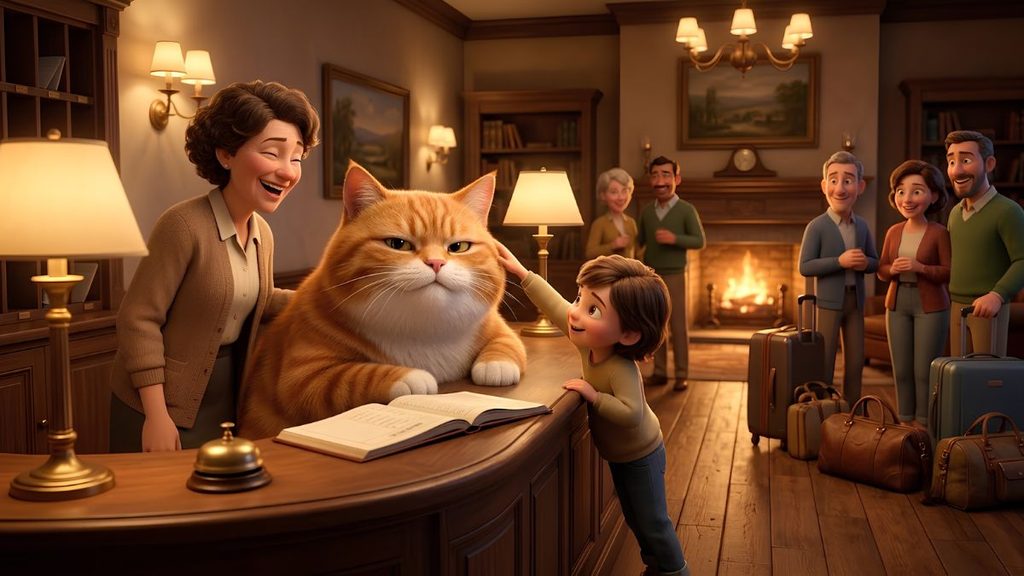
Type: Funny Bedtime Story
Mr. Biscuit had never doubted his importance.
He was an enormous orange cat with a white patch beneath his chin, green eyes, a thick tail, and an expression that suggested he had been disappointed by humanity for many years.
In reality, Mr. Biscuit was only eight years old.
But he behaved like an elderly gentleman who had inherited half the countryside.
He lived at the Willowbrook Hotel, a small family-run inn surrounded by green fields and narrow country roads.
The hotel belonged to Clara Bennett, a cheerful woman in her fifties who had inherited the property from her parents.
Clara officially considered Mr. Biscuit her cat.
Mr. Biscuit strongly disagreed.
He considered Clara his assistant.
The distinction was important.
Every morning at seven, Mr. Biscuit walked through the hotel.
He inspected the dining room.
He checked the kitchen.
He examined the reception desk.
Then he sat beside the front door and watched the first guests arrive.
Clara had tried to explain to him that guests did not need to be inspected.
Mr. Biscuit ignored her.
He had his responsibilities.
One Monday morning, Clara found him sitting behind the reception desk.
“You’re not working here,” she said.
Mr. Biscuit looked at her.
“Get down.”
He remained where he was.
“Mr. Biscuit.”
He slowly blinked.
Clara sighed.
“Fine.”
She picked up the phone.
Mr. Biscuit immediately placed one paw on it.
“You’re impossible.”
He looked pleased.
The hotel had been in Clara’s family for nearly forty years.
It wasn’t large.
There were eighteen rooms.
A small restaurant.
A garden.
A lounge with a fireplace.
And a library containing books that had belonged to Clara’s parents.
Guests came for the quiet atmosphere.
They liked the old wooden floors.
The homemade breakfasts.
The fireplaces.
The garden.
And, increasingly, they liked Mr. Biscuit.
The hotel website had never mentioned him.
But guests often posted photographs of him.
One review said:
“Lovely hotel. Excellent breakfast. Orange cat is clearly the manager.”
Another said:
“Five stars. The cat checked my luggage personally.”
Clara had laughed when she first read it.
Then she noticed that bookings were increasing.
One evening, a guest asked:
“Is Mr. Biscuit available for photographs?”
Clara looked toward the cat.
He was sleeping on a chair.
“I don’t think he has a schedule.”
The guest nodded seriously.
“He’s very professional.”
Clara laughed.
Mr. Biscuit opened one eye.
He seemed pleased.
Then came the evening of the food critic.
Clara had been nervous all week.
A famous restaurant reviewer named Julian Hart had booked a room.
Nobody knew exactly when he would arrive.
He had simply said that he was visiting the area to review several countryside restaurants.
Clara’s chef, Marcus, had been preparing for days.
The dining room had been polished.
The menus had been rewritten.
The wine glasses were spotless.
Clara had even bought new tablecloths.
At six o’clock, she stood in the kitchen.
“Everything ready?”
Marcus nodded.
“Everything.”
At six fifteen, Mr. Biscuit walked into the kitchen.
He looked at the food.
Marcus stopped.
“No.”
Mr. Biscuit looked at him.
“Absolutely not.”
The cat continued walking.
He jumped onto a chair.
Then onto the counter.
Marcus immediately lifted him down.
“You are not helping.”
Mr. Biscuit sat on the floor.
He looked offended.
Clara laughed.
“Leave him alone.”
Marcus shook his head.
“He thinks he owns the kitchen.”
“He thinks he owns the hotel.”
Mr. Biscuit’s ears moved.
Clara pointed at him.
“See? He knows we’re talking about him.”
At seven, the restaurant opened.
Guests began arriving.
Mr. Biscuit stationed himself near the entrance.
He greeted everyone.
One couple walked in.
Mr. Biscuit sniffed the woman’s coat.
Another guest scratched his head.
Mr. Biscuit accepted the attention.
Then Julian Hart arrived.
He was a tall man wearing a dark coat.
He looked around the restaurant carefully.
Clara approached him.
“Good evening. Welcome to Willowbrook.”
“Thank you.”
“I’m Clara Bennett.”
“Julian Hart.”
“I know.”
Julian smiled.
“I imagine you do.”
He was polite but serious.
Clara showed him to his table.
Mr. Biscuit followed.
Julian looked down.
“And who is this?”
“Mr. Biscuit.”
Julian raised an eyebrow.
“Does he belong to the hotel?”
Clara smiled.
“According to him.”
Mr. Biscuit jumped onto the empty chair beside Julian.
Julian laughed.
“Interesting.”
Clara gently lifted him down.
“I’m sorry.”
Mr. Biscuit immediately returned.
Julian laughed again.
“Leave him.”
Clara hesitated.
“Are you sure?”
“Yes.”
Mr. Biscuit sat beside him.
He looked at the menu.
Julian looked at the cat.
The cat looked at Julian.
It was the beginning of a professional relationship.
The evening started well.
The first course was served.
A mushroom soup with fresh herbs.
Julian tasted it.
He nodded.
“Excellent.”
Clara breathed quietly.
The main course followed.
Roasted chicken with potatoes and vegetables from the hotel garden.
Julian took a bite.
Then another.
Mr. Biscuit watched.
Julian looked at him.
“You approve?”
Mr. Biscuit blinked.
Julian smiled.
“Fair enough.”
Then disaster struck.
Marcus had placed a basket of freshly baked bread on the side table.
Mr. Biscuit saw it.
He stood.
He walked toward it.
Clara noticed.
“Mr. Biscuit.”
Too late.
He jumped.
The basket tipped.
Three bread rolls rolled across the floor.
One landed beneath a chair.
Another stopped beside Julian.
The third landed directly in front of a guest.
The restaurant went silent.
Mr. Biscuit sat proudly in the middle of the room.
Clara closed her eyes.
“I’m so sorry.”
Julian started laughing.
Then the other guests laughed.
Even Marcus laughed.
Clara picked up the bread.
“Mr. Biscuit.”
The cat walked away as if nothing had happened.
Later that evening, Clara found him in the lounge.
He was sitting beneath the fireplace.
She sat beside him.
“You embarrassed me.”
Mr. Biscuit yawned.
“You did.”
He looked at her.
“But I suppose everyone had fun.”
Mr. Biscuit curled his tail around his paws.
Clara smiled.
“You know, you’re lucky you’re cute.”
He closed his eyes.
The next morning, Clara discovered that Julian had left a note at reception.
She opened it.
Excellent food. Wonderful atmosphere. Exceptional cat.
She laughed.
Then she noticed something else.
A newspaper had been delivered.
The hotel was mentioned in an article.
Not the review.
Not yet.
But a small travel column had described Willowbrook as:
“The countryside hotel with the cat who appears to run everything.”
Clara stared at the headline.
Then looked toward Mr. Biscuit.
He was asleep on the reception desk.
“You’re famous.”
Mr. Biscuit didn’t move.
Over the following weeks, more guests began asking about him.
One wanted to know his favorite chair.
Another wanted to know whether he liked children.
Someone asked if he had a favorite room.
Clara invented answers.
“Room seven.”
“Why?”
“He likes the afternoon sunlight.”
Nobody questioned this.
Then a family arrived with a little girl named Sophie.
Sophie was shy.
She stayed close to her mother.
She didn’t want to eat in the restaurant.
She didn’t want to explore the garden.
She sat quietly in the lounge.
Mr. Biscuit noticed.
He walked over.
He sat beside her.
Sophie looked down.
“Hello.”
Mr. Biscuit blinked.
She gently touched his fur.
He didn’t move.
After a few minutes, she smiled.
Clara watched from across the room.
Sophie eventually whispered something.
“What did you say?” her mother asked.
“I think he likes me.”
Clara smiled.
“I think he does.”
Mr. Biscuit stayed beside Sophie for most of the afternoon.
By dinner, she was talking.
She told Clara about school.
She showed her mother a drawing.
She even asked to help set the tables.
Mr. Biscuit had done nothing except sit beside her.
But somehow, that was enough.
Clara began noticing things like this.
Mr. Biscuit seemed to know when someone needed company.
He slept beside elderly guests reading in the lounge.
He followed couples into the garden.
He sat near people eating alone.
He waited outside the rooms of guests who had children.
He never seemed to force himself into anyone’s space.
He simply appeared.
As though he understood when he was needed.
One winter evening, the hotel became unusually busy.
A snowstorm had closed several roads.
Guests who had planned to travel farther were forced to stay at Willowbrook.
Clara suddenly had thirty people in the hotel.
The kitchen worked late.
The fireplaces burned constantly.
Guests gathered in the lounge.
Mr. Biscuit was delighted.
He walked through the room like a host at a private party.
A man played the piano.
Someone brought out a board game.
Children built a blanket fort.
Clara served hot chocolate.
For hours, the hotel felt less like a business and more like a large family home.
Mr. Biscuit eventually climbed onto a chair near the fireplace.
He watched everyone.
Clara sat beside him.
“You like this, don’t you?”
He closed his eyes.
“I knew it.”
The next morning, the snow had stopped.
Guests began leaving.
Before departing, many stopped to say goodbye to Mr. Biscuit.
One child hugged him.
An elderly woman gave him a small piece of cheese.
A businessman took a photograph.
By noon, the hotel was quiet again.
Clara looked around the lounge.
The sudden silence felt strange.
Mr. Biscuit sat beside the fireplace.
“You miss them?”
He opened one eye.
Clara smiled.
“Me too.”
A few months later, the official review from Julian Hart was published.
Clara was nervous when she opened it.
She read the first paragraph.
Then the second.
Then the third.
She smiled.
The food received high praise.
The atmosphere received even more.
But the final paragraph made her laugh.
Julian had written:
“Willowbrook offers excellent food, peaceful rooms, warm hospitality, and one of the most confident orange cats I have ever encountered. Whether Mr. Biscuit is technically employed by the hotel remains unclear. His management style, however, appears highly effective.”
The review became widely shared.
Bookings increased.
People started arriving specifically to meet Mr. Biscuit.
Clara eventually put a photograph of him on the hotel’s website.
Underneath it, she wrote:
Mr. Biscuit
General Manager
Available when he feels like it
It became the most popular page on the website.
Years passed.
Mr. Biscuit grew older.
He slept more.
He still inspected the hotel every morning.
But he no longer jumped onto the reception desk.
Instead, he preferred the chair beside the fireplace.
Guests still greeted him.
Children still whispered to him.
Visitors still took photographs.
And Clara still called him impossible.
One evening, after closing the restaurant, Clara found Mr. Biscuit sitting outside beneath the stars.
She sat beside him.
“You know,” she said, “I never planned any of this.”
Mr. Biscuit looked toward the garden.
“I thought I was running a hotel.”
He blinked.
“But apparently you were.”
The cat stretched.
Clara laughed.
“Do you know what I like most about you?”
Mr. Biscuit looked at her.
“You make people slow down.”
She scratched behind his ear.
“Everyone arrives here carrying something.”
“Work.”
“Worries.”
“Loneliness.”
“Plans.”
“And somehow, they sit down beside you.”
Mr. Biscuit closed his eyes.
“And for a little while, they forget everything else.”
The night was quiet.
The hotel windows glowed behind them.
Somewhere inside, guests were talking softly.
A fire crackled.
A clock ticked.
Mr. Biscuit leaned against Clara.
She smiled.
“Goodnight, Mr. Manager.”
He purred.
The next morning, Clara found him asleep on the reception desk.
She shook her head.
“You’re supposed to be retired.”
Mr. Biscuit opened one eye.
Then closed it again.
Clara laughed.
She placed a small blanket over him.
Outside, a new group of guests arrived.
The bell above the door rang.
Clara greeted them.
“Welcome to Willowbrook.”
A little boy looked around.
“Where’s the cat?”
Clara smiled.
“Ah.”
She pointed toward the reception desk.
“That’s the owner.”
The boy’s eyes widened.
“Really?”
Clara nodded.
“Absolutely.”
Mr. Biscuit opened one eye.
He looked at the boy.
The boy looked at him.
Then the cat went back to sleep.
Clara laughed.
And another ordinary day began at Willowbrook Hotel.
Warm.
Quiet.
A little ridiculous.
And exactly the way Mr. Biscuit liked it.
6. The House We Remember

Type: Nostalgic Story
James had spent most of his adult life moving forward.
That was what he told himself, anyway.
He moved from one city to another.
Changed jobs.
Made new friends.
Learned new routines.
Bought new furniture.
Filled his apartment with things that belonged to the person he had become.
He rarely looked backward.
Not because he disliked his past.
He simply believed that some chapters were meant to stay closed.
Then, one autumn morning, a letter arrived.
It had no email address.
No familiar company logo.
Just his name written carefully across the envelope.
James Carter
He opened it at his kitchen table.
Inside was a single sheet of paper.
James,
I heard the old house is being sold.
I thought you might want to see it one last time.
If you’re coming, I’ll be at the café on Saturday afternoon.
Michael.
James read the letter twice.
Michael.
He hadn’t spoken to Michael in eleven years.
They had been best friends as children.
For most of their childhood, they had been inseparable.
They rode bicycles through the neighborhood.
Played football in the park.
Built forts in the garden.
Shared school lunches.
Spent long summer evenings sitting on the front steps.
Then adulthood arrived.
University.
Jobs.
Relationships.
Different cities.
Different lives.
The messages became less frequent.
Then stopped.
James placed the letter on the table.
He thought about throwing it away.
Instead, he kept it.
That night, he searched for train tickets.
The following Saturday, he traveled back to his hometown.
The journey took three hours.
As the train approached the town, familiar fields appeared beyond the window.
James recognized the church tower.
The old water tower.
The row of houses near the station.
He hadn’t realized how much he remembered.
When he stepped onto the platform, the air felt different.
Cooler.
Quieter.
He walked through the streets.
Some shops had disappeared.
Others had changed names.
But the bakery was still there.
The library was still there.
The park still had the same large oak tree.
And the street where he had grown up looked almost exactly as he remembered it.
James stopped outside the old house.
The garden was overgrown.
The paint on the front door had faded.
One window was cracked.
But it was unmistakable.
He stood there for a long time.
Then he unlocked the door.
The estate agent had given him permission to look around.
The house smelled of dust and old wood.
James stepped into the hallway.
The floor creaked.
He smiled.
Some things never changed.
He looked toward the staircase.
The third step still made the same sound.
He pressed his foot against it.
Creak.
James laughed quietly.
“I remember you.”
He walked into the kitchen.
The cabinets were old.
The tiles were faded.
But suddenly he could see his mother standing beside the stove.
He could almost hear her voice.
“James, dinner is ready.”
He closed his eyes.
The memory was so clear.
For a moment, he was eight years old again.
His sister was sitting at the table.
His father was reading the newspaper.
The radio was playing softly.
Rain tapped against the kitchen window.
James opened his eyes.
The room was empty.
But the memory remained.
He walked into the living room.
The old fireplace stood against the wall.
He remembered Christmas mornings.
His father placing presents beneath the tree.
His mother taking photographs.
His sister trying to guess what was inside every package.
He smiled.
Then he walked toward the bookshelf.
There were still several old books.
He pulled one out.
A children’s adventure story.
He remembered reading it under a blanket with a flashlight.
His mother had caught him once.
“You’re supposed to be sleeping.”
“I am.”
“Then why are you holding a flashlight?”
James had laughed.
She had pretended to be angry.
But she had let him continue reading.
He returned the book.
Then he went upstairs.
His childhood bedroom was smaller than he remembered.
The walls were still painted blue.
A small mark remained near the window where he had once measured his height.
He touched it.
Then laughed.
“I thought I was tall.”
He opened the closet.
Nothing remained except an old cardboard box.
James pulled it out.
Inside were notebooks, toy cars, school certificates, and photographs.
He sat on the floor.
One photograph showed him and Michael standing beside the garden fence.
They were both wearing oversized sweaters.
James was missing a front tooth.
Michael was holding a bicycle.
James laughed.
He turned the photograph over.
There was writing on the back.
We’ll always come back here.
James stared at the words.
He remembered writing them.
They had made a promise as children.
They believed the house would always be theirs.
They believed their friendship would never change.
They believed adulthood was something that happened to other people.
James smiled sadly.
He placed the photograph in his pocket.
Then he heard a sound downstairs.
The front door opened.
“James?”
He recognized the voice immediately.
“Michael?”
James walked downstairs.
Michael stood in the hallway.
He looked older.
Of course he did.
His hair was darker than James remembered, but there were a few gray strands.
He wore a brown coat and carried an umbrella.
They looked at each other.
Neither knew what to say.
Finally, Michael smiled.
“You came.”
James smiled back.
“You asked.”
Michael laughed.
“I wasn’t sure you would.”
“Neither was I.”
They shook hands.
Then, after a moment, they hugged.
It was slightly awkward.
Then it wasn’t.
They stood there laughing.
“You’re older,” Michael said.
“So are you.”
“I was hoping you wouldn’t notice.”
“I noticed.”
They walked through the house together.
Michael pointed toward the kitchen.
“Remember that cabinet?”
“The one you broke?”
“You broke it.”
“You climbed on it.”
“You dared me.”
“You accepted the dare.”
They laughed.
The house seemed less empty with two people inside.
They walked into the garden.
The grass was tall.
An old tree stood near the fence.
Michael pointed toward it.
“Remember when we built the treehouse?”
James smiled.
“It collapsed.”
“Because you put it together.”
“You told me how.”
“I gave you terrible instructions.”
“You gave me no instructions.”
“Exactly.”
They sat beneath the tree.
For a while, they didn’t speak.
Then Michael said:
“I missed you.”
James looked at him.
“I missed you too.”
“Why didn’t you call?”
“I don’t know.”
“Me neither.”
They both smiled.
“Life happened,” James said.
Michael nodded.
“That’s what I told myself.”
They sat quietly.
A few leaves fell around them.
Then Michael asked:
“Do you remember summer evenings?”
James smiled.
“Of course.”
“We used to stay outside until our parents called us.”
“Your mother used to shout your name three times.”
“She had to.”
“Because you pretended not to hear.”
“I was busy.”
“Doing what?”
“Nothing.”
James laughed.
“Exactly.”
They talked for hours.
Not just about childhood.
They talked about adulthood too.
Jobs.
Relationships.
Mistakes.
Things they had wanted to do.
Things they had postponed.
People they had lost.
Places they had traveled.
The conversation felt strange at first.
Then natural.
Like picking up a book halfway through and discovering you still remembered the beginning.
Eventually, Michael took out his phone.
“I have something.”
He showed James an old photograph.
It was the two of them standing beside the lake outside town.
They were teenagers.
James stared.
“I forgot about this.”
“I didn’t.”
“Why?”
“Because you fell into the lake five minutes later.”
James laughed.
“I did not.”
“You did.”
“I slipped.”
“You jumped.”
“I was pushed.”
Michael laughed.
“By who?”
James pointed at him.
Michael raised both hands.
“Allegedly.”
They stayed at the house until sunset.
Before leaving, James returned to his old bedroom.
He looked around one final time.
The room was empty.
But it no longer felt empty.
It felt complete.
He understood something then.
Home wasn’t necessarily the place you returned to.
Sometimes home was the collection of memories you carried with you.
He walked downstairs.
Michael was waiting near the front door.
“You ready?”
James nodded.
“Yes.”
They locked the house.
Then walked toward the town.
The café was still open.
They sat beside the window.
Two cups of coffee arrived.
For a while, neither spoke.
Then Michael asked:
“Do you ever miss it?”
James knew what he meant.
“The old days?”
“Yeah.”
“Sometimes.”
“Me too.”
James looked outside.
Children were playing near the fountain.
An elderly couple walked past holding hands.
A cyclist passed on the street.
Everything looked ordinary.
James smiled.
“But I’m glad we had them.”
Michael nodded.
“Me too.”
They talked until the café closed.
When they finally stepped outside, the town was quiet.
Streetlights reflected on the wet pavement.
James looked toward the old road leading to his childhood home.
“Do you think we’ll always remember it?”
Michael smiled.
“We already do.”
They walked toward the station together.
Before James boarded the train, Michael said:
“Don’t disappear again.”
James smiled.
“I won’t.”
“Promise?”
James held out his hand.
Michael shook it.
“Promise.”
The train arrived.
James stepped aboard.
As the train pulled away, he watched Michael standing on the platform.
He waved.
Michael waved back.
The town slowly disappeared.
James sat beside the window.
He took the old photograph from his pocket.
He looked at the two boys standing beside the garden fence.
For years, James had thought of childhood as something that had ended.
Now he understood that it hadn’t really ended.
It had simply become memory.
And memories did not ask permission to stay.
They waited quietly.
Sometimes for years.
Then, when you needed them, they returned.
The next morning, James woke early.
He looked around his apartment.
Everything was familiar.
His books.
His furniture.
His kitchen.
His morning coffee.
But something had changed.
He took the photograph from his bedside table.
Then he placed it inside a simple wooden frame.
He put the frame beside the window.
Later that day, Michael called.
James answered.
“Hello.”
“You’re still there.”
James laughed.
“Apparently.”
They talked for an hour.
Then another.
Before hanging up, Michael said:
“We should do this more often.”
James smiled.
“We should.”
And this time, they did.
They began calling every Sunday.
Sometimes they talked for ten minutes.
Sometimes two hours.
Sometimes they had nothing important to say.
But they called anyway.
Months later, they returned to the town together.
The old house had been sold.
A family had moved in.
There were new flowers in the garden.
The front door had been painted green.
James and Michael stood across the street.
James smiled.
“It looks good.”
Michael nodded.
“Yeah.”
Neither felt sad.
The house had changed.
But that was okay.
It was never really the house they had missed.
It was the life they had lived inside it.
The friendship.
The laughter.
The people.
The ordinary evenings.
The feeling of being young and believing the world would always remain familiar.
They walked toward the park.
The old oak tree was still there.
They sat beneath it.
James looked at his friend.
“We kept our promise.”
Michael smiled.
“We came back.”
James looked around.
“Just not the way we thought.”
Michael nodded.
“No.”
They sat together as the afternoon faded.
There was no need to say anything else.
Some friendships survive distance.
Some survive years.
Some survive silence.
And some simply wait patiently until two people are ready to find their way back to each other.
That evening, James returned home.
Before going to bed, he looked at the photograph beside his window.
Two boys.
One garden.
One promise.
He smiled.
Then he turned off the light.
Outside, the city was quiet.
James closed his eyes.
For a moment, he could hear his mother’s voice calling him home from the garden.
He could hear Michael laughing.
He could hear bicycles rolling along the pavement.
He could smell summer rain.
And instead of wishing he could go back, James simply smiled.
The past had given him something better than a place to return to.
It had given him a place to remember.
And sometimes, that was enough.
Why Reading Stories Before Bed Can Feel Relaxing
Reading at night can become a useful signal that the day is coming to an end.
When the same calming activity is repeated regularly, it can become associated with bedtime.
A peaceful story also gives your attention something gentle to focus on rather than leaving you to think about unfinished tasks, tomorrow’s schedule, or the day’s events.
The experience can be particularly enjoyable when reading replaces more stimulating activities close to bedtime.
What Makes a Good Bedtime Story?
Not every story is suitable for reading before sleep.
A gripping thriller may be entertaining, but it may encourage you to keep reading long after you intended to go to bed.
A good sleep story usually has several characteristics.
A Calm Pace
The story should not rush from one dramatic event to another.
Instead, the narrative can move gradually from one scene to the next.
Descriptions of places, weather, sounds, and simple activities can create a slower rhythm.
For example, a character walking beside a quiet lake can provide a more relaxing reading experience than a character running through a dangerous situation.
Comfortable Settings
Certain settings naturally lend themselves to bedtime storytelling.
A small cottage during rainfall.
A quiet beach at sunset.
A village surrounded by hills.
A warm apartment during a winter evening.
A peaceful forest beneath the stars.
A train traveling slowly through the countryside.
These environments can create a feeling of comfort and safety.
Gentle Characters
Characters in bedtime stories do not always need enormous challenges.
They might simply be returning home, preparing dinner, remembering an old friend, exploring a peaceful town, or enjoying a quiet evening.
The lack of constant conflict allows the reader to relax.
Limited Suspense
A small mystery can keep a story interesting without making it too stimulating.
For example, a character might wonder who has been leaving flowers outside their door every morning.
The mystery can eventually have a warm explanation.
This creates curiosity without fear.
A Satisfying Ending
A peaceful ending is particularly useful for bedtime reading.
The characters might return home.
A misunderstanding might be resolved.
Two friends might reconnect.
A character might finally achieve something they have been hoping for.
The story can end with a sense that everything is okay.
Different Types of Stories to Read to Fall Asleep
There is no single type of story that works for everyone.
Your ideal bedtime story depends on your personality and mood.
Romantic Bedtime Stories
Romantic stories can be especially appealing when they focus on affection, emotional connection, and quiet moments rather than dramatic conflict.
A couple walking beneath city lights, remembering their first meeting, sharing a late-night conversation, or planning a future together can create a warm atmosphere.
Romantic bedtime stories are particularly suitable for readers who enjoy emotional narratives.
Cozy Stories
Cozy stories focus on comfort.
They might take place in:
- Small cafés
- Country cottages
- Bookstores
- Bakeries
- Quiet neighborhoods
- Lakeside cabins
- Family homes
The plot may be simple, but the atmosphere becomes the main attraction.
Gentle Fantasy Stories
Fantasy does not have to be filled with battles and dangerous creatures.
A gentle fantasy story might involve a magical garden, a friendly dragon, a talking tree, a village among the clouds, or a character who discovers a secret path through an enchanted forest.
These stories allow readers to use their imagination while maintaining a peaceful mood.
Nature Stories
Stories involving nature can be particularly calming.
A character might walk through a forest after rain, watch the sunrise over a mountain, sit beside a lake, or listen to waves on a quiet beach.
Detailed descriptions of nature can give the reader a feeling of being somewhere peaceful.
Funny Bedtime Stories
Humor can help release tension at the end of the day.
Funny bedtime stories work best when the humor is gentle rather than loud or chaotic.
A clumsy character, an overly confident pet, or a series of harmless misunderstandings can create an enjoyable ending to the day.
Nostalgic Stories
Stories about childhood memories, old friends, family traditions, or returning to a familiar place can create a reflective atmosphere.
They often focus on emotions rather than action.
These stories can be especially comforting when the ending emphasizes connection and belonging.
How Story Length Affects Bedtime Reading
Choosing the right length is important.
5-Minute Stories
Ideal for a very short bedtime routine.
They can provide a quick transition from daily activities to rest.
10-Minute Stories
A popular middle ground.
There is enough time for a meaningful plot without requiring a long reading session.
20-Minute Stories
Suitable for readers who enjoy settling into a longer narrative before sleep.
30-Minute or Longer Stories
Best for people who enjoy reading as part of their main nighttime routine.
Long stories can be divided into chapters so that you can stop naturally whenever you feel sleepy.
How to Create a Relaxing Reading Environment
The story itself is only part of the experience.
Your environment can also influence how relaxing bedtime reading feels.
Dim the Lights
Bright lighting can make the environment feel more like daytime.
A softer, comfortable light can create a calmer atmosphere.
Put Away Distracting Devices
Constant notifications and social media can interrupt the transition toward bedtime.
Consider keeping your phone away while reading, especially if you tend to check it repeatedly.
Choose a Comfortable Position
Read somewhere where your body can relax.
A comfortable chair, couch, or bed can work well.
Keep the Room Quiet
Background noise can make it difficult to concentrate.
If complete silence isn’t possible, gentle ambient sounds may be preferable to stimulating entertainment.
Keep the Reading Pace Slow
You don’t need to rush through the story.
Allow yourself to pause between paragraphs.
Focus on the imagery and atmosphere.
Reading From a Physical Book vs. a Screen
Both formats can work, but they offer different experiences.
A physical book can make it easier to separate reading time from other digital activities.
An e-reader may be convenient, especially when you want access to many stories without keeping multiple books nearby.
If reading from a phone, notifications and other apps can become distracting.
Whatever format you choose, the goal is to make reading feel like a calm nighttime activity rather than another source of stimulation.
How to Choose the Right Story for Your Mood
Your mood can determine what kind of story feels relaxing.
- If You Feel Stressed: Choose a peaceful story involving nature, home, friendship, or simple routines.
- If You Feel Lonely: A warm romance or friendship story may provide emotional comfort.
- If You Feel Mentally Tired: Choose a simple story with a straightforward plot.
- If You Want to Escape: Gentle fantasy can take you somewhere completely different.
- If You Want Something Light: Choose a funny or heartwarming story.
- If You Want to Reflect: A nostalgic or inspirational story may be appropriate.
Avoiding Stories That Keep You Awake
Some stories are simply too engaging for bedtime.
If you notice yourself saying, “Just one more chapter,” repeatedly, the story may be better suited to daytime reading.
Consider avoiding:
- Major cliffhangers
- Intense thrillers
- Fast-paced action
- Frightening horror
- Complicated mysteries
- Highly emotional conflicts
- Stories with frequent plot twists
The ideal bedtime story should be interesting enough to hold your attention but not so intense that you feel compelled to stay awake.
Can Repeated Stories Be Helpful?
Absolutely.
You don’t always need something new.
In fact, rereading a familiar story can be comforting because you already know what happens.
There is no need to wonder how the story will end.
That predictability can make it easier to relax.
Children especially may enjoy hearing the same bedtime story repeatedly.
Adults can benefit from familiar stories too.
A favorite book can become part of a consistent nighttime ritual.
Creating a Bedtime Reading Routine
A simple routine might look like this:
- Step 1: Finish your evening activities.
- Step 2: Dim the lights.
- Step 3: Put away unnecessary distractions.
- Step 4: Get comfortable.
- Step 5: Choose a calming story.
- Step 6: Read slowly.
- Step 7: Stop when you feel sleepy.
The routine doesn’t need to be complicated.
Consistency is often more important than perfection.
What Makes a Story Feel Dreamlike?
Some bedtime stories use dreamlike elements to create a particularly relaxing atmosphere.
These might include:
- Soft moonlight
- Gentle rain
- Floating lanterns
- Quiet oceans
- Star-filled skies
- Snow-covered villages
- Whispering forests
- Warm fireplaces
- Slow-moving trains
- Peaceful gardens
The language can also become more descriptive.
Instead of rushing through events, the story can spend time describing the environment.
This encourages the reader to imagine the scene.
Bedtime Stories and Imagination
One of the wonderful things about bedtime reading is that the story does not have to disappear when you close the book.
You may continue imagining the setting.
You might picture the cottage where the characters live.
You might imagine walking along the beach described in the story.
You might wonder what the magical forest looks like after the characters have gone home.
That imaginative process can make bedtime reading feel like a gentle transition from waking life toward sleep.
Tips for Writing Your Own Sleep Stories
If you want to create your own bedtime stories, start with a peaceful setting.
Then introduce a character with a simple goal.
Avoid creating unnecessary complications.
Allow the story to unfold gradually.
Use sensory details such as:
- Soft rain
- Warm blankets
- Crackling fireplaces
- Gentle wind
- Fresh flowers
- Ocean waves
- Quiet music
- Moonlight
Keep the conflict manageable.
Most importantly, give the story a satisfying conclusion.
The reader should ideally finish with a feeling of comfort rather than anxiety.
Final Thoughts
Stories to read to fall asleep can be much more than simple entertainment.
They can become a peaceful nightly ritual, a way to step away from the day’s responsibilities, and a chance to spend a few quiet moments somewhere completely different.
Whether you prefer a short romantic story, a cozy tale about everyday life, a gentle fantasy adventure, a funny animal story, or a longer emotional journey, there is a bedtime story for almost every mood.
The best choice is usually one that feels comfortable rather than demanding.
Choose a calm setting.
Find characters you enjoy.
Let the story move at an easy pace.
Dim the lights.
Set aside distractions.
Then allow yourself to simply read.
And when the final paragraph arrives and your eyes begin to feel heavy, there is no need to force yourself to finish.
You can close the book, let the story continue quietly in your imagination, and drift toward sleep.