
Good bedtime stories for adults offer a simple way to relax after a long day, quiet an overactive mind, and prepare for a peaceful night’s sleep. Unlike children’s bedtime stories, adult bedtime stories often explore familiar experiences, meaningful relationships, peaceful surroundings, personal memories, and the quiet beauty of everyday life.
Whether you enjoy gentle romance, nostalgic memories, countryside adventures, heartwarming encounters, or stories with happy endings, the right bedtime story can help you step away from daily worries and enter a calmer state of mind.
Many adults struggle to fall asleep because their minds remain occupied with work, responsibilities, financial concerns, or unfinished conversations. Reading or listening to a gentle story before bed can create a relaxing nighttime routine. Instead of scrolling through social media or thinking about tomorrow’s tasks, you can spend a few minutes following a peaceful story.
In this article, we explore what makes a good bedtime story for adults, the different types of stories worth reading, and how to choose a story that helps you unwind before sleeping.
What Are Good Bedtime Stories for Adults?
Good bedtime stories for adults are relaxing, engaging, and emotionally comforting stories designed to help readers unwind before sleep. They generally feature gentle storytelling, relatable characters, peaceful settings, and simple plots that do not create unnecessary tension.
Unlike thrillers, horror stories, or complicated dramas, relaxing bedtime stories focus on emotional warmth rather than suspense. They allow readers to enjoy a story without feeling the need to discover what happens next immediately.
Some popular types of bedtime stories for adults include:
- Romantic bedtime stories: Gentle stories about love, companionship, meaningful conversations, and unexpected connections.
- Short relaxing stories: Simple narratives that can be enjoyed in five to ten minutes.
- Nostalgic stories: Stories about childhood memories, old friendships, family traditions, and familiar places.
- Nature-inspired stories: Peaceful tales set in gardens, forests, mountains, beaches, and quiet countryside villages.
- Heartwarming stories: Narratives about kindness, forgiveness, friendship, and small acts of generosity.
- Boring bedtime stories: Slow-paced stories about ordinary activities that help the mind settle down.
- Fantasy bedtime stories: Gentle imaginative tales featuring magical places, beautiful landscapes, and comforting adventures.
The best bedtime story is one that makes you feel comfortable rather than emotionally overwhelmed.
Why Should Adults Read Bedtime Stories Before Sleeping?
Bedtime stories are not just for children. Adults can also benefit from making storytelling part of their nighttime routine.
Here are some reasons why reading a relaxing story before bed can be worthwhile.
Helps You Disconnect From Daily Stress
After a busy day, your mind may continue thinking about unfinished work, upcoming responsibilities, and personal challenges.
A gentle story gives your attention something different to focus on. Following a character through a peaceful afternoon or a quiet evening can help you temporarily disconnect from everyday concerns.
Creates a Relaxing Nighttime Routine
A consistent bedtime routine can help your body recognize when it is time to rest.
Reading a few pages of a calming story every night can become a familiar signal that the day is coming to an end.
You do not need to read for an hour. Even ten minutes of quiet reading can make your evening feel more peaceful.
Encourages Imagination
Stories naturally encourage readers to imagine places, people, and experiences.
A description of a small cottage surrounded by trees, a quiet train journey, or a warm bakery on a rainy evening can create pleasant mental images.
This gentle use of imagination can be a welcome alternative to the constant stimulation of digital screens.
Offers Emotional Comfort
Heartwarming stories remind us of simple things that matter, including friendship, kindness, love, family, and human connection.
Sometimes, a story about two strangers helping each other can provide more comfort than a complicated fictional adventure.
Provides an Alternative to Screen Time
Many people spend their evenings looking at phones, watching videos, or browsing social media.
Reading a printed book or listening to an audio bedtime story can help reduce exposure to stimulating digital content. If you use an electronic device, consider lowering its brightness and choosing a comfortable reading setting.
Bedtime stories are not a guaranteed treatment for insomnia, but they can be a useful part of a relaxing sleep routine.
7 Good Bedtime Stories for Adults to Read Tonight
If you are looking for something peaceful to read before sleeping, the following original story ideas offer different experiences. Each story focuses on gentle emotions, familiar surroundings, and simple moments that make nighttime reading enjoyable.
Choose a story based on the mood you want before bed.
1. The Little Hotel at the End of the Road

There was a narrow road that stretched beyond the last village, winding through green hills and disappearing into a quiet valley. Most people rarely traveled along it because it led nowhere particularly important.
There were no shopping centers, busy restaurants, or popular tourist attractions nearby. Only a few scattered farms, tall trees, and an occasional wooden bridge crossed the countryside.
At the very end of that road stood a small hotel.
It was an old stone building with a dark green roof, white-framed windows, and a wooden sign hanging above its entrance. The sign read The Willow Inn. Ivy covered part of the front wall, and a row of flowerpots decorated the windowsills.
During summer, colorful flowers surrounded the entrance. In autumn, golden leaves collected along the pathway. During winter, smoke rose gently from the chimney, making the hotel look like a warm little refuge in the middle of the countryside.
The hotel had only eight rooms.
It was owned by an elderly gentleman named Walter, who had spent most of his life welcoming travelers, preparing breakfast, and looking after the building.
Walter was not particularly interested in expanding his business. He had never wanted a large hotel with hundreds of rooms or a restaurant filled with noisy guests.
He liked things the way they were.
He enjoyed preparing fresh bread every morning, arranging flowers near the reception desk, and listening to the old wall clock ticking in the hallway.
Most guests stayed for one or two nights before continuing their journeys.
But one autumn evening, a traveler arrived who would stay much longer than anyone expected.
The Traveler Who Needed a Break
His name was Michael.
He was thirty-eight years old and worked as a project manager for a technology company in a crowded city.
For years, his life had followed almost the same routine.
He woke up early, checked his emails, hurried through breakfast, and traveled to his office. His working days were filled with meetings, deadlines, phone calls, and conversations about projects that always seemed urgent.
Even after returning home, he rarely stopped thinking about work.
His phone remained beside his bed, notifications continued arriving, and his mind often wandered toward unfinished tasks.
Michael had once enjoyed traveling.
He remembered visiting small coastal towns, walking through unfamiliar streets, and spending entire afternoons reading books in cafés.
But those memories belonged to another period of his life.
Recently, even his holidays had become complicated. He planned every activity, checked hotel reviews repeatedly, and worried about how much time he might be wasting.
One Monday morning, after another exhausting weekend spent preparing a presentation, Michael decided he needed a break.
He did not book an expensive resort or plan an elaborate vacation.
Instead, he packed a small suitcase, turned off most of his phone notifications, and started driving without choosing a specific destination.
For several hours, he followed country roads.
He passed green fields, small villages, and quiet farms.
By late afternoon, the weather changed. Clouds gathered above the hills, and a gentle rain began falling against his windshield.
Michael considered finding a hotel in the nearest town.
Then he noticed a small wooden sign beside the road.
The Willow Inn. Two miles ahead.
He followed the narrow road until the building appeared beyond a bend.
The hotel looked warm and welcoming.
A few lights glowed behind the windows, and smoke rose from the chimney.
Michael parked beside the entrance and stepped out of his car.
For the first time that day, he felt no need to hurry.
A Warm Welcome
The wooden door opened with a soft creak.
Inside, Michael found a small reception area decorated with old photographs, wooden furniture, and a vase of fresh flowers.
A fireplace burned quietly in the corner.
Behind the reception desk stood Walter.
“Good evening,” the elderly man said with a welcoming smile. “You look like someone who has traveled a fair distance.”
“That’s probably true,” Michael replied. “Do you have a room available?”
Walter looked through his reservation book.
“Certainly. We have several. Would you prefer a room facing the garden or the hills?”
Michael paused.
He had not been asked such a simple question in a long time.
“The hills, I suppose.”
“An excellent choice,” Walter said.
He handed Michael a brass key attached to a small wooden keychain.
“Room number four. Dinner is available until eight. Breakfast begins whenever you are ready. We don’t believe in rushing people through their mornings here.”
Michael smiled politely.
“That sounds wonderful.”
Walter carried his suitcase upstairs.
The room was simple but comfortable. It had a large wooden bed, cream-colored curtains, a writing desk, and a window overlooking the valley.
A small lamp stood beside the bed.
On the desk was a handwritten note.
Welcome to Willow Inn. We hope you find a little peace during your stay.
Michael read it twice.
It was a small gesture, but something about those words stayed with him.
He unpacked only a few things, washed his face, and went downstairs for dinner.
Walter had prepared vegetable soup, roasted potatoes, fresh bread, and a small apple dessert.
Michael ate slowly.
Nobody interrupted him with phone calls. No one asked him about project deadlines.
Outside, the rain continued falling.
Inside, the fireplace crackled softly.
For the first time in months, dinner felt like a pleasant part of the day rather than another activity between responsibilities.
The Morning Without an Alarm
The following morning, Michael woke up naturally.
There was no alarm ringing beside his bed.
For a moment, he wondered whether he had overslept.
Then he remembered where he was.
He opened the curtains.
The valley was covered in a thin layer of mist. The hills appeared in soft shades of green and grey, while small patches of sunlight slowly moved across the fields.
Birds sat on the branches outside his window.
Michael remained there for several minutes, simply watching.
Eventually, he went downstairs.
Walter was preparing breakfast.
“Good morning,” the old man said. “Did you sleep well?”
“Better than I have in weeks.”
“Then the room is doing its job.”
Breakfast consisted of warm bread, butter, homemade jam, eggs, and tea.
Michael sat near the window.
Walter brought another cup of tea and joined him for a few minutes.
“Are you traveling somewhere?” Walter asked.
Michael thought about the question.
“I’m not sure. I just needed to get away from work.”
Walter nodded.
“That happens to many people.”
“I thought a few days away would help, but I’m still thinking about everything I need to do.”
Walter smiled.
“Your mind has traveled here with you. It may need a little longer to unpack.”
Michael laughed.
It was an unexpectedly accurate observation.
Walter continued arranging breakfast dishes.
“You know, people often come here looking for a destination. Some discover they actually needed a place where they could stop.”
Michael looked through the window again.
Perhaps that was what he needed.
The Life of the Willow Inn
Over the next few days, Michael learned more about the hotel.
Walter had purchased the property nearly forty years earlier with his wife, Eleanor.
At the time, it had been an old farmhouse with a damaged roof and an overgrown garden.
Eleanor had imagined turning it into a small guesthouse.
Walter had been uncertain.
They had limited savings, and neither had much experience running a hotel.
But Eleanor believed the building had potential.
She wanted travelers to experience the countryside without feeling like strangers.
They began repairing the rooms one by one.
Walter handled the building work, while Eleanor decorated the interiors and prepared meals.
Their first guests were a young couple traveling across the country.
Then came a retired teacher, a family with two children, and a businessman who had missed his train.
Gradually, the farmhouse became the Willow Inn.
Walter described those early years with a smile.
“Eleanor used to say that a good hotel should feel like someone has been expecting you.”
Michael looked around the reception area.
There were no expensive decorations or luxurious furniture.
Yet the place felt comfortable.
“She sounds wonderful,” Michael said.
“She was,” Walter replied.
Eleanor had passed away several years earlier, but Walter continued managing the hotel.
He still followed many of her traditions.
The fresh flowers near reception were her idea. So was the handwritten welcome note.
And every Sunday morning, Walter prepared the same apple cake she used to bake.
Michael began understanding why the hotel felt different.
It had not been designed simply to provide accommodation.
It had been built around the idea of making people feel welcome.
A Small Task and a New Friendship
On the fourth morning, Michael found Walter struggling with a wooden garden bench.
One of its legs had become loose.
“Would you like some help?” Michael asked.
Walter looked up.
“Are you sure? I wouldn’t want to interrupt your holiday.”
“I think I can spare a few minutes.”
Walter handed him a screwdriver.
They spent the next hour repairing the bench.
Michael discovered that he enjoyed working with his hands.
His usual working day involved spreadsheets, presentations, and computer screens. Here, he was simply tightening screws and checking whether a piece of wood was properly aligned.
When they finished, Walter brought out two cups of tea.
They sat on the repaired bench.
“Not bad,” Walter said, testing its strength.
Michael smiled.
“At least it won’t collapse while someone is sitting on it.”
Walter laughed.
They began talking about their lives.
Michael explained how he had gradually become dissatisfied with his routine.
He had achieved many things professionally, but he often felt that his days were passing without leaving him with anything meaningful.
Walter listened carefully.
“Do you remember what you enjoyed before all the work became important?” he asked.
Michael thought for a while.
“I used to write.”
“What kind of things?”
“Travel notes, small stories, descriptions of places. Nothing serious.”
“Why did you stop?”
“I suppose I became busy.”
Walter nodded.
“Busy is a strange word. Sometimes it describes a necessary part of life. Other times, it becomes an excuse for forgetting what makes life enjoyable.”
Michael looked toward the garden.
He had not written anything simply for pleasure in almost six years.
The Notebook in the Attic
That afternoon, Michael was exploring the hotel when he noticed a narrow staircase leading to a small attic.
Walter had given him permission to look around the common areas.
The attic contained old furniture, travel trunks, paintings, and boxes filled with photographs.
Near a wooden chest, Michael discovered a collection of notebooks.
They belonged to Eleanor.
Some contained recipes, while others held descriptions of the guests who had visited the hotel.
Michael opened one carefully.
The pages were filled with short handwritten observations.
One entry described a young traveler who had arrived during a thunderstorm.
Another mentioned a couple celebrating their twentieth anniversary.
There were notes about children who had planted flowers in the garden and an elderly woman who had stayed for three weeks after losing her husband.
Michael spent nearly an hour reading.
The notebook was not a formal diary.
It was a collection of ordinary moments.
Eleanor had noticed things that other people might have forgotten.
A guest’s laughter.
A child’s excitement about seeing a butterfly.
The smell of bread on a cold morning.
The sound of rain against the windows.
Michael closed the notebook and returned downstairs.
He found Walter arranging flowers.
“I found Eleanor’s notebooks.”
Walter looked toward him.
“Ah, yes. She wrote in them almost every day.”
“She noticed so many small things.”
Walter smiled.
“That was her gift. She believed ordinary days deserved to be remembered.”
Michael thought about those words for the rest of the afternoon.
An Unexpected Decision
Michael had originally planned to stay for two nights.
But by the end of the fourth day, he was considering extending his visit.
He called his office and requested a few additional days of leave.
His manager was surprised but agreed.
Michael then sent a message to his family explaining that he was enjoying a quiet holiday.
After that, he put his phone away.
He began spending his mornings walking through the valley.
He visited a small village bakery, bought fresh bread, and sometimes sat near the river watching the water move over the stones.
In the afternoons, he read books in the hotel lounge.
One day, he found an old notebook in his suitcase.
It had been sitting there for months.
He opened it and began writing.
At first, the words came slowly.
He described the hotel, the misty hills, the wooden bench, and Walter’s morning routine.
Then he wrote about the people he had met during his travels.
He did not worry about grammar or structure.
He simply wrote what he noticed.
The activity felt strangely familiar.
It reminded him of a younger version of himself, someone who had enjoyed observing the world without expecting anything in return.
The Last Evening
After spending nine days at the Willow Inn, Michael decided it was time to return home.
On his final evening, Walter prepared a special dinner.
There was roasted chicken, fresh vegetables, homemade bread, and Eleanor’s apple cake.
They ate together near the fireplace.
Michael thanked Walter for making his stay so comfortable.
Walter waved away the compliment.
“You were a guest. Looking after guests is what we do.”
“Still, I think I needed this more than I realized.”
Walter smiled.
“Most people arrive here thinking they need a holiday. Sometimes they simply need to remember that life can be pleasant without being productive every minute.”
Michael nodded.
Before going upstairs, he handed Walter a small envelope.
Inside was a handwritten note.
It read:
Thank you for reminding me that a good day does not need to be extraordinary. Sometimes it only needs fresh bread, a quiet room, a little conversation, and enough time to notice the world.
Walter read it carefully.
Then he placed it beside the reception desk.
The next morning, Michael packed his suitcase and carried it downstairs.
Walter was waiting near the entrance.
“Will you visit again?” he asked.
“I think I will.”
“Then we shall keep your room in mind.”
Michael smiled.
He stepped outside and looked back at the building.
The windows were glowing in the morning sunlight. A few flowers moved gently beside the entrance, and the wooden sign swung slightly in the breeze.
He started his car and followed the narrow road toward the village.
This time, he was not thinking about the next meeting or the unfinished presentation waiting for him.
He was thinking about the notebook in his suitcase.
And about the story he wanted to write.
The Road Back Home
Several weeks later, Michael returned to his regular routine.
Work was still busy.
Emails continued arriving, meetings still filled his calendar, and unexpected problems occasionally interrupted his plans.
But something had changed.
He began protecting a small part of each evening for himself.
Sometimes he wrote in his notebook.
Other times, he prepared a proper dinner, walked through the neighborhood, or simply sat beside the window with a cup of tea.
He also stopped checking his phone immediately before sleeping.
The world did not become less demanding.
He simply learned that he did not have to respond to everything at once.
One Friday evening, Michael received a postcard.
It was from Walter.
The front showed the Willow Inn surrounded by autumn colors.
On the back, Walter had written:
The apple trees are beginning to change color. Eleanor’s garden is looking lovely, and the new bench is still standing. I hope you are finding time to enjoy your evenings. There is always a room waiting for you here.
Michael placed the postcard on his desk.
Then he opened his notebook and wrote a new sentence.
Somewhere beyond the last village, there is a little hotel where nobody asks you to hurry.
He smiled and closed the notebook.
Outside, the evening sky was turning dark.
Tomorrow would bring its own responsibilities.
But tonight, there was nothing urgent to finish.
He prepared a cup of tea, opened the window slightly, and listened to the quiet sounds of the neighborhood.
For a moment, he imagined the Willow Inn.
The warm fireplace.
The old wooden staircase.
The smell of fresh bread.
And Walter, standing behind the reception desk, welcoming another traveler who had finally decided to slow down.
Michael smiled.
Perhaps the most important journeys were not always about discovering somewhere new.
Sometimes, they were about finding your way back to the parts of yourself you had forgotten.
And sometimes, all it took was a little hotel at the end of a quiet road.
The End.
2. The Woman Who Left Letters in Library Books

In a quiet corner of an old town stood a library that had been there for almost a hundred years. It was a beautiful building with tall windows, dark wooden shelves, and a narrow staircase that led to a small reading room on the upper floor.
The library was not particularly famous. It did not attract large crowds or organize impressive literary events. Most of its visitors were local residents who enjoyed spending a little time among the books.
Some came to borrow novels, others searched for newspapers, and a few simply wanted a peaceful place to sit.
The woman who looked after the library was named Eleanor.
She was forty-six years old, unmarried, and had worked there for nearly eighteen years. She knew almost every shelf, every reading corner, and even the small imperfections in the wooden floor.
She knew which window became warmest during winter afternoons and which reading chair was most comfortable for older visitors.
Eleanor loved her work.
She enjoyed the smell of old books, the gentle sound of pages turning, and the quiet atmosphere that filled the building during rainy afternoons.
But there was one unusual habit that nobody knew about.
Every few weeks, Eleanor wrote a small letter and placed it inside a library book.
She never signed her full name.
She never included an address or telephone number.
The letters were simply little collections of thoughts about life, memories, and the small things people often overlooked.
Sometimes they contained a comforting message.
Sometimes they described a beautiful morning.
Occasionally, they asked a question that encouraged the reader to think about something differently.
Eleanor did not expect anyone to reply.
She simply enjoyed the idea that a stranger might discover her words at exactly the right moment.
And perhaps, for a few minutes, feel a little less alone.
The First Letter
Eleanor had started writing these letters several years earlier.
At the time, she had been going through a difficult period.
Her mother had recently passed away, and the house where she had grown up suddenly felt much quieter.
Her mother had been a great reader.
She always kept a book beside her bed and often left small handwritten notes between its pages.
Sometimes the notes contained reminders about grocery shopping.
Other times, they were simple messages such as:
Don’t forget to enjoy the sunshine today.
Or:
There is always time for another cup of tea.
After her mother’s passing, Eleanor discovered a collection of these notes inside an old cookbook.
She spent an entire afternoon reading them.
They were ordinary words, but they brought back memories of conversations, family dinners, and quiet evenings spent together.
That evening, Eleanor placed a small handwritten note inside a novel she was returning to the library shelf.
It read:
If you are reading this, I hope something good happens to you today. And if today has been difficult, I hope tomorrow feels a little kinder.
She did not know who would find it.
A week later, she discovered that the note was gone.
She smiled.
Someone had found it.
That was enough.
The Man Who Found a Letter
One rainy Thursday afternoon, a man named James entered the library.
He was in his early fifties and worked as an architect.
Recently, he had moved back to the town after spending nearly twenty years in a large city.
His decision to return had surprised many people.
He had a successful career, a comfortable apartment, and a busy social life. But after his marriage ended, he began questioning whether he wanted to continue living the same way.
He had purchased a small house near the river and started working independently.
Although he enjoyed the peaceful surroundings, he sometimes found the evenings difficult.
He missed having someone to talk to.
He also missed the simple routines he had once taken for granted.
On that particular afternoon, James visited the library looking for a book about traditional architecture.
After browsing for several minutes, he selected an old collection of architectural essays.
He carried it to a reading table near the window.
As he opened the book, a folded piece of paper slipped onto the table.
He picked it up.
The handwriting was neat and slightly curved.
The message was short:
Some days are not meant to be productive. Some days are simply meant to be lived. If you have spent today worrying about tomorrow, perhaps it is time to give yourself permission to enjoy the afternoon.
James read it twice.
Then he looked toward the rainy window.
He had spent most of the morning worrying about an unfinished project.
For some reason, the note made him smile.
He placed it carefully inside his coat pocket.
Before leaving, he looked toward the reception desk.
Eleanor was arranging a collection of returned books.
“Excuse me,” he said. “Does the library sometimes include handwritten notes in its books?”
Eleanor looked up.
“Handwritten notes?”
“Yes. I found one inside this book.”
She examined his expression.
For a moment, she considered pretending not to know anything.
Instead, she smiled.
“Perhaps someone wanted to leave a little kindness behind.”
James nodded.
“Well, it worked.”
And then he left.
A Letter Becomes a Conversation
Two weeks later, James returned to the library.
He borrowed another book, this time a collection of short stories.
When he opened it at home, he discovered another handwritten note.
It said:
When was the last time you did something simply because it made you happy? Not because it was useful, impressive, or necessary. Just because you enjoyed it.
James placed the note on his kitchen table.
He thought about the question.
He had become so accustomed to measuring his days by completed tasks that he rarely considered whether he actually enjoyed them.
The following weekend, he decided to do something different.
He visited a small art shop, purchased a sketchbook, and spent the afternoon drawing the old bridge near his house.
He had not drawn anything for years.
The result was not particularly impressive, but he enjoyed the process.
A few days later, he returned to the library.
This time, he brought a small reply.
He placed it inside a recently returned book.
His message read:
Dear Unknown Writer, I followed your suggestion and spent an afternoon drawing an old bridge. I discovered that I still enjoy doing things that have no particular purpose. Thank you for the reminder.
He signed it simply:
A grateful reader.
Eleanor discovered the reply three days later.
She was arranging the returned books when a folded piece of paper slipped from a collection of essays.
She recognized the handwriting was different from her own.
For a moment, she simply stared at it.
Someone had answered.
She read the message twice.
Then she smiled in a way she had not smiled for quite some time.
The letters had become more than a quiet habit.
They had become a conversation.
The Mystery of the Unknown Reader
Over the following months, the letters continued.
Eleanor wrote messages about ordinary experiences.
One described the pleasure of walking through a garden after rain.
Another asked whether people remembered their childhood dreams.
A third suggested making breakfast slowly instead of rushing through it.
James replied whenever he found a new note.
He wrote about his old house, the river, his sketches, and the small discoveries he made while exploring the town.
Neither person revealed their identity.
They had agreed, without ever discussing it, to remain unknown.
The letters were not romantic declarations or dramatic confessions.
They were simple conversations between two people who had never met.
Yet they gradually became important to both of them.
Eleanor began looking forward to finding James’s replies.
She wondered what he looked like, whether he enjoyed music, and what kind of work he did.
James began visiting the library more often.
He did not always borrow a book.
Sometimes he simply walked between the shelves, hoping to discover another message.
He started noticing things he had previously ignored.
The smell of fresh bread from the bakery next door.
The sound of bicycles passing along the street.
The changing colors of the trees outside his kitchen window.
His letters reflected these observations.
One afternoon, he wrote:
I used to think happiness required a major change. A new house, a different job, a long holiday, or some important achievement. Lately, I have started wondering whether happiness might also be found in smaller things. A quiet breakfast, a familiar street, or a good conversation with someone you have never met.
Eleanor placed the letter inside her favorite book.
She read it again before returning the book to the shelf.
A Difficult Question
One evening, Eleanor received a letter that was different from the others.
James had written:
Dear Unknown Writer,
I have been thinking about why I enjoy these letters so much. Perhaps it is because they allow me to speak honestly without worrying about how I appear to someone else.
I wonder whether you also find it easier to write than to speak.
Sometimes, I think people become strangers to themselves because they spend too much time trying to meet everyone else’s expectations.
Have you ever felt that way?
Eleanor sat at her desk for a long time.
The question reminded her of something she had rarely discussed.
When she was younger, she had wanted to become a writer.
She used to spend evenings writing short stories and imagining characters who lived in distant towns.
But her father had considered writing an uncertain career.
He encouraged her to choose something stable.
Eleanor had eventually found work in the library and built a comfortable life.
She did not regret her decision.
She loved books, enjoyed helping visitors, and had never felt that her life was meaningless.
Still, there were moments when she wondered what might have happened if she had followed her original dream.
She took out a sheet of paper.
Her reply was longer than usual.
Dear Reader,
Yes, I think I understand what you mean. I have spent many years being the person others expected me to be. Responsible, practical, and sensible. There is nothing wrong with those qualities, but sometimes I wonder whether I left a few dreams waiting somewhere along the way.
Perhaps it is never too late to return to them.
I hope you are doing something that makes you feel like yourself.
She folded the letter and placed it inside a novel about a woman who traveled through the countryside.
The Reply That Changed Everything
James discovered Eleanor’s message on a quiet Saturday morning.
He was sitting in his kitchen, drinking coffee, when he opened the book.
He read the letter carefully.
Then he looked at his sketchbook.
He had been drawing almost every day.
Sometimes he sketched buildings, sometimes trees, and occasionally people sitting near the river.
He had also started writing short descriptions beneath his drawings.
One afternoon, he had even written a small story about an old house that remembered everyone who had ever lived inside it.
He realized that the letters had encouraged him to return to something he had abandoned.
That evening, he wrote a reply.
Dear Unknown Writer,
I believe it is never too late to begin something again. Perhaps our old dreams do not disappear. Maybe they simply wait until we have enough quiet in our lives to hear them calling.
I hope you find the courage to return to yours.
Your grateful reader.
Eleanor found the message the following week.
She kept it in her desk drawer rather than placing it inside another book.
For the first time, she wondered whether she should tell the unknown reader who she was.
But she hesitated.
The mystery had become part of their friendship.
She did not want to disturb something that felt so peaceful.
The Library’s Little Secret
Spring arrived, bringing warmer afternoons and longer evenings.
The library became busier as students returned to prepare for examinations.
Eleanor continued her work, but she had also started writing again.
At first, she wrote only a few paragraphs each evening.
Then she began working on a collection of short stories.
She wrote about a woman who collected seashells, a man who repaired old clocks, and a small village where people left flowers outside one another’s doors.
The stories were simple, but writing them brought her genuine happiness.
James, meanwhile, had started volunteering at a local community art group.
He helped young people learn basic sketching techniques and occasionally displayed his drawings at a small café.
His life had not changed dramatically.
He still lived in the same house and worked on architectural projects.
But he had begun making room for things that had nothing to do with professional success.
One afternoon, he visited the library and found Eleanor standing beside the reception desk.
“Good afternoon,” he said.
“Good afternoon. Can I help you?”
“I’m looking for something to read.”
“What kind of book?”
James smiled.
“Something that reminds me why I started reading in the first place.”
Eleanor considered the question.
Then she walked toward a shelf and selected a collection of short stories.
“Perhaps this one.”
James accepted the book.
As he opened it, he noticed a folded note.
But this time, it was different.
The message read:
Dear Reader,
Perhaps we have been having this conversation for long enough.
If you would like to meet the person behind these letters, I will be sitting beside the library’s garden window next Saturday at four o’clock, with a book and a cup of tea.
You do not have to come.
But if you do, I would be happy to say hello.
There was no signature.
James looked toward the reception desk.
Eleanor was arranging a few books, apparently unaware of his discovery.
He placed the note inside his coat pocket.
For the rest of the afternoon, he thought about Saturday.
A Meeting Between Two Strangers
The following Saturday was bright and pleasant.
James arrived at the library a few minutes before four.
He carried a small notebook and a bunch of yellow flowers.
The garden window overlooked a small courtyard filled with flowering plants.
A woman was sitting beside it with a book in her hands.
She had shoulder-length brown hair and wore a soft blue cardigan.
James recognized her immediately.
It was Eleanor.
He approached the table.
“Good afternoon,” he said.
Eleanor looked up.
For a moment, neither spoke.
Then James smiled.
“I believe I have been receiving your letters.”
Eleanor laughed softly.
“And I believe I have been receiving yours.”
He placed the flowers on the table.
“These are for you.”
“Thank you. They’re lovely.”
They sat together.
At first, the conversation felt slightly awkward.
They had written so many things to each other, yet now they were trying to decide where to begin.
James eventually broke the silence.
“I never imagined the person writing those letters would be the librarian.”
Eleanor smiled.
“And I never imagined my mysterious reader would be an architect.”
They laughed.
The conversation gradually became easier.
James showed her some of his sketches.
Eleanor told him about her unfinished stories.
They spoke about childhood memories, favorite books, and the small pleasures of living in the town.
James discovered that Eleanor enjoyed classical music and preferred rainy afternoons to bright summer mornings.
Eleanor learned that James liked drawing old buildings and often walked along the river before breakfast.
They also discovered that they shared a love for simple things.
Neither was interested in impressing the other.
They simply enjoyed talking.
A New Chapter
After that afternoon, James continued visiting the library.
Sometimes he came to borrow books.
Other times, he brought coffee for Eleanor during her afternoon break.
Their friendship grew naturally.
They occasionally walked together through the old streets, visited the village bakery, or sat in the courtyard discussing the books they had read.
Eleanor eventually showed James some of her stories.
He encouraged her to submit them to a small literary magazine.
She was hesitant at first.
“I don’t know whether anyone would be interested,” she said.
James looked at her.
“You have spent years writing letters that made a stranger’s life better. I think your stories deserve to be read.”
Eleanor smiled.
She finally submitted three stories.
A few weeks later, one was accepted.
The magazine was small, but Eleanor was delighted.
She brought a copy to the library and placed it on the reception desk.
James was the first person she told.
“Congratulations,” he said.
“I still can’t believe it.”
“You should.”
That evening, Eleanor went home and wrote one final letter.
She placed it inside the book where their correspondence had begun.
It read:
Sometimes, the most beautiful conversations begin without names, introductions, or expectations.
Sometimes, a few simple words can bring two distant lives a little closer.
And sometimes, a stranger who finds a letter inside a library book becomes someone you are grateful to know.
If you are reading this, I hope you remember that your words matter. You never know whose day they might brighten.
She signed it:
With warmth, Eleanor.
The following morning, James discovered the note.
He read it, smiled, and carefully placed it inside his notebook.
Then he looked toward the garden window.
Eleanor was arranging a vase of fresh flowers.
Outside, the town was beginning another ordinary day.
The library clock ticked softly.
Someone entered to return a book.
A student settled into a reading chair.
And somewhere between the shelves, another person opened a book and discovered a small handwritten message.
It was a simple note.
Nothing extraordinary.
But perhaps it was exactly what that person needed.
Because kindness does not always arrive through grand gestures or important speeches.
Sometimes it comes quietly.
Sometimes it waits between the pages of a forgotten book.
And sometimes, the smallest letters can begin the most meaningful chapters of our lives.
The End.
3. The Midnight Café That Never Closed

At the end of Willow Street, between a small flower shop and an old building with green shutters, stood a café that seemed to belong to another time.
Its name was The Midnight Café.
During the day, most people walked past without noticing it. The windows looked ordinary, the wooden sign above the door had faded, and the narrow entrance was often hidden behind the branches of an old climbing rose.
But at night, something changed.
At exactly eleven o’clock, a warm golden light appeared behind the curtains. The little brass bell above the door began to shine, and the smell of freshly brewed coffee drifted into the street.
The café never closed.
It had been that way for as long as anyone in the neighbourhood could remember.
Some people believed the owner simply loved working at night. Others said the café stayed open because there were always people who needed somewhere quiet to sit when the rest of the world had gone to sleep.
Nobody knew the real reason.
And nobody thought to ask.
A Man Who Could Not Sleep
Daniel first discovered the café on a Thursday night in late October.
He had been walking for nearly an hour, unable to settle his thoughts. His apartment felt unusually small that evening, and the ticking clock in his kitchen seemed louder than usual.
Work had been tiring lately. His days were filled with emails, unfinished projects, meetings, and conversations that rarely went beyond ordinary greetings.
He had not done anything particularly wrong. Nothing terrible had happened.
He simply felt as though life had become a long list of things to complete.
That evening, he had made dinner, washed the dishes, watched half an episode of a television show, and gone to bed.
But sleep refused to come.
After turning from one side to the other for nearly forty minutes, he finally got dressed and stepped outside.
The streets were almost empty. A few apartment windows glowed in the distance, and the occasional car passed through the intersection.
Daniel walked without choosing a direction.
He passed the closed bakery, the small park, and the pharmacy with its bright green sign. Then he turned onto Willow Street.
That was when he noticed the golden light.
He stopped.
The café stood quietly between the flower shop and the building with green shutters. Its windows glowed like two small lanterns.
Daniel looked at his watch.
It was 11:47 p.m.
He approached the entrance and read the wooden sign.
The Midnight Café.
Before he could decide whether to enter, the door opened slightly, and a pleasant smell of coffee reached him.
He pushed it gently.
A small bell rang above his head.
Inside, the café was warm and peaceful. There were only six tables, each covered with a cream-coloured cloth. A few books rested on a shelf near the window, and a soft jazz melody played from an old radio behind the counter.
An elderly man stood near a coffee machine.
He wore a dark brown waistcoat, a white shirt, and a pair of round spectacles. His silver hair was neatly combed, and his expression was calm.
“Good evening,” he said.
Daniel glanced at the clock.
“Isn’t it a little late for coffee?”
The man smiled.
“That depends on the person asking.”
Daniel laughed quietly.
“Fair enough.”
“Would you like a table?”
“Yes, please.”
The elderly man pointed towards a window seat.
“Sit wherever you feel comfortable. There’s no hurry here.”
Daniel chose the table beside the window.
A moment later, the man approached with a small menu.
“We serve coffee, tea, hot chocolate, and a few simple things to eat.”
Daniel looked at the menu.
“Just coffee, please. Something not too strong.”
“One gentle coffee coming up.”
The man returned to the counter.
Daniel leaned back in his chair and looked around. The café felt strangely familiar, even though he was certain he had never visited it before.
There was no television, no loud music, and no bright digital display demanding attention.
For the first time that evening, his mind became quiet.
The Owner’s Name
The coffee arrived in a white ceramic cup.
It was warm, lightly sweet, and smelled of roasted hazelnuts.
Daniel took a sip.
“That’s very good.”
The elderly man nodded.
“I’m glad you like it.”
“Do you own this place?”
“I do. My name is Arthur.”
“Daniel.”
Arthur offered his hand, and they shook.
“Are you always open this late?” Daniel asked.
Arthur looked towards the clock on the wall.
“We are always open.”
“Even during the day?”
“Especially during the day.”
Daniel smiled.
He had expected a joke, but Arthur seemed entirely serious.
“How many people come here at night?”
“Enough.”
“That sounds mysterious.”
“Perhaps it is better not to count people who come looking for a little peace.”
Arthur returned to the counter.
Daniel watched him for a moment. There was something comforting about the way the man moved. He never seemed hurried. Even when preparing an order, he worked with the patience of someone who had nowhere else to be.
Daniel took another sip of coffee.
Outside, a light rain began to fall.
Small drops appeared on the window, slowly joining one another before sliding down the glass.
He opened a book from the shelf and began reading.
It was an old collection of short stories. The pages had turned slightly yellow, and someone had written a small note inside the cover.
For anyone who needs a quiet evening.
Daniel smiled.
He read for almost half an hour.
When he finally looked up, he noticed that another customer had entered.
A woman in a blue coat sat at the table near the counter. She carried a small notebook and a pen. She ordered tea and began writing.
A few minutes later, a young man arrived with a backpack. He chose a table in the corner and took out a book.
Nobody spoke loudly.
Nobody seemed bothered by the presence of strangers.
It was as though the café had its own quiet rules, and everyone understood them without being told.
The Regular Visitors
Daniel returned the following night.
He told himself it was because the coffee was good.
The truth was that he had slept better after his first visit.
The café was just as warm as before. Arthur greeted him by name and prepared his usual coffee without asking.
“Back again, Daniel?”
“I suppose I liked the place.”
“That’s usually how it begins.”
Daniel sat by the window.
The woman with the notebook was there again. This time, she was reading an old letter.
The young man with the backpack had returned too. He was sketching something in a notebook.
Daniel began to recognise the other visitors.
There was a middle-aged woman who came every Saturday night and ordered peppermint tea. She always sat near the bookshelf.
There was a tall man who arrived around midnight, placed his phone face down on the table, and spent an hour looking out of the window.
There was also a cheerful elderly couple who visited once a week. They shared a slice of apple cake and spoke quietly about their garden.
Daniel eventually learned that the woman with the notebook was named Clara.
She had once worked as a schoolteacher but had recently retired. She came to the café to write letters to people she had lost touch with.
The young man was named Oliver. He was studying architecture and often stayed awake drawing buildings.
The tall man was Mr. Bennett, a retired railway worker who enjoyed watching the quiet streets.
Each person seemed to have a reason for being there.
Yet nobody appeared to be in a hurry to explain it.
One night, Daniel asked Arthur how he managed to remember everyone’s order.
“People tell me what they need without always saying it,” Arthur replied.
“How does that work?”
Arthur placed a clean cup on the counter.
“Some people need coffee. Some need tea. Some need a place where nobody asks why they’re awake.”
Daniel considered that.
“And what do you need?”
Arthur smiled.
“I need to keep the coffee warm.”
A Conversation About Time
One rainy evening, Daniel arrived earlier than usual.
It was barely ten thirty, and the street was still busy. A delivery van stood outside the flower shop, and two people were walking home with umbrellas.
Arthur was cleaning the counter.
“You’re early tonight,” he said.
“Couldn’t concentrate at home.”
“Work?”
Daniel nodded.
“Work, mostly. I feel like I’m always trying to catch up with something.”
Arthur placed a cup beneath the coffee machine.
“What happens if you don’t catch up?”
Daniel thought about it.
“I suppose things get delayed.”
“And then?”
“Someone asks why.”
Arthur nodded thoughtfully.
“That sounds exhausting.”
“It is.”
The coffee machine hummed softly.
Daniel looked at the old clock above the bookshelf.
“Do you ever feel that time is moving too quickly?”
Arthur followed his gaze.
“Of course.”
“How do you deal with it?”
Arthur took a moment before answering.
“When I was younger, I thought time was something I had to use carefully. Every hour needed to produce something. Every day needed to bring me closer to something important.”
“That sounds familiar.”
“Then I grew older and realised that some of my happiest memories were moments in which I had accomplished absolutely nothing.”
Daniel smiled.
“Like what?”
“An afternoon spent watching my wife water the plants. A long breakfast on a Sunday. A walk through the market without buying anything. Sitting beside a window while it rained.”
Arthur placed the coffee in front of him.
“Those moments never looked important while they were happening. But they stayed with me.”
Daniel looked down at his cup.
He could not remember the last time he had enjoyed an afternoon without checking his phone.
He could not remember the last time he had walked somewhere simply because the weather was pleasant.
His calendar was full, but his memories seemed strangely empty.
“Perhaps,” Arthur continued, “we spend too much time preparing to enjoy life later.”
Daniel took a slow sip.
The coffee was warm.
Outside, the rain had become softer.
The Letter in the Drawer
A few weeks passed.
Daniel began visiting the café almost every night.
Sometimes he stayed for twenty minutes. Sometimes he remained until two in the morning.
He began bringing a book instead of scrolling through his phone. He also started taking longer walks during the day.
Nothing dramatic changed.
His work was still waiting for him each morning. His responsibilities had not disappeared. But the evenings felt different.
One night, he arrived to find Arthur sitting alone at a table.
The old man was holding a photograph.
Daniel noticed that it showed a younger Arthur standing beside a woman in a garden.
“Your wife?” Daniel asked.
Arthur looked up and smiled.
“Yes. Her name was Margaret.”
“She looks lovely.”
“She was.”
Arthur placed the photograph carefully on the table.
“She used to sit right there,” he said, pointing towards the window seat Daniel usually occupied.
Daniel looked at the chair.
“Was this café hers too?”
Arthur nodded.
“We opened it together many years ago. At first, it was an ordinary little coffee shop. We opened at seven in the morning and closed at six in the evening.”
“What happened?”
Arthur looked towards the window.
“Margaret loved the night. She said the city became more honest after midnight. People stopped pretending to be busy. They spoke more slowly. They noticed little things.”
Daniel listened quietly.
“One evening, a man came in just before closing. He had been travelling all day and missed the last train home. Margaret made him coffee and allowed him to sit until morning.”
Arthur smiled at the memory.
“After that, we began staying open later. Eventually, we stopped closing at all.”
“That’s a lovely story.”
“It was her idea.”
Arthur reached into his waistcoat pocket and took out a small key.
“There’s something I want to show you.”
He walked towards a narrow door behind the counter. Daniel followed him into a small room filled with shelves and old boxes.
At the back was a wooden desk.
On it rested a small drawer with a brass handle.
Arthur unlocked it.
Inside were letters, photographs, and folded pieces of paper.
“Margaret used to collect little notes from people who visited the café,” he explained. “Some wrote about their worries. Others wrote about their dreams. A few simply left messages for whoever might need them.”
He picked up a small folded paper and handed it to Daniel.
The handwriting was delicate and slightly faded.
Daniel opened it.
If you are reading this late at night, I hope you remember that tomorrow does not need to be solved before you go to sleep.
Daniel read it twice.
“She wrote this?”
“Yes. Many years ago.”
Daniel folded the paper carefully.
“She understood people.”
Arthur nodded.
“She understood that everyone carries something they cannot easily explain.”
A Small Change
After that evening, Daniel began noticing little things.
He noticed how the morning light entered his apartment through the kitchen window.
He noticed the smell of bread from the bakery downstairs.
He noticed that the old man who lived across the hall always watered his plants at exactly eight in the morning.
He even noticed that his favourite walking route was quieter when he took it in the opposite direction.
These were small discoveries.
But they made ordinary days feel less ordinary.
At work, Daniel began taking proper lunch breaks. He stopped answering every message immediately. He organised his tasks more carefully and learned to leave some things for the next day.
He did not become careless or irresponsible.
He simply stopped treating every unfinished task as an emergency.
One Friday evening, Clara approached his table.
“May I ask you something?” she said.
“Of course.”
She sat down with her cup of tea.
“You seem happier lately.”
Daniel laughed softly.
“Do I?”
“Yes. You used to look as though you were carrying a heavy suitcase everywhere.”
“Perhaps I was.”
“And now?”
Daniel looked around the café.
“Now I think I’ve learned where to put it down for a while.”
Clara smiled.
“That’s a useful thing to learn.”
They spoke for a few minutes about books, gardens, and places they wanted to visit.
When Clara left, Daniel noticed that she had forgotten a small piece of paper on the table.
He picked it up.
It contained a sentence written in blue ink.
Some evenings are not meant to be remembered. They are meant to be enjoyed while they last.
Daniel placed it carefully beside his cup.
The Night Arthur Was Away
One Monday night, Daniel arrived at the café and found the door locked.
The golden light was on, but there was a handwritten note attached to the glass.
Closed tonight. Back tomorrow. Thank you for understanding.
Daniel stood outside for a moment.
He had become so accustomed to seeing Arthur behind the counter that the dark entrance felt unusual.
He checked the street.
Everything was quiet.
Then he noticed a small envelope tucked beneath the note.
His name was written on it.
Daniel looked around before opening it.
Inside was a short message.
Daniel,
I have a small family matter to attend to tonight. Nothing to worry about. I wanted to let you know that the café will reopen tomorrow.
Remember to take the evening slowly.
Arthur.
Daniel smiled.
He slipped the letter into his coat pocket and began walking home.
For the first time in many weeks, he did not feel disappointed that the café was closed.
He understood something.
The café had helped him enjoy quiet evenings, but it had not created them. The quiet had always been there. He had simply forgotten how to notice it.
He walked through the park.
The trees moved gently in the wind, and a few leaves crossed the pavement.
He stopped near a bench and watched the lights of the apartments in the distance.
Somewhere, a family was having dinner. Somewhere else, someone was reading a book. A few people were probably still working.
Life continued in its ordinary way.
And that was enough.
The Café’s Little Tradition
Arthur returned the next evening.
He looked slightly tired but greeted everyone with his familiar smile.
Daniel arrived around midnight.
“Everything all right?” he asked.
“Everything is fine,” Arthur replied. “My daughter needed a little help with her house.”
Daniel sat at his usual table.
After bringing his coffee, Arthur placed a small notebook beside him.
“What’s this?”
“A new tradition.”
Daniel opened it.
The first page contained a handwritten sentence:
Leave one good thought for the next person who visits.
Below it were several empty pages.
Arthur explained that Margaret had once kept a notebook in which visitors could write anything they wanted. It had disappeared years ago during a renovation.
Now he wanted to begin again.
Daniel turned to the second page.
Someone had already written:
I am grateful for the sound of rain against the window.
Another person had added:
I hope the person reading this finds a reason to smile tomorrow.
Daniel held the pen for a moment.
He thought about what to write.
Then he added:
You do not have to make every day extraordinary. Sometimes a peaceful evening is enough.
He closed the notebook and returned it to Arthur.
The old man read the sentence and nodded.
“That’s a good one.”
Daniel smiled.
“I hope someone needs it.”
“Someone always does.”
The Last Cup of Coffee
Winter arrived slowly.
The flower shop next door replaced its colourful summer display with pine branches and small white lights. The streets became colder, and people began wearing thick coats and scarves.
The Midnight Café remained warm.
Daniel continued visiting, though not every night. Sometimes he stayed home and read. Sometimes he cooked dinner with music playing softly in the background.
He had begun to enjoy his own company again.
One evening, close to Christmas, he found Arthur arranging small paper stars near the window.
“Getting ready for the holidays?” Daniel asked.
Arthur nodded.
“Margaret loved decorating this place.”
“Do you miss her?”
Arthur stopped arranging the stars.
“Every day.”
Daniel waited.
“But I have learned that missing someone and being grateful for having known them can exist together.”
He placed another star on the window.
“Some memories make the heart feel heavy. Others make it feel warm. Often, they do both.”
Daniel looked at the photograph of Margaret behind the counter.
“She must have loved this place.”
“She loved the people who came through its door.”
Arthur walked towards the coffee machine.
“Would you like your usual?”
“Yes, please.”
The café was almost empty that night.
Clara had gone home early. Oliver was spending the holidays with his family. Mr. Bennett had left a few minutes earlier after finishing his tea.
Daniel sat by the window and watched the gentle snowfall outside.
Arthur brought him his coffee.
“On the house tonight.”
Daniel looked surprised.
“Why?”
“Because it is nearly Christmas.”
Daniel smiled.
“Thank you.”
He took a sip and watched the snow settle on the pavement.
After a while, he closed his eyes.
The jazz music played softly. The old clock ticked above the bookshelf. Somewhere behind the counter, Arthur washed a cup.
Nothing important was happening.
And yet Daniel felt completely content.
He had spent months searching for a way to make his life feel different. He had considered changing jobs, moving apartments, travelling somewhere new, and making several ambitious plans.
Some of those things might still happen.
But he no longer believed happiness was waiting somewhere in the future, hidden behind a major achievement.
Sometimes it was sitting quietly in front of him.
A warm cup.
A familiar chair.
A kind conversation.
A window covered with raindrops or snow.
A place where nobody expected him to be anything other than himself.
A Place That Stayed Open
Years later, Daniel would still remember the Midnight Café.
He would remember Arthur’s gentle voice, Clara’s letters, Oliver’s drawings, and the old notebook filled with thoughtful messages.
He would remember the smell of coffee drifting through the narrow street after midnight.
He would remember how the café made the world feel a little less hurried.
One evening, long after his first visit, Daniel arrived to find the café unusually busy.
A young woman stood near the entrance, looking uncertain.
She held a suitcase in one hand and a phone in the other.
“Excuse me,” she said to Arthur. “Are you still open?”
Arthur smiled.
“We always are.”
The woman looked relieved.
“Could I sit for a little while? My train doesn’t leave until morning.”
“Of course,” Arthur replied. “Would you like some tea?”
She nodded.
Daniel watched her take the window seat.
He recognised the expression on her face. It was the same tired expression he had worn on the night he first discovered the café.
He returned to his coffee.
A few minutes later, Arthur placed a small folded paper beside the woman’s cup.
She opened it and read the message.
You do not have to figure everything out tonight. Rest first.
The woman smiled.
Daniel looked towards Arthur.
The old man gave him a small nod.
Outside, the street remained quiet. The shops were closed, the traffic had almost disappeared, and the city seemed to be breathing slowly beneath the night sky.
Inside the café, the lights stayed warm.
The coffee continued to brew.
The old clock continued to tick.
And somewhere between one ordinary evening and the next, another tired stranger found a place where the night did not feel quite so long.
The Midnight Café never closed.
Not because everyone needed coffee, but because everyone, at some point, needed a little time to sit, breathe, and remember that life did not have to be rushed.
Sometimes, the kindest thing a place can offer is simply an open door.
And sometimes, the best way to end a long day is to find somewhere warm, leave tomorrow’s worries outside, and allow the night to be peaceful.
4. The House That Smelled Like Rain
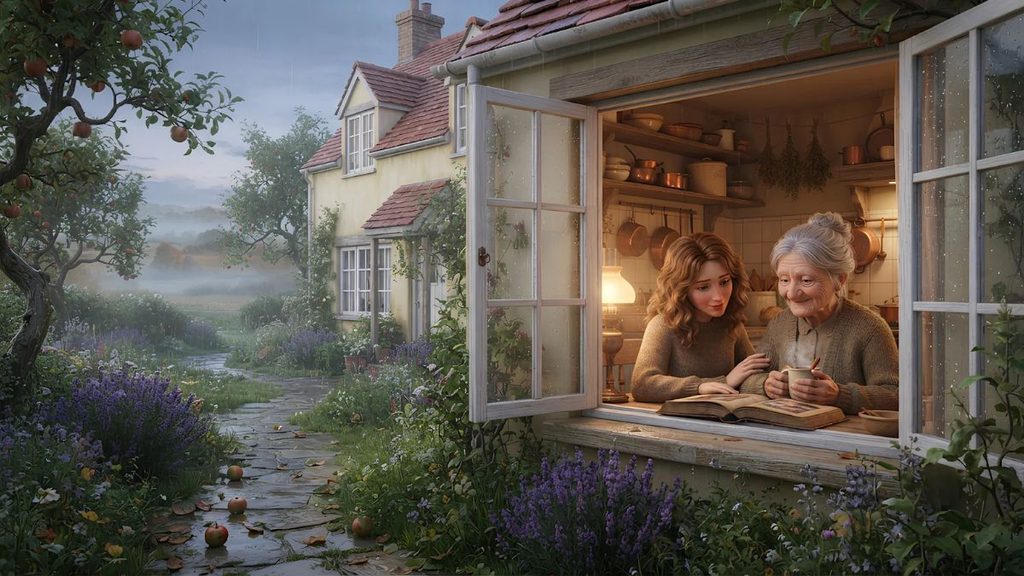
There was a little house at the end of a narrow country lane that always smelled like rain.
It did not matter whether the sky was clear, the sun was shining, or the summer heat had settled over the fields. The moment someone opened its old wooden door, they were greeted by the familiar scent of wet earth, fresh leaves, and cool stone.
It was a gentle smell, the kind that reminded people of childhood afternoons spent watching raindrops slide down windows.
The house belonged to a woman named Eleanor, who had lived there for almost forty years.
It stood beyond a small village, surrounded by apple trees, wildflowers, and an untidy garden that Eleanor lovingly refused to make perfect. Its walls were painted pale yellow, although years of sunshine had softened the colour into something closer to warm cream. The windows had white wooden frames, and the roof was covered with dark red tiles.
A narrow path led from the gate to the front porch. Beside the door stood two clay pots filled with lavender. A wooden bench rested beneath the largest apple tree, where Eleanor liked to sit in the evenings.
People in the village often wondered why the house smelled like rain.
Some believed it was because Eleanor collected rainwater in old ceramic jars. Others thought the smell came from the wooden floors, which had absorbed decades of changing seasons.
Eleanor never explained it.
Whenever someone asked, she simply smiled and said, “Perhaps the house remembers.”
A Visitor After Many Years
One autumn afternoon, a young woman named Sophie arrived at the house.
She was Eleanor’s granddaughter.
Sophie had not visited for nearly five years. Life in the city had become busy with work, rent, shopping, and the endless responsibilities that seemed to appear whenever one task was finished.
She had often promised herself that she would visit.
But weekends became crowded, holidays passed quickly, and the months kept moving.
Then, one morning, she received a telephone call from her mother.
“Your grandmother has been asking about you,” her mother said gently. “She would really love to see you.”
Sophie looked at her calendar.
There were meetings scheduled for the following week, an unfinished presentation, and several messages waiting for replies.
But for once, she closed her laptop.
“I’ll come this weekend,” she said.
The journey took nearly three hours by train and another twenty minutes by taxi.
When she finally reached the village, the afternoon was cloudy. A cool breeze moved through the trees, and distant hills were covered in a soft grey mist.
The taxi stopped near the old iron gate.
Sophie stepped out with her suitcase.
The house looked smaller than she remembered.
The apple trees were taller, the garden seemed wilder, and the wooden bench had faded beneath years of weather.
She walked towards the front door.
Before she could knock, it opened.
“Eleanor!”
Her grandmother stood there wearing a light blue cardigan and a pair of comfortable slippers.
“Sophie, my dear!”
They embraced for a long moment.
“You’ve grown thinner,” Eleanor said.
“And you’ve grown exactly the same.”
Eleanor laughed.
“That is a very generous thing to say.”
She took Sophie’s suitcase and led her inside.
The familiar smell greeted Sophie immediately.
Wet earth.
Old wood.
Lavender.
Something cool and peaceful that she could never quite describe.
For a moment, she was a little girl again, standing in the hallway with muddy shoes while her grandmother called from the kitchen.
“Still smells like rain,” Sophie said.
Eleanor smiled.
“I told you. The house remembers.”
The Room With the Blue Curtains
Sophie was given her old bedroom upstairs.
The room had not changed very much.
There was still a small wooden bed beside the window, a writing desk near the wall, and a bookshelf filled with children’s novels and old picture books.
The curtains were blue, just as she remembered.
A small vase stood on the desk with three fresh lavender stems inside.
Sophie placed her suitcase near the wardrobe and opened the window.
The garden stretched below her.
A few apples had fallen beneath the trees, and a robin was hopping along the stone path.
She could hear the soft rustling of leaves.
The room felt peaceful.
Yet something made her pause.
On the desk was an old wooden box.
She recognised it immediately.
When she was younger, she had used it to store little treasures: buttons, smooth stones, dried flowers, postcards, and tiny objects she had collected during visits.
She opened the lid.
Inside were several familiar things.
A blue marble.
A small shell.
A photograph of herself at seven years old.
And a folded piece of paper.
She opened the paper carefully.
It contained a short message written in Eleanor’s handwriting.
For Sophie, whenever you need a quiet afternoon.
Sophie smiled.
She placed the note back in the box.
Then she sat on the bed and listened to the house.
There was a soft creaking sound somewhere downstairs. A clock ticked in the hallway. The wind brushed against the window.
It felt as though the house was welcoming her back.
Tea, Rain, and Old Memories
By four o’clock, the sky had darkened.
Eleanor was in the kitchen preparing tea.
The kitchen was warm and smelled of cinnamon, butter, and freshly baked apple cake.
Sophie sat at the wooden table while her grandmother placed two cups in front of her.
“Do you still like cinnamon tea?” Eleanor asked.
“I love it.”
“I thought you might.”
They sat together near the window.
Outside, the first drops of rain began falling.
They tapped lightly against the glass, then became more frequent.
Soon, the entire garden was covered in a soft silver curtain.
Sophie watched the rain.
“I forgot how beautiful it is here.”
Eleanor stirred her tea.
“People often forget beautiful things when they are far away from them.”
Sophie smiled.
“Is that why you never left?”
Eleanor looked towards the garden.
“Perhaps. I did travel when I was younger. I lived in two different towns and spent a year near the coast. But I always wanted to return.”
“Was it because of the house?”
“Partly.”
Eleanor took a small bite of cake.
“Your grandfather built the back porch himself. He planted the apple trees when we first moved here. Every spring, he would say that the garden needed one more tree.”
Sophie laughed.
“How many did he plant?”
“Eleven.”
“Eleven?”
“He kept saying there was room for one more.”
They both laughed.
For a while, they spoke about old family stories.
Sophie remembered her grandfather teaching her how to skip stones across the little pond behind the house. Eleanor remembered how Sophie once tried to feed an apple to a wooden garden statue.
They laughed about the summer when a family of ducks had taken over the back garden.
The afternoon passed gently.
Nobody checked the time.
Nobody rushed to finish a conversation.
When the rain finally stopped, the garden smelled stronger than ever.
Sophie stepped outside with her grandmother.
The grass was wet, the apple leaves glistened, and tiny drops of water rested on the lavender flowers.
She took a deep breath.
The smell was familiar.
It was the smell of the house.
The Secret of the Rainwater Jars
The following morning, Sophie woke to the sound of birds.
She looked at the clock.
It was only seven.
At home, she rarely woke this early without an alarm. But here, the morning light seemed to enter the room gently, as though it did not want to disturb her.
She dressed and went downstairs.
Eleanor was already in the garden.
She was standing beside several large ceramic jars near the back wall.
“Good morning,” Sophie called.
“Good morning, sleepyhead.”
Sophie looked at the jars.
“Are these the rainwater jars?”
“Yes.”
She walked closer.
There were five of them, each with a rounded body and a narrow opening. Their surfaces were decorated with faded blue patterns.
“Why do you collect so much rainwater?”
“For the garden, mostly.”
Eleanor lifted the lid of one jar.
Inside, the water was clear.
“When your grandfather was alive, he built a little system to guide rainwater from the roof into these jars. He thought it was wasteful to let all that water run away.”
“That’s clever.”
“He was very proud of it.”
Eleanor walked towards the lavender bushes.
“Rain is useful in more ways than people realise. It waters the plants, cools the earth, fills the ponds, and gives everything a chance to begin again.”
Sophie touched a wet lavender leaf.
“Did Grandpa say that?”
“No. I just made it sound poetic.”
Sophie laughed.
They spent the next hour tending the garden.
Eleanor showed her how to remove dead flowers, trim the lavender, and gather fallen apples.
Sophie was surprised by how much she enjoyed the work.
There was something satisfying about doing one simple thing at a time.
She did not need to plan the next hour or check whether she was being productive.
She only needed to hold the basket, pick the apples, and listen to the birds.
When they finished, Eleanor made breakfast.
They ate toast with homemade jam and fresh fruit.
Sophie looked at the kitchen clock.
It was nearly ten.
At home, she would have already answered dozens of messages.
Here, the morning had passed without a single notification.
She did not miss them.
The Rainy Afternoon Tradition
After lunch, Eleanor brought an old photo album from the living room.
It was large, covered in brown leather, and held together with a small brass clasp.
They sat on the sofa.
Sophie turned the pages slowly.
There were photographs of her grandparents when they were young, pictures of family gatherings, and images of the house before the garden had fully grown.
In one photograph, Eleanor stood beside the front gate holding a watering can.
In another, her grandfather sat beneath the apple tree with a newspaper.
Sophie stopped at a photograph of herself.
She was perhaps eight years old, wearing a yellow raincoat and holding a small red umbrella.
“Do you remember this day?” Eleanor asked.
Sophie studied the picture.
“Not really.”
“It rained all afternoon. You insisted on going outside because you wanted to see whether worms came out of the ground.”
Sophie laughed.
“That sounds like something I would do.”
“You collected seven worms and placed them in a flowerpot.”
“What happened to them?”
“Your grandfather helped you return them to the garden.”
Sophie smiled.
They turned another page.
There were photographs of Christmas dinners, summer picnics, and birthdays.
The house seemed to contain an entire collection of ordinary happiness.
A kettle boiling.
A table covered with food.
A family standing in the garden.
A little girl holding a flower.
A man repairing a wooden chair.
None of the photographs showed anything extraordinary.
Yet each one seemed precious.
Outside, the clouds gathered again.
Eleanor glanced at the window.
“Looks like another rainy afternoon.”
Sophie closed the album.
“Do you always enjoy rainy days?”
“Not always. Sometimes I enjoy sunny days too.”
“Then why does the house smell like rain even when it’s sunny?”
Eleanor laughed.
“You’re still trying to solve that mystery.”
“Of course.”
Her grandmother leaned back.
“Perhaps I should tell you.”
Sophie moved closer.
“Really?”
Eleanor smiled.
“Your grandfather used to say that a house should smell like the people who love it. He spent years working with wood, soil, flowers, and water. He loved opening the windows after rain. He kept old wooden furniture instead of replacing it. He dried lavender in the hallway and brought fresh flowers into the kitchen.”
She paused.
“Over time, all those little things became part of the house.”
Sophie looked around.
“So that’s the secret?”
“That’s my explanation.”
Eleanor smiled.
“But I prefer the idea that the house remembers.”
A Walk Through the Village
On Sunday morning, Sophie suggested taking a walk.
The village was quiet.
Small shops lined the main road, and a bakery near the church had just opened its doors.
Eleanor walked slowly, carrying a light brown handbag.
Sophie matched her pace.
They passed the old post office, the village green, and a little pond surrounded by willow trees.
A man was sweeping leaves from the pavement.
He greeted Eleanor warmly.
“Morning, Mrs. Eleanor.”
“Good morning, Peter.”
He looked at Sophie.
“Your granddaughter?”
“Yes. She’s visiting for the weekend.”
“Lovely to see you again,” he said.
Sophie smiled.
They continued towards the bakery.
Eleanor bought two warm rolls and a small packet of biscuits.
They sat on a bench near the pond.
The water was still, reflecting the clouds above.
A pair of ducks moved slowly across its surface.
Sophie watched them.
“I think I’ve forgotten how to do this.”
“Do what?”
“Just sit somewhere without feeling like I should be doing something else.”
Eleanor looked at her.
“That is a habit many people develop.”
“Everything feels urgent in the city.”
“Some things are urgent. Many are simply loud.”
Sophie considered those words.
A bicycle passed along the road.
Somewhere nearby, a dog barked.
The village continued its ordinary morning.
Eleanor opened the packet of biscuits.
“Would you like one?”
“Yes, please.”
They ate quietly.
After a while, Sophie asked, “Were you ever worried about the future?”
Eleanor smiled.
“Of course. Everyone is.”
“Even when you were young?”
“Especially when I was young.”
Sophie looked surprised.
“But you always seem so calm.”
Eleanor laughed.
“That is because you usually see me when the difficult part is already over.”
She looked towards the pond.
“When I was your age, I worried about money, work, family, and whether I had made the right decisions. I thought everyone else had a clearer idea of what they were doing.”
“Did they?”
“Probably not.”
They both laughed.
“Life becomes easier in some ways as you grow older,” Eleanor continued. “Not because every problem disappears, but because you stop expecting yourself to control everything.”
Sophie looked at the water.
For a moment, she felt as though a small weight had been lifted from her shoulders.
The Box Beneath the Bed
That afternoon, Sophie began packing.
Her train was scheduled to leave the following morning.
She folded her clothes and placed them inside her suitcase.
While looking beneath the bed for a missing sock, she noticed another wooden box.
It was larger than the one on the desk.
She pulled it out.
The box was old and covered with a thin layer of dust.
Inside were several notebooks, a bundle of letters, and a small wooden bird.
Sophie picked up the bird.
Her grandfather had carved it.
She remembered watching him work at the kitchen table, carefully shaping pieces of wood with small tools.
He used to say that every piece of wood had a shape waiting inside it.
She placed the bird on the desk.
Then she opened one of the notebooks.
It belonged to Eleanor.
The pages were filled with handwritten observations about the garden, the weather, and everyday life.
One entry caught Sophie’s attention.
April 18. Rain in the afternoon. The apple trees are beginning to bloom. Sophie came to visit today and spent an hour collecting stones. She says the round ones are the prettiest.
Another entry read:
September 3. A clear morning. The house smells of lavender. I made apple cake. I hope Sophie remembers these ordinary days when she grows older.
Sophie turned the pages slowly.
There were dozens of entries.
Some were only a few lines long.
Others described entire afternoons.
The notebook was not a diary of great events. It was a record of little moments.
A cup of tea.
A walk through the garden.
A conversation with a neighbour.
A storm that arrived just before dinner.
Sophie sat on the floor, reading.
She realised that her grandmother had been collecting memories in the same way she collected rainwater.
Carefully.
Patiently.
Without expecting anything dramatic in return.
She closed the notebook and held it for a moment.
Then she carried it downstairs.
A Gift for Sophie
Eleanor was sitting in the living room, knitting a soft grey scarf.
Sophie placed the notebook on the table.
“I found this upstairs.”
Eleanor looked at it.
“Oh, that old thing.”
“You wrote about me.”
“I wrote about everyone.”
Sophie opened the notebook to the page about collecting stones.
“Do you remember this?”
“Of course. You had a wonderful collection.”
“I think I still have some of those stones.”
Eleanor smiled.
“I hope you do.”
Sophie sat beside her.
“Could I take this notebook with me?”
Eleanor stopped knitting.
“Why?”
“I want to keep reading it.”
Her grandmother considered the request.
Then she nodded.
“Of course. I have several more.”
Sophie laughed.
“How many?”
“Enough to keep you busy.”
Eleanor placed the scarf in her lap.
“You can take the notebook, but you must promise me something.”
“What?”
“Write in it sometimes.”
Sophie looked at the pages.
“What should I write?”
“Anything. A good meal. A beautiful morning. Something funny someone said. A place you visited. It doesn’t need to be important.”
Sophie smiled.
“All right. I promise.”
Eleanor handed her a small fountain pen.
“Then this is yours too.”
Sophie took it carefully.
The pen was simple, with a dark green body and a gold-coloured cap.
“Thank you.”
“Your grandfather bought it for me many years ago. I think it would be happier being used.”
Sophie placed it inside the notebook.
For a while, they sat together without speaking.
The afternoon light entered the room through the curtains.
The house smelled of old wood and lavender.
And somewhere outside, the wind moved softly through the apple trees.
Learning to Carry the Quiet Home
The next morning, Sophie prepared to leave.
Eleanor stood near the front door while Sophie checked her suitcase.
“Have you got everything?”
“Yes.”
“Your phone charger?”
“Yes.”
“Your notebook?”
Sophie lifted the wooden notebook slightly.
“Right here.”
Eleanor smiled.
They embraced.
“Come again soon,” Eleanor said.
“I will.”
“And don’t wait five years this time.”
“I won’t.”
Sophie stepped outside.
The morning was cool, and a thin layer of mist rested over the garden.
She walked towards the gate, then turned around.
The house looked peaceful in the soft morning light.
Its windows reflected the pale sky. The lavender pots stood beside the entrance, and a few fallen apples rested near the path.
Sophie took a deep breath.
The smell of rain was still there.
She smiled and waved.
Eleanor waved back.
During the journey home, Sophie kept the notebook in her bag.
She did not spend the train ride checking emails or planning her week.
Instead, she watched the countryside pass outside the window.
Fields appeared and disappeared.
Small villages came and went.
Clouds moved slowly across the sky.
She thought about the house, her grandmother, and the ordinary afternoons they had shared.
She realised that she had spent a long time looking for a way to make her life feel more complete.
She had imagined that happiness required a better job, a larger apartment, more money, or a holiday somewhere far away.
Perhaps those things could bring enjoyment.
But she now understood that peace could also be found in much smaller places.
In a quiet kitchen.
In the smell of fresh rain.
In a handwritten note.
In a familiar voice asking whether she wanted another cup of tea.
When Sophie arrived at her apartment, she placed the notebook on her desk.
She opened it to the first empty page.
For a moment, she did not know what to write.
Then she picked up the fountain pen.
November 12. I visited Grandma this weekend. It rained on Saturday afternoon. We drank cinnamon tea and looked through old photographs. I remembered how beautiful ordinary days can be.
She stopped writing.
Then she added one more sentence.
I think I want to remember more of them.
She closed the notebook.
Outside, the city was busy as usual.
Cars moved along the road, people hurried towards their buildings, and the familiar sounds of traffic filled the evening.
But inside her apartment, something felt different.
She opened the window.
A cool breeze entered the room.
Somewhere in the distance, rain began to fall.
Sophie smiled.
For a moment, she could almost smell the lavender, the old wooden floors, and the wet earth of her grandmother’s garden.
The house that smelled like rain was miles away.
But the feeling it had given her had travelled home.
And from that evening onward, whenever life became too hurried, Sophie remembered Eleanor’s words.
A house should smell like the people who love it.
Perhaps a life should feel the same.
It should hold the little things we care about, the memories we make without noticing, and the quiet moments we sometimes forget to appreciate.
And sometimes, all it takes to find your way back to yourself is an open window, a little rain, and the memory of a place where you were never in a hurry to leave.
5. The Baker Who Worked Before Sunrise

Every morning, long before the first bus entered the town square and before the shopkeepers lifted their shutters, a small bakery on Maple Street began to glow.
Its windows were usually dark when the rest of the town was asleep, but a warm golden light appeared behind the curtains at exactly four o’clock.
Inside, an elderly baker named Thomas was already at work.
He had been following the same routine for nearly forty years.
He arrived while the streets were empty, tied a white apron around his waist, washed his hands, and opened the large wooden cupboard where he kept his flour, sugar, yeast, and other ingredients.
Then he began making bread.
He never hurried.
He measured the flour carefully, added warm water, mixed the dough, and kneaded it with the patience of someone who understood that good things needed time.
Outside, the sky slowly changed from black to deep blue.
Inside the bakery, the smell of fresh bread began to fill the street.
People who passed by on their way to work often slowed down.
Some looked through the window.
Others smiled when Thomas opened the door to place a tray of warm rolls on the cooling rack.
Nobody in town knew exactly why he had chosen such an unusual working schedule.
They only knew that if they wanted fresh bread before sunrise, Thomas was the person to visit.
And if they arrived early enough, he would always have a kind word waiting for them.
The Town That Woke Slowly
The bakery stood between a small grocery shop and an old bookshop.
It was not particularly large. There were two wooden counters, a glass display cabinet, three small tables, and a narrow staircase leading to a storage room above.
The walls were painted a soft cream colour, and a collection of old photographs hung beside the entrance.
One photograph showed the bakery when it had first opened.
Another showed Thomas as a young man standing beside his father, who had owned the shop before him.
Thomas had inherited the bakery many years earlier.
His father had taught him everything he knew about baking.
He had taught him how to recognise properly kneaded dough, how to judge the temperature of an oven without relying entirely on a thermometer, and how to tell when a loaf was ready simply by listening to the sound it made when tapped.
But perhaps the most important lesson was one Thomas remembered every day.
“Never rush the bread,” his father used to say. “The dough has its own time.”
Thomas had never forgotten those words.
The town had changed considerably since those early years.
New houses had appeared beyond the railway station. The old cinema had become a supermarket, and several family-owned shops had been replaced by larger businesses.
Yet the bakery remained almost exactly the same.
Its wooden sign still carried the family name.
Its front door still had a little brass bell.
And Thomas still arrived before sunrise.
A New Assistant
One autumn morning, a young man named Oliver entered the bakery at half past five.
He was carrying a small backpack and wearing a dark green jacket.
Thomas looked up from the counter.
“Good morning.”
“Good morning. Are you Mr. Thomas?”
“I am.”
Oliver smiled nervously.
“I’m here about the job.”
Thomas wiped his hands on his apron.
“Ah, yes. You spoke to me on the telephone yesterday.”
Oliver nodded.
He had recently moved to town after leaving a job in a large city. He was looking for something quieter and had seen a small advertisement in the local newspaper.
The bakery needed someone to help with cleaning, packing, arranging orders, and serving customers during busy hours.
Oliver had never worked in a bakery before.
He had spent most of his previous years working at a computer, answering emails and preparing reports.
He was used to bright offices, busy roads, and schedules that seemed to change every hour.
The idea of working in a small bakery appealed to him.
It sounded simple.
Perhaps too simple.
Thomas showed him the storage room, the kitchen, and the back entrance.
“This is where we keep the flour,” he explained. “The sugar and other ingredients are on the next shelf. Keep everything dry and clean.”
Oliver listened carefully.
“And what time do we usually finish?”
“That depends on the day.”
“Roughly?”
Thomas smiled.
“When the bread is ready and the customers have gone home.”
Oliver laughed.
He thought the old baker was joking.
But over the following days, he discovered that Thomas rarely followed the clock as strictly as he did.
He worked according to the rhythm of the bakery.
The dough needed time to rise.
The ovens needed time to warm.
The bread needed time to cool.
There was little point in trying to make everything happen faster.
The First Morning
Oliver’s first working morning began at four thirty.
He arrived wearing a new apron and carrying a notebook.
Thomas was already mixing dough.
“You’re early,” the old baker said.
“I didn’t want to be late.”
“Good habit.”
Thomas pointed towards a large bowl.
“Today, we’ll make simple white bread.”
Oliver moved closer.
Thomas explained the ingredients and demonstrated how to combine them.
He poured flour into the bowl, added yeast, and slowly mixed in water.
Then he began kneading.
His hands moved steadily, folding and pressing the dough.
“Would you like to try?”
Oliver nodded.
He placed his hands on the mixture and began working.
At first, the dough stuck to his fingers.
He added more flour.
“Not too much,” Thomas advised.
Oliver tried again.
The dough became smoother, but he was pressing it too hard.
“Relax your hands,” Thomas said.
Oliver looked at him.
“Does that make a difference?”
“More than you think.”
Thomas demonstrated again.
“Don’t fight the dough. Work with it.”
Oliver followed his movements.
After a few minutes, the dough began to feel different.
It became softer and more elastic.
Thomas nodded.
“That’s better.”
They placed it in a bowl and covered it with a clean cloth.
“Now we wait,” Thomas said.
Oliver glanced at the clock.
“How long?”
“Until it’s ready.”
Oliver smiled.
He was beginning to understand that this job might require a different kind of patience.
The First Customer
At six fifteen, the brass bell above the door rang.
A woman wearing a brown woollen coat entered.
“Good morning, Thomas.”
“Good morning, Mrs. Bennett. The usual?”
“Please.”
Thomas reached for a small paper bag.
Inside, he placed two warm bread rolls and a cinnamon bun.
Mrs. Bennett paid and turned towards Oliver.
“New face?”
“This is Oliver,” Thomas said. “He’s helping us now.”
“Well, welcome to the bakery.”
“Thank you.”
Mrs. Bennett smiled.
“I hope you enjoy working here. Thomas makes the best cinnamon buns in town.”
Oliver laughed.
“I’ve heard they’re popular.”
“They certainly are.”
She picked up her bag and left.
Thomas returned to the counter.
“She’s been coming here for twenty-six years.”
“Twenty-six?”
“Every morning except Sunday.”
“That’s a long time.”
Thomas nodded.
“She used to bring her daughter. Now she comes alone.”
Oliver looked towards the door.
“Do you remember everyone’s habits?”
“Most of them.”
Thomas began arranging loaves in the display cabinet.
“People have their routines. Some like the same bread every morning. Some want a particular pastry on Fridays. Others come just to talk for five minutes.”
Oliver watched him.
“Do you know them all personally?”
“Not all. But after enough mornings, you learn a few things.”
At seven o’clock, the bakery became busier.
A railway worker bought a sandwich.
A teacher ordered a loaf of wholegrain bread.
A father entered with his little daughter, who pointed excitedly towards the glass cabinet.
“One chocolate bun, please,” she said.
Thomas handed it to her.
“Here you are, young lady.”
The girl smiled.
Oliver noticed how naturally Thomas spoke to everyone.
He never seemed impatient, even when several customers were waiting.
He made each person feel as though there was enough time for them.
The Bread That Needed More Time
One Thursday, Oliver made his first serious mistake.
He had prepared a batch of dough while Thomas was receiving a delivery.
He followed the instructions correctly, but he became impatient when the dough did not rise as quickly as expected.
He moved the bowl closer to the oven.
Then he covered it with an extra cloth.
When Thomas returned, he noticed the change.
“What have you done here?”
Oliver explained.
“I thought it needed a little warmth.”
Thomas examined the dough.
“It may have become too warm.”
Oliver looked worried.
“Can we still use it?”
“Let’s see.”
Thomas checked its texture and gently pressed the surface.
After a moment, he shook his head.
“This batch won’t give us the bread we want.”
Oliver felt embarrassed.
“I’m sorry. I was trying to save time.”
Thomas placed a hand on his shoulder.
“Don’t worry. We can make another batch.”
“But we’ve lost the ingredients.”
“Ingredients can be replaced.”
Oliver looked down.
Thomas continued calmly.
“What matters is understanding what happened.”
He showed Oliver how temperature affected the yeast and explained why the dough needed a suitable environment to rise properly.
Then he added something else.
“You see, Oliver, baking teaches you a useful lesson. Not everything improves when you try to hurry it.”
Oliver nodded.
Thomas began preparing another batch.
This time, they left the dough in its proper place.
They waited.
They watched.
And when it was ready, the bread came out beautifully.
Its crust was golden, its shape was even, and the kitchen filled with a warm, comforting smell.
Oliver tapped the loaf gently.
It made a hollow sound.
Thomas smiled.
“Now that’s bread.”
A Conversation Before Sunrise
As the weeks passed, Oliver became more comfortable with the early mornings.
He learned how to prepare different types of dough, operate the ovens, clean the equipment, and arrange the display cabinet.
He also began recognising the regular customers.
There was Mrs. Bennett, who always bought cinnamon buns.
There was Mr. Lewis, who collected a loaf of rye bread every Tuesday.
There was a young mother who came with a sleeping baby in a stroller.
And there was an elderly gentleman named George who never bought anything before asking Thomas how his garden was doing.
One morning, George arrived at five forty-five.
“Morning, Thomas.”
“Morning, George. How’s the garden?”
“Doing well. The roses are almost finished for the season.”
“Everything has its time.”
George laughed.
“You’re always saying that.”
Thomas handed him a small loaf of bread.
“Because it’s true.”
George paid and left.
Oliver looked at Thomas.
“Do you ever get tired of the same conversations?”
Thomas considered the question.
“Sometimes.”
Oliver seemed surprised.
“But you always appear happy to see everyone.”
“Being tired doesn’t mean you don’t enjoy people.”
Thomas wiped the counter.
“Besides, ordinary conversations can be quite important. You never know what kind of morning someone is having.”
Oliver thought about that.
He remembered his own first weeks in town.
He had arrived feeling uncertain and disconnected. The bakery had become the first place where he felt recognised.
A familiar greeting had made a difference.
A warm cup of tea had made a difference.
Even the simple question, “How are you settling in?” had made a difference.
Perhaps Thomas understood something that Oliver had overlooked.
A little kindness did not need to be impressive.
Sometimes it only needed to be consistent.
The Old Recipe Book
One afternoon, while cleaning the storage room, Oliver found a thick notebook inside a wooden cupboard.
Its cover was dark brown, and the corners were worn.
He carried it downstairs.
“Thomas, is this yours?”
The old baker looked at the notebook.
“Ah, you’ve found my father’s recipe book.”
Oliver opened it carefully.
The pages were filled with handwritten recipes.
Some were marked with dates.
Others had little notes in the margins.
There were recipes for bread, rolls, fruit cakes, biscuits, and pastries.
Several pages contained corrections in different handwriting.
“Did your father write all of these?”
“Most of them. Some belonged to my grandmother.”
Oliver turned another page.
A recipe for apple bread caught his attention.
“Have you ever made this?”
Thomas smiled.
“Not for many years.”
“Why not?”
“It takes quite a bit of time, and people don’t ask for it as often as they used to.”
Oliver examined the ingredients.
“It sounds delicious.”
“It is.”
“Could we make it?”
Thomas looked at the notebook for a moment.
Then he nodded.
“Perhaps tomorrow.”
The following morning, they prepared the apple bread.
They peeled fresh apples, measured the flour, mixed the ingredients, and allowed the dough to rest.
Thomas explained each step.
He told Oliver how his grandmother used to prepare it during the colder months.
She would serve it with warm butter and homemade jam.
“Your father must have learned from her,” Oliver said.
“He did. And I learned from him.”
Thomas smiled.
“That’s how these things continue.”
When the bread was ready, they placed it in the oven.
The smell of apples and cinnamon slowly spread through the bakery.
Mrs. Bennett arrived just as Thomas removed the first loaf.
She stopped near the counter.
“What is that wonderful smell?”
“Something from the old recipe book,” Thomas replied.
He cut a small slice and offered it to her.
Mrs. Bennett tasted it.
Her eyes brightened.
“Oh, I remember this!”
Thomas smiled.
“My grandmother used to make it,” she continued. “My mother brought it home from your bakery when I was a child.”
Oliver looked at Thomas.
The old baker seemed pleased.
“Then perhaps we should make it more often.”
Mrs. Bennett bought an entire loaf.
Before leaving, she turned towards Oliver.
“You’ve brought something special back to this place.”
Oliver smiled.
He had only followed a recipe.
Yet he felt strangely proud.
The Morning the Bakery Stayed Quiet
One cold morning in December, Oliver arrived to find the bakery unusually quiet.
The lights were on, but Thomas was not in the kitchen.
Instead, he was sitting at one of the small tables near the window.
A cup of tea rested in front of him.
“Good morning,” Oliver said.
Thomas looked up.
“Good morning.”
“Are you feeling all right?”
“Just a little tired.”
Oliver placed his bag near the counter.
“Should I start the dough?”
Thomas nodded.
“Please.”
Oliver washed his hands and began preparing the ingredients.
He worked carefully, following the routine Thomas had taught him.
After a while, the old baker joined him.
They worked quietly.
The dough was mixed, kneaded, and covered.
While they waited, Oliver prepared the trays.
Outside, the sky began turning blue.
Thomas looked through the window.
“Beautiful morning.”
Oliver followed his gaze.
The street was still quiet, and a thin mist rested above the rooftops.
“Yes,” he replied.
Thomas sat down again.
“Do you know why I started working before sunrise?”
Oliver shook his head.
“I assumed it was because the bread needs to be ready early.”
“That’s part of it.”
Thomas smiled.
“But when I was young, my father used to wake me before dawn. I complained about it every morning.”
“I can imagine.”
“He told me that the early hours were the most peaceful part of the day. There were no deliveries, no customers, and no interruptions. Just the kitchen, the ingredients, and the work.”
Thomas looked towards the window.
“At first, I didn’t understand. I thought I was missing sleep for no reason.”
“What changed?”
“One morning, I finished preparing the first batch of bread and stepped outside. The sun was just rising. The whole town looked different.”
He paused.
“I realised that I had been given a few quiet hours before the world began asking things from me.”
Oliver smiled.
“I think I understand now.”
Thomas nodded.
“Those hours became my favourite part of the day.”
A Different Kind of Success
By spring, Oliver had become an important part of the bakery.
He could prepare most of the daily bread without assistance and had learned several of the older recipes.
He also suggested introducing a small selection of seasonal pastries.
Thomas agreed, although he insisted that they should not make too many changes at once.
The new apple bread became popular.
A few customers began asking for it every week.
The bakery was doing well.
One afternoon, Oliver received a message from a former colleague.
The company he had left was hiring again.
The position offered a higher salary, better benefits, and the possibility of working remotely.
Oliver read the message several times.
It was a good opportunity.
He had not expected to miss the office environment, but the salary was certainly attractive.
That evening, he spoke to Thomas.
“I’ve been offered another job.”
Thomas listened.
“Is it something you’d like to do?”
“I’m not sure.”
“Does it interest you?”
“Some parts of it.”
“Then perhaps you should think about it.”
Oliver looked surprised.
“Wouldn’t you want me to stay?”
Thomas smiled.
“Of course I would. You’ve become a good baker.”
“But?”
“But your life belongs to you, Oliver. You should choose what feels right.”
Oliver looked at the wooden counter.
“I used to think success meant earning more, moving faster, and getting somewhere important.”
Thomas listened quietly.
“Now I enjoy coming here every morning. I like making things with my hands. I like knowing that people are waiting for the bread we prepare.”
Thomas nodded.
“Those are good reasons to stay.”
“But what if I regret not taking the other job?”
“Then you will have learned something. And if you take it and later miss the bakery, you will have learned something too.”
Oliver laughed.
“You make everything sound simple.”
“It rarely is. But you don’t have to make the decision tonight.”
Oliver thanked him.
He went home and thought about the offer for several days.
Eventually, he declined it.
He was not rejecting success.
He was simply choosing a different definition of it.
The Little Celebration
A year passed.
The bakery celebrated its fortieth anniversary under the Thomas family name.
Oliver suggested making the day special.
They decorated the windows with small paper stars, arranged flowers on the tables, and prepared extra batches of bread and pastries.
Thomas brought out several old photographs.
Customers began arriving early.
Mrs. Bennett brought a homemade cake.
George brought a small basket of apples from his garden.
The railway worker arrived with a bouquet of flowers.
Even the young mother with the stroller came, now carrying a toddler who happily pointed towards the display cabinet.
Thomas stood near the counter, looking around.
The bakery was full of familiar faces.
Oliver noticed his expression.
“Everything all right?”
Thomas nodded.
“Better than all right.”
He looked at the photographs on the wall.
“My father would have liked this.”
Oliver smiled.
“I think he would have been proud.”
Thomas looked at him.
“Perhaps he would.”
They spent the morning serving customers and sharing stories.
There were no speeches or elaborate celebrations.
Just warm bread, tea, laughter, and people who had been part of the bakery’s life for many years.
At one point, Thomas asked Oliver to stand beside him for a photograph.
They stood in front of the old family picture.
The photographer counted to three.
The camera clicked.
Another ordinary moment became a memory.
The First Light of Another Morning
Many years later, Oliver would remember those early mornings more clearly than many of the important events in his life.
He would remember the smell of warm bread before sunrise.
He would remember the sound of the brass bell above the door.
He would remember Thomas carefully explaining why dough should never be rushed.
He would remember the regular customers and their familiar orders.
And he would remember how the town slowly woke while the bakery was already alive with warmth.
The work was never glamorous.
There were heavy flour bags to carry, ovens to clean, trays to wash, and mornings when the cold made it difficult to leave bed.
But there was also something deeply satisfying about preparing food that would become part of someone’s breakfast.
Years passed, and Thomas eventually decided to reduce his working hours.
He still visited the bakery, but Oliver took responsibility for most of the daily work.
The old baker sometimes arrived at five in the morning, sat at his favourite table, and watched the new generation prepare the bread.
One morning, Oliver placed a warm cup of tea in front of him.
“Your usual?”
Thomas smiled.
“Thank you.”
Oliver returned to the kitchen.
He measured the flour, added the yeast, and began kneading the dough.
The movement had become familiar.
His hands worked steadily.
The dough was soft and elastic.
He covered it with a cloth and waited.
Outside, the sky slowly changed from dark grey to pale blue.
A delivery van passed through the square.
The grocery shop owner lifted his shutters.
A few early customers began appearing on the pavement.
Oliver opened the bakery door.
The smell of fresh bread drifted into the street.
Thomas took a sip of tea and watched him.
“Good morning,” Oliver called to the first customer.
“Good morning. Is the bread ready?”
“Almost.”
The customer smiled.
“I’ll wait.”
Oliver nodded.
There was no need to hurry.
The dough had its own time.
The oven had its own warmth.
And the morning had only just begun.
For a moment, Oliver understood exactly what Thomas’s father had meant all those years ago.
The early hours were a gift.
They offered a little space before the world became busy, a little quiet before the day’s responsibilities arrived, and a chance to make something good with patient hands.
The town would wake soon.
People would hurry towards their jobs, buses would fill, and the streets would become noisy.
But inside the little bakery, everything moved at a gentler pace.
The bread rose.
The ovens warmed.
The first golden loaves were placed on the counter.
And before sunrise, another peaceful morning had been made.
6. The Last Ferry Across the Quiet Lake

Every evening, at exactly nine fifteen, a small wooden ferry crossed the lake between the village of Bellwater and the little settlement on the opposite shore.
It was the last ferry of the day.
After that, the lake belonged to the moon, the stars, and the occasional fishing boat returning home.
The ferry was old but dependable. Its wooden sides had faded beneath years of sunshine, its blue paint had begun to peel, and a small brass bell hung beside the steering cabin. A narrow row of yellow lights ran along its deck, giving it the appearance of a floating lantern.
For thirty-two years, a man named Samuel had operated the ferry.
He knew the lake better than anyone in the village. He knew where the water became shallow, where the morning mist gathered, and where the wind usually changed direction just before sunset.
He also knew that the lake was never completely silent.
Even on the calmest nights, there was always something to hear: water brushing against the wooden sides, reeds moving along the shore, or the distant call of a bird settling into its nest.
Samuel enjoyed those sounds.
He believed that the lake had its own way of speaking, although he never tried to explain it to anyone.
Every evening, he prepared the ferry, checked its lamps, and waited for the final passengers.
Some travelled home from work. Others visited relatives across the water. A few came simply because they preferred the quiet crossing to the longer road around the lake.
And every night, Samuel welcomed them aboard.
He never knew who would arrive next.
But he always made room.
The Young Woman at the Jetty
One October evening, a young woman named Anna arrived at the ferry terminal carrying a small suitcase.
She had been away from Bellwater for almost eleven years.
The village looked smaller than she remembered. The shops had changed, the old cinema had become a grocery store, and a few new houses had appeared near the northern road.
But the lake remained almost exactly as it had been.
Its surface stretched beneath the evening sky, reflecting the fading colours of sunset.
Anna stood beside the wooden jetty and looked across the water.
She was returning because her grandmother’s house had been left empty after her passing.
Her mother had asked her to visit, collect a few belongings, and decide what should happen to the property.
Anna had agreed, although she was not entirely sure how she felt about returning.
She had left the village after university, believing that a larger city would offer more opportunities.
It had.
She found work, made friends, built a comfortable routine, and gradually became accustomed to a life filled with meetings, appointments, and crowded streets.
Yet somewhere along the way, she had stopped visiting the places that once mattered to her.
She checked the ferry timetable.
The last crossing was scheduled for nine fifteen.
Her watch showed nine twelve.
A small bell rang.
“Are you travelling?” someone called.
Anna turned.
A man in a dark blue jacket stood aboard the ferry.
He had silver hair, a weathered face, and a warm expression.
“Yes,” Anna replied.
“Then you should come aboard. We’re leaving shortly.”
She lifted her suitcase and stepped onto the wooden deck.
The man helped her place it beside a bench.
“First time crossing the lake?”
Anna smiled faintly.
“Not exactly. I grew up here.”
The man looked at her more carefully.
“Ah. One of the Bellwater children.”
“Something like that.”
He laughed.
“I’m Samuel. I’ve been running this ferry for a long time.”
“Anna.”
“Welcome home, Anna.”
She was surprised by how warmly he said it.
Then the ferry pulled away from the jetty.
The Journey Across the Water
The engine made a gentle humming sound.
Anna sat on the wooden bench near the railing and watched the village slowly move away.
The streetlights along the waterfront appeared one by one.
Their reflections stretched across the water like long golden ribbons.
Samuel stood near the steering cabin, keeping one hand on the controls.
A few other passengers were aboard.
An elderly woman held a shopping bag filled with vegetables. A middle-aged man read a newspaper beneath the deck light. A young couple sat close together, speaking quietly.
Nobody seemed particularly interested in conversation.
The crossing was peaceful.
Anna rested her hands on her suitcase.
She remembered travelling on the ferry as a child.
Her grandmother used to take her across the lake every Sunday to visit a small garden on the eastern shore.
They would carry sandwiches, a flask of tea, and sometimes a little packet of biscuits.
Anna had always wanted to stand near the front of the boat.
Her grandmother would hold her hand and remind her not to lean too far over the railing.
She could still remember the cool wind on her face and the smell of the water.
“Beautiful evening,” Samuel said.
Anna looked up.
“Yes. It is.”
“Clear skies tonight. We’ll be able to see the stars properly.”
She glanced towards the horizon.
A few stars had already appeared.
“Does it always look this peaceful?”
Samuel smiled.
“Not always. Some nights the wind has other ideas.”
He pointed towards a distant line of trees.
“See those trees? When the wind comes from that direction, the water becomes restless.”
Anna followed his finger.
The trees stood quietly beneath the darkening sky.
“How many times have you crossed this lake?” she asked.
Samuel considered the question.
“Thousands, probably.”
“Don’t you get tired of it?”
He smiled.
“Not of the lake.”
“Even after all these years?”
“Especially after all these years.”
He looked across the water.
“Every evening is a little different. The light changes. The weather changes. The passengers change. Sometimes you see birds flying low over the water. Sometimes the moon is so bright that the whole lake looks silver.”
He paused.
“There’s always something worth noticing.”
Anna looked at him.
She wondered when she had last paid such attention to an ordinary journey.
The Old Woman With the Shopping Bag
Halfway across the lake, the elderly woman approached Samuel.
“Are we running late tonight?”
Samuel checked the clock.
“Only by a minute, Mrs. Collins.”
“Good. I don’t like keeping my sister waiting.”
Samuel smiled.
“She’ll still be there.”
The woman returned to her seat.
Anna watched her.
“Does she travel every night?”
“Three or four times a week.”
“Why?”
“Her sister lives on the other side. They have dinner together quite often.”
“That’s lovely.”
Samuel nodded.
“They’ve been doing it for years.”
The woman noticed Anna looking at her and smiled.
“Do you know what my sister cooks on Thursdays?” she asked.
Anna shook her head.
“Potato soup. Always potato soup. She says nobody makes it as well as she does.”
The woman laughed.
“She has been saying that for forty years.”
Anna smiled.
“Do you agree with her?”
“Absolutely not. But I let her believe it.”
They both laughed.
The woman returned to her seat.
Samuel looked towards Anna.
“People sometimes think this ferry only carries passengers from one side to the other.”
“What else does it carry?”
“Little routines. Family dinners. Workdays ending. People visiting someone they love. Sometimes a person who simply needs to get home.”
Anna considered those words.
She thought about the number of journeys she had taken without remembering anything about them.
Perhaps she had spent too much time thinking about destinations.
A Story About a Wooden Bench
A few minutes later, Anna noticed a wooden bench near the back of the ferry.
It was slightly different from the others.
Its surface was darker, and one corner had been repaired with a small piece of polished wood.
“Has that bench always been there?” she asked.
Samuel looked behind him.
“Almost.”
“Why is it different?”
He smiled.
“That bench belonged to an old gentleman named Henry. He used to travel on this ferry every evening.”
“Was he a regular passenger?”
“Very much so.”
Samuel slowed the engine slightly as they approached a narrow section of the lake.
“Henry lived alone on the eastern shore. He had a small house with a garden full of roses. Every evening, he crossed the lake to buy a newspaper and a loaf of bread.”
Anna listened.
“One day, he brought a wooden bench aboard. He said the ferry needed a proper place for people to sit and look at the water.”
Samuel laughed softly.
“He repaired it himself and insisted that we keep it.”
“That’s kind.”
“He was a kind man.”
Samuel touched the railing.
“After he passed away, his daughter asked if we would keep the bench. She said he would have liked knowing that other people were using it.”
Anna looked at the old wooden seat.
She imagined Henry sitting there, watching the same water she was watching now.
There was something comforting about the thought that a small part of someone’s life could remain useful long after they were gone.
“Does his daughter still live here?” she asked.
“Yes. She visits sometimes.”
The ferry continued towards the eastern shore.
The House With the Green Gate
When the ferry arrived, Anna stepped onto the wooden jetty.
The settlement on the opposite shore was smaller than Bellwater.
There were only a few streets, a little grocery shop, a post office, and a row of old houses facing the lake.
Anna’s grandmother had lived in one of them.
Her house stood near the end of Willow Lane, behind a green wooden gate.
Samuel helped her lift the suitcase onto the jetty.
“Do you need a taxi?” he asked.
“No, thank you. It’s only a short walk.”
“Then enjoy your evening.”
Anna looked back at the ferry.
“Will you be here tomorrow?”
“At nine fifteen.”
She smiled.
“Good night, Samuel.”
“Good night, Anna.”
The ferry turned slowly and began its return journey.
Anna watched its lights move across the water.
Then she picked up her suitcase and walked towards the house.
The green gate was slightly open.
She pushed it gently.
The garden was overgrown, but the old rose bushes were still there.
The house looked smaller than she remembered.
She unlocked the front door and stepped inside.
The hallway smelled faintly of lavender and old books.
Everything was quiet.
She placed her suitcase near the staircase.
On a small table stood a framed photograph of her grandmother sitting beside the lake.
Anna picked it up.
Her grandmother was smiling.
Behind her, the water stretched towards the opposite shore.
For a long moment, Anna stood without moving.
Then she placed the photograph back.
She made herself a cup of tea and sat near the window.
Outside, the last ferry crossed the lake again.
Its yellow lights moved slowly through the darkness.
Anna watched until they disappeared.
The Notebook in the Kitchen
The next morning, Anna began sorting through her grandmother’s belongings.
She opened cupboards, checked drawers, and organised old photographs into small piles.
The kitchen was filled with familiar objects.
A blue teapot.
A wooden bread box.
A collection of ceramic cups.
An old calendar that had not been changed in months.
In the bottom drawer, she found a small notebook.
Its cover was faded green, and the pages were filled with her grandmother’s handwriting.
Anna sat at the kitchen table and began reading.
Most entries were ordinary observations.
Monday. The roses need trimming.
Wednesday. Bought apples from Mr. Lewis. Very good this week.
Friday. The lake was unusually calm. Watched the sunset from the jetty.
She turned another page.
Sunday. Anna visited. We crossed the lake together. She wanted to stand at the front of the ferry again. She still laughs when the wind blows her hair across her face.
Anna smiled.
She kept reading.
Tuesday. The ferry was late because of the weather. Samuel waited until everyone had crossed safely. A good man.
Another entry caught her attention.
Thursday. Made potato soup. Anna would have liked it.
Anna closed her eyes briefly.
She remembered the soup.
It had been one of her favourite meals as a child.
She could almost imagine her grandmother standing at the stove, stirring a large pot while rain tapped against the kitchen window.
The notebook contained no grand stories.
It was simply a record of life as it happened.
And somehow, that made it more precious.
A Second Crossing
That evening, Anna decided to visit the village again.
She wanted to buy a few groceries and perhaps find the little bookshop that had once stood near the square.
She arrived at the jetty just before nine fifteen.
Samuel was preparing the ferry.
“Back again?” he asked.
“Yes. I thought I’d go across for a little while.”
“Good idea.”
Anna stepped aboard.
This time, she sat on Henry’s old bench.
The ferry moved away from the shore.
The evening was colder than the previous night, and a thin mist had begun gathering above the water.
Anna watched the lights of the eastern settlement grow smaller.
Samuel approached her.
“How is the old house?”
“Quiet.”
“Your grandmother kept it well.”
“You knew her?”
Samuel smiled.
“Of course. She travelled on this ferry for years.”
Anna looked surprised.
“She never told me how often she came across.”
“She was a regular. Usually on Sunday mornings.”
He paused.
“She used to bring a little basket of food and sit near the front.”
Anna smiled.
“That sounds like her.”
Samuel returned to the controls.
For a while, neither spoke.
Then Anna asked, “Did she ever talk about me?”
Samuel glanced towards her.
“Often.”
“What did she say?”
“Mostly that she hoped you were enjoying your life.”
Anna looked down at her hands.
Samuel continued.
“She was proud of you.”
Anna felt a small lump in her throat.
She looked towards the water.
The lake was dark, but the lights along the shore made it seem almost transparent.
“Thank you,” she said quietly.
Samuel nodded.
There was no need to say anything more.
The Passenger Who Missed the Ferry
A week passed.
Anna spent her days sorting through the house, meeting the local estate agent, and visiting old places.
She found the bookshop, although it had moved to a smaller building near the church.
She visited the garden where she used to play and discovered that the old stone wall was still standing.
She also began taking the ferry more often.
Sometimes she crossed simply to buy a newspaper or have tea at the village café.
One evening, she arrived at the jetty just after nine fifteen.
The ferry was already moving away.
Anna watched it disappear.
She had missed the last crossing.
For a moment, she felt disappointed.
Then she heard footsteps behind her.
A young man carrying a backpack approached.
“Did I miss it too?” he asked.
Anna nodded.
“Looks like it.”
He sighed.
“I was hoping to get home tonight.”
“Where do you live?”
“On the eastern shore. My parents are visiting, and I stayed too long at dinner.”
Anna smiled.
“There’s a road around the lake, isn’t there?”
“Yes, but it takes nearly an hour to walk.”
They stood together near the jetty.
The man looked across the water.
“I suppose I’ll have to walk.”
Anna considered the distance.
Then she remembered Samuel’s words.
A ferry carried more than passengers.
It carried people home.
“Would you like to wait a few minutes?” she asked.
The young man looked at her.
“Why?”
“I think Samuel might still be near the other side. Sometimes he checks the dock before finishing for the night.”
She pointed towards a small light near the distant shore.
They waited.
A few minutes later, a telephone rang inside the little ticket office.
Anna answered.
It was Samuel.
“Are you still there?” he asked.
“Yes. We missed the ferry.”
“I can see you from the other side. Give me a moment.”
The young man looked relieved.
Soon, the ferry’s lights appeared again.
It moved slowly towards the jetty.
When Samuel arrived, he opened the gate.
“Good evening. I thought you two might need a little help.”
The young man thanked him several times.
Samuel simply waved away the gratitude.
“Come aboard. It’s a quiet night for an extra crossing.”
Anna smiled.
She stepped onto the ferry.
As they moved across the lake, the young man introduced himself as Daniel.
He was studying music and had recently moved to the settlement.
They spoke about the village, the lake, and the small café near the eastern shore.
Daniel told Anna that he sometimes sat by the water after evening classes.
“I like it here,” he said. “The city where I studied before was too loud.”
Anna smiled.
“I understand.”
When they reached the other side, Daniel thanked Samuel and walked towards home.
Anna stayed aboard for a moment.
“Do you often make extra crossings?” she asked.
Samuel smiled.
“Only when someone needs one.”
What the Lake Had Been Keeping
One Sunday afternoon, Anna visited the old jetty with her grandmother’s notebook.
She sat on the wooden bench and read several pages.
The weather was pleasant.
The sky was pale blue, and the water reflected the clouds.
A family was having a picnic near the trees.
Two children were throwing small stones into the lake.
A dog was sleeping beside a bicycle.
Anna read an entry from several years earlier.
The lake was very quiet today. I sat for a long time and thought about how quickly children grow. Anna is becoming a young woman now. I hope she remembers that there will always be a place for her here.
Anna closed the notebook.
She looked across the water.
For years, she had believed that leaving the village was the beginning of her real life.
She had wanted to see new places, meet new people, and build something of her own.
There was nothing wrong with that.
But somewhere along the way, she had started treating her past as something she had already finished.
She had forgotten that a place could remain important even when you no longer lived there.
The lake had not changed much.
The ferry still crossed every evening.
The old jetty still creaked beneath people’s footsteps.
And somewhere on the other shore, the little house with the green gate was waiting.
Anna realised that she did not have to choose between the life she had built elsewhere and the memories she carried from home.
She could keep both.
She could travel, work, meet new people, and still return when she needed a little quiet.
Perhaps home was not always a place where you stayed forever.
Sometimes it was a place that allowed you to leave without making you feel that you had lost it.
Samuel’s Last Crossing
Several weeks later, Anna was preparing to return to the city.
She had finished sorting through her grandmother’s belongings.
She decided to keep the house rather than sell it immediately. She planned to visit whenever work allowed and gradually restore the garden.
On her final evening, she arrived at the jetty with a small bag.
Samuel was waiting beside the ferry.
“Going home?” he asked.
Anna smiled.
“Going back to the city.”
“Then I suppose we’ll see you again.”
“I hope so.”
She stepped aboard.
There were only two other passengers that evening.
An elderly couple sat near the front, sharing a packet of biscuits.
The ferry pulled away.
Anna stood beside the railing.
The sky was clear, and the moon had begun to appear.
She watched the lights along the shore.
“Do you ever think about retiring?” she asked Samuel.
He laughed.
“People keep asking me that.”
“Well?”
“One day, perhaps.”
“Would you miss the ferry?”
Samuel looked towards the water.
“Of course.”
He adjusted the controls.
“But I think the lake would still be here.”
Anna smiled.
“And someone else would take over.”
“Yes. Someone else would learn the route. They would discover where the water becomes shallow and how the wind moves through the reeds.”
He paused.
“That’s the nice thing about a place like this. It doesn’t belong to one person.”
Anna looked at the ferry’s lights reflecting on the lake.
“Do you think you’ll ever stop loving it?”
Samuel considered the question.
“No. I think some places become part of you. You can leave them, but you don’t really lose them.”
The ferry continued across the water.
The engine hummed softly.
The moon rose higher.
And the lake seemed to stretch endlessly beneath the night sky.
The Journey That Continued
When the ferry reached Bellwater, Anna stepped onto the jetty.
She thanked Samuel and picked up her bag.
Before leaving, she turned around.
“Thank you for everything.”
Samuel smiled.
“You’re welcome.”
“I’ll come back.”
“I’ll be here at nine fifteen.”
Anna laughed.
Then she walked towards the station.
The train would take her back to the city, where work, responsibilities, and familiar routines were waiting.
But she no longer felt that returning meant leaving everything behind.
She carried her grandmother’s notebook in her bag.
Inside were memories of quiet mornings, family dinners, old gardens, and countless journeys across the lake.
She also carried something less visible.
A reminder that life was not only about reaching destinations.
It was also about the journeys between them.
The people who shared them.
The familiar places that welcomed us.
And the small moments that seemed ordinary until we realised how much they meant.
The following spring, Anna returned to Bellwater.
She arrived on a Friday evening, just before sunset.
The village looked beautiful in the soft golden light.
She walked towards the jetty and found Samuel preparing the ferry.
“Good evening,” she said.
He looked up and smiled.
“Well, look who’s back.”
Anna stepped aboard.
The ferry bell rang.
The engine started.
And slowly, gently, the boat moved away from the shore.
Across the quiet lake, the lights of the little settlement began to appear.
Anna stood near the railing, watching the water.
She was no longer in a hurry.
She had nowhere she needed to be before the ferry arrived.
For a little while, there was only the gentle sound of the engine, the cool evening air, and the reflection of the moon on the lake.
And as the ferry carried her towards the other shore, Anna understood that some journeys were worth taking again and again.
Not because the destination changed.
But because, each time, they reminded us of something we had almost forgotten.
That there was beauty in slowing down.
That home could be found in familiar places.
And that even the last ferry of the evening could carry a person towards a new beginning.
7. The Apartment With the Yellow Balcony

At the end of a narrow street in a quiet coastal town stood an old apartment building with faded blue walls, wooden windows, and a small yellow balcony on its fourth floor.
The building was not particularly beautiful. Its entrance smelled faintly of old books and floor polish, the staircase creaked whenever someone climbed it, and the elevator occasionally stopped between floors before remembering what it was supposed to do.
But the yellow balcony was different.
Every morning, sunlight settled across its painted railing. A small collection of flowerpots stood along the edge, and a white curtain moved gently behind the glass doors. From the street, the balcony looked like a warm little square of sunshine attached to an otherwise ordinary building.
For nearly twenty years, the apartment belonged to an elderly woman named Margaret.
She lived alone, although she rarely seemed lonely. Every morning, she watered her plants, prepared a cup of tea, and sat on the balcony with a book. Sometimes she watched the street below. Sometimes she listened to the distant sound of fishing boats returning to the harbor.
The neighbors knew her as the woman with the yellow balcony.
They did not know much else about her.
Margaret was polite but quiet. She remembered everyone’s birthdays, occasionally left homemade biscuits outside someone’s door, and always greeted the postman by name. If a neighbor needed help carrying groceries, she appeared almost magically at the staircase.
But she never invited anyone inside.
When people asked about the flowers on her balcony, she smiled and said they were old friends.
When they asked how long she had lived there, she answered, “Long enough to know which floorboards complain in winter.”
And when someone asked whether she ever considered moving somewhere larger or more modern, she looked toward the sea and said, “I have everything I need here.”
A New Neighbor
One autumn afternoon, a young woman named Clara moved into the apartment directly across the hallway from Margaret.
Clara was thirty-two and had recently accepted a job as an illustrator for a small publishing company. She had moved from a busy city after realizing that she could no longer remember the last time she had enjoyed an ordinary evening.
Her previous life had been filled with deadlines, crowded trains, unfinished meals, and endless notifications.
The coastal town offered something different.
There were quiet streets, small cafés, a public library, and a beach that remained almost empty during the colder months.
Clara rented a modest apartment with two rooms and a narrow kitchen. Its windows faced an old courtyard, where a lemon tree grew beside a wooden bench.
On her first evening, while carrying a box of books upstairs, she met Margaret.
“New neighbor?” Margaret asked.
Clara nodded, struggling to balance the box.
“Let me hold the door.”
“Thank you. I’m Clara.”
“Margaret.”
They exchanged smiles.
“Your apartment is opposite mine,” Margaret explained. “If you ever need anything, knock twice. The first knock sometimes gets lost in the building.”
Clara laughed.
“That’s a very specific instruction.”
“This building has its own personality.”
Margaret helped her carry the box to her door and then returned to her apartment.
Clara watched her disappear behind the wooden door.
For some reason, the brief conversation made the unfamiliar building feel a little less unfamiliar.
The Morning Routine
During her first week, Clara began noticing Margaret’s daily routine.
At seven in the morning, the older woman opened the balcony doors.
At seven fifteen, she watered the plants.
At seven thirty, she carried a small blue cup outside and settled into her chair.
At eight, she usually disappeared inside to prepare breakfast.
The routine was so consistent that Clara began using it as a gentle reminder to start her own day.
Whenever she heard the balcony doors open, she knew it was time to put the kettle on.
One morning, Clara stepped outside her own apartment just as Margaret was arranging a small pot of white flowers.
“Good morning,” Clara called.
“Good morning, dear.”
“Your flowers look lovely.”
Margaret looked pleased.
“They are called moonflowers. They open properly in the evening.”
“I’ve never grown flowers.”
“Then you should begin with something forgiving.”
“Are moonflowers forgiving?”
“Not particularly. But they are beautiful enough to make you patient.”
Clara smiled.
Over the following days, their conversations became slightly longer.
Margaret told her which bakery made the best bread, which streets flooded during heavy rain, and which bus driver was most likely to wait if someone was running toward the stop.
Clara told Margaret about her illustrations, her new job, and her difficulty getting used to the slower rhythm of the town.
“You’ll learn,” Margaret said. “A quiet life takes practice. At first, you keep looking for something to happen.”
“And later?”
“Later, you notice that things have been happening all along.”
Clara thought about that sentence for the rest of the day.
The Empty Chair
One Saturday, Clara returned from the market carrying a bag of oranges and a loaf of fresh bread.
As she climbed the stairs, she noticed Margaret sitting on the landing.
The older woman was holding a small wooden picture frame.
“Are you all right?” Clara asked.
Margaret looked up and smiled.
“Perfectly. I was just taking a little rest.”
Clara placed her shopping bag beside the wall.
“Would you like some help?”
“Perhaps you could sit with me for a minute.”
Clara sat on the step below her.
Margaret looked at the picture frame. It contained a photograph of a younger woman standing beside a man near the sea. Both were smiling.
“My husband, Thomas,” Margaret said. “He took that photograph.”
“How long ago?”
“Forty years, perhaps. We were younger then and believed we had all the time in the world.”
Clara studied the photograph.
“You look very happy.”
“We were. We had a good life. Not a perfect one, but a good one.”
Margaret explained that Thomas had been a carpenter. He made furniture, repaired fishing boats, and could turn almost any piece of discarded wood into something useful.
He had painted the balcony yellow.
“Why yellow?” Clara asked.
“He said the apartment needed more sunshine.”
Margaret laughed softly.
“He wasn’t particularly good at painting. There are still uneven patches near the railing.”
Clara looked toward the balcony.
“I thought it was charming.”
“So did he.”
Margaret placed the photograph carefully inside her cardigan.
Thomas had passed away eleven years earlier. Since then, the apartment had remained almost exactly as he had left it.
The chair beside the balcony door was still his favorite. A small wooden shelf he had built stood above the kitchen counter. Even the brass hook near the entrance had been made by him.
“Sometimes,” Margaret said, “I think a home remembers people better than we do.”
Clara did not know what to say.
So she stayed a little longer.
They talked about the weather, the market, and the strange habit of neighborhood cats.
When Clara finally stood to leave, Margaret thanked her for the company.
“Anytime,” Clara replied.
And she meant it.
A Small Change
Winter arrived slowly.
The mornings became colder, and the sea turned a deeper shade of gray. Rain tapped against the windows, while the old building seemed to settle into itself.
Margaret continued her routine, although she spent less time outside.
Clara became busier with work. She was illustrating a children’s book about a small boat that traveled around the world, and the publisher had given her a tight deadline.
Most evenings, she worked at her desk until late.
One Thursday, she noticed that Margaret’s balcony remained closed.
At first, Clara thought the older woman might simply be resting.
But the next morning, the curtains were still drawn.
By afternoon, Clara began to worry.
She knocked twice.
There was no answer.
She waited and knocked again.
Still nothing.
Clara contacted the building caretaker, who had a spare key for emergencies. Together, they opened the apartment door.
They found Margaret sitting in her favorite chair beside the window.
She was awake, but she looked unusually tired.
“I seem to have caught a rather stubborn cold,” Margaret said.
The caretaker called a doctor, who advised Margaret to rest and avoid going outside for several days.
Clara offered to help with groceries.
Margaret protested.
“You’re busy, dear. I don’t want to trouble you.”
“It’s no trouble.”
“You have your work.”
“My work will still be there tomorrow.”
Margaret looked at her for a moment.
Then she smiled.
“That is a sensible arrangement.”
The Winter Evenings
For the next week, Clara checked on Margaret every morning and evening.
She brought soup, fresh bread, oranges, and occasionally a small dessert from the bakery.
Margaret insisted that Clara take something home each time.
“You cannot keep feeding me without accepting something in return,” she said.
“Then what are you offering?”
“Advice.”
“That sounds expensive.”
“It is. But I offer it to good neighbors at a discount.”
Clara laughed.
During those quiet evenings, they began talking about things they had never discussed before.
Margaret told Clara about the early years of her marriage, when she and Thomas had very little money but somehow managed to enjoy every small pleasure.
They had once saved for six months to buy a secondhand radio.
They had celebrated their tenth anniversary with a homemade cake because neither could afford a restaurant.
They had spent an entire summer repairing the apartment, painting one room at a time.
“Thomas used to say that happiness was mostly maintenance,” Margaret explained one evening.
“Maintenance?”
“Looking after things. Your home, your friendships, your health, your garden. People think happiness arrives like a visitor. But most of the time, it needs someone to water it.”
Clara considered the idea.
She had spent years waiting for life to become easier before allowing herself to enjoy it.
Perhaps she had been approaching things backward.
One evening, Margaret asked Clara about her family.
Clara explained that her parents lived several hours away. She spoke to them regularly but had not visited in almost a year.
“Why not?”
“Work. Travel. Things kept getting postponed.”
“Do they know you miss them?”
Clara hesitated.
“I suppose I haven’t said it.”
“Then perhaps you should.”
The next morning, Clara called her mother.
They spoke for forty minutes.
It was an ordinary conversation about groceries, relatives, weather, and an old family recipe. But when the call ended, Clara felt unexpectedly peaceful.
The Yellow Paint
By the beginning of March, Margaret had recovered.
She returned to her balcony, although she now moved more slowly.
Clara noticed that the yellow paint on the railing had begun to peel.
“Perhaps it needs a little attention,” she said.
Margaret examined the damaged patch.
“Thomas would have repaired it immediately.”
“Would you like me to help?”
Margaret looked surprised.
“You know how to paint?”
“Not particularly.”
“Then we may be in trouble.”
“We can learn.”
Margaret laughed.
They agreed to repair the balcony together once the weather became warmer.
Clara bought brushes and a small tin of yellow paint from the hardware store.
On the first sunny Saturday, they placed an old sheet across the balcony floor and began preparing the railing.
Margaret directed the work from her chair.
“Not too much paint there.”
“Like this?”
“A little less.”
“Margaret, I think you’re supervising rather than helping.”
“Experience is a form of labor.”
Clara laughed and continued painting.
The work took most of the afternoon.
They talked about Thomas, childhood holidays, favorite books, and the different colors of the sea.
When they finished, the balcony looked brighter than it had in years.
The fresh yellow paint caught the afternoon sunlight.
Margaret stood beside the railing and looked at it quietly.
“I think he would have liked that,” she said.
Clara followed her gaze.
“I think so too.”
For the first time, Margaret invited Clara inside for tea.
The apartment was full of small memories.
There were books arranged by subject, framed photographs along the hallway, and handmade wooden objects that Thomas had created.
A small music box sat on the mantelpiece.
Margaret opened it, and a gentle melody filled the room.
“Thomas bought this for me on our twenty-fifth anniversary,” she explained.
The music was soft and slightly uneven, but beautiful.
Clara sat near the window and listened.
It felt as though the apartment had opened a door into another time.
The Letter in the Drawer
A few weeks later, Margaret asked Clara to help her organize a cupboard.
“I have been collecting too many things,” she explained. “At some point, every drawer becomes a small museum.”
They began sorting old photographs, letters, notebooks, and household papers.
Inside a wooden drawer, Clara discovered a folded envelope with Thomas’s handwriting on the front.
It was addressed to Margaret.
“Did you know this was here?” Clara asked.
Margaret took the envelope.
“No. I haven’t seen that handwriting in years.”
She opened it carefully.
The letter was dated almost fifteen years earlier, written during a period when Thomas had been away helping his brother repair a boat.
It was not particularly long.
He wrote about the weather, the food, and how much he missed sitting on the balcony with her.
Near the end, he had written:
When I come home, let’s paint the balcony yellow again. I know you think it is already yellow enough, but I like giving the sun a place to rest.
Margaret read the sentence twice.
Then she smiled.
“He always had a way of making ordinary things sound important.”
Clara gently returned the letter to its envelope.
“Would you like to keep it somewhere safe?”
Margaret nodded.
They placed it inside a small wooden box with the photographs and other letters.
Afterward, Margaret sat quietly for a while.
Clara wondered whether she should leave, but Margaret reached across the table and touched her hand.
“Thank you for helping me find that.”
“I’m glad we did.”
“It is funny,” Margaret said. “You spend years thinking that memories are behind you. Then one little letter reminds you that they are still part of your present.”
Clara understood.
She had been so focused on what came next that she had forgotten to appreciate what had already happened.
A Different Kind of Home
Summer approached.
The town became livelier, with visitors walking along the harbor and children riding bicycles through the narrow streets.
Clara finished her illustration project and received another commission.
Her work was going well, but something else had changed.
She no longer treated her apartment as a temporary place between one busy day and another.
She bought a small dining table, placed fresh flowers in the kitchen, and hung two of her illustrations on the wall.
She also began taking evening walks.
Sometimes she visited the beach. Sometimes she sat in the little café near the harbor.
And every few days, she spent an hour with Margaret.
They developed a comfortable routine.
On Wednesday afternoons, Clara brought groceries.
On Sunday mornings, they shared tea on the yellow balcony.
Sometimes they talked for hours. Sometimes they simply watched the street.
There was no pressure to make every moment meaningful.
Their friendship had become something quiet and dependable.
One Sunday, Clara asked Margaret whether she ever felt lonely.
Margaret considered the question.
“Of course. Everyone does sometimes.”
“Does it get easier?”
“Not always. But you learn that loneliness is not necessarily a sign that something is missing. Sometimes it is simply a reminder that you are human.”
Clara looked at the flowerpots.
“That sounds like another piece of advice.”
“At full price, I’m afraid.”
They laughed.
The Last Summer Afternoon
Late in August, Margaret began feeling tired more frequently.
She visited her doctor and was advised to slow down.
She no longer watered every plant herself. Clara helped with the heavier pots, while the building caretaker brought groceries when needed.
One afternoon, Margaret asked Clara to sit beside her on the balcony.
The sea was unusually calm.
Small boats moved slowly across the water, and the sky had turned pale gold.
“I have been thinking about this apartment,” Margaret said.
Clara looked at her.
“What about it?”
“I don’t think I will stay here forever. The stairs are becoming difficult, and I may move closer to my niece.”
Clara felt a small sadness.
“That would be a big change.”
“Yes. But perhaps a necessary one.”
Margaret looked at the yellow railing.
“Thomas would have wanted me to be comfortable. He loved this place, but he loved me more.”
Clara smiled.
“Would you take the flowers?”
“Some of them. I cannot carry an entire balcony.”
They sat quietly.
After a while, Margaret turned toward Clara.
“Promise me something.”
“What?”
“When you move on from this apartment one day, don’t wait until everything is perfect before making it a home.”
Clara nodded.
“I promise.”
“Put something beautiful near the window. Invite people over. Make a little mess. And don’t be afraid of becoming attached to a place.”
Clara looked at the yellow paint.
“I think I understand.”
Margaret reached for her hand.
“Good. Then I have done my work.”
The New Beginning
Margaret moved to her niece’s home in early autumn.
The decision was not easy, but she was closer to family and no longer needed to manage the stairs.
Before leaving, she gave Clara a small gift.
It was a wooden flowerpot that Thomas had made many years earlier.
“Take care of it,” Margaret said. “It has survived several winters and one rather disastrous attempt at repainting.”
Clara smiled.
“I’ll look after it.”
Margaret also gave her a small envelope.
Inside was a photograph of the yellow balcony, taken many years earlier. Thomas stood beside the railing, holding a paintbrush, while Margaret laughed at something outside the frame.
On the back, Margaret had written:
Some places become home because of the people who fill them with ordinary days.
Clara placed the photograph beside her desk.
After Margaret left, the apartment across the hallway remained empty for several weeks.
The yellow balcony was still visible from the street, but the flowerpots had disappeared.
Clara missed seeing Margaret’s chair near the railing.
She missed the morning greetings and the occasional biscuits.
But she remembered the promise.
So she began taking care of her own apartment with greater attention.
She planted flowers in the wooden pot, bought a comfortable chair for the window, and started inviting friends over for Sunday lunch.
She called her parents more often.
She visited the market without rushing.
And whenever she felt overwhelmed, she went downstairs and walked toward the sea.
The Balcony That Stayed Yellow
A year later, a new family moved into Margaret’s old apartment.
They had a young daughter who loved drawing and a father who spent weekends repairing old furniture.
The little girl noticed the yellow balcony immediately.
“Why is it yellow?” she asked her parents.
Her father shrugged.
“Perhaps the previous owner liked the color.”
Clara heard the conversation while collecting her mail.
She smiled and walked over.
“Actually, the man who lived there painted it yellow because he wanted the apartment to have more sunshine.”
The little girl looked delighted.
“That’s a nice reason.”
“It is,” Clara said.
Over the following weeks, the new family filled the balcony with plants.
The father repaired the old wooden chair, and the little girl placed a small painted bird beside the flowerpots.
One morning, Clara noticed the child waving at her from across the courtyard.
She waved back.
The building felt alive again.
That evening, Clara sat near her own window with a cup of tea.
The sky was turning orange, and the sea reflected the last light of the day.
She looked at the photograph beside her desk.
Thomas stood with his paintbrush. Margaret was laughing. The balcony was yellow.
Clara thought about all the ordinary moments that had taken place there.
Morning tea.
Rainy afternoons.
Conversations on the staircase.
A letter discovered in an old drawer.
A fresh coat of paint.
None of these moments had seemed extraordinary when they happened. Yet together, they had made a life.
She finally understood what Margaret had meant when she said that a home remembers people.
A home does not need to remain unchanged to keep its memories.
People leave. New people arrive. Furniture moves, flowers grow, and the paint slowly fades. But the warmth of a place can continue through the small kindnesses that happen inside it.
Clara finished her tea and opened the window.
A gentle evening breeze entered the room.
Across the courtyard, the yellow balcony glowed beneath the setting sun.
And for a moment, the whole building seemed to hold the warmth of an ordinary, beautiful day.
Clara smiled, turned off her desk lamp, and prepared for bed.
Tomorrow would bring another morning, another cup of tea, and another chance to make something ordinary feel like home.
Different Types of Bedtime Stories for Adults
Not every adult enjoys the same kind of bedtime story. Some readers prefer romance, while others enjoy nature-inspired storytelling or simple everyday experiences.
Here are some popular categories to explore.
Romantic Bedtime Stories
Romantic bedtime stories explore love, companionship, emotional connections, and meaningful relationships.
Unlike dramatic romance novels, relaxing romantic stories generally focus on small gestures, quiet conversations, shared memories, and emotional comfort.
Some story ideas include:
- Two strangers meeting at a small seaside café.
- An elderly couple remembering their first meeting.
- A handwritten love letter discovered after many years.
- Two neighbors slowly becoming close friends.
- A couple spending a peaceful weekend in the countryside.
These stories are ideal for readers who enjoy emotional warmth without complicated relationship drama.
Short Bedtime Stories
Short bedtime stories are suitable for adults who have limited time before sleeping.
They usually feature a simple plot, a small number of characters, and a satisfying ending.
A good short bedtime story can be completed in five to ten minutes, making it easy to include in a regular nighttime routine.
Examples include:
- The Last Cup of Coffee.
- The Neighbor Who Shared Flowers.
- A Walk Through the Quiet Village.
- The Forgotten Birthday Card.
- The Window Facing the Garden.
Boring Bedtime Stories
Boring bedtime stories are intentionally slow-paced and focus on ordinary activities.
They do not rely on exciting twists, emotional conflicts, or unexpected events.
Instead, they describe familiar routines such as preparing breakfast, organizing a bookshelf, walking through a quiet neighborhood, or watching rain fall outside a window.
Examples include:
- A Man Cleaning His Garage.
- The Woman Who Arranged Her Books.
- A Quiet Morning at the Farm.
- The Daily Routine of a Lighthouse Keeper.
- The Little Train That Crossed the Countryside.
For adults who find exciting plots mentally stimulating before bed, these stories can be a pleasant alternative.
Bedtime Stories About Nature
Nature-inspired bedtime stories use beautiful landscapes and peaceful surroundings to create a relaxing reading experience.
They often feature forests, mountains, rivers, beaches, gardens, and countryside villages.
Popular ideas include:
- The Forest That Woke Up Slowly.
- A Night Beside the River.
- The Gardener and the First Spring Flower.
- The Little House Under the Mountains.
- A Walk Along the Empty Beach.
These stories are especially enjoyable for readers who appreciate natural scenery and quiet environments.
Heartwarming Bedtime Stories
Heartwarming stories focus on kindness, friendship, generosity, and meaningful human relationships.
They remind readers that even small actions can make a difference in someone’s life.
Some examples include:
- The Shopkeeper Who Helped a Stranger.
- The Old Man Who Planted Trees.
- The Woman Who Remembered Everyone’s Birthday.
- The Neighbor Who Left Fresh Bread at the Door.
- The Stranger Who Returned a Lost Wallet.
These stories are ideal for readers who enjoy positive endings and uplifting messages.
How to Choose the Best Bedtime Story for Your Mood
Choosing the right story can make your nighttime reading experience more enjoyable.
Instead of reading the same type of story every night, consider your mood and the kind of experience you want.
| Your mood | Recommended bedtime story |
|---|---|
| Feeling stressed | Slow-paced nature stories |
| Feeling lonely | Heartwarming friendship stories |
| Missing someone | Nostalgic family stories |
| Looking for comfort | Gentle romantic stories |
| Mentally exhausted | Simple, boring bedtime stories |
| Wanting inspiration | Uplifting stories with positive endings |
| Have limited time | Short bedtime stories |
If you have had a particularly demanding day, avoid stories with intense conflicts, frightening scenes, or complicated plots.
A familiar and predictable story may be more enjoyable when your mind needs rest.
Are Bedtime Stories Better to Read or Listen to?
Both reading and listening to bedtime stories can be enjoyable. The better option depends on your personal preferences and nighttime routine.
| Reading bedtime stories | Listening to bedtime stories |
|---|---|
| Encourages quiet reading time | Allows you to relax with your eyes closed |
| Gives you control over reading speed | You can listen without holding a book |
| Works well with printed books | Convenient for audio storytelling |
| Easy to pause and revisit passages | Suitable for gentle narration |
| Requires visual attention | Can be enjoyed while resting comfortably |
Reading is a good choice if you enjoy books and want a quiet activity before bed.
Listening is a good choice if you prefer closing your eyes and enjoying a calm narration.
For audio bedtime stories, choose a narrator with a soft, steady voice. Keep the volume comfortable and consider using a sleep timer so the audio does not continue throughout the night.
Tips for Creating a Relaxing Bedtime Story Routine
You do not need an elaborate nighttime routine to enjoy bedtime stories. A few small changes can make the experience more comfortable.
Choose a Consistent Reading Time
Try reading at approximately the same time every night. This can help make storytelling a familiar part of your bedtime routine.
Select a Comfortable Reading Environment
Choose a quiet place with comfortable seating and soft lighting.
A bedside lamp or warm reading light can make the experience more enjoyable.
Avoid Overly Exciting Stories
If your primary goal is relaxation, choose stories with gentle plots and predictable endings.
Save thrillers, mysteries, and emotionally intense novels for another time.
Keep Your Stories Short
You do not have to finish an entire chapter every night.
A story lasting five to fifteen minutes may be enough to help you transition from your daily activities to bedtime.
Try Audio Storytelling
If reading feels tiring after a long day, listen to a relaxing bedtime story instead.
Choose slow narration, gentle background sounds, and a comfortable volume.
Put Away Unnecessary Distractions
Try to avoid checking emails, work messages, and social media while reading.
Give yourself a few minutes when you do not need to respond to anyone or complete another task.
Frequently Asked Questions About Good Bedtime Stories for Adults
What are the best bedtime stories for adults?
The best bedtime stories for adults are gentle, slow-paced, and emotionally comforting. Popular choices include romantic stories, nostalgic memories, nature-inspired tales, heartwarming stories, and simple everyday narratives.
Are bedtime stories good for adults?
Yes. Bedtime stories can help adults establish a relaxing nighttime routine, temporarily shift attention away from daily stress, and enjoy a calming activity before sleeping. They are not a substitute for professional treatment for persistent sleep problems.
How long should an adult bedtime story be?
An adult bedtime story can be anywhere from five to twenty minutes long. Shorter stories are convenient for people with busy schedules, while longer stories may suit those who enjoy listening or reading before bed.
What kind of stories help adults sleep?
Slow-paced stories with peaceful settings, familiar experiences, gentle characters, and positive endings are popular choices. Stories about gardens, quiet villages, seaside cottages, family memories, and everyday activities can create a relaxing reading experience.
Are romantic bedtime stories suitable for adults?
Yes. Romantic bedtime stories are popular among adults who enjoy gentle emotional connections, companionship, and meaningful relationships. The most relaxing ones focus on warmth and affection rather than intense drama.
Can I listen to bedtime stories instead of reading them?
Absolutely. Audio bedtime stories are a convenient alternative for people who prefer relaxing with their eyes closed. Choose gentle narration, comfortable volume, and a suitable sleep timer.
Are boring stories better for sleeping?
Some adults prefer boring bedtime stories because they have simple plots and predictable events. These stories avoid unnecessary excitement and focus on ordinary activities, making them a useful option for people who want less stimulating nighttime entertainment.
Can bedtime stories help with anxiety?
Relaxing stories may provide a temporary distraction from anxious thoughts and help create a calming nighttime environment. However, they do not treat anxiety disorders. If anxiety regularly interferes with your sleep or daily life, consider speaking with a qualified healthcare professional.
Where can I find free bedtime stories for adults?
You can find free bedtime stories on storytelling websites, online reading platforms, public-domain book collections, podcasts, and audio storytelling channels. Look for original stories with gentle themes and comfortable narration.
What is the best time to read bedtime stories?
Reading bedtime stories approximately 15 to 30 minutes before your intended sleeping time can be a convenient way to wind down. Choose a time that fits your routine and avoid making reading feel like another responsibility.
Conclusion
Good bedtime stories for adults offer more than simple entertainment. They provide an opportunity to slow down, enjoy meaningful storytelling, and temporarily step away from the responsibilities of everyday life.
Whether you prefer romantic stories, peaceful countryside adventures, nostalgic family memories, or deliberately boring narratives, there is a bedtime story for almost every mood.
You do not need an elaborate routine or a lengthy novel to enjoy the experience. Start with a short, gentle story, find a comfortable place, and give yourself a few quiet minutes before sleeping.
Sometimes, the best ending to a busy day is not another achievement or completed task. It is simply a peaceful story, a comfortable bed, and the feeling that tomorrow can wait until morning.