
When people think about bedtime stories, they often imagine exciting adventures, romantic moments, magical worlds, or dramatic mysteries. But sometimes, excitement is exactly what you do not want before bed.
If your mind feels busy at night, a complicated story can keep you interested when what you really want is to slow down.
That is where boring stories for sleep can be surprisingly useful.
Boring bedtime stories are not necessarily bad stories. They are intentionally simple, predictable, slow-paced, and low in emotional intensity. Instead of trying to keep you turning pages, they create a gentle rhythm that allows your attention to settle.
A quiet story about someone organizing a bookshelf, walking through a sleepy village, sorting old photographs, watching rain from a window, or taking a slow train journey may not sound exciting. That is precisely the point.
These stories give your mind something soft to follow without demanding too much attention.
This guide explains what boring stories for sleep are, why people enjoy them, what makes them effective, and how to choose the right type for your nighttime routine.
What Are Boring Stories for Sleep?
Boring stories for sleep are deliberately calm narratives designed to avoid excitement and mental stimulation.
They usually have:
- Simple plots
- Predictable events
- Gentle descriptions
- Familiar environments
- Limited conflict
- Slow pacing
- Relaxing repetition
- Few major surprises
- Comfortable endings
The goal is not to create suspense.
The goal is not to make you eager to discover what happens next.
Instead, the story provides a quiet stream of thoughts that can gradually become less important as you become sleepy.
A traditional bedtime story might encourage you to stay awake because you want to know how the story ends.
A boring sleep story works differently.
You might reach the middle of the story and realize that you no longer care whether the character finishes organizing the books, reaches the next village, or completes the evening walk.
That is often a good sign.
Your attention can slowly drift away from the narrative and toward sleep.
Boring Stories for Sleep
Here are 7 original types of boring stories for sleep, each offering a different kind of quiet atmosphere.
Story 1: The Man Who Followed the Same Evening Routine
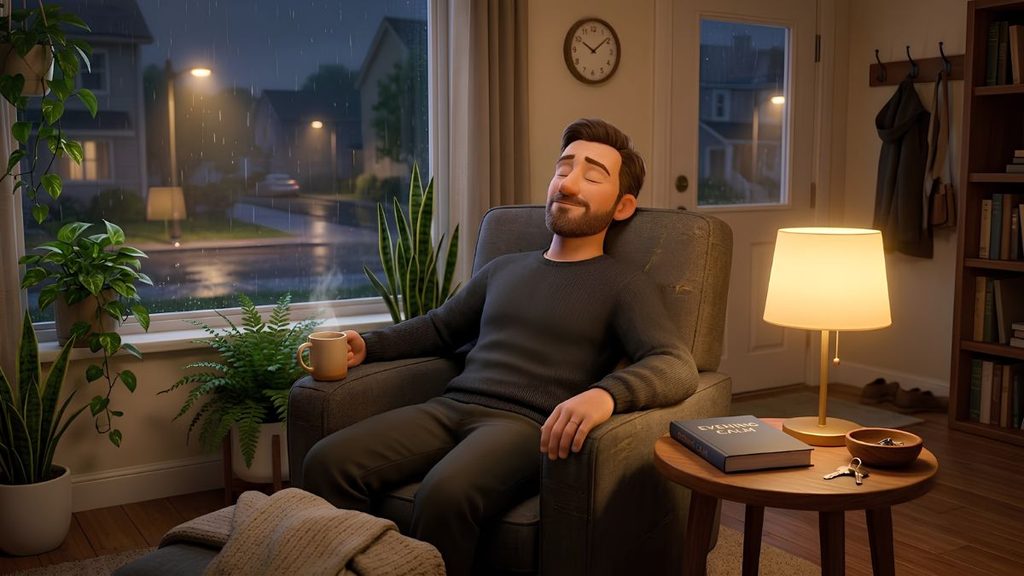
Thomas had lived in the same small apartment for almost twelve years.
It was on the third floor of an old brick building at the end of Willow Street, where the road became narrower and quieter before reaching the river.
His apartment was not large.
It had one bedroom, a small kitchen, a sitting room, a bathroom, and a narrow balcony overlooking the street.
There was nothing particularly remarkable about it.
The walls were cream-colored.
The curtains were light brown.
The sofa had become slightly faded over the years.
A round clock hung above the kitchen doorway.
A small wooden bowl sat beside the front door.
And every evening, Thomas followed exactly the same routine.
Nobody had asked him to.
He had never written it down.
He simply liked knowing what came next.
At 7:15 each evening, Thomas came home.
At 7:17, he placed his keys in the wooden bowl.
At 7:18, he removed his shoes.
At 7:20, he opened the kitchen window.
At 7:25, he changed into a soft gray sweater.
At 7:30, he prepared dinner.
At 8:00, he washed the dishes.
At 8:15, he watered his plants.
At 8:30, he made tea.
At 8:40, he sat in his armchair.
At 8:45, he opened a book.
At 9:00, he closed the book.
At 9:05, he checked the kitchen.
At 9:10, he turned off the lights downstairs.
At 9:15, he went upstairs.
And eventually, he went to bed.
It was not an exciting life.
Thomas liked it that way.
He worked at a small accounting office on the other side of town.
His workdays were generally quiet.
He answered emails.
Checked numbers.
Prepared reports.
Spoke to clients.
Drank coffee.
At five-thirty, he packed his bag.
At six, he left the office.
He took the same bus home every evening.
The driver was usually the same man.
The bus usually stopped at the same places.
Thomas usually sat near the window.
He liked watching the city change as evening arrived.
Shops closed.
Streetlights came on.
People carried grocery bags.
Children returned home from parks.
Restaurants became brighter.
By the time Thomas reached Willow Street, the sky was usually beginning to darken.
He would walk the final three minutes to his building.
Then he would climb the stairs.
Then the routine would begin.
One Monday evening, Thomas arrived home at exactly 7:15.
He opened the door.
The apartment was quiet.
He placed his keys in the wooden bowl.
Removed his shoes.
Hung his coat on the hook.
Then he opened the kitchen window.
A cool breeze entered.
Thomas stood there for a moment.
Across the street, a woman was closing the curtains of her apartment.
A dog barked somewhere below.
A bicycle rolled along the pavement.
Someone laughed.
Thomas closed the window.
He changed his sweater.
Then he prepared dinner.
That evening, he made pasta.
He boiled water.
Added salt.
Opened a jar of tomato sauce.
Chopped a few mushrooms.
Placed everything into a pan.
The kitchen slowly filled with the smell of tomatoes and herbs.
Thomas liked cooking because it required very little thought.
The ingredients did what they were supposed to do.
Water boiled.
Vegetables softened.
Sauce warmed.
Pasta became tender.
There were no surprises.
He placed the food on a white plate.
Then he sat at the small kitchen table.
Outside, rain began to fall.
Thomas listened to it while eating.
Rain was one of his favorite sounds.
It made the apartment feel warmer.
When he finished dinner, he washed the plate.
Then the fork.
Then the glass.
He wiped the counter.
He dried his hands.
At 8:15, he watered his plants.
There were six of them.
A tall green plant beside the balcony door.
Two small plants on the kitchen shelf.
A fern near the window.
A flowering plant on the table.
And one tiny cactus that needed almost no water.
Thomas knew exactly how much each plant required.
The tall plant received a little.
The fern received more.
The cactus received nothing.
He looked at it.
“You’re doing fine.”
The cactus remained silent.
Thomas smiled.
At 8:30, he made tea.
He always used the same cup.
It was white with a thin blue line around the top.
The cup had belonged to his mother.
He had used it for years.
He poured the tea.
Carried it into the sitting room.
Sat in his armchair.
And waited.
There was no particular reason for the waiting.
He simply enjoyed sitting quietly before reading.
The rain continued outside.
Thomas could hear water running along the street.
The clock ticked.
The refrigerator hummed.
The heating made a faint clicking sound.
He took a sip of tea.
Then another.
At 8:45, he opened his book.
He was reading an old novel about a family living near the sea.
He had already read several chapters.
Sometimes he remembered what happened.
Sometimes he didn’t.
It did not matter.
He liked the feeling of turning pages.
He liked the weight of the book.
He liked the quiet sound the pages made.
At exactly 9:00, he closed it.
He placed a small bookmark between the pages.
Then he looked around the room.
The lamp beside his chair was glowing softly.
The curtains moved slightly from the breeze.
Everything was in its usual place.
Thomas stood.
He walked into the kitchen.
Checked the stove.
It was off.
He checked the tap.
It was closed.
He checked the back door.
Locked.
Then he turned off the kitchen light.
He walked toward the stairs.
Before going upstairs, he looked at the wooden bowl near the front door.
His keys were still there.
Good.
He went upstairs.
The bedroom was cool.
He opened the curtains.
The rain had stopped.
Thomas could see a small section of sky between the buildings.
One star was visible.
He stood there for a while.
Then he closed the curtains.
Changed into pajamas.
Placed his glasses on the bedside table.
And climbed into bed.
The routine ended there.
Or at least, it usually did.
But one Tuesday evening, something slightly different happened.
Thomas arrived home at 7:15.
He placed his keys in the bowl.
Removed his shoes.
Opened the kitchen window.
Then he noticed something.
The clock above the doorway had stopped.
It was showing 7:22.
Thomas looked at his watch.
It was 7:16.
He stared at the clock.
He had not noticed it stop before.
He took it down.
Opened the back.
The battery was empty.
Thomas found a new battery in a drawer.
He replaced it.
The clock began ticking again.
He put it back on the wall.
Then he continued with dinner.
That was the entire interruption.
But Thomas found himself thinking about the clock.
He had watched it every evening for years.
He had simply never thought about it.
It had always been there.
Ticking.
Moving.
Marking time.
He finished dinner.
Washed the dishes.
Watered the plants.
Made tea.
Sat in his chair.
Opened his book.
But every few minutes, he looked at the clock.
It was still moving.
Tick.
Tick.
Tick.
The sound seemed louder than usual.
Thomas smiled.
“You’ve been working hard.”
The clock continued.
On Wednesday, Thomas followed his routine.
On Thursday, he followed it again.
On Friday, the bus arrived three minutes late.
Thomas noticed.
He sat near the window as usual.
The driver apologized.
“Traffic.”
Thomas nodded.
“No problem.”
He watched the streets.
Three minutes did not matter.
He still arrived home.
He still placed his keys in the bowl.
He still changed his sweater.
He still made dinner.
But that evening, instead of pasta, he made soup.
It was not part of the routine.
Yet somehow, it felt right.
He chopped carrots.
Added potatoes.
Sliced an onion.
Put everything into a pot.
Then he sat beside the kitchen window while the soup cooked.
Outside, the evening sky was clear.
A woman walked her dog.
A man carried groceries.
Two children rode bicycles.
The city was settling down.
Thomas realized that he had spent years following the same routine without really noticing the world around him.
The routine had given him peace.
But it had also given him something else.
Time to notice small things.
The sound of rain.
The smell of dinner.
The changing seasons.
The plants growing slowly.
The light moving across the walls.
The first star appearing above the rooftops.
He finished his soup.
Washed the bowl.
Watered the plants.
Made tea.
Sat in his chair.
At 8:45, he opened his book.
But after a few pages, he stopped.
He listened.
The apartment was quiet.
Very quiet.
Thomas closed the book.
He sat back.
For a few minutes, he did nothing.
And he discovered that doing nothing was pleasant.
The next evening, he followed the routine again.
But this time, at 8:40, he stood on the balcony.
The air was cool.
The streetlights below were glowing.
Someone had opened a window across the road.
Music floated faintly into the evening.
Thomas leaned against the railing.
He stayed there for ten minutes.
Then he went inside.
Nothing important had happened.
Yet he felt rested.
Over the following weeks, Thomas continued his routine.
But small changes appeared.
Sometimes he made soup instead of pasta.
Sometimes he read for twenty minutes.
Sometimes he read for only five.
Sometimes he stood on the balcony.
Sometimes he opened the window and listened to the rain.
The routine remained.
But it became softer.
It was no longer a list of things that had to happen.
It became a collection of familiar moments he could enjoy.
One Sunday evening, Thomas sat at the kitchen table.
The sun was setting.
The room was filled with golden light.
He looked at his wooden bowl.
His keys were inside.
His shoes were beside the door.
The plants were watered.
The dishes were clean.
The tea was warm.
The clock was ticking.
Everything was ordinary.
Thomas smiled.
He realized that ordinary was not the same as meaningless.
There was something comforting about knowing where everything belonged.
The cup.
The keys.
The chair.
The book.
The plants.
The evening light.
And perhaps people needed such things.
Small places where nothing demanded anything from them.
Small routines that said:
You are home.
The clock reached 8:45.
Thomas picked up his book.
He opened it.
Read a page.
Then another.
His eyes became heavy.
The words began to blur slightly.
He closed the book.
He did not worry about finishing the chapter.
He placed it beside his chair.
Then he made his final check of the kitchen.
The stove was off.
The tap was closed.
The back door was locked.
The lights were off.
He climbed the stairs.
In the bedroom, he opened the curtains one last time.
The moon was visible above the rooftops.
Thomas stood there quietly.
Then he closed the curtains.
He climbed into bed.
The apartment settled into silence.
The clock downstairs continued ticking.
The plants stood quietly by the window.
The book waited on the chair.
The cup rested in the kitchen sink.
Everything was exactly where it needed to be.
Thomas closed his eyes.
Tomorrow would probably be much the same.
He would wake up.
Make breakfast.
Go to work.
Take the bus home.
Put his keys in the wooden bowl.
Remove his shoes.
Open the window.
Prepare dinner.
Water the plants.
Make tea.
Read a little.
Turn off the lights.
Go upstairs.
And sleep.
Nothing extraordinary.
Nothing dramatic.
Nothing worth telling the evening news.
Just another ordinary day.
And Thomas had finally understood that ordinary days were not empty spaces between important moments.
They were the moments.
The quiet ones.
The familiar ones.
The ones that passed almost unnoticed.
The ones that slowly became a life.
And as the clock continued its gentle ticking downstairs, Thomas drifted into sleep.
The routine could wait until morning.
For tonight, everything was quiet.
Everything was safe.
And nothing else needed to happen.
Story 2: The Train That Stopped at Every Little Station
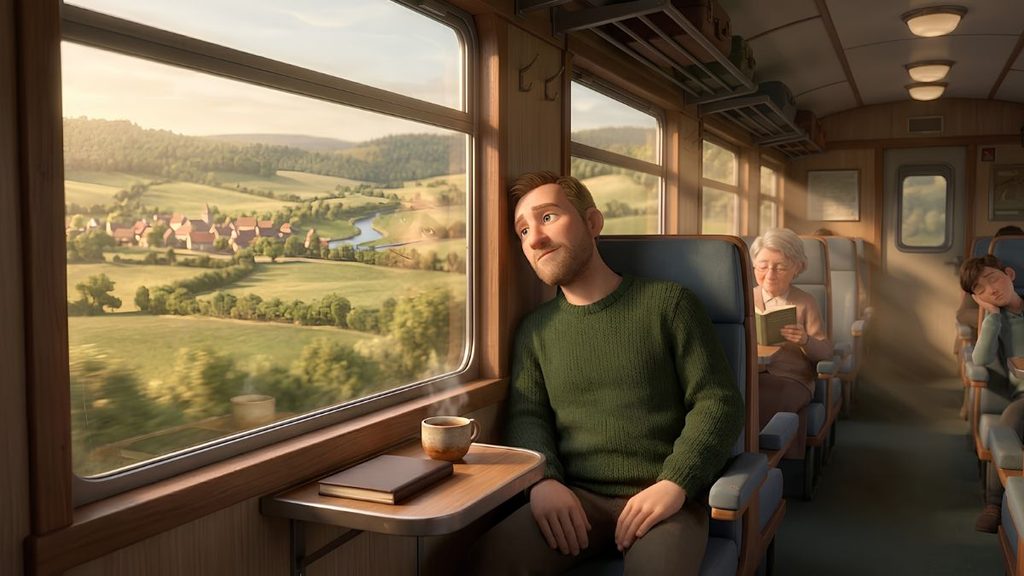
The train left the station at 3:18 in the afternoon.
It was not a fast train.
It was not famous.
It did not connect any important cities.
It simply traveled from one small town to another, stopping at nearly every station along the way.
Thomas had chosen it because he had nowhere particular to be.
He had finished work on Friday morning, and instead of going directly home, he decided to take a train through the countryside.
There was no appointment waiting for him.
No friend expecting him.
No hotel reservation.
He had simply looked at the railway timetable and noticed a train leaving at 3:18.
The destination was a town called Bellford.
Thomas had never been to Bellford.
He had no reason to go there.
That was precisely why he chose it.
The train stood quietly at Platform 4.
It was an old regional train with large windows, comfortable blue seats, and slightly worn wooden panels.
A few passengers were already inside.
An elderly woman sat near the front, holding a cloth bag.
A young man was reading a newspaper.
A mother and her daughter sat together across the aisle.
A conductor walked slowly through the carriages, checking his watch.
Thomas climbed aboard.
He found a seat beside the window.
He placed his small bag on the luggage rack.
Then he sat down.
The train remained still for another five minutes.
Thomas looked through the window.
The platform was almost empty.
A man carried two paper bags toward the station exit.
A station worker rolled a small trolley toward the ticket office.
A pigeon walked along the edge of the platform.
Nothing happened.
Thomas liked that.
At 3:18 exactly, the train began moving.
Very slowly.
The station slipped behind him.
The platform disappeared.
The town began to move past the window.
For the first few minutes, there were houses.
Then shops.
Then a row of small warehouses.
Then fewer buildings.
Then fields.
Thomas leaned his head against the window.
The glass was cool.
The countryside stretched into the distance.
Green fields were separated by narrow hedges.
A few cows stood near a fence.
Far away, he could see a farmhouse with a red roof.
The train moved steadily.
It did not hurry.
Thomas opened a small book.
He read two pages.
Then he looked outside again.
The train passed a small pond.
A flock of birds flew over the water.
Then the first station appeared.
Its name was Meadowbrook.
The station consisted of a single platform, a small wooden shelter, and a sign painted white with black letters.
There were three people waiting.
The train slowed.
The brakes made a soft sound.
Then the train stopped.
One passenger got off.
Nobody got on.
Thomas looked at the station.
A man stood beneath the shelter.
He was holding an umbrella even though it was not raining.
A woman stood near the station sign.
She was carrying a shopping bag.
The conductor checked his watch.
After two minutes, the train began moving again.
Thomas turned the page of his book.
The countryside returned.
A line of trees passed outside.
Then a field.
Then a narrow stream.
Then another field.
The train continued.
Thomas wondered how many people used this railway every day.
Perhaps someone took it to work.
Perhaps someone visited family.
Perhaps someone simply enjoyed the journey.
He liked imagining that the railway connected many small ordinary lives.
Twenty minutes later, the train reached another station.
Oakfield.
This station had two platforms.
There was a small flower garden beside the ticket office.
A woman was watering the flowers.
The train stopped.
Four passengers got off.
Two passengers got on.
One of them was an elderly man carrying a folded newspaper.
He sat several rows ahead of Thomas.
The train started again.
The elderly man opened his newspaper.
Thomas looked out of the window.
The sun had moved lower in the sky.
The light was softer now.
The fields looked golden.
A few clouds were beginning to gather above the hills.
Thomas closed his book.
He decided he would not read anymore.
There was nothing he needed to do.
He could simply watch.
The train passed a small village.
A bakery stood beside the road.
A bicycle leaned against a wall.
A woman was hanging clothes outside her house.
A child kicked a ball across a garden.
Then the village disappeared.
The train crossed a stone bridge.
Below it, a narrow river moved slowly through the fields.
Thomas watched the water until the bridge disappeared behind him.
Another station was approaching.
This one was called Pine Hill.
There was nobody waiting.
The train slowed anyway.
It stopped for less than a minute.
The conductor looked through the windows.
Then the train continued.
Thomas smiled.
He had expected every station to have a reason.
But perhaps a station did not need to be busy.
It could simply be there.
A platform.
A sign.
A bench.
A timetable.
Waiting quietly.
The next station was smaller.
It was called Green Lane.
Only one passenger got off.
She carried a small suitcase.
She stepped onto the platform and walked toward a waiting car.
The driver waved.
The woman waved back.
The car disappeared down a narrow road.
The train continued.
Thomas checked his watch.
It was almost five o’clock.
He had been traveling for nearly two hours.
He did not feel tired.
He felt calmer than he had in weeks.
At home, there was always something to do.
Laundry.
Messages.
Emails.
Bills.
Shopping.
Cleaning.
There was always another task waiting.
Here, there was nothing.
He was simply sitting.
The train was moving.
That was enough.
A conductor walked through the carriage.
“Tea or coffee?”
Thomas looked up.
“Tea, please.”
The conductor poured tea into a paper cup.
Thomas thanked him.
The tea was simple.
A little too hot.
But it was pleasant.
He held the cup between both hands.
Outside, the landscape continued.
The fields gradually became more wooded.
Trees stood closer to the railway.
The afternoon light filtered through the branches.
The train entered a shallow cutting.
For several minutes, Thomas saw only trees.
Then the land opened again.
A lake appeared.
It was large enough to reflect the sky.
A few small boats were visible near the shore.
Thomas watched them until the lake disappeared.
The train approached another station.
Lakeside.
A couple got off.
An older woman got on.
She carried a basket.
She sat near the door.
The conductor checked her ticket.
Then he walked away.
The woman opened her basket.
Inside was a loaf of bread.
Thomas could smell it from several seats away.
The woman noticed him looking.
“Fresh this morning,” she said.
Thomas smiled.
“It smells good.”
“My daughter’s family likes this kind.”
She closed the basket.
Thomas returned his attention to the window.
The train moved again.
The sun was now close to the horizon.
The sky had turned pale orange.
The trees became dark silhouettes.
The houses along the railway began turning on their lights.
One by one.
A small yellow window.
Then another.
Then another.
Thomas imagined people preparing dinner.
Someone washing vegetables.
Someone setting a table.
Someone feeding a dog.
Someone turning on a television.
Ordinary evenings.
The train passed another station.
Hillcrest.
Then another.
Maple Junction.
Then another.
Westfield.
At each station, a few people got off.
A few people got on.
Sometimes nobody did either.
The train simply stopped.
Waited.
Then continued.
Thomas found something comforting about that.
There was no need for every moment to be productive.
The train could stop simply because it had reached a station.
It could wait.
Then it could continue.
Perhaps people needed permission to do the same.
To stop.
To wait.
Then continue.
The conductor came through again.
“Next stop, Bellford.”
Thomas looked up.
Bellford.
The destination.
He had almost forgotten about it.
The town was still twenty minutes away.
He looked at his reflection in the darkening window.
The glass now showed his face more clearly than the countryside.
He looked tired.
But peaceful.
He wondered whether he should get off at Bellford.
Perhaps he would find a small hotel.
Perhaps he would have dinner.
Perhaps he would return on the same train tomorrow.
He didn’t need to decide yet.
The train continued.
The carriage became quieter.
The young man put away his newspaper.
The mother and daughter were sleeping.
The elderly woman with the bread basket looked out the window.
The lights above the seats were now glowing softly.
Thomas leaned back.
The sound of the train became rhythmic.
Click.
Click.
Click.
The wheels moved over the rails.
Click.
Click.
Click.
Thomas closed his eyes.
He did not sleep.
He simply listened.
The sound was steady.
Predictable.
Comforting.
After a while, the train slowed.
Thomas opened his eyes.
A station appeared.
Bellford.
The platform was small.
A single lamp stood near the station building.
There was a bench.
A clock.
A flower bed.
And a sign.
The train stopped.
Thomas stood.
He took his bag from the rack.
He walked toward the door.
Before stepping outside, he looked back at the carriage.
The elderly woman was still sitting there.
The conductor stood near the door.
The young man was putting on his coat.
Thomas stepped onto the platform.
The air was cooler than he expected.
He looked around.
Bellford was quiet.
The station building was small.
A road ran past it.
There were a few houses in the distance.
A bakery sign was visible at the end of the street.
Thomas walked toward the town.
He found a small guesthouse above a café.
The owner gave him a room.
It was simple.
A bed.
A small table.
A chair.
A window overlooking the street.
Thomas put down his bag.
Then he went downstairs.
The café was nearly empty.
He ordered soup and bread.
The owner brought it to him.
“Traveling for work?” she asked.
“No.”
“Visiting someone?”
“No.”
She smiled.
“Holiday?”
Thomas thought about it.
“Perhaps.”
The woman nodded as if that made perfect sense.
He ate his soup slowly.
Outside, the town became quieter.
The last shop closed.
The bakery lights went out.
A bicycle passed along the street.
Then even that disappeared.
Thomas returned to his room.
He opened the window slightly.
The night air came inside.
Somewhere in the distance, a train horn sounded.
Thomas smiled.
He could hear the railway.
The same railway that had carried him through fields and villages.
The same railway that stopped at every little station.
He got into bed.
He thought about the journey.
Nothing had happened.
He had not discovered anything.
He had not met anyone important.
He had not seen anything extraordinary.
He had simply traveled.
And perhaps that was enough.
The next morning, Thomas returned to the station.
He bought a ticket for the train home.
The same slow train arrived at 9:10.
He climbed aboard.
Found a seat beside the window.
And waited.
At 9:10, the train began moving.
Bellford disappeared behind him.
Then came the fields.
Then the lake.
Then Lakeside.
Then Westfield.
Then Maple Junction.
Then Hillcrest.
The same stations.
The same platforms.
The same benches.
The same quiet rhythm.
Thomas watched the countryside.
He no longer needed a destination.
He simply enjoyed the journey.
The train stopped at every little station.
It waited patiently.
Then moved again.
And as Thomas rested his head against the window, listening to the gentle sound of the wheels moving over the tracks, he realized that perhaps there was something peaceful about a journey that asked nothing from you.
You did not have to hurry.
You did not have to decide.
You did not have to accomplish anything.
You could simply sit.
Watch.
Listen.
And let the world pass by.
The train continued through the countryside.
Fields became forests.
Forests became villages.
Villages became towns.
And every few minutes, another small station appeared.
The train slowed.
Stopped.
Waited.
Then continued.
Thomas closed his eyes.
The rhythmic sound of the wheels continued beneath him.
Click.
Click.
Click.
The afternoon light became softer.
The carriage became warmer.
The train moved steadily toward home.
And there was nowhere else Thomas needed to be.
For now, the train was enough.
The window was enough.
The quiet was enough.
And the long, uneventful journey continued.
The Path Beside the Quiet River

Every evening at half past six, Daniel took the same path.
The path began behind his small house, passed through a field, crossed beneath a line of old trees, and eventually reached a quiet river.
It was not a famous river.
There were no boats.
There were no large bridges.
There were no tourists taking photographs.
It was simply a narrow river moving slowly between grassy banks.
Daniel had discovered the path several years earlier.
Since then, he had walked it almost every evening.
He did not walk for exercise.
He did not walk because he needed to reach somewhere.
He walked because he liked the quiet.
At half past six, he would finish his dinner.
He would wash his plate.
He would put on a light jacket.
Then he would step outside.
His house stood at the edge of a small village.
Behind it were fields that stretched toward low hills.
During spring, the fields were bright green.
During summer, they became golden.
In autumn, the grass turned brown.
In winter, the ground was often covered with frost.
But the path remained.
A narrow strip of earth between the grass.
Daniel knew every part of it.
He knew where the ground became softer after rain.
He knew which tree had a low branch.
He knew where wildflowers grew in May.
He knew where the path became covered with fallen leaves in October.
He knew where the river made a quiet bend.
He knew the old wooden bench beside the water.
Nothing changed quickly there.
That was what he liked.
On a warm Tuesday evening in June, Daniel stepped outside at exactly half past six.
The sky was pale blue.
There were a few thin clouds above the hills.
A gentle breeze moved through the grass.
Daniel closed the door behind him.
Then he began walking.
The first part of the path passed through a field.
On his left was a wooden fence.
On his right were tall grasses.
A few small insects moved above the plants.
Daniel walked slowly.
He could hear birds somewhere in the trees ahead.
He could hear the distant sound of a tractor.
Then the tractor became quieter.
The village disappeared behind him.
Soon, there was only the sound of his footsteps.
One step.
Then another.
Then another.
The path curved slightly.
Daniel passed an old apple tree.
The tree had grown at an angle, with one large branch stretching toward the path.
He stopped beneath it.
There were small green apples beginning to form.
Daniel looked at them.
They were still too small to eat.
He had seen them grow every summer.
In a few months, they would become red.
He continued walking.
After several minutes, he reached the trees.
The path became darker.
The sunlight came through the leaves in small patches.
Daniel could hear birds more clearly now.
A blackbird sang from somewhere above him.
Another bird answered from farther away.
Daniel did not know their names.
He had never tried to learn them.
He simply liked listening.
The path continued beneath the trees.
A few dry leaves lay on the ground.
Daniel stepped over them.
Then he heard water.
The river was nearby.
He continued walking.
The trees gradually became thinner.
Then the river appeared.
It was exactly as he remembered.
Quiet.
Slow.
Brown-green beneath the evening light.
Daniel walked toward the wooden bench.
The bench had been there for many years.
One side was slightly darker than the other because of rain.
Daniel sat down.
He placed his hands on his knees.
Then he looked at the river.
Nothing happened.
A small leaf floated past.
Then another.
A few ripples moved across the surface.
The wind touched the grass.
Daniel leaned back.
He stayed there.
Ten minutes passed.
Then fifteen.
He did not check his phone.
He rarely carried it during his walks.
He had discovered that the river was more interesting when there was nothing else competing for his attention.
A dragonfly passed in front of him.
It hovered above the grass.
Then disappeared.
A fish moved beneath the surface.
Daniel saw the water change slightly.
Then everything became still again.
The sun began to lower.
The light became softer.
The river reflected a long line of pale gold.
Daniel watched it.
He had always liked evening.
Morning seemed full of expectations.
Evening had fewer.
The day’s work was finished.
The village was becoming quiet.
People were returning home.
Dinner was being prepared.
Windows were beginning to glow.
Soon, the first lights would appear along the distant road.
Daniel sat on the bench.
He remembered the first time he had found this place.
He had been walking without knowing where he was going.
He had followed the road out of the village.
Then he had noticed the path.
At the time, the river had been swollen from several days of rain.
The water had moved faster.
The grass had been flattened.
He had stood beside the river for a few minutes.
Then he had returned home.
The next evening, he came back.
And the evening after that.
Eventually, it became a habit.
There were no rules.
He simply came.
Sometimes he stayed for ten minutes.
Sometimes half an hour.
Sometimes he walked farther along the river.
Sometimes he turned around almost immediately.
It depended on the day.
Today, he felt like staying.
The breeze became cooler.
Daniel looked at the sky.
The blue was changing to gray.
A bird flew across the river.
Then another.
The grass moved gently.
Daniel closed his eyes.
He listened.
The river made a soft sound.
Not loud.
Not even particularly musical.
Just water moving over stones.
He breathed slowly.
For a moment, he thought about nothing.
Then he thought about the next day’s breakfast.
Then he thought about a letter he needed to send.
Then he thought about the old apple tree.
Then the thoughts disappeared again.
He did not try to stop them.
He simply let them come and go.
After a while, Daniel opened his eyes.
The first evening star was visible above the trees.
He stood.
He brushed a little dust from his trousers.
Then he began walking home.
The path looked different now.
During daylight, it had been bright and green.
Now it was becoming blue and gray.
The trees stood like dark shapes against the sky.
Daniel walked slowly.
He passed the same bend.
The same tree.
The same field.
He heard an owl somewhere in the distance.
He stopped.
Listened.
Then continued.
When he reached the apple tree, he looked up.
The small apples were almost invisible in the fading light.
He smiled.
He would see them tomorrow.
Or the day after.
There was no need to remember exactly.
Some things were better when they changed slowly.
Daniel reached the field.
The village lights were visible ahead.
One house.
Then another.
Then another.
Smoke rose from a chimney.
A dog barked once.
Then became quiet.
Daniel crossed the field.
The grass moved around his legs.
He could smell the cool evening air.
He reached his house at seven thirty.
He opened the door.
Inside, everything was quiet.
He took off his jacket.
Placed it on the hook.
Went into the kitchen.
Filled a glass with water.
Then he stood beside the window.
From there, he could not see the river.
But he could see the dark outline of the hills.
Somewhere beyond them, the river was still moving.
Daniel thought about it for a moment.
Then he closed the curtain.
He washed the glass.
Turned off the kitchen light.
And went upstairs.
The following evening, he took the same path.
And the evening after that.
Some days were sunny.
Some were cloudy.
Some were windy.
Some were rainy.
On rainy evenings, Daniel carried an umbrella.
He still walked to the river.
The path became muddy.
Water gathered in small puddles.
The leaves became darker.
The river moved slightly faster.
Daniel sat beneath the trees where the rain was lighter.
He listened to the drops falling onto the leaves.
Sometimes he did not even reach the bench.
He simply stood beneath a tree for a few minutes.
Then returned home.
There was always something different.
But nothing dramatic.
One evening, a family of ducks appeared on the river.
They moved slowly along the bank.
Daniel watched them for several minutes.
The next evening, they were gone.
Another evening, a deer stood in the field.
Daniel stopped walking.
The deer looked at him.
Neither moved.
After a while, the deer turned and walked toward the trees.
Daniel continued home.
A week later, the apple tree began producing red fruit.
Daniel picked one.
He wiped it on his sleeve.
Then took a bite.
It was slightly sour.
He smiled.
He continued walking.
The seasons passed.
Summer became autumn.
The green leaves turned yellow.
Then orange.
Then brown.
The path became covered with leaves.
Daniel walked more slowly because the ground was slippery.
The river reflected the colors of the trees.
He sat on the bench.
A leaf landed beside him.
He picked it up.
Looked at it.
Then placed it back on the ground.
Nothing needed to be kept.
Winter arrived.
The grass became pale.
The river looked darker.
Some mornings, there was frost along the bank.
Daniel continued walking in the evenings.
He wore a heavier coat.
Sometimes the sun disappeared before he reached the river.
Then he carried a small flashlight.
The beam illuminated the path.
The trees were dark.
The river was almost invisible.
But Daniel could still hear it.
Water moving.
Slowly.
Steadily.
The sound was familiar.
He did not need to see the river to know it was there.
Spring returned.
Small flowers appeared beside the path.
The grass became green again.
Birds returned to the trees.
The apple tree began growing new leaves.
Daniel sat on the bench one evening and watched the river.
A year had passed.
He had walked the path hundreds of times.
Yet it never felt exactly the same.
The path was the same.
The river was the same.
The bench was the same.
But Daniel was different each evening.
Sometimes tired.
Sometimes cheerful.
Sometimes thoughtful.
Sometimes completely empty of thoughts.
The river accepted all of those moods without asking anything.
That was perhaps why he liked it.
It did not require an explanation.
He could simply sit beside it.
The sun began to set.
Daniel watched the light disappear from the water.
The sky became pale.
Then darker.
The first star appeared.
Daniel stood.
He walked home.
Tomorrow, he would probably return.
There would be another evening.
Another walk.
Another quiet stretch of path.
Another few minutes beside the river.
Nothing important would happen.
And that was perfectly fine.
Because not every evening needed a story worth remembering.
Some evenings simply needed to pass gently.
Some walks simply needed to lead nowhere.
And some places were valuable precisely because nothing demanded your attention there.
Daniel reached his house.
He opened the door.
The room was warm.
He switched on the lamp.
Made a cup of tea.
Sat beside the window.
And listened to the quiet.
Far beyond the hills, the river continued moving through the darkness.
Slowly.
Steadily.
Without hurry.
Daniel finished his tea.
Then he went upstairs.
He changed into comfortable clothes.
Turned down the bed.
And lay beneath the blanket.
For a few moments, he thought about the path.
The trees.
The bench.
The water.
Then his thoughts became quieter.
The river was still moving.
The village was sleeping.
The fields were still.
The trees stood quietly beneath the night sky.
And Daniel closed his eyes.
Tomorrow, the path would still be there.
There was nowhere else he needed to go.
For tonight, that was enough.
The Afternoon Spent Organizing the Kitchen Cupboard

Margaret decided to organize the kitchen cupboard on a Saturday afternoon.
There was no particular reason for choosing that day.
The weather was ordinary.
The house was quiet.
She had finished lunch, washed the dishes, and placed the last clean plate on the drying rack.
Then she stood in the middle of the kitchen and looked at the cupboard beside the refrigerator.
It had been bothering her for several weeks.
Not seriously.
It was not broken.
Nothing was missing.
There was simply too much inside it.
A packet of rice stood behind two boxes of pasta.
Three different kinds of tea had been placed on the same shelf.
A jar of cinnamon sat behind a bottle of cooking oil.
There were several packets that Margaret could not remember buying.
Every time she opened the cupboard, she had to move something before finding what she wanted.
She had always intended to organize it.
But there was always another day.
On Saturday, however, there was nothing else that needed to be done.
Margaret looked at the clock.
It was 2:10 in the afternoon.
She decided that she would organize the cupboard before making tea.
She opened the cupboard door.
The first thing she noticed was the tea.
There were seven boxes.
Margaret counted them twice.
Seven.
She smiled.
“I don’t remember buying all of these.”
She took the first box out.
Then the second.
Then the third.
Soon the kitchen table was covered with tea boxes.
Black tea.
Green tea.
Herbal tea.
Mint tea.
Chamomile tea.
A box of tea that someone had given her last winter.
And one box that she had apparently purchased because she liked the picture on the front.
Margaret looked at it.
She could not remember whether she liked the tea.
She opened the box.
There were still several tea bags inside.
She decided to keep it.
She placed all the tea on one side of the table.
Then she continued.
Behind the tea were several jars.
Sugar.
Salt.
Cinnamon.
Cloves.
Paprika.
Dried oregano.
Bay leaves.
Margaret removed them one by one.
The cupboard became emptier.
The table became fuller.
She placed each jar carefully on the table.
The cinnamon jar had a small amount of powder around its lid.
Margaret wiped it with a damp cloth.
The salt jar was almost empty.
She made a mental note to buy more.
She found two jars of oregano.
She laughed softly.
“Two.”
She had no idea why she needed two.
She opened both.
One was nearly full.
The other was almost empty.
She decided to combine them.
She found a small clean bowl.
Poured the nearly empty jar into it.
Then poured the contents of the full jar into the same bowl.
She cleaned the empty jar and dried it.
Then she filled it with the oregano.
Now there was one jar instead of two.
Margaret put the empty jar into a drawer.
She was not sure why.
Perhaps she would need it someday.
The cupboard now had only a few things left.
Packets of pasta.
Rice.
Flour.
Sugar.
Several cans.
A jar of biscuits.
And a few items she did not immediately recognize.
Margaret took out the pasta.
There were four packets.
Spaghetti.
Penne.
Fusilli.
And another packet of spaghetti.
She placed them together.
Then she looked at the dates.
None were expired.
She put the newest packet toward the back.
The older ones went toward the front.
She had learned that system from her mother.
Use the older things first.
Margaret had followed that rule for years.
Sometimes she forgot.
Today she remembered.
Next came the rice.
There were two bags.
One was open.
The other was unopened.
She took the open bag and poured the rice into a glass container.
The grains made a soft sound as they fell.
Tick.
Tick.
Tick.
Margaret filled the container almost to the top.
Then she closed the lid.
She placed the unopened bag behind it.
She liked seeing the rice through the glass.
It made the cupboard look more orderly.
She wiped the shelf.
A small amount of dust had collected in the corner.
She wiped it again.
Then once more.
Finally, the shelf looked clean.
Margaret stepped back.
There was still a lot to do.
She continued.
At the back of the cupboard, she found an old packet of biscuits.
The packet was slightly dusty.
Margaret picked it up.
She remembered buying it several months earlier.
She had been shopping on a rainy evening.
She had gone into the supermarket for milk.
Then she had walked past the biscuit aisle.
The biscuits had been on sale.
She had bought them without thinking.
She placed the packet on the table.
She checked the date.
There was still plenty of time.
Margaret opened it.
The biscuits smelled fine.
She ate one.
It was slightly sweet.
She ate another.
Then she closed the packet.
She decided to have the rest with tea later.
She placed them in a small container.
The kitchen was quiet.
The only sound was the clock above the doorway.
Tick.
Tick.
Tick.
Margaret looked outside.
The afternoon sun was shining through the window.
A neighbor was hanging clothes on a balcony.
A bird sat on a rooftop.
A car passed slowly along the road.
Then the street became quiet again.
Margaret returned to the cupboard.
She wiped the bottom shelf.
Then the middle shelf.
Then the top shelf.
She cleaned the inside of the cupboard door.
There was a small mark near the handle.
She rubbed it with a cloth.
The mark disappeared.
She smiled.
It was satisfying.
Not exciting.
Just satisfying.
She put the cans together.
There were tomatoes.
Beans.
Soup.
Sweetcorn.
She arranged them in rows.
The taller cans went behind the shorter ones.
The cans she used most often went toward the front.
She stepped back again.
The cupboard was beginning to look different.
There was more space.
Things were easier to see.
She could find everything without moving half the shelf.
Margaret decided to take a short break.
She sat at the kitchen table.
She made herself a cup of tea.
She used the blue cup with the small flower painted on the side.
She placed two biscuits on a plate.
Then she sat quietly.
The tea was warm.
The biscuit was crisp.
The afternoon sunlight had moved across the floor.
Margaret watched it.
She did not turn on the television.
She did not check her phone.
She simply sat.
After a few minutes, she looked at the cupboard.
She still had the top shelf to organize.
She finished her tea.
Ate the last biscuit.
Then she stood.
The top shelf contained the things she used least often.
A large bag of flour.
A jar of cocoa.
Some baking ingredients.
A small packet of dried fruit.
Several containers with lids.
Margaret removed everything.
She put the containers on the table.
There were five of them.
Two had lids.
Three did not.
She looked around the kitchen.
The missing lids were nowhere to be found.
She opened one drawer.
Nothing.
Another drawer.
Nothing.
She checked the cabinet beneath the sink.
Nothing.
Finally, she found one lid inside another container.
She smiled.
She placed the lid beside its container.
The second missing lid never appeared.
Margaret decided not to worry about it.
She put the container aside.
Perhaps she would use it without a lid.
Or perhaps she would eventually throw it away.
There was no need to decide today.
She returned to the cupboard.
The flour went to the left.
The baking ingredients went together.
The cocoa went beside the sugar.
The dried fruit went into a glass jar.
Margaret placed everything carefully.
She left a small amount of empty space.
She liked that.
An empty space made the cupboard feel less crowded.
She closed the door.
Then opened it again.
She looked inside.
Everything was where it belonged.
She closed the door.
Then opened it once more.
She laughed quietly.
“Why am I checking again?”
She checked anyway.
The rice was still there.
The pasta was still there.
The tea was still there.
The cans were still in rows.
Everything looked good.
She closed the door.
It was 4:05.
Almost two hours had passed.
Margaret was surprised.
She had not expected it to take that long.
But she had not hurried.
There had been no reason to.
She walked to the kitchen sink.
Washed the cloth.
Hung it over the tap.
Then she wiped the table.
There were tea boxes everywhere.
She returned each one to the cupboard.
Black tea on the left.
Green tea beside it.
Herbal tea at the end.
She placed the tea she used most often at the front.
The others went behind it.
She looked at the arrangement.
It seemed right.
She closed the cupboard.
Then she swept the kitchen floor.
There were a few crumbs beneath the table.
She collected them.
Then she emptied the dustpan.
The kitchen looked clean.
Not perfectly clean.
But comfortable.
Margaret washed her hands.
Then she made another cup of tea.
This time, she took the biscuits from the container.
She carried the cup and plate to the small chair beside the window.
She sat down.
The sunlight was softer now.
The afternoon was becoming evening.
A breeze moved the curtains.
Margaret took a sip.
She looked at the cupboard.
It was only a cupboard.
Nothing special had happened.
She had not discovered anything valuable.
She had not solved a problem.
She had not accomplished something important.
She had simply moved things around.
Yet she felt strangely pleased.
There was comfort in knowing where things were.
Tomorrow, if she wanted pasta, she knew where to find it.
If she needed rice, she knew where it was.
If she wanted tea, she would not have to move six boxes first.
The cupboard had become easier.
That was enough.
Margaret finished her tea.
She took the plate to the sink.
Washed the cup.
Washed the plate.
Dried them.
Then she opened the cupboard one final time.
She looked at everything.
The shelves were clean.
The jars were arranged.
The pasta stood neatly together.
The rice sat in its glass container.
The cans were lined up.
The tea boxes were organized.
The biscuits were in their container.
There was empty space between several items.
Margaret liked that most of all.
She closed the door.
The kitchen became quiet.
She turned off the main light.
Only the small lamp above the sink remained on.
Margaret stood for a moment.
The house was peaceful.
The work was finished.
There was nothing else she needed to organize.
She switched off the final light.
Then she went into the sitting room.
She sat in her favorite chair.
Outside, evening was beginning.
The sky was pale gold.
The rooftops had become darker.
A few lights appeared in neighboring houses.
Margaret leaned back.
She thought about the cupboard.
She wondered how long it would stay organized.
Probably not very long.
Someone would eventually move a jar.
A packet of pasta would be opened.
A new box of tea would be purchased.
The rice container would become empty.
The neat rows would slowly become uneven again.
That was fine.
Things were used.
Things were moved.
Things became untidy.
Then, occasionally, they were organized again.
There was nothing permanent about a tidy cupboard.
Margaret smiled.
She closed her eyes.
The clock continued ticking.
The kitchen was quiet.
The cupboard was closed.
Everything was finished for the day.
And there was nothing more to do.
The afternoon had passed without anything remarkable happening.
No visitors had arrived.
No phone had rung.
No unexpected message had appeared.
Margaret had simply spent two peaceful hours organizing a kitchen cupboard.
And somehow, that was exactly what she had needed.
She remained in her chair for a while longer.
Then she stood.
She walked into the kitchen.
The cupboard was still closed.
She opened it once.
Everything was still in place.
She nodded.
Then she closed it again.
This time, she did not reopen it.
She switched off the light.
Walked upstairs.
Changed into comfortable clothes.
And prepared for bed.
Downstairs, the kitchen remained quiet.
The cupboard stood neatly against the wall.
The jars waited on their shelves.
The rice rested in its glass container.
The tea boxes stood together.
The biscuits sat safely in their small container.
Nothing moved.
Nothing happened.
And for one quiet evening, everything was exactly where Margaret had left it.
The Librarian Who Opened the Library Every Morning
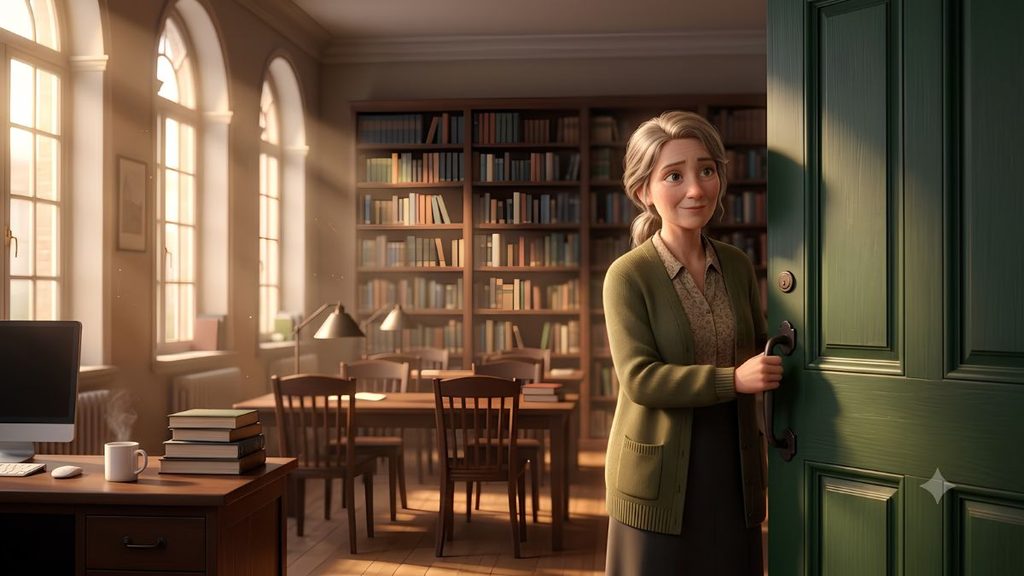
Helen worked at a small neighborhood library on the corner of Maple Street and Willow Road.
It was not a large library.
There were only three rooms.
The main reading room occupied most of the building.
A smaller room at the back held children’s books.
And beside the entrance was a narrow office where Helen kept the library records, her lunch, a kettle, and a small collection of pens.
The library had been there for many years.
Its windows were tall.
Its wooden doors were heavy.
The shelves were made of dark wood, polished by decades of hands.
There was a large round clock above the front desk.
The clock was slightly slow.
Helen knew this.
She had known it for years.
But she never corrected it.
She liked the way it looked.
Every morning, Helen arrived at eight o’clock.
She walked from her apartment because the library was only fifteen minutes away.
She followed the same route every day.
She passed the bakery.
Then the post office.
Then a small flower shop.
Then she crossed Maple Street.
At the corner stood the library.
The building had a green door and two large windows facing the street.
Helen always arrived at exactly eight.
She would take the key from her coat pocket.
Unlock the door.
Push it open.
And step inside.
The library was always quiet in the morning.
The air smelled faintly of paper and wood.
Helen liked that smell.
She closed the door behind her.
Then she turned on the lights.
One row.
Then another.
Then the lamp above the front desk.
The reading room slowly became brighter.
Helen removed her coat.
Hung it on the hook in the office.
Then she opened the curtains.
Outside, the street was beginning to wake.
A baker carried a tray into the shop next door.
A bus passed along Maple Street.
A man walked his dog.
Two people waited outside the post office.
Helen watched them for a moment.
Then she turned away from the window.
There was always something to do before the library opened.
Nothing difficult.
Nothing urgent.
Just small tasks.
She checked the heating.
It was usually already comfortable.
If the room felt cold, she adjusted the thermostat.
Then she walked between the shelves.
She looked at the chairs.
Sometimes one had been left slightly crooked.
Helen would straighten it.
Then she would straighten another.
She did not need to.
The chairs were perfectly usable.
But she liked them to be aligned.
There were six tables in the main room.
Helen walked from one to another.
She made sure each chair was pushed in.
She checked the lamps.
She wiped one table where someone had left a faint mark.
Then she returned to the front desk.
The library was ready.
But it was only 8:20.
Helen still had forty minutes before opening.
She made tea.
She used a white mug with a green line around the edge.
The mug belonged to the library.
There were six identical mugs in the kitchen.
Helen had chosen the one with the green line because it was easiest to recognize.
She poured hot water into the cup.
Added a tea bag.
Then carried it to her desk.
She sat down.
For a few minutes, she did nothing.
She looked at the empty reading room.
Sunlight slowly entered through the windows.
Dust moved gently in the light.
The clock ticked above her.
Helen took a sip of tea.
Then she opened the returns box.
Several books had been returned the previous afternoon.
She took them out one at a time.
A gardening book.
A mystery novel.
A cookbook.
A biography.
Two books about local history.
And a small children’s book about animals.
Helen checked each one.
No pages were missing.
No covers were damaged.
She placed them on the trolley.
Then she began returning them to their shelves.
The gardening book went to the second aisle.
The mystery novel went to the fiction section.
The cookbook went toward the back.
The biography went on the history shelf.
The local history books went together.
The children’s book went into the small room.
Helen knew the shelves very well.
She rarely needed to check the labels.
She simply walked.
Book after book.
Shelf after shelf.
The task took about twenty minutes.
When she finished, she returned the trolley to its place.
Then she looked at the clock.
8:55.
Five minutes until opening.
Helen returned to the front desk.
She unlocked the front door.
At nine o’clock, she opened it.
The first visitor arrived at 9:07.
It was an older man named Arthur.
He came to the library three mornings a week.
He always wore a brown coat.
He always carried the same black umbrella.
And he always asked Helen the same question.
“Has the gardening section moved?”
“No, Arthur.”
“Good.”
He smiled.
Then he walked toward the gardening books.
Helen watched him disappear between the shelves.
She smiled too.
There was comfort in familiar routines.
At 9:20, a woman returned three novels.
Helen scanned them.
“Did you enjoy them?”
“Very much.”
“Good.”
The woman smiled.
Then she left.
At 9:40, a young man sat by the window.
He opened his laptop.
He stayed for two hours.
Helen barely noticed him.
That was part of working in a library.
People came and went quietly.
Sometimes they asked questions.
Sometimes they needed help.
Sometimes they simply wanted a warm, quiet place to sit.
At ten o’clock, a mother arrived with her daughter.
The girl was perhaps six years old.
She immediately walked toward the children’s room.
Helen heard her footsteps.
Then she heard the sound of books being moved.
A few moments later, the girl returned holding a picture book.
“This one.”
Her mother smiled.
“That one?”
The girl nodded.
Helen scanned the book.
“Enjoy it.”
The girl smiled.
“Thank you.”
Then they sat together in the children’s room.
Helen returned to her desk.
The library became quiet again.
She looked through the window.
Outside, the flower shop had opened.
Buckets of flowers stood beside the door.
A man bought a small bunch of yellow flowers.
Then he walked away.
Helen watched him until he disappeared around the corner.
She returned to her paperwork.
There were forms to check.
Books to record.
A few emails to answer.
None were urgent.
She worked slowly.
At eleven thirty, she made another cup of tea.
She carried it to the reading room.
She checked the heating again.
Everything was fine.
She walked past the shelves.
The books were in order.
The chairs were straight.
The tables were clean.
She returned to her desk.
At noon, the library became quieter.
Some visitors left for lunch.
Others stayed.
Helen opened the small lunch container she had brought from home.
Inside was a sandwich, an apple, and a few biscuits.
She sat in the staff room.
The window was open slightly.
She could hear the street outside.
A bus.
A bicycle bell.
Someone talking.
Then silence.
Helen ate slowly.
She looked at the clock.
12:30.
After lunch, she returned to the main room.
The sunlight had shifted.
Earlier, it had fallen across the front desk.
Now it stretched across the floor near the history shelves.
Helen liked watching the light move.
It changed every hour.
She had noticed that in summer, sunlight reached the back wall.
In winter, it rarely reached beyond the first row of shelves.
She never got tired of noticing.
At one o’clock, Arthur left the library.
He stopped at the front desk.
“See you Thursday.”
“See you Thursday.”
Helen knew he would come.
At 1:30, the young man closed his laptop.
He packed his bag.
He nodded to Helen.
She nodded back.
Then he left.
At 2:00, a delivery arrived.
It contained six new books.
Helen signed for them.
She opened the box.
The books smelled new.
She liked that smell too.
She placed the books on the desk.
One was about gardening.
One was about cooking.
One was a novel.
One was about local history.
Two were children’s books.
Helen added them to the library system.
Then she placed them on a small display table near the entrance.
She arranged them carefully.
The gardening book stood upright.
The novel went beside it.
The cookbook lay flat.
The children’s books were placed at the front.
Helen stepped back.
The display looked good.
It was a small thing.
But she liked making small things look right.
The afternoon continued.
A few visitors arrived.
A few left.
Someone borrowed a book.
Someone returned one.
Someone asked where the newspapers were.
Helen pointed toward the reading room.
A woman asked whether the library would be open on Saturday.
“Yes.”
She thanked Helen.
Then she left.
Nothing unexpected happened.
Nothing difficult happened.
The day simply continued.
At four o’clock, the library became quieter again.
The light outside had changed.
The street was golden.
Helen sat at the front desk.
She opened a book.
She read for ten minutes.
Then fifteen.
She looked up occasionally.
The library was nearly empty.
A man sat in the corner.
An elderly woman read a magazine.
A student turned pages at one of the tables.
The clock ticked.
Helen returned to her book.
At 4:30, the student left.
At 4:40, the elderly woman left.
At 4:50, the last visitor returned a book.
Helen scanned it.
“Thank you.”
“Good evening.”
“Good evening.”
The door closed.
Helen looked around.
The library was empty.
She did not feel lonely.
She liked the quiet at the end of the day.
She began closing the library.
First, she checked the children’s room.
She straightened two chairs.
Then she checked the main reading room.
She pushed in six chairs.
Straightened three books.
Turned off one lamp.
Then another.
She closed the curtains.
The windows became dark.
The library lights remained on.
Helen walked toward the front desk.
She checked the returns box.
Empty.
She checked the computer.
Closed.
She looked at the clock.
5:00.
It was time.
Helen switched off the lights.
One row.
Then another.
The room became dim.
She switched off the lamp above the desk.
The library was quiet again.
She walked toward the door.
Before leaving, she looked back.
The shelves stood in long rows.
The tables were empty.
The chairs were straight.
The books were waiting.
Everything was ready for tomorrow.
Helen locked the door.
She put the key into her coat pocket.
Then she walked home.
The flower shop was closing.
The bakery was still open.
The post office had been closed for an hour.
The streets were becoming quieter.
Helen walked past the same buildings she had passed that morning.
She reached her apartment.
Made dinner.
Washed her dishes.
Read for a while.
Then went to bed.
The next morning, she woke up at seven.
She dressed.
Had breakfast.
Put on her coat.
And walked to the library.
At exactly eight o’clock, she stood in front of the green door.
She took the key from her pocket.
Unlocked the door.
Pushed it open.
And stepped inside.
The library was quiet.
Just as it had been yesterday.
She turned on the lights.
Opened the curtains.
Checked the heating.
Straightened the chairs.
Returned the books.
Made a cup of tea.
And sat at the desk.
At nine o’clock, she opened the door.
Arthur arrived at 9:07.
The woman returned her books.
The young man opened his laptop.
The little girl chose another picture book.
The day continued.
Then evening came.
Helen closed the curtains.
Switched off the lights.
Locked the door.
And walked home.
The following morning, she did it again.
And the morning after that.
The library never became exciting.
Helen never expected it to.
There were no dramatic events.
No great adventures.
No important discoveries.
There were simply books.
Shelves.
Visitors.
Quiet conversations.
Warm cups of tea.
Sunlight moving across wooden floors.
Chairs being straightened.
Books being returned.
Doors being opened.
Doors being locked.
Days passing quietly into evenings.
And Helen liked it that way.
Because sometimes a peaceful life was made from small repeated things.
A key turning in a lock.
A curtain opening.
A kettle beginning to boil.
A book returning to its proper shelf.
A chair being pushed gently beneath a table.
The soft sound of footsteps between rows of books.
And at the end of the day, the quiet click of a library door being locked.
Nothing more was required.
The library would be there tomorrow.
The books would still be waiting.
The chairs would need straightening again.
The curtains would need opening again.
The kettle would need filling again.
And Helen would arrive at eight o’clock.
She would unlock the green door.
Step inside.
Turn on the lights.
And begin another ordinary morning.
The Quiet Morning in a Village Bakery, 1926

Before the sun rose over the hills, Thomas was already awake.
It was a cool morning in October 1926, and the small village of Bellmere was still sleeping.
The houses along the main road were dark.
The windows were covered with curtains.
The narrow streets were empty.
Even the village church, whose bell usually marked the hours, seemed quiet.
Thomas lived in a small house behind the bakery.
He had been the village baker for almost twenty years.
Every morning, he woke before sunrise.
He did not need an alarm clock.
His body had become accustomed to the hour.
At 4:45, he opened his eyes.
For a moment, he remained beneath the blanket.
The room was dark.
He could hear the faint sound of wind outside.
A branch moved against the wall.
Thomas sat up.
He put on his woolen shirt, trousers, and brown waistcoat.
Then he pulled on his boots.
Before leaving the bedroom, he folded the blanket neatly.
He always did that.
He walked downstairs.
The kitchen was cold.
He lit a small lamp.
Then he went to the back door.
The bakery was only a few steps away.
Thomas unlocked it.
The wooden door made a soft creaking sound.
He stepped inside.
The bakery was darker than the kitchen.
He lit the lamp above the worktable.
The warm yellow light spread across the room.
There were shelves along the walls.
A large wooden table stood in the center.
Several bowls rested on a smaller table.
Near the back was the brick oven.
It had been built many years earlier.
Thomas knew every part of it.
He walked toward the woodpile.
There were several pieces of dry wood stacked beside the oven.
Thomas picked up three pieces.
He placed them inside.
Then he added a few smaller pieces.
He struck a match.
The flame appeared.
He held it beneath the dry kindling.
A small fire began.
Thomas waited.
The wood crackled quietly.
He added another piece.
Then another.
The oven would take time to become hot.
There was no need to hurry.
Thomas walked to the worktable.
A large sack of flour stood nearby.
He opened it.
The smell of flour was familiar.
He measured several scoops into a large wooden bowl.
The flour fell softly.
A small cloud rose from the bowl.
Thomas smiled.
He added water.
Then salt.
Then yeast.
He began mixing.
The dough slowly came together.
At first, it was sticky.
Thomas continued.
He folded it.
Pressed it.
Turned it.
Then folded it again.
The work was repetitive.
Thomas liked that.
There was no need to think about anything else.
His hands knew what to do.
The village outside remained quiet.
Through the bakery window, he could see only darkness.
A little later, the sky began to change.
The black became deep blue.
Then gray.
Thomas continued kneading.
At around 5:30, he stopped.
The dough was smooth.
He placed it in a large bowl.
Covered it with a clean cloth.
Then he left it to rest.
Thomas walked outside.
The air was cold.
He stood in the street for a moment.
Bellmere looked different before sunrise.
During the day, the village was full of movement.
Children walked to school.
Farmers traveled toward the fields.
Shopkeepers opened their doors.
People visited one another.
But before sunrise, everything was still.
Thomas looked toward the hills.
A thin line of light had appeared behind them.
He returned to the bakery.
The fire was burning steadily.
Thomas opened the oven door.
Warm air came toward him.
He added two more pieces of wood.
Then closed the door.
He returned to the dough.
It had risen slightly.
Thomas removed the cloth.
He pressed the dough gently.
Then divided it into several pieces.
Each piece would become a loaf.
He shaped them carefully.
One.
Then another.
Then another.
He placed them on a wooden board.
They would rest for a little longer.
Thomas washed his hands.
Then he made tea.
There was a small kettle in the bakery.
He filled it with water.
Placed it on the stove.
And waited.
The water warmed slowly.
Thomas stood beside the stove.
He looked out the window.
The first chimney in the village had begun producing smoke.
Someone else was awake.
A few minutes later, a second chimney released a thin gray line into the morning air.
Thomas smiled.
The village was waking.
At 6:15, he heard footsteps outside.
A milkman walked down the road.
His cart moved slowly behind him.
The horse’s hooves made a soft sound against the road.
Clip.
Clop.
Clip.
Clop.
Thomas watched him pass.
The milkman raised a hand.
Thomas raised his hand in return.
Neither spoke.
There was no need.
Thomas turned back to the oven.
He checked the temperature.
It was nearly ready.
He placed the first loaves inside.
The oven door closed with a heavy sound.
Thomas set a small clock beside the worktable.
Then he began preparing the next batch.
Outside, more windows were opening.
Across the street, a woman opened her curtains.
She looked toward the bakery.
Thomas could see her through the glass.
She waved.
Thomas waved back.
She disappeared behind the curtains.
A few minutes later, the smell of bread began to spread through the bakery.
Thomas opened the oven slightly.
Warm air escaped.
The smell was richer now.
Fresh bread.
Flour.
Wood smoke.
The familiar scent filled the small room.
At 7:00, Thomas unlocked the front door.
He turned the sign around.
OPEN.
The first customer arrived almost immediately.
It was Mrs. Miller.
She came every morning.
She wore a dark coat and carried a cloth shopping bag.
“Good morning, Thomas.”
“Good morning.”
“Two loaves, please.”
Thomas reached for the bread.
He wrapped each loaf in brown paper.
He tied the paper with string.
Mrs. Miller placed the money on the counter.
“Thank you.”
“You’re welcome.”
She picked up the bread.
Then she walked home.
Thomas watched her cross the road.
A few minutes later, another customer arrived.
Mr. Wilson.
He wanted one loaf.
Then came a young woman who bought two rolls.
Then an older man who bought bread for his family.
The bakery slowly became busier.
But it was never loud.
People spoke quietly.
The door opened.
The door closed.
Bread was wrapped.
Coins changed hands.
People exchanged greetings.
Thomas liked the rhythm.
It continued for about an hour.
Then the bakery became quiet again.
At 8:15, Thomas looked outside.
The village was fully awake now.
A horse-drawn cart passed.
A man swept the front of his shop.
Two children walked down the road.
A dog followed them.
The church bell rang eight times.
Thomas looked at the clock.
He realized he had not heard the first seven bells because he had been working.
He smiled.
He returned to the worktable.
There was another batch of dough waiting.
He began shaping it.
The bakery became warm.
Outside, the morning remained cool.
The windows slowly became slightly misted.
Thomas wiped one with a cloth.
He could see the road again.
At nine o’clock, a farmer entered.
“Morning.”
“Morning.”
“Anything left?”
“Plenty.”
The farmer laughed.
“I’ll take two.”
Thomas wrapped the loaves.
The farmer paid.
Then he left.
At ten o’clock, Thomas sat down for a few minutes.
He had a piece of bread and some cheese.
He poured himself another cup of tea.
He sat beside the window.
Outside, sunlight had reached the rooftops.
The sky was clear.
A few clouds moved slowly above the hills.
Thomas ate quietly.
He watched the village.
A woman carried a basket.
A boy pushed a bicycle.
A man repaired a fence.
A cat sat on a doorstep.
Nothing important was happening.
Thomas liked that.
The morning passed slowly.
At eleven, several customers came.
At noon, fewer.
By one o’clock, the shelves were beginning to empty.
Thomas looked at the remaining bread.
Seven loaves.
Then five.
Then three.
He did not need to bake more.
There would be enough for the afternoon.
He began cleaning the worktable.
He swept flour from the surface.
He washed the bowls.
He placed them upside down to dry.
He cleaned the wooden table with a damp cloth.
The bakery smelled of warm bread and wood.
At two o’clock, only two loaves remained.
A woman bought one.
An elderly man bought the other.
Thomas looked at the empty shelf.
The day’s bread was almost gone.
He was pleased.
Not because it had been a particularly successful day.
It was simply nice to know that people had bought the bread he had made that morning.
At three o’clock, Thomas closed the bakery door for a short break.
He sat on the step outside.
The afternoon sun was warm.
The village had become quieter again.
Children were still at school.
Farmers were working in the fields.
Shopkeepers were inside their stores.
Thomas sat with his hands resting on his knees.
A cat walked past him.
It stopped.
Looked at him.
Then continued.
Thomas smiled.
He sat there for another ten minutes.
Then he went back inside.
There was still cleaning to do.
He swept the floor.
Collected the ashes near the oven.
Stacked the remaining wood.
Washed the last bowl.
Wiped the counter.
Then he checked the oven.
The fire had gone out.
The bricks were still warm.
Thomas closed the oven door.
He looked around.
The bakery was ready for tomorrow.
The shelves were empty.
The worktable was clean.
The bowls were dry.
The flour sack was covered.
The wood was stacked.
Everything was in order.
Thomas turned off the lamps.
The bakery became dim.
He walked toward the front door.
Before leaving, he looked back once.
The warm smell of bread remained in the air.
Thomas smiled.
He locked the door.
Then he walked home.
The village road was quiet.
The sun was beginning to lower.
Long shadows stretched across the street.
A woman stood outside her house shaking a small rug.
A man carried firewood.
Someone was closing a shop.
The church bell rang four times.
Thomas continued walking.
He reached his house.
He opened the door.
The kitchen was warm.
His wife, Eleanor, was preparing supper.
“How was the morning?” she asked.
“Quiet.”
She smiled.
“Good.”
Thomas removed his coat.
He washed his hands.
Then he sat at the kitchen table.
There was soup waiting.
He ate slowly.
After dinner, he washed his bowl.
Then he went outside for a few minutes.
The sky was turning orange.
The village looked peaceful.
Smoke rose from chimneys.
A few lamps had been lit.
Thomas stood beside the garden fence.
He could smell wood smoke in the evening air.
Tomorrow would be much the same.
He would wake before sunrise.
Walk to the bakery.
Light the oven.
Measure flour.
Add water.
Knead the dough.
Wait.
Bake.
Wrap the bread.
Serve customers.
Sweep the floor.
Close the door.
Go home.
There would be no great adventure.
No unexpected journey.
No dramatic event.
Just bread.
Just mornings.
Just the quiet rhythm of work.
Thomas liked that rhythm.
It had carried him through many years.
He went inside.
Eleanor had placed a cup of tea on the table.
Thomas sat beside her.
They listened to the clock.
Tick.
Tick.
Tick.
Outside, the village became darker.
One by one, the windows lit up.
The church stood quietly at the end of the road.
The bakery was dark.
The oven was cold.
The shelves were empty.
Tomorrow morning, Thomas would fill them again.
But tonight, there was nothing left to do.
Thomas finished his tea.
He went upstairs.
Changed into his night clothes.
Folded his clothes neatly.
Then climbed into bed.
The house was quiet.
The village was quiet.
The bakery was quiet.
Far away, a horse moved inside a stable.
A dog barked once.
Then silence returned.
Thomas closed his eyes.
He imagined the bakery in the morning.
The smell of flour.
The warmth of the oven.
The sound of dough being kneaded.
The first light appearing behind the hills.
The first chimney sending smoke into the sky.
The milkman walking down the road.
The bakery door opening at seven.
The first customer saying good morning.
The day beginning slowly.
Nothing extraordinary.
Nothing urgent.
Just another morning waiting to arrive.
Thomas breathed slowly.
The house was warm.
The blanket was comfortable.
The village rested outside.
And somewhere in the darkness, the old bakery waited patiently for sunrise.
Tomorrow, Thomas would unlock the door again.
He would light the oven.
And begin.
For now, though, the day was finished.
The village was asleep.
And Thomas drifted quietly into sleep with the simple thought that morning would come when it came.
There was no need to hurry.
There was nothing else to do.
Everything could wait until tomorrow.
7. The Nostalgic Day at an Old House
Nostalgic boring stories can focus on familiar objects and memories rather than emotional conflict.
A character might return to an old family home and spend a quiet afternoon looking through photographs, cleaning a bedroom, opening old cupboards, or sitting in the garden.
The memories can be warm rather than sad.
Possible Story Idea:
The Afternoon in the House With the Blue Door
After many years away, Emily returns to the small house where she grew up.
She opens the blue front door.
Inside, everything seems familiar.
The old clock still hangs in the hallway.
A wooden chair remains beside the window.
In the kitchen, she finds a ceramic bowl she remembers using as a child.
She spends the afternoon opening drawers and looking through old photographs.
She finds a picture of herself standing beside a bicycle.
Another shows her family having breakfast.
She makes tea and sits in the garden.
The afternoon becomes evening.
Nothing important happens.
But Emily feels comfortable being there.
Before leaving, she closes each window, checks the doors, and turns off the lights.
Then she looks back at the blue door before walking away.
The story ends quietly.
Why Would Anyone Want a Boring Story?
The word “boring” usually has a negative meaning.
During the day, boredom can feel uncomfortable.
At night, however, a little boredom can be useful.
Modern life provides an enormous amount of stimulation. Phones, social media, television, work notifications, games, news, and conversations can keep the brain engaged until very late.
When you finally get into bed, your body may be tired while your mind remains active.
You might replay conversations.
Think about tomorrow’s responsibilities.
Remember something embarrassing from years ago.
Plan your weekend.
Calculate expenses.
Think about work.
Or simply experience a stream of unrelated thoughts.
A simple story can provide an alternative focus.
Instead of following every thought your mind produces, you follow something predictable and gentle.
Eventually, you may stop actively following the story.
That transition can make bedtime feel easier.
Boring Does Not Mean Unpleasant
The best boring stories are not irritating.
There is an important difference between boring and poorly written.
A poorly written story can be frustrating.
A good boring story can be comforting.
It may contain beautiful descriptions and carefully chosen details, but the overall narrative remains low-stakes.
For example, imagine a story about a person spending an evening in a quiet country house.
They make tea.
They close the curtains.
They arrange a few books.
They listen to rain.
They prepare something simple for dinner.
They wash the dishes.
They look outside.
Nothing dramatic happens.
That lack of drama is exactly what makes the story suitable for sleep.
The Main Characteristics of Boring Sleep Stories
1. Slow Pacing
Slow pacing is one of the most important characteristics.
Events should happen gradually.
Instead of writing:
Sarah rushed downstairs, grabbed her coat, and ran through the rain to catch the last train.
A sleep-oriented story might describe Sarah slowly putting away a book, washing her cup, putting on her coat, and walking calmly toward the station.
The second version gives the reader more time to settle.
2. Predictable Events
Predictability can be relaxing.
Readers do not need to constantly wonder what will happen next.
A character might wake up, make breakfast, take a walk, return home, prepare dinner, and go to bed.
There is no need for a sudden twist.
There is no villain waiting around the corner.
There is no dramatic revelation.
The reader knows the world is safe.
3. Minimal Conflict
Conflict creates mental stimulation.
For sleep stories, unnecessary conflict is usually best avoided.
A character can experience small inconveniences, but they should not create significant tension.
For example, a character might discover that the bakery is closed and decide to visit the café instead.
That is enough.
There is no need for a major crisis.
4. Familiar Settings
Familiar environments can make stories easier to relax with.
Common settings include:
- Bedrooms
- Libraries
- Small towns
- Quiet cafés
- Country houses
- Bookshops
- Gardens
- Beaches
- Trains
- Hotels
- Parks
- Lakesides
- Bakeries
- Neighborhood streets
These settings can feel safe because they are easy to imagine.
5. Gentle Repetition
Repetition can create a soothing rhythm.
A character might follow the same evening routine every night.
They close the curtains.
Make tea.
Read a few pages.
Wash the cup.
Turn off the kitchen light.
Check the door.
Go upstairs.
This repetition can become almost hypnotic without requiring anything supernatural.
6. Low Emotional Intensity
A bedtime story does not need to create strong emotional reactions.
Heavy grief, fear, anger, suspense, or excitement can make it harder for some readers to settle.
Boring sleep stories usually emphasize:
- Comfort
- Familiarity
- Peace
- Routine
- Quiet observation
- Gentle nostalgia
- Simple satisfaction
The emotional atmosphere should gradually become softer.
Different Types of Boring Stories for Sleep
There is more than one way to create a deliberately uneventful story.
Different readers may find different types relaxing.
Everyday Routine Stories
These stories follow ordinary daily activities.
A character might spend an evening preparing dinner, folding laundry, watering plants, reading, and getting ready for bed.
There is no major plot.
The pleasure comes from observing familiar routines.
Slow Travel Stories
A slow train journey can make an excellent sleep-story setting.
The character might sit beside a window and watch fields, villages, rivers, and distant hills pass by.
The train stops at small stations.
Passengers get on and off.
Someone reads a newspaper.
A conductor checks tickets.
Nothing particularly exciting happens.
The journey itself becomes the story.
Quiet Nature Stories
Nature provides plenty of material for slow storytelling.
A character can walk through a forest.
They can sit beside a lake.
They can watch clouds.
They can listen to birds.
They can observe rain moving across a field.
The emphasis should be on sensory details rather than dramatic events.
Simple Household Stories
Household tasks may sound incredibly ordinary, which makes them ideal for this genre.
A story could describe:
- Organizing a cupboard
- Cleaning an attic
- Folding clothes
- Rearranging books
- Preparing breakfast
- Watering plants
- Washing dishes
- Sorting old photographs
- Repairing a chair
The task gives the story a gentle structure without creating pressure.
Quiet Workplace Stories
Workplace stories can also be relaxing when they focus on routine rather than stress.
Imagine a librarian opening a small library each morning.
They unlock the door.
Open the curtains.
Turn on the lights.
Dust a few shelves.
Arrange returned books.
Make tea.
Check the reading room.
The repetition becomes comforting.
Gentle Historical Stories
Historical settings can work well when they avoid wars, political conflict, and major tragedies.
A story might follow an old-fashioned village baker preparing bread before sunrise.
The character measures flour, lights the oven, prepares dough, opens the bakery, and watches the town wake up.
The historical atmosphere provides interest without requiring dramatic action.
Nostalgic Stories
Nostalgia can be calming when handled gently.
A character might revisit a childhood home or find an old box of photographs.
Rather than focusing on loss, the story can concentrate on small details.
A familiar kitchen.
An old clock.
A favorite chair.
The smell of bread.
A garden path.
These details can create a peaceful reflective mood.
Boring Stories Versus Sleep Stories
Not every sleep story needs to be boring.
There is a spectrum.
Some readers prefer:
Gentle → Cozy → Relaxing → Slow → Boring → Very Boring
Others might prefer a mild romantic story or a peaceful fantasy story.
The best choice depends on how active your mind feels.
If you enjoy reading before bed and simply want something calming, a cozy story may be enough.
If you become mentally absorbed in every plot, a deliberately boring story may work better.
The goal is to find a story that holds your attention lightly.
How Long Should Boring Sleep Stories Be?
There is no perfect length.
Short stories can work well when you want a quick transition into bedtime.
Medium-length stories provide more time to settle down.
Long stories can be useful for people who prefer listening or reading until they naturally fall asleep.
A useful range might be:
- 5 to 10 minutes: Quick bedtime relaxation
- 10 to 20 minutes: Gentle wind-down
- 20 to 30 minutes: Extended relaxation
- 30 minutes or longer: Slow bedtime listening
However, length is less important than pacing.
A 30-minute exciting story may be more stimulating than a calm 10-minute story.
Why Predictability Can Feel Comforting
Predictability reduces the need to constantly anticipate what comes next.
In a suspenseful story, every paragraph can create a question.
Who is behind the door?
What will happen next?
Will the character escape?
What does the mysterious letter say?
A boring sleep story removes most of those questions.
The reader can relax because nothing important is about to happen.
The character may simply continue walking.
The rain continues falling.
The kettle continues boiling.
The train continues moving.
The pages continue turning.
That predictability creates a steady rhythm.
The Importance of Sensory Details
Although boring sleep stories have simple plots, they do not have to be dull in their descriptions.
Sensory details can make them immersive without making them exciting.
A story might describe:
- The warmth of a mug
- The sound of rain
- The smell of fresh bread
- The texture of an old blanket
- The sound of footsteps
- The coolness of evening air
- The rustling of leaves
- The gentle movement of curtains
These details encourage the reader to imagine a peaceful environment.
The story becomes less about “what happens” and more about “what it feels like to be there.”
Boring Stories Can Be Especially Useful for Overactive Minds
Some people have difficulty falling asleep because their thoughts move quickly from one subject to another.
A simple narrative can offer a neutral mental pathway.
Instead of thinking about several unrelated concerns, the reader follows one uncomplicated sequence.
For example:
A person walks to a bakery.
They buy bread.
They walk home.
They put the bread on the kitchen counter.
They make tea.
They sit near the window.
The story does not demand much interpretation.
There is no puzzle to solve.
No mystery to uncover.
No complicated character relationship to analyze.
The mind can gradually lose interest.
That is often the desired result.
What Makes a Boring Story Good?
A good boring story still needs careful writing.
It should have a clear atmosphere.
It should feel coherent.
The sentences should flow naturally.
The setting should be easy to imagine.
The characters should feel believable.
Most importantly, the story should not accidentally introduce excitement.
A writer can ruin a sleep story by suddenly adding a mystery, argument, frightening event, romantic revelation, or unexpected danger.
The safest approach is to keep the emotional temperature steady.
Topics That Work Well
When creating boring stories for sleep, consider ordinary subjects such as:
- A quiet morning at a country inn
- A librarian organizing shelves
- A person taking the same evening walk
- A slow train through the countryside
- A baker preparing bread
- Someone cleaning an old house
- A gardener tending plants
- A person watching rain from a café
- An evening spent sorting photographs
- A peaceful day beside a lake
- A small-town post office
- A quiet bookstore
- A person preparing tea
- A long ferry ride
- An old hotel during the off-season
These subjects provide enough structure to keep the narrative moving without creating excitement.
Topics to Avoid When You Want Maximum Calm
Some subjects naturally create tension.
If the purpose is extremely relaxing bedtime content, it may be better to avoid:
- Horror
- Crime
- Thrillers
- Violent conflict
- Intense arguments
- Sudden emergencies
- Dangerous adventures
- Major betrayals
- High-stakes mysteries
- Fast-paced action
- Complicated plot twists
Even a beautiful story can become unsuitable for sleep if it suddenly introduces danger.
How to Read Boring Stories Before Bed
The reading environment can influence the experience.
Consider lowering the room lighting.
Put your phone on silent.
Choose a comfortable position.
Keep the room at a comfortable temperature.
Read slowly.
You do not need to finish the story.
If you become sleepy halfway through, stop reading.
That is not failure.
It may mean the story has done exactly what you wanted it to do.
How to Listen to Boring Stories
Boring stories can also work well as audio.
A calm narrator can make a simple story even more relaxing.
The narration should ideally be:
- Slow
- Clear
- Gentle
- Consistent
- Free from dramatic changes in volume
Background music should also be subtle if it is used at all.
Loud music, sudden sound effects, or dramatic narration can defeat the purpose.
Why You Do Not Need to Finish the Story
One of the biggest differences between entertainment and sleep content is the goal.
When reading an exciting novel, finishing the chapter may be satisfying.
With a sleep story, finishing may not matter.
You can stop after three pages.
You can miss the ending.
You can forget the character’s name.
You can fall asleep while the narrator is describing a quiet garden.
The story is there to accompany your transition toward sleep, not necessarily to demand completion.
Creating a Personal Bedtime Story Routine
A consistent routine can make bedtime feel more predictable.
For example:
30 minutes before bed: Finish demanding tasks.
20 minutes before bed: Reduce screen activity.
15 minutes before bed: Prepare your bedroom.
10 minutes before bed: Get comfortable and begin a quiet story.
At bedtime: Allow your attention to drift naturally.
The exact schedule is not important.
Consistency is more useful than perfection.
Boring Stories Can Turn Ordinary Life Into Something Peaceful
One of the most appealing qualities of this genre is that it finds comfort in ordinary life.
A story does not need a castle, magical creature, secret treasure, or dramatic romance to be worth reading.
A person making tea can be enough.
A train crossing a bridge can be enough.
A quiet street after rain can be enough.
Someone watering plants can be enough.
A library closing for the night can be enough.
This simplicity can be especially appealing at bedtime because it mirrors what the body is naturally asking for: fewer demands, fewer decisions, and less stimulation.
The Beauty of an Uneventful Ending
A boring bedtime story does not need a dramatic conclusion.
The character can simply go to bed.
The shop can close.
The train can arrive.
The rain can continue.
The lamp can be switched off.
The book can be placed on a bedside table.
There does not need to be a lesson.
There does not need to be a surprise.
There does not need to be a perfect resolution.
Sometimes the most appropriate ending is simply:
The day is over.
Everything is quiet.
Nothing else needs to happen.
Final Thoughts
Boring stories for sleep offer a different kind of bedtime entertainment.
Instead of excitement, they provide predictability.
Instead of suspense, they offer routine.
Instead of complicated plots, they offer simple moments.
And instead of demanding your full attention, they allow your attention to gradually drift.
For adults who find traditional stories too stimulating, these intentionally uneventful narratives can be a comforting alternative.
A quiet walk.
A slow train ride.
A warm kitchen.
A peaceful library.
A rainy window.
A familiar evening routine.
These ordinary moments can become surprisingly effective bedtime settings.
The best boring story is not one that feels badly written.
It is one that makes you comfortable enough to stop caring what happens next.
And when you reach that point, you do not need to keep reading.
You can simply close your eyes.
Let the story fade into the background.
Let the room become quiet.
And allow sleep to arrive in its own time.