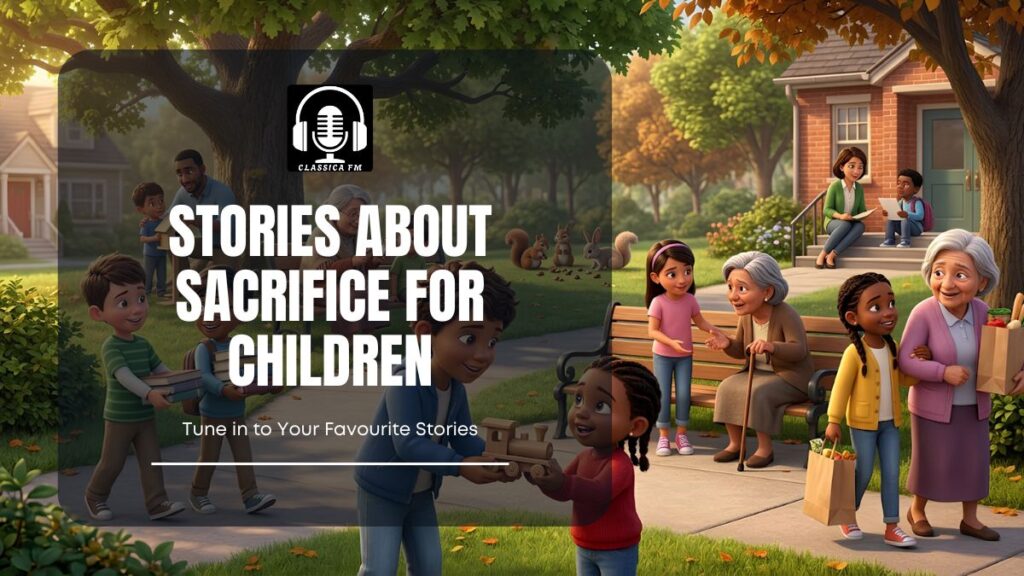
Stories about sacrifice for children can teach some of the most meaningful lessons about love, courage, generosity, responsibility, and compassion. When written thoughtfully, these stories help young readers understand that caring for others sometimes means giving up something we want for the benefit of someone else.
However, sacrifice does not always have to mean something dramatic. For children, the most relatable examples are often simple: sharing a favorite toy, helping a sibling, giving up free time to help a friend, saving money for someone else, or choosing kindness when being selfish would be easier.
This article explores the meaning of sacrifice in children’s stories, the different types of sacrifice that can be used in storytelling, suitable themes, character ideas, emotional lessons, and ways to make these stories engaging and age-appropriate.
What Are Stories About Sacrifice for Children?
Stories about sacrifice for children are narratives in which a character willingly gives up something valuable, convenient, enjoyable, or personally important to help another person.
The sacrifice might involve:
- Time
- Money
- Comfort
- Possessions
- Opportunities
- Personal preferences
- Recognition
- Pride
- Convenience
- Safety in age-appropriate situations
The important part is the motivation behind the sacrifice.
A child might give their favorite snack to a hungry friend because they care about them. Another child might spend an afternoon helping a younger sibling instead of playing a video game.
These situations demonstrate that sacrifice is not simply about losing something.
It is about recognizing that another person’s needs can sometimes matter more than our immediate wants.
Stories About Sacrifice for Children
1. The Kite That Never Flew
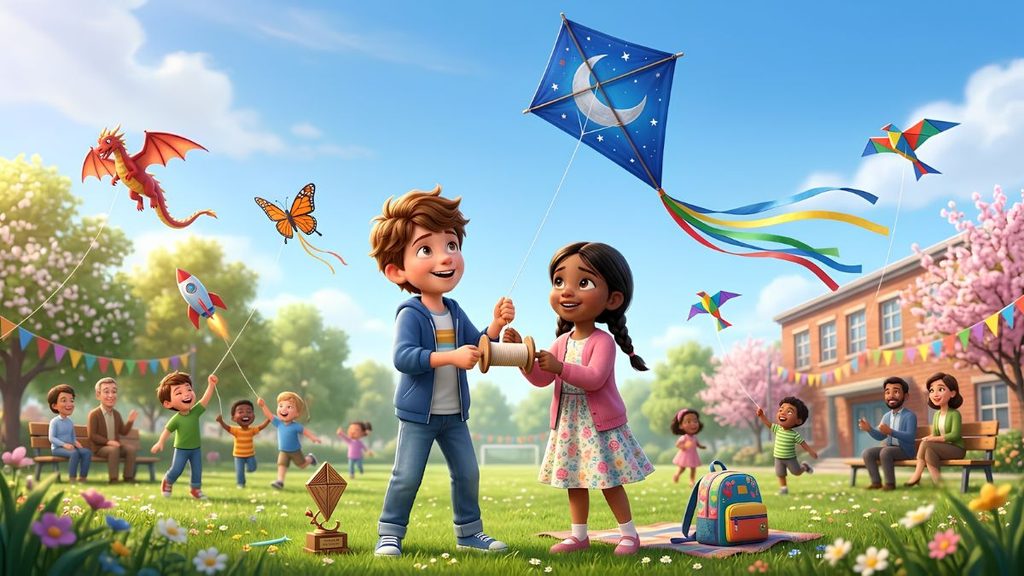
Type: Sacrificing Something Special
Core themes: generosity, friendship, sharing, letting go, happiness through giving.
Oliver Hayes had been building his kite for three weeks.
Not just any kite.
The best kite he had ever made.
It was large enough to need both hands to carry, with a long blue tail made from strips of fabric that fluttered whenever the wind passed through his bedroom window. The frame was made from thin bamboo sticks, carefully measured and tied together with strong thread.
Across the center of the kite, Oliver had painted a silver moon surrounded by tiny white stars.
His father had helped him find the right glue.
His grandmother had shown him how to make the tail.
But most of the work had been Oliver’s.
And he was proud of it.
Very proud.
“You’re going to win,” his father had told him.
Oliver smiled.
“I know.”
His father raised an eyebrow.
“That’s confidence.”
“It’s not confidence.”
“What is it?”
“Evidence.”
His father laughed.
Oliver laughed too.
The annual school kite festival was only two days away.
Oliver couldn’t wait.
The Most Important Kite
Every spring, the children at Maplewood Elementary gathered in the enormous field behind the school for the annual kite festival.
There were prizes for the highest kite.
The most creative kite.
The longest flight.
And the teacher’s special award for the kite that showed the most imagination.
Oliver wanted the highest-flying kite.
He had spent hours researching wind patterns.
He had watched videos about kite design.
He had tested different tail lengths.
He had even kept a notebook.
Test One: Kite fell sideways.
Test Two: Tail too short.
Test Three: Frame bent.
Test Four: Almost perfect.
Test Five: Perfect.
His mother found him writing in the notebook one evening.
“Are you doing homework?”
“No.”
“Then what are you doing?”
“Science.”
She leaned over his shoulder.
“You’ve written ‘wind speed’ three times.”
“Because wind speed is important.”
She smiled.
“Of course it is.”
Oliver returned to his calculations.
He wasn’t going to let anything go wrong.
Two days later, the festival arrived.
Oliver woke before his alarm.
He jumped out of bed.
The sky outside was bright and clear.
A perfect day.
He carried the kite downstairs.
His mother took a photograph.
His father inspected the frame.
“Ready?”
Oliver nodded.
“Completely.”
They drove to school.
The field was already crowded.
Children carried kites shaped like dragons, butterflies, rockets, birds, and enormous colorful flowers.
Some kites were homemade.
Others were store-bought.
Oliver didn’t care.
He believed his was better.
He carried it carefully toward the registration table.
Then he heard someone laughing nearby.
It was a group of children gathered around a small girl.
Oliver recognized her.
Mia.
She had joined his class only a few weeks earlier.
She was quiet.
She rarely spoke during lunch.
Oliver had once tried talking to her.
She had smiled but answered only with a few words.
Now she stood beside the fence watching the other children prepare their kites.
She had nothing in her hands.
Oliver looked at her.
Then at his kite.
Then back at her.
He didn’t think much of it.
Not yet.
The first competition began.
Children ran across the field.
Kites rose into the air.
Some immediately crashed.
Others twisted wildly.
A dragon-shaped kite climbed higher and higher.
Oliver waited.
The wind wasn’t quite right yet.
He checked his notebook.
Then he looked toward Mia.
She was still standing near the fence.
Oliver walked over.
“Where’s your kite?”
Mia looked down.
“I don’t have one.”
“Why?”
“My parents said we couldn’t get one this year.”
Oliver didn’t know what to say.
He looked at his own kite.
Mia noticed.
“That’s beautiful.”
“Thanks.”
“Did you make it?”
“Mostly.”
She smiled.
“I’ve never flown a kite before.”
Oliver felt something strange in his chest.
He looked at the field.
The wind was getting stronger.
This was it.
His perfect moment.
He had imagined this for weeks.
He would run across the field.
His father would watch.
His kite would rise above everyone else’s.
Maybe he would win.
Maybe his name would be announced over the loudspeaker.
Maybe everyone would see how much work he had put into it.
Then he looked at Mia again.
She was watching a child fly a bright yellow kite.
Oliver swallowed.
“Do you want to fly mine?”
Mia’s eyes widened.
“Really?”
Oliver nodded.
He held out the kite.
She hesitated.
“Are you sure?”
Oliver almost said no.
He wanted to say:
Actually, I should probably fly it myself.
But the words wouldn’t come.
“Yeah,” he said.
Mia took the kite.
The First Flight
Oliver explained everything.
“Hold this part.”
“Okay.”
“When the wind catches it, run.”
“How fast?”
“Fast.”
Mia laughed.
“That’s very scientific.”
Oliver smiled.
“Just trust me.”
She took the spool.
Oliver held the kite.
“Ready?”
Mia nodded.
“Three.”
“Two.”
“One!”
Oliver released it.
Mia ran.
The kite rose.
Slowly at first.
Then higher.
The blue fabric caught the wind.
The silver moon seemed to shine in the sunlight.
The long tail streamed behind it.
Mia stopped running.
The kite kept climbing.
Her mouth opened in amazement.
“It worked!”
Oliver laughed.
“I told you.”
The kite climbed higher.
Higher.
Higher.
Soon it was above nearly every kite on the field.
Children pointed.
Teachers looked up.
Oliver’s father smiled.
But Oliver wasn’t holding the spool.
Mia was.
And she was laughing.
For a few minutes, Oliver forgot about winning.
He simply watched.
Mia’s face was completely different.
She wasn’t shy anymore.
She wasn’t standing alone.
She was running around the field, laughing as the kite danced above her.
“This is amazing!” she shouted.
Oliver smiled.
Then the wind suddenly changed.
The kite dipped.
Mia panicked.
“What do I do?”
Oliver ran toward her.
“Let the string out!”
She did.
The kite steadied.
Oliver grabbed the spool beside her.
“Slowly.”
They worked together.
The kite climbed again.
Mia looked at him.
“You’re really good at this.”
Oliver smiled.
“I’ve practiced.”
The judges began walking around the field.
They measured heights.
Looked at designs.
Asked children questions.
One judge approached Oliver and Mia.
“Whose kite is this?”
Oliver hesitated.
Mia looked at him.
Oliver looked at the kite.
Finally, he said:
“Ours.”
The judge smiled.
“Ours?”
Oliver nodded.
“Mia’s flying it.”
The judge wrote something on his clipboard.
“Very impressive.”
The Prize
At the end of the festival, everyone gathered near the stage.
Oliver stood beside Mia.
The principal stepped forward.
“We have several awards today.”
Children became quiet.
“The award for Most Creative Kite goes to…”
A pause.
“Oliver Hayes and Mia Carter!”
Mia looked stunned.
Oliver smiled.
They walked onto the stage together.
The crowd applauded.
The principal handed them a small wooden trophy.
Oliver held one side.
Mia held the other.
Then came the final award.
“The Highest-Flying Kite.”
Oliver’s heart began beating faster.
The principal looked at the judges’ notes.
“The winner is…”
Oliver waited.
“Mia Carter and Oliver Hayes.”
The crowd cheered.
Mia stared at Oliver.
“You won.”
Oliver laughed.
“We won.”
The principal smiled.
“This kite reached the highest altitude of the day.”
Oliver looked up.
The blue kite was still flying.
Its silver moon was shining against the afternoon sky.
A Different Kind of Victory
After the awards, Oliver’s father walked over.
“I’m proud of you.”
Oliver smiled.
“Because I won?”
His father shook his head.
“Not exactly.”
Oliver understood.
He had almost kept the kite for himself.
He had almost chosen the prize before thinking about Mia.
If he had, perhaps he would have won anyway.
But he would have missed something.
His father looked at Mia.
“You made someone’s day.”
Oliver nodded.
Mia was still holding the trophy.
She looked happier than Oliver had ever seen her.
The next Monday, something unexpected happened.
Mia brought a drawing to school.
It showed the blue kite flying over the school field.
Underneath, she had drawn two children holding the spool together.
Oliver smiled.
“You drew that?”
Mia nodded.
“I’m going to put it in my room.”
“Can I have a copy?”
She laughed.
“Maybe.”
Over the next few weeks, Oliver and Mia became friends.
They ate lunch together.
They worked on science projects.
They talked about books.
They built another kite.
This one was smaller.
Mia chose the colors.
Oliver designed the frame.
They argued about the tail.
Oliver wanted a long tail.
Mia wanted a short one.
They compromised.
It flew beautifully.
One afternoon, Oliver asked:
“Do you miss the first kite?”
Mia thought about it.
“A little.”
“Me too.”
“Do you regret giving it to me?”
Oliver looked at her.
He thought carefully.
“No.”
Mia smiled.
“Good.”
Then she said:
“I think the first kite was supposed to belong to both of us.”
Oliver laughed.
“Maybe.”
The Kite in the Tree
A month later, Oliver and Mia were flying their new kite behind the school.
The wind suddenly became strong.
The kite pulled hard.
Oliver held the spool.
Mia shouted:
“Let it out!”
Oliver released the string.
The kite climbed.
Then a gust pushed it sideways.
Straight toward a large tree.
“Oh no!”
The kite became tangled in the branches.
Oliver stared.
Mia stared.
“Your turn,” she said.
“What?”
“You built it.”
“You fly it.”
They laughed.
Oliver climbed carefully onto the lowest branch.
Mia stood below.
“Be careful!”
“I am!”
“You don’t look careful!”
“I’m very careful!”
“You almost fell!”
“I did not!”
“You definitely did!”
Oliver eventually reached the kite.
He untangled it.
But one side had torn.
He climbed down.
Mia looked disappointed.
Oliver examined the damage.
“We can fix it.”
“Really?”
“Of course.”
They took the kite home.
For the next hour, they repaired it.
The tear wasn’t completely invisible.
But it didn’t matter.
When they flew it again, the patched section fluttered in the wind.
Mia smiled.
“It looks better.”
Oliver raised an eyebrow.
“Better?”
“Yes.”
“Why?”
“Because now it has a story.”
Oliver smiled.
What Oliver Finally Understood
Oliver had once believed that the best part of building a kite was making something that everyone admired.
Then he thought the best part was winning.
Later, he thought it was seeing his kite fly higher than the others.
But he was wrong.
The best part had been giving someone else the chance to experience something wonderful.
He had spent weeks building the perfect kite.
But it wasn’t the perfect kite until someone else had a chance to enjoy it.
That lesson stayed with him.
Years later, Oliver would still remember that festival.
He wouldn’t remember exactly how high the kite had flown.
He wouldn’t remember the names of all the other winners.
He wouldn’t even remember what prize they had received.
But he would remember Mia’s face when the kite first rose into the sky.
He would remember her laughter.
He would remember standing beside her as they watched the silver moon climb higher and higher.
And he would remember the moment the judge asked whose kite it was.
He had answered:
Ours.
That one word had changed everything.
A Lesson Worth Remembering
Sometimes, sacrifice looks much bigger from the inside than it does from the outside.
Oliver had believed giving away his kite meant losing something.
But he discovered that giving something meaningful to another person could create something he couldn’t have bought or built himself.
Friendship.
Confidence.
A memory.
A shared achievement.
The kite he had built for himself became something better when he shared it.
And perhaps that is one of the most important lessons children can learn:
When we share something we truly value, we may lose possession of it, but we can gain something far more meaningful.
The kite eventually disappeared.
The fabric became worn.
The frame eventually broke.
The blue tail was eventually thrown away.
But the memory remained.
And whenever Oliver saw a kite flying high above a field, he remembered the little girl who had never flown one before.
He remembered how nervous she had been.
He remembered the smile on her face.
And he remembered that sometimes the happiest moments aren’t the ones where we get what we wanted.
Sometimes they are the moments when we help someone else experience something wonderful.
That was the day Oliver learned that the best things aren’t always the things we keep.
Sometimes they are the things we are willing to share.
2. The Library Book Nobody Wanted
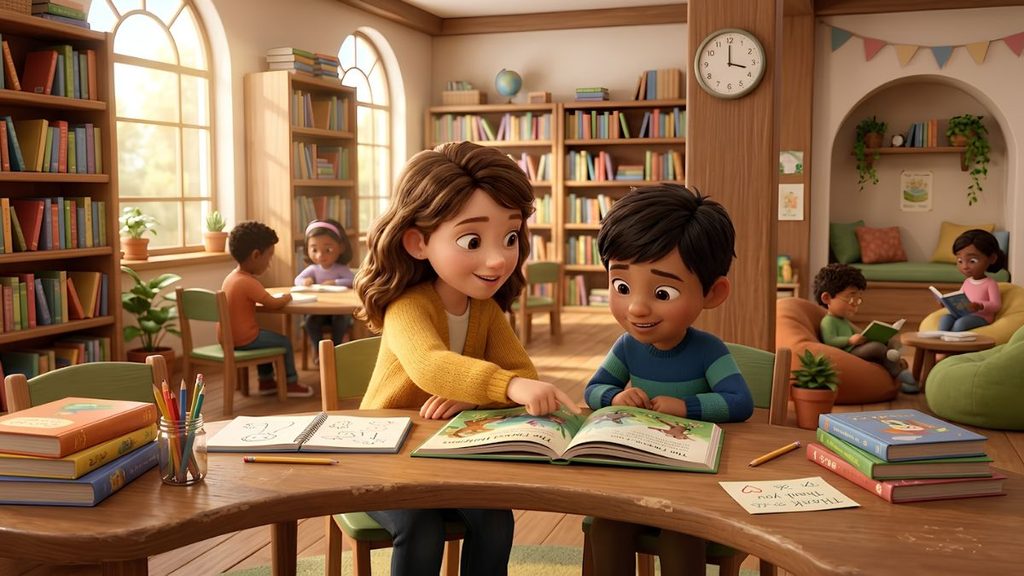
Type: Sacrificing Time
Core themes: kindness, patience, education, friendship, giving time.
Clara Bennett loved books.
She loved the smell of old pages, the quiet rustle of turning paper, and the strange feeling of opening a book and discovering that an entirely different world was waiting inside.
At ten years old, Clara was already known as the biggest reader in Maplewood Elementary.
Her teacher, Mrs. Wilson, often joked that Clara probably read during breakfast.
Clara once corrected her.
“I read during breakfast only when the book is really good.”
Mrs. Wilson laughed.
“Of course you do.”
Clara’s favorite place in the entire school was the library.
It was a small room at the end of the second-floor hallway, with tall wooden shelves, wide windows, colorful cushions, and an old clock that always seemed to run three minutes slow.
To Clara, it was perfect.
And recently, the library had become even more important.
She had been selected to represent Maplewood Elementary in the district reading competition.
The competition was only five days away.
And Clara intended to win.
The Competition
The district reading competition was a serious event.
Students from twelve schools would gather at the community hall.
Each contestant would receive a passage they had never seen before.
They would have a few minutes to read it silently.
Then they would stand in front of judges and read it aloud.
The judges would score pronunciation, expression, confidence, pace, and understanding.
Clara had been practicing every afternoon.
She read poems.
She read adventure stories.
She read difficult passages filled with words she had never encountered before.
Her mother timed her.
Her father listened.
Even her little brother Noah had become an unwilling audience member.
“Again?” Noah asked one evening.
“Again.”
“You already read it.”
“I know.”
“You read it really well.”
“I know.”
“So why again?”
“Because I can read it better.”
Noah sighed dramatically.
“Books have made you very demanding.”
Clara laughed.
Then she opened the book again.
The Boy in the Corner
On Monday afternoon, Clara entered the library carrying three practice books.
She found her usual table beside the window.
She arranged her books.
She sharpened her pencil.
She opened her notebook.
Then she noticed someone sitting in the corner.
It was a boy she had seen around school.
His name was Ben Parker.
He was younger than Clara, probably eight.
He usually kept to himself.
Today he had a children’s book open in front of him.
But he wasn’t reading.
He was staring at the same page.
Clara glanced at him.
Then back at her book.
She had limited time.
Five days.
She couldn’t afford distractions.
She began practicing.
“The old lighthouse stood at the edge of the cliff…”
She stopped.
Her voice sounded too fast.
She tried again.
“The old lighthouse stood…”
Across the room, Ben quietly moved his finger beneath a line of text.
His lips moved.
He whispered the words.
Then he stopped.
He looked around.
Nobody was watching.
Clara looked down at her book.
She told herself not to interfere.
The next day, Ben was there again.
Same corner.
Same book.
Same struggle.
Clara noticed him before she even sat down.
He whispered a sentence.
Stopped.
Started again.
Then someone walked past the library door.
Ben immediately closed his book.
Clara watched.
Something about that made her uncomfortable.
She waited until the other student left.
Ben reopened the book.
He tried again.
“Th-the…”
He stopped.
His face became red.
Clara finally walked over.
“What are you reading?”
Ben looked startled.
“Nothing.”
Clara smiled.
“It looks like something.”
He looked down.
“It’s just a book.”
“What book?”
He turned it around.
It was an illustrated story about a boy who built a boat in his backyard.
“I like that one,” Clara said.
Ben looked surprised.
“You’ve read it?”
“Twice.”
“I can’t read it.”
Clara sat down.
“Why not?”
Ben shrugged.
“I don’t know some of the words.”
“That’s okay.”
He shook his head.
“Everyone else can read.”
Clara didn’t answer immediately.
Then she asked:
“Do you want help?”
Ben looked at her.
“Really?”
Clara nodded.
“Really.”
Ten Minutes
Clara opened the book.
“Let’s start here.”
Ben looked nervous.
“Do I have to read aloud?”
“Only if you want to.”
He looked relieved.
Clara pointed to the first sentence.
“You know this word?”
Ben shook his head.
“That’s ‘adventure.'”
“Adventure.”
“Exactly.”
They went through the sentence together.
Then the next.
And the next.
After ten minutes, Ben had finished an entire page.
He smiled.
“I read it.”
“You did.”
“I actually read it.”
Clara smiled.
“See?”
Ben looked at the clock.
“I have to go.”
“Okay.”
He stood up.
Then he hesitated.
“Will you be here tomorrow?”
Clara looked at her competition books.
She was already behind schedule.
“Probably.”
Ben smiled.
“Okay.”
Then he left.
The First Sacrifice
Clara returned to her table.
She had lost ten minutes.
Only ten.
That shouldn’t matter.
She opened her practice book.
She read the first paragraph.
Then stopped.
She couldn’t concentrate.
She kept thinking about Ben.
She looked toward the empty chair.
Then at the clock.
She had thirty-five minutes before her mother arrived.
She could practice.
Or she could help Ben tomorrow.
She decided it wasn’t a big decision.
Tomorrow, she would practice first.
Then help him for ten minutes.
That seemed fair.
The next afternoon, Clara arrived early.
She practiced for twenty minutes.
Then Ben appeared.
He carried the same book.
“You’re here!”
Clara smiled.
“Ready?”
He nodded.
They sat together.
This time, Ben read two pages.
He stumbled over several words.
Clara didn’t interrupt.
She waited.
When he finished, she said:
“That was much better.”
Ben smiled.
“Can we do another page?”
Clara looked at the clock.
She still had forty minutes.
“Sure.”
Ten minutes became twenty.
Twenty became thirty.
Soon, Clara’s mother arrived.
She found Clara and Ben sitting together at the library table.
“Clara?”
Clara looked up.
“Oh!”
Her mother smiled.
“I thought you were practicing.”
“I was.”
“Are you finished?”
Clara looked at Ben.
“Not exactly.”
Her mother understood.
“Do you want to come home?”
Clara hesitated.
Then she looked at Ben.
“I’ll stay a little longer.”
Her mother nodded.
“All right. I’ll wait outside.”
Clara returned to the book.
Ben smiled.
“Your mom is nice.”
“She is.”
Falling Behind
By Wednesday, Clara’s practice schedule was completely disrupted.
She had planned to spend ninety minutes each afternoon preparing.
Instead, she spent about forty-five minutes practicing and the rest helping Ben.
Her father noticed.
“You seem distracted.”
“I’m not.”
“You’ve read the same paragraph three times.”
Clara looked down.
She had.
“What happened?”
Clara explained about Ben.
Her father listened.
“Do you want to stop helping him?”
Clara thought about it.
“No.”
“Then don’t.”
“But I’m falling behind.”
Her father smiled.
“Sometimes the things worth doing aren’t the things that help us win.”
Clara frowned.
“That’s easy for you to say.”
“True.”
He laughed.
“But you’re allowed to care about more than one thing.”
Clara thought about that.
The next day, she made a new plan.
She would practice for thirty minutes before helping Ben.
Then another thirty minutes after he left.
It wasn’t perfect.
But it was possible.
A Difficult Word
On Thursday afternoon, Ben reached a difficult paragraph.
He had been reading beautifully.
Then he stopped.
There was one word he couldn’t pronounce.
“Extraordinary.”
He tried.
“Ex-tra…”
He frowned.
Clara smiled.
“It’s okay.”
“I can’t say it.”
“Of course you can.”
“No.”
“Break it into pieces.”
She wrote the word on a sheet of paper.
“Ex-tra-or-di-na-ry.”
Ben repeated it.
“Ex-tra-or-di-na-ry.”
“Again.”
“Extraordinary.”
“Again.”
“Extraordinary.”
Ben grinned.
“I said it!”
“You did.”
“That word is ridiculous.”
Clara laughed.
“It is.”
Ben read the entire sentence again.
This time, he didn’t stop.
The Moment Clara Realized
The following afternoon, something happened that Clara hadn’t expected.
Ben walked into the library carrying a different book.
Clara looked at it.
“You finished the boat book?”
Ben nodded proudly.
“Yesterday.”
“Without me?”
He smiled.
“Yes.”
Clara felt strangely happy.
“What are you reading now?”
Ben showed her the cover.
It was a much longer book.
Clara stared.
“You chose that yourself?”
“Mrs. Green said I could.”
“Wow.”
Ben opened it.
“I want to read this one.”
Clara smiled.
Then she understood something.
She hadn’t simply been helping Ben finish a book.
She had helped him believe that he could read.
The Day Before the Competition
Friday arrived.
Clara was nervous.
The competition was tomorrow.
Her father asked:
“Ready?”
“No.”
“Good.”
“Good?”
“If you weren’t nervous, you probably wouldn’t care.”
Clara smiled.
That afternoon, she went to the library.
Ben was already there.
He was reading.
Alone.
Clara watched him for a moment.
He looked comfortable.
He wasn’t hiding.
He wasn’t whispering.
He was simply reading.
Clara sat beside him.
“You don’t need my help anymore.”
Ben looked up.
“I know.”
“How does that feel?”
He smiled.
“Good.”
Then he added:
“But you can still sit here.”
Clara laughed.
“Deal.”
The Competition
Saturday morning arrived.
Clara stood backstage at the community hall.
Students from different schools were talking nervously.
Some were practicing.
Others were reviewing notes.
Clara held her number card.
Her hands were cold.
Her name was called.
She walked onto the stage.
The judge handed her a passage.
She read it silently.
Then she began.
Her voice was clear.
She didn’t rush.
She paused naturally.
She emphasized the important words.
When she reached the end, the room was silent for a moment.
Then the audience applauded.
Clara smiled.
She had done her best.
That was enough.
The Results
There were three awards.
Third place.
Second place.
First place.
Clara waited.
The announcer opened the envelope.
“Third place goes to…”
Another student.
“Second place…”
A girl from another school.
Clara held her breath.
“And first place goes to…”
A pause.
“Daniel Moore from Riverside School.”
The audience applauded.
Clara smiled and joined them.
She didn’t win.
For a moment, she felt disappointed.
She had practiced so hard.
She had wanted the trophy.
But as she walked off the stage, she thought about Ben.
And somehow, the disappointment didn’t feel quite as heavy.
Monday Morning
When Clara returned to school, Ben was waiting for her.
“Did you win?”
Clara shook her head.
“No.”
Ben looked disappointed.
“Oh.”
“But I did really well.”
He smiled.
“I knew you would.”
Then he handed her something.
It was a piece of paper.
Clara unfolded it.
Written in large, uneven handwriting were the words:
Thank you for helping me read.
Underneath was another sentence.
Books are not scary anymore.
Clara stared at the paper.
Then she smiled.
“Ben…”
“I made it myself.”
“I can tell.”
He laughed.
The Library Book Nobody Wanted
Later that afternoon, Clara noticed something unusual on the library shelf.
The book Ben had struggled to read was still there.
She pulled it down.
Inside the front cover was a small note from the librarian.
This book has been borrowed only twice this year.
Clara smiled.
She understood why.
It wasn’t the newest book.
It wasn’t the most colorful.
It didn’t have a famous character on the cover.
Most children walked past it.
Nobody wanted it.
But Clara realized something.
A book doesn’t have to be popular to matter.
Sometimes the book nobody wants is exactly the book someone needs.
She carried it over to Ben.
“Want to read this one again?”
Ben smiled.
“Maybe.”
“Why maybe?”
“Because I think I want to try another one first.”
Clara laughed.
“Fair enough.”
A Different Kind of Prize
A few weeks later, Clara’s teacher announced that the school would hold a small reading celebration.
Mrs. Wilson asked Clara to say a few words.
Clara stood in front of her classmates.
She had expected to talk about the competition.
Instead, she talked about Ben.
Not his struggles.
Not his embarrassment.
She simply said:
“I learned that reading isn’t only about reading well. Sometimes it’s about helping someone discover that they can read at all.”
The room became quiet.
Ben smiled from his seat.
Clara continued.
“I used to think winning the competition was the most important thing I could accomplish this year.”
She looked at Ben.
“I was wrong.”
Everyone applauded.
The New Reading Club
That summer, Clara and Ben started a small reading club in the library.
At first, only three children came.
Then five.
Then eight.
Some were excellent readers.
Some struggled.
Some preferred comics.
Some preferred mysteries.
Some liked animals.
Some liked space.
Clara didn’t care.
Everyone was welcome.
They took turns reading aloud.
Nobody laughed when someone made a mistake.
If someone struggled with a word, the others waited.
And if someone finished a book, everyone celebrated.
The librarian eventually put a new sign on the door.
THE MAPLEWOOD READING CLUB
Underneath, someone had added:
EVERYONE GETS A TURN.
Clara suspected Ben had written it.
She was right.
What Clara Learned
Clara never forgot the reading competition.
She still loved books.
She still practiced reading aloud.
She even entered another competition the following year.
But she no longer measured success only by trophies.
She had learned that time could be one of the most valuable things a person could give.
Money could buy books.
Awards could collect dust.
Trophies could eventually be forgotten.
But an hour spent helping someone believe in themselves could change the way they saw the world.
Clara had sacrificed some of her practice time.
She had sacrificed the certainty that she would win.
But she had gained something much more meaningful.
A friend.
And Ben had gained something too.
He had discovered that the library wasn’t a place where people went to prove how well they could read.
It was a place where people could learn.
A place where mistakes were allowed.
A place where questions were welcome.
A place where even the book nobody wanted could become someone’s favorite.
And sometimes, Clara thought, that’s what books were really for.
Not just to tell us stories.
But to help us understand one another.
Moral of the Story
Sometimes the greatest use of our time is helping someone else discover what they are capable of.
Winning can make us proud for a moment.
But helping another person grow can create a memory that lasts much longer.
Clara didn’t win the reading competition that year.
But she discovered something more important:
A person doesn’t have to lose everything to make a sacrifice. Sometimes giving a little of our time can give someone else the confidence to find their own path.
And that was a prize Clara would never forget.
3. The Golden Button
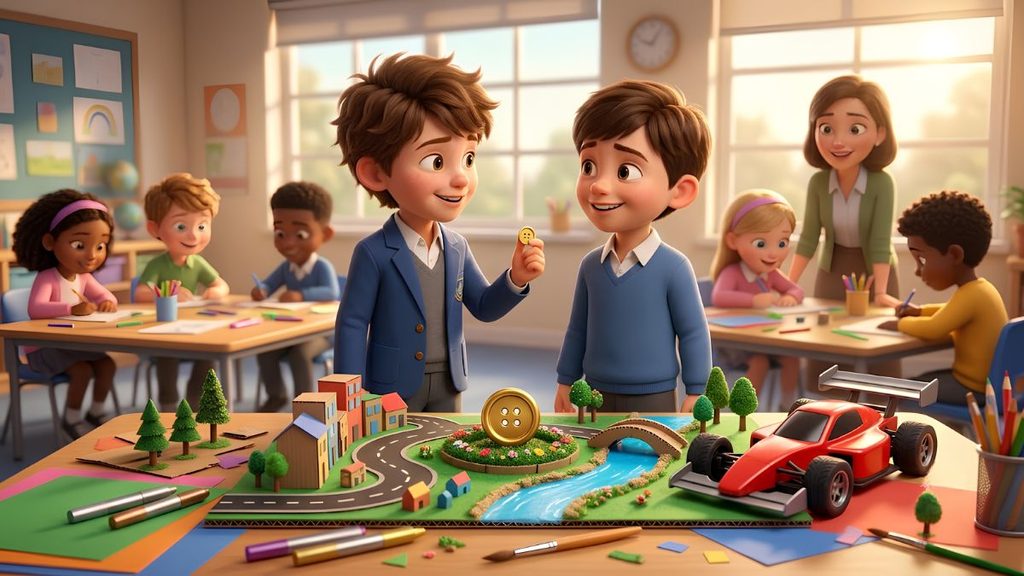
Type: Sacrificing a Reward
Core themes: generosity, rewards, friendship, selflessness, recognition.
Henry Miller had been thinking about the red racing car for 127 days.
He knew this because he had marked every day on the calendar above his desk.
The car was not an ordinary toy.
It was a remote-control racing car with enormous black wheels, bright headlights, a silver spoiler, and a tiny controller with two joysticks.
Henry had seen it through the window of the toy shop near his school.
He had wanted it immediately.
For months, he had been saving coins in a blue glass jar.
Unfortunately, his savings were nowhere near enough.
Then something unexpected happened.
Henry won the school’s Kindness Champion Award.
And the prize was exactly what he needed.
Or so he thought.
The Golden Button
Maplewood Elementary had a tradition.
Every Friday afternoon, one student was chosen as the Kindness Champion.
The award wasn’t based on grades.
It wasn’t based on sports.
It wasn’t based on popularity.
Teachers nominated students who had helped others, shown patience, included someone who was lonely, or done something kind without expecting a reward.
The winner received a small golden button.
The button looked ordinary at first.
It was about the size of a coin, with a smiling sun engraved on the front.
But it had a special value.
The golden button could be exchanged at the school store for any toy worth up to fifty points.
Henry had never won it.
He had secretly hoped he might.
Then, one Friday afternoon, Mrs. Parker stood at the front of the classroom.
“I have this week’s Kindness Champion.”
Everyone became quiet.
Mrs. Parker smiled.
“And the award goes to…”
She paused.
“Henry Miller.”
The classroom erupted in applause.
Henry’s eyes widened.
“Me?”
Mrs. Parker laughed.
“Yes, Henry. You.”
She walked over and pinned the golden button to his shirt.
Everyone clapped.
His best friend Sam shouted:
“Yes!”
Henry touched the button.
It felt surprisingly heavy.
Not physically.
Somehow, emotionally.
The Racing Car
After school, Henry ran home.
“Mum!”
His mother looked up from the kitchen.
“What happened?”
Henry held up the golden button.
“I won!”
His mother smiled.
“The Kindness Champion?”
Henry nodded.
“I’m going to get the racing car.”
His mother laughed.
“You’ve been planning that for a while.”
“One hundred and twenty-seven days.”
She stared at him.
“You’ve been counting?”
“Of course.”
Henry showed her his calendar.
Every day had a tiny red check mark.
His mother smiled.
“Then I suppose tomorrow is a very important day.”
Henry nodded.
“The most important.”
The next morning, Henry went to school early.
He kept touching the button.
It was still there.
He imagined the racing car waiting for him.
He imagined driving it across the playground.
He imagined racing Sam.
He imagined winning.
At lunchtime, Henry showed Sam the button.
“You really got it,” Sam said.
Henry nodded proudly.
“What are you going to buy?”
“The racing car.”
Sam smiled.
“I knew it.”
“You want to race me?”
“Obviously.”
Henry laughed.
“You’re going to lose.”
“We’ll see.”
The Art Project
That afternoon, Mrs. Parker announced a class project.
The students would work in teams to create a giant three-dimensional model of their town.
There would be roads.
Buildings.
Parks.
Trees.
A river.
A train station.
The best project would be displayed in the school entrance.
Henry was placed on Sam’s team.
There were five students altogether:
Henry.
Sam.
Lucy.
Maya.
And Oliver.
Everyone was excited.
They immediately started planning.
“We need cardboard,” said Lucy.
“And paint,” Maya added.
“Foam sheets,” said Oliver.
Sam opened his backpack.
“I brought the special art supplies.”
Everyone looked.
Sam had several sheets of high-quality colored paper, metallic markers, tiny wooden sticks, textured cardboard, and a box of miniature trees.
“Wow,” Henry said.
“My aunt gave them to me,” Sam explained.
“They’re perfect.”
They began working.
The project was going wonderfully.
By Wednesday, the group had finished the town square.
The miniature buildings were painted carefully.
The roads were marked with tiny white lines.
The river had blue paper flowing through the middle.
Sam had created a beautiful bridge.
Henry was responsible for the racing track.
It was going to be the centerpiece of the town.
Then, Thursday morning, something went wrong.
The Missing Supplies
Sam opened his desk drawer.
He frowned.
Then he opened his backpack.
Nothing.
He checked again.
Still nothing.
“Where are they?”
Henry looked over.
“What?”
“My art supplies.”
Sam searched through his backpack again.
The special paper was gone.
The metallic markers were gone.
The miniature trees were gone.
The textured cardboard was gone.
Sam’s face became pale.
“I had them yesterday.”
“Maybe you left them at home.”
“I didn’t.”
They searched the classroom.
Nothing.
They checked the art room.
Nothing.
They asked the librarian.
Nothing.
Sam became increasingly worried.
“Our project is due tomorrow.”
Henry looked at the unfinished model.
Without the supplies, the group couldn’t complete several important sections.
“What will we do?”
Sam shook his head.
“I don’t know.”
After school, Sam sat alone beside the project.
Henry walked over.
“Maybe we’ll find them tomorrow.”
Sam didn’t answer.
Henry noticed something.
Sam’s eyes were wet.
“Are you okay?”
“I ruined everything.”
“No, you didn’t.”
“I was supposed to bring the supplies.”
“You didn’t lose them on purpose.”
“But they’re gone.”
Henry sat beside him.
“We’ll figure something out.”
Sam shook his head.
“We can’t.”
Then he whispered:
“My aunt spent weeks collecting those things for me.”
Henry didn’t know what to say.
The School Store
That evening, Henry went home with the golden button in his pocket.
He took it out.
He placed it on his desk.
Then he looked at his calendar.
Tomorrow was the day.
He could finally get the racing car.
Henry smiled.
Then he thought about Sam.
The missing supplies.
The unfinished project.
The disappointment on Sam’s face.
Henry picked up the button.
He turned it over.
There was a small number engraved on the back.
50 points.
The exact price of the racing car.
Henry stared at it.
Then an idea entered his mind.
He immediately pushed it away.
“No.”
He looked at the button again.
“Absolutely not.”
He put it inside his drawer.
Then he took it out.
He put it back.
Then he took it out again.
Henry groaned.
“This is impossible.”
The Choice
Henry’s mother found him sitting on the floor.
“What happened?”
Henry explained everything.
She listened.
When he finished, she asked:
“What do you want to do?”
“I don’t know.”
“You do.”
Henry looked at the button.
“I want the car.”
“Of course.”
“I’ve wanted it forever.”
“I know.”
“But Sam needs the art supplies.”
His mother sat beside him.
“What would you tell Sam if he were sitting here?”
Henry thought.
“I’d tell him that the project isn’t more important than he is.”
His mother smiled.
“And what would you tell yourself?”
Henry looked down.
“I don’t know.”
His mother didn’t answer.
She simply hugged him.
The decision had to be his.
The Golden Button Goes to the Store
The next morning, Henry arrived at school early.
He walked toward the school store.
Mrs. Green, who managed it, smiled.
“Good morning, Henry.”
“Good morning.”
She noticed the button.
“Ready to choose your prize?”
Henry nodded.
“Yes.”
He looked through the window.
There it was.
The racing car.
Bright red.
Black wheels.
Silver spoiler.
Exactly as he had imagined.
Mrs. Green opened the door.
“You can take it.”
Henry reached toward it.
Then stopped.
“Do you have art supplies?”
Mrs. Green looked surprised.
“Some.”
“Do you have colored paper? Metallic markers? Little trees?”
She thought.
“Not enough for a big project.”
Henry nodded.
Then he took a deep breath.
“Can I use my fifty points for a collection of art supplies instead?”
Mrs. Green studied him.
“Are you sure?”
Henry looked at the racing car.
“No.”
She smiled gently.
“But?”
Henry swallowed.
“But I think I should.”
The Surprise Box
Mrs. Green helped Henry gather everything he needed.
Colored paper.
Cardboard.
Markers.
Wooden sticks.
Miniature trees.
Glue.
Decorative pieces.
When the box was full, Henry looked at it.
It wasn’t a racing car.
But it was something.
He carried it carefully to the classroom.
Sam looked up.
“What is that?”
Henry placed the box on the table.
“Replacement supplies.”
Sam stared.
“Where did you get those?”
Henry shrugged.
“The school store.”
“How?”
Henry pointed to his shirt.
The golden button was gone.
Sam understood.
“No.”
“It’s okay.”
“You used your button?”
Henry nodded.
“But the racing car…”
“I know.”
“You wanted it.”
“I know.”
Sam stared at Henry.
Then he hugged him.
Henry froze.
Sam rarely hugged anyone.
“Thank you.”
Henry smiled.
“Just help me build the bridge.”
Sam laughed through his tears.
“Deal.”
The Town Comes Alive
The five children worked all morning.
They built roads.
They painted buildings.
They created tiny trees.
They added benches to the park.
Henry built the racing track.
Sam rebuilt the bridge.
Lucy created the town square.
Maya painted the river.
Oliver made tiny street signs.
By lunchtime, the model looked incredible.
But something was still missing.
“What should we put here?” Maya asked.
She pointed to an empty space in the center.
Henry looked at it.
“Maybe a park.”
Sam shook his head.
“No.”
He took a golden marker.
“What about a statue?”
“A statue of what?”
Sam smiled.
“A button.”
Everyone laughed.
Henry shook his head.
“Very funny.”
The Unexpected Idea
Sam looked at Henry.
“No, I’m serious.”
He explained his idea.
They would create a small golden button in the center of the town.
It would represent kindness.
Around it, they would build a tiny garden.
The garden would connect all the roads.
The message would be that every part of a community was connected through kindness.
The others loved the idea.
They worked together.
By the end of the day, the model was finished.
It was beautiful.
Presentation Day
On Friday morning, the judges arrived.
Each group stood beside its project.
Henry’s team stood proudly around their miniature town.
The judges examined everything.
They asked questions.
“Who designed the bridge?”
“Sam.”
“Who created the park?”
“Maya.”
“Who built the racing track?”
“Henry.”
“And who came up with the golden button?”
Sam looked at Henry.
“Henry.”
Henry shook his head.
“Sam.”
The judge smiled.
“Both of you?”
They nodded.
The judges moved on.
Later that afternoon, the principal announced the results.
“Third place goes to…”
Another class.
“Second place…”
Another team.
Then came the winner.
“The first-place award goes to…”
Henry held his breath.
“Room 12!”
Everyone cheered.
Sam jumped into the air.
Lucy screamed.
Maya hugged Oliver.
Henry smiled.
They had won.
The Real Surprise
After the celebration, Mrs. Parker asked the five students to stay behind.
She held something in her hand.
It was a small wooden box.
“Henry,” she said.
He looked confused.
“What’s that?”
“Open it.”
Henry lifted the lid.
Inside was the red racing car.
His mouth fell open.
“What?”
Mrs. Parker smiled.
“The school heard what you did.”
Henry shook his head.
“I can’t take this.”
“Why not?”
“Because I used my button.”
Mrs. Parker nodded.
“We know.”
“Then…”
“The school store manager told us.”
Henry looked at Sam.
Sam smiled.
Mrs. Parker continued.
“We don’t normally replace prizes.”
Henry nodded.
“But sometimes a kindness deserves recognition.”
Henry stared at the racing car.
“Are you sure?”
“Very.”
Henry carefully picked it up.
It was exactly as he had imagined.
The Golden Button
There was one more surprise.
Mrs. Parker handed Henry another button.
It wasn’t the same.
This one was slightly larger.
It had the words:
KINDNESS CHAMPION
engraved around the edge.
Henry looked at it.
“Is this another prize?”
Mrs. Parker smiled.
“No.”
“What is it?”
“A reminder.”
“Of what?”
“That the most important rewards aren’t always the ones we receive.”
Henry looked at Sam.
Sam smiled.
Henry understood.
The Race
That afternoon, Henry and Sam took the racing car outside.
Henry placed it on the pavement.
Sam held the controller.
“Ready?”
Henry nodded.
“Ready.”
Sam pressed the button.
The car shot forward.
Henry laughed.
“It works!”
“It better.”
The car raced across the pavement.
It turned left.
Then right.
Then crashed gently into a bush.
Both boys burst out laughing.
Henry retrieved it.
“You know,” Sam said, “you could have bought this yesterday.”
“I know.”
“You almost did.”
“I know.”
Sam smiled.
“But then we wouldn’t have won.”
Henry thought about it.
“Maybe.”
“And we wouldn’t have the golden button in the project.”
Henry looked toward the school.
“Maybe.”
Sam nudged him.
“Would you do it again?”
Henry considered the question.
Then smiled.
“Probably.”
The Lesson of the Golden Button
Henry had spent 127 days wanting the racing car.
He had imagined it.
He had planned for it.
He had dreamed about it.
When he finally received the opportunity to get it, something unexpected happened.
He realized that getting what he wanted wasn’t the only thing that mattered.
Sometimes another person needs something more.
Sometimes helping a friend means giving up a reward.
And sometimes the reward we give away comes back in a completely different form.
Henry had exchanged fifty points for art supplies.
But he received something worth much more.
He helped his friend.
He helped his team.
He became part of something everyone could be proud of.
And eventually, he received the racing car anyway.
But even if he hadn’t, Henry knew he would still have made the same choice.
Because the best part wasn’t getting the prize.
It was knowing that when someone needed help, he had chosen to be there.
The golden button eventually became a little scratched.
Henry kept it in a drawer beside his racing car.
Years later, whenever he saw it, he remembered the lesson it had taught him:
A reward is wonderful when you receive it, but kindness is even more valuable when you are willing to give something up for someone else.
And that was something no school store could ever sell.
Moral of the Story
True generosity means being willing to share something valuable, even when you have worked hard to earn it. Sometimes the greatest reward is knowing that your choice made someone else’s life a little better.
4. The Warmest Seat on the Bus
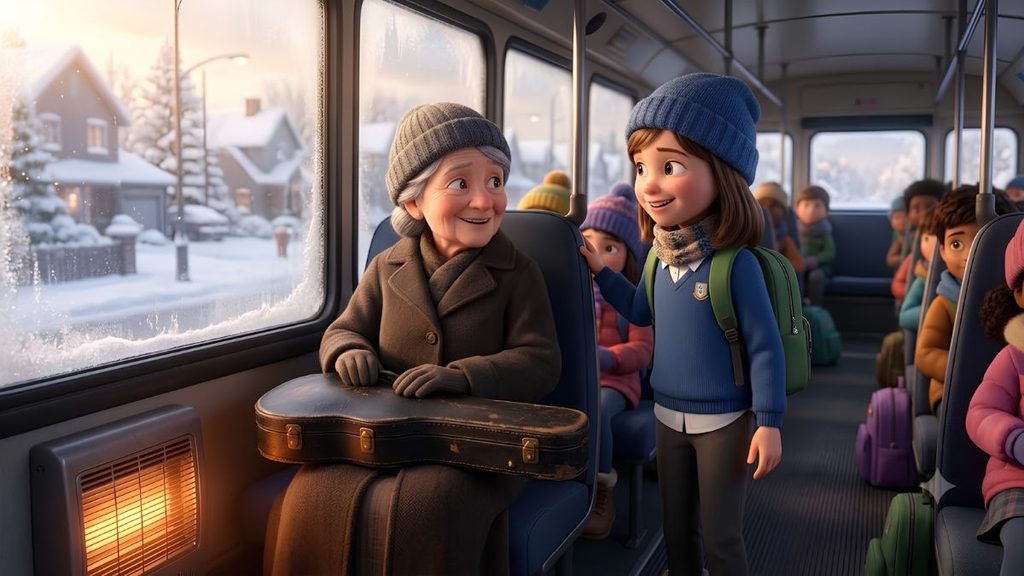
Type: Sacrificing Comfort
Core themes: compassion, respect, kindness, comfort, unexpected connections.
Every morning at exactly 7:42, Lily Harper climbed onto Bus Number 6.
And every morning, without exception, she went straight to the same seat.
Seat number eight.
Left side.
Second row behind the driver.
Right beside the heater.
Lily considered it the best seat on the entire bus.
It wasn’t just warm.
It was perfectly warm.
Outside, Maplewood could become terribly cold during winter. Frost covered the sidewalks. Breath turned into little clouds. The windows of houses sometimes became white with ice.
But seat number eight was different.
The heater beneath it hummed gently.
The window beside it gave Lily a perfect view of the neighborhood.
And because the seat was near the front, she could get off the bus quickly when she reached school.
Most importantly, nobody else ever seemed interested in it.
That meant Lily had quietly claimed it.
She had never officially announced that seat eight belonged to her.
She didn’t need to.
Everyone knew.
The Morning Ritual
Lily’s morning routine was almost always the same.
Wake up.
Brush her teeth.
Put on her blue school sweater.
Eat toast.
Check her backpack.
Put on her wool hat.
And then hurry to the bus stop.
Her mother always reminded her:
“Don’t forget your gloves.”
“I won’t.”
“Your scarf?”
“Yes.”
“Your lunch?”
“Yes.”
“Your reading book?”
Lily stopped.
“My book!”
She ran upstairs.
Her mother smiled.
Every morning was an adventure.
Even when it wasn’t.
On particularly cold days, Lily would arrive at the bus stop with her shoulders hunched and her hands buried deep inside her pockets.
Then Bus Number 6 would appear around the corner.
Lily would climb aboard.
She would walk directly to seat number eight.
She would sit down.
And within seconds, the warmth from the heater would surround her.
“Ahhh.”
Sometimes she actually said it aloud.
The New Passenger
One Monday morning, the temperature dropped dramatically.
The weather forecast said it was the coldest morning of the winter.
Lily could feel the cold even through her gloves.
When the bus arrived, she climbed aboard quickly.
She smiled when she saw seat number eight was empty.
“Perfect.”
She sat down.
She placed her backpack beside her.
The heater began blowing warm air.
Lily leaned against the seat.
She closed her eyes.
Then the bus stopped at the next corner.
The doors opened.
An elderly woman climbed aboard.
She carried a large black instrument case.
Lily didn’t recognize her immediately.
The woman was wearing a long brown coat, but it wasn’t thick enough for the weather.
Her gray hair was tucked beneath a knitted hat.
She looked tired.
And cold.
Very cold.
She carefully stepped onto the bus.
The driver greeted her.
“Good morning, Mrs. Bell.”
“Good morning, George.”
Mrs. Bell looked around.
There were no empty seats.
The bus was crowded.
She held the instrument case against her leg.
Lily watched her.
Mrs. Bell’s hands were trembling.
She tried to move farther down the aisle.
But there was nowhere to sit.
Lily’s Problem
Lily looked at the woman.
Then she looked at her own seat.
The heater was blowing warm air directly beneath her.
She could feel the warmth through her shoes.
She looked at Mrs. Bell again.
The woman was standing.
The bus started moving.
Mrs. Bell grabbed a metal rail.
Lily frowned.
She knew what she should do.
But she didn’t want to do it.
Not really.
She had been waiting all morning for this seat.
Her fingers were still cold.
She wanted the warmth.
She looked out the window.
Maybe someone else would give up their seat.
Surely someone else.
Lily waited.
Nobody moved.
She looked back.
Mrs. Bell was still standing.
She was shivering.
Lily sighed.
“Fine.”
She picked up her backpack.
She stood.
“Excuse me.”
Mrs. Bell looked down.
“Yes?”
“You can sit here.”
Mrs. Bell blinked.
“Oh, sweetheart. Are you sure?”
Lily nodded.
“Yes.”
She moved into the aisle.
Mrs. Bell smiled.
“Thank you.”
She carefully lowered herself into the seat.
Almost immediately, her shoulders relaxed.
The heater warmed her coat.
“Oh, that’s lovely.”
Lily smiled weakly.
“Yes.”
Mrs. Bell laughed.
“I can tell this is a good seat.”
“It is.”
Lily walked toward the back.
The Cold Seat
Lily found an empty place near the rear.
She sat down.
The seat was cold.
Very cold.
She pulled her scarf tighter.
She put her hands beneath her arms.
She could hear the heater at the front of the bus.
Hummmm.
Hummmm.
Lily looked toward seat number eight.
Mrs. Bell was sitting there.
Warm.
Comfortable.
Lily tried not to feel annoyed.
She had done the right thing.
She knew that.
But doing the right thing didn’t magically make the seat warm.
Her toes were freezing.
She looked outside.
Frost covered the windows.
“This is going to be a long ride,” she whispered.
The Instrument Case
The bus traveled through several neighborhoods.
At the next stop, the bus became quieter.
Mrs. Bell suddenly turned around.
“Lily?”
Lily looked up.
“Yes?”
“You gave me your seat.”
“Yes.”
“I never properly thanked you.”
“It’s okay.”
Mrs. Bell smiled.
“What’s your name?”
“Lily.”
“I’m Margaret Bell.”
Lily smiled.
“Nice to meet you.”
“Likewise.”
Mrs. Bell looked at the large case beside her.
“Do you know what’s inside?”
Lily shook her head.
“A violin.”
Lily’s eyes widened.
“A violin?”
“Yes.”
“You play?”
“I do.”
“You’re a musician?”
Mrs. Bell smiled.
“I used to be a music teacher.”
“Used to be?”
“I still am, really.”
She laughed.
“I just don’t teach in a classroom anymore.”
“Where do you teach?”
“Anywhere someone wants to learn.”
Lily smiled.
She liked Mrs. Bell.
Even though she was sitting in Lily’s favorite seat.
The Old Violin
Lily looked at the instrument case.
“Is it a special violin?”
Mrs. Bell became quiet.
“Very.”
“Why?”
She rested one hand on the case.
“Because I’ve had it for more than fifty years.”
Lily’s eyes widened.
“Fifty?”
“Fifty-three.”
“That’s older than my mother.”
Mrs. Bell laughed.
“Yes. Much older.”
Lily became curious.
“Where did you get it?”
Mrs. Bell looked out the window.
“That’s a long story.”
Lily glanced at the clock.
“We have time.”
Mrs. Bell smiled.
“You’re right.”
She settled comfortably in the seat.
Then she began.
The First Concert
“When I was seventeen,” Mrs. Bell said, “I wanted to become a violinist.”
“Like a professional?”
“Exactly.”
“Were you good?”
Mrs. Bell smiled.
“Not at first.”
Lily laughed.
“I thought you said you wanted to become a professional.”
“I did.”
“But you weren’t good?”
“Wanting something and being ready for it are different things.”
Lily considered that.
Mrs. Bell continued.
“I practiced every day. Sometimes for four hours.”
“Four hours?”
“My neighbors weren’t very happy.”
Lily laughed.
“Did they complain?”
“Constantly.”
“What did you do?”
“I practiced more quietly.”
“Did that work?”
“No.”
They both laughed.
Mrs. Bell looked at the violin case.
“My teacher eventually told me I was ready for my first public concert.”
“Were you nervous?”
“Terrified.”
“What happened?”
“I forgot how to breathe.”
Lily laughed.
“Really?”
“Absolutely.”
Mrs. Bell nodded.
“I stood backstage holding this violin.”
She tapped the case.
“My hands were shaking.”
“What did your teacher say?”
Mrs. Bell smiled.
“He told me something I’ll never forget.”
“What?”
“He said, ‘Margaret, the audience doesn’t need you to be perfect. They only need you to be brave enough to begin.'”
Lily was quiet.
“Did you play?”
“Yes.”
“Did you make mistakes?”
“Many.”
“Did people laugh?”
“No.”
“Did you win?”
Mrs. Bell smiled.
“There wasn’t a competition.”
“Oh.”
“There was just a concert.”
The Music
Mrs. Bell explained that the concert took place in a tiny community hall.
There were perhaps forty people in the audience.
She had been terrified.
But once she played the first few notes, something changed.
The fear didn’t disappear.
She simply stopped listening to it.
She played.
When she finished, everyone applauded.
Her teacher stood at the back of the room.
He was smiling.
Mrs. Bell had expected the applause to be the most memorable part.
It wasn’t.
“What was?” Lily asked.
“The moment after the music ended.”
“Why?”
“Because for a few seconds, nobody spoke.”
Mrs. Bell smiled.
“It was completely quiet.”
Lily imagined it.
“Then everyone clapped?”
“Yes.”
Mrs. Bell looked at the instrument case.
“I’ve never forgotten that silence.”
Lily’s Dream
The bus continued moving.
Lily had stopped noticing the cold.
She was listening carefully.
“Do you still play?” she asked.
“Every day.”
“Even now?”
“Especially now.”
“Why?”
Mrs. Bell smiled.
“Because music gets better when you have more memories to put into it.”
Lily liked that sentence.
She thought about it.
Then Mrs. Bell asked:
“What about you?”
“What about me?”
“What do you love?”
Lily looked down.
“I like drawing.”
“That’s wonderful.”
“I draw houses.”
“Why houses?”
“I don’t know.”
“Perhaps you do.”
Lily looked at her.
Mrs. Bell smiled.
“Perhaps you’re interested in the stories that happen inside them.”
Lily hadn’t thought about that.
Maybe she was.
The School Stop
Soon, the bus reached Maplewood Elementary.
Children began standing.
Lily gathered her backpack.
Mrs. Bell looked at her.
“Thank you again.”
Lily smiled.
“You’re welcome.”
Then Mrs. Bell said:
“Lily?”
“Yes?”
“Would you like to hear something?”
“Sure.”
“Your sacrifice this morning gave me the chance to arrive somewhere warm enough to protect my hands.”
She held them up.
“And these hands need to play this afternoon.”
Lily smiled.
“Why?”
“I have a lesson with six children.”
“You’re teaching them violin?”
“Yes.”
Lily thought about the cold seat.
Suddenly it didn’t seem quite so important.
A Week Later
The next Monday, Lily climbed onto Bus Number 6.
She walked toward seat number eight.
It was empty.
She stopped.
Then she looked toward the bus door.
Mrs. Bell wasn’t there.
Lily sat down.
The heater warmed her feet.
She smiled.
Then she noticed someone standing in the aisle.
It was a younger boy from her school.
He looked nervous.
Lily moved her backpack.
“You can sit here.”
The boy looked surprised.
“Are you sure?”
Lily nodded.
“Yes.”
She moved to another seat.
This one wasn’t nearly as warm.
But Lily smiled anyway.
The Music Room
A few days later, Lily discovered something unexpected.
Her teacher announced that Mrs. Bell would visit the school.
She was going to perform for the students.
Lily’s eyes widened.
“Mrs. Bell?”
“Do you know her?” her teacher asked.
“Yes!”
“Well, you’re in for a treat.”
The entire class gathered in the music room.
Mrs. Bell entered carrying the same black violin case.
Lily smiled.
Mrs. Bell recognized her immediately.
“There’s my seat giver.”
The class laughed.
Lily blushed.
Mrs. Bell opened the case.
Inside was a beautiful wooden violin.
It looked old.
But it had a warm, polished shine.
“This violin,” Mrs. Bell told the children, “has traveled with me for more than fifty years.”
She began playing.
The room became completely quiet.
Lily remembered what Mrs. Bell had said.
The silence after the music.
The moment before the applause.
And suddenly Lily understood why it had mattered.
Music wasn’t only about sound.
Sometimes it was about making people stop and listen.
The Story Behind the Violin
After the performance, Lily approached Mrs. Bell.
“Can I ask you something?”
“Of course.”
“Why did you keep the violin for so long?”
Mrs. Bell thought for a moment.
“Because it reminds me of who I was when I was seventeen.”
“The girl who was scared?”
“Yes.”
“But you became brave.”
Mrs. Bell smiled.
“Not exactly.”
Lily looked confused.
“I still get scared.”
“Really?”
“Of course.”
“Then what changed?”
Mrs. Bell gently closed the violin case.
“I learned that being afraid doesn’t mean you have to stop.”
Lily remembered her own morning.
She had been afraid of losing her warm seat.
It wasn’t a huge fear.
But she had felt it.
She had still moved.
Maybe courage came in many sizes.
The Winter Festival
A few weeks later, Maplewood held its winter festival.
There were lights everywhere.
Children built snow sculptures.
Parents brought hot chocolate.
Teachers organized games.
Mrs. Bell played music near the entrance.
Lily saw her.
“Mrs. Bell!”
The older woman smiled.
“Lily!”
Lily ran over.
“Your music sounds beautiful.”
“Thank you.”
“Do you remember the bus?”
“Of course.”
Lily smiled.
“I’ve been thinking about it.”
“About the seat?”
“Yes.”
Mrs. Bell laughed.
“Was it worth giving up?”
Lily looked at the violin.
“Yes.”
“Why?”
Lily thought.
“Because if I hadn’t given you the seat, I wouldn’t have heard your story.”
Mrs. Bell smiled.
“And now?”
“Now I know a story I can remember forever.”
The Warmest Seat
Winter eventually ended.
Spring arrived.
The snow disappeared.
The mornings became warmer.
One day, Lily boarded Bus Number 6 and sat in seat number eight.
She looked at the heater.
It wasn’t running.
She laughed.
The seat wasn’t special anymore.
Not really.
What had once been the warmest seat on the bus was now just an ordinary seat.
Lily smiled.
She realized that the seat itself had never been the important part.
It had simply given her an opportunity.
An opportunity to choose.
She could have stayed where she was.
She could have protected her comfort.
Nobody would have called her cruel.
Nobody would have punished her.
But she had moved.
And because she had moved, she had gained a story.
A friendship.
A lesson.
And a memory that would stay with her much longer than winter.
Years Later
Many years later, Lily would still remember Mrs. Bell.
She would remember the old violin.
She would remember the story of the seventeen-year-old girl standing backstage with shaking hands.
She would remember the sentence:
“The audience doesn’t need you to be perfect. They only need you to be brave enough to begin.”
Lily never forgot it.
Whenever she faced something difficult, she thought about that first concert.
And whenever she saw someone who needed help, she remembered seat number eight.
She learned that sacrifice doesn’t always mean giving away something enormous.
Sometimes it means giving up a few minutes of comfort.
Sometimes it means moving one seat farther back.
Sometimes it means letting someone else go first.
And sometimes, that tiny act can open the door to a story you never expected to hear.
Moral of the Story
Kindness often begins when we are willing to give up a little comfort for someone else. What seems like a small sacrifice to us may become a meaningful moment in another person’s life.
Lily thought she was giving away a warm bus seat.
In the end, she received something much warmer:
a story, a friendship, and a lesson about courage that stayed with her long after the snow had melted.
5. The Saturday Robot Club
Type: Sacrificing Personal Convenience
Core themes: family, responsibility, priorities, kindness, teamwork.
The Golden Button
Henry Miller had been thinking about the red racing car for 127 days.
He knew this because he had marked every day on the calendar above his desk.
The car was not an ordinary toy.
It was a remote-control racing car with enormous black wheels, bright headlights, a silver spoiler, and a tiny controller with two joysticks.
Henry had seen it through the window of the toy shop near his school.
He had wanted it immediately.
For months, he had been saving coins in a blue glass jar.
Unfortunately, his savings were nowhere near enough.
Then something unexpected happened.
Henry won the school’s Kindness Champion Award.
And the prize was exactly what he needed.
Or so he thought.
The Golden Button
Maplewood Elementary had a tradition.
Every Friday afternoon, one student was chosen as the Kindness Champion.
The award wasn’t based on grades.
It wasn’t based on sports.
It wasn’t based on popularity.
Teachers nominated students who had helped others, shown patience, included someone who was lonely, or done something kind without expecting a reward.
The winner received a small golden button.
The button looked ordinary at first.
It was about the size of a coin, with a smiling sun engraved on the front.
But it had a special value.
The golden button could be exchanged at the school store for any toy worth up to fifty points.
Henry had never won it.
He had secretly hoped he might.
Then, one Friday afternoon, Mrs. Parker stood at the front of the classroom.
“I have this week’s Kindness Champion.”
Everyone became quiet.
Mrs. Parker smiled.
“And the award goes to…”
She paused.
“Henry Miller.”
The classroom erupted in applause.
Henry’s eyes widened.
“Me?”
Mrs. Parker laughed.
“Yes, Henry. You.”
She walked over and pinned the golden button to his shirt.
Everyone clapped.
His best friend Sam shouted:
“Yes!”
Henry touched the button.
It felt surprisingly heavy.
Not physically.
Somehow, emotionally.
The Racing Car
After school, Henry ran home.
“Mum!”
His mother looked up from the kitchen.
“What happened?”
Henry held up the golden button.
“I won!”
His mother smiled.
“The Kindness Champion?”
Henry nodded.
“I’m going to get the racing car.”
His mother laughed.
“You’ve been planning that for a while.”
“One hundred and twenty-seven days.”
She stared at him.
“You’ve been counting?”
“Of course.”
Henry showed her his calendar.
Every day had a tiny red check mark.
His mother smiled.
“Then I suppose tomorrow is a very important day.”
Henry nodded.
“The most important.”
The next morning, Henry went to school early.
He kept touching the button.
It was still there.
He imagined the racing car waiting for him.
He imagined driving it across the playground.
He imagined racing Sam.
He imagined winning.
At lunchtime, Henry showed Sam the button.
“You really got it,” Sam said.
Henry nodded proudly.
“What are you going to buy?”
“The racing car.”
Sam smiled.
“I knew it.”
“You want to race me?”
“Obviously.”
Henry laughed.
“You’re going to lose.”
“We’ll see.”
The Art Project
That afternoon, Mrs. Parker announced a class project.
The students would work in teams to create a giant three-dimensional model of their town.
There would be roads.
Buildings.
Parks.
Trees.
A river.
A train station.
The best project would be displayed in the school entrance.
Henry was placed on Sam’s team.
There were five students altogether:
Henry.
Sam.
Lucy.
Maya.
And Oliver.
Everyone was excited.
They immediately started planning.
“We need cardboard,” said Lucy.
“And paint,” Maya added.
“Foam sheets,” said Oliver.
Sam opened his backpack.
“I brought the special art supplies.”
Everyone looked.
Sam had several sheets of high-quality colored paper, metallic markers, tiny wooden sticks, textured cardboard, and a box of miniature trees.
“Wow,” Henry said.
“My aunt gave them to me,” Sam explained.
“They’re perfect.”
They began working.
The project was going wonderfully.
By Wednesday, the group had finished the town square.
The miniature buildings were painted carefully.
The roads were marked with tiny white lines.
The river had blue paper flowing through the middle.
Sam had created a beautiful bridge.
Henry was responsible for the racing track.
It was going to be the centerpiece of the town.
Then, Thursday morning, something went wrong.
The Missing Supplies
Sam opened his desk drawer.
He frowned.
Then he opened his backpack.
Nothing.
He checked again.
Still nothing.
“Where are they?”
Henry looked over.
“What?”
“My art supplies.”
Sam searched through his backpack again.
The special paper was gone.
The metallic markers were gone.
The miniature trees were gone.
The textured cardboard was gone.
Sam’s face became pale.
“I had them yesterday.”
“Maybe you left them at home.”
“I didn’t.”
They searched the classroom.
Nothing.
They checked the art room.
Nothing.
They asked the librarian.
Nothing.
Sam became increasingly worried.
“Our project is due tomorrow.”
Henry looked at the unfinished model.
Without the supplies, the group couldn’t complete several important sections.
“What will we do?”
Sam shook his head.
“I don’t know.”
After school, Sam sat alone beside the project.
Henry walked over.
“Maybe we’ll find them tomorrow.”
Sam didn’t answer.
Henry noticed something.
Sam’s eyes were wet.
“Are you okay?”
“I ruined everything.”
“No, you didn’t.”
“I was supposed to bring the supplies.”
“You didn’t lose them on purpose.”
“But they’re gone.”
Henry sat beside him.
“We’ll figure something out.”
Sam shook his head.
“We can’t.”
Then he whispered:
“My aunt spent weeks collecting those things for me.”
Henry didn’t know what to say.
The School Store
That evening, Henry went home with the golden button in his pocket.
He took it out.
He placed it on his desk.
Then he looked at his calendar.
Tomorrow was the day.
He could finally get the racing car.
Henry smiled.
Then he thought about Sam.
The missing supplies.
The unfinished project.
The disappointment on Sam’s face.
Henry picked up the button.
He turned it over.
There was a small number engraved on the back.
50 points.
The exact price of the racing car.
Henry stared at it.
Then an idea entered his mind.
He immediately pushed it away.
“No.”
He looked at the button again.
“Absolutely not.”
He put it inside his drawer.
Then he took it out.
He put it back.
Then he took it out again.
Henry groaned.
“This is impossible.”
The Choice
Henry’s mother found him sitting on the floor.
“What happened?”
Henry explained everything.
She listened.
When he finished, she asked:
“What do you want to do?”
“I don’t know.”
“You do.”
Henry looked at the button.
“I want the car.”
“Of course.”
“I’ve wanted it forever.”
“I know.”
“But Sam needs the art supplies.”
His mother sat beside him.
“What would you tell Sam if he were sitting here?”
Henry thought.
“I’d tell him that the project isn’t more important than he is.”
His mother smiled.
“And what would you tell yourself?”
Henry looked down.
“I don’t know.”
His mother didn’t answer.
She simply hugged him.
The decision had to be his.
The Golden Button Goes to the Store
The next morning, Henry arrived at school early.
He walked toward the school store.
Mrs. Green, who managed it, smiled.
“Good morning, Henry.”
“Good morning.”
She noticed the button.
“Ready to choose your prize?”
Henry nodded.
“Yes.”
He looked through the window.
There it was.
The racing car.
Bright red.
Black wheels.
Silver spoiler.
Exactly as he had imagined.
Mrs. Green opened the door.
“You can take it.”
Henry reached toward it.
Then stopped.
“Do you have art supplies?”
Mrs. Green looked surprised.
“Some.”
“Do you have colored paper? Metallic markers? Little trees?”
She thought.
“Not enough for a big project.”
Henry nodded.
Then he took a deep breath.
“Can I use my fifty points for a collection of art supplies instead?”
Mrs. Green studied him.
“Are you sure?”
Henry looked at the racing car.
“No.”
She smiled gently.
“But?”
Henry swallowed.
“But I think I should.”
The Surprise Box
Mrs. Green helped Henry gather everything he needed.
Colored paper.
Cardboard.
Markers.
Wooden sticks.
Miniature trees.
Glue.
Decorative pieces.
When the box was full, Henry looked at it.
It wasn’t a racing car.
But it was something.
He carried it carefully to the classroom.
Sam looked up.
“What is that?”
Henry placed the box on the table.
“Replacement supplies.”
Sam stared.
“Where did you get those?”
Henry shrugged.
“The school store.”
“How?”
Henry pointed to his shirt.
The golden button was gone.
Sam understood.
“No.”
“It’s okay.”
“You used your button?”
Henry nodded.
“But the racing car…”
“I know.”
“You wanted it.”
“I know.”
Sam stared at Henry.
Then he hugged him.
Henry froze.
Sam rarely hugged anyone.
“Thank you.”
Henry smiled.
“Just help me build the bridge.”
Sam laughed through his tears.
“Deal.”
The Town Comes Alive
The five children worked all morning.
They built roads.
They painted buildings.
They created tiny trees.
They added benches to the park.
Henry built the racing track.
Sam rebuilt the bridge.
Lucy created the town square.
Maya painted the river.
Oliver made tiny street signs.
By lunchtime, the model looked incredible.
But something was still missing.
“What should we put here?” Maya asked.
She pointed to an empty space in the center.
Henry looked at it.
“Maybe a park.”
Sam shook his head.
“No.”
He took a golden marker.
“What about a statue?”
“A statue of what?”
Sam smiled.
“A button.”
Everyone laughed.
Henry shook his head.
“Very funny.”
The Unexpected Idea
Sam looked at Henry.
“No, I’m serious.”
He explained his idea.
They would create a small golden button in the center of the town.
It would represent kindness.
Around it, they would build a tiny garden.
The garden would connect all the roads.
The message would be that every part of a community was connected through kindness.
The others loved the idea.
They worked together.
By the end of the day, the model was finished.
It was beautiful.
Presentation Day
On Friday morning, the judges arrived.
Each group stood beside its project.
Henry’s team stood proudly around their miniature town.
The judges examined everything.
They asked questions.
“Who designed the bridge?”
“Sam.”
“Who created the park?”
“Maya.”
“Who built the racing track?”
“Henry.”
“And who came up with the golden button?”
Sam looked at Henry.
“Henry.”
Henry shook his head.
“Sam.”
The judge smiled.
“Both of you?”
They nodded.
The judges moved on.
Later that afternoon, the principal announced the results.
“Third place goes to…”
Another class.
“Second place…”
Another team.
Then came the winner.
“The first-place award goes to…”
Henry held his breath.
“Room 12!”
Everyone cheered.
Sam jumped into the air.
Lucy screamed.
Maya hugged Oliver.
Henry smiled.
They had won.
The Real Surprise
After the celebration, Mrs. Parker asked the five students to stay behind.
She held something in her hand.
It was a small wooden box.
“Henry,” she said.
He looked confused.
“What’s that?”
“Open it.”
Henry lifted the lid.
Inside was the red racing car.
His mouth fell open.
“What?”
Mrs. Parker smiled.
“The school heard what you did.”
Henry shook his head.
“I can’t take this.”
“Why not?”
“Because I used my button.”
Mrs. Parker nodded.
“We know.”
“Then…”
“The school store manager told us.”
Henry looked at Sam.
Sam smiled.
Mrs. Parker continued.
“We don’t normally replace prizes.”
Henry nodded.
“But sometimes a kindness deserves recognition.”
Henry stared at the racing car.
“Are you sure?”
“Very.”
Henry carefully picked it up.
It was exactly as he had imagined.
The Golden Button
There was one more surprise.
Mrs. Parker handed Henry another button.
It wasn’t the same.
This one was slightly larger.
It had the words:
KINDNESS CHAMPION
engraved around the edge.
Henry looked at it.
“Is this another prize?”
Mrs. Parker smiled.
“No.”
“What is it?”
“A reminder.”
“Of what?”
“That the most important rewards aren’t always the ones we receive.”
Henry looked at Sam.
Sam smiled.
Henry understood.
The Race
That afternoon, Henry and Sam took the racing car outside.
Henry placed it on the pavement.
Sam held the controller.
“Ready?”
Henry nodded.
“Ready.”
Sam pressed the button.
The car shot forward.
Henry laughed.
“It works!”
“It better.”
The car raced across the pavement.
It turned left.
Then right.
Then crashed gently into a bush.
Both boys burst out laughing.
Henry retrieved it.
“You know,” Sam said, “you could have bought this yesterday.”
“I know.”
“You almost did.”
“I know.”
Sam smiled.
“But then we wouldn’t have won.”
Henry thought about it.
“Maybe.”
“And we wouldn’t have the golden button in the project.”
Henry looked toward the school.
“Maybe.”
Sam nudged him.
“Would you do it again?”
Henry considered the question.
Then smiled.
“Probably.”
The Lesson of the Golden Button
Henry had spent 127 days wanting the racing car.
He had imagined it.
He had planned for it.
He had dreamed about it.
When he finally received the opportunity to get it, something unexpected happened.
He realized that getting what he wanted wasn’t the only thing that mattered.
Sometimes another person needs something more.
Sometimes helping a friend means giving up a reward.
And sometimes the reward we give away comes back in a completely different form.
Henry had exchanged fifty points for art supplies.
But he received something worth much more.
He helped his friend.
He helped his team.
He became part of something everyone could be proud of.
And eventually, he received the racing car anyway.
But even if he hadn’t, Henry knew he would still have made the same choice.
Because the best part wasn’t getting the prize.
It was knowing that when someone needed help, he had chosen to be there.
The golden button eventually became a little scratched.
Henry kept it in a drawer beside his racing car.
Years later, whenever he saw it, he remembered the lesson it had taught him:
A reward is wonderful when you receive it, but kindness is even more valuable when you are willing to give something up for someone else.
And that was something no school store could ever sell.
Moral of the Story
True generosity means being willing to share something valuable, even when you have worked hard to earn it. Sometimes the greatest reward is knowing that your choice made someone else’s life a little better.
Featured Image Prompt
16:9 cinematic 3D animated featured image: A heartwarming children’s school story scene featuring an eight-year-old boy named Henry with tousled brown hair, wearing a neat school uniform and proudly holding a small golden button in one hand while standing beside his friend Sam at a colorful classroom table. In front of them is a magnificent handmade miniature town model featuring tiny buildings, roads, trees, a blue river, a small bridge, and a beautiful golden button-shaped centerpiece surrounded by a miniature garden. Art supplies including colorful paper, metallic markers, cardboard, glue, miniature trees, and craft materials are scattered naturally across the table. A bright red remote-control racing car with black wheels and a silver spoiler sits nearby, symbolizing Henry’s difficult choice and reward. Henry and Sam are smiling warmly at each other, showing friendship and gratitude. Other children work happily in the softly blurred background while a kind teacher watches proudly. Warm afternoon sunlight streams through classroom windows, creating a cozy golden atmosphere. Expressive child characters, detailed facial emotions, realistic craft textures, cinematic depth of field, polished high-end 3D animated family movie aesthetic, inspirational and emotionally uplifting mood, strong visual storytelling about generosity, sacrifice, friendship, selflessness, and kindness, 16:9 widescreen, no readable text, no watermark.
The Warmest Seat on the Bus
Type: Sacrificing Comfort
Every morning, nine-year-old Lily sits in the warmest seat on her school bus.
It is directly beside the heater and has become her favorite place.
One freezing winter morning, an elderly music teacher boards the bus carrying a heavy instrument case.
There are no empty seats.
Lily notices that the teacher is shivering.
She reluctantly gives up her warm seat.
At first, she is uncomfortable and annoyed.
But the teacher later tells Lily a story about the first concert where she played that very instrument.
Lily discovers that the uncomfortable journey has given her something much more valuable than a warm seat: a story she will remember forever.
Core themes: compassion, respect, kindness, comfort, unexpected connections.
The Warmest Seat on the Bus
Every morning at exactly 7:42, Lily Harper climbed onto Bus Number 6.
And every morning, without exception, she went straight to the same seat.
Seat number eight.
Left side.
Second row behind the driver.
Right beside the heater.
Lily considered it the best seat on the entire bus.
It wasn’t just warm.
It was perfectly warm.
Outside, Maplewood could become terribly cold during winter. Frost covered the sidewalks. Breath turned into little clouds. The windows of houses sometimes became white with ice.
But seat number eight was different.
The heater beneath it hummed gently.
The window beside it gave Lily a perfect view of the neighborhood.
And because the seat was near the front, she could get off the bus quickly when she reached school.
Most importantly, nobody else ever seemed interested in it.
That meant Lily had quietly claimed it.
She had never officially announced that seat eight belonged to her.
She didn’t need to.
Everyone knew.
The Morning Ritual
Lily’s morning routine was almost always the same.
Wake up.
Brush her teeth.
Put on her blue school sweater.
Eat toast.
Check her backpack.
Put on her wool hat.
And then hurry to the bus stop.
Her mother always reminded her:
“Don’t forget your gloves.”
“I won’t.”
“Your scarf?”
“Yes.”
“Your lunch?”
“Yes.”
“Your reading book?”
Lily stopped.
“My book!”
She ran upstairs.
Her mother smiled.
Every morning was an adventure.
Even when it wasn’t.
On particularly cold days, Lily would arrive at the bus stop with her shoulders hunched and her hands buried deep inside her pockets.
Then Bus Number 6 would appear around the corner.
Lily would climb aboard.
She would walk directly to seat number eight.
She would sit down.
And within seconds, the warmth from the heater would surround her.
“Ahhh.”
Sometimes she actually said it aloud.
The New Passenger
One Monday morning, the temperature dropped dramatically.
The weather forecast said it was the coldest morning of the winter.
Lily could feel the cold even through her gloves.
When the bus arrived, she climbed aboard quickly.
She smiled when she saw seat number eight was empty.
“Perfect.”
She sat down.
She placed her backpack beside her.
The heater began blowing warm air.
Lily leaned against the seat.
She closed her eyes.
Then the bus stopped at the next corner.
The doors opened.
An elderly woman climbed aboard.
She carried a large black instrument case.
Lily didn’t recognize her immediately.
The woman was wearing a long brown coat, but it wasn’t thick enough for the weather.
Her gray hair was tucked beneath a knitted hat.
She looked tired.
And cold.
Very cold.
She carefully stepped onto the bus.
The driver greeted her.
“Good morning, Mrs. Bell.”
“Good morning, George.”
Mrs. Bell looked around.
There were no empty seats.
The bus was crowded.
She held the instrument case against her leg.
Lily watched her.
Mrs. Bell’s hands were trembling.
She tried to move farther down the aisle.
But there was nowhere to sit.
Lily’s Problem
Lily looked at the woman.
Then she looked at her own seat.
The heater was blowing warm air directly beneath her.
She could feel the warmth through her shoes.
She looked at Mrs. Bell again.
The woman was standing.
The bus started moving.
Mrs. Bell grabbed a metal rail.
Lily frowned.
She knew what she should do.
But she didn’t want to do it.
Not really.
She had been waiting all morning for this seat.
Her fingers were still cold.
She wanted the warmth.
She looked out the window.
Maybe someone else would give up their seat.
Surely someone else.
Lily waited.
Nobody moved.
She looked back.
Mrs. Bell was still standing.
She was shivering.
Lily sighed.
“Fine.”
She picked up her backpack.
She stood.
“Excuse me.”
Mrs. Bell looked down.
“Yes?”
“You can sit here.”
Mrs. Bell blinked.
“Oh, sweetheart. Are you sure?”
Lily nodded.
“Yes.”
She moved into the aisle.
Mrs. Bell smiled.
“Thank you.”
She carefully lowered herself into the seat.
Almost immediately, her shoulders relaxed.
The heater warmed her coat.
“Oh, that’s lovely.”
Lily smiled weakly.
“Yes.”
Mrs. Bell laughed.
“I can tell this is a good seat.”
“It is.”
Lily walked toward the back.
The Cold Seat
Lily found an empty place near the rear.
She sat down.
The seat was cold.
Very cold.
She pulled her scarf tighter.
She put her hands beneath her arms.
She could hear the heater at the front of the bus.
Hummmm.
Hummmm.
Lily looked toward seat number eight.
Mrs. Bell was sitting there.
Warm.
Comfortable.
Lily tried not to feel annoyed.
She had done the right thing.
She knew that.
But doing the right thing didn’t magically make the seat warm.
Her toes were freezing.
She looked outside.
Frost covered the windows.
“This is going to be a long ride,” she whispered.
The Instrument Case
The bus traveled through several neighborhoods.
At the next stop, the bus became quieter.
Mrs. Bell suddenly turned around.
“Lily?”
Lily looked up.
“Yes?”
“You gave me your seat.”
“Yes.”
“I never properly thanked you.”
“It’s okay.”
Mrs. Bell smiled.
“What’s your name?”
“Lily.”
“I’m Margaret Bell.”
Lily smiled.
“Nice to meet you.”
“Likewise.”
Mrs. Bell looked at the large case beside her.
“Do you know what’s inside?”
Lily shook her head.
“A violin.”
Lily’s eyes widened.
“A violin?”
“Yes.”
“You play?”
“I do.”
“You’re a musician?”
Mrs. Bell smiled.
“I used to be a music teacher.”
“Used to be?”
“I still am, really.”
She laughed.
“I just don’t teach in a classroom anymore.”
“Where do you teach?”
“Anywhere someone wants to learn.”
Lily smiled.
She liked Mrs. Bell.
Even though she was sitting in Lily’s favorite seat.
The Old Violin
Lily looked at the instrument case.
“Is it a special violin?”
Mrs. Bell became quiet.
“Very.”
“Why?”
She rested one hand on the case.
“Because I’ve had it for more than fifty years.”
Lily’s eyes widened.
“Fifty?”
“Fifty-three.”
“That’s older than my mother.”
Mrs. Bell laughed.
“Yes. Much older.”
Lily became curious.
“Where did you get it?”
Mrs. Bell looked out the window.
“That’s a long story.”
Lily glanced at the clock.
“We have time.”
Mrs. Bell smiled.
“You’re right.”
She settled comfortably in the seat.
Then she began.
The First Concert
“When I was seventeen,” Mrs. Bell said, “I wanted to become a violinist.”
“Like a professional?”
“Exactly.”
“Were you good?”
Mrs. Bell smiled.
“Not at first.”
Lily laughed.
“I thought you said you wanted to become a professional.”
“I did.”
“But you weren’t good?”
“Wanting something and being ready for it are different things.”
Lily considered that.
Mrs. Bell continued.
“I practiced every day. Sometimes for four hours.”
“Four hours?”
“My neighbors weren’t very happy.”
Lily laughed.
“Did they complain?”
“Constantly.”
“What did you do?”
“I practiced more quietly.”
“Did that work?”
“No.”
They both laughed.
Mrs. Bell looked at the violin case.
“My teacher eventually told me I was ready for my first public concert.”
“Were you nervous?”
“Terrified.”
“What happened?”
“I forgot how to breathe.”
Lily laughed.
“Really?”
“Absolutely.”
Mrs. Bell nodded.
“I stood backstage holding this violin.”
She tapped the case.
“My hands were shaking.”
“What did your teacher say?”
Mrs. Bell smiled.
“He told me something I’ll never forget.”
“What?”
“He said, ‘Margaret, the audience doesn’t need you to be perfect. They only need you to be brave enough to begin.'”
Lily was quiet.
“Did you play?”
“Yes.”
“Did you make mistakes?”
“Many.”
“Did people laugh?”
“No.”
“Did you win?”
Mrs. Bell smiled.
“There wasn’t a competition.”
“Oh.”
“There was just a concert.”
The Music
Mrs. Bell explained that the concert took place in a tiny community hall.
There were perhaps forty people in the audience.
She had been terrified.
But once she played the first few notes, something changed.
The fear didn’t disappear.
She simply stopped listening to it.
She played.
When she finished, everyone applauded.
Her teacher stood at the back of the room.
He was smiling.
Mrs. Bell had expected the applause to be the most memorable part.
It wasn’t.
“What was?” Lily asked.
“The moment after the music ended.”
“Why?”
“Because for a few seconds, nobody spoke.”
Mrs. Bell smiled.
“It was completely quiet.”
Lily imagined it.
“Then everyone clapped?”
“Yes.”
Mrs. Bell looked at the instrument case.
“I’ve never forgotten that silence.”
Lily’s Dream
The bus continued moving.
Lily had stopped noticing the cold.
She was listening carefully.
“Do you still play?” she asked.
“Every day.”
“Even now?”
“Especially now.”
“Why?”
Mrs. Bell smiled.
“Because music gets better when you have more memories to put into it.”
Lily liked that sentence.
She thought about it.
Then Mrs. Bell asked:
“What about you?”
“What about me?”
“What do you love?”
Lily looked down.
“I like drawing.”
“That’s wonderful.”
“I draw houses.”
“Why houses?”
“I don’t know.”
“Perhaps you do.”
Lily looked at her.
Mrs. Bell smiled.
“Perhaps you’re interested in the stories that happen inside them.”
Lily hadn’t thought about that.
Maybe she was.
The School Stop
Soon, the bus reached Maplewood Elementary.
Children began standing.
Lily gathered her backpack.
Mrs. Bell looked at her.
“Thank you again.”
Lily smiled.
“You’re welcome.”
Then Mrs. Bell said:
“Lily?”
“Yes?”
“Would you like to hear something?”
“Sure.”
“Your sacrifice this morning gave me the chance to arrive somewhere warm enough to protect my hands.”
She held them up.
“And these hands need to play this afternoon.”
Lily smiled.
“Why?”
“I have a lesson with six children.”
“You’re teaching them violin?”
“Yes.”
Lily thought about the cold seat.
Suddenly it didn’t seem quite so important.
A Week Later
The next Monday, Lily climbed onto Bus Number 6.
She walked toward seat number eight.
It was empty.
She stopped.
Then she looked toward the bus door.
Mrs. Bell wasn’t there.
Lily sat down.
The heater warmed her feet.
She smiled.
Then she noticed someone standing in the aisle.
It was a younger boy from her school.
He looked nervous.
Lily moved her backpack.
“You can sit here.”
The boy looked surprised.
“Are you sure?”
Lily nodded.
“Yes.”
She moved to another seat.
This one wasn’t nearly as warm.
But Lily smiled anyway.
The Music Room
A few days later, Lily discovered something unexpected.
Her teacher announced that Mrs. Bell would visit the school.
She was going to perform for the students.
Lily’s eyes widened.
“Mrs. Bell?”
“Do you know her?” her teacher asked.
“Yes!”
“Well, you’re in for a treat.”
The entire class gathered in the music room.
Mrs. Bell entered carrying the same black violin case.
Lily smiled.
Mrs. Bell recognized her immediately.
“There’s my seat giver.”
The class laughed.
Lily blushed.
Mrs. Bell opened the case.
Inside was a beautiful wooden violin.
It looked old.
But it had a warm, polished shine.
“This violin,” Mrs. Bell told the children, “has traveled with me for more than fifty years.”
She began playing.
The room became completely quiet.
Lily remembered what Mrs. Bell had said.
The silence after the music.
The moment before the applause.
And suddenly Lily understood why it had mattered.
Music wasn’t only about sound.
Sometimes it was about making people stop and listen.
The Story Behind the Violin
After the performance, Lily approached Mrs. Bell.
“Can I ask you something?”
“Of course.”
“Why did you keep the violin for so long?”
Mrs. Bell thought for a moment.
“Because it reminds me of who I was when I was seventeen.”
“The girl who was scared?”
“Yes.”
“But you became brave.”
Mrs. Bell smiled.
“Not exactly.”
Lily looked confused.
“I still get scared.”
“Really?”
“Of course.”
“Then what changed?”
Mrs. Bell gently closed the violin case.
“I learned that being afraid doesn’t mean you have to stop.”
Lily remembered her own morning.
She had been afraid of losing her warm seat.
It wasn’t a huge fear.
But she had felt it.
She had still moved.
Maybe courage came in many sizes.
The Winter Festival
A few weeks later, Maplewood held its winter festival.
There were lights everywhere.
Children built snow sculptures.
Parents brought hot chocolate.
Teachers organized games.
Mrs. Bell played music near the entrance.
Lily saw her.
“Mrs. Bell!”
The older woman smiled.
“Lily!”
Lily ran over.
“Your music sounds beautiful.”
“Thank you.”
“Do you remember the bus?”
“Of course.”
Lily smiled.
“I’ve been thinking about it.”
“About the seat?”
“Yes.”
Mrs. Bell laughed.
“Was it worth giving up?”
Lily looked at the violin.
“Yes.”
“Why?”
Lily thought.
“Because if I hadn’t given you the seat, I wouldn’t have heard your story.”
Mrs. Bell smiled.
“And now?”
“Now I know a story I can remember forever.”
The Warmest Seat
Winter eventually ended.
Spring arrived.
The snow disappeared.
The mornings became warmer.
One day, Lily boarded Bus Number 6 and sat in seat number eight.
She looked at the heater.
It wasn’t running.
She laughed.
The seat wasn’t special anymore.
Not really.
What had once been the warmest seat on the bus was now just an ordinary seat.
Lily smiled.
She realized that the seat itself had never been the important part.
It had simply given her an opportunity.
An opportunity to choose.
She could have stayed where she was.
She could have protected her comfort.
Nobody would have called her cruel.
Nobody would have punished her.
But she had moved.
And because she had moved, she had gained a story.
A friendship.
A lesson.
And a memory that would stay with her much longer than winter.
Years Later
Many years later, Lily would still remember Mrs. Bell.
She would remember the old violin.
She would remember the story of the seventeen-year-old girl standing backstage with shaking hands.
She would remember the sentence:
“The audience doesn’t need you to be perfect. They only need you to be brave enough to begin.”
Lily never forgot it.
Whenever she faced something difficult, she thought about that first concert.
And whenever she saw someone who needed help, she remembered seat number eight.
She learned that sacrifice doesn’t always mean giving away something enormous.
Sometimes it means giving up a few minutes of comfort.
Sometimes it means moving one seat farther back.
Sometimes it means letting someone else go first.
And sometimes, that tiny act can open the door to a story you never expected to hear.
Moral of the Story
Kindness often begins when we are willing to give up a little comfort for someone else. What seems like a small sacrifice to us may become a meaningful moment in another person’s life.
Lily thought she was giving away a warm bus seat.
In the end, she received something much warmer:
a story, a friendship, and a lesson about courage that stayed with her long after the snow had melted.
Featured Image Prompt
16:9 cinematic 3D animated featured image: A heartwarming winter morning on a school bus, featuring a kind nine-year-old girl named Lily with brown hair, wearing a blue school sweater, warm scarf, wool hat, and backpack, standing beside her favorite seat and offering it to an elderly woman named Mrs. Bell. Mrs. Bell has gentle gray hair, a knitted hat, a long brown winter coat, and carries a beautiful vintage black violin case. She is smiling gratefully as she sits beside the bus heater while Lily prepares to move toward another seat. Frost-covered bus windows reveal a snowy neighborhood outside, with soft morning sunlight filtering through the glass. Other children sit quietly in the background, creating a cozy school-bus atmosphere. The heater should subtly glow beneath the seat, emphasizing warmth versus the cold winter outside. Include expressive facial emotions, detailed winter clothing, realistic violin case textures, soft snow-covered scenery, cinematic depth of field, warm golden lighting contrasting with cool winter surroundings, polished high-end 3D animated family movie aesthetic, emotionally uplifting storytelling composition representing compassion, sacrifice, kindness, respect, and an unexpected friendship, 16:9 widescreen, no readable text, no watermark.
The Saturday Robot Club
Type: Sacrificing Personal Convenience
Twelve-year-old Noah has been waiting all week for Saturday morning because it is the final meeting of his favorite robot-building club.
His team is preparing for a competition.
But on Saturday morning, Noah’s grandfather unexpectedly needs help preparing an old community garden for an important neighborhood event.
Noah doesn’t want to miss the robot competition.
He decides to help his grandfather first.
By the time he finishes, he fears that he has missed the club meeting.
When he arrives, his teammates are still there.
They had heard what happened and decided to postpone the final test so Noah could participate.
Core themes: family, responsibility, priorities, kindness, teamwork.
The Saturday Robot Club
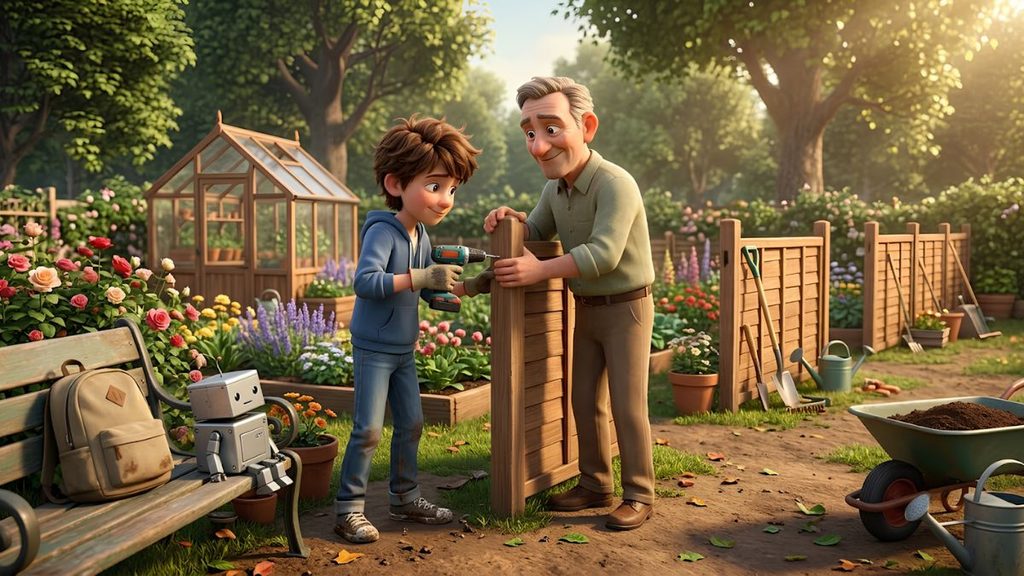
Noah Carter had been waiting for Saturday for six days.
Technically, he had been waiting for it since the beginning of the month.
But now that the final meeting of the Saturday Robot Club had arrived, six days felt like six years.
The competition was only a week away.
His team had spent months building their robot.
They had designed its wheels.
Programmed its sensors.
Tested its tiny robotic arm.
Rebuilt it when the arm broke.
Reprogrammed it when the sensors stopped working.
And argued about its name for almost three entire meetings.
Eventually, they had settled on Bolt.
Noah thought it was perfect.
Bolt was silver, box-shaped, and slightly crooked on one side because the team had accidentally attached one panel upside down.
But to Noah, Bolt was magnificent.
And Saturday was supposed to be the day everything finally came together.
There was only one problem.
His grandfather needed help.
The Final Meeting
Noah woke up before his alarm.
He immediately looked at the clock.
6:18 a.m.
He smiled.
The robot club didn’t start until 9:00.
He had plenty of time.
He jumped out of bed.
His backpack was already packed.
Inside were:
- A laptop
- Programming cables
- Two spare batteries
- A screwdriver
- A small roll of electrical tape
- Three packets of biscuits
- A notebook
- Safety glasses
- And a printed photograph of Bolt
Noah had packed the biscuits because his teammate Emma always forgot breakfast.
He packed two extra batteries because Liam always said:
“We won’t need them.”
Then they always needed them.
Noah went downstairs.
His grandfather was sitting at the kitchen table.
That was unusual.
Grandpa Arthur normally woke early, drank tea, and disappeared into the community garden before breakfast.
Today he looked worried.
“Morning, Grandpa.”
“Morning, Noah.”
Noah grabbed a piece of toast.
“Big day.”
“I know.”
“Final robot club.”
“I know.”
Noah smiled.
“You remembered.”
Arthur smiled back.
“Of course I remembered.”
Then he sighed.
“There’s a problem.”
The Community Garden
Arthur managed a small community garden three streets away.
It wasn’t a formal park.
It had been created years earlier by neighborhood residents.
There were vegetable beds, flower patches, wooden benches, a small greenhouse, and a narrow path lined with lavender.
Every spring, the neighborhood held a garden festival.
Families brought food.
Children played games.
Local musicians performed.
People displayed plants.
This year, however, the garden was in terrible condition.
A storm earlier in the week had damaged several sections.
One of the fences had fallen.
Branches were scattered across the paths.
Several flower beds were covered with debris.
And the main wooden sign had fallen over.
The festival was tomorrow.
Arthur had promised to have everything ready.
But his usual helpers had canceled.
One was sick.
Another was out of town.
A third had injured his knee.
Arthur looked at Noah.
“I could really use some help.”
Noah stopped chewing.
“Today?”
Arthur nodded.
“Just for a few hours.”
Noah looked at the clock.
6:31.
He still had time.
“How long?”
“I don’t know.”
Noah’s stomach tightened.
The robot club started at nine.
The Choice
Noah knew what he should say.
He also knew what he wanted to say.
He wanted to go to the robot club.
He had been waiting all week.
The final testing session was important.
His teammates were counting on him.
He was responsible for the navigation program.
Without him, Bolt couldn’t complete the obstacle course.
But his grandfather was looking at him.
Arthur didn’t ask again.
He simply waited.
Noah looked at the photograph of Bolt sticking out of his backpack.
Then he looked at his grandfather.
“I’ll help.”
Arthur smiled.
“Thank you.”
Noah nodded.
“But we have to work fast.”
Arthur laughed.
“Agreed.”
The First Job
They reached the garden at 7:00.
The damage looked worse than Noah expected.
A large branch had fallen across one of the paths.
Several flower pots were overturned.
The fence near the entrance had collapsed.
Noah stared.
“How are we going to fix all this?”
Arthur handed him a pair of gloves.
“One thing at a time.”
They started with the branch.
It was too heavy for Noah to lift alone.
Arthur took one end.
Noah grabbed the other.
“Ready?”
“Ready.”
They lifted.
The branch moved a few inches.
Then slipped.
“Again.”
They tried again.
This time they managed to drag it away from the path.
Noah looked at his watch.
7:24.
He felt a little better.
They still had time.
The Fence
The fence was next.
Arthur brought out a toolbox.
Noah held the wooden panels while his grandfather hammered nails.
“Hold it steady.”
“I am.”
“It’s moving.”
“I’m holding it.”
“It’s still moving.”
“Grandpa!”
Arthur laughed.
“You’re right. My mistake.”
Noah laughed too.
They worked together.
For a while, Noah forgot about the robot club.
He enjoyed working with his grandfather.
Arthur had a way of explaining things without making Noah feel like he was being taught.
He showed him how to measure the distance between fence posts.
He explained why the support beams needed to be angled.
He even let Noah use the cordless drill.
At 8:10, the fence was standing again.
Noah looked at his watch.
His smile disappeared.
“Uh-oh.”
Arthur looked over.
“What?”
“It’s 8:10.”
Arthur understood.
“How long to the club?”
“Twenty-five minutes.”
“You can still make it.”
Noah shook his head.
“The garden isn’t finished.”
Arthur looked around.
“No.”
He sighed.
“You don’t have to stay.”
Noah looked at the broken flower beds.
Then at his grandfather.
“I said I’d help.”
The Missing Wheelbarrow
They moved to the garden beds.
Leaves covered everything.
Noah began clearing them.
Arthur went to find the wheelbarrow.
Five minutes later, he returned.
“It’s gone.”
“What?”
“The wheelbarrow.”
“Where?”
“I don’t know.”
Noah laughed.
“How do you lose a wheelbarrow?”
Arthur shrugged.
“I’ve managed to do it.”
They searched behind the greenhouse.
Nothing.
They checked the tool shed.
Nothing.
Finally, Noah found it upside down behind a pile of wooden boards.
“There!”
Arthur laughed.
“Good detective work.”
Noah pulled it free.
The wheel was flat.
He stared at it.
“You have got to be kidding.”
Arthur smiled.
“Welcome to gardening.”
Time Slips Away
At 8:42, they were still working.
Noah’s gloves were dirty.
His shoes were covered in mud.
His hair was messy.
He looked at his phone.
Three missed messages.
Emma: Where are you?
Liam: We are testing Bolt’s sensors.
Emma: Noah???
He quickly typed:
Helping Grandpa. Will come ASAP.
Then he put his phone away.
Arthur noticed.
“You should go.”
Noah shook his head.
“Not yet.”
“You’re going to miss it.”
“I know.”
Arthur became quiet.
“I don’t want you to miss something important because of me.”
Noah looked at him.
“You need help.”
Arthur smiled sadly.
“I do.”
“Then I’m staying.”
The Greenhouse
The greenhouse was their final major task.
A storm had broken several panels.
Inside, pots were scattered everywhere.
A shelf had collapsed.
Young tomato plants were leaning sideways.
Arthur looked at the mess.
“Oh dear.”
Noah laughed.
“That’s one way to describe it.”
They began rebuilding the shelf.
Noah held the frame.
Arthur tightened the screws.
Then they moved the plants.
Noah carefully lifted each pot.
“These are pretty.”
“Those are tomato plants.”
“I know.”
Arthur smiled.
“You’ve never been interested in gardening before.”
“I’ve never had a grandfather who needed a robot engineer to help.”
Arthur laughed.
“Fair point.”
The Last Task
By 10:15, the garden finally looked presentable.
Not perfect.
But presentable.
The path was clear.
The fence stood upright.
The flower beds were cleaned.
The greenhouse was organized.
The fallen branches were gone.
The wooden sign had been repaired.
Noah stood beside his grandfather.
He looked exhausted.
Arthur looked at him.
“You did good.”
Noah smiled.
Then he checked his phone.
There were more messages.
His heart sank.
The robot meeting had started at nine.
The final test was probably already over.
“I missed it.”
Arthur placed a hand on his shoulder.
“I’m sorry.”
Noah shook his head.
“It’s okay.”
But it wasn’t.
Not entirely.
He had wanted to be there.
He had imagined this morning so many times.
He had imagined Bolt completing the obstacle course.
He had imagined the team cheering.
Now he had missed it.
The Unexpected Ride
Arthur picked up the garden tools.
“Come on.”
“Where?”
“School.”
Noah stared.
“But we’re done.”
“We’re done enough.”
“You’ll take me?”
“Of course.”
They hurried home.
Noah changed his muddy shoes.
He grabbed his backpack.
Arthur drove him to the community center where the robot club met.
The entire way, Noah was quiet.
He expected the building to be empty.
He expected his teammates to have packed everything away.
He expected Bolt to be sitting inside a box.
But when Arthur opened the car door, Noah heard something.
A buzzing sound.
Then laughter.
He looked toward the building.
The lights were still on.
They Waited
Noah opened the door.
“Hello?”
Emma appeared from behind a table.
“Noah!”
She ran toward him.
“You made it!”
Noah stared at her.
“You didn’t leave?”
“Leave?”
Liam appeared.
“We couldn’t finish without you.”
“But it’s eleven.”
“We know.”
Noah looked around.
Bolt was sitting on the table.
The robot’s silver panel was still attached crookedly.
The laptop was open.
The obstacle course was ready.
Noah smiled.
“You waited?”
Emma shrugged.
“Obviously.”
Liam nodded.
“We heard you were helping your grandfather.”
Emma pointed at Bolt.
“We decided the robot could wait.”
Noah’s eyes became watery.
“You really waited?”
Liam smiled.
“You’re the one who wrote the navigation code.”
Emma added:
“And you promised to fix Bolt’s left sensor.”
Noah laughed.
“Right.”
The Final Test
They got to work.
Noah connected his laptop.
The team gathered around Bolt.
“Ready?” Emma asked.
“No.”
Everyone laughed.
“Good,” Liam said.
Noah checked the code.
Everything looked correct.
He ran the program.
Bolt moved forward.
Slowly.
Then faster.
It reached the first obstacle.
Turned left.
Stopped.
Its sensor detected the wall.
Then it turned right.
Everyone cheered.
“Yes!”
Bolt continued.
It reached the ramp.
The little robot climbed.
Its left wheel slipped.
Noah’s heart jumped.
“Come on.”
Bolt corrected itself.
Then continued upward.
At the end of the course was a red flag.
Bolt’s robotic arm extended.
It grabbed the flag.
The entire team screamed.
“We did it!”
Noah laughed.
They high-fived.
Emma hugged him.
Even Liam, who claimed he hated hugs, gave Noah a quick one.
Something More Important
After the test, Noah sat beside Arthur.
His grandfather had stayed to watch.
“You did it,” Arthur said.
“We did.”
Arthur nodded.
Noah looked at the robot.
Then at the garden tools still visible in the back of the car.
“I thought I missed everything.”
Arthur smiled.
“You missed part of the meeting.”
“Yeah.”
“But you didn’t miss everything.”
Noah smiled.
He realized his grandfather was right.
He had helped repair the garden.
His teammates had waited.
The robot had worked.
And somehow, the day had turned out better than he expected.
The Garden Festival
The next morning, Noah returned to the community garden with his family.
The festival was beginning.
Children ran between the flower beds.
Parents carried baskets of food.
A local guitarist played near the entrance.
The repaired fence looked almost new.
The greenhouse stood proudly in the sunlight.
Arthur watched people arriving.
“Looks good,” Noah said.
Arthur smiled.
“It does.”
A little girl stopped beside them.
“Did you fix this?”
Arthur pointed toward Noah.
“He helped.”
The girl smiled.
“Thank you.”
Noah felt strangely proud.
Not the same kind of pride he felt when Bolt completed a challenge.
This was quieter.
Warmer.
The Robot’s Unexpected Job
Later that afternoon, Noah’s teammates arrived.
They brought Bolt.
“We thought the garden needed a robot,” Emma said.
Arthur laughed.
“A robot?”
“Yes.”
They programmed Bolt to drive along the garden paths.
It carried tiny seed packets in its robotic arm.
Children gathered around it.
Bolt delivered seeds to different planting stations.
Everyone loved it.
Arthur watched from a bench.
“Your robot is useful.”
Noah smiled.
“We’re still working on that.”
A New Tradition
After the festival, Noah and Arthur started spending Saturday mornings together.
Sometimes they worked in the garden.
Sometimes Noah brought Bolt.
Sometimes they built things.
Sometimes they simply sat on the bench and drank hot chocolate.
Noah discovered something.
He had always thought weekends were about having free time.
Now he understood that they were also about choosing what to do with that time.
Sometimes the best choice wasn’t the most exciting one.
Sometimes responsibility came before entertainment.
And sometimes helping someone didn’t mean losing something important.
It simply meant making room for something else.
The Competition
A week later, the robot competition arrived.
Noah’s team stood beside Bolt.
There were dozens of robots.
Some were enormous.
Some were incredibly fast.
Some had complicated arms.
Bolt looked small.
And slightly crooked.
But Noah wasn’t worried.
They had practiced.
They knew their robot.
When their turn came, Bolt entered the course.
It completed every challenge.
It didn’t win first place.
It came second.
Emma was disappointed for about three seconds.
Then she smiled.
“Second place isn’t bad.”
Liam nodded.
“We’ll beat them next year.”
Noah laughed.
Then he looked at Bolt.
He thought about that Saturday morning.
The garden.
The broken fence.
The missed meeting.
His teammates waiting.
And the lesson he had learned.
The Real Competition
Noah realized that the competition hadn’t really been about winning.
It had been about teamwork.
His grandfather had needed him.
His team had needed him.
And both groups had shown him something important.
Responsibility wasn’t about giving up everything you enjoyed.
It was about recognizing when someone needed you.
And friendship wasn’t about expecting someone to be available every second.
It was about understanding when life interrupted the plans.
Noah had given up part of his Saturday morning.
In return, he had strengthened his relationship with his grandfather.
His teammates had given up part of their meeting.
In return, they had shown Noah that he wasn’t alone.
And Bolt?
Bolt had survived another crooked wheel, three software bugs, and one suspiciously aggressive garden path.
For a robot, that was probably enough adventure for one year.
The Saturday That Changed Everything
Months later, the community garden was thriving.
New flowers had grown.
The greenhouse was full of vegetables.
The fence had been repainted.
The wooden sign stood proudly at the entrance.
And beside it was a small plaque.
It read:
Maplewood Community Garden
Built and cared for by neighbors
Noah had helped make it possible.
But he never considered that Saturday morning a sacrifice.
Not anymore.
He remembered being disappointed.
He remembered worrying that he had missed the robot meeting.
But he also remembered his grandfather handing him the first fence board.
He remembered laughing over the missing wheelbarrow.
He remembered the muddy shoes.
And most of all, he remembered walking into the community center and discovering that his friends had waited.
Sometimes, he realized, changing your plans doesn’t mean losing your day.
Sometimes it means discovering something you didn’t know you needed.
Moral of the Story
Being responsible sometimes means putting aside your own plans to help someone who needs you. But choosing responsibility doesn’t mean you lose the things you love. True friends and family understand, support your choices, and help you find your way back.
Noah thought he was choosing between his grandfather and his robot club.
Instead, he discovered something better.
The people who care about us don’t always ask us to choose between responsibility and happiness. Sometimes, they help us make room for both.
6. The Last Place in the Race
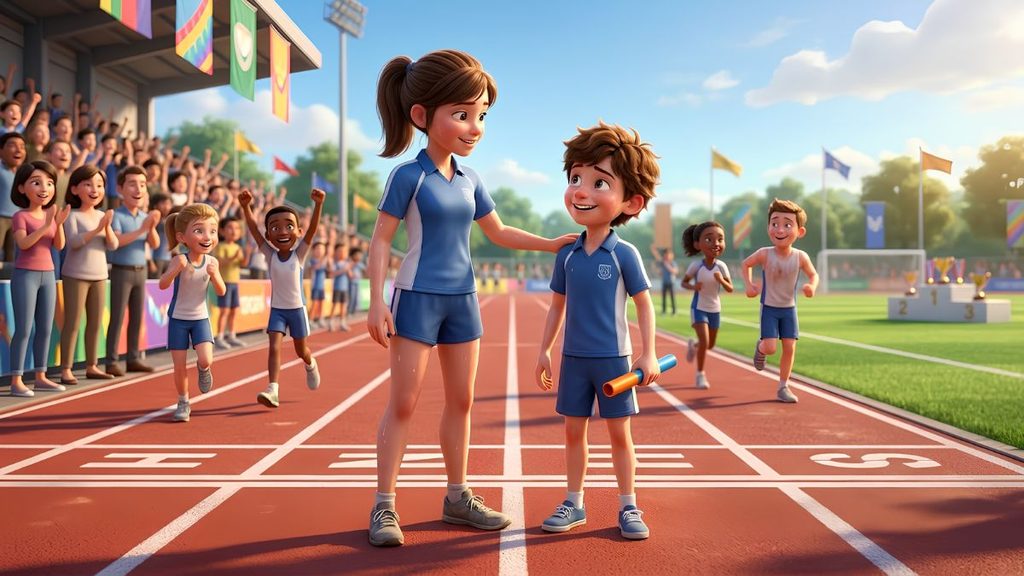
Type: Sacrifice Between Siblings
Core themes: sibling love, encouragement, competition, confidence, putting relationships before victory.
Sophie Carter had never lost a race to her younger brother.
This was partly because she was thirteen.
Daniel was nine.
But Daniel insisted there was another reason.
“You have longer legs.”
Sophie would laugh.
“That’s because I’m older.”
“Exactly.”
“So?”
“It’s unfair.”
Sophie would shake her head.
“Life is unfair.”
Daniel would narrow his eyes.
“One day I’ll beat you.”
“I’ll be waiting.”
Daniel believed her.
He had always believed her.
The Fastest Runner
At Maplewood Middle School, Sophie was known as one of the fastest runners in her grade.
She had won the 100-meter race at the spring sports festival.
She had placed first in the school cross-country run.
She even had a small collection of medals hanging above her desk.
Daniel loved looking at them.
Sometimes he would take one down.
“How fast were you?”
Sophie would tell him.
“Really fast.”
“Faster than me?”
“Much faster.”
Daniel would put the medal back.
“Not forever.”
Sophie smiled.
“Not forever.”
Daniel had recently started running himself.
He wasn’t fast.
At least, not yet.
But he loved it.
He ran everywhere.
To the kitchen.
To the garden.
To the mailbox.
Sometimes Sophie would watch him from the window.
He always looked determined.
Even when he came last.
Especially when he came last.
The Relay Race
One Monday morning, the school announced a relay competition.
Each class would form teams of four runners.
Every runner would complete one section of the track before passing the baton to the next teammate.
The winning team would receive a large silver trophy.
Sophie immediately wanted to participate.
Daniel’s school was holding its own junior relay on the same day.
He was excited.
“I’ll be racing too!”
Sophie smiled.
“Really?”
Daniel nodded.
“I’ve been practicing.”
“Good.”
“I’m going to win.”
Sophie raised an eyebrow.
“Are you?”
“Maybe.”
She laughed.
“Okay. Maybe.”
Team Selection
Sophie’s coach, Mr. Harris, watched several practice races.
He quickly selected four students for the strongest relay team.
Sophie was one of them.
She would run the final leg.
The anchor.
The last runner.
The person responsible for bringing the team home.
Sophie was thrilled.
“You’re our best finisher,” Mr. Harris told her.
She smiled.
“I won’t let you down.”
Across the field, Daniel was practicing with the younger students.
His team was very different.
They weren’t the fastest.
Some runners were inexperienced.
One boy had never competed before.
Daniel was the second-fastest member.
But his team was still considered one of the weaker groups.
During practice, they finished last.
Again.
And again.
And again.
Daniel’s Frustration
One afternoon, Sophie found Daniel sitting on the grass.
His running shoes were untied.
His head was down.
“What’s wrong?”
“Nothing.”
Sophie sat beside him.
“That’s your ‘something is wrong’ face.”
Daniel sighed.
“Our team is terrible.”
“They’re not terrible.”
“We’re always last.”
“So?”
“So it means we’re bad.”
Sophie shook her head.
“Finishing last doesn’t mean you’re bad.”
“It does in a race.”
“No.”
Daniel looked at her.
“It means you’re the slowest team.”
“That’s different.”
“How?”
“Because being slow is something you can work on.”
Daniel looked at the track.
“I’m never going to be fast like you.”
Sophie smiled.
“You don’t have to be.”
“I want to be.”
“I know.”
She nudged his shoulder.
“But you know what makes a good runner?”
“Speed?”
“Partly.”
“What else?”
“Finishing.”
Daniel looked at her.
“Even when you’re last?”
“Especially then.”
The Team Sophie Didn’t See
The next practice session changed things.
Sophie’s team was excellent.
They passed the baton smoothly.
They ran efficiently.
They were almost guaranteed to win the school event.
Daniel’s team struggled.
One runner dropped the baton.
Another ran too early.
Daniel himself stumbled during the final turn.
Afterward, he sat alone.
Sophie watched him from across the field.
She wanted to go over.
But Mr. Harris called her.
“Sophie, we need to work on your final handoff.”
She nodded.
“Coming.”
She looked back at Daniel.
He was tying his shoes.
She turned toward her coach.
The Invitation
The following day, Mr. Harris called Sophie aside.
“There’s been a change.”
“What happened?”
“Daniel’s team needs another runner.”
Sophie nodded.
“One of their runners is injured.”
“Okay.”
“We’re allowing them to substitute someone.”
Sophie waited.
Mr. Harris looked at her.
“You could switch.”
Sophie blinked.
“Me?”
“Yes.”
“To Daniel’s team?”
“Yes.”
Sophie looked toward the younger runners.
Then toward her own team.
Mr. Harris continued.
“It would weaken our team considerably.”
Sophie understood.
“If I switch, we probably won’t win.”
“Probably not.”
“And Daniel’s team?”
“Would have a much better chance.”
Sophie didn’t answer.
The Decision
That evening, Sophie sat on her bed.
Her medals hung on the wall.
The silver relay trophy was still only a possibility.
She imagined standing on the podium.
She imagined her teammates cheering.
She imagined the final sprint.
Then she imagined Daniel.
Sitting alone on the grass.
Thinking he was holding everyone back.
She picked up one of her medals.
It suddenly seemed less important.
Her mother walked past the doorway.
“You look thoughtful.”
Sophie sighed.
“I have to make a decision.”
Her mother sat beside her.
“What kind?”
Sophie explained.
Her mother listened.
Then she said:
“Do you want advice?”
Sophie nodded.
“Whatever you choose, make sure you’re choosing it because you believe it’s right, not because you think someone expects you to.”
Sophie thought about that.
“What would you do?”
Her mother smiled.
“That’s your decision.”
The Next Morning
Sophie approached Mr. Harris before practice.
“I’ll switch.”
He nodded slowly.
“Are you sure?”
“Yes.”
“You understand what that means?”
“We probably won’t win.”
“Correct.”
Sophie smiled.
“Daniel might.”
Mr. Harris laughed.
“That’s a good way to look at it.”
Her teammates were surprised.
One boy asked:
“Why would you leave our team?”
Sophie explained.
Nobody was particularly happy.
But nobody was cruel.
Her closest teammate, Maya, finally said:
“I think it’s a good thing.”
Sophie looked surprised.
“You do?”
“Yes.”
Maya smiled.
“Besides, now we have something to prove.”
Daniel’s Reaction
Daniel was speechless when Sophie joined his team.
“You?”
Sophie nodded.
“Me.”
“But you’re supposed to be on the good team.”
“I changed teams.”
“Why?”
Sophie shrugged.
“I wanted to.”
Daniel looked suspicious.
“You did this because I’m slow.”
“No.”
“Then why?”
“Because you’re my brother.”
Daniel stared at her.
“That’s not a reason.”
Sophie smiled.
“To me, it is.”
Daniel looked away.
His eyes became watery.
Sophie pretended not to notice.
“Come on.”
“Where?”
“Practice.”
Training Together
For the next several days, Sophie trained with Daniel’s team.
She didn’t magically make them fast.
But she helped them become better.
She taught them how to hold the baton.
She showed them how to accelerate after receiving it.
She explained that runners shouldn’t look backward too early.
Most importantly, she taught them how to encourage each other.
When someone stumbled, they didn’t complain.
They tried again.
When someone dropped the baton, they practiced the handoff.
When they finished last, Sophie applauded.
“Again.”
Daniel laughed.
“Again?”
“Again.”
They practiced.
And practiced.
And practiced.
By Friday, they were still one of the slowest teams.
But they were no longer embarrassed about it.
Race Day
Saturday morning arrived.
The school track was filled with families.
Parents held cameras.
Teachers carried clipboards.
Students shouted encouragement.
The relay teams lined up.
Sophie stood beside Daniel.
He looked nervous.
“You okay?”
“No.”
“Good.”
Daniel laughed.
“Why is that good?”
“Because nervous means you care.”
Daniel took a deep breath.
“I’m scared I’ll mess up.”
“You might.”
Daniel stared at her.
“Thanks.”
Sophie laughed.
“Everyone makes mistakes.”
“What if we’re last?”
Sophie smiled.
“Then we finish last.”
“That’s it?”
“That’s it.”
Daniel looked at her.
“You’re really not worried?”
Sophie shook her head.
“I’m more worried about you forgetting to breathe.”
Daniel laughed.
The First Runner
The race began.
The first runners exploded forward.
The crowd cheered.
Daniel’s team immediately fell behind.
But nobody panicked.
Their first runner completed the section and passed the baton.
Second place?
No.
Third?
No.
They were fourth.
Last.
Daniel’s teammate reached him.
“Go!”
Daniel grabbed the baton.
He ran.
His legs felt heavy.
The crowd seemed incredibly loud.
He could hear people cheering.
He could hear footsteps behind him.
For a moment, he wanted to stop.
Then he heard Sophie.
“KEEP GOING, DANIEL!”
He ran faster.
Not much faster.
But enough.
He completed his section.
He passed the baton.
His teammate smiled.
“Good job!”
Daniel stepped aside.
He was breathing hard.
But he was smiling.
The Final Runner
The race was almost over.
Sophie’s team was in first place.
Daniel’s team was still last.
But they were running.
Every runner gave everything they had.
Then the final baton arrived.
Sophie took it.
She looked ahead.
The other teams were far in front.
There was no chance of catching them.
She could have pushed herself.
She could have tried.
Instead, she slowed slightly.
She looked toward the finish line.
Daniel was standing there.
Cheering.
“COME ON, SOPHIE!”
She smiled.
Then she ran.
She crossed the finish line.
Last.
The crowd applauded.
Daniel ran toward her.
“You did it!”
Sophie laughed.
“We did.”
The Unexpected Applause
For a moment, Sophie expected disappointment.
Instead, something unexpected happened.
People began cheering louder.
Not because they had won.
Because they had finished.
The other runners came over.
Maya, Sophie’s former teammate, hugged her.
“That was amazing.”
Sophie laughed.
“We came last.”
“So?”
Sophie smiled.
Daniel stood beside her.
His face was glowing.
“We finished.”
Sophie nodded.
“Yes.”
The Medal
At the end of the event, the winners received trophies.
Sophie’s original team won.
Maya came running over afterward.
“We won!”
Sophie hugged her.
“I’m proud of you.”
Maya smiled.
“But you know what?”
“What?”
“I think you won something too.”
Sophie laughed.
“I didn’t get a trophy.”
Maya shook her head.
“Not that.”
She pointed toward Daniel.
“Look at him.”
Daniel was talking excitedly to another runner.
He was describing the race.
For the first time, he wasn’t talking about finishing last.
He was talking about finishing.
The Walk Home
After the race, Sophie and Daniel walked home together.
Daniel carried his water bottle.
Sophie carried both their bags.
“Do you regret switching teams?”
Sophie thought.
“No.”
“Not even a little?”
She smiled.
“I wanted to win.”
Daniel looked at her.
“But?”
“But I wanted you to believe in yourself more.”
Daniel was quiet.
Then he said:
“I still want to beat you.”
Sophie laughed.
“I know.”
“One day.”
“I’ll be waiting.”
Daniel smiled.
This time, Sophie believed him.
The Race That Mattered
Years later, Daniel would become a much faster runner.
He never became quite as fast as Sophie.
But he didn’t care.
He continued running because he loved it.
And whenever he struggled, he remembered that first relay race.
He remembered being last.
He remembered wanting to quit.
And he remembered his sister shouting from the sidelines.
“Keep going, Daniel!”
Sophie had sacrificed a chance to win.
But she hadn’t lost anything important.
She had gained something instead.
She had helped her little brother discover that finishing last was not the same as being a failure.
Sometimes courage meant running when everyone else was faster.
Sometimes success meant crossing the finish line.
And sometimes the person who gives up the first-place trophy gains something much more valuable.
The Photograph
Years later, the family had a photograph from that race.
It showed Sophie and Daniel standing together at the finish line.
Sophie was smiling.
Daniel was covered in sweat.
Both were holding the same water bottle.
Their team had finished last.
But whenever their parents looked at the photograph, they smiled.
Because they knew something the scoreboard didn’t show.
That day, Sophie had chosen her brother over victory.
And Daniel had discovered that his sister believed in him even when he didn’t believe in himself.
The photograph became one of their family’s favorite memories.
Not because they had won.
But because, for one important moment, they had understood what winning really meant.
Moral of the Story
Winning is exciting, but helping someone you love believe in themselves can be worth far more than a trophy.
Sophie gave up her place on the strongest team because she didn’t want her brother to face his first major race believing he wasn’t good enough.
The team finished last.
But Daniel crossed the finish line with confidence.
And sometimes, helping someone keep going is the greatest victory of all.
7. The Secret Behind the Science Fair
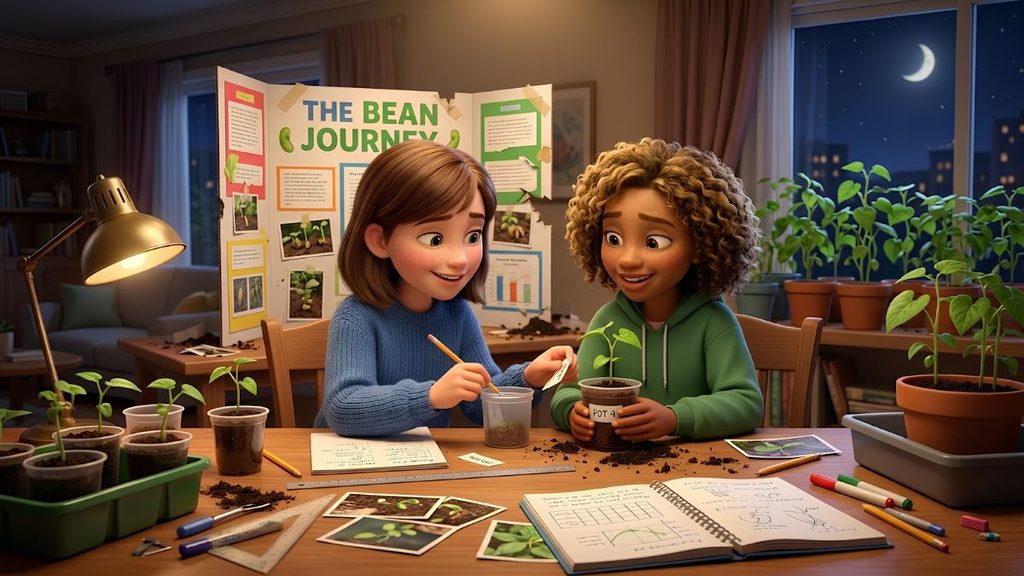
Type: Sacrifice Between Friends
Core themes: friendship, generosity, competition, cooperation, integrity.
Emma Parker had always loved science.
Not just the kind of science that appeared in textbooks.
She loved the messy kind.
The kind that involved wires, measuring cups, magnets, batteries, notebooks, and experiments that sometimes went spectacularly wrong.
Her best friend, Grace Miller, loved science too.
The two girls had been friends since kindergarten.
They had built paper bridges together.
Collected leaves for biology projects.
Made miniature volcanoes.
And once spent an entire afternoon trying to discover whether a potato could power a small flashlight.
It couldn’t.
At least, not the way they had tried.
But they had laughed so much that neither cared.
Now, at eleven years old, they were preparing for the biggest science fair their school had ever organized.
And this time, there was something important at stake.
A scholarship.
The Science Fair
Maplewood Elementary held its annual science fair every spring.
Students from grades four through six could enter.
There were categories for biology, physics, environmental science, chemistry, engineering, and technology.
The best projects received certificates and trophies.
But this year, the school had announced a special prize.
A local science foundation was offering a scholarship for the student with the most impressive project.
Emma wanted it badly.
Her family couldn’t easily afford many extracurricular opportunities.
A scholarship could help her attend a summer science program.
She had been dreaming about that program for months.
Her project was called The Clean Water Challenge.
She had built a small filtration system using layers of gravel, sand, charcoal, and natural fibers.
It wasn’t intended to make dirty water safe to drink.
Instead, it demonstrated how different materials could remove visible impurities.
Emma had tested it dozens of times.
Her charts were complete.
Her display board was finished.
Her presentation cards were organized.
Everything was ready.
Almost.
Grace’s Project
Grace had chosen a completely different subject.
Her project explored how plants responded to different amounts of sunlight.
She had grown several groups of bean plants.
One group received full sunlight.
Another received partial sunlight.
A third received very little.
Grace had carefully measured their height every day.
She had photographed their progress.
She had created charts.
Her display board was colorful and beautifully organized.
Emma admired it.
“Your plants look amazing.”
Grace smiled.
“I hope the judges like it.”
“They will.”
“You haven’t even seen my presentation.”
“I don’t need to.”
Grace laughed.
“That’s very scientific of you.”
Emma grinned.
“You’ve got this.”
They had promised each other something.
No matter who won, they would celebrate together.
The Night Before
The evening before the science fair, Emma finished her final practice presentation.
She stood in front of her bedroom mirror.
“My experiment demonstrates how different layers of natural filtration materials can reduce visible particles in water…”
She stopped.
She frowned.
“Too boring.”
She tried again.
“My experiment demonstrates…”
Her phone buzzed.
It was Grace.
Can I call you?
Emma immediately answered.
“Hey.”
Grace didn’t speak.
Emma sat up.
“Grace?”
“I ruined it.”
“Ruined what?”
“My project.”
Emma’s stomach tightened.
“What happened?”
Grace took a shaky breath.
“I was moving the plants.”
“And?”
“One of the trays fell.”
Emma waited.
“And the water spilled.”
“Oh.”
“It got everywhere.”
Emma stood.
“Are the plants okay?”
“No.”
“How bad?”
Grace began crying.
“The soil mixed together.”
Emma closed her eyes.
“Can you separate them?”
“I tried.”
“Okay.”
“Emma, it’s impossible.”
“Maybe not.”
“I’ve destroyed everything.”
“No, you haven’t.”
Grace’s voice became quieter.
“The fair is tomorrow.”
“I know.”
“I spent six weeks on this.”
“I know.”
“I can’t fix it.”
Emma looked at the clock.
8:17 p.m.
The Choice
Emma’s project was ready.
She could go to bed early.
Wake up rested.
Arrive at school confident.
Give her presentation.
And perhaps win the scholarship.
Or she could help Grace.
But helping Grace wouldn’t be simple.
They would need to rebuild the experiment.
That meant new soil.
New containers.
New measurements.
New labels.
New photographs.
They would have to recreate as much of the original project as possible.
It could take hours.
Emma knew what she should do.
She also knew what she wanted.
Winning mattered to her.
The scholarship mattered.
She looked at her science fair display board.
Everything was perfect.
Then she heard Grace crying through the phone.
Emma made her decision.
“Where are you?”
“Home.”
“I’ll come over.”
Grace became silent.
“What?”
“You don’t have to.”
“I know.”
“Your project is finished.”
“I know.”
“You could lose the scholarship.”
Emma looked at her display board again.
“Maybe.”
“Then why?”
Emma smiled.
“Because you’re my friend.”
Rebuilding the Experiment
Emma arrived at Grace’s house twenty minutes later.
Grace’s dining table looked like a disaster zone.
Plant trays were scattered everywhere.
Soil covered the floor.
Labels had fallen off.
Photographs were damp.
Grace looked exhausted.
“I don’t know where to start.”
Emma put down her backpack.
“Neither do I.”
Grace stared at her.
Emma smiled.
“So let’s start somewhere.”
They cleaned the table.
They sorted the plants.
They checked which containers were still usable.
They found replacement soil.
Grace’s parents helped them gather supplies.
Emma brought her notebook.
“Your original measurements?”
Grace nodded.
“Here.”
They compared the notes.
Some plants could still be identified.
Others couldn’t.
“Okay,” Emma said.
“We can’t recreate everything.”
Grace looked disappointed.
“But we can explain what happened.”
“What?”
“The accident.”
“But then it won’t be perfect.”
Emma smiled.
“Science isn’t perfect.”
Grace laughed weakly.
“That’s easy for you to say.”
Emma held up a muddy plant tray.
“Trust me. Nothing about tonight is perfect.”
The Midnight Experiment
By 10:30 p.m., they had recreated three groups.
By 11:15, they had labeled everything.
At midnight, they were exhausted.
Grace yawned.
“We should stop.”
Emma looked at the clock.
“We need something for the presentation.”
“What?”
“A new chart.”
Grace stared at her.
“At midnight?”
“At midnight.”
They laughed.
They created a new chart using Grace’s original measurements.
Where the data was missing, they marked it clearly.
Emma insisted that they shouldn’t invent anything.
“What about the missing measurements?”
Grace asked.
“We explain them.”
“But judges won’t like that.”
“Maybe.”
Emma looked at her.
“But honesty is more important.”
Grace smiled.
“You’re right.”
The Unexpected Discovery
Around 1:00 a.m., something interesting happened.
One of the replacement plants had been placed near the window.
Another was farther away.
Grace noticed something.
“Look.”
Emma leaned closer.
“The one near the window is already bending toward the light.”
Grace grabbed her notebook.
“That’s interesting.”
“Very.”
They began observing.
They measured the angles.
Compared them with Grace’s earlier notes.
Then they realized something.
The accident had created an unexpected opportunity.
Because some plants had been disturbed and repositioned, they could observe how quickly the plants responded to changes in light direction.
Grace’s original experiment had been about the amount of sunlight.
Now they had discovered another question:
How does the direction of light affect plant growth?
Grace’s eyes widened.
“Emma.”
“I know.”
“This could be part of the project.”
Emma smiled.
“Now we’re doing science.”
Morning
At 5:42 a.m., the girls finally finished.
Grace’s new display wasn’t perfect.
Some photographs were missing.
The charts were smaller.
The replacement plants weren’t as tall.
But there was something new.
A section titled:
“What We Learned From an Unexpected Failure.”
Underneath it, Grace had written about the accident.
She explained what had happened.
Then she described how the accident led to a new observation.
Emma read it.
“This is good.”
“Really?”
“Really.”
Grace smiled.
“You think the judges will like it?”
Emma nodded.
“I think they’ll remember it.”
The Science Fair
The next morning, the school gymnasium was crowded.
Tables filled the room.
Students stood beside their projects.
Judges walked from display to display.
Emma stood beside her water filtration experiment.
Her presentation was ready.
But she was tired.
Very tired.
She had slept for perhaps forty minutes.
Grace stood across the room.
Her project looked slightly different from the one she had planned.
But she was smiling.
Emma smiled back.
Then the judges approached Grace.
Grace’s Presentation
Grace took a deep breath.
“My project was supposed to demonstrate how plants respond to different amounts of sunlight.”
She paused.
“Then something went wrong.”
The judges listened.
Grace explained the accident.
She showed them the damaged photographs.
She showed them the original measurements.
Then she explained how she and Emma had rebuilt the experiment.
One judge asked:
“Why did you change your project?”
Grace answered:
“Because the accident made us ask a different question.”
“What question?”
“How plants respond when the direction of light changes.”
The judge smiled.
“And what did you discover?”
Grace pointed to the plants.
“They bend toward the light.”
“Why?”
Grace smiled.
“That’s what we’re still investigating.”
The judges nodded.
Emma watched proudly.
Emma’s Turn
Eventually, the judges reached Emma’s table.
She explained her filtration system.
Normally, Emma’s presentation was polished.
Today, however, she stumbled over one sentence.
Then another.
Her tired brain couldn’t remember a word.
She stopped.
“I’m sorry.”
The judge smiled.
“Take your time.”
Emma breathed.
Then continued.
She finished the presentation.
One judge looked at her carefully.
“Emma, your project is excellent.”
“Thank you.”
“But I have a question.”
Emma nodded.
“What did you do last night?”
Emma froze.
She looked at Grace.
Grace looked back.
Emma didn’t understand.
The judge smiled.
“We heard about Grace’s experiment.”
Emma’s face became warm.
“Oh.”
“You helped her rebuild it.”
Emma nodded.
“Yes.”
“Even though you were competing for the same scholarship?”
Emma looked down.
“Yes.”
The judge smiled.
“Why?”
Emma thought for a moment.
“Because winning matters.”
She looked at Grace.
“But not more than my friend.”
The Result
That afternoon, the students gathered for the awards ceremony.
Everyone was nervous.
Third place was announced.
Then second.
Then first.
Emma didn’t win.
Grace didn’t win either.
The scholarship went to another student whose project involved renewable energy.
Emma felt disappointed.
Of course she did.
She had wanted to win.
But when the applause ended, she looked at Grace.
Grace was smiling.
Then the science fair coordinator stepped onto the stage.
“There is one additional recognition this year.”
The room became quiet.
“We would like to present a special award for scientific integrity and cooperation.”
Emma looked surprised.
The coordinator continued.
“This student demonstrated that science isn’t simply about producing perfect results. It is also about helping others, responding to failure, asking new questions, and being honest about what went wrong.”
Emma’s eyes widened.
“Emma Parker.”
The room applauded.
Grace jumped up.
“That’s my best friend!”
Emma walked onto the stage.
She received a small certificate.
It wasn’t the scholarship.
But it meant something.
After the Ceremony
Outside the school, Emma and Grace sat beneath a tree.
Grace looked at the certificate.
“You deserved that.”
Emma smiled.
“So did you.”
“I ruined my project.”
“No.”
Grace looked at her.
“You turned a mistake into a new experiment.”
Grace smiled.
“With your help.”
Emma nodded.
“With our help.”
They sat quietly.
Then Grace said:
“Would you do it again?”
Emma laughed.
“Stay up until two in the morning covered in soil?”
“Yes.”
“Absolutely not.”
Grace laughed.
“Okay.”
Emma smiled.
“I’d help you again.”
What They Learned
The science fair changed the way both girls thought about competition.
Before that week, they had believed that winning meant being better.
Now they understood something different.
Competition could push people to work harder.
It could encourage creativity.
It could make people want to improve.
But competition didn’t have to destroy friendship.
Emma could want the scholarship and still help Grace.
Grace could compete against Emma and still cheer for her.
They could want to win without wanting the other person to lose.
And sometimes, helping someone else succeed required giving up something for yourself.
The Garden Experiment
A few weeks later, Emma and Grace started another project.
This time, they worked together.
They planted bean seeds in the school garden.
They created different light conditions.
They measured growth.
They recorded observations.
They made mistakes.
They changed their methods.
And whenever something went wrong, they didn’t panic.
They asked:
“What can we learn from this?”
That became their favorite question.
One afternoon, Grace looked at their plants.
“You know what?”
“What?”
“I’m glad my project broke.”
Emma laughed.
“Don’t say that too loudly.”
“Why?”
“Because next time you break something, I’m not staying up until two.”
Grace grinned.
“Deal.”
The Secret Behind the Science Fair
Years later, neither girl remembered every detail of the science fair.
They couldn’t remember the exact scores.
They couldn’t remember which student won every category.
They couldn’t even remember what the final scholarship amount was.
But they remembered the night they sat on the floor surrounded by soil and broken plant trays.
They remembered being exhausted.
They remembered laughing.
They remembered wondering whether they were making a terrible decision.
And they remembered choosing friendship.
The science fair had taught them something no textbook could.
Sometimes the most important experiment isn’t the one displayed on the table.
Sometimes it happens inside us.
We discover what kind of people we want to be.
We discover what matters when nobody is watching.
And sometimes, we discover that helping someone else doesn’t make our own light shine less brightly.
It makes the whole room brighter.
Moral of the Story
True success is not always measured by trophies, prizes, or first-place certificates. Sometimes the greatest achievement is choosing kindness and integrity when competition gives you every reason to think only about yourself.
Emma wanted to win.
She worked hard for it.
But when her best friend needed help, she chose friendship over an advantage.
She didn’t know whether she would receive anything in return.
She simply believed that helping Grace was the right thing to do.
And in the end, Emma discovered that some victories never appear on a scoreboard.
When we help others succeed, we don’t necessarily lose our own chance to shine. Sometimes, we discover a brighter definition of success.
8. Dad’s Empty Toolbox
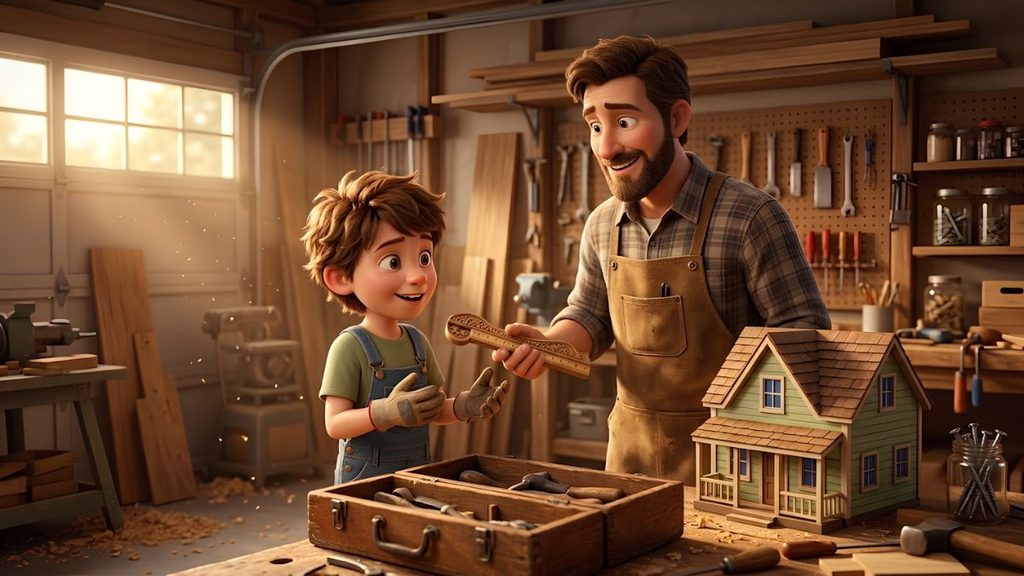
Type: Parent Sacrifice
Core themes: parental love, family traditions, generosity, craftsmanship, legacy.
Max Carter believed that his father could fix anything.
A broken chair?
Dad could fix it.
A loose cupboard handle?
Dad could fix it.
A bicycle with a squeaky wheel?
Dad could fix it.
A toy train that suddenly stopped working?
Dad would turn it over, examine it carefully, and say:
“Let’s see what’s wrong.”
Max loved those words.
Let’s see what’s wrong.
To Max, they meant that problems weren’t something to be afraid of.
They were simply things waiting to be understood.
His father, Daniel, kept most of his tools in an old wooden toolbox.
The toolbox was scratched.
The brass hinges were dull.
One corner had been repaired several times.
But Daniel treated it carefully.
Max wasn’t allowed to take anything without asking.
Especially one particular tool.
A small measuring tool carved from dark wood.
Max had always wondered why.
He would soon discover that the tool had a story.
And that sometimes parents sacrifice something precious not because it doesn’t matter to them, but because something else matters even more.
The Old Toolbox
The toolbox sat on a shelf in Daniel’s workshop.
The workshop occupied half of the garage.
There were shelves along the walls.
Jars filled with screws.
Boxes of nails.
Paintbrushes.
Sandpaper.
Lengths of wood.
And tools of every imaginable shape.
Max loved visiting.
At seven years old, he didn’t understand what every tool did.
He knew a hammer.
He knew a screwdriver.
He knew pliers.
He knew a tape measure.
And he knew the mysterious wooden measuring tool.
It was about the length of Max’s hand.
Its surface was smooth from years of use.
Tiny measurement marks had been carved into the wood.
There were no numbers.
Instead, small lines marked the distances.
“What’s this?” Max had asked many times.
Daniel always gave the same answer.
“That’s special.”
“Special how?”
“It’s been in our family for a long time.”
“How long?”
“Longer than me.”
Max’s eyes widened.
“Older than you?”
Daniel laughed.
“Much older.”
Saturday Mornings
Every Saturday morning, Max helped his father in the workshop.
Sometimes they repaired things.
Sometimes they built things.
Sometimes they simply organized the shelves.
Max didn’t mind.
He liked being with his father.
Daniel taught him small lessons.
“Always measure twice.”
“Why?”
“So you only have to cut once.”
Max nodded seriously.
He repeated the sentence often.
“Measure twice. Cut once.”
Daniel smiled.
“Exactly.”
One Saturday, Max asked:
“Who taught you that?”
“My father.”
“And who taught him?”
“His father.”
Max looked at the toolbox.
“So the toolbox is really old?”
Daniel nodded.
“Some of these tools belonged to your grandfather.”
“And your grandfather?”
“Some belonged to him too.”
Max looked impressed.
“Wow.”
Daniel smiled.
“Tools can carry memories.”
Max didn’t completely understand.
But he liked the idea.
The School Announcement
On Monday, Max’s teacher made an exciting announcement.
“Our school is holding a building competition.”
Max immediately sat up.
Students could create almost anything using simple materials.
A bridge.
A tower.
A vehicle.
A model house.
A playground.
The projects would be displayed at the school exhibition.
Max knew exactly what he wanted to build.
“A little house!”
His teacher smiled.
“That sounds wonderful.”
Max imagined it.
A tiny wooden house.
A little door.
Windows.
A roof.
Maybe even a tiny garden.
He couldn’t wait to tell his father.
Dad’s Workshop
That afternoon, Max ran into the garage.
“Dad!”
Daniel looked up.
“What happened?”
“School building competition!”
Daniel smiled.
“Tell me.”
“I want to build a house.”
“A real house?”
“No!”
Max laughed.
“A little one.”
Daniel put down his screwdriver.
“Sounds interesting.”
“I need wood.”
“We can find some.”
“I need nails.”
“Got them.”
“Glue.”
“Easy.”
“Paint.”
“Probably.”
Max paused.
“And tools.”
Daniel smiled.
“That might be the difficult part.”
Max looked around.
There were dozens of tools.
“I can use yours.”
Daniel laughed.
“Some of them.”
“Which ones?”
“We’ll choose together.”
The Design
That evening, Max drew his house.
It had four walls.
A triangular roof.
Two windows.
A door.
A chimney.
And a tiny porch.
He brought the drawing to his father.
“What do you think?”
Daniel studied it.
“I think it’s ambitious.”
“Is that good?”
“It means you’ve given yourself a challenge.”
Max smiled.
“I can do it.”
Daniel nodded.
“I think you can.”
Gathering the Tools
The next Saturday, they prepared.
Daniel placed several tools on the workbench.
A small hammer.
A screwdriver.
Sandpaper.
A pencil.
A ruler.
And the old wooden measuring tool.
Max immediately reached for it.
“Can I use this?”
Daniel hesitated.
Just for a moment.
Then he nodded.
“Be careful.”
Max held it gently.
“Why is it so special?”
Daniel sat beside him.
“My grandfather used it.”
“Your grandfather?”
“Yes.”
“Did he build houses?”
“Sometimes.”
“What did he build?”
“Furniture mostly.”
Daniel pointed toward an old cabinet in the corner.
“That cabinet was made by him.”
Max stared.
“Really?”
“Really.”
Max looked at the wooden tool.
“I don’t want to break it.”
“Then use it carefully.”
Building Begins
They started with the walls.
Daniel showed Max how to measure the wood.
Max placed the wooden measuring tool against the first piece.
“Like this?”
“Exactly.”
He marked the wood.
Then measured again.
“Twice,” Max said proudly.
“Good.”
They cut the wood.
Max sanded the edges.
Daniel helped with the difficult parts.
Then they assembled the walls.
The little house began taking shape.
Max was thrilled.
“It looks like a house!”
Daniel smiled.
“It does.”
The Problem
The roof was harder.
Max measured one piece incorrectly.
It was too short.
He looked disappointed.
“I ruined it.”
Daniel shook his head.
“No.”
“But it’s wrong.”
“That’s not the same as ruined.”
“What do we do?”
“We fix it.”
Max smiled.
“Let’s see what’s wrong.”
Daniel smiled.
He recognized his own words coming back to him.
Together, they measured another piece.
This time, Max checked twice.
The roof fit.
The Missing Tool
A few days later, Max needed to make the windows.
His teacher had given the children strict instructions.
The windows had to be the same size.
Max measured one.
Then another.
They were different.
He frowned.
“Dad!”
Daniel came into the workshop.
“What happened?”
“The windows aren’t matching.”
Daniel examined them.
“You need more accurate measurements.”
Max picked up the ruler.
“Like this?”
“Try the wooden tool.”
Max did.
The measurements became much more consistent.
He smiled.
“It works!”
Daniel watched quietly.
The Question
Max looked at his father.
“Why don’t you use this tool more often?”
Daniel smiled.
“Because I don’t want it to get damaged.”
“Then why did you let me use it?”
Daniel didn’t answer immediately.
Instead, he picked up the tool.
“My father gave this to me when I was about your age.”
Max’s eyes widened.
“Really?”
“Yes.”
“What did you build?”
“A wooden boat.”
“Did it float?”
Daniel laughed.
“No.”
Max laughed too.
“What happened?”
“It sank in about thirty seconds.”
“That’s terrible.”
“It was.”
“Did Grandpa get angry?”
“No.”
“What did he say?”
Daniel smiled.
“He said, ‘At least you learned something.'”
The Secret
Max continued working on his house.
But he started noticing something.
His father kept looking at the wooden measuring tool.
Not constantly.
Just occasionally.
Almost as though he were remembering something.
One afternoon, Max asked:
“Are you sad about the tool?”
Daniel looked surprised.
“Why?”
“Because you keep looking at it.”
Daniel smiled.
“I’m not sad.”
“Then what?”
Daniel thought.
“Sometimes old things remind us of people we miss.”
Max understood.
His grandfather had died before Max was born.
He knew him only through photographs and stories.
“Do you miss Grandpa?”
Daniel nodded.
“Sometimes.”
Max looked at the tool.
“That’s why it’s special?”
“That’s part of it.”
The Competition Approaches
The school competition was only three days away.
Max’s house was nearly finished.
He painted the walls pale green.
The roof was brown.
The windows were blue.
He made a tiny wooden door.
Daniel helped him build a miniature porch.
Max was proud.
Then something happened.
The wooden measuring tool slipped from Max’s hand.
It fell onto the workshop floor.
Clack.
Max froze.
He picked it up.
A small corner had chipped.
His heart sank.
“Dad.”
Daniel came running.
“What happened?”
Max held out the tool.
“I’m sorry.”
Daniel took it.
He examined the chipped corner.
Max expected anger.
Instead, Daniel smiled.
“It’s okay.”
“But I broke it.”
“You didn’t break it.”
“There’s a piece missing.”
“It’s a small piece.”
“I’m really sorry.”
Daniel put a hand on Max’s shoulder.
“Things can be repaired.”
The Unexpected Gift
That evening, Daniel came into Max’s bedroom.
He was holding the wooden measuring tool.
Max looked up.
“I thought you were fixing it.”
“I am.”
Daniel sat beside him.
“But I want you to keep it.”
Max stared at him.
“Keep it?”
“Yes.”
“Forever?”
Daniel nodded.
“But it’s yours.”
“It was my father’s.”
“Then you should keep it.”
Daniel smiled.
“I’ve kept it for many years.”
He looked at Max.
“Now I’d like you to have it.”
Max didn’t understand.
“Why?”
“Because you’ve learned how to use it.”
Daniel placed the tool in Max’s hands.
“And because you love building things.”
Max looked down.
“But you said it was special.”
“It is.”
“Then why give it to me?”
Daniel smiled.
“Because you’re special too.”
Max’s Worry
Max held the tool carefully.
“But what if I lose it?”
“Don’t.”
“What if I break it?”
“Then we repair it.”
“What if it gets old?”
“It already is.”
Max laughed.
Daniel laughed too.
Then Daniel became serious.
“I wanted to restore it.”
“You did?”
“Yes.”
“I thought you were fixing the chip.”
“I was.”
Daniel explained that he had planned to polish the wood, repair the old markings, and place it in a display case.
He wanted to keep it as a family keepsake.
Something that could be passed down.
Max looked surprised.
“You were going to put it away?”
“Probably.”
Max thought for a moment.
“Wouldn’t that be sad?”
Daniel smiled.
“Maybe.”
“Then why did you give it to me?”
Daniel looked at his son.
“Because a family keepsake doesn’t have to sit in a box.”
The Building Competition
The next morning, Max carried his little house into school.
The wooden measuring tool was safely inside his backpack.
The competition was held in the gymnasium.
Tables filled the room.
There were bridges.
Towers.
Model trains.
Miniature farms.
Mechanical inventions.
One child had built an entire cardboard castle.
Max felt nervous.
Then he looked at his house.
It wasn’t perfect.
One window was slightly crooked.
The roof had a tiny gap.
The paint wasn’t perfectly even.
But Max loved it.
The Judges Arrive
Three judges walked around the room.
They stopped at Max’s table.
“What did you build?”
“A house.”
“Who helped you?”
“My dad.”
“Did he build it?”
Max shook his head.
“No.”
“He helped me learn.”
The judges smiled.
“What’s this?”
One judge pointed toward the wooden measuring tool.
Max carefully took it out.
“This belonged to my grandfather.”
“Your grandfather?”
“My dad’s father.”
“And why did you bring it?”
Max smiled.
“Because it helped me build the house.”
The judge examined it.
“That’s a beautiful old tool.”
Max nodded.
“It is.”
The Unexpected Question
One judge asked:
“What is the most important thing about your project?”
Max looked at his house.
Then at the measuring tool.
He thought about his father.
He thought about the workshop.
He thought about Grandpa Daniel’s father.
Finally, he answered:
“That my dad gave me something important.”
The judges looked at each other.
Max continued.
“He could have kept it safe.”
“But he gave it to me because he wanted me to learn.”
One judge smiled.
“That’s a very good lesson.”
The Result
Max didn’t win first place.
A girl named Olivia built an impressive moving bridge that took the top prize.
Max received a special award for craftsmanship and creativity.
But he didn’t care much about the certificate.
He was thinking about the wooden tool.
That afternoon, he showed his father the award.
Daniel smiled.
“I’m proud of you.”
Max handed him the certificate.
“Thanks.”
Then he gave him the wooden tool.
Daniel looked surprised.
“What’s this?”
“I want to give it back.”
Daniel shook his head.
“No.”
“Why?”
“Because it’s yours now.”
Max thought.
“I have an idea.”
The New Keepsake
Max went into the workshop.
He found a small piece of leftover wood.
Then another.
He asked his father for help.
Together, they built a tiny wooden box.
Max sanded the edges.
Daniel helped him attach the lid.
Max carefully carved a small pattern on the top.
Inside, they placed the wooden measuring tool.
But Max didn’t want the box to be locked.
He wanted it to be opened.
Inside, he placed a small handwritten note.
It said:
“For the next person who wants to build something.”
Daniel read it.
His eyes became watery.
“That’s beautiful.”
Max smiled.
“It’s a family tool.”
Passing It Forward
Years passed.
Max continued building things.
He became interested in woodworking.
Then engineering.
Then design.
He never forgot the lessons his father taught him.
Measure twice.
Cut once.
Mistakes can be fixed.
And tools can carry memories.
The wooden measuring tool stayed with him.
Sometimes he used it.
Sometimes he simply looked at it.
But he never forgot where it came from.
A New Generation
Many years later, Max had a child of his own.
One Saturday morning, his daughter found the little wooden box.
“Dad?”
Max smiled.
“What is it?”
“Something important.”
He opened the lid.
Inside was the old measuring tool.
His daughter touched it carefully.
“How old is it?”
“Very old.”
“Who did it belong to?”
Max smiled.
“Your great-grandfather.”
“Did he make things?”
“He did.”
“Did you use this?”
“I did.”
“Did you build a house?”
Max laughed.
“I did.”
“Can I use it?”
Max looked at the tool.
Then at his daughter.
He smiled.
“Yes.”
The Empty Toolbox
Years earlier, Daniel had sometimes worried that giving away the measuring tool would leave something missing from his toolbox.
In a way, it had.
The small space where the tool once rested was empty.
But Daniel eventually realized that the empty space wasn’t a loss.
It was evidence that something valuable had been passed on.
Tools were meant to be used.
Skills were meant to be taught.
Stories were meant to be remembered.
And love was meant to be given.
The toolbox didn’t become less meaningful because one tool was missing.
It became more meaningful because that tool was now part of another generation’s story.
What Max Learned
Max never forgot what his father had sacrificed.
Daniel could have kept the tool safely stored away.
He could have restored it and placed it behind glass.
Instead, he gave it to his son.
Not because the tool wasn’t valuable.
Because it was.
Daniel understood that the greatest way to honor something meaningful wasn’t always to protect it from being touched.
Sometimes it was to let someone else use it.
Sometimes parents give away things they love because they want their children to inherit something more important than an object.
A skill.
A memory.
A tradition.
A sense of belonging.
The Real Family Treasure
Years later, Max still had the little wooden house he built for the school competition.
The paint had faded.
The roof had become slightly loose.
One window was still crooked.
But he kept it.
Beside it sat the wooden measuring tool.
And inside the handmade box was the note.
For the next person who wants to build something.
Whenever Max looked at those three things, he remembered his father.
He remembered Saturday mornings.
The old workshop.
The smell of wood.
The sound of hammers.
The phrase:
“Let’s see what’s wrong.”
And most of all, he remembered the lesson behind the empty space in the toolbox.
Sometimes giving something away doesn’t make your life poorer.
Sometimes it allows something valuable to live on.
Moral of the Story
Parents often sacrifice things they treasure because they want their children to experience, learn, and grow. The greatest family treasures are not always objects. They can be skills, memories, traditions, and love passed from one generation to another.
Daniel gave Max an old measuring tool.
Max eventually understood that the real gift wasn’t the piece of wood.
It was the trust behind it.
His father was saying:
“I believe you can carry this forward.”
And Max did.
Not by hiding the tool away.
But by using it, learning from it, and eventually passing its story to someone new.
Because sometimes the most beautiful family legacy isn’t something we keep untouched.
It’s something we use, cherish, and pass on.
9. Grandma’s Blue Bicycle
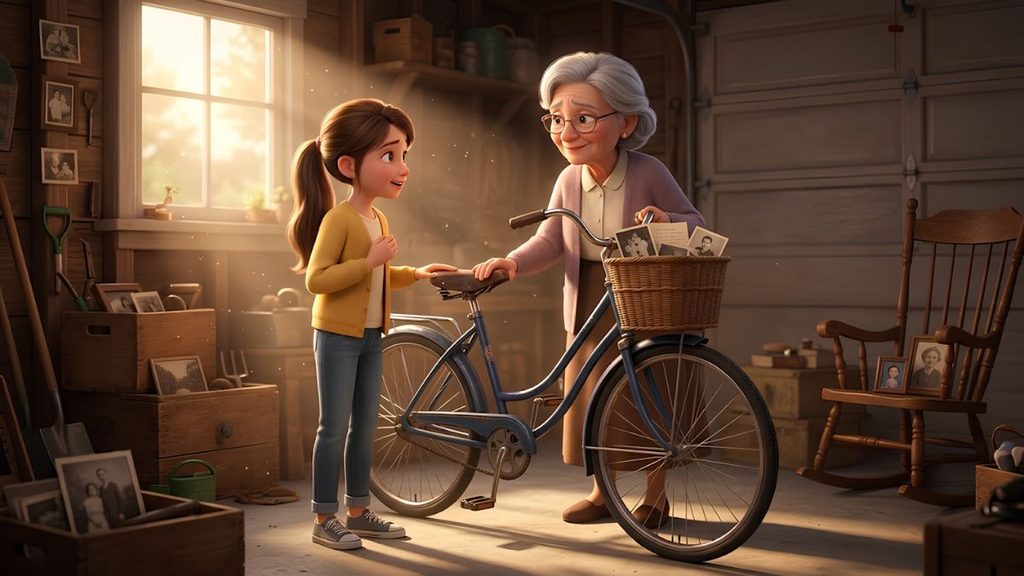
Type: Grandparent Sacrifice
Core themes: grandparents, memories, family history, treasured possessions, generational love.
Ruby had always believed that her grandmother’s garage contained everything except a bicycle.
There were gardening tools.
Old flowerpots.
Boxes of Christmas decorations.
A broken radio.
Three suitcases nobody seemed to use.
A wooden rocking chair.
And enough jars of buttons to supply an entire sewing shop.
But there was no bicycle.
At least, Ruby had never seen one.
That changed on a warm Saturday afternoon when Grandma asked her to help clean the garage.
“Be careful with that box,” Grandma called.
Ruby moved a stack of newspapers.
“I am!”
“Not that one. The other one.”
Ruby laughed.
“Grandma, you have too many boxes.”
“I know.”
“Why?”
“Because one day I’ll need everything inside them.”
“You said that last year.”
“And I was right.”
Ruby smiled.
She loved afternoons like this.
There was something comforting about being in Grandma’s house.
Everything seemed to have a story.
Even the old teacups.
Especially the old teacups.
Ruby just didn’t know that one of the biggest stories in the garage was waiting behind a pile of gardening equipment.
Behind the Old Boxes
Ruby was carrying a box toward the garage door when she noticed something blue.
It was barely visible.
She stopped.
“What is that?”
Grandma looked over.
“What?”
Ruby moved two old flowerpots.
There it was.
A bicycle.
It was covered in dust.
Its tires were flat.
The metal frame had faded.
But underneath the dirt was a beautiful deep blue color.
Ruby’s eyes widened.
“Grandma!”
“What?”
“You have a bicycle!”
Grandma became unusually quiet.
Ruby stepped closer.
“Is it yours?”
Grandma looked at the bicycle for several seconds.
Then she smiled.
“Yes.”
“You never told me.”
“I haven’t thought about it in a long time.”
Ruby examined it.
“Can I ride it?”
Grandma laughed.
“Not yet.”
“Why?”
“Because it hasn’t moved in many years.”
Ruby touched the handlebars.
“How old is it?”
Grandma smiled.
“Older than your mother.”
Ruby’s mouth fell open.
“Really?”
“Really.”
Grandma’s Bicycle
Grandma pulled an old cloth from a shelf.
She wiped a small section of the frame.
The blue paint appeared beneath the dust.
Ruby smiled.
“It’s beautiful.”
“It used to be.”
“It still is.”
Grandma looked at her.
“You think so?”
“Definitely.”
Ruby examined the bicycle more closely.
The basket was rusty.
The seat was cracked.
The tires were flat.
One pedal was slightly bent.
But the frame was strong.
“Could we fix it?”
Grandma hesitated.
“Maybe.”
“Please?”
Grandma smiled.
“You always say please when you really want something.”
Ruby grinned.
“Does it work?”
“Sometimes.”
The Story Begins
They carried the bicycle outside.
Grandma sat on the porch.
Ruby leaned the bicycle against the railing.
“Tell me about it.”
Grandma smiled.
“I was eleven when I got it.”
Ruby looked surprised.
“Eleven?”
“Exactly your age.”
“Really?”
“Really.”
“Who gave it to you?”
“My parents.”
“Was it new?”
Grandma laughed.
“Yes.”
Ruby looked at the bicycle.
“It doesn’t look new now.”
“It was very new then.”
“What did you use it for?”
“Everything.”
Grandma began remembering.
She rode it to school.
To the market.
To her friend’s house.
To the library.
To the park.
She rode it on summer evenings.
She rode it through autumn leaves.
She even rode it in light rain.
Ruby listened carefully.
“What was your favorite place?”
Grandma smiled.
“The river road.”
“Why?”
“Because it was quiet.”
The Cycling Event
Ruby had recently joined her school’s cycling club.
The school was organizing a family cycling event.
Students could bring bicycles from home.
There would be a short ride through the neighborhood.
Then a picnic.
Ruby had been hoping to participate.
But her own bicycle had been damaged.
The chain kept slipping.
The repair shop said it would take another week.
Ruby looked at Grandma’s bicycle.
“Could I use this?”
Grandma didn’t answer.
Ruby noticed.
“You don’t have to.”
Grandma looked at the bicycle.
“I haven’t seen it outside this garage in a very long time.”
“Would you like to?”
“I don’t know.”
Ruby nodded.
“I understand.”
Grandma touched the handlebar.
“It’s just…”
She stopped.
Ruby waited.
“What?”
Grandma smiled sadly.
“It holds a lot of memories.”
The First Photograph
A few days later, Ruby and Grandma began cleaning the bicycle.
Ruby removed the dust from the frame.
Grandma cleaned the basket.
When Ruby lifted the basket, something fell out.
A small photograph.
Ruby picked it up.
“Grandma!”
Grandma turned.
“What?”
“Look.”
It was an old black-and-white photograph.
A young girl stood beside the same blue bicycle.
She was smiling.
Ruby recognized her immediately.
“You!”
Grandma laughed.
“I was very young.”
“You look exactly like me.”
“Do I?”
Ruby held the photograph beside her face.
“Look!”
Grandma laughed.
“Perhaps.”
Ruby turned the photograph over.
There was writing on the back.
Summer picnic, 1979.
Ruby stared.
“You kept this here?”
“I didn’t know it was still there.”
Another Surprise
They continued cleaning.
Inside the basket, beneath the old lining, Ruby discovered another small piece of paper.
It had been folded several times.
She opened it carefully.
It read:
Don’t forget the strawberry field.
Ruby looked confused.
“What does this mean?”
Grandma laughed.
“Oh.”
“What?”
“I remember.”
Grandma began telling the story.
When she was a child, she and her closest friend had ridden their bicycles to a strawberry field.
They had gotten lost.
They arrived home hours late.
Their parents had been furious.
Ruby laughed.
“What happened?”
“We ate so many strawberries that neither of us could finish dinner.”
“That’s terrible.”
“It was wonderful.”
The Hidden Notes
Every time Ruby moved something on the bicycle, another memory appeared.
A folded note inside the basket.
A tiny photograph beneath the seat.
An old movie ticket tucked into a frame joint.
A faded ribbon attached to the handlebar.
A pressed flower hidden beneath the basket lining.
Ruby began collecting them carefully.
“Grandma, you have a whole history inside this bicycle.”
Grandma smiled.
“I suppose I do.”
Ruby laid everything on the table.
There were photographs of:
Grandma with her childhood friends.
Grandma beside a lake.
Grandma at a school picnic.
Grandma wearing a summer dress.
Grandma standing beside the bicycle under a large tree.
Ruby looked at them all.
“I wish I could have known you then.”
Grandma smiled.
“You know me now.”
“But I want to know that girl too.”
Grandma looked at the photographs.
“Perhaps you can.”
The Blue Bicycle Gets a Second Life
Ruby became determined.
She wanted to restore the bicycle.
Not replace it.
Restore it.
She cleaned the frame.
Her father helped repair the brakes.
Grandma helped choose new tires.
They carefully repaired the basket.
The old blue paint remained.
Ruby refused to repaint it.
“It’s part of the story.”
Grandma agreed.
The bicycle slowly began to look alive again.
The tires were full.
The chain was cleaned.
The seat was repaired.
The basket was polished.
But the old scratches remained.
Ruby liked them.
Each scratch seemed like a tiny piece of history.
Grandma’s Hesitation
One afternoon, Ruby asked:
“Can I take it to the cycling event?”
Grandma looked at her.
“You really want to?”
“Yes.”
Grandma looked at the bicycle.
Then at Ruby.
“I don’t know.”
Ruby understood.
“Because of the memories?”
Grandma nodded.
“What if something happens to it?”
“We’ll be careful.”
“What if it gets damaged?”
Ruby thought.
“Then we’ll fix it.”
Grandma smiled.
“You’re becoming very much like your father.”
Ruby laughed.
“Is that good?”
“Very.”
The Decision
The night before the cycling event, Grandma called Ruby into the garage.
The blue bicycle stood beneath a soft light.
Grandma had cleaned it one final time.
“I want you to have it.”
Ruby stared.
“Have it?”
“Yes.”
“But it’s yours.”
“It was.”
Ruby didn’t understand.
Grandma touched the handlebar.
“I’ve kept it for decades.”
“You still love it.”
“I do.”
“Then why give it to me?”
Grandma smiled.
“Because memories aren’t meant to stop with one person.”
Ruby became quiet.
Grandma continued.
“When I was your age, this bicycle made me feel free.”
She looked at Ruby.
“Maybe it can make you feel the same.”
Ruby hugged her.
“Thank you.”
Grandma hugged her tightly.
“Take good care of it.”
“I will.”
The Cycling Event
The next morning, Ruby arrived at school on the blue bicycle.
Everyone noticed.
“Wow!”
“Is that vintage?”
“Where did you get it?”
Ruby smiled.
“My grandmother.”
Her teacher examined it.
“It’s beautiful.”
Ruby nodded.
“It belonged to her when she was eleven.”
Her classmates were amazed.
“Seriously?”
Ruby laughed.
“Seriously.”
The cycling event began.
Ruby rode carefully at first.
The bicycle felt different from modern bicycles.
The frame was heavier.
The handlebars were wider.
The brakes responded slowly.
But after a few minutes, Ruby adjusted.
Then something strange happened.
She understood.
She understood why Grandma had loved it.
The bicycle wasn’t fast.
It didn’t need to be.
It made her notice everything.
The trees.
The breeze.
The sound of birds.
The sunlight.
The road beneath the tires.
She smiled.
The River Road
The cycling route passed near the river.
Ruby remembered Grandma’s story.
“This was her favorite place.”
She slowed down.
The river shimmered beside the road.
For a moment, Ruby imagined her grandmother as an eleven-year-old girl.
Riding the same bicycle.
Laughing with her friends.
Carrying a basket.
Racing toward the afternoon sun.
Ruby smiled.
She wasn’t simply riding an old bicycle.
She was following a path that had been traveled decades earlier.
The Photograph
After the event, Ruby returned home.
Grandma was waiting.
“How was it?”
“Wonderful.”
“Did the bicycle behave?”
“Perfectly.”
Grandma laughed.
“Good.”
Ruby handed her something.
The old photograph.
“I want to keep this.”
Grandma smiled.
“You can.”
“But I want you to write something on the back.”
“What?”
“The story.”
Grandma thought.
“What story?”
“The day you rode to the strawberry field.”
Grandma laughed.
“You remember that?”
“Of course.”
So Grandma wrote it.
Then she wrote another.
And another.
Soon, Ruby had an idea.
She wanted to preserve every memory connected to the bicycle.
The Memory Book
Ruby found an old notebook.
On the first page, she wrote:
The Story of Grandma’s Blue Bicycle
Then she added the photographs.
Behind each photograph, Grandma wrote a story.
There was the summer picnic.
The strawberry field.
The rainy afternoon.
The library trip.
The first time Grandma rode without training wheels.
The day she accidentally rode into a puddle.
The afternoon she and her best friend got lost.
Every story became part of the book.
Ruby loved reading them.
She discovered that her grandmother had once been a mischievous child.
A curious child.
A brave child.
A child who loved adventures.
A child who wasn’t very different from Ruby.
The Bicycle Becomes a Bridge
As months passed, Ruby continued riding the blue bicycle.
She rode it to the park.
To the library.
Around the neighborhood.
Sometimes Grandma joined her.
They would ride slowly together.
Grandma’s modern bicycle moved easily.
Ruby’s old blue bicycle made a gentle clicking sound.
“You know,” Grandma said one afternoon, “I used to think this bicycle was part of my past.”
Ruby looked at her.
“What do you think now?”
Grandma smiled.
“I think it’s part of my future too.”
“How?”
“Because you’re riding it.”
Another Generation
Years later, Ruby would tell her own children about the blue bicycle.
She would show them the photographs.
She would explain the notes.
She would tell them about Grandma.
And perhaps one day, another child would ask:
“Can I ride it?”
Ruby would smile.
“Yes.”
She would teach them how to care for it.
How to check the tires.
How to clean the chain.
How to listen for unusual sounds.
And she would tell them the most important thing.
“This bicycle isn’t valuable because it’s old.”
“Why is it valuable?”
“Because people you love have ridden it.”
Grandma’s Last Ride
Many years later, when Ruby was an adult, she and Grandma took one final ride together.
Grandma was older now.
They didn’t go far.
Just down the quiet road behind the house.
They stopped beside the river.
Grandma looked at the blue bicycle.
“It still feels the same.”
Ruby smiled.
“Maybe it remembers you.”
Grandma laughed.
“Perhaps.”
They sat together.
The river moved quietly.
Leaves rustled overhead.
Grandma touched the bicycle.
“I’m glad I gave it to you.”
Ruby looked at her.
“I’m glad you did.”
“Why?”
“Because I didn’t just get a bicycle.”
Grandma smiled.
“What did you get?”
Ruby thought about the photographs.
The notes.
The stories.
The memories.
“Your childhood.”
Grandma’s eyes became warm.
“Then take good care of it.”
“I will.”
The Meaning of the Blue Bicycle
The bicycle eventually became more than a treasured possession.
It became a family storyteller.
Every scratch had a memory.
Every photograph had a name.
Every note had a moment attached to it.
The bicycle had traveled through decades.
It had carried a little girl.
Then a grandmother.
Then another little girl.
And eventually, it would carry another generation.
Ruby finally understood what Grandma meant when she said memories weren’t meant to stop with one person.
A treasured possession can be held.
But a memory must be shared.
A family story becomes stronger each time it is told.
And sometimes, the best way to preserve the past isn’t to lock it away somewhere safe.
It is to allow it to keep moving.
The Empty Garage
Years later, the garage looked different.
The old boxes were gone.
The gardening tools had been organized.
The broken radio had disappeared.
But one place remained empty.
The spot where the blue bicycle had once stood.
Grandma’s garage felt strangely quiet without it.
But she didn’t feel sad.
She knew exactly where the bicycle was.
Outside.
Being used.
Being cared for.
Creating new memories.
And that was exactly where it belonged.
Because Grandma hadn’t really lost her bicycle.
She had given it a future.
The Bicycle’s New Stories
Ruby eventually added her own notes to the memory book.
She wrote about her first cycling event.
The river road.
The day she learned to repair a loose chain.
The time she accidentally rode through a puddle and splashed her father.
The afternoon she and Grandma rode together.
The bicycle now had two childhoods inside its story.
Grandma’s.
And Ruby’s.
One day, it would have three.
Then four.
Perhaps more.
And every generation would add another page.
Moral of the Story
The most precious family treasures are not valuable because of their age or price. They are valuable because they carry memories, love, and stories from one generation to the next.
Grandma could have kept the blue bicycle locked away as a reminder of her childhood.
Instead, she gave it to Ruby.
In doing so, she didn’t lose her memories.
She shared them.
Ruby discovered that receiving the bicycle meant receiving something much larger than an old possession.
She received a connection to the grandmother she knew and the young girl her grandmother once was.
The blue bicycle became a bridge between generations.
And that is sometimes the greatest gift a grandparent can give:
not simply something they own, but a piece of their story that can continue long after they are gone.
10. The Teacher’s Saturday
Type: Teacher Sacrifice
Core themes: teachers, education, dedication, creativity, generosity.
Mr. Bennett had a secret.
Every time someone asked him what his favorite subject was, he gave the same answer.
“That’s easy. Science.”
But that wasn’t completely true.
His favorite subject was the sky.
He loved astronomy.
He loved the moon with its changing shapes.
He loved planets that looked like tiny dots through a telescope.
He loved constellations whose names had been passed from generation to generation.
Most of all, he loved watching someone’s face the first time they looked through a telescope and realized that the bright little dot in the sky was actually another world.
That was why he had been especially excited about his class’s upcoming astronomy night.
For months, his fourth-grade students had been talking about it.
They had drawn planets.
Read books about space.
Learned about constellations.
Built paper rockets.
And practiced identifying stars.
They were supposed to finish the experience with a special nighttime visit to the city’s observatory.
Mr. Bennett had been looking forward to that evening almost as much as his students.
But then, one Friday afternoon, everything changed.
The Astronomy Club
Mr. Bennett taught at Willow Creek Elementary School.
His classroom was on the second floor, at the end of a quiet hallway.
There were posters of planets on the walls.
A small model of the solar system hung above his desk.
A telescope stood near the window.
And on the back wall was a giant dark-blue poster covered with stars.
The students called it the “space wall.”
Every child had added something to it.
One had drawn Saturn.
Another had drawn the moon.
Someone had carefully written the names of several constellations.
And twelve-year-old Oliver had drawn a rocket that was much larger than the Earth.
Mr. Bennett had never corrected him.
“That’s a very large rocket,” he had said.
Oliver had smiled.
“It needs to be.”
The Big Plan
The astronomy event had been planned since the beginning of the semester.
Mr. Bennett had arranged a special evening visit to the city’s observatory.
The students would learn about planets.
They would see the moon through a powerful telescope.
They would learn how astronomers locate distant stars.
And, if the weather was clear, they would stand outside beneath the night sky.
The children couldn’t stop talking about it.
“I want to see Saturn!”
“I want to see the moon!”
“I want to see a black hole!”
Mr. Bennett smiled.
“You probably won’t see a black hole.”
“Why?”
“They’re rather far away.”
“How far?”
“Very.”
The children laughed.
The Problem
A week before the trip, Mr. Bennett received an email from the school office.
The observatory had confirmed the booking.
But there was a problem.
Several families had contacted the school.
They couldn’t afford the transportation and admission costs.
The school had already used most of its activity budget.
Mr. Bennett read the message twice.
He knew how excited his students were.
He also knew that some of them would now have to stay home.
The next morning, he called a meeting with the principal.
“Can we find additional funding?”
The principal shook her head.
“We’ve asked the district.”
“Any possibility?”
“Not this late.”
Mr. Bennett sighed.
“What if we postpone it?”
“We could.”
“But?”
“The observatory’s next available weekend isn’t for another three months.”
Mr. Bennett looked disappointed.
“Three months is a long time for fourth graders.”
The principal smiled sympathetically.
“I know.”
The Announcement
That afternoon, Mr. Bennett stood in front of his class.
The children immediately noticed that something was different.
Oliver raised his hand.
“Are we still going to the observatory?”
Mr. Bennett looked around the room.
He didn’t want to disappoint them.
But he also didn’t want some children to feel excluded.
“The observatory trip will have to be changed.”
The room became quiet.
“Why?”
Mr. Bennett explained.
Several children looked disappointed.
One student lowered her head.
Another asked:
“Does that mean we can’t do astronomy night?”
Mr. Bennett smiled.
“Not exactly.”
Everyone looked at him.
“I said the observatory trip has to change.”
He paused.
“I didn’t say astronomy night was canceled.”
Mr. Bennett’s Idea
That evening, Mr. Bennett stayed late at school.
He walked behind the building.
There was a small unused patch of grass beside the playground.
It wasn’t much.
A few trees.
A wooden fence.
An old storage shed.
But Mr. Bennett looked at it differently.
He imagined folding chairs.
Tables.
Star charts.
A telescope.
Planet models.
A small observation area.
He smiled.
Maybe they didn’t need an observatory.
Maybe they simply needed the sky.
Saturday Morning
Saturday arrived.
While most of the school was quiet, Mr. Bennett unlocked the back gate.
He arrived carrying boxes.
Then more boxes.
Then a telescope.
Then several pieces of cardboard.
Then paint.
Then rope.
Then a folding table.
His neighbor, Mrs. Carter, watched from across the street.
“What are you doing?”
Mr. Bennett smiled.
“Building a space station.”
She looked at the pile.
“That looks like a lot of work.”
“It is.”
“Need help?”
Mr. Bennett hesitated.
Then smiled.
“I might.”
The Observation Area
Mr. Bennett began by cleaning the grass.
He marked out a small circle.
This would be the observation area.
Then he placed chairs around it.
He built a simple wooden stand for the telescope.
He created a table for star charts.
He hung dark-blue fabric along the fence.
Then he began painting.
Cardboard planets appeared one by one.
Mercury.
Venus.
Earth.
Mars.
Jupiter.
Saturn.
Uranus.
Neptune.
Pluto wasn’t forgotten.
Mr. Bennett knew the scientific classification.
But he also knew his students loved Pluto.
So he painted a small one anyway.
He placed it at the edge.
Underneath it, he wrote:
“Still part of the conversation.”
The Cardboard Moon
The most difficult project was the moon.
Mr. Bennett wanted the children to understand its craters.
He found a large cardboard sphere.
Then he covered it with paper.
Once it dried, he pressed small objects into the surface.
Craters appeared.
He painted the moon gray.
Then he added shadows.
When he finished, he stepped back.
It looked surprisingly good.
Mrs. Carter came outside.
“That’s impressive.”
Mr. Bennett smiled.
“I hope the kids like it.”
“They will.”
The Star Charts
Mr. Bennett spent the afternoon making star charts.
He drew the Big Dipper.
Orion.
Cassiopeia.
The North Star.
He created simple instructions.
Find three stars.
Follow the line.
Look for the pattern.
He wanted the children to discover the constellations themselves.
Education, he believed, was most exciting when students felt like explorers.
The Telescope
At sunset, Mr. Bennett carried his personal telescope outside.
It was an old telescope he had owned for years.
He had used it many times.
He placed it carefully on its stand.
Then he adjusted the lens.
He looked toward the evening sky.
The moon would be visible.
Perfect.
He smiled.
The children were going to love it.
Sunday Evening
By Sunday, the observation area was ready.
The small patch of grass had been transformed.
There were chairs.
Tables.
Planet models.
Star charts.
The cardboard moon.
A homemade constellation board.
And Mr. Bennett’s telescope.
It wasn’t an observatory.
It wasn’t fancy.
But it felt magical.
Mr. Bennett stood in the middle of the space.
He looked around.
Then he smiled.
He knew exactly what his students would say.
Astronomy Night
Monday evening arrived.
Families began arriving at the school.
Children ran toward the backyard.
Oliver stopped.
His mouth opened.
“Whoa.”
Mr. Bennett smiled.
“Welcome.”
Oliver pointed.
“Did you make all this?”
Mr. Bennett nodded.
“You did?”
“Most of it.”
Another student ran toward the cardboard planets.
“Look!”
Soon the children were everywhere.
Some examined the star charts.
Others counted the craters on the moon.
Someone discovered that Saturn’s rings were made from cardboard plates.
The children laughed.
The Discovery
Then one student noticed something.
“Where’s the observatory?”
Mr. Bennett smiled.
“We’re not going to the observatory.”
The children looked confused.
“This is our observatory.”
They stared at the small observation area.
At first, there was silence.
Then Oliver grinned.
“Really?”
“Really.”
He pointed toward the telescope.
“And that’s the real telescope?”
Mr. Bennett nodded.
“My telescope.”
“You brought it from home?”
“Yes.”
“Why?”
Mr. Bennett smiled.
“Because I wanted everyone to see the sky.”
The First Look
The children lined up.
One by one, they looked through the telescope.
The first student stepped away.
“I saw the moon!”
“Was it good?”
“It was HUGE!”
The next student looked.
Then another.
Then another.
Soon everyone was whispering.
“There’s a crater.”
“I can see shadows.”
“It doesn’t look flat.”
Mr. Bennett smiled.
“That’s because it isn’t.”
The Quiet Student
One student named Mia had been unusually quiet.
She stood near the back.
Mr. Bennett noticed.
“Mia?”
She shook her head.
“I don’t want to look.”
“Why not?”
“I’m scared I’ll do it wrong.”
Mr. Bennett smiled.
“There isn’t a wrong way to look at the moon.”
Mia slowly approached.
She looked through the telescope.
For several seconds, she said nothing.
Then she stepped back.
“Mr. Bennett?”
“Yes?”
“I think I understand.”
“What?”
“Why you like astronomy.”
Mr. Bennett smiled.
“Why?”
Mia pointed upward.
“Because it’s beautiful.”
The Planet Walk
After everyone had seen the moon, Mr. Bennett introduced another activity.
He had placed his cardboard planets around the yard.
The children walked from one to another.
At Mercury, they learned about extreme temperatures.
At Venus, they learned about its thick atmosphere.
At Earth, they discussed water.
At Mars, they talked about exploration.
At Jupiter, everyone laughed when Mr. Bennett explained its enormous size.
One child asked:
“Could Jupiter fit all the other planets inside it?”
“Almost.”
The children gasped.
“That’s crazy!”
Mr. Bennett smiled.
“Space is full of things that seem impossible.”
The Teacher’s Saturday
As the evening continued, the children didn’t realize how much work had gone into the event.
They didn’t know that Mr. Bennett had spent most of Saturday cleaning the yard.
They didn’t know that he had painted planets until his hands were covered in paint.
They didn’t know that he had stayed awake late making star charts.
They didn’t know that the telescope belonged to him.
They simply thought the event had appeared.
Like magic.
Then Oliver found the stack of cardboard boxes behind the shed.
He saw paintbrushes.
Glue.
Pieces of cardboard.
Paint cans.
And Mr. Bennett’s handwritten sketches.
He called the others.
“Look!”
The children gathered around.
“You made all this?”
Mr. Bennett nodded.
“Yes.”
“On Saturday?”
“Mostly.”
“All day?”
“Almost.”
The children became quiet.
A Different Kind of Lesson
Mia looked at the planet models.
Then at the telescope.
Then at Mr. Bennett.
“You did this because some of us couldn’t go to the observatory.”
Mr. Bennett smiled.
“Yes.”
Oliver frowned.
“Why?”
“Because everyone deserves a chance to explore.”
The children didn’t respond immediately.
They were beginning to understand.
The event wasn’t simply about astronomy.
It was about inclusion.
It was about creativity.
It was about a teacher deciding that a problem didn’t have to become the end of an experience.
The Night Sky
Later, the lights around the school were turned off.
The children sat quietly on the grass.
The sky above them was dark.
Stars appeared one by one.
Mr. Bennett pointed upward.
“There’s Orion.”
The children looked.
“Where?”
He showed them.
Then he pointed toward another part of the sky.
“There’s the North Star.”
The children followed his finger.
For a few moments, nobody spoke.
The schoolyard had become very quiet.
The stars seemed brighter.
Mia whispered:
“It feels like we’re somewhere else.”
Mr. Bennett smiled.
“Sometimes you don’t have to travel far to discover something new.”
The Question
Oliver raised his hand.
Mr. Bennett laughed.
“Yes?”
“How far away are the stars?”
“Very far.”
“How far?”
Mr. Bennett explained.
Oliver thought about it.
Then asked:
“If they’re that far away, how can we see them?”
Mr. Bennett smiled.
“Because their light travels all the way to us.”
Oliver looked at the stars.
“Even now?”
“Even now.”
Oliver became quiet.
He looked up again.
Mr. Bennett could almost see the thought forming in his mind.
The light they were seeing had traveled an enormous distance.
The children weren’t simply looking at stars.
They were looking into the past.
The Final Activity
Before the evening ended, Mr. Bennett gave every child a blank piece of paper.
“Draw something you learned tonight.”
Some drew planets.
Some drew stars.
One drew the telescope.
Mia drew the moon.
Oliver drew the entire solar system.
It was wildly inaccurate.
Mr. Bennett loved it.
Then one student raised her hand.
“Can we do this again?”
Mr. Bennett smiled.
“Perhaps.”
“Next Saturday?”
Everyone laughed.
Mr. Bennett shook his head.
“Let’s start with next month.”
The Thank-You
At the end of the evening, parents began collecting their children.
Mia’s mother approached Mr. Bennett.
“Thank you.”
Mr. Bennett smiled.
“You’re welcome.”
“You didn’t have to do all this.”
“I know.”
She looked toward the children.
“They had such a wonderful time.”
Mr. Bennett nodded.
“That’s what matters.”
Oliver came running over.
“Mr. Bennett!”
“Yes?”
“Can I help you put everything away?”
Mr. Bennett smiled.
“Absolutely.”
Soon several children joined him.
They carried chairs.
Collected star charts.
Moved cardboard planets.
Folded tables.
Even the youngest children helped.
Mr. Bennett watched them.
He smiled.
The sacrifice had become shared effort.
Monday Morning
The next morning, the classroom felt different.
The space wall had new drawings.
Children had added notes.
One said:
“The moon has craters.”
Another said:
“Stars are really far away.”
Someone wrote:
“I want to be an astronomer.”
And Oliver had added:
“Mr. Bennett’s rocket is still too small.”
Mr. Bennett laughed when he saw it.
“Very funny.”
Oliver grinned.
A New Tradition
The astronomy night became a tradition at Willow Creek Elementary.
Every year, Mr. Bennett’s students gathered outside.
Sometimes they used a larger telescope.
Sometimes they built better models.
Sometimes parents brought additional equipment.
Eventually, the school received funding for a proper science program.
But the first astronomy night remained special.
Because it had started with a problem.
A few children couldn’t afford to attend an observatory.
Mr. Bennett could have canceled the event.
He could have postponed it.
Instead, he looked at what he had.
A small patch of grass.
Some cardboard.
Paint.
A telescope.
And a group of curious children.
That was enough.
What the Children Remembered
Years later, many of Mr. Bennett’s students would forget individual lessons from fourth grade.
They might forget some multiplication tables.
They might forget the names of every planet.
They might forget the exact dates of school events.
But they remembered that night.
They remembered sitting beneath the stars.
They remembered looking through a telescope.
They remembered cardboard planets.
They remembered their teacher staying late.
And they remembered learning that education wasn’t always about having the most expensive equipment.
Sometimes education meant someone caring enough to create an opportunity.
The Real Lesson
Mr. Bennett loved astronomy.
But he loved teaching even more.
He knew that children didn’t need perfect circumstances to become curious.
They needed someone to encourage their questions.
Someone to give them time.
Someone to show them that limitations didn’t always have to become barriers.
His Saturday wasn’t simply a day spent building an observation area.
It was a day spent making sure every child in his classroom could look up and feel included.
He had given up his weekend.
He had brought his own telescope.
He had spent hours making cardboard planets.
He had worked until his hands were covered in paint.
But he didn’t consider it a sacrifice.
To him, it was simply part of being a teacher.
The Last Look at the Stars
At the end of the school year, Mr. Bennett stood outside his classroom.
The children had gone home.
The hallway was quiet.
He looked at the space wall.
There were planets everywhere.
Stars.
Rockets.
Moon drawings.
Constellations.
And one small picture of a telescope.
Underneath it, Mia had written:
“Thank you for showing us the sky.”
Mr. Bennett smiled.
He looked out the window.
The evening sky was beginning to darken.
One star appeared.
Then another.
He stood there for a moment.
And smiled.
Because sometimes the greatest lessons happen after the school bell rings.
Sometimes they happen on a Saturday.
Sometimes they happen beneath a sky full of stars.
And sometimes, the most important thing a teacher can give a child isn’t an answer.
It’s a chance to look upward and ask a question.
Moral of the Story
Great teachers don’t simply teach lessons from books. They create opportunities for children to discover, wonder, and believe that learning belongs to everyone.
Mr. Bennett could not change the cost of the observatory trip.
But he could change what happened next.
He used his time, creativity, knowledge, and personal resources to build an experience that included everyone.
The children learned about astronomy that night.
But they also learned something deeper:
When circumstances create a barrier, kindness and creativity can sometimes build another path.
And the stars were there to remind them that learning doesn’t always have to happen inside a classroom.
Sometimes, all you need is a curious mind, a caring teacher, and a clear view of the sky.
11. The Sparrow’s Last Seed
Type: Animal Story
Core themes: animal friendship, generosity, sharing, trust, community.
The forest had begun to change.
Summer had once filled every branch with green leaves, every meadow with flowers, and every morning with the noisy songs of birds.
But now the mornings were colder.
Leaves drifted slowly from the trees.
The grass was covered with silver frost.
And the warm summer breeze had disappeared.
Winter was coming.
Everyone in the forest knew it.
The squirrels were carrying nuts into their nests.
The rabbits were strengthening their burrows.
The hedgehogs were gathering leaves.
Even the ants seemed to be working twice as hard.
Among all these busy animals lived a young sparrow named Pip.
Pip was small.
He was quick.
He was curious.
And, according to his mother, he was always thinking about something.
But this year, Pip had a problem.
He had almost nothing saved for winter.
Pip’s Tiny Nest
Pip lived in a small nest high inside an old oak tree.
His nest wasn’t large.
It wasn’t particularly comfortable either.
But Pip loved it.
From the entrance, he could see most of the forest.
He could see the winding stream.
The meadow.
The berry bushes.
The old stone bridge.
And, in the distance, the hill where the birds often gathered.
Pip had spent the entire autumn collecting food.
He had gathered tiny grains.
Seeds.
Berries.
And pieces of fruit.
But Pip wasn’t as good at collecting food as the older birds.
He was easily distracted.
Sometimes he would fly after a butterfly.
Sometimes he would stop to watch squirrels.
Sometimes he simply forgot where he had hidden something.
As winter approached, his food supply became smaller.
Much smaller.
The Search
One chilly morning, Pip woke up hungry.
He looked inside his nest.
Three grains.
Two dried berries.
Nothing else.
“That’s not enough,” he whispered.
He flew into the forest.
The ground was covered with leaves.
He searched beneath bushes.
Nothing.
He checked near the stream.
Nothing.
He flew to the meadow.
The flowers were gone.
Most of the seeds had already been collected by other animals.
Pip became worried.
“I need to find something.”
He searched until the sun was high.
Then, near an old wooden fence, he saw something yellow.
Pip landed.
His eyes widened.
A sunflower seed.
A single sunflower seed.
It was lying beneath a pile of dry leaves.
Pip stared at it.
“My lucky day.”
The Last Seed
Pip picked up the seed.
It was perfect.
Not damaged.
Not rotten.
Not even cracked.
He held it carefully in his beak.
Then he began imagining all the ways he could use it.
He could eat it immediately.
But that would only help for a few minutes.
He could save it for dinner.
Or perhaps breakfast tomorrow.
Better yet, he could keep it for the coldest day of winter.
Pip flew back toward his nest.
“This is my winter seed,” he told himself.
He tucked it carefully into a small crack beside his nest.
Then he flew out again.
He felt slightly better.
At least he had something.
A Strange Sound
That afternoon, Pip went looking for a safe winter shelter.
The wind had become stronger.
Clouds covered the sky.
Pip flew toward a group of pine trees.
As he passed through the branches, he heard something.
A tiny sound.
“Peep.”
Pip stopped.
He listened.
“Peep.”
He flew lower.
Behind a fallen branch sat a very young bird.
The bird was smaller than Pip.
Its feathers were soft and messy.
Its wings trembled in the cold.
Pip landed nearby.
“Are you okay?”
The little bird looked at him.
“I can’t find my family.”
Pip’s heart sank.
“Where were they?”
“I don’t know.”
“How long have you been here?”
The little bird looked down.
“Since yesterday.”
The Hungry Little Bird
Pip looked at the young bird.
“Have you eaten?”
The bird shook its head.
Pip felt worried.
“You haven’t eaten since yesterday?”
The bird shook its head again.
Pip looked toward the forest.
He could search for food.
But food was becoming increasingly difficult to find.
Then he remembered his seed.
The sunflower seed was waiting in his nest.
His last seed.
His winter seed.
He imagined eating it.
He imagined the warmth it might give him.
He imagined having something to depend on.
Then he looked at the little bird.
The young bird’s eyes were tired.
Pip made his decision.
“Wait here.”
Pip’s Difficult Choice
Pip flew back to his nest.
The sunflower seed was still there.
He looked at it.
“Just one seed,” he whispered.
He picked it up.
Then he flew back.
The little bird looked at him.
Pip placed the seed on the ground.
“Here.”
The young bird stared.
“For me?”
Pip nodded.
The bird ate slowly.
Pip watched.
With every bite, he felt two things.
Happiness.
And worry.
The seed disappeared.
Pip looked at the empty patch of ground.
His last seed was gone.
The Cold Evening
As evening approached, the temperature dropped.
Pip and the little bird stayed beneath the pine branches.
Pip tried to remain cheerful.
“Your family will find you.”
“What if they don’t?”
“They will.”
“How do you know?”
Pip paused.
“I don’t.”
The young bird looked frightened.
Pip moved closer.
“But we can keep looking tomorrow.”
The little bird nodded.
They stayed together.
Pip was hungry.
Very hungry.
But he didn’t regret sharing the seed.
At least, he tried not to.
The First Morning
The next morning was colder.
Frost covered the ground.
Pip woke before sunrise.
He looked at the little bird.
It was still sleeping.
Pip stretched his wings.
His stomach growled.
He looked toward the forest.
“We need to find your family.”
The little bird woke.
“Okay.”
They began searching.
They followed the stream.
They crossed the meadow.
They flew past the old stone bridge.
Pip called loudly.
“Hello!”
The little bird called too.
“Mom!”
Nothing.
A Sound in the Distance
They continued.
After an hour, Pip heard something.
A bird calling.
He stopped.
“Did you hear that?”
The little bird lifted its head.
Another call came from the trees.
Then another.
And another.
The young bird suddenly became excited.
“That’s them!”
Pip flew upward.
A group of sparrows was flying toward them.
At the front was an older female sparrow.
She was calling frantically.
The little bird flew toward her.
“Mother!”
The two birds met in the air.
They landed together.
The mother hugged her child beneath her wings.
Pip watched quietly.
The Family’s Gratitude
The little bird’s father landed beside them.
He looked at Pip.
“Who are you?”
“I’m Pip.”
“You found our child?”
Pip nodded.
The mother looked at him.
“How did you keep him safe?”
Pip shrugged.
“We stayed under the pine trees.”
The little bird interrupted.
“Pip gave me food.”
His parents looked at him.
“What food?”
The young bird smiled.
“A sunflower seed.”
Pip looked away.
“It was just one seed.”
The father looked at Pip carefully.
“Was it your seed?”
Pip nodded.
“Your only seed?”
Pip didn’t answer.
The little bird did.
“His last one.”
The Invitation
The bird family became quiet.
The mother looked at Pip.
“Then you must come home with us.”
Pip blinked.
“Why?”
“Because anyone who shares their last seed with our child is welcome at our nest.”
Pip shook his head.
“I don’t want to be a bother.”
“You won’t be.”
“But I don’t have food.”
The father smiled.
“Neither did our child.”
Pip didn’t know what to say.
The Winter Store
The family flew toward their home.
Pip followed.
Their nest was inside a large hollow tree.
When Pip entered, his eyes widened.
Seeds were everywhere.
Dried berries.
Grains.
Nuts.
Small pieces of fruit.
It was the biggest winter store Pip had ever seen.
The father smiled.
“We prepared early this year.”
Pip stared.
“You have enough for the winter?”
“We hope so.”
The mother pushed a small pile of seeds toward him.
“Eat.”
Pip hesitated.
“But I didn’t collect these.”
“You don’t have to.”
Pip looked at the little bird.
The young bird smiled.
“You gave me your last seed.”
Pip finally ate.
A Different Kind of Wealth
Pip stayed with the family that day.
They shared food.
They told stories.
They showed him where they had found the best berries.
The young bird followed Pip everywhere.
By evening, Pip felt warm.
Not simply because he had eaten.
He felt warm because he wasn’t alone.
He had thought that his last seed was his greatest security.
But he had been wrong.
The seed had disappeared.
The friendship remained.
Winter Arrives
A few days later, winter arrived.
Snow covered the forest.
The stream became partly frozen.
The meadow disappeared beneath white frost.
Animals stayed inside their homes.
The trees became bare.
Pip spent the winter with the bird family.
He helped them collect what little food could still be found.
He helped protect the younger bird.
And he became part of the family.
Sometimes Pip remembered the sunflower seed.
He wondered what might have happened if he had kept it.
Perhaps he would have eaten it.
Perhaps it would have kept him comfortable for one meal.
But instead, it had brought him something far more valuable.
A community.
The Storm
One evening, a powerful winter storm arrived.
Wind shook the trees.
Snow blew across the forest.
The birds stayed inside their hollow tree.
The young bird became frightened.
Pip sat beside him.
“Remember the pine tree?”
The little bird nodded.
“You were there with me.”
“And you weren’t afraid.”
Pip smiled.
“I was terrified.”
The little bird laughed.
“You didn’t look scared.”
“I was trying to look brave.”
The young bird laughed again.
The storm continued outside.
But inside the hollow tree, everyone was safe.
Spring Returns
Eventually, the snow melted.
The stream began flowing again.
Tiny flowers appeared.
The forest slowly returned to life.
Birds filled the trees with songs.
Pip flew outside.
He looked around.
The forest seemed completely different.
Or perhaps he was different.
He had learned something important.
Food was necessary.
Shelter was necessary.
But friendship was necessary too.
The Sunflower Field
One spring morning, Pip discovered a field filled with sunflowers.
Hundreds of them.
He landed beside the flowers.
Seeds covered the ground.
Pip laughed.
He had never seen so many.
The young bird landed beside him.
“Look!”
“I see.”
“So many seeds!”
Pip smiled.
“More than we could ever eat.”
They began collecting them.
But this time, Pip didn’t think only about himself.
He collected some for his family.
Some for the younger bird.
Some for other birds.
And some for the animals who might need them during the next winter.
The New Tradition
From that year onward, Pip had a tradition.
Whenever he found more food than he needed, he shared it.
The young bird did the same.
Soon, other birds joined them.
Then squirrels.
Then rabbits.
The forest animals began storing food together in safe places.
When one animal had extra, they shared.
When another was hungry, they helped.
The forest became a little stronger.
Not because there was more food.
But because the animals had learned to trust one another.
Pip’s Mother Asks a Question
One afternoon, Pip’s mother visited him.
“I heard you gave away your last seed last winter.”
Pip smiled.
“Yes.”
“Were you afraid?”
“A little.”
“Do you regret it?”
Pip thought about the question.
Then he shook his head.
“No.”
“Why?”
Pip looked at the young bird playing nearby.
“Because I thought I was giving away food.”
He smiled.
“But I was actually making a friend.”
His mother nodded.
“That’s a valuable lesson.”
The Little Bird Grows
The young bird eventually grew larger.
His wings became strong.
He learned to fly farther.
He learned where the best berries grew.
He learned how to find shelter during storms.
And whenever someone asked how he had survived his first winter, he always told the same story.
“There was a sparrow named Pip.”
“He found me when I was lost.”
“He gave me his last seed.”
“And then my family found us.”
Everyone who heard the story smiled.
The Seed That Became a Forest
Years later, Pip sometimes wondered about that single sunflower seed.
It had been tiny.
Almost weightless.
It could have been eaten in seconds.
Yet giving it away had changed everything.
It had led him to a family.
A friendship.
A community.
And a tradition of sharing that spread throughout the forest.
One seed had become a friendship.
That friendship had become trust.
And that trust had become a community.
Pip finally understood something his mother had once told him.
“Some things become smaller when you share them.”
“Others become bigger.”
The sunflower seed had disappeared.
But what it created had continued to grow.
A New Winter
The following winter was unusually cold.
Snow arrived early.
Food became scarce.
Many animals struggled.
But this time, the forest was ready.
Birds shared seeds.
Squirrels shared nuts.
Rabbits shared sheltered spaces.
The animals helped one another.
Pip looked around at them.
He remembered the day he had found his last sunflower seed.
He smiled.
He had been worried that giving it away would leave him with nothing.
Instead, it had helped him discover that he was never meant to survive alone.
The Last Seed’s Lesson
On a snowy evening, Pip sat beside the young bird.
The two watched the falling snow.
“Do you remember the first time we met?” Pip asked.
“Yes.”
“You were very hungry.”
“So were you.”
Pip laughed.
“That’s true.”
“You gave me your food anyway.”
Pip nodded.
The young bird smiled.
“I’m glad you did.”
“So am I.”
They sat quietly.
Outside, snow covered the trees.
Inside, the nest was warm.
Food was shared.
Friends were together.
And somewhere in the forest, hundreds of sunflower seeds waited for spring.
Moral of the Story
Generosity may feel risky when we have very little to give, but a small act of kindness can create friendships, trust, and a community that gives back in ways we never expected.
Pip thought his last sunflower seed was his final protection against winter.
He could have kept it.
He could have eaten it.
Instead, he gave it to someone who needed it more.
The seed was gone within moments.
But the kindness behind it remained.
It brought Pip a new friendship and connected him with a family that later welcomed him when he needed help.
The lesson isn’t that children should give away everything they have.
Rather, it shows that sharing what we reasonably can, especially when someone truly needs help, can create connections that are worth far more than the thing we give away.
Sometimes the smallest gift can grow into something much bigger.
Just like one sunflower seed.
Why Sacrifice Is an Important Theme for Children
Children naturally begin life with a strong focus on their own needs.
This is completely normal.
As they grow, they gradually learn that families, friendships, classrooms, and communities involve cooperation.
Sacrifice can help introduce this idea in an understandable way.
A well-written story can show children that:
- Other people have feelings and needs.
- Helping others can require effort.
- Kindness sometimes involves giving something up.
- Generosity can strengthen relationships.
- Small actions can have meaningful consequences.
- Doing the right thing isn’t always the easiest choice.
Stories make these lessons easier to understand because children can see the consequences through characters rather than simply being given a moral lecture.
Different Types of Sacrifice in Children’s Stories
Sacrifice can take many forms. Using different types keeps a collection of children’s stories interesting and prevents every story from following the same pattern.
Sacrificing Time
Time is one of the simplest forms of sacrifice for children.
A character might want to play outside but notices that a younger sibling needs help with homework.
Instead of immediately choosing their own entertainment, they spend time helping.
The story can demonstrate that helping someone doesn’t necessarily require giving up something permanently.
Sometimes the sacrifice is simply choosing another person’s needs for a little while.
Possible lesson
Helping someone can be more valuable than getting what you want immediately.
Sharing Something Special
Children often understand possessions very strongly.
A favorite toy, book, bicycle, game, or collection may have significant emotional value.
A story can explore what happens when a character chooses to share something special.
For example, a child might have a favorite storybook that another child has never read.
Instead of keeping it hidden, the protagonist lends it to them.
The sacrifice is small, but emotionally meaningful.
Possible lesson
Sharing something valuable can create happiness for someone else.
Sacrificing a Reward
A character might receive a reward for good behavior or achievement.
Perhaps they win a prize at school.
Then they discover that a friend is struggling.
The protagonist decides to use part of their reward to help.
This type of story introduces generosity while also showing that rewards do not always have to be kept entirely for ourselves.
Sacrificing Comfort
Sometimes helping someone means becoming slightly uncomfortable.
A child might give up the comfortable seat on a bus to an elderly passenger.
A character might lend their umbrella to someone caught in the rain.
Another might give their jacket to a younger child who is cold.
These situations are easy for children to understand because the sacrifice is immediate and visible.
Sacrificing Personal Convenience
This is another highly relatable theme.
Imagine a child who wants to watch their favorite television program.
Their grandmother needs help carrying groceries inside.
The child chooses to help first.
The television show can wait.
The story teaches an important lesson:
Doing something kind sometimes means changing our plans.
Sacrifice Between Siblings
Sibling relationships provide excellent opportunities for stories about sacrifice.
Brothers and sisters may argue frequently, but they can also demonstrate extraordinary loyalty.
A story might involve an older sibling protecting a younger brother or sister from embarrassment.
Another could involve a child giving up something they desperately wanted because their sibling needs it more.
The emotional power comes from showing that love between siblings isn’t always expressed through words.
Sometimes it appears through actions.
Example premise
A brother has been saving for months to buy a new bicycle.
Just before he reaches his goal, his younger sister loses an important school item.
He uses his savings to replace it.
Initially, he feels disappointed.
Later, he realizes that helping his sister was more important than buying the bicycle immediately.
Sacrifice Between Friends
Friendship stories are another natural setting for this theme.
Children can learn that being a good friend sometimes means putting another person’s feelings before their own.
A character might:
- Give a friend their place in a competition.
- Help someone practice for a performance.
- Stay behind to help clean up.
- Share supplies.
- Defend a friend from unfair treatment.
- Give up a preferred activity to support someone.
These stories work especially well when the sacrifice creates a genuine emotional choice.
The protagonist should have something they actually want.
Otherwise, the decision doesn’t feel meaningful.
Parents Who Sacrifice for Their Children
Stories can also explore parental sacrifice.
Parents routinely give up time, comfort, money, opportunities, and personal plans for their children.
A children’s story can help readers recognize these everyday acts of love.
For example, a parent might:
- Work extra hours to provide something important.
- Give up a personal purchase to afford a child’s school activity.
- Spend a weekend helping with a project.
- Stay awake caring for a sick child.
- Give their child the last piece of dessert.
- Put aside personal plans to attend an important event.
The story should avoid making sacrifice seem tragic or burdensome.
Instead, it can show that love often appears through ordinary decisions.
Grandparents and Sacrifice
Grandparents can provide another emotional perspective.
A grandparent might give a child an old treasured possession.
Perhaps it is a watch, book, photograph, toy, or musical instrument.
The object has personal history.
Giving it away therefore becomes meaningful.
The child learns that the real gift isn’t simply the object.
It represents memories, love, and trust.
This can create especially touching stories for family-oriented children’s collections.
Teachers Who Sacrifice for Their Students
Teachers can also be portrayed as characters who make meaningful sacrifices.
A teacher might stay after school to help a struggling student.
They might spend their weekend preparing materials.
They could give up personal time to organize an opportunity for children.
The story can demonstrate that education isn’t only about textbooks and grades.
It can also involve patience, encouragement, and compassion.
Animal Characters and Sacrifice
Animal characters are particularly effective in children’s storytelling.
Animals can make emotional lessons easier to approach.
A squirrel might give up its favorite hiding place to help another animal stay safe.
A bird might share food with a hungry companion.
A loyal dog might wait patiently for an injured friend.
A young rabbit might give up a comfortable shelter so another animal can escape a storm.
These stories can introduce sacrifice without making the lesson feel overly serious.
They can also incorporate nature, friendship, cooperation, and environmental themes.
Small Sacrifices Can Be More Powerful Than Grand Ones
One of the most important principles in writing children’s stories about sacrifice is that the sacrifice does not have to be enormous.
In fact, small sacrifices are often more relatable.
Consider these examples:
- Giving away the last cookie.
- Sharing a favorite pencil.
- Letting someone else choose the game.
- Helping clean up after an activity.
- Giving a friend the better seat.
- Spending free time helping someone learn.
- Sharing a favorite toy.
- Waiting patiently for someone.
- Giving another person credit for an idea.
These situations are close to children’s everyday experiences.
Because they are familiar, the lessons can feel more authentic.
Sacrifice Should Not Mean Self-Neglect
An important distinction should be made when writing these stories.
Children should learn generosity, but they should not be taught that they must always give everything away or ignore their own needs.
Healthy sacrifice involves thoughtful choices.
A character shouldn’t constantly suffer to make everyone else happy.
Instead, stories can teach children to ask:
- Does someone genuinely need help?
- Can I help without putting myself in danger?
- Is there another solution?
- Am I choosing to help willingly?
- Can we find a fair compromise?
This makes the message more balanced.
The Difference Between Sacrifice and Giving
Sacrifice and generosity are closely related, but they aren’t exactly the same.
Giving something away can be easy.
Sacrifice usually involves giving up something that matters.
For example:
Giving an unused pencil to someone is generosity.
Giving away the only pencil you brought to school because a classmate has none involves a greater personal sacrifice.
Both actions are positive.
But sacrifice creates a stronger emotional conflict.
That conflict gives stories their narrative power.
The Importance of Emotional Conflict
A sacrifice becomes meaningful when the character has a genuine reason not to make it.
Imagine a child who has two identical toys and gives one away.
That’s kind.
But there isn’t much conflict.
Now imagine the child has been waiting months for a special toy.
Another child cannot afford one.
The protagonist must decide whether to share it.
Suddenly, the story has emotional depth.
The reader understands:
This choice costs the character something.
That makes the eventual decision more meaningful.
Sacrifice and Empathy
Empathy should be one of the central lessons in this genre.
A character doesn’t necessarily need to immediately understand another person’s situation.
They can learn gradually.
For example, a child might initially become frustrated because their friend keeps missing soccer practice.
Later, they discover that the friend has responsibilities at home.
The protagonist begins to understand.
They decide to visit the friend instead of complaining about missed games.
The sacrifice becomes a consequence of empathy.
This creates a stronger emotional lesson than simply telling children to “be kind.”
Sacrifice and Courage
Sometimes doing something generous requires courage.
A character might risk embarrassment by defending someone who is being excluded.
They might give up popularity to stand beside a lonely classmate.
They might admit that another child deserves credit.
They might apologize first after an argument.
These situations teach children that courage isn’t always about physical bravery.
Sometimes courage means choosing kindness when selfishness would be easier.
Sacrifice and Honesty
Sacrifice can also involve telling the truth.
A child might discover that their friend accidentally broke something.
Instead of allowing another person to take the blame, they explain what really happened.
The protagonist may know that telling the truth could result in losing a privilege.
That creates a meaningful moral choice.
The story can demonstrate that honesty sometimes has a personal cost.
Sacrifice and Forgiveness
Forgiveness can also function as a form of emotional sacrifice.
A character might be deeply hurt by a friend’s mistake.
They have every reason to remain angry.
But after the friend apologizes sincerely, the protagonist chooses to forgive.
The story doesn’t need to suggest that harmful behavior should simply be ignored.
Instead, it can distinguish between forgiveness and forgetting.
A character can forgive while still establishing healthy boundaries.
Sacrifice and Teamwork
Team-based stories provide another useful structure.
Imagine a group of children participating in a school competition.
One member becomes nervous and wants to quit.
Another child gives up their preferred role so the nervous student can participate in a way that feels comfortable.
The team succeeds because everyone stops focusing exclusively on personal achievement.
This teaches children that sometimes the success of the group matters more than individual recognition.
Sacrifice and Nature
Nature stories can use sacrifice to teach environmental responsibility.
A group of children might discover that a local pond is being damaged.
They give up some of their weekend free time to clean the area.
They organize a recycling project.
They plant trees.
They create signs encouraging visitors to protect the environment.
The sacrifice is their time and effort.
The reward is seeing their community improve.
Sacrifice and Community
Community-based stories can show children that small contributions can create large results.
For example, several children might organize a neighborhood food collection.
Each child gives something.
No single contribution solves the problem.
Together, however, their efforts make a difference.
This teaches an important principle:
A small sacrifice from many people can become something powerful.
Creating Strong Characters for Sacrifice Stories
A memorable protagonist should have a personality beyond simply being “kind.”
Give the character weaknesses.
Perhaps they are:
- Impatient
- Competitive
- Shy
- Possessive
- Easily embarrassed
- Afraid of failure
- Extremely ambitious
- Protective of their belongings
These characteristics create opportunities for growth.
A naturally generous child doesn’t face much internal conflict when asked to share.
A child who strongly dislikes sharing has a much more interesting journey.
Character Growth Is Essential
The character should ideally change because of the experience.
At the beginning, they might think:
“Why should I give this up?”
By the end, they might understand:
“I wanted it, but helping someone mattered more.”
That transformation creates the emotional heart of the story.
The character doesn’t need to become completely selfless.
They simply need to gain a deeper understanding of generosity and responsibility.
The Role of Parents and Adults
Adults can guide children through these experiences without solving every problem for them.
A parent might ask:
“How do you think your friend felt?”
A teacher might ask:
“What would you want someone to do if you were in that situation?”
These questions allow the child protagonist to reach the conclusion themselves.
That is generally more powerful than having an adult deliver a long moral speech.
Avoid Making Sacrifice Feel Like Punishment
A common storytelling mistake is making sacrifice feel like something children are forced to endure.
The protagonist shouldn’t constantly be punished for wanting something.
Instead, the story should show that they choose to make the sacrifice.
Choice is important.
The emotional message becomes:
“I decided to help.”
rather than:
“I was forced to give something up.”
That distinction makes the character’s kindness more meaningful.
Positive Outcomes Without Unrealistic Rewards
Not every sacrifice needs to produce a material reward.
A child shouldn’t help someone simply because they expect a prize.
The emotional reward can be:
- A stronger friendship
- Gratitude
- Greater confidence
- A sense of accomplishment
- Understanding
- Peace of mind
- A stronger family relationship
Sometimes the most powerful ending is simply knowing that the character did the right thing.
How to Write Age-Appropriate Sacrifice Stories
The complexity should match the child’s age.
Younger Children
Stories for younger readers should focus on simple situations:
- Sharing toys
- Helping parents
- Giving food
- Helping animals
- Sharing classroom supplies
- Taking turns
The language should be straightforward.
Middle-Grade Readers
Older children can handle more complicated choices.
Stories can explore:
- Friendship conflicts
- Competition
- Responsibility
- Family challenges
- School pressures
- Reputation
- Forgiveness
Characters can experience stronger emotional conflicts.
Older Children
More mature children’s stories can explore deeper themes such as:
- Personal ambition versus helping others
- Family responsibilities
- Peer pressure
- Standing up for someone
- Giving up recognition
- Difficult ethical choices
The stories can remain hopeful while acknowledging that some choices are genuinely difficult.
Story Structures That Work Well
Several narrative structures are particularly effective.
- The Choice Structure: The protagonist must choose between two things they value.
- The Discovery Structure: The protagonist discovers someone else’s hidden difficulty and decides how to respond.
- The Mistake Structure: The character initially acts selfishly, realizes the consequences, and makes a meaningful sacrifice.
- The Rescue Structure: A character gives up something important to help someone in need.
- The Friendship Structure: Two friends face a situation where one must put the other’s needs first.
- The Family Structure: A family member makes a sacrifice that strengthens the family bond.
- The Community Structure: Several people make small sacrifices that create a larger positive result.
Emotional Elements to Include
Strong stories about sacrifice can include several emotional stages:
Desire → Conflict → Decision → Sacrifice → Consequence → Understanding
For example:
A child wants a new bicycle.
They have been saving money.
A friend needs help paying for something essential.
The child struggles with the decision.
They choose to help.
They experience disappointment.
Eventually, they realize their choice strengthened their friendship.
This structure creates a natural emotional journey.
Lessons Children Can Learn From Sacrifice Stories
Well-written stories can communicate many valuable lessons.
- Kindness requires action: Feeling sympathy isn’t always enough. Sometimes we need to do something.
- Giving can be meaningful: Sharing something valuable can create happiness.
- Other people matter: Our choices affect those around us.
- Courage can be quiet: Standing up for someone can require emotional bravery.
- Friendship involves responsibility: Good friendships aren’t based only on having fun.
- Families support one another: Family members often make sacrifices because they care.
- Small actions matter: A seemingly minor decision can make someone’s day better.
- Selflessness needs balance: Helping others doesn’t mean completely ignoring your own needs.
How to Make These Stories Engaging
A moral lesson alone doesn’t make a great story.
The story still needs:
- Interesting characters
- A clear setting
- A believable problem
- Emotional conflict
- Dialogue
- Humor when appropriate
- A meaningful turning point
- A satisfying ending
Children should become interested in what happens before they realize they’re learning something.
The lesson should emerge naturally from the plot.
Using Humor in Sacrifice Stories
Sacrifice doesn’t always have to be serious.
Humor can make the theme approachable.
For example, a child might sacrifice their favorite hiding spot to help a younger sibling during a game.
Unfortunately, the sibling immediately reveals the hiding place to everyone.
The protagonist becomes annoyed.
Then they realize that helping their sibling was still worth it.
Funny consequences can make moral lessons memorable.
Using Animals to Create Emotional Distance
Animal protagonists can be especially effective for difficult emotional subjects.
A young fox might give up the warmest part of a den.
A squirrel might share its carefully stored food.
A penguin might help another chick find its family.
The animal setting makes the story imaginative while preserving the emotional lesson.
Creating Memorable Endings
A strong sacrifice story doesn’t necessarily need a dramatic ending.
Sometimes the quietest ending is the most powerful.
The child might return home after helping someone.
Their parent asks:
“Was it worth it?”
The child thinks about what they gave up.
Then smiles.
“Yes.”
That simple moment can communicate the entire lesson.
Final Thoughts
Stories about sacrifice for children can teach lessons that remain valuable throughout life.
The strongest stories don’t simply tell children that sacrifice is good.
They show why a character chooses to sacrifice something, what makes the decision difficult, and how that choice affects other people.
A child who shares a toy, a sibling who gives up an opportunity, a parent who sacrifices time, a friend who puts someone else’s needs first, or a group that works together for a community can all become powerful storytelling examples.
Most importantly, sacrifice should be presented as a thoughtful act of care rather than punishment or obligation.
The message is simple:
Sometimes we give something up not because we have to, but because someone else matters to us.
That idea can turn an ordinary children’s story into a memorable lesson about empathy, generosity, courage, and love.