
Bedtime is more than the end of a busy day. It can be a quiet opportunity to slow down, let go of stress, and create a sense of warmth before sleep. Sweet bedtime fables for her offer a gentle way to turn those final moments of the day into something meaningful, comforting, and memorable.
A thoughtfully written bedtime fable can take her into a peaceful world filled with kindness, friendship, hope, romance, and simple life lessons. Unlike stories designed around suspense or intense drama, sweet fables usually have a softer rhythm. They allow the listener to relax while following characters through small challenges that eventually lead to reassuring endings.
Whether you are looking for something to read to your girlfriend, wife, partner, or someone special, bedtime fables can become a beautiful nighttime ritual.
What Are Sweet Bedtime Fables?
Sweet bedtime fables are short or medium-length stories designed to create a calm emotional atmosphere before sleep. They often feature relatable characters, gentle adventures, talking animals, magical settings, or everyday situations with a meaningful lesson.
Traditional fables usually end with a moral. Modern bedtime fables can take the same basic idea and make it more emotional and soothing.
For example, a fable might explore ideas such as:
- The importance of patience
- The value of kindness
- Learning to appreciate small things
- Trusting someone you love
- Finding courage during difficult moments
- Understanding that mistakes are part of growing
- Appreciating friendship
- Believing in yourself
- Letting go of unnecessary worries
- Finding happiness in simple moments
The main purpose is not simply to teach a lesson. It is to create a peaceful experience that leaves her feeling relaxed and emotionally comfortable.
Sweet Bedtime Fables for Her
Here are seven original fable ideas designed to be gentle, romantic, comforting, and suitable for bedtime. Each has a distinct theme and a warm moral.
1. The Moonflower That Bloomed Only for Her

Characters: Amelia and a tiny moonflower named Luma
Setting: A quiet cottage garden beneath a silver moon
A sweet bedtime fable about rest, patience, and learning that not every beautiful thing needs to be hurried.
Amelia had always believed that being busy was the same thing as being useful.
If there was something that needed doing, she wanted to do it immediately.
If someone needed help, she wanted to be the first person to offer it.
If she had a free hour, she filled it with something productive.
She cleaned.
She organized.
She answered messages.
She made lists.
She started projects.
She finished projects.
And when there was finally nothing left to do, she usually found something else.
Her grandmother used to tell her, “A garden cannot bloom because you keep staring at it.”
Amelia never quite understood what she meant.
She thought flowers bloomed because someone watered them.
So she watered them.
Flowers needed sunlight, so she moved their pots toward the sun.
Flowers needed fertilizer, so she carefully measured it.
Flowers needed pruning, so she trimmed them.
Her little garden was beautiful.
But Amelia rarely sat in it.
There was always something else to do.
Amelia lived in a small stone cottage at the edge of a quiet English village called Bellwick.
The cottage had white-framed windows, a green wooden door, and a narrow garden that stretched behind the house.
During spring, the garden became filled with roses, lavender, daisies, and climbing jasmine.
At the far end stood an old wooden bench.
It had belonged to Amelia’s grandmother.
The bench was slightly crooked and covered with tiny scratches.
Amelia rarely used it.
She thought it looked nice.
That was enough.
One evening, after an unusually long day, Amelia returned home just before sunset.
She had spent the entire afternoon helping organize a village charity event.
When she entered her cottage, she noticed three unopened letters on the table.
She sighed.
Then she made tea.
Then she opened the letters.
Then she washed the cup.
Then she noticed the kitchen floor needed sweeping.
After sweeping the floor, she remembered the laundry.
After the laundry, she remembered the garden.
By the time she finally looked out the window, the sky had turned dark.
Amelia sighed.
“Another day gone.”
She switched off the kitchen light.
Then she walked into the garden.
The evening air was cool.
The flowers were quiet.
The village beyond the garden had become peaceful.
Amelia stood there for a moment.
She suddenly noticed something unusual.
At the far end of the garden, beside the old wooden bench, there was a small silver glow.
She walked toward it.
The glow disappeared.
She stopped.
Then it returned.
Amelia crouched down.
There, beneath a cluster of ordinary green leaves, was a tiny flower bud.
It was pale blue.
Almost silver.
Its petals were tightly closed.
Amelia had never seen anything like it.
She touched the soil.
It was warm.
“Where did you come from?”
The flower obviously did not answer.
But Amelia smiled.
She decided to look at it again in the morning.
The next morning, the flower was still closed.
Amelia watered it.
She added some fresh soil.
Then she went to work.
That evening, she returned home.
The flower was still closed.
She frowned.
Perhaps it needed more sunlight.
So the next morning, she carefully moved the soil around it.
She placed a small garden reflector nearby.
She watered it again.
Nothing happened.
The following day, she added fertilizer.
Nothing.
Then she searched through an old gardening book.
She found several possibilities.
Too little water.
Too much water.
Poor soil.
Insufficient sunlight.
Amelia tried everything.
Still, the flower remained closed.
Finally, she became frustrated.
“I’ve done everything I can.”
She sat on the old wooden bench.
For the first time in years, she stayed there without doing anything.
Five minutes passed.
Then ten.
Then twenty.
She heard birds.
She heard leaves moving in the breeze.
She heard distant footsteps on the village road.
She realized something strange.
The garden sounded different when she wasn’t working in it.
It sounded alive.
The following night, Amelia returned to the garden.
The moon was bright.
She sat on the bench.
She did not water anything.
She did not trim anything.
She did not inspect the plants.
She simply sat.
The silver flower remained closed.
Amelia smiled.
“Maybe you don’t need me.”
The flower shimmered faintly.
She laughed.
“I suppose that’s all right.”
She stayed there until she became sleepy.
Then she went inside.
The next evening, she returned.
Again, she sat on the bench.
She watched the moon rise.
She listened to the wind.
She thought about her grandmother.
She remembered how her grandmother could sit in the garden for hours.
Amelia had always wondered how she could be so comfortable doing nothing.
Now she began to understand.
Her grandmother had not been doing nothing.
She had been noticing things.
The smell of jasmine.
The sound of bees.
The changing color of the sky.
The way moonlight rested on leaves.
The quiet.
Amelia realized she had spent years rushing past all of it.
On the seventh night, something changed.
Amelia was sitting beneath the moon when she heard the faintest sound.
A tiny unfolding.
She looked toward the flower.
One silver petal opened.
Then another.
Amelia stopped breathing.
Slowly, the entire flower opened.
It was beautiful.
The petals were pale silver with a soft blue center.
Tiny droplets of light seemed to float around it.
Amelia stared.
“I didn’t do anything.”
The flower glowed brighter.
Amelia smiled.
Perhaps that was exactly the point.
The next morning, Amelia told her neighbor, Sophie, about the flower.
Sophie came immediately.
“Where is it?”
Amelia led her into the garden.
But the flower was closed.
Sophie looked disappointed.
“Maybe it only blooms at night.”
“I think so.”
“Does it have a name?”
Amelia thought.
“Moonflower.”
Sophie smiled.
“That seems appropriate.”
That evening, Sophie returned.
They sat together on the bench.
They waited.
Neither spoke.
The moon rose.
And slowly, the flower opened.
Sophie gasped.
“Oh, Amelia.”
“I know.”
They watched it quietly.
Neither wanted to disturb the moment.
After that, Amelia developed a new habit.
Every night, she spent fifteen minutes in the garden.
Sometimes she sat alone.
Sometimes Sophie joined her.
Sometimes she brought tea.
Sometimes she brought a book.
But she never brought a list of things to accomplish.
The moonflower became part of her evenings.
And something else began to change.
Amelia became less hurried during the day.
She stopped trying to complete everything immediately.
When a friend asked for help, she still helped.
When work needed to be done, she still worked.
But she learned that not every moment needed to be filled.
She learned to eat lunch without checking her phone.
She learned to walk through the village without rushing.
She learned to sit beside the river.
She learned to watch the sunset.
Most importantly, she learned to rest without feeling guilty.
One evening, Amelia received a letter from her grandmother’s old friend, Mrs. Eleanor.
Inside was a note.
“Your grandmother once told me that you were always going to be a very busy woman.”
Amelia smiled.
The letter continued.
“She worried that you would forget something important.”
Amelia read the sentence twice.
At the bottom was another line.
“She hoped you would remember that flowers need darkness too.”
Amelia’s eyes filled with tears.
She carried the letter into the garden.
The moonflower was already open.
She sat beside it.
“Did you know?”
The flower shimmered.
Amelia laughed softly.
“I suppose she knew.”
Years earlier, her grandmother had tried to teach her the same lesson in many ways.
She had told Amelia to sit beneath the apple tree.
She had invited her to drink tea on the porch.
She had encouraged her to watch clouds.
Amelia had always thought these were distractions.
Now she understood.
Her grandmother had been teaching her how to live.
Not simply how to accomplish things.
One summer evening, Amelia’s younger cousin, Lily, visited.
Lily was energetic and constantly moving.
She wanted to see everything.
She wanted to play.
She wanted to explore.
She wanted to pick flowers.
Amelia stopped her gently.
“Wait.”
“Why?”
“Look.”
She showed Lily the moonflower.
Lily stared.
“It’s beautiful.”
“It only opens at night.”
“Why?”
“We don’t know.”
“Can I touch it?”
“Very gently.”
Lily touched one petal.
Then she sat down.
After a few minutes, she asked:
“How long does it take?”
“For what?”
“For the flower to open.”
“Sometimes a long time.”
Lily looked at it.
Then she said:
“I don’t think I can wait.”
Amelia smiled.
“I couldn’t either.”
“What changed?”
Amelia looked at the moonflower.
“I learned that waiting can be part of the beautiful thing.”
Lily thought about that.
Then she stayed.
As the years passed, the moonflower returned every summer.
It never bloomed during the day.
It never responded to extra water.
It did not care about fertilizer.
It opened only when the moon rose and the garden became quiet.
Amelia began to understand that some things simply could not be forced.
Friendships needed time.
Healing needed time.
Dreams needed time.
Love needed time.
Even happiness sometimes needed time.
She stopped measuring her life only by what she accomplished.
She began measuring it by what she noticed.
One autumn evening, Amelia sat on the bench with a cup of tea.
The garden was almost empty.
Leaves covered the ground.
The flowers had faded.
Only the moonflower remained.
She looked at it.
“You taught me something.”
The flower shimmered.
Amelia smiled.
“I thought resting meant stopping.”
She paused.
“But resting isn’t stopping.”
The night breeze moved through the garden.
“It’s making room.”
She looked toward the moon.
“Room to notice.”
The moonflower opened.
“Room to breathe.”
Another petal unfolded.
“Room to remember.”
The flower glowed.
“And room to become something new.”
Amelia stayed there for a long time.
Eventually, she became sleepy.
She carried her empty cup inside.
She washed it.
Then she stopped.
She looked toward the garden.
Normally, she would have checked the doors.
Checked the windows.
Checked tomorrow’s schedule.
Checked her messages.
But tonight she simply smiled.
Everything could wait until morning.
She turned off the light.
She went upstairs.
And for the first time in many years, she went to bed without feeling that she should have done more.
The next morning, Amelia woke to sunlight.
She opened the window.
Birds were singing.
The village was beginning its day.
She made breakfast.
Then she sat at the kitchen table.
There was nothing urgent.
She drank her tea slowly.
She watched the sunlight move across the floor.
And she smiled.
She had finally learned what her grandmother had tried to teach her.
A garden did not need constant attention.
A flower did not need to be forced open.
And a person did not need to be productive every minute to have a meaningful life.
Some things became beautiful only when we allowed them time.
Some answers arrived only after we stopped searching.
Some dreams needed darkness before they could bloom.
And sometimes, the kindest thing we can do for ourselves is simply sit beneath the moon and breathe.
That evening, Amelia returned to the garden.
She sat on the old bench.
The moon rose slowly.
The moonflower began to open.
Amelia closed her eyes.
She listened to the quiet.
For once, she had nowhere else to be.
Nothing else to finish.
Nothing else to prove.
She was simply there.
And somehow, that was enough.
The moonflower glowed softly beside her.
Its silver petals looked almost like tiny stars.
Amelia smiled.
Then she whispered:
“Goodnight.”
The flower shimmered in the moonlight.
And beneath the peaceful night sky, Amelia finally understood that rest was not the opposite of growth.
Sometimes, rest was where growth began.
And just like the moonflower, she had never needed to bloom on anyone else’s schedule.
She only needed to give herself permission to open when the time was right.
Moral of the Story
You do not have to rush through life to make it meaningful. Like a flower that blooms in its own time, some of the most beautiful things happen when we slow down, rest, and allow ourselves to grow naturally.
2. The Little Bakery at the Edge of the Clouds

Characters: Sophie, an elderly baker named Margot, and a cheerful sparrow
Setting: A magical bakery floating above a sleepy village
Sophie had always believed that the best memories had a smell.
Her childhood smelled like cinnamon toast.
Her grandmother’s kitchen smelled like vanilla and warm butter.
Rainy afternoons smelled like wet pavement and coffee.
Christmas mornings smelled like orange peel and freshly baked bread.
Even now, whenever Sophie caught one of those familiar scents, she felt as though she had stepped backward through time.
She could be twenty-eight years old one moment and eight years old the next.
Perhaps that was why she loved bakeries.
They reminded her that life could be simple.
Warm bread.
Sweet pastries.
A cup of tea.
A quiet table beside a window.
Nothing extraordinary.
And yet, somehow, enough.
Sophie lived in a small apartment overlooking the old streets of Edinburgh. She worked at a publishing company and spent most of her days surrounded by manuscripts, emails, deadlines, and meetings.
She enjoyed her work, but lately, everything felt rushed.
She woke up rushing.
She ate breakfast rushing.
She walked to work rushing.
She returned home tired.
Even weekends seemed to disappear before she had properly noticed them.
One Friday evening, after an especially exhausting week, Sophie decided to take a different route home.
Instead of walking through the crowded city center, she followed a narrow street that climbed toward the hills.
She had never noticed the street before.
At the top, she found a stone staircase.
She climbed it.
At the end of the staircase was a small wooden gate.
Beyond it was a meadow.
Sophie stopped.
She had no idea it was there.
The city lights stretched below her.
The sky was turning purple.
She walked into the meadow.
The wind was gentle.
She could hear birds settling into the trees.
Then she smelled something.
Cinnamon.
Warm butter.
Fresh bread.
Sophie looked around.
There was no bakery.
She followed the scent.
At the far edge of the meadow stood a tiny staircase leading upward.
It seemed to disappear into the clouds.
Sophie stared.
“That wasn’t there yesterday.”
At least, she assumed it wasn’t.
Curiosity won.
She climbed.
One step.
Then another.
The stairs were made of pale stone.
Clouds drifted around her.
The higher she climbed, the quieter everything became.
Finally, she reached a small wooden platform.
And there it was.
A bakery.
It floated above the clouds.
Its windows glowed golden.
A tiny sign hung above the door.
MARGOT’S BAKERY
Sophie blinked.
She looked behind her.
The staircase was still there.
She looked at the bakery again.
“Well,” she whispered, “I suppose I should at least have a look.”
She opened the door.
A bell chimed.
Warm air surrounded her.
The bakery smelled like cinnamon, vanilla, chocolate, fresh bread, and something else she could not identify.
A woman stood behind the counter.
She appeared to be in her seventies.
She had silver hair tied loosely behind her head and kind green eyes.
“Good evening,” the woman said.
Sophie looked around.
“Is this a real bakery?”
The woman smiled.
“That depends.”
“On what?”
“On whether you’re hungry.”
Sophie laughed.
“I think I am.”
“Then it’s real.”
The woman placed a small pastry on a plate.
It was golden and filled with something that looked like honey.
“What is it?”
“A memory.”
Sophie frowned.
“A memory?”
“Try it.”
Sophie took a bite.
Immediately, she smelled cinnamon.
She was eight years old again.
She was sitting in her grandmother’s kitchen.
Her grandmother was laughing.
A radio was playing softly.
Rain tapped against the window.
Sophie stopped eating.
Her eyes filled with tears.
The baker smiled.
“You remember.”
“My grandmother.”
“Yes.”
Sophie looked at the pastry.
“How?”
The baker leaned against the counter.
“Every good memory has a flavor.”
The baker introduced herself as Margot.
Sophie sat at one of the small tables.
The bakery was much larger inside than it appeared from outside.
There were wooden shelves filled with bread.
Jars of jam.
Baskets of fruit.
Rows of pastries.
There were also hundreds of tiny glass containers filled with glowing golden lights.
Sophie pointed toward them.
“What are those?”
“Memories.”
“Whose memories?”
“People who have visited.”
“Why are they here?”
Margot smiled.
“Because sometimes people forget how many beautiful moments they’ve already lived.”
Sophie looked around.
“Do you sell them?”
“No.”
“Then what do you do?”
“I remind people.”
Sophie smiled.
“I think I need reminding.”
Margot nodded.
“Most people do.”
That evening, Sophie stayed for almost an hour.
She tasted a warm apple tart that reminded her of a school picnic.
She tried a chocolate biscuit that reminded her of the first time she had stayed up late with her best friend.
She tasted a lemon cake that reminded her of summer holidays.
Each pastry brought back a memory.
None of them were grand.
There were no famous places.
No expensive gifts.
No extraordinary adventures.
They were simple moments.
A hug.
A laugh.
A rainy afternoon.
A shared meal.
A conversation.
A walk.
A song.
When Sophie finally stood to leave, Margot handed her a small paper bag.
“What’s this?”
“Something for tomorrow.”
Sophie looked inside.
There was one small golden pastry.
“What’s the memory?”
Margot smiled.
“You’ll know when you’re ready.”
Sophie climbed down the staircase.
When she reached the meadow, the bakery had disappeared.
She looked back.
Only clouds.
She laughed.
“Of course.”
She returned home.
The next morning, she opened the paper bag.
Inside was the pastry.
She ate it.
Nothing happened.
Sophie frowned.
She tried another bite.
Still nothing.
She finished it.
Nothing.
She called Margot’s bakery.
There was no phone number.
She searched the internet.
Nothing.
She returned to the meadow.
The staircase was gone.
For several days, she wondered whether she had dreamed the whole thing.
Then, one Tuesday evening, she smelled cinnamon again.
She followed the scent.
The staircase appeared.
She climbed.
The bakery was waiting.
Margot smiled.
“Welcome back.”
Sophie laughed.
“I thought I imagined you.”
“People often do.”
“What was that pastry?”
Margot asked:
“What did you expect?”
“I don’t know.”
“Perhaps that’s why you didn’t recognize it.”
Sophie sat down.
“I’ve been thinking about it.”
“Good.”
“What was the memory supposed to be?”
Margot poured tea.
“Maybe it hasn’t happened yet.”
Sophie stared at her.
“What?”
“Not every pastry contains a memory from the past.”
“Some contain future memories?”
“Sometimes.”
Sophie smiled.
“That’s impossible.”
Margot shrugged.
“You’re sitting in a bakery above the clouds.”
Sophie laughed.
“Fair point.”
From then on, Sophie visited every Friday evening.
Sometimes she brought questions.
Sometimes she brought stories.
Sometimes she simply sat.
Margot never asked her to explain why she had come.
The bakery seemed to understand.
One evening, Sophie told Margot about her work.
“I’m always busy.”
Margot nodded.
“I know.”
“I feel like I’m constantly trying to catch up.”
“With what?”
Sophie thought.
“Everything.”
Margot handed her a cup of tea.
“Everything doesn’t have to be caught.”
“What does that mean?”
“Some things are meant to be experienced, not completed.”
Sophie looked at her.
Margot smiled.
“Eat your pastry.”
Over the next few weeks, Sophie began changing small things.
She stopped checking her phone during breakfast.
She started taking longer walks.
She called her parents more often.
She visited her old neighborhood.
She began cooking meals instead of ordering food every night.
She bought fresh flowers.
She read books without feeling guilty about the time.
She started noticing things.
A musician playing violin near the train station.
A child laughing in the park.
A neighbor watering plants.
The smell of bread from the bakery downstairs.
The sunset reflected in a shop window.
Her life had not dramatically changed.
But her attention had.
And somehow, that made everything feel different.
One evening, Margot asked:
“What is your happiest memory?”
Sophie thought.
“That’s difficult.”
“Why?”
“I have many.”
“Choose one.”
Sophie closed her eyes.
“I remember being six.”
Margot waited.
“My mother made pancakes on a Sunday morning.”
“What was special about them?”
“Nothing.”
“Then why do you remember?”
Sophie smiled.
“Because my father was trying to flip one and it landed on the floor.”
Margot laughed.
“And?”
“We all laughed for ten minutes.”
Sophie became quiet.
“I don’t remember what the pancakes tasted like.”
“What do you remember?”
“Everyone being happy.”
Margot nodded.
“That’s the memory.”
Sophie understood.
The best memories were rarely about the thing itself.
They were about how the moment felt.
A pastry was not special because of its ingredients.
A holiday was not special because of the destination.
A gift was not special because of its price.
What mattered was who was there.
What was shared.
What was felt.
One winter evening, Sophie arrived at the bakery looking unusually tired.
Margot noticed immediately.
“Bad day?”
Sophie nodded.
“I made a mistake at work.”
“Was anyone hurt?”
“No.”
“Did the world end?”
“No.”
“Then perhaps tomorrow will be better.”
Sophie smiled.
“I wish everything were that simple.”
“It often is.”
Margot placed a warm pastry in front of her.
“Try this.”
Sophie took a bite.
She froze.
She knew the memory.
It was from that very morning.
Her colleague, Daniel, had brought pastries to the office.
Everyone had gathered around the table.
They had laughed about something silly.
Sophie had forgotten about it because the rest of the day had been stressful.
But the pastry reminded her.
A good moment had already happened that day.
She had simply overlooked it.
Sophie smiled.
“I understand.”
Margot smiled.
“Good.”
One night, Sophie asked Margot:
“Why do you run this bakery?”
Margot looked out the window.
“I used to be like you.”
“Busy?”
“Very.”
“What happened?”
“I forgot to enjoy my life.”
Sophie waited.
Margot continued.
“I spent years believing happiness was waiting for me somewhere ahead.”
“Did you find it?”
“Eventually.”
“Where?”
Margot smiled.
“Here.”
She touched the counter.
“In bread?”
“In ordinary moments.”
The bakery became Sophie’s favorite place.
But she eventually noticed something.
Every time she visited, there were fewer glass jars.
“Where do the memories go?”
Margot smiled.
“Back where they belong.”
“To the people?”
“Yes.”
“How?”
“When someone remembers a beautiful moment, it no longer needs to stay here.”
Sophie looked at the glowing jars.
“So you’re giving them back?”
“Exactly.”
One Friday evening, Sophie entered the bakery and found only one pastry on the counter.
It was small.
Golden.
Covered with powdered sugar.
Margot placed it in front of her.
“This one is special.”
Sophie smiled.
“Another memory?”
“Yes.”
She took a bite.
Nothing happened.
She took another.
Still nothing.
Then she smelled coffee.
She heard laughter.
She felt sunlight.
She saw herself sitting at a small table.
Across from her was someone she loved.
They were talking.
Nothing important.
Nothing dramatic.
Just talking.
They laughed.
Sophie suddenly understood.
It was not a memory from her childhood.
It was not a memory from her past.
It was a memory from the future.
A simple morning.
A peaceful life.
A table.
A warm drink.
Someone she loved.
And happiness.
Sophie opened her eyes.
Tears filled them.
“That was beautiful.”
Margot smiled.
“You haven’t lived it yet.”
“How do you know?”
“Because you still have things to look forward to.”
Sophie returned home that night with a different feeling.
She had spent so much time worrying about whether her life was moving quickly enough.
She had worried about achievements.
Career.
Money.
Plans.
Deadlines.
She had forgotten that life was not only a destination.
It was a collection of moments.
Some were painful.
Some were ordinary.
Some were beautiful.
And some had not happened yet.
She decided she did not need to rush toward them.
She could let them arrive.
Years later, Sophie still remembered the little bakery.
She never found it again.
She returned to the meadow many times.
Sometimes there was only grass.
Sometimes there were wildflowers.
Sometimes clouds covered the hills.
But there was never another staircase.
She did not mind.
She no longer needed the bakery to remind her.
She had learned its lesson.
She learned to notice warm mornings.
She learned to appreciate quiet evenings.
She learned to laugh more.
She learned to call people she loved.
She learned to eat slowly.
She learned that rest was not laziness.
And she learned that happiness often hides inside ordinary moments.
One Sunday morning, Sophie invited her family for breakfast.
She made pancakes.
Her father tried to flip one.
It landed on the floor.
Everyone laughed.
For ten minutes.
Sophie looked around the table.
The room was warm.
The windows were open.
Sunlight filled the kitchen.
Someone was laughing.
Someone was pouring coffee.
Someone was reaching for another pancake.
Sophie smiled.
She suddenly remembered Margot.
She whispered:
“Thank you.”
Her mother looked at her.
“What?”
Sophie laughed.
“Nothing.”
She took another bite.
The pancake was warm.
The coffee smelled wonderful.
The morning was ordinary.
And somehow, it was perfect.
That night, Sophie went to bed feeling peaceful.
She thought about the bakery.
She thought about Margot.
She thought about all the memories she had collected without realizing it.
Then she understood the bakery’s greatest lesson.
Happiness did not always arrive as something extraordinary.
Sometimes it arrived disguised as a cup of tea.
Sometimes as laughter around a table.
Sometimes as rain against a window.
Sometimes as a friend calling at exactly the right moment.
Sometimes as someone remembering how you like your coffee.
And sometimes, happiness was simply being present enough to notice that a perfectly ordinary day had quietly become a beautiful memory.
Sophie closed her eyes.
Outside, the city became quiet.
Somewhere above the clouds, perhaps a tiny bakery was glowing beneath the stars.
Perhaps Margot was baking another batch of pastries.
Perhaps another tired traveler was climbing the staircase.
And perhaps tomorrow, someone else would discover that the sweetest memories were not necessarily the biggest ones.
They were simply the moments when life felt warm.
The moments when someone laughed.
The moments when someone stayed.
The moments when there was enough time to breathe.
And the moments when, without realizing it, you were already happy.
Sophie smiled.
Then she whispered:
“Goodnight.”
And somewhere beyond the clouds, a tiny bakery bell seemed to ring.
Moral of the Story
Happiness is often found in ordinary moments. The people we love, the laughter we share, and the simple experiences we notice can become our most precious memories.
3. The Girl Who Borrowed a Star
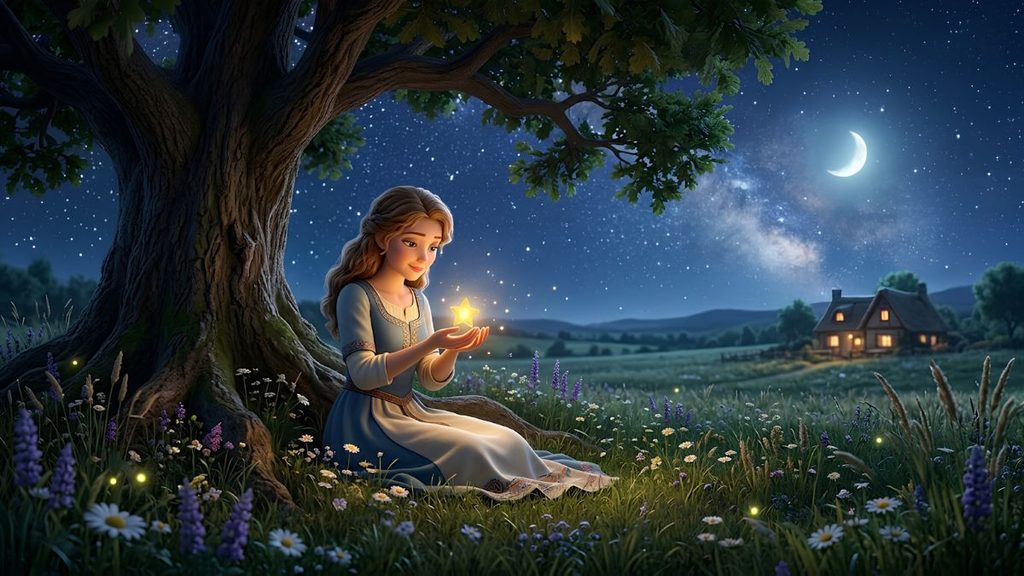
Characters: Eleanor and a lonely little star named Milo
Setting: A peaceful hillside overlooking a sleeping town
Elena had always loved the night sky.
As a child, she would lie beneath the old oak tree behind her family’s house and count the stars.
One.
Two.
Three.
She would keep counting until she lost track.
Her father used to laugh.
“You’ll never finish.”
“I know,” Elena would reply.
“Then why keep counting?”
“Because there might be one I haven’t seen.”
Her father would smile.
“Perhaps there is.”
Years later, Elena still looked for that one special star.
She lived alone in a small cottage at the edge of a quiet village in the French countryside. Her home stood beside a meadow where wildflowers grew during spring and tall grasses swayed through summer.
She worked as an illustrator, drawing children’s books from a small studio at the back of her cottage.
Her life was peaceful.
But sometimes, peaceful was not the same as happy.
Elena had recently gone through a difficult year.
A project she had spent months creating had been cancelled.
A close friend had moved away.
Her grandmother had passed away.
Nothing was completely broken.
Yet everything felt slightly different.
She still smiled.
She still worked.
She still went shopping and cooked dinner.
But at night, when she turned off the lights, she sometimes felt as though the world had become quieter than before.
She missed having someone to tell her small thoughts to.
Someone to say:
“Look at that moon.”
Or:
“Did you hear that bird?”
Or simply:
“Goodnight.”
So Elena returned to an old habit.
Every evening, she sat beneath the oak tree and looked at the stars.
One particularly cold night, Elena noticed something strange.
There was a gap in the sky.
Not a cloud.
Not darkness.
A real gap.
One star seemed to be missing.
Elena frowned.
She knew the sky was enormous.
She knew stars moved.
She knew she could not possibly remember every constellation.
But she felt certain.
Something was missing.
She looked again.
There.
A small empty space between two bright stars.
“Where did you go?”
She smiled at herself.
“Talking to stars now?”
The wind moved through the grass.
Then she heard something.
A tiny sound.
Almost like a bell.
Elena stood.
The sound came from the meadow.
She followed it.
Near a patch of wildflowers, she found something glowing.
At first she thought it was a lantern.
Then she realized it was a star.
A tiny star.
It was no larger than an apple.
It lay in the grass, glowing softly.
Elena stared.
“You fell.”
The star flickered.
“I suppose you did.”
She crouched down.
It was warm.
Not hot.
Warm like sunlight through a window.
Elena carefully picked it up.
The moment she did, the star became brighter.
She laughed.
“Well, hello.”
Elena carried the star home.
She placed it in a glass bowl beside her bed.
The room filled with gentle golden light.
She sat beside it.
“Are you hurt?”
The star flickered twice.
Elena decided that meant yes.
She looked through several books about astronomy.
None of them explained what to do with a fallen star.
So she improvised.
She gave it a soft blanket.
She placed the bowl near the window.
She made sure it had enough moonlight.
She even read to it.
At first, she felt silly.
Then she stopped caring.
The star seemed to enjoy the stories.
Whenever Elena read aloud, it glowed brighter.
Whenever she stopped, it dimmed.
So she kept reading.
Over the next few days, the star became part of her routine.
In the morning, Elena opened the curtains.
The star would glow softly.
During the afternoon, she worked at her desk.
The star rested beside her sketches.
At night, she carried it outside.
They sat together beneath the oak tree.
Elena began talking to it.
She told it about her day.
She complained about difficult drawings.
She talked about her grandmother.
She talked about her childhood.
She talked about the friend who had moved away.
She talked about things she had never said aloud.
The star listened.
It never interrupted.
It never judged.
It simply glowed.
One evening, Elena said:
“I think I know why you fell.”
The star flickered.
“You were lonely.”
It became brighter.
Elena smiled sadly.
“Me too.”
The star’s light became warm.
For the first time in months, Elena felt that she was not entirely alone.
Not because a magical star had solved her problems.
It hadn’t.
But because caring for something gave her a reason to slow down.
She began noticing the world again.
The sound of rain.
The smell of grass.
The changing colors of dawn.
The little things she had stopped paying attention to.
One afternoon, Elena took the star into her studio.
She was working on a children’s illustration.
The page showed a little girl standing beneath a night sky.
Elena looked at the drawing.
Then she looked at the star.
She changed the picture.
She added a small glowing star beside the girl.
Then another.
Then another.
Soon, the entire sky was filled with tiny lights.
Elena smiled.
She realized she was drawing something she had needed herself.
A reminder that darkness was not the same as emptiness.
A week passed.
Then another.
The star grew stronger.
Its glow became brighter.
Elena knew what that meant.
It was getting ready to return to the sky.
The thought made her unexpectedly sad.
One evening, she held the star in her hands.
“You’ll have to go soon.”
The star flickered.
“I know.”
She looked at it.
“I don’t want you to.”
The star became dim.
Elena sighed.
“But you belong up there.”
The star brightened again.
She smiled.
“You’re right.”
The following night, Elena carried the star to the hilltop.
The sky was perfectly clear.
The moon was low.
Thousands of stars filled the darkness.
She held the little star against her chest.
“Are you ready?”
It glowed.
Elena took a breath.
Then she lifted it toward the sky.
The star rose from her hands.
Slowly.
Higher.
Higher.
It became smaller.
Then brighter.
Then it flew toward the empty place between the two stars.
For a moment, the sky seemed to hold its breath.
Then the little star returned to its place.
The missing space disappeared.
Elena stared.
Tears filled her eyes.
“Goodbye.”
The star flashed.
Once.
Twice.
Three times.
Then it became part of the night sky.
Elena sat beneath the oak tree.
The meadow was quiet.
She felt the sadness of goodbye.
But something else was there too.
Gratitude.
She had been lonely.
The star had not erased that loneliness.
Instead, it had taught her something.
Loneliness did not mean that she had been forgotten.
Sometimes, it simply meant she needed to open herself to connection again.
The next morning, Elena called her old friend.
They talked for an hour.
Then Elena called her father.
Then her aunt.
Then she visited a neighbor she had not spoken to in months.
She began making plans again.
Not huge plans.
Small ones.
Coffee with a friend.
A walk.
A visit.
A shared dinner.
A new drawing project.
She realized she had been waiting for life to become perfect before allowing herself to enjoy it.
She no longer wanted to wait.
Several months later, Elena published a new children’s book.
It was about a girl who found a star in the grass.
The book became unexpectedly popular.
Children loved the glowing star.
Parents loved the gentle message.
At the end of the book, Elena had written:
Even the smallest light can remind us that we are not alone.
She dedicated the book to her grandmother.
She also added a small line:
For the stars that find us when we need them.
One evening, Elena sat beneath the oak tree again.
The book was finished.
The meadow was quiet.
The sky was clear.
She looked toward the place where her little star had returned.
There it was.
She was certain.
It seemed brighter than the others.
Elena smiled.
“Hello.”
The star flickered.
She laughed.
“You’re still there.”
Another flicker.
Elena leaned back against the tree.
She remembered the first night.
The loneliness.
The sadness.
The little glowing object in the grass.
She had thought she was rescuing the star.
But perhaps the star had rescued her.
Not by solving her problems.
Not by changing her life.
Simply by reminding her to look upward.
Years later, Elena would still tell people about the night she found a star.
Most people smiled politely.
Some assumed it was a metaphor.
Others thought it was a story she had invented.
Elena never argued.
She knew what she had seen.
But she also understood something important.
Maybe the star had been magical.
Maybe it had been something else.
Perhaps it had simply been an extraordinary moment that arrived when she needed one.
Either way, the lesson remained.
Sometimes we spend so much time looking for enormous signs that we miss the tiny ones.
A friend calling.
A stranger smiling.
A warm cup of tea.
A beautiful sunset.
A child laughing.
A flower opening.
A star shining through a dark sky.
Small things can carry enormous comfort.
One night, Elena’s niece asked her:
“Aunt Elena, are stars lonely?”
Elena looked up.
“I don’t think so.”
“Why?”
“Because they’re always shining together.”
“What if one falls?”
Elena smiled.
“Then someone might find it.”
“Like you?”
“Like me.”
“What did you do?”
“I kept it safe.”
“What happened?”
“It went home.”
Her niece looked at the sky.
“Did you miss it?”
Elena thought.
“Yes.”
“Then why were you happy?”
“Because sometimes loving something means helping it return to where it belongs.”
Her niece thought about that.
Then she pointed upward.
“Is that your star?”
Elena followed her finger.
A bright point of light shimmered in the darkness.
“Yes.”
“How do you know?”
Elena smiled.
“I just do.”
That night, Elena returned to her cottage.
She made tea.
She turned off the lights.
Then she opened the bedroom window.
Moonlight entered the room.
The stars were visible above the trees.
Elena climbed into bed.
She looked at the sky one last time.
The bright star was still there.
She smiled.
“Goodnight.”
The star shimmered.
Elena closed her eyes.
And for the first time in a long time, she understood that she did not need to be afraid of quiet nights.
The darkness was not empty.
There were always little lights somewhere.
Some were above her.
Some were beside her.
Some lived in memories.
Some lived in friendships.
Some were still waiting in the future.
And sometimes, when life became difficult, all she needed to do was look for one.
Because even the smallest light can make the darkness feel less lonely.
And even when that light eventually returns to the sky, the warmth it left behind can remain in your heart.
Elena smiled beneath the moonlight.
Then she fell peacefully asleep.
Moral of the Story
Even the smallest act of kindness can brighten someone’s darkest moment. We may not always realize how much our presence matters, but a little light can remind someone that they are never truly alone.
4. The Tea Shop Where Worries Disappeared
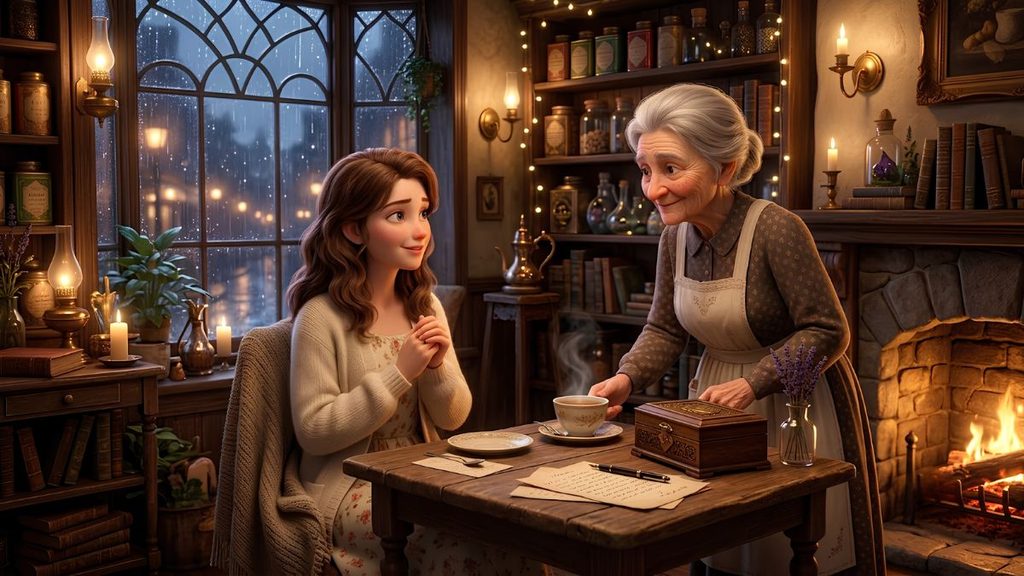
Characters: Clara and a mysterious tea shop owner named Evelyn
Setting: A tiny Victorian tea shop that appears on rainy evenings
A soothing bedtime fable about letting go, accepting what cannot be controlled, and learning that tomorrow can wait until morning.
Clara had a habit of carrying tomorrow around with her.
She carried it to breakfast.
She carried it to work.
She carried it on walks.
She carried it into conversations.
And, most of all, she carried it to bed.
Every night, when she turned off the light, her mind became louder.
Did I answer that email?
What if the meeting goes badly tomorrow?
Did I say the wrong thing earlier?
What if something goes wrong?
What if I am not prepared?
What if tomorrow is worse than today?
Clara knew she was tired.
Her body knew.
Her eyes knew.
Even her pillow seemed to know.
But her mind refused to sleep.
She would turn onto one side.
Then the other.
She would check the clock.
11:47.
12:16.
12:58.
1:31.
The more she worried about not sleeping, the harder sleeping became.
Her grandmother had once told her:
“Never invite tomorrow into your bed.”
Clara had laughed when she heard it.
Now she finally understood.
Clara lived in a quiet town called Rosebridge.
The town was small enough that everyone seemed to know everyone.
There was a bakery near the square.
A library beside the church.
A flower shop on the corner.
And a narrow street that disappeared between two old stone buildings.
Clara had lived in Rosebridge for almost ten years.
She had walked nearly every street.
Yet one rainy evening, while returning home from work, she discovered a street she had never noticed before.
It was narrow.
The lamps were old-fashioned.
Rainwater reflected their golden light.
At the end stood a small wooden sign.
EVELYN’S TEA ROOM
Clara stopped.
She had never seen it before.
She looked at the clock.
It was nearly nine.
The shop appeared to be open.
Warm yellow light glowed through the windows.
Clara hesitated.
Then she noticed something in the window.
A handwritten message.
Leave your worries at the door.
She smiled.
“That’s convenient.”
She opened the door.
A small brass bell rang.
Warm air surrounded her.
The room smelled of cinnamon, lavender, honey, and freshly baked biscuits.
Behind the counter stood an elderly woman with silver hair and kind brown eyes.
“Good evening,” the woman said.
“Good evening.”
“You’re wet.”
“Very.”
The woman smiled.
“Sit down.”
Clara looked around.
There were only four tables.
Each had a small lamp.
Bookshelves covered the walls.
A fireplace crackled in the corner.
Rain tapped softly against the windows.
Clara sat.
The woman brought her a towel.
Then she placed a cup of tea in front of her.
“I didn’t order anything.”
“You didn’t need to.”
Clara looked at the tea.
“What is it?”
“Tonight?”
“Yes.”
“Whatever you need.”
Clara laughed.
“That’s not a very specific answer.”
The woman smiled.
“Neither are most worries.”
Clara took a sip.
The tea was warm and slightly sweet.
Immediately, her shoulders relaxed.
She sighed.
The woman sat across from her.
“My name is Evelyn.”
“Clara.”
“I know.”
Clara frowned.
“How?”
Evelyn smiled.
“I own a tea shop. I know things.”
Clara laughed.
“Of course.”
Evelyn leaned forward.
“What’s troubling you?”
Clara hesitated.
“Everything.”
Evelyn nodded.
“That’s a large order.”
Clara smiled.
“I have work tomorrow.”
“Everyone does.”
“I have an important meeting.”
“Many people do.”
“I’m worried I’ll make a mistake.”
“Most people do.”
Clara stared.
“You make everything sound simple.”
“Because you are making it complicated.”
“How?”
Evelyn pointed toward Clara’s bag.
“How many things are you carrying?”
“My laptop.”
“Not what I meant.”
Clara looked at her.
Evelyn pointed toward her chest.
“You’re carrying tomorrow.”
Clara became quiet.
The rain continued.
For a moment, neither spoke.
Then Evelyn stood.
She returned with a small wooden box.
It had a brass latch.
She placed it on the table.
“What’s this?”
“A worry box.”
Clara smiled.
“You’re joking.”
“No.”
“How does it work?”
“You write down what you’re worried about.”
“And then?”
“You put it inside.”
“That’s it?”
“For tonight.”
Clara looked at the box.
“That won’t solve anything.”
Evelyn smiled.
“No.”
“Then what’s the point?”
“Not everything needs to be solved tonight.”
Evelyn handed her a piece of paper.
Clara took a pen.
She wrote:
Tomorrow’s meeting.
She folded the paper.
Put it into the box.
Then she wrote:
What if I forget something important?
Into the box.
What if I disappoint someone?
Into the box.
What if I make a mistake?
Into the box.
What if tomorrow goes badly?
Into the box.
The stack grew.
Finally, Clara placed the pen down.
She felt strangely lighter.
Evelyn closed the box.
“There.”
Clara looked at it.
“Now what?”
“Drink your tea.”
Clara smiled.
She stayed for another hour.
Evelyn told her stories about people who had visited the shop.
A young man worried about proposing to his girlfriend.
A mother worried about her daughter leaving home.
An old woman worried about an appointment.
A student worried about an examination.
A traveler worried about getting lost.
“They all had different worries,” Clara said.
“Yes.”
“But they all put them in the same box.”
“Exactly.”
“Did it work?”
Evelyn smiled.
“They learned something.”
“What?”
“Some worries disappear.”
“And the ones that don’t?”
“You carry them tomorrow.”
Clara left the shop around ten.
When she stepped outside, the rain had stopped.
The street looked different.
The lamps seemed warmer.
The air felt cleaner.
She walked home.
For the first time in weeks, she did not rehearse tomorrow’s meeting in her head.
She simply listened to the sound of her shoes against the pavement.
When she reached home, she made no list.
She did not check her email.
She did not prepare another presentation.
She changed into comfortable clothes.
Then she went to bed.
Her mind was quiet.
Not completely.
But enough.
She fell asleep.
The next morning, Clara woke before her alarm.
She felt rested.
She prepared breakfast.
She reviewed her notes once.
Then she stopped.
She remembered Evelyn.
Not everything needs to be solved tonight.
Clara smiled.
The meeting went well.
Not perfectly.
She made one small mistake.
Someone asked a question she had not expected.
She did not know the answer immediately.
But she took a breath.
Then she answered honestly.
The meeting continued.
Nobody was disappointed.
Nobody shouted.
The world did not end.
When Clara returned home that evening, she laughed at herself.
She had spent three days worrying about something that lasted forty minutes.
She returned to Evelyn’s tea shop.
The sign was still there.
Leave your worries at the door.
Clara opened the door.
The bell rang.
Evelyn looked up.
“How did it go?”
“Fine.”
“Only fine?”
“Better than fine.”
Evelyn smiled.
“I thought so.”
Clara sat at the same table.
“Do you want your box?”
“Not yet.”
“Why?”
“I have another worry.”
Evelyn brought tea.
“What is it?”
“I’m worried I’ll start worrying again.”
Evelyn laughed.
“That’s a very advanced worry.”
Clara laughed too.
Over the following months, Clara visited the tea shop regularly.
Sometimes she had a problem.
Sometimes she had no problem at all.
She discovered that the shop did not always appear in the same place.
Sometimes it was at the end of an alley.
Sometimes beside the river.
Once, she found it near the train station.
But whenever she truly needed it, there it was.
Evelyn never asked why.
She simply served tea.
One winter evening, Clara arrived looking exhausted.
Evelyn immediately noticed.
“What’s happened?”
“My mother is unwell.”
Evelyn said nothing.
Clara sat down.
For the first time, the worry box did not feel like enough.
She began crying.
“I can’t put this in a box.”
Evelyn sat beside her.
“No.”
“Then what do I do?”
“You let someone sit with you.”
Clara looked at her.
Evelyn took her hand.
“Some worries are not meant to disappear.”
Clara cried quietly.
“They are meant to be shared.”
Clara stayed for hours.
Evelyn made tea.
They talked.
Sometimes they were silent.
Sometimes Clara cried.
Sometimes she laughed.
Nothing was fixed.
But she was no longer carrying the worry alone.
That night, Clara understood the deeper lesson of the tea shop.
Letting go did not always mean forgetting.
Sometimes it meant accepting that you could not control everything.
Sometimes it meant asking for help.
Sometimes it meant allowing yourself to rest even when a problem remained unsolved.
Her mother eventually recovered.
The months were difficult.
There were appointments.
Long conversations.
Uncertain days.
But Clara learned to live one day at a time.
When something could be solved, she solved it.
When something required patience, she waited.
When something could not be controlled, she learned to release it.
And when she became overwhelmed, she remembered the tea shop.
Years later, Clara became the person her friends called when they were worried.
One friend would call late at night.
“I can’t stop thinking.”
Clara would say:
“Have you tried putting tomorrow down for a while?”
Another would say:
“But what if something goes wrong?”
Clara would answer:
“Then you’ll deal with it when it happens.”
Someone else might say:
“I don’t know how.”
“Then ask someone to help.”
Her friends often laughed.
But the advice worked.
Not because Clara had all the answers.
She didn’t.
She had simply learned something important.
A person could be worried and still rest.
A problem could exist and still wait until morning.
Uncertainty could remain without consuming every moment.
One rainy evening, many years after her first visit, Clara walked through Rosebridge.
She suddenly remembered the tea shop.
She turned toward the narrow street.
The lamps were glowing.
She smiled.
The shop was there.
She opened the door.
The bell rang.
But something was different.
The counter was empty.
The fireplace was cold.
There were no cups.
No books.
No Evelyn.
Clara walked farther inside.
On the table where she had once sat was a small wooden box.
Her worry box.
She opened it.
Inside were dozens of folded papers.
Clara recognized her handwriting.
She opened one.
What if I make a mistake?
Another:
What if tomorrow goes badly?
Another:
What if I disappoint someone?
She smiled.
Those worries seemed so small now.
At the bottom of the box was one final note.
It read:
You were always stronger than your worries. You just needed to stop carrying them everywhere.
Clara’s eyes filled with tears.
She looked around.
“Evelyn?”
No answer.
She walked outside.
The street was empty.
The rain had stopped.
The tea shop was gone.
Only an ordinary stone building stood there.
Clara smiled.
Perhaps it had never existed.
Perhaps it had.
She did not need to know.
That night, Clara returned home.
She placed her bag beside the door.
She turned off her phone.
She washed her face.
She climbed into bed.
Tomorrow had many possibilities.
Some good.
Some difficult.
Some uncertain.
But tomorrow belonged to tomorrow.
Tonight belonged to her.
She closed her eyes.
She thought about Evelyn’s words.
Not everything needs to be solved tonight.
Clara breathed slowly.
The room became quiet.
The rain began again outside.
She imagined a little tea shop somewhere beyond the ordinary streets.
A warm lamp glowing.
A kettle steaming.
A wooden box waiting patiently.
And perhaps someone else was sitting inside.
Someone tired.
Someone worried.
Someone who needed to hear the same simple truth.
You can put tomorrow down.
You can rest.
You can breathe.
You can begin again in the morning.
Clara smiled.
Then she whispered:
“Goodnight, Evelyn.”
The rain tapped softly against the window.
And for once, Clara did not ask what tomorrow might bring.
She simply closed her eyes.
Tomorrow could wait.
Moral of the Story
You do not have to solve every problem before you sleep. Some worries can wait until morning, while others become easier when they are shared with someone who cares.
5. The Swan Who Was Afraid of the Sunrise

Characters: Elise and a graceful young swan named Pearl
Setting: A peaceful lake surrounded by misty forests
A soothing bedtime fable about embracing change, trusting new beginnings, and discovering that something unfamiliar can become beautiful.
Elise had always loved the night.
She loved the quiet that settled over the countryside after sunset.
She loved the silver moonlight resting on the surface of the lake.
She loved the way the stars appeared one by one until the entire sky seemed covered in tiny lights.
Most of all, she loved the feeling that nothing was expected of her at night.
No one asked questions.
No one needed anything.
The night simply existed.
And Elise liked that.
She lived in a small cottage near Lake Bellmere, a peaceful body of water surrounded by willow trees, wildflowers, and thick green forests.
Every evening, she walked to the lake.
She carried a small blanket.
Sometimes she brought a book.
Sometimes she brought tea.
And sometimes she simply sat beside the water and watched the moon.
There was only one thing she had never understood.
The swans always disappeared before sunrise.
All except one.
A young white swan named Pearl.
Pearl lived on the lake with several other swans.
During the day, she stayed near the reeds.
At sunset, she glided across the water.
But as soon as the eastern sky began turning pale, Pearl would become nervous.
She would swim toward the deepest part of the lake.
She would hide beneath the willow branches.
And she would refuse to look toward the rising sun.
Elise noticed this every morning.
She became curious.
One spring morning, Elise arrived at the lake before sunrise.
Mist hovered over the water.
The world was quiet.
The trees were dark silhouettes.
Pearl floated alone near the shore.
Elise sat on the grass.
“Good morning.”
Pearl looked at her.
Elise smiled.
“You’re afraid again.”
Pearl lowered her head.
“I know.”
Elise had spoken to Pearl many times.
She knew the swan could not answer with words.
But somehow, they understood one another.
The sky slowly began to change.
A thin line of pink appeared beyond the trees.
Pearl immediately became restless.
She moved toward the reeds.
Elise watched.
“What are you afraid of?”
Pearl looked toward the horizon.
Then away.
Elise waited.
The first ray of sunlight touched the lake.
Pearl disappeared beneath the willow branches.
Elise frowned.
The sunrise was beautiful.
Why would anyone fear it?
The next evening, Elise returned.
Pearl was waiting.
Elise sat beside the lake.
“You don’t like mornings.”
Pearl looked away.
“Do you like the night?”
Pearl spread her wings.
Elise laughed.
“I suppose you do.”
She watched the moon rise.
The lake became silver.
Pearl glided through the water.
She looked completely peaceful.
“I understand why you love it.”
The swan drifted closer.
“It’s quiet.”
Pearl rested her head against her feathers.
“There are no surprises.”
The swan closed her eyes.
Elise smiled.
“Maybe that’s why you don’t like sunrise.”
Pearl opened her eyes.
“You know exactly what night will be.”
Elise began visiting Pearl every evening.
She learned that Pearl had been born during a storm.
Her nest had been hidden beneath a willow tree.
Her mother had disappeared when Pearl was very young.
Since then, Pearl had preferred darkness.
At night, she felt safe.
The moon did not demand anything from her.
The stars did not change quickly.
The night moved slowly.
Sunrise was different.
It brought noise.
Movement.
Light.
Unexpected things.
Pearl was afraid that if she entered the daylight, something would change.
Perhaps she would lose the peaceful world she knew.
Elise understood.
She had felt the same way herself.
Years earlier, Elise had lost her job unexpectedly.
She had been offered a new position in another town.
But she had refused.
The thought of starting again frightened her.
So she had stayed.
She told herself she was happy.
And she was.
Mostly.
But sometimes she wondered what might have happened if she had said yes.
One evening, Elise told Pearl about it.
“I was afraid too.”
Pearl looked at her.
“I thought if I changed anything, everything would become worse.”
The swan floated quietly.
“But eventually I realized something.”
Elise touched the water.
“Nothing stays the same anyway.”
The wind moved through the willow branches.
“Even when we do nothing, time keeps moving.”
Pearl looked toward the horizon.
Elise smiled.
“So maybe the question isn’t whether things will change.”
She paused.
“Maybe it’s whether we want to discover what comes next.”
The next morning, Elise arrived early.
Pearl was waiting.
The sky was still dark.
Elise sat beside her.
“Today?”
Pearl looked nervous.
Elise did not force her.
They waited.
A faint golden glow appeared beyond the trees.
Pearl moved toward the reeds.
Then stopped.
She looked back at Elise.
Elise smiled.
“You don’t have to.”
Pearl stayed where she was.
The first ray of sunlight appeared.
Pearl closed her eyes.
Elise expected her to hide.
But she didn’t.
She stayed.
Another ray appeared.
The lake changed from silver to gold.
Pearl opened her eyes.
She stared at the horizon.
Nothing terrible happened.
The world was still there.
The willow trees were still standing.
The water was still calm.
Elise smiled.
“See?”
Pearl moved forward.
One small stroke.
Then another.
She entered the sunlight.
Her feathers became golden.
She looked almost magical.
Pearl stopped.
She looked at herself.
Then at the lake.
Then at Elise.
Elise laughed softly.
“You like it.”
Pearl spread her wings.
From that day forward, Pearl began watching the sunrise.
At first, she stayed near Elise.
She seemed nervous.
But each morning became easier.
The sky changed colors.
Pink.
Gold.
Orange.
Blue.
The lake reflected everything.
Birds began singing.
The village slowly woke.
Pearl discovered something unexpected.
Daytime had beauty too.
Not the same beauty as night.
Something different.
And different did not mean worse.
One morning, Pearl flew for the first time after sunrise.
She had always flown at dusk.
Now she rose into the morning sky.
Her wings caught the sunlight.
She circled above the lake.
Elise watched from below.
Pearl flew higher.
Then higher.
She disappeared briefly into the mist.
Elise became worried.
But moments later, Pearl returned.
She landed gracefully on the water.
Elise clapped.
“You did it!”
Pearl shook her feathers.
Elise laughed.
“You were never afraid of flying.”
Pearl looked toward the sunrise.
“You were afraid of what the light might reveal.”
As spring turned into summer, Pearl became one of the first creatures awake each morning.
She explored parts of the lake she had never visited.
She discovered a small island covered with wildflowers.
She found a hidden stream.
She met other birds.
She even began swimming farther from the shore.
Elise watched the transformation.
Pearl had not become a different swan.
She was still gentle.
Still quiet.
Still fond of moonlight.
She still loved the night.
But now she loved mornings too.
She had learned that enjoying something new did not require giving up something old.
One evening, Elise sat beside the lake.
Pearl rested nearby.
“You still like the night?”
Pearl looked toward the moon.
Elise smiled.
“I thought so.”
Pearl tucked her head beneath her wing.
Elise lay back on the grass.
The sky was full of stars.
For a long time, neither moved.
Then Elise said:
“You know, I think you taught me something too.”
Pearl lifted her head.
“I’ve been thinking about that job I refused.”
The swan looked at her.
“Maybe I should stop wondering what would have happened.”
Elise smiled.
“Maybe I should start wondering what could happen next.”
The following week, Elise received an unexpected letter.
It was from a small art school in another town.
They were looking for someone to teach watercolor painting.
Elise had always loved painting.
She had once dreamed about becoming an artist.
She had never pursued it because she was afraid.
She read the letter twice.
Then she looked out the window.
The lake was visible in the distance.
Pearl was swimming beneath the sunlight.
Elise smiled.
She wrote back.
I would like to come for an interview.
The interview went well.
Elise was offered the position.
This time, she said yes.
She would have to move.
She would have to leave her cottage.
She would have to meet new people.
Everything would change.
She was frightened.
But she was also excited.
Before leaving, she returned to the lake.
Pearl was waiting.
Elise sat beside her.
“I got the job.”
Pearl moved closer.
“I’m scared.”
Pearl looked at her.
“But I’m going anyway.”
The swan touched her beak gently against Elise’s hand.
Elise smiled.
“I think I finally understand you.”
On her final morning at Lake Bellmere, Elise woke before sunrise.
She walked to the lake.
Pearl was already there.
The sky was dark.
The lake was still.
Elise sat on the grass.
“I’ll miss this.”
Pearl looked at her.
“I’ll miss you too.”
The first light appeared.
Pearl moved into the water.
Elise watched.
The sun rose.
Pearl spread her wings.
She flew across the golden lake.
Elise smiled through tears.
She realized something.
Leaving did not mean losing everything.
The lake would remain.
The swans would remain.
The memories would remain.
And she could carry them with her.
Years later, Elise returned to Lake Bellmere.
She had become a successful art teacher.
She had made new friends.
She had painted hundreds of pictures.
She had traveled.
She had learned new things.
She had even opened a small art studio.
But she never forgot Pearl.
When she reached the lake, she looked toward the water.
A group of swans floated near the reeds.
Among them was an older swan with slightly silver feathers.
Elise smiled.
“Pearl?”
The swan lifted her head.
She glided toward the shore.
Elise laughed.
“I knew it was you.”
Pearl looked at her.
For a moment, neither moved.
Then Elise sat beside the water.
Pearl rested nearby.
The sun began to rise.
They watched it together.
Elise thought about how frightened Pearl had once been.
She remembered the young swan hiding beneath the willow branches.
She remembered how she had believed that darkness was the only safe place.
Now Pearl sat comfortably in the morning light.
Elise smiled.
She understood that people were sometimes like that too.
We become comfortable with what we know.
Even if it is not perfect.
We convince ourselves that familiar is safer.
But life keeps moving.
Seasons change.
People grow.
Opportunities appear.
Doors open.
And sometimes, the thing we fear is not the ending of something.
It is the beginning of something new.
The sun climbed higher.
Pearl spread her wings.
She flew across the lake.
Elise watched her disappear into the golden morning.
Then she stood.
She took a deep breath.
The world was changing again.
It always would.
But she was no longer afraid of that.
She looked toward the bright horizon.
“Good morning.”
The wind moved through the willow trees.
The lake shimmered.
Birds sang.
And somewhere beyond the hills, another day was beginning.
Elise smiled.
She had finally learned what Pearl had discovered.
You can love the night and still welcome the morning.
You can cherish the past without living inside it.
You can be afraid of change and still take one small step toward it.
Because sometimes, the sunrise is not there to take away the darkness you loved.
It is there to show you what else the world has been waiting to reveal.
That night, Elise slept peacefully.
The next morning, she woke before the alarm.
She opened the curtains.
Sunlight filled the room.
She smiled.
Once, she had been afraid of mornings.
Now she welcomed them.
And somewhere far away, beside a quiet lake surrounded by willow trees, an old white swan lifted her wings toward the rising sun.
Neither of them knew exactly what the next day would bring.
And that was all right.
They no longer needed to know.
They only needed to be willing to see it.
Moral of the Story
Change can feel frightening because it is unfamiliar, but new beginnings can reveal beauty we never knew existed. You can honor the past while still welcoming what comes next.
6. The House That Remembered Happy Dreams
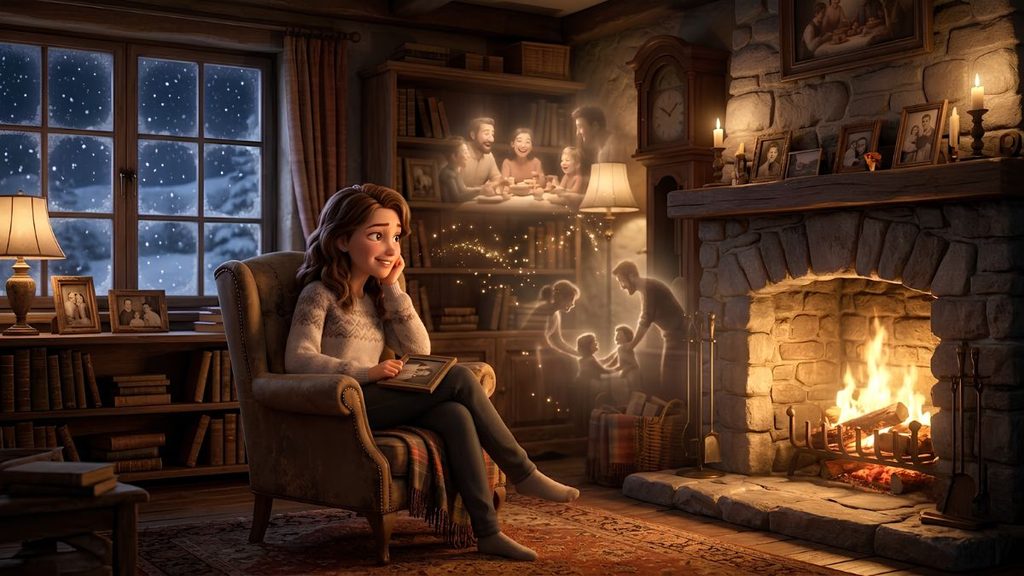
Characters: Isabelle and a magical old house called Willow House
Setting: A quiet countryside village surrounded by gardens
A soothing bedtime fable about memories, home, and discovering that happiness is something we continue creating rather than something we leave behind.
Isabelle had always been fascinated by old houses.
She liked houses with creaking wooden floors, tall windows, faded wallpaper, and gardens that had grown a little wild.
Modern houses were beautiful, she supposed.
But old houses seemed to have stories.
They seemed to remember.
Perhaps that was why Isabelle accepted the house on Willow Lane.
It was not the largest house in the village.
It was not the newest.
It needed repairs.
The roof needed attention.
Several windows were painted shut.
The garden had become overgrown.
And the front door made an unpleasant squeaking sound whenever it opened.
But Isabelle loved it immediately.
The house had belonged to an elderly woman named Margaret, who had recently moved to live with her daughter.
When Isabelle first walked through the front door, she felt an inexplicable warmth.
She could not explain it.
The house was empty.
Yet somehow, it did not feel lonely.
It felt as though someone had just left the room.
Isabelle moved in on a quiet autumn afternoon.
She carried boxes from her car.
Books.
Clothes.
Kitchen utensils.
Photographs.
A few plants.
An old armchair.
By sunset, most of her belongings were inside.
She made a simple dinner.
Then she sat near the fireplace.
The house was silent.
Outside, rain began falling.
Isabelle opened a book.
She read for several minutes.
Then she heard laughter.
She looked up.
The sound seemed to come from upstairs.
Isabelle froze.
She listened.
Nothing.
She returned to her book.
A few minutes later, she heard it again.
A child’s laughter.
Soft.
Distant.
Happy.
Isabelle stood.
She walked upstairs.
The hallway was dark.
She opened one door.
An empty bedroom.
Another.
Empty.
At the end of the hallway was a small room with faded blue wallpaper.
Isabelle opened it.
Inside was an old wooden rocking chair.
Nothing else.
She stepped inside.
The laughter stopped.
She looked around.
“Hello?”
No answer.
She laughed nervously.
“Okay.”
She closed the door.
The next morning, Isabelle convinced herself that she had imagined it.
Old houses made strange sounds.
Pipes.
Wood.
Wind.
Anything could explain a mysterious noise.
She went to work.
When she returned that evening, the house seemed ordinary.
She cooked dinner.
Washed the dishes.
Read for a while.
Then, just before bedtime, she heard music.
A piano.
Soft and distant.
Isabelle followed the sound.
It came from the living room.
But there was no piano.
She stood in the doorway.
The music stopped.
Isabelle looked around.
Then she noticed something.
The room smelled faintly of roses.
She smiled.
“This house is strange.”
But strangely, she was not frightened.
She felt comforted.
A few days later, Isabelle invited her neighbor, Thomas, for tea.
Thomas had lived on Willow Lane for more than forty years.
He knew the history of almost every house.
When Isabelle mentioned the strange sounds, he smiled.
“I was wondering when you’d notice.”
“Notice what?”
“The house.”
“What about it?”
Thomas looked toward the old fireplace.
“It remembers.”
Isabelle laughed.
“Excuse me?”
“The house remembers the people who lived here.”
“How?”
“Nobody knows.”
“Did Margaret hear things?”
“Sometimes.”
“Why didn’t she tell me?”
“She probably thought you’d discover it yourself.”
Isabelle stared at him.
“You’re serious.”
Thomas nodded.
“What does it remember?”
“Happy things.”
That night, Isabelle sat in the living room.
She waited.
Nothing happened.
She almost laughed at herself.
Then the clock struck ten.
The room suddenly became warm.
A faint golden glow appeared near the fireplace.
Isabelle stood.
The glow grew brighter.
Then she heard voices.
A woman laughing.
A man saying something she could not quite hear.
Children running across the floor.
She looked around.
The room was empty.
But for a moment, she could almost see them.
A family sitting around the fireplace.
Someone reading.
Someone pouring tea.
A little girl asleep against her mother’s shoulder.
A boy building something from wooden blocks.
A grandfather laughing.
Then the vision faded.
Isabelle stood completely still.
She realized she was smiling.
The following night, the house showed her something else.
The kitchen.
It was no longer empty.
It was filled with people.
A woman was baking bread.
A young man was washing dishes.
Two children were arguing about something.
An elderly man was sitting at the table.
Everyone was laughing.
Isabelle smelled cinnamon.
She closed her eyes.
For a moment, she felt as though she had been invited into their happiness.
Then everything disappeared.
She whispered:
“Who were you?”
The house remained silent.
Isabelle began exploring the rooms more carefully.
She found small clues everywhere.
A pencil mark on a doorframe measuring a child’s height.
A faded photograph behind a bookshelf.
A handwritten recipe inside a kitchen drawer.
A tiny toy horse beneath the floorboards.
A collection of pressed flowers inside an old book.
Each object seemed to carry a feeling.
The house was not simply remembering people.
It was remembering moments.
One rainy evening, Isabelle found an old photograph.
It showed a young woman standing beside the front door.
The woman looked familiar.
Isabelle turned the photograph over.
Written on the back were two words:
Margaret, 1968.
So the elderly woman who had owned the house had once been young.
Isabelle wondered what her life had been like.
She placed the photograph on the mantel.
That night, the house showed her Margaret.
Not as an old woman.
As a young woman.
She was standing in the kitchen with a baby in her arms.
A man stood beside her.
They were laughing.
Isabelle watched silently.
Then the scene changed.
Margaret was older.
Her child was running through the garden.
Then older still.
The family sat around the dining table.
Then another scene.
Margaret alone.
The house became quiet.
The visions disappeared.
Isabelle felt tears in her eyes.
She understood.
The house remembered happiness because happiness had filled it.
But it also remembered change.
People grew.
People left.
People aged.
Nothing remained exactly the same.
The next morning, Isabelle visited Thomas.
“Did Margaret have a family?”
Thomas nodded.
“She had two children.”
“What happened to them?”
“They moved away.”
“Does she ever visit?”
“Sometimes.”
“Does she know the house remembers?”
Thomas smiled.
“She says it remembers better than she does.”
Isabelle looked thoughtful.
“Why would a house remember?”
“Perhaps because people leave pieces of themselves behind.”
Isabelle began to wonder about her own memories.
She had moved to Willow Lane because she wanted a fresh start.
She had recently left a city where she had lived for nearly ten years.
Her friends were still there.
Her old apartment was still there.
The café she loved was still there.
But she had felt that she needed somewhere new.
She had thought leaving would help her forget the past.
Now she realized that she did not actually want to forget.
She missed things.
Sunday breakfasts with her sister.
Late-night conversations with her best friend.
Her father’s terrible jokes.
Her mother’s garden.
The sound of rain against her childhood bedroom window.
She had been trying to become someone new by leaving everything behind.
The house taught her that perhaps that was unnecessary.
One Saturday, Isabelle decided to recreate one of her childhood memories.
She baked her mother’s apple cake.
The recipe was not written down.
She remembered it from watching her mother.
A little cinnamon.
A little nutmeg.
Too much vanilla.
She laughed when she realized she could not remember the exact measurements.
She called her mother.
“How much sugar did you use?”
Her mother laughed.
“You never measured it.”
“Then how did you know?”
“I knew.”
Isabelle smiled.
They talked for an hour.
When the cake came out of the oven, the house became warm.
The scent filled every room.
The lights seemed to shimmer.
Then Isabelle heard laughter.
Not from the past.
From the kitchen.
Her own laughter.
She had invited Thomas over.
Then her sister arrived unexpectedly.
Soon the kitchen was filled with conversation.
People ate cake.
Someone spilled tea.
Thomas told an embarrassing story.
Everyone laughed.
Isabelle looked around.
The house was remembering again.
But this time, the memory was being created.
That night, Isabelle understood the secret.
The house did not only remember the past.
It remembered happiness itself.
Whenever people laughed, loved, shared food, comforted one another, or simply enjoyed being together, the house seemed to hold onto the feeling.
It did not care whether the moment was extraordinary.
A birthday.
A wedding.
A holiday.
A simple dinner.
It remembered them all.
Months passed.
Isabelle repaired the windows.
She painted the hallway.
She planted flowers.
She fixed the garden.
But she also began inviting people over.
Friends came for dinner.
Neighbors came for tea.
Her sister visited.
Children played in the garden.
Someone started bringing board games.
Someone else brought homemade bread.
The old house became lively again.
And every night, when everyone had gone home, Isabelle sometimes heard faint sounds.
Laughter.
Music.
Footsteps.
The sound of a cup being placed on a table.
She no longer wondered whether she was imagining them.
She simply smiled.
One winter evening, Isabelle found a small envelope inside an old drawer.
It contained a letter from Margaret.
The letter had never been mailed.
Isabelle hesitated before reading it.
It said:
“If you are reading this, then you are probably living in my old house.”
Isabelle smiled.
“I hope the house has welcomed you.”
She continued.
“People sometimes think houses are made of bricks, wood, glass, and stone. But I don’t believe that anymore.”
“I think a home is made from everything that happens inside it.”
“The laughter. The arguments. The birthdays. The quiet mornings. The tears. The meals. The forgiveness. The people who leave. The people who return.”
“A house remembers because love leaves traces.”
Isabelle stopped reading.
Her eyes filled with tears.
At the bottom Margaret had written:
“If you are happy there, then the house is happy too.”
Isabelle kept the letter.
She placed it beside the fireplace.
That evening, she sat in the armchair.
The room was quiet.
Snow fell outside.
She looked around.
The house no longer felt old.
It felt alive.
She imagined all the people who had once lived there.
All the laughter.
All the difficult days.
All the ordinary evenings.
All the dreams.
All the goodbyes.
The house had witnessed generations of lives.
And somehow, it had kept the happiest pieces.
Years later, Isabelle became known in the village for hosting Sunday dinners.
Everyone was welcome.
Sometimes there were ten people.
Sometimes twenty.
Sometimes only three.
The menu did not matter.
Neither did the occasion.
The important thing was that the house was full.
Full of voices.
Full of warmth.
Full of life.
And every evening after everyone left, Isabelle would walk through the rooms turning off the lights.
She would hear the faintest echoes.
A laugh from the dining room.
A song from the kitchen.
Footsteps upstairs.
A child giggling in the hallway.
She would smile.
“Goodnight.”
One evening, when Isabelle was much older, she sat beside the fireplace with her granddaughter, Sophie.
Sophie had always loved the house.
“Grandmother,” she asked, “is it true that the house remembers?”
Isabelle smiled.
“What do you think?”
“I think it does.”
“Why?”
“Because sometimes I hear people laughing when nobody is here.”
Isabelle nodded.
“Then perhaps it does.”
“Are the people ghosts?”
“No.”
“What are they?”
Isabelle thought for a moment.
“Memories.”
Sophie looked toward the fireplace.
“Do memories stay forever?”
“Not exactly.”
“Then how long?”
“As long as someone remembers them.”
Sophie leaned against her grandmother.
“Then I’ll remember.”
Isabelle kissed her forehead.
“That’s all a memory asks.”
That night, after Sophie went to sleep, Isabelle walked through the old house.
She touched the walls.
The wooden staircase.
The kitchen table.
The fireplace.
She thought about the people who had lived there before her.
She thought about the people who would live there after her.
She realized something beautiful.
A home was never really owned.
It was borrowed.
One generation lived inside it.
Then another.
Each left something behind.
A recipe.
A photograph.
A scratch on a doorframe.
A song.
A story.
A memory.
And eventually, someone else arrived and added their own.
The house continued.
Isabelle sat in the old armchair.
The fireplace crackled.
Outside, snow covered the garden.
She closed her eyes.
For a moment, she heard everything.
Children laughing.
A woman singing.
Someone telling a joke.
A baby crying.
Friends talking.
Dishes clinking.
Footsteps.
Rain.
Music.
Then she heard her own laughter.
She smiled.
The house had remembered her too.
Not the day she moved in.
Not the repairs.
Not the lonely evenings.
It remembered the happy moments.
The apple cake.
Sunday dinners.
Her sister laughing in the kitchen.
Her granddaughter playing in the garden.
The countless cups of tea.
The quiet mornings.
The ordinary evenings.
The moments that had seemed small at the time.
Those were the moments that mattered most.
Isabelle opened her eyes.
The room was quiet again.
She looked toward the fireplace.
“Thank you.”
The old house creaked gently.
She smiled.
Then she went upstairs.
She climbed into bed.
Outside, snow continued falling.
The house settled around her.
Its wooden beams creaked softly.
Its old windows rattled in the wind.
Somewhere downstairs, the clock ticked.
Isabelle closed her eyes.
She thought about all the happy moments still waiting to happen.
Tomorrow’s breakfast.
Next Sunday’s dinner.
Another visit from Sophie.
Another summer garden.
Another story.
She realized that happiness was not something she needed to chase.
It was something she could create.
One meal.
One conversation.
One laugh.
One kind gesture.
One ordinary evening at a time.
And perhaps, years from now, those little moments would become memories.
Perhaps someone else would live in the house.
Perhaps they would hear laughter in an empty room.
Perhaps they would wonder where it came from.
And perhaps the house would simply be reminding them of something important.
That a beautiful life is not made only from extraordinary days.
It is made from ordinary moments filled with love.
The kind that quietly settles into walls.
The kind that remains after people leave.
The kind that makes an empty house feel like home.
Isabelle smiled beneath her blankets.
Then she whispered:
“Goodnight, old house.”
The floor creaked softly.
Almost like a reply.
And with the warmth of remembered happiness surrounding her, Isabelle drifted peacefully into sleep.
Moral of the Story
A happy life is built from small moments of love, laughter, and togetherness. The memories we create today can become the warmth that stays with us long after the moment has passed.
7. The Little Boat That Followed the Sleeping River

Characters: Charlotte and a small wooden boat called Willow
Setting: A moonlit river flowing through forests, meadows, and sleepy villages
A soothing bedtime fable about love, patience, hope, and the quiet ways we guide one another through difficult nights.
On the northern edge of a small coastal village stood an old lighthouse.
It was built on a rocky cliff where the sea stretched endlessly toward the horizon.
During the day, the lighthouse looked ordinary.
White stone walls.
A red roof.
A narrow balcony.
A tall glass room at the very top.
But at night, it became something else.
Its great lantern swept across the ocean every few seconds, sending a warm beam of light over the waves.
For generations, the lighthouse had helped sailors find their way home.
And for almost thirty years, it had been cared for by a quiet man named Arthur.
Arthur lived alone in the small cottage beside the lighthouse.
He was a gentle man with silver hair, weathered hands, and kind blue eyes.
Every evening, just before sunset, he climbed the winding staircase to the lantern room.
He polished the glass.
Checked the mechanism.
Trimmed the wick.
Made sure everything was ready.
Then, when darkness arrived, he lit the lamp.
The beam crossed the sea.
Again.
And again.
And again.
Arthur never became tired of watching it.
He used to say:
“A light doesn’t need to know who needs it.”
“It only needs to shine.”
Arthur had a daughter named Sophie.
She lived in a city several hours away.
She had moved there when she was twenty-two.
At first, she visited every weekend.
Then every month.
Then only during holidays.
Life became busy.
Work became demanding.
Years passed.
Arthur never complained.
Whenever Sophie called, he smiled.
Whenever she asked if he was lonely, he said:
“Never.”
She knew he was lying.
But she also knew he did not want to burden her.
So she promised herself she would visit more often.
One day.
When work became easier.
When she had more time.
When life slowed down.
Arthur always told her the same thing.
“Don’t worry about me.”
But secretly, he looked forward to every call.
One autumn evening, a storm arrived.
The wind grew stronger.
Waves crashed against the cliffs.
Rain struck the lighthouse windows.
Arthur climbed the stairs as usual.
He reached the lantern room.
He checked the mechanism.
Everything seemed fine.
Then lightning flashed.
The lighthouse went dark.
Arthur froze.
He checked the electrical system.
Nothing.
He tried the backup.
Nothing.
The storm had damaged the generator.
Arthur looked through the window.
The ocean was almost invisible beneath the rain.
Far out in the darkness, he saw a faint light.
A boat.
It was moving toward the harbor.
Arthur’s heart tightened.
The lighthouse needed to shine.
He hurried downstairs.
In the storage room, he found an old oil lantern.
It had not been used in years.
He cleaned it.
Filled it with oil.
Lit the flame.
Then he climbed all the way back to the top.
The lantern was much smaller than the lighthouse lamp.
Its light was weak.
But it was something.
Arthur placed it in the lantern room.
The little flame began glowing.
It was nowhere near as bright as the lighthouse.
But it was visible.
Arthur stood beside it.
“Come on,” he whispered.
“See me.”
For nearly two hours, Arthur kept the little lantern burning.
The storm grew worse.
The boat moved slowly.
Arthur watched.
The light disappeared behind waves.
Then appeared again.
He kept the lantern burning.
At last, sometime after midnight, the boat reached the harbor.
Arthur saw its lights pass safely through the breakwater.
He closed his eyes.
“Thank goodness.”
He remained beside the lantern until the storm began to weaken.
Then he fell asleep in the chair.
The next morning, Sophie called.
“Are you okay?”
Arthur smiled.
“I’m fine.”
“I heard there was a terrible storm.”
“It was.”
“Did the lighthouse work?”
Arthur looked toward the lantern room.
“Not exactly.”
“What happened?”
“The big light went out.”
Sophie became quiet.
“Are you serious?”
“Yes.”
“Was anyone hurt?”
“No.”
Arthur smiled.
“I kept a little lantern burning.”
Sophie sighed with relief.
“You’re unbelievable.”
Arthur laughed.
“Maybe.”
Then Sophie said something he had not expected.
“I’m coming home.”
Arthur’s smile faded.
“What?”
“I’m coming home for a while.”
“You don’t have to.”
“I know.”
“Your work…”
“I’ll manage.”
“Sophie…”
“I miss you, Dad.”
Arthur looked toward the sea.
“I miss you too.”
Sophie arrived three days later.
Arthur stood outside the lighthouse waiting.
When he saw her car, he smiled.
Sophie got out.
She walked toward him.
For a moment, neither spoke.
Then she hugged him.
Arthur held her tightly.
“You’ve grown,” he said.
Sophie laughed.
“Again?”
“You always seem taller.”
“I’m thirty-two.”
“Exactly.”
She laughed.
The two of them walked toward the cottage.
Sophie looked at the lighthouse.
“How long has it been since I’ve been here?”
Arthur thought.
“Too long.”
She smiled.
“I know.”
That evening, they had dinner together.
Arthur made fish soup.
Sophie brought dessert.
They talked for hours.
About work.
About the city.
About neighbors.
About the storm.
About everything they had not said during their shorter phone calls.
Later, Sophie asked:
“Do you still climb the lighthouse every night?”
“Of course.”
“Even when it’s stormy?”
“Especially then.”
“Why?”
Arthur looked at her.
“Because that’s when people need the light most.”
Sophie nodded.
She understood.
The next morning, Sophie climbed the lighthouse with him.
She had forgotten how many stairs there were.
“This is exhausting.”
Arthur laughed.
“You’re getting old.”
“I’m younger than you.”
“That’s irrelevant.”
They reached the lantern room.
The great lamp had been repaired.
Sunlight streamed through the windows.
Sophie looked out at the sea.
“It is beautiful.”
Arthur nodded.
“It always is.”
She noticed the little oil lantern sitting on a shelf.
“Is that the one?”
Arthur nodded.
“You kept it?”
“Of course.”
Sophie picked it up.
It was old.
The glass was scratched.
The metal was blackened from years of use.
“It doesn’t look like much.”
Arthur smiled.
“It saved a boat.”
Sophie looked at him.
“No.”
He pointed toward the sea.
“It helped someone find their way.”
That sentence stayed with Sophie.
Over the next few days, she noticed how Arthur lived.
He did not do anything extraordinary.
He woke early.
Fed the birds.
Fixed things around the cottage.
Read newspapers.
Made tea.
Worked in the garden.
Checked the lighthouse.
He lived quietly.
But everywhere Sophie looked, she saw little acts of care.
A blanket folded neatly for a visiting fisherman.
Fresh bread left outside a neighbor’s door.
A repaired fishing net hanging beside the shed.
A basket of apples shared with the old woman next door.
Arthur never talked about these things.
He simply did them.
One afternoon, Sophie asked:
“Why do you do all this?”
Arthur looked confused.
“Do what?”
“Help everyone.”
“I don’t help everyone.”
“You do.”
Arthur smiled.
“I just do what I can.”
“Why?”
He looked toward the lighthouse.
“Because someone once did the same for me.”
Sophie waited.
Arthur sat down.
“When I was young, I worked on a fishing boat.”
“You never told me that.”
“I was seventeen.”
“What happened?”
“We got caught in a storm.”
Arthur’s expression changed.
“We couldn’t see the shore.”
“What did you do?”
“We followed a light.”
“The lighthouse?”
“Yes.”
He smiled.
“Someone kept it burning.”
Arthur looked at the little lantern.
“That person never knew who I was.”
“Did you ever meet him?”
“No.”
“Then why remember him?”
“Because he didn’t need to know me.”
Sophie understood.
The light had been given without expecting anything in return.
A week passed.
Sophie extended her stay.
Then extended it again.
She began helping Arthur around the lighthouse.
She cleaned the windows.
Sorted supplies.
Painted the railings.
She even learned how to maintain the lantern.
Arthur was delighted.
“You’re becoming a lighthouse keeper.”
Sophie laughed.
“Don’t get carried away.”
“You like it.”
“I do.”
“Then perhaps you should stay.”
Sophie became quiet.
The idea had never occurred to her.
She had always assumed her life belonged in the city.
But now she was not so sure.
One evening, Sophie sat alone on the cliff.
The sun was setting.
The ocean was calm.
She thought about her life.
She had spent years rushing.
Working late.
Answering messages.
Chasing promotions.
Planning the next thing.
She had convinced herself that being busy meant she was moving forward.
But sitting beside the sea, she wondered whether she had simply been moving.
There was a difference.
The lighthouse did not move.
Yet it reached farther than almost anything she had known.
Its light traveled across the water.
It helped people without ever leaving home.
Sophie smiled.
Maybe a meaningful life did not always have to be loud.
Winter arrived.
The nights became longer.
The lighthouse continued shining.
Sophie stayed.
She worked remotely from the cottage.
She helped Arthur.
She walked along the cliffs.
She learned the names of the seabirds.
She began painting again.
Arthur had once taught her when she was a child.
She had forgotten how much she loved it.
One night, she showed him a painting.
It was the lighthouse surrounded by darkness.
The beam stretched across the sea.
Arthur looked at it for a long time.
“It’s beautiful.”
Sophie smiled.
“I wanted to paint what you do.”
“What do I do?”
“You keep a light on.”
Arthur smiled.
“That’s all?”
“That’s enough.”
Years passed.
Arthur grew older.
Climbing the lighthouse became difficult.
One evening, he stopped halfway up the stairs.
Sophie noticed.
“Dad?”
“I’m fine.”
She smiled.
“You’re not.”
Arthur laughed.
“Perhaps not.”
Sophie took his arm.
“Let me.”
Together, they climbed.
From then on, Sophie began taking over more of the work.
Arthur still supervised.
He still gave advice.
But Sophie became the lighthouse keeper.
She checked the lamp.
Cleaned the windows.
Maintained the mechanism.
And every evening, she watched the beam sweep across the sea.
One winter night, Arthur became very ill.
Sophie sat beside his bed.
The storm outside was loud.
Arthur opened his eyes.
“Is the light on?”
Sophie smiled.
“Yes.”
“Good.”
He closed his eyes.
After a moment, he whispered:
“That’s all that matters.”
Sophie held his hand.
“You taught me that.”
Arthur smiled.
“I only kept a lamp burning.”
Sophie shook her head.
“No.”
“You taught me how.”
Arthur passed away peacefully several weeks later.
The village came to the lighthouse.
People brought flowers.
Food.
Letters.
Stories.
Everyone had something to say.
A fisherman told Sophie:
“Your father once helped me find the harbor during a storm.”
An old woman said:
“He repaired my window when I couldn’t afford someone.”
A young sailor said:
“He always remembered my name.”
Sophie listened.
She realized that her father had spent his life doing small things.
But those small things had reached farther than he knew.
Like the lighthouse beam.
That evening, Sophie climbed the lighthouse alone.
She lit the lamp.
The beam swept across the dark ocean.
She placed the old oil lantern beside it.
She lit it too.
The little flame glowed.
Sophie smiled.
“You were right, Dad.”
She looked out at the sea.
“A light doesn’t need to know who needs it.”
The lighthouse continued turning.
Across the water.
Again.
And again.
And again.
Years later, Sophie became known throughout the region as the lighthouse keeper.
She welcomed travelers.
Helped sailors.
Taught children about the sea.
She kept her father’s little lantern beside the great lamp.
Whenever someone asked about it, she told them the story.
Sometimes children would say:
“But that little lantern was so weak.”
Sophie would smile.
“Yes.”
“Then how did it help?”
“Because darkness doesn’t require a huge light.”
The children would listen.
“Sometimes,” Sophie would tell them, “one small light is enough to show someone where to go next.”
One summer evening, a young girl named Emma visited the lighthouse with her mother.
Emma looked at the ocean.
Then at the lantern.
“Are you ever afraid up here?”
Sophie thought.
“Sometimes.”
“Even though you’re the lighthouse keeper?”
“Especially then.”
Emma frowned.
“Then why do you stay?”
Sophie smiled.
“Because being brave doesn’t mean never being afraid.”
“What does it mean?”
“It means keeping the light on anyway.”
Emma looked at the lighthouse.
Then she smiled.
That night, after everyone had left, Sophie climbed to the lantern room.
The sky was full of stars.
The ocean was dark and peaceful.
The lighthouse beam crossed the waves.
She thought about Arthur.
She imagined him standing beside her.
Silver hair.
Weathered hands.
Kind blue eyes.
She smiled.
“Goodnight, Dad.”
The light continued turning.
For a moment, Sophie felt as though the lighthouse was answering.
Not with words.
With light.
Eventually, Sophie sat down.
She watched the sea.
She thought about all the people who were somewhere out there.
Some were traveling.
Some were lost.
Some were frightened.
Some were going home.
Some were beginning new journeys.
They might never know who was keeping the light burning.
And that was okay.
The light did not ask for recognition.
It simply shone.
Sophie finally understood the lesson her father had carried throughout his life.
We cannot always rescue someone.
We cannot solve every problem.
We cannot remove every storm.
Sometimes all we can do is offer a little light.
A phone call.
A kind word.
A warm meal.
A listening ear.
A hand held during a difficult moment.
A message that says:
“I’m here.”
Sometimes that is enough.
Sometimes someone does not need us to fix the darkness.
They only need to know that they are not facing it alone.
The wind became softer.
The sea settled.
The stars grew brighter.
Sophie checked the lamp one final time.
Everything was working perfectly.
She turned toward the stairs.
Then paused.
She looked back at the little oil lantern.
Its flame was still burning.
She smiled.
“Keep shining.”
Then she walked downstairs.
Outside, the lighthouse continued sending its golden beam across the ocean.
One sweep at a time.
One wave at a time.
One night at a time.
And somewhere beyond the horizon, a sailor looked toward the light and knew the way home.
Sophie never knew who that sailor was.
She didn’t need to.
She had learned that love was often like a lighthouse.
It did not always follow us.
It did not always speak.
It did not always solve our problems.
Sometimes it simply remained.
Steady.
Patient.
Warm.
Waiting for us to find our way.
And when the night felt too dark, that little light was enough to remind us:
Keep going.
You are not alone.
There is still a way home.
Sophie closed the lighthouse door.
The village below was quiet.
Windows glowed softly in the distance.
The moon rested above the sea.
She returned to her cottage, made a cup of tea, and climbed into bed.
Before closing her eyes, she looked toward the lighthouse.
Its golden beam crossed her bedroom window.
Once.
Then again.
She smiled.
“Goodnight.”
The light passed over her room one final time.
And under its gentle glow, Sophie fell peacefully asleep.
Moral of the Story
You do not have to solve someone’s entire journey to make a difference. Sometimes your kindness, presence, or simple encouragement can be the small light someone needs to find their way through a difficult night.
Why Read Bedtime Fables for Her?
A bedtime fable can be a surprisingly meaningful way to connect with someone.
During the day, conversations often revolve around work, responsibilities, schedules, and practical matters. At night, there is usually more space for imagination and emotion.
A gentle story can provide that transition.
They Create a Peaceful Bedtime Routine
A consistent bedtime routine can make the end of the day feel calmer.
Reading or listening to a soothing fable can become a signal that the busy part of the day is over. The lights are dimmed, the phone is put aside, and attention shifts toward a quiet story.
Over time, the ritual itself can become comforting.
They Offer Emotional Comfort
Everyone has difficult days.
She may have experienced stress at work, a disagreement with someone, disappointment, or simply a tiring day.
A gentle fable does not need to solve those problems.
Sometimes, it is enough to give her a few peaceful minutes where she can think about something else.
A story about a character finding hope after a difficult day can provide emotional reassurance without becoming overly serious.
They Encourage Imagination
Fables naturally lend themselves to imaginative settings.
A tiny village hidden inside a forest, a moonlit garden, a talking bird, a curious rabbit, or a magical lantern can create a world far removed from everyday responsibilities.
That imaginative shift can make bedtime feel special.
They Can Strengthen Romantic Connection
For couples, reading bedtime stories can become an intimate ritual.
The story does not have to be explicitly romantic.
A simple tale about two characters who support each other can still create a warm emotional atmosphere.
You can also personalize the experience by choosing stories that reflect qualities you admire in her.
They Leave Her With a Positive Thought
A good bedtime fable should ideally end on a reassuring note.
Instead of leaving the reader with fear or unresolved tension, it can offer a simple idea to carry into sleep.
Perhaps the lesson is: Small acts of kindness matter.
Or: You do not have to solve everything today.
Or: Sometimes the people who care about us are closer than we realize.
These gentle messages can make a story memorable.
What Makes a Bedtime Fable Sweet?
Not every fable works equally well before sleep.
A bedtime story should have an atmosphere that encourages relaxation rather than excitement.
Several elements can make a fable especially soothing.
Gentle Characters
Sweet bedtime fables often work well with kind and relatable characters.
These could include:
- A thoughtful young woman
- A curious little fox
- A gentle rabbit
- A lonely bird
- A wise old turtle
- A friendly deer
- A caring grandmother
- Two supportive friends
- A couple learning something about each other
The characters should feel emotionally safe.
Even when they face a problem, the reader should feel that the situation can eventually be resolved.
Peaceful Settings
The setting has a major effect on the mood.
A bedtime fable can take place in:
- A quiet forest
- A moonlit meadow
- A sleepy village
- A peaceful seaside town
- A cottage beside a lake
- A garden filled with flowers
- A small mountain village
- A cozy bedroom
- A magical library
- A quiet countryside
Nature-based settings are particularly useful because they naturally lend themselves to slower storytelling.
Simple Conflicts
Bedtime fables do not need dramatic villains or dangerous situations.
The conflict can be something small.
A character may lose something important.
Someone may feel lonely.
A friend may misunderstand another friend.
A character may be afraid to try something new.
Someone may need to learn patience.
These situations provide enough narrative movement without creating excessive tension.
Reassuring Endings
The ending matters greatly.
A sweet bedtime fable should ideally bring the story toward emotional resolution.
The characters may discover that they are loved.
A misunderstanding may be cleared up.
A lost object may be found.
A character may overcome a small fear.
A difficult journey may end with a peaceful homecoming.
The goal is to leave the listener feeling settled rather than anxious about what happens next.
How to Make a Bedtime Fable More Romantic
If you are reading a story to someone you love, a few simple techniques can make the experience more personal.
Use Her Name
If appropriate, incorporating her name into a personalized version of the story can immediately make it feel more intimate.
Instead of saying:
“The girl walked toward the garden…”
you could say:
“Emma walked toward the garden…”
A familiar name can make an imaginary story feel surprisingly personal.
Include Familiar Details
You can incorporate harmless details that remind her of your relationship.
For example:
- Her favorite flower
- A favorite city
- A favorite season
- A meaningful place
- A shared memory
- A favorite dessert
- A special nickname
The story then becomes more than entertainment.
It becomes something connected to your shared memories.
Keep the Pace Slow
Bedtime stories should not rush.
Use descriptive details sparingly and allow scenes to breathe.
Instead of rapidly moving from one event to another, spend time describing the environment and emotions.
For example, a peaceful evening can include the sound of rain, warm lights through windows, a quiet garden, or the soft movement of trees.
The goal is to create a sense of calm.
Avoid Excessive Drama
A bedtime fable does not need constant twists.
Too much suspense can make it difficult to relax.
If there is a problem, keep it manageable.
The character should have time to think, learn, and eventually find a solution.
Ideal Length for a Bedtime Fable
There is no single perfect length.
A very short fable may take only a few minutes to read.
A longer bedtime story may take twenty minutes or more.
For regular bedtime reading, stories of approximately 800 to 2,000 words can work well because they provide enough space for character development and emotional resolution without becoming unnecessarily complicated.
Shorter stories are useful when she is already tired.
Longer stories can be enjoyable on weekends or during relaxed evenings.
The most important factor is not word count.
It is pacing.
A 700-word story can feel calming if written gently, while a 2,000-word story can feel exhausting if it moves too quickly.
How to Read a Bedtime Fable
The way you tell a story can be just as important as the story itself.
Use a calm voice.
Avoid rushing through sentences.
Pause naturally between paragraphs.
Let emotional moments breathe.
If you are reading through a voice call, keep your voice soft and consistent.
You can also reduce distractions by dimming the lights and putting notifications aside.
The goal is to create a small ritual where both of you can slow down.
A Simple Bedtime Fable Routine
You can create a routine like this:
- Step 1: Settle down – Make the room comfortable and reduce unnecessary distractions.
- Step 2: Choose a gentle story – Pick something with a warm setting and reassuring ending.
- Step 3: Read slowly – Use a relaxed pace.
- Step 4: Let the story end naturally – Avoid immediately switching to unrelated conversations.
- Step 5: Finish with a comforting message – Something as simple as: “Sleep well. I’ll be here tomorrow.” can make the entire experience feel more personal.
Why Simple Stories Can Be More Meaningful
A common mistake is assuming that a bedtime story needs a huge adventure to be memorable.
It does not.
Some of the most touching stories revolve around ordinary moments.
A character waiting by a window.
Someone leaving a cup of tea for another person.
Two friends sharing a quiet walk.
A letter arriving in the morning.
A small lantern glowing in the darkness.
A couple watching the rain together.
These moments can feel more comforting because they resemble real life.
The magic comes from how the moment is described, not how dramatic it is.
Moral Lessons That Work Well in Bedtime Fables
A fable is often remembered because of its message.
However, the moral should feel natural rather than forced.
Some suitable lessons include:
- Kindness always has value.
- Patience can lead to beautiful things.
- Small gestures can mean a great deal.
- True friendship survives difficult moments.
- It is okay to ask for help.
- Being different can be a strength.
- Love grows through understanding.
- Home can be found in the people who care about us.
- You do not need to solve everything at once.
- Rest is part of moving forward.
- Hope can survive difficult seasons.
- Sometimes the smallest light can guide you through darkness.
These lessons work particularly well because they leave the listener with something positive to think about before sleeping.
Creating a Cozy Atmosphere for Bedtime Fables
The environment can enhance the storytelling experience.
Consider using soft lighting rather than bright overhead lights.
A comfortable blanket can make the setting feel warmer.
Background sounds such as gentle rain or quiet instrumental music may also help create a relaxing atmosphere, provided they are not distracting.
If you are reading to her through a phone call, keeping the conversation quiet and unhurried can have the same effect.
The goal is not to create a complicated setup.
It is simply to make bedtime feel different from the rest of the day.
Final Thoughts
Sweet bedtime fables for her can be much more than simple stories.
They can become small moments of connection at the end of a long day.
A good fable gives the imagination somewhere peaceful to wander while offering a gentle reminder about kindness, love, patience, courage, or hope.
For couples, the tradition can become especially meaningful. A story can be read in the same room or shared through a phone when miles separate two people. What matters is the intention behind it.
The best bedtime fables do not need complicated plots or dramatic endings.
Sometimes all they need is a quiet setting, a lovable character, a simple lesson, and a peaceful ending.
And sometimes, the sweetest part of the story is not what happens inside it.
It is the feeling left behind when the story ends, the lights grow dim, and she closes her eyes knowing that someone cared enough to give her a few peaceful minutes before sleep.