
Death is one of the most difficult subjects to write about because it touches something everyone eventually experiences: loss.
Stories about death can be painful, but they can also be deeply meaningful. They give readers a safe space to explore grief, remember people they have lost, and think about the importance of love, forgiveness, family, friendship, and time.
Sad Stories That Will Make You Cry About Death are not necessarily powerful because they contain dramatic endings. Often, the most emotional stories are built around ordinary moments: an unanswered phone call, an empty chair at the dinner table, an old photograph, a forgotten voice message, or a familiar song that suddenly brings someone to tears.
This article explores what makes stories about death emotionally powerful, the themes commonly found in them, and why readers connect so strongly with stories about loss.
Why Stories About Death Can Be So Emotional
Death changes everything around it.
A person’s belongings remain, but the person is gone. Their favorite chair may still be beside the window. Their clothes may still hang inside a wardrobe. Their photographs may remain on the walls.
These ordinary reminders can make grief feel especially real.
A well-written story about death allows readers to experience this emotional contrast. The world continues moving, even though someone’s personal world has changed forever.
That contrast can create some of the strongest emotional moments in storytelling.
For example, a character might wake up expecting to hear their mother’s voice from the kitchen, only to remember that she has died.
Nothing dramatic needs to happen.
The sadness comes from the ordinary routine that can no longer continue.
Sad Stories That Will Make You Cry About Death
1. The Blue Sweater

Type: Losing a Parent
Theme: Regret, love, memories, and learning to appreciate someone before it is too late
Ethan Miller had always believed that there would be more time.
More weekends to visit his father.
More birthdays to celebrate together.
More phone calls.
More conversations.
More opportunities to sit across from him at the kitchen table and listen to the stories he had heard a hundred times before.
There would always be another Christmas.
Another summer.
Another chance to drive the three hours from London to his childhood home in Devon.
At thirty-eight, Ethan was successful, independent, and constantly busy.
He had built a career in international finance.
His apartment overlooked the Thames.
His calendar was always full.
His phone never stopped vibrating.
His father, Arthur Miller, lived alone in the small house where Ethan had grown up.
Arthur never complained about the distance.
Whenever Ethan apologized for not visiting, his father would simply say:
“Don’t worry about me. You’ve got your life.”
Ethan always promised he would visit soon.
Soon became next weekend.
Next weekend became next month.
And next month became another year.
Arthur had never been a man who demanded attention.
He had worked as a railway engineer for most of his life.
He wasn’t wealthy.
He didn’t travel much.
He didn’t care about expensive restaurants or fashionable clothes.
His greatest pleasures were simple.
A cup of tea in the morning.
His garden in spring.
Old records on Sunday afternoons.
And hearing from his son.
Every Wednesday evening, Arthur called Ethan.
The conversations were usually short.
“How are things?”
“Busy.”
“Work going well?”
“Very.”
“Have you eaten?”
“Yes, Dad.”
“Good.”
Then they would talk about the weather.
Sometimes football.
Sometimes the garden.
Sometimes nothing important at all.
Ethan often ended the call after five minutes.
“I’ve got another meeting, Dad.”
“Of course. Go on.”
“Talk soon.”
“Take care, son.”
Ethan always assumed his father would be there next Wednesday.
One cold November morning, Ethan was preparing for an important presentation when his phone rang.
It was his aunt, Margaret.
“Ethan?”
Something in her voice made him stop.
“What happened?”
“It’s your father.”
Ethan stood.
“Is he okay?”
Margaret didn’t answer immediately.
“He passed away last night.”
For several seconds, Ethan couldn’t understand the words.
“What?”
“I’m so sorry.”
“No.”
He sat down.
“No, I spoke to him yesterday.”
“I know.”
“He was fine.”
“I know.”
“He said he was going to the garden.”
Margaret began crying softly.
“The doctor thinks it was his heart.”
Ethan stared at the wall.
His father had been planning to plant new roses.
He had mentioned them during their Wednesday call.
Ethan suddenly remembered something.
His father had said:
“You should come down when they bloom.”
Ethan had replied:
“Definitely.”
Now there would be no roses to see with him.
The funeral was held three days later.
The church was small.
Arthur had known many people in the village.
Former colleagues came.
Neighbors came.
Old friends came.
People Ethan barely remembered stood beside him and told stories about his father.
One man said Arthur had helped him repair his bicycle when he was twelve.
A woman said Arthur had spent every winter clearing snow from her driveway.
Another neighbor remembered that Arthur had once driven thirty miles to help her when her car broke down.
Ethan listened.
He realized something painful.
His father had spent his entire life quietly helping people.
And Ethan, who was supposed to know him better than anyone, knew surprisingly little about the details of that life.
After the funeral, Ethan returned to the family home.
The house felt smaller.
Or perhaps Ethan had become larger.
Everything was exactly where Arthur had left it.
His reading glasses rested beside the chair.
A newspaper lay folded on the table.
A half-used jar of marmalade stood in the kitchen.
There was a mug near the sink.
Ethan picked it up.
His father’s fingerprints were invisible, but Ethan imagined them there.
He put the mug down.
Then he saw the coat.
It was hanging beside the back door.
A thick blue sweater was folded over it.
Ethan recognized it immediately.
His father had worn that sweater for years.
Winter after winter.
Garden work.
Grocery trips.
Walks along the coast.
Christmas mornings.
Ethan smiled despite himself.
“You really loved this thing, didn’t you?”
The house gave no answer.
Ethan took the sweater from the coat rack.
It was soft from years of use.
There was a tiny hole near one sleeve.
His father had repaired it himself.
Ethan remembered seeing him do it.
He had been twelve.
Arthur had sat near the window, carefully stitching the fabric.
“Why don’t you buy a new one?” Ethan had asked.
His father had laughed.
“Because this one still works.”
“You’ve had it forever.”
“Exactly.”
Ethan had rolled his eyes.
Now he pressed the sweater against his chest.
It smelled faintly like his father’s house.
Wood smoke.
Soap.
Something familiar.
Something impossible to describe.
He closed his eyes.
For a moment, he imagined Arthur walking through the back door.
“You’re still wearing that old sweater?”
Arthur would laugh.
Ethan began crying.
The following weeks were difficult.
Ethan returned to London.
Work expected him to continue as normal.
Meetings.
Reports.
Flights.
Deadlines.
People asked how he was.
“I’m okay.”
He wasn’t.
At night, he found himself looking at his phone.
Sometimes he opened his father’s contact.
The name was still there.
Dad.
Ethan would stare at it.
He couldn’t delete it.
He couldn’t call it either.
One evening, he accidentally pressed the number.
The phone began ringing.
Ethan froze.
He ended the call immediately.
Then he sat on the edge of his bed and cried.
It was strange.
His father had been only a phone call away for most of his life.
Now the same phone felt like a useless object.
A month later, Ethan returned to Devon to begin clearing the house.
His aunt helped him sort through the belongings.
There were boxes everywhere.
Old photographs.
Tools.
Books.
Receipts.
Letters.
Garden equipment.
Ethan wanted to finish quickly.
He had already arranged for the house to be sold.
But his aunt stopped him.
“Don’t rush.”
“I just want it done.”
“Why?”
Ethan didn’t answer.
She looked at him.
“You don’t have to turn your father’s life into a checklist.”
Her words stayed with him.
That evening, Ethan sat in his father’s chair.
He put on the blue sweater.
For the first time since the funeral, he felt calm.
The next morning, he opened the desk.
Inside were old documents.
Bank statements.
Insurance papers.
Instruction manuals.
And notebooks.
Arthur had apparently kept notes about almost everything.
Garden schedules.
House repairs.
Names of people he had helped.
Ethan smiled.
Then he found a notebook labeled:
Ethan.
His heart stopped.
He opened it.
The first page contained his birth date.
Then his father’s handwriting.
“Ethan’s first word was Dad.”
Ethan laughed through his tears.
He turned the page.
“First day of school. He was nervous but pretended not to be.”
Another page.
“Won his first football match. Scored once and talked about it for three days.”
Another.
“Got his university acceptance letter today. Never seen him so happy.”
Page after page.
His father’s handwriting documented Ethan’s life.
Not every day.
Not every event.
But the moments Arthur had considered important.
Ethan sat on the floor.
He read for hours.
There were notes about Ethan’s first job.
His first apartment.
His promotion.
Even his first trip abroad.
Arthur had written:
“He says he doesn’t need help. I know that means he probably does.”
Ethan smiled.
Then he found a more recent entry.
“Ethan is very busy. He apologized for not visiting. I told him not to worry. I hope he knows I don’t mind. I am proud of him.”
Ethan stopped reading.
His vision blurred.
He turned the page.
“I wish he would come home more often, but I don’t want him to feel guilty. He has worked hard for everything he has.”
Ethan closed the notebook.
He pressed it against his chest.
For years, he had believed he had failed his father by not visiting enough.
Now he understood something else.
Arthur had never measured his son’s love by the number of visits.
He had simply wanted Ethan to be happy.
That afternoon, Ethan walked into the garden.
The roses were beginning to grow.
Arthur had prepared the soil carefully.
There were small wooden markers beside each plant.
Ethan remembered his father saying:
“You should come down when they bloom.”
He touched one of the markers.
“I’m here, Dad.”
The wind moved through the trees.
Ethan stood there for a long time.
Then he began working.
He pulled weeds.
Watered the plants.
Repaired the fence.
By sunset, his hands were dirty.
He smiled.
For the first time, he understood why his father had loved gardening.
It wasn’t just about flowers.
It was about patience.
You planted something.
You cared for it.
You waited.
You trusted that one day it would bloom.
Months passed.
Ethan changed.
He began leaving work earlier.
He stopped answering emails during dinner.
He started calling his mother every Sunday.
He visited his aunt more often.
He reconnected with childhood friends.
And every Wednesday evening, he did something unusual.
He made tea.
Then he sat by his window.
He didn’t call his father.
He couldn’t.
Instead, he remembered him.
Sometimes he spoke aloud.
“Work was terrible today.”
Or:
“You’d hate the weather.”
Or:
“I finally fixed that shelf.”
It felt strange.
But it helped.
One spring morning, Ethan received a package.
It contained several items his aunt had found while cleaning the house.
Inside was the blue sweater.
There was also a photograph.
It showed Ethan as a young boy standing beside his father in the garden.
Ethan was wearing a football shirt.
Arthur was wearing the same blue sweater.
Ethan laughed.
“Of course.”
He placed the photograph in a frame.
Then he folded the sweater carefully.
He didn’t want to wear it every day.
It was too precious.
Instead, he kept it in a drawer.
Whenever he missed his father terribly, he took it out.
Sometimes he simply held it.
Two years after Arthur’s death, Ethan returned to the village with his young daughter, Sophie.
She was six.
“Grandad lived here?”
“Yes.”
“Where is he?”
Ethan paused.
“He died.”
Sophie looked confused.
“Will he come back?”
“No.”
“Why?”
Ethan knelt beside her.
“Because sometimes people become very old or very sick, and their bodies stop working.”
Sophie looked toward the house.
“Did he like gardens?”
Ethan smiled.
“He loved them.”
“Can we see?”
They walked outside.
The roses were blooming.
Sophie ran between them.
“Which one was Grandad’s favorite?”
Ethan pointed.
“That one.”
“How do you know?”
“He planted it.”
Sophie touched the petals carefully.
“Did he plant it for me?”
Ethan smiled.
“Maybe.”
That evening, Ethan told Sophie stories about her grandfather.
He told her about the railway.
About the blue sweater.
About the garden.
About the way Arthur always burned toast.
About how he never threw anything away if it could still be repaired.
Sophie laughed.
“Grandad sounds funny.”
“He was.”
“Do you miss him?”
“Every day.”
Sophie thought about this.
“Does missing someone ever stop?”
Ethan looked at the garden.
“No.”
Sophie looked sad.
“But it gets easier?”
“Sometimes.”
“How?”
Ethan smiled.
“You remember the good things more than the painful things.”
Years later, Sophie would remember those conversations.
She would remember the blue sweater.
She would remember the roses.
She would remember a grandfather she had never met but somehow felt she knew.
That was Arthur’s final gift.
He had left behind more than a house.
He had left stories.
Lessons.
Memories.
Love.
And a son who had finally learned that time should never be treated as something guaranteed.
One evening, Ethan sat alone in the garden.
The sun was setting.
The roses were moving gently in the wind.
He wore the blue sweater.
It was too large for him.
He smiled.
“Dad?”
The word came naturally.
“I finally understand.”
He looked toward the house.
“You weren’t asking me to visit because you needed me.”
He paused.
“You just wanted to spend time with me.”
The garden remained silent.
But Ethan no longer found the silence empty.
He understood that grief was not simply the pain of losing someone.
It was also the evidence that someone had mattered.
And his father had mattered enormously.
Ethan eventually decided not to sell the house.
He turned it into a small family retreat.
Every summer, he brought Sophie.
Later, she brought friends.
Eventually, Ethan’s grandchildren would run through the same garden.
The blue sweater remained in a wooden chest upstairs.
The notebook stayed beside it.
And the photograph of Arthur and young Ethan remained on the mantel.
Visitors sometimes asked:
“Who is that?”
Ethan always smiled.
“My father.”
Then he told them the story.
Not the story of how Arthur died.
The story of how Arthur lived.
How he repaired things instead of replacing them.
How he helped neighbors without expecting anything.
How he loved gardens.
How he wore the same blue sweater for years.
How he quietly recorded the important moments of his son’s life.
And how, even when Ethan was far away, Arthur never stopped being proud of him.
Ethan eventually understood that he had spent too many years believing love had to be demonstrated through grand gestures.
It didn’t.
His father had shown love through ordinary things.
A weekly phone call.
A packed lunch.
A repaired bicycle.
A warm sweater.
A garden.
A cup of tea.
A sentence in a notebook.
Small things.
Almost invisible things.
But when someone dies, those small things become enormous.
Because suddenly, they are all you have.
On the anniversary of Arthur’s death, Ethan sat beneath the roses with Sophie.
She was older now.
She had brought the blue sweater downstairs.
“Can I keep this one day?”
Ethan looked at her.
“Of course.”
She smiled.
“I’ll take care of it.”
“I know you will.”
They sat quietly.
The evening light fell across the garden.
Ethan reached for his daughter’s hand.
For a moment, he thought about all the time he had believed he had.
He realized that the greatest lesson his father had left him wasn’t written in the notebook.
It was in the way Arthur had lived.
Love people while they’re here.
Make time.
Listen.
Call.
Visit.
Forgive.
Don’t assume there will always be another Wednesday.
Ethan looked at Sophie.
“Want to make some tea?”
She smiled.
“Yes.”
They walked toward the house together.
Behind them, the roses moved gently in the evening breeze.
And hanging inside the quiet old house was a blue sweater that had belonged to a father who had spent his entire life loving his son in ways that were almost too ordinary to notice.
Until it was too late.
Moral Lesson
The people we love may not remain with us forever, so we should value the time we have with them. Love is often expressed through small, ordinary gestures that may seem insignificant today but can become priceless memories tomorrow.
2. Grandma’s Last Recipe
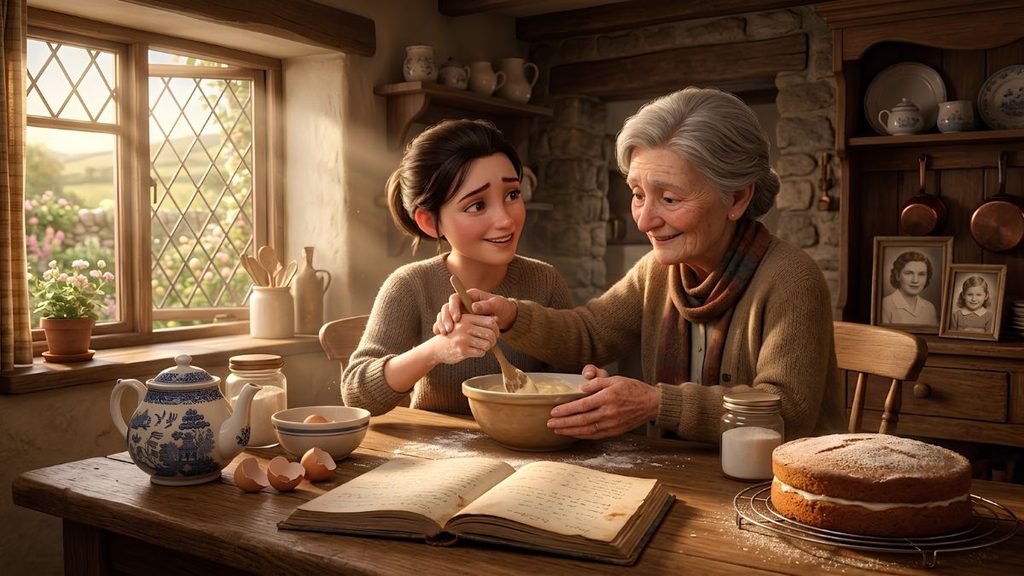
Type: Losing a Grandparent
Theme: Family memories, regret, unconditional love, and the value of ordinary moments
Charlotte Evans had always believed her grandmother would be there.
Not forever, exactly.
She understood that people grew old.
She understood that one day her grandmother would no longer be able to answer the phone or sit beside the kitchen window with a cup of tea.
But those thoughts belonged to some distant future.
Not today.
Not this year.
There would always be another Sunday.
Another Christmas.
Another afternoon in her grandmother’s kitchen.
At least, that was what Charlotte believed.
Her grandmother, Margaret Evans, had lived in the same small stone house in the English countryside for more than fifty years.
The house had a narrow hallway, creaking wooden stairs, faded photographs along the walls, and a kitchen that always smelled of something warm.
But the kitchen was what Charlotte remembered most.
It was where Margaret had spent countless hours cooking.
And it was where she had taught Charlotte almost everything she knew about baking.
Charlotte had been six years old when she first stood on a wooden chair beside her grandmother.
She could barely see over the kitchen counter.
Margaret had placed a large mixing bowl in front of her.
“What are we making?”
“Cake.”
“What kind?”
“Chocolate.”
Charlotte’s eyes widened.
“Can I eat it?”
“Eventually.”
“How long?”
Margaret laughed.
“That’s the difficult part.”
Charlotte had loved those afternoons.
Her grandmother never seemed rushed.
She measured flour carefully.
She cracked eggs with one hand.
She always tasted the mixture before putting it into the oven.
And she had one rule.
“You don’t bake when you’re angry.”
“Why?”
“Because food remembers.”
Charlotte didn’t understand.
Years later, she would.
As Charlotte grew older, the Sunday visits continued.
When she was ten, she learned to make biscuits.
At thirteen, she learned Margaret’s apple pie.
At sixteen, she learned how to make bread.
At nineteen, she moved away for university.
At twenty-three, she got her first job.
At twenty-seven, she moved to London.
At thirty, she became a senior architect.
Her life became increasingly busy.
Her grandmother’s life remained almost exactly the same.
The garden.
The kitchen.
The old radio.
The Sunday newspaper.
And the recipes.
Charlotte still visited.
Just not as often.
“You’re too thin.”
That was always Margaret’s first comment.
“Hello to you too, Grandma.”
“You don’t eat properly.”
“I eat.”
“Coffee isn’t food.”
Charlotte smiled.
“How do you know what I drink?”
“You’re my granddaughter. I know everything.”
Margaret would then place something on the table.
Usually cake.
Sometimes soup.
Always something.
Charlotte would eat while telling her grandmother about work.
Margaret rarely understood the technical details of architecture.
But she listened.
That was enough.
One rainy Sunday, Charlotte arrived late.
She had promised to come at noon.
She arrived at nearly four.
Margaret was sitting by the window.
“I thought you weren’t coming.”
Charlotte immediately felt guilty.
“I’m sorry. Work.”
“You always say that.”
“I know.”
Margaret smiled.
“I’m not angry.”
Charlotte took off her coat.
“I’ll make tea.”
“No.”
“What?”
“Sit.”
Charlotte sat.
Margaret looked older than she had the previous month.
Her hair was thinner.
Her hands shook slightly.
Charlotte noticed.
“You okay?”
“I’m fine.”
“You don’t look fine.”
“That’s because I’m eighty-two.”
Charlotte laughed.
Margaret smiled.
Then she reached for a small notebook.
“I found this.”
“What is it?”
“My mother’s recipe book.”
Charlotte opened it.
The pages were yellow.
The handwriting was faded.
“Can I have it?”
“Not yet.”
“Why?”
“Because you haven’t earned it.”
Charlotte laughed.
“How do I earn it?”
“Learn the last recipe.”
“What recipe?”
Margaret closed the book.
“You’ll know.”
Charlotte stayed until evening.
They cooked together.
They talked.
They laughed.
Before leaving, Charlotte hugged her grandmother.
“I’ll come next Sunday.”
Margaret smiled.
“I know.”
Charlotte drove back to London.
She never saw her grandmother alive again.
The phone call came on a Tuesday morning.
Charlotte was at work.
Her mother called.
“Charlotte?”
“Yes?”
“It’s Grandma.”
Charlotte immediately stood.
“What happened?”
Her mother’s voice broke.
“She passed away this morning.”
The office around Charlotte suddenly became silent.
She couldn’t hear the conversations anymore.
Couldn’t hear the phones.
Couldn’t hear the traffic outside.
All she heard was her mother’s voice.
“She died peacefully.”
Charlotte sat down.
“No.”
“I’m sorry.”
“But I was supposed to visit Sunday.”
Her mother didn’t answer.
Charlotte closed her eyes.
She remembered Margaret’s final words.
“I know.”
She had assumed there would be another Sunday.
There wasn’t.
The funeral was small.
Margaret had wanted it that way.
There were flowers.
Photographs.
Old friends.
Neighbors.
Family.
Charlotte stood beside her mother and watched people tell stories.
A neighbor talked about Margaret’s garden.
Another remembered her Christmas dinners.
Someone else said:
“She always had food ready for everyone.”
Charlotte smiled sadly.
That was true.
Margaret never let anyone leave hungry.
After the funeral, Charlotte returned to the house.
She didn’t want to go inside.
Her mother gave her the keys.
“You should take whatever you want.”
Charlotte shook her head.
“I don’t want anything.”
“You will.”
Charlotte walked into the kitchen.
Everything was still there.
The wooden spoon.
The mixing bowls.
The old oven.
The jars of flour and sugar.
The small blue teapot.
Charlotte touched the counter.
She could almost hear her grandmother saying:
“Don’t spill that.”
Charlotte laughed.
Then cried.
For the first time, she realized how many memories were attached to that room.
The first cake.
The first burned batch of biscuits.
The Christmas pudding.
The apple pie.
The bread.
The birthday cakes.
Every important moment seemed to have passed through that kitchen.
Charlotte opened the cupboard.
Inside was a small box.
She pulled it out.
It contained recipe cards.
Most were familiar.
Then she found one without a title.
Only three words were written at the top.
Grandma’s Last Recipe.
Charlotte’s hands began shaking.
She read the ingredients.
Flour.
Butter.
Milk.
Sugar.
Eggs.
Vanilla.
Nothing unusual.
But at the bottom was a handwritten instruction:
“Make this with someone you love.”
Charlotte smiled through her tears.
That was it.
The final recipe.
Not a secret cake.
Not a family treasure.
A lesson.
Charlotte tried making it that evening.
She measured the flour.
Added the butter.
Mixed the ingredients.
But something went wrong.
The dough was too dry.
She called her mother.
“Mom?”
“Yes?”
“I found Grandma’s recipe.”
There was silence.
“The last one?”
“Yes.”
“What does it say?”
Charlotte read the instructions.
Her mother laughed softly.
“That’s your grandmother.”
“I don’t understand.”
“Neither did I at first.”
“What does it mean?”
Her mother replied:
“She didn’t care about the cake.”
Charlotte looked at the bowl.
“What?”
“She cared about who was standing beside you.”
Charlotte sat quietly.
Her mother continued.
“Your grandmother used to say that recipes were just excuses.”
“Excuses for what?”
“To make people sit down together.”
Charlotte looked around the kitchen.
She suddenly remembered something.
Her grandmother had never baked alone when Charlotte was young.
There had always been someone.
A neighbor.
A child.
A friend.
A relative.
Someone.
Maybe Margaret had understood something Charlotte hadn’t.
Food disappeared.
The cake was eaten.
The kitchen was cleaned.
But the time spent together remained.
The next morning, Charlotte called her mother.
“Come to London.”
“Why?”
“I want to make Grandma’s recipe.”
Her mother smiled.
“I’ll come.”
They spent Saturday afternoon baking.
The cake wasn’t perfect.
It was slightly uneven.
The top cracked.
Charlotte laughed.
“Grandma would say we rushed.”
Her mother smiled.
“She would.”
They sat at the kitchen table and ate it together.
For the first time since Margaret’s death, they talked about her without immediately crying.
They remembered her laugh.
Her stubbornness.
Her terrible singing.
Her habit of hiding chocolate from everyone.
They talked for hours.
A week later, Charlotte returned to her grandmother’s house.
She found more recipe cards.
Each contained small notes.
One said:
“For rainy afternoons.”
Another:
“For when someone needs cheering up.”
Another:
“For birthdays.”
Another:
“For people who say they aren’t hungry.”
Charlotte laughed.
Her grandmother had built an entire language around food.
Then she found a photograph.
It showed Margaret as a young woman.
She was standing beside a woman Charlotte didn’t recognize.
Charlotte took it to her mother.
“Who is this?”
Her mother looked at it.
“Your great-grandmother.”
Charlotte stared.
“I’ve never seen her.”
“Neither had I.”
On the back was a handwritten note:
“She taught me that food is love when words are difficult.”
Charlotte read the sentence twice.
Then she understood why her grandmother had cooked so much.
Perhaps Margaret had learned that lesson from her own mother.
And now she had passed it to Charlotte.
Months passed.
Charlotte began cooking more often.
Not because she suddenly loved baking.
She still burned things.
She still made mistakes.
But she began inviting people.
Her neighbors.
Friends from work.
Her mother.
Her cousins.
Sometimes even strangers who needed somewhere to spend an evening.
She started a Sunday dinner tradition.
Every Sunday, someone new could join.
There was only one rule.
Phones stayed away from the table.
“Grandma’s rule,” Charlotte would say.
Nobody knew who Grandma was.
But everyone followed the rule.
One Sunday, a young colleague named Sophie came to dinner.
She had recently moved to London and knew almost nobody.
After dinner, Sophie said:
“I haven’t had a meal like this in years.”
Charlotte smiled.
“Why?”
“Because everyone actually talked.”
Charlotte thought about her grandmother.
“That’s the point.”
Several years later, Charlotte returned to the countryside with her young daughter, Emma.
The old family house had been renovated.
The kitchen was brighter.
The walls were freshly painted.
But Charlotte had kept the old wooden table.
She placed the original recipe book on it.
Emma opened it.
“What’s this?”
“Your great-great-grandmother’s recipes.”
“Can we make something?”
Charlotte smiled.
“Of course.”
“What?”
Charlotte looked through the pages.
Then she found the familiar card.
Grandma’s Last Recipe.
Emma read it aloud.
“Make this with someone you love.”
She looked at her mother.
“What does that mean?”
Charlotte smiled.
“I’ll show you.”
They baked together.
Emma stood on a chair just as Charlotte had once done.
Charlotte handed her the mixing spoon.
“Slowly.”
“I’m doing it.”
“You’re making a mess.”
“I’m cooking.”
“Fair enough.”
Emma laughed.
Charlotte suddenly saw herself as a child.
The kitchen.
The bowl.
Her grandmother.
The blue teapot.
The wooden spoon.
For a moment, the years seemed to disappear.
After the cake was finished, Emma asked:
“Was Grandma good at baking?”
Charlotte smiled.
“Very.”
“Was she better than you?”
“Much better.”
“Did she teach you?”
“Yes.”
“Who taught her?”
Charlotte looked at the old photograph.
“Her mother.”
“And who will teach me?”
Charlotte’s eyes filled with tears.
“Me.”
Emma smiled.
“Good.”
That night, after Emma went to bed, Charlotte sat alone in the kitchen.
She opened the recipe book.
On the final page, she found a note she had never seen before.
It was in Margaret’s handwriting.
“Charlotte, if you’re reading this, I hope you’re sitting with someone.”
Charlotte froze.
She continued.
“Don’t spend your life waiting for the perfect moment. There isn’t one. Sit with people. Eat with them. Listen to them. Laugh when you can. Forgive when you should. And when someone you love is gone, remember that the time you gave them was never wasted.”
Charlotte pressed her hand against her mouth.
She read the final sentence.
“A recipe is never really about the food.”
Then:
“It’s about who sits at the table.”
Charlotte cried.
Not because the words were sad.
Because they were exactly what her grandmother had been trying to teach her all those years.
Years later, Charlotte would keep the recipe book in her own kitchen.
The pages became worn.
The handwriting faded further.
But the final recipe remained.
She taught it to Emma.
Emma taught it to her own children.
Every generation changed something.
A little less sugar.
A different type of flour.
A new topping.
But one instruction never changed.
Make this with someone you love.
Charlotte eventually understood that she had spent years measuring her relationship with her grandmother by missed visits.
She remembered every Sunday she had failed to come.
Every phone call she had ended quickly.
Every promise she had postponed.
But Margaret had never asked her to count those things.
She had simply wanted her granddaughter to sit down.
To stay.
To listen.
To share food.
To be present.
And perhaps that was the real lesson.
We often imagine that the important moments in life will announce themselves.
A graduation.
A wedding.
A birthday.
A final goodbye.
But sometimes the moments that matter most are completely ordinary.
A cup of tea.
A piece of cake.
A conversation.
A Sunday afternoon.
A grandmother standing beside a child in a kitchen.
Those moments don’t look important while they are happening.
Only later do we understand what they were.
On the anniversary of Margaret’s death, Charlotte prepared the old recipe.
She invited her mother.
Her daughter.
Her daughter’s children.
They gathered around the table.
Someone laughed.
Someone spilled milk.
Someone complained about the cake.
Charlotte smiled.
For a moment, she could almost hear Margaret.
“Don’t rush.”
Charlotte looked at everyone sitting around the table.
“No,” she whispered.
“I’m not.”
Outside, the evening light fell across the garden.
Inside, the family continued talking.
And although Margaret was no longer sitting at the table, she was there in every recipe, every story, every laugh, and every person she had taught to make room for someone else.
Charlotte finally understood.
Her grandmother had never really left her with a recipe.
She had left her with a way of living.
Make time for people.
Share what you have.
Sit at the table.
Listen.
Love while you still can.
Because one day, someone will leave the table.
And what remains will be the memories of all the meals you shared before they did.
Moral Lesson
Small moments shared with loved ones can become some of our most treasured memories. Don’t wait for special occasions to spend time with the people who matter. A simple meal, conversation, or afternoon together can become priceless after they are gone.
3. The Empty Side of the Bed
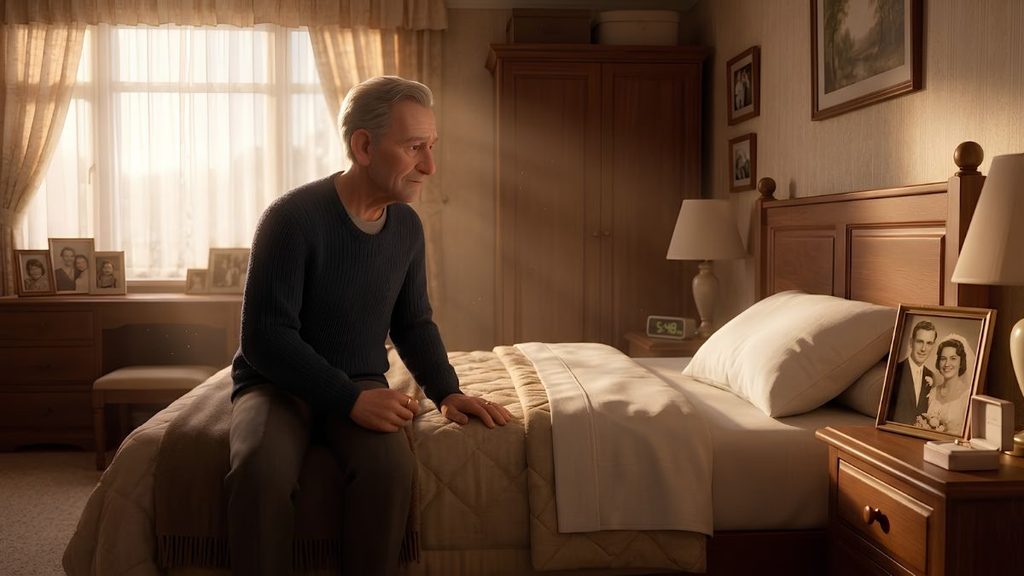
Type: Losing a Spouse
Theme: Love, grief, memories, loneliness, and learning that moving forward does not mean forgetting
Daniel Brooks had been married to Amelia for thirty-eight years.
For most of those years, he had taken her presence for granted.
Not because he didn’t love her.
He loved her deeply.
But when someone becomes part of every ordinary moment of your life, their presence begins to feel as natural as breathing.
Amelia was there when Daniel woke up.
She was there when he came home.
She was there when he couldn’t find his glasses.
She was there when he burned the toast.
She was there when he couldn’t decide what to wear.
She was there on birthdays, anniversaries, rainy Sundays, boring Tuesdays, difficult mornings, and quiet evenings.
She was simply there.
And Daniel never imagined a day when she wouldn’t be.
They had met when Daniel was twenty-seven.
He had been working as a junior architect in Manchester.
Amelia worked at a small publishing company.
They first spoke at a friend’s birthday dinner.
Daniel accidentally spilled water on her handbag.
“I’m sorry.”
Amelia looked at him.
“You’ve just baptized my purse.”
Daniel laughed.
“I’ll buy you a new one.”
“No. You can buy me a coffee.”
“That’s fair.”
The coffee became dinner.
Dinner became another date.
Another date became a relationship.
And three years later, they were married.
Their wedding was small.
There were only family members and close friends.
Amelia wore a simple ivory dress.
Daniel remembered thinking she looked beautiful.
But what he remembered most was what happened after the ceremony.
They were standing outside the church when it began to rain.
Everyone ran for shelter.
Amelia laughed.
Daniel took off his jacket and held it over her head.
“You’ll ruin your dress,” he said.
She smiled.
“So will you.”
“I don’t care.”
She looked at him.
“Good answer.”
For thirty-eight years, they would tell that story.
Their life together was never perfect.
They argued.
Sometimes about money.
Sometimes about work.
Sometimes about Daniel leaving his shoes in the hallway.
Sometimes about Amelia buying books faster than she could read them.
But their arguments never lasted long.
One of them always apologized.
Usually Daniel.
“Fine.”
“What?”
“You were right.”
“I know.”
“You’re enjoying this.”
“A little.”
Then they laughed.
That was their marriage.
Not dramatic.
Not perfect.
Just steady.
Every morning, Daniel woke before Amelia.
He would quietly get out of bed.
Make coffee.
Open the curtains.
Then return with her cup.
Amelia always complained.
“It’s too hot.”
Daniel would say:
“You said that yesterday.”
“And I’ll say it tomorrow.”
He would leave the cup on her bedside table.
Then wait.
Eventually, she would open her eyes.
“Morning.”
“Morning.”
“Did you sleep?”
“Yes.”
“Good.”
Thirty-eight years of the same conversation.
Daniel never imagined how much he would miss it.
Amelia became ill in her late fifties.
At first, it was small things.
Fatigue.
Occasional pain.
Appointments.
Tests.
More appointments.
Eventually came the diagnosis.
The doctor spoke carefully.
Daniel remembered almost none of the words.
He remembered Amelia holding his hand.
He remembered the drive home.
He remembered sitting in the car outside their house for twenty minutes.
Neither of them wanted to go inside.
Finally, Amelia said:
“Come on.”
Daniel looked at her.
“Are you scared?”
She nodded.
“Very.”
“So am I.”
She squeezed his hand.
“Then we’ll be scared together.”
The following months changed everything.
Hospital visits.
Medication.
Long nights.
Short nights.
Good days.
Bad days.
There were days when Amelia felt almost normal.
They would laugh.
Watch television.
Order takeaway.
Talk about old memories.
Then there were days when she couldn’t get out of bed.
Daniel took care of everything.
He learned how to prepare meals she could eat.
He learned which medicines she needed and when.
He learned how to hide his fear.
But Amelia always knew.
One evening, she looked at him.
“You don’t have to pretend.”
“I’m not pretending.”
“You are.”
Daniel looked away.
She smiled.
“You’ve always been a terrible liar.”
He laughed.
Then cried.
She reached for his hand.
“Come here.”
He sat beside her.
She rested her head against his shoulder.
They stayed like that for a long time.
One night, Amelia couldn’t sleep.
Daniel woke.
“You okay?”
“No.”
“What do you need?”
She looked toward the window.
“Nothing.”
“Are you sure?”
“Yes.”
Then she whispered:
“Tell me something.”
“What?”
“Something ordinary.”
Daniel thought.
“Today I saw a man walking a very small dog.”
Amelia smiled.
“What kind?”
“I don’t know.”
“You don’t know?”
“It was dark.”
“Then why are you telling me?”
“Because you asked for something ordinary.”
She laughed softly.
“Fair enough.”
They talked until morning.
About the dog.
The weather.
Their first apartment.
Their wedding.
Their honeymoon.
The time Daniel had accidentally locked himself outside in winter.
The time Amelia had cooked dinner and forgotten to turn on the oven.
They laughed until they were exhausted.
That became one of Daniel’s favorite memories.
Amelia died three weeks later.
She died quietly.
Daniel was holding her hand.
There was no dramatic final speech.
No perfect goodbye.
Only silence.
Then the silence became permanent.
After the funeral, people came to help.
Friends brought food.
Family members called.
Neighbors checked on him.
Everyone said:
“Take your time.”
“You’ll be okay.”
“She wouldn’t want you to be alone.”
Daniel nodded.
But he didn’t know what any of it meant.
How could he be okay?
Amelia wasn’t there.
That was the only fact that mattered.
The first night alone was the hardest.
Daniel entered the bedroom.
The bed looked enormous.
He stood beside it.
Amelia’s pillow was still there.
He touched it.
Then he sat down.
For years, the bed had been divided without discussion.
Amelia slept on the left.
Daniel slept on the right.
She always complained that he took too much space.
Now the entire bed belonged to him.
He hated it.
He moved to the far edge.
He couldn’t sleep.
At three in the morning, he reached across the mattress.
His hand touched cold sheets.
He closed his eyes.
“Goodnight, Amelia.”
Silence.
The following morning, Daniel made two cups of coffee.
He placed one beside the empty chair.
Then he stared at it.
After several minutes, he poured it away.
The next day, he did the same thing.
On the third day, he made only one cup.
He felt guilty.
It seemed ridiculous.
But grief does not always make sense.
Weeks became months.
Daniel stopped going out.
He declined invitations.
He ignored messages.
He went grocery shopping at quiet hours.
He didn’t like seeing couples.
He didn’t like hearing people complain about their partners.
He didn’t like watching romantic films.
Everything reminded him of Amelia.
A song.
A restaurant.
A street.
A smell.
A book.
Even the supermarket aisle where they used to argue about cereal.
One afternoon, Daniel saw a woman holding a box of Amelia’s favorite brand.
He had to leave the store.
His daughter, Sophie, became worried.
“Dad, you need to get out.”
“I’m fine.”
“You always say that.”
“Because I’m fine.”
“No, you’re not.”
Daniel became angry.
“You don’t understand.”
Sophie was quiet.
Then she said:
“You’re right.”
Daniel looked at her.
“I don’t understand what it’s like to lose your wife.”
She paused.
“But I understand what it’s like to lose Mum.”
Daniel looked down.
Sophie sat beside him.
“I miss her too.”
They held hands.
For the first time in months, Daniel allowed himself to grieve with someone else.
One Saturday, Sophie found a box in the bedroom.
“What’s this?”
“Amelia’s things.”
“Have you opened it?”
“No.”
“Why?”
“I don’t know.”
Sophie sat on the floor.
“Let’s open it together.”
Inside were photographs.
Letters.
A scarf.
Old tickets.
A wedding invitation.
Daniel smiled.
“I forgot about this.”
“What?”
“Our first holiday.”
He picked up a photograph.
They were standing beside a lake.
Amelia was wearing a ridiculous hat.
Daniel laughed.
“She hated that picture.”
“Why?”
“She said her hair looked terrible.”
Sophie smiled.
“You both look happy.”
Daniel stared at the photograph.
“We were.”
That evening, Daniel opened another box.
Inside was a notebook.
It belonged to Amelia.
He hesitated.
Then opened it.
Most of the pages contained ordinary things.
Shopping lists.
Book titles.
Appointments.
Garden plans.
Then he found an entry dated several months before her death.
Daniel began reading.
It was about him.
“Daniel worries too much.”
He smiled.
“He thinks I don’t notice.”
Another line.
“He made tea at 2 a.m. again because he couldn’t sleep.”
Daniel laughed.
Then:
“I wish he understood how much I love being cared for by him.”
Daniel stopped.
His eyes filled with tears.
He continued.
“I am frightened about what will happen to him if I am gone.”
He closed the notebook.
He couldn’t read anymore.
The next page was different.
“If Daniel finds this one day, I hope he knows something.”
Daniel stared at the words.
“I don’t want him to spend the rest of his life sitting in an empty room waiting for me.”
Daniel’s breathing became unsteady.
“I want him to remember me, but I also want him to live.”
He pressed the notebook against his chest.
Then he cried.
Not quietly.
Not politely.
He cried the way he hadn’t allowed himself to cry since the funeral.
The following morning, Daniel opened the curtains.
It was raining.
He made coffee.
Only one cup.
Then he looked at the empty chair.
“She’d tell me I’m making it too strong.”
He smiled.
He drank it anyway.
A month later, Daniel returned to the park where he and Amelia had walked every Sunday.
At first, it hurt.
Every bench reminded him of her.
Every tree.
Every path.
But he kept walking.
He began going every Sunday.
Eventually, he started talking to people.
An elderly man with a dog.
A young couple.
A woman who always sat beneath the same tree.
One day, the woman asked:
“Do you come here every week?”
“Yes.”
“Me too.”
They smiled.
They became friends.
Nothing romantic.
Nothing complicated.
Just two people who understood that loneliness could be lighter when shared.
Daniel began rebuilding his life.
Slowly.
He joined a photography club.
He started cooking again.
He visited Sophie more often.
He traveled to places he and Amelia had once discussed visiting.
He didn’t stop missing her.
That surprised him.
He had expected grief to disappear.
Instead, it changed.
At first, it had been an enormous weight.
Then it became a smaller ache.
Eventually, it became something else.
A quiet presence.
A reminder of love.
Three years after Amelia’s death, Daniel returned to their bedroom.
He had changed almost nothing.
But that night, he did something different.
He moved Amelia’s bedside table.
Then her chair.
He opened the curtains.
He changed the sheets.
He placed a photograph of her on the dresser.
Then he stood beside the bed.
For years, he had slept on one side because the other side belonged to her.
Now he understood something.
The empty side of the bed didn’t mean that his life had ended.
It meant that part of his life had changed.
He could honor what had been without refusing what could still be.
Daniel lay down.
For the first time, he didn’t move to the edge.
He slept in the middle.
In the morning, sunlight filled the room.
He woke slowly.
For a brief moment, he forgot.
Then he remembered.
Amelia was gone.
The sadness returned.
But it didn’t destroy him.
He smiled.
“Good morning.”
There was no answer.
But he no longer needed one.
Years later, Daniel would still talk about Amelia.
He would tell people about her terrible singing.
Her love of books.
Her obsession with keeping the kitchen spotless.
Her habit of stealing the blankets.
Her terrible sense of direction.
Her kindness.
Her patience.
Her laugh.
He never described her only by how she died.
He described how she lived.
And that became important to him.
Because death had taken her presence.
It had not taken her story.
On what would have been their fortieth wedding anniversary, Daniel visited the lake where they had spent their honeymoon.
He brought the old photograph.
He sat beneath a tree.
The water was calm.
He took the photograph from his pocket.
“You were right,” he said.
He smiled.
“Your hair did look terrible.”
He laughed.
Then he became quiet.
“I miss you.”
The wind moved through the leaves.
Daniel closed his eyes.
“I always will.”
He put the photograph back into his pocket.
Then he stood.
For the first time, he didn’t feel guilty about leaving.
He walked toward the lake.
Toward the sunlight.
Toward whatever remained of his life.
And he carried Amelia with him.
Not as an absence.
But as a memory.
Love had once meant waking beside her.
Then it meant caring for her.
Then it meant grieving her.
Eventually, Daniel discovered that love could also mean continuing.
Continuing to laugh.
Continuing to travel.
Continuing to make coffee.
Continuing to tell her stories.
Continuing to live.
Because moving forward was not betrayal.
It was not forgetting.
It was simply the next chapter of a story they had started together.
The empty side of the bed would always be there.
But it no longer frightened him.
It reminded him that once, someone had slept there.
Someone had laughed there.
Someone had loved him there.
And although that person was gone, the love remained.
Moral Lesson
Deep love leaves lasting memories, even after a loved one is gone. Grief may change the way we live, but moving forward does not mean forgetting someone. Sometimes the best way to honor a person’s memory is to continue living the life they wanted us to have.
4. Friday at Seven
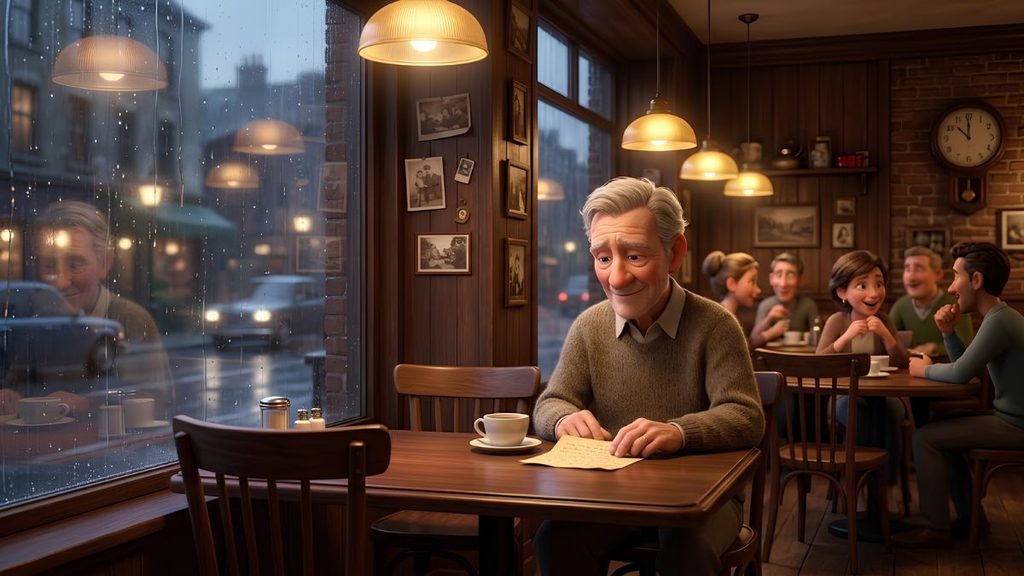
Type: Losing a Best Friend
Theme: Friendship, grief, loyalty, memories, and carrying someone’s kindness forward
Every Friday at exactly seven o’clock, Oliver Grant met Marcus Reed at the same little café.
It had been their tradition for almost twenty years.
No matter how busy the week had been, no matter how tired they were, no matter how bad the weather became, one of them would eventually walk through the café door.
Usually, Marcus arrived first.
He always chose the table near the window.
Oliver always complained that Marcus had taken the better seat.
And Marcus always replied:
“You’re late.”
“I am not.”
“You are.”
“It’s seven.”
“Exactly. I’m already here.”
Then they would laugh.
The routine was so ordinary that neither man ever imagined it would one day become the most important tradition of Oliver’s life.
Oliver and Marcus had met at university.
They were both twenty-one.
Oliver was studying history.
Marcus was studying engineering.
They had almost nothing in common.
Oliver loved books.
Marcus loved machines.
Oliver preferred quiet evenings.
Marcus enjoyed crowded parties.
Oliver planned everything.
Marcus rarely planned anything.
Yet somehow, they became inseparable.
Their friendship survived university.
Then jobs.
Relationships.
Marriages.
Children.
Different cities.
Financial problems.
Career changes.
Arguments.
Years of uncertainty.
Through everything, Friday at seven remained.
Their first Friday evening together happened by accident.
Oliver had just moved into a shared apartment.
His roommate invited Marcus over.
The three men went to the café because there was nowhere else nearby.
Oliver and Marcus stayed after the roommate left.
They talked for hours.
About politics.
Music.
Women.
Their parents.
Their fears.
Their dreams.
By midnight, the café owner had asked them to leave.
Outside, Marcus looked at Oliver.
“Same time next Friday?”
Oliver laughed.
“Why?”
“Because we clearly have more to talk about.”
They returned the following Friday.
Then the next.
Then the next.
Eventually, it became a rule.
Life changed around them.
Marcus married Clara at twenty-nine.
Oliver married Rachel at thirty-one.
Both couples had children.
The two friends became uncles to each other’s families.
Marcus’s daughter, Sophie, called Oliver “Uncle Ollie.”
Oliver’s son, Daniel, once asked Marcus to teach him how to fix a bicycle.
Marcus spent three hours doing it.
“You could have bought him a new one,” Oliver said.
Marcus shook his head.
“He needs to learn.”
“He’s eight.”
“Exactly.”
Oliver laughed.
The years passed quickly.
They both became busier.
Marcus eventually started his own engineering company.
Oliver became a university professor.
There were weeks when they barely spoke outside Friday evening.
Sometimes Friday at seven was the only time they had together.
It became a place where everything could be said.
Bad news.
Good news.
Fears.
Plans.
Regrets.
Nothing was too small.
Nothing was too serious.
One winter Friday, Oliver arrived at seven fifteen.
Marcus was already there.
“You’re late.”
“Traffic.”
“You always say that.”
“It was actually traffic this time.”
Marcus smiled.
“You look tired.”
“So do you.”
“Long week.”
Oliver sat down.
They ordered coffee.
After a few minutes, Marcus said:
“Do you ever wonder what we’d be doing if we hadn’t met?”
Oliver thought.
“Probably something boring.”
Marcus laughed.
“I’m serious.”
“So am I.”
They talked for hours.
Before leaving, Marcus said:
“Same time next week.”
Oliver nodded.
“Of course.”
The next week, Marcus didn’t come.
Oliver waited until 7:15.
Then 7:30.
He called.
No answer.
He sent a message.
Where are you?
Nothing.
At 8:10, he called again.
Still nothing.
Oliver became irritated.
“Typical Marcus.”
He went home.
The following morning, Clara called.
Her voice was trembling.
“Oliver?”
“Yes?”
“It’s Marcus.”
Oliver’s stomach tightened.
“What happened?”
“He collapsed yesterday.”
“Where?”
“At work.”
Oliver stood.
“Is he okay?”
There was silence.
Then Clara said:
“He died last night.”
Oliver didn’t speak.
The room around him seemed unreal.
He sat down.
“No.”
“I’m so sorry.”
“No.”
“He was with the doctors.”
Oliver closed his eyes.
“Did he suffer?”
“No.”
Clara began crying.
“He asked about you.”
Oliver’s heart broke.
“What did he say?”
“He said he was supposed to meet you.”
The funeral was crowded.
Marcus had known hundreds of people.
Employees.
Friends.
Family.
Clients.
Neighbors.
People he had helped.
Oliver stood near the back.
He listened to stories.
Everyone described Marcus differently.
A brilliant engineer.
A loving father.
A generous employer.
A terrible singer.
A loyal brother.
A stubborn husband.
A wonderful friend.
Oliver smiled.
Yes.
That was Marcus.
All of those things.
After the funeral, Oliver stopped going to the café.
He couldn’t explain why.
He simply couldn’t walk through the door.
Every Friday at seven, his phone reminded him.
Friday, 7:00 PM.
For the first few weeks, he deleted the reminder.
Then he stopped checking his phone.
He avoided the neighborhood.
He avoided the café.
He avoided anything that reminded him of Marcus.
One Friday evening, Oliver sat alone at home.
It was seven o’clock.
He looked at the clock.
7:01.
7:10.
7:30.
At 7:45, he finally stood.
He put on his coat.
He drove to the café.
The owner recognized him immediately.
“I haven’t seen you in a while.”
Oliver nodded.
“Can I have the usual?”
The owner looked toward the window table.
Then back at Oliver.
“Two coffees?”
Oliver paused.
“One.”
The owner nodded.
Oliver sat at the table.
The chair opposite him was empty.
He stared at it.
For twenty years, someone had occupied that chair.
Now it was just a chair.
Oliver took out his phone.
He opened Marcus’s contact.
He typed:
You’re late.
He stared at the message.
Then smiled.
He didn’t send it.
Instead, he put the phone away.
The coffee arrived.
Oliver drank slowly.
He stayed for an hour.
Then went home.
The following Friday, he returned.
It became a strange ritual.
Every Friday at seven, Oliver sat at the same table.
Sometimes he read.
Sometimes he worked.
Sometimes he stared out the window.
Sometimes he talked to Marcus in his head.
“You’d hate this book.”
“Work was terrible.”
“Daniel finally got his driver’s license.”
“Clara is doing okay.”
He knew Marcus couldn’t hear him.
But somehow, saying the words helped.
One evening, a young man approached the table.
“Excuse me.”
Oliver looked up.
“Yes?”
“Is this seat taken?”
Oliver looked at the empty chair.
“No.”
The young man sat.
They began talking.
His name was Elliot.
He had recently moved to town.
He didn’t know many people.
They talked about work.
Then family.
Then loneliness.
Oliver realized he was listening in exactly the way Marcus had once listened to him.
The following Friday, Elliot returned.
Then another person joined them.
Then another.
The café slowly became a place where people came to talk.
Not because Oliver had planned it.
It simply happened.
People noticed the older man who sat at the window table every Friday.
They began joining him.
One evening, Oliver told Elliot about Marcus.
“He was my best friend.”
“How long did you know him?”
“Forty years.”
Elliot looked surprised.
“That’s a long time.”
“It was.”
“What was he like?”
Oliver smiled.
“Annoying.”
Elliot laughed.
“Really?”
“Very.”
Then Oliver spent the next hour telling stories.
Marcus fixing Daniel’s bicycle.
Marcus getting lost on holiday.
Marcus accidentally sending an embarrassing email to his entire company.
Marcus pretending not to cry at his daughter’s wedding.
The stories made Oliver laugh.
For the first time, he noticed something.
Talking about Marcus no longer felt like reopening a wound.
It felt like keeping a door open.
Months passed.
Friday at seven became a tradition for more than Oliver.
The café owner put two extra tables near the window.
People brought books.
Food.
Board games.
Sometimes someone brought a guitar.
Sometimes nobody talked much.
It didn’t matter.
The important thing was that nobody had to spend Friday evening alone.
Clara eventually came.
She stood at the entrance and looked around.
Oliver waved.
She sat beside him.
“I wondered what happened here.”
Oliver smiled.
“I don’t know.”
She looked at the people gathered around the tables.
“You’d have liked this.”
Oliver looked at her.
“Marcus?”
She nodded.
“He always hated seeing people alone.”
Oliver smiled.
“You’re right.”
Clara took out a small envelope.
“I found this.”
She handed it to Oliver.
“What’s this?”
“It was in Marcus’s desk.”
Oliver opened it.
Inside was a handwritten note.
It was dated three weeks before Marcus died.
The first line read:
Friday at Seven.
Oliver’s hands began shaking.
He continued reading.
Marcus had written about their friendship.
About the years.
About how important the Friday tradition had become.
Then came a sentence that made Oliver stop.
“If I ever miss a Friday, don’t let the tradition disappear.”
Oliver stared at the page.
Clara said softly:
“He must have written it before he knew.”
Oliver shook his head.
“Maybe he just thought about life.”
Clara nodded.
“That’s what he did.”
Oliver read the final paragraph.
“We started Friday at Seven because we didn’t want to lose touch. But maybe the real reason was that everyone needs somewhere they know they’ll be welcomed.”
Oliver’s eyes filled with tears.
He folded the letter carefully.
Then placed it inside his jacket.
From that evening onward, Oliver changed the name of the gathering.
He called it:
Friday at Seven.
There were no rules.
You didn’t have to know anyone.
You didn’t have to bring anything.
You didn’t have to talk.
You simply had to come.
Every Friday at seven, the door was open.
Years passed.
Children grew up.
People moved away.
New people arrived.
The café changed owners.
The furniture changed.
The neighborhood changed.
But Friday at seven remained.
Oliver became known as the man who never missed it.
He grew older.
His hair turned white.
His steps became slower.
But every Friday, he sat at the window.
Sometimes people asked:
“Why do you still come?”
He always answered:
“My friend asked me to.”
One winter evening, Oliver brought his grandson, Henry.
Henry was seventeen.
He sat beside him.
“Grandad?”
“Yes?”
“Who is Marcus?”
Oliver smiled.
“My best friend.”
“Was he the reason for all this?”
“Yes.”
“Why did he start it?”
Oliver looked around the café.
“Because he didn’t want people to feel alone.”
Henry thought about this.
Then asked:
“Did it work?”
Oliver looked at the crowded tables.
People were laughing.
Someone was telling a story.
Two strangers were playing chess.
A woman was quietly reading.
A young man was talking to an elderly couple.
Oliver smiled.
“I think so.”
When Oliver was eighty, he began writing down Marcus’s stories.
He wanted the younger generations to know who Marcus had been.
Not just the successful businessman.
Not just the father.
Not just the man whose name appeared on a memorial plaque.
He wanted people to know his friend.
The man who arrived early.
The man who hated bad coffee.
The man who always fixed broken bicycles.
The man who believed everyone deserved a place at the table.
Oliver’s final entry was short.
“Marcus died years ago. But every Friday at seven, I still meet him here.”
He paused.
Then added:
“Not because I think he will walk through the door.”
“Because he already did.”
Oliver died peacefully many years later.
He had attended his final Friday at Seven only two weeks before.
That evening, he sat by the window.
Henry sat beside him.
“Grandad, you want to go home?”
Oliver shook his head.
“Not yet.”
He looked around the café.
People were laughing.
Talking.
Sharing food.
Exactly as Marcus had imagined.
Oliver smiled.
“Your grandfather started this.”
Henry smiled.
“No. You did.”
Oliver shook his head.
“No.”
He looked at the empty chair opposite him.
“Marcus did.”
After Oliver’s funeral, Henry thought about ending Friday at Seven.
It seemed impossible to continue without Oliver.
But on the following Friday, Henry arrived at the café at six forty-five.
He sat at the window.
At seven o’clock, the owner brought him coffee.
Then someone else arrived.
Then another.
Soon the café was full.
Henry looked at the empty chair opposite him.
He smiled.
“You’re late, Marcus.”
Then he laughed.
The tradition continued.
Decades later, Friday at Seven was still happening.
Nobody remembered exactly when it began.
New generations came.
Some knew the story.
Others didn’t.
But every Friday at seven, people gathered.
Some were old.
Some were young.
Some were strangers.
Some were lonely.
Some were celebrating.
Some were grieving.
But they all had a place.
And somewhere, in the story of that little café, two friends who had once met by accident had created something that outlived both of them.
Marcus had died.
Oliver had eventually died too.
But their friendship had not disappeared.
It had changed shape.
It became a chair.
A table.
A cup of coffee.
A weekly gathering.
A stranger being welcomed.
A lonely person finding company.
A story being told.
A laugh shared.
That was the strange thing about love and friendship.
Sometimes a person leaves the world.
But what they taught us remains.
Sometimes their kindness becomes our kindness.
Their traditions become ours.
Their words become part of our decisions.
Their memory becomes a reason to help someone else.
And sometimes, the best way to remember a friend isn’t to sit alone and mourn the empty chair.
It is to pull another chair toward the table.
Invite someone to sit.
And keep the conversation going.
Moral Lesson
True friendship can continue to influence us long after someone is no longer beside us. When we carry a friend’s kindness, values, and traditions forward, a part of their presence remains in the world through the lives they touched.
5. The Birthday Candle
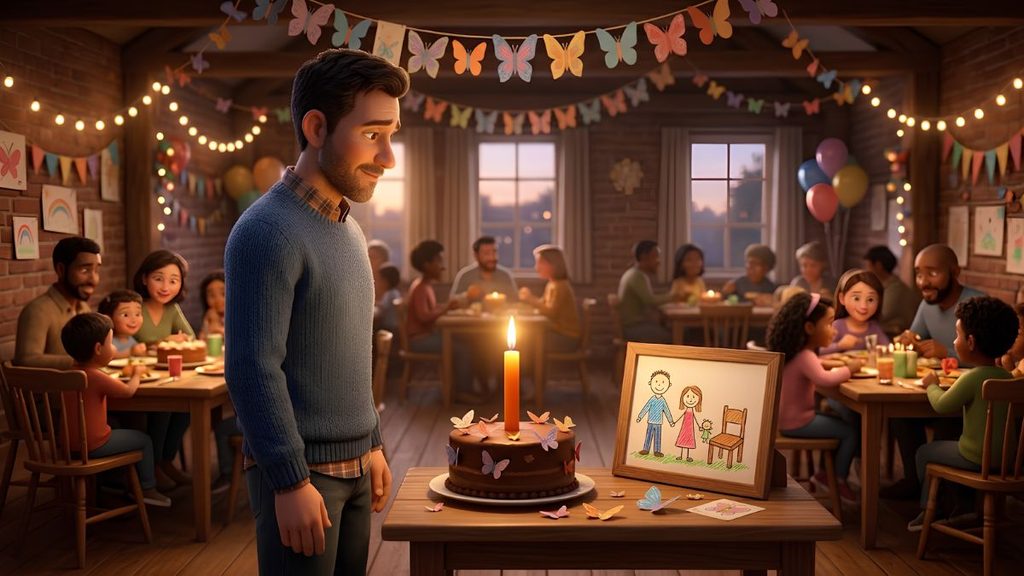
Type: Losing a Child
Theme: Grief, parental love, memory, and finding a way to keep love alive
James Carter had always believed birthdays were supposed to be noisy.
There should be music.
There should be balloons.
There should be cake.
There should be someone laughing too loudly.
There should be candles that took several attempts to blow out.
And there should always be a child making a wish.
For James and his wife, Sophie, birthdays had once meant all of those things.
Especially one birthday.
Their daughter Lily’s birthday.
Lily had been eight years old when she died.
Years later, James still remembered exactly how she laughed.
It wasn’t a quiet laugh.
It began as a little giggle and quickly became impossible to control.
Whenever Lily found something funny, everyone around her eventually started laughing too, even if they hadn’t understood the joke.
James used to say that her laugh could make an unhappy room feel warm.
After she died, the house became very quiet.
Lily had been a curious child.
She asked questions about everything.
Why did birds know where to fly?
Why did the moon follow the car?
Why did grown-ups drink coffee when it tasted bitter?
Why couldn’t dogs talk?
Why did people have to sleep?
And one question she asked repeatedly was:
“Why do birthdays only happen once a year?”
“Because that’s how calendars work,” James would say.
“Who decided that?”
“I don’t know.”
“That’s strange.”
She would then return to whatever she had been doing.
Lily never accepted simple answers.
She wanted to understand the world.
Her favorite birthday was her eighth.
She wanted a garden party.
Not an expensive one.
Not a huge one.
Just a few friends, a chocolate cake, paper decorations, and a treasure hunt.
James spent two weeks preparing clues.
Sophie made the cake.
Lily decorated the garden.
She hung paper butterflies from the trees.
She placed colorful stones around the flower beds.
Then she made one final decoration.
A large paper sun.
She wrote on it:
“Make today happy.”
James kept that decoration.
He didn’t know why at the time.
Years later, he would understand.
Lily’s ninth birthday never came.
Neither did her tenth.
Her eleventh.
Or her twelfth.
The years after her death became difficult to measure.
At first, there were weeks.
Then months.
Then years.
James sometimes felt as though time had stopped on the day Lily died.
The world continued.
People went to work.
Children went to school.
Neighbors complained about traffic.
Stores changed their decorations.
Spring returned.
Then summer.
Then autumn.
Then winter.
But inside James, one part of life remained frozen.
The first birthday after Lily’s death was the hardest.
Sophie refused to buy a cake.
James didn’t mention the date.
They went through the day separately.
Neither wanted to hurt the other by talking about it.
That evening, James walked into Lily’s room.
Her toys were still there.
Her books.
Her drawings.
Her little blue lamp.
On the wall was a calendar.
The birthday date was circled in red.
James sat on the floor.
He looked at the circle.
Then he began crying.
Sophie found him there.
She sat beside him.
Neither spoke.
Eventually, Sophie whispered:
“I don’t know what we’re supposed to do.”
James shook his head.
“Neither do I.”
The following year, they decided not to celebrate.
They didn’t want balloons.
They didn’t want cake.
They didn’t want to pretend everything was normal.
They simply went to Lily’s favorite park.
They sat beneath a tree.
Sophie brought flowers.
James brought the paper sun from her eighth birthday.
They placed it beneath the tree.
For the first time, they spoke about Lily’s birthday without feeling as though they were doing something wrong.
They talked about the treasure hunt.
The cake.
The butterflies.
The ridiculous paper sun.
They even laughed.
James felt guilty.
“We shouldn’t be laughing.”
Sophie looked at him.
“Why not?”
“I don’t know.”
“Lily would have laughed.”
James smiled.
“She would.”
After that, they returned to the park every year.
They brought flowers.
Sometimes they brought photographs.
Sometimes they simply sat quietly.
The ritual helped.
But it didn’t erase the grief.
Nothing could.
There were still difficult mornings.
There were still songs James couldn’t listen to.
There were still children’s birthdays that made his chest tighten.
There were still moments when he saw a little girl with the same hairstyle Lily had worn and had to look away.
Grief remained.
It simply changed.
One afternoon, several years later, James was cleaning the attic.
He found a cardboard box labeled:
LILY’S DRAWINGS
He sat down.
He opened it.
Inside were dozens of pictures.
Houses.
Animals.
Trees.
Family portraits.
Dragons.
Princesses.
A crooked drawing of James wearing a crown.
He laughed.
“Apparently I was a king.”
Sophie came upstairs.
“What did you find?”
“Lily’s drawings.”
They sat together on the attic floor.
Then Sophie pulled out a notebook.
“What is this?”
James didn’t know.
They opened it.
It was Lily’s handwriting.
Some pages contained drawings.
Others had little stories.
One page had a list titled:
Things I Want to Do When I Grow Up
The list included:
See the ocean.
Have a dog.
Build a treehouse.
Learn to paint.
Make a cake taller than Dad.
James smiled.
Then his eyes filled with tears.
He whispered:
“She really was going to make that cake.”
The next page was different.
It contained a drawing of their family.
James.
Sophie.
Lily.
And an empty chair.
James stared at it.
“Why is there a chair?”
Sophie looked at the drawing.
“I don’t know.”
Underneath, Lily had written:
“For whoever needs a place.”
James read it again.
For whoever needs a place.
Those words stayed with him.
A few days later, James and Sophie talked about Lily’s birthday.
“What if we invited people?” Sophie asked.
“Who?”
“Families.”
“Which families?”
“People who don’t have anyone to celebrate with.”
James thought about it.
“You mean a party?”
“Not exactly.”
“What then?”
Sophie smiled.
“Dinner.”
They rented a small community hall.
They didn’t put up balloons.
They didn’t make a big announcement.
They simply invited families who might otherwise spend the evening alone.
Some were elderly couples.
Some were single parents.
Some had recently moved to the area.
Some were struggling financially.
There were children.
There were grandparents.
There were people who had never met before.
James prepared tables.
Sophie cooked.
At the center of the room, they placed one candle.
Not a large one.
Just a small white candle.
They didn’t put Lily’s name on it.
They didn’t need to.
When everyone arrived, James stood at the front.
He didn’t know what to say.
He looked at Sophie.
She nodded.
James took a breath.
“My daughter Lily would have been twelve today.”
The room became quiet.
“She loved birthdays.”
A few people smiled.
“So every year, my wife and I used to feel like this day belonged only to our grief.”
He paused.
“But Lily taught us something before she left.”
James looked at the candle.
“She believed everyone should have a place.”
He explained the drawing.
Then he said:
“Tonight, this table is that place.”
The dinner began.
At first, everyone was quiet.
Then someone told a joke.
A child laughed.
Another child joined.
Soon the room became louder.
People talked.
They shared food.
Someone brought a guitar.
A little boy began dancing.
James watched.
His heart hurt.
But it also felt warm.
He imagined Lily running through the room.
She would have loved it.
At the end of the evening, Sophie brought out a chocolate cake.
James looked surprised.
“You made cake?”
“Of course.”
She smiled.
“But there isn’t enough for everyone.”
James laughed.
“Then Lily would say we made it too small.”
They cut the cake.
Everyone received a piece.
Then the children began arguing about who had the largest slice.
James laughed.
For a moment, he felt something he hadn’t felt in years.
Not happiness exactly.
Something gentler.
Peace.
The following year, they did it again.
Then again.
The event grew.
More families came.
Local businesses donated food.
Neighbors volunteered.
Children brought toys to share.
People began calling it Lily’s Table.
James never planned for that to happen.
He didn’t want a monument.
He didn’t want people to remember only that Lily had died.
He wanted them to know that she had lived.
She had laughed.
She had asked strange questions.
She had decorated gardens.
She had loved chocolate cake.
She had wanted everyone to have a place.
One year, a young girl named Emma came to the dinner.
She was about Lily’s age.
She sat quietly beside her mother.
James noticed that she wasn’t eating.
“Don’t like cake?”
Emma shook her head.
“Too sweet?”
She shook her head again.
“What’s wrong?”
Emma looked down.
“My dad died.”
James sat beside her.
“I’m sorry.”
She nodded.
“Everyone keeps telling me he’ll always be in my heart.”
James waited.
“I don’t know what that means.”
James understood.
He had heard the same words.
He had said them himself.
But sometimes grief needed something more than comforting phrases.
“You don’t have to understand it yet,” he said.
Emma looked at him.
“You don’t?”
“No.”
She seemed relieved.
James continued:
“Sometimes you just miss someone.”
Emma nodded.
“And sometimes you remember something funny and laugh.”
Another nod.
“And sometimes you cry again.”
“Yes.”
“All of that is okay.”
Emma finally took a bite of cake.
“Is it Lily’s birthday?”
James smiled.
“Yes.”
“Would she have liked this?”
James looked around the room.
Children laughing.
Parents talking.
People eating.
An elderly man telling a story.
“Very much.”
As the years passed, James discovered something important.
Lily’s death had changed his life.
But it didn’t have to make every year afterward only about loss.
He could miss her and still laugh.
He could remember her and still make new memories.
He could love her without remaining trapped in the day she died.
That realization didn’t happen suddenly.
It happened slowly.
One birthday at a time.
On what would have been Lily’s twentieth birthday, James returned to the garden where she had celebrated her eighth.
The house had changed.
The garden was different.
But one rose bush remained.
James had planted it years earlier.
He sat beside it.
In his hands was the old paper sun.
It was faded now.
The edges were torn.
But the words could still be read.
Make today happy.
James smiled.
“You were right, Lily.”
He touched the paper.
“You were always right.”
Sophie joined him.
They sat together.
“Do you remember the cake?” she asked.
“The one you burned?”
“I didn’t burn it.”
“It was black.”
“It was chocolate.”
“It was charcoal.”
She laughed.
James laughed too.
Then they sat quietly.
After a while, Sophie said:
“I wish she could see what this became.”
James nodded.
“Me too.”
He looked toward the garden.
“But I think she’d be happy.”
That evening, Lily’s Table gathered hundreds of people.
Children ran through the hall.
There were cakes.
There were flowers.
There was music.
There were stories.
And at the center of every table was a small candle.
James stood at the doorway and watched.
He thought about the little girl who had once drawn a picture of a chair.
For whoever needs a place.
She had been too young to understand how powerful those words were.
But she had understood something important.
People need somewhere to belong.
Especially when they are hurting.
Years later, when James became too old to organize the event himself, Sophie took over.
Then Lily’s Table became a tradition in the community.
New volunteers joined.
New families arrived.
Children who had once attended grew up and returned with children of their own.
The story of Lily became less about the tragedy of her death and more about the kindness that grew from her memory.
James preferred it that way.
Whenever someone asked:
“How old would Lily be now?”
He would answer.
Then smile.
“And what was she like?”
That was the question he loved.
Because it allowed him to talk about her life.
Not just her death.
On James’s final birthday, Sophie brought him a small chocolate cake.
He was sitting beside the window.
“Where’s everyone else?”
“They’re coming.”
“What about Lily’s Table?”
“Still happening.”
James smiled.
“Good.”
Sophie placed the cake in front of him.
There was one candle.
James looked at it.
“Only one?”
“You’re getting old.”
He laughed.
Then Sophie lit it.
James stared at the flame.
For a moment, he remembered Lily.
Her eighth birthday.
The garden.
The butterflies.
The treasure hunt.
The paper sun.
Her laughter.
He closed his eyes.
“What did you wish for?” Sophie asked.
James smiled.
“Nothing.”
“Why?”
“Because I already got what I wanted.”
Sophie looked confused.
James reached for her hand.
“I got to be her father.”
That night, Sophie sat beside her father.
They looked through Lily’s old drawings.
The paper sun was there.
The family picture was there.
And the drawing of the empty chair.
Sophie placed it carefully into a frame.
Then she wrote underneath:
“For whoever needs a place.”
She hung it in the community hall where Lily’s Table continued.
And every year, on Lily’s birthday, a single candle was placed beneath it.
Not as a symbol of death.
But as a symbol of love.
Because Lily’s life had been short.
But it had not been meaningless.
She had left behind laughter.
Questions.
Drawings.
Recipes.
Stories.
Memories.
And one simple idea:
There should always be room at the table.
For someone lonely.
For someone grieving.
For someone who has nowhere else to go.
For someone who simply needs to feel welcome.
James had once thought that losing Lily meant losing the future he had imagined for her.
He was right.
There would never be the first day of university.
The first job.
The first apartment.
The wedding.
The children.
All the milestones he had once imagined.
But there was something else.
There was the life she had already lived.
And that life mattered.
Every birthday she had celebrated.
Every laugh.
Every question.
Every hug.
Every ordinary afternoon.
None of it became meaningless because it ended.
And perhaps that was the hardest lesson James ever learned.
Love does not become less valuable because it ends in grief.
A short life can still leave a long shadow of kindness.
A child can leave an adult with lessons that last decades.
And sometimes the best way to remember someone who is gone is not to spend every birthday staring at an empty chair.
It is to make room for someone else.
Light a candle.
Share a meal.
Tell a story.
Laugh when you can.
Cry when you need to.
And remember.
Always remember.
Because the people we love may not get to stay as long as we hoped.
But the love they gave us can continue long after they are gone.
Moral Lesson
When someone we love dies, remembering them does not mean remaining trapped in grief. We can honor their life by carrying their kindness forward, creating meaningful memories, and making room for others who need love and companionship.
6. The Phone Call I Never Made

Type: Regret After Death
Theme: Regret, forgiveness, missed opportunities, family, and learning to express love before it is too late
Daniel Harper had a habit of postponing things.
He postponed doctor’s appointments.
He postponed cleaning the garage.
He postponed replacing the broken kitchen light.
He postponed vacations.
He postponed difficult conversations.
But there was one thing he had postponed for years.
Calling his older brother, Thomas.
It was never because Daniel hated him.
That would have been easier.
Hate was simple.
Their problem was much more complicated.
They loved each other.
They simply didn’t know how to speak anymore.
Daniel and Thomas had grown up in a small town in northern England.
Thomas was four years older.
As children, they were inseparable.
They built forts in the garden.
Rode bicycles through the neighborhood.
Played football until their mother called them home.
When Daniel was frightened by thunderstorms, Thomas let him sleep on the floor beside his bed.
When Daniel struggled with mathematics, Thomas helped him study.
When Daniel broke a neighbor’s window with a football, Thomas took the blame.
Their mother was furious.
Thomas received the punishment.
Daniel never forgot it.
As teenagers, things changed.
Thomas became serious.
He wanted to work.
Daniel wanted to explore.
Thomas stayed close to home.
Daniel wanted to leave.
They began arguing.
At first, the arguments were small.
Then they became about everything.
Money.
Family.
Their father’s expectations.
Daniel’s choices.
Thomas’s stubbornness.
Eventually, they stopped talking about what the arguments were really about.
They simply became angry.
Their biggest argument happened when their father became ill.
Thomas wanted Daniel to move back home and help.
Daniel had just received an opportunity to work abroad.
He wanted to take it.
Thomas said:
“Family should come first.”
Daniel replied:
“That doesn’t mean I have to give up my whole life.”
Thomas became angry.
“You always run away when things get difficult.”
Daniel stared at him.
“And you always act like you’re the only one who cares.”
The words hurt.
Neither apologized.
Daniel left the next morning.
He moved to Canada.
The job became a career.
The career became a life.
He married.
He bought a house.
He had two children.
He became successful.
Thomas remained in England.
He married too.
He worked in construction.
He raised one daughter.
Their lives continued separately.
They spoke occasionally.
Birthdays.
Christmas.
Family emergencies.
But the conversations were short.
“How are you?”
“Fine.”
“How’s work?”
“Busy.”
“How’s everyone?”
“Good.”
Then silence.
Neither knew how to cross the distance.
Daniel often thought about calling Thomas.
He would pick up his phone.
Find his brother’s name.
Then hesitate.
What would he say?
“Hello, it’s been ten years”?
“I’m sorry”?
“I miss you”?
None of those words seemed sufficient.
So he would tell himself:
I’ll call tomorrow.
Tomorrow became next week.
Next week became next month.
Then another year.
One winter morning, Daniel’s daughter, Emma, asked him:
“Dad, why don’t we visit Uncle Thomas?”
Daniel looked at her.
“We should.”
“Then why don’t we?”
Daniel smiled awkwardly.
“I don’t know.”
Emma noticed his expression.
“Do you want to?”
“Yes.”
“Then call him.”
Daniel laughed.
“You make it sound easy.”
“It is.”
“No, it isn’t.”
“Why?”
Daniel didn’t answer.
Because the truth was embarrassing.
He was afraid.
Afraid that Thomas would reject him.
Afraid that Thomas was still angry.
Afraid that his brother might say:
“It’s too late.”
That evening, Daniel opened his phone.
He found Thomas’s number.
He stared at it.
Then pressed call.
The phone rang.
Once.
Twice.
Three times.
Daniel panicked.
He ended the call.
His heart was racing.
He laughed at himself.
“Ridiculous.”
He put the phone down.
Then promised:
Tomorrow.
The next morning, Daniel received a call.
It wasn’t Thomas.
It was his niece, Emily.
Her voice was quiet.
“Uncle Daniel?”
“Yes?”
“It’s Dad.”
Daniel knew immediately.
“What happened?”
“He died last night.”
The room seemed to disappear.
Daniel sat down.
“When?”
“Yesterday evening.”
Daniel closed his eyes.
“Was he ill?”
“No.”
There was a pause.
“He just collapsed.”
Daniel couldn’t speak.
Then Emily said:
“He was asking about you.”
Daniel covered his face.
“I tried to call.”
Emily was silent.
“I mean… I was going to call.”
She whispered:
“I know.”
The funeral was two weeks later.
Daniel flew back to England.
He had not been in his hometown for almost fifteen years.
Everything looked smaller.
The streets.
The houses.
The school.
The football field.
Even the old park.
He stood outside the church.
For a moment, he felt like a child again.
He expected Thomas to appear.
Maybe laugh.
Maybe complain.
Maybe say:
“You’re late.”
But Thomas wasn’t coming.
After the funeral, Emily gave Daniel a box.
“This was Dad’s.”
“What is it?”
“Things from his desk.”
Daniel opened it.
There were photographs.
A watch.
Old receipts.
A football ticket.
A childhood drawing.
Daniel picked up the drawing.
It was a picture of two boys.
One taller.
One shorter.
Underneath, in Thomas’s handwriting, were the words:
My little brother.
Daniel began crying.
There was another envelope.
Daniel opened it.
Inside was a photograph of the two brothers as children.
They were standing beside their bicycles.
Daniel remembered the day.
They had ridden ten miles without telling their parents.
Their mother had been furious.
Thomas had laughed the entire way home.
Daniel turned the photograph over.
On the back was a sentence.
We were idiots.
Daniel laughed through his tears.
Then he noticed something else.
Below it, Thomas had written:
I miss those days.
Daniel sat at the desk where Thomas had worked.
He looked around.
The room was ordinary.
Books.
Tools.
Photographs.
A mug.
A calendar.
A small plant.
There was nothing dramatic about it.
His brother had simply lived here.
And now he wasn’t.
Emily came into the room.
“Did Dad ever talk about me?”
Daniel asked.
She smiled.
“All the time.”
Daniel looked surprised.
“What did he say?”
“He said you were stubborn.”
Daniel laughed.
“That sounds right.”
“He also said you were the most talented person he knew.”
Daniel stopped smiling.
“He said that?”
“Many times.”
Daniel looked down.
“Why didn’t he tell me?”
Emily shrugged.
“Maybe he thought you knew.”
Daniel closed his eyes.
He had spent years assuming his brother was angry with him.
Perhaps Thomas had spent years assuming Daniel knew he was loved.
Both had been wrong.
That night, Daniel walked through the town.
He passed the old football field.
Then the bicycle path.
Then the small bridge where he and Thomas had once thrown stones into the river.
He sat on a bench.
He took out his phone.
Thomas’s number was still there.
Daniel knew he would never answer.
But he didn’t delete it.
He wasn’t ready.
The next morning, Daniel returned to the family home.
Emily was in the kitchen.
She was making tea.
“I found something else,” she said.
“What?”
She handed him an old answering machine.
Daniel laughed.
“Does this still work?”
“Probably not.”
They plugged it in.
To their surprise, it turned on.
There were several old recordings.
Most were from family members.
Then Daniel heard his own voice.
It was from fifteen years earlier.
He had called Thomas once.
Thomas had been away.
Daniel had left a message.
“Hi, Tom. It’s me. Just wanted to say hello. Call me when you get this.”
The message ended.
Daniel stared at the machine.
He had forgotten about it.
Then another message played.
Thomas’s voice.
“Dan, it’s me.”
Daniel froze.
His brother sounded younger.
“I got your message. Sorry I missed you.”
There was a pause.
“I don’t know if you’re still angry.”
Daniel’s eyes filled with tears.
“I hope you’re doing okay.”
Another pause.
“Call me.”
Then the recording ended.
Daniel sat perfectly still.
“Did they ever talk after that?” Emily asked.
Daniel shook his head.
“No.”
“Why?”
“I don’t know.”
But he did know.
He had been busy.
He had been stubborn.
He had been afraid.
He had told himself there would be another chance.
Daniel returned to Canada a week later.
He changed his life in small ways.
Not dramatically.
He started calling his mother every Sunday.
He called old friends.
He apologized to people he had argued with.
He visited his sister more often.
He stopped ending conversations with:
“We’ll talk later.”
Instead, he stayed a little longer.
One evening, Emma found him sitting in the living room.
“Are you okay?”
Daniel smiled.
“Yes.”
“You miss Uncle Thomas?”
“Every day.”
“What do you miss most?”
Daniel thought.
“His voice.”
Emma sat beside him.
“Do you wish you had called him?”
Daniel looked down.
“Yes.”
She was quiet.
Then asked:
“Why didn’t you?”
Daniel didn’t give her the complicated answer.
He gave her the honest one.
“I thought I had more time.”
Emma looked at him.
“Do you think he knew you loved him?”
Daniel nodded.
“I hope so.”
Then he smiled.
“I think he did.”
A year later, Daniel returned to England.
He brought his children.
He took them to the places where he and Thomas had grown up.
The football field.
The bicycle path.
The river.
The old school.
He told them stories.
Funny stories.
Embarrassing stories.
Stories about Thomas.
His children laughed.
“Was Uncle Thomas always that annoying?”
“Absolutely.”
“Did you like him?”
Daniel smiled.
“I loved him.”
Before leaving town, Daniel visited the cemetery.
He stood beside Thomas’s grave.
He didn’t bring flowers.
He brought the old photograph.
He placed it beside the headstone.
Then he sat down.
“I should have called.”
The wind moved through the trees.
“I know that’s not enough.”
He looked at the photograph.
“But I wish I had.”
He paused.
“Thank you for always being my big brother.”
Then he smiled.
“And for taking the blame for that window.”
For a moment, Daniel laughed.
Then cried.
Then laughed again.
Before leaving, Daniel said one final thing.
“I love you.”
He knew Thomas couldn’t hear him.
But saying it still mattered.
Maybe it was years too late.
Maybe the words should have been spoken when Thomas was alive.
But Daniel had finally understood something.
Regret cannot change the past.
But it can change the future.
From then on, Daniel became the person who called first.
When a friend mentioned being lonely, Daniel called.
When his daughter was upset, Daniel stayed on the phone.
When his mother complained about something for twenty minutes, Daniel listened.
When an old friend sent a message after years of silence, Daniel replied immediately.
He stopped waiting for perfect moments.
There were no perfect moments.
There were only moments.
Years later, Daniel’s son asked him:
“Why do you call everyone so much?”
Daniel smiled.
“Because sometimes people need to hear a voice.”
“Whose?”
“Someone who cares.”
His son nodded.
Then left the room.
A few minutes later, Daniel’s phone rang.
It was his son.
“Hey, Dad?”
“Yes?”
“I just wanted to say I love you.”
Daniel smiled.
“I love you too.”
The call lasted less than a minute.
But Daniel knew he would remember it.
The phone call Daniel never made became the phone call that changed how he lived.
He couldn’t make that call anymore.
He couldn’t hear Thomas answer.
He couldn’t repair the years they had lost.
But he could refuse to lose more time with the people who remained.
That was the lesson his brother left behind.
Not through a final speech.
Not through a grand gesture.
But through silence.
Through regret.
Through a missed opportunity.
And eventually, through love.
Daniel kept Thomas’s number in his phone for the rest of his life.
He never called it.
He didn’t need to.
Whenever he saw the name, he remembered.
Don’t wait.
Call the person.
Send the message.
Visit the friend.
Apologize.
Forgive.
Say:
“I love you.”
Say:
“I miss you.”
Say:
“I’m sorry.”
Say whatever needs to be said.
Because one day, there may be no one left to answer.
And the hardest call to live with is not the one that ended badly.
It is the one you never made at all.
Moral Lesson
Regret often comes from words left unsaid and opportunities repeatedly postponed. We cannot change conversations we failed to have, but we can learn from them. If someone matters to you, don’t assume there will always be another chance to call, apologize, forgive, or say “I love you.”
7. The Watch on the Mantel
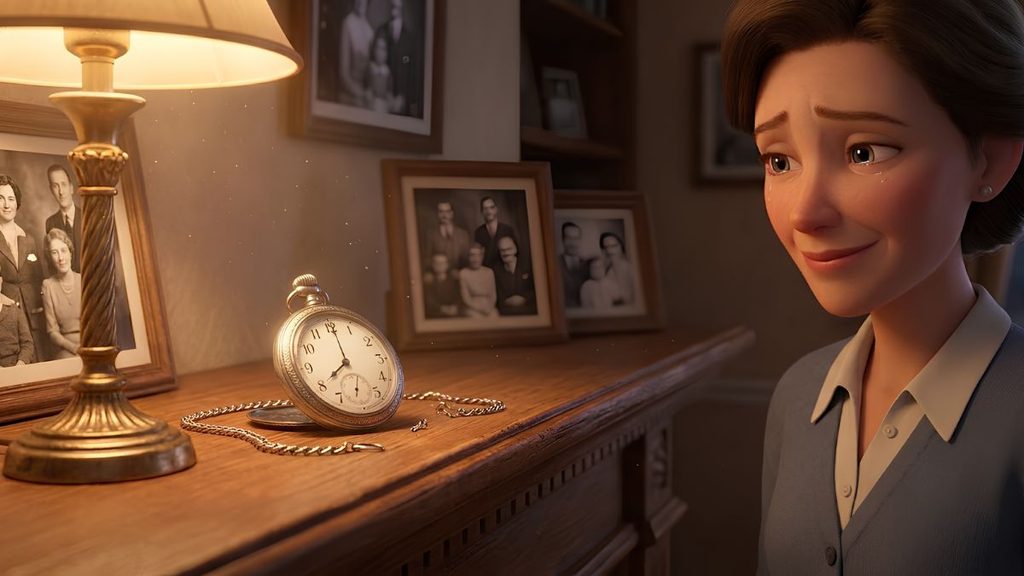
Type: Objects Left Behind
Theme: Memory, grief, family, and the emotional value of things that remain after someone dies
When Clara Bennett first saw the watch on the mantel, she almost threw it away.
It was an old silver pocket watch.
The glass was scratched.
The chain was broken.
The hands had stopped at 8:17.
There was nothing particularly beautiful about it.
Yet her father had kept it on the mantel for almost forty years.
He dusted around it.
Moved it whenever he cleaned.
Polished the silver once every few months.
But he never repaired it.
When Clara was a child, she had asked him why.
“Because it reminds me of your grandfather.”
That was all he ever said.
Now her father was gone too.
And the watch was still there.
Clara stood in the living room of her parents’ old house three days after the funeral.
The house was quiet.
Too quiet.
Her father’s reading glasses remained beside his chair.
His newspaper was folded on the table.
A half-empty jar of biscuits sat in the kitchen.
His coat still hung behind the front door.
Everywhere she looked, there were signs of him.
But he wasn’t there.
Her mother had died six years earlier.
Now the house belonged to silence.
Clara had come to sort through everything.
There were boxes to pack.
Documents to organize.
Furniture to donate.
Clothes to give away.
Photographs to save.
The practical work of grief.
Sometimes practical work was easier than feeling.
Her younger brother, James, was helping.
He carried a box down the stairs.
“Where should this go?”
“Garage.”
James nodded.
They worked quietly.
After an hour, Clara looked toward the mantel.
The watch was still there.
“Do you remember that?”
James followed her gaze.
“Of course.”
“Dad never explained why it stopped.”
“He did.”
Clara looked at him.
“When?”
“When you were in university.”
“I don’t remember.”
James smiled.
“You weren’t there.”
James walked toward the mantel.
He picked up the watch.
“He told me the story.”
“What story?”
James sat down.
“Our grandfather died when Dad was nineteen.”
Clara nodded.
“I know.”
“But you don’t know how.”
“No.”
“He died at work.”
Clara’s expression changed.
“What happened?”
James shook his head.
“Dad never liked talking about it.”
He turned the watch over.
“There was an accident.”
Their grandfather, Edward Bennett, had worked at a railway workshop.
He was known for being punctual.
Every morning, he left home at 6:40.
Every evening, he returned at exactly 5:30.
He carried the same lunchbox.
Wore the same brown coat.
And carried the silver watch.
It had been a gift from his wife.
On the day Edward died, the watch stopped at 8:17.
The accident had damaged it.
But Edward’s wife kept it.
Then she gave it to their son, Michael.
Clara’s father.
Michael kept it for the rest of his life.
“Why didn’t he repair it?” Clara asked.
James shrugged.
“Because he didn’t want to.”
“That makes no sense.”
“It made sense to Dad.”
Clara picked up the watch.
It was heavier than she expected.
She opened the cover.
The hands remained frozen.
8:17.
She looked at it.
Then closed it.
“What happened to Grandma?”
“She kept it in a drawer.”
“For years?”
“Yes.”
“Then Dad took it?”
“After she died.”
Clara looked toward the empty chair where her father used to sit.
“Why didn’t he tell me?”
James smiled sadly.
“Maybe you never asked.”
That sentence stayed with Clara.
Maybe you never asked.
There were so many things she had never asked.
What was her father like as a teenager?
What did her grandparents dream about?
What did her father fear?
What had he regretted?
What did he remember about his parents?
She had spent her childhood believing parents were simply parents.
Permanent.
Unchanging.
She had never considered that they had once been young people with their own dreams and fears.
Now there was no one left to ask.
That evening, Clara decided to take the watch home.
She wrapped it in a cloth.
Placed it inside her handbag.
Then continued packing.
At home, Clara placed the watch on her own mantel.
It looked strange there.
Too old.
Too quiet.
Her husband, Daniel, noticed it.
“What’s that?”
“My father’s.”
He picked it up.
“Does it work?”
“No.”
“Want me to fix it?”
Clara shook her head.
“No.”
“Why?”
She looked at the watch.
“Because Dad never wanted it fixed.”
Daniel nodded.
“Fair enough.”
For the next few months, Clara forgot about it.
She went back to work.
She took care of her children.
She attended family gatherings.
She paid bills.
She lived.
But every time she walked past the mantel, she saw the watch.
And every time she saw it, she thought of her father.
Not his funeral.
Not his final days.
The ordinary things.
His hands around a cup of tea.
His voice calling her from the garden.
His habit of humming while cooking.
The way he always checked the weather before leaving home.
The way he said:
“Take a coat.”
Even when it wasn’t cold.
One winter afternoon, Clara’s daughter Sophie asked:
“Mom, why does that watch not work?”
Clara smiled.
“It belonged to Grandpa.”
“Was it broken?”
“Yes.”
“Why don’t you fix it?”
Clara looked at the watch.
“Because sometimes people keep broken things for reasons.”
Sophie frowned.
“Why?”
“Because they remind them of something.”
“Like what?”
Clara thought.
“Someone they loved.”
Sophie considered this.
“Does it make you sad?”
“Sometimes.”
“Then why keep it?”
Clara smiled.
“Because remembering someone isn’t always about being sad.”
That night, Clara searched through old photographs.
She found one of her father as a young man.
He was standing beside a railway platform.
Beside him was an older man.
Her grandfather.
Clara had seen the photograph many times.
But now she looked closely.
Her grandfather was wearing a silver pocket watch.
The chain was visible.
The same watch.
Clara felt something inside her shift.
She had always thought of the watch as an object.
Now she understood that it had traveled through three generations.
It had belonged to Edward.
Then Michael.
Now Clara.
The watch wasn’t simply broken.
It was carrying history.
The next day, Clara visited her brother.
She brought the photograph.
“Look.”
James smiled.
“I remember that.”
“Did Dad ever tell you what Grandpa was like?”
James thought.
“Not much.”
“Do you remember anything?”
“He said Grandpa whistled when he worked.”
Clara smiled.
“That’s all?”
“He said he was terrible at cooking.”
They laughed.
Then James became quiet.
“Apparently Grandma loved his terrible cooking.”
Clara smiled.
“That’s sweet.”
They spent the afternoon remembering.
Not their father.
Their grandfather.
The man neither of them had truly known.
They discovered small pieces of him.
He liked apples.
He hated wasting food.
He always carried coins in his left pocket.
He loved cricket.
He once bought Michael a red bicycle.
He sang badly.
He danced badly.
He laughed loudly.
He was always early.
Slowly, Edward became more than a name.
He became a person.
That evening, Clara returned home.
She placed the photograph beside the watch.
Then she noticed something.
The watch had a tiny engraving inside the cover.
She had never seen it before.
She opened it carefully.
There were four words.
Always come home safely.
Clara stared at them.
Her grandmother had probably given the watch to Edward with those words.
She imagined a young woman standing beside a train station.
Handing her husband the watch.
Telling him to come home.
And perhaps Edward had carried those words every day.
Clara cried.
Not because the watch had stopped.
Because it had once meant something so simple.
Someone had loved someone enough to worry about them coming home.
Years passed.
The watch remained on the mantel.
Sophie grew older.
Then she went to university.
One evening, before leaving home, she stood near the door.
Clara looked at her.
“Take a coat.”
Sophie laughed.
“Mom, it’s not cold.”
“I know.”
“You always say that.”
“I know.”
Sophie hugged her.
“I’ll be back Sunday.”
Clara smiled.
“Come home safely.”
The words came naturally.
Then Clara froze.
She thought about the watch.
Her grandmother.
Her grandfather.
Her father.
All the generations connected by the same simple wish.
Come home safely.
Sophie left.
Clara stood by the window until the car disappeared.
Then she returned to the living room.
She looked at the watch.
8:17.
Still frozen.
But now Clara didn’t see a broken object.
She saw a family.
Years later, Clara became a grandmother herself.
Sophie had a daughter.
Her name was Emily.
When Emily was five, she asked about the watch.
“Why does it not work?”
Clara smiled.
“Because it doesn’t need to.”
Emily looked confused.
“Every watch needs to work.”
“Not this one.”
“Why?”
Clara sat beside her.
“This watch reminds us of people.”
“Who?”
“Your great-great-grandfather.”
Emily’s eyes widened.
“Did you know him?”
“No.”
“How do you know about him?”
Clara pointed to the photograph.
“Because people leave stories behind.”
Emily touched the watch.
“Can I hold it?”
“Carefully.”
She held it in both hands.
“It’s pretty.”
Clara smiled.
“Your great-great-grandmother thought so too.”
Clara told her the story.
The railway.
The accident.
The stopped hands.
The inscription.
She told her about her father.
She told her about the people who had owned it.
She explained that objects could carry memories.
Emily listened carefully.
Then asked:
“Will I get it someday?”
Clara smiled.
“Maybe.”
“When?”
“When you’re old enough to understand what it means.”
Years later, Clara’s health began to decline.
She knew she didn’t have forever.
One evening, she called Sophie.
“I want to give you something.”
Sophie came over.
Clara pointed toward the mantel.
The watch was there.
“You already have it.”
“I want you to keep it.”
Sophie picked it up.
“Are you sure?”
“Yes.”
“Should we repair it?”
Clara smiled.
“No.”
“Why?”
“Because it tells the story better this way.”
Sophie looked at the watch.
8:17.
The same hands.
The same scratches.
The same broken chain.
But now she understood.
It wasn’t a watch that had stopped.
It was a moment that had been preserved.
Before Sophie left, Clara said:
“There’s something else.”
“What?”
“When you have children, tell them the story.”
“I will.”
“And don’t just tell them about the accident.”
Sophie nodded.
“Tell them about Grandpa.”
“Yes.”
“Tell them about his parents.”
“Yes.”
“Tell them about the bicycle.”
Sophie smiled.
“I will.”
“And tell them to come home safely.”
Sophie hugged her.
“I will, Mom.”
Clara died peacefully several years later.
The watch remained on the mantel.
Sophie kept it exactly where her mother had kept it.
The hands still pointed to 8:17.
The engraving was still there.
Always come home safely.
One evening, Sophie sat with her own daughter, Emily.
She placed the watch on the table.
“Do you remember this?”
Emily smiled.
“Of course.”
“Do you remember what Grandma told us?”
“That it belonged to Great-Great-Grandpa.”
“And?”
“That people leave stories behind.”
Sophie nodded.
She opened the watch.
8:17.
Then she showed Emily the engraving.
“Always come home safely.”
Emily touched the words.
“Who wrote that?”
“We don’t know.”
“Grandma didn’t know?”
“No.”
“Then how do we know?”
Sophie smiled.
“Because sometimes the words survive even when the people don’t.”
Emily looked at the watch.
She finally understood what her grandmother had meant.
The watch had passed through generations.
It had witnessed departures.
Returns.
Births.
Deaths.
Arguments.
Reconciliations.
Ordinary mornings.
Difficult evenings.
It had never told time again.
Yet somehow, it had measured something more important.
Love.
Sophie placed the watch back on the mantel.
She didn’t repair it.
She didn’t replace it.
She didn’t try to make it useful.
It didn’t need to be useful.
It needed to be remembered.
And every time someone in the family left the house, someone eventually said the same words.
“Come home safely.”
Not because they expected tragedy.
Because they understood how precious ordinary life was.
A watch might stop.
A house might become empty.
A photograph might fade.
A voice might become a memory.
But love could travel.
From a husband to a wife.
From a father to a daughter.
From a daughter to her children.
From one generation to another.
Sometimes it traveled through stories.
Sometimes through photographs.
And sometimes through a broken watch sitting quietly on a mantel.
Moral Lesson
Objects left behind after someone’s death may seem ordinary to others, but they can hold enormous emotional value for the people who understand their history. We should not measure the worth of a keepsake by its price or usefulness. Sometimes a simple object preserves memories, love, and family stories that might otherwise disappear.
8. The Empty Chair at Christmas
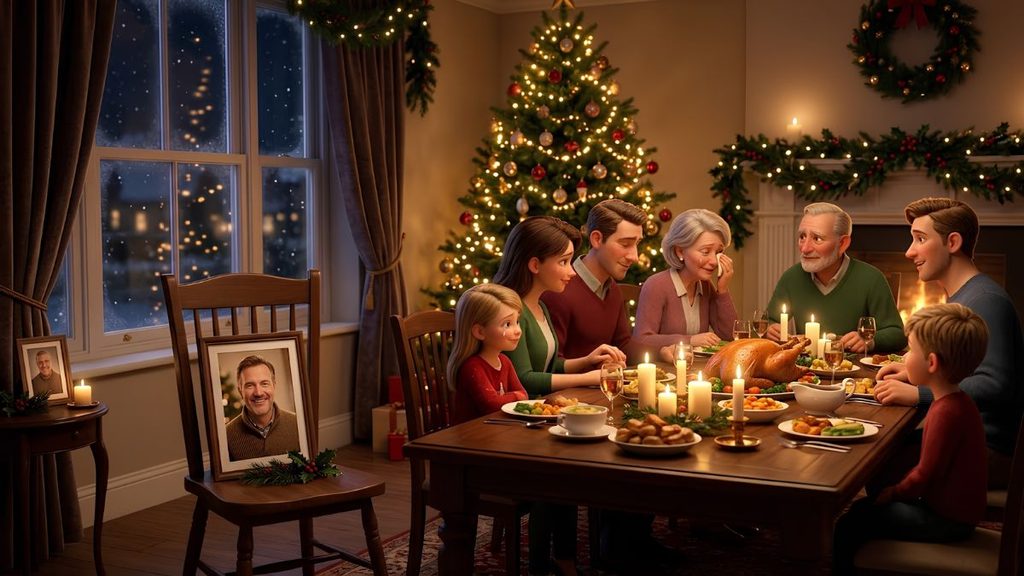
Type: Empty Traditions
Theme: Grief, family traditions, remembrance, and learning that moving forward does not mean forgetting
Christmas had always belonged to the Bennett family.
Not because they were particularly religious.
Not because they decorated their house more beautifully than anyone else.
And certainly not because their Christmas dinners were perfect.
They belonged to Christmas because of one simple tradition.
Every year, no matter where life took them, everyone came home.
There was always a crowded dining table.
There were always too many dishes.
Someone always forgot the cranberry sauce.
Someone always argued about which Christmas movie to watch.
And there was always one person who arrived late.
Daniel Bennett.
He was the youngest of three brothers, and being late had become his unofficial family tradition.
Their mother, Margaret, would complain.
“You could try arriving before dessert one year.”
Daniel would laugh.
“I like making an entrance.”
His father, Robert, would shake his head.
“You’ve been making the same entrance for thirty-five years.”
Everyone would laugh.
It was ordinary.
Comfortable.
Predictable.
Nobody imagined there would ever be a Christmas when Daniel wouldn’t arrive.
Daniel was forty-two when he died.
It happened in spring.
A sudden illness.
Too fast.
Too unexpected.
There was no time for the family to prepare.
One week he was planning a summer trip.
The next week, he was gone.
The funeral was difficult.
But the family survived those first months by telling themselves:
“At least Christmas is still far away.”
They didn’t realize what Christmas would feel like without him.
By December, the house had been decorated.
The tree stood in the corner of the living room.
Lights covered the windows.
The smell of cinnamon filled the kitchen.
Cards arrived in the mail.
Everything looked exactly as it always had.
And yet nothing felt the same.
Margaret was seventy-one.
She had lost her husband years earlier.
Now she had lost her youngest son.
She moved through the house quietly.
Her older sons, Michael and Thomas, tried to keep things normal.
But they all knew there was something missing.
Daniel.
On Christmas Eve, Michael asked:
“Should we still have dinner tomorrow?”
Margaret looked at him.
“Of course.”
“Are you sure?”
She nodded.
“Your brother would be furious if we canceled.”
Thomas smiled.
“That’s true.”
Margaret laughed.
For a moment, Daniel seemed present.
They remembered his voice.
His terrible jokes.
His habit of stealing food before dinner.
His obsession with opening presents early.
Then silence returned.
Christmas morning arrived.
Snow covered the garden.
The house was warm.
The tree lights blinked softly.
Margaret prepared breakfast.
Michael brought coffee.
Thomas carried dishes into the dining room.
Everything was ready.
Then Margaret stopped.
She looked at the table.
There were four chairs.
She had unconsciously placed one extra.
Daniel’s chair.
Nobody spoke.
Thomas finally said:
“Should we move it?”
Margaret shook her head.
“No.”
Michael looked at her.
“Mom?”
“Leave it.”
They sat down.
Three people ate.
One chair remained empty.
Nobody looked directly at it.
But everyone saw it.
Daniel’s place.
His favorite chair.
The chair closest to the window.
The chair he had used every Christmas since childhood.
Dinner was quiet.
Then Thomas reached for the potatoes.
“Daniel would have complained that these were cold.”
Michael laughed.
“Definitely.”
Margaret smiled.
“He complained about everything.”
“He loved your cooking.”
“I know.”
“You burned the turkey once.”
“That was one time.”
“It was unforgettable.”
They laughed.
And then Margaret began crying.
Not because they had remembered something sad.
Because they had remembered something happy.
That was the strange cruelty of grief.
Sometimes happiness hurt more than sadness.
After dinner, nobody wanted to clear the table.
They sat there.
The empty chair remained.
Michael looked at it.
“Do you remember when he broke that chair?”
Thomas laughed.
“Which one?”
“This one.”
They all laughed.
Daniel had been sixteen.
He had leaned back too far.
The chair had collapsed.
He had fallen onto the floor.
Their father had been furious.
Daniel had looked up and said:
“Good news. I found the problem.”
Their father had tried not to laugh.
He had failed.
“Do you remember his first Christmas away from home?” Michael asked.
Margaret nodded.
“He was twenty-one.”
“He called twelve times.”
“Because he forgot how to cook.”
Thomas laughed.
“He asked how long potatoes should boil.”
Margaret smiled.
“He could have searched for the answer.”
“He wanted you to tell him.”
They fell silent again.
The empty chair didn’t feel quite as painful.
It had become part of the conversation.
Later that evening, Margaret walked into the dining room.
She touched the back of Daniel’s chair.
She remembered him sitting there.
Laughing.
Eating.
Complaining.
Falling asleep after dinner.
She whispered:
“Merry Christmas, sweetheart.”
Then she walked away.
The next morning, Michael found her in the kitchen.
“You okay?”
“Yes.”
“Did you sleep?”
“Not much.”
He poured coffee.
Then asked:
“Do you want to talk about him?”
Margaret looked surprised.
“Why wouldn’t I?”
“I don’t know.”
She smiled.
“People keep thinking I need to stop talking about him.”
Michael frowned.
“Who?”
“Everyone.”
She looked toward the dining room.
“They think remembering him will keep me sad.”
Michael was quiet.
Margaret continued:
“But forgetting him would make me sadder.”
That sentence stayed with Michael.
He realized something.
The family had spent months trying not to talk about Daniel because they thought mentioning him would make Christmas unbearable.
Instead, silence had made his absence louder.
The following Christmas, something changed.
The family decided to keep the chair.
Not because they believed Daniel would return.
Not because they wanted to pretend nothing had happened.
They kept it because it belonged to the family.
But this time, they placed something on it.
A small framed photograph of Daniel.
He was laughing.
His head was tilted back.
His eyes were closed.
Someone had caught him in the middle of a joke.
It was the most Daniel photograph imaginable.
Everyone brought a memory.
Michael brought an old Christmas card Daniel had written when he was twelve.
Thomas brought a photograph of Daniel wearing a ridiculous Santa hat.
Margaret brought his favorite recipe.
They placed everything beside the chair.
The chair became a small memorial.
But it wasn’t a shrine.
It was part of the celebration.
Dinner began.
Michael raised his glass.
“To Daniel.”
Thomas lifted his.
“To Daniel.”
Margaret smiled.
“To our Christmas troublemaker.”
They laughed.
Then Michael said:
“Do you think he would like this?”
Thomas looked at the photograph.
“He’d complain about the food.”
“Definitely.”
“And then eat everything.”
Margaret smiled.
“Absolutely.”
That year, they told stories.
For hours.
Some were sad.
Some were embarrassing.
Some were ridiculous.
They talked about Daniel’s first job.
His first car.
His terrible singing.
His failed attempt to make Christmas pudding.
His habit of calling his mother whenever he had a problem.
His love for old movies.
His habit of giving everyone the same terrible joke gifts.
The children listened.
They had known Uncle Daniel.
But now they were learning who he had been.
Daniel’s niece, Sophie, asked:
“Why do we leave his chair empty?”
Margaret looked at her.
“Because we remember him.”
Sophie thought for a moment.
“Doesn’t that make you sad?”
“Sometimes.”
“Then why do you do it?”
Margaret smiled.
“Because love doesn’t disappear when someone dies.”
The tradition continued.
Every Christmas, the chair remained.
But over time, something unexpected happened.
The chair became less about absence.
It became about presence.
It reminded everyone of Daniel.
But it also reminded them of one another.
They started calling more often.
Visiting more.
Taking photographs.
Making plans.
They became more intentional about gathering.
The empty chair had taught them not to take full chairs for granted.
Years later, Margaret became too old to host Christmas.
The family moved the celebration to Michael’s house.
Everyone helped.
The tree went up.
The food was prepared.
The children decorated cookies.
And Daniel’s chair came too.
It had become part of the family.
When Margaret died, several years later, there were now two empty chairs.
One for Daniel.
One for Margaret.
But nobody wanted to remove either.
Instead, they placed photographs on both.
Daniel smiling.
Margaret laughing.
The family sat around the table.
There were tears.
But there was laughter too.
Someone told a story about Margaret burning the turkey.
Everyone laughed.
Then someone remembered Daniel falling through the chair.
They laughed harder.
The empty chairs were no longer symbols of only sadness.
They had become reminders of the lives that had shaped everyone sitting around the table.
Eventually, Sophie became a mother.
Her daughter, Emma, asked about the chairs.
“Who are they?”
Sophie pointed.
“That’s Uncle Daniel.”
“And Grandma Margaret.”
“What happened to them?”
“They died.”
Emma became quiet.
“Do you miss them?”
“Every day.”
“Then why are you smiling?”
Sophie looked at the photographs.
“Because missing someone and being grateful for them can happen at the same time.”
Emma didn’t completely understand.
Not yet.
But one day she would.
That Christmas, Emma placed a drawing beside Daniel’s photograph.
It showed a large family sitting around a table.
There were two empty chairs.
But Emma had drawn flowers on them.
Sophie smiled.
“What’s this?”
“It’s for them.”
“What does it mean?”
Emma shrugged.
“It means they are still part of Christmas.”
Sophie hugged her.
“Yes.”
As the years passed, the family changed.
Children grew up.
People moved.
New partners joined.
New babies arrived.
Some people left.
Some returned.
But every Christmas, the chairs remained.
They became part of the family’s language.
When someone asked:
“Why are those chairs empty?”
Someone would tell the story.
Then another story.
Then another.
Eventually, the person would understand.
The chairs weren’t empty.
They were full of memories.
One Christmas Eve, many decades after Daniel’s death, Emma sat alone in the dining room.
She was now an adult.
The house was quiet.
She looked at the two chairs.
She remembered her grandmother telling her:
“Love doesn’t disappear when someone dies.”
She finally understood.
The chairs weren’t there to remind the family of what they had lost.
They were there to remind the family of what they had been given.
Time.
Laughter.
Stories.
Traditions.
Love.
Family.
Emma turned on the Christmas lights.
The room glowed softly.
She placed two candles on the table.
One beside Daniel’s photograph.
One beside Margaret’s.
Then she whispered:
“Merry Christmas.”
The house was quiet.
But it didn’t feel empty.
The next morning, the family arrived.
Children ran through the hallway.
Someone burned the toast.
Someone forgot the cranberry sauce.
Someone argued about the Christmas movie.
And someone arrived late.
Everyone laughed.
For a moment, it was exactly as it had always been.
Except the family now understood something they hadn’t understood when Daniel was alive.
Christmas wasn’t about keeping everything unchanged.
It was about carrying what mattered forward.
People leave.
Families change.
Chairs become empty.
Traditions evolve.
But love can remain.
That evening, Emma stood at the dining room doorway.
She looked at the two chairs.
Then at the crowded table.
She realized the chairs had taught her something important.
One day, every chair at every table will eventually be empty.
That is part of being alive.
The answer isn’t to spend our lives fearing that day.
The answer is to appreciate the people sitting beside us today.
To listen when they speak.
To laugh when we can.
To forgive sooner.
To take photographs.
To make traditions.
To call.
To come home.
To say:
“I love you.”
Before the chair beside us becomes empty.
And so the Bennett family continued their Christmas tradition.
Not because they refused to let go.
But because they had learned how to remember without being trapped in the past.
Every December, Daniel’s chair stood beside the table.
Every December, Margaret’s chair stood beside it.
And every December, the family gathered around them.
They ate.
They laughed.
They cried.
They told stories.
They remembered.
And they made new memories.
Because grief had taught them something beautiful:
The people we lose may leave the table, but the love they gave us can remain seated beside us forever.
Moral Lesson
Grief does not mean we must stop celebrating or enjoying life. Remembering someone who has died can become a way of honoring the love and memories they left behind. Moving forward does not mean forgetting the people we have lost. It means carrying their love with us while continuing to live.
9. The Photograph on the Window
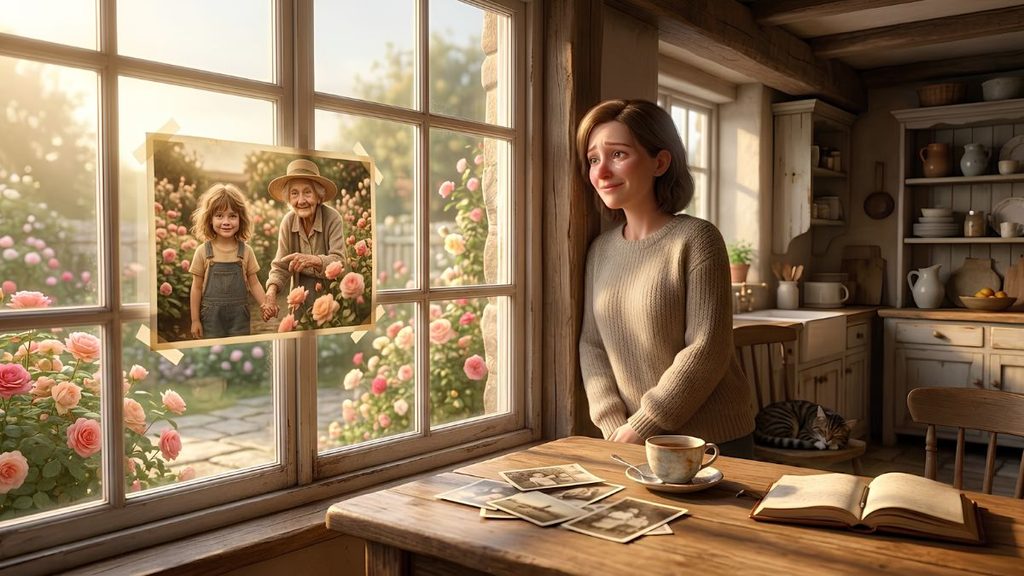
Type: Losing a Grandparent / Objects Left Behind
Theme: Memory, childhood, grief, family connection, and the small moments that become precious after someone is gone
Every morning, Sophie Walker opened the curtains of her grandmother’s old house.
And every morning, she saw the same photograph.
It was taped to the kitchen window.
A faded photograph of a little girl standing beside an elderly woman in a garden.
The girl was Sophie.
The woman was her grandmother, Eleanor.
The photograph had been taken almost twenty years earlier.
The colors had faded.
One corner was bent.
The tape had turned yellow.
But Eleanor had never replaced it.
She had kept it on the window for as long as Sophie could remember.
Whenever Sophie visited, she would see it.
Whenever she asked about it, Eleanor would smile.
“That’s my favorite view.”
Sophie would laugh.
“Grandma, it’s just a photograph.”
Eleanor would shake her head.
“No. It’s you.”
Sophie was twenty-nine when Eleanor died.
She had been living in Edinburgh for several years, working as a graphic designer.
Her career was going well.
She had a small apartment.
A good group of friends.
A busy schedule.
She loved her grandmother.
But she didn’t visit as often as she wanted.
There was always something.
A project.
A deadline.
A weekend away.
A friend’s birthday.
A flight.
A meeting.
She would call Eleanor instead.
“I’ll come next month.”
“You always say that,” Eleanor would tease.
“I mean it this time.”
“I know.”
Eleanor always forgave her.
The final time Sophie spoke to her grandmother was on a Sunday evening.
Sophie was packing for a work trip.
Her phone rang.
It was Eleanor.
“Hello, Grandma.”
“Are you busy?”
“A little.”
“Then I’ll let you go.”
“No, no. It’s okay.”
There was a pause.
“What are you doing?”
“Packing.”
“Where are you going?”
“Paris.”
“For work?”
“Yes.”
“Will you have fun?”
“I hope so.”
Eleanor laughed softly.
“Good.”
Sophie smiled.
“I’ll visit when I get back.”
“When?”
“Next weekend.”
“Promise?”
“Promise.”
That was the last conversation they had.
Three days later, Eleanor died peacefully in her sleep.
Sophie was on a flight when she heard.
She stared out of the airplane window for a long time.
She remembered her promise.
Next weekend.
She would visit next weekend.
But there would be no next weekend.
After the funeral, Sophie returned to Eleanor’s house.
Her parents were already sorting through belongings.
Her mother was packing clothes.
Her uncle was organizing paperwork.
Boxes filled the hallway.
Sophie walked into the kitchen.
And there it was.
The photograph.
Still taped to the window.
She stopped.
For a moment, she forgot that Eleanor was gone.
The kitchen looked exactly as it had always looked.
The old kettle.
The wooden table.
The small clock.
The bowl of apples.
And the photograph.
Sophie touched the glass.
She remembered being seven.
She had been wearing a yellow dress.
Her grandmother had planted roses that year.
Sophie had wanted to help.
She had dug a hole.
It was far too large.
Eleanor had laughed.
“You’re planting a rose, not a tree.”
Sophie had insisted.
The photograph had been taken afterward.
They were standing beside the rose bush.
Eleanor’s hand rested on Sophie’s shoulder.
Both were smiling.
Sophie had forgotten the day.
She remembered the photograph.
But she had forgotten the conversation.
Now, standing in the kitchen, fragments returned.
Her grandmother had told her:
“One day, you’ll be older.”
Sophie had replied:
“I don’t want to be older.”
Eleanor had laughed.
“You’ll like it.”
“No.”
“Why not?”
“Because I want to stay seven.”
Eleanor had smiled.
“Then we’ll keep this picture.”
Sophie wiped her eyes.
She looked at the photograph.
The rose bush behind them was small.
Today, it would have been enormous.
Her mother entered the kitchen.
“You’re here.”
Sophie nodded.
She pointed to the window.
“She never moved it.”
“No.”
“Why?”
Her mother smiled.
“Because she could see it every morning.”
Sophie looked at the photograph.
“I remember.”
“She talked about you all the time.”
Sophie looked down.
“Really?”
“All the time.”
Her mother opened a drawer.
Inside were dozens of photographs.
Sophie sat at the kitchen table.
They went through them together.
Sophie as a baby.
Sophie at school.
Sophie holding her first bicycle.
Sophie asleep on Eleanor’s sofa.
Sophie eating birthday cake.
Sophie opening Christmas presents.
Sophie graduating.
There were photographs Sophie had never seen.
One showed her at sixteen, sitting beside Eleanor in the garden.
Another showed them drinking tea.
Another showed Eleanor watching Sophie leave for university.
Sophie stopped.
“Why did she take this?”
Her mother smiled.
“Because you were leaving.”
Sophie stared at the picture.
Eleanor was standing at the front door.
Sophie was carrying two bags.
She remembered that day.
She had been excited.
She had barely looked back.
Now the photograph made her chest hurt.
That evening, Sophie stayed in the house alone.
She walked through every room.
Her grandmother’s bedroom.
The sitting room.
The garden.
The hallway.
She opened drawers.
Read old notes.
Found recipes.
Looked at photographs.
Then she returned to the kitchen.
The photograph on the window was glowing in the evening light.
Sophie finally understood why Eleanor had kept it there.
It wasn’t just a photograph.
It was a daily reminder.
Every morning, Eleanor had opened the curtains and seen Sophie as a little girl.
Perhaps it reminded her of laughter.
Perhaps it reminded her of youth.
Perhaps it reminded her that life had once been simpler.
Or perhaps it simply reminded her that she had been loved.
Sophie carefully removed the photograph from the window.
The tape left a pale rectangle on the glass.
She held the picture.
She wanted to take it home.
But something stopped her.
Instead, she placed it in a small frame.
Then put the frame back on the windowsill.
Her mother came into the room.
“You’re not taking it?”
Sophie shook her head.
“No.”
“Why?”
“Because Grandma put it here for a reason.”
Her mother smiled.
“She would have liked that.”
Sophie returned to Edinburgh.
For the first few weeks, she kept thinking about the photograph.
She thought about Eleanor every morning.
She started calling her mother more often.
She visited her parents.
She began sorting through her own photographs.
She realized how many moments she had captured without truly noticing them.
Friends laughing.
Her parents cooking.
Her grandmother holding a cup of tea.
Her old neighborhood.
A rainy afternoon.
A birthday.
A family dinner.
Ordinary moments.
One evening, Sophie found an old message from Eleanor.
It was a voice recording.
Sophie pressed play.
Her grandmother’s voice filled the apartment.
“Hello, sweetheart. Just checking you’re okay. Call me when you have time.”
That was all.
Twenty-three seconds.
Sophie listened again.
Then again.
She cried.
But this time, the tears were not only sadness.
They were gratitude.
She still had her grandmother’s voice.
Months passed.
Sophie began visiting her grandmother’s house regularly.
Her parents had decided not to sell it immediately.
The garden still needed care.
Sophie volunteered.
She trimmed the roses.
Pulled weeds.
Painted the garden fence.
One afternoon, she found the rose bush from the photograph.
It was huge.
Its branches stretched across the garden.
Red flowers covered it.
Sophie stood beside it.
She laughed.
“Grandma, you were right.”
She took a photograph.
Then another.
She printed one.
She placed it beside the old photograph.
The first picture showed a seven-year-old girl beside a tiny rose bush.
The new photograph showed the same girl, now an adult, beside a massive rose bush.
Twenty-two years between them.
Same garden.
Same person.
Different life.
Sophie began thinking about time.
How quickly it moved.
How children became adults.
How parents became grandparents.
How houses changed.
How photographs stayed still while everything around them changed.
She realized that perhaps this was why Eleanor loved photographs.
They preserved what life refused to preserve.
One afternoon, Sophie’s niece, Lily, visited.
She was six years old.
She found the photographs.
“Who’s that?”
“Me.”
“You were little.”
“Yes.”
“Who’s the lady?”
“My grandmother.”
“Is she dead?”
Sophie nodded.
Lily became quiet.
“Do you miss her?”
“Very much.”
“What was she like?”
Sophie smiled.
“Kind.”
“Was she funny?”
“Very.”
“Did she make good food?”
“The best.”
“What did she like?”
“Roses.”
“Like those?”
Sophie nodded.
Lily studied the photograph.
“Why is it on the window?”
Sophie thought for a moment.
“Because Grandma wanted to see someone she loved every morning.”
Lily smiled.
“That’s nice.”
That night, Sophie moved the framed photograph to her own kitchen window.
Her apartment looked different from Eleanor’s house.
There was no garden outside.
No rose bush.
Only city buildings.
But the morning light fell across the photograph.
Sophie smiled.
She understood now.
The photograph didn’t belong to the old house.
It belonged wherever someone wanted to remember.
Years later, Sophie had a daughter of her own.
Her name was Eleanor.
She told her daughter about her great-grandmother.
She showed her the photograph.
“This is you?” little Eleanor asked.
“No.”
“Then who?”
“My grandmother.”
“What’s her name?”
“Eleanor.”
“Like me?”
“Exactly.”
The little girl smiled.
“Why did you name me Eleanor?”
Sophie touched the photograph.
“Because some people leave something beautiful behind.”
As her daughter grew, Sophie told her stories.
Not about death.
About life.
She told her about the rose garden.
The yellow dress.
The broken bicycle.
The Christmas dinners.
The terrible cooking.
The rainy afternoons.
The old house.
The photograph.
The morning phone calls.
The promise Sophie had made and never been able to keep.
She didn’t hide the regret.
She explained it.
“I thought I had more time.”
Her daughter asked:
“Did Grandma know you loved her?”
Sophie smiled.
“Yes.”
“How?”
“Because I told her.”
“Often?”
Sophie thought.
“Not often enough.”
Then she smiled.
“But enough for her to know.”
That answer stayed with her.
Not often enough.
But enough.
It reminded Sophie to do better.
She started telling people what they meant to her.
Her parents.
Her friends.
Her daughter.
Her husband.
She stopped assuming love was obvious.
She learned that people shouldn’t have to guess.
Many years later, Sophie returned to the old house.
She stood in the kitchen.
The original photograph was still there.
The frame had changed.
The glass had been replaced.
But the photograph remained.
She stood beside it.
For a moment, she imagined her grandmother opening the curtains.
Seeing the little girl.
Smiling.
Perhaps saying:
“Good morning, sweetheart.”
Sophie smiled.
“Good morning, Grandma.”
Outside, the rose bush was still blooming.
It had become enormous.
Some branches reached the second-floor window.
Sophie walked into the garden.
She touched one of the flowers.
Then she looked back at the kitchen.
The photograph was still visible through the glass.
She understood something she hadn’t understood as a child.
A photograph doesn’t stop time.
It simply reminds us that time has passed.
The little girl in the picture was gone.
But she had become the woman standing in the garden.
Her grandmother was gone.
But her lessons remained.
The house would eventually change.
The garden would eventually change.
The photograph would eventually fade.
Everything changed.
But love had a strange way of surviving those changes.
Sophie took one final photograph.
This time, she didn’t photograph the roses.
She photographed the old picture on the window.
The little girl.
The grandmother.
The morning light.
The garden behind them.
Then she placed her hand against the glass.
She whispered:
“Thank you for remembering me.”
That evening, Sophie returned home.
She stood in her own kitchen.
The photograph was still there.
Her daughter was doing homework at the table.
Her husband was making tea.
Outside, the city lights were beginning to glow.
It was an ordinary evening.
Nothing special.
Nothing dramatic.
Sophie looked at the photograph.
Then looked at her family.
She smiled.
She understood the lesson her grandmother had left behind.
Don’t wait for life to become extraordinary before appreciating it.
Take the photograph.
Make the call.
Sit at the table.
Listen to the story.
Stay a little longer.
Because someday, the ordinary moments will become the memories we would give anything to experience again.
And sometimes, all we need to keep those moments alive is something as simple as a photograph taped to a window.
Moral Lesson
The smallest moments with loved ones can become our most precious memories. We should not wait for special occasions to appreciate the people around us. Take photographs, listen to their stories, spend time together, and tell people you love them while you still have the opportunity.
What Makes a Death Story Truly Heartbreaking?
A sad story should not rely only on tragedy.
The emotional impact usually comes from the relationship between the characters and what that relationship means.
Several elements can make stories about death especially moving.
A Strong Emotional Connection
Readers need a reason to care about the characters before the loss occurs.
A story about a father and daughter becomes more emotional when readers first see them sharing ordinary moments.
Perhaps the father teaches his daughter how to ride a bicycle.
Maybe they drink coffee together every Sunday.
Perhaps he calls her before every important exam.
When the father eventually dies, those small memories become emotionally significant.
The reader isn’t simply witnessing a death.
They are witnessing the disappearance of a relationship.
Ordinary Moments Become Precious
Some of the saddest moments in stories about death are not directly related to death itself.
A character might find an old grocery list written by their spouse.
Someone might discover a handwritten note inside a book.
A daughter might hear her father’s favorite song playing unexpectedly.
A husband might still instinctively reach for his wife’s side of the bed.
These moments remind readers that grief often appears through everyday life.
The smallest objects can suddenly carry enormous emotional weight.
Unfinished Conversations
One of the most painful themes in stories about death is the idea of things left unsaid.
A character may wish they had said:
- “I love you.”
- “I’m sorry.”
- “Thank you.”
- “I forgive you.”
- “You were important to me.”
- “I should have visited more often.”
These unfinished words can create powerful emotional tension.
The character cannot change the past, but they can learn from it.
This can make the story meaningful rather than simply sad.
The Final Goodbye
Goodbye scenes can be among the most emotional parts of a death story.
However, the most effective goodbyes are often quiet.
A parent may hold their child’s hand.
Two old friends may share one final conversation.
A couple may sit together while watching the sunset.
A grandparent may tell a grandchild one final story.
The emotional power comes from knowing that the characters don’t have much time left together.
Memories After Death
A death story doesn’t necessarily end when the character dies.
In many cases, the emotional story truly begins afterward.
The surviving character must learn how to live with the absence.
They may return to familiar places.
They may keep old traditions.
They may struggle with birthdays and anniversaries.
They may discover that grief changes over time.
At first, everything reminds them of the person.
Later, memories may become painful but comforting at the same time.
This creates a more realistic portrayal of grief.
The Empty Space Someone Leaves Behind
Death creates absence.
A bedroom becomes empty.
A chair remains unused.
A name disappears from a phone’s recent calls.
A family dinner has one fewer person.
A workplace becomes quieter.
These details can communicate grief without directly describing it.
For example:
Every Sunday morning, Daniel still bought two cups of coffee before remembering that only one person would drink them.
A simple routine can communicate an enormous amount of emotion.
Love That Continues After Death
One of the most beautiful themes in sad stories about death is that love doesn’t necessarily disappear when someone dies.
A person may continue to influence another person’s life.
A mother may leave behind lessons that guide her daughter.
A father may inspire his son to pursue a dream.
A friend may leave behind a message that changes someone’s life.
A spouse may have taught their partner how to appreciate ordinary moments.
Death ends a person’s physical presence, but their influence can continue.
This is often where a heartbreaking story becomes hopeful.
Different Types of Sad Stories About Death
There are many ways to approach the theme of death.
Using different emotional situations prevents every story from feeling the same.
Stories About Losing a Parent
Parent-child relationships are among the strongest emotional relationships in storytelling.
A story may follow an adult child who loses a parent after years of taking their presence for granted.
The character may initially focus on regrets.
Later, they may realize that their parent left behind lessons, memories, and love that continue to shape their life.
Possible Moral
The people we love may not remain with us forever, so we should value the time we have with them.
Stories About Losing a Grandparent
Grandparents can represent childhood, family traditions, and unconditional affection.
A grandparent’s death can be especially emotional when a character remembers simple experiences.
Perhaps a grandmother taught someone to bake.
Maybe a grandfather took them fishing.
Perhaps they told the same bedtime story every night.
After their death, those memories become precious.
Possible Moral
Small moments shared with loved ones can become some of our most treasured memories.
Stories About Losing a Spouse
Stories about losing a husband or wife can explore the emptiness created when someone who shared everyday life is suddenly gone.
The surviving character may struggle with ordinary routines.
Cooking for one person.
Sleeping alone.
Shopping alone.
Celebrating birthdays without their partner.
The story can focus on how grief changes rather than disappears.
Possible Moral
Deep love leaves lasting memories, even after a loved one is gone.
Stories About Losing a Best Friend
Friendship-based death stories can explore loyalty, shared memories, and unfinished plans.
Two friends might have promised to travel together.
They may have planned to start a business.
They might have had a tradition of meeting every Friday.
When one friend dies, the survivor may initially feel unable to continue the tradition.
Eventually, continuing it may become a way of honoring the friendship.
Possible Moral
True friendship can continue to influence us long after someone is no longer beside us.
Stories About Losing a Child
Stories involving the death of a child are among the most emotionally difficult forms of fiction.
If writing such stories, it is usually more effective to focus on the family’s emotions, memories, and healing rather than graphic descriptions of death.
The story might explore a parent keeping a child’s room untouched.
It could involve a birthday tradition that continues after the child’s death.
It might show parents eventually finding a way to honor their child’s memory through kindness toward others.
The focus should remain on love and grief rather than tragedy for its own sake.
Stories About Unexpected Death
Unexpected death can create a powerful emotional shock.
A character might leave home in the morning expecting to return that evening.
They may send a casual message to someone.
They may make ordinary plans for the weekend.
Then something happens that changes everything.
The emotional impact comes from the contrast between ordinary expectations and sudden loss.
Possible Moral
Life is unpredictable, which makes ordinary moments with loved ones more valuable.
Stories About Regret After Death
Regret is one of the strongest themes available to writers exploring death.
A character may regret:
- Not calling often enough
- Missing important occasions
- Saying hurtful words
- Refusing to forgive
- Being too busy
- Taking someone for granted
- Not expressing gratitude
These stories can encourage readers to reflect on their own relationships.
The goal should not be to create unnecessary guilt.
Instead, the story can encourage readers to make meaningful changes while they still have the opportunity.
Stories About Letters From Someone Who Died
Letters can be powerful storytelling devices.
A character may discover a letter written years earlier.
Perhaps it was never delivered.
Perhaps it was intentionally left for someone to find after the writer’s death.
The letter can reveal feelings that were never spoken aloud.
It can also provide closure.
A letter might contain forgiveness.
It might contain advice.
It might simply say how much the writer loved the person who would eventually read it.
Stories About Objects Left Behind
Objects can become symbols of memory.
A character may keep:
- An old watch
- A photograph
- A scarf
- A handwritten recipe
- A favorite book
- A music box
- A pair of glasses
- A wedding ring
- A childhood toy
The object itself has little value to anyone else.
But to the grieving character, it becomes priceless.
This demonstrates an important truth about grief:
The emotional value of something can be much greater than its financial value.
Stories About Empty Traditions
Traditions become especially emotional after someone dies.
A family may always gather for Christmas.
A couple may always visit the same restaurant on an anniversary.
Two friends may always call each other on birthdays.
After death, continuing the tradition can feel painful.
But eventually, it may become a way to keep someone’s memory alive.
This creates a powerful emotional transformation.
The tradition begins as a reminder of absence.
Eventually, it becomes a celebration of connection.
Stories About Grief and Healing
Not every sad story should end in complete happiness.
Real grief rarely disappears overnight.
Instead, a character may gradually learn to carry the memory of someone while continuing to live.
They may laugh again.
They may make new friends.
They may fall in love again.
They may pursue a dream.
They may eventually realize that moving forward does not mean forgetting.
This is an important message for readers.
Moving Forward Does Not Mean Forgetting
A common misunderstanding about grief is that healing means leaving the past behind.
A more meaningful story can show something different.
The character doesn’t forget the person.
They learn to live with the memory.
A father’s advice may still guide his son.
A grandmother’s recipe may still be prepared every holiday.
A friend’s favorite song may still be played.
A spouse’s kindness may inspire someone to become kinder.
The person is gone.
But their influence remains.
The Difference Between Sadness and Meaningful Grief
A story can make readers cry without having much emotional depth.
Simply killing a beloved character does not automatically create a powerful story.
Meaningful grief requires emotional preparation.
Readers should understand:
Who was the person?
Why did they matter?
What did they mean to the surviving characters?
What will change because they are gone?
What will remain?
The strongest stories answer these questions.
How to Write Death Stories Without Becoming Overly Dramatic
Subtle storytelling is often more powerful than excessive tragedy.
Instead of writing:
Everyone was devastated beyond words.
Show the emotion.
For example:
A character prepares two cups of tea before remembering.
Someone reaches for their phone and stops.
A father opens his daughter’s bedroom door even though he knows it is empty.
A husband continues buying his wife’s favorite cereal.
A grandmother’s recipe remains unfinished on the kitchen counter.
These small details allow readers to experience the grief themselves.
Why Readers Connect With Stories About Death
Readers connect with these stories because death is universal.
People may have different cultures, backgrounds, careers, and lifestyles.
But almost everyone understands attachment.
Almost everyone understands what it means to miss someone.
A story about death can therefore create empathy between strangers.
A reader may see their own parent in a fictional father.
They may remember a grandparent while reading about a grandmother.
They may think about an old friend after reading about childhood friendship.
That personal connection makes these stories powerful.
The Role of Hope in Sad Stories
A story about death doesn’t have to end with happiness.
It can end with acceptance.
Hope doesn’t mean pretending that the loss wasn’t painful.
Hope means recognizing that life can continue.
A character may still cry.
They may still miss the person.
But they can also laugh again.
They can build relationships.
They can create new memories.
They can honor the person they lost by living according to the values that person taught them.
That kind of ending often feels more authentic than a completely happy conclusion.
Important Life Lessons From Stories About Death
Stories about death can leave readers with lessons that extend beyond grief.
Tell People You Love Them
Don’t always assume people know.
Sometimes a simple expression of love can mean more than an elaborate gesture.
Make Time for People
Work and responsibilities matter.
But relationships also require time.
Don’t Wait Forever to Forgive
Some disagreements last for years because neither person wants to take the first step.
Stories about death can remind readers that time is limited.
Appreciate Ordinary Moments
- A normal dinner.
- A short phone call.
- A walk.
- A cup of coffee.
These moments may seem insignificant today but become precious memories later.
Don’t Take Presence for Granted
Someone being there every day can make their presence feel permanent.
It isn’t.
Keep Meaningful Memories Alive
Photographs, traditions, recipes, letters, and stories can help families preserve connections across generations.
Healing Doesn’t Mean Forgetting
Moving forward can coexist with remembering.
How These Stories Can Help Readers Reflect
Sad stories can encourage readers to think about their own lives.
After reading a story about a person regretting an unanswered phone call, someone might decide to call their parent.
After reading about an old friendship ending because of pride, someone might reconnect with a friend.
After reading about a grandmother’s final recipe, someone might ask their own grandparent to teach them a family tradition.
This is one reason emotional storytelling can be valuable.
A fictional story can inspire real-world kindness.
Final Thoughts
Sad Stories That Will Make You Cry About Death can be heartbreaking, but their purpose doesn’t have to be sadness alone.
The best stories about death remind us of life.
They remind us to call people while we still can.
To say “I love you.”
To apologize.
To forgive.
To sit beside someone.
To make time.
To appreciate ordinary moments.
And to understand that the people we love may eventually leave our lives, but the memories, lessons, and love they give us can remain.
A powerful story about death doesn’t simply ask readers to cry.
It asks them to look at the people around them and realize how precious their presence really is.
Because sometimes the most important message in a story about death is not about the moment someone leaves.
It is about how we choose to love them while they are still here.