
Falling asleep can become surprisingly difficult when the mind refuses to slow down. After a long day of work, responsibilities, conversations, decisions, and endless thoughts, getting into bed does not always mean the brain is ready for rest.
This is where bedtime stories for adults to fall asleep free can offer a simple and comforting solution.
Unlike exciting novels, thrillers, or stories filled with suspense, bedtime stories are designed to create a peaceful mental environment. They give the imagination something gentle to focus on while gradually helping the mind move away from everyday worries.
Adults can enjoy bedtime stories just as much as children. The difference is usually in the themes. Adult bedtime stories often feature peaceful journeys, relationships, quiet evenings, personal growth, nostalgic memories, nature, romance, friendship, and comforting moments.
This guide explains what bedtime stories for adults are, how they can support a relaxing nighttime routine, what types work best, and how to choose stories that are available to read for free.
What Are Bedtime Stories for Adults?
Bedtime stories for adults are short or long fictional narratives created specifically for relaxing before sleep.
They are generally written with a slower pace and a calming atmosphere rather than constant action or suspense.
A good bedtime story may describe:
- A peaceful evening in a small town
- A quiet walk beside the sea
- Two people remembering their childhood
- A couple spending a rainy evening together
- A traveler discovering a peaceful village
- Someone reflecting on an important life lesson
- A family gathering during a winter evening
- A gentle romantic experience
- A nostalgic memory from the past
- A character finding peace after a difficult day
The goal isn’t necessarily to create a dramatic plot.
Instead, the story should create a sense of emotional comfort and gradually encourage the reader to relax.
Bedtime Stories for Adults to Fall Asleep Free
1. The Rainy Evening in Rosewood
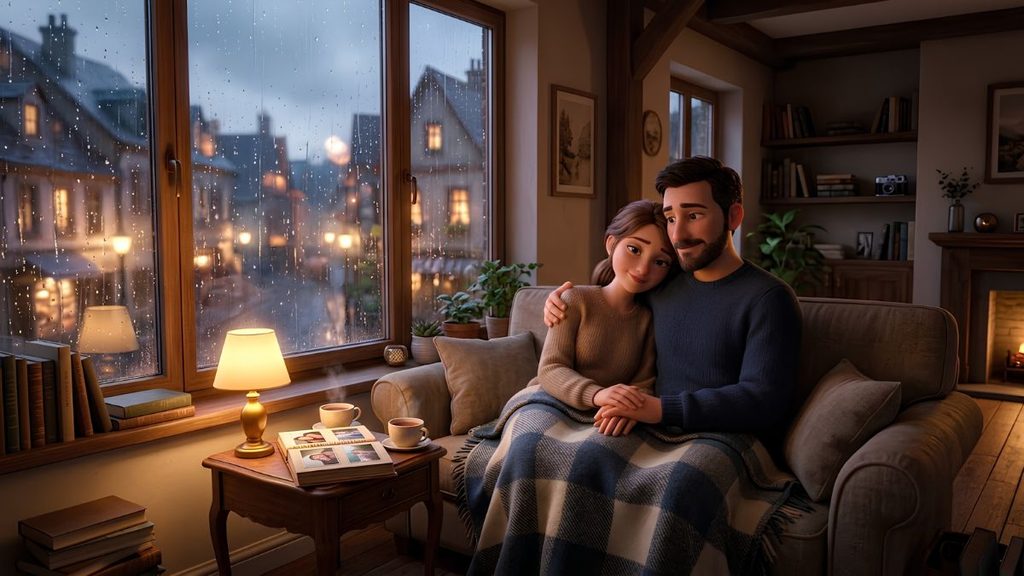
Type: Romantic Bedtime Story
Characters: Nathan Cole and Elise Morgan
Theme: Love, companionship, and appreciating ordinary moments
Nathan Cole had spent most of his life believing that happiness was supposed to be loud.
He imagined that the happiest moments would arrive with music playing somewhere in the background, sunlight pouring through windows, and something extraordinary happening at exactly the right moment.
Perhaps it was because of the movies he had watched growing up.
Perhaps it was because of the stories people told.
Or perhaps it was simply because ordinary happiness was so easy to overlook.
Nathan worked in a busy office in the center of Rosewood, a small European town surrounded by green hills and narrow streets. Every morning, he walked through the same square, bought coffee from the same little café, and caught the same train.
His life was comfortable.
It was also predictable.
He didn’t dislike his routine.
He simply didn’t notice it anymore.
Then there was Elise Morgan.
Elise had lived in Rosewood most of her life.
She worked at a small independent bookstore on Willow Street, where the windows were always filled with carefully arranged books and seasonal decorations.
Nathan had first met her there three years earlier.
He had gone into the bookstore looking for a travel guide.
He had been planning a trip to Scotland.
Elise had recommended a book.
“You don’t want this one,” she had said.
Nathan had looked at the book in his hand.
“Why?”
“It’s too serious.”
“That’s not usually a problem.”
“It will be if you’re supposed to be enjoying your holiday.”
He had laughed.
“What would you recommend?”
She had walked to another shelf.
“This.”
Nathan looked at the cover.
“Why this one?”
“Because it makes you want to travel.”
He bought it.
He also returned the following week.
Then again.
Eventually, the books became less important than the person recommending them.
Three years later, Nathan and Elise lived together in a small apartment overlooking Rosewood’s old market square.
Their home wasn’t large.
There was a narrow kitchen, a comfortable living room, two bedrooms, and a small balcony.
But Elise loved it.
She said the apartment had character.
Nathan called it “a charming way of saying the walls are uneven.”
Elise always laughed.
They had built a quiet life together.
There were grocery lists on the refrigerator.
Books beside the bed.
Two mugs permanently sitting near the coffee machine.
A blanket that somehow always ended up on the floor.
None of it seemed particularly romantic.
Yet Elise loved those things.
Nathan was beginning to understand why.
One Thursday afternoon, Nathan looked out of his office window.
Dark clouds had gathered above the town.
Rain was coming.
His colleague, Martin, looked outside.
“Looks like we’re going to get soaked.”
Nathan checked his watch.
“Wonderful.”
“You walking home?”
“Probably.”
“You could take the train.”
“I could.”
Martin looked at him.
“But you won’t.”
Nathan smiled.
“Probably not.”
He finished work at six.
By the time he stepped outside, the rain had started.
It wasn’t heavy.
Just a steady drizzle that covered the pavement with a thin layer of silver.
People hurried through the streets carrying umbrellas.
Cars moved slowly.
Shop windows reflected the wet roads.
Nathan walked home.
He liked rain.
It made Rosewood quieter.
The usual noise seemed softer.
The streets became almost peaceful.
As he approached the apartment, he wondered whether Elise had already arrived home.
She often finished work before him.
He opened the door.
The apartment was warm.
A lamp was glowing in the living room.
The smell of cinnamon filled the air.
Elise was sitting beside the window.
Two cups of tea were on the table.
She looked up.
“You’re wet.”
Nathan smiled.
“It’s raining.”
“I noticed.”
She pointed toward the chair.
“Sit down.”
Nathan removed his coat.
He sat beside her.
Elise handed him a cup.
“Tea.”
“Perfect.”
They watched the rain together.
For several minutes, neither spoke.
Nathan looked at her.
“What?”
Elise smiled.
“Nothing.”
“You’re staring.”
“I’m allowed.”
“Apparently.”
She leaned her head against his shoulder.
Nathan took her hand.
Outside, rain moved down the window in thin streams.
“How was your day?” Elise asked.
“Long.”
“Bad?”
“Not bad.”
“Just long?”
“Very long.”
She nodded.
“Mine was busy too.”
“Anyone buy anything interesting?”
“An elderly man bought twelve mystery novels.”
“Planning something?”
“Probably.”
Nathan laughed.
“Did you sell him all twelve?”
“Of course.”
“That’s why you’re good at your job.”
Elise smiled.
“Maybe.”
Nathan looked toward the window.
“Do you remember when we first met?”
“Of course.”
“You told me the book I wanted was too serious.”
“It was.”
“You were very confident.”
“I was right.”
Nathan laughed.
“You were.”
Elise smiled.
“That was a long time ago.”
“Three years.”
“It feels longer.”
“Good longer or bad longer?”
“Good.”
She squeezed his hand.
The rain became heavier.
The apartment grew darker as evening settled over the town.
Nathan stood up and switched on another lamp.
Elise watched him.
“You know what I like?”
“What?”
“Evenings like this.”
Nathan sat down again.
“Rainy evenings?”
“Yes.”
“Why?”
She looked through the window.
“Because everyone outside is rushing home.”
“And?”
“And we’re already home.”
Nathan smiled.
He had never thought about it that way.
They ordered dinner from a small restaurant nearby.
While they waited, Elise brought out an old photo album.
Nathan raised an eyebrow.
“What’s this?”
“Memories.”
“That’s dangerous.”
She opened it.
The first photograph showed them at a summer festival.
Nathan was wearing a ridiculous hat.
Elise was laughing.
“Why did you let me wear that?”
“You chose it.”
“You should have stopped me.”
“You looked happy.”
Nathan looked at the picture.
“I was.”
She turned the page.
Another photograph.
A train station.
Another.
A beach.
Another.
Christmas.
Then another.
Their first apartment.
Their first road trip.
Their first Christmas tree.
A rainy afternoon at a café.
A photograph from the day they adopted their cat.
Nathan smiled.
“We’ve done a lot.”
Elise nodded.
“And yet I remember the little things more.”
“Like what?”
She thought.
“The first time you made me breakfast.”
Nathan laughed.
“I burned the toast.”
“Exactly.”
“You remember that?”
“I remember everything.”
Nathan closed the album.
“Do you ever worry?”
“About what?”
“That life becomes too ordinary?”
Elise looked at him.
“Sometimes.”
“Me too.”
She was quiet.
Then she said:
“Maybe ordinary isn’t the opposite of wonderful.”
Nathan looked at her.
“What do you mean?”
She pointed around the room.
“This.”
“The apartment?”
“Us.”
She smiled.
“Nothing extraordinary is happening tonight.”
Nathan nodded.
“True.”
“But we’re together.”
He looked at her.
“And?”
“That’s enough.”
Nathan thought about it.
He realized how often people waited for special occasions to appreciate their lives.
Birthdays.
Anniversaries.
Holidays.
Vacations.
Big achievements.
They waited for something memorable.
But perhaps life wasn’t meant to be memorable every day.
Perhaps some days were meant to be simple.
A warm drink.
A familiar voice.
A comfortable room.
Rain against a window.
Someone beside you.
Their food arrived.
They ate at the small kitchen table.
Elise told him about a customer who had spent twenty minutes searching for a book before realizing he was holding it.
Nathan laughed.
He told her about Martin accidentally sending an email to the entire office.
They laughed harder.
After dinner, Elise washed the dishes.
Nathan dried them.
They had done it thousands of times.
Yet tonight, Nathan noticed it.
The quiet rhythm.
The comfortable silence.
The familiarity.
There was something beautiful about knowing exactly how another person moved through a room.
Later, they sat on the balcony.
The rain had stopped.
The streets were wet and shining beneath the streetlights.
Rosewood looked different after rain.
Cleaner.
Quieter.
Almost dreamlike.
Elise wrapped a blanket around herself.
Nathan pulled it closer.
“You’ll get cold.”
“I’m fine.”
“You always say that.”
“And you’re always right.”
“Thank you.”
She smiled.
They watched a couple walk down the street holding hands.
A cyclist passed.
A dog barked somewhere in the distance.
Then everything became quiet again.
“Do you remember what you wanted when you were twenty?” Elise asked.
Nathan thought.
“To travel.”
“Did you?”
“Not enough.”
“What about now?”
He looked at her.
“Now?”
“Yes.”
He smiled.
“I want this.”
Elise’s expression softened.
“This?”
“You.”
She leaned closer.
“That’s a good answer.”
“It’s also true.”
They stayed on the balcony until the air became too cold.
Before going inside, Elise looked up at the sky.
Clouds were slowly moving away.
A few stars appeared.
“Look.”
Nathan looked.
“Beautiful.”
“Very.”
He wasn’t sure whether she meant the stars.
He didn’t ask.
When they went to bed, Elise turned off the lamp.
The room became dark.
Rain began again.
Softly.
Almost like a whisper.
Nathan lay beside her.
“Elise?”
“Yes?”
“Thank you.”
“For what?”
“Tonight.”
She laughed softly.
“We didn’t do anything.”
“I know.”
There was a pause.
“That’s why.”
She reached for his hand beneath the blanket.
“Goodnight, Nathan.”
“Goodnight.”
The next morning, the rain had stopped.
Sunlight entered through the curtains.
Rosewood was beginning another ordinary day.
People walked to work.
Shops opened.
Trains arrived.
Coffee machines started.
Nathan prepared breakfast.
Elise stood beside him.
“Toast?”
“Please.”
“Not burned.”
“I’ve improved.”
“We’ll see.”
He laughed.
Then he looked around the kitchen.
The same mugs.
The same table.
The same morning routine.
Nothing extraordinary.
And yet he smiled.
Because he had finally understood something.
A happy life isn’t necessarily made from extraordinary moments.
Sometimes it is made from hundreds of ordinary moments that become precious because they are shared with someone you love.
A cup of tea.
A rainy evening.
A conversation.
A laugh.
A hand held beneath a blanket.
A quiet goodnight.
And the comforting knowledge that when the day becomes difficult, there is someone waiting for you at home.
Years later, Nathan would remember that rainy evening.
Not because anything spectacular had happened.
Nothing had.
There had been no grand proposal.
No surprise trip.
No dramatic confession.
Only rain.
Tea.
An old photo album.
Dinner.
A balcony.
And Elise.
But perhaps that was why the memory remained so vivid.
It represented the kind of happiness that doesn’t announce itself.
The kind that quietly enters your life and stays.
The kind you only recognize when you stop long enough to notice it.
And whenever rain returned to Rosewood, Nathan would sometimes sit beside the window with Elise.
They would drink tea.
They would talk.
Or sometimes they would say nothing at all.
They didn’t need to.
They had learned that silence could be intimate too.
Outside, the rain would fall.
Inside, the lights would glow.
And the world would become quiet.
For a little while, nothing would matter except the simple fact that they were together.
And that was enough.
Moral Lesson
Happiness is not always found in grand adventures or extraordinary events. Some of life’s most meaningful moments are quiet and ordinary: sharing a meal, listening to the rain, holding someone’s hand, or simply being together. Learning to appreciate these moments can make everyday life feel much richer.
The Dog Who Wanted to Help

Type: Funny Bedtime Story for Adults
Characters: Oliver Hayes and Winston
Theme: Friendship, everyday chaos, and learning to slow down
Approximate Length: 1,200 words
Oliver Hayes had always believed that working from home would make his life easier.
He had imagined quiet mornings, uninterrupted concentration, freshly brewed coffee, and the freedom to work in comfortable clothes.
What he had not considered was Winston.
Winston was a large golden retriever with a cheerful personality, an enormous appetite, and absolutely no understanding of professional boundaries.
Oliver had adopted him two years earlier from a local shelter.
The first day they met, Winston had walked directly toward Oliver, placed one enormous paw on his shoe, and looked up at him.
Oliver had immediately fallen in love.
“You’re coming home with me,” he had said.
Winston wagged his tail.
It was a simple agreement.
Oliver would provide food, shelter, walks, and affection.
Winston would provide companionship.
At least, that was the original plan.
The Home Office
Oliver worked as a marketing consultant.
For several years, he had gone into an office every morning.
Then his company introduced permanent remote work.
At first, Oliver celebrated.
No traffic.
No crowded trains.
No office meetings.
No one asking him whether he had “a minute.”
He converted the spare bedroom into an office.
He bought a comfortable chair.
He purchased a large monitor.
He organized his desk.
He even put a small plant beside the window.
Everything was perfect.
For approximately three days.
On the fourth morning, Winston discovered the office.
Oliver was halfway through an important video conference when the door slowly opened.
Winston entered.
Oliver ignored him.
Winston walked toward the desk.
Oliver continued talking.
“Based on our current campaign performance, I believe we should…”
Winston placed his head on Oliver’s knee.
Oliver stopped.
His colleague, Martin, looked at the screen.
“Was that your dog?”
“No.”
Martin laughed.
“Oliver, I can see him.”
Winston looked directly into the camera.
Oliver sighed.
“That’s Winston.”
Winston wagged his tail.
Martin smiled.
“He’s adorable.”
Oliver whispered, “He’s a distraction.”
Winston barked.
Martin laughed.
“I think he disagrees.”
After the meeting, Oliver looked at Winston.
“You can’t come into the office during meetings.”
Winston stared at him.
“Understand?”
Winston wagged his tail.
Oliver pointed toward the door.
“Out.”
Winston walked out.
Oliver smiled.
“Good boy.”
Thirty seconds later, Winston returned carrying a sock.
Oliver stared at him.
“Where did you get that?”
Winston dropped the sock.
Oliver picked it up.
“You stole this from the laundry.”
Winston wagged his tail.
“Why are you proud of that?”
Winston sat down.
Oliver couldn’t help laughing.
The Important Presentation
A week later, Oliver had his biggest presentation of the month.
His company was pitching a major client.
Oliver had spent three days preparing.
He had created forty-seven slides.
He had checked every statistic.
He had practiced his presentation twice.
On the morning of the meeting, he made coffee and entered his office.
“Winston, today is important.”
Winston looked at him.
“I need you to be quiet.”
Winston wagged his tail.
“Very quiet.”
Winston wagged harder.
Oliver pointed toward the living room.
“Stay there.”
Winston obeyed.
For ten minutes.
Then Oliver heard scratching.
He ignored it.
The scratching continued.
He opened the door.
Winston was sitting beside a cardboard box.
“What are you doing?”
Winston looked at him.
Oliver noticed that the box contained old Christmas decorations.
“You’ve found another hobby.”
Winston pulled out a string of lights.
Oliver shook his head.
“Put those back.”
Winston dropped them.
“Good.”
Oliver returned to his desk.
Five minutes later, the scratching began again.
This time, Winston had found an old gift bag.
Oliver stared at him.
“Winston.”
The dog looked innocent.
“Please.”
Winston slowly lowered his head.
Oliver sighed.
“Fine.”
He closed the door.
The presentation began at ten.
Oliver introduced himself.
Everything went perfectly.
Then came slide twenty-three.
He clicked the remote.
Nothing happened.
He clicked again.
Still nothing.
He looked at the screen.
The presentation had frozen.
Martin messaged him.
Are you okay?
Oliver tried to fix it.
Then he heard a familiar sound.
Bark.
Everyone on the video call heard it.
Oliver closed his eyes.
“Winston.”
The dog barked again.
The client smiled.
“Is that your dog?”
Oliver nodded.
“Yes.”
“What’s his name?”
“Winston.”
“He’s very enthusiastic.”
Oliver laughed.
“That’s one way to describe him.”
The tension disappeared.
The client began telling Oliver about their own dog.
For five minutes, the meeting became a conversation about pets.
Then the presentation continued.
And surprisingly, the client loved the proposal.
After the call, Martin messaged him.
Your dog just saved the meeting.
Oliver looked at Winston.
“Did you hear that?”
Winston wagged his tail.
“You’re becoming a consultant.”
The Cooking Disaster
That evening, Oliver decided to cook.
He rarely cooked.
But he had purchased a new recipe book and wanted to try something different.
The recipe looked simple.
Chicken.
Vegetables.
Rice.
Sauce.
How difficult could it be?
Very difficult, apparently.
First, Oliver burned the onions.
Then he added too much salt.
Then he forgot the rice.
Then he discovered that the oven temperature was wrong.
Winston watched from the kitchen doorway.
Oliver looked at him.
“Don’t judge me.”
Winston tilted his head.
“I said don’t judge me.”
Winston sat down.
Oliver tried the food.
He immediately regretted it.
Winston looked interested.
“No.”
Winston’s tail moved.
“Absolutely not.”
Winston moved closer.
Oliver shook his head.
“You deserve better.”
Winston continued staring.
Finally, Oliver gave him a tiny piece.
Winston ate it.
Then he looked at Oliver.
Oliver laughed.
“Even you don’t like it.”
Winston walked away.
“That’s fair.”
The Accidental Nap
The next Saturday, Oliver planned to clean the apartment.
He made a list.
Laundry.
Vacuum.
Grocery shopping.
Clean kitchen.
Organize office.
He completed none of them.
Instead, he sat on the sofa for five minutes.
Winston jumped beside him.
Oliver scratched behind his ears.
“You know, I should be doing something.”
Winston rested his head on Oliver’s lap.
“You’re not helping.”
Winston closed his eyes.
Oliver leaned back.
“Just five minutes.”
He closed his eyes.
When he opened them again, two hours had passed.
Sunlight had moved across the room.
Winston was still sleeping beside him.
Oliver looked at the clock.
“Oh no.”
He stood up.
Then stopped.
The apartment wasn’t perfectly clean.
The laundry wasn’t finished.
The grocery shopping hadn’t happened.
But somehow, he didn’t feel guilty.
He looked at Winston.
“You know what?”
Winston opened one eye.
“Maybe I needed that.”
Winston closed his eye again.
Oliver smiled.
Chief Stress Reduction Officer
A few months later, Oliver’s company held a virtual team meeting.
Everyone was exhausted.
Deadlines were approaching.
People were stressed.
During the meeting, Winston walked into Oliver’s office.
He approached the camera.
Martin laughed.
“There he is.”
Another colleague smiled.
“Where has he been?”
Oliver looked at Winston.
“Working.”
Everyone laughed.
Martin said:
“I think Winston should officially join the team.”
Oliver smiled.
“He’s already more popular than me.”
Someone suggested giving Winston a job title.
After several ridiculous suggestions, they finally agreed on one:
Chief Stress Reduction Officer.
Oliver made Winston an imaginary employee badge.
It said:
WINSTON HAYES
CHIEF STRESS REDUCTION OFFICER
Winston immediately tried to eat it.
Oliver laughed.
“Excellent leadership.”
The Lesson Oliver Learned
Before Winston, Oliver had believed productivity meant constantly doing something.
Work.
Emails.
Meetings.
Cleaning.
Planning.
Improving.
Achieving.
He had forgotten how to stop.
Winston didn’t understand deadlines.
He didn’t care about presentations.
He didn’t know what a spreadsheet was.
He didn’t care whether the laundry was folded.
Winston understood something Oliver had forgotten.
Sometimes you simply needed to sit beside someone.
Sometimes you needed to go outside.
Sometimes you needed to laugh.
Sometimes you needed to sleep.
And sometimes a bad dinner could still become a funny memory.
One evening, Oliver sat on the floor beside Winston.
“You’re a strange dog.”
Winston rested his head against him.
“But you’re a good friend.”
Winston wagged his tail.
Oliver smiled.
“Tomorrow, I’ll finish the laundry.”
Winston looked at him.
“Probably.”
Winston sighed.
Oliver laughed.
“Fine. Maybe Monday.”
The apartment became quiet.
Outside, the evening settled over the neighborhood.
Oliver switched off the television.
Winston curled up beside him.
For once, Oliver wasn’t thinking about tomorrow’s meetings.
He wasn’t thinking about unfinished work.
He wasn’t thinking about his schedule.
He was simply sitting with his dog.
And somehow, that was exactly what he needed.
Moral Lesson
Life isn’t meant to be perfectly organized all the time. Sometimes the unexpected interruptions, silly mistakes, and quiet moments with the people or animals we love become the memories we treasure most. Learning to slow down can be just as valuable as getting everything done.
The Last Train to Willow Creek
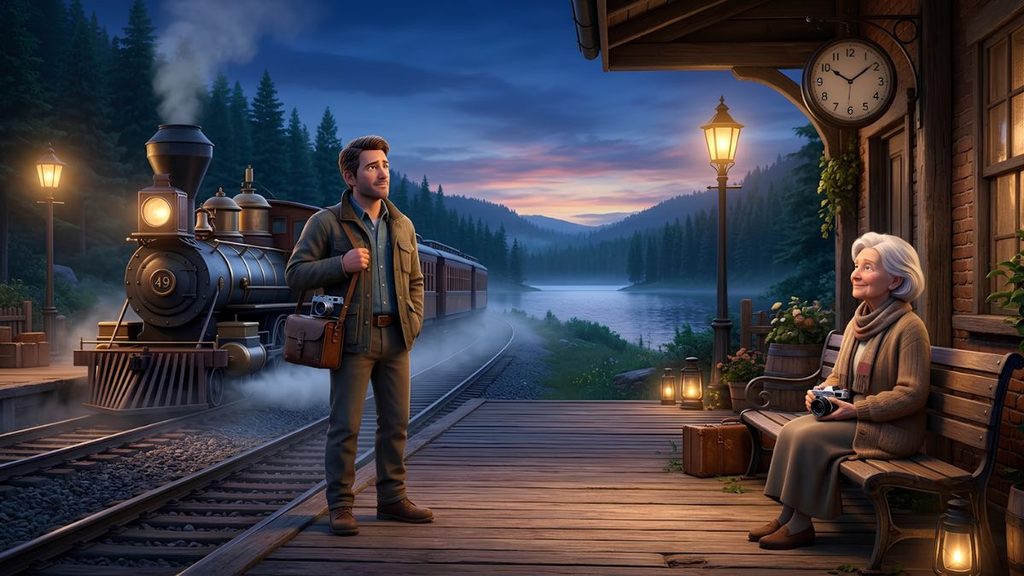
Type: Inspirational Bedtime Story for Adults
Approximate Length: 1,500 words
Characters: Daniel Foster and Claire Bennett
Theme: Second chances, rediscovering forgotten dreams, and finding courage to begin again
Daniel Foster had forgotten what it felt like to be excited about tomorrow.
It wasn’t that his life was unhappy.
He had a comfortable apartment, a reliable car, a steady job, and enough money to pay his bills without worrying every month. His colleagues respected him. His family was proud of him.
From the outside, Daniel’s life looked perfectly fine.
But somewhere along the way, he had stopped asking himself what he wanted.
At thirty-nine, his days had become almost identical.
He woke at 6:30.
Made coffee.
Checked his phone.
Went to work.
Returned home.
Made dinner.
Watched something on television.
Went to bed.
Then he did it again.
And again.
And again.
Years earlier, Daniel had dreamed of becoming a photographer.
He had owned an old camera that his father had given him when he was twenty-two. He used to carry it everywhere.
He photographed streets after rain.
People sitting in cafés.
Children playing in parks.
Old buildings.
Sunsets.
Empty train stations.
He loved finding beauty in ordinary things.
But photography had never seemed like a practical career.
His parents encouraged him to find stable employment.
Daniel listened.
He got a corporate job.
Then he received a promotion.
Then another.
Eventually, he stopped carrying his camera.
The camera remained inside a drawer.
And the dream remained somewhere behind it.
One Friday evening, Daniel stayed late at work.
Most of the office had emptied by seven.
He was finishing a report when he looked at the clock.
8:17.
He closed his laptop.
For some reason, he didn’t want to go home.
He couldn’t explain why.
The apartment would be waiting.
The television would be waiting.
Tomorrow’s responsibilities would be waiting.
Everything would be exactly where he had left it.
But suddenly, Daniel felt tired of everything being exactly the same.
He walked to the train station.
Instead of taking his usual train, he looked at the departure board.
One train was leaving in twelve minutes.
Willow Creek.
Daniel had never been there.
He had heard of it, though.
A small town several hours away, known for its lake, forest trails, and old railway station.
He looked at the ticket machine.
Then at the clock.
For a moment, he hesitated.
He had no luggage.
No hotel reservation.
No plan.
He almost walked away.
Then he bought a ticket.
The train was nearly empty.
Daniel found a seat beside the window.
As the train left the city, buildings gradually disappeared.
Streetlights became fewer.
Then there were fields.
Trees.
Small villages.
Dark stretches of countryside.
Daniel watched the scenery pass.
He hadn’t realized how long it had been since he had simply looked out of a train window.
His phone vibrated.
A message from his colleague.
Did you finish the report?
Daniel smiled.
He typed:
Yes. I’ll deal with Monday on Monday.
Then he switched off his phone.
For the first time in months, perhaps years, he didn’t feel the need to check it again.
A few seats away, an elderly woman was looking through a small camera.
Daniel noticed it immediately.
It was an old film camera.
Something about it reminded him of his own.
The woman noticed him looking.
“You like photography?”
Daniel smiled.
“I used to.”
“Used to?”
“Years ago.”
She looked at him carefully.
“Why did you stop?”
Daniel thought about the question.
“I got busy.”
The woman nodded.
“Everyone gets busy.”
She looked out the window.
“But busy isn’t the same as alive.”
Daniel didn’t answer.
The words stayed with him.
After a moment, she introduced herself.
“Claire.”
“Daniel.”
“Going to Willow Creek?”
“Apparently.”
She laughed.
“Apparently?”
“I bought the ticket without really knowing why.”
Claire smiled.
“Perhaps that’s why you bought it.”
The train continued through the darkness.
Daniel and Claire talked quietly.
She told him she had been a teacher.
Daniel told her about his work.
They discussed books, travel, photography, and places they had visited.
Eventually, Daniel told her about his old camera.
“I still have it,” he said.
“Then you haven’t really stopped.”
“I haven’t used it in years.”
Claire smiled.
“That’s different.”
Daniel looked at her.
“What do you mean?”
“Stopping means deciding something is finished.”
She pointed toward his phone.
“Putting something aside because life became complicated doesn’t mean you stopped caring about it.”
Daniel looked through the window.
For the first time in years, he wondered whether his old dream was actually gone.
Perhaps it had simply been waiting.
They arrived in Willow Creek shortly before midnight.
The station was tiny.
There were only a few lamps.
A wooden bench stood beneath a covered platform.
The town beyond the station was quiet.
Claire picked up her small bag.
“Where are you staying?”
Daniel laughed.
“I have absolutely no idea.”
She raised an eyebrow.
“Adventurous.”
“Or irresponsible.”
“Sometimes they’re the same thing.”
Claire pointed toward the road.
“There is a small inn about ten minutes away.”
Daniel thanked her.
They said goodbye.
Before leaving, Claire turned around.
“Daniel?”
“Yes?”
“Take a photograph tomorrow.”
He smiled.
“I will.”
The next morning, Daniel woke early.
Sunlight entered through the curtains.
He looked outside.
Willow Creek was beautiful.
The town sat beside a wide lake surrounded by trees.
Daniel suddenly remembered the camera.
His old camera wasn’t with him.
But his phone was.
He walked outside.
For the first time in years, he started taking photographs.
A fisherman standing beside the lake.
An old bicycle leaning against a wall.
A bakery opening its doors.
Morning sunlight falling across the wooden bridge.
A woman carrying flowers.
A dog sleeping outside a café.
None of the photographs were extraordinary.
But Daniel enjoyed taking them.
He realized he wasn’t photographing things because they were important.
They became important because he had noticed them.
That afternoon, Daniel returned to the station.
Claire was sitting on the same bench.
“You came back.”
“I said I would.”
She smiled.
“Did you take your photograph?”
Daniel showed her the pictures.
Claire looked at them carefully.
“You have a good eye.”
“Thank you.”
“Do you still want to be a photographer?”
Daniel looked toward the lake.
“I don’t know.”
Claire nodded.
“Good.”
Daniel laughed.
“Good?”
“Not knowing is better than pretending you know.”
Daniel returned home Sunday evening.
The apartment looked exactly the same.
But something inside him had changed.
He opened the drawer beside his desk.
His old camera was still there.
He picked it up.
Dust covered the surface.
He cleaned it carefully.
Then he placed it on his desk.
Monday morning came.
Daniel went to work.
He completed his responsibilities.
He attended meetings.
He answered emails.
But during lunch, he searched for photography classes.
He found one.
Then another.
He registered for an evening course.
It felt strange.
Almost frightening.
He hadn’t been a beginner at anything in years.
He was used to being competent.
Now he would have to learn again.
And strangely, he was excited.
The first class was difficult.
Daniel’s photographs were average.
Some were poorly framed.
Others had terrible lighting.
One was completely blurred.
He almost laughed.
After class, he considered quitting.
Then he remembered Claire.
Not knowing is better than pretending you know.
So he returned the following week.
Then the week after that.
He practiced.
He learned.
He failed.
He improved.
Months passed.
Daniel began photographing Rosewood again.
The same streets he had walked through for years suddenly looked different.
He photographed rain on windows.
Morning commuters.
Children playing in the square.
Old couples walking together.
The bakery where he bought coffee.
The train station.
His own neighborhood.
Ordinary life became interesting again.
One evening, Daniel received an email.
A local gallery was accepting photographs for a small exhibition.
He almost deleted it.
Then he remembered the drawer.
The old camera.
The last train.
The woman named Claire.
He submitted several photographs.
Three weeks later, he received a reply.
They wanted to display his work.
Daniel stared at the screen.
He didn’t become famous.
He didn’t quit his job immediately.
He didn’t become a wealthy photographer.
But something much more important happened.
He felt proud.
Not because other people liked his photographs.
Because he had finally kept a promise he had made to his younger self.
A year later, Daniel returned to Willow Creek.
This time, he planned the trip.
He carried his camera.
He stayed at the same inn.
He walked beside the lake.
And in the afternoon, he returned to the railway station.
Claire was there.
She looked older.
But her smile was the same.
“You came back.”
Daniel nodded.
“I told you I would.”
She looked at the camera hanging from his shoulder.
“So?”
Daniel smiled.
“I took photographs.”
“Good ones?”
“Some.”
She laughed.
“That’s enough.”
They sat together on the bench.
The evening train arrived.
People got off.
Others boarded.
The station filled with movement.
Daniel lifted his camera.
He took a photograph.
The scene captured everything he had learned over the previous year.
The warm station lights.
The darkening sky.
People saying goodbye.
People beginning journeys.
And somewhere between all those departures and arrivals, Daniel understood something.
A second chance doesn’t always arrive as a dramatic opportunity.
Sometimes it arrives as a small decision.
A train ticket.
A forgotten camera.
A conversation with a stranger.
A moment when you decide to try again.
Before Daniel left, Claire handed him a small envelope.
“What is this?”
“Open it later.”
He thanked her.
On the train, he opened it.
Inside was a photograph.
It showed Daniel standing on the Willow Creek platform the night they had first met.
He was looking toward the tracks.
On the back, Claire had written:
“You were already looking for something. You just didn’t know what it was.”
Daniel smiled.
He placed the photograph carefully inside his camera bag.
Outside the window, Willow Creek disappeared into the distance.
But this time, Daniel wasn’t leaving the town behind.
He was carrying something home with him.
Hope.
Not the loud kind.
Not the kind that promises everything will become perfect.
A quieter kind.
The kind that says:
There is still time.
And sometimes, that is enough.
Moral Lesson
It is never too late to return to something that once mattered to you. Life may change your plans, but a forgotten dream does not necessarily disappear. Sometimes a second chance begins with one small decision to try again.
The Ten-Minute Walk

Type: Short Bedtime Story for Adults
Approximate Length: 800 words
Characters: Ethan Brooks and Marcus Reed
Theme: Friendship, nostalgia, and appreciating simple moments
Ethan Brooks had a habit that almost nobody knew about.
Every evening at exactly seven o’clock, he went for a walk.
It wasn’t a long walk.
It wasn’t exercise.
He didn’t track his steps, wear special shoes, or listen to podcasts.
He simply walked.
Ten minutes around the neighborhood.
That was all.
The habit had started several years earlier when Ethan had been going through a particularly stressful period at work.
One evening, he had felt overwhelmed.
Instead of staying inside, he had put on his shoes and walked around the block.
The walk had taken ten minutes.
When he returned, nothing in his life had changed.
But he felt slightly better.
So he did it again the next evening.
Eventually, it became part of his life.
Seven o’clock.
Shoes.
Door.
Ten minutes.
One autumn evening, Ethan was halfway through his usual walk when he noticed someone sitting outside a small café.
The man was holding a cup of coffee and staring at the street.
Ethan slowed down.
There was something familiar about him.
He stopped.
The man looked up.
For several seconds, neither spoke.
Then Ethan smiled.
“Marcus?”
The man stood.
“Ethan?”
They laughed.
It had been almost fifteen years since they had seen each other.
Marcus Reed had been Ethan’s closest friend during university.
They had studied together.
Traveled together.
Shared terrible apartments.
Celebrated birthdays.
Argued about football.
Dreamed about starting businesses.
They had once promised that they would remain friends forever.
Then life happened.
Jobs.
Relationships.
Different cities.
Responsibilities.
One year became five.
Five became ten.
Eventually, they stopped calling.
Not because they were angry.
They simply became busy.
“You look exactly the same,” Marcus said.
Ethan laughed.
“That’s not true.”
“It is.”
“You’ve clearly forgotten what I looked like.”
“Probably.”
They both laughed again.
Marcus pointed toward the chair.
“Sit.”
Ethan looked at his watch.
“Only for ten minutes.”
Marcus smiled.
“Still in a hurry?”
“Not really.”
“Then why ten minutes?”
Ethan explained his evening habit.
Marcus shook his head.
“You always had strange routines.”
“You once alphabetized your books.”
“That was necessary.”
“It wasn’t.”
“It was.”
They laughed again.
Ten minutes became twenty.
Twenty became forty.
They talked about university.
About people they had lost touch with.
About old dreams.
About mistakes.
About the strange directions their lives had taken.
Eventually, Marcus became quiet.
“I’ve missed this.”
Ethan looked at him.
“Me too.”
Neither knew what to say after that.
So they ordered another coffee.
When they finally left the café, the neighborhood was quiet.
Marcus looked at Ethan.
“Do you still take your ten-minute walk?”
“Every evening.”
“Can I come tomorrow?”
Ethan smiled.
“Of course.”
The next evening, Marcus arrived at seven.
They walked together.
Ten minutes.
Then twenty.
Then thirty.
They talked the way they used to.
There was no need to explain everything.
Some friendships have a strange ability to survive silence.
They may become distant.
They may change.
But when two people meet again, something familiar can remain.
Months passed.
Their walks became a tradition.
Sometimes they talked.
Sometimes they didn’t.
Sometimes they walked for only ten minutes.
Other times they wandered around the neighborhood for an hour.
One evening, Marcus asked:
“Why do you think we stopped talking?”
Ethan considered the question.
“Life?”
“That’s a convenient answer.”
“Maybe.”
Marcus looked at the pavement.
“I thought you were too busy.”
“I thought you were.”
They both laughed.
Then Ethan said:
“We should have called.”
Marcus nodded.
“Probably.”
They continued walking.
Neither felt guilty.
They simply felt grateful that they had another chance.
One spring evening, Ethan arrived at the usual corner.
Marcus wasn’t there.
Ethan waited.
Five minutes.
Ten.
Then his phone rang.
Marcus couldn’t make it.
Ethan smiled.
He continued walking alone.
For the first time, he realized something.
The walk had started as a way to escape stress.
Then it had become a habit.
Then it had brought an old friend back into his life.
The ten-minute walk had given him something he hadn’t known he was missing.
Not exercise.
Not routine.
Connection.
The next evening, Marcus arrived.
“Sorry about yesterday.”
“It’s fine.”
They began walking.
After a few minutes, Marcus said:
“You know, we should never stop doing this.”
Ethan smiled.
“We won’t.”
They continued down the familiar street.
The sun was setting.
Windows glowed warmly.
Someone was watering flowers.
A child rode a bicycle along the pavement.
A dog barked behind a garden gate.
Nothing extraordinary was happening.
And yet Ethan felt completely content.
Sometimes happiness didn’t need a grand plan.
Sometimes it only needed ten minutes.
And someone willing to walk beside you.
Moral Lesson
Small moments can create meaningful changes in our lives. A simple walk, a forgotten friendship, or a short conversation can remind us how valuable connection really is. Don’t assume you are too busy to reach out to someone who matters.
The Cottage at Silver Lake

Type: Long Bedtime Story for Adults
Approximate Length: 2,000 words
Characters: William Carter, Sophie Carter, and Henry Carter
Theme: Family, healing, slowing down, and appreciating time together
William Carter had spent most of his life believing that there would always be more time.
More time to call his daughter.
More time to visit old places.
More time to repair things.
More time to take vacations.
More time to sit down and have the conversations that somehow never happened.
It was an easy belief to have when he was younger.
There were always birthdays ahead.
Another summer.
Another Christmas.
Another weekend.
Another year.
Then, somewhere between one year and the next, William realized that time didn’t make promises.
It simply moved forward.
He was sixty-two when he received the letter about the cottage.
The envelope had been sitting on his kitchen table for three days before he finally opened it.
Inside was a short legal notice informing him that his grandfather’s old property beside Silver Lake had officially been transferred to him.
William had known about the cottage.
His grandfather, Henry Carter, had owned it for decades.
As a child, William had spent summers there.
He remembered fishing from the wooden dock.
He remembered waking to birds outside the window.
He remembered his grandfather making pancakes on Sunday mornings.
He remembered the smell of wood smoke from the fireplace.
But he hadn’t been there in almost twenty years.
After his grandfather died, William stopped visiting.
The memories were too painful.
So the cottage remained locked and forgotten.
Until now.
William decided to take his daughter Sophie with him.
Sophie was thirty-two and lived in the city.
She worked long hours and rarely took time away from her job.
When William called her, he expected her to refuse.
Instead, she said:
“When?”
“This weekend.”
There was silence.
“Seriously?”
“Yes.”
“Why?”
William looked at the letter.
“I think we should see the cottage.”
Sophie sighed.
“How long?”
“A week.”
“A week?”
“Yes.”
“Dad, I have work.”
“You have a laptop.”
“I have meetings.”
“Then take the meetings somewhere with a view.”
Sophie laughed.
“You’ve clearly thought this through.”
“Not really.”
She paused.
Then she said:
“Okay.”
They left early Saturday morning.
The drive took nearly four hours.
For the first hour, they talked about ordinary things.
Work.
Traffic.
Weather.
Groceries.
Then the conversation became quieter.
William noticed Sophie looking out of the window.
“You okay?”
“I’m fine.”
“You’re quiet.”
“So are you.”
William smiled.
“Fair.”
They continued driving.
Eventually, the city disappeared.
Tall buildings became fields.
Fields became forests.
The road narrowed.
Then they saw the sign.
SILVER LAKE — 8 MILES
William felt something inside him change.
He remembered his grandfather.
He remembered being ten years old.
He remembered running toward the lake.
He remembered believing that summer would never end.
The cottage looked smaller than William remembered.
The paint had faded.
Several wooden boards needed replacing.
The garden had become wild.
But the old stone chimney was still there.
William stood outside.
Sophie looked at him.
“This is it?”
“This is it.”
“It looks…”
“Old?”
“Peaceful.”
William smiled.
They opened the door.
Dust covered almost everything.
The furniture remained.
An old wooden table.
Two armchairs.
A bookshelf.
A small kitchen.
And above the fireplace hung a photograph of Henry Carter.
William stopped.
His grandfather was smiling in the photograph.
For several seconds, William said nothing.
Sophie stood beside him.
“You okay?”
William nodded.
“Yes.”
He wasn’t sure whether it was true.
They spent the afternoon cleaning.
Sophie opened windows.
William swept floors.
They carried old boxes outside.
They found forgotten objects everywhere.
A fishing rod.
A broken lantern.
An old radio.
Several board games.
A box of photographs.
Sophie opened it.
“Look.”
William sat beside her.
The first photograph showed his grandfather standing beside the lake.
Another showed William as a child.
He was holding a fish almost as large as his arm.
Sophie laughed.
“You were adorable.”
“I was terrified.”
“Of the fish?”
“Yes.”
She laughed harder.
William smiled.
He hadn’t seen those photographs in years.
That evening, they sat outside.
The lake was completely still.
The setting sun turned the water gold.
Sophie looked across the lake.
“It’s beautiful.”
“Your grandfather loved this place.”
“I can see why.”
William nodded.
They ate dinner outside.
It was simple food.
Bread.
Cheese.
Soup.
Fruit.
Nothing special.
But they didn’t rush.
They watched the sky become darker.
Eventually, Sophie asked:
“Why did you stop coming here?”
William looked at the lake.
“I don’t know.”
She waited.
He continued.
“After your grandfather died, everything here reminded me of him.”
“So you stayed away.”
“Yes.”
“Did it help?”
William thought for a moment.
“No.”
Sophie looked at him.
“Why didn’t you tell me that?”
William smiled sadly.
“I suppose I thought I was protecting you.”
“From what?”
“From seeing me sad.”
Sophie looked down.
“Dad, you’re allowed to be sad.”
William nodded.
“I know that now.”
The next morning, Sophie woke early.
She walked outside and found William standing on the dock.
He was holding an old fishing rod.
She smiled.
“Going fishing?”
“I was thinking about it.”
“Do you know how?”
William laughed.
“I used to.”
“You haven’t forgotten?”
“Probably.”
Sophie sat beside him.
William handed her the fishing rod.
“Try.”
“I’ve never fished.”
“Neither had I once.”
She looked at him.
“Did Grandpa teach you?”
“Yes.”
William showed her how to cast.
Her first attempt landed in the water approximately two feet away.
William laughed.
Sophie looked offended.
“You said you knew how to do this.”
“I said I used to.”
They tried again.
And again.
Eventually, Sophie caught a small fish.
She stared at it in surprise.
“I did it!”
William laughed.
“Your grandfather would have been proud.”
Sophie smiled.
Then she looked at him.
“So would you?”
William nodded.
“Very.”
The days became slower.
On Monday, they repaired the dock.
On Tuesday, they walked through the forest.
On Wednesday, Sophie found an old board game and insisted they play.
William won.
Sophie accused him of cheating.
“I taught you the rules.”
“Exactly.”
“How does that make me a cheater?”
“You knew the rules.”
William laughed.
On Thursday, they cooked together.
The meal wasn’t particularly good.
But they laughed about it.
On Friday, they sat beside the fireplace.
Neither wanted to talk about leaving.
That evening, Sophie finally asked the question she had been avoiding.
“Dad?”
“Yes?”
“Are you happy?”
William looked at her.
It was a simple question.
But he couldn’t answer immediately.
“I think I am.”
“You think?”
William smiled.
“I’ve spent so long thinking happiness was something you achieved.”
Sophie listened.
“A good job. A nice house. Money. Security.”
He looked toward the fire.
“But maybe it’s not something you achieve.”
“What is it?”
“Something you notice.”
Sophie smiled.
William continued.
“I’ve had happy moments for years. I just kept waiting for something bigger.”
“Like what?”
“I don’t know.”
He looked around the cottage.
“Maybe this.”
The following morning, William found something beneath the old bed.
A wooden box.
He opened it.
Inside were several letters.
All of them had been written by his grandfather.
The first was dated twenty-five years earlier.
William began reading.
It wasn’t a dramatic letter.
His grandfather wrote about the weather.
The garden.
Fishing.
A broken chair.
The lake.
Then, near the end, he had written:
“The older I become, the more I understand that the best days are rarely the ones we plan. They are the ones we notice.”
William stopped reading.
Sophie looked at him.
“What does it say?”
He handed her the letter.
She read it.
Then she looked toward the lake.
“He sounds like you.”
William smiled.
“Or maybe I’ve finally started listening to him.”
On their final evening, they sat on the dock.
The sky was clear.
Stars covered the darkness above them.
Sophie leaned against her father’s shoulder.
“Can we come back?”
William smiled.
“Of course.”
“Next summer?”
“Next summer.”
“Promise?”
William looked at her.
“Promise.”
She smiled.
For a while, neither spoke.
Then Sophie said:
“I wish we had done this sooner.”
William looked at the lake.
“So do I.”
“But we did it.”
He nodded.
“Yes.”
“That’s what matters.”
William smiled.
She was right.
The next morning, they packed the car.
Before leaving, William walked through the cottage one final time.
He touched the old table.
Looked at the fireplace.
Checked the bedroom.
Then he stood beside the photograph of his grandfather.
“Thank you,” he whispered.
Sophie waited outside.
William locked the door.
They drove away.
But this time, the cottage didn’t feel like a place he had lost.
It felt like a place he had rediscovered.
A year later, William returned to Silver Lake.
This time, Sophie brought her husband.
They spent another week there.
Then they came again the following year.
Eventually, the cottage became a family tradition.
Children came.
Friends came.
Birthdays were celebrated there.
Christmas holidays were spent there.
The old dock was repaired completely.
The garden was cleaned.
The kitchen was renovated.
But William insisted that they keep the old wooden table.
And the photograph of Henry Carter remained above the fireplace.
Years later, when William’s grandchildren asked about the man in the photograph, he always told them the same story.
“He taught me how to fish.”
“Was he a good fisherman?”
William smiled.
“Not really.”
The children laughed.
“Then what did he teach you?”
William looked toward the lake.
“Something much more important.”
“What?”
“To notice the time you have.”
One evening, many years after the first visit, William sat alone on the dock.
The sun was setting.
The lake was calm.
He heard footsteps behind him.
Sophie sat beside him.
“You okay?”
William smiled.
“I’m perfect.”
They watched the sunset together.
Neither needed to say anything.
They had learned something during that first week at the cottage.
Time doesn’t become valuable only when we realize it is running out.
It is valuable because every ordinary day is something we will never experience again.
A conversation.
A meal.
A walk.
A laugh.
A quiet morning.
A hand on your shoulder.
A person sitting beside you while the sun disappears behind the trees.
These moments may seem insignificant while they are happening.
But years later, they can become the memories we would give almost anything to experience once more.
William looked at Sophie.
“I’m glad you came with me.”
She smiled.
“I’m glad you asked.”
The sun disappeared.
The lake became silver beneath the evening sky.
And for a moment, William thought about his grandfather.
He understood now why Henry had loved this place.
It wasn’t because the cottage was beautiful.
It wasn’t because the lake was peaceful.
It wasn’t because the forest was quiet.
It was because the cottage had a way of making people slow down.
And when people finally slowed down, they noticed what had been there all along.
Love.
Family.
Memory.
Time.
And the simple beauty of being together.
William leaned back.
Sophie rested her head against his shoulder.
Neither spoke.
They didn’t need to.
The evening was already saying everything.
Moral Lesson
We often believe we will have more time to spend with the people we love, but time quietly moves forward. The most meaningful memories are often created during ordinary moments when we slow down and give our full attention to one another. Moving forward does not mean leaving the past behind. Sometimes, the best way to honor the people we have loved is to carry their lessons into the life we continue to live.
Why Adults Enjoy Bedtime Stories
Adults often associate bedtime stories with childhood, but storytelling can remain enjoyable throughout life.
In fact, adults may appreciate bedtime stories for different reasons.
During the day, the brain is constantly processing information.
Emails need responses.
Work needs attention.
Bills need to be paid.
Messages need replies.
Plans need to be made.
Bedtime provides an opportunity to step away from those responsibilities.
A calming story can act as a transition between an active day and a quieter night.
Instead of continuing to think about tomorrow’s responsibilities, the reader can focus on a fictional world for a few minutes.
Bedtime Stories Can Help Create a Relaxing Routine
One of the biggest advantages of reading bedtime stories is that they can become part of a consistent nighttime routine.
For example, an adult might follow this sequence:
- Finish dinner.
- Complete necessary tasks.
- Reduce screen activity.
- Take a shower.
- Prepare the bedroom.
- Get comfortable in bed.
- Read a calming story.
- Turn off the light.
- Allow the mind to settle naturally.
The story becomes a signal that the active part of the day is ending.
The important thing is consistency.
Reading a calming story occasionally can be enjoyable, but incorporating it into a regular bedtime routine may make the experience more meaningful.
What Makes a Good Bedtime Story for Adults?
Not every story is appropriate for bedtime.
A story can be beautifully written and still be too stimulating to read before sleeping.
The best bedtime stories generally share several characteristics.
A Calm Opening
A peaceful opening immediately establishes the mood.
Instead of beginning with an emergency or frightening event, the story might begin with:
- Rain falling outside a window
- A quiet village at sunset
- Someone preparing tea
- A train traveling through the countryside
- A couple sitting beside a fireplace
- Waves moving gently along a beach
The opening should make the reader feel comfortable.
A Gentle Pace
Fast-paced storytelling can encourage readers to keep turning pages.
That isn’t necessarily what you want at bedtime.
A relaxing story usually moves slowly.
Characters have conversations.
They notice their surroundings.
They remember things.
They walk.
They observe nature.
They reflect.
There is enough movement to keep the story interesting without creating urgency.
Limited Suspense
Suspense can be entertaining during the day.
At bedtime, however, it may encourage alertness.
For sleep-focused stories, it is generally better to avoid:
- Sudden twists
- Frightening scenes
- Dangerous situations
- Intense arguments
- Graphic events
- Cliffhangers
- Extremely emotional confrontations
A story should feel safe.
Comfortable Characters
Readers often connect with characters who feel familiar.
A tired office worker.
A person returning to their hometown.
A couple enjoying a quiet evening.
A traveler staying at a peaceful hotel.
A person remembering their grandparents.
These characters allow readers to identify with the story without requiring intense concentration.
A Satisfying Ending
A bedtime story should ideally provide emotional closure.
The reader shouldn’t finish a story wondering:
“What happens next?”
Instead, the ending can leave them thinking:
“Everything is going to be okay.”
Peaceful endings are particularly useful for nighttime reading.
Types of Free Bedtime Stories for Adults
There are many different categories that can work well for adults.
Choosing the right type depends on the reader’s mood.
Romantic Bedtime Stories
Romantic bedtime stories can be especially appealing to couples.
These stories might involve:
- A couple watching the rain
- Two people falling in love slowly
- Long-distance partners thinking about each other
- Married couples remembering their first date
- A quiet anniversary evening
- Two people meeting again after many years
The focus should remain on warmth and emotional connection rather than intense drama.
Funny Bedtime Stories
Humor can also work well before bed when it is gentle and lighthearted.
Funny stories might involve everyday situations such as:
- A disastrous attempt at cooking
- A pet causing trouble
- A funny misunderstanding between friends
- An embarrassing workplace memory
- A couple trying to assemble furniture
- A traveler getting lost in a small town
The objective is to create a smile without becoming overly stimulating.
Inspirational Bedtime Stories
Inspirational stories can help readers end the day with a positive thought.
These stories might explore:
- Starting over
- Overcoming disappointment
- Finding confidence
- Learning from mistakes
- Helping someone else
- Discovering a new purpose
- Appreciating simple things
A gentle inspirational story can leave the reader with a hopeful message before sleep.
Short Bedtime Stories
Short stories are ideal for readers who don’t want to spend a long time reading.
A five-to-ten-minute story can provide enough entertainment without encouraging the reader to stay awake for hours.
Short bedtime stories can focus on one simple event.
For example, a character might take an evening walk and encounter an old friend.
The story could explore their conversation, memories, and eventual goodbye.
Simple plots often work particularly well at night.
Long Bedtime Stories
Some adults prefer longer stories.
Long bedtime stories can create an immersive experience that gradually becomes more relaxing.
They may include:
- Several characters
- Multiple locations
- A gentle romantic storyline
- A journey
- Family relationships
- Personal growth
- Nostalgic memories
However, long stories should still maintain a calm pace.
The objective isn’t to create an addictive page-turner.
It is to create a peaceful world the reader can enter before sleeping.
Why Free Stories Can Be Convenient
Free bedtime stories remove one of the simplest barriers to developing a nighttime reading habit.
You don’t need to purchase a new book every time you want something different.
You can choose a story based on your mood.
One night you might want romance.
Another night you might prefer something funny.
On another evening, you may want an inspirational story.
This variety can make bedtime reading more enjoyable.
How to Choose a Story Before Bed
Choosing the right story can make a significant difference. Ask yourself what kind of emotional experience you want.
- If you’re feeling stressed: Choose something peaceful and predictable.
- If you’re feeling lonely: Try a warm romantic or friendship story.
- If you’re feeling nostalgic: Choose a story involving family, childhood, or memories.
- If you’re feeling emotionally tired: Choose a gentle story with a comforting ending.
- If you want something entertaining: Try a lighthearted or funny story.
- If you want motivation: Choose a calm inspirational story.
The key is to match the story with your emotional state.
Avoid Stories That Are Too Stimulating
If your primary goal is to fall asleep, some genres may not be ideal immediately before bedtime.
These can include highly suspenseful thrillers, frightening horror stories, intense mysteries, or stories with frequent cliffhangers.
Even if you enjoy those genres, they may encourage you to keep reading.
A relaxing bedtime story should make it easy to stop.
Ideally, you should be comfortable putting the story down when you begin feeling sleepy.
Reading vs Listening to Bedtime Stories
Bedtime stories don’t necessarily have to be read.
Adults can also listen to stories.
Audiobooks and narrated bedtime stories can be useful for people who don’t want to look at a screen or hold a book.
Listening also allows the eyes to remain closed.
A calm narrator can create a soothing atmosphere through:
- Slow pacing
- Gentle volume
- Natural pauses
- Relaxed delivery
- Soft background ambience
However, the narrator and story should both be calming.
An exciting narration can have the opposite effect.
Creating a Comfortable Environment
The story is only one part of the bedtime experience.
Your environment matters too.
Try creating a comfortable space by keeping the bedroom:
- Quiet
- Comfortable
- Dark or softly lit
- At a pleasant temperature
- Free from unnecessary distractions
If you are reading digitally, reducing screen brightness can also make the experience more comfortable.
The goal is to create an environment where nothing demands your attention.
Bedtime Stories and Imagination
One reason storytelling works so well as a nighttime activity is that it gives the imagination a gentle direction.
During a stressful day, thoughts can move rapidly from one subject to another.
A story provides a single narrative thread.
You follow one character.
You imagine one location.
You experience one sequence of events.
Eventually, the mind may become less focused on everyday concerns.
For some readers, this transition from real-life thinking to gentle imagination is one of the most enjoyable parts of bedtime reading.
Bedtime Stories Can Be About Ordinary Life
A bedtime story doesn’t need a magical kingdom or extraordinary adventure.
Some of the most comforting stories can be about ordinary experiences.
A man returning home after work.
A woman making tea during a rainy evening.
Two old friends meeting at a café.
A family preparing Christmas dinner.
A retired couple walking beside the sea.
A traveler watching the sunset from a hotel balcony.
These stories can feel peaceful precisely because they are familiar.
They remind readers that ordinary moments can have meaning.
The Importance of Emotional Safety
Stories designed for bedtime should generally make readers feel emotionally secure.
That doesn’t mean every story must be cheerful.
A story can involve sadness, loss, loneliness, or difficult memories.
What matters is how those themes are handled.
A gentle sad story can end with acceptance.
A story about loss can focus on cherished memories.
A story about loneliness can end with connection.
A story about failure can lead toward hope.
This creates emotional depth without leaving the reader distressed.
Building a Personal Bedtime Story Collection
If you regularly read before bed, consider creating your own collection. You could organize stories into categories such as:
- Monday: Short inspirational story
- Tuesday: Romantic bedtime story
- Wednesday: Funny bedtime story
- Thursday: Peaceful travel story
- Friday: Long romantic story
- Saturday: Nostalgic family story
- Sunday: Gentle story about personal growth
Having a selection ready means you don’t have to spend time searching when you’re already tired.
How Long Should a Bedtime Story Be?
There is no single ideal length.
It depends on the reader.
Some people prefer a story that takes five minutes to read.
Others enjoy twenty or thirty minutes of storytelling.
The important thing is that the story doesn’t encourage you to stay awake simply to discover what happens next.
For many adults, a story between 10 and 30 minutes can be a comfortable starting point.
Shorter stories are useful for people who become sleepy quickly.
Longer stories are better suited to readers who enjoy a more immersive experience.
Making Bedtime Stories Part of Self-Care
Self-care doesn’t always have to involve elaborate routines.
Sometimes it means doing something simple that makes the day feel complete.
Reading a peaceful story can be one such activity.
It gives you permission to stop thinking about productivity for a while.
You don’t need to learn anything.
You don’t need to accomplish anything.
You simply read.
And when the story ends, you can close your eyes and let the day become quieter.
Tips for Getting the Most From Free Bedtime Stories
Here are some simple suggestions for creating a better experience:
- Choose calming themes: Look for stories involving comfort, friendship, romance, nature, family, or personal reflection.
- Avoid cliffhangers: A story that demands another chapter may keep you awake.
- Keep the volume low: If you’re listening rather than reading, use a comfortable volume.
- Reduce distractions: Put unnecessary notifications away before starting.
- Choose a comfortable position: Read somewhere that naturally encourages relaxation.
- Don’t force yourself to finish: If you become sleepy halfway through the story, stop reading. The goal is relaxation, not completing the story.
- Create a regular routine: Reading around the same time each night can make the activity feel familiar.
The Difference Between Entertainment and Sleep-Friendly Storytelling
The best story for entertainment isn’t necessarily the best story for bedtime.
Entertainment often depends on curiosity.
You want to know what happens next.
Sleep-friendly storytelling often works differently.
It creates atmosphere.
It provides emotional comfort.
It moves gently.
It allows the reader to stop at any point.
This distinction is important when choosing free stories online.
If a story makes you increasingly alert, excited, nervous, or eager to continue, it may be better suited to daytime reading.
Final Thoughts
Bedtime stories for adults to fall asleep free offer a simple way to make nighttime feel calmer and more enjoyable.
A good bedtime story doesn’t need a complicated plot.
It doesn’t need dramatic twists.
It doesn’t need constant excitement.
Sometimes the most effective story is simply one that gives your mind somewhere peaceful to go.
Whether you prefer romance, humor, family memories, inspiration, gentle adventures, or quiet reflections, there is a bedtime story for almost every mood.
The most important thing is to choose stories that help you slow down rather than stories that encourage you to stay awake.
Turn down the lights.
Put away the day’s distractions.
Get comfortable.
Choose a gentle story.
And let the final few minutes of your day belong to something quiet, warm, and peaceful.