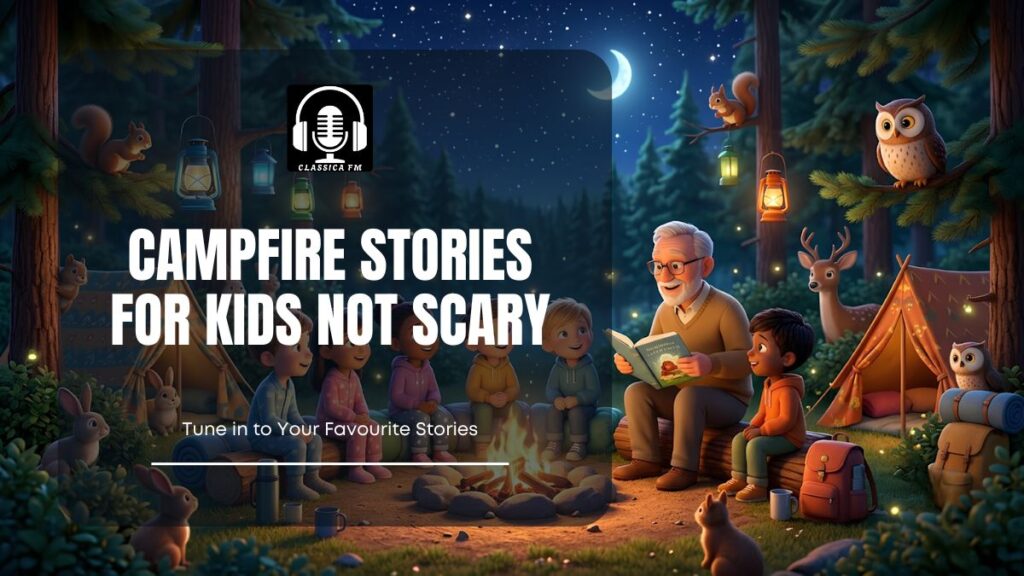
Campfires have a special kind of magic. As the flames crackle, sparks rise into the night sky, and everyone gathers close, even a simple story can feel like a little adventure. But not every child enjoys scary stories. For younger children especially, frightening ghosts, monsters, dark forests, or dangerous situations can turn a fun evening into an uncomfortable one.
That is where campfire stories for kids not scary come in.
Gentle campfire stories can still be exciting, funny, mysterious, imaginative, and memorable without relying on fear. They can take children on adventures through enchanted forests, introduce lovable animals, explore hidden treasures, or reveal surprising friendships.
This collection is designed around the idea that a campfire story does not have to be frightening to be entertaining.
What Are Campfire Stories for Kids Not Scary?
Campfire stories for kids not scary are short or long tales designed to be enjoyed around a campfire while keeping the atmosphere positive, playful, and age-appropriate.
Instead of frightening children with ghosts or monsters, these stories can use:
- Friendly forest animals
- Magical adventures
- Funny characters
- Hidden treasures
- Curious explorers
- Talking animals
- Secret gardens
- Gentle mysteries
- Unexpected friendships
- Imaginative journeys
- Silly adventures
- Stories with positive lessons
The goal is to create excitement without creating fear.
A story can make children wonder what happens next without making them afraid of what might be hiding in the darkness.
Campfire Stories for Kids Not Scary
1. The Fox Who Became a Detective
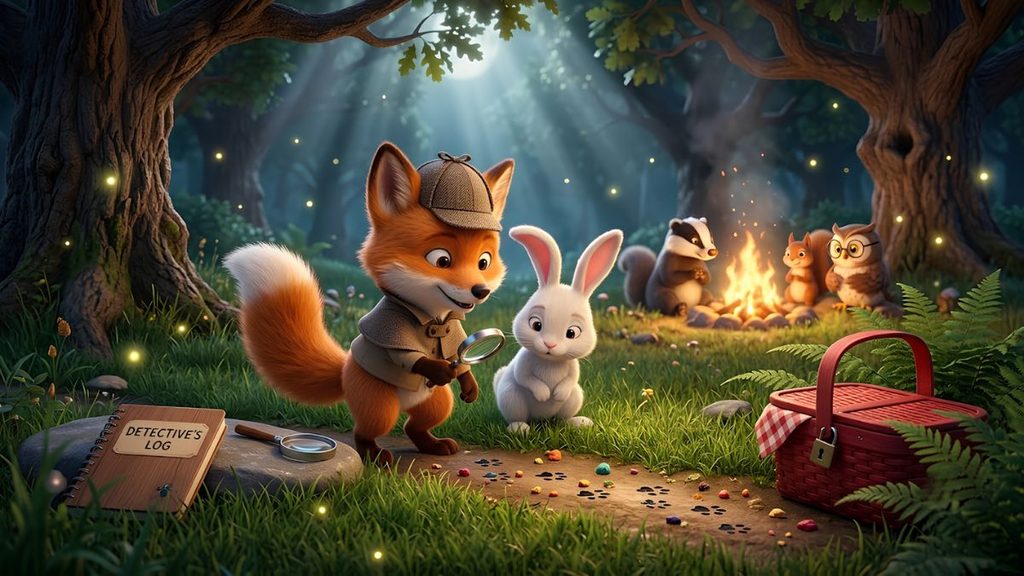
Theme: Talking Animals
Oliver Fox had always been curious.
Whenever something unusual happened in Willowbrook Forest, Oliver wanted to know why.
If a bird suddenly changed its singing pattern, Oliver wondered what had happened.
If a squirrel buried an acorn in an unusual place, Oliver wanted to know why.
If a rabbit came home with muddy paws when it had been sunny all morning, Oliver immediately wanted to hear the story.
The other animals sometimes found his curiosity amusing.
“You ask too many questions,” his friend Hazel the Rabbit often told him.
Oliver would simply smile.
“Questions help us discover things.”
One warm summer evening, Oliver was sitting beneath an old oak tree when Hazel came running toward him.
“Oliver!”
He jumped to his feet.
“What happened?”
“The picnic basket is gone!”
Oliver’s ears stood straight up.
“What picnic basket?”
“The big red one.”
“The one from Mrs. Maple’s picnic?”
“Yes!”
Oliver looked toward the meadow.
The woodland animals were preparing for their annual Moonlight Picnic, an evening when everyone gathered together to share food, play games, tell stories, and watch the stars.
Mrs. Maple, a kind elderly deer, had prepared the picnic basket that contained the special treats.
There were honey cakes.
Apple slices.
Berry muffins.
Carrot biscuits.
And Hazel’s favorite, tiny strawberry pies.
But the basket had disappeared.
“Where was it?” Oliver asked.
“Beside the picnic blanket.”
“When did you last see it?”
“About twenty minutes ago.”
“Who was nearby?”
Hazel thought.
“Everyone was getting ready.”
Oliver looked serious.
“Then we have a mystery.”
Hazel smiled.
“You mean you’re going to investigate?”
Oliver’s tail wagged.
“Of course.”
They hurried toward the meadow.
Several animals were gathered around the empty picnic blanket.
Mrs. Maple looked worried.
“I don’t understand,” she said. “I placed the basket right here.”
Oliver crouched down.
“Nobody touch anything.”
Hazel giggled.
“You’re acting like a real detective.”
Oliver looked around.
“I need to inspect the evidence.”
He examined the blanket.
Then the grass.
Then the nearby bushes.
He noticed several things.
There were tiny paw prints near the blanket.
A few crumbs lay on the ground.
One red thread was caught on a bush.
And there was a long trail through the grass.
Oliver followed it.
The trail led toward the forest.
Hazel followed close behind.
“What do you think happened?” she asked.
“I don’t know yet.”
“Do you think someone stole the basket?”
Oliver stopped.
“That’s possible.”
Hazel looked worried.
“Do you think it was someone from the forest?”
“Maybe.”
They continued walking.
After a few minutes, they reached a large stone.
Behind it were more crumbs.
Oliver picked one up.
“Honey cake.”
Hazel’s eyes widened.
“The basket came this way.”
They followed the crumbs.
The trail led deeper into the woods.
Soon they heard something.
Scritch.
Scritch.
Scritch.
Oliver stopped.
“What was that?”
Hazel whispered:
“I don’t know.”
They moved quietly toward the sound.
Behind a fallen tree, they found something unexpected.
A family of mice was trying to move a large piece of bread.
Oliver blinked.
“Hello.”
The mice froze.
The smallest mouse dropped the bread.
“We didn’t take the basket!”
Oliver smiled.
“I didn’t say you did.”
The mouse looked embarrassed.
“We found this bread near the meadow.”
Oliver looked at the bread.
It had been torn from one of the honey cakes.
“Did you see the basket?”
The mice looked at each other.
Finally, the oldest mouse pointed toward the hill.
“We saw something rolling that way.”
“Rolling?”
“Yes.”
Oliver thanked them.
He and Hazel hurried toward the hill.
At the top, they found another clue.
A small wheel track crossed the dirt.
Oliver examined it.
“The basket didn’t disappear by itself.”
Hazel looked confused.
“What do you mean?”
“I think it was moved.”
“By someone?”
“Or something.”
They followed the wheel track.
It led toward an old wooden bridge.
Halfway across the bridge, they discovered another clue.
A blue ribbon was caught between two wooden boards.
Hazel recognized it.
“That’s from Benny Badger’s hat.”
Oliver frowned.
“Benny?”
Benny Badger was known for being energetic.
He was always organizing games and races.
But he was also easily distracted.
“Maybe Benny took the basket,” Hazel said.
Oliver shook his head.
“We need more evidence.”
They found Benny near the river.
He was collecting smooth stones.
“Benny,” Oliver said.
“Yes?”
“Did you move the picnic basket?”
Benny looked shocked.
“No!”
“Did you see it?”
Benny thought.
“I saw Mrs. Maple put it beside the blanket.”
“What happened afterward?”
“I went to collect stones.”
“Did you see anything unusual?”
Benny pointed toward the river.
“A gust of wind came through.”
Oliver looked toward the meadow.
“Wind?”
“It was strong enough to knock over a few cups.”
Oliver’s ears lifted.
He thought about the wheel track.
Then the red thread.
Then the crumbs.
Then the basket.
“Where does the river flow?”
“Toward the old mill.”
Oliver thanked him.
He and Hazel hurried along the riverbank.
The trail eventually disappeared.
Oliver stopped.
“Something doesn’t make sense.”
Hazel looked at him.
“What?”
“If someone carried the basket, there should be footprints.”
He looked around.
“There aren’t any.”
Hazel thought for a moment.
“Then maybe nobody carried it.”
Oliver’s eyes widened.
“Exactly.”
They walked back toward the meadow.
Oliver studied the ground carefully.
Then he noticed something.
The picnic blanket had been placed on a gentle slope.
A wooden board had been lying nearby.
Oliver picked it up.
There were tiny scratches on its surface.
“What is that?”
Hazel asked.
“I think I know.”
Oliver returned to the picnic area.
He placed the board against the ground.
Then he looked at the slope.
“The basket was sitting here.”
He pointed.
“The wind knocked it sideways.”
Hazel’s eyes widened.
“It rolled?”
“Yes.”
“All the way into the forest?”
“Probably.”
They followed the slope.
The wheel marks became clearer.
The basket had rolled downhill.
It had crossed the meadow.
Passed the stone.
Gone through the bushes.
And continued toward the old mill.
Oliver and Hazel raced after it.
When they reached the mill, they heard laughter.
They looked around the corner.
There was the picnic basket.
It had stopped beside the mill wall.
And sitting beside it was Benny Badger.
He was eating a strawberry pie.
“Benny!”
Benny nearly dropped the pie.
“I can explain!”
Oliver laughed.
“You didn’t steal it.”
Benny looked confused.
“I didn’t?”
“No.”
Oliver explained what had happened.
The wind had knocked the basket onto its side.
It had rolled down the hill.
The animals had followed the crumbs without realizing that the basket had simply rolled away.
Benny had found it beside the mill.
He had opened it because he thought someone had deliberately left it there.
Then he had eaten one pie.
“Only one?” Hazel asked.
Benny looked guilty.
“Two.”
Hazel laughed.
Soon the whole group arrived.
Oliver explained the mystery.
Mrs. Maple smiled.
“So nobody stole the basket.”
“No,” Oliver said.
“The wind did.”
Everyone laughed.
Benny apologized for eating the pies.
Mrs. Maple handed him another.
“Since you found the basket, you may have one.”
Benny smiled.
“Thank you.”
The Moonlight Picnic continued.
The animals ate honey cakes.
The rabbits played games.
The birds sang.
The squirrels raced around the trees.
And Oliver sat beneath the old oak tree.
Hazel brought him a strawberry pie.
“You were good at this detective business.”
Oliver smiled.
“I learned something.”
“What?”
“Sometimes the most obvious explanation isn’t the right one.”
Hazel nodded.
“And sometimes the answer is much less exciting.”
Oliver looked at the picnic.
“Maybe.”
Then he noticed something.
A small green leaf was stuck to his tail.
He turned around.
“How did that get there?”
Hazel laughed.
“You really are going to investigate everything, aren’t you?”
Oliver smiled.
“Probably.”
As the evening continued, the sky became darker.
The first stars appeared.
The animals gathered around the campfire.
Mrs. Maple asked Oliver to tell everyone about his investigation.
Oliver stood proudly.
He described the missing basket.
The crumbs.
The mice.
The wheel tracks.
The bridge.
Benny.
And finally, the wind.
When he finished, everyone applauded.
Hazel leaned toward him.
“You know, you’re not really a detective.”
Oliver smiled.
“Not yet.”
“Why not?”
“Because I need a detective hat.”
Hazel laughed.
“What color?”
“Green.”
“Why green?”
“Because it matches my fur.”
Hazel shook her head.
“You are impossible.”
Oliver laughed.
That night, before everyone went home, Mrs. Maple gave Oliver a small notebook.
“For your investigations.”
Oliver opened it.
The first page was blank.
He wrote:
Case Number One: The Missing Picnic Basket
Underneath, he wrote:
Solved.
Then he added:
Cause: Wind.
He closed the notebook.
The moon was shining above the trees.
Oliver looked around the forest.
There would always be mysteries.
Some would be important.
Some would be silly.
Some would have complicated answers.
Others would turn out to be nothing more than a basket rolling down a hill.
But Oliver had learned something important.
Being a good detective wasn’t about accusing people.
It wasn’t about being the cleverest animal in the forest.
It was about asking questions.
Listening carefully.
Looking closely.
And most importantly, finding the truth before deciding what had happened.
Oliver placed the notebook under his arm.
Hazel walked beside him.
“Ready to go home?”
“Yes.”
They walked through the moonlit forest together.
Behind them, the campfire slowly faded into glowing embers.
Above them, the stars filled the sky.
And somewhere near the old mill, a very happy badger was eating his third strawberry pie.
2. The Forest Where the Flowers Glowed
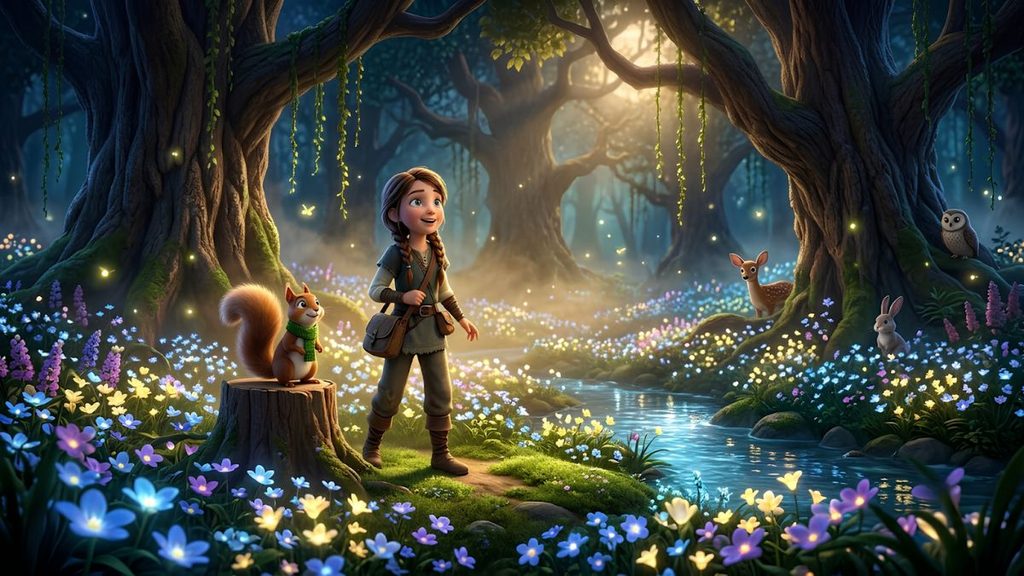
Theme: Magical Forests
Mia had always loved camping.
She loved sleeping inside a tent while rain tapped softly against the fabric.
She loved roasting marshmallows over a campfire.
She loved waking up early enough to see mist floating above the lake.
But most of all, Mia loved exploring.
Her parents often reminded her to stay close to the campsite.
“Look all you want,” her father would say, “but don’t wander too far.”
Mia always promised.
And she usually kept her promise.
Her younger brother, Leo, was different.
Leo preferred staying near the fire.
He liked roasting marshmallows and telling silly jokes.
He wasn’t interested in walking through forests.
“The woods are full of bugs,” he would complain.
Mia would laugh.
“That’s because it’s a forest.”
Their family had arrived at Pinewood Campground on a warm Saturday afternoon.
The campground was surrounded by tall pine trees.
A clear stream ran nearby.
Beyond the stream was a large forest that stretched toward distant hills.
The campsite was peaceful.
Birds sang from the branches.
Squirrels moved between the trees.
The air smelled of pine needles and fresh earth.
That evening, the family gathered around the campfire.
Their parents cooked dinner while Mia and Leo toasted marshmallows.
Mia looked toward the forest.
The trees appeared almost golden in the fading sunlight.
“I wonder what’s back there,” she said.
Leo looked up.
“Probably trees.”
Mia laughed.
“Very clever.”
Their mother smiled.
“Maybe you can explore tomorrow.”
Mia nodded.
But she was already thinking about it.
After dinner, everyone sat around the fire.
Their father told them stories about his childhood camping trips.
Leo eventually became sleepy.
Mia stayed awake.
She watched sparks rise from the fire.
Then something caught her attention.
A tiny green light appeared between the trees.
Mia blinked.
It disappeared.
Then another appeared.
And another.
“Mom?”
Her mother looked over.
“What?”
“Did you see that?”
“See what?”
Mia pointed.
“There was a light.”
Her father looked toward the forest.
“Probably a firefly.”
Mia smiled.
“Maybe.”
But she wasn’t convinced.
She had seen fireflies before.
These lights had been brighter.
Almost like tiny stars.
The next morning, Mia woke early.
The campground was quiet.
Her parents were still asleep.
Leo was curled up inside his sleeping bag.
Mia stepped outside.
The morning sun was rising.
She heard the stream nearby.
Then she noticed something on the ground.
A small trail of blue flowers.
They grew along the edge of the campsite.
Mia crouched down.
She had never seen flowers like them.
Their petals were pale blue.
Tiny drops of dew rested on their leaves.
She touched one gently.
The flower seemed to shimmer.
Mia smiled.
She followed the trail.
The flowers led toward the stream.
She stopped before crossing.
Her father’s warning came back to her.
Don’t wander too far.
Mia looked back at the campsite.
It was still visible.
She decided she would only explore for a few minutes.
She crossed the stream using a line of flat stones.
On the other side, the forest felt different.
It was quieter.
The sunlight came through the trees in soft golden beams.
Birds sang somewhere above her.
Mia followed the blue flowers.
Soon they disappeared.
But another kind appeared.
These were yellow.
Then purple.
Then white.
The flowers formed a winding trail through the forest.
Mia followed it.
After several minutes, she reached a clearing.
There was an enormous tree in the center.
Its branches stretched in every direction.
But what surprised Mia most was the flowers.
Hundreds of them covered the clearing.
They were closed.
Mia stepped closer.
Then one flower opened.
Its petals began to glow.
Mia stared.
Another flower opened.
Then another.
Within seconds, the entire clearing was filled with soft light.
Mia smiled.
“It really is a glowing forest.”
A voice answered.
“Yes.”
Mia jumped.
She looked around.
“Who’s there?”
A small squirrel climbed down the tree.
“Me.”
Mia stared.
The squirrel wore a tiny green scarf.
“You can talk!”
The squirrel tilted its head.
“Of course.”
Mia laughed.
“I’ve never met a talking squirrel.”
“I’ve never met a girl who follows glowing flowers.”
Mia smiled.
“My name is Mia.”
“I’m Pip.”
“Nice to meet you, Pip.”
Pip jumped onto a nearby branch.
“You found the hidden forest.”
“Hidden?”
“Yes.”
“Why is it hidden?”
Pip shrugged.
“Because it likes being hidden.”
Mia looked around.
“Who takes care of the flowers?”
“Everyone.”
“Everyone?”
“The rabbits bring water. The birds carry seeds. The butterflies help the flowers bloom. The trees protect them from strong winds.”
Mia smiled.
“That’s beautiful.”
Pip nodded.
“But something is wrong.”
Mia became curious.
“What?”
Pip pointed toward the far side of the clearing.
A section of flowers was dark.
They had not opened.
Mia walked closer.
“Why aren’t they glowing?”
Pip sighed.
“They haven’t bloomed for three nights.”
“Are they sick?”
“We don’t know.”
Mia examined the flowers.
They looked healthy.
Their leaves were green.
Their stems were strong.
But they remained closed.
“Maybe they need water.”
“We tried.”
“Sunlight?”
“They get plenty.”
“Maybe the soil?”
Pip shook his head.
“We tried everything.”
Mia thought.
“Then perhaps they need something else.”
“What?”
“I don’t know yet.”
She looked around.
Maybe the answer was somewhere nearby.
She followed the edge of the flower patch.
Then she noticed a small stream.
It was almost completely blocked by fallen branches.
Water was barely reaching the flowers.
“Pip!”
“What?”
“Look!”
Mia pointed.
“The stream is blocked.”
Pip’s eyes widened.
“That’s the problem!”
He called for help.
Within minutes, animals began appearing.
Rabbits.
Squirrels.
Birds.
A family of hedgehogs.
Even a friendly-looking badger.
Everyone worked together.
The rabbits moved small branches.
The squirrels pulled twigs away.
The birds carried leaves.
Mia and Pip moved larger pieces.
It took nearly an hour.
Finally, the last branch was removed.
Water began flowing again.
It traveled down the little stream.
Across the moss.
Toward the flowers.
Everyone waited.
Nothing happened.
Pip looked worried.
“Maybe that wasn’t it.”
Mia sat beside the flowers.
“Let’s wait.”
The animals gathered around.
They waited quietly.
A minute passed.
Then another.
A tiny purple flower opened.
Everyone gasped.
Then another.
And another.
Soon the entire patch began glowing.
Soft purple light filled the clearing.
The animals cheered.
Mia laughed.
Pip jumped onto her shoulder.
“You did it!”
“We all did it.”
The animals celebrated.
The birds sang.
The rabbits danced.
The squirrels ran in circles.
Mia watched the glowing flowers.
She felt as though she had discovered something magical.
But then she noticed another strange thing.
The flowers were glowing brighter than before.
“Why are they so bright?”
Pip looked at the flowers.
“I think they’re happy.”
Mia smiled.
“Flowers can be happy?”
“Why not?”
Mia laughed.
The animals invited her to stay for lunch.
They shared berries, nuts, mushrooms, and sweet forest fruit.
Mia sat beneath the enormous tree.
Pip told her stories about the forest.
He explained that the flowers only glowed at night or when someone did something kind.
Mia found that difficult to believe.
“Then why did they glow when I arrived?”
Pip smiled.
“You followed the trail instead of picking the flowers.”
Mia looked at the flowers.
“Would that have hurt them?”
“Yes.”
Mia felt relieved.
She had wanted to touch them.
But she hadn’t picked any.
Pip nodded.
“That’s why the forest likes visitors who are careful.”
After lunch, Mia looked toward the campsite.
She realized she had been gone longer than she expected.
“I need to go back.”
Pip nodded.
“I’ll show you.”
They followed the flower trail.
As they walked, Mia noticed something strange.
The trail seemed much shorter than before.
Soon they reached the stream.
Mia crossed carefully.
The campground was only a few steps away.
Her parents were awake.
Her father was looking around.
“Mia!”
She hurried toward him.
“Sorry!”
He hugged her.
“Where were you?”
“I was exploring.”
“We were worried.”
Mia nodded.
“I’m sorry.”
Her mother knelt beside her.
“Did you go across the stream?”
“Yes.”
Her mother looked concerned.
“But I stayed close.”
Mia hesitated.
She wanted to tell them about the glowing flowers.
She wanted to tell them about Pip.
But she wondered whether they would believe her.
She pointed toward the forest.
“There are beautiful flowers over there.”
Her father smiled.
“Maybe we’ll look together later.”
Mia smiled.
“Okay.”
That evening, the family sat around the campfire.
Leo roasted marshmallows.
Their father played a guitar.
Their mother told stories.
Mia looked toward the forest.
She could see tiny lights between the trees.
One.
Two.
Three.
Then dozens.
The glowing flowers were visible from the campsite.
“Mia,” Leo said.
“What?”
“Look.”
He pointed.
“Are those fireflies?”
Mia smiled.
“Maybe.”
Leo narrowed his eyes.
“They look different.”
Mia laughed.
“They do.”
Later that night, after everyone had gone to sleep, Mia stepped outside the tent.
She looked toward the forest.
The flowers were glowing.
She could almost see Pip waving from the trees.
Mia waved back.
The next morning, Mia returned to the clearing with her family.
But when they reached the forest, she could not find the trail.
She looked everywhere.
No blue flowers.
No yellow flowers.
No purple flowers.
Nothing.
Her father smiled.
“Maybe the flowers moved.”
Mia laughed.
“Maybe.”
Leo searched beneath a tree.
“I don’t see anything.”
Mia wasn’t disappointed.
She knew the forest was still there.
Some things didn’t need to be proven.
She looked toward the trees.
A tiny squirrel appeared on a branch.
Pip.
He was wearing his green scarf.
Mia smiled.
Pip winked.
Then he disappeared.
Mia’s family never saw him.
But Mia did.
And she knew she would never forget the glowing forest.
Years later, whenever she went camping, Mia still looked for tiny blue flowers near streams.
Sometimes she found ordinary wildflowers.
Sometimes she found nothing.
But she always remembered what the hidden forest had taught her.
Nature was full of small wonders.
Some were easy to see.
Others required patience.
And sometimes the most magical discoveries happened when you simply followed a little trail and took the time to help.
Mia never picked flowers after that day.
Instead, she photographed them.
She watched butterflies land on their petals.
She listened to birds singing above them.
She learned the names of trees.
She collected fallen leaves.
She taught Leo how to recognize animal footprints.
And every time they returned to the forest, Leo asked the same question.
“Do you think Pip is still there?”
Mia would smile.
“I think he is.”
One summer evening, many years later, Mia brought her own children camping.
She showed them the stream.
She showed them the meadow.
She told them about the mysterious flowers.
Her children listened with wide eyes.
“Did you really see them glow?”
Mia smiled.
“Yes.”
“Did you really meet a talking squirrel?”
Mia looked toward the trees.
“I think I did.”
Her children laughed.
“Mom!”
She laughed with them.
That night, they sat around the campfire.
Stars filled the sky.
The fire crackled.
A gentle breeze moved through the trees.
Then Mia’s youngest child suddenly pointed toward the forest.
“Look!”
Everyone turned.
Tiny blue lights were glowing between the trees.
Mia’s heart skipped.
She smiled.
Perhaps it was fireflies.
Perhaps it was something else.
She didn’t need to know.
Some mysteries are more beautiful when they remain mysteries.
Mia wrapped a blanket around her children.
“Maybe,” she whispered, “the forest is saying goodnight.”
The children smiled.
And beyond the campfire, hidden among the trees, the flowers continued to glow.
3. The Treasure Beneath the Old Oak Tree
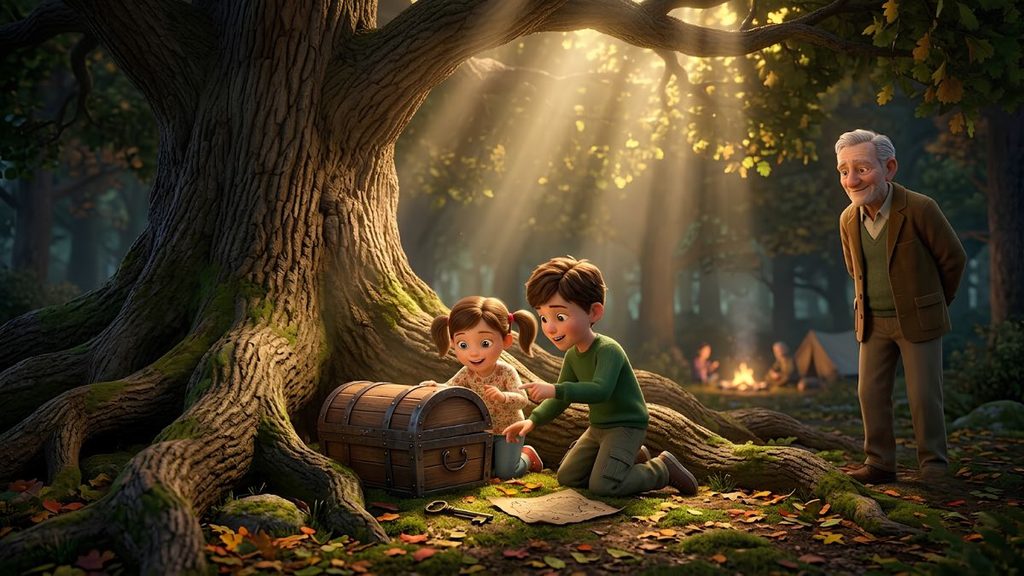
Theme: Treasure Hunts
Ethan had always believed that every old place had a story.
His grandfather disagreed.
“Not every old tree is hiding treasure,” Grandpa James would say.
Ethan would smile.
“You don’t know that.”
Grandpa would laugh.
“Fair enough.”
Ethan was eleven years old and loved adventures.
He collected unusual stones.
He drew maps of places he had visited.
He kept old buttons, feathers, leaves, coins, and anything else he thought might have an interesting history.
His bedroom wall was covered with hand-drawn maps.
Some showed imaginary islands.
Others showed forests filled with castles.
One showed a secret tunnel beneath his school.
His mother had asked him several times to remove that one.
But Ethan insisted it was important.
“It’s for research.”
His mother laughed.
“Of course.”
One summer weekend, Ethan’s family went camping at Willow Creek Campground.
His parents, his younger sister Sophie, and his grandfather came along.
Grandpa James had been camping there many times when he was younger.
“This place hasn’t changed much,” he said as they arrived.
Ethan looked around.
Tall trees surrounded the campground.
A small stream ran nearby.
There was a wooden bridge.
Beyond the campground stood a large old oak tree.
Its branches were enormous.
Its trunk was thick and twisted.
Ethan immediately noticed it.
“What’s that tree?”
Grandpa looked toward it.
“That’s the old oak.”
“How old is it?”
“Very old.”
“How old?”
Grandpa smiled.
“Older than me.”
Sophie laughed.
“That’s really old.”
Grandpa pretended to be offended.
“Thank you.”
That evening, everyone sat around the campfire.
They roasted marshmallows and told stories.
Grandpa talked about camping at Willow Creek when he was young.
“I used to explore the woods with my friends,” he said.
“Did you ever find treasure?” Ethan asked.
Grandpa smiled.
“Treasure?”
“Yes.”
“Nothing valuable.”
“What did you find?”
Grandpa thought.
“A few old coins. Some bottles. A rusty key.”
Ethan leaned closer.
“A key?”
Grandpa nodded.
“Yes.”
“Where?”
“Near the old oak tree.”
Ethan’s eyes widened.
“Did it open anything?”
Grandpa laughed.
“I never found out.”
Ethan looked toward the dark outline of the oak.
“Maybe it opens something now.”
Grandpa shook his head.
“Perhaps.”
That night, Ethan couldn’t stop thinking about the key.
The next morning, he asked Grandpa about it again.
“Do you still have it?”
“No.”
“Do you remember what it looked like?”
“Small. Brass. Very old.”
“Where exactly did you find it?”
Grandpa pointed toward the oak.
“Somewhere near there.”
Ethan grabbed his backpack.
Sophie followed.
“I’m coming.”
“You’ll get bored.”
“No, I won’t.”
“You’re nine.”
“So?”
Ethan sighed.
“Fine.”
They walked toward the oak tree.
Their parents called after them.
“Stay where we can see you!”
“We will!” Ethan shouted.
The tree stood at the edge of a grassy clearing.
Its roots rose from the ground like giant wooden waves.
Ethan walked around the trunk.
Sophie searched beside him.
“What are we looking for?”
“A clue.”
“What kind?”
“Anything.”
They searched beneath fallen leaves.
They looked near the roots.
They examined rocks.
Then Sophie called out.
“Ethan!”
He hurried over.
She was holding something.
A small metal object.
Ethan’s heart raced.
“What is it?”
Sophie handed it to him.
It was a rusty key.
Ethan stared.
“Grandpa’s key.”
“Are you sure?”
He turned it over.
It was small and brass.
“This must be it.”
They ran back to the campsite.
Grandpa was drinking coffee.
Ethan placed the key in front of him.
Grandpa stared.
For several seconds, he said nothing.
“Where did you find that?”
“Under the oak.”
Grandpa picked it up.
He turned it over.
“I haven’t seen this in nearly fifty years.”
Ethan smiled.
“Then we need to find what it opens.”
Grandpa laughed.
“Of course we do.”
They returned to the oak tree.
This time, Grandpa came with them.
He looked carefully at the tree.
“I remember finding the key near this root.”
He pointed.
“But I never found a lock.”
Ethan searched the ground.
Sophie examined the trunk.
Then she noticed something.
“There’s a hole.”
Everyone turned.
Near the base of the tree was a tiny opening partly covered by moss.
Ethan reached inside.
His fingers touched something.
“There’s something here.”
He pulled out a small wooden box.
Everyone stared.
The box was old.
Its surface was covered with scratches.
There was a tiny metal lock.
Ethan held up the key.
Grandpa smiled.
“Well.”
Ethan inserted the key.
It turned.
Click.
The box opened.
Inside was a folded piece of paper.
There was also a small silver coin.
Sophie gasped.
“Treasure!”
Ethan carefully unfolded the paper.
It was a handwritten note.
The writing was faded.
He read it aloud.
“To whoever finds this box.”
Ethan looked at Grandpa.
“Keep reading.”
He continued.
“If you found this beneath the old oak, you have probably spent some time looking.”
Sophie laughed.
“That’s true.”
Ethan continued.
“I placed this box here many years ago with my closest friend, Samuel.”
Grandpa suddenly became quiet.
“Samuel?”
He looked at the note.
“I knew someone named Samuel.”
“Who was he?” Ethan asked.
“My best friend when I was a boy.”
Grandpa sat beneath the tree.
“I haven’t thought about him in years.”
Ethan continued reading.
“We were certain that one day someone would discover our treasure.”
The note explained that two boys had visited Willow Creek many decades earlier.
They had found the old oak.
They had decided to create their own treasure.
But they had no gold.
No jewels.
No expensive objects.
So they collected things that mattered to them.
A coin.
A marble.
A feather.
A small wooden button.
A photograph.
And a note.
They placed everything in the box.
Then they buried it.
At the end of the letter, they had written:
“Treasure isn’t always something that makes you rich. Sometimes it is something that reminds you of the people you love.”
Grandpa stared at the words.
“Samuel and I wrote that.”
Ethan looked at him.
“You remember?”
Grandpa smiled.
“I remember now.”
He laughed softly.
“We thought we were very clever.”
“What happened to Samuel?” Sophie asked.
Grandpa’s smile faded slightly.
“We lost touch when we grew up.”
“Did you ever see him again?”
“No.”
Grandpa looked at the old tree.
“I always wondered what happened to him.”
Ethan examined the box.
“Maybe we can find him.”
Grandpa laughed.
“How?”
“The letter might have a clue.”
They searched the box again.
Underneath the first note was another piece of paper.
Ethan unfolded it.
It contained a simple drawing.
A map.
The map showed the campground.
The stream.
The bridge.
And another location marked with an X.
Grandpa looked at it.
“I remember this.”
“Where is it?”
“Across the bridge.”
They followed the map.
The trail led through the trees.
Soon they reached a small meadow.
At the edge of the meadow stood an old stone bench.
Grandpa stared.
“That’s where Samuel and I used to sit.”
Ethan looked beneath the bench.
Nothing.
Sophie searched nearby.
Then she found another small box.
Inside was an old photograph.
Two boys stood beneath the oak tree.
They were smiling.
One was Grandpa James.
The other was Samuel.
Grandpa held the photograph with trembling hands.
“I haven’t seen this picture in decades.”
He smiled.
“We were terrible at taking serious photographs.”
Ethan laughed.
“What happened to him?”
Grandpa looked at the back.
There was a name.
Samuel Carter.
And an old address.
It wasn’t a complete address.
But it was enough to begin searching.
When they returned home from the camping trip, Grandpa asked Ethan to help him search for Samuel.
They looked through old family papers.
They searched through an old telephone directory.
Eventually, they found a possible address.
Grandpa wasn’t sure.
But he called.
An elderly man answered.
“Hello?”
Grandpa hesitated.
“Samuel?”
There was silence.
Then:
“James?”
Grandpa smiled.
“Yes.”
Ethan watched his grandfather’s face.
Samuel began laughing.
“Where have you been?”
“Everywhere.”
“You disappeared.”
“So did you.”
They talked for nearly an hour.
They remembered the old campground.
The oak tree.
The treasure box.
The terrible sandwiches they used to make.
The games they played.
The promises they had made.
Eventually, Grandpa asked:
“Do you remember the treasure?”
Samuel laughed.
“I wondered whether anyone would ever find it.”
“They did.”
“Who?”
“My grandson.”
Ethan waved at the phone.
“Hello!”
Samuel laughed.
“Hello, young treasure hunter.”
Ethan told him everything.
Samuel was delighted.
A few weeks later, Samuel visited Willow Creek.
He was older now.
His hair was white.
He walked with a cane.
But when he saw Grandpa James beneath the old oak, both men smiled like children.
They hugged.
Ethan watched quietly.
The treasure had done something unexpected.
It had brought two old friends together.
That evening, everyone gathered beneath the oak.
Grandpa brought the wooden box.
He placed the original treasures inside.
The coin.
The marble.
The feather.
The button.
The photograph.
The note.
Then he added something new.
A photograph of himself, Samuel, Ethan, and Sophie.
Sophie added a friendship bracelet.
Ethan added one of his favorite stones.
Samuel added a small silver button from his old jacket.
Grandpa wrote a new note.
Ethan read it aloud.
“Dear future treasure hunter,
If you have found this box, remember that the most valuable things in life are rarely made of gold.
People matter.
Memories matter.
Friendship matters.
And sometimes, the greatest treasure is finding someone you thought you had lost forever.
Take care of the people you love.
And leave something kind behind for whoever comes next.”
They placed the note inside.
The box was closed.
Then they decided not to bury it.
Instead, they placed it in a safe wooden container beneath the old oak, where future campers could discover it someday.
Ethan looked at Grandpa.
“Is that really treasure?”
Grandpa smiled.
“I think it’s the best kind.”
That night, Ethan sat beside the campfire.
He looked at the stars.
Sophie sat beside him.
“Do you think someone will find it someday?”
“I hope so.”
“What will they think?”
Ethan smiled.
“Maybe they’ll think we were strange.”
Sophie laughed.
“Definitely.”
They watched sparks rise from the fire.
The old oak stood quietly beyond the campsite.
Its branches moved gently in the night breeze.
Ethan realized that he had expected treasure to be something exciting.
Something valuable.
Something that would make him famous.
Instead, he had found something better.
A story.
A friendship.
A memory.
And a reason to remember that ordinary things can become extraordinary when they are connected to people we love.
Years later, Ethan would return to Willow Creek.
He would bring his own children.
He would show them the old oak.
He would tell them about Grandpa James and Samuel.
And he would tell them about the treasure box.
Then he would ask them what they would put inside if they had to create their own treasure.
His children would probably choose toys.
Or coins.
Or stones.
Ethan would smile.
“Those are good choices.”
Then he would give them a piece of paper.
“Now write something for the person who finds it.”
Because the real treasure had never been hidden beneath the old oak.
It had been hidden inside a memory.
And memories, Ethan had learned, become more valuable every time they are shared.
4. The Night We Lost the Flashlight
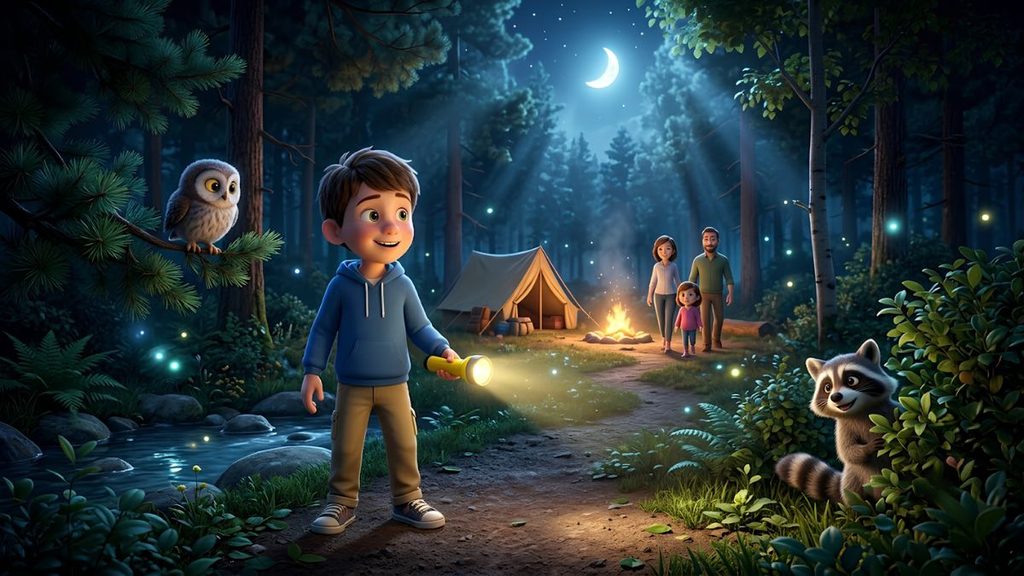
Theme: Camping Adventures
Noah thought he was an excellent camper.
His mother disagreed.
“You’ve been camping for three hours,” she reminded him.
“Exactly,” Noah said. “And nothing has gone wrong.”
His younger sister Lily laughed.
“That’s because Mom is doing everything.”
Noah looked offended.
“I helped.”
“You carried the marshmallows.”
“That’s important.”
Their father smiled from beside the campfire.
“Very important.”
The family had arrived at Pine Creek Campground that afternoon.
It was their first camping trip of the summer.
The campsite sat beside a quiet forest, with a small stream running nearby.
Tall pine trees surrounded the area.
Birds sang in the branches.
Every few minutes, Noah heard something moving through the leaves.
Usually it was a squirrel.
Sometimes it was a bird.
Once, he discovered it was only a large leaf being pushed by the wind.
By evening, the family had finished setting up the tent.
Their father cooked dinner over a small camp stove.
Their mother arranged sleeping bags.
Lily collected sticks.
Noah’s job was to keep the flashlight nearby.
It was a large yellow flashlight with a black handle.
Their father had bought it especially for the trip.
“It has fresh batteries,” he told Noah.
“So don’t lose it.”
Noah held it up proudly.
“I won’t.”
After dinner, everyone sat around the campfire.
Noah roasted marshmallows.
Lily tried to make the biggest marshmallow sandwich possible.
It fell apart.
She blamed the marshmallow.
“The marshmallow betrayed me.”
Everyone laughed.
The sky gradually darkened.
Stars appeared between the trees.
The campfire became the brightest thing in the clearing.
Their father told funny stories.
Their mother sang an old song.
Lily eventually became sleepy.
Noah stayed awake.
He loved nighttime camping.
Everything seemed different after sunset.
The forest that looked ordinary during the day now seemed mysterious.
Not frightening.
Just unfamiliar.
Noah took the flashlight.
He walked to the edge of the campsite.
“Don’t go far,” his mother called.
“I won’t.”
He switched on the flashlight.
The beam cut through the darkness.
He pointed it toward the trees.
Then toward the stream.
Then toward the tent.
Lily laughed.
“You’re making a lighthouse.”
Noah grinned.
Then something moved near the bushes.
Noah pointed the flashlight.
A rabbit jumped away.
“Got you!”
The rabbit disappeared.
Noah laughed.
He took a few more steps.
Then he heard a strange sound.
Plop.
He looked down.
His flashlight was gone.
“No!”
He searched the grass.
Nothing.
He checked his pockets.
Nothing.
He looked toward the stream.
Then he remembered.
He had been holding the flashlight while walking.
He must have dropped it.
Noah sighed.
He turned back toward the campfire.
Then he noticed something.
The campsite wasn’t as close as he thought.
He had walked farther than he realized.
The fire was visible through the trees, but the path looked confusing.
“No problem,” Noah said.
“I can find it.”
He started walking.
He took a few steps.
Then stopped.
The fire disappeared behind the trees.
Noah looked around.
He suddenly wasn’t sure which direction he had come from.
“Okay.”
He took a breath.
“Don’t panic.”
He remembered what his father always said.
When you’re unsure, stop and think.
Noah stopped.
He listened.
He could hear the stream.
He knew the stream was beside the campsite.
So he followed the sound of running water.
After a minute, he heard something else.
Scratching.
Noah froze.
Then a small animal appeared.
A raccoon.
It was holding something.
Noah stared.
“Is that my flashlight?”
The raccoon looked at him.
Then it dropped the object.
Noah walked closer.
It wasn’t the flashlight.
It was a metal cup.
The raccoon picked it up again.
Noah laughed.
“Sorry.”
The raccoon disappeared into the bushes.
Noah continued toward the stream.
Soon he heard water.
He followed it.
But instead of reaching the campsite, he found a small clearing.
There was a wooden picnic table.
Noah recognized it.
His father had mentioned that there was an old picnic area somewhere nearby.
He had taken the wrong turn.
Noah sat down.
He wasn’t frightened.
But he was beginning to feel worried.
He wondered whether his parents had noticed he was missing.
They probably had.
His mother would be worried.
His father would come looking.
Noah wished he had listened more carefully.
Then he heard a sound.
Chirp.
He looked up.
A small owl sat on a branch.
Noah smiled.
“Hello.”
The owl tilted its head.
Noah looked around.
The forest was surprisingly beautiful at night.
Moonlight passed through the branches.
Tiny insects moved through the air.
Leaves rustled softly.
It wasn’t scary.
It was peaceful.
Noah sat quietly.
Then he remembered another thing his father had taught him.
“If you’re ever unsure where you are, stay in one safe place instead of wandering around.”
Noah decided to follow that advice.
He stayed beside the picnic table.
A few minutes later, he heard voices.
“Noah!”
His father’s voice.
Noah stood.
“Dad!”
“We’re here!”
Noah followed the sound.
Within moments, his father appeared between the trees.
His mother was behind him.
Lily followed.
Noah ran toward them.
His mother hugged him.
“Are you okay?”
“Yes.”
“What happened?”
“I lost the flashlight.”
His father smiled.
“That’s all?”
Noah nodded.
“Then we have a mystery to solve.”
Lily laughed.
“The great flashlight mystery.”
They searched the area together.
Noah explained where he had been walking.
His father checked the path.
His mother looked around the grass.
Lily examined the bushes.
Then she shouted:
“I found something!”
Everyone hurried over.
She was holding a small yellow object.
The flashlight.
It had fallen beside a tree root.
Noah laughed.
“I walked right past it.”
His father switched it on.
The beam lit up the trees.
“Found.”
They started walking back.
But halfway there, Noah stopped.
“Wait.”
“What?”
“I think I hear something.”
Everyone listened.
Chirp.
Chirp.
It was the owl.
Lily looked up.
“There it is.”
The owl was sitting above them.
Their father smiled.
“Looks like you made a friend.”
Noah smiled.
“Maybe.”
They returned to the campsite.
The campfire was still burning.
Noah sat beside it.
His mother handed him a warm drink.
“You did well.”
“I got lost.”
“You stayed where you were.”
Noah thought about it.
“Because Dad told me to.”
His father nodded.
“Good.”
Lily looked at him.
“Did you see anything interesting?”
Noah smiled.
“An owl.”
“Anything else?”
“A raccoon.”
“Anything else?”
“Moonlight.”
Lily looked impressed.
“Sounds like a pretty good adventure.”
Noah nodded.
“It was.”
That night, everyone went to bed.
Noah placed the flashlight beside his sleeping bag.
His father laughed.
“Good idea.”
Noah smiled.
“I’m not losing it again.”
The next morning, Noah woke early.
Sunlight filled the campsite.
Birds were singing.
He stepped outside.
The forest looked completely different.
It was bright.
Green.
Friendly.
Noah walked toward the picnic table from the previous night with his father.
They wanted to make sure everything was clean before leaving.
As they reached the clearing, Noah spotted something.
A small pile of objects sat beneath the picnic table.
His flashlight.
A metal cup.
A spoon.
A shiny wrapper.
And a pinecone.
Noah laughed.
The raccoon had apparently been collecting things.
His father smiled.
“Looks like someone has a collection.”
Noah placed the cup and spoon back where they belonged.
Then he left the pinecone.
“Maybe the raccoon likes it.”
They returned to camp.
Before leaving, Noah looked toward the forest.
The owl was nowhere to be seen.
But he thought he heard a soft chirp.
“Goodbye,” he whispered.
Lily heard him.
“Who are you talking to?”
“The owl.”
She smiled.
“You’re weird.”
“No, I’m polite.”
Their parents laughed.
The family packed their things.
The tent came down.
The campfire was extinguished.
The last bag was placed in the car.
Noah looked around one final time.
He had learned something during the night.
Being lost didn’t always mean being in danger.
Sometimes it meant stopping.
Listening.
Thinking.
And waiting for help.
He had also discovered that nighttime forests weren’t necessarily frightening.
They could be beautiful.
The moonlight made everything look different.
Owls called from trees.
Raccoons searched for interesting objects.
Streams whispered over stones.
And sometimes, a lost flashlight could lead to an adventure you remembered for years.
As the car pulled away from Pine Creek Campground, Lily leaned toward Noah.
“Next time, I’ll carry the flashlight.”
Noah shook his head.
“No.”
“Why?”
“Because you’re even worse at keeping track of things.”
Lily laughed.
Their father looked at them through the mirror.
“Maybe we should buy two flashlights.”
Their mother smiled.
“Three.”
Everyone laughed.
Noah looked out the window.
The forest slowly disappeared behind them.
He smiled.
He already knew he would come back.
And next time, he would keep the flashlight firmly in his hand.
Probably.
5. The Rabbit and the Bear Who Couldn’t Agree
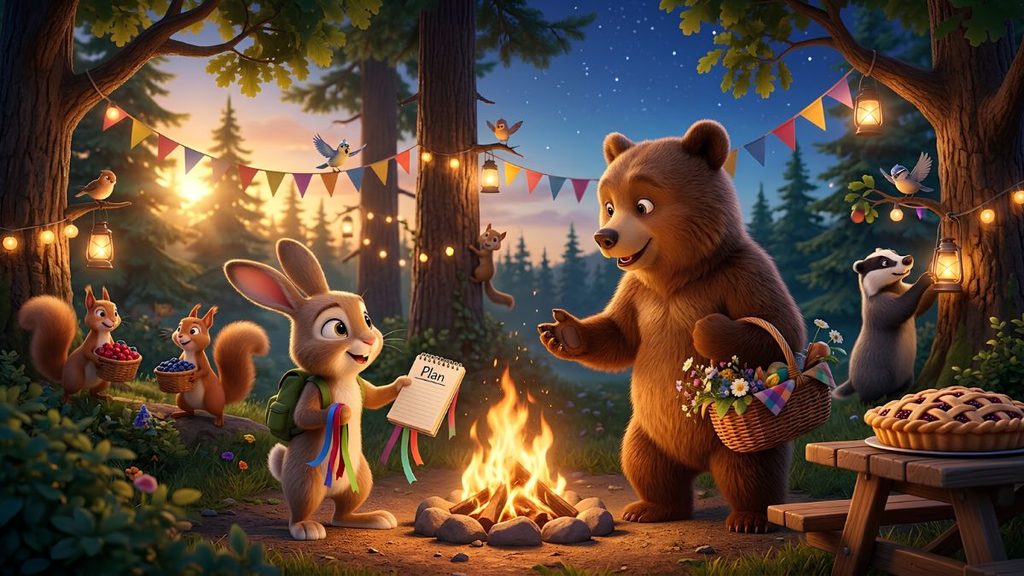
Theme: Friendship Adventures
In a peaceful corner of Willow Creek Forest lived two very different friends.
One was Pip, a small brown rabbit who could never sit still.
The other was Bruno, a large young bear who preferred to take his time.
Pip liked to move quickly.
Bruno liked to think carefully.
Pip loved making plans.
Bruno preferred to see what happened.
Pip liked carrots.
Bruno liked berries.
Pip enjoyed early mornings.
Bruno thought mornings were something that should begin after breakfast.
Despite their differences, they were best friends.
Every summer, the animals of Willow Creek held a grand evening celebration beside the forest campfire.
There were games, songs, stories, and plenty of food.
The animals spent several days preparing.
Pip always volunteered to organize everything.
“I’ll make the schedule!”
“I’ll decorate the trees!”
“I’ll organize the games!”
“I’ll decide where everyone sits!”
Bruno usually watched him with amusement.
“You don’t have to do everything.”
Pip would shake his head.
“Someone has to.”
This year, however, something unexpected happened.
The animals decided to hold their biggest celebration yet.
There would be music.
There would be dancing.
There would be a storytelling contest.
There would be a giant berry pie.
And there would be a special campfire ceremony when the moon rose.
Pip was thrilled.
“This is going to be the greatest celebration ever!”
Bruno smiled.
“It probably will.”
Pip pulled a large piece of paper from his backpack.
“I’ve made a plan.”
Bruno sighed.
“Of course you have.”
Pip unfolded the paper.
It was enormous.
It rolled down the hill.
Bruno stared at it.
“How long is that?”
“Seven pages.”
“Seven?”
“Front and back.”
Bruno laughed.
Pip pointed to the first section.
“We need decorations.”
“I can help.”
“Then we need chairs.”
“I can help.”
“Then food.”
“I can help.”
“Then games.”
“I can help.”
“Then music.”
“I can help.”
Pip smiled.
“Excellent.”
Bruno nodded.
“What’s next?”
Pip looked at the list.
“Cleaning the entire forest.”
Bruno blinked.
“Do we really need to clean the entire forest?”
Pip nodded.
“Of course.”
“Why?”
“Because everything must be perfect.”
Bruno looked around.
The forest already looked beautiful.
Green leaves covered the trees.
Flowers grew beside the stream.
Birds sang overhead.
“I think it’s already perfect.”
Pip shook his head.
“Not yet.”
And that was where their disagreement began.
Pip wanted everything organized.
Bruno thought they were doing too much.
Pip wanted decorations hanging from every branch.
Bruno thought a few would be enough.
Pip wanted the campfire area swept three times.
Bruno thought once was fine.
Pip wanted twelve games.
Bruno suggested four.
By lunchtime, they had argued about almost everything.
“I think the chairs should go here.”
“No, there.”
“Here.”
“There.”
“Here!”
“There!”
They stopped.
Pip crossed his arms.
Bruno looked away.
Finally, Pip said:
“Fine.”
“Fine.”
They walked in opposite directions.
Pip went toward the meadow.
Bruno went toward the stream.
Neither noticed the other watching from behind a tree.
Pip felt bad.
Bruno felt bad too.
But neither wanted to apologize first.
Meanwhile, the other animals continued preparing.
Hazel the Rabbit carried flowers.
The squirrels hung ribbons.
The birds practiced songs.
The deer arranged food.
Everyone was busy.
Pip worked alone.
He carried baskets of decorations from the meadow.
He climbed trees to hang ribbons.
He arranged flowers around the campfire.
But some of the branches were too high.
He stretched.
He jumped.
He tried again.
Nothing worked.
Bruno, meanwhile, was carrying chairs.
He could easily lift several at once.
But without Pip’s plan, he wasn’t sure where to put them.
He placed them near the campfire.
Then moved them.
Then moved them again.
He sighed.
“This would be easier if Pip were here.”
At the same moment, Pip sat beneath a tree.
“This would be easier if Bruno were here.”
Neither knew the other was thinking exactly the same thing.
By afternoon, something went wrong.
A strong breeze swept through the forest.
Several ribbons flew away.
Flowers scattered across the grass.
A pile of leaves blew into the campfire area.
Pip rushed around trying to fix everything.
“This is terrible!”
He chased a ribbon.
It flew over a bush.
He chased it again.
It landed in a tree.
Pip groaned.
Then he heard a familiar voice.
“Need some help?”
Pip looked up.
Bruno stood behind him.
Pip hesitated.
“Maybe.”
Bruno smiled.
“Good.”
He reached up and retrieved the ribbon.
Then he gathered the scattered flowers.
Pip began arranging them again.
For a few minutes, neither spoke.
Then Bruno said:
“You were right about the decorations.”
Pip looked at him.
“And you were right about the chairs.”
Bruno smiled.
“Maybe we were both right.”
Pip laughed.
“That sounds strange.”
“It does.”
They continued working.
Soon, the campfire area looked better than before.
But then Hazel came running toward them.
“Pip! Bruno!”
They turned.
“What happened?”
“The berry pie is missing!”
Pip gasped.
“The pie?”
Bruno frowned.
“Where was it?”
“Beside the picnic table.”
Pip immediately pulled out his notebook.
“We have a mystery.”
Bruno laughed.
“You’ve been waiting for this.”
Pip smiled.
“Maybe.”
They followed Hazel to the picnic table.
The pie was gone.
Only a few berries remained on the plate.
Pip examined the ground.
“Look.”
There were tiny footprints.
Bruno crouched.
“Those are squirrel tracks.”
Pip nodded.
“Let’s follow them.”
The tracks led through the grass.
They went around a tree.
Then toward the stream.
Suddenly, they disappeared.
Pip looked confused.
Bruno looked around.
“Maybe the squirrel climbed a tree.”
They looked up.
Nothing.
Then they heard a giggle.
They turned.
Three young squirrels were hiding behind a bush.
Pip approached.
“Did you take the pie?”
The squirrels looked nervous.
Finally, one nodded.
“We only wanted one piece.”
Bruno smiled.
“Where is it?”
The squirrel pointed toward a nearby tree.
The pie was sitting beneath a branch.
Most of it was still there.
Pip sighed.
“We can’t serve this.”
The squirrels lowered their heads.
“We’re sorry.”
Bruno looked at Pip.
Pip looked at Bruno.
Then Pip smiled.
“How about this?”
The squirrels looked up.
“We make another pie.”
Bruno nodded.
“And you help us.”
The squirrels agreed immediately.
Soon, everyone was busy.
The squirrels gathered berries.
Pip mixed ingredients.
Bruno carried the heavy cooking pot.
Hazel brought honey.
The deer brought apples.
By the time they finished, they had made an enormous pie.
It was even bigger than the first one.
Everyone cheered.
Pip looked at Bruno.
“That worked well.”
Bruno smiled.
“Teamwork.”
Pip nodded.
“Maybe we should use that more often.”
As evening approached, the celebration began.
Lanterns hung from the trees.
Flowers surrounded the campfire.
The animals gathered together.
Music filled the clearing.
The squirrels performed a funny dance.
The birds sang.
The rabbits played a game.
Everyone laughed.
Pip and Bruno stood beside the campfire.
“You know,” Pip said, “I still think twelve games would have been better.”
Bruno laughed.
“And I still think four was enough.”
Pip smiled.
“But we ended up playing six.”
“Exactly.”
“Which means my idea was better.”
Bruno shook his head.
“How did you get that from six?”
Pip laughed.
Later, the storytelling contest began.
Each animal told a short story.
Some were funny.
Some were silly.
Some were adventurous.
Then it was Pip and Bruno’s turn.
Pip stepped forward.
“We have a story about friendship.”
Bruno nodded.
“It starts with two friends who couldn’t agree about anything.”
Pip looked at him.
“Sounds familiar.”
“Very.”
The animals laughed.
They told the story of their day.
The argument.
The decorations.
The missing pie.
The squirrels.
And how working together had solved everything.
When they finished, everyone applauded.
Hazel smiled.
“That was the best story.”
Pip and Bruno bowed.
Then the moon appeared above the trees.
The special ceremony began.
Everyone gathered around the fire.
One by one, the animals placed small glowing stones beside the flames.
The stones reflected the firelight.
The forest became warm and golden.
Pip looked at Bruno.
“I’m glad we made up.”
Bruno nodded.
“Me too.”
Pip thought for a moment.
“Do you think we’ll disagree again?”
“Definitely.”
“When?”
Bruno shrugged.
“Probably tomorrow.”
Pip laughed.
“Good.”
Bruno looked confused.
“Good?”
“Yes.”
“Why?”
“Because if we never disagreed, we’d probably be very boring.”
Bruno laughed.
“That’s true.”
The celebration continued late into the evening.
When it finally ended, the animals cleaned the campsite together.
Pip started organizing everyone.
“Put the cups here!”
“Move the chairs there!”
“Collect the ribbons!”
Bruno watched.
“You’re doing it again.”
Pip stopped.
“What?”
“Trying to do everything yourself.”
Pip smiled.
“Maybe.”
Bruno picked up a basket.
“I’ll help.”
Soon everyone joined.
The work was finished quickly.
Pip looked around.
The campsite was clean.
The decorations were safely stored.
The fire was glowing softly.
Everyone was tired but happy.
Pip sat beside Bruno.
“You know what?”
“What?”
“I think my plan was too complicated.”
Bruno smiled.
“I think my plan was too simple.”
Pip laughed.
“So we needed both.”
“Exactly.”
The two friends sat quietly.
Above them, the stars filled the sky.
A gentle breeze moved through the trees.
The forest was peaceful.
Pip leaned against Bruno’s shoulder.
“I’m tired.”
Bruno smiled.
“Me too.”
“Do you think we should sleep?”
“Definitely.”
They stood.
Then Pip suddenly stopped.
“Wait.”
“What?”
“I forgot something.”
Bruno sighed.
“What?”
“The final item on my list.”
“What is it?”
Pip pulled out the paper.
At the bottom was one final instruction:
Remember to have fun.
Bruno laughed.
“We forgot the most important part.”
Pip smiled.
“Not really.”
“Why?”
“Because we did.”
They walked home beneath the stars.
The celebration had not been perfect.
The decorations had blown away.
The pie had disappeared.
They had argued.
Plans had changed.
But somehow, everything had turned out better than expected.
Pip learned that not every detail needed to be perfect.
Bruno learned that having a plan could sometimes be helpful.
And both discovered something more important.
Friendship did not mean agreeing all the time.
Friends could have different ideas.
They could disagree.
They could make mistakes.
What mattered was being willing to listen, help, forgive, and try again.
The next morning, Pip arrived at Bruno’s tree.
“Bruno!”
A sleepy voice answered.
“What?”
“We need to plan next year’s celebration.”
Bruno groaned.
“Already?”
Pip smiled.
“I have a twelve-page plan.”
Bruno sat up.
“Twelve?”
“Front and back.”
Bruno laughed.
“Fine.”
Pip grinned.
“But this time, we’re starting with the fun part.”
Bruno smiled.
“Deal.”
And together, the two very different friends walked toward the meadow.
They were still different.
Pip was still energetic.
Bruno was still patient.
Pip still made too many plans.
Bruno still preferred to take things slowly.
But they had learned how to make those differences work.
Because sometimes the best friendships aren’t built between people who are exactly alike.
Sometimes they’re built between two people who are completely different, learn from each other, and discover that together they can create something neither could have created alone.
6. The Little Dragon Who Collected Stars
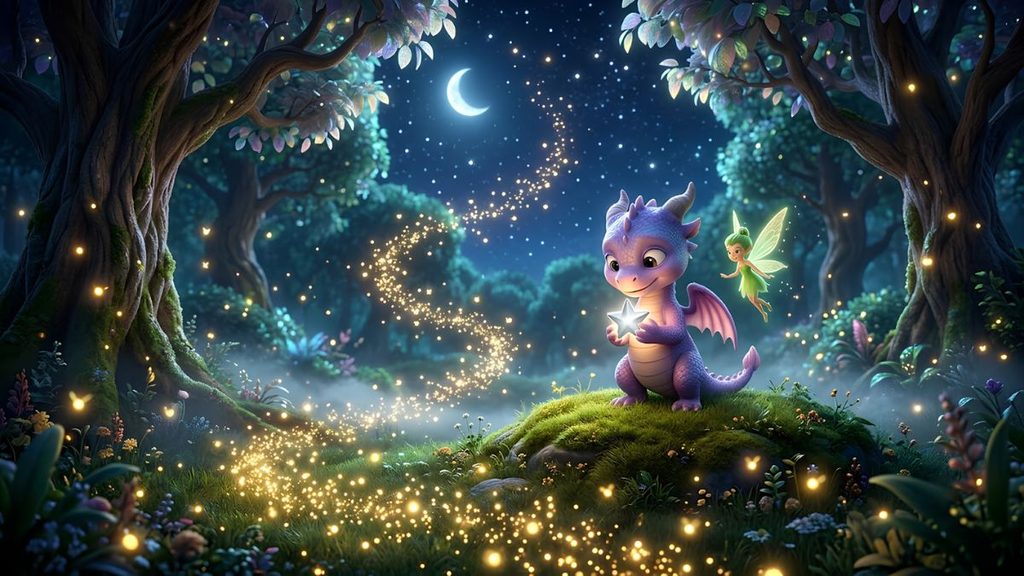
Theme: Gentle Fantasy
Luna was the smallest dragon in Willowbrook Forest.
She was so small that when she stood beside the old oak tree, her head barely reached the lowest branch.
She was also the youngest dragon in the forest.
And she had a very unusual hobby.
Luna collected stars.
Not real stars, of course.
At least, that was what everyone told her.
She collected anything that reminded her of them.
Silver pebbles.
Shiny buttons.
Tiny pieces of glass polished smooth by the river.
Glowing mushrooms.
White feathers.
Even bits of moon-colored seashells that she found near the lake.
She kept them all in a wooden box beneath her bed.
Every evening, Luna would sit outside her little treehouse and look at the night sky.
She would count the stars.
“One hundred and twelve.”
The next night:
“One hundred and thirteen.”
Her friend Willow, a tiny green fairy, would often sit beside her.
“You know you can’t actually collect those stars.”
Luna smiled.
“I know.”
“Then why do you keep trying?”
“Because they’re beautiful.”
Willow nodded.
“That’s a good reason.”
One summer evening, Luna had an idea.
She wanted to collect a real star.
Just one.
She imagined carrying it carefully in her paws.
She imagined placing it inside her collection box.
She imagined showing everyone.
“Look!”
She would say.
“I caught a star.”
Willow laughed.
“Stars are very far away.”
“I know.”
“How are you going to reach one?”
Luna looked thoughtful.
“I’ll figure it out.”
The next morning, she began planning.
She built a tower from wooden boxes.
It wasn’t tall enough.
She stacked chairs on top.
Still not tall enough.
She climbed the tallest hill in the forest.
Still not tall enough.
Finally, she tried flying.
Luna flapped her tiny wings.
She rose above the trees.
She flew higher.
And higher.
Then her wings became tired.
She landed on a branch.
The stars were still far away.
Luna sighed.
Maybe Willow was right.
Maybe some things couldn’t be collected.
That evening, Luna sat beside the forest stream.
She watched the water flow over the stones.
A tiny light floated past her.
Luna blinked.
It was a firefly.
Then another appeared.
Then another.
Soon dozens of fireflies danced above the stream.
Luna smiled.
“You look like little stars.”
The fireflies circled around her.
One landed on her nose.
Luna giggled.
“You’re very pretty.”
But she still wanted a real star.
That night, something strange happened.
Luna looked up at the sky.
One section seemed darker than usual.
She counted the stars.
“One hundred and twelve…”
She counted again.
“One hundred and eleven.”
One star was missing.
Luna gasped.
“Willow!”
Her fairy friend flew out of her treehouse.
“What happened?”
“One of the stars disappeared.”
Willow looked upward.
She counted.
Her eyes widened.
“You’re right.”
“Where did it go?”
“I don’t know.”
Luna looked toward the forest.
“Maybe it fell.”
They searched everywhere.
They looked beneath trees.
They searched beside the stream.
They checked the meadow.
They looked near the hills.
Nothing.
Then Luna noticed something.
A tiny silver glow on the ground.
She walked closer.
It was a trail of sparkling dust.
“Look!”
Willow flew down.
“That’s stardust.”
Luna’s eyes widened.
“The star came this way.”
They followed the trail.
It led deeper into the forest.
The trees became taller.
The path became narrower.
But there was nothing frightening about it.
Moonlight filtered through the branches.
The silver trail shimmered beneath their feet.
Eventually, they reached a clearing.
In the center stood an enormous talking tree.
Its branches were covered with glowing leaves.
“Good evening,” the tree said.
Luna nearly fell backward.
“You can talk!”
The tree chuckled.
“I’ve been talking for a very long time.”
Willow smiled.
“Have you seen anything unusual?”
The tree nodded.
“A star fell into the forest.”
Luna’s eyes widened.
“Where?”
“It passed through my branches.”
“Where did it go?”
The tree pointed with one long branch.
“Toward the hill.”
Luna thanked the tree.
She and Willow continued.
The trail led uphill.
At the top, they found a strange sight.
A small silver light was resting beside a rock.
Luna stopped.
“The star!”
It wasn’t as large as she expected.
It was about the size of an apple.
It glowed softly.
Luna approached slowly.
“Hello.”
The star flickered.
Willow smiled.
“I think it’s scared.”
Luna sat beside it.
“Are you lost?”
The star flickered again.
Luna thought for a moment.
“Don’t worry.”
She held out her paw.
“You can stay with us.”
The star floated into her paws.
It was warm.
Luna smiled.
“I finally found a star.”
Willow laughed.
“You did.”
Luna carefully placed the star inside her wooden box.
But the moment she closed the lid, something strange happened.
The forest became darker.
The glowing leaves on the trees faded.
The fireflies disappeared.
Even the moonlight seemed weaker.
Luna opened the box.
The star was glowing brightly.
Willow looked worried.
“Something is wrong.”
Luna looked at the forest.
“The star doesn’t belong in the box.”
She gently lifted it out.
The moment the star left her paws, the forest became brighter.
The leaves glowed again.
Fireflies returned.
The stream sparkled.
Luna looked sad.
“But I wanted to keep it.”
Willow smiled.
“Maybe you don’t have to own something to enjoy it.”
Luna looked at the star.
She knew Willow was right.
She carried the star back to the hill.
But before releasing it, she asked:
“How do we get you home?”
The star floated upward.
Then stopped.
It seemed unable to rise.
Luna looked around.
“Maybe it needs help.”
Willow thought.
“Perhaps we need to make it a path.”
“A path?”
“Something bright enough for it to follow.”
Luna had an idea.
“Fireflies.”
They called the fireflies.
Hundreds arrived.
They formed a glowing trail from the hill toward the sky.
The talking tree sent glowing leaves into the air.
The forest flowers opened.
Even the stream reflected moonlight upward.
Luna stood beneath the star.
“Ready?”
The star flickered.
Luna gently breathed a small flame beneath it.
Unlike the large flames of older dragons, Luna’s fire was tiny.
Warm.
Golden.
It lifted the star into the air.
Higher.
Higher.
The star followed the glowing path.
The fireflies rose with it.
The leaves shimmered.
The whole forest seemed to sparkle.
Luna watched.
The star climbed higher.
Then higher still.
Finally, it reached the night sky.
It returned to its place.
Suddenly, the entire forest became brighter.
The missing star was back.
Luna smiled.
“I did it.”
Willow laughed.
“We did it.”
Luna looked upward.
She counted the stars.
“One hundred and twelve.”
Then she looked again.
“One hundred and thirteen.”
The missing star was home.
Luna felt happy.
But she also felt a little sad.
She had wanted to collect a star.
Now she understood something.
Some beautiful things were meant to be admired rather than owned.
She returned to her treehouse.
She opened her collection box.
Inside were all her little treasures.
The silver pebbles.
The smooth glass.
The feathers.
The glowing stones.
Luna smiled.
She didn’t need to add a real star.
Instead, she added something else.
A small piece of bark from the talking tree.
A glowing leaf.
And a tiny jar containing a few harmless firefly-shaped reflections she had drawn herself.
She placed them inside.
Willow looked at her collection.
“Do you still want to collect stars?”
Luna smiled.
“Yes.”
“How?”
“By collecting memories.”
Willow nodded.
“I like that.”
From that day forward, Luna continued her collection.
But she changed what she collected.
She collected things that reminded her of special moments.
A blue feather reminded her of the day she helped a bird find its nest.
A smooth stone reminded her of a rainy afternoon beside the stream.
A golden leaf reminded her of the night she returned the star.
A tiny wooden button reminded her of Willow.
Every object had a story.
And every story was more valuable than the object itself.
Years passed.
Luna grew bigger.
Her wings became stronger.
Her fire became brighter.
But she never stopped looking at the stars.
Whenever someone asked her why, she always gave the same answer.
“Because they remind me that beautiful things don’t have to belong to us to make us happy.”
One evening, Luna was sitting beside the stream when she noticed a little dragon watching the sky.
The young dragon looked sad.
Luna walked over.
“What’s wrong?”
“I want a star.”
Luna smiled.
“I understand.”
“Can you help me get one?”
Luna looked upward.
Then she smiled.
“I can help you get closer to one.”
The young dragon’s eyes widened.
“Really?”
“Yes.”
They climbed the tallest hill.
They watched the fireflies.
They listened to the trees.
They looked at the moon.
Luna pointed toward the brightest star.
“See that one?”
“Yes.”
“That’s your star.”
“But I can’t have it.”
“You don’t need to have it.”
The little dragon looked confused.
“Then what’s the point?”
Luna smiled.
“Sometimes the best way to keep something is to remember it.”
The little dragon looked at the star.
For the first time, he smiled.
They sat together beneath the night sky.
The forest was peaceful.
Fireflies floated around them.
The stream whispered over smooth stones.
The stars shone above.
And Luna realized that she had finally collected the most important star of all.
Not in a box.
Not in her room.
But in her memory.
The memory of a night when she learned that some things become even more beautiful when you let them go.
Why Non-Scary Campfire Stories Are Great for Kids
Storytelling around a campfire can become one of the most memorable parts of a family trip or outdoor adventure.
Children get to step away from screens and listen to someone tell a story directly to them. The natural setting makes even an ordinary story feel special.
They Encourage Imagination
A campfire story gives children an opportunity to create pictures in their minds.
A storyteller might describe a tiny village hidden among enormous trees, a curious fox searching for a lost button, or a group of friends following glowing footprints toward a secret garden.
Children fill in the details themselves.
They Create Family Memories
Years later, children may not remember every detail of a camping trip, but they may remember sitting beside a campfire while someone told them a funny or magical story.
These simple moments can become meaningful family memories.
They Keep the Atmosphere Comfortable
Not every child likes frightening stories.
Some children become nervous when stories involve ghosts, monsters, or dangerous situations. Gentle stories allow everyone to participate without worrying about nightmares afterward.
They Can Teach Valuable Lessons
Campfire stories can introduce lessons naturally.
Characters can learn about:
- Friendship
- Honesty
- Patience
- Courage
- Kindness
- Teamwork
- Responsibility
- Curiosity
- Sharing
- Helping others
The lesson does not need to feel like a classroom lecture.
It can simply emerge from what happens to the characters.
They Encourage Listening
When children listen to a story without pictures or a screen, they have to pay attention to the storyteller.
They follow characters, remember details, predict what might happen next, and imagine the setting.
This makes storytelling an engaging activity rather than passive entertainment.
What Makes a Great Non-Scary Campfire Story?
A good campfire story for children should have enough adventure to maintain interest while remaining reassuring.
A Friendly Main Character
The protagonist could be a child, animal, explorer, fairy, inventor, or another imaginative character.
Giving the character a clear personality makes children more interested in what happens to them.
For example, a curious rabbit who always asks too many questions can create plenty of humorous situations.
A Simple Adventure
The story should have a clear goal.
Perhaps the character needs to:
- Find a missing toy
- Return a lost bird
- Discover where a strange sound is coming from
- Help a friend
- Find a hidden picnic spot
- Follow a trail of colorful leaves
- Prepare for a village celebration
A simple objective is enough to create momentum.
A Little Mystery
Non-scary does not mean boring.
Mystery can be used without fear.
A mysterious glowing object, strange footprints, an unusual map, or a distant musical sound can make children curious.
The eventual explanation can be cheerful or funny.
For example, mysterious lights in the woods might turn out to be fireflies gathering around a pond.
Humor
Funny moments work especially well around a campfire.
A character might misunderstand a clue, accidentally wear something backward, mistake a squirrel’s hiding place for a treasure chest, or become convinced that a talking tree is giving directions.
Humor gives children something to laugh about while keeping the story light.
A Positive Ending
A satisfying ending is particularly important for younger listeners.
The characters should generally be safe, friendships should be restored, and problems should have a hopeful resolution.
The ending can also include a small surprise or lesson.
Popular Themes for Non-Scary Campfire Stories
There are many directions a storyteller can take while keeping the stories gentle.
1. Talking Animals
Talking animals are perfect for children’s campfire stories.
A fox might become a detective.
A squirrel might become an inventor.
A bear might discover that he is afraid of singing in front of other animals.
A rabbit might become the leader of an unexpected adventure.
2. Magical Forests
A magical forest can be mysterious without being frightening.
Children might discover:
- Trees that whisper friendly advice
- Flowers that glow at night
- Streams that sing
- Butterflies that form patterns
- Friendly woodland creatures
- Hidden paths
- Tiny villages
3. Treasure Hunts
Treasure-hunt stories naturally create suspense.
A group of children might discover an old map and follow clues around a campsite.
The final treasure does not have to be gold.
It could be a box filled with old photographs, letters, toys, friendship bracelets, or treats.
4. Camping Adventures
Stories can also be based on realistic camping experiences.
Characters might lose their flashlight, try to cook breakfast over a campfire, search for a missing backpack, or wake up to discover animal footprints near their campsite.
These stories can be funny and relatable.
5. Friendship Adventures
Two characters who are very different can become friends after solving a problem together.
These stories are especially useful for showing children how cooperation and understanding can overcome disagreements.
6. Gentle Fantasy
Fairies, friendly dragons, talking trees, magical stars, and tiny forest villages can create wonderful campfire adventures.
The fantasy does not need to involve danger.
The characters might simply be trying to solve a puzzle or help their community.
How Long Should a Campfire Story Be?
The ideal length depends on the children’s ages and attention spans.
Very Young Children
Stories of around 5 to 8 minutes can work well.
Keep the plot simple and use repetition, humor, and familiar characters.
Elementary-Age Children
Stories of around 10 to 15 minutes can provide enough room for a proper adventure.
You can introduce a mystery, several characters, and a satisfying conclusion.
Older Children
Stories of 15 to 25 minutes can include more developed plots, multiple locations, deeper characters, and more complicated mysteries.
The important thing is not the exact word count.
The story should be long enough to be interesting without becoming difficult to follow.
How to Tell a Non-Scary Campfire Story
The storyteller’s delivery can be just as important as the story itself.
Use Your Voice
Change your tone when different characters speak.
A tiny squirrel might have a fast, excited voice.
A large bear might speak slowly.
A curious child might ask lots of questions.
This makes the story more entertaining.
Use the Campfire Setting
The surroundings can become part of the storytelling experience.
You can mention:
- The sound of the fire
- Stars overhead
- Leaves moving in the breeze
- Crickets singing
- The warmth of the flames
- The smell of the outdoors
These details make children feel as though they are inside the story.
Avoid Sudden Scares
If the goal is a non-scary story, avoid deliberately startling children with sudden screams, frightening sound effects, or unexpected monsters.
Suspense is fine.
Fear does not need to be.
Ask Children Questions
Interactive storytelling can be especially fun.
Ask:
“Which path should they take?”
“What do you think is inside the box?”
“Do you think the squirrel is telling the truth?”
Let children make predictions.
This can turn a simple story into a group activity.
Campfire Stories Can Be Mysterious Without Being Scary
One common misconception is that a campfire story needs something frightening to create suspense.
That is not true.
Curiosity can create suspense just as effectively.
Imagine a group of children discovering a trail of tiny golden footprints leading away from their campsite.
The audience immediately wants to know:
Where did they come from?
Who made them?
Where do they lead?
The answer could reveal a friendly woodland creature preparing a surprise celebration.
The children experience anticipation without fear.
This type of storytelling is especially effective for younger audiences.
Age-Appropriate Storytelling Matters
Children of different ages respond differently to stories.
A five-year-old may become frightened by something an older child considers harmless.
Before telling a story, consider the children listening.
For younger children, keep conflicts gentle and avoid themes involving serious injury, death, abandonment, or frightening creatures.
For older children, you can introduce slightly more complicated mysteries while still maintaining a reassuring atmosphere.
The goal is to make children feel curious and engaged rather than overwhelmed.
Ideas for Making Campfire Storytelling More Fun
The storytelling experience can include more than simply reading a story.
Use Simple Props
A flashlight, map, toy animal, small box, old key, or colorful stone can become part of the story.
A mysterious object can be passed around while the story unfolds.
Create Character Voices
Different voices help children distinguish characters.
You can even allow children to provide voices for certain characters.
Let Children Choose the Ending
Pause near the conclusion and ask the group what they think should happen.
Then compare their ideas with the planned ending.
Add Simple Songs
Some stories can include short songs or rhymes.
A group of characters might sing while traveling through the forest.
This works particularly well with younger children.
Connect Stories to the Location
If you’re camping near a lake, create a story involving a friendly lake creature.
If you’re in a forest, create an adventure involving woodland animals.
If you’re near mountains, tell a story about an adventurous little cloud searching for the perfect mountain peak.
This makes the experience feel personal.
The Best Settings for Gentle Campfire Stories
A non-scary campfire story can take place almost anywhere. Some particularly effective settings include:
- A Moonlit Forest: A moonlit forest can feel magical without being frightening when the story focuses on friendly creatures and beautiful discoveries.
- A Mountain Campsite: Mountains provide opportunities for stories about explorers, lost maps, unusual rocks, and spectacular views.
- A Quiet Lakeside: A lake can become the setting for stories involving mysterious ripples, friendly ducks, floating lanterns, or hidden islands.
- A Magical Meadow: A meadow filled with glowing flowers and tiny creatures offers endless possibilities for gentle fantasy.
- A Family Backyard: Not every campfire story needs to take place in the wilderness.
A backyard campfire can inspire stories about children discovering something magical just beyond their garden fence.
Why Children Remember Gentle Stories
A good children’s story does more than entertain.
It gives children something to imagine.
It creates emotional connections with characters.
It may teach them something without explicitly telling them what to learn.
Most importantly, it creates a shared experience.
When children sit together around a campfire, they are already in an unusual environment.
The familiar world feels slightly different.
The stars seem brighter.
The trees seem larger.
The fire creates a natural focal point.
A gentle story adds another layer of imagination.
Suddenly, the forest becomes home to friendly animals.
The stars become messages from distant worlds.
The stream becomes a secret road.
The campfire becomes the beginning of an adventure.
Tips for Parents and Storytellers
When choosing campfire stories for children, consider the following:
- Choose stories appropriate for the children’s ages.
- Avoid frightening imagery if the children dislike scary themes.
- Keep the characters relatable.
- Use simple plots for younger children.
- Add humor whenever possible.
- Use mystery rather than fear to create suspense.
- Give children opportunities to participate.
- Keep endings reassuring.
- Use the natural surroundings to enhance the story.
- Allow children to ask questions afterward.
A good campfire story should leave children excited to hear another one, not worried about what might be waiting outside the tent.
What to Expect From a Collection of Non-Scary Campfire Stories
A well-rounded collection can include several different styles.
Some stories can be funny.
Others can be magical.
Some can focus on friendship.
Others can involve treasure hunts or outdoor adventures.
Some can have gentle mysteries.
Others can simply celebrate imagination.
This variety helps keep children interested and gives parents, teachers, and camp counselors different options depending on the mood.
For example, a silly animal story might work perfectly after dinner, while a calm magical adventure could be better as bedtime approaches.
Final Thoughts
Campfire stories for kids not scary prove that storytelling around a fire does not need ghosts, monsters, or frightening surprises to be memorable.
The best children’s campfire stories can create excitement through curiosity, humor, friendship, imagination, and adventure.
A mysterious trail can lead to a hidden garden.
A strange sound can come from a playful animal.
A forgotten map can lead to an unexpected treasure.
A lonely character can discover a wonderful new friend.
These stories give children something important: the chance to experience the magic of the outdoors while feeling safe and comfortable.
Whether you’re sitting around a campfire at a family camping trip, spending an evening at summer camp, or enjoying a backyard fire with friends, a gentle story can turn an ordinary evening into a memorable adventure.
And sometimes, the best campfire stories are not the ones that make children afraid to look into the darkness.
They are the ones that make children curious about what wonderful things might be waiting there.