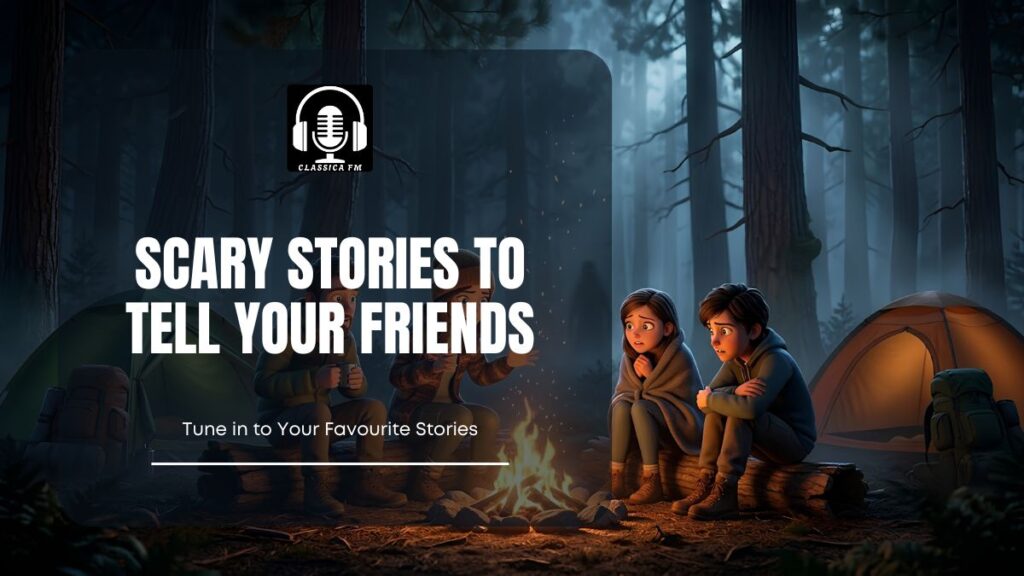
There is something special about telling a scary story to a group of friends. It does not require expensive entertainment, complicated plans, or a carefully prepared setting. All it takes is a few people, a little imagination, and the right atmosphere.
A scary story can transform an ordinary evening into something memorable. A quiet room suddenly feels mysterious. A walk home becomes a little more unsettling. Even familiar sounds can seem different after someone finishes describing a haunted house, a strange encounter, or an unexplained figure in the darkness.
Whether you are sitting around a campfire, having a sleepover, spending the night with friends, or simply looking for something entertaining to share, scary stories can create suspense and excitement without needing to be genuinely dangerous.
This guide explores Scary Stories to Tell Your Friends, including what makes a story frightening, how to choose the right story for your group, different types of scary stories, and tips for creating the perfect storytelling atmosphere.
What Are Scary Stories to Tell Your Friends?
Scary stories to tell your friends are short or long fictional tales designed to create suspense, mystery, fear, or surprise among a group of listeners.
They can involve haunted houses, mysterious strangers, abandoned buildings, unexplained phone calls, strange creatures, supernatural encounters, cursed objects, or seemingly ordinary situations that take an unsettling turn.
The best scary stories do not necessarily depend on graphic violence or extreme horror. In many cases, suggestion is more frightening than explanation.
A story becomes memorable when listeners begin imagining what might happen rather than being told every detail.
For example, hearing that someone saw a mysterious figure standing at the end of a forest trail can be more unsettling when the story leaves the figure’s identity unexplained.
That uncertainty gives the listener’s imagination room to work.
Scary Stories to Tell Your Friends
Here are 7 completely original scary stories, created specifically for this collection. Each has a different setting, mystery, and twist so they do not feel repetitive.
The Knock From Room 309
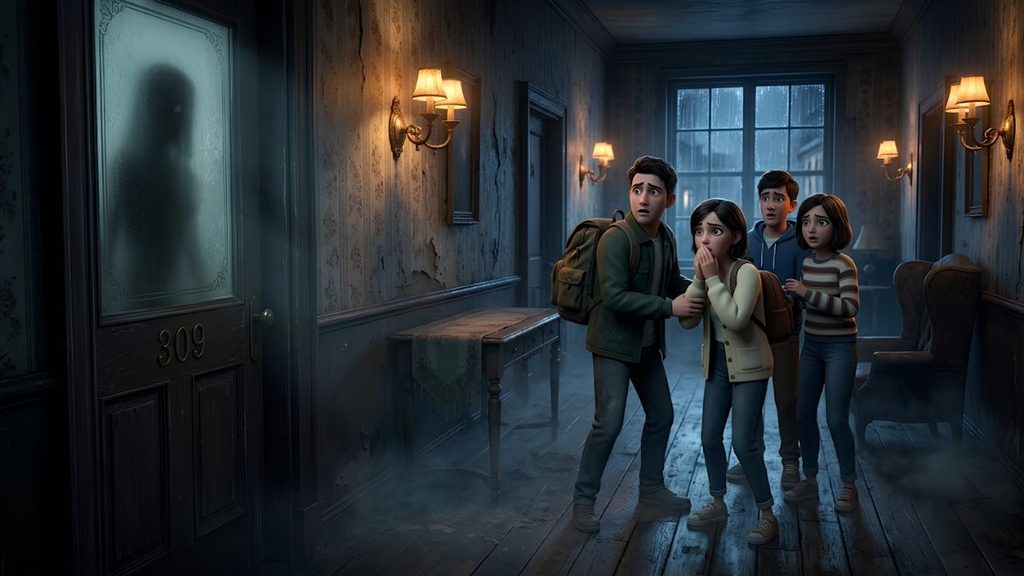
A scary story about four friends, an abandoned hotel room, and three knocks that should never have been answered.
The rain had been falling for almost three hours when Ethan realized they were not going to reach the mountains that night.
He slowed the car as another sheet of water swept across the windshield.
“We need to stop,” he said.
From the back seat, Oliver looked up from his phone.
“How far?”
“Maybe forty minutes to the town.”
Sophie glanced through the window.
“I can’t even see the road.”
Charlotte leaned forward between the seats.
“Is there anything nearby?”
Ethan checked the road signs.
There was nothing.
Then, through the rain, a faded sign appeared beside the highway.
THE BLACKWOOD INN
Below it, in smaller letters:
ROOMS AVAILABLE
Oliver smiled.
“Perfect.”
Sophie frowned.
“That place looks abandoned.”
“It’s got a sign,” Oliver replied.
“That’s not exactly reassuring.”
Ethan turned the steering wheel.
A narrow driveway disappeared between tall pine trees.
At the end stood an old three-story hotel.
The lights were on.
That was the first strange thing.
The building looked as though it had been forgotten for decades, yet warm yellow lights glowed behind several windows.
Ethan parked.
Rain hammered the roof.
For a moment, none of them moved.
Then Charlotte said quietly:
“We’re not sleeping in the car.”
They grabbed their bags and ran toward the entrance.
The lobby was warm.
Too warm.
The moment Ethan opened the door, the smell of old wood and dust surrounded them.
Behind the reception desk sat an elderly man.
He looked up slowly.
“Good evening.”
His voice was calm.
“Do you have rooms available?” Ethan asked.
The man smiled.
“Of course.”
Oliver glanced around.
“Are you open?”
The old man chuckled.
“I wouldn’t be sitting here if I weren’t.”
He pushed four keys across the counter.
“Rooms 305, 306, 307, and 308.”
Sophie looked at the keys.
“Four rooms?”
The man nodded.
“One for each of you.”
Charlotte pointed toward the staircase.
“What about the third floor?”
The man’s smile disappeared.
“Do not go there.”
Oliver raised an eyebrow.
“Why?”
“Third floor is closed.”
“Renovation?”
The old man shook his head.
“Room 309.”
He said the number quietly.
“That room is not for guests.”
They carried their bags upstairs.
The hallway was old but surprisingly clean.
Room 305 was at one end.
Then 306.
And at the very end of the hallway stood a door.
309
A thick metal chain crossed it.
A small wooden sign hung above the handle.
CLOSED
Oliver stared.
“That’s creepy.”
Ethan laughed.
“Don’t start.”
They entered their rooms.
The storm continued outside.
For the next hour, they ordered food from the hotel’s kitchen and sat together in Room 307.
They played cards.
They talked.
The atmosphere became comfortable.
The strange warning about Room 309 gradually became a joke.
Until 11:47 p.m.
Knock.
Everyone stopped.
Three seconds passed.
Then:
Knock.
Another pause.
Knock.
Three slow knocks.
From the hallway.
Oliver smiled.
“Someone’s at the door.”
Ethan stood.
He opened it.
The hallway was empty.
Rain tapped against the windows at the end of the corridor.
Oliver stepped outside.
“Hello?”
Nothing.
He walked toward the staircase.
No one.
He returned.
“Probably the pipes.”
Sophie didn’t look convinced.
“That sounded like knocking.”
“Old building.”
They returned to their conversation.
Ten minutes later:
Knock.
Everyone looked at one another.
Then:
Knock.
Knock.
This time, the sound came from the end of the hallway.
Room 309.
Nobody spoke.
Charlotte whispered:
“That came from the locked room.”
Oliver stood.
“Someone could be inside.”
Ethan grabbed his arm.
“The manager said it’s closed.”
“Exactly.”
Oliver walked toward Room 309.
The others followed reluctantly.
The hallway seemed colder.
When they reached the door, Oliver pressed his ear against it.
Silence.
He looked at Ethan.
“Maybe someone needs help.”
Ethan shook his head.
“We should get the manager.”
They returned downstairs.
The old man was still sitting behind the desk.
Ethan explained what they had heard.
The manager’s expression remained completely calm.
“Three knocks?”
Ethan nodded.
“Yes.”
The old man looked at the clock.
Then at the ceiling.
“Go back to your rooms.”
Oliver asked:
“What’s in Room 309?”
The old man didn’t answer.
“Please.”
His voice had become firmer.
“Go back upstairs.”
They did.
For a while, nothing happened.
At 1:05 a.m., everyone went to their rooms.
Ethan lay awake.
He couldn’t stop thinking about the locked door.
Then he heard something.
Knock.
His bedroom door.
He sat upright.
Knock.
Then:
Knock.
Ethan stared at the door.
“Oliver?”
No answer.
He slowly opened it.
The hallway was empty.
But Room 309 was different.
The chain was gone.
The door stood slightly open.
Ethan’s heart began pounding.
He woke the others.
Within minutes, all four stood in the hallway.
Oliver whispered:
“The chain wasn’t gone earlier.”
Sophie shook her head.
“Let’s leave.”
Charlotte pointed toward the door.
“It’s open.”
Ethan stepped closer.
A cold breeze came through the gap.
Oliver pushed the door.
It opened.
Room 309 looked strangely ordinary.
A bed.
A wooden desk.
A wardrobe.
A lamp.
Dust covered everything.
There was no electricity, yet the lamp was glowing.
Charlotte stared.
“How is that on?”
Nobody answered.
Ethan walked toward the desk.
A guest register lay open.
The last entry was dated October 14, 1987.
Name:
Daniel Mercer
Ethan read the note beneath it.
Room 309.
One night.
Do not disturb.
Oliver looked around.
“That’s it?”
Sophie pointed toward the bed.
“There.”
A suitcase sat beside it.
Old-fashioned.
Covered in dust.
Yet it looked as though it had been packed recently.
Ethan opened it.
Inside were clothes.
A newspaper.
A wallet.
And a photograph.
Four young people stood outside the hotel.
Two men.
Two women.
On the back was written:
October 14, 1987.
Oliver picked up the photograph.
“Maybe these were his friends.”
Charlotte looked closely.
“There’s something wrong.”
One of the women was looking away from the camera.
Toward Room 309.
Suddenly:
Knock.
Everyone jumped.
The sound came from inside the wardrobe.
Oliver whispered:
“Did you hear that?”
Another knock.
Knock.
Then another.
Knock.
Ethan backed toward the door.
“Nobody open it.”
The wardrobe shook.
Charlotte grabbed Sophie’s hand.
A voice came from inside.
“Please.”
Everyone froze.
The voice sounded like a young man.
“Please let me out.”
Oliver whispered:
“Someone’s inside.”
Ethan shook his head.
“That’s impossible.”
The voice came again.
“Please.”
Oliver reached for the wardrobe handle.
Ethan grabbed him.
“Don’t.”
Oliver pulled away.
“What if someone is trapped?”
The voice whispered:
“Oliver.”
Oliver froze.
Nobody had told the voice his name.
The voice repeated:
“Oliver.”
Then:
“Ethan.”
“Charlotte.”
“Sophie.”
The four friends stared at one another.
The voice knew all their names.
Then it whispered:
“You shouldn’t have come here.”
The wardrobe door opened.
Slowly.
There was nobody inside.
Only a mirror.
A tall antique mirror stood at the back of the wardrobe.
Ethan stared into it.
The four friends were reflected.
But something was wrong.
There were five people.
A young man stood behind them.
His face was pale.
His clothes looked decades old.
Oliver spun around.
Nobody.
He looked back at the mirror.
The fifth person was still there.
The man lifted one finger.
He pointed toward the hallway.
Then he disappeared.
The lights went out.
They ran.
The door slammed behind them.
They rushed downstairs.
The old manager was standing in the lobby.
He looked at them.
“Did you enter Room 309?”
Nobody answered.
The manager closed his eyes.
“I told you not to.”
Ethan asked:
“Who was Daniel Mercer?”
The old man looked surprised.
“How do you know that name?”
“We found his things.”
The manager sighed.
“Daniel checked into Room 309 in 1987.”
“What happened?”
“He was traveling with three friends.”
The manager paused.
“They disappeared.”
“All four?”
“Yes.”
Oliver frowned.
“Then why was his suitcase still there?”
The manager looked toward the stairs.
“Because Daniel never left the room.”
He told them the story.
Daniel and his friends had arrived during a storm.
They stayed in Room 309.
At midnight, guests heard three knocks.
The next morning, the four travelers were gone.
The room was locked from the inside.
Their belongings remained.
Police searched the building.
No bodies were found.
No evidence of an escape.
The room was eventually closed.
But every few years, guests reported hearing three knocks.
And whenever someone opened Room 309…
Someone disappeared.
Sophie whispered:
“Why didn’t you tell us?”
The manager looked at her.
“Because I hoped you wouldn’t hear it.”
The hotel suddenly became silent.
Then:
Knock.
The sound came from upstairs.
The manager looked terrified.
“Go.”
Ethan frowned.
“Where?”
“Anywhere.”
Another knock.
Knock.
The manager grabbed an old iron key.
“Take the back exit.”
They ran.
The door opened into a narrow alley behind the hotel.
Rain poured down.
They sprinted toward the car.
But Oliver stopped.
“Where’s Charlotte?”
Everyone turned.
She wasn’t with them.
Ethan’s heart dropped.
They looked back.
Charlotte stood beneath the hotel entrance.
She was staring upward.
Toward Room 309.
“Charlotte!”
She didn’t respond.
Then the lights in Room 309 came on.
A figure appeared behind the window.
Charlotte slowly walked toward the hotel.
Ethan ran after her.
He grabbed her arm.
She looked at him.
Her eyes were strangely empty.
“I heard knocking,” she whispered.
“What?”
She smiled.
“It said my name.”
They dragged her into the car.
Ethan started the engine.
They drove.
The hotel disappeared behind the trees.
Nobody spoke.
After ten minutes, Oliver looked at the clock.
2:18 a.m.
He sighed.
“We’re out.”
Sophie looked through the rear window.
The hotel was gone.
Only darkness remained.
Then Charlotte whispered:
“Three.”
Ethan looked at her.
“What?”
She stared straight ahead.
“Three knocks.”
Oliver frowned.
“What about them?”
Charlotte smiled.
“We only heard two.”
Everyone went silent.
Then:
Knock.
The sound came from inside the car.
Nobody moved.
Knock.
Sophie began crying.
Then:
Knock.
Three slow knocks.
From the trunk.
Ethan pulled over.
“No.”
Oliver shook his head.
“We don’t open it.”
The knocking continued.
Charlotte whispered:
“Someone is trapped.”
Ethan looked at her.
“No one is in there.”
The trunk shook.
Then a voice whispered through the seats.
“Please.”
It was Daniel’s voice.
“Please let me out.”
Ethan stepped on the accelerator.
The car sped through the rain.
The knocking continued.
But gradually, it became quieter.
Then stopped.
At sunrise, they reached the nearest town.
They went directly to a police station.
The officers inspected the vehicle.
The trunk was empty.
There were no fingerprints.
No signs of forced entry.
Nothing.
The four friends eventually returned home.
They never spoke publicly about the incident.
But Ethan kept one thing.
The photograph from Room 309.
He had accidentally taken it from the hotel.
Months later, he was cleaning his desk when he found it.
He looked at the photograph.
The four young people from 1987 were still standing outside the hotel.
But now there was something different.
A fifth figure stood beside them.
Daniel.
Ethan turned the photograph over.
A new sentence had appeared on the back.
October 14, 2026.
His blood ran cold.
That was the date they had stayed at the hotel.
Then he heard it.
From his bedroom door:
Knock.
He stopped breathing.
Knock.
He looked toward the hallway.
Then:
Knock.
Three slow knocks.
Ethan didn’t move.
A voice whispered from outside.
“Room 309.”
He closed his eyes.
The voice continued.
“You forgot someone.”
The bedroom door slowly opened.
And standing in the hallway was Daniel Mercer.
He smiled.
“Your room is ready.”
Moral
Curiosity can sometimes lead us into places we do not understand. When something feels deeply wrong, listening to your instincts may be wiser than trying to uncover every mystery.
The Photograph With One Extra Person
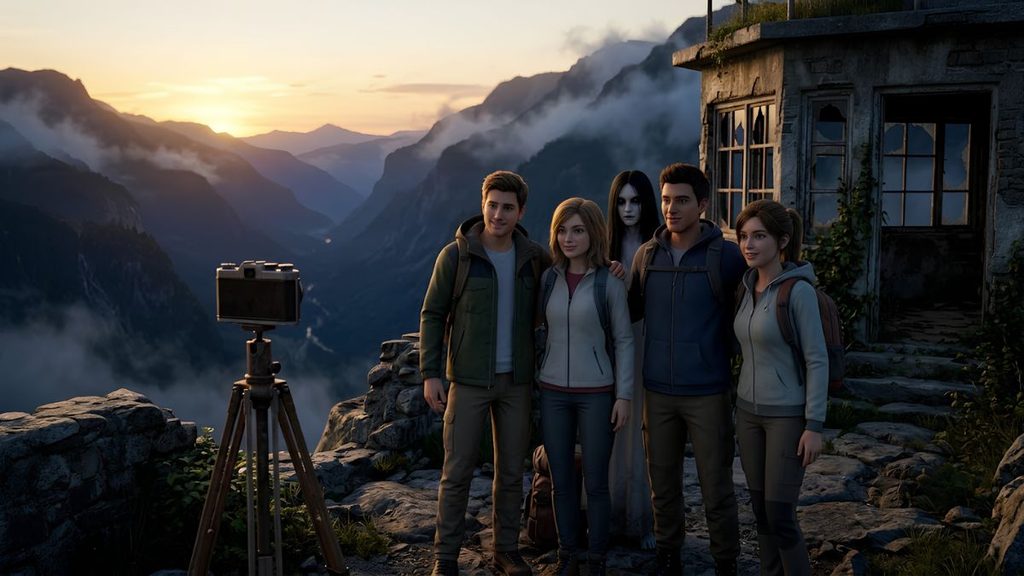
The photograph was taken at 6:42 p.m.
At the time, nobody noticed anything unusual.
There were only four friends standing on a mountain overlook, laughing beneath a pale evening sky.
Ethan was holding the camera.
Sophie stood beside him.
Lucas and Amelia were behind them.
The mountains stretched endlessly into the distance.
A cold wind moved through the trees.
It should have been an ordinary vacation photograph.
Instead, it became the reason none of them ever trusted photographs again.
Ethan, Sophie, Lucas, and Amelia had been friends since university.
They were all in their twenties and had planned the trip months earlier.
Their destination was a remote mountain region in northern Scotland where an abandoned observation station overlooked a deep valley.
The place had once been popular with hikers.
Then, years earlier, part of the mountain road collapsed.
The observation station was closed.
The hiking trail was rarely used.
That was precisely why Ethan wanted to visit.
“It’s supposed to have the best view in the region,” he said as they walked uphill.
Sophie adjusted her backpack.
“That’s what you’ve said for the last three hours.”
“We’re almost there.”
Lucas laughed.
“You said that an hour ago.”
Amelia pointed ahead.
“I think that’s it.”
Through the trees, they could see an old stone structure.
The observation station stood at the edge of a cliff.
Its windows were broken.
The wooden door had fallen from its hinges.
But the view was breathtaking.
Mountains covered the horizon.
A narrow river wound through the valley below.
Clouds floated beneath the highest peaks.
Sophie took out her phone.
“Okay. This was worth the climb.”
Ethan smiled.
“I told you.”
They explored the old station for almost an hour.
Inside, they found rusted equipment, faded maps, and several photographs pinned to a wall.
One photograph caught Amelia’s attention.
It showed a group of hikers standing outside the station.
The photograph looked old.
Perhaps forty years old.
Amelia examined it.
“Look at this.”
Lucas leaned closer.
“What?”
“That woman.”
A young woman stood at the edge of the group.
She wasn’t smiling.
She wasn’t looking at the camera.
She was looking toward the mountains.
Sophie shrugged.
“Maybe she didn’t want her picture taken.”
Amelia turned the photograph over.
There was writing on the back.
October 17, 1986.
Nothing else.
Ethan took a photograph of it.
Then they moved on.
As evening approached, they returned outside.
The sky was turning orange.
Ethan placed his camera on a stone wall.
“Everyone get together.”
Sophie laughed.
“We’ve taken about twenty photographs today.”
“This is the best view.”
They stood shoulder to shoulder.
Ethan set the timer.
The camera beeped.
He ran into position.
Click.
The photograph was taken.
They immediately checked it.
Everyone looked normal.
Four friends.
Four backpacks.
Four smiling faces.
Beautiful mountains behind them.
Lucas pointed at the screen.
“Perfect.”
Ethan saved it.
Then they began walking back toward the trail.
Nobody noticed the fifth person.
Not yet.
They reached their cabin after dark.
It was a small rental house near the forest.
They cooked dinner and played music.
After eating, Sophie connected Ethan’s camera to the television.
They began reviewing the photographs from the day.
Mountain views.
Food.
Funny faces.
Old buildings.
The abandoned observation station.
Then they reached the group photograph.
Sophie smiled.
“That’s actually really good.”
Amelia leaned closer.
“Wait.”
“What?”
Amelia pointed toward the screen.
“Who’s that?”
Nobody understood.
There was a person standing behind them.
A young woman.
Dark hair.
Pale face.
Long gray coat.
She stood between Ethan and Lucas, partially hidden behind them.
Ethan frowned.
“Someone must have walked behind us.”
Lucas shook his head.
“No.”
“Why not?”
“Because there wasn’t anyone there.”
Sophie remembered the observation station.
“Maybe one of the hikers?”
Amelia looked at the photograph.
“She’s wearing the same coat as the woman in that old picture.”
Silence filled the room.
Ethan zoomed in.
The woman was looking directly at the camera.
Her expression was completely blank.
They laughed it off.
At least they tried.
Ethan suggested that someone had simply walked past at exactly the right moment.
The old photograph was probably unrelated.
Coincidence.
That was all.
But Amelia remained uncomfortable.
She asked Ethan to send her the photograph.
He did.
The next morning, Amelia noticed something strange.
The woman was closer.
Not physically.
In the photograph.
The previous evening, the figure had stood several meters behind them.
Now, when Amelia opened the image, the woman appeared much closer.
Her face was visible between Ethan and Lucas.
Amelia called Sophie.
“Look at the picture again.”
Sophie opened it.
She stopped talking.
The woman was definitely closer.
“I don’t understand.”
“Maybe the image is loading differently.”
“It’s downloaded.”
Sophie stared at the screen.
Then the woman appeared even closer.
Her face now seemed only a few centimeters behind Lucas’s shoulder.
Sophie dropped the phone.
They called Ethan and Lucas.
Everyone gathered around the table.
Ethan opened the original photograph on his camera.
The woman was there.
Closer.
Lucas whispered:
“That’s impossible.”
Amelia looked at him.
“Delete it.”
Ethan pressed delete.
The photograph disappeared.
Everyone relaxed.
Then the camera screen flickered.
The photograph returned.
But it had changed.
Now the woman was standing directly behind them.
Her face was visible between all four friends.
Her eyes appeared completely black.
Sophie stepped away.
“Delete it again.”
Ethan did.
Again, it returned.
This time, the woman was standing beside Ethan.
Close enough to touch him.
They decided to leave the mountain area.
Immediately.
They packed their belongings.
Nobody discussed the photograph during the drive.
They wanted to forget it.
After two hours, they stopped at a roadside café.
Ethan checked his phone.
A new photograph had appeared in his gallery.
He hadn’t taken it.
It showed the four friends sitting in the car.
Sophie was driving.
Lucas was asleep.
Amelia was looking out the window.
Ethan was looking at his phone.
And behind them, visible through the rear window, stood the woman.
She was following them.
Ethan’s hands became cold.
“Guys.”
Everyone looked.
He showed them the screen.
Nobody spoke.
Then Lucas said:
“That’s not possible.”
The photograph had been taken from outside the moving car.
They returned to the observation station.
Not because they wanted to.
Because they needed answers.
The old photograph on the wall was still there.
Amelia took it down.
She studied the woman.
Then she noticed something.
The woman wasn’t standing with the group.
She was standing behind them.
Exactly as in their photograph.
Lucas turned the old photograph over.
This time, there was writing that none of them had noticed.
If she appears in your photograph, don’t let her become the fifth.
Sophie stared.
“What does that mean?”
Ethan read the sentence again.
“Don’t let her become the fifth.”
Amelia looked toward the broken windows.
“Maybe she wants to replace someone.”
Nobody laughed.
They searched the station.
In a storage room, they found boxes of old records.
One contained newspaper articles about missing hikers.
There were several.
Different years.
Different people.
But every case had one detail in common.
Each missing person had visited the observation station.
And photographs had been found afterward.
Photographs containing one extra person.
Lucas opened another file.
A photograph showed six hikers.
There were seven people in the image.
Another showed three friends.
Four people appeared.
Another showed a family of five.
Six figures stood behind them.
Amelia’s hands shook.
“What happens to the extra person?”
Ethan read the report.
“They disappear.”
Sophie looked at the photographs.
“All of them?”
Lucas nodded.
“Every case.”
Then Ethan found the oldest report.
It belonged to the woman.
Her name was Clara Bennett.
She had been a photographer.
In 1986, Clara had traveled to the mountain with three friends.
They took a photograph at sunset.
Four people stood in the picture.
A fifth figure appeared behind them.
The next morning, Clara’s three friends were gone.
Clara disappeared later that same day.
The final photograph showed Clara standing alone.
Behind her were four people.
All staring at the camera.
Ethan felt sick.
“She became the extra person.”
Amelia whispered:
“And now she’s looking for someone else.”
The camera beeped.
Everyone jumped.
A new photograph had appeared.
Ethan hadn’t touched it.
It showed the four of them standing inside the observation station.
But they weren’t standing together.
Three of them were near the entrance.
Amelia was standing alone at the far end.
Behind her stood Clara.
Amelia stared at the photograph.
“That’s me.”
Lucas grabbed her arm.
“Stay with us.”
The photograph changed.
Now Clara was standing directly behind Amelia.
Then closer.
Then closer.
Amelia felt a cold breath against her neck.
She turned.
Nothing.
She looked at the camera.
Clara was almost touching her.
They ran outside.
The sun was beginning to set.
They needed to get away before darkness.
But the trail was covered in fog.
Thick white fog rolled down the mountain.
Sophie looked at Ethan.
“Which way?”
Ethan checked the map.
“Down.”
They hurried along the trail.
Then Amelia stopped.
“Wait.”
She pointed toward a tree.
Someone had carved words into the bark.
DON’T LOOK AT THE CAMERA.
Ethan slowly lowered his camera.
Nobody touched it.
They continued walking.
The fog became thicker.
Then they heard a camera shutter.
Click.
They stopped.
Another.
Click.
Another.
Click.
The sound was coming from behind them.
Lucas whispered:
“Don’t turn around.”
Nobody did.
They kept walking.
Then Ethan heard a voice.
“Smile.”
He closed his eyes.
The camera in his backpack began taking photographs by itself.
One after another.
Click.
Click.
Click.
Ethan removed the battery.
The camera continued.
He threw it onto the ground.
The shutter stopped.
Silence returned.
Then Amelia screamed.
Everyone turned.
She was staring at her phone.
A new photograph had appeared.
It showed the four friends walking along the trail.
Behind them stood Clara.
But this time, there were only three friends in the photograph.
Amelia was missing.
She looked at them.
“That’s not me.”
Ethan shook his head.
“You’re here.”
Amelia touched her face.
“Then why am I not in the photograph?”
Nobody knew.
The fog suddenly cleared.
The trailhead was only fifty meters away.
They ran.
They reached the car.
Everyone climbed inside.
Ethan started the engine.
The observation station disappeared behind them.
They drove down the mountain.
No one spoke.
After twenty minutes, Sophie looked at the rearview mirror.
Her face turned pale.
“Don’t look.”
Ethan asked:
“What?”
“There are five of us.”
Everyone froze.
Sophie slowly looked toward the back seat.
Three people sat there.
Lucas.
Amelia.
Ethan’s backpack.
And a woman.
Clara.
She sat completely still.
Her face was inches from the window.
Ethan slammed the brakes.
The car stopped.
They all turned.
The back seat was empty.
Only Lucas and Amelia remained.
Sophie began crying.
“She was there.”
They drove until they reached a police station.
They explained what happened.
The officers were skeptical.
Then Ethan showed them the photographs.
The officers became quiet.
One older officer recognized Clara’s face.
He had seen the old case.
“Where did you find this?”
Ethan told him.
The officer stared at the photograph.
“That woman disappeared forty years ago.”
Lucas whispered:
“We know.”
The officer shook his head.
“No.”
He pointed at the latest photograph.
“That’s not Clara.”
Everyone looked.
The face in the photograph was different.
The woman had changed.
She was no longer Clara.
She had become someone else.
Someone familiar.
Sophie whispered:
“Who?”
The officer looked at them.
“It’s you.”
The photograph showed Sophie standing alone.
Behind her was the mysterious woman.
But the woman’s face had become Sophie’s face.
Sophie stared.
“No.”
The photograph changed.
Now the woman looked exactly like Sophie.
Another change.
The woman was closer.
Then closer.
Sophie dropped the phone.
They never found out what happened next.
Because Sophie disappeared three days later.
There was no sign of her.
No explanation.
Her apartment was untouched.
Her belongings remained.
But every photograph containing Sophie had changed.
She was no longer standing with her friends.
Instead, she stood behind them.
Always looking directly at the camera.
Always wearing the same expression.
Always getting closer.
Months later, Ethan returned to the mountain.
He brought the old photograph of Clara.
He wanted to destroy it.
He climbed to the observation station alone.
At sunset, he placed the photograph on the stone floor.
He lit a match.
Before the flame reached the paper, a camera shutter sounded behind him.
Click.
Ethan froze.
Another.
Click.
He slowly turned.
Nobody stood there.
Then he heard Sophie’s voice.
“Smile, Ethan.”
He closed his eyes.
The photograph on the ground began burning.
The image changed.
Clara disappeared.
Lucas disappeared.
Amelia disappeared.
Only Ethan remained.
And beside him stood Sophie.
She was smiling.
But there was something wrong with her eyes.
They were completely black.
Ethan looked at the burning photograph.
A final sentence appeared across the back.
Now there are five again.
The photograph burst into flames.
And the mountain became silent.
Moral
Some mysteries are better left unexplored. Curiosity can reveal fascinating things, but not every discovery is meant to be brought home with you.
The Last Bus to Blackwood
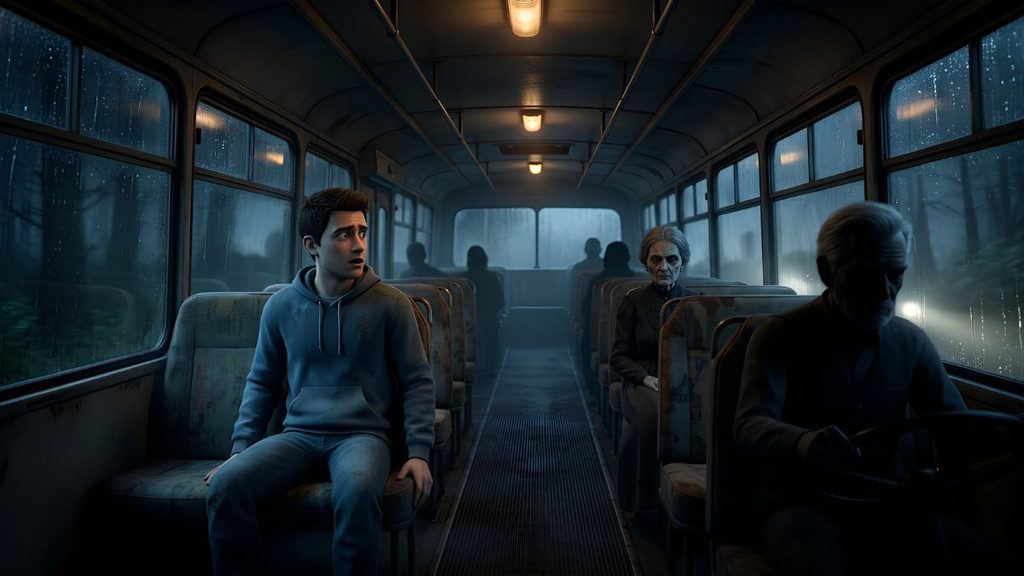
The last bus was supposed to leave at 11:40 p.m.
Ethan knew that because he had checked the timetable three times.
He had spent the weekend visiting his sister in a small town in northern England, and now he was standing alone at a deserted bus stop, watching rain slide down the glass shelter.
His phone showed 11:36 p.m.
The road was empty.
No cars.
No pedestrians.
No lights except the occasional glow from a distant house.
Ethan pulled his jacket tighter around himself.
He was tired.
He wanted nothing more than to get home.
The bus appeared four minutes later.
Its headlights emerged from the darkness.
Ethan stood.
The bus slowed.
The doors opened.
He stepped inside.
“Blackwood?” he asked the driver.
The driver nodded.
“Last stop.”
Ethan paid and walked toward the back.
There were already passengers sitting inside.
About eight of them.
An elderly woman.
A young couple.
A businessman.
A teenage boy.
Two women sitting together.
An old man near the rear.
And one empty seat beside the window.
Ethan sat down.
The doors closed.
The bus moved.
And immediately, Ethan noticed something strange.
Nobody was talking.
Not one person.
The bus was completely silent.
For the first few minutes, Ethan assumed everyone was simply tired.
It was late.
The rain was heavy.
Perhaps the passengers had no reason to speak.
He looked out the window.
The town disappeared behind them.
Streetlights became fewer.
Buildings gave way to fields.
Then the fields disappeared too.
Only darkness remained.
Ethan checked his phone.
No signal.
That wasn’t unusual in the countryside.
He put the phone away.
Then he noticed something else.
The bus driver hadn’t spoken a word.
Not even when someone boarded.
Not even when Ethan had asked about Blackwood.
The driver had simply nodded.
Ethan looked toward the front.
The driver was an old man with gray hair.
His face was reflected faintly in the windshield.
He never moved his head.
He simply stared at the road.
Twenty minutes passed.
Ethan checked the time.
12:03 a.m.
That seemed strange.
The journey from the town to Blackwood should take around thirty minutes.
They had already been traveling for twenty-three.
Yet the landscape outside looked completely unfamiliar.
Ethan leaned toward the window.
He saw a sign.
BLACKWOOD 12 MILES
He frowned.
That couldn’t be right.
They had already traveled several miles beyond the town.
How could Blackwood still be twelve miles away?
He looked at the passengers.
Nobody seemed concerned.
The old woman stared straight ahead.
The teenage boy looked at the floor.
The couple sat motionless.
The businessman had his eyes closed.
Ethan stood.
He walked toward the driver.
“Excuse me.”
No response.
“How long until Blackwood?”
The driver kept his eyes on the road.
Ethan waited.
Then the driver quietly said:
“Not long.”
Ethan returned to his seat.
He tried to convince himself that everything was normal.
A few minutes later, the bus passed another sign.
BLACKWOOD 12 MILES
Ethan stared.
He checked his phone.
12:11 a.m.
They had been driving for almost half an hour.
The distance hadn’t changed.
He stood again.
This time, the elderly woman looked at him.
Her face was pale.
She whispered:
“Don’t ask again.”
Ethan sat down.
“What?”
The woman looked toward the driver.
“Don’t ask him where we’re going.”
Ethan lowered his voice.
“Why?”
The woman shook her head.
“Just don’t.”
Then she turned toward the window.
Ethan stared at her.
Something about her expression frightened him.
She wasn’t merely nervous.
She looked terrified.
At 12:17 a.m., the bus stopped.
There was no bus stop.
No station.
No building.
Just a narrow road surrounded by trees.
The doors opened.
Nobody moved.
Ethan looked outside.
Rain fell through the darkness.
Then someone got on.
A man.
He wore an old-fashioned black coat.
His hair was wet.
He walked down the aisle.
There were empty seats everywhere.
Yet he stopped beside Ethan.
He looked directly at him.
“Is this Blackwood?”
Ethan hesitated.
Before he could answer, the driver said:
“Sit down.”
The man slowly sat in the seat opposite Ethan.
He didn’t look at anyone else.
Only Ethan.
Then he smiled.
Ethan felt uncomfortable.
He looked away.
When he looked back, the man’s face was pressed against the window.
He was staring into the forest.
The bus started moving again.
Ethan checked the time.
12:20 a.m.
The man suddenly spoke.
“You shouldn’t have taken this bus.”
Ethan looked at him.
“Why?”
The man smiled.
“Because it doesn’t go to Blackwood.”
Ethan’s stomach tightened.
“What?”
The man pointed toward the passengers.
“Look at them.”
Ethan did.
“They’re not going to Blackwood either.”
The man lowered his voice.
“They’re going back.”
“Back where?”
The man smiled again.
“Where they came from.”
Ethan looked at the elderly woman.
She was staring at him.
Tears were running down her face.
The man stood.
He walked toward the front.
The driver didn’t react.
He opened the door to the driver’s cabin.
Ethan watched.
The man disappeared inside.
A moment later, the bus passed beneath a stone bridge.
The interior lights flickered.
When they came back on, the man was gone.
Ethan stood.
He looked around.
The passengers were still there.
But something had changed.
The teenage boy was gone.
So was the businessman.
The couple had disappeared.
Only four passengers remained.
The elderly woman.
The two women.
The old man.
And Ethan.
He rushed toward the driver.
“Where did they go?”
The driver finally looked at him.
His eyes were completely black.
Ethan stumbled backward.
“Sit down.”
The driver turned toward the road.
“They’re where they belong.”
Ethan returned to his seat.
The bus continued through the darkness.
He tried his phone again.
No signal.
Then it suddenly connected.
He had one new message.
From his sister.
Did you get home?
Ethan quickly typed:
I’m still on the bus.
The message wouldn’t send.
He tried again.
Nothing.
Then another message arrived.
What bus?
Ethan frowned.
He typed:
The Blackwood bus.
A reply came immediately.
Ethan, there hasn’t been a Blackwood bus running for twenty years.
His hands went cold.
He stared at the screen.
Another message appeared.
Where are you?
Ethan looked through the window.
There were no road signs.
No buildings.
No lights.
Only trees.
Then the elderly woman whispered:
“Don’t answer her.”
Ethan looked at her.
“Why?”
She pointed at his phone.
“Because she isn’t your sister.”
Ethan stared at the message.
Another appeared.
Please get off the bus.
Then:
It’s not safe.
Then:
I’m waiting for you.
The elderly woman shook her head.
“Don’t.”
Ethan looked at the contact name.
It was definitely his sister.
He called.
The phone rang.
Once.
Twice.
Three times.
Then someone answered.
“Hello?”
It was his sister’s voice.
Ethan almost cried with relief.
“Emily?”
Silence.
Then:
“Where are you?”
“On the bus.”
A pause.
Then Emily whispered:
“Ethan…”
Her voice sounded frightened.
“Listen to me.”
“What?”
“There is no bus.”
Ethan looked around.
The passengers were staring at him.
Emily continued:
“You’re not on a bus.”
The call ended.
The bus suddenly stopped.
The doors opened.
The driver spoke:
“Blackwood.”
Ethan looked outside.
There was a bus shelter.
A street sign.
A small village.
Everything looked normal.
He stood.
The elderly woman grabbed his wrist.
“Don’t get off.”
“Why?”
“Because this isn’t Blackwood.”
Ethan looked outside.
A sign clearly read:
BLACKWOOD
He pulled his arm away.
“I have to go home.”
The woman shook her head.
“You don’t understand.”
“What?”
She looked toward the driver.
“Nobody gets off at Blackwood.”
The driver turned around.
His black eyes met Ethan’s.
“Everyone gets off eventually.”
Ethan stepped toward the door.
Then he noticed something.
There was no rain outside.
But rain was falling everywhere else.
He looked down.
The pavement was dry.
The village appeared completely empty.
No cars.
No people.
No lights.
He stepped back.
The doors closed.
The bus moved.
The elderly woman sighed with relief.
Ethan sat beside her.
“What is this place?”
She stared out the window.
“The road between places.”
“What does that mean?”
“Some people take this bus when they’re lost.”
“Lost where?”
“Sometimes in the forest.”
“Sometimes in their lives.”
She looked at him.
“And sometimes…”
She paused.
“They’re already dead.”
Ethan felt a chill.
“Are you?”
The woman smiled sadly.
“I don’t remember.”
The bus continued.
The passengers slowly disappeared.
First the old man.
Then one of the women.
Then the other.
Eventually only Ethan and the elderly woman remained.
The driver was still there.
Ethan asked:
“Who are you?”
The woman thought for a moment.
“My name is Margaret.”
“Where are you going?”
She looked confused.
“I don’t know.”
“How long have you been on this bus?”
Margaret looked at the driver.
He didn’t respond.
Then she whispered:
“Since 1974.”
Ethan stared at her.
“What?”
She nodded.
“I remember getting on one night.”
“I was going home.”
“I never arrived.”
Ethan’s heart sank.
“What happened?”
Margaret looked at the window.
“I think I died.”
The bus lights flickered.
Margaret began to disappear.
Her hands became transparent.
Ethan stood.
“No.”
She smiled.
“You need to leave.”
“How?”
“Ask the driver.”
Ethan looked toward the front.
The driver was watching him through the mirror.
Ethan walked forward.
“What do you want from me?”
The driver didn’t answer.
“Why am I here?”
Still nothing.
“Where is Blackwood?”
The driver finally spoke.
“You asked for it.”
“I did.”
“You wanted to go home.”
“Yes.”
“Then go.”
The bus stopped.
The doors opened.
Outside was Ethan’s street.
His house stood under the yellow glow of a streetlamp.
His front door was open.
His sister stood outside.
“Ethan!”
She waved.
He almost stepped off.
Then he remembered the voice on the phone.
There is no bus.
He looked at the street.
Something was wrong.
His house looked exactly right.
But there was no reflection in the windows.
No lights inside.
No cars.
No neighbors.
His sister stood completely still.
Too still.
Ethan didn’t move.
She smiled.
“Come home.”
Ethan whispered:
“You’re not my sister.”
Her smile disappeared.
The street vanished.
The doors closed.
The bus continued.
Ethan turned toward the driver.
“Where are you taking me?”
The driver said:
“Back.”
“Back where?”
The driver looked at him.
“To the moment you got on.”
The bus lights went out.
Ethan heard the passengers whispering.
Then everything became silent.
He opened his eyes.
He was sitting at the bus stop.
Rain was falling.
His phone showed:
11:36 p.m.
The bus hadn’t arrived yet.
Ethan stared at the road.
He remembered everything.
The bus.
Margaret.
The driver.
Blackwood.
The impossible journey.
He stood.
Then he heard a voice behind him.
“Excuse me.”
Ethan turned.
The elderly woman was standing beside the shelter.
Margaret.
She looked exactly as she had on the bus.
She smiled.
“Are you waiting for the Blackwood bus?”
Ethan stepped backward.
“No.”
She nodded.
“Good.”
Then she disappeared.
Ethan walked home.
He never took the bus again.
When he told his sister what happened, she searched the local transport records.
There was no Blackwood bus.
Not anymore.
The route had been discontinued in 2006.
But she found something else.
An old newspaper article.
It described a bus accident that had occurred in 1974.
A night bus traveling toward Blackwood had disappeared during a storm.
The driver and several passengers were never found.
One passenger was named Margaret Collins.
Ethan read the article several times.
Then he noticed the date.
October 14, 1974.
The same date Margaret had mentioned.
He closed the newspaper.
He wanted to forget.
For several months, nothing happened.
Then, one winter night, Ethan was walking home.
Rain began falling.
He heard an engine behind him.
A bus slowly passed.
He stopped.
The bus had no route number.
No company logo.
Only one destination displayed above the windshield:
BLACKWOOD
Ethan watched it disappear into the darkness.
Then his phone vibrated.
One new message.
From an unknown number.
You left someone behind.
Ethan’s hands shook.
Another message appeared.
Margaret is still waiting.
Then:
The next bus leaves at 11:40.
Ethan looked at his watch.
11:36 p.m.
Four minutes remained.
He turned toward the road.
Far away, two headlights appeared.
And this time…
The bus was coming straight toward him.
Moral
Not every journey should be completed simply because you have started it. When something feels deeply wrong, trust your instincts, question what you see, and remember that getting home safely matters more than reaching your destination.
The Voice Beneath the Floor
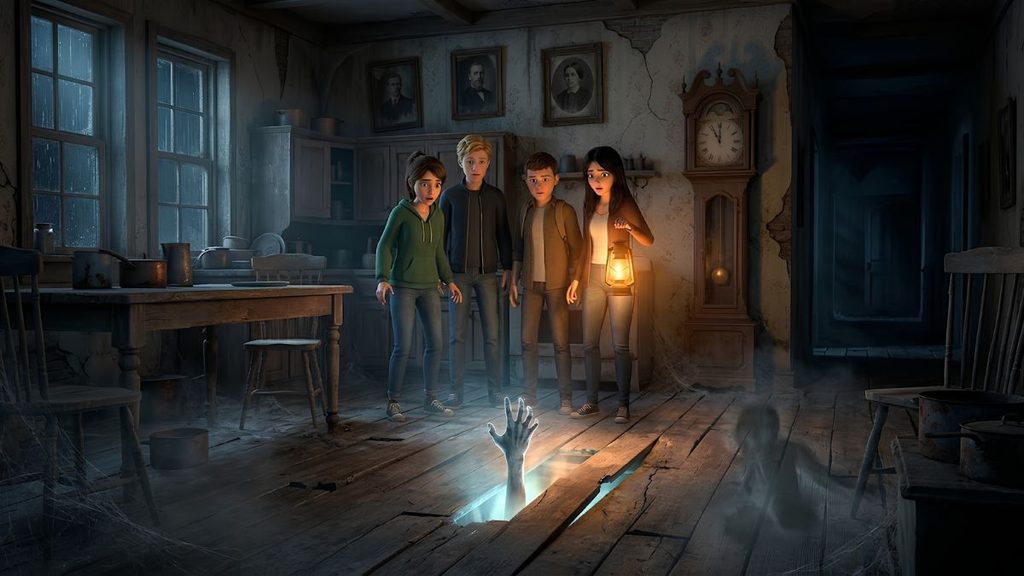
The house had been empty for seventeen years.
At least, that was what the real estate agent told Clara.
“It’s been in the family for generations,” he said as he unlocked the front door. “Nobody has lived here since 2009.”
Clara looked at the enormous Victorian house.
The paint was peeling.
The windows were dusty.
Ivy covered one side of the building.
It should have looked abandoned.
Instead, something about it felt as though someone had just left.
She turned toward her three friends.
Ethan, Noah, and Sophie were standing beside the car.
Noah grinned.
“Still think this is a good idea?”
Clara smiled.
“Absolutely.”
They had rented the house for a weekend.
Clara’s aunt had recently inherited it and wanted to sell it.
Before putting it on the market, she had asked Clara to spend a few days there and photograph the interior.
Clara had invited her friends.
They expected an old house.
They didn’t expect it to speak.
The first evening was uneventful.
They explored the rooms.
There were twelve bedrooms, two staircases, a library, an enormous kitchen, and a basement.
The house contained furniture covered with white sheets.
Old portraits hung along the walls.
A grandfather clock stood in the entrance hall.
It hadn’t worked for decades.
At 10 p.m., they gathered in the kitchen.
Noah opened a bottle of soda.
“So,” he said, “what’s the creepy story behind this place?”
Clara laughed.
“There isn’t one.”
Ethan pointed toward the portraits.
“Every old house has a creepy story.”
Sophie looked at one portrait.
A woman in a dark green dress stared down at them.
“Who is she?”
Clara walked closer.
She read the small brass plaque beneath it.
Eleanor Whitmore, 1912–1978
“Probably one of the previous owners.”
Noah smiled.
“Did she murder anyone?”
“Probably not.”
“Probably?”
They laughed.
Then they heard it.
A faint sound beneath them.
Tap.
Everyone stopped.
Another.
Tap.
Sophie looked down.
“What was that?”
Clara listened.
Nothing.
Noah shrugged.
“Old pipes.”
They returned to their conversation.
Then the sound came again.
Tap.
Tap.
Tap.
Three slow knocks.
From beneath the floor.
Nobody spoke.
Ethan crouched.
“That’s not the pipes.”
Noah looked at him.
“What else could it be?”
Ethan placed his hand against the wooden floor.
A faint vibration traveled through it.
Then a voice whispered:
“Clara.”
She jumped backward.
“What?”
Everyone stared at her.
Sophie whispered:
“It said your name.”
Clara shook her head.
“No.”
The voice came again.
“Clara.”
This time, everyone heard it.
The voice was faint.
But unmistakable.
It was coming from beneath the floorboards.
Noah immediately suggested opening the floor.
Clara refused.
“Let’s check the basement first.”
They found the basement entrance beneath the staircase.
The door was locked.
Clara searched the kitchen drawers.
Eventually, she found an old iron key.
It fit.
The door opened with a long creak.
Cold air rose from below.
The basement was enormous.
Stone walls.
Dirt floor.
Old shelves.
Broken furniture.
At the far end was another wooden door.
Sophie pointed.
“What’s that?”
Clara walked toward it.
The door was covered in scratches.
Hundreds of them.
Some were deep enough to expose the wood beneath the paint.
Ethan looked closer.
“They’re on the inside.”
Noah frowned.
“How do you know?”
“The scratches are around the handle.”
He pointed.
“Someone was trying to get out.”
They searched the basement.
Near the old boiler, Clara found a metal box.
Inside were newspapers.
Letters.
Photographs.
And a diary.
The diary belonged to Eleanor Whitmore.
Clara opened it.
Most entries were ordinary.
Weather.
Visitors.
House repairs.
Family arguments.
Then, in 1978, the entries changed.
March 3
There is knocking beneath the kitchen floor.
March 7
Thomas says it is rats.
March 12
It called my name.
Clara stopped reading.
Ethan looked over her shoulder.
“Keep going.”
She turned the page.
March 15
It knows where we sleep.
Another page.
March 18
We must not answer.
Then:
March 20
Thomas opened the door.
The next page was stained.
The writing became shaky.
He heard his mother calling from beneath the floor. She died twelve years ago. He believed it was her.
The final sentence read:
Whatever is beneath this house can imitate the voices of the dead.
Sophie stepped away from the diary.
“Let’s leave.”
Noah nodded.
“Agreed.”
Then a voice came from the dark basement.
“Clara.”
She froze.
The voice sounded like her mother.
Her mother had died when Clara was sixteen.
Clara’s eyes filled with tears.
“Mom?”
Ethan grabbed her arm.
“Don’t.”
The voice came again.
“Clara, sweetheart.”
She began crying.
Sophie stepped between Clara and the darkness.
“That’s not your mother.”
The voice changed.
Now it sounded like Ethan.
“Clara, help me.”
Ethan was standing beside her.
Everyone turned toward the voice.
“Don’t listen.”
Then it became Noah.
“Clara.”
Then Sophie.
Then her father.
Then her mother again.
The voices came faster.
One after another.
Until the entire basement seemed to whisper her name.
They ran upstairs.
They slammed the basement door.
For several minutes, nobody spoke.
Then Noah said:
“We’re leaving.”
Clara nodded.
They grabbed their bags.
Ethan opened the front door.
It wouldn’t move.
He pulled harder.
Nothing.
The lock wasn’t engaged.
The door simply refused to open.
Sophie tried another entrance.
Locked.
Windows?
Stuck.
They were trapped.
Then the grandfather clock began ticking.
Everyone turned.
The clock had been broken for decades.
Yet its hands were moving.
Backward.
11:57.
11:56.
11:55.
The time continued decreasing.
Clara whispered:
“What does that mean?”
Nobody answered.
Then the clock struck twelve.
The sound echoed through the house.
And every door opened simultaneously.
The basement door opened first.
Then the bedrooms.
Then the kitchen.
Then the library.
One by one.
All of them.
A cold wind moved through the hallway.
Clara heard something beneath the floor.
Scratching.
Then:
Tap.
Tap.
Tap.
The same three knocks.
But now they came from directly beneath their feet.
A voice whispered:
“Open.”
Noah shouted:
“No!”
The voice laughed.
Then it became Clara’s mother’s voice.
“Please.”
Clara covered her ears.
“Stop.”
The voice continued.
“I’m cold.”
Clara began shaking.
Ethan held her.
“It’s not her.”
The voice whispered:
“You know me.”
Clara closed her eyes.
Then the floor cracked.
A wooden plank lifted.
Something moved beneath it.
Noah grabbed a chair.
“What is that?”
Ethan pulled him backward.
The plank rose higher.
A pale hand appeared.
Everyone screamed.
The hand grabbed the edge.
Then another.
The creature beneath the floor began pulling itself upward.
But it wasn’t a person.
It had no face.
Only smooth pale skin where its features should have been.
Yet it spoke.
And it spoke in Clara’s mother’s voice.
“Clara.”
Clara stared.
The creature tilted its head.
“Don’t you want to see me?”
Clara stepped backward.
“No.”
The creature smiled.
A mouth appeared on its blank face.
“You’ve missed me.”
Ethan noticed something.
The diary.
He had left it on the kitchen table.
He ran toward it.
The creature screamed.
The sound shook the windows.
Ethan grabbed the diary and searched the final pages.
There was another entry.
One he hadn’t noticed.
If it comes above the floor, do not fight it.
It cannot leave the house.
But it can be returned.
Below that:
Give it the voice it wants.
Ethan stared.
“What does that mean?”
Clara understood.
“It wants me.”
The creature turned toward her.
“Yes.”
Clara stepped forward.
Everyone shouted.
“No!”
She raised her hand.
“Wait.”
She looked at the creature.
“You want my voice?”
It nodded.
“Then take it.”
The creature opened its mouth.
Clara began speaking.
“My mother used to sing to me.”
The creature listened.
Clara continued.
“She sang whenever I was afraid.”
The creature stepped closer.
“And she always told me something.”
The creature stopped.
“What?”
Clara smiled through her tears.
“That monsters only sound powerful when you believe them.”
The creature screamed.
The walls shook.
The floorboards rattled.
But Clara kept speaking.
She told it everything she remembered about her mother.
Her favorite songs.
Her laugh.
The way she made tea.
The way she used to sit beside Clara when she was sick.
The creature became smaller.
Its voice weakened.
“Stop.”
Clara continued.
“She wasn’t afraid of the dark.”
The creature backed away.
“Stop.”
“She taught me not to be afraid either.”
The creature screamed.
The floor split open.
A black hole appeared beneath it.
The creature fell backward.
Its hands clawed at the wooden boards.
Then the voice changed.
It became Clara’s mother again.
“Clara!”
She almost stopped.
Then she remembered the diary.
It can imitate the voices of the dead.
Clara closed her eyes.
“You’re not her.”
The creature disappeared beneath the floor.
The boards slammed shut.
Silence returned.
The front door opened.
The four friends ran outside.
They didn’t stop until they reached the road.
Sunrise was beginning.
Clara looked back at the house.
Every window was dark.
Except one.
A single light glowed in the basement.
Then it went out.
The police investigated the house after Clara reported what happened.
They found no evidence of anyone living beneath it.
The strange basement door was gone.
The scratches had disappeared.
The floor was perfectly intact.
Even the diary was missing.
The officers assumed the friends had frightened themselves.
Clara eventually accepted that explanation.
Or tried to.
Months passed.
She moved to another city.
She stopped talking about the house.
One night, she was lying in bed when she heard a sound.
Tap.
She opened her eyes.
Tap.
Her bedroom floor creaked.
Then:
Tap.
Three knocks.
Clara sat upright.
Her heart began racing.
A voice whispered beneath the floor.
“Clara.”
She didn’t answer.
The voice changed.
It became her mother’s.
“Sweetheart.”
Clara covered her ears.
The voice whispered:
“You forgot something.”
Clara stayed silent.
Then the floorboard beneath her bed moved.
Slowly.
A thin crack appeared.
Something was underneath.
A pale finger emerged.
Clara screamed.
But then she noticed something.
The finger was holding a piece of paper.
She reached for it.
The handwriting was familiar.
It belonged to Eleanor Whitmore.
There was only one sentence.
It can only follow the person who answers.
Clara stared at the words.
Then she understood.
The creature had never followed her.
She had brought it with her by listening.
She threw the paper away.
The finger disappeared.
The crack closed.
Silence returned.
Clara stayed awake until sunrise.
She never heard the voice again.
But whenever she visited an old house…
She never stood directly over the floorboards.
And she never, ever answered when something beneath them called her name.
Moral
Not every voice deserves an answer. When something feels wrong, trust your instincts and remember that familiarity does not always mean safety.
The Girl at the Empty Playground
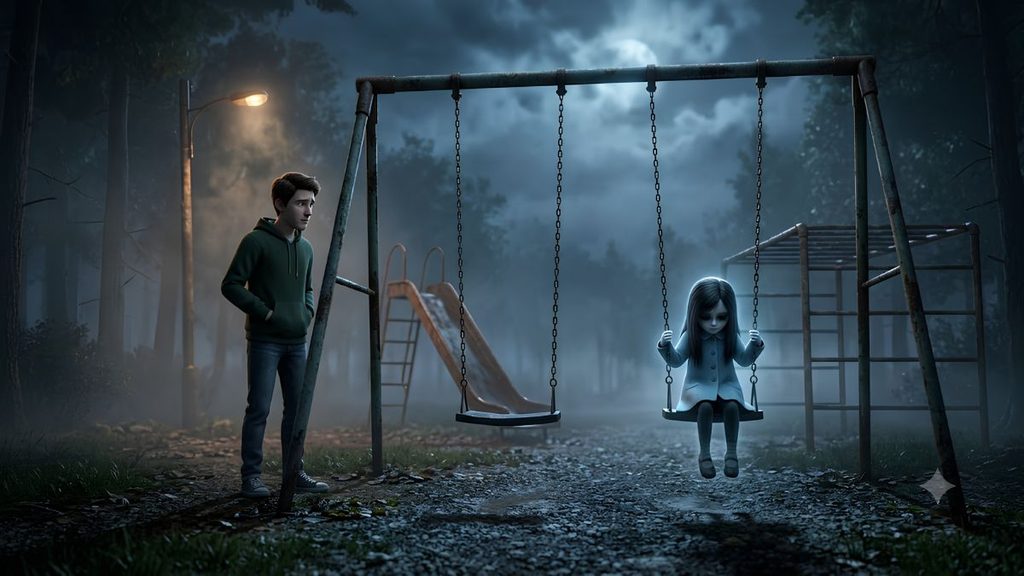
The first time Noah saw the girl, it was exactly midnight.
He was walking home from his friend Daniel’s house after a late movie night.
The neighborhood was quiet.
Most houses were dark.
Streetlights cast long shadows across the sidewalks.
Noah had lived in the neighborhood for almost ten years, so he knew every street and every shortcut.
That was why the playground caught his attention.
It was normally locked after sunset.
Yet that night, the gate stood open.
Noah slowed down.
Beyond the gate was a small playground surrounded by tall trees.
There were two swings.
A slide.
A climbing frame.
And an old wooden bench.
Something moved beside the swings.
A girl.
She looked about ten years old.
She wore a pale blue coat.
Her dark hair hung over her shoulders.
She was sitting on one of the swings.
Moving gently.
Back and forth.
Back and forth.
Noah stopped.
He looked at his watch.
12:03 a.m.
He thought about walking away.
Instead, he called out:
“Are you okay?”
The swing stopped.
The girl looked at him.
And smiled.
Noah walked closer.
“Are you lost?”
The girl shook her head.
“Do you need me to call someone?”
Another shake.
Noah felt uncomfortable.
“What’s your name?”
The girl looked toward the empty street.
Then she said:
“Emily.”
Her voice was soft.
Noah glanced around.
“Where are your parents?”
Emily pointed toward the houses.
“They’re asleep.”
Noah frowned.
“Then why are you here?”
Emily looked at him.
“Waiting.”
“For what?”
She smiled.
“For my friends.”
Noah looked at the empty playground.
“Where are they?”
Emily pointed toward the other swing.
“They’re coming.”
Noah waited.
Nobody came.
He looked at the girl again.
“Maybe you should go home.”
Emily’s smile disappeared.
“I can’t.”
“Why?”
She whispered:
“They don’t know I’m gone.”
Noah felt a chill.
He took out his phone.
“I’ll call the police.”
Emily immediately jumped from the swing.
“No!”
She grabbed his wrist.
Her hand was ice cold.
Noah pulled away.
Emily stared at him.
“Don’t call them.”
“Why?”
“They’ll ask questions.”
“That’s what they’re supposed to do.”
Emily shook her head.
“They’ll ask what happened to me.”
Noah stared.
“What happened to you?”
Emily didn’t answer.
She walked toward the slide.
Then she said:
“Ask your friends.”
Noah frowned.
“My friends?”
“Daniel.”
Noah’s heart stopped.
“How do you know Daniel?”
Emily smiled.
“He’s one of them.”
Then she disappeared behind the slide.
Noah ran around it.
Nobody was there.
He searched the playground.
Empty.
He checked beneath the climbing frame.
Nothing.
The gate was still open.
He ran home.
He didn’t sleep.
The next morning, he called Daniel.
“Do you know an Emily?”
Daniel was silent.
“What?”
“Emily who?”
“A girl who lives around the playground.”
Daniel laughed nervously.
“I don’t know.”
“She said she knows you.”
“That’s impossible.”
Noah described her.
Daniel stopped laughing.
“What did she look like?”
“Dark hair. Blue coat. About ten.”
Daniel didn’t answer.
“Daniel?”
“I have to go.”
The call ended.
Noah called again.
Daniel didn’t answer.
That evening, Noah went to his house.
Daniel’s mother opened the door.
“Hi, Mrs. Collins.”
She smiled.
“Hi, Noah.”
“Is Daniel home?”
Her expression changed.
“Yes.”
“Can I see him?”
She hesitated.
Then:
“He doesn’t want to talk.”
“Why?”
She looked toward the stairs.
“He had a nightmare last night.”
Noah felt uneasy.
“About what?”
Mrs. Collins sighed.
“The playground.”
Daniel eventually came downstairs.
He looked exhausted.
Noah sat beside him.
“Who is Emily?”
Daniel stared at the floor.
“Where did you hear that name?”
“The playground.”
Daniel’s face became pale.
“She spoke to you?”
“Yes.”
“What did she say?”
“She said you’re one of her friends.”
Daniel closed his eyes.
“I haven’t thought about her in years.”
Noah leaned forward.
“Who is she?”
Daniel whispered:
“She died.”
Noah said nothing.
Daniel explained.
When they were children, he and three other friends often played at the neighborhood playground.
Daniel.
Emily.
Lily.
And Michael.
They were inseparable.
One summer evening, Emily disappeared.
The police searched the neighborhood.
They found her body near the river three days later.
The official conclusion was accidental drowning.
Daniel was nine years old.
He remembered the funeral.
He remembered his parents crying.
He remembered never returning to the playground.
But there was something he had never told anyone.
The night Emily disappeared, the four children had been playing there.
Emily had suggested playing hide-and-seek.
She hid.
The others couldn’t find her.
Then Daniel heard her calling from the woods.
He followed the voice.
But he became frightened and ran home.
The others did the same.
They never told their parents.
The next morning, Emily was missing.
Daniel had always believed he had abandoned her.
Noah looked at him.
“She said you were one of her friends.”
Daniel whispered:
“She wants something.”
“What?”
“I don’t know.”
That night, Noah returned to the playground.
Daniel came with him.
They stood outside the gate.
It was locked.
Daniel stared through the bars.
“She shouldn’t be here.”
Noah nodded.
“Then why is she?”
The clock on the church tower struck midnight.
The gate opened.
By itself.
The swings began moving.
Both of them.
Back and forth.
Back and forth.
Daniel whispered:
“Emily.”
A voice answered from behind them.
“You came.”
They turned.
Emily stood near the slide.
She smiled.
Daniel’s face became pale.
“Emily.”
She looked at him.
“You left me.”
Daniel started crying.
“I’m sorry.”
“You heard me.”
“I was scared.”
“You ran.”
“I was nine.”
Emily’s expression remained blank.
“I waited.”
Noah stepped forward.
“Emily, what do you want?”
She looked at him.
“I want them to remember.”
“Remember what?”
Emily pointed toward the trees.
“The truth.”
The playground lights flickered.
Then went out.
The darkness became complete.
Emily walked toward the trees.
Daniel followed.
Noah grabbed his arm.
“Don’t.”
Emily turned.
“You want to know what happened.”
Daniel nodded.
She disappeared into the darkness.
The two boys followed.
They entered the woods.
After several minutes, they reached a clearing.
There was an old concrete drainage tunnel beneath the road.
Daniel stopped.
“I remember this.”
Noah looked at him.
“What?”
“This is where Emily went.”
Daniel’s breathing became heavy.
“She said she found something.”
“What?”
“I don’t know.”
Then they heard laughter.
Children’s laughter.
From inside the tunnel.
Noah switched on his flashlight.
They entered.
The walls were covered in old drawings.
Flowers.
Trees.
Names.
One name appeared repeatedly.
EMILY
Then:
DANIEL
LILY
MICHAEL
At the end of the tunnel was a small wooden box.
Emily stood beside it.
“Open it.”
Daniel approached.
The box was covered in dirt.
He opened it.
Inside were four children’s belongings.
A toy car.
A bracelet.
A red ribbon.
And a small notebook.
Daniel recognized the notebook.
“It was mine.”
He opened it.
Inside were drawings.
The last page contained a sentence.
Emily saw the man.
Daniel looked at Noah.
“What man?”
Emily whispered:
“The man who lived near the river.”
Noah felt a chill.
Daniel remembered.
A strange man had lived in an old cabin near the river.
The children had seen him watching them from a distance.
Adults had dismissed it.
They assumed he was harmless.
But Emily had been afraid of him.
She had told the others.
Daniel hadn’t believed her.
The notebook contained another drawing.
A tall man standing near the playground.
Beside him was a small house.
Daniel whispered:
“She didn’t drown.”
Emily looked at him.
“No.”
“What happened?”
“He followed me.”
The forest became silent.
Noah looked around.
“Where is he now?”
Emily pointed toward the road.
“Dead.”
Daniel stared.
“When?”
Emily smiled.
“Two years after me.”
Noah felt confused.
“Then who was he?”
Emily didn’t answer.
Instead, she pointed toward the notebook.
The final page had another sentence.
He was not alone.
A sound came from behind them.
Footsteps.
Slow.
Heavy.
Noah turned.
A tall shadow stood at the entrance of the tunnel.
Daniel grabbed his arm.
“Run.”
They sprinted.
The shadow followed.
Branches snapped behind them.
Emily’s voice echoed through the trees.
“Don’t look back.”
They ran faster.
The playground appeared ahead.
The gate was open.
They reached it.
The shadow stopped at the edge of the forest.
It didn’t enter.
Daniel looked back.
Nobody was there.
Only darkness.
Emily stood beside the swings.
She looked at Daniel.
“Now you remember.”
Daniel nodded.
“I’m sorry.”
She smiled.
“I know.”
Noah looked at her.
“Are you going to disappear?”
Emily nodded.
“I’ve been waiting a long time.”
“For what?”
“For someone to remember.”
The swings stopped moving.
Emily stepped backward.
Her body became transparent.
Daniel cried.
“Goodbye, Emily.”
She smiled.
“Goodbye.”
Then she vanished.
The playground became completely still.
The next morning, Daniel and Noah went to the police.
They handed over the notebook.
The police investigated the old case.
They discovered evidence that Emily’s death had not been accidental.
The man who had lived near the river had been investigated years earlier for several unrelated incidents.
But there had never been enough evidence to connect him to Emily.
After his death, the case was closed.
Now, decades later, the evidence from the notebook reopened the investigation.
Emily’s family finally learned that she had not simply wandered away.
She had been afraid.
She had tried to tell her friends.
And one of them had remembered.
Years passed.
The playground was eventually renovated.
The old swings were replaced.
The trees were cut back.
New lights were installed.
Children returned.
The neighborhood became brighter.
Safer.
But Daniel never forgot Emily.
Every year, on the anniversary of her disappearance, he visited the playground.
He would sit on the bench.
He would leave flowers.
And sometimes…
At exactly midnight…
One swing would begin moving.
Back and forth.
Back and forth.
Daniel never saw Emily again.
But he always smiled.
Because he knew she was no longer waiting.
One autumn evening, years later, Daniel brought his daughter to the playground.
She ran toward the swings.
“Dad!”
Daniel followed.
His daughter climbed onto one.
Then pointed at the empty swing beside her.
“Dad, who is that girl?”
Daniel froze.
“What girl?”
She pointed.
A little girl in a pale blue coat was sitting on the second swing.
Daniel couldn’t breathe.
The girl looked at him.
Smiled.
And raised one finger to her lips.
Then she whispered:
“Don’t tell them I’m here.”
The swing moved gently.
Back and forth.
Back and forth.
Daniel closed his eyes.
When he opened them again…
The swing was empty.
His daughter looked confused.
“Dad?”
Daniel smiled.
“Let’s go home.”
As they walked away, he glanced back one final time.
A faint figure stood beside the swings.
Emily.
But this time, she wasn’t alone.
Three other children stood beside her.
Daniel recognized them immediately.
Lily.
Michael.
And another child he had never seen before.
They were holding hands.
And all four were smiling.
Moral
Sometimes the truth remains hidden because people are too afraid to face it. Remembering those who were forgotten can bring peace, closure, and the courage to confront what happened.
The House That Remembered Names
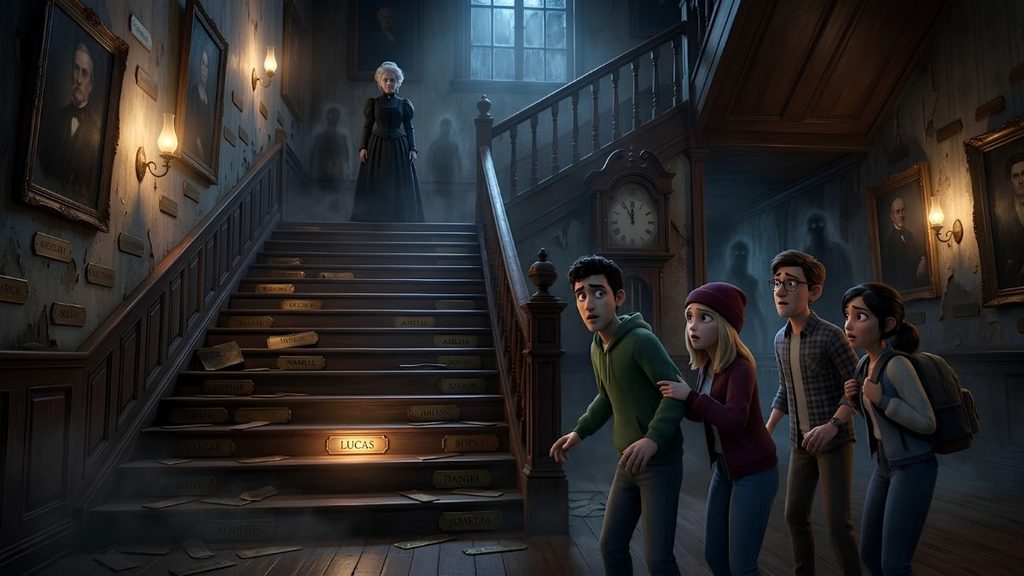
When Lucas first saw the house, he thought it looked lonely.
It stood at the end of a narrow country road, surrounded by tall grass and crooked trees.
The nearest village was almost three miles away.
There were no neighboring houses.
No streetlights.
No fences.
Just an enormous old house sitting beneath a gray evening sky.
Lucas parked his car beside the stone steps.
His friends, Sophie, Daniel, and Amelia, climbed out behind him.
Daniel looked at the house.
“You actually rented this place?”
Lucas smiled.
“For the weekend.”
Sophie stared at the dark windows.
“It looks like nobody has lived here for fifty years.”
“That’s the point.”
Lucas had found the house through a vacation rental website.
The listing described it as a historic country residence.
Four bedrooms.
Large kitchen.
Fireplace.
Private grounds.
Perfect for a quiet weekend away.
There had been hundreds of positive reviews.
But one detail in the listing had bothered Lucas.
The house had no photographs of the upstairs hallway.
When he asked the owner about it, she had simply replied:
Some rooms are better left private.
Lucas thought it was a strange way of saying that part of the house was under renovation.
He hadn’t expected anything more.
He was wrong.
The front door opened easily.
Inside, the house was surprisingly beautiful.
Dark wooden floors.
Tall windows.
Old paintings.
A grand staircase curved toward the second floor.
The furniture was antique but well maintained.
Sophie walked into the living room.
“Okay, this is actually beautiful.”
Daniel dropped his bag.
“I’m taking the room with the fireplace.”
Amelia laughed.
“You can’t claim a room before seeing the others.”
Lucas looked around.
“There’s something strange.”
“What?”
He pointed toward the wall beside the staircase.
Several small brass plaques were attached to it.
Each contained a name.
Margaret.
Thomas.
Eleanor.
William.
Clara.
There were dozens.
Sophie touched one.
“What are these?”
Lucas shook his head.
“I don’t know.”
Daniel laughed.
“Probably previous owners.”
But Amelia didn’t smile.
She was looking at the final plaque.
It was blank.
That evening, they cooked dinner together.
The house became warm and comfortable.
They opened wine, played music, and talked until nearly midnight.
The strange plaques were forgotten.
Then, at exactly 12:14 a.m., the grandfather clock in the hallway began chiming.
One.
Two.
Three.
The friends stopped talking.
The clock continued.
Four.
Five.
Six.
By the time it reached twelve, everyone was staring toward the hallway.
Then came the thirteenth chime.
Dong.
Silence.
Daniel laughed nervously.
“Okay.”
Lucas stood.
“That’s weird.”
Sophie looked at the clock.
“It shouldn’t have done that.”
Amelia whispered:
“Maybe it’s broken.”
Then someone spoke from upstairs.
A woman’s voice.
Soft.
Clear.
“Lucas.”
Everyone froze.
Lucas looked toward the staircase.
“Did someone say my name?”
Nobody answered.
Then the voice came again.
“Lucas.”
Daniel stood.
“Was that one of us?”
Sophie shook her head.
“No.”
The voice whispered:
“Lucas.”
Then footsteps began moving across the upstairs hallway.
Slowly.
One step at a time.
They stood together.
Daniel picked up a fireplace poker.
“Maybe someone broke in.”
Lucas shook his head.
“The doors were locked.”
The footsteps stopped.
Then came a soft knock.
From upstairs.
Three knocks.
Knock.
Knock.
Knock.
Amelia whispered:
“Don’t go up.”
Lucas stared at the staircase.
Then something rolled down the steps.
A small brass plaque.
It landed at Lucas’s feet.
He picked it up.
His face changed.
The plaque had his name on it.
LUCAS
Nobody spoke.
Sophie whispered:
“That wasn’t there before.”
Lucas looked toward the upstairs hallway.
“How did it know my name?”
Another plaque appeared at the top of the staircase.
It slid down one step.
Then another.
Then another.
It stopped beside Lucas.
SOPHIE
Daniel backed away.
“Okay. We’re leaving.”
They grabbed their phones.
None had a signal.
Lucas tried the front door.
It wouldn’t open.
He pulled harder.
Nothing.
Then the lights went out.
The house became completely dark.
A voice whispered from the staircase.
“Daniel.”
Daniel gasped.
Another voice came from behind them.
“Sophie.”
Then:
“Amelia.”
The friends stood back-to-back.
Their names echoed throughout the house.
Lucas switched on his phone flashlight.
The beam revealed the staircase.
The brass plaques were no longer on the wall.
They covered the steps.
Hundreds of them.
Every plaque carried a different name.
Some looked old.
Others looked new.
Daniel picked one up.
“These dates…”
He pointed toward the back.
Each plaque had a date engraved behind it.
Some were decades old.
Some were from only a few years earlier.
Then Sophie found one.
She turned it over.
Her face went pale.
2026.
That was the current year.
They decided to search the house.
If the front door wouldn’t open, perhaps another exit existed.
They found an old study at the end of the hallway.
A desk stood beneath the window.
On it was an enormous leather-bound book.
Lucas opened it.
The first page contained a handwritten sentence:
THE HOUSE REMEMBERS EVERYONE WHO ENTERS.
Sophie read the next line.
IT NEVER FORGETS A NAME.
Daniel turned the page.
There were hundreds of names.
Each had a date beside it.
And beneath many names was another word.
Stayed.
Stayed.
Stayed.
Lucas turned another page.
Then another.
At the bottom of one page was a familiar name.
LUCAS HART
Beside it:
2026
Underneath:
STAYED
Lucas dropped the book.
“That’s impossible.”
Amelia picked it up.
She turned the page.
Her name was there too.
AMELIA REED
2026
STAYED
Then Sophie.
Then Daniel.
All four names had already been written.
A door slammed somewhere upstairs.
They ran into the hallway.
At the far end stood a woman.
She appeared to be in her seventies.
Gray hair.
Long black dress.
Pale face.
She stared at them.
Lucas shouted:
“Who are you?”
The woman smiled.
“I am Eleanor.”
Sophie looked toward the brass plaque on the wall.
ELEANOR
The woman nodded.
“This house remembers me.”
“Are you the owner?”
“I was.”
“When?”
Eleanor smiled.
“Many years ago.”
Daniel stepped forward.
“What is this place?”
Eleanor looked at the book in Lucas’s hands.
“You read the names.”
“What happens to the people?”
Eleanor didn’t answer.
Lucas raised his voice.
“Where are they?”
The woman pointed toward the hallway.
“Still here.”
The lights flickered.
For a moment, the hallway filled with people.
Dozens of them.
Men.
Women.
Children.
They stood silently along the walls.
Some looked frightened.
Some looked sad.
Some simply stared.
Then the lights stabilized.
The hallway was empty.
Sophie began crying.
“We need to leave.”
Eleanor looked at her.
“You can.”
“How?”
“Give the house another name.”
Lucas frowned.
“What does that mean?”
Eleanor pointed toward the empty plaque on the wall.
“The house needs someone to remember.”
Daniel shook his head.
“We’re not giving it anyone.”
Eleanor smiled.
“It already has you.”
The grandfather clock began ticking again.
Tick.
Tick.
Tick.
Lucas looked at the book.
The names were changing.
One by one, the word STAYED appeared beside them.
Lucas’s name changed first.
LUCAS HART — STAYED
Then Sophie.
SOPHIE MILLER — STAYED
Then Daniel.
DANIEL PRICE — STAYED
Then Amelia.
AMELIA REED — STAYED
Amelia screamed.
The book slammed shut.
The house shook.
Doors opened and closed throughout the building.
Eleanor whispered:
“Run upstairs.”
Lucas stared at her.
“Why?”
“Because the house is waking.”
They raced upstairs.
At the end of the hallway was a door they hadn’t noticed before.
It was painted black.
Lucas tried the handle.
It opened.
Inside was a narrow room filled with shelves.
Every shelf contained objects.
Watches.
Photographs.
Letters.
Keys.
Jewelry.
Children’s toys.
Hundreds of personal belongings.
Each had a name attached.
Sophie picked up an old photograph.
A family stood outside the house.
Five people.
She turned it over.
The Collins Family. 1954.
Daniel found a watch.
Thomas Bell. 1968.
Amelia picked up a child’s wooden horse.
Emily Grant. 1931.
Lucas realized what they were looking at.
“These belonged to the people in the book.”
A voice came from the doorway.
“Yes.”
Eleanor stood there.
“Why?”
“Because the house keeps what people leave behind.”
Lucas looked at her.
“What happened to them?”
Eleanor whispered:
“They forgot how to leave.”
The room suddenly changed.
The shelves seemed to stretch endlessly.
The doorway disappeared.
The walls moved closer.
Daniel shouted:
“We’re trapped!”
Lucas searched the shelves.
Then he noticed something.
Every object had a name.
Except one.
A small silver key sat on the floor.
No plaque.
No name.
Lucas picked it up.
Eleanor’s expression changed.
“Put it down.”
Lucas looked at her.
“Why?”
“That key belongs to the house.”
“Maybe it’s our way out.”
Eleanor stepped toward him.
“No.”
Lucas ran.
He pushed past her.
The hallway returned.
The black door slammed shut.
The others followed.
Lucas looked at the silver key.
There was a tiny engraving.
ROOM 13
Sophie whispered:
“There are only twelve bedrooms.”
Daniel looked toward the end of the hall.
A new door appeared.
Number 13.
They approached it.
The key fit.
Lucas unlocked the door.
Inside was a small bedroom.
There was a bed.
A desk.
A window.
And a single brass plaque on the wall.
It was blank.
Lucas understood.
“This is where the house puts people who have no name.”
Amelia shook her head.
“Then why is the plaque blank?”
A voice answered.
“Because you haven’t given it one.”
The door slammed shut.
The room began changing.
Their photographs appeared on the walls.
Their childhood pictures.
Their family photographs.
Images they had never brought into the house.
Sophie stared at one.
It showed her as a child.
Daniel found one of himself.
Amelia saw a picture of her parents.
Lucas saw his childhood home.
The house was showing them memories.
Then the pictures began changing.
Faces disappeared.
Names vanished.
Sophie looked at her photograph.
Her mother’s face was gone.
She screamed.
“What is happening?”
Eleanor’s voice came through the walls.
“The house is making room.”
Lucas realized what she meant.
If the house erased their memories…
They wouldn’t remember who they were.
And if they forgot their own names…
They could never leave.
Lucas shouted:
“Sophie!”
She looked at him.
“Yes?”
“What’s your full name?”
She hesitated.
“Sophie…”
Her expression changed.
“I…”
Lucas grabbed her shoulders.
“Remember.”
“Why?”
“Your name!”
She closed her eyes.
“Sophie Miller.”
The house shook.
Daniel shouted:
“Daniel Price!”
Amelia followed.
“Amelia Reed!”
Lucas screamed:
“Lucas Hart!”
The walls cracked.
The blank plaque fell from the wall.
It shattered.
The door opened.
They ran.
The house seemed to come alive around them.
Portraits turned their heads.
Doors slammed.
Footsteps followed them.
The grandfather clock spun wildly.
Eleanor stood at the bottom of the staircase.
“Stop!”
Lucas ignored her.
They rushed toward the front door.
This time, it opened.
Cold night air flooded inside.
They ran outside.
The moment their feet touched the road, the house became silent.
They turned around.
The windows were dark.
The front door closed.
The house looked abandoned again.
They drove until sunrise.
Nobody spoke.
Eventually, Sophie said:
“Did we really see those people?”
Lucas looked at the silver key.
It was still in his hand.
“I think so.”
Daniel stared at it.
“Throw it away.”
Lucas opened the window.
He threw the key into a river.
They watched it disappear.
Then they drove home.
Two weeks later, Lucas received a letter.
There was no return address.
Inside was a photograph.
It showed the four friends standing outside the house.
But they hadn’t taken that photograph.
On the back was a handwritten message:
Thank you for remembering your names.
Lucas turned the photograph over.
The four friends stood together.
Behind them was Eleanor.
And behind Eleanor stood dozens of people.
Every person from the house.
Lucas stared at the photograph.
Then he noticed something else.
A fifth figure stood among them.
A young man.
He looked familiar.
Lucas studied his face.
Then he realized who it was.
It was him.
But older.
Much older.
His future self stood behind them, staring directly at the camera.
Beneath the photograph was another sentence.
The house remembers where you live.
Lucas burned the photograph.
He burned the letter.
He never told his friends about the older version of himself.
But three nights later, he woke to a sound.
A grandfather clock.
Dong.
Lucas sat up.
He didn’t own a grandfather clock.
Dong.
His bedroom became colder.
Dong.
Thirteen chimes.
Then someone whispered his name.
“Lucas.”
He turned toward the bedroom door.
A brass plaque was hanging from it.
LUCAS HART
Underneath was a date.
2026–
The final part was blank.
Lucas stared at it.
Then a second plaque appeared beside it.
SOPHIE MILLER
Another.
DANIEL PRICE
Another.
AMELIA REED
The four plaques glowed faintly in the darkness.
Then the grandfather clock stopped.
A woman’s voice whispered:
“Names are how we remember.”
Lucas closed his eyes.
And from somewhere far away, he heard a door unlock.
Moral
Your identity is shaped by the memories, relationships, and experiences that make you who you are. Never allow fear or outside pressure to make you forget your own voice and identity.
The Lantern at Hollow Creek
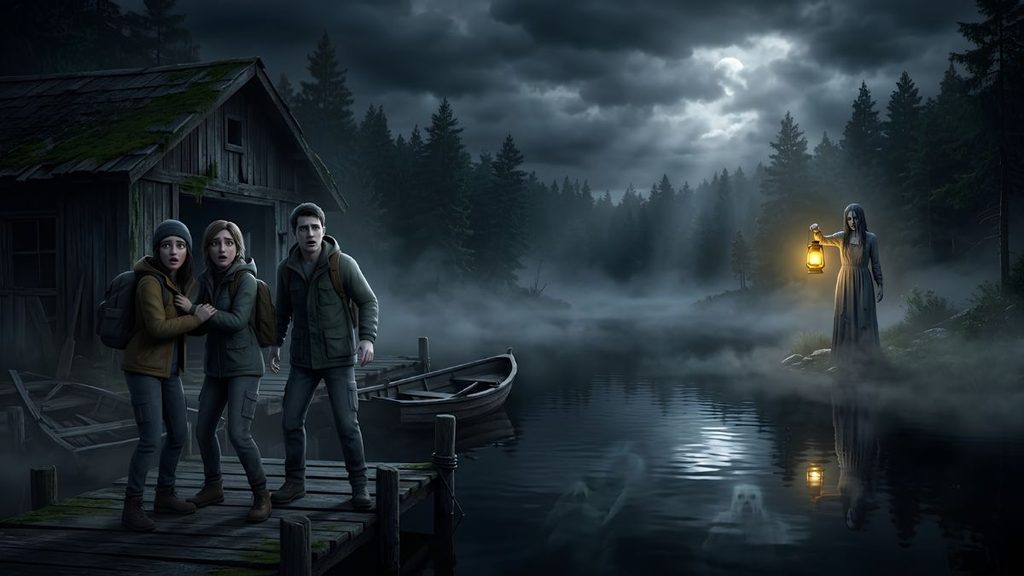
The first time Amelia saw the lantern, she thought it was a star.
It appeared across the lake just after midnight.
A tiny yellow light.
Floating in the darkness.
She stood outside the cabin with her friends, Sophie, Daniel, and Lucas, staring across the water.
The forest around them was silent.
No insects.
No birds.
Not even the sound of wind moving through the trees.
The lake looked like black glass.
Then the yellow light moved.
Slowly.
From one side of the lake to the other.
Amelia frowned.
“Is that a boat?”
Lucas shook his head.
“There’s no one out there.”
Daniel picked up the binoculars.
He looked through them.
Then immediately lowered them.
“What?”
Sophie asked.
Daniel didn’t answer.
He handed the binoculars to her.
Sophie looked.
Her face changed.
“What do you see?”
Amelia took them.
Across the lake stood a person.
A tall figure holding an old-fashioned lantern.
The person was standing in the water.
Not on a boat.
Not on the shore.
In the middle of the lake.
Amelia lowered the binoculars.
“How is that possible?”
Nobody knew.
The figure raised the lantern.
Then the light went out.
The cabin belonged to Lucas’s uncle.
It was located deep in a forest several hours from the nearest town.
The four friends had come there for a weekend.
They wanted to escape the city.
During the day, they hiked, cooked outside, and explored the surrounding woods.
The lake had been their favorite place.
But none of them had heard about the lantern.
Until that night.
After seeing it, they decided to search the cabin for information.
Maybe there was an old dock.
Maybe a boat.
Maybe some local explanation.
Lucas found an old wooden chest beneath the stairs.
Inside were fishing equipment, maps, photographs, and a handwritten journal.
The journal belonged to his grandfather.
Lucas opened it.
Most pages described fishing trips.
Weather.
Animals.
Water levels.
Then he found several entries about Hollow Creek Lake.
One sentence immediately caught his attention.
Never follow the lantern.
He read it aloud.
Sophie looked at him.
“What lantern?”
Lucas continued.
If you see a yellow light on the lake after midnight, stay inside.
Daniel laughed nervously.
“Okay. That’s creepy.”
Lucas turned the page.
The next entry was dated twenty-eight years earlier.
I saw it again last night.
It moved toward the eastern shore.
I heard someone calling my name.
The next page was torn out.
Amelia looked toward the window.
The lake was visible through the trees.
“What happened to him?”
Lucas shook his head.
“I don’t know.”
Daniel took the journal.
“There are newspaper clippings in the back.”
He pulled out several old articles.
The first was about a missing fisherman.
The second described two hikers who disappeared near the lake.
The third was about a teenage boy who had vanished while camping.
Every disappearance had occurred after midnight.
And every case mentioned a light on the lake.
Sophie looked at the dates.
“How many people?”
Lucas counted.
“At least eleven.”
Amelia felt uneasy.
“What did the police think?”
Daniel found another clipping.
He read:
“Authorities believe the missing individuals may have drowned or become lost in the surrounding forest.”
Sophie frowned.
“But no bodies?”
“None.”
Lucas closed the journal.
“We’re staying inside tonight.”
Nobody argued.
At 1:17 a.m., the lantern appeared again.
They saw it through the cabin window.
This time it was closer.
Much closer.
It floated just beyond the dock.
The yellow light moved slowly from side to side.
Amelia whispered:
“It’s looking for someone.”
Daniel shook his head.
“Lights don’t look for people.”
Then a voice came from outside.
“Amelia.”
She froze.
Everyone turned toward her.
The voice came again.
“Amelia.”
It sounded like her father.
Her father had been dead for six years.
Amelia stood.
Sophie grabbed her hand.
“Don’t.”
The voice called again.
“Sweetheart.”
Amelia began crying.
Lucas stepped between her and the window.
“That’s not him.”
The voice changed.
Now it sounded like Daniel.
“Amelia.”
Then Lucas.
Then Sophie.
Then her father again.
The lantern remained outside.
Waiting.
Suddenly, something struck the cabin door.
Bang.
Everyone jumped.
Another.
Bang.
Then scratching.
Slow scratching against the wood.
Daniel whispered:
“Don’t open it.”
The scratching stopped.
Silence.
Then three knocks.
Knock.
Knock.
Knock.
The cabin door handle moved.
Lucas held it tightly.
The handle stopped.
A voice whispered:
“Let me in.”
Amelia recognized the voice.
Her father.
“Please.”
She covered her ears.
“I know you’re not him.”
The voice became angry.
“Open the door.”
The cabin windows began shaking.
The lantern outside suddenly became brighter.
Then every light inside the cabin went out.
Darkness filled the room.
Lucas switched on his phone flashlight.
The beam revealed something written across the wooden door.
Words that hadn’t been there before.
HE IS WAITING FOR YOU.
Sophie whispered:
“Who?”
The answer came from outside.
“Your grandfather.”
Lucas froze.
His grandfather had died twenty years earlier.
The voice continued.
“He left something for you.”
Lucas stared at the door.
“What?”
“Come and see.”
Lucas stepped backward.
“No.”
The voice laughed.
The lantern outside began moving toward the lake.
Slowly.
Then it stopped.
A second lantern appeared.
Then a third.
Then a fourth.
Four yellow lights floated across the black water.
One for each of them.
Daniel looked at Lucas.
“We need to leave.”
They grabbed their coats.
The back door opened normally.
They ran toward the road.
But the forest seemed different.
The path they had used earlier was gone.
Trees stood where the trail should have been.
Lucas checked the map.
Nothing made sense.
“We’re going the wrong way.”
Daniel pointed.
“There.”
A yellow light appeared between the trees.
The lantern.
Amelia whispered:
“It’s leading us.”
Lucas shook his head.
“Don’t follow it.”
But the light moved deeper into the forest.
Then Daniel heard something.
“Someone’s crying.”
They listened.
A child’s voice came from ahead.
“Help me.”
Daniel stepped forward.
Lucas grabbed him.
“Don’t.”
The child cried again.
“Please.”
Daniel pulled away.
“What if someone is actually out there?”
They followed.
The lantern led them to a clearing.
In the center stood an old wooden cabin.
Lucas stared.
“This wasn’t here.”
The cabin was almost completely collapsed.
Its windows were broken.
The roof had partially fallen in.
A rusty sign hung above the door.
HOLLOW CREEK BOATHOUSE
Sophie looked at Lucas.
“Your grandfather’s journal.”
Lucas nodded.
“He mentioned an old boathouse.”
The lantern stood beside the entrance.
Its flame burned brightly.
Daniel approached.
“Maybe the missing people were here.”
Lucas didn’t want to enter.
But the door was already open.
Inside, they found old fishing equipment.
Ropes.
Broken oars.
Empty fuel cans.
And dozens of names carved into the wooden walls.
Some were recent.
Others were decades old.
Amelia touched one.
MICHAEL HARRIS, 1998
Another:
JULIA MORRIS, 2004
Another:
BEN COLLINS, 2011
Daniel found a name he recognized.
His older brother.
MARK PRICE, 2015
Daniel stepped backward.
“No.”
Lucas stared at him.
“Your brother?”
Daniel nodded.
“He disappeared when I was fifteen.”
Everyone had assumed Mark had run away.
Daniel had never known the truth.
He touched the carving.
His hand trembled.
“Why is his name here?”
A voice came from the darkness.
“Because he came looking.”
Daniel turned.
“Mark?”
A figure stood at the far end of the boathouse.
A young man.
Wet clothes.
Pale face.
Daniel stepped forward.
“Mark?”
The figure smiled.
“Daniel.”
Daniel ran toward him.
Lucas grabbed him.
“Wait!”
The figure stopped.
His smile disappeared.
“Why won’t you let him come to me?”
Lucas stared.
“Who are you?”
The figure pointed toward the lake.
“She.”
A woman appeared outside the boathouse.
She wore a long gray dress.
Her hair was soaked.
She carried a lantern.
The same yellow lantern they had seen from the cabin.
She stood barefoot in the water.
And she was smiling.
Lucas remembered the journal.
He searched the pages.
The woman’s name appeared in an old entry.
Evelyn Holloway.
According to the journal, Evelyn had lived near the lake in the early twentieth century.
She had been the daughter of the man who built the original boathouse.
One winter night, her young son disappeared while playing near the lake.
Evelyn searched for him for days.
She eventually drowned while searching the frozen water.
After her death, people began seeing a lantern on the lake.
They said Evelyn was still searching.
But over time, something changed.
She no longer searched for her son.
She began searching for others.
Anyone who followed her lantern became part of the lake’s mystery.
Lucas looked at the figure standing in the water.
“You took them.”
Evelyn smiled.
“They followed.”
The four friends backed away.
Evelyn raised her lantern.
The lake behind her began moving.
Dark shapes appeared beneath the surface.
People.
Dozens of them.
Their faces appeared briefly beneath the water.
Then vanished.
Daniel stared.
“Mark!”
His brother’s figure stood among them.
“Come with me.”
Daniel began walking.
Lucas stopped him.
“That’s not your brother.”
Daniel looked at him.
“How do you know?”
“Because he’s been missing for eleven years.”
Mark smiled.
“I’ve been waiting.”
Daniel cried.
“I thought you were dead.”
Mark answered:
“I am.”
The words echoed through the boathouse.
Daniel froze.
Mark’s face changed.
His skin became pale.
Water streamed from his mouth.
His eyes turned completely black.
He whispered:
“Now you can join me.”
The lanterns suddenly went out.
The boathouse shook.
Water rushed through the doorway.
Sophie screamed.
Lucas grabbed her hand.
“Run!”
They sprinted toward the forest.
Daniel followed.
Behind them came the sound of hundreds of footsteps.
Wet footsteps.
They were running through the water.
The friends didn’t look back.
They ran until they reached the lake shore.
Their cabin was visible across the water.
But the path was blocked.
Evelyn stood between them and the cabin.
Her lantern glowed brighter.
“You cannot leave.”
Lucas shouted:
“We don’t belong to you.”
Evelyn smiled.
“Everyone belongs to the lake eventually.”
She raised the lantern.
The water began rising.
It covered the shore.
Then their shoes.
Then their ankles.
Amelia grabbed a tree.
“We’re going to drown!”
Lucas remembered the journal.
He searched through it.
There was one final page.
He read quickly.
The lantern is not the curse.
It is the door.
Break the lantern, and the dead return to the place where they belong.
Lucas looked at Evelyn.
Then at the lantern.
He understood.
He grabbed a heavy branch.
Evelyn screamed.
“Don’t!”
Lucas ran toward her.
She raised the lantern.
A wave of freezing water struck him.
He fell.
The branch slipped from his hand.
Daniel grabbed it.
He picked it up.
Evelyn turned toward him.
“You want your brother?”
Daniel stared at her.
“Yes.”
“Then come.”
Daniel took a step.
Lucas shouted:
“Daniel!”
Daniel stopped.
He looked at the lantern.
Then at the water.
Then at the dark figure of his brother.
Mark smiled.
“Come home.”
Daniel raised the branch.
“I’m already home.”
He swung.
CRACK!
The lantern shattered.
A burst of yellow light exploded across the lake.
Evelyn screamed.
The water suddenly became still.
Every shadow beneath the surface disappeared.
Mark looked at Daniel one final time.
His expression became peaceful.
“Goodbye.”
Then he sank beneath the water.
Evelyn stood motionless.
The lantern was gone.
She looked at the four friends.
For the first time, she looked sad rather than angry.
“My son.”
Lucas whispered:
“He’s gone.”
Evelyn nodded.
“He has been gone for a very long time.”
Her body began dissolving into mist.
The lake became calm.
She whispered:
“Thank you.”
Then she disappeared.
The forest fell silent.
The four friends returned to the cabin before sunrise.
The strange path through the woods had returned.
Everything looked normal.
They packed their belongings and drove away.
Daniel never spoke about seeing his brother again.
But before leaving, he found something on the cabin porch.
A small brass lantern.
It was old.
Rusty.
Cold.
He picked it up.
Lucas immediately told him to leave it.
Daniel shook his head.
“It’s not lit.”
“Still.”
Daniel placed it on the ground.
They drove away.
Several weeks later, Daniel received a letter.
There was no return address.
Inside was a photograph.
It showed Mark as a teenager.
Daniel stared at it.
On the back was handwriting.
You remembered me.
Daniel smiled sadly.
Then he noticed something in the background.
The lake.
And a tiny yellow light floating across it.
He burned the photograph.
But that night, he dreamed of the lake.
He stood on the shore.
His brother stood in the water.
Mark smiled.
“Don’t be afraid.”
Daniel asked:
“Are you trapped?”
Mark shook his head.
“No.”
“Then where are you?”
Mark pointed toward the horizon.
“I’m where I belong.”
Daniel woke before sunrise.
For the first time since his brother disappeared, he felt at peace.
Years later, the cabin was sold.
The new owners never heard about the lantern.
They never read the journal.
They never learned about the missing people.
They simply enjoyed the peaceful lake.
One summer evening, their daughter went outside.
She was seven years old.
She stood at the edge of the water.
Her mother called from the cabin.
“Emma, come inside.”
The girl looked across the lake.
A tiny yellow light floated in the distance.
She smiled.
“Mommy?”
“What?”
“There’s someone out there.”
Her mother walked toward the window.
“What do you mean?”
The girl pointed.
A figure stood in the middle of the lake.
Holding a lantern.
The mother stared.
Then the figure raised the lantern.
Once.
Twice.
Three times.
The girl whispered:
“She’s looking for someone.”
Her mother pulled her away from the window.
“Don’t look at it.”
The lantern disappeared.
But beneath the lake, something moved.
And from somewhere across the water came a faint voice.
“Emma.”
The little girl turned.
Her mother covered her ears.
“Don’t answer.”
The voice called again.
“Emma.”
Then silence.
The lake returned to darkness.
For a few seconds, everything seemed normal.
Until a small yellow light appeared at the edge of the forest.
And then another.
And another.
Four lanterns.
Waiting.
Moral
Grief can keep us attached to the past, but letting go does not mean forgetting the people we loved. Sometimes the most loving thing we can do is allow the past to rest.
Why Do People Enjoy Scary Stories?
Fear might seem like something people would naturally want to avoid, yet scary entertainment remains popular around the world.
One reason is that scary stories allow people to experience fear from a safe distance.
When friends listen to a fictional story, they know they are sitting together in a familiar environment. The brain can enjoy the suspense while still recognizing that the situation is imaginary.
Scary stories can also create strong social experiences.
Friends react together.
Someone jumps at a sudden twist.
Another person laughs nervously.
Someone else insists they are not scared.
These reactions become part of the entertainment.
The Social Experience
A frightening story can bring people together because everyone experiences the suspense at the same time.
This is particularly effective during:
- Campouts
- Sleepovers
- Road trips
- Weekend gatherings
- Halloween parties
- Late-night conversations
- Family gatherings
- School trips
- Outdoor adventures
- Movie nights
The story becomes something everyone remembers afterward.
What Makes a Scary Story Effective?
A genuinely effective scary story usually contains more than a frightening character.
It creates anticipation.
It makes the listener wonder what is going to happen next.
Several elements can make a story particularly effective.
1. A Familiar Setting
The scariest locations are often ordinary places.
A bedroom.
A hotel room.
A quiet road.
A school hallway.
A forest campsite.
A friend’s house.
A familiar setting makes the story easier to imagine.
When something strange happens in an ordinary environment, it feels more believable.
2. Mystery
Mystery is one of the strongest ingredients in horror.
Instead of immediately explaining everything, a good story raises questions.
Who was standing outside?
Why did the phone ring?
Where did the footprints come from?
Why did the photograph change?
Who left the message?
What was behind the locked door?
The listener keeps waiting for an explanation.
Sometimes the story provides one.
Sometimes it doesn’t.
3. Suspense
Suspense keeps the audience interested.
A character might hear footsteps approaching.
A door might slowly open.
A phone might ring repeatedly.
A strange figure might appear in the distance.
The important thing is not to reveal everything immediately.
The longer the storyteller makes the audience wait, the more anticipation develops.
4. A Strong Twist
A good twist can completely change how listeners understand the story.
Perhaps the mysterious stranger was never a stranger.
Perhaps the supposedly empty house wasn’t empty.
Perhaps the character had been talking to someone who wasn’t alive.
Or perhaps the frightening event was only the beginning.
A memorable ending can make people discuss the story long after it has finished.
5. Atmosphere
Atmosphere can be just as important as the story itself.
A quiet room with dim lighting can make a simple story feel much more frightening.
The same story told at noon in a crowded room may have a completely different effect.
How to Tell a Scary Story Effectively
Knowing a good story is only part of the experience.
The way you tell it matters too.
Start Slowly
Do not begin with the scariest moment.
Build the situation first.
Introduce the characters.
Describe the setting.
Explain why they are there.
Give the audience time to become comfortable.
Then introduce something unusual.
This gradual progression makes the eventual scare more effective.
Use Pauses
Silence can be incredibly powerful.
If a character hears something outside a bedroom door, do not immediately explain what it is.
Pause.
Let your friends imagine what might be there.
Then continue.
A well-timed pause can create more tension than a dramatic sentence.
Change Your Voice
You do not need professional acting skills.
Simply changing your tone can help.
Use a normal voice for ordinary dialogue.
Lower your voice when describing something mysterious.
Speak slowly during suspenseful moments.
Then return to your normal voice after a frightening revelation.
Describe Small Details
Specific details make a fictional story easier to visualize.
Instead of saying:
“The house was scary.”
Describe it.
The porch light flickered every few seconds.
The front door had peeling white paint.
A broken clock hung above the fireplace.
There were muddy footprints across the hallway.
Small details allow listeners to construct the scene in their minds.
Don’t Explain Everything
One of the biggest mistakes in horror storytelling is explaining every mystery.
Sometimes the audience should be left wondering.
What was behind the door?
Who made the phone call?
Where did the footprints lead?
Why did the photograph change?
An unanswered question can remain frightening long after the story ends.
Scary Stories for Different Situations
The best story depends partly on where you are telling it.
Around a Campfire
Campfire stories are perfect for atmospheric horror.
The darkness surrounding the group naturally creates suspense.
Choose stories involving:
- Forests
- Missing hikers
- Strange campers
- Abandoned cabins
- Mysterious lights
- Unexplained sounds
The firelight creates a natural contrast between safety and darkness.
At a Sleepover
Sleepovers provide a different atmosphere.
Everyone is already indoors, often late at night.
Stories involving bedrooms, mirrors, phones, closets, hallways, or strange noises can work particularly well.
During a Road Trip
Road trips are ideal for stories involving highways, remote towns, gas stations, strangers, and mysterious destinations.
A long nighttime drive can make such stories particularly immersive.
At a Halloween Party
Halloween allows you to choose almost any type of scary fiction.
Ghost stories, supernatural mysteries, haunted houses, monsters, cursed objects, and psychological horror can all fit the occasion.
How to Choose the Right Story for Your Friends
Not every group enjoys the same level of horror.
Some people enjoy intense supernatural stories.
Others prefer mysterious stories with mild scares.
Before telling a story, consider your audience.
For Friends Who Love Horror
Choose stories with:
- Darker themes
- Strong suspense
- Unexpected twists
- Supernatural elements
- Unsettling endings
For Friends Who Prefer Mild Horror
Choose stories focused on:
- Mystery
- Strange coincidences
- Ghostly encounters
- Unexplained events
- Suspense rather than graphic horror
For Younger Audiences
Keep the story age-appropriate.
Avoid graphic violence and extremely disturbing themes.
Focus instead on mysterious sounds, unusual places, harmless ghosts, magical objects, and spooky discoveries.
Why Short Scary Stories Can Be More Effective
Long stories can create deep suspense, but short stories have their own advantage.
A short story can deliver an unsettling idea quickly.
This makes short scary stories excellent for:
- Group conversations
- Parties
- Social media content
- Classroom storytelling
- Quick nighttime entertainment
- Campfire sessions
A strong short story often has three basic components:
Setup → Suspense → Twist
The setup introduces the situation.
The suspense creates questions.
The twist changes the meaning of what came before.
Why Long Scary Stories Can Be More Immersive
Longer stories provide more room for character development and atmosphere.
The storyteller can slowly introduce strange details.
The characters can investigate mysteries.
The danger can become increasingly complicated.
A long horror story can feel almost like a short movie playing inside the listener’s imagination.
These stories work particularly well when friends have plenty of time and want to become deeply involved in the fictional world.
How to Create the Perfect Scary Story Atmosphere
You do not need elaborate decorations.
A few simple changes can make a major difference.
Lower the Lighting
Dim lighting makes shadows more noticeable and creates a stronger atmosphere.
Turn Off Background Noise
Silence makes small sounds more noticeable.
A creaking chair or wind against a window can suddenly feel significant.
Tell the Story at Night
Nighttime naturally enhances suspense.
The same story can feel completely different when told after midnight.
Use a Fire
For outdoor storytelling, a campfire provides natural lighting and atmosphere.
The flames illuminate faces while leaving the surrounding forest in darkness.
Encourage Everyone to Participate
Ask listeners questions.
“What would you do?”
“Would you open the door?”
“Would you follow the sound?”
This turns passive listeners into participants.
Scary Stories and Imagination
One reason fictional horror works so well is that everyone’s imagination fills in different details.
A storyteller might describe a shadow at the end of a hallway.
One listener imagines a ghost.
Another imagines a stranger.
Someone else imagines something completely different.
The story provides the framework.
The listener creates the fear.
This is why leaving certain things unexplained can make a story more effective.
Avoiding Common Storytelling Mistakes
Even a good horror story can lose its impact if it is poorly presented.
Avoid rushing through important scenes.
Avoid adding too many unnecessary characters.
Avoid explaining every supernatural event.
Avoid using the same type of scare repeatedly.
Most importantly, avoid making every ending predictable.
The strongest scary stories often begin as ordinary situations and gradually become something the characters never expected.
Are Scary Stories Better When They Are Based on Real Events?
Stories described as “true” can feel more frightening because they create the impression that something similar could happen in real life.
However, many stories shared online as true are actually fictional, exaggerated, or impossible to verify.
When telling friends a fictional story, it is better to present it honestly as fiction rather than falsely claiming that it happened to a real person.
The goal is entertainment, not deception.
Creating Your Own Scary Stories
You can also create original scary stories for your friends.
Start with an ordinary situation.
For example:
A person is staying alone in a hotel.
Then introduce something unusual.
Every night at exactly 2:17 a.m., someone knocks on the door.
Add a mystery.
The hotel receptionist insists that nobody is staying in the neighboring room.
Build suspense.
The knocking continues.
Finally, introduce a twist.
The person discovers that the room next door does not exist on the hotel’s floor plan.
This simple structure can become an entire horror story.
A Simple Formula
You can use this structure:
1. Introduce the characters
Who are they?
What are they doing?
2. Establish the setting
Where are they?
Why are they there?
3. Introduce something unusual
A sound, object, person, message, or event.
4. Increase the mystery
The characters investigate.
Things become stranger.
5. Add a major revelation
They discover something they didn’t expect.
6. End with a memorable twist
Leave the audience with one final unsettling idea.
Why the Ending Matters
A scary story can have an excellent beginning and middle but still fail if the ending feels rushed.
The ending should provide some form of payoff.
It could answer the central mystery.
It could introduce a final twist.
It could leave an important question unanswered.
Or it could reveal that something the characters thought was over is actually still happening.
A particularly effective technique is to connect the ending back to something mentioned near the beginning.
This gives the story a sense of completion while adding another layer of suspense.
Keeping Scary Storytelling Fun
The purpose of scary stories is entertainment.
It is important to understand your audience and respect personal boundaries.
If someone genuinely dislikes frightening content, there is no reason to pressure them into participating.
A good storyteller creates suspense without making friends feel unsafe.
You can also balance frightening stories with funny ones.
After a particularly intense story, telling a humorous story can give everyone a chance to relax.
Final Thoughts on Scary Stories to Tell Your Friends
Scary Stories to Tell Your Friends can turn an ordinary gathering into an unforgettable experience.
The best stories do not depend entirely on monsters, ghosts, or graphic horror. They rely on atmosphere, mystery, suspense, believable settings, memorable characters, and endings that stay in the listener’s mind.
A dark forest, an empty hallway, a mysterious phone call, or an unfamiliar figure can become the beginning of an unforgettable tale when presented well.
Whether you prefer supernatural horror, haunted places, mysterious encounters, psychological suspense, or eerie campfire tales, there are countless ways to entertain a group of friends.
So turn down the lights, gather everyone together, choose the right atmosphere, and let the story begin.
Just remember one thing:
Sometimes the scariest part of a story is what you imagine after the storyteller stops talking.