
Teachers do much more than explain lessons, check homework, and prepare students for examinations. They inspire confidence, encourage curiosity, teach important life values, and help young people discover their potential. Sometimes, a few kind words from a teacher can change a student’s life forever.
Inspirational short stories for teachers remind us that teaching is not simply a profession but a responsibility that can influence generations. These stories highlight patience, kindness, dedication, honesty, perseverance, and the extraordinary impact teachers have on their students.
Whether you are a teacher looking for motivation, a student who wants to appreciate an inspiring educator, or someone searching for meaningful stories about education, these tales offer valuable lessons about the true purpose of teaching.
In this collection, you will discover inspirational short stories about teachers who never gave up on their students, educators who believed in children when nobody else did, and ordinary classroom moments that created extraordinary changes.
What Are Inspirational Short Stories for Teachers?
Inspirational short stories for teachers are meaningful narratives that celebrate the positive influence of educators and highlight the values that make teaching a life-changing profession.
These stories often explore real-life classroom situations, teacher-student relationships, difficult decisions, personal sacrifices, and moments of unexpected success. They remind educators that even small actions, such as listening to a struggling student or offering encouragement, can create lasting memories.
The central message is simple: a good teacher does more than transfer knowledge. A great teacher helps students believe in themselves.
7 Inspirational Short Stories for Teachers
The following stories explore different aspects of teaching, from patience and understanding to courage, compassion, and lifelong dedication. Each story includes a meaningful moral that teachers can apply to their classrooms and everyday lives.
1. The Teacher Who Never Gave Up

A teacher’s greatest achievement is not always measured by examination results or academic awards. Sometimes, it is reflected in the life of a student who finally begins to believe in himself.
This inspirational short story explores the importance of patience, encouragement, and never giving up on students who struggle. It reminds us that every child has potential, even when their abilities are not immediately visible.
In a small town surrounded by green fields and narrow streets, there stood an old school where children from different backgrounds came to study. Some students were excellent at mathematics, others enjoyed science, and a few were naturally talented in sports and art.
Among them was a boy named Daniel.
Daniel was twelve years old and studied in the seventh grade. He was a quiet child who preferred sitting at the back of the classroom. He rarely raised his hand, avoided answering questions, and often submitted incomplete homework.
His examination results were disappointing. Mathematics was particularly difficult for him. While his classmates solved equations quickly, Daniel struggled to understand even the simplest problems.
Some students made jokes about his mistakes.
“Daniel will never become good at mathematics,” one boy whispered to another.
Daniel heard the comment but pretended not to notice. He had become accustomed to people expecting very little from him.
His previous teachers had tried different methods to improve his performance. Some gave him additional homework, while others warned him that poor marks could affect his future.
Unfortunately, none of these approaches helped.
Daniel gradually began believing that he simply wasn’t intelligent enough to succeed.
Everything changed when a new mathematics teacher joined the school.
Her name was Mrs. Anderson.
She was a middle-aged woman with a gentle voice, a warm smile, and more than twenty years of teaching experience. She believed that every student deserved an opportunity to learn, regardless of their academic performance.
On her first day, she entered Daniel’s classroom and introduced herself.
“Good morning, everyone. I am Mrs. Anderson, and I will be teaching you mathematics this year.”
The students welcomed her enthusiastically.
She began the lesson by writing a simple equation on the blackboard.
“Who would like to solve this?”
Several students raised their hands.
Mrs. Anderson selected a girl from the front row. She answered correctly, and the teacher appreciated her effort.
Then Mrs. Anderson looked toward the back of the classroom.
“Daniel, would you like to try the next question?”
Daniel immediately looked down.
“I don’t know, ma’am.”
“That’s perfectly fine. Come and give it a try.”
He slowly walked toward the blackboard. Holding the chalk nervously, he looked at the equation for several seconds.
He wrote something, erased it, and tried again.
A few students started whispering.
Daniel’s face turned red.
“I am sorry, ma’am. I cannot solve it.”
Mrs. Anderson looked at his work.
“Why are you apologizing? You came forward and tried. That is already a good beginning.”
She explained the problem step by step and asked Daniel to complete the final calculation.
This time, he got the answer right.
“Excellent!” she said.
The class applauded politely.
Daniel returned to his seat, but he still wasn’t convinced that he had done anything special.
A Teacher Notices What Others Miss
During the following weeks, Mrs. Anderson carefully observed her students.
She noticed that Daniel was not careless or uninterested. In fact, he paid attention during every lesson.
He copied everything written on the blackboard and often stayed behind to organize his notebooks.
His biggest problem was a lack of confidence.
Whenever he encountered a difficult question, he immediately assumed he would fail.
One afternoon, Mrs. Anderson noticed Daniel sitting alone after school.
His mathematics notebook was open, and several incorrect calculations were crossed out.
“Daniel, are you waiting for someone?” she asked.
“No, ma’am. I am trying to understand today’s homework.”
“Would you like some help?”
Daniel hesitated.
“I don’t want to waste your time. You have already explained this in class.”
Mrs. Anderson pulled a chair beside him.
“Helping students understand is not a waste of my time. It is my job.”
Daniel showed her the questions he had been struggling with.
She quickly realized that he had missed a few basic concepts from earlier lessons. Because those foundations were weak, every new topic seemed confusing.
Instead of giving him more difficult exercises, she decided to start from the beginning.
For the next fifteen minutes, she explained simple mathematical concepts using everyday examples.
She used apples, pencils, books, and classroom objects to make the calculations easier to understand.
Daniel listened carefully.
By the time they finished, he had solved three questions independently.
“See? You can do this,” Mrs. Anderson said.
Daniel smiled slightly.
It was the first time in months that someone had made him feel capable of learning mathematics.
The Small Steps That Created a Big Change
Mrs. Anderson created a simple learning plan for Daniel.
She did not expect him to become the best student overnight. Instead, she wanted him to improve gradually.
Every afternoon, she spent a few minutes reviewing his progress.
If he solved five questions correctly, she encouraged him to try six the next day.
If he made mistakes, she explained them without making him feel embarrassed.
Sometimes Daniel became frustrated.
“I keep getting the answers wrong,” he complained one afternoon.
Mrs. Anderson picked up his notebook.
“Look at this page. Last week, you couldn’t solve even two of these questions. Today, you solved seven.”
“But I still made mistakes.”
“Of course. Learning is not about never making mistakes. It is about understanding them and becoming better.”
She then wrote a sentence at the top of his notebook:
Progress is more important than perfection.
Daniel began reading those words whenever he felt discouraged.
Slowly, his attitude started changing.
He began asking questions during lessons. He no longer hid his notebook when the teacher approached his desk. He even volunteered to solve a few problems on the blackboard.
His classmates noticed the difference.
One day, a boy who had previously laughed at Daniel asked him for help with a mathematics question.
Daniel was surprised.
“Are you asking me?”
The boy smiled.
“Yes. You solved this problem yesterday, didn’t you?”
Daniel explained the steps.
For the first time, he experienced the happiness of helping someone else learn.
The Unexpected Setback
Just when everything seemed to be improving, Daniel faced another difficulty.
The school announced that the annual mathematics examination would take place in three weeks.
Daniel became nervous.
He remembered his previous examination results and started worrying that he would disappoint everyone again.
During one practice test, he struggled with several questions.
When the results were announced, he scored much lower than he had expected.
He felt defeated.
After class, he approached Mrs. Anderson.
“Ma’am, perhaps everyone was right about me. I don’t think I can become good at mathematics.”
Mrs. Anderson looked at him seriously.
“Daniel, do you remember how you felt when you first entered my classroom?”
He nodded.
“You were afraid to solve a single question on the blackboard. Now you can solve problems that once seemed impossible. Have you forgotten how much you have improved?”
“But I failed the practice test.”
“One examination cannot define your ability. It only shows us which areas need more attention.”
Daniel remained quiet.
Mrs. Anderson continued.
“Imagine someone learning to ride a bicycle. If they fall once, should they decide that riding is impossible?”
“No, ma’am.”
“Exactly. They get up, learn what went wrong, and try again.”
She asked Daniel to bring his practice paper the following day.
Together, they reviewed every incorrect answer. They discovered that most of his mistakes happened because he rushed through calculations when he became nervous.
Mrs. Anderson taught him to read questions carefully, manage his examination time, and check his answers before submitting the paper.
Daniel felt hopeful again.
The Day Daniel Surprised Everyone
The annual examination finally arrived.
Daniel entered the examination hall carrying his pens, pencils, and a small ruler.
His hands were slightly cold, but he remembered Mrs. Anderson’s advice.
“Take one question at a time. Don’t let difficult questions frighten you.”
He read the paper carefully.
Some questions were easy, while others required more thought. Instead of panicking, he skipped the difficult ones temporarily and completed the questions he understood.
When he finished, he reviewed his calculations.
For the first time, he left the examination hall feeling satisfied with his effort.
A week later, the results were announced.
Students gathered around the noticeboard.
Daniel slowly walked toward the crowd.
He searched for his name.
Then he found it.
His mathematics score had improved significantly. He had passed comfortably and achieved his best result in the subject.
He stared at the marks for several seconds.
“Is this really mine?” he whispered.
Mrs. Anderson, standing nearby, smiled.
“Yes, Daniel. You earned every mark.”
He ran toward her, holding his result sheet.
“Ma’am, I did it!”
Mrs. Anderson congratulated him.
But Daniel had something important to say.
“You didn’t just teach me mathematics. You taught me that I shouldn’t give up on myself.”
Mrs. Anderson became emotional.
She had taught hundreds of students throughout her career, but moments like this reminded her why she had chosen teaching.
Years Later, a Beautiful Surprise
Time passed.
Daniel completed school, continued his education, and eventually developed a strong interest in engineering.
He worked hard, faced several challenges, and gradually built a successful career.
Although he learned many things from books and professional experiences, he never forgot Mrs. Anderson.
One afternoon, many years later, he returned to his old school.
The building had changed slightly. The classrooms had new furniture, the playground had been renovated, and the walls were covered with colorful educational posters.
But the mathematics classroom was still there.
Daniel asked the office staff whether Mrs. Anderson was available.
He learned that she was still teaching at the school, although she was planning to retire soon.
He walked toward her classroom.
Mrs. Anderson was explaining a mathematics problem to a group of students.
Daniel waited until the lesson finished.
“Excuse me, ma’am,” he said.
She turned around.
For a moment, she looked confused.
Then Daniel introduced himself.
“Do you remember the boy who couldn’t solve simple mathematics questions?”
Mrs. Anderson smiled.
“Daniel!”
They shook hands warmly.
Daniel told her about his education, career, and the challenges he had overcome.
Then he said something that brought tears to her eyes.
“Ma’am, I became an engineer because I learned that difficult things become possible when you keep trying. And I learned that from you.”
Mrs. Anderson looked at the classroom.
Several students were watching them curiously.
She smiled and said, “Then perhaps you should tell them what you just told me.”
Daniel turned toward the children.
“When I was your age, I thought I wasn’t intelligent enough to succeed. I was afraid of making mistakes, and I believed that one bad result could decide my entire future.”
He paused.
“But one teacher refused to believe that I was incapable. She helped me understand that improvement takes time. So, whenever you struggle with a subject, remember that your current difficulty does not define your future.”
The students listened carefully.
Mrs. Anderson stood beside him with a proud smile.
That day, Daniel understood something he had never fully appreciated before.
A teacher’s influence does not end when a student leaves the classroom.
Sometimes, it continues through every decision, every challenge, and every success that follows.
And sometimes, the most important lesson a teacher gives is simply the belief that someone can become better.
Moral of the Story
Never give up on a struggling student because every child has the potential to succeed. Students learn at different speeds, and some need additional patience, guidance, and encouragement.
A great teacher does not label a child according to their weaknesses. Instead, they recognize possibilities, celebrate small improvements, and help students develop confidence.
The story of Daniel reminds us that a few minutes of encouragement, consistent support, and genuine belief can change the direction of a young person’s life.
Life Lessons for Teachers
Teaching goes beyond textbooks: Helping students develop confidence and resilience is equally important.
Every student deserves patience: Children have different learning abilities, and teachers should respect their individual progress.
Encouragement builds confidence: A few positive words can motivate students to attempt things they once feared.
Mistakes are part of learning: Students should feel comfortable making mistakes without worrying about humiliation.
Small improvements matter: Celebrate progress instead of expecting immediate perfection.
Believe in hidden potential: A student’s current academic performance does not determine what they can achieve in the future.
2. The Chalk That Changed a Life
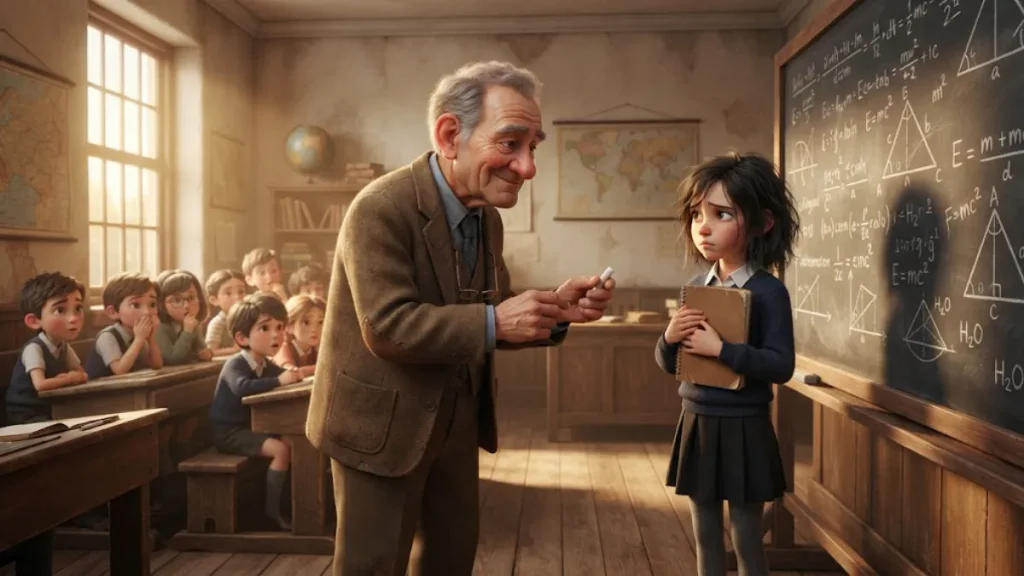
Sometimes, a person’s future changes because someone believes in them at the right moment. A few encouraging words, a small opportunity, or a simple act of kindness can give someone the courage to pursue a dream.
This inspirational story is about a dedicated teacher who recognizes the hidden potential of a shy student. Through patience and encouragement, he helps her overcome her fear and discover her ability to inspire others.
It reminds us that teachers do not simply teach lessons from textbooks. They help students find confidence, recognize their talents, and believe in possibilities they never imagined.
In a small town surrounded by farms and quiet streets, there was an old government school where children from different families came to study. The school building was simple, with faded yellow walls, wooden benches, and large windows that allowed sunlight to enter the classrooms.
Among the teachers was Mr. Thomas, a man who had dedicated more than twenty-five years of his life to education.
He was known for his patience, honesty, and unusual ability to understand children. He believed that every student had something special inside them, even if they were unable to express it.
One of his students was a twelve-year-old girl named Lily.
Lily was intelligent, hardworking, and extremely polite. She completed her homework regularly and always paid attention during lessons. However, she had one major weakness.
She was afraid of speaking in front of others.
Whenever a teacher asked her a question, she knew the answer but rarely raised her hand. If someone suddenly asked her to speak, her voice became so quiet that nobody could hear her.
Her classmates sometimes wondered why she remained silent despite being such a good student.
Lily had a dream, though she rarely shared it with anyone.
She wanted to become a teacher.
She admired educators who could stand confidently in front of a classroom and explain things to children. She imagined herself doing the same one day.
But whenever she thought about speaking in front of people, fear stopped her.
She believed that becoming a teacher was impossible for someone as shy as her.
The Essay That Revealed a Dream
One Monday morning, Mr. Thomas entered Lily’s classroom carrying a notebook.
“Good morning, everyone!” he greeted the students.
The children stood up and welcomed him.
After completing the attendance, he announced a writing activity.
“Today, I want each of you to write about one question: What do you want to become when you grow up?”
The classroom immediately became lively.
Some students wanted to become doctors. Others dreamed of becoming engineers, pilots, police officers, and business owners.
A boy sitting near the window announced that he wanted to become a famous cricket player.
Mr. Thomas smiled.
“Wonderful. Remember, dreams become meaningful when we work toward them.”
He gave the students twenty minutes to complete their essays.
Lily opened her notebook and began writing carefully.
She wrote about her admiration for teachers, the importance of education, and her desire to help children who struggled with learning.
Her essay ended with three simple sentences:
“I want to become a teacher. I want to help children who feel that nobody believes in them. I want every child to know that they are capable of doing something important.”
When Mr. Thomas collected the notebooks, he noticed Lily’s essay.
He read it once.
Then he read it again.
He was surprised by the honesty and maturity of her thoughts.
The following morning, he called Lily to his desk.
“Lily, I read your essay yesterday. May I ask you something?”
She nodded nervously.
“Why do you want to become a teacher?”
Lily looked down at her shoes.
“Because teachers help children learn things they cannot understand on their own.”
“That’s a beautiful reason. Is there anything else?”
She hesitated.
“I want to help children who are afraid of making mistakes. Sometimes, students need someone who tells them they can do something important.”
Mr. Thomas smiled.
“Then you already understand something very important about teaching.”
Lily looked surprised.
But he noticed that she still seemed uncertain.
“Would you like to explain a lesson to your classmates someday?”
Her expression immediately changed.
“No, sir. I cannot speak in front of everyone.”
“Why not?”
“They might laugh if I make a mistake.”
Mr. Thomas thought for a moment.
He decided that he needed to help Lily overcome this fear.
A Small Piece of Chalk
The next day, Mr. Thomas entered the classroom carrying a piece of white chalk.
He wrote a simple question on the blackboard and explained the answer.
After finishing, he turned toward Lily.
“Would you like to explain the next question?”
Lily became nervous.
“Sir, I don’t know how to explain it.”
“That’s all right. You don’t need to be perfect. Just try.”
She shook her head.
Mr. Thomas walked toward his desk and picked up the piece of chalk.
He placed it gently in her hand.
“Take this.”
Lily looked at the chalk.
“What should I do with it, sir?”
“Come to the blackboard and show us what you understand.”
The entire class watched quietly.
Lily slowly walked toward the front of the classroom.
Her hands were trembling.
She looked at the question, then at her classmates.
For a few seconds, she couldn’t say anything.
Mr. Thomas stood nearby.
“Take your time, Lily. Nobody is rushing you.”
She finally began writing the first step.
Her handwriting was slightly uneven, but she continued.
She explained the calculation in a soft voice.
When she reached the final step, she became confused and stopped.
A few students began whispering.
Lily immediately wanted to return to her seat.
But Mr. Thomas gently encouraged her.
“Look at your work again. You already know the answer.”
She studied the calculation and corrected her mistake.
Then she completed the question.
“Very good, Lily!” Mr. Thomas said.
He started applauding.
Soon, the entire class joined him.
Lily smiled shyly.
It was a small moment, but something inside her had changed.
For the first time, she had stood in front of her classmates and completed a task without giving up.
Before returning to her seat, she looked at the chalk in her hand.
Mr. Thomas smiled.
“Keep it. You may need it again.”
Learning to Believe in Herself
Over the following weeks, Mr. Thomas created small opportunities for Lily to speak.
He never forced her to perform in front of the entire school. Instead, he started with manageable activities.
First, he asked her to read a paragraph aloud.
Then he encouraged her to explain a simple question to a friend.
Later, he invited her to help another student with homework.
Each small success made her slightly more confident.
However, progress was not always easy.
One afternoon, Mr. Thomas announced that the school would organize a classroom teaching activity.
Every student would have to explain a topic for five minutes.
Lily immediately became worried.
She approached him after class.
“Sir, can I skip the activity?”
“Why do you want to skip it?”
“I am afraid I will forget everything when I stand in front of everyone.”
Mr. Thomas sat down beside her.
“Do you remember the first time you came to the blackboard?”
Lily nodded.
“You were frightened then, too. But you completed the question. What makes you think you cannot do it again?”
Lily remained silent.
He continued.
“Confidence doesn’t mean that you never feel afraid. It means that you are willing to try even when you feel afraid.”
Lily thought about his words.
She finally agreed to participate.
Mr. Thomas helped her select a simple topic from her science textbook.
She chose the water cycle.
For several days, she prepared her explanation at home. She practiced in front of a mirror and sometimes explained the topic to her younger brother.
Whenever she made a mistake, she started again.
Slowly, she began feeling more comfortable.
The Day Everyone Listened
The classroom teaching activity arrived.
Students explained different subjects throughout the morning.
Some spoke confidently, while others forgot their lines and laughed nervously.
When Lily’s turn came, she walked toward the blackboard holding her notebook.
She noticed that her hands were shaking.
For a moment, she remembered how frightened she had felt during her first attempt.
Then she looked toward Mr. Thomas.
He gave her an encouraging smile.
Lily took a deep breath.
“Good morning, everyone. Today, I am going to explain the water cycle.”
She began by drawing a simple picture of the sun, clouds, and rain.
Her explanation was clear and organized.
She described evaporation, condensation, and precipitation using examples from everyday life.
At one point, a student asked her why clouds sometimes became dark before rain.
Lily paused, thought carefully, and answered the question.
When she finished, the classroom became quiet for a moment.
Then the students applauded.
Mr. Thomas stood up.
“Excellent work, Lily.”
She returned to her seat with a wide smile.
For the first time, she had enjoyed speaking in front of an audience.
The fear had not completely disappeared, but it no longer controlled her.
A Dream Begins to Grow
As the school year continued, Lily became more active in classroom activities.
She participated in debates, helped organize school events, and started explaining difficult topics to younger students.
Her academic performance also improved because she had developed greater confidence in asking questions.
Mr. Thomas continued encouraging her.
He often reminded her that becoming a good teacher required more than speaking confidently.
A teacher needed patience, honesty, preparation, and the ability to understand different students.
Lily listened carefully.
She began observing how Mr. Thomas treated students.
She noticed that he never embarrassed anyone for giving a wrong answer. He encouraged students to ask questions and explained difficult concepts using simple examples.
She also noticed that he remembered small details about his students.
He knew who needed extra help, who was struggling with confidence, and who needed encouragement.
Lily realized that teaching was not simply about standing in front of a classroom.
It was about caring enough to help others grow.
The Final School Day
At the end of the academic year, the school organized a farewell ceremony for students moving to the next grade.
Mr. Thomas announced that he would be leaving the school after completing his service.
The students were disappointed.
Many of them had learned valuable lessons from him, and Lily was particularly emotional.
After the ceremony, she approached his desk.
“Sir, I wanted to thank you for everything.”
Mr. Thomas smiled.
“What are you thanking me for?”
“For helping me speak in front of the class. Before meeting you, I thought I could never become a teacher.”
Mr. Thomas opened his desk drawer and took out a small wooden box.
Inside was a collection of old chalk pieces.
He picked one and handed it to Lily.
“Do you remember the chalk I gave you on your first day at the blackboard?”
Lily nodded.
“I kept it in my schoolbag for months.”
He laughed.
“Then keep this one, too. But remember, the chalk itself has no special power. The real power is in your willingness to write your own story.”
Lily held the chalk carefully.
“I promise I will become a teacher someday.”
Mr. Thomas smiled.
“I hope you become the kind of teacher who helps others believe in themselves.”
Years Later, the Chalk Returned
Many years passed.
Lily completed her education, earned a teaching qualification, and began working at a school.
She was no longer the shy girl who feared standing in front of a classroom.
She had become a confident educator who enjoyed explaining lessons and encouraging children.
One afternoon, she noticed a young student sitting alone at the back of her classroom.
His name was Oliver.
He was intelligent but extremely nervous about speaking in front of others.
Whenever Lily asked him a question, he lowered his head.
She recognized the same fear she had experienced years earlier.
One morning, she gave the class a simple writing assignment.
The topic was “My Dream for the Future.”
When she collected the notebooks, she found Oliver’s essay.
He had written that he wanted to become a teacher because he wanted to help children who struggled with confidence.
Lily smiled.
The words reminded her of her own childhood.
The following day, she called Oliver to her desk.
“I read your essay. Would you like to explain a small lesson to your classmates?”
Oliver immediately shook his head.
“I cannot, ma’am. I am afraid everyone will laugh.”
Lily opened her drawer and took out the old piece of chalk that Mr. Thomas had given her.
She placed it gently in Oliver’s hand.
“Take this. Come to the blackboard and try.”
Oliver looked at the chalk.
“What if I make a mistake?”
Lily smiled.
“Then we will learn from it together.”
He slowly walked toward the blackboard.
For a moment, Lily felt as though she were watching her younger self.
Oliver began writing.
He made a mistake, corrected it, and continued.
When he finished, Lily applauded.
The other students followed.
Oliver smiled.
Lily looked at the old chalk in her hand and remembered Mr. Thomas.
She finally understood the true meaning of his gift.
It was never about a piece of chalk.
It was about passing confidence from one generation to another.
And that day, the lesson continued.
Moral of the Story
A teacher’s encouragement can transform a student’s fear into confidence and help turn an ordinary dream into a meaningful future.
Mr. Thomas did not give Lily expensive gifts, special opportunities, or extraordinary rewards. He gave her something far more valuable: the courage to try.
The story reminds us that every student has hidden potential. Sometimes, all they need is someone who recognizes it and creates a safe opportunity to express it.
A great teacher does not simply teach students what to think. A great teacher helps them believe in what they can become.
Life Lessons for Teachers
- Recognize hidden talent: Quiet students may have extraordinary abilities that remain unnoticed.
- Create opportunities: Give students small responsibilities that help them develop confidence.
- Never humiliate students: Mistakes should become learning opportunities, not reasons for embarrassment.
- Encourage dreams: Take students’ ambitions seriously, even when they seem difficult to achieve.
- Lead by example: Students often develop their values by observing how teachers behave.
- Pass confidence forward: A student encouraged today may become an inspiring educator tomorrow.
3. The Student Who Taught His Teacher

Teachers spend their lives guiding students, sharing knowledge, and helping young people make better decisions. But sometimes, an unexpected experience reminds educators that learning is a two-way process. Students can teach their teachers valuable lessons about patience, understanding, kindness, and life.
This inspirational short story is about a strict teacher who believes that discipline is the key to success. However, when he meets a student facing difficult circumstances at home, he discovers that understanding a child is just as important as correcting their mistakes.
It reminds us that great teachers never stop learning, and sometimes the most meaningful lessons come from the people they teach.
Mr. Robert was a respected teacher at a well-known school in a small town. He had been teaching English and social studies for almost eighteen years.
He was intelligent, punctual, and extremely disciplined. His classroom was always organized, his lessons were carefully prepared, and his students knew exactly what he expected from them.
For Mr. Robert, discipline was the foundation of success.
He believed that students should arrive on time, complete their homework, respect their teachers, and follow classroom rules without excuses.
He often reminded his students:
“Your habits today will decide your future tomorrow.”
Most parents appreciated his strict approach. They believed their children would become responsible and hardworking under his guidance.
However, some students found him intimidating.
He rarely accepted incomplete assignments, and he disliked students who arrived late.
Among his students was a fourteen-year-old boy named Michael.
Michael was intelligent, polite, and naturally curious. He enjoyed reading history books and asking questions about the world. However, he had developed a habit of arriving late to school.
Sometimes he arrived ten minutes after the morning bell. On other days, he missed the first lesson entirely.
His homework was also frequently incomplete.
Mr. Robert became increasingly frustrated with him.
“Michael, this is becoming a habit,” he warned one morning. “You cannot expect to succeed if you refuse to take responsibility.”
Michael quietly nodded.
“I’m sorry, sir.”
The teacher looked disappointed.
“Being sorry will not improve your performance. You need to change your behavior.”
Michael returned to his seat without saying anything.
The teacher believed that the boy simply lacked discipline.
He had no idea what was happening outside the classroom.
A Student Nobody Truly Understood
Michael lived with his mother and younger sister in a small rented house on the outskirts of town.
His father worked in another city and returned home only occasionally.
His mother had been struggling with a long-term health problem, which made everyday household responsibilities difficult.
Michael’s younger sister was only seven years old.
Every morning, he woke up early, prepared breakfast, packed his sister’s schoolbag, and helped her get ready.
Sometimes he also cleaned the kitchen and purchased groceries before leaving for school.
His mother often told him to focus on his education.
“Michael, don’t worry about the house. I will manage everything,” she said.
But he knew that she needed help.
He never wanted to complain or make his family feel guilty.
As a result, he rarely discussed his personal problems with teachers or classmates.
He simply tried to manage everything quietly.
Unfortunately, his responsibilities sometimes made him late.
He also struggled to complete homework because he often helped his sister with her studies before going to bed.
Michael wanted to explain his situation to Mr. Robert, but he was afraid that the teacher would consider it an excuse.
So he remained silent.
The Rainy Morning That Changed Everything
One Tuesday morning, heavy rain covered the town.
The streets were filled with water, and several roads became difficult to cross.
Michael woke up earlier than usual.
His mother was feeling unwell, so he prepared breakfast and helped his sister get dressed.
Before leaving, he made sure his mother had everything she needed.
He then walked his younger sister to a nearby neighbor’s house, where she could stay until someone took her to school.
By the time Michael reached his own school, he was nearly thirty minutes late.
His uniform was wet, his shoes were covered in mud, and his hair was dripping with rainwater.
He quietly entered the classroom.
Mr. Robert stopped writing on the blackboard.
“Michael! Again?”
The entire class turned toward him.
“Why are you late today?”
Michael lowered his eyes.
“I’m sorry, sir.”
Mr. Robert placed the chalk on the table.
“Every week, you arrive late. Sometimes you forget your homework. Do you think education is a game?”
Michael remained silent.
“Tell me honestly. Why don’t you take your studies seriously?”
The boy looked at the floor.
“Sir, I am trying.”
“Trying is not enough. You must show responsibility.”
A few students looked uncomfortable.
Michael returned to his seat and opened his notebook.
He tried to concentrate on the lesson, but his mind was somewhere else.
He was worried about his mother.
He wondered whether she had taken her medicine and whether his sister had reached school safely.
He could barely focus.
The Truth Behind the Late Arrivals
During the lunch break, Mr. Robert noticed that Michael was sitting alone near the classroom window.
The boy had not opened his lunchbox.
The teacher walked toward him.
“Michael, come with me for a moment.”
Michael stood up and followed him into the empty staffroom.
Mr. Robert was ready to explain the importance of discipline again.
But before he could speak, he noticed that Michael looked exhausted.
His eyes were tired, and his uniform was still damp.
The teacher decided to ask a different question.
“Michael, is everything all right at home?”
The boy was surprised.
For a few seconds, he remained silent.
Then he slowly began explaining his situation.
He told Mr. Robert about his mother’s health, his younger sister, and the responsibilities he handled every morning.
He explained that he sometimes had to prepare breakfast, arrange things at home, and make sure his sister was safe before coming to school.
He also admitted that completing homework had become difficult.
“I know I should be on time, sir,” he said quietly. “I am not trying to avoid school. I just don’t always finish everything before leaving.”
Mr. Robert listened without interrupting.
For the first time, he understood that Michael’s behavior had a reason.
He had judged the boy’s actions without understanding his circumstances.
The teacher felt uncomfortable.
“Why didn’t you tell me earlier?” he asked.
Michael replied honestly.
“I thought you would think I was making excuses.”
Mr. Robert looked at him for a moment.
Then he said something he had never said to a student before.
“Michael, I am sorry. I should have asked before judging you.”
The boy looked surprised.
He had never expected his strict teacher to apologize.
A Teacher Learns an Important Lesson
That afternoon, Mr. Robert returned home thinking about Michael.
He remembered how many times he had warned the boy without asking why he was struggling.
He also began thinking about other students.
Had he misunderstood someone else’s behavior?
Was there a student who appeared careless but was actually dealing with personal difficulties?
He realized that his understanding of discipline had been incomplete.
Rules were important, but they could not replace compassion.
The following day, he spoke with the school counselor and explained Michael’s circumstances.
Together, they discussed ways to support the boy without making him feel embarrassed.
They arranged some flexibility with assignment deadlines and identified additional academic support.
Mr. Robert also spoke with the school administration about helping Michael’s family connect with available community resources.
He made sure that the arrangements were handled privately.
He did not want Michael to feel that he was being treated differently in front of his classmates.
A Different Kind of Classroom
Over the following weeks, Mr. Robert changed the way he approached his students.
He continued maintaining classroom discipline, but he became more willing to listen.
Whenever a student submitted incomplete homework, he began asking whether they needed help.
When someone arrived late, he tried to understand the reason before deciding how to respond.
He also started giving students opportunities to discuss challenges that affected their studies.
One morning, he addressed the class.
“Students, I want you to remember something. Discipline is important, but kindness is important too. We should never judge another person without understanding what they might be going through.”
A student raised her hand.
“Sir, does that mean rules are not important?”
Mr. Robert smiled.
“Rules are important because they help us work together. But rules should guide people, not prevent us from understanding them.”
The students listened carefully.
Michael sat quietly near the window.
He felt relieved.
For the first time, he no longer believed that his teacher considered him irresponsible.
He began receiving the support he needed to balance school and home responsibilities.
His attendance improved gradually, and he became more confident about asking for help.
The Unexpected Classroom Discussion
One afternoon, Mr. Robert organized a classroom discussion.
He wrote a question on the blackboard:
What is the most important quality a successful person should have?
Students gave different answers.
“Hard work,” said one boy.
“Honesty,” suggested another.
“Confidence,” added a girl.
Mr. Robert listened to everyone.
Then he turned toward Michael.
“What do you think?”
Michael looked surprised.
He stood up slowly.
“I think a successful person should have understanding.”
Mr. Robert raised his eyebrows.
“Can you explain?”
Michael took a deep breath.
“Sometimes people make mistakes because they are careless. But sometimes they make mistakes because something difficult is happening in their lives. If we understand them, we can help them improve instead of making them feel worse.”
The classroom became quiet.
Michael continued.
“For example, a student who comes late might be helping someone at home. A student who doesn’t complete homework might not have enough time or a quiet place to study. We should ask them what happened before deciding they don’t care.”
Mr. Robert looked at him thoughtfully.
Then he smiled.
“That is an excellent answer, Michael.”
Several students nodded.
The teacher realized that Michael had expressed something he had been learning himself.
A student had helped him understand the difference between judging behavior and understanding people.
The Lesson That Changed the Teacher
As the school year progressed, Michael continued working hard.
His academic performance improved, although he still had occasional difficulties.
Mr. Robert supported him whenever possible.
He also became a more thoughtful teacher.
He began understanding that every classroom contained different stories.
Some students had supportive families and comfortable homes. Others faced financial problems, family responsibilities, emotional difficulties, or personal struggles.
Not every challenge was visible.
One evening, Mr. Robert attended a teacher training meeting.
During the discussion, someone asked what made a teacher truly successful.
Several educators mentioned examination results, discipline, academic achievements, and student performance.
When it was his turn, Mr. Robert shared Michael’s story.
He explained how he had misunderstood a hardworking student simply because he had not taken the time to understand his circumstances.
Then he said:
“I used to believe that my responsibility was to correct students whenever they made mistakes. Now I understand that my responsibility is also to discover why those mistakes happen.”
His colleagues listened carefully.
He continued.
“Sometimes students need correction. Sometimes they need guidance. And sometimes they simply need someone willing to listen.”
The room became quiet.
Mr. Robert realized that teaching had changed him in ways he had never expected.
Years Later, a Meaningful Reunion
Many years passed.
Michael completed school and continued his education.
He worked hard, built a successful career, and remained deeply connected to his family.
His mother eventually recovered enough to manage her daily activities independently.
His younger sister also completed her education.
One day, Michael received an invitation to attend his former school’s annual celebration.
He decided to visit.
When he entered the school building, memories came rushing back.
He remembered the classrooms, the playground, the old library, and the rainy morning when Mr. Robert had finally listened to him.
He asked the office staff whether his former teacher was available.
Mr. Robert was now older and had retired from regular teaching, but he occasionally visited the school.
Michael found him sitting in the staffroom, reading a newspaper.
“Good afternoon, sir.”
Mr. Robert looked up.
For a moment, he did not recognize the young man.
Then Michael introduced himself.
“I am Michael. I used to arrive late to your class.”
Mr. Robert laughed.
“Michael! Of course, I remember you.”
They shook hands warmly.
Michael told him about his life, his career, and his family.
Then he said something that made the teacher emotional.
“Sir, you probably don’t remember this, but one day you apologized to me for judging me without understanding my situation.”
Mr. Robert smiled.
“I remember that day.”
Michael continued.
“That conversation changed how I saw teachers. It taught me that even adults can learn, admit mistakes, and become better people.”
Mr. Robert listened quietly.
Then Michael added:
“You taught me many subjects, but that was the lesson I carried with me throughout my life.”
Mr. Robert looked toward the school courtyard.
He realized that the boy who had once struggled to manage his responsibilities had grown into a thoughtful and compassionate adult.
And the student had taught him something that no textbook could explain.
Moral of the Story
Before judging a student’s behavior, understand the circumstances behind it.
The story of Michael and Mr. Robert reminds us that every student has a unique life outside the classroom. A child who appears careless may be dealing with responsibilities that others cannot see.
Teachers should maintain discipline, but they should also practice patience, empathy, and understanding.
The most effective educators are not those who never make mistakes. They are those who are willing to recognize their mistakes and learn from them.
Sometimes, a student can teach a teacher the most important lesson of all: understanding people is just as valuable as educating them.
Life Lessons for Teachers
- Listen before judging: Ask students about their difficulties before making assumptions about their behavior.
- Practice empathy: Remember that children may face responsibilities and challenges outside school.
- Maintain flexible support: Fairness does not always mean treating every situation identically. Students sometimes need different kinds of assistance.
- Admit your mistakes: A teacher who can apologize teaches students the value of humility.
- Build trust: Students are more likely to seek help when they know they will be heard rather than embarrassed.
- Never stop learning: Teaching is a continuous learning process in which educators can also grow through their students’ experiences.
4. The Empty Chair in the Classroom

Sometimes, the most important thing a teacher can do is notice what is missing. An empty chair in a classroom may seem like an ordinary sight, but behind it could be a student facing difficulties that nobody knows about.
This inspirational short story is about a caring teacher who refuses to forget an absent student. Through kindness, determination, and compassion, she discovers that a small effort can help a child return to education and rebuild hope.
It reminds us that great teachers do more than teach students who attend their classes. They also care about those who are struggling to find their way back.
Mrs. Wilson had been teaching primary school children for nearly twenty years. She worked at a small school in a peaceful town where everyone knew one another.
Her classroom was always filled with colorful drawings, educational posters, neatly arranged desks, and cheerful voices.
She believed that every child deserved an opportunity to learn, regardless of their family background or financial situation.
Among her students was a little girl named Emma.
Emma was eleven years old, polite, hardworking, and naturally curious. She enjoyed reading stories, drawing pictures, and asking questions about the world.
She was not the most talkative student, but she always completed her assignments and treated her classmates kindly.
Her favorite place in the classroom was the wooden chair beside the window.
From there, she could see the school garden, where butterflies often rested on colorful flowers.
Mrs. Wilson knew that Emma loved sitting there because the sunlight made her reading time feel special.
Every morning, Emma entered the classroom with a small smile and greeted her teacher.
“Good morning, Mrs. Wilson!”
“Good morning, Emma. Ready for another day of learning?”
“Yes, ma’am!”
But one Monday morning, Emma did not arrive.
Mrs. Wilson assumed she might have been unwell.
She marked her absent and continued the lesson.
The following day, the chair remained empty.
Then another day passed.
By Friday, Mrs. Wilson had started worrying.
Emma had never missed several consecutive school days without informing anyone.
The empty chair beside the window suddenly seemed different.
It was no longer just an unused desk. It represented a student whose absence needed attention.
A Missing Student and an Unanswered Question
During the next week, Mrs. Wilson asked the school office whether anyone had contacted Emma’s family.
The office staff explained that they had tried calling the number provided during admission, but nobody had answered.
Mrs. Wilson decided to ask Emma’s classmates whether they knew anything.
One girl raised her hand.
“Ma’am, I saw Emma near the market last weekend. She was helping her mother carry some bags.”
Another student added, “I think her father lost his job.”
Mrs. Wilson listened carefully.
She did not want to make assumptions, but she became increasingly concerned.
After school, she checked Emma’s previous notebooks.
Her work was neat, her assignments were complete, and she had written several thoughtful answers.
On the last page of her English notebook, Mrs. Wilson noticed a small drawing.
It showed a teacher standing beside a classroom board with several children sitting in front of her.
Underneath the drawing, Emma had written:
“When I grow up, I want to become a teacher.”
Mrs. Wilson smiled sadly.
She could not understand how a child who loved school so much had suddenly stopped attending.
The following afternoon, she spoke with the school principal.
“Sir, I am worried about Emma. She has missed several days, and nobody knows when she will return.”
The principal suggested contacting the family again.
Mrs. Wilson agreed.
She believed that Emma deserved more than an unanswered phone call.
The Visit That Revealed Everything
On Saturday morning, Mrs. Wilson visited the address listed in the school records.
Emma lived in a small rented house on the outskirts of town.
The house was simple, with a narrow entrance and a tiny courtyard.
When Mrs. Wilson knocked, Emma’s mother opened the door.
She looked surprised to see the teacher.
“Good morning. I am Emma’s class teacher. May I speak with you?”
The woman welcomed her inside.
Mrs. Wilson noticed that the house had very little furniture. A few cooking utensils were arranged near the kitchen, and a pile of clothes rested in one corner.
Emma’s mother looked tired.
“Ma’am, I am sorry Emma has not been attending school.”
Mrs. Wilson gently asked what had happened.
The mother explained that the family had been experiencing serious financial difficulties.
Emma’s father had lost his job several months earlier. Since then, the family had struggled to pay rent and manage everyday expenses.
Her mother had started working longer hours at a nearby shop.
Emma had been staying home to help with household responsibilities.
“We thought she would return once things became better,” her mother explained. “But we don’t know how long that will take.”
Mrs. Wilson listened quietly.
She understood that the family was not choosing to neglect Emma’s education.
They were simply trying to manage difficult circumstances.
“Where is Emma now?” she asked.
“She is in the courtyard.”
Mrs. Wilson stepped outside.
Emma was sitting beside a small table, helping her younger brother with his homework.
When she noticed her teacher, she immediately stood up.
“Mrs. Wilson!”
The teacher smiled warmly.
“Hello, Emma. Your chair has been waiting for you.”
Emma lowered her eyes.
“I am sorry, ma’am. I wanted to come to school, but I cannot.”
Mrs. Wilson sat beside her.
“Why do you think you cannot?”
Emma looked at her mother.
“We don’t have enough money right now. I need to help at home.”
Mrs. Wilson felt a deep sadness.
She realized that Emma had begun accepting the idea that her education was something she could give up whenever life became difficult.
The teacher gently held her hand.
“Emma, your family is going through a difficult time, but that doesn’t mean your dreams have to disappear.”
Emma’s eyes filled with tears.
“Will I be allowed to return?”
Mrs. Wilson smiled.
“Of course. We will try to find a way.”
A Teacher’s Promise
Mrs. Wilson returned to school on Monday with a clear purpose.
She spoke with the principal and explained Emma’s situation.
The school administration agreed to review the available support options.
They discussed helping the family with school-related expenses and arranging books, notebooks, and other essential supplies.
Mrs. Wilson also spoke with a few colleagues.
One teacher offered unused textbooks. Another arranged stationery, while a staff member helped the family identify a local community organization that provided educational assistance.
Nobody wanted Emma to feel embarrassed.
They decided to handle everything privately.
Mrs. Wilson also contacted Emma’s mother to discuss a practical arrangement that would allow her daughter to attend school regularly.
The teacher understood that the family might still face difficulties, but she wanted them to know that they were not alone.
A few days later, she returned to Emma’s house.
She carried a schoolbag containing notebooks, pencils, textbooks, and a new water bottle.
Emma opened the door.
“Ma’am!”
Mrs. Wilson handed her the bag.
“These belong to you.”
Emma looked inside.
Her eyes widened.
“Are you giving me all these things?”
“Yes. And there is something else.”
Mrs. Wilson took out a small piece of paper.
It contained a handwritten message:
Your dreams deserve a place in your classroom.
Emma read it slowly.
Then she hugged her teacher.
For the first time in several weeks, she felt hopeful about returning to school.
The Chair Was Waiting
The following Monday morning, Mrs. Wilson entered the classroom as usual.
The students were busy arranging their books.
She placed her attendance register on the desk and looked toward the window.
The empty chair was still there.
She wondered whether Emma would return that day.
Just as she was about to begin the lesson, someone knocked on the classroom door.
Mrs. Wilson turned around.
It was Emma.
She stood there holding her new schoolbag.
“May I come in, ma’am?”
For a moment, Mrs. Wilson could not speak.
Then she smiled.
“Of course, Emma. Welcome back!”
The entire class turned toward the door.
Several students greeted her excitedly.
Emma walked toward her familiar seat beside the window.
She placed her bag on the desk and looked at Mrs. Wilson.
“Thank you for not forgetting me.”
Mrs. Wilson smiled.
“We never forgot you.”
The lesson continued.
Emma opened her notebook and began writing.
The sunlight entered through the window, falling gently across her desk.
The empty chair was no longer empty.
And for Mrs. Wilson, that simple sight was more rewarding than any examination result.
A New Beginning
Over the next few months, Emma worked hard to catch up with the lessons she had missed.
Mrs. Wilson arranged additional study sessions and helped her understand the topics she had missed.
Her classmates also supported her.
One student shared notes, while another helped her with mathematics homework.
Emma slowly regained her confidence.
She started participating in classroom activities and once again became excited about reading and learning.
Her family situation did not change overnight.
There were still difficult days, and her mother continued working hard.
But Emma was attending school regularly.
The teacher also encouraged her mother to seek support through local educational assistance programs whenever needed.
One afternoon, Mrs. Wilson asked Emma to read a paragraph aloud.
Emma stood up and read confidently.
When she finished, the teacher smiled.
“Very good. You have improved so much.”
Emma replied, “I practiced every evening, ma’am.”
Mrs. Wilson nodded.
“I can see that.”
Then Emma asked a question.
“Ma’am, why did you come to my house? You had so many other students to teach.”
Mrs. Wilson thought for a moment.
“Because being a teacher doesn’t mean caring only about the students sitting in front of me. It also means caring when one of them is missing.”
Emma smiled.
She finally understood how much her teacher valued her education.
Years Later, Emma Returned
Time passed.
Emma completed her schooling and continued her education.
She worked hard and eventually became a qualified teacher.
Her childhood experiences had shaped her understanding of education.
She knew that many children wanted to study but faced challenges that were beyond their control.
Some lacked money for books and uniforms. Others had family responsibilities or struggled with circumstances at home.
Emma decided that she wanted to help such children.
After gaining teaching experience, she joined a school that served children from financially struggling families.
She became known for her kindness and dedication.
Whenever a student missed several days, she made sure someone from the school contacted the family and understood the situation.
She never wanted a child to feel forgotten.
One afternoon, Emma returned to her old school.
She learned that Mrs. Wilson had retired but occasionally visited her former colleagues.
Emma found her sitting in the school garden.
“Good afternoon, ma’am.”
Mrs. Wilson looked up.
For a moment, she did not recognize the woman standing before her.
Then Emma smiled.
“I am Emma. I used to sit beside the classroom window.”
Mrs. Wilson’s face lit up.
“Emma! Look at you!”
They hugged warmly.
Emma told her about her career and the children she was now teaching.
Then she said:
“Do you remember the empty chair in your classroom?”
Mrs. Wilson smiled.
“Of course I do.”
Emma continued.
“That chair taught me that someone can notice when you are missing. You didn’t allow my difficult circumstances to decide my future.”
Mrs. Wilson became emotional.
Emma added:
“Now, whenever one of my students stops coming to school, I remember what you did. I try to understand their situation before assuming they have lost interest in education.”
Mrs. Wilson looked at her former student with pride.
The little girl who once feared losing her education had become a teacher who helped other children protect their dreams.
As they walked through the school courtyard, Emma glanced toward the classroom window.
She could almost picture her younger self sitting at that familiar wooden desk.
The chair had been empty for several weeks, but her teacher had never allowed her dream to become empty.
And that was a lesson Emma would carry for the rest of her life.
Moral of the Story
A caring teacher notices when a student is missing and makes an effort to understand why.
The story of Emma reminds us that every child deserves an opportunity to learn, regardless of their financial circumstances or family difficulties.
Sometimes, students stop attending school not because they dislike education but because life becomes difficult.
A simple visit, a supportive conversation, or help with basic school supplies can make a meaningful difference.
Great teachers do not simply count the students present in their classrooms. They care about the children who are absent and the challenges they might be facing.
The empty chair reminds us that behind every absence, there may be a story worth understanding.
Life Lessons for Teachers
- Notice every absence: Repeated absences may indicate that a student needs support.
- Understand before judging: A child may have responsibilities or financial difficulties outside school.
- Take meaningful action: Contact families, involve school support systems, and explore practical solutions.
- Protect students’ dignity: Offer assistance privately without making children feel embarrassed.
- Encourage hope: Remind students that difficult circumstances do not have to end their dreams.
- Build a caring classroom: Encourage classmates to welcome and support students returning after an absence.
5. The Teacher Who Shared Her Lunch

A teacher’s kindness can make a lasting difference in a student’s life. Sometimes, the most meaningful lessons are not found in textbooks or written on a classroom blackboard. They are taught through small acts of compassion, generosity, and understanding.
The Teacher Who Shared Her Lunch is an inspirational short story about a teacher who notices a hungry student and decides to help him without making him feel embarrassed. Her simple gesture teaches the entire class that kindness is not measured by how much we give, but by how much we care.
Mrs. Margaret was a kind and hardworking teacher who had been teaching at Green Valley School for almost fifteen years. She believed that every child deserved an equal opportunity to learn, grow, and build a better future.
Her classroom was always cheerful. She greeted her students with a smile every morning, listened patiently to their questions, and encouraged even the quietest children to participate.
Mrs. Margaret often told her students, “Education is important, but becoming a good human being is even more important.”
Some students understood her words immediately, while others thought they were simply another lesson their teacher liked to repeat.
One of her students, a ten-year-old boy named Ethan, rarely spoke during class. He usually sat on the last bench, completed his assignments quietly, and avoided drawing attention to himself.
Ethan was not a weak student. In fact, he was quite intelligent and enjoyed reading. However, he often appeared tired and sometimes struggled to concentrate during afternoon lessons.
Mrs. Margaret noticed another unusual thing about him.
While most students eagerly opened their lunchboxes during the lunch break, Ethan usually remained at his desk. Sometimes he drank water from his bottle. On other days, he pretended to be busy arranging his books.
At first, Mrs. Margaret assumed that he simply preferred eating at home. But after observing him for several days, she began to worry.
One Wednesday, she decided to pay closer attention.
The Boy Who Never Opened His Lunchbox
It was almost noon when the school bell rang.
The students happily rushed outside, carrying their colorful lunchboxes. Some gathered beneath the trees, while others sat together in the school courtyard.
Mrs. Margaret stayed in the classroom to check a few notebooks.
Ethan remained at his desk.
“Why aren’t you going outside, Ethan?” she asked gently.
“I’m not hungry, ma’am,” he replied without looking up.
Mrs. Margaret smiled.
“That’s all right. But you should still enjoy some fresh air. Sitting in the classroom all day isn’t good for you.”
Ethan nodded but did not move.
A few minutes later, Mrs. Margaret noticed him looking toward the other students. His eyes followed a group of boys opening their lunchboxes. One of them had a sandwich, another had fruit, and someone else was sharing homemade cookies.
Ethan quickly looked away when he realized his teacher was watching.
Mrs. Margaret understood that something was wrong, but she did not want to embarrass him by asking too many questions.
The next day, she brought an extra lunchbox from home.
When the lunch bell rang, she sat at the desk beside Ethan and opened it.
“Would you like to have lunch with me today?” she asked.
Ethan looked surprised.
“With you, ma’am?”
“Of course. I brought too much food, and I need someone to help me finish it.”
She opened the lunchbox. Inside were two vegetable sandwiches, some sliced apples, and a small container of homemade rice.
Ethan hesitated.
“But ma’am, I don’t want to take your food.”
Mrs. Margaret laughed softly.
“You’re not taking anything. We’re sharing it. Besides, food always tastes better when someone shares it with you.”
After a moment, Ethan accepted a sandwich.
He ate slowly at first, but soon his hesitation disappeared. Mrs. Margaret continued talking about books, school activities, and the funny things that sometimes happened in the staff room.
She never asked him why he had no lunch.
For the first time in several days, Ethan smiled.
A Small Act of Kindness
The following day, Mrs. Margaret brought another lunchbox.
This time, Ethan did not need an invitation. When he saw her sitting near the window, he quietly walked over and asked, “May I sit with you today, ma’am?”
“Absolutely,” she replied.
They shared lunch again.
Soon, it became a small daily routine. Mrs. Margaret brought an extra portion of food, and Ethan joined her during the break.
She made sure that he never felt like a charity case. She treated him as a friend who happened to share her lunch.
Sometimes they discussed his favorite subjects. On other days, Ethan told her about the books he wanted to read.
Slowly, he became more confident.
He started participating in classroom discussions, asking questions, and even volunteering to read aloud.
His classmates noticed the change.
One afternoon, a student named Oliver asked, “Ethan, why do you always have lunch with Mrs. Margaret?”
Ethan looked uncomfortable.
Before he could answer, Mrs. Margaret smiled and said, “Because we both enjoy good company. And I must admit, he has excellent taste in sandwiches.”
The children laughed.
Ethan smiled too.
Mrs. Margaret had protected his dignity without making a big announcement about what she was doing.
The Truth Behind His Empty Lunchbox
A few weeks later, Mrs. Margaret received a message from Ethan’s mother requesting a meeting.
She arrived at the school the following morning.
Mrs. Margaret welcomed her into the classroom and offered her a chair.
“I’m sorry if Ethan has caused any trouble,” his mother began nervously.
“Oh, not at all,” Mrs. Margaret replied. “Ethan is a wonderful student. I wanted to know if everything was all right at home because I’ve noticed that he sometimes seems tired.”
Ethan’s mother lowered her eyes.
Her husband had lost his job several months earlier, and the family was struggling financially. She worked long hours doing sewing work from home, but the income was not enough to cover all their expenses.
Some mornings, she managed to prepare breakfast for Ethan, but preparing lunch was becoming difficult.
She had never told him to stop carrying lunch deliberately. Instead, he had begun saying he was not hungry because he did not want his parents to worry.
“I feel terrible,” his mother said. “He never told me he was missing lunch at school. I thought he was eating with his friends.”
Mrs. Margaret listened carefully.
She did not judge the family or ask unnecessary questions.
Instead, she said, “Please don’t feel ashamed. Every family faces difficult times. Ethan is a bright child, and he deserves to enjoy his school days without worrying about food.”
She explained that she had been sharing her lunch with him.
His mother became emotional.
“Thank you for looking after my son. I don’t know how to repay you.”
Mrs. Margaret gently shook her head.
“You don’t need to repay me. Just make sure Ethan knows that he is loved and supported. That is enough.”
Before leaving, Ethan’s mother thanked her again.
For Mrs. Margaret, however, the matter was not finished. She knew that sharing lunch was a temporary solution. Ethan needed consistent support, not just an occasional meal.
A Classroom Becomes a Place of Kindness
The following week, Mrs. Margaret spoke to the school principal about starting a small lunch-sharing initiative.
She suggested that students who wanted to participate could bring an extra fruit, sandwich, or snack to school. These items would be collected and made available to children who needed them.
The principal liked the idea but wanted to ensure that no student would feel singled out.
Together, they created a simple arrangement.
A small table was placed near the library with a sign that read:
“The Kindness Table: Take What You Need, Share What You Can.”
Students could leave extra food there, and anyone who needed something could take it without explaining why.
Mrs. Margaret also spoke to the parents during a school meeting. She explained that the initiative was not about identifying poor children. It was about creating a school community where nobody had to sit hungry while others enjoyed their meals.
At first, only a few families participated.
One parent brought bananas. Another sent homemade sandwiches. A local bakery offered fresh bread twice a week.
Gradually, the table became a regular part of school life.
Some children donated food. Others helped arrange the lunch items. A few students even began sharing their own lunchboxes with classmates.
The most beautiful change was that nobody made fun of anyone for taking food.
The children began to understand that everyone has different circumstances, and kindness should never come with embarrassment.
Ethan also started bringing lunch again when his family’s situation improved slightly.
However, he continued visiting the Kindness Table.
Sometimes he took an extra fruit. On other days, he placed a small packet of biscuits there for someone else.
Mrs. Margaret noticed his actions but said nothing.
She was happy to see that he had learned something more important than the value of a meal.
He had learned the value of sharing.
The Lesson That Changed the Students
A month later, Mrs. Margaret organized a classroom activity.
She asked every student to write about one small act of kindness that had made a difference in their life.
Some wrote about a friend who had helped them with homework. Others mentioned their parents, grandparents, or siblings.
When it was Ethan’s turn, he stood up nervously.
He held a small piece of paper in his hands.
“I want to thank Mrs. Margaret,” he began.
The classroom became quiet.
“Sometimes, I didn’t bring lunch to school. I thought nobody would notice because I didn’t want anyone to know. But Mrs. Margaret noticed.”
He paused and looked toward his teacher.
“She never asked me why I didn’t have food. She just invited me to share hers. She made me feel like I was her friend, not someone who needed help.”
Mrs. Margaret smiled, but her eyes filled with tears.
Ethan continued.
“I used to think that being poor meant I was different from everyone else. But now I understand that everyone needs help sometimes. When I have something to share, I want to share it with others too.”
The classroom remained silent for a moment.
Then the students began clapping.
Mrs. Margaret walked toward Ethan and placed a hand gently on his shoulder.
“Thank you, Ethan,” she said. “You have taught us a beautiful lesson today.”
She looked around the classroom.
“Remember, children, kindness doesn’t always require money. Sometimes, it means sharing your food, listening to someone, offering a seat, or simply making another person feel welcome.”
That day, the students understood why their teacher always spoke about becoming good human beings.
She had not simply told them about kindness.
She had shown them what it looked like.
Years Later, the Lesson Continued
Several years passed.
Mrs. Margaret eventually retired from teaching. Her hair turned grey, and she spent more time reading books, gardening, and visiting former colleagues.
One afternoon, she received a letter.
The handwriting looked familiar, but she could not immediately recognize the sender.
She opened the envelope and began reading.
It was from Ethan.
He had grown into a young man and was studying to become a teacher. In his letter, he described how much that small lunch-sharing routine had meant to him.
He explained that he still remembered the first sandwich Mrs. Margaret had shared with him.
He had also started volunteering at a community center where children from financially struggling families received meals and educational support.
At the end of the letter, he wrote:
“You once shared your lunch with me when I had nothing to share. I cannot return those sandwiches, but I can pass on the kindness you showed me. I hope one day I become the kind of teacher you were.”
Mrs. Margaret read the letter twice.
Then she placed it carefully inside an old notebook where she kept messages from former students.
She looked out of her window and smiled.
She had taught thousands of lessons throughout her career. She had explained mathematics, grammar, history, and science.
But one of her most meaningful lessons had happened during an ordinary lunch break.
It had required no textbook, no blackboard, and no examination.
It had only required an extra portion of food and a little kindness.
And that kindness had travelled much further than she could have imagined.
Moral of the Story
A small act of kindness can make a big difference in someone’s life.
Teachers do more than teach academic subjects. They notice when students are struggling, create safe environments, and help children understand the importance of compassion.
Mrs. Margaret did not make Ethan feel ashamed of his situation. She treated him with respect, shared what she had, and encouraged the entire school to build a culture of generosity.
Her story reminds us that helping someone is not only about what we give. It is also about how we make that person feel.
Life Lessons for Teachers
1. Notice the little changes: A student who becomes quiet, avoids lunch, or loses concentration may be dealing with difficulties outside school.
2. Help without embarrassing anyone: Support should protect a student’s dignity rather than make them feel different from their classmates.
3. Kindness creates trust: Students are more likely to learn and communicate when they feel safe and respected.
4. Lead by example: Children often learn values more effectively by observing what adults do than by listening to repeated instructions.
5. Build a supportive classroom: Encourage sharing, cooperation, and respect so that every student feels included.
6. Remember the power of small actions: A shared meal, a kind conversation, or a few encouraging words can remain in a student’s memory for years.
6. The Teacher Who Learned to Listen

A good teacher knows how to explain a difficult lesson, maintain discipline, and guide students toward success. But one of the most important qualities of a great teacher is the ability to listen.
Sometimes, students do not need another lecture or a long list of instructions. They need someone who will listen to their fears, understand their problems, and give them the confidence to move forward.
The Teacher Who Learned to Listen is an inspirational short story about a strict teacher who discovers that understanding students is just as important as teaching them. Through one unexpected conversation, she learns that every student has a story that deserves to be heard.
Mrs. Eleanor Parker had been teaching English at Riverside Public School for more than twenty years. She was known as one of the most experienced teachers in the school.
Her lessons were always well organized. She prepared notes in advance, checked homework regularly, and expected every student to follow classroom rules.
She believed that discipline was the foundation of education.
Her students respected her, but many were afraid of making mistakes in front of her.
If someone gave a wrong answer, she immediately corrected it. If a student failed to complete homework, she asked for an explanation. If anyone interrupted the lesson, she reminded the entire class that learning required concentration.
Mrs. Parker was not an unkind person. She genuinely wanted her students to succeed. She simply believed that students needed firm guidance more than anything else.
However, she had one habit that she rarely noticed.
She talked much more than she listened.
Whenever a student tried to explain a problem, she often interrupted with advice. When someone complained about a difficult assignment, she immediately explained why the assignment was necessary. When a child appeared upset, she usually suggested that the student should concentrate on studies instead of worrying about small things.
She thought she was helping.
But some of her students felt that their words never really reached her.
The Quiet Girl in the Last Row
Among her students was a thirteen-year-old girl named Sophie.
Sophie was intelligent, creative, and interested in writing. She enjoyed reading stories and often filled the pages of her notebook with poems, observations, and small pieces of fiction.
But she rarely participated in classroom discussions.
Whenever Mrs. Parker asked a question, Sophie looked down at her desk. Even when she knew the answer, she hesitated to raise her hand.
One afternoon, Mrs. Parker returned the students’ English assignments.
Most students had received good marks, but Sophie had left several questions unanswered.
Mrs. Parker looked disappointed.
“Sophie, you are capable of doing much better than this. Why are you not taking your studies seriously?”
Sophie stood quietly.
“I tried, ma’am.”
“Trying is not enough. You must complete your work properly.”
Sophie wanted to explain something, but Mrs. Parker continued speaking.
“You have potential. I don’t want to see you wasting it. Please pay more attention next time.”
Sophie nodded and returned to her seat.
Mrs. Parker moved on to the next student, believing she had given Sophie the encouragement she needed.
But she had not noticed that the girl was holding back tears.
A Conversation That Never Happened
For the next few weeks, Sophie became even quieter.
She stopped sharing her writing with classmates. She rarely asked questions and sometimes appeared distracted during lessons.
Mrs. Parker noticed her declining participation.
One day, she called Sophie to her desk.
“Your performance has changed recently. You used to be one of the most active readers in this class. Is something wrong?”
Sophie hesitated.
“No, ma’am.”
“Then why aren’t you completing your work?”
Sophie looked at the floor.
“I don’t know.”
Mrs. Parker sighed.
“You must learn to manage your time. You cannot expect good results without effort.”
Sophie nodded again.
The conversation ended exactly as it had begun. Mrs. Parker had asked a question, but she had not given Sophie enough space to answer it.
Later that afternoon, the school organized a teachers’ meeting.
The principal, Mr. Harrison, discussed student engagement and the importance of understanding children’s emotional needs.
He shared a simple observation:
“Sometimes, we become so busy teaching students that we forget to hear them. A child may sit silently in our classroom for months while carrying a problem that we know nothing about.”
Mrs. Parker listened carefully.
The principal continued.
“Before correcting a student, try to understand what is happening. Sometimes, the right question is not ‘Why didn’t you finish your homework?’ It is ‘Is there something making it difficult for you?'”
Those words stayed with her.
On her way home, Mrs. Parker thought about Sophie.
She remembered the girl’s unfinished assignments, her quiet behavior, and the way she had looked down whenever someone asked her a question.
For the first time, Mrs. Parker wondered whether she had been asking the wrong questions.
The Day Everything Changed
The following Monday, Mrs. Parker noticed that Sophie was absent.
She assumed the girl might be unwell.
But Sophie was also absent on Tuesday and Wednesday.
On Thursday, she returned to school.
During the lunch break, Mrs. Parker saw her sitting alone near the library window. The girl was holding a notebook but was not writing anything.
Mrs. Parker approached her.
“May I sit here for a moment?”
Sophie looked surprised.
“Yes, ma’am.”
Mrs. Parker sat beside her.
For a few seconds, neither of them spoke.
Then the teacher asked, “How have you been feeling lately?”
Sophie shrugged.
“I’m fine.”
Mrs. Parker almost began explaining why attendance and homework were important. But she remembered the principal’s words.
Instead, she waited.
Sophie looked at her notebook.
“My mother has been sick,” she finally said.
Mrs. Parker turned toward her.
“Is she feeling better?”
“Not really. She has been having health problems for a few months. My father works in another town, so I have to help at home.”
Sophie explained that she looked after her younger brother, helped prepare meals, and sometimes accompanied her mother to medical appointments.
By the time she finished her household responsibilities, she was often too tired to complete her schoolwork.
“I want to study, ma’am,” Sophie said quietly. “But sometimes I don’t have enough time. I don’t tell anyone because I don’t want people to think I’m making excuses.”
Mrs. Parker felt a sudden heaviness in her heart.
She remembered the occasions when Sophie had tried to explain herself but had been interrupted.
The girl had not been avoiding her responsibilities because she did not care about education. She had been trying to manage more responsibilities than most children her age.
Mrs. Parker gently replied, “Thank you for telling me. I’m sorry I didn’t understand earlier.”
Sophie looked up.
The teacher continued, “You should not feel that you have to handle everything alone. We can work together to find a way for you to continue your studies.”
For the first time in weeks, Sophie smiled.
Learning to Listen Before Giving Advice
After that conversation, Mrs. Parker began changing the way she taught.
She still believed in discipline and academic effort, but she understood that every student had different circumstances.
Instead of immediately correcting students, she began asking questions.
When a student failed to submit homework, she asked whether anything had made the assignment difficult.
When someone remained unusually quiet, she checked whether the student wanted to talk.
When students disagreed with one another, she listened to both sides before making a decision.
She also introduced a simple classroom activity called “Five Minutes to Be Heard.”
Every Friday, students could volunteer to share something they wanted the class to understand.
They could talk about a book, a personal challenge, a happy memory, a fear, or even something that had happened during the week.
Nobody was forced to speak.
The only rule was that everyone had to listen without laughing, interrupting, or judging.
At first, the students were hesitant.
Then a boy named Daniel shared that he was nervous about speaking in public. Another student explained that she often felt lonely after moving to a new town. One child spoke about struggling with mathematics despite studying every evening.
The classroom slowly became more open.
Students began asking for help instead of hiding their difficulties.
They also became more patient with one another.
Mrs. Parker discovered that listening did not weaken her authority. In fact, it helped her build stronger relationships with her students.
Sophie’s Hidden Talent
One Friday, Mrs. Parker announced a short writing activity.
“Write about a person who has made a positive difference in your life,” she instructed.
The students began writing.
Sophie looked thoughtful for a moment before opening her notebook.
She wrote about her mother, who continued smiling even when she was tired. She described how her mother encouraged her to study and reminded her not to give up on her dreams.
When Mrs. Parker collected the assignments, she noticed that Sophie’s writing was unusually beautiful.
The sentences were clear and emotional. Her descriptions made the reader feel close to the people in the story.
Mrs. Parker read the piece twice.
The next morning, she called Sophie to her desk.
“I read your writing,” she said.
Sophie looked nervous.
“Was it bad, ma’am?”
“Bad? Sophie, it was wonderful.”
The girl smiled shyly.
Mrs. Parker continued, “You have a gift for expressing emotions through words. Have you ever thought about writing stories?”
“Sometimes,” Sophie replied. “But I don’t think I’m good enough.”
“Why not?”
“I make mistakes. And I don’t know how to write like famous authors.”
Mrs. Parker smiled.
“Every writer makes mistakes. Writing improves when you keep practicing. You don’t have to sound like someone else. You have to learn how to express your own thoughts.”
She suggested that Sophie join the school’s writing club.
She also spoke with the school counselor and arranged additional academic support so that Sophie could manage her assignments more comfortably.
Most importantly, Mrs. Parker continued checking on her without making her feel that she was being watched or judged.
Sophie slowly regained her confidence.
She started participating in class, submitting her assignments, and sharing her stories with friends.
The Teacher’s Greatest Lesson
As the school year progressed, Mrs. Parker noticed a change in herself.
She had become more patient.
She no longer believed that every problem required an immediate solution. Sometimes, students simply needed time to express themselves.
She also realized that listening was not the same as agreeing with everything a student said.
It meant understanding their perspective before deciding how to guide them.
One afternoon, the principal visited her classroom.
He noticed students discussing a writing assignment in small groups. They were listening to one another, offering suggestions, and respectfully disagreeing.
After the lesson, he asked Mrs. Parker how she had managed to create such a comfortable learning environment.
She smiled.
“I used to think my job was to make sure every student listened to me. Now I understand that I must also listen to them.”
The principal nodded.
“That is an important lesson.”
Mrs. Parker looked around the classroom.
She had spent more than twenty years teaching students how to read, write, and communicate. Yet she had only recently understood how much a simple conversation could change someone’s experience at school.
She thought about Sophie and the day the girl had finally shared her difficulties.
That conversation had changed more than one student’s life.
It had changed the teacher too.
Years Later, a Letter of Gratitude
Several years passed.
Sophie completed school with excellent results and later pursued a degree in literature. She continued writing stories and eventually became a published children’s author.
One day, she visited Riverside Public School.
Mrs. Parker was still teaching there, although she had begun thinking about retirement.
Sophie entered the classroom carrying a small package.
“Good afternoon, ma’am.”
Mrs. Parker looked up and smiled.
“Sophie! It is wonderful to see you. How have you been?”
“I’m doing well, ma’am. I brought something for you.”
She handed her a beautifully wrapped book.
On the cover was Sophie’s name.
Mrs. Parker opened it and discovered a collection of short stories written for young readers.
On the first page, there was a handwritten message:
“To Mrs. Parker, who taught me that my voice mattered. Thank you for listening when I needed someone to hear me.”
Mrs. Parker read the message quietly.
Then she looked at Sophie.
“I’m proud of you,” she said.
Sophie smiled.
“I still remember the day you sat beside me near the library. You didn’t give me a lecture. You simply asked how I was feeling and waited for my answer.”
Mrs. Parker’s eyes filled with tears.
“I wish I had learned to do that earlier.”
Sophie shook her head.
“You learned, ma’am. And because you learned, I found the courage to keep writing.”
The two shared a warm smile.
As Sophie left the classroom, Mrs. Parker looked at the book in her hands.
She realized that some of the most important lessons in teaching were not about giving answers.
They were about making students feel comfortable enough to ask questions, share their fears, and discover their abilities.
That day, Mrs. Parker understood something she would never forget:
A teacher’s voice can guide a student, but a teacher’s willingness to listen can change a student’s life.
Moral of the Story
A good teacher does not just teach students. A great teacher listens to them, understands their struggles, and helps them find their own voice.
Mrs. Parker’s experience shows that students may be dealing with problems that are not visible in the classroom. Poor performance, silence, or incomplete homework does not always mean a lack of interest or effort.
Sometimes, a student needs understanding before correction and encouragement before criticism.
Listening with patience can build trust, improve confidence, and help students overcome challenges they might otherwise face alone.
Life Lessons for Teachers
1. Listen before judging: A student’s behavior may have a reason that is not immediately visible.
2. Give students time to speak: Avoid interrupting when children are trying to explain their feelings or difficulties.
3. Understand individual circumstances: Every student has a different home environment, personality, and learning experience.
4. Create a safe classroom: Students should feel comfortable asking questions and admitting mistakes without fear of embarrassment.
5. Encourage hidden talents: A quiet student may have abilities that become visible only when given the right opportunity.
6. Balance discipline with compassion: Good classroom management does not require ignoring students’ emotional needs.
7. Remember that listening is a teaching skill: Sometimes, the most valuable thing a teacher can offer is their full attention.
7. The Lesson That Was Never in the Textbook

Some of the most important lessons in life cannot be found in textbooks. Schools teach children mathematics, science, history, and language, but life also requires honesty, courage, patience, responsibility, and kindness.
A truly inspirational teacher understands that education is not limited to examinations and classroom assignments. Sometimes, a real-life experience can teach students something that no written chapter ever could.
The Lesson That Was Never in the Textbook is an inspirational short story about a teacher who uses an unexpected classroom incident to show students the importance of honesty, responsibility, and doing the right thing even when nobody is watching.
Mr. Jonathan Reed had been teaching social studies at Maplewood School for nearly eighteen years. He was a thoughtful teacher who enjoyed explaining history through stories and real-life examples.
His classroom was different from most others.
Instead of simply asking students to memorize dates and names, he encouraged them to question historical events, discuss different viewpoints, and think about how past decisions influenced the present.
He often reminded his students that education was not just about remembering information.
“Knowledge helps you understand the world,” he would say, “but character decides what you do with that knowledge.”
Most students liked his teaching style. However, some thought his discussions about honesty, responsibility, and kindness were unnecessary.
They believed school was mainly about getting good marks and preparing for examinations.
One of those students was a fourteen-year-old boy named Lucas.
Lucas was intelligent and confident. He usually scored among the highest marks in class and enjoyed competing with his classmates.
He wanted to become a successful businessman one day and often talked about earning money, owning a large house, and travelling around the world.
He was not a bad student, but he sometimes believed that winning was more important than how he achieved it.
Mr. Reed had noticed this attitude but had never found the right opportunity to discuss it.
That opportunity arrived on an ordinary Thursday morning.
The Unexpected Discovery
It was examination week at Maplewood School.
Students were preparing for their final social studies test, and the atmosphere was full of nervous excitement.
Mr. Reed had prepared the question papers carefully. He wanted the examination to test understanding rather than memorization.
Before distributing the papers, he reminded everyone to keep their books and notebooks inside their bags.
The examination began.
For the first twenty minutes, the classroom remained quiet. Students concentrated on their answers while Mr. Reed walked slowly between the desks.
As he approached the last row, he noticed a small folded piece of paper lying near Lucas’s chair.
He picked it up.
It contained several important dates, names, and short answers related to the examination.
Mr. Reed looked at the paper and then at Lucas.
“Lucas, did this belong to you?”
Lucas immediately became uncomfortable.
“No, sir. I don’t know where it came from.”
Mr. Reed did not argue. He placed the paper on his desk and continued supervising the examination.
However, he had noticed something else.
Lucas was looking unusually nervous. He repeatedly checked his answers and glanced toward the teacher’s desk.
After the examination ended, Mr. Reed asked Lucas to stay behind.
The other students left the classroom.
“Lucas, I want to ask you something. Did you prepare this paper?”
Lucas shook his head.
“No, sir. I found it near my chair.”
“Are you sure?”
“Yes, sir.”
Mr. Reed looked at him for a moment.
“All right. You may go.”
Lucas collected his bag and left.
But Mr. Reed was not satisfied. He had a feeling that the incident needed further attention.
The Truth Comes Out
The following morning, Mr. Reed received a message from another student named Daniel.
Daniel requested a private conversation.
When he entered the classroom, he looked worried.
“Sir, I need to tell you something about yesterday’s examination.”
Mr. Reed asked him to sit down.
Daniel explained that Lucas had prepared the small paper before the examination. He had seen him writing the notes during lunch break.
Daniel had also noticed Lucas dropping the paper near his chair.
“Why didn’t you tell me yesterday?” Mr. Reed asked.
“I was afraid, sir. Lucas is my friend, and I didn’t want him to get into trouble. But I also thought it was wrong to stay silent.”
Mr. Reed thanked Daniel for being honest.
He did not immediately punish Lucas. Instead, he decided to speak with him once more.
When Lucas arrived, Mr. Reed showed him the paper.
“I spoke with another student. I want to give you one more opportunity to tell me the truth.”
Lucas remained silent.
After a few moments, he lowered his head.
“Yes, sir. I made it.”
“Why?”
Lucas looked embarrassed.
“I wanted to get full marks. I studied, but I was afraid I would forget some answers. I thought keeping a few notes would make me feel safer.”
Mr. Reed listened carefully.
“Did you use them during the examination?”
Lucas shook his head.
“No, sir. I didn’t look at them. But I know I shouldn’t have brought them.”
Mr. Reed nodded.
“Thank you for telling me the truth now. But I want you to understand something. The problem is not only whether you used the paper. The problem is that you decided to enter an examination with something you knew was not allowed.”
Lucas looked confused.
“But sir, I didn’t cheat.”
“You may not have used the notes, but you created an unfair situation. Other students followed the rules. You brought an advantage that they did not have.”
Lucas had no answer.
Mr. Reed continued.
“Marks are important, but they are not the only measure of success. What matters is how you earn them.”
A Lesson Outside the Textbook
Mr. Reed decided to do something different that day.
Instead of beginning the scheduled chapter, he wrote a question on the blackboard:
“Would you choose success if you had to sacrifice your honesty to achieve it?”
The students looked at the question with curiosity.
Mr. Reed divided the class into small groups and asked them to discuss it.
Some students argued that success was the most important thing because it created opportunities.
Others believed that honesty mattered more because dishonest success could not bring genuine satisfaction.
Lucas remained quiet.
After fifteen minutes, Mr. Reed invited the students to share their opinions.
A girl named Emma said, “If someone gets a good job by lying about their qualifications, they might succeed for a while. But what happens when people discover the truth?”
Another student replied, “Sometimes people cheat because they are under pressure. Maybe they think everyone else is doing it.”
Mr. Reed nodded.
“That is an important point. Pressure can explain why someone makes a wrong decision, but it does not automatically make the decision right.”
Then he shared a story from his own childhood.
When he was a student, he had once found a wallet outside a local shop. It contained money and an identification card.
He had been struggling financially at the time. His family did not have much money, and he knew the amount inside the wallet could help them buy several things they needed.
For a few minutes, he considered keeping it.
Nobody had seen him pick it up.
Nobody would have known.
But he eventually returned the wallet to its owner.
The man was extremely grateful. He explained that the money was meant for his daughter’s school fees.
Mr. Reed told the class that the experience had stayed with him for decades.
“I could have kept that money and nobody might have discovered it. But I would have known what I had done. That is the person I would have had to live with.”
The classroom became quiet.
He looked at the students and added:
“Your character is not defined only by what you do when someone is watching. It is also defined by what you choose when nobody is watching.”
The Difficult Decision
After the discussion, Mr. Reed announced that Lucas would receive a zero for the examination because bringing unauthorized notes into the examination room violated school rules.
Lucas looked disappointed.
“Sir, I didn’t even use them.”
“I understand,” Mr. Reed replied. “And I appreciate that you eventually admitted the truth. But rules must be applied fairly.”
He paused before continuing.
“However, this does not mean you cannot learn from the mistake. You will have an opportunity to demonstrate your understanding through an additional assignment. Your original examination result will remain unchanged, but you can show that you are willing to improve.”
Lucas nodded.
He knew the consequence was fair.
For the first time, he understood that accepting responsibility was part of becoming mature.
Over the next few days, he completed an assignment about ethical decisions and personal responsibility.
He researched real-life examples of people who had faced difficult choices and explained why honesty mattered even when dishonesty seemed easier.
While preparing the assignment, he began thinking differently about success.
He realized that he had been so focused on achieving high marks that he had forgotten the purpose of learning.
The Change in Lucas
A few weeks later, the school organized a group project.
Students were asked to prepare presentations about important values in society.
Lucas volunteered to work with Daniel and Emma.
During the project, the group discovered that one section of their research contained incorrect information.
Lucas suggested changing it, even though doing so would require extra work.
Daniel looked surprised.
“Are you sure? We could leave it as it is. Nobody may notice.”
Lucas smiled.
“That is exactly why we should correct it. We know it’s wrong.”
Daniel laughed.
“Looks like Mr. Reed’s lesson stayed with you.”
“It did,” Lucas replied.
The group corrected the information and completed the presentation.
Their project received excellent feedback from the teacher.
But something more important had happened.
Lucas had begun choosing honesty even when it was inconvenient.
He also became more respectful toward classmates who struggled academically. Instead of focusing only on competition, he started helping others prepare for tests.
Mr. Reed noticed the change.
One afternoon, Lucas approached him after class.
“Sir, can I ask you something?”
“Of course.”
“Do you think one mistake can change the way people see us forever?”
Mr. Reed considered the question.
“One mistake can affect how people trust us. But what we do afterward matters too. If you accept responsibility, learn from it, and make better choices, you give people a reason to trust you again.”
Lucas nodded.
“I think I understand now.”
Mr. Reed smiled.
“Good. Remember, the purpose of making mistakes is not to collect them. It is to learn from them.”
The Final Examination
At the end of the school year, the students appeared for their final examinations.
This time, Lucas prepared honestly.
He studied regularly, asked questions when he did not understand something, and avoided shortcuts.
When the examination papers were distributed, he felt nervous, but he was confident in his preparation.
He completed the examination without looking around or worrying about what others were doing.
A few weeks later, the results were announced.
Lucas did not receive the highest marks in the class.
He came third.
His friends congratulated him, and he smiled proudly.
Mr. Reed called him forward.
“Well done, Lucas. You have worked hard.”
“Thank you, sir.”
Mr. Reed looked at him and asked, “Are you disappointed that you didn’t come first?”
Lucas thought for a moment.
“Maybe a little, sir. But I know I earned these marks honestly. That makes me happy.”
Mr. Reed smiled.
“That is an excellent answer.”
Lucas returned to his seat, carrying a feeling of satisfaction that was different from the excitement of winning.
He had learned that real success was not simply about standing ahead of others.
It was about becoming someone he could respect.
The Lesson That Stayed for Life
Years passed.
Lucas grew up and became a successful business owner. He built his career through hard work, fair decisions, and honest relationships.
One day, while speaking at a school event, he was asked to share the most important lesson he had learned as a student.
He thought about his teachers, examinations, textbooks, and school memories.
Then he remembered Mr. Reed.
He told the audience about the small folded paper, the examination, and the question written on the blackboard.
He explained how one teacher had helped him understand that success without honesty was not worth pursuing.
Before finishing his speech, Lucas said:
“Mr. Reed taught me many things about history, but the lesson I remember most was never written in our textbook. He taught me that the person I become is more important than the marks I receive.”
The audience applauded.
Somewhere in the crowd, Mr. Reed was sitting quietly.
He had retired several years earlier, but he had attended the event after receiving an invitation from his former student.
He smiled proudly.
He knew that the lesson had reached its destination.
A teacher might spend years explaining chapters, checking assignments, and preparing students for examinations. But sometimes, one honest conversation can influence a student’s decisions for the rest of their life.
And that is a lesson no textbook can fully teach.
Moral of the Story
True success is not just about achieving your goals. It is about achieving them through honesty, integrity, and responsibility.
Mr. Reed’s story reminds us that teachers have an important role beyond academic education. They help students develop values that guide their decisions throughout life.
Lucas learned that cheating was not simply about breaking an examination rule. It was about choosing an unfair shortcut instead of accepting the challenge of learning.
His teacher did not humiliate him or define him by one mistake. Instead, he helped him understand the consequences of his actions and encouraged him to make better choices.
Life Lessons for Teachers
1. Teach values through real experiences: Students often understand important lessons better when they can connect them to everyday situations.
2. Correct mistakes without destroying confidence: A student’s wrong decision should become an opportunity to learn, not a permanent label.
3. Explain the reason behind rules: Children are more likely to respect rules when they understand fairness and responsibility.
4. Lead by personal example: Teachers influence students through their own honesty, patience, and behavior.
5. Reward integrity, not just achievement: Good marks are valuable, but honesty and effort deserve equal recognition.
6. Give students opportunities to improve: A mistake should not prevent a student from learning and becoming better.
7. Prepare students for life: Education should develop character, judgment, and responsibility alongside academic knowledge.
8. The Teacher Who Returned After Retirement

Retirement is often seen as the end of a professional journey. After spending decades working, people look forward to resting, travelling, and enjoying time with their families. But for some people, their passion is too strong to disappear with a retirement date.
Teaching is one such profession. A teacher may leave the classroom, but the desire to guide young minds can remain alive for a lifetime.
The Teacher Who Returned After Retirement is an inspirational short story about an experienced teacher who discovers that his purpose is not finished when he retires. Through an unexpected visit to his former school, he finds a new way to inspire students and prove that it is never too late to make a difference.
Mr. Samuel Bennett had spent thirty-five years teaching mathematics at Oakwood Public School.
He had taught thousands of students, helped countless children overcome their fear of mathematics, and watched several generations grow into successful adults.
For him, teaching was never just a job. It was a responsibility and a passion.
He enjoyed arriving early in the morning, arranging the classroom, writing equations on the blackboard, and greeting students as they entered.
His lessons were famous for their simplicity. He could explain complicated mathematical problems using everyday examples.
Whenever a student complained that mathematics was too difficult, he would smile and say, “Every problem has a solution. Sometimes, you simply need to look at it from another angle.”
His students remembered him as a patient teacher who never made anyone feel foolish for asking questions.
However, time passed.
His hair turned grey, his steps became slower, and eventually, the school administration informed him that it was time to retire.
The news made him emotional.
He had known that retirement would come one day, but he had never imagined how difficult it would be to leave the classroom.
On his final working day, the principal organized a farewell ceremony.
Students prepared speeches, teachers presented him with a beautiful wooden plaque, and several former students sent messages thanking him for his guidance.
One student said, “Sir, you taught us mathematics, but you also taught us how to face difficult problems in life.”
Mr. Bennett smiled and thanked everyone.
Before leaving, he walked through the empty classroom one last time.
He looked at the blackboard, the desks, and the familiar window through which morning sunlight entered.
He gently touched the teacher’s desk.
Then he switched off the lights and walked away.
His teaching career had officially ended.
But he did not know that his story was far from over.
The Silence After Retirement
During the first few weeks, Mr. Bennett enjoyed his free time.
He woke up late, read newspapers, worked in his garden, and spent more time with his wife, Margaret.
His family was happy that he finally had time to relax.
But after a few months, something began to change.
He missed the sound of students talking in the corridors.
He missed preparing lessons and solving questions on the blackboard.
Most importantly, he missed feeling useful.
Every morning, he found himself waking up at the same time he had followed for decades.
He would make tea, sit near the window, and look at the school bus passing through the street.
Sometimes, he opened his old teaching notebooks and read through the lessons he had prepared years earlier.
Margaret noticed his sadness.
One evening, she asked, “Samuel, are you enjoying retirement?”
He smiled politely.
“Of course. I have plenty of time now.”
Margaret looked at him carefully.
“But are you happy?”
He remained silent for a moment.
Then he admitted, “I thought retirement would feel like a holiday. But I miss the classroom more than I expected.”
Margaret held his hand.
“You spent thirty-five years helping students. Perhaps you haven’t finished helping them yet. You just need to find a different way.”
Her words stayed with him.
An Unexpected Visit
One morning, Mr. Bennett received a phone call from the current principal of Oakwood Public School.
Her name was Mrs. Helen Carter.
She had joined the school two years earlier and had heard many stories about the retired mathematics teacher.
“Good morning, Mr. Bennett,” she said warmly. “I hope you are doing well.”
“Very well, thank you. How is the school?”
“Busy as always. We have a small problem, actually, and I was wondering whether you might be able to help us.”
Mr. Bennett became curious.
“What sort of problem?”
Mrs. Carter explained that several students in the senior classes were struggling with mathematics.
The school had qualified teachers, but many children lacked confidence. They were afraid of making mistakes and had started believing that they were simply not good at the subject.
“We are planning a special learning program,” she said. “Would you consider visiting the school once a week and sharing some of your teaching experience?”
Mr. Bennett was surprised.
“Do you think the students would want to learn from an old teacher like me?”
Mrs. Carter laughed.
“Sir, your former students still talk about you. I think the children would be delighted.”
Mr. Bennett looked toward Margaret, who was listening from the other side of the room.
She smiled and nodded.
He took a deep breath.
“I would be happy to visit.”
For the first time in months, he felt a familiar excitement.
Returning to the Classroom
The following Monday, Mr. Bennett arrived at Oakwood Public School.
The school building looked almost the same, although some classrooms had new furniture and digital boards.
As he walked through the entrance, he noticed a few teachers who had worked with him many years earlier.
They greeted him warmly.
“Welcome back, sir!”
“It feels wonderful to see you again!”
Mr. Bennett smiled at everyone.
When he entered the classroom, a group of twenty students was waiting.
Some looked curious. Others appeared unsure about why a retired teacher had been invited.
Mrs. Carter introduced him.
“Students, today we have someone special joining us. Mr. Bennett taught mathematics here for thirty-five years. He has helped many students discover that mathematics is not something to fear.”
The students applauded politely.
Mr. Bennett placed his old leather bag on the desk and looked around.
“Good morning, everyone.”
“Good morning, sir!” the students replied.
He picked up a piece of chalk and turned toward the blackboard.
For a moment, he felt as though he had never left.
But instead of beginning with a mathematical formula, he wrote a simple question:
“What makes you afraid of mathematics?”
The students looked at one another.
A boy named Oliver raised his hand.
“I make mistakes, sir. Then I get nervous and forget everything.”
A girl named Emily said, “I understand the examples in class, but I cannot solve questions during examinations.”
Another student admitted, “I think mathematics is only for intelligent people.”
Mr. Bennett listened to every answer.
Then he smiled.
“Thank you for being honest. Today, we will not begin with equations. We will begin by understanding why you think you cannot solve them.”
The Teacher’s Different Approach
Mr. Bennett began his first session with a simple activity.
He divided the students into small groups and gave each group a practical problem.
They had to plan a small birthday party with a fixed budget. They needed to calculate the cost of food, decorations, invitations, and other expenses.
At first, the students were confused.
Then they began discussing the prices and adding numbers.
Some groups made mistakes, but Mr. Bennett did not immediately correct them.
Instead, he asked questions.
“How did you reach that answer?”
“Can you think of another way to calculate it?”
“What happens if you change one of the prices?”
Slowly, the students began enjoying the activity.
They realized that mathematics was not limited to textbooks. It was present in shopping, cooking, travelling, budgeting, and everyday decisions.
At the end of the session, Oliver approached him.
“Sir, I didn’t know mathematics could be this interesting.”
Mr. Bennett smiled.
“Mathematics has always been interesting. Sometimes, we simply forget to connect it with real life.”
The next week, he introduced another activity using sports scores and distances.
After that, he taught fractions through cooking measurements.
Every session was different.
He never rushed through a topic. He gave students time to think, make mistakes, ask questions, and try again.
Gradually, their fear began to disappear.
The Student Who Had Almost Given Up
Among the students was a fourteen-year-old girl named Grace.
She had been struggling with mathematics for several years.
Despite attending extra classes, she consistently received low marks. Her parents had begun worrying about her academic future.
Grace had developed a habit of leaving mathematical questions unanswered during examinations.
She believed she would never become good at the subject.
During one of Mr. Bennett’s sessions, he noticed that she was sitting quietly with her notebook closed.
“Grace, would you like to solve this problem?” he asked.
She immediately shook her head.
“I can’t do it, sir.”
“Have you tried?”
“Many times. I always get it wrong.”
Mr. Bennett pulled a chair beside her.
“May I see your notebook?”
Grace handed it over.
He looked through her previous work and noticed that she understood the basic concepts but frequently made small calculation errors.
“Grace, can I tell you something?”
She nodded.
“Your problem is not that you cannot understand mathematics. Your problem is that you have started believing you cannot understand it.”
Grace looked at him.
He continued.
“Every time you make a mistake, you treat it as proof that you are not capable. But a mistake is simply information. It tells you what to practice next.”
He gave her a simple problem and asked her to solve it step by step.
She made an error in the second calculation.
Instead of correcting her immediately, he asked her to check the previous step.
Grace looked carefully and found the mistake herself.
“That’s right!” Mr. Bennett said. “Now you know what went wrong. Try again.”
She solved the problem correctly.
A small smile appeared on her face.
It was the first time in months that she had completed a mathematical question without feeling defeated.
Mr. Bennett encouraged her to practice a few questions every day.
He also reminded her that improvement did not require perfection.
It required patience and consistency.
A New Purpose for an Old Teacher
Over the next few months, Mr. Bennett continued visiting Oakwood Public School.
What had started as a weekly invitation became an important part of the school’s learning program.
Students began looking forward to his sessions.
Some came early to ask questions. Others brought problems they had struggled with at home.
Even students from different classes requested permission to attend.
Mrs. Carter noticed the improvement.
The mathematics teachers also began adopting some of his practical teaching methods.
They organized group activities, used real-life examples, and encouraged students to explain their thinking instead of simply memorizing formulas.
Mr. Bennett was delighted.
He had initially returned to help a small group of students, but his presence had inspired a wider change in the school.
One afternoon, Mrs. Carter thanked him.
“Sir, you have made a tremendous difference. Students are more confident, and their participation has improved.”
Mr. Bennett smiled.
“I am only doing what I have always loved.”
“But you are retired. You could be spending your time resting.”
He looked toward the classroom.
“Perhaps this is my rest. I feel younger when I am teaching.”
Mrs. Carter laughed.
A Special Day
At the end of the academic year, the school organized a celebration for students who had shown remarkable improvement.
Grace was among the students receiving recognition.
She had not become the highest scorer in mathematics, but her marks had improved significantly.
More importantly, she no longer avoided difficult questions.
When her name was announced, she walked onto the stage and received her certificate.
Then she requested permission to say a few words.
She looked toward Mr. Bennett, who was sitting in the front row.
“A few months ago, I believed I could never understand mathematics. I was afraid of making mistakes, and I had almost stopped trying.”
She paused.
“Mr. Bennett taught me that mistakes are not the end of learning. They are part of learning. He helped me believe in myself again.”
The audience applauded.
Grace continued.
“I want to become a mathematics teacher one day. I want to help students who are afraid of the subject, just like I was.”
Mr. Bennett felt emotional.
He remembered how nervous Grace had been during their first meeting.
Now she was standing confidently on the stage, speaking in front of hundreds of people.
After the ceremony, she approached him.
“Thank you, sir.”
Mr. Bennett smiled.
“You did the hard work, Grace. I only reminded you that you could do it.”
The Return That Made a Difference
As the year ended, Mrs. Carter asked Mr. Bennett whether he would continue visiting the school.
He agreed without hesitation.
He had discovered that retirement did not mean he had to stop contributing to society.
His teaching methods had evolved, his students were different, and the world had changed. But the joy of helping a child understand something remained exactly the same.
One evening, he returned home and told Margaret about the day’s events.
“Grace wants to become a teacher,” he said proudly.
Margaret smiled.
“Then you have helped create another teacher.”
Mr. Bennett nodded.
“And perhaps one day, she will help another student who believes they cannot succeed.”
He looked at the old school photographs displayed on the wall.
For decades, he had measured his teaching career through lessons completed, examinations conducted, and students guided.
Now he understood something deeper.
A teacher’s influence does not end when students leave the classroom. It continues through the confidence they gain, the values they carry, and the people they inspire.
He had retired from his official position, but he had never retired from being a teacher.
And sometimes, the most meaningful chapter of a person’s life begins when everyone else thinks the story is over.
Moral of the Story
Retirement may end a professional career, but it does not have to end a person’s purpose.
Mr. Bennett’s story reminds us that experience, knowledge, and passion remain valuable at every age. His return to school helped struggling students regain confidence and showed that meaningful contributions do not always require a formal job or position.
It also teaches us that one person’s encouragement can inspire another generation.
A great teacher does not simply help students pass examinations. A great teacher helps them believe in their abilities and discover what they can become.
Life Lessons for Teachers
1. Teaching is a lifelong purpose: A teacher’s influence can continue long after retirement through mentoring, volunteering, and sharing knowledge.
2. Experience is valuable: Experienced teachers have practical knowledge and patience that can benefit younger generations.
3. Make learning practical: Connecting lessons with everyday life helps students understand difficult concepts more easily.
4. Never underestimate encouragement: A few supportive words can help a struggling student regain confidence.
5. Mistakes are part of learning: Students should understand that errors are opportunities to improve rather than reasons to give up.
6. Inspire future teachers: When teachers share their knowledge and passion, they help develop the next generation of educators.
7. Age does not limit contribution: People can continue learning, teaching, mentoring, and making a difference at any stage of life.
9. The Boy Who Could Not Afford a Notebook
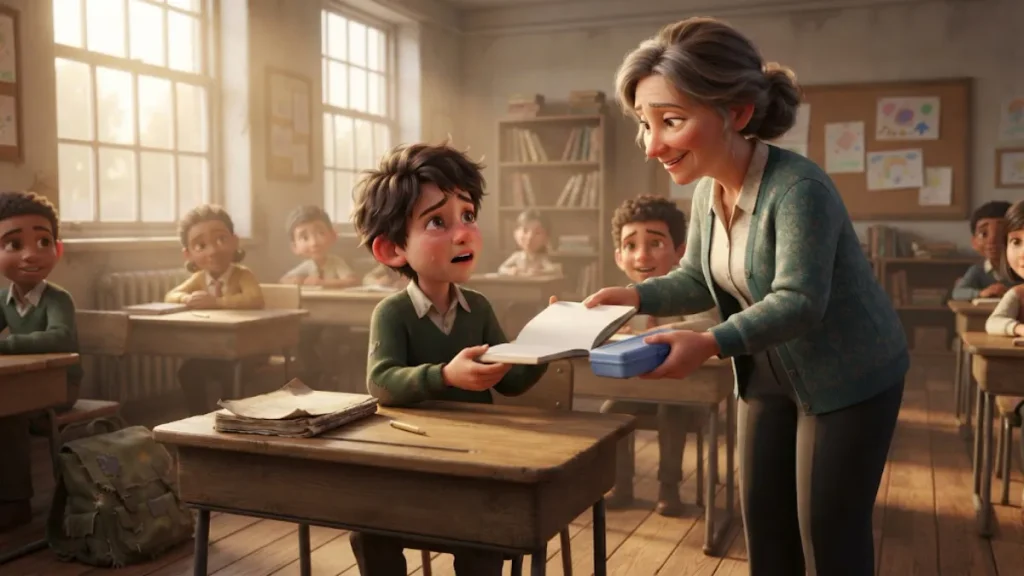
Education can open doors to a better future, but not every child has the resources needed to pursue it. For some students, even buying a notebook, a pencil, or a school uniform can become a difficult challenge.
A caring teacher understands that a student’s potential should never be measured by the things they can afford. Sometimes, a little support at the right moment can change the direction of a young person’s life.
The Boy Who Could Not Afford a Notebook is an inspirational short story about a hardworking student who refuses to give up on education despite financial difficulties. When his teacher discovers his struggle, a simple act of kindness helps him regain confidence and continue pursuing his dreams.
Every morning, children gathered outside Sunrise Public School, talking excitedly about homework, examinations, sports, and their plans for the day.
Some arrived in shiny shoes and carried colorful schoolbags filled with books and stationery. Others came with simple bags and carefully arranged notebooks.
Among them was a twelve-year-old boy named Noah.
Noah was one of the quietest students in Class Seven. He usually arrived early, sat on the second bench, and listened carefully to every lesson.
He loved learning, especially science and mathematics. He was curious about how machines worked and often spent his free time reading old magazines about inventions.
His dream was to become an engineer.
However, his family was struggling financially.
His father worked as a daily-wage laborer, and his mother earned a little money by stitching clothes for people in their neighborhood. Their combined income was barely enough to cover rent, food, electricity, and other essential expenses.
Noah understood his family’s situation.
He never demanded expensive toys, fashionable clothes, or unnecessary things. When his classmates discussed new video games or birthday celebrations, he usually listened quietly.
But there was one thing he desperately needed.
A new notebook.
His old notebook was almost full. Several pages had been torn out, and the remaining pages were covered with writing from different subjects.
He needed separate notebooks for mathematics, science, and English, but his parents could not afford to buy them that month.
Noah decided not to ask again.
He thought he could manage somehow.
The Notebook with No Empty Pages
At the beginning of the new academic term, the school asked students to bring fresh notebooks for every subject.
Most children arrived with new stationery.
Some had notebooks with colorful covers, while others carried neatly arranged sets of books.
Noah arrived with his old schoolbag.
Inside it was a single notebook that had been used throughout the previous year.
He carefully opened it and searched for empty pages.
There were only a few left.
He decided to use them wisely.
During the mathematics lesson, he wrote his calculations in the remaining space. For science, he turned the notebook upside down and began writing from the last page.
When the teacher dictated English notes, he squeezed the sentences into the narrow spaces between previous answers.
At first, nobody noticed.
Noah was careful. He wrote neatly and tried to keep his work organized.
But as the days passed, his notebook became increasingly difficult to use.
Some lessons had no space for answers. Other pages contained three different subjects.
One afternoon, his mathematics teacher, Mrs. Elizabeth Carter, asked the class to complete a set of questions.
Noah opened his notebook and looked for a blank page.
There was none.
He turned several pages, hoping to find a small empty corner, but everything was filled.
He finally wrote the answers on the back of an old worksheet.
Mrs. Carter noticed.
“Noah, why aren’t you using your mathematics notebook?”
He stood up.
“I’m sorry, ma’am. I forgot to bring it.”
“Please remember it tomorrow. Keeping your work organized is important.”
Noah nodded.
“Yes, ma’am.”
He sat down, feeling embarrassed.
He wanted to explain the truth, but the words would not come.
The Teacher Notices Something Different
Over the following week, Mrs. Carter noticed that Noah was struggling to complete written assignments.
He continued answering questions correctly when asked orally, but his notebooks were becoming increasingly disorganized.
One day, she asked him to submit his science work.
Noah hesitated before handing over his old notebook.
Mrs. Carter opened it.
She found mathematics calculations on one page, English grammar exercises on the next, and science diagrams squeezed between old homework answers.
Some pages were completely full.
Others had torn edges.
She looked at Noah.
“Is this the only notebook you are using?”
Noah lowered his eyes.
“Yes, ma’am.”
“Why haven’t you brought separate notebooks?”
He remained silent.
Mrs. Carter waited.
After a few moments, Noah quietly explained that his parents could not afford to buy new notebooks at the moment.
He added that he had planned to reuse his old ones until the family had enough money.
Mrs. Carter listened without interrupting.
“Have you told anyone else about this?”
Noah shook his head.
“No, ma’am. I don’t want my classmates to know.”
Mrs. Carter understood his embarrassment.
She gently closed the notebook.
“Thank you for telling me, Noah. You have nothing to be ashamed of. Your family’s financial situation does not make you any less deserving of an education.”
Noah looked up.
For the first time, he felt that someone understood what he was going through.
Mrs. Carter smiled.
“Don’t worry about the notebooks. We will find a solution.”
A Teacher’s Quiet Decision
That evening, Mrs. Carter thought about Noah’s situation.
She remembered how carefully he listened in class and how excited he became whenever she discussed science experiments.
He was clearly interested in learning.
Yet something as basic as stationery was becoming an obstacle.
She decided to speak with the school principal, Mr. Anderson.
She explained Noah’s circumstances and asked whether the school had any unused notebooks or educational supplies.
The principal immediately agreed to help.
The school had a small collection of extra stationery donated by parents during previous academic years.
There were notebooks, pencils, erasers, rulers, and other basic supplies.
However, Mrs. Carter wanted to do more than simply hand Noah a few notebooks.
She wanted to create a system that would help other students facing similar difficulties.
The next morning, she met with the principal again.
“What if we start a small stationery support program?” she suggested. “Students who have extra notebooks or unused school supplies could donate them. The school could make them available to children who need them.”
Mr. Anderson liked the idea.
They agreed to organize a stationery collection drive.
The initiative would be voluntary and confidential. Students who needed supplies could receive them without having to explain their circumstances to classmates.
Mrs. Carter called it the “Every Student Can Learn” Initiative.
The Gift That Meant More Than Money
A few days later, Mrs. Carter asked Noah to stay after class.
He looked worried.
“Did I do something wrong, ma’am?”
She smiled.
“No, Noah. I have something for you.”
She placed a new schoolbag on the desk.
Inside were three notebooks, a mathematics practice book, a pencil box, a ruler, and a set of colored pencils.
Noah stared at the supplies.
“Are these for me?”
“Yes. The school has arranged some stationery for students who need it. You can use these for your studies.”
Noah slowly picked up one of the notebooks.
Its pages were completely empty.
He ran his fingers across the first page.
“Thank you, ma’am,” he whispered.
Mrs. Carter smiled.
“You don’t have to thank me. Just promise me that you will continue studying and never give up on your dreams.”
Noah nodded.
“I promise.”
He packed the supplies carefully into his schoolbag.
For the first time in months, he felt excited about organizing his schoolwork.
He could finally maintain separate notebooks for each subject.
He no longer had to squeeze answers into the corners of old pages.
That evening, when he reached home, he showed the notebooks to his parents.
His mother became emotional.
“Who gave you all these, Noah?”
“My teacher and the school, Mother. They said I should use them for my studies.”
His father looked at the new schoolbag and smiled.
“We are proud of you, son. Keep working hard.”
Noah hugged them.
He knew his parents had always wanted to provide everything he needed. Their financial difficulties had never meant that they cared any less.
A School Learns to Share
The stationery initiative gradually became popular.
Several parents donated unused notebooks, pencils, schoolbags, and other supplies.
Some students brought stationery they no longer needed.
A local bookstore offered a discount on essential school materials, while a few former students contributed money to support the program.
Mrs. Carter and the principal made sure that the supplies were distributed fairly and privately.
No student was required to stand in front of the class or explain why they needed help.
The school also introduced a small collection shelf near the library.
A simple message was placed above it:
“Share What You Can. Learn Without Limits.”
Students began understanding that not everyone had the same opportunities.
One boy donated a collection of unused drawing books. A girl brought extra pencils and erasers. Another student offered a schoolbag that was still in excellent condition.
The children started helping one another naturally.
The initiative did not just provide stationery. It created a stronger sense of community.
Noah also began contributing whenever he could.
When he received a new set of colored pencils from his uncle, he donated his older but usable set to the collection shelf.
He wanted another child to experience the same happiness he had felt.
The Boy with the Big Dream
With proper notebooks and regular encouragement, Noah’s academic performance improved.
He became more organized and started completing his assignments on time.
His science teacher noticed that he had a special interest in machines.
During a classroom discussion about renewable energy, Noah explained how a small wind turbine could generate electricity.
His explanation was simple but thoughtful.
Mrs. Carter encouraged him to participate in the school’s science exhibition.
At first, Noah was nervous.
“I don’t think I can build anything impressive, ma’am.”
“You don’t need an expensive project,” she replied. “You need an idea and the willingness to work on it.”
With the help of his science teacher, Noah began building a small model of a wind-powered electricity generator.
He collected cardboard, plastic bottles, an old motor, wires, and other reusable materials.
He worked on the project after school and spent several evenings testing different designs.
His first model did not work.
The blades were too heavy, and the small motor failed to rotate properly.
Noah felt disappointed.
Mrs. Carter noticed his frustration.
“What happened?”
“It isn’t working, ma’am. I think I should start again.”
“That is exactly what engineers do. They test, learn, and improve their designs.”
Noah smiled.
He adjusted the blades, changed the connections, and tried again.
After several attempts, the small motor finally started rotating.
A tiny light connected to the circuit began glowing.
Noah stared at it with excitement.
He had built something that worked.
The Science Exhibition
On the day of the school science exhibition, students displayed their projects in the main hall.
There were working models of bridges, solar systems, water filters, and simple robots.
Noah placed his wind turbine on a table near the entrance.
His project was not the biggest or most expensive, but it demonstrated a useful idea.
When the judges arrived, he explained how wind energy could be converted into electricity.
He described the materials he had used and explained the problems he had faced while building the model.
One judge asked, “What did you learn from this project?”
Noah answered confidently.
“I learned that a failed attempt is not the end. It helps us understand what needs to change. I also learned that we don’t always need expensive materials to create something useful.”
The judges smiled.
His project received a special award for creativity and practical thinking.
When the results were announced, Noah could hardly believe it.
His parents were sitting in the audience.
His mother clapped proudly, while his father stood up and cheered.
Mrs. Carter watched from the side of the hall.
She felt proud, not simply because Noah had won an award, but because he had found the confidence to pursue his interests.
A Thank-You That Changed Everything
After the exhibition, Noah approached Mrs. Carter with a small notebook.
“Ma’am, I made something for you.”
She opened it.
On the first page, Noah had written a short message:
“Dear Mrs. Carter, thank you for giving me notebooks when I had none. You did more than give me stationery. You helped me believe that my dreams were still possible. I hope one day I can help another student the way you helped me.”
Mrs. Carter read the message slowly.
She looked at Noah and smiled.
“You have already learned the most important lesson, Noah.”
“What lesson, ma’am?”
“Never allow someone else’s difficult circumstances to make you forget your own potential. And when you become successful, remember to help others.”
Noah nodded.
Years later, he would remember those words.
He eventually earned a scholarship to study engineering. He continued working hard and developed a special interest in affordable technology for communities with limited resources.
He never forgot the old notebook that had once been his only source of space for writing.
When he became financially independent, he started supporting students who struggled to afford basic educational supplies.
He believed that every child deserved the tools needed to learn.
And whenever someone asked him why he cared so much about education, he shared the story of the teacher who had noticed an almost-empty notebook and refused to let a young student’s dream disappear.
Moral of the Story
A lack of money should never become a reason for a child to lose hope in education.
Noah’s story reminds us that every student deserves the opportunity to learn, regardless of their family’s financial situation.
Mrs. Carter understood that the boy’s lack of stationery was not a reflection of his ability or dedication. Instead of judging him, she found a practical solution and helped create a school initiative that supported other children too.
Her actions show that teachers can make a difference not only through lessons but also through compassion, awareness, and meaningful support.
A notebook may seem like a small thing, but for a child with a big dream, it can represent an important new beginning.
Life Lessons for Teachers
1. Look beyond academic performance: A student who struggles to complete assignments may lack resources rather than motivation.
2. Never judge a child’s circumstances: Financial difficulties should never become a reason to question a student’s intelligence or dedication.
3. Protect students’ dignity: Offer help privately so children can receive support without feeling embarrassed.
4. Find practical solutions: Small initiatives such as stationery collections, book banks, and school supply programs can remove barriers to education.
5. Recognize hidden potential: Students with limited resources may have extraordinary creativity, curiosity, and determination.
6. Encourage students to keep dreaming: Financial challenges may make the journey difficult, but they should not define a child’s future.
7. Teach the value of sharing: Children who receive kindness can learn to extend the same kindness to others.
What Makes a Teacher Truly Inspirational?
An inspirational teacher is not necessarily the one who knows every answer or maintains the strictest classroom. Often, the most influential educators are those who understand their students, encourage independent thinking, and create an environment where children feel safe to learn.
Here are some qualities that make teachers truly inspirational.
Patience With Every Student
Every student has a different learning speed. Some understand a concept immediately, while others need additional explanations and practice. Patient teachers recognize these differences and give students the time they need.
Belief in Students’ Potential
Students sometimes struggle to recognize their own abilities. An encouraging teacher helps them see possibilities beyond their current limitations.
Kindness and Understanding
A student’s behavior may be influenced by problems outside the classroom. Teachers who listen and respond with compassion can build stronger relationships with their students.
Leading by Example
Students learn from what teachers do, not just what they say. Honesty, discipline, respect, and responsibility become more meaningful when educators demonstrate these qualities in everyday life.
Making Learning Interesting
Great teachers connect academic concepts with practical experiences. They encourage students to ask questions, explore ideas, and develop a genuine interest in learning.
Inspirational Quotes for Teachers
Sometimes, a few meaningful words can provide encouragement to educators who feel tired, overwhelmed, or uncertain about their impact.
Here are some original inspirational quotes for teachers:
1. “A teacher may spend one hour teaching a lesson, but its influence can last a lifetime.”
2. “The greatest reward of teaching is watching a student achieve something they once thought impossible.”
3. “A classroom becomes special when every student feels that they belong.”
4. “Great teachers do not create followers. They inspire independent thinkers.”
5. “A kind word from a teacher can become a student’s lifelong source of confidence.”
6. “Teaching is planting seeds of knowledge whose flowers may bloom years later.”
7. “A successful teacher measures progress not only through marks but also through personal growth.”
8. “The best teachers make students believe that their future is bigger than their present circumstances.”
9. “Every child deserves at least one person who believes in their potential.”
10. “A teacher’s legacy lives in the confidence, character, and courage of former students.”
How Can Teachers Apply These Stories in Their Classrooms?
Inspirational stories become more valuable when their lessons are put into practice. Teachers can use these narratives as discussion starters, classroom activities, or opportunities to encourage positive behavior.
Here are a few practical ways to use them.
- Begin the day with a short story: Share a meaningful story during morning assembly or the first few minutes of class.
- Encourage classroom discussions: Ask students what they learned from a character’s decisions and actions.
- Promote kindness: Encourage students to help classmates who are struggling academically or socially.
- Celebrate improvement: Recognize effort and progress instead of focusing exclusively on examination scores.
- Connect stories with real life: Ask students how they would apply a story’s moral in their own situations.
- Create a storytelling activity: Let students write their own inspirational stories about teachers, classmates, and everyday experiences.
These activities can help create a positive classroom environment where students develop empathy, confidence, and respect for others.
Frequently Asked Questions About Inspirational Short Stories for Teachers
What are the best inspirational short stories for teachers?
Some meaningful inspirational short stories for teachers include The Teacher Who Never Gave Up, The Chalk That Changed a Life, The Empty Chair in the Classroom, and The Last Lesson of a Great Teacher. These stories highlight patience, encouragement, kindness, and the lasting influence of educators.
Why are inspirational stories important for teachers?
Inspirational stories remind teachers why their work matters. They offer encouragement during challenging periods and highlight how small actions can positively influence students’ confidence, behavior, and future opportunities.
What is the moral of inspirational stories about teachers?
The central moral is that teaching is about more than academic achievement. Great teachers help students develop confidence, responsibility, kindness, curiosity, and the courage to overcome difficulties.
How can teachers motivate students through storytelling?
Teachers can share short stories that highlight perseverance, honesty, friendship, courage, and personal growth. After reading, they can ask students questions about the characters and encourage them to connect the lessons with their own experiences.
Can these stories be used for morning assemblies?
Yes. Short inspirational stories are excellent for school morning assemblies. Teachers can select a story, read it aloud, and conclude with its moral or a brief motivational message.
What makes a teacher memorable to students?
Teachers become memorable through their kindness, patience, encouragement, fairness, and ability to understand students. Many students remember how a teacher made them feel long after they have forgotten specific classroom lessons.
How can teachers stay motivated during difficult times?
Teachers can stay motivated by remembering their positive influence, celebrating small student achievements, sharing experiences with colleagues, maintaining healthy boundaries, and focusing on the long-term purpose of education.
Conclusion: A Teacher’s Influence Lasts a Lifetime
Teaching is one of the few professions where success is often measured through the lives of others. A teacher may never know how many students will remember a particular lesson, an encouraging conversation, or a simple act of kindness.
The inspirational short stories for teachers shared in this collection remind us that meaningful teaching happens in many ways. Sometimes it is a teacher who refuses to give up on a struggling student. Sometimes it is an educator who shares lunch with a hungry child or listens patiently when someone needs support.
These moments may seem small, but they can create lasting changes.
A teacher does not need to be famous to make a difference. Every day, ordinary educators have opportunities to inspire confidence, develop character, and help students discover their potential.
The greatest lesson a teacher can leave behind is not simply what students learn from their books, but what they learn about themselves and the world through their teacher’s example.