Bedtime stories are often associated with childhood, but adults can enjoy them just as much. In fact, a short funny bedtime story can be an excellent way to end a long and stressful day. Instead of filling your mind with work, responsibilities, news, or endless scrolling, a lighthearted story gives you something simple and entertaining to enjoy before sleep.
Short Funny Bedtime Stories for Adults combine humor, relatable situations, everyday problems, and amusing characters in stories that are easy to read at night. They are usually short enough to finish in a few minutes, while still having enough personality and plot to make the reading experience satisfying.
Unlike complicated novels or intense stories, funny bedtime stories don’t require much concentration. You can read one while relaxing in bed, share one with your partner, or listen to one as part of a nightly routine.
This guide explores what makes short funny bedtime stories for adults enjoyable, why they work so well before sleep, what themes they can include, and how to choose the right stories for different moods.
What Are Short Funny Bedtime Stories for Adults?
Short funny bedtime stories for adults are brief fictional stories designed specifically for grown-up readers who want something humorous and relaxing before going to sleep.
They generally focus on ordinary situations that become unexpectedly funny.
A character may have an embarrassing experience at work.
Someone may misunderstand a simple conversation.
A couple may have a ridiculous argument over something completely unimportant.
A person may attempt to cook dinner and accidentally create something that looks nothing like the recipe.
The humor usually comes from relatable situations rather than complicated jokes.
A good bedtime story should feel effortless to read.
It should have:
- A simple plot
- Relatable characters
- Light humor
- A comfortable pace
- An entertaining ending
- A positive or amusing conclusion
- Enough detail to create a small world without becoming overwhelming
The goal isn’t necessarily to make the reader laugh loudly.
Sometimes a small smile is enough.
The best bedtime humor often leaves the reader feeling relaxed rather than overstimulated.
Short Funny Bedtime Stories for Adults
1. The Alarm Clock Negotiation
Oliver had a plan.
Not an ordinary plan, either.
It was the kind of plan that made him feel productive simply by writing it down.
On Sunday evening, he sat at his small desk, opened a fresh page in his notebook, and wrote:
MONDAY: NEW LIFE
Underneath, he carefully listed everything he intended to accomplish.
- Wake up at 6:00 a.m.
- Exercise for thirty minutes.
- Take a cold shower.
- Eat a healthy breakfast.
- Read twenty pages of a book.
- Start work by 8:00.
- Finish important tasks before lunch.
- Avoid unnecessary phone scrolling.
- Go to bed early.
Oliver leaned back in his chair and admired the list.
“This,” he said confidently, “is the beginning of a better version of me.”
His roommate, Daniel, was sitting on the sofa eating chips.
“You said that last Sunday.”
“This time is different.”
“You also said that the Sunday before last.”
Oliver frowned.
“You have no faith in me.”
“I have complete faith in you.”
Daniel paused.
“I just don’t have faith in Monday morning Oliver.”
Oliver ignored him.
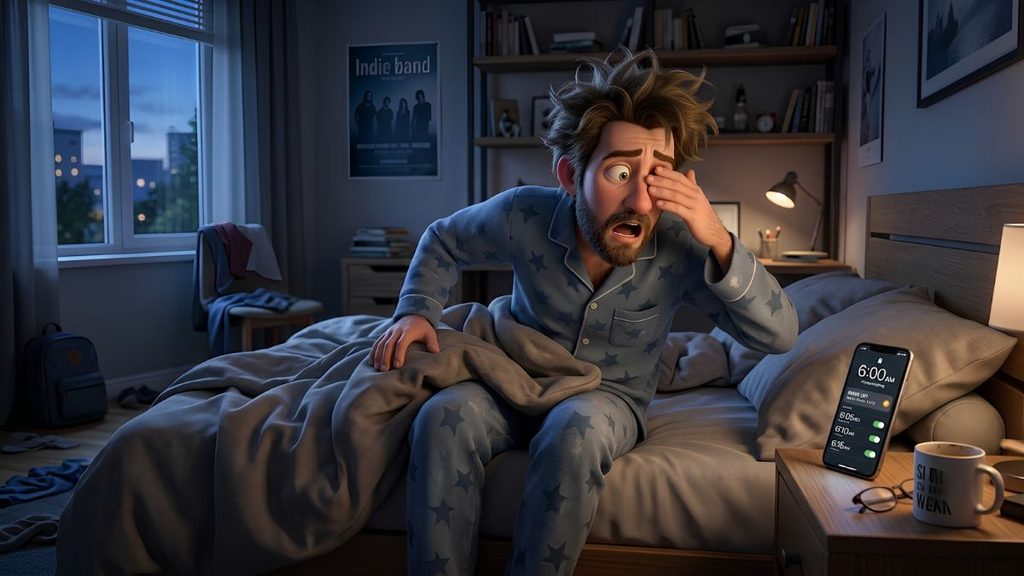
He opened the alarm app on his phone and set the first alarm for 6:00 a.m.
Then another for 6:05.
Then another for 6:10.
Then, after thinking about it, he added one for 6:15.
He looked satisfied.
“Four alarms.”
Daniel nodded.
“That’s not an alarm system. That’s a hostage negotiation.”
Oliver laughed.
“You’ll see.”
He placed his phone beside the bed and went to sleep.
At exactly 6:00 a.m., the first alarm rang.
Oliver opened one eye.
The room was dark.
His blanket was warm.
His pillow was perfect.
His brain immediately presented him with a reasonable argument.
You worked hard yesterday.
Oliver agreed.
You deserve five more minutes.
He agreed again.
Five minutes won’t change anything.
“Exactly,” Oliver whispered.
He reached for the phone.
SNOOZE.
The room became silent again.
At 6:05, the alarm rang.
Oliver opened his eyes.
This time, he was slightly more awake.
He looked at the clock.
“Okay.”
He sat up.
For approximately three seconds.
Then he remembered the weather.
It was cold outside.
He imagined getting out of bed, putting on his running shoes, walking outside, and exercising while everyone else was still asleep.
The thought exhausted him.
“Tomorrow,” he whispered.
He pressed snooze again.
At 6:10, the third alarm rang.
Oliver didn’t even open his eyes.
He reached out automatically.
His hand searched the bedside table.
Nothing.
The phone had moved.
He opened his eyes.
The phone was on the floor.
He leaned over.
His fingers couldn’t reach it.
He stretched.
Nothing.
He stretched farther.
Still nothing.
Finally, he rolled out of bed.
His feet touched the cold floor.
Oliver froze.
For one glorious moment, he was standing.
He had done it.
He was awake.
He looked at the phone.
Then at the bed.
Then back at the phone.
“That wasn’t so bad,” he said.
He picked up the phone.
The alarm stopped.
Oliver stood there for another five seconds.
Then he climbed back into bed.
“Just until 6:15.”
At 6:15, the fourth alarm rang.
Oliver stared at the ceiling.
He didn’t even bother reaching for the phone.
Instead, he pulled the blanket over his head.
“I’m awake,” he announced.
The alarm continued ringing.
Oliver shouted from underneath the blanket.
“I SAID I’M AWAKE!”
The alarm did not care.
He finally grabbed the phone and turned it off.
Silence.
Oliver smiled.
“I won.”
Then he fell asleep.
At 8:17 a.m., Oliver suddenly opened his eyes.
He stared at the clock.
His face went blank.
“Eight seventeen.”
He sat up.
“EIGHT SEVENTEEN?”
He jumped out of bed.
His peaceful Monday morning disappeared instantly.
He ran into the bathroom.
He brushed his teeth while looking for his shirt.
He found one shirt under the chair.
It was wrinkled.
He put it on anyway.
He searched for his socks.
One was under the bed.
The other was mysteriously inside the living room.
Daniel appeared in the doorway.
“Good morning.”
Oliver stared at him.
“What time is it?”
“Eight twenty.”
“Why didn’t you wake me?”
Daniel raised an eyebrow.
“You had four alarms.”
“They failed.”
“No.”
Daniel pointed toward the phone.
“You failed four alarms.”
Oliver ignored him.
“I have a meeting at nine.”
“You’re going to be late.”
“I know!”
Oliver grabbed his laptop bag and rushed toward the door.
Then stopped.
“Wait.”
Daniel looked at him.
“What?”
“My breakfast.”
“You don’t have time.”
“But I wrote it on my list.”
Daniel nodded.
“Your list also said you would exercise.”
Oliver looked down at his stomach.
“Maybe running to the office counts.”
“That depends on how far away your office is.”
“Twenty minutes.”
“Then yes.”
Oliver smiled.
“See? I’m still following the plan.”
Daniel laughed.
Oliver rushed outside.
He arrived at the office at 9:07.
His manager, Helen, was standing near the conference room.
“Oliver.”
“Yes?”
“Are you okay?”
“Absolutely.”
“You look like you fought a bear.”
Oliver straightened his shirt.
“I had a productive morning.”
Helen looked unconvinced.
“I thought you were going to start waking up early.”
“I did.”
“What time?”
“Six.”
She smiled.
“Excellent.”
Oliver hesitated.
“Well… technically, I was awake at six.”
Helen stared at him.
“Technically?”
“Yes.”
“Did you get out of bed?”
Oliver thought about it.
“No.”
She laughed.
“Then you weren’t awake. You were negotiating.”
Oliver sighed.
“That is exactly what my roommate said.”
At lunch, Oliver sat with his colleague Sophie.
She asked him about his morning.
“I failed.”
“What happened?”
“I set four alarms.”
“And?”
“I ignored all four.”
Sophie smiled.
“Why don’t you just set one?”
“One alarm isn’t enough.”
“Why?”
“Because at 6 a.m., I become a completely different person.”
Sophie laughed.
“What kind of person?”
“A lawyer.”
“A lawyer?”
“Yes.”
“What does that mean?”
Oliver picked up his sandwich.
“I negotiate with myself.”
Sophie leaned forward.
“Give me an example.”
Oliver cleared his throat.
“Alarm says: Wake up.”
“Okay.”
“I say: Why?”
Sophie laughed.
“Continue.”
“Alarm says: You need to exercise.”
“I say: I can exercise later.”
“Alarm says: You said that yesterday.”
“I say: Yesterday is irrelevant.”
Sophie was laughing now.
“Then what?”
“I say: Five more minutes.”
“And?”
“I promise that tomorrow I’ll wake up immediately.”
Sophie shook her head.
“You sound very convincing.”
“I am.”
“Unfortunately, you only have to convince yourself.”
“That is the problem.”
That evening, Oliver went home determined to solve the issue.
He decided the problem wasn’t his motivation.
It was his alarm.
The alarm was too easy to turn off.
So he searched online for solutions.
He found an app that required him to solve a mathematical problem before the alarm would stop.
Perfect.
He installed it.
The next morning, at 6:00 a.m., the phone rang.
Oliver opened his eyes.
A question appeared on the screen:
What is 17 + 26?
Oliver stared at it.
“Forty-three.”
The alarm stopped.
Oliver smiled.
“That was easy.”
He closed his eyes.
Five minutes later, the second alarm rang.
Another question appeared.
What is 84 – 37?
Oliver stared.
“Forty-seven.”
Silence.
He smiled.
“Nice try.”
He turned over.
At 6:10, another alarm rang.
This time the question was:
What is 12 × 8?
Oliver frowned.
“Ninety-six.”
The alarm stopped.
He closed his eyes.
At 6:15, the phone rang again.
The question appeared:
What is 144 ÷ 12?
Oliver stared at the screen.
“Twelve.”
The alarm stopped.
Oliver smiled.
“See?”
He placed the phone down.
Then he suddenly realized something.
He had solved four mathematics problems.
He had not exercised.
He had not meditated.
He had not taken a cold shower.
He had, however, completed enough mathematics to qualify for a very small scholarship.
He went back to sleep.
At 8:20, he woke up again.
This time, he didn’t panic.
He simply stared at the ceiling.
Then he laughed.
He picked up his phone and called Daniel.
“Good morning.”
Daniel answered sleepily.
“What happened?”
“I think I’ve discovered the truth.”
“What truth?”
“I don’t need a better alarm.”
“Okay.”
“I need better discipline.”
There was a long silence.
Daniel finally said,
“Who are you and what have you done with Oliver?”
Oliver laughed.
“I’m serious.”
“So am I.”
Oliver got dressed.
He went for a short walk.
It wasn’t thirty minutes.
It wasn’t even twenty.
It was twelve minutes.
But he went.
When he returned, he made breakfast.
Nothing complicated.
Eggs and toast.
Then he opened his notebook.
His original list was still there.
Wake up at 6:00.
He crossed it out.
Underneath, he wrote:
Wake up at a realistic time and actually get up.
He smiled.
It felt less impressive.
But somehow, it felt possible.
That evening, Oliver set only one alarm.
6:45 a.m.
Daniel noticed.
“Only one?”
“Yes.”
“Are you sure?”
“Yes.”
“What happened to the four-alarm strategy?”
“Retired.”
“And the mathematics alarm?”
“Also retired.”
Daniel nodded.
“I’m proud of you.”
Oliver climbed into bed.
“Thanks.”
He closed his eyes.
Then opened them.
“Daniel?”
“Yes?”
“If I don’t get up tomorrow, wake me.”
Daniel smiled.
“Sure.”
“What time?”
“Six forty-five.”
Oliver nodded.
“Perfect.”
The next morning, the alarm rang.
6:45.
Oliver opened his eyes.
He looked at the phone.
Then at the ceiling.
Then at the warm blanket.
For a moment, the old Oliver returned.
Five more minutes.
But he remembered his new rule.
Don’t negotiate.
He sat up.
Then he stood.
He walked to the bathroom.
He looked at himself in the mirror.
His hair was terrible.
His face looked tired.
But he was awake.
Oliver smiled.
“I won.”
From the bedroom, Daniel shouted,
“You’re finally awake?”
Oliver shouted back,
“Yes!”
Daniel replied,
“Congratulations!”
Oliver grinned.
“Thank you.”
A few seconds later, Daniel asked,
“Can you make coffee?”
Oliver paused.
“Absolutely not.”
Daniel laughed.
Oliver walked into the kitchen and started the coffee machine.
For the first time in months, he had actually won the battle with his alarm clock.
Not because the alarm had become louder.
Not because he had downloaded a smarter app.
Not because he had created a complicated morning routine.
He simply stopped arguing with himself.
Of course, Oliver still had bad mornings.
He still overslept occasionally.
He still sometimes pressed snooze.
And on particularly cold mornings, he remained deeply suspicious of the person who had invented exercise.
But from that day forward, whenever his alarm rang, he remembered one important lesson:
The alarm clock isn’t your enemy.
Sometimes, the real problem is the sleepy lawyer living inside your head.
And unfortunately for Oliver, that lawyer was extremely good at negotiating.
Moral
Sometimes we make simple things unnecessarily complicated. Instead of searching for the perfect system, app, routine, or alarm, it is often better to develop one simple habit and stick with it. Progress does not require perfection. Sometimes, getting out of bed is already a victory.
2. The Midnight Refrigerator Mystery
Emma had a complicated relationship with her refrigerator.
During the day, she barely noticed it.
She opened it in the morning to get milk for her coffee. She opened it after work to take out vegetables for dinner. Occasionally, she opened it simply because she had forgotten what she was looking for.
But at night, the refrigerator became something else.
It became a mysterious place.
A place full of possibilities.
A place that somehow convinced Emma that she was hungry even when she had eaten dinner only two hours earlier.
Her husband, Daniel, had noticed the habit.
“You don’t need to check the refrigerator every night,” he told her one evening.
Emma looked offended.
“I don’t check it every night.”
Daniel raised an eyebrow.
“You checked it last night.”
“I was looking for water.”
“The water is in the bottle on your bedside table.”
Emma paused.
“That was yesterday.”
“You checked it the night before too.”
“I thought there might be something interesting.”
“It’s a refrigerator, Emma. Not a treasure chest.”
She smiled.
“You never know.”
Daniel laughed and returned to watching television.
Emma went to bed at around 11:30 p.m.
She was tired.
Very tired.
She had spent the entire day working, answering emails, attending meetings, and pretending to understand a presentation that could have been an email.
By midnight, she was asleep.
At 1:17 a.m., her eyes suddenly opened.
She didn’t know why.
She stared at the ceiling.
The room was completely silent.
Daniel was sleeping beside her.
Emma swallowed.
She was thirsty.
She reached for the glass of water on her bedside table.
Empty.
She sighed.
“Of course.”
She slowly got out of bed.
The floor was cold.
She walked toward the kitchen.
The house was dark.
She switched on the small kitchen light.
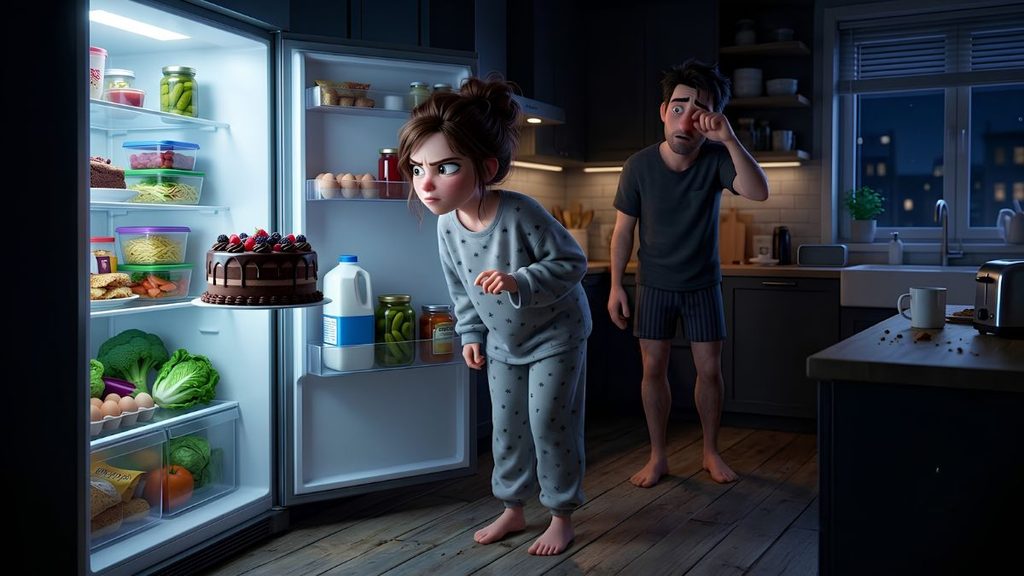
Then she opened the refrigerator.
The bright white light filled the room.
Emma stood there.
She stared inside.
There was a container of leftover pasta.
Some vegetables.
A carton of milk.
Cheese.
A bowl of grapes.
And, sitting proudly on the middle shelf, was a chocolate cake.
Emma stared at it.
The cake was covered with chocolate frosting.
There were strawberries on top.
A small piece had already been cut from one side.
Emma frowned.
She remembered the cake.
Her colleague, Sophie, had brought it home from a birthday celebration.
Emma had promised herself she would only eat one slice.
She had eaten one slice after dinner.
Then she had put the rest away.
She closed the refrigerator.
She stood there for three seconds.
Then opened it again.
The cake was still there.
Emma nodded.
“Good.”
She wasn’t sure why she had expected it to disappear.
She closed the refrigerator.
She took a sip of water.
Then she looked back at the refrigerator.
Something bothered her.
She couldn’t explain what.
Maybe it was the cake.
Maybe it was the leftover pasta.
Maybe it was the mysterious feeling that there was something inside the refrigerator that she needed.
She opened it again.
Daniel suddenly appeared behind her.
“What are you doing?”
Emma nearly screamed.
“Daniel!”
He looked at her.
“Why are you standing in the kitchen at one in the morning?”
“I wanted water.”
“You have water.”
“I drank it.”
He looked at the refrigerator.
“Then why are you staring inside?”
Emma crossed her arms.
“I don’t know.”
Daniel yawned.
“Are you hungry?”
“No.”
“Then close it.”
Emma closed the refrigerator.
Daniel started walking back toward the bedroom.
“Wait.”
He turned around.
“What?”
“Do you think there is something wrong with the cake?”
Daniel stared at her.
“The cake?”
“Yes.”
“What’s wrong with it?”
“I don’t know.”
“Is it moving?”
“No.”
“Does it smell strange?”
“No.”
“Is it making noise?”
“No.”
“Then I think the cake is innocent.”
Emma laughed.
“Very funny.”
“I try.”
He went back to bed.
Emma followed.
She climbed under the blanket.
Five minutes later, she was still awake.
She stared at the ceiling.
The cake appeared in her mind.
She imagined the chocolate frosting.
She imagined the strawberries.
She remembered how soft it had been.
Her stomach made a small noise.
Emma frowned.
“I am not hungry.”
Daniel, half asleep, murmured,
“Then why did your stomach just disagree?”
Emma turned toward him.
“Were you awake?”
“No.”
“Then how did you hear that?”
“I’m married.”
She laughed quietly.
Eventually, she fell asleep.
At 1:42 a.m., she woke up again.
She sat up.
The cake was back in her mind.
She tried to ignore it.
She turned over.
She closed her eyes.
She opened them again.
She looked at Daniel.
He was sleeping peacefully.
She looked at the clock.
1:43.
Emma whispered,
“This is ridiculous.”
She got out of bed.
She walked into the kitchen.
She opened the refrigerator.
The cake was there.
She stared at it.
“Just one bite.”
She took the cake out.
She placed it on the counter.
She picked up a fork.
Then she stopped.
“No.”
She put the fork down.
She opened the refrigerator again.
She looked at the cake’s empty space.
Then she looked at the cake on the counter.
“This is a bad decision.”
She took one tiny bite.
It was delicious.
Emma closed her eyes.
“Oh.”
She took another bite.
“Still delicious.”
Another.
“Definitely still delicious.”
Five minutes later, half the cake was gone.
Emma stared at the empty plate.
She looked around the kitchen as if someone else might be watching.
Nobody was there.
She whispered,
“How did this happen?”
From behind her came a voice.
“I was wondering the same thing.”
Emma froze.
She slowly turned around.
Daniel was standing in the doorway.
His hair was messy.
His eyes were half closed.
He looked like a confused ghost.
Emma looked at him.
Then at the cake.
Then back at him.
“This isn’t what it looks like.”
Daniel stared at the plate.
“It looks like you ate half a cake.”
Emma nodded.
“That’s what makes it complicated.”
“Complicated?”
“Yes.”
“How?”
“I only intended to eat one bite.”
Daniel looked at the plate.
“That bite seems to have had children.”
Emma burst out laughing.
“Go back to bed.”
Daniel walked toward the refrigerator.
He opened it.
He looked inside.
Then he looked at Emma.
“You left the refrigerator door open.”
Emma looked at the refrigerator.
The door was wide open.
“Oh.”
Daniel closed it.
Then he looked at the cake.
“Are you going to finish it?”
Emma shook her head.
“No.”
Daniel nodded.
“Good.”
He walked toward the bedroom.
Emma followed.
Three steps later, Daniel stopped.
“Wait.”
Emma looked at him.
“What?”
“Do we have ice cream?”
Emma stared.
“You’re joking.”
“No.”
“It’s one forty-five in the morning.”
“I know.”
“Why do you want ice cream?”
Daniel shrugged.
“You started something.”
Emma laughed.
“You are blaming me?”
“Yes.”
“For wanting cake?”
“No.”
“For making you hungry.”
Daniel thought about it.
“Exactly.”
They returned to the kitchen.
Emma opened the freezer.
There was a container of vanilla ice cream.
Daniel smiled.
“Perfect.”
Emma took it out.
They sat at the kitchen table.
Daniel grabbed two spoons.
Emma looked at him.
“Are we really eating ice cream at almost two in the morning?”
Daniel nodded.
“Apparently.”
“This is terrible for us.”
“Probably.”
“We have work tomorrow.”
“Yes.”
“We should be sleeping.”
“Definitely.”
They both took a spoonful.
Emma smiled.
“This is good.”
Daniel nodded.
“Very.”
They ate quietly for a minute.
Then Emma said,
“You know, I think nighttime makes food taste better.”
Daniel shook his head.
“No. Nighttime makes us make worse decisions.”
Emma considered that.
“That’s probably true.”
After another spoonful, she looked at him.
“Should we stop?”
Daniel nodded.
“Yes.”
They both took another spoonful.
Emma laughed.
“We’re terrible at this.”
Daniel smiled.
“Tomorrow we’ll be responsible adults.”
Emma nodded.
“Absolutely.”
They put the ice cream away.
They cleaned the kitchen.
They switched off the light.
They returned to bed.
At 2:03 a.m., Emma pulled the blanket over herself.
“Good night.”
“Good night.”
Silence.
Then Daniel whispered,
“Emma?”
“Yes?”
“Did you put the cake back in the refrigerator?”
Emma opened her eyes.
“Oh.”
They both started laughing.
Emma got out of bed again.
She walked to the kitchen.
She opened the refrigerator.
She put the cake back.
She stared at it.
For a moment, she considered taking another bite.
Then she shook her head.
“No.”
She closed the refrigerator.
As she walked back to the bedroom, she heard Daniel call out.
“What are you doing?”
“Nothing!”
“Did you eat more cake?”
“No!”
“Are you sure?”
“Yes!”
She climbed back into bed.
Daniel smiled.
“You know, I trust you.”
Emma smiled.
“Thank you.”
A few seconds later, Daniel whispered,
“But I don’t trust the refrigerator.”
Emma laughed.
Neither of them knew that the midnight refrigerator visits would become a regular part of their lives.
Sometimes it was cake.
Sometimes it was leftover pizza.
Sometimes it was cheese.
Once, at 2:30 in the morning, Emma opened the refrigerator and stared at a bowl of pasta for nearly a minute before closing the door without taking anything.
Daniel asked what she had been looking for.
“I don’t know.”
“You opened it three times.”
“I was checking.”
“Checking what?”
Emma thought about it.
“Possibilities.”
Daniel laughed.
“You need a hobby.”
“The refrigerator is my hobby.”
“That explains everything.”
Weeks later, Emma came home after a particularly exhausting day.
She had worked late.
She had missed dinner.
By 11:30 p.m., she was exhausted.
Daniel was already in bed.
Emma went into the kitchen.
She opened the refrigerator.
Inside was a small note.
She took it out.
It said:
STOP LOOKING.
Emma laughed.
She turned around.
Daniel was standing in the doorway.
“You wrote this?”
“Yes.”
“When?”
“Yesterday.”
“You knew I would open the refrigerator?”
“I know you.”
Emma looked back inside.
“What if there is something delicious?”
“There isn’t.”
She searched the shelves.
“Are you sure?”
“Yes.”
Emma found a container.
She opened it.
“Leftover pasta.”
Daniel smiled.
“You see?”
Emma closed it.
She looked at him.
“Wait.”
“What?”
“You said there wasn’t anything delicious.”
“There isn’t.”
Emma smiled.
“Then why did you eat the cake last night?”
Daniel froze.
“What cake?”
“The chocolate cake.”
Daniel looked away.
“What chocolate cake?”
Emma crossed her arms.
“The one that disappeared.”
Daniel smiled awkwardly.
“I have no idea.”
Emma laughed.
“So you’re the midnight refrigerator thief!”
Daniel pointed at her.
“You ate half of it!”
“And you ate the other half!”
They both laughed.
The truth was finally revealed.
There had never been a refrigerator mystery.
There had only been two tired adults pretending they weren’t hungry while secretly hoping the other person would suggest a midnight snack.
From that night onward, they created a new rule.
If either of them opened the refrigerator after midnight, they had to announce it.
“I’m checking the refrigerator.”
The other person could then choose one of three responses:
“Good luck.”
“Bring me something.”
Or:
“Close it and go to sleep.”
Of course, the third option was almost never used.
Because adults may have responsibilities.
They may have meetings.
They may have diets.
They may have alarms waiting for them in the morning.
But at 1:17 a.m., when a refrigerator light suddenly illuminates a dark kitchen and a piece of chocolate cake is sitting quietly on the middle shelf…
Sometimes responsibility has to wait.
Especially when the cake is innocent.
Moral
Sometimes we don’t need a complicated explanation for our strange habits. We are simply tired, hungry, curious, or looking for a little comfort after a long day. And sometimes, sharing a ridiculous midnight snack with someone you love can turn an ordinary night into a funny memory.
3. The Man Who Tried to Sleep Early
Ethan had finally admitted that he had a problem.
He was tired all the time.
Not ordinary tired.
He was the kind of tired that made him stare at the microwave while waiting for thirty seconds and wonder why thirty seconds suddenly felt like a personal attack.
He was tired during meetings.
Tired while commuting.
Tired while making coffee.
Sometimes, he was even tired while complaining about being tired.
His biggest problem was simple.
He didn’t sleep enough.
Every night, Ethan told himself that he would go to bed early.
Every night, something happened.
One night he watched a documentary.
Another night he started reading an article online and somehow ended up watching videos about people restoring old wooden furniture.
Another night he spent forty minutes looking for his phone while holding it in his hand.
But one Sunday evening, Ethan decided enough was enough.
He stood in the middle of his bedroom and made an announcement to himself.
“Tonight, I am going to bed at ten.”
His girlfriend, Chloe, was sitting on the bed scrolling through her phone.
She looked up.
“Really?”
“Yes.”
“You?”
“Yes.”
“At ten?”
“Exactly.”
Chloe smiled.
“That would be historic.”
Ethan ignored her.
“I need discipline.”
“You’ve been saying that for six months.”
“And now I’m finally serious.”
Chloe nodded.
“I believe you.”
Ethan looked suspicious.
“Why did you say that like that?”
“Like what?”
“Like you’re trying not to laugh.”
“I am not trying.”
She laughed.
Ethan checked the time.
It was 8:45 p.m.
“Perfect,” he said.
“I have plenty of time.”
He decided to prepare himself properly.
At 8:50, he brushed his teeth.
At 8:55, he washed his face.
At 9:00, he changed into his pajamas.
At 9:05, he made a cup of herbal tea.
At 9:10, he turned down the lights.
At 9:15, he put his phone on silent.
At 9:20, he checked the phone one last time.
Chloe noticed.
“You said you weren’t going to use it.”
“I’m not.”
“What are you doing?”
“Checking the weather.”
“Why?”
“So I know what the weather is tomorrow.”
“Why do you need to know that before sleeping?”
Ethan looked at her.
“Because I need to prepare.”
“For what?”
“Morning.”
Chloe smiled.
“You are making this very complicated.”
“No. I’m being organized.”
At 9:25, Ethan got into bed.
He pulled the blanket up to his shoulders.
He smiled.
“This feels good.”
Chloe turned off the lamp.
“Good night.”
“Good night.”
The room became quiet.
Ethan closed his eyes.
Ten seconds passed.
Twenty seconds.
Thirty.
He opened them.
He looked at the ceiling.
Something felt strange.
He checked the clock.
9:27.
“Too early,” he whispered.
Chloe opened one eye.
“What?”
“Nothing.”
He closed his eyes again.
A minute passed.
Then Ethan suddenly sat up.
“Did I lock the front door?”
Chloe sighed.
“I think so.”
“You think so?”
“Yes.”
“We should check.”
“You check.”
“Why me?”
“Because you’re the one who asked.”
Ethan got out of bed.
He walked downstairs.
The front door was locked.
He checked it twice.
Then he checked the back door.
Locked.
He checked the kitchen.
The lights were off.
He checked the stove.
Off.
He checked the windows.
Closed.
He returned upstairs.
“Everything is fine.”
Chloe nodded.
“Good.”
Ethan climbed back into bed.
He closed his eyes.
9:38.
He suddenly remembered something.
“My work presentation.”
“What about it?” Chloe asked.
“I need to change one slide.”
“Can you do it tomorrow?”
“Yes.”
“Then do it tomorrow.”
“But what if I forget?”
“Write it down.”
Ethan grabbed his phone.
He opened the notes app.
Chloe stared at him.
“You just said you weren’t using your phone.”
“I am only writing a note.”
“What are you writing?”
“Change slide seven.”
He saved it.
Then he noticed a notification.
He shouldn’t have opened it.
But he did.
It was a message from his friend Marcus.
Did you see the video I sent you?
Ethan clicked it.
It was a funny video.
He laughed.
Then another video appeared.
Then another.
Then another.
At 9:55, Chloe looked over.
“You’re watching videos.”
“No.”
“You are literally holding your phone.”
“I am researching.”
“Researching what?”
Ethan paused.
“Sleep.”
Chloe sat up.
“How does watching a man fall into a swimming pool help you sleep?”
“It relaxes me.”
She shook her head.
“Put the phone away.”
Ethan reluctantly put it down.
He closed his eyes.
At 10:00 p.m., he smiled.
“Perfect.”
Chloe whispered,
“Congratulations.”
“I did it.”
“You’re in bed at ten.”
“I told you.”
He felt proud.
This was the earliest he had gone to bed in months.
He closed his eyes.
At 10:03, he opened them.
He wasn’t sleepy.
At 10:07, he turned over.
Still awake.
At 10:12, he adjusted the pillow.
At 10:15, he adjusted the blanket.
At 10:18, he turned the pillow to the cool side.
At 10:20, he stared at the ceiling.
Chloe was already sleeping.
Ethan whispered,
“Of course.”
He tried breathing exercises.
“Inhale.”
He breathed in.
“Exhale.”
He breathed out.
“Inhale.”
Nothing.
“Exhale.”
Still nothing.
He tried counting.
“One.”
“Two.”
“Three.”
At seventeen, he remembered a conversation he had had with a coworker in 2018.
Why had he said that?
He hadn’t thought about it in years.
Now it was suddenly extremely important.
Ethan frowned.
“I should have answered differently.”
Chloe remained asleep.
Ethan turned over.
He tried to forget the conversation.
Instead, his brain brought up another memory.
A birthday party from ten years ago.
Then a school teacher.
Then an embarrassing haircut.
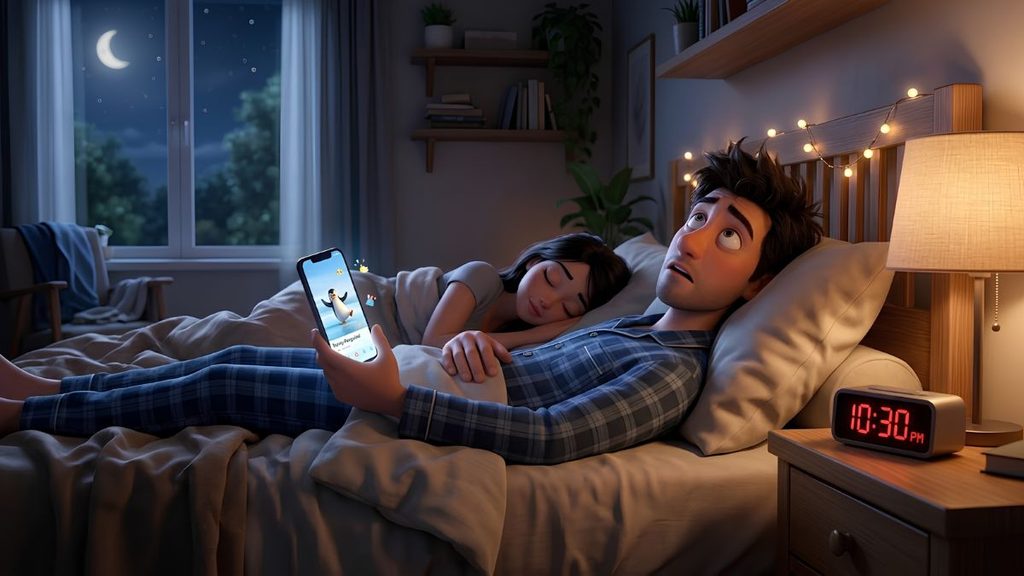
Then a question appeared in his mind:
Do penguins have knees?
Ethan opened his eyes.
“What?”
He sat up.
“Why am I thinking about penguin knees?”
He searched the internet.
Chloe woke up.
“What are you doing?”
Ethan looked at her.
“Do penguins have knees?”
She stared at him.
“It’s ten thirty at night.”
“I know.”
“Why are you asking me about penguins?”
“I don’t know.”
She pulled the blanket over her head.
“Go to sleep.”
Ethan searched.
He discovered that penguins do indeed have knees.
He read about penguin anatomy for twelve minutes.
Then he watched a video.
Then another.
Then he found a video about unusual animal facts.
At 11:15, Chloe woke up again.
“Ethan.”
“Yes?”
“Why are you watching videos?”
“Educational content.”
“At midnight?”
“Learning has no schedule.”
She grabbed the phone.
“Give me that.”
“Hey!”
She put it on her side of the bed.
“No phone.”
Ethan sighed.
“Fine.”
He closed his eyes.
At 11:30, he was still awake.
He looked at the ceiling.
“This is ridiculous.”
Chloe smiled.
“You’re trying too hard.”
“I need sleep.”
“Stop trying to sleep.”
“How?”
“Just lie down.”
“I am lying down.”
“Then relax.”
“I am relaxed.”
“You’re clenching your jaw.”
Ethan noticed.
He relaxed his jaw.
“You’re right.”
“Stop thinking about tomorrow.”
“I need to prepare for tomorrow.”
“You prepared.”
“What if I forget something?”
“You won’t.”
“How do you know?”
“Because you made a list.”
Ethan nodded.
“That is true.”
He closed his eyes.
The room was quiet.
For the first time, he stopped trying to force himself to sleep.
He simply lay there.
A few minutes passed.
Then he noticed something.
He was actually tired.
His breathing slowed.
His thoughts became less organized.
The last thing he remembered was thinking:
Maybe Chloe was right.
At 6:30 a.m., his alarm rang.
Ethan opened his eyes.
He stared at the ceiling.
He felt surprisingly rested.
He looked at Chloe.
She was still asleep.
He smiled.
“I did it.”
He got out of bed.
He walked to the bathroom.
He looked at himself in the mirror.
His hair was sticking up.
He looked terrible.
But he felt good.
He walked into the kitchen.
He made coffee.
Then he remembered his presentation.
Slide seven.
He opened his laptop.
He changed it.
Everything was ready.
When Chloe came into the kitchen, she found Ethan sitting at the table.
“You’re awake.”
“Yes.”
“At six thirty?”
“Yes.”
“Did you sleep?”
“Yes.”
She smiled.
“Without watching penguin videos?”
Ethan laughed.
“Without penguin videos.”
“I’m proud of you.”
“Thank you.”
He took a sip of coffee.
“This is going to be a great day.”
Chloe sat down.
“You know what your problem was?”
“What?”
“You kept treating sleep like a task.”
Ethan thought about it.
“That sounds accurate.”
“You can’t force yourself to fall asleep.”
He nodded.
“Apparently.”
That evening, Ethan decided not to make another complicated plan.
He didn’t set ten reminders.
He didn’t research the best sleep routine.
He didn’t buy a special pillow.
He simply turned off the lights, put his phone away, and went to bed.
At 10:15, he was asleep.
The next night, he went to bed at 10:20.
Then 10:05.
Then 10:30.
He stopped obsessing over the exact time.
And something strange happened.
He started sleeping better.
His mornings improved.
He had more energy.
He stopped drinking his third cup of coffee before lunch.
His colleagues noticed.
Marcus asked him one morning,
“You look different.”
“I’ve been sleeping.”
“Seriously?”
“Yes.”
“How?”
Ethan smiled.
“I stopped trying so hard.”
Marcus nodded.
“That’s surprisingly wise.”
“I know.”
“What changed your mind?”
Ethan looked serious.
“Penguins.”
Marcus stared at him.
“What?”
“Never mind.”
Weeks later, Ethan was sitting with Chloe on the sofa.
She asked,
“Do you remember when you said you were going to start sleeping early?”
“Yes.”
“You were in bed at ten.”
“Yes.”
“And you stayed awake until midnight.”
“Yes.”
“You watched penguin videos.”
“Yes.”
“You researched penguin knees.”
Ethan smiled.
“They were interesting.”
Chloe laughed.
“You are impossible.”
Ethan leaned back.
“Maybe.”
She rested her head against his shoulder.
“But at least you sleep now.”
He smiled.
“That is true.”
The funny thing was that Ethan had spent months searching for the perfect solution.
He had tried alarms.
Apps.
Tea.
Breathing exercises.
Videos.
Lists.
Schedules.
And complicated routines.
In the end, the answer was surprisingly simple.
He needed to stop treating bedtime like another assignment he had to complete perfectly.
Sometimes, the harder you try to force sleep, the more awake you become.
And sometimes, the best thing you can do is turn off the light, put the phone away, stop checking the clock, and let your tired brain finally do its job.
Of course, Ethan still had occasional sleepless nights.
One night, he woke up at 2:00 a.m.
He stared at the ceiling.
He remembered his old habit.
He almost reached for his phone.
Then he stopped.
He smiled.
“No.”
He closed his eyes.
A thought appeared in his mind.
Do penguins dream?
Ethan opened one eye.
He sighed.
“Not tonight.”
He turned over.
And within minutes, he was asleep.
Moral
Sleep cannot always be forced. The more we obsess over falling asleep, the harder it can become. Sometimes, the best approach is to create a calm routine, put away distractions, stop watching the clock, and simply allow yourself to rest.
4. The Very Serious Pillow Problem

James believed in many important things.
He believed people should be honest.
He believed coffee was an essential part of civilization.
He believed weekends were too short.
And, most importantly, he believed that a good pillow could determine the quality of an entire night’s sleep.
His wife, Sophie, thought this was ridiculous.
“It is a pillow,” she reminded him.
James disagreed.
“No. It is not just a pillow.”
Sophie looked at him.
“What is it, then?”
James carefully lifted the pillow from the bed.
“This is the Royal Pillow.”
Sophie laughed.
“The Royal Pillow?”
“Yes.”
“Why?”
“Because it is perfect.”
She examined it.
It looked completely ordinary.
White cotton cover.
Medium size.
Slightly flattened in the middle.
Nothing special.
James, however, had spent years searching for it.
Before meeting Sophie, he had owned at least twelve different pillows.
One was too hard.
One was too soft.
One made his neck hurt.
One was apparently designed for people who enjoyed sleeping on concrete.
Another had been advertised as “cloud-like.”
James had tried it for three nights.
“It feels like sleeping on a bag of rocks,” he had complained.
Then, one weekend, he found the perfect pillow.
It was soft but supportive.
Cool but not cold.
Firm but not hard.
It somehow seemed to know exactly how his head wanted to rest.
James loved it.
He even gave it a name.
The Royal Pillow.
Sophie thought he was being dramatic.
“You know pillows don’t have personalities.”
James placed the pillow carefully on his side of the bed.
“This one does.”
“How?”
“It understands me.”
Sophie laughed.
“You have conversations with it?”
“No.”
“Then how does it understand you?”
“Through comfort.”
“That makes absolutely no sense.”
“It doesn’t have to.”
Every night, James placed the Royal Pillow at exactly the right angle.
He never folded it too much.
He never crushed it.
He never threw it across the room.
He treated it with the respect normally reserved for expensive electronics.
Sophie occasionally teased him.
“You’re more careful with that pillow than you are with me.”
James smiled.
“That’s because you move around.”
“I move around?”
“Yes.”
“I’m sleeping.”
“Exactly.”
One Friday evening, James came home from work exhausted.
He had spent the day in meetings.
He had answered dozens of emails.
He had eaten lunch at his desk.
By 10:30 p.m., he was ready for bed.
He showered, brushed his teeth, and walked into the bedroom.
Then he stopped.
Something was wrong.
The Royal Pillow was missing.
James looked at the bed.
He looked under the blanket.
He looked on the floor.
Nothing.
“Sophie?”
No answer.
He walked into the living room.
Sophie was sitting on the sofa reading a book.
“Have you seen my pillow?”
She looked up.
“Your pillow?”
“Yes.”
“The Royal Pillow?”
James nodded seriously.
“Yes.”
Sophie smiled.
“I borrowed it.”
James stared at her.
“You what?”
“I needed another pillow.”
“You took my pillow?”
“I was watching television.”
“You have three pillows.”
“They weren’t comfortable.”
James stood there in silence.
Sophie looked at him.
“What?”
“You knew what that pillow meant to me.”
She laughed.
“James, it’s a pillow.”
“It is not.”
She pointed toward the bedroom.
“It’s literally a pillow.”
James sighed.
“Please give it back.”
Sophie held it tighter.
“I’m using it.”
“For how long?”
“Until I finish reading.”
James looked at the clock.
“You’ve been reading for an hour.”
“Yes.”
“And how much longer?”
“I don’t know.”
James considered his options.
He could wait.
He could take another pillow.
Or he could negotiate.
He chose negotiation.
“How about this?”
Sophie raised an eyebrow.
“What?”
“I’ll make you tea.”
“No.”
“Hot chocolate?”
“No.”
“I’ll give you my side of the blanket.”
She looked interested.
“For how long?”
“Tonight.”
Sophie smiled.
“Tempting.”
James nodded.
“Then we have a deal?”
“No.”
He sighed.
“What do you want?”
“I want the pillow.”
“You already have the pillow.”
“I want it permanently.”
James looked horrified.
“You can’t own the Royal Pillow.”
“Why not?”
“Because it is mine.”
Sophie laughed.
“Fine.”
She handed it back.
James took it carefully.
He returned to the bedroom.
He placed the pillow on the bed.
Then he paused.
He inspected it.
“Sophie?”
“Yes?”
“Did you fold it?”
“Maybe.”
James shook his head.
“Don’t do that.”
She laughed.
“You are unbelievable.”
He went to bed.
Within minutes, he was asleep.
At around 2:00 a.m., Sophie woke up.
She was uncomfortable.
Her pillow had somehow fallen onto the floor.
She reached for it.
Nothing.
She looked at James.
He was sleeping peacefully.
His head rested perfectly on the Royal Pillow.
Sophie stared at him.
Then at her pillow.
Then back at James.
She quietly pulled the Royal Pillow from under his head.
James immediately woke up.
“What are you doing?”
Sophie froze.
“I need it.”
James sat up.
“No.”
“James.”
“No.”
“I’m uncomfortable.”
“So am I.”
“You’re sleeping.”
“I was.”
She stared at him.
“Give me the pillow.”
James held it protectively.
“You have your own.”
“Mine fell.”
“Pick it up.”
“I don’t want that one.”
“Why?”
“Because yours is better.”
James smiled.
“Exactly.”
Sophie frowned.
“You’re enjoying this.”
“A little.”
She grabbed the pillow.
James grabbed it too.
For several seconds, they silently pulled at opposite ends.
“This is ridiculous,” Sophie said.
“I agree.”
“Then let go.”
“You let go.”
“No.”
“Then we’re stuck.”
They stared at each other.
Finally, Sophie laughed.
James laughed too.
They both released the pillow.
It flew into the air.
Then landed directly on the floor.
They stared at it.
Sophie sighed.
“Now look what you’ve done.”
James pointed.
“You started it.”
“You were protecting a pillow.”
“You were stealing it.”
They both laughed again.
Sophie picked it up.
“Fine.”
She placed it between them.
“Shared custody.”
James nodded.
“Temporary.”
She smiled.
“Of course.”
They went back to sleep.
The next morning, James woke up with the Royal Pillow under his head.
He smiled.
Then he noticed something.
Sophie was using it too.
Her head was resting on one corner.
James stared.
“Sophie.”
She opened her eyes.
“What?”
“You’re using my pillow.”
She smiled sleepily.
“Our pillow.”
James considered correcting her.
Then he stopped.
“Fine.”
She smiled.
“Good.”
For the next few weeks, the Royal Pillow became a source of endless arguments.
Sophie would take it.
James would retrieve it.
James would put it on his side.
Sophie would move it back.
Sometimes they would both fall asleep with their heads on opposite ends of it.
Once, James woke up at 3 a.m. and discovered Sophie had somehow wrapped herself around the pillow like a giant sleeping cat.
He stared at her.
Then he whispered,
“You don’t deserve it.”
She didn’t respond.
She was asleep.
James carefully pulled another pillow from the closet.
He went back to bed.
The next morning, Sophie found him sleeping on the sofa.
“What happened?”
James looked exhausted.
“You stole the Royal Pillow.”
She laughed.
“I didn’t steal it.”
“You had it.”
“I was sleeping.”
“With my pillow.”
She smiled.
“Our pillow.”
James sighed.
“I need coffee.”
One afternoon, Sophie came home with a surprise.
She placed a large box on the bed.
James looked at it.
“What is that?”
“Open it.”
He opened the box.
Inside was a brand-new pillow.
James looked confused.
“What is this?”
“Your new Royal Pillow.”
He picked it up.
It was soft.
Very soft.
He squeezed it.
“This is nice.”
“I know.”
He looked at Sophie.
“Why did you buy me another one?”
“So we can stop fighting.”
James smiled.
“You bought yourself one too?”
Sophie pointed to another box.
“Yes.”
James opened it.
Inside was an identical pillow.
He looked at her.
“You bought two?”
“Yes.”
He smiled.
“This is the greatest day of my life.”
Sophie laughed.
“You are ridiculous.”
That night, they put the new pillows on the bed.
James carefully positioned his.
Sophie positioned hers.
They both lay down.
“This is wonderful,” James said.
Sophie smiled.
“No fighting.”
“No stealing.”
“No negotiations.”
“Exactly.”
They turned off the light.
Five minutes later, Sophie whispered,
“James?”
“Yes?”
“Can I try yours?”
James opened his eyes.
“What?”
“Just for a minute.”
He stared at her.
“You have your own.”
“I know.”
“Then why?”
“I want to see if yours is better.”
James sighed.
“You’re impossible.”
She smiled.
“Please?”
James handed it over.
Sophie placed it under her head.
She closed her eyes.
“This is better.”
James laughed.
“Of course it is.”
He took her pillow.
“This one is terrible.”
“You’re using it now.”
“I know.”
They both laughed.
Eventually, they discovered the truth.
The pillows weren’t actually that different.
The reason the Royal Pillow seemed so special was simply because each of them believed the other’s pillow was better.
It became a running joke in their home.
If James couldn’t sleep, Sophie would say,
“Maybe you need my pillow.”
If Sophie complained about her neck, James would say,
“Try mine.”
And if either of them woke up in the middle of the night, the first question was always the same:
“Who has the good pillow?”
One Saturday morning, they were having breakfast when Sophie suddenly said,
“You know what?”
“What?”
“We spent years arguing about pillows.”
James nodded.
“Yes.”
“We could have just bought two.”
“Yes.”
“So why didn’t we?”
James thought about it.
“Because we’re idiots.”
Sophie laughed.
“Fair.”
James took a sip of coffee.
Then he smiled.
“But I think the arguments were worth it.”
“Why?”
“Because now we have a story.”
Sophie smiled.
“That is true.”
That evening, James carefully placed his pillow on the bed.
Sophie placed hers beside it.
He looked at them.
“They look happy.”
Sophie laughed.
“Don’t start talking to the pillows again.”
James smiled.
“I wasn’t.”
He climbed into bed.
Then he whispered,
“Good night.”
Sophie looked at him.
“Were you talking to me or the pillow?”
James grinned.
“Yes.”
They both laughed.
And finally, they fell asleep.
Side by side.
Each with their own pillow.
At least until one of them stole the other person’s during the night.
Moral
Sometimes the things we argue about are not really important. A pillow may seem silly, but small disagreements can become funny memories when handled with patience and humor. In a relationship, learning to laugh together is often more valuable than winning an argument.
5. The Diet That Started Tomorrow
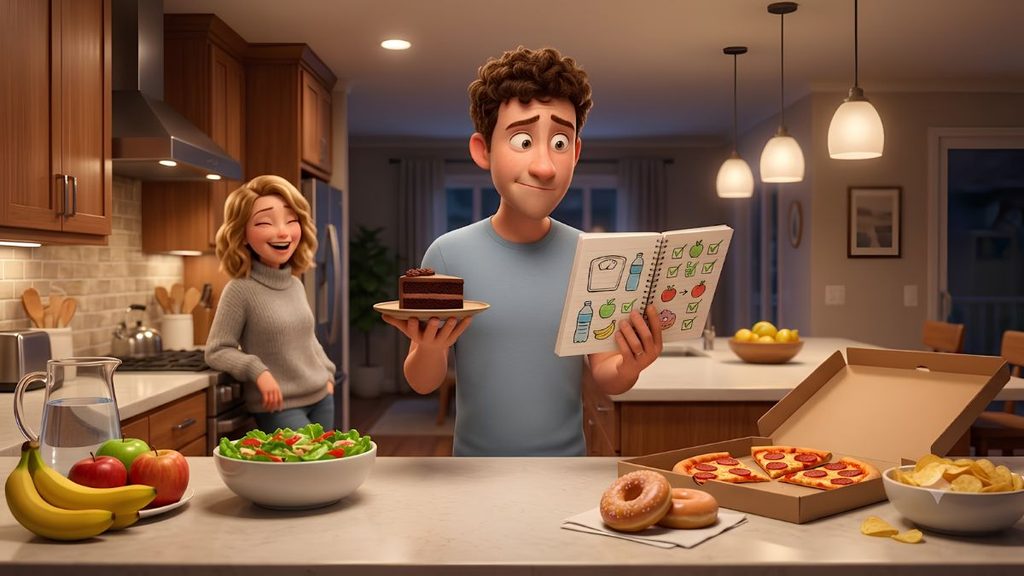
Nathan had made a decision.
A serious decision.
A life-changing decision.
He was going to lose weight.
He had been thinking about it for months, but this time was different.
This time, he had a plan.
It started on Monday.
Of course, there had been other Mondays.
There had been the Monday in January.
The Monday after his birthday.
The Monday after a holiday.
The Monday after he had eaten an unreasonable amount of pizza.
But this Monday was special.
Nathan stood in front of the bathroom mirror on Sunday evening and looked at himself seriously.
“Tomorrow,” he said, “everything changes.”
His girlfriend, Emily, was brushing her hair nearby.
She looked at him through the mirror.
“Tomorrow?”
“Yes.”
“You said that yesterday.”
“I wasn’t ready yesterday.”
“You said it last week too.”
“I wasn’t ready last week either.”
Emily smiled.
“When will you be ready?”
Nathan thought carefully.
“Tomorrow.”
She laughed.
“That seems to be your favorite day.”
Nathan ignored her.
He walked to the kitchen and opened a notebook.
At the top of the first page, he wrote:
NEW ME
Then he made a list.
No sugar.
No fried food.
No pizza.
No burgers.
No late-night snacks.
Thirty minutes of exercise every day.
Two liters of water.
Eight hours of sleep.
He looked at the list proudly.
Emily came into the kitchen.
“That’s ambitious.”
“I need discipline.”
“You also need to finish that chocolate cake.”
Nathan looked toward the cake sitting on the counter.
It was chocolate.
It was covered in frosting.
It had strawberries on top.
Nathan stared at it.
Emily smiled.
“Go ahead.”
“No.”
“Why?”
“Because tomorrow I’m starting my diet.”
“So?”
“So I can’t eat cake tomorrow.”
Emily nodded.
“Then eat it tonight.”
Nathan considered this.
“That makes sense.”
Emily laughed.
“That was not what I meant.”
Nathan cut himself a slice.
“One last piece.”
He ate it.
Then another.
Then he looked at the remaining cake.
“It’s probably better if I finish it.”
Emily stared at him.
“Why?”
“So it isn’t here tomorrow.”
“That is not how dieting works.”
“It makes sense in my head.”
By 10:30 p.m., the cake was gone.
Nathan went to bed feeling slightly guilty.
But also strangely satisfied.
“This is good,” he thought.
“Tomorrow will be easy.”
Monday morning arrived.
Nathan woke up at 6:30.
He immediately remembered his diet.
“No sugar.”
He walked into the kitchen.
Emily was making breakfast.
“What do you want?”
“Something healthy.”
She pointed toward a bowl.
“Fruit.”
Nathan nodded.
“Perfect.”
He ate an apple.
Then a banana.
Then some berries.
He felt proud.
“This is easy.”
Emily smiled.
“You’re doing well.”
Nathan took a sip of water.
“I feel different already.”
“You’ve been awake for fifteen minutes.”
“I know.”
He smiled.
“Still.”
At 10:30, Nathan was at work.
His colleague, Michael, walked into the office carrying a box.
“What is that?”
“Donuts.”
Nathan froze.
Michael opened the box.
There were six donuts.
Chocolate.
Vanilla.
Strawberry.
Cinnamon.
One had caramel on top.
Nathan stared.
Michael noticed.
“You want one?”
“No.”
“You sure?”
“Yes.”
Michael took a chocolate donut.
Nathan watched him take a bite.
He swallowed.
“Good?”
Michael nodded.
“Very.”
Nathan looked back at his computer.
“I don’t care.”
Michael smiled.
“Okay.”
Five minutes passed.
Nathan looked at the box again.
Michael had eaten another donut.
Nathan sighed.
“What?”
Michael looked up.
“Nothing.”
“You’re looking at the donuts.”
“I am not.”
“You are.”
Nathan pointed at his computer.
“I am working.”
Michael laughed.
“Fine.”
Nathan lasted another seven minutes.
Then he stood up.
“Okay.”
Michael smiled.
“What?”
“I’ll have half.”
“Half?”
“Yes.”
Michael handed him one.
Nathan took a bite.
Then another.
Then another.
Two minutes later, the donut was gone.
Nathan looked at the empty box.
“What happened?”
Michael laughed.
“You ate it.”
“I know.”
“I thought you were only having half.”
“I was.”
“What happened?”
Nathan sighed.
“The other half was lonely.”
Michael laughed so loudly that two people from the next office looked in.
Nathan returned to his desk.
“This is fine,” he told himself.
“One donut doesn’t ruin a diet.”
At lunch, he ordered grilled chicken and salad.
He felt proud again.
Then his friend Sophie walked into the restaurant.
“What are you eating?”
“Healthy food.”
She looked at his plate.
“That’s impressive.”
Nathan smiled.
“I’ve started a diet.”
“Really?”
“Yes.”
“How long?”
“Since this morning.”
Sophie laughed.
“That’s great.”
Nathan nodded.
“I am serious this time.”
She looked at him.
“Good.”
Then the waiter walked past carrying a large plate of fries.
Nathan’s eyes followed the fries.
Sophie noticed.
“No.”
Nathan looked at her.
“I didn’t say anything.”
“You were thinking about fries.”
“I was not.”
“You were.”
Nathan sighed.
“Maybe a little.”
Sophie smiled.
“You can do it.”
Nathan took another bite of salad.
“Yes.”
He finished lunch.
No fries.
No dessert.
He felt victorious.
After work, he went home.
He changed into sports clothes.
Emily looked surprised.
“Where are you going?”
“Exercise.”
She smiled.
“Really?”
“Yes.”
Nathan put on his shoes.
“I am going for a run.”
He went outside.
He ran for five minutes.
Then he walked for ten.
Then he sat on a bench.
He looked at his watch.
“Thirty minutes.”
He stood up.
He walked home.
Emily was waiting.
“How was the run?”
“Fantastic.”
“How far did you run?”
Nathan paused.
“That’s not important.”
She laughed.
“You walked, didn’t you?”
“For most of it.”
“That’s still exercise.”
Nathan smiled.
“Exactly.”
Dinner was healthy.
Chicken.
Vegetables.
Brown rice.
Nathan ate slowly.
He felt proud.
“This diet is working.”
At 9:30 p.m., he was watching television.
Emily brought out a bowl of popcorn.
Nathan looked at it.
“No.”
Emily raised an eyebrow.
“No?”
“No snacks.”
“You’re sure?”
“Yes.”
She started eating.
Nathan tried to ignore her.
Five minutes later, he asked,
“Is that butter?”
“Yes.”
“Real butter?”
“Yes.”
Nathan swallowed.
“That smells good.”
Emily smiled.
“You can have some.”
“No.”
“You’re strong.”
“Yes.”
Another five minutes passed.
Nathan took one piece.
“Just one.”
Then another.
Then another.
Emily watched him.
“You know, you don’t have to pretend.”
“I’m not pretending.”
“You’re eating popcorn.”
“I know.”
“You said no snacks.”
“This is different.”
“How?”
“It’s air-popped.”
Emily looked at the bowl.
“It has butter.”
Nathan nodded.
“Air-popped with butter.”
She laughed.
By 10:15, the bowl was empty.
Nathan looked at it.
“I don’t understand.”
Emily smiled.
“Neither do I.”
Nathan went to bed.
Tuesday morning arrived.
He stepped onto the weighing scale.
He looked down.
The number was almost exactly the same as the previous morning.
Nathan frowned.
“What?”
Emily walked into the bathroom.
“What happened?”
“I didn’t lose any weight.”
“You’ve been dieting for one day.”
“One whole day.”
“Yes.”
“I expected results.”
Emily laughed.
“You need time.”
Nathan sighed.
“Fine.”
He stepped off the scale.
At breakfast, he ate eggs and toast.
At work, he avoided donuts.
At lunch, he ate salad.
In the evening, he exercised for twenty minutes.
He was doing better.
But then Wednesday arrived.
His boss brought pizza into the office.
“Everyone, help yourselves.”
Nathan stared at the boxes.
He had promised himself he wouldn’t eat pizza.
He walked away.
Five minutes later, he returned.
He opened a box.
He took one slice.
He looked at it.
“This is a mistake.”
He took a bite.
His eyes closed.
“This is a delicious mistake.”
He ate another slice.
Then another.
Michael walked over.
“Diet?”
Nathan nodded.
“Yes.”
Michael looked at the pizza.
“Interesting.”
Nathan shrugged.
“I’m allowed one cheat meal.”
“How often?”
“Once a week.”
“What day?”
Nathan thought.
“Wednesday.”
“But it’s Wednesday.”
“Exactly.”
Michael laughed.
“You changed the plan?”
“I adjusted it.”
By Friday, Nathan had developed a new philosophy.
He no longer called it a diet.
He called it “balanced living.”
Emily asked him what that meant.
“It means I can eat whatever I want as long as I also eat something healthy.”
She looked confused.
“For example?”
Nathan pointed at his plate.
“Pizza and salad.”
“That doesn’t make the pizza healthy.”
“No.”
“But the salad?”
“Very healthy.”
“So you’re balancing unhealthy food with healthy food?”
“Exactly.”
Emily laughed.
“You’re impossible.”
Saturday morning, Nathan went shopping.
He bought vegetables.
Fruit.
Whole-grain bread.
Chicken.
And three large bags of potato chips.
Emily looked at the cart.
“Why the chips?”
“For emergencies.”
“What kind of emergency requires potato chips?”
“Any emergency.”
“Like?”
Nathan thought.
“Football.”
“That’s not an emergency.”
“Rain.”
“No.”
“Boredom.”
Emily laughed.
“You need help.”
That evening, Nathan watched a movie.
He opened a bag of chips.
He ate a few.
Then a few more.
Then he realized he had eaten almost the entire bag.
He looked at Emily.
“I wasn’t hungry.”
“Then why did you eat them?”
“I don’t know.”
She smiled.
“Maybe you’re eating because you’re bored.”
Nathan nodded.
“That makes sense.”
He stood up.
“I’m going for a walk.”
“Good.”
He went outside.
He walked for twenty minutes.
When he returned, he felt better.
Not because he had burned many calories.
But because he had actually done something instead of sitting around thinking about food.
Sunday morning, Nathan opened his notebook.
The words NEW ME were still at the top.
He looked at his list.
Most of the items had failed.
He hadn’t completely eliminated sugar.
He had eaten pizza.
He had eaten donuts.
He had eaten cake.
He had eaten chips.
His exercise routine wasn’t exactly athletic.
But something had changed.
He had started paying attention.
He noticed when he ate because he was hungry.
He noticed when he ate because he was bored.
He noticed when he ate because someone else was eating.
He also noticed that he didn’t have to be perfect.
So he turned to a fresh page.
At the top, he wrote:
REALISTIC PLAN
Then he wrote:
Eat better most of the time.
Exercise regularly.
Don’t starve myself.
Don’t treat one bad meal like a disaster.
Stop saying I’ll start tomorrow.
He looked at the last line.
He smiled.
Emily walked into the kitchen.
“What are you doing?”
“Making a new plan.”
“Another diet?”
“No.”
“What then?”
“A realistic one.”
She smiled.
“That’s better.”
Nathan nodded.
“I don’t need to become a completely different person.”
“Good.”
“I just need to make better choices more often.”
“Exactly.”
He closed the notebook.
Then he opened the refrigerator.
Inside was the leftover cake.
Nathan stared at it.
Emily saw him.
“No.”
Nathan laughed.
“I wasn’t going to eat it.”
“You were thinking about it.”
“Maybe.”
He closed the refrigerator.
Then he opened it again.
Emily laughed.
“What are you doing?”
Nathan took out the cake.
“One small piece.”
She smiled.
“Of course.”
He cut himself a small slice.
He sat at the table.
He ate it slowly.
Then he put the rest away.
No guilt.
No dramatic promises.
No declaration that Monday would transform his entire life.
Just cake.
A small piece of cake.
And a little more common sense.
Over the next few months, Nathan slowly changed his habits.
He started walking every day.
He cooked more meals at home.
He kept healthier snacks around.
He still ate pizza.
He still enjoyed burgers.
He still had dessert.
But food stopped being a battle.
He stopped labeling everything as “good” or “bad.”
He stopped punishing himself after eating something unhealthy.
And, most importantly, he stopped saying:
“I’ll start tomorrow.”
One evening, Emily asked him,
“So, are you still on a diet?”
Nathan thought for a moment.
“No.”
“Then what are you doing?”
“I’m taking care of myself.”
She smiled.
“That sounds much better.”
Nathan nodded.
“It is.”
He paused.
“But I still believe potato chips are an emergency food.”
Emily laughed.
“Of course you do.”
He smiled.
“Some principles are important.”
And that was the end of Nathan’s greatest diet.
Not because he became perfect.
Not because he stopped eating everything he enjoyed.
But because he finally realized that changing your habits doesn’t have to mean declaring war on yourself.
Sometimes, the healthiest approach is simply to make better choices most of the time, enjoy your food without guilt, move your body regularly, and stop waiting for some magical Monday when you suddenly become a completely different person.
Because tomorrow is always coming.
But so is today.
And sometimes, today deserves a small piece of cake.
Moral
Real change does not require perfection. Small, consistent improvements are usually more sustainable than extreme rules that make everyday life miserable. Enjoying an occasional treat does not ruin your progress. What matters is what you do consistently over time.
6. The Sleepy Couple

Lucas and Olivia were exhausted.
Not mildly tired.
Not “I could use a cup of coffee” tired.
They were the kind of tired where putting something in the refrigerator instead of the cupboard seemed perfectly reasonable.
It had been a long week.
Lucas had spent five days dealing with deadlines, meetings, emails, traffic, and a printer that apparently had a personal grudge against him.
Olivia had spent her week doing almost the same thing, except she also had to deal with a manager who believed that every email deserved an immediate response, including emails sent at 11:58 p.m.
By Friday evening, both of them were finished.
They ordered dinner.
They watched television.
They barely spoke.
At 10:15 p.m., Olivia looked at Lucas.
“I am going to bed.”
Lucas nodded.
“Me too.”
She stood up.
Then sat back down.
“What?”
Lucas looked at her.
“I don’t have the energy to walk upstairs.”
Olivia laughed.
“It’s one staircase.”
“I know.”
They stared at the stairs.
The stairs seemed unusually long.
Lucas sighed.
“Okay.”
They stood together.
They walked upstairs slowly.
At the bedroom door, Olivia stopped.
“Did we lock the front door?”
Lucas looked at her.
“I don’t know.”
She sighed.
“We need to check.”
Lucas nodded.
They went downstairs.
The front door was locked.
Olivia checked it.
Then checked it again.
Lucas watched her.
“You checked twice.”
“I know.”
“Why?”
“I don’t know.”
They walked upstairs again.
At the top of the stairs, Lucas stopped.
“Did we turn off the kitchen light?”
Olivia looked at him.
“I don’t know.”
They both stared at each other.
Then they walked back downstairs.
The kitchen light was off.
Lucas laughed.
“We are losing our minds.”
Olivia smiled.
“We’re just tired.”
They went upstairs for the third time.
This time, they reached the bedroom.
Lucas climbed into bed.
Olivia climbed in beside him.
They pulled the blanket over themselves.
“Good night,” Olivia said.
“Good night.”
The room became quiet.
For approximately forty seconds.
Then Olivia whispered,
“Lucas?”
“Yes?”
“Did you lock the back door?”
Lucas stared at the ceiling.
“I’m not checking.”
“Why?”
“Because we checked it earlier.”
“Did we?”
“I think so.”
“You think so?”
“Yes.”
Olivia sighed.
“I don’t remember.”
Lucas pulled the blanket over his face.
“We are staying here.”
Olivia laughed.
“Fine.”
They lay quietly.
A minute later, Lucas said,
“Olivia?”
“What?”
“Did you turn off the bathroom light?”
Olivia slowly turned toward him.
“You’re closer.”
Lucas sighed.
“Okay.”
He got out of bed.
He walked to the bathroom.
The light was off.
He returned.
“Off.”
“Good.”
He climbed back into bed.
They closed their eyes.
Five minutes passed.
Olivia whispered,
“Lucas?”
He didn’t answer.
“Lucas?”
Silence.
She poked him.
“What?”
“Are you asleep?”
“No.”
“You answered very quickly.”
“I was pretending.”
She laughed.
“I’m thirsty.”
“There’s water.”
“Where?”
“On your bedside table.”
She reached for it.
The bottle was empty.
“Oh.”
Lucas sighed.
“Of course.”
“Can you get me some?”
“You’re closer to the kitchen.”
“You’re closer to the door.”
“That isn’t how distance works.”
She laughed.
“Please?”
Lucas got up.
He went downstairs.
He filled two glasses.
He returned.
Olivia took hers.
“Thank you.”
Lucas drank his.
They both lay down.
Silence.
Then Lucas whispered,
“This is nice.”
“What?”
“Being in bed.”
Olivia smiled.
“Yes.”
“I think we should never leave.”
“Agreed.”
Five minutes later, Lucas said,
“Do we have work tomorrow?”
Olivia opened her eyes.
“Yes.”
“What time?”
“Nine.”
Lucas sighed.
“That’s unfortunate.”
Olivia laughed.
“We’ll survive.”
Lucas closed his eyes.
“I don’t want to.”
“You have to.”
“Why?”
“Because bills.”
He sighed.
“Bills are very motivating.”
Eventually, they both fell asleep.
At 2:17 a.m., Olivia woke up.
She looked at the clock.
She needed to use the bathroom.
She slowly got out of bed.
Lucas woke up.
“What are you doing?”
“Bathroom.”
“Oh.”
She walked away.
Then returned a few seconds later.
“Lucas?”
“What?”
“Do you want anything?”
“No.”
“Are you sure?”
“Yes.”
She went to the bathroom.
When she returned, Lucas was sitting up.
“What?”
“Nothing.”
“You’re awake.”
“Yes.”
“Why?”
“I heard something.”
Olivia looked around.
“What?”
“I don’t know.”
They both listened.
Nothing.
Lucas looked nervous.
“Maybe it was the wind.”
Olivia nodded.
“Probably.”
They lay down again.
Five minutes later, Lucas whispered,
“Olivia?”
“Yes?”
“Do you think someone is in the house?”
She opened her eyes.
“No.”
“How do you know?”
“Because we locked the doors.”
Lucas thought about it.
“That is true.”
“Go to sleep.”
“Okay.”
He closed his eyes.
Then opened them again.
“Wait.”
“What?”
“What if we didn’t lock the back door?”
Olivia stared at him.
“Lucas.”
“Yes?”
“Go to sleep.”
“But—”
“Sleep.”
He sighed.
“Okay.”
They both fell asleep.
At 6:30 a.m., the alarm rang.
Neither moved.
At 6:35, it rang again.
Lucas opened one eye.
“Five more minutes.”
Olivia murmured,
“Okay.”
At 6:40, the alarm rang again.
Lucas reached for it.
He couldn’t find the phone.
He searched the bedside table.
Nothing.
He searched the floor.
Nothing.
Olivia opened her eyes.
“Where is it?”
“I don’t know.”
They both looked around.
The phone was under the pillow.
Lucas pulled it out.
“Found it.”
He turned off the alarm.
They went back to sleep.
At 7:45, Olivia suddenly woke up.
She sat up.
“Lucas!”
He jumped.
“What?”
“What time is it?”
He looked at the clock.
“Seven forty-five.”
She stared at him.
“We’re late.”
Lucas sat up.
“Oh.”
They both jumped out of bed.
The peaceful morning disappeared.
Olivia rushed into the bathroom.
Lucas ran downstairs.
“Coffee!” he shouted.
“Forget coffee!”
“I can’t!”
“You can!”
“No!”
He turned on the coffee machine.
Olivia came downstairs.
“You’re making coffee now?”
“Yes.”
“We have fifteen minutes.”
“I need coffee.”
“We need to leave.”
“I can drive without breakfast.”
“You can’t drive without pants.”
Lucas looked down.
He was wearing pajama shorts.
“Oh.”
Olivia laughed.
“Exactly.”
He ran upstairs.
Five minutes later, they were both dressed.
Lucas grabbed his keys.
Olivia grabbed her bag.
They reached the front door.
Lucas stopped.
“What?”
“Did we lock it?”
Olivia stared at him.
They both burst out laughing.
“Yes.”
“Are you sure?”
“Yes.”
“Okay.”
They walked to the car.
Inside, Lucas looked at Olivia.
“Did you bring your phone?”
“Yes.”
“Wallet?”
“Yes.”
“Keys?”
“Yes.”
“Coffee?”
Olivia stared at him.
“You made it.”
“Right.”
They drove to work.
Neither spoke for several minutes.
Then Olivia said,
“We’re ridiculous.”
Lucas smiled.
“We’re tired.”
“Same thing.”
At lunch, they called each other.
“How’s your day?”
Lucas sighed.
“I’m exhausted.”
“Me too.”
“Did you sleep?”
“Yes.”
“Then why am I still tired?”
Olivia laughed.
“Because you’re old.”
Lucas gasped.
“I’m thirty-two.”
“Exactly.”
“That is not old.”
“Then why did you ask me three times whether the door was locked?”
Lucas laughed.
“You asked too.”
“That is true.”
They talked for a few more minutes.
Before hanging up, Olivia said,
“Tonight we’re going to bed early.”
Lucas nodded.
“Definitely.”
“Ten o’clock.”
“Ten.”
“No phones.”
“Agreed.”
“No television.”
“Agreed.”
“No checking doors repeatedly.”
Lucas paused.
“That might be difficult.”
Olivia laughed.
“Try.”
That evening, they followed their plan.
Dinner at seven.
Kitchen cleaned by eight.
Phones charging outside the bedroom.
Lights dimmed at nine.
At 9:45, they got into bed.
Lucas looked at Olivia.
“This feels organized.”
“Yes.”
“We’re becoming responsible adults.”
Olivia smiled.
“Finally.”
They closed their eyes.
Thirty seconds passed.
Lucas opened his eyes.
“Olivia?”
She opened hers.
“What?”
“Did you lock the door?”
She stared at him.
He smiled.
She smiled.
Then they both started laughing.
“Don’t check,” she said.
“Okay.”
“Trust yourself.”
“Okay.”
They closed their eyes.
A minute later, Olivia whispered,
“Lucas?”
“Yes?”
“Did you turn off the stove?”
Lucas laughed.
“It’s off.”
“How do you know?”
“Because we didn’t cook anything.”
Olivia burst out laughing.
“Right.”
They pulled the blanket over their heads.
The laughter continued.
Eventually, the room became quiet.
This time, neither of them checked the doors.
Neither checked the lights.
Neither checked the kitchen.
Neither checked the clock.
They simply lay there.
Side by side.
Comfortable.
Warm.
Safe.
And slowly, they fell asleep.
The next morning, they woke up naturally.
No alarm.
No panic.
No forgotten phone.
No argument about coffee.
Lucas opened his eyes.
Olivia was already awake.
She smiled.
“Good morning.”
“Good morning.”
“How did you sleep?”
“Really well.”
“Me too.”
They stayed in bed for another few minutes.
Then Lucas asked,
“What time is it?”
Olivia looked at the clock.
“Eight.”
Lucas sat up.
“We’re late.”
Olivia laughed.
“No.”
“Why not?”
“It’s Saturday.”
Lucas stared at her.
Then he smiled.
“Oh.”
He fell back onto the pillow.
“Best news I’ve heard all week.”
Olivia laughed.
They stayed in bed until almost nine.
Then they went downstairs.
They made coffee.
They opened the curtains.
Sunlight filled the kitchen.
Everything felt calm.
Lucas took a sip of coffee.
“You know what?”
“What?”
“I think we should have more nights like that.”
Olivia smiled.
“Without checking the doors ten times?”
“Yes.”
“Without asking where your phone is?”
“Yes.”
“Without waking each other up?”
“Definitely.”
She leaned against him.
“Then we need to remember something.”
“What?”
“We don’t always have to be productive.”
Lucas nodded.
“True.”
“Sometimes we just need to rest.”
He smiled.
“I like that plan.”
That night, when they went to bed, Lucas placed his phone on the table.
Olivia turned off the light.
They got under the blanket.
“Good night,” she said.
“Good night.”
A few seconds passed.
Lucas whispered,
“Olivia?”
“Yes?”
“Did you—”
She threw a pillow at him.
He laughed.
“Okay, okay.”
They both smiled.
And finally, they slept.
Moral
Being tired can make even the simplest things feel complicated. Sometimes we spend so much time worrying about small details that we forget to simply relax. A little humor, trust, and shared patience can turn an exhausting day into a peaceful night.
7. The Dream Interview
Oliver had an important job interview.
Very important.
It was for a position he had wanted for months, at a company that offered better pay, better working hours, and, most importantly, an office with free coffee.
Oliver was highly qualified.
He had experience.
He had prepared answers.
He had researched the company.
He had even practiced smiling naturally in front of the mirror.
Unfortunately, Oliver had one problem.
He was terrible at sleeping before important events.
The night before the interview, he sat on the edge of his bed and looked at his neatly prepared clothes.
His suit was hanging from the wardrobe.
His shoes were polished.
His resume was inside his laptop bag.
His alarm was set for 6:30 a.m.
Everything was ready.
Oliver smiled.
“Tomorrow is going to be perfect.”
His girlfriend, Charlotte, looked up from her book.
“You’re nervous.”
“No.”
“You are.”
“I am prepared.”
“That wasn’t my question.”
Oliver laughed.
“Maybe a little.”
Charlotte closed her book.
“You’ll do fine.”
“I know.”
“You researched the company.”
“Yes.”
“You prepared answers.”
“Yes.”
“You practiced.”
“Yes.”
“So now you just need to sleep.”
Oliver nodded.
“Exactly.”
He climbed into bed.
Charlotte turned off the light.
“Good night.”
“Good night.”
Oliver closed his eyes.
Five minutes passed.
Then ten.
Then fifteen.
His brain became extremely active.
What if they ask me about my weaknesses?
He had prepared an answer.
What if they ask me where I see myself in five years?
He had prepared that too.
What if they ask something unexpected?
He hadn’t prepared for that.
Oliver opened his eyes.
He stared at the ceiling.
Charlotte was already asleep.
He turned over.
He tried to relax.
Then his brain asked another question.
What if I forget my own name?
Oliver frowned.
“That would be impressive.”
He closed his eyes again.
Eventually, he fell asleep.
And that’s when the strangest thing happened.
Oliver dreamed that he was sitting in an interview room.
He looked around.
Everything seemed normal.
There was a desk.
Three chairs.
A large window.
A glass of water.
A folder containing his resume.
A serious-looking interviewer sat across from him.
Oliver straightened his jacket.
“Good morning.”
The interviewer smiled.
“Good morning, Mr. Bennett.”
Oliver felt confident.
The interviewer opened his folder.
“Let’s begin.”
Oliver nodded.
“Of course.”
The interviewer looked at him.
“Why should we hire you?”
Oliver smiled.
“Because I’m hardworking, reliable, adaptable, and committed to achieving results.”
The interviewer nodded.
“Good.”
Oliver relaxed.
Then the interviewer asked,
“What are your weaknesses?”
Oliver froze.
He had prepared this question.
He knew the perfect answer.
He leaned forward.
“I sometimes work too hard.”
The interviewer stared at him.
Oliver continued.
“I care too much about getting things right.”
The interviewer nodded.
“That’s a very common answer.”
Oliver smiled nervously.
“I know.”
“Do you have an actual weakness?”
Oliver thought.
“Procrastination.”
The interviewer raised an eyebrow.
“That seems serious.”
Oliver nodded.
“It is.”
“How do you deal with it?”
Oliver thought carefully.
“I’ll deal with it tomorrow.”
The interviewer stared at him.
Oliver stared back.
Then the interviewer smiled.
“Interesting.”
He wrote something down.
Oliver felt slightly better.
The second interviewer leaned forward.
“Where do you see yourself in five years?”
Oliver smiled.
“In a leadership position, contributing to the growth of the company and developing my professional skills.”
The interviewer nodded.
“Excellent.”
Oliver relaxed.
Then the interviewer asked,
“And personally?”
Oliver thought.
“Asleep.”
The room became silent.
The interviewer blinked.
“Excuse me?”
Oliver shrugged.
“Hopefully sleeping.”
The interviewer looked at the other interviewers.
They exchanged confused glances.
Oliver tried to recover.
“I mean, work-life balance.”
The first interviewer nodded slowly.
“Right.”
The third interviewer spoke.
“Do you work well under pressure?”
“Yes.”
“How do you handle pressure?”
Oliver answered honestly.
“I panic quietly.”
The interviewers stared at him.
Oliver smiled.
“Very quietly.”
The third interviewer wrote something down.
Oliver looked nervous.
The first interviewer asked,
“Where do you see yourself working?”
Oliver answered,
“Here.”
“Why?”
“Because your company has an excellent reputation.”
“Anything else?”
“Free coffee.”
Silence.
Oliver realized he had said that out loud.
“I mean, professional development.”
The interviewer smiled.
“Of course.”
The interview continued.
“What motivates you?”
“Money.”
The interviewer blinked.
Oliver quickly added,
“And professional growth.”
“Good.”
“What is your greatest achievement?”
Oliver thought.
“Successfully waking up before 7 a.m. three days in a row.”
The interviewer stopped writing.
“Is that your greatest achievement?”
“Recently.”
“Interesting.”
Oliver nodded.
“Very challenging.”
The interviewers began whispering among themselves.
Oliver sat nervously.
After a moment, the first interviewer returned his attention to him.
“Do you have any questions for us?”
Oliver smiled.
“Yes.”
“What would you like to know?”
“What time does lunch start?”
The interviewer stared.
Oliver tried again.
“Where is the coffee machine?”
Another pause.
“And one final question.”
“Yes?”
“How long is the interview?”
The interviewer smiled.
“Almost finished.”
Oliver nodded.
“Excellent.”
The interviewers stood.
Oliver stood too.
The first interviewer extended his hand.
“Thank you for your time.”
Oliver shook it.
“Thank you.”
Then the interviewer smiled.
“Congratulations.”
Oliver’s eyes widened.
“I got the job?”
“No.”
Oliver’s smile disappeared.
“What?”
The interviewer laughed.
“You’re extremely entertaining.”
Oliver looked confused.
“So I didn’t get the job?”
“No.”
“Then why did you say congratulations?”
“You survived the interview.”
Oliver frowned.
“That doesn’t seem like something you congratulate someone for.”
“It does today.”
Suddenly, the room began spinning.
The walls moved.
The interviewers disappeared.
Oliver woke up.
He sat upright.
His heart was beating quickly.
He looked around.
His bedroom.
His bed.
Charlotte.
Morning sunlight.
He checked the clock.
7:45 a.m.
Oliver froze.
“Oh no.”
He had slept through his alarm.
He jumped out of bed.
Charlotte woke up.
“What happened?”
“My interview!”
She looked at the clock.
“Oh.”
Oliver grabbed his phone.
There were three missed calls.
He panicked.
“I’m late!”
He rushed into the bathroom.
He brushed his teeth while putting on his shirt.
He couldn’t find his tie.
Charlotte brought it to him.
“Here.”
“Thanks.”
“Your shoes.”
He looked down.
He was wearing one black shoe and one slipper.
“Oh.”
He changed.
He grabbed his laptop.
Then stopped.
“Resume!”
Charlotte handed it to him.
“Here.”
“Thank you.”
“Water?”
“No time.”
“Coffee?”
Oliver stopped.
“Coffee.”
She handed him a cup.
He took it.
“Thank you.”
He rushed toward the door.
Then turned around.
“Wish me luck.”
Charlotte smiled.
“You’ll do great.”
He ran downstairs.
He reached the company five minutes before the interview.
He entered the building.
A receptionist smiled.
“Good morning.”
“Good morning.”
“Are you here for the interview?”
“Yes.”
She checked the computer.
“Oliver Bennett?”
“Yes.”
“Conference room three.”
“Thank you.”
He walked toward the conference room.
His heart was racing.
He took a deep breath.
He knocked.
“Come in.”
Oliver opened the door.
Three people were sitting around a table.
One of them looked familiar.
It was the same interviewer from his dream.
Oliver froze.
The interviewer smiled.
“Good morning, Mr. Bennett.”
Oliver stared at him.
For a second, he couldn’t speak.
The interviewer raised an eyebrow.
“Are you okay?”
Oliver nodded.
“Yes.”
“Please sit.”
Oliver sat.
The interviewer opened a folder.
“Let’s begin.”
Oliver swallowed.
He knew exactly what was coming.
“Why should we hire you?”
Oliver smiled.
“Because I’m hardworking, reliable, adaptable, and committed to achieving results.”
The interviewer nodded.
“What are your weaknesses?”
Oliver paused.
This was the moment.
He remembered his dream.
He decided to be honest.
“I sometimes procrastinate.”
The interviewer smiled.
“What do you do about it?”
Oliver thought.
“I’ve started breaking large tasks into smaller ones and setting deadlines for myself.”
The interviewer nodded.
“Good.”
Oliver relaxed.
The interview continued.
“What motivates you?”
“Learning new skills, solving problems, and doing meaningful work.”
Excellent.
“Where do you see yourself in five years?”
Oliver answered carefully.
“Growing into a leadership role while continuing to develop professionally.”
The interviewer smiled.
“That sounds good.”
Oliver smiled back.
Everything was going perfectly.
Then the interviewer asked,
“Do you have any questions for us?”
Oliver paused.
He remembered his dream.
What time does lunch start?
He almost laughed.
Instead, he asked,
“What does success look like in this position during the first six months?”
The interviewers looked impressed.
Oliver felt proud.
The meeting ended after forty minutes.
The first interviewer shook his hand.
“Thank you for coming.”
“Thank you for having me.”
“We’ll be in touch.”
Oliver walked out.
He couldn’t believe it.
He had survived.
He walked outside.
He took a deep breath.
Then his phone rang.
It was Charlotte.
“How did it go?”
“Great.”
“Really?”
“Yes.”
“Did you say anything strange?”
Oliver thought about it.
“No.”
“Are you sure?”
“Yes.”
He smiled.
“I was professional.”
“I’m proud of you.”
“Thanks.”
He walked toward a coffee shop.
Then he stopped.
He remembered the dream.
The free coffee.
The penguins.
The ridiculous answers.
He laughed.
Maybe dreams were strange.
Maybe stress turned ordinary worries into ridiculous stories.
Maybe his brain had simply been trying to prepare him in its own completely unreasonable way.
A week later, the company called.
Oliver got the job.
He celebrated with Charlotte that evening.
She raised her glass.
“To your new job.”
Oliver smiled.
“And to surviving the dream interview.”
Charlotte laughed.
“What dream interview?”
Oliver told her the whole story.
She laughed harder with every detail.
When he finished, she shook her head.
“Your brain is ridiculous.”
“I know.”
She smiled.
“But at least it helped.”
“Maybe.”
“How?”
“It showed me what not to say.”
Charlotte laughed.
“That might be the most useful dream you’ve ever had.”
Oliver nodded.
“I agree.”
That night, Oliver went to bed early.
He put his phone away.
He turned off the light.
He closed his eyes.
He smiled.
“I wonder what I’ll dream about tonight.”
Charlotte groaned.
“Don’t ask.”
Oliver laughed.
He fell asleep.
And, fortunately, he didn’t dream about interviews.
He dreamed about a beach.
A quiet beach.
A comfortable chair.
A large glass of lemonade.
And absolutely no interviewers.
At least until a penguin in a business suit walked toward him carrying a briefcase.
Oliver stared.
The penguin smiled.
“Mr. Bennett?”
Oliver sat up.
“Oh, no.”
The penguin opened the briefcase.
“Why should we hire you?”
Oliver looked around.
Then laughed.
“Because I’m already employed.”
The penguin nodded.
“Excellent answer.”
Oliver smiled.
“Thank you.”
The penguin handed him a cup of coffee.
“Welcome aboard.”
Oliver took it.
“Do I get free coffee?”
The penguin smiled.
“Unlimited.”
Oliver smiled.
“Best company ever.”
And this time, he slept peacefully until morning.
Moral
Preparation is important, but worrying endlessly about an important event rarely makes things better. Sometimes our minds turn ordinary concerns into ridiculous dreams. The best approach is to prepare honestly, get some rest, and trust yourself when the moment arrives.
Why Adults Enjoy Funny Bedtime Stories
Adults deal with responsibilities that children don’t normally have to worry about.
Work deadlines, finances, relationships, household responsibilities, commuting, family obligations, and personal goals can make it difficult to mentally switch off at night.
A funny story provides a temporary escape.
Instead of thinking about tomorrow’s meeting, you can follow a character trying to survive an absurd dinner party.
Instead of worrying about unfinished work, you can laugh at someone’s disastrous attempt to assemble furniture.
Instead of scrolling through social media, you can spend five or ten minutes with a simple story.
That change in mental focus can make bedtime feel more enjoyable.
They Provide Mental Relaxation
Humor can make the transition from daytime activity to nighttime relaxation feel easier.
A serious or suspenseful story may encourage you to keep reading because you want to know what happens next.
A funny bedtime story can be different.
You already know the goal is simply to enjoy a few minutes of entertainment.
There doesn’t need to be a major mystery or dramatic conflict.
This makes light comedy particularly suitable for bedtime reading.
They Help Create a Positive Mood
The final thoughts you have before sleeping can influence how you feel as you settle down.
Ending the day with something amusing can create a pleasant emotional transition.
You might finish the story thinking about a funny character rather than a frustrating conversation from earlier in the day.
The story doesn’t have to solve your problems.
It simply gives your mind something lighter to focus on.
They Are Easy to Read
Long books can be enjoyable, but sometimes adults don’t have the mental energy for them at bedtime.
Short stories solve that problem.
A story may take only five to fifteen minutes to read.
That makes it easy to fit into a nightly routine.
You don’t have to commit to several chapters.
You can simply read one story and put your phone or book away.
What Makes a Good Short Funny Bedtime Story?
Not every funny story works well before sleep.
A good bedtime story needs to balance humor with relaxation.
Simple Storyline
The plot shouldn’t require extensive concentration.
A character has a problem.
Something funny happens.
The situation becomes more ridiculous.
Eventually, everything works out or reaches an amusing conclusion.
That’s enough.
Relatable Characters
Adults tend to enjoy humor that reflects experiences they recognize.
Characters might struggle with:
- Office meetings
- Cooking
- Dating
- Grocery shopping
- Exercise
- Technology
- Household chores
- Parenting
- Travel
- Neighbors
- Pets
- Social situations
The reader can easily recognize themselves or someone they know.
Gentle Humor
Bedtime is usually not the best time for extremely aggressive or disturbing comedy.
Gentle humor works particularly well.
For example, a character might confidently explain how to make a complicated dinner and then accidentally burn the simplest ingredient.
The humor comes from the situation rather than cruelty.
A Satisfying Ending
A short story needs a strong ending because there isn’t much space for a long conclusion.
The final scene might contain:
- A funny twist
- An unexpected realization
- A clever misunderstanding
- A wholesome surprise
- A humorous lesson
The ending should feel complete.
Short Funny Bedtime Stories Can Still Have Meaning
Humor doesn’t mean a story has to be meaningless.
A funny story can contain a simple lesson without becoming preachy.
For example, a story about a character who constantly tries to appear perfect could end with the character discovering that everyone enjoys them more when they simply relax.
A story about an overly competitive couple might reveal that winning isn’t nearly as important as enjoying time together.
A story about an anxious traveler might show that unexpected problems can eventually become the funniest memories.
The lesson should naturally emerge from the story.
It shouldn’t feel like a lecture.
The Importance of Relatable Humor
The funniest bedtime stories often involve situations that could realistically happen to the reader.
Consider a character who spends twenty minutes looking for their phone.
Eventually, they discover that they’re holding it.
That’s funny because many people have experienced something similar.
Relatable humor creates immediate recognition.
The reader thinks:
“I’ve done that.”
That recognition makes the story more enjoyable.
Everyday life is full of small absurdities.
A good writer simply notices them and turns them into stories.
Short Stories Are Perfect for Busy Adults
Modern adults often struggle to find time for reading.
A short bedtime story solves the problem.
You don’t need an hour.
You don’t need a quiet afternoon.
You can simply spend a few minutes reading before turning off the light.
This makes short stories particularly useful for people with busy schedules.
They can become a small nightly ritual.
For example:
10:15 p.m. Put the phone away.
10:20 p.m. Read one short funny story.
10:30 p.m. Turn off the light.
Over time, this simple routine can make bedtime feel more intentional.
Reading Funny Bedtime Stories With Your Partner
Short funny bedtime stories can also become a shared activity.
Couples can take turns reading.
One person can read while the other listens.
They can discuss the characters afterward.
They can even compare the story’s characters to people they know.
For couples, humor can create a relaxed atmosphere at the end of the day.
A story doesn’t have to be romantic to strengthen connection.
Sometimes laughing together is enough.
How Long Should a Short Funny Bedtime Story Be?
There isn’t one perfect length.
However, stories designed specifically for bedtime generally benefit from being concise.
A story of around 800 to 2,000 words can provide enough room for:
- Character introduction
- A simple situation
- A humorous problem
- Escalation
- Resolution
- A memorable ending
Very short stories can work when the joke or idea is simple.
Longer stories can work when there is a stronger emotional component.
The important thing is that the story shouldn’t feel unnecessarily stretched.
Should Funny Bedtime Stories Have a Moral?
They can, but they don’t have to.
A funny story can simply be entertaining.
However, a short moral can add depth.
Good morals might include:
- Don’t take yourself too seriously.
- It’s okay to make mistakes.
- Life rarely goes exactly according to plan.
- Laughing at yourself can make difficult situations easier.
- Small moments can become wonderful memories.
- Nobody has everything figured out.
- Sometimes the simplest solution is the best one.
The lesson should be subtle.
Humor should remain the primary focus.
How Humor Makes Stories More Memorable
People often remember stories because of emotional moments.
Humor creates a strong emotional response.
A funny character can stay in the reader’s mind long after the story ends.
A ridiculous situation can become something the reader remembers the following morning.
That’s particularly useful for bedtime content because readers may return to stories they enjoyed previously.
A recurring character can become especially effective.
For example, a fictional character who constantly makes amusing mistakes can appear across several short bedtime stories.
Readers begin to recognize their personality and look forward to their next adventure.
The Role of Characters in Funny Bedtime Stories
Characters are the heart of comedy.
A character shouldn’t simply exist to deliver jokes.
They should have personality.
One character might be overly confident.
Another might worry about everything.
Someone else might always misunderstand instructions.
Another character might think they’re extremely organized while constantly losing things.
The contrast between personalities creates humor naturally.
For example, imagine a highly organized woman marrying a man who considers “somewhere in the house” an acceptable location for his keys.
Their everyday life could generate dozens of funny situations.
Using Unexpected Twists
A good twist can make a short story much more satisfying.
The reader thinks they know where the story is going.
Then something unexpected happens.
For example, a man spends an entire evening preparing for an important presentation.
He practices repeatedly.
He creates detailed slides.
He rehearses every sentence.
When the meeting finally begins, he discovers that he has prepared for the wrong meeting.
The twist doesn’t need to be dramatic.
It simply needs to be unexpected and believable.
Keeping Bedtime Humor Comfortable
Because these stories are intended for bedtime, the atmosphere matters.
Avoid making every story extremely loud, chaotic, or stressful.
Even when something ridiculous happens, the story can maintain a warm tone.
A character might panic about a minor problem.
The situation becomes increasingly funny.
Eventually, everyone laughs.
The problem is solved.
The reader finishes the story feeling lighter.
That is the ideal emotional experience.
Why Everyday Mistakes Make Great Comedy
Adults make mistakes constantly.
They forget appointments.
Misplace keys.
Send messages to the wrong person.
Buy things they already own.
Try complicated recipes.
Forget passwords.
Leave laundry in the washing machine overnight.
These situations are funny because they’re familiar.
The key is to exaggerate the situation slightly while keeping it believable.
A small mistake can become a complete story when the character reacts dramatically.
Short Funny Bedtime Stories Should Feel Natural
The writing style matters as much as the plot.
The language should be easy to follow.
Paragraphs should remain reasonably short.
Dialogue should feel natural.
The story should move forward without unnecessary descriptions.
Since the reader may be tired, complicated vocabulary or overly complex sentence structures can make the experience less enjoyable.
Simple storytelling is often more effective.
Creating a Relaxing Bedtime Atmosphere
The setting can also influence the emotional tone.
Many funny bedtime stories work well in familiar environments:
- Bedrooms
- Apartments
- Cafés
- Small towns
- Offices
- Kitchens
- Hotels
- Train stations
- Quiet neighborhoods
These locations make the stories feel grounded.
A humorous event happening in an ordinary place can be more relatable than an exaggerated fantasy world.
Funny Does Not Have to Mean Mean-Spirited
One important distinction is the difference between laughing with someone and laughing at them.
The best bedtime comedy usually treats its characters with affection.
A character may make a silly mistake, but the story doesn’t need to humiliate them.
Instead, the character can learn to laugh at themselves.
This creates a warmer reading experience.
It also makes the stories suitable for a wider audience.
How to Choose a Story Before Bed
Your mood can determine which story works best.
If you’ve had a stressful day, choose something gentle.
If you’re already relaxed, try a more absurd comedy.
If you’re reading with your partner, choose relationship humor.
If you want something extremely quick, choose a story with a simple premise.
If you want something slightly more meaningful, choose a funny story with a warm lesson.
The important thing is to choose entertainment that helps you transition away from the day’s responsibilities.
Building a Bedtime Reading Routine
Short funny stories can become part of a consistent nighttime routine. A simple routine might look like this:
- Step 1. Finish Your Evening Tasks: Take care of anything urgent before getting into bed.
- Step 2. Reduce Distractions: Put unnecessary notifications and devices aside.
- Step 3: Choose One Story: Don’t spend twenty minutes searching for the perfect story. Pick one.
- Step 4: Read Slowly: There’s no need to rush. Enjoy the characters and humor.
- Step 5: Stop After One Story: The purpose isn’t to stay awake reading for hours. One story may be enough.
- Step 6: Let the Story End: Once you finish, close the book or screen and allow yourself to relax.
Short Funny Bedtime Stories Can Become a Daily Escape
Adults don’t always need complicated entertainment.
Sometimes they simply need ten minutes where nothing is expected from them.
No emails.
No meetings.
No responsibilities.
No decisions.
Just a funny story.
That is one reason Short Funny Bedtime Stories for Adults can be so appealing.
They provide a small escape without demanding much time or energy.
A good story can make you smile, remind you that everyone makes silly mistakes, and leave you feeling a little lighter than you did before reading.
Final Thoughts
Short Funny Bedtime Stories for Adults offer a simple way to combine entertainment, humor, and relaxation at the end of the day.
They don’t need dramatic plots or complicated characters.
The funniest stories often come from ordinary situations that adults experience every day.
A forgotten phone.
A disastrous dinner.
An awkward meeting.
A strange neighbor.
A confused couple.
A mischievous pet.
A failed attempt at becoming organized.
These small moments can become memorable stories when approached with creativity and humor.
The best bedtime comedy doesn’t demand anything from the reader.
It simply invites them to relax, smile, and remember that life doesn’t always have to be taken so seriously.
After a long day, sometimes the perfect ending is not another piece of information or another task.
Sometimes it’s just a short story, a quiet room, and a reason to laugh before falling asleep.