Have you ever read a horror story that seemed perfectly ordinary at first but ended with a twist you never saw coming? The best horror stories do more than introduce ghosts, mysterious strangers, or terrifying creatures. They build suspense slowly, make readers question what is happening, and finish with an unexpected revelation that changes everything.
Horror short stories to read online for adults with a twist are perfect for readers who enjoy psychological suspense, supernatural mysteries, disturbing discoveries, and shocking endings. Unlike traditional horror stories that depend entirely on frightening scenes, twist-ending horror stories play with the reader’s expectations. Sometimes the person we fear is not the real danger. Sometimes the haunted house is not haunted at all. And sometimes the most terrifying truth is something the main character has known all along but refused to accept.
In this collection, you will discover original horror stories featuring mysterious phone calls, strange neighbours, abandoned buildings, forgotten memories, unexplained disappearances, and unsettling secrets. Each story begins with an intriguing mystery and gradually reveals a surprising truth.
Whether you enjoy psychological horror, supernatural fiction, creepy mysteries, or unexpected endings, these stories offer an entertaining and chilling reading experience.
What Are Horror Short Stories With a Twist?
Horror short stories with a twist are brief works of fiction that combine fear, suspense, and an unexpected ending. They usually begin with a mysterious situation and encourage readers to develop their own explanation before revealing a surprising truth.
A good twist ending changes how readers understand the events of the story. For example, a character might discover that the ghost haunting their house is actually connected to their forgotten past, or someone receiving mysterious messages might realize that the messages are coming from their own future.
Common elements include:
- Psychological horror: Fear created through memories, paranoia, guilt, and the human mind.
- Supernatural horror: Ghosts, spirits, unexplained appearances, and mysterious forces.
- Mystery and suspense: Hidden identities, strange events, and secrets waiting to be uncovered.
- Unexpected revelations: Endings that completely change the meaning of earlier events.
- Atmospheric storytelling: Dark rooms, empty streets, abandoned houses, and unsettling silence.
The strongest twist endings do not simply surprise readers. They make readers rethink everything they have just read.
Horror Short Stories to Read Online for Adults With A Twist
Here are ten original horror stories for adults who enjoy suspenseful storytelling and unexpected revelations. Each story explores a different kind of fear, from supernatural encounters to disturbing psychological discoveries.
1. The Woman in Apartment 13
Psychological Horror · Supernatural Mystery · Twist Ending
Daniel had never believed in ghosts. He considered himself a practical man who trusted facts, logic, and explanations that could be supported by evidence. Strange noises were usually caused by old pipes. Shadows came from passing vehicles. And mysterious figures seen in the middle of the night were generally the result of tired eyes.
But after moving into an old apartment building in the city, Daniel began experiencing things that even his logical mind struggled to explain.
The building was called Rosewood Residency, although there was very little that looked like a rose or a wood about it. It was a twelve-storey concrete structure squeezed between two busy roads. Its paint was peeling, its elevators frequently stopped working, and the corridors smelled of damp walls and old furniture.
Daniel had rented Apartment 12 on the third floor.
It was inexpensive, reasonably spacious, and close to his office. He had moved there six months earlier after accepting a new job in the city.
His neighbours were ordinary people. An elderly couple lived across the hallway, a young family occupied the apartment downstairs, and a university student lived near the staircase.
However, one apartment had always caught his attention.
Apartment 13.
It was located at the far end of the third-floor corridor, directly opposite his bedroom window. Its wooden door was dark brown, covered in dust, and secured with an old brass lock.
Nobody appeared to live there.
Whenever Daniel asked about it, people gave vague answers.
“That apartment has been empty for years,” the elderly neighbour told him once.
The security guard offered a different explanation.
“Nobody wants to rent it,” he said.
Daniel assumed the apartment belonged to someone who lived elsewhere.
He never imagined that its history would eventually become connected to his own.
The Woman at the Door
One Thursday evening, Daniel returned home around 10:30 p.m.
He had spent the entire day dealing with office deadlines and wanted nothing more than a hot shower and a few hours of sleep.
As he walked along the third-floor corridor, he noticed something unusual.
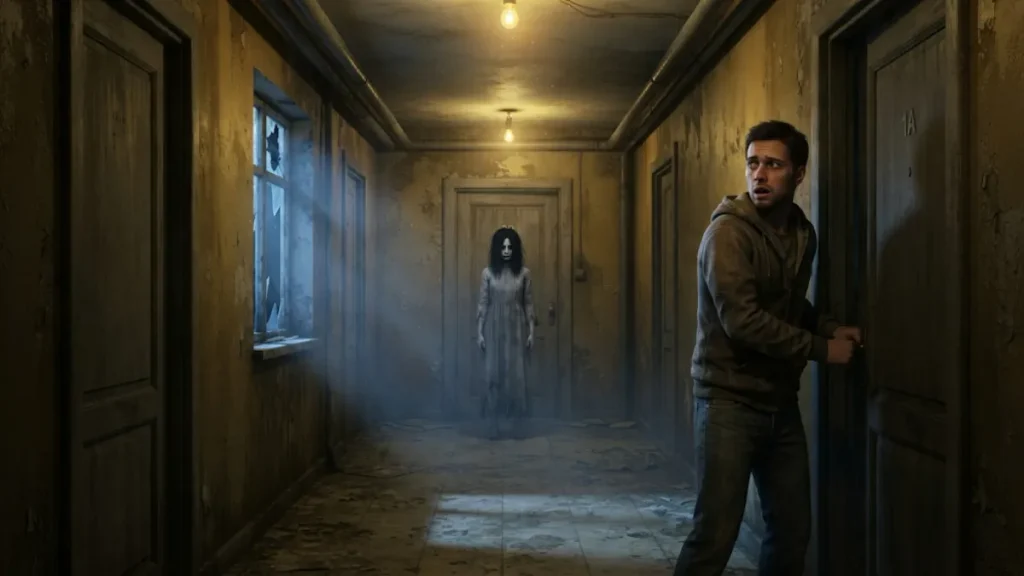
Someone was standing outside Apartment 13.
It was a woman wearing a long grey dress.
Her black hair reached her shoulders, and she stood perfectly still with her back towards him.
Daniel slowed down.
“Excuse me,” he said politely. “Are you looking for someone?”
The woman turned around.
Her face was unusually pale, and her expression carried a strange sadness. She looked to be in her early thirties.
For several seconds, she simply stared at him.
Then she asked, “Do you live here?”
Daniel pointed towards his apartment.
“Apartment 12.”
The woman glanced at his door.
“How long have you been living here?”
“About six months.”
She looked surprised.
“Six months?”
“Yes. Is something wrong?”
The woman took a small step towards him.
“You should keep your bedroom curtains closed at night.”
Daniel frowned.
“Why?”
She glanced towards his bedroom window.
“Because someone watches you while you sleep.”
Before he could ask another question, the woman turned around, unlocked Apartment 13, and disappeared inside.
Daniel stood frozen.
He had not seen her take a key from her pocket.
He had not heard the lock turn.
And strangely, he had not heard the door close either.
He walked towards Apartment 13 and tried the handle.
It was locked.
He shook his head, convinced that the woman was simply an unusual neighbour, and returned to his apartment.
That night, he kept his curtains closed.
The First Warning
The following morning, Daniel mentioned the encounter to the security guard.
The guard, an old man named Ramesh, was sitting behind his desk near the entrance.
“Do you know a woman who lives in Apartment 13?” Daniel asked.
Ramesh stopped reading his newspaper.
“Apartment 13?”
“Yes. A woman wearing a grey dress. I saw her last night.”
The guard looked uncomfortable.
“Sir, that apartment has been locked for fifteen years.”
Daniel laughed.
“That’s impossible. I spoke to someone standing outside it.”
Ramesh slowly folded his newspaper.
“Did you see her enter?”
“Yes.”
The guard leaned forward.
“Listen, sir. The previous owner died inside that apartment. Her name was Meera. After her death, nobody wanted to live there.”
Daniel felt slightly embarrassed.
“Maybe somebody rented it recently.”
Ramesh shook his head.
“I would know. I work here every night.”
Daniel decided not to argue.
He went to work, but the conversation stayed in his mind throughout the day.
That evening, he returned home and inspected Apartment 13 again.
There was dust around the entrance.
The brass lock was covered in rust.
There were no footprints.
He even knocked twice.
Nobody answered.
Daniel smiled at himself.
Perhaps he had imagined the entire conversation.
But just as he turned towards his apartment, he noticed something written on the wooden door.
Three words, scratched into the surface.
DON’T LOOK OUTSIDE.
The Midnight Visitor
For the next few days, Daniel tried to forget about the woman.
He stayed busy with work, watched television in the evenings, and avoided looking towards Apartment 13.
Then, on Sunday night, something happened.
At approximately 2:15 a.m., Daniel woke up to the sound of three gentle knocks.
Knock.
Knock.
Knock.
He sat up in bed.
The sound had come from the wall beside his bedroom.
He waited.
Nothing happened.
Then a woman’s voice whispered:
“Daniel.”
His entire body went cold.
He switched on the bedside lamp.
“Who’s there?”
Silence.
He slowly walked towards the bedroom door and checked the hallway.
Nobody was there.
When he returned, he noticed that his bedroom curtains were slightly open.
He distinctly remembered closing them before going to sleep.
He approached the window and looked outside.
Across the courtyard stood another residential building.
Most of its windows were dark.
But one apartment on the third floor was illuminated.
A woman was standing behind the glass.
She was wearing a grey dress.
Daniel stepped closer.
It was the same woman he had met outside Apartment 13.
She raised one hand and placed it against the window.
Then she pointed towards him.
Daniel immediately pulled the curtains closed.
His phone began vibrating.
An incoming call appeared on the screen.
The caller ID showed his own mobile number.
Confused, he answered.
For a few seconds, there was only static.
Then a frightened voice spoke.
“Daniel, listen carefully.”
He recognized the voice.
It was his own.
“Who is this?” he whispered.
“I’m you.”
Daniel felt his throat tighten.
“What kind of joke is this?”
The voice became desperate.
“Don’t open Apartment 13. Don’t trust the woman. And whatever happens, don’t look into the bedroom mirror.”
The call disconnected.
Daniel stood motionless.
Slowly, he turned towards the mirror beside his wardrobe.
His reflection was standing there.
But it was not copying his movements.
The reflection was looking towards the bedroom window.
And behind it stood the woman in the grey dress.
The Locked Room
The following morning, Daniel decided to investigate Apartment 13.
He had barely slept.
He was convinced that someone was deliberately frightening him, perhaps using a recording or some kind of technological trick.
He waited until the security guard went downstairs to collect a delivery.
Then he approached the apartment.
The brass lock was still attached to the door.
However, the door itself was slightly open.
Daniel pushed it gently.
It creaked.
Inside was a dark hallway covered in dust.
The apartment smelled of old wood and damp clothes.
He switched on his phone flashlight and entered.
The living room contained an old sofa, a broken television, and several framed photographs.
Most of the furniture was covered with white sheets.
On a small table sat a photograph of a woman.
It was the same woman he had encountered.
Meera.
Daniel picked up the frame.
Something about the photograph made him uncomfortable.
He turned it over.
Written on the back were the words:
Meera Sharma. Died November 2011.
Daniel checked the date on his phone.
It was November 2026.
Fifteen years.
He placed the photograph back on the table.
Then he noticed another photograph lying underneath it.
It showed Meera standing beside a man.
Daniel moved closer.
The man looked exactly like him.
Not similar.
Not vaguely familiar.
Exactly like him.
He was wearing the same hairstyle, had the same facial features, and even had the small scar above his left eyebrow.
Daniel dropped the photograph.
He stepped backwards and bumped into a cupboard.
Something fell from the top shelf.
It was a small diary.
He picked it up and began reading.
The entries were written in Meera’s handwriting.
Most described ordinary things: grocery shopping, visitors, family conversations, and daily routines.
But the final pages were different.
One entry read:
November 14, 2011.
He came back again today. He looks exactly the same. He keeps asking me where he is, but I cannot tell him.
Another entry read:
November 15, 2011.
He still doesn’t remember the accident.
Daniel felt dizzy.
He checked the next page.
November 16, 2011.
I think tomorrow he will finally wake up.
The diary slipped from his hands.
He heard a door close behind him.
Then someone whispered:
“Daniel?”
He turned around.
The woman in the grey dress was standing in the hallway.
Her eyes were filled with tears.
“Why did you come back?” she asked.
Daniel backed away.
“Who are you?”
She stepped closer.
“You know me.”
“I don’t know you!”
The woman looked heartbroken.
“You promised you wouldn’t forget.”
Daniel ran towards the entrance.
But the apartment door had disappeared.
Where the entrance should have been was a long, narrow corridor.
At its end stood a hospital bed.
The Truth Behind Apartment 13
Daniel ran down the corridor.
The walls were white.
The floor was covered with shiny tiles.
He could hear the steady beeping of a medical machine.
At the end of the corridor, a doctor stood beside a hospital bed.
A man was lying on it.
Daniel slowed down.
The patient had his face.
His hair was longer, his cheeks were sunken, and his eyes were closed.
A woman sat beside the bed, holding his hand.
It was Meera.
Daniel approached them.
“What is happening?” he shouted.
Nobody responded.
He looked at the patient again.
A small monitor displayed a heartbeat.
The doctor spoke quietly to Meera.
“His condition hasn’t changed. We have been trying to bring him back for fifteen years.”
Meera nodded.
“I know.”
Daniel felt the room spinning.
He looked at the patient.
Then at his own hands.
Something was wrong.
His fingers looked transparent.
He tried touching the hospital bed, but his hand passed through it.
Suddenly, memories began returning.
A rainy evening.
A car.
An argument.
Headlights approaching from the opposite direction.
A violent crash.
Meera screaming his name.
Then darkness.
Daniel remembered everything.
Fifteen years earlier, he and Meera had been travelling home when their car crashed into a roadside barrier.
Meera had survived.
Daniel had suffered severe head injuries and fallen into a coma.
The apartment, the job, the neighbours, and the life he had been living were not real.
They were fragments of his unconscious mind.
Apartment 12 was a fictional home created by his memories.
Apartment 13 was the place where he had stored the memories he could not face.
And Meera was the person who had spent fifteen years visiting him in the hospital.
She had never stopped talking to him.
She had told him stories, played his favourite songs, and reminded him of their life together.
But Daniel’s mind had created a different version of her.
A woman who lived behind a locked door.
A woman who kept warning him.
A woman who wanted him to remember.
The Final Knock
Daniel stood beside the hospital bed.
Meera was crying.
“I waited for you,” she whispered.
He tried to touch her shoulder.
For the first time, she seemed to notice him.
She slowly turned towards him.
“Daniel?”
He nodded.
“Meera, I’m sorry.”
Her expression changed.
She reached towards him.
The doctor looked at the monitor.
“Something is happening!”
The machine began beeping faster.
Daniel felt a strange warmth spreading through his body.
He could hear Meera calling his name.
Then he heard another sound.
Three gentle knocks.
Knock.
Knock.
Knock.
He opened his eyes.
A white ceiling appeared above him.
A hospital room.
Medical equipment.
A window.
And Meera sitting beside his bed.
She was older now. Her hair had a few grey strands, and her face looked tired.
But she was smiling.
“Daniel?”
He tried speaking.
His throat was dry.
“Meera.”
She immediately began crying.
The doctor rushed into the room.
“He’s awake!”
Daniel slowly turned towards his wife.
For fifteen years, he had believed he was living alone in an apartment building.
Now he understood that he had never been alone.
Meera held his hand.
“You’re home,” she whispered.
Daniel smiled weakly.
Then his eyes moved towards the bedroom mirror across the hospital room.
A familiar woman stood inside it.
She wore a long grey dress.
Meera.
But the woman sitting beside his bed was also Meera.
The reflection slowly raised one hand.
And wrote something on the glass.
YOU WOKE UP TOO SOON.
Daniel’s smile disappeared.
He looked towards his wife.
“Meera, did you see that?”
She frowned.
“See what?”
He pointed towards the mirror.
There was nothing there.
Then his wife leaned closer and whispered:
“Daniel, there is something I never told you about the accident.”
He looked at her.
She began crying again.
“I wasn’t in the car with you that night.”
Daniel’s heart stopped.
The hospital monitor began producing a continuous tone.
And from somewhere inside the room, the woman in the grey dress whispered:
“Now you remember.”
The End.
2. The Last Message From Dad
Psychological Horror · Supernatural Mystery · Family Secrets · Twist Ending
Michael had deleted his father’s number three times.
The first time was immediately after the funeral. The second was two weeks later, when he accidentally opened their old conversation and spent an entire evening reading messages he could no longer reply to. The third time was six months after his father’s death, when he finally accepted that keeping the number saved was only making it harder to move forward.
But deleting a number was easier than forgetting a person.
His father, Richard, had been a quiet man. He wasn’t particularly affectionate, rarely expressed his emotions, and believed that children should learn to solve their own problems. Michael remembered him as someone who always had an answer for practical questions but struggled whenever a conversation became emotional.
They had argued during Michael’s final visit to the hospital.
Richard wanted his son to visit more often. Michael was busy with work and believed there would always be another weekend.
There wasn’t.
Richard died three days later.
Six months passed, but Michael still remembered their last conversation.
“You’re always busy,” his father had said.
“I have responsibilities, Dad.”
“Everyone has responsibilities. That doesn’t mean you forget your family.”
Michael had become irritated.
“We’ll talk when I have more time.”
Those were the last words he had spoken to his father.
Now, living alone in a small apartment, Michael sometimes wondered whether his father had been right.
He had no siblings, his mother had died when he was young, and most of his relatives lived in another city. His evenings were usually spent watching television, checking emails, or scrolling through his phone.
He had become comfortable with loneliness.
Until one November night, his father’s number sent him a message.
The First Message
It was 11:47 p.m. when Michael’s phone vibrated.
He was sitting on his sofa, watching an old comedy show.
The screen displayed a familiar name.
Dad.
Michael stopped smiling.
For several seconds, he simply stared at the notification.
Then he opened it.
Dad
11:47 PM
Are you awake?
Who is this?
Michael’s first thought was that someone had gained access to his father’s old number.
Perhaps the mobile company had reassigned it to another customer.
He checked the contact details.
The number was exactly the same.
He typed another message.
“Whoever you are, this number belonged to my father. Please stop messaging me.”
A minute later, another notification appeared.
Dad: Don’t worry, Michael. I just wanted to talk.
His fingers went cold.
Nobody outside his family used the name Michael in the particular way his father did. He always pronounced it slowly, almost as though he were disappointed before the conversation even began.
Michael called the number.
It rang once.
Then the call disconnected.
He tried again.
This time, an automated voice announced that the number was unavailable.
He placed the phone on the table and switched off the television.
He didn’t sleep much that night.
Conversations From the Dead
The next morning, Michael convinced himself that someone was playing a cruel joke.
He checked social media, looked through his recent calls, and even contacted the mobile network provider.
There was no explanation.
For three days, nothing happened.
Then, on Thursday evening, another message arrived.
Dad: Have you been eating properly?
Michael stared at it.
He almost laughed.
That was exactly the kind of question his father used to ask whenever they spoke.
He replied:
“Why are you doing this?”
The response came almost immediately.
Dad: Doing what? Talking to my son?
Michael felt a strange mixture of fear and sadness.
He typed:
“Are you really Dad?”
There was a long pause.
Then:
Dad: You still leave your shoes outside the bedroom, don’t you? I told you many times not to do that.
Michael looked towards the bedroom.
His shoes were exactly where his father used to complain about them.
Nobody knew about this habit except his father.
He sat down.
“How is this possible?”
Another message appeared.
Dad: Some things are difficult to explain.
Michael wanted to believe it was his father.
He knew how irrational that sounded, but the possibility was too comforting to ignore.
Over the next few evenings, the messages became longer.
His father asked about work, reminded him to exercise, and occasionally shared memories from his childhood.
They even discussed their favourite cricket team.
For the first time in six months, Michael felt as though he had his father back.
One evening, he asked:
“Do you remember the old house?”
The reply came quickly.
Dad: Of course. You were always afraid of the basement.
Michael smiled.
He had spent years avoiding that basement.
His father had always kept it locked, saying it contained old tools and things that children shouldn’t touch.
Then another message arrived.
Dad: You never knew what happened down there, did you?
Michael’s smile disappeared.
The Basement
Michael returned to his childhood home the following Saturday.
The house had been locked since his father’s funeral. A neighbour checked on it occasionally, but most of the rooms remained untouched.
The familiar smell of old furniture and wooden cupboards greeted him as he entered.
He walked through the living room, passed the dining table, and stopped outside the basement door.
It was still locked.
He searched his father’s old desk and eventually found a small brass key inside an envelope.
His hands trembled slightly as he opened the door.
A narrow staircase descended into darkness.
He switched on the light.
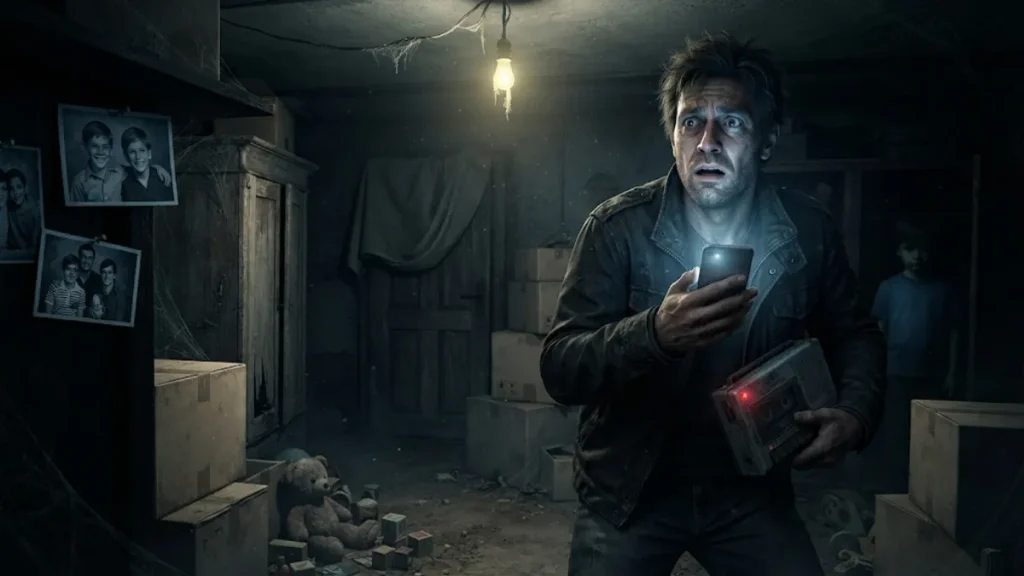
The basement looked exactly as he remembered it. There were cardboard boxes, old furniture, gardening equipment, and several shelves filled with forgotten belongings.
He noticed a small wooden cabinet in the corner.
Inside were old family photographs.
Most showed his father, mother, and Michael as a child.
But one photograph caught his attention.
It showed two little boys standing beside Richard.
One was Michael.
The other was a boy of approximately the same age, wearing a blue shirt.
Michael stared at the photograph.
He didn’t recognize the child.
He turned it over.
Written in his father’s handwriting were the words:
Michael and Daniel, Summer 1998.
Michael felt a strange pressure in his chest.
He had always believed he was an only child.
He searched through the remaining photographs.
There were more pictures of the same boy.
One showed him sitting beside Michael at a birthday party.
Another showed both children playing in the garden.
And another showed the boy standing beside their mother.
Michael’s phone vibrated.
Dad: You found the photographs.
He nearly dropped it.
He typed:
“Who is Daniel?”
The reply arrived.
Dad: Your brother.
Michael sat on an old wooden chair.
“Why did nobody tell me?”
His phone vibrated again.
Dad: Because you were too young to understand what happened.
He stared at the screen.
“What happened to him?”
For almost a minute, there was no response.
Then a message appeared.
Dad: He disappeared.
The Forgotten Brother
Michael searched the basement for anything related to Daniel.
He found a collection of old school notebooks, birthday cards, and a small toy car.
At the bottom of a cardboard box was a cassette recorder.
A handwritten label was attached to it.
Family Recording, August 1998.
Michael pressed the play button.
At first, there was only static.
Then he heard his father’s voice.
“Michael, stop running. You’ll fall.”
A child’s laughter followed.
Another voice spoke.
“Dad, he took my car.”
Richard laughed.
“Daniel, you can have it back.”
Michael stopped breathing.
It was a recording of his family.
He continued listening.
The children were arguing over a toy.
Then his mother called them for dinner.
Everything sounded ordinary.
Until a sudden crash interrupted the conversation.
A child began crying.
Richard shouted.
“Michael! What have you done?”
The recording became distorted.
Then a little boy spoke.
“Dad, Michael pushed me.”
The tape stopped.
Michael sat frozen.
He played it again.
And again.
The words remained the same.
He looked at the photograph of the two boys.
A terrible memory began returning.
A staircase.
A locked door.
A heated argument.
A little boy crying.
Michael stood up and began searching the basement more desperately.
Behind an old cupboard, he found a small metal box.
It contained newspaper cuttings, handwritten notes, and a hospital document.
The newspaper headline read:
CHILD MISSING AFTER FAMILY INCIDENT.
The article described a seven-year-old boy who had disappeared from his home.
His name was Daniel Richard.
The police had searched the neighbourhood for weeks.
But no trace of him had ever been found.
Michael felt sick.
His father had hidden everything.
He called the number saved as Dad.
It rang.
For the first time, someone answered.
A man’s voice whispered:
“Michael.”
He almost cried.
“Dad?”
There was silence.
Then the voice replied:
“You remember him now.”
Michael’s eyes filled with tears.
“Where is Daniel?”
His father sighed.
“He’s closer than you think.”
The Last Recording
Michael spent the entire evening examining the documents.
He discovered that Daniel had been reported missing on August 17, 1998.
His father had given several interviews to the police.
The official explanation was that Daniel had gone outside to play and never returned.
But the cassette recording suggested otherwise.
Michael searched for more tapes.
Inside the metal box, he found a small envelope containing one final cassette.
The label read:
For Michael. When he remembers.
He inserted it into the recorder.
His father’s voice began playing.
“Michael, if you’re listening to this, then you have probably found the photographs.”
A pause followed.
“I don’t know whether you’ll ever remember your brother. I spent years hoping you wouldn’t have to.”
Michael’s breathing became uneven.
His father continued.
“That afternoon, you and Daniel were playing near the basement stairs. You were arguing over a toy. I heard a crash, but by the time I reached the hallway, Daniel was gone.”
The recording became quiet.
Then Richard began crying.
“I searched everywhere. I looked in every room, every cupboard, every corner of this house. The police searched too. But I never found him.”
Michael closed his eyes.
His father continued.
“You were seven. You kept telling me that Daniel was hiding. I thought you were frightened. I thought you would eventually forget.”
A long pause followed.
“Then one evening, you told me something I have never been able to forget.”
Michael leaned closer.
His father’s voice became barely audible.
“You said Daniel was standing behind me.”
The cassette stopped.
Michael stared at it.
He suddenly remembered the basement.
He remembered playing with his brother.
He remembered the argument.
And he remembered something else.
A little boy falling down the basement stairs.
The Message That Changed Everything
Michael rushed upstairs.
He needed fresh air.
He needed to leave the house.
But before he reached the front door, his phone vibrated.
Dad: Michael, don’t leave.
He froze.
Another message appeared.
Dad: You haven’t heard the whole recording.
Michael looked towards the basement.
The cassette recorder was still playing.
He returned downstairs.
A second recording had started automatically.
His father’s voice sounded different.
It was quieter, almost exhausted.
“Michael, I need you to understand something. Daniel didn’t disappear because he ran away.”
Michael’s hands shook.
“That afternoon, you pushed him. He fell down the stairs. When I reached the basement, he was already gone.”
Michael felt the world tilt.
His father continued.
“I found you hiding behind the cupboard. You kept saying you didn’t mean to hurt him.”
Michael began crying.
Then came the sentence that changed everything.
“I told the police Daniel had gone missing because I couldn’t bear the thought of losing both my sons. I knew what had happened, Michael. I knew.”
The recording ended.
Michael sat on the basement floor.
He had spent nearly thirty years believing he was an only child.
But he had a brother.
And he had caused his disappearance.
His phone vibrated.
Dad: Now you understand why I never told you.
Michael typed with shaking fingers.
“Why are you messaging me?”
The reply appeared.
Dad: Because I promised I would tell you when you were ready.
Michael stared at the screen.
“Are you really Dad?”
A final message appeared.
Dad: No, Michael. I’m not your father.
He felt his stomach tighten.
Then another message arrived.
Dad: I’m Daniel.
The Final Revelation
Michael dropped the phone.
He looked around the basement.
The air felt colder.
He slowly picked up the device again.
“Daniel?”
The phone vibrated.
Daniel: I’ve been trying to reach you for years.
Michael typed:
“Where are you?”
The reply came.
Daniel: Downstairs.
Michael looked towards the staircase.
There was nobody there.
Then he heard a small sound.
A toy car rolling across the basement floor.
It stopped near his feet.
Michael recognized it immediately.
It was the same blue toy car from the photographs.
He picked it up.
A little boy’s voice whispered from behind the cupboard.
“You promised you would play with me.”
Michael began crying.
“Daniel, I’m sorry.”
The voice answered:
“You were only a child.”
A small figure appeared near the staircase.
It was a boy wearing a blue shirt.
His face looked exactly like the child in the photographs.
Michael couldn’t move.
The boy smiled.
“Do you remember me now?”
Michael nodded.
Then the boy asked something that made his blood run cold.
“Why did you leave me here?”
Michael looked towards the old cupboard.
For the first time, he noticed that its bottom panel was slightly loose.
He pulled it away.
Behind it was a narrow wooden door.
He had never seen it before.
A small brass handle was attached to the centre.
He opened it.
Inside was a tiny storage space.
And there, beneath a dusty blanket, lay a small child’s shoe.
Michael recognized it.
Daniel had worn the matching shoe in the family photographs.
His phone vibrated one final time.
Daniel: Dad found me that night. He never told you because he thought you would remember everything.
Michael stared at the message.
Another followed.
Daniel: He buried the truth with himself.
Then he understood.
Daniel had never been missing.
His father had found his body inside the hidden storage space after the accident.
He had concealed the truth to protect Michael from the consequences of what had happened.
But there was one more message.
Daniel: Dad isn’t the one who sent you the messages.
Michael’s fingers went numb.
He looked towards the staircase.
The little boy was gone.
His phone displayed a final notification.
Daniel: I’m still here, Michael.
The basement light flickered.
Then, from somewhere behind the wall, came three soft knocks.
Knock.
Knock.
Knock.
Michael turned towards the hidden door.
A small voice whispered:
“Now it’s your turn to stay.”
The phone screen went black.
And for the first time in nearly thirty years, Michael heard his brother laughing.
The End.
3. The House That Remembered Everything
Psychological Horror · Haunted House · Family Mystery · Unexpected Twist
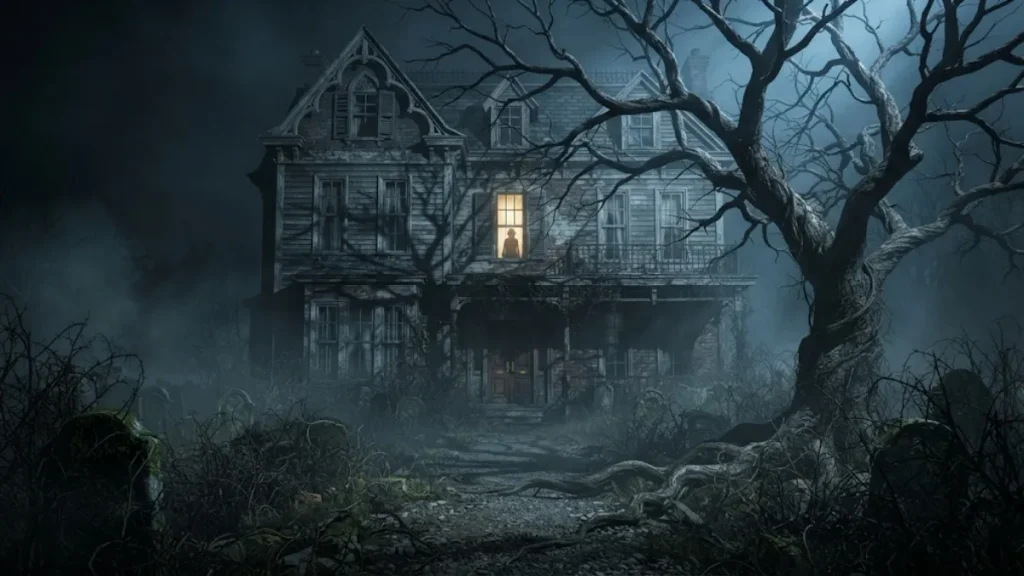
Robert had never liked his grandmother’s house.
It wasn’t because the building was old or because its wooden floors creaked whenever someone walked across them. He disliked it because the house always seemed to know when someone was unhappy.
Whenever Robert visited as a child, his grandmother somehow knew if he had been crying before arriving. She knew when he had argued with his parents, when he had lied about finishing his homework, and even when he had secretly taken biscuits from the kitchen.
She never asked how she knew.
She would simply look at him and say, “This house has ears, Robert.”
He used to laugh whenever she said it.
Now, twenty years later, he wished he had taken her words more seriously.
The Inheritance
Robert received the news about his grandmother’s death on a rainy Tuesday morning.
She had passed away peacefully at the age of eighty-six, leaving behind a small amount of money, some jewellery, and the old family house in a quiet countryside neighbourhood.
Robert was the only person named in her will.
His parents had died several years earlier, and he had no siblings. Although he had fond memories of visiting his grandmother during childhood, he hadn’t seen her regularly in recent years.
Work, responsibilities, and distance had gradually separated them.
He decided to visit the house, clean it, and prepare it for sale.
The journey took almost three hours.
When he finally arrived, the house looked exactly as he remembered it.
A narrow garden surrounded the property. An old oak tree stood near the front gate, and several climbing plants covered the walls.
The windows were dusty.
The front door had a brass handle shaped like a bird.
Robert unlocked it and stepped inside.
A familiar smell of old wood, lavender, and furniture polish greeted him.
He walked through the living room.
Everything remained in its original place.
The sofa.
The grandfather clock.
The wooden bookshelf.
Even the small photograph of his parents standing beside his grandmother was still sitting on the fireplace.
Robert smiled.
“Well, Grandma,” he whispered. “Let’s see what you’ve left behind.”
He didn’t notice the grandfather clock moving backwards.
The First Night
Robert decided to spend one night in the house before beginning the cleaning.
He carried his luggage upstairs and chose his old bedroom.
It was a small room with faded blue curtains, a wooden bed, and a wardrobe that had belonged to his grandfather.
He remembered spending countless afternoons there as a child.
After unpacking, he went downstairs to prepare dinner.
At approximately 9 p.m., he heard music coming from the living room.
It was an old song his grandmother used to play while cooking.
Robert walked towards the radio.
It was switched off.
Yet the music continued.
He looked around.
Then, without warning, the grandfather clock began chiming.
Nine times.
Robert checked the time.
It was exactly 9 p.m.
He smiled nervously.
“Old house. Old clock.”
He returned to the kitchen.
A few minutes later, he noticed something unusual.
A cup of tea was sitting on the dining table.
It was steaming.
Robert stopped.
He hadn’t made tea.
He hadn’t even switched on the kettle.
He approached the cup cautiously.
It was his grandmother’s favourite floral cup.
A small piece of paper was placed beside it.
The handwriting was unmistakable.
You still take two spoons of sugar.
Robert felt a chill.
He looked towards the staircase.
“Grandma?”
Nobody answered.
He searched the entire house, including the upstairs bedrooms, bathroom, and garden.
There was nobody there.
He checked the front door.
It was locked from the inside.
That night, Robert slept with the bedroom light switched on.
The House Begins Talking
The following morning, Robert tried to explain the previous night’s events logically.
Perhaps someone had entered the house before he arrived.
Maybe a relative had prepared the tea.
The music could have come from a neighbouring property.
But the note?
That was difficult to explain.
He decided to inspect the house properly.
Inside his grandmother’s bedroom, he found several old diaries.
Most contained ordinary entries about shopping, gardening, and family visits.
But one diary had a strange title written on its cover.
Things the House Remembers.
Robert opened it.
The first page contained a sentence:
Every person leaves something behind when they enter this house.
He turned the page.
Their footsteps remain in the hallway. Their laughter stays in the kitchen. Their arguments settle inside the walls.
Robert chuckled.
His grandmother had always enjoyed writing imaginative things.
He continued reading.
The house remembers everything. But it never remembers without a reason.
The next page contained a warning.
Never ask the house to remember you.
Robert closed the diary.
He found the entire thing ridiculous.
That evening, he decided to test his grandmother’s strange theory.
He stood in the living room and said:
“Grandma, if you can hear me, play your favourite song.”
Nothing happened.
Robert laughed.
“See? Just an old house.”
He turned towards the kitchen.
Suddenly, the radio switched on.
The same song from the previous night began playing.
Robert froze.
Then the grandfather clock chimed once.
A woman’s voice whispered from the hallway.
“You’re home, Robert.”
He spun around.
Nobody was there.
Memories Inside the Walls
Over the next two days, the house became increasingly strange.
Robert began noticing objects appearing in places where they hadn’t been before.
His childhood schoolbag was placed beside the staircase.
A toy car he had lost twenty years earlier appeared under the sofa.
And a photograph of his parents suddenly appeared on the kitchen table.
He tried calling the estate agent to discuss selling the property.
But whenever he mentioned the house, the phone connection became distorted.
On the third evening, he heard a child laughing upstairs.
He rushed towards the sound.
It was coming from his old bedroom.
The door was open.
Inside, his childhood toys were scattered across the floor.
His old wooden train set was moving by itself.
Robert stood in the doorway.
Then a small voice spoke.
“Do you want to play?”
He backed away.
The voice sounded familiar.
It was his own voice from childhood.
He rushed downstairs and grabbed his grandmother’s diary.
He began reading more urgently.
One entry dated twenty-five years earlier caught his attention.
Robert came today. He was unhappy because his father shouted at him. He cried in the garden, but he told everyone he was fine.
Another entry read:
He asked me why the house makes strange sounds at night. I told him it was remembering.
Then came a final entry.
Robert is afraid of what happened here. One day, he will have to remember.
Robert stared at the words.
What had happened here?
He searched through the remaining diaries.
Most pages were missing.
But tucked inside the final diary was a folded newspaper cutting.
Its headline read:
LOCAL FAMILY TRADEGY: CHILD REPORTED MISSING AFTER HOUSE FIRE.
Robert read the article twice.
It described a fire that had occurred in the property nearly thirty years earlier.
A young boy had disappeared during the incident.
His name was Robert.
He dropped the newspaper.
The Photograph
Robert couldn’t understand what he had just read.
He was standing inside the house.
He had lived a normal childhood.
He remembered his parents.
He remembered his grandmother.
How could a newspaper report describe him as missing?
He searched for his phone.
His hands were shaking.
He called an old family friend, Margaret, who lived in the nearby village.
She answered after several rings.
“Robert? Is everything alright?”
He immediately asked about the fire.
There was a long silence.
“Who told you about that?”
“I found an old newspaper.”
Margaret sighed.
“Your grandmother never wanted you to know.”
“Know what?”
“Robert, you were very young.”
He became impatient.
“Just tell me what happened.”
Margaret spoke slowly.
“Your parents died in that fire. Your grandmother rescued you, but you were unconscious for several days. The doctors believed you had suffered severe trauma.”
Robert felt dizzy.
“That’s impossible. My parents died in a car accident.”
Margaret began crying.
“That’s what your grandmother told you.”
Robert ended the call.
He walked towards the fireplace.
The family photograph was still sitting there.
He picked it up.
It showed his parents standing beside his grandmother, with Robert as a small child.
But something was different.
His parents’ faces appeared blurred.
He turned the photograph around.
There was a date written on the back.
Three days before the fire.
Below it, in his grandmother’s handwriting, were the words:
The last photograph of our family.
Robert suddenly noticed something else.
His grandmother was not looking at the camera.
She was looking directly at him.
The Room That Wasn’t There
That night, Robert decided to leave.
He packed his belongings, grabbed the car keys, and walked towards the front door.
But when he opened it, he found a wall.
A solid brick wall stood where the entrance should have been.
He stepped backwards.
He tried another door.
It opened into the kitchen.
He tried the kitchen window.
Outside was darkness.
The house had somehow changed.
The hallway was longer than before.
The staircase seemed to stretch upwards into shadows.
And the grandfather clock was ticking backwards.
Robert shouted.
“Let me out!”
A woman’s voice answered from upstairs.
“Why are you leaving?”
He recognized it immediately.
His grandmother.
He ran towards the staircase.
At the top stood an elderly woman wearing a pale blue dress.
Her hair was neatly tied behind her head.
She looked exactly as Robert remembered her.
“Grandma?”
She smiled.
“You’ve grown up.”
Robert began crying.
“What is happening?”
His grandmother approached him.
“You’ve forgotten too much.”
“Tell me the truth!”
She looked towards the bedroom.
“Come with me.”
Robert followed her.
She opened a small door at the end of the upstairs corridor.
He had never seen it before.
Inside was a narrow room filled with old photographs, childhood drawings, and newspaper cuttings.
At the centre stood a wooden table.
On it was a small metal box.
His grandmother opened it.
Inside were several hospital documents.
Robert picked up the first one.
It was a medical report.
The patient was listed as Robert Williams.
The date was thirty years earlier.
The diagnosis read:
Severe injuries following residential fire. Patient remains unconscious.
Robert felt his knees weaken.
He looked at his grandmother.
“What does this mean?”
She took his hands.
“You never left this house, Robert.”
What the House Remembered
Robert stared at her.
“But I’m here. I’m alive.”
His grandmother smiled sadly.
“You are remembering.”
She explained that after the fire, Robert had been taken to a hospital.
His parents had died, and she had spent months sitting beside his bed.
He never regained consciousness.
Eventually, the doctors had explained that there was little hope of recovery.
But his grandmother refused to accept it.
She visited him every day and spoke to him about his childhood.
She described the garden, the old oak tree, the kitchen, and the rooms of their family home.
She told him stories about his parents.
She played his favourite music.
She reminded him of everything he loved.
And gradually, Robert’s mind created a world from those memories.
A world in which he had grown up.
A world in which his parents had simply died years later.
A world in which he could return to his grandmother’s house whenever he wanted.
“The house was never haunted,” his grandmother whispered.
“It was remembering you.”
Robert began to cry.
All the strange events suddenly made sense.
The music was the song his grandmother used to play.
The toys were his childhood belongings.
The tea was prepared exactly how he liked it.
The voices were fragments of conversations his grandmother had repeated beside his hospital bed.
The house had been keeping his memories alive.
But there was one thing Robert still didn’t understand.
“Why did you say never ask the house to remember me?”
His grandmother looked towards the window.
“Because every time you remember something, you come closer to the truth.”
She touched his cheek.
“And the truth might make you leave.”
The Final Memory
Robert looked around the room.
He noticed a small drawing hanging on the wall.
It showed a house with three people standing outside.
His parents.
His grandmother.
And himself.
At the bottom, a child had written:
We will always be together.
Robert began remembering the fire.
He remembered waking up during the night.
He remembered smoke filling the hallway.
He remembered his mother shouting.
He remembered his father carrying him towards the front door.
Then everything became dark.
His grandmother was crying now.
“I tried to save all of you,” she whispered.
Robert hugged her.
For the first time in years, he felt like a little boy again.
He wanted to stay.
He wanted to return to the garden, listen to the radio, and drink tea at the kitchen table.
But the house was beginning to disappear.
The photographs faded.
The walls became white.
The grandfather clock stopped.
His grandmother held his hand.
“Don’t be afraid, Robert.”
He looked at her.
“Will I see you again?”
She smiled.
“Every time you remember me.”
Then the familiar sound of a medical monitor began echoing through the house.
Beep.
Beep.
Beep.
Robert opened his eyes.
He was lying in a hospital bed.
A nurse stood beside him.
An elderly woman was sitting near the window.
It was his grandmother.
But she looked much older than he remembered.
She was holding his hand and crying.
“Robert?”
He tried to speak.
His lips moved.
“Grandma.”
She immediately called the doctor.
“He’s awake! He’s finally awake!”
Robert looked around the hospital room.
A small calendar on the wall showed the current year.
2026.
He had been unconscious for nearly thirty years.
His grandmother had aged while waiting for him.
But before he could say anything else, she leaned closer.
“There’s something I need to tell you.”
Robert looked at her.
She glanced towards the hospital room door.
“Your parents didn’t die in the fire.”
Robert frowned.
“What?”
His grandmother’s eyes filled with tears.
“They escaped. They were waiting outside when I went back to find you.”
He tried to understand.
“Then where are they?”
She lowered her head.
“They left the house before the fire started. They never came back.”
Robert felt a strange chill.
His grandmother continued.
“I told you they died because I didn’t want you to spend your life wondering why they abandoned you.”
He looked towards the hospital window.
For a moment, he saw the old house reflected in the glass.
A small boy was standing in the upstairs bedroom.
It was him.
The boy smiled.
Then he raised one finger to his lips.
A warning.
Robert turned towards his grandmother.
“Did you hear that?”
“Hear what?”
From the hospital corridor came the sound of three gentle knocks.
Knock.
Knock.
Knock.
His grandmother’s face suddenly changed.
She looked terrified.
Then a familiar voice whispered from behind the door.
“Mother, it’s time to take Robert home.”
Robert slowly turned towards the entrance.
His parents were standing there.
They looked exactly as they had in the old photographs.
And neither of them was smiling.
The End.
4. The Stranger in My Family Photograph
Horror Short Story for Adults With a Twist
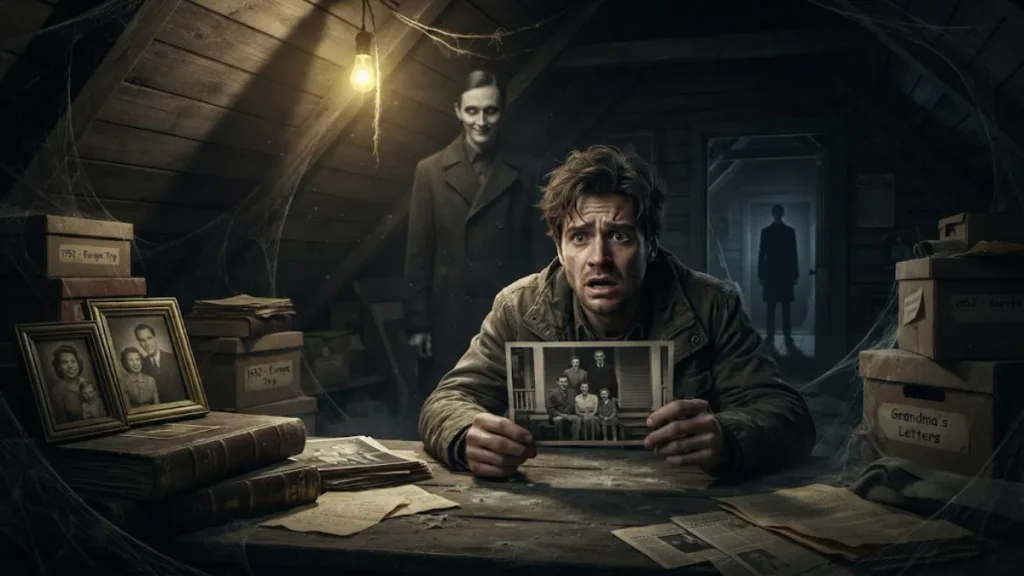
Some family photographs preserve beautiful memories. Others capture moments we wish we could forget. But what happens when a stranger appears in an old family photograph, standing among your loved ones as though he has always belonged there?
When Daniel discovers an unfamiliar man in a photograph taken decades before he was born, he assumes it is an old printing mistake. But as he searches through his family’s albums, the same mysterious face begins appearing in photographs from different years. The man is always standing somewhere in the background, watching the camera.
And the strangest part is that nobody in the family seems to remember him.
The Photograph in the Attic
Daniel had never been particularly interested in old family photographs. His mother, Margaret, kept dozens of albums in a wooden cabinet, carefully arranged according to the year they had been taken. Whenever relatives visited, she enjoyed bringing them out and telling stories about people Daniel barely remembered.
His father had died when Daniel was twelve, and his mother had spent most of the following years preserving memories of their life together. There were photographs of birthdays, holidays, weddings, family dinners, and ordinary afternoons in the garden.
Daniel usually smiled politely whenever his mother showed him these pictures. He preferred living in the present.
But one rainy Saturday, while cleaning the attic of his childhood home, he discovered a photograph that made him stop.
It was an old black-and-white picture of his grandparents standing outside their first house. His grandfather wore a dark suit, and his grandmother stood beside him with one hand resting on his shoulder. Between them were Daniel’s mother and her younger brother, both looking unusually serious.
The photograph was probably taken in the early 1960s.
Daniel turned it over, expecting to find a date or a handwritten note.
Instead, he found a short message.
Our family, Christmas 1962.
He studied the photograph again.
There were five people in the picture.
But according to everything he knew about his family, only four people should have been there.
A man stood behind his grandmother, slightly to the left. He was tall and thin, dressed in a dark coat. His face was pale, and his expression was completely blank.
Daniel leaned closer.
The man’s eyes appeared to be looking directly at the camera.
He had never seen him before.
Perhaps it was a family friend, he thought. Maybe a neighbour or a distant relative whose name had been forgotten.
Still, something about the man’s expression made Daniel uncomfortable.
Everyone else in the photograph looked natural. His grandparents were smiling, his mother appeared shy, and his uncle was staring impatiently at the photographer.
But the stranger looked as though he had been standing there for a very long time.
Daniel placed the photograph inside his jacket and carried it downstairs.
His mother was sitting in the living room, reading a magazine.
“Mom, do you know who this is?”
He handed her the photograph.
Margaret glanced at it.
For a moment, her expression changed.
Then she smiled.
“It’s your grandfather’s family. I remember this picture.”
“Who is the man behind Grandma?”
Her smile disappeared.
“What man?”
Daniel pointed at the stranger.
Margaret looked at the photograph again. Her fingers tightened around its edges.
“I don’t see anyone.”
“Mom, he’s standing right there.”
She handed it back without answering.
Daniel thought she was joking.
But when he looked at her face, he realized she was genuinely frightened.
“Put that photograph away,” she said quietly.
“Why?”
“Because I don’t want to talk about it.”
Daniel wanted to ask more questions, but his mother had already returned to her magazine.
He put the photograph in his pocket.
Something told him that the stranger was not simply an old family friend.
The Same Man Appears Again
That evening, Daniel decided to examine the other albums.
He carried three heavy books from the cabinet and placed them on the dining table. Each contained photographs from a different period of his family’s history.
The first album covered the 1960s.
The second covered the 1970s.
The third contained pictures from the early 1980s.
Daniel began turning the pages.
At first, everything seemed ordinary.
There were photographs of his grandparents at the beach, his mother graduating from school, and his uncle standing beside an old motorcycle.
Then he found another picture.
It showed his mother celebrating her eighteenth birthday. She stood in front of a cake while her friends gathered around her.
And behind the group, near a doorway, stood the same stranger.
Daniel felt a chill move down his back.
He picked up the photograph and examined it carefully.
The man’s clothing was different, but his face was unmistakable.
He looked exactly the same.
Not older. Not younger.
Exactly the same.
Daniel quickly checked the date written beneath the photograph.
1974.
The man had appeared in a picture taken twelve years after the first one.
Daniel continued searching.
In a photograph from 1978, the stranger stood beside a tree at a family picnic.
In another from 1981, he was visible through a window behind Daniel’s grandparents.
He appeared in the background of a wedding photograph, standing near the church entrance.
Every time, he was looking directly at the camera.
Daniel felt increasingly disturbed.
The photographs had been taken by different people, using different cameras, in different places.
Yet the same man appeared in all of them.
He checked the family album from the 1990s.
Nothing.
Then he opened the album containing photographs from his own childhood.
His hands began to shake.
There he was.
A photograph showed Daniel sitting on his father’s shoulders at a local fair. His parents stood beside him, smiling at the camera.
Behind them, near a food stall, the stranger was watching.
Daniel remembered that day.
He remembered the bright lights, the smell of roasted peanuts, and his father buying him a toy car.
But he did not remember seeing that man.
He turned another page.
A photograph from his sixth birthday showed Daniel blowing out candles.
The stranger stood in the hallway behind him.
In a picture taken during a family holiday, he appeared near the hotel reception.
Daniel suddenly closed the album.
His heart was beating too quickly.
The stranger had been present throughout his childhood.
And nobody had ever noticed him.
A Face Nobody Remembered
The following morning, Daniel called his uncle, Peter.
Peter was in his late sixties and lived several hours away. He had always been close to Daniel’s father and knew more about the family history than anyone else.
Daniel sent him a photograph of the stranger.
“Do you recognize this man?”
Peter took several seconds to respond.
“Where did you get this?”
“From Grandma’s old album. Who is he?”
“I don’t know.”
“Have you seen him before?”
Another pause followed.
“Daniel, listen to me. Don’t waste your time looking through those photographs.”
Daniel sat upright.
“Why does everyone keep telling me that?”
Peter sighed.
“Because some things are better left alone.”
“That’s not an answer.”
“I was a child when those pictures were taken. I remember asking your grandmother about him once.”
“What did she say?”
“She told me it was a printing defect.”
Daniel looked at the photograph on his phone.
“That doesn’t explain why he’s in pictures taken twenty years apart.”
Peter did not respond.
“Uncle Peter?”
“Your grandmother used to say that the man appeared whenever the family was about to lose someone.”
Daniel felt his stomach tighten.
“What?”
“She said it was superstition. She never explained it properly. Your grandfather refused to discuss it.”
“Did anyone in the family die after those photographs were taken?”
“Of course. People die, Daniel. Those pictures cover decades.”
“Was the man connected to any particular death?”
Peter’s voice became quieter.
“Your grandfather disappeared for three days in 1962. Nobody ever found out where he went. When he returned, he refused to speak about what had happened.”
Daniel stared at the old Christmas photograph.
“Was the stranger there before Grandpa disappeared?”
“I don’t know.”
Peter paused.
“Your grandmother burned several photographs after that. She said she didn’t want him appearing in the house again.”
Daniel felt a cold sensation spread through his arms.
“Who is he?”
“I wish I knew.”
Then Peter added something that made Daniel’s blood run cold.
“Your grandmother once told me that the man wasn’t standing behind the family.”
“What do you mean?”
“She said he was standing with us. We were the ones who couldn’t see him.”
The call ended shortly afterward.
Daniel remained seated for several minutes.
He looked at the photograph on his phone.
The stranger’s face seemed clearer than before.
The Hidden Envelope
That afternoon, Daniel returned to the attic.
He searched through old boxes, documents, and family belongings, hoping to find something that explained the stranger’s identity.
Near the back of a wooden cupboard, he discovered a small metal box.
It contained his grandmother’s jewellery, several letters, and a sealed envelope.
The envelope had his grandfather’s handwriting on it.
For Margaret. Only open if he appears again.
Daniel immediately recognized the name.
His mother was downstairs.
He carried the envelope to her.
“Mom, I found this in Grandpa’s box.”
Margaret looked at the handwriting and went completely still.
“Where did you find it?”
“In the attic.”
She took the envelope but did not open it.
For a long time, she simply held it in her hands.
Then she whispered, “I thought we had finally gotten rid of him.”
Daniel sat beside her.
“Who is he?”
His mother looked toward the window.
“When I was young, your grandmother told me a story. She said that before your grandfather married her, he had a younger brother named Thomas.”
Daniel frowned.
“I’ve never heard of him.”
“Nobody spoke about him. He disappeared when he was seventeen.”
“What happened?”
“Your grandfather said Thomas had run away. But your grandmother believed he had died.”
Margaret opened the envelope.
Inside was a single sheet of yellowed paper.
She read it silently before handing it to Daniel.
The letter was dated November 1962.
Margaret,
If you are reading this, then the man has returned to our photographs.
His name is Thomas. He was my younger brother. I told everyone he disappeared, but the truth is much worse.
When we were young, Thomas and I made a promise. We said that no matter what happened, neither of us would ever leave the family.
One winter evening, we argued near the old railway bridge. He slipped while trying to cross the frozen ground and fell into the river.
I was frightened. I ran home and told everyone he had left town.
I never told them that I had watched him fall.
For years, I believed I had escaped what happened. Then he appeared in a photograph.
He has never aged. He never changes. And whenever he appears, someone in the family remembers him.
I have tried destroying the photographs, but new ones keep appearing.
If you see him again, do not look for him in the house.
Look for him in the family.
Your father,
George.
Daniel read the letter twice.
“Grandpa killed his brother?”
Margaret shook her head.
“He didn’t push him. He was just too frightened to help.”
“But why does Thomas appear in photographs?”
“I don’t know.”
Daniel looked at his mother.
“Did Grandma know?”
“Yes. She spent the rest of her life believing that Thomas had come back to take someone.”
Daniel felt suddenly uncomfortable.
“Take someone?”
Margaret nodded.
“Your grandfather died three months after that letter was written. He was found in his bedroom. There was a photograph on his bedside table.”
“What photograph?”
His mother went upstairs without answering.
A few minutes later, she returned carrying a small frame.
It showed George sitting in his garden.
Thomas stood behind him.
Only this time, he was no longer looking at the camera.
He was looking directly at George.
The Photograph From Tomorrow
Daniel spent the next two days examining every photograph he could find.
He discovered something strange.
The stranger appeared more frequently in pictures taken shortly before someone in the family died.
He appeared in a photograph taken three months before his grandfather’s death.
He appeared in another taken shortly before his grandmother suffered a fatal stroke.
And he appeared in a picture taken just weeks before his father’s accident.
Daniel had never noticed the man in that photograph.
He remembered the day clearly.
His father had taken him to a park on a Sunday afternoon. They had eaten sandwiches, played football, and taken several photographs near a lake.
Daniel found the picture in an old album.
His father stood beside him, one arm resting on his shoulder.
Behind them, near the lake, stood Thomas.
Daniel felt sick.
His father had died in a car accident only two weeks later.
He stared at the stranger’s face.
For the first time, he noticed something unusual.
Thomas was holding a small object in his right hand.
Daniel zoomed in on the image.
It was a pocket watch.
The same pocket watch that had belonged to his grandfather.
Daniel remembered seeing it inside the metal box in the attic.
He rushed upstairs and searched through the jewellery.
The watch was missing.
He checked the drawers, the cupboards, and the floor.
Nothing.
Then he heard his mother calling from the living room.
“Daniel?”
He ran downstairs.
Margaret was standing beside the dining table, holding a photograph.
Her face had turned pale.
“What happened?”
She pointed at the picture.
It was a photograph of Daniel and his mother, taken the previous evening.
They were standing together in front of the fireplace.
Daniel remembered taking it on his phone.
But something was wrong.
Behind them, in the dark hallway, stood Thomas.
He was closer than ever before.
His pale face was clearly visible.
And he was holding the pocket watch.
Daniel looked at his mother.
“When was this taken?”
“Last night.”
“Why didn’t we see him?”
Margaret began crying.
“Because he doesn’t appear to us when the photograph is taken.”
Daniel took the picture from her.
The stranger’s eyes seemed almost alive.
Then he noticed something else.
Thomas was no longer looking at the camera.
He was looking at Daniel.
The Last Photograph
That night, Daniel could not sleep.
He kept thinking about his grandfather’s letter and his father’s accident.
He wondered whether Thomas was a ghost seeking revenge or something far more terrible.
At around two in the morning, he heard a noise from the hallway.
It sounded like someone slowly winding an old clock.
Daniel opened his bedroom door.
The hallway was empty.
Then he noticed the family photograph hanging near the staircase.
It was the picture of his parents on their wedding day.
He had seen it hundreds of times.
But now something was different.
Thomas was standing beside his father.
Not behind him.
Beside him.
Daniel approached the frame.
The stranger’s face looked strangely familiar.
He studied the photograph more carefully.
Then he noticed a small detail.
Thomas had the same eyes as his father.
The same narrow nose.
The same faint scar above his left eyebrow.
Daniel stepped back.
He remembered his father’s old stories about growing up with a brother who had disappeared.
But his father had never mentioned a name.
Could Thomas have been his father’s brother too?
No. The dates made no sense.
His grandfather had been a child in 1962 when Thomas supposedly died.
Daniel returned to the attic and searched through the documents again.
Inside an old family register, he found something he had missed.
His grandfather George had two younger brothers.
One was Thomas.
The other was Daniel’s great-uncle, William.
William had died as an infant.
Daniel looked at the dates.
Thomas had been seventeen in 1962.
George had been twenty-one.
But Daniel’s father had been born in 1968.
The man in the photographs could not have been his father’s brother.
Unless the family had lied about something else.
He searched further and found a birth certificate hidden between two old newspapers.
The name on it was not George’s.
It was Thomas.
The date was 1941.
Daniel read the document carefully.
Thomas had been born to a woman named Eleanor, who died shortly after childbirth.
George had been adopted by the family three years later.
Daniel’s grandfather was not Thomas’s brother by blood.
He was his adopted brother.
And there was another detail.
The document listed Thomas’s father as unknown.
Daniel suddenly heard a voice behind him.
“You’re looking in the wrong place.”
He turned.
His mother stood at the attic entrance.
She looked exhausted.
“Mom, what aren’t you telling me?”
Margaret walked slowly into the room.
“Your grandfather never knew the whole truth,” she said.
“About Thomas?”
She nodded.
“Thomas wasn’t his brother. He was his father’s son from another relationship. George was adopted into the family after Thomas was born.”
Daniel stared at her.
“Why did everyone hide that?”
“Because Thomas was never accepted. Your great-grandfather treated him like a mistake. When he disappeared, the family pretended he had never existed.”
Daniel looked again at the photograph.
“Then why does he keep appearing?”
Margaret’s eyes filled with tears.
“Because he wants to be remembered.”
For a moment, neither of them spoke.
Then Daniel asked the question that had been troubling him.
“Why did Grandpa think he was coming to take someone?”
His mother looked at him.
“Because he believed Thomas was looking for the person who had replaced him.”
Daniel felt his stomach drop.
“Grandpa?”
Margaret shook her head.
“No.”
She looked toward the family photographs.
“Your father.”
Daniel could barely breathe.
His father had been the only child George truly accepted. He had inherited the family home, the photographs, and the stories.
Thomas had been erased.
And now he was appearing in the photographs of the people who had forgotten him.
Daniel returned to the dining room.
The photograph of him and his mother still lay on the table.
He picked it up.
Thomas was standing behind them.
But something had changed.
His face was no longer expressionless.
He was smiling.
Daniel turned the photograph over.
There was a new line written on the back.
The handwriting was old-fashioned and unfamiliar.
You finally remember me.
Daniel dropped the photograph.
His mother screamed.
The lights went out.
In the darkness, they heard the slow ticking of a pocket watch.
Then a man’s voice spoke from the hallway.
“George promised I would never be forgotten.”
The lights flickered back on.
The hallway was empty.
But the family photograph on the wall had changed.
Thomas was no longer standing in the background.
He was sitting in the centre of the family, between Daniel and his mother.
And Daniel recognized the expression on his face.
It was the same expression his grandfather had worn in every photograph taken during the last months of his life.
Fear.
The Twist Nobody Expected
The following morning, Daniel decided to destroy the photographs.
He gathered every album, every framed picture, and every loose photograph he could find. He placed them inside a large box and carried it into the garden.
His mother watched silently.
“Are you sure?” she asked.
“I don’t want him following us anymore.”
Daniel lit a match.
But before he could drop it into the box, he noticed a small photograph lying near the bottom.
It was not an old family picture.
It was a recent photograph of him.
Someone had taken it inside the house.
Daniel was standing in the attic, holding his grandfather’s letter.
He looked at the date printed on the back.
It was dated three days earlier.
He stared at the image.
In the background stood Thomas.
But this time, the stranger was not looking at Daniel.
He was looking at the person taking the photograph.
Daniel slowly turned toward his mother.
“Did you take this?”
Margaret did not answer.
Her eyes were fixed on the picture.
Then she whispered something that made Daniel’s hands go cold.
“That’s impossible.”
“What?”
She pointed at the man behind Daniel.
“That’s not Thomas.”
Daniel looked again.
The stranger’s face was different.
The height, the dark coat, and the pale expression were the same, but the features had changed.
The man now had Daniel’s face.
Not an exact copy of his adult face.
It was Daniel as a young boy.
The photograph showed a version of him standing behind himself.
Margaret began shaking.
Daniel turned the photograph over.
A final message had appeared on its back.
Every family has someone who is forgotten. Every photograph has someone who remembers.
Daniel looked at the old family albums scattered across the garden.
Suddenly, he understood why Thomas had appeared in so many photographs.
He was not following the family to punish them.
He was waiting for someone to notice him.
Someone who would remember his name.
Someone who would finally give him a place in the family.
Daniel looked at his mother.
“Mom, who took this photograph?”
Margaret opened her mouth, but no words came out.
Then Daniel heard the sound of a camera shutter from inside the house.
Click.
He turned toward the living room window.
A figure stood behind the glass.
A tall, thin man in a dark coat.
He was holding an old camera.
Daniel raised his hand to shield his eyes.
The figure smiled.
Then it disappeared.
Daniel looked down at the photograph in his hands.
A new image had appeared beneath the previous one.
It showed the garden.
His mother stood beside the box of photographs.
Daniel stood beside her.
And behind them stood Thomas.
But there was one more person in the picture.
A young boy with Daniel’s face.
The boy was standing directly beside Thomas, holding his hand.
Daniel dropped the photograph.
He finally understood the truth.
Thomas had not been appearing in photographs to announce someone’s death.
He had been appearing because the family had erased him.
And now that Daniel remembered him, Thomas had found someone willing to stand beside him.
The stranger had finally become part of the family.
But when Daniel looked at the photograph one last time, he noticed something that made his blood run cold.
His mother was no longer standing beside him.
She was standing alone in the garden.
Daniel was nowhere in the picture.
Only Thomas and the little boy remained beside her.
And at the bottom of the photograph, in handwriting that looked exactly like his own, were four words:
The family is complete.
5. The Hotel Room With No Number
Horror Short Story for Adults With a Twist
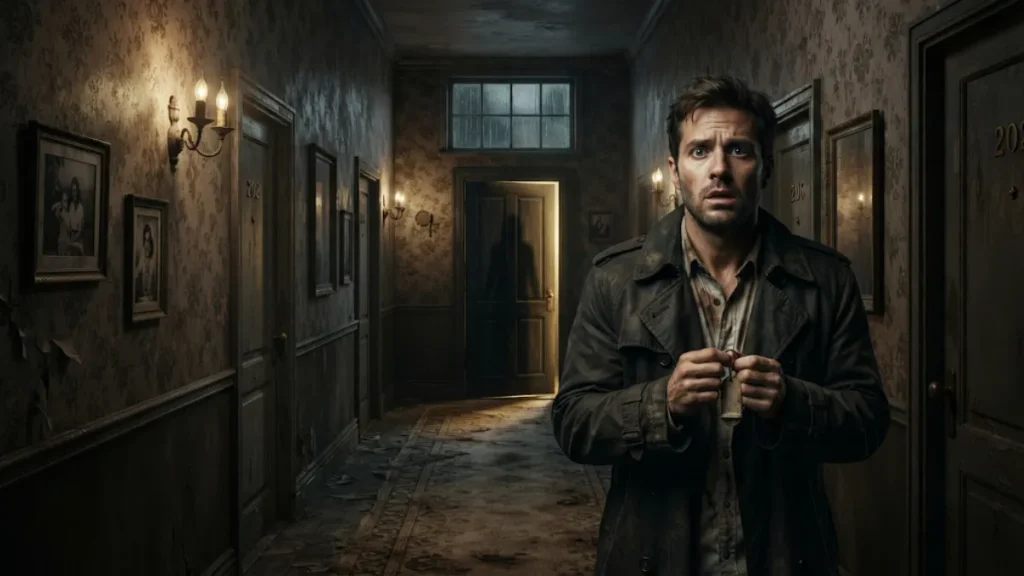
Hotels are supposed to offer temporary comfort to strangers. You check in, receive a key, sleep for a night, and leave the next morning. The room becomes just another forgotten place in your travels.
But what if your hotel has a room that doesn’t appear on the floor plan? What if the staff refuses to discuss it, the guests pretend it doesn’t exist, and the room key somehow finds its way into your pocket?
For Daniel, one unexpected night at an old hotel becomes a terrifying experience. He discovers a door without a number, hears someone calling his name from behind it, and eventually learns that some hotel rooms are not meant for guests.
The Hotel on Blackwood Street
Daniel Carter had been driving for nearly seven hours when he finally decided to stop for the night.
Rain covered the highway, his phone battery was almost dead, and the nearest town was still several miles away. He had planned to reach his destination before midnight, but the heavy weather had made driving difficult.
At around 11:30 p.m., he noticed an old hotel standing beside the road.
Its name was displayed on a faded wooden sign:
The Blackwood Hotel
The building looked unusually old. It had three floors, tall windows, and a narrow entrance sheltered by a stone balcony. A few yellow lights glowed behind the curtains, but most of the building appeared dark.
Daniel parked his car and hurried inside.
A small bell rang when he opened the door.
The reception area smelled of old wood, furniture polish, and something faintly unpleasant. Behind the counter sat an elderly receptionist wearing a dark suit.
“Good evening,” Daniel said. “Do you have a room available?”
The receptionist looked up slowly.
“One night?”
“Yes. Just until morning.”
The man opened a large register.
“Name?”
“Daniel Carter.”
The receptionist wrote something down and handed him a brass key.
“Room 214. Second floor. Breakfast begins at seven.”
Daniel noticed that the key had no electronic card attached to it. It was an old-fashioned key with a small metal tag.
“Is the restaurant still open?” he asked.
“No, sir. The kitchen closes at ten.”
“That’s fine.”
The receptionist hesitated before adding something.
“Please remain on the second floor tonight.”
Daniel smiled.
“Why? Is the third floor closed?”
The receptionist looked directly at him.
“Some areas are not available to guests.”
Daniel assumed the hotel was undergoing renovation.
He picked up his luggage and headed toward the staircase.
As he climbed, he noticed several framed photographs hanging along the wall. They showed the hotel as it had looked decades earlier.
In one photograph, a group of guests stood outside the entrance.
Daniel paused.
One of the men in the picture looked strangely familiar.
He continued upstairs without giving it much thought.
Room 214 was clean but old-fashioned. There was a large wooden bed, a wardrobe, a small television, and a window overlooking the empty road.
Daniel placed his bag beside the wardrobe and checked his phone.
No signal.
He sighed, plugged in his charger, and decided to sleep.
He had no idea that the most frightening part of his stay was still waiting for him.
The Door Without a Number
Daniel woke at approximately 2:17 a.m.
At first, he wasn’t sure what had disturbed him.
Then he heard footsteps outside.
Someone was walking slowly along the corridor.
The footsteps stopped.
A few seconds later, Daniel heard three gentle knocks.
Knock.
Knock.
Knock.
He sat up.
“Hello?”
Nobody answered.
He checked the time on his phone.
2:18 a.m.
Daniel got out of bed and approached the door. He looked through the peephole.
The corridor was empty.
He opened the door slightly.
A cold draft passed over his face.
The corridor lights flickered.
At the far end, near the staircase, he noticed something he hadn’t seen earlier.
A door.
It stood between rooms 219 and 220.
Daniel frowned.
The door had no number.
Unlike the other hotel doors, it was painted black. Its handle looked old and tarnished, and a narrow strip of yellow light appeared beneath it.
Daniel stepped into the corridor.
He looked at the doors nearby.
Room 218.
Room 219.
The strange door.
Room 220.
He was certain it had not been there when he checked in.
Perhaps he had simply missed it.
Then he heard a voice.
“Daniel?”
He froze.
The voice had come from behind the black door.
It sounded like a woman.
“Daniel, are you there?”
He stared at the door.
Nobody at the hotel knew him well enough to call him by his first name.
“Who’s there?” he asked.
Silence.
Then the woman spoke again.
“Please open the door.”
Daniel took a step backward.
He returned to room 214 and locked it.
For several minutes, he sat on the edge of the bed, listening.
Nothing happened.
Eventually, exhaustion overcame his fear, and he fell asleep.
The Missing Room
The following morning, Daniel went downstairs for breakfast.
The receptionist was sitting in the same position behind the counter.
“Good morning,” Daniel said.
“Good morning, sir.”
Daniel placed his room key on the counter.
“Can I ask you something?”
“Of course.”
“There’s a strange door at the end of the second-floor corridor. It doesn’t have a room number.”
The receptionist stopped writing.
“What door?”
“The black one. Between 219 and 220.”
The old man looked at him for several seconds.
“There is no room between 219 and 220.”
Daniel smiled awkwardly.
“I saw it last night.”
“You must have been mistaken.”
“I’m sure I wasn’t.”
The receptionist closed the register.
“Perhaps you should have an early breakfast and continue your journey.”
Daniel found the response strange.
“Is it a storage room?”
“No, sir.”
“Then what is it?”
The receptionist leaned forward.
“Mr. Carter, I suggest you do not look for that door again.”
Daniel stared at him.
“Why?”
The receptionist said nothing.
A young waiter arrived with a tray of tea and toast, interrupting the conversation.
Daniel decided not to argue.
He ate breakfast, collected his key, and returned upstairs.
Before leaving, he wanted to take a picture of the strange door.
He walked along the corridor.
Room 218.
Room 219.
Room 220.
There was no black door.
He stopped.
He checked the wall carefully.
Between rooms 219 and 220 was a narrow section of wallpaper decorated with faded flowers.
No door.
No handle.
Nothing.
Daniel rubbed his eyes.
He remembered seeing it clearly.
He returned to his room and packed his belongings.
As he was closing his suitcase, something fell from his jacket pocket.
A small brass key.
He picked it up.
It was not his room key.
This one had a round metal tag attached to it.
There was no number on the tag.
Only a small engraving:
Come back tonight.
Daniel felt a chill.
He had never seen the key before.
He placed it on the bedside table and called the reception from his room.
The receptionist answered immediately.
“Front desk.”
“I found a key in my jacket. It has no number. Did someone leave it in my room?”
The receptionist was silent.
Then he said something unexpected.
“Where did you find it?”
“In my jacket pocket.”
“Please bring it downstairs.”
Daniel carried the key to reception.
The old man took it with trembling fingers and locked it inside a drawer.
“Thank you, sir.”
“Where does it belong?”
The receptionist looked toward the staircase.
“Nowhere.”
Daniel wanted to ask more, but the man had already turned away.
Daniel returned to his car.
He had decided to leave.
But when he checked the dashboard, he noticed something strange.
The time was 2:17 a.m.
He looked at his phone.
It was 10:46 a.m.
The dashboard clock had stopped.
Daniel tapped it twice.
Nothing changed.
He started the engine and drove away.
The Woman in Room 219
Daniel had barely travelled twenty miles when his car began making a strange rattling sound.
He pulled over and checked the engine.
Nothing appeared wrong.
He considered continuing, but the rain had become heavier, and he did not want to risk breaking down on the highway.
He returned to Blackwood Hotel.
The receptionist looked surprised when Daniel walked through the entrance.
“Back already, Mr. Carter?”
“Car trouble. I’ll need another night.”
The old man slowly nodded.
“I see.”
Daniel noticed that the receptionist was holding a photograph.
It showed the same hotel entrance he had seen on the staircase.
“Is everything okay?” Daniel asked.
“Yes, sir.”
The receptionist placed the photograph inside a drawer.
Daniel checked into room 214 again.
This time, he decided to stay awake.
At around 1:45 a.m., he heard a woman’s voice coming from the neighbouring room.
Room 215.
“Please help me.”
Daniel stood up.
The voice sounded weak.
“Hello?” he called.
There was no answer.
Then came another whisper.
“He’s coming back.”
Daniel opened his door and looked into the corridor.
A young woman stood near room 219.
She wore a white dress and had long dark hair covering part of her face.
“Are you okay?” Daniel asked.
She looked at him.
For a moment, she seemed relieved.
“You’re staying in 214?”
Daniel nodded.
The woman glanced toward the end of the corridor.
“Did you see the door?”
Daniel felt his stomach tighten.
“Yes. The black door?”
She nodded.
“Don’t open it.”
“What’s inside?”
The woman stepped closer.
“People who never checked out.”
Daniel stared at her.
“Are you a guest here?”
The woman smiled faintly.
“I used to be.”
A door slammed somewhere behind them.
The woman immediately looked frightened.
“Go back to your room.”
“Wait. What’s your name?”
She hesitated.
“Emily.”
Before Daniel could ask anything else, she disappeared into room 219.
He waited for a moment.
Then he knocked.
No answer.
He tried the handle.
The door opened.
The room was empty.
The bed was neatly made, the curtains were closed, and a thick layer of dust covered the furniture.
It looked as though nobody had stayed there for years.
Daniel stepped inside.
On the bedside table was a photograph.
It showed a young woman standing outside Blackwood Hotel.
She was wearing the same white dress.
On the back, someone had written:
Emily Wilson. Checked in: October 14, 1987.
Daniel dropped the photograph.
He remembered seeing the current date on his phone.
October 14.
But the year was 2026.
He rushed out of the room.
At the far end of the corridor, the black door had returned.
This time, the yellow light beneath it was brighter.
And someone was knocking from the other side.
The Hotel’s Secret
Daniel ran downstairs.
The receptionist was standing behind the counter, as though he had been waiting.
“Who was Emily?” Daniel demanded.
The old man’s expression changed.
“You saw her?”
“She was standing outside room 219. She told me not to open the black door.”
The receptionist closed his eyes.
“Then you should listen to her.”
“Who is she?”
“She checked in many years ago.”
“Why is she still here?”
The receptionist looked toward the staircase.
“Because she never checked out.”
Daniel felt increasingly frustrated.
“Stop speaking in riddles. What is happening in this hotel?”
The old man opened a drawer and removed a thick register.
He placed it on the counter.
“Read this.”
Daniel opened it.
The pages contained handwritten guest records dating back several decades.
He found entries from the 1980s, 1990s, and early 2000s.
Some names were familiar from the newspaper reports he had read over the years.
A businessman who disappeared while travelling.
A couple who vanished during a winter holiday.
A young woman who had supposedly left her hometown without telling anyone.
Daniel turned another page.
Then he found Emily Wilson.
Her check-in date was October 14, 1987.
There was no checkout date.
Beside her name, someone had written:
Transferred to Room Without Number.
Daniel looked at the receptionist.
“What does this mean?”
The old man sat down.
“Blackwood Hotel has always had twenty rooms on the second floor. But there is another room.”
“Why doesn’t it appear on the floor plan?”
“Because it is not part of the hotel.”
Daniel stared at him.
“Then what is it?”
The receptionist’s voice became quieter.
“A place for people who cannot leave.”
Daniel looked at the staircase.
“Are you saying those people are dead?”
The old man did not answer immediately.
Then he opened another page.
“Many years ago, a guest disappeared from this hotel. The owner searched every room, every corridor, and every storage area. Eventually, he found a door that had never been there before.”
“Room without a number?”
The receptionist nodded.
“The owner entered it. He never came out.”
Daniel looked at the register again.
“Why do you keep accepting guests?”
“Because the hotel needs someone at reception.”
“What happens if nobody works here?”
The old man looked directly at him.
“Then the room begins choosing for itself.”
Daniel felt a cold sensation in his chest.
“What does it want?”
The receptionist slowly turned the register toward him.
A new entry had appeared at the bottom of the page.
Daniel Carter.
Check-in: October 14, 2026.
Room: Unassigned.
Status: Pending.
Daniel stepped backward.
“I didn’t write that.”
“No,” the receptionist replied.
“The room did.”
The Room That Knew His Name
Daniel decided to leave immediately.
He grabbed his car keys and rushed toward the entrance.
But the front door would not open.
He pulled the handle repeatedly.
It remained locked.
“Open it!” he shouted.
The receptionist stood behind the counter.
“Please remain calm.”
“Unlock the door!”
“I cannot.”
Daniel turned toward him.
“Then who can?”
The old man pointed toward the staircase.
A faint yellow light was glowing on the second floor.
Daniel heard footsteps.
Slow, deliberate footsteps.
Then a voice came from above.
“Daniel?”
It was his father’s voice.
Daniel froze.
His father had died eleven years earlier.
“Son, come here.”
Daniel’s eyes filled with tears.
He turned toward the staircase.
The receptionist shook his head.
“Don’t listen.”
But the voice continued.
“Daniel, I have been waiting.”
Daniel climbed the stairs.
Every step felt heavier than the previous one.
At the end of the corridor, the black door stood open.
Warm light spilled into the hallway.
Inside, he could hear someone moving furniture.
“Son?”
Daniel approached.
He looked through the opening.
The room appeared to be an ordinary hotel bedroom.
There was a large bed, a wooden desk, and a window overlooking the road.
His father stood beside the window.
He looked exactly as Daniel remembered him.
The same grey hair.
The same gentle smile.
The same blue shirt he had worn on the day Daniel last saw him.
Daniel’s eyes filled with tears.
“Dad?”
His father turned.
“There you are.”
Daniel stepped inside.
For a moment, he forgot about the receptionist’s warning.
He forgot about Emily.
He forgot about the strange room.
He only saw his father.
“I missed you,” Daniel whispered.
His father smiled.
“I know.”
Daniel moved closer.
“Why are you here?”
His father glanced at the door.
“Because I never left.”
Daniel felt confused.
“What do you mean?”
His father looked toward the bed.
“Sit down. We have a lot to discuss.”
Daniel remained standing.
Something felt wrong.
His father’s face was warm and familiar, but his eyes were strangely empty.
“How did you know I would come here?”
His father smiled again.
“You always come back.”
Daniel’s stomach tightened.
“What?”
Then his father said something that made Daniel step backward.
“You checked into this room once before.”
Daniel shook his head.
“No, I didn’t.”
“Not as an adult.”
The room suddenly seemed colder.
His father walked toward the desk and picked up an old photograph.
It showed a little boy standing outside Blackwood Hotel.
Daniel recognized himself.
He was about seven years old.
His father stood beside him, holding his hand.
Daniel remembered that photograph.
His mother had kept it in an album.
But he had never known where it was taken.
“Do you remember this night?” his father asked.
Daniel stared at the picture.
“No.”
His father placed it on the desk.
“You were here with me. I came to collect something from the owner. You were tired, so I told you to wait in the car.”
Daniel felt a strange pressure behind his eyes.
Images began appearing in his mind.
Rain.
A dark staircase.
A door without a number.
His father telling him to stay outside.
Then a voice calling his name.
Daniel stumbled backward.
“What happened?”
His father stepped closer.
“You opened the door.”
Daniel’s breathing became uneven.
“No.”
“You came inside.”
“No!”
His father lowered his voice.
“And you never left.”
The Twist Behind Room 214
Daniel suddenly remembered everything.
He remembered being seven years old, sitting in the passenger seat of his father’s car outside Blackwood Hotel.
He remembered waking up alone.
He remembered entering the hotel to look for his father.
He remembered a black door at the end of the second-floor corridor.
And he remembered opening it.
Inside was a room filled with people.
Some were sitting on beds.
Some were standing near the windows.
Others were staring silently at the walls.
They all looked as though they were waiting for someone.
Daniel remembered seeing a woman in a white dress.
Emily.
He remembered his father standing near the window.
And he remembered his father telling him to come closer.
Then the memory disappeared.
Daniel looked at the man in front of him.
“You’re not my father.”
The man’s smile faded.
“Of course I am.”
“No. My father died in a hospital.”
The figure’s face changed.
For a moment, it looked older.
Then younger.
Then completely unfamiliar.
The walls began making a low creaking sound.
Daniel turned toward the door.
It was slowly closing.
He ran toward it.
But before he could reach the handle, someone grabbed his arm.
It was Emily.
“Don’t let it close!”
Daniel struggled.
“Who are you?”
Emily pulled him toward the corridor.
“I told you not to open it.”
They stumbled into the hallway.
The door slammed behind them.
Daniel looked at her.
“Why did you help me?”
Emily’s expression was sad.
“Because someone helped me once.”
“Who?”
She pointed toward the staircase.
“The receptionist.”
Daniel looked down.
At the bottom of the stairs, the elderly man was standing with a key in his hand.
“Come quickly,” he shouted.
Daniel and Emily rushed downstairs.
The receptionist unlocked the front door.
“Go!” he yelled.
Daniel stepped outside.
Cold rain hit his face.
He turned to look for Emily.
She was standing in the doorway.
For the first time, she looked peaceful.
“Thank you,” she whispered.
Then she stepped backward into the darkness.
The door closed.
Daniel stood in the rain, shaking.
He turned toward the receptionist.
“Come with me!”
The old man smiled sadly.
“I cannot.”
“Why?”
The receptionist looked toward the hotel.
“Because I checked in many years ago.”
Daniel stared at him.
“Who are you?”
The old man reached into his pocket and handed Daniel a photograph.
It showed a young man standing outside Blackwood Hotel.
Daniel recognized him immediately.
It was the receptionist.
The date printed on the back was 1962.
Daniel looked up.
The old man’s face had not changed.
“How long have you been here?”
The receptionist smiled.
“Long enough to know that the room never forgets a guest.”
Daniel backed away.
Then he ran toward his car.
The Guest Who Never Left
The following morning, Daniel woke up in his own bed.
Sunlight entered through the curtains.
His clothes were dry.
His phone was charging beside him.
For several minutes, he wondered whether the entire experience had been a dream.
Then he noticed something on his bedside table.
A brass key.
It had a round metal tag attached to it.
There was no number.
Only two words:
Room 214.
Daniel immediately called the hotel.
The number was disconnected.
He searched for Blackwood Hotel online.
Nothing appeared.
He searched the address.
There was no hotel on Blackwood Street.
Instead, he found an old newspaper article about a building that had burned down in October 1987.
The fire had destroyed a small hotel.
Several guests were reported missing.
Among them was a seven-year-old boy named Daniel Carter.
The article stated that the boy had been travelling with his father, who survived the incident.
Daniel read the article several times.
The date was October 14, 1987.
His hands began to shake.
He looked at his phone.
The date was October 15, 2026.
He opened his family album and searched for the photograph of himself outside the hotel.
It was there.
A little boy standing beside his father.
On the back was a handwritten message from his mother:
Daniel’s first hotel trip. October 1987.
He looked at the picture again.
His father was smiling.
Daniel was holding a small brass key.
The same key that now rested beside his bed.
Then he noticed something else.
Behind them, in the hotel entrance, stood the elderly receptionist.
But the receptionist in the photograph was not an old man.
He was young.
And he was looking directly at Daniel.
Daniel slowly turned the photograph over again.
A new line had appeared beneath his mother’s handwriting.
Guest checked in: October 14, 1987.
Guest never checked out.
His phone rang.
The caller ID displayed an unknown number.
Daniel answered.
For several seconds, there was only silence.
Then he heard the familiar voice of the elderly receptionist.
“Good morning, Mr. Carter.”
Daniel could not speak.
“We have your room ready.”
A pause followed.
“Room 214, as requested.”
Daniel looked at the brass key.
The receptionist continued.
“Breakfast is served until seven. Please don’t be late.”
Then the call ended.
Daniel stared at the photograph.
His father was still smiling.
But now the little boy in the picture was no longer looking at the camera.
He was looking toward the hotel entrance.
And behind him, the black door stood open.
Daniel finally understood the truth. He had never returned to Blackwood Hotel as an adult. He had simply grown up inside a room that had been waiting for him to remember.
6. The Voice Calling From the Empty House
Horror Short Story for Adults With a Twist
An empty house should be silent. There should be no footsteps in the hallway, no movement behind closed doors, and certainly no familiar voice calling your name from an upstairs bedroom.
When Michael returns to his childhood home after his mother’s death, he expects to spend a few days sorting through old belongings before selling the property. But every night, he hears someone calling him from inside the locked house next door.
At first, he assumes it is a neighbour playing a cruel trick. Then he hears his mother’s voice.
The problem is that his mother has been dead for three weeks.
The House at the End of Willow Lane
Michael Reed had not visited his childhood home in almost fifteen years.
The house stood at the end of Willow Lane, a quiet residential street surrounded by old trees and narrow gardens. It was a large two-storey building with faded white walls, a red-tiled roof, and a wooden front door that had not been painted since his childhood.
His mother, Eleanor, had lived there alone after his father died.
When she passed away three weeks earlier, Michael returned to settle the property and arrange its sale. He planned to spend four or five days sorting through the furniture, documents, and personal belongings before leaving permanently.
The first two days were uneventful.
He cleaned the kitchen, packed old clothes, and arranged for a local agent to inspect the property.
But something about the neighbouring house bothered him.
It stood directly beside his mother’s home. Unlike the other houses on Willow Lane, its windows were always covered with thick curtains. The garden had become overgrown, the front gate was rusted, and weeds had grown through the cracks in the driveway.
Michael remembered the house from childhood.
It had belonged to an elderly couple, Mr and Mrs Harris. He remembered seeing them occasionally, but they had moved away when he was around ten years old.
Since then, nobody appeared to have lived there.
On his second evening, Michael noticed a light inside one of the upstairs windows.
He stopped washing the dishes and looked outside.
The light was faint, almost yellow.
Someone was standing behind the curtain.
Michael stared for several seconds.
Then the figure moved away.
He assumed the property had been sold recently and that someone had finally moved in.
He returned to his work.
At around 11:30 p.m., he went upstairs to sleep.
That was when he heard the first voice.
“Michael?”
He stopped halfway through removing his jacket.
The voice came from outside.
It sounded like a woman calling from the neighbouring house.
“Michael, come here.”
He walked toward the bedroom window and looked out.
The street was empty.
The neighbouring house was dark again.
He waited, but nothing happened.
Perhaps someone had mistaken him for another person.
He closed the curtains and went to bed.
A few minutes later, the voice returned.
This time, it was closer.
“Michael, I know you’re awake.”
He sat up.
The voice sounded familiar.
Too familiar.
It was his mother’s voice.
The Voice Behind the Wall
Michael spent the next morning trying to convince himself that exhaustion had caused the strange experience.
He had driven for several hours, dealt with funeral arrangements, and spent two days cleaning an old house. Perhaps his mind was simply playing tricks on him.
Still, he decided to investigate the neighbouring property.
He walked through the garden and approached its front gate.
A rusty chain held it shut.
He called out.
“Hello? Is anyone there?”
No answer.
He looked through the gate.
The front door was covered in dust, and the windows were dirty. There were no footprints in the garden.
Michael noticed a small brass nameplate beside the entrance.
It read:
HARRIS FAMILY
He remembered the name.
He returned to his own house and called the local property agent.
“Do you know who owns the house next door?”
The agent checked his records.
“Which property?”
“The old Harris house. Number 18.”
There was a pause.
“That property is still registered to the Harris family.”
“Is anyone living there?”
“Not that I’m aware of. It has been empty for years.”
Michael frowned.
“Are you sure?”
“Quite sure. Why?”
“Nothing. I thought I saw someone inside last night.”
The agent laughed politely.
“Probably a reflection. Those old windows can be deceptive.”
Michael ended the call.
That evening, he decided to stay downstairs rather than go to bed early.
He made coffee, switched on the television, and sat in the living room.
At 10:48 p.m., the lights in the neighbouring house turned on.
Michael looked through the curtains.
A shadow moved behind the upstairs window.
Then he heard a voice.
“Michael?”
He stood up.
It was definitely his mother.
“Michael, please.”
His coffee cup slipped from his hand and broke on the floor.
He knew that voice.
He had heard it every day throughout his childhood. He remembered its gentle tone, the slight softness in the way she pronounced his name, and the familiar pause before she spoke.
He had heard it in the hospital three weeks earlier, just before she died.
“Michael, open the door.”
He stepped closer to the window.
The voice came from the neighbouring house.
But his mother had never lived there.
He picked up his phone and recorded the sound.
“Mom?” he whispered.
Silence.
Then the voice answered.
“Why did you leave me alone?”
Michael dropped the phone.
For several seconds, he could not move.
Then he heard something that frightened him even more.
A slow knock came from the wall separating the two houses.
Three knocks.
Then a pause.
Then three more.
The Locked Room
The following morning, Michael visited the local police station.
He explained what had happened, although he avoided mentioning that the voice sounded like his dead mother.
He told the officer that someone might be entering the neighbouring property without permission.
The officer listened patiently.
“Have you actually seen anyone?”
“No. But I heard someone calling my name.”
“Could it be a recording?”
“Possibly.”
The officer took the address and promised to check the property.
Michael returned home feeling slightly embarrassed.
He decided to examine the old photographs in his mother’s bedroom. Perhaps something there would distract him.
Inside a cupboard, he found several albums from his childhood.
He opened one.
There were photographs of birthday parties, school events, family holidays, and Christmas celebrations.
In one picture, he stood beside his mother in the garden.
Behind them was the neighbouring house.
Michael noticed something strange.
One of its upstairs windows was open.
A small boy was standing inside, looking directly at the camera.
Michael leaned closer.
The boy appeared to be around seven years old.
He wore a white shirt and dark trousers.
His face was pale.
Michael turned the photograph over.
His mother’s handwriting appeared on the back.
Michael’s seventh birthday. October 1994.
He stared at the picture.
He remembered that birthday.
He remembered the cake, the balloons, and his father giving him a bicycle.
But he did not remember anyone standing in the neighbouring house.
He checked the next photograph.
It showed him opening presents inside the living room.
The same boy appeared behind the curtains of the house next door.
Another photograph showed Michael playing football in the garden.
The boy was standing near the fence.
He appeared in picture after picture.
Always watching.
Always alone.
Michael searched the remaining albums.
The boy appeared in photographs taken over several years.
But he never seemed to grow older.
Michael felt a chill.
He called his mother’s old friend, Mrs Collins, who lived two streets away.
“Do you remember the Harris family?”
Mrs Collins became quiet.
“Why are you asking?”
“I found some old photographs. There seems to be a boy in the neighbouring house.”
A long silence followed.
Then Mrs Collins said, “Michael, you should not be looking at those photographs.”
“Why?”
“Because that family had a child.”
“Who was he?”
“His name was David.”
Michael waited.
“What happened to him?”
“Nobody knows. He disappeared.”
“When?”
“October 1994.”
Michael looked at the photograph in his hand.
His seventh birthday.
The date was exactly the same.
Mrs Collins continued.
“His parents left the house shortly afterward. People said they had gone away because they couldn’t bear living there anymore.”
“Was David ever found?”
“No.”
Michael looked toward the neighbouring house.
For the first time, he wondered whether the voice calling him at night belonged to the missing boy.
But why did it sound like his mother?
The Recording
That night, Michael placed his phone on the living room table and started recording.
He wanted proof.
At 11:17 p.m., the neighbouring house became illuminated again.
A faint yellow light appeared in the upstairs window.
Michael watched.
A small figure moved behind the curtain.
Then the voice came.
“Michael?”
He pressed the record button.
“Who are you?” he called.
The voice answered immediately.
“It’s me.”
“Who?”
“You know me.”
Michael swallowed.
“Are you David?”
The lights in the neighbouring house flickered.
A soft laugh came through the wall.
“No.”
“Then who are you?”
The voice changed.
It became his mother’s voice again.
“Come and see me, Michael.”
He backed away.
“You’re not my mother.”
“Why do you say that?”
“Because my mother is dead.”
Silence.
Then the voice whispered:
“Are you sure?”
Michael felt his chest tighten.
He wanted to leave the house immediately, but he forced himself to stay.
“Tell me something only my mother would know.”
The voice was quiet for several seconds.
Then it said:
“You were afraid of the dark when you were little. You used to sleep with the hallway light on.”
Michael closed his eyes.
It was true.
He had never told anyone about it.
The voice continued.
“Your father used to check on you every night. But after he died, I stayed awake until you fell asleep.”
Michael began crying.
“Mom?”
“Come outside, sweetheart.”
He walked toward the front door.
Then his phone vibrated.
The recording had stopped.
He looked at the screen.
The audio file was only forty-seven seconds long.
He played it.
At first, he heard the same voice.
But the recording contained something he had not noticed while listening live.
Behind the woman’s voice, another voice was speaking.
A child’s voice.
It repeated the same sentence over and over.
“Don’t let her in.”
Michael replayed the recording.
“Don’t let her in.”
“Don’t let her in.”
“Don’t let her in.”
Then he heard a final whisper.
“She’s not your mother.”
Michael dropped the phone.
Outside, the neighbouring house went dark.
The Woman in the Window
The next morning, Michael decided to visit the Harris property with the police.
The officer arrived shortly after nine.
They approached the front gate and found the chain still attached.
The officer cut it with a pair of bolt cutters.
Inside, the garden was overgrown, and the entrance was covered in dust.
The officer knocked.
No answer.
He tried the handle.
The door was unlocked.
They entered.
The smell inside was unbearable.
The furniture was covered with white sheets, and thick cobwebs stretched across the corners of the rooms.
Everything looked untouched.
Michael walked slowly through the living room.
A large family portrait hung above the fireplace.
It showed Mr and Mrs Harris standing beside a little boy.
The boy was David.
Michael recognized him immediately.
The same pale face.
The same white shirt.
The same expression from the old photographs.
But something else caught his attention.
The woman in the portrait looked exactly like his mother.
Not similar.
Exactly like her.
Michael stepped closer.
“Who is this?” he asked.
The officer looked at the portrait.
“Mrs Harris.”
“No. That’s my mother.”
The officer frowned.
“Are you sure?”
Michael stared at the woman.
He knew her face better than anyone.
Her eyes, her smile, and even the small mark near her left eyebrow were identical.
He touched the frame.
Then he noticed a handwritten note beneath it.
The Harris family, October 1994.
Michael felt dizzy.
His mother had been living in the neighbouring house before he was born.
Or at least, someone who looked exactly like her had.
The officer continued searching.
Upstairs, they found three bedrooms and a small storage room.
The final bedroom had been locked from the outside.
The officer forced it open.
Inside was a child’s bedroom.
There was a small bed, a wooden desk, several toys, and a shelf filled with storybooks.
On the desk lay a school notebook.
Michael picked it up.
The first few pages contained ordinary drawings.
A house.
A garden.
A family.
Then the drawings became strange.
The boy had drawn a woman standing outside his bedroom window.
In another picture, the woman was standing beside his bed.
In the final drawing, the woman had no face.
Beneath it, David had written:
She wears my mother’s face.
Michael’s hands began shaking.
The officer called from the doorway.
“Mr Reed, you should see this.”
He was standing beside a wardrobe.
Inside were dozens of photographs.
They showed the same woman standing in different rooms.
Sometimes she was smiling.
Sometimes she was crying.
In several photographs, she was looking directly at the camera.
Michael recognized her.
It was his mother.
But the photographs were dated long before he had been born.
The Truth About David
Michael returned to his mother’s house and searched through every document he could find.
He found an old envelope hidden beneath the floorboards in her bedroom.
Inside were several letters.
The first was addressed to Eleanor Reed.
It was dated 1994.
The sender was Mrs Harris.
Dear Eleanor,
I know you told us never to contact you again, but David keeps asking about you.
He says he hears your voice at night.
He says you call him from the empty rooms.
We have tried everything, but he refuses to sleep.
Please tell us what happened in that house.
Michael read the letter twice.
Then he found another.
This one was written by his mother.
Dear Mrs Harris,
I am sorry for what happened.
I never wanted David to see me.
He should not have been able to hear my voice.
Please keep him away from the old house.
Michael felt his heart beating faster.
He searched for the remaining letters.
The final one was dated October 1994.
It contained only a few lines.
Eleanor,
David has disappeared.
Last night, we heard him calling from your house.
We searched every room, but he was nowhere.
When we returned home, his bedroom was locked from the inside.
The only thing we found was a photograph of you.
Please tell us what you have done.
Michael dropped the letter.
His mother had known the Harris family.
She had known David.
And somehow, she had been involved in his disappearance.
But why?
He continued searching until he found an old diary.
The first entry was written by his mother when she was twenty-eight.
October 12, 1994.
The boy came again. He stood outside the window and asked why I had taken his mother.
I told him to go home.
He said he knew I was not his mother.
I am beginning to think he can see what I really am.
The next entry was dated October 14.
David came into the house tonight.
He found the room.
He saw the photographs.
He called me Eleanor.
I told him I was not his mother.
He began screaming.
Then he disappeared.
Michael could barely breathe.
He turned to the final page.
It contained a message written in a different handwriting.
The letters were uneven, as though written by a child.
Michael,
She told you she was your mother.
But she was never the woman who gave birth to you.
Ask her what happened in the house.
Ask her why she kept my voice.
At the bottom was a name.
David.
The Woman Who Wasn’t His Mother
Michael returned to his mother’s bedroom.
He sat on the bed and looked at the photograph of her on the bedside table.
For the first time, he noticed something unusual.
In every photograph he had seen of his mother, she appeared exactly the same age.
Even pictures taken decades apart showed no noticeable changes.
He called Mrs Collins again.
This time, he asked directly.
“Was my mother involved in David’s disappearance?”
Mrs Collins sighed.
“I hoped you would never discover this.”
“What happened?”
“Your mother was not the woman you think she was.”
Michael closed his eyes.
“Explain.”
“Your real mother died when you were born. Eleanor was her older sister.”
Michael felt as though the floor had disappeared beneath him.
“What?”
“Eleanor raised you. Your father agreed to keep the truth hidden because he thought it would protect you.”
“Why did nobody tell me?”
“Because Eleanor was afraid you would leave her.”
Michael looked at the old photographs.
“Was David her son?”
Mrs Collins became quiet.
“Yes.”
Michael felt sick.
David was his cousin.
Eleanor had lost her son in 1994, and she had spent the rest of her life pretending nothing had happened.
But there was something he still did not understand.
“Why did David say she wasn’t his mother?”
Mrs Collins took a deep breath.
“Because Eleanor was not the same after he disappeared.”
Michael waited.
“She started hearing his voice. She claimed he was calling from the empty house. She began telling people that David was still alive, even though the police had searched everywhere.”
“Did she know where he was?”
“No one knew.”
“Then why did she keep his photographs?”
Mrs Collins answered softly.
“Because she believed she had taken something from him.”
The call ended.
Michael sat alone for a long time.
Then he heard a voice from the hallway.
“Michael?”
He looked toward the door.
It was his mother’s voice.
“Sweetheart, are you there?”
He stood up.
The voice came from the neighbouring house.
But the house was supposed to be empty.
He walked to the window.
A woman stood behind the upstairs curtain.
It was Eleanor.
She looked exactly as she had in the last photograph taken before her death.
She raised one hand and waved.
Michael backed away.
Then another figure appeared beside her.
A little boy.
David.
He was holding her hand.
The woman turned toward him.
Her smile disappeared.
She opened her mouth.
But the voice that came out was not Eleanor’s.
It was David’s.
“Michael, don’t come here.”
The Last Call
Michael ran downstairs and locked the front door.
He pulled the curtains shut and switched on every light in the house.
Then his phone rang.
The screen displayed his mother’s old number.
He stared at it.
That number had been disconnected after her death.
The phone rang again.
He answered.
“Hello?”
For several seconds, he heard only breathing.
Then a familiar voice spoke.
“Michael, it’s me.”
He closed his eyes.
“Who are you?”
A soft laugh came through the speaker.
“You know who I am.”
“No. I don’t.”
The voice became gentle.
“Remember when you were six? You fell off your bicycle, and I carried you home. You cried all the way because you thought your father would be angry.”
Michael said nothing.
“Remember your first day at school? You held my hand so tightly that I couldn’t open the front gate.”
Tears filled his eyes.
Those memories were real.
Whether Eleanor was his mother or aunt, she had raised him.
She had loved him.
Or at least, he had believed she had.
“Why did you keep calling me?” he asked.
“Because I wanted you to come home.”
“I’m already home.”
“No, Michael.”
Her voice changed.
“You are in the wrong house.”
Michael looked toward the front door.
Someone was standing outside.
He could see a shadow beneath it.
Then came three gentle knocks.
Knock.
Knock.
Knock.
“Open the door, sweetheart.”
Michael stepped backward.
“You’re dead.”
The voice sighed.
“I know.”
“Then leave me alone.”
A long silence followed.
Then the woman whispered:
“I never wanted to lose either of you.”
Michael felt a cold sensation move through the room.
“Either of us?”
“David and you.”
He looked toward the window.
The neighbouring house was dark.
“Where is David?”
The voice became almost inaudible.
“Inside.”
“Inside where?”
“Inside the room you were never supposed to find.”
Michael suddenly remembered the old photograph of the boy standing behind the curtains.
He remembered the notebook.
The letters.
The strange drawings.
Then he heard a child’s voice behind him.
“She’s lying.”
Michael turned.
A little boy stood at the top of the staircase.
He wore a white shirt and dark trousers.
His face was pale.
It was David.
Michael could barely speak.
“David?”
The boy nodded.
“Please don’t listen to her.”
“Where have you been?”
The boy pointed toward the neighbouring house.
“She kept me there.”
Michael looked toward the front door.
The knocking had stopped.
“Why?”
David looked down.
“Because she couldn’t accept that I was gone.”
Michael frowned.
“What do you mean?”
The boy’s eyes filled with tears.
“She made me disappear. Then she tried to replace me with you.”
Michael felt his knees weaken.
The little boy continued.
“She told everyone you were her son. She gave you my room, my toys, and my name.”
Michael stared at him.
“What are you saying?”
David pointed toward the photograph on the wall.
It showed Michael as a child standing beside Eleanor.
But now he noticed something.
The photograph had been altered.
A second child had been removed from the picture.
There was a faint outline beside Michael.
A space where someone should have been standing.
David whispered:
“She didn’t take me from my parents.”
He looked directly at Michael.
“She took you from me.”
The Final Photograph
Michael could no longer tell what was real.
He remembered growing up with Eleanor.
He remembered his father.
He remembered his childhood bedroom and the family holidays.
But he also remembered a small boy appearing in the background of photographs.
A boy who never seemed to grow older.
A boy who had disappeared on his seventh birthday.
Michael looked at David.
“Why are you calling me?”
The boy answered quietly.
“Because you are the only person who can let me go.”
“How?”
“Tell someone what happened.”
Michael picked up his phone and called the police.
He told them everything.
The missing boy.
The old letters.
The photographs.
The house next door.
When the officers arrived, they searched both properties.
In the neighbouring house, they discovered a hidden room behind a false wall.
Inside were children’s clothes, old toys, photographs, and a small wooden box.
The box contained a silver bracelet.
It had the name David engraved on it.
They also found a small skeleton beneath the floorboards.
The remains were identified as those of David Harris.
The investigation revealed that Eleanor had taken the boy from his bedroom in October 1994. She had been suffering from a severe psychological disturbance after losing her own child years earlier. She had become convinced that David belonged with her.
Michael’s father had discovered the truth but had hidden it to protect the family.
Eleanor had raised Michael under a false identity, keeping him away from the truth.
David had died inside the neighbouring house.
The voice Michael heard was not simply an echo.
It was a memory that had never been allowed to rest.
A week later, Michael left Willow Lane.
Before leaving, he returned to the house one final time.
He stood in the garden and looked toward the neighbouring property.
The upstairs window was open.
For a moment, he thought he saw a little boy standing behind the curtain.
David raised his hand.
Michael raised his hand in return.
Then the boy disappeared.
Michael walked to his car.
Just before he opened the door, his phone vibrated.
A new audio file had appeared.
It was a recording from the night he first heard his mother’s voice.
He played it.
At first, he heard the familiar whisper.
“Michael, come here.”
Then the child’s voice spoke.
“Don’t let her in.”
The recording continued for several seconds.
Then another voice appeared.
It was a man’s voice.
Michael recognized it immediately.
His father.
“Son, if you can hear this, I’m sorry.”
Michael stopped breathing.
The recording continued.
“I tried to protect you. I thought keeping you away from the truth would give you a normal life. But I should have told you what happened.”
There was a pause.
Then his father whispered:
“David wasn’t the only child who disappeared that night.”
Michael felt his hands go cold.
A final sound came through the recording.
A child’s voice.
Not David’s.
It was Michael’s own childhood voice.
“Where’s my brother?”
The recording ended.
Michael slowly looked back at the two houses.
For the first time, he noticed a small detail in the upstairs window of his childhood home.
Two boys were standing side by side.
One was David.
The other looked exactly like Michael when he was seven years old.
Both were watching him.
Then the lights went out.
Michael drove away without looking back.
But that night, in a hotel room hundreds of miles from Willow Lane, his phone rang again.
The caller ID displayed his mother’s name.
He answered without speaking.
A woman’s voice whispered:
“Michael, sweetheart, why did you leave your brother alone?”
Then a child’s voice answered from somewhere inside the room.
“We’re not alone anymore.”
Michael turned toward the wardrobe.
The door was slightly open.
And from the darkness came the sound of two little boys laughing.
7. The Man Who Never Appeared in Mirrors
Genre: Supernatural Horror, Psychological Thriller, Mystery
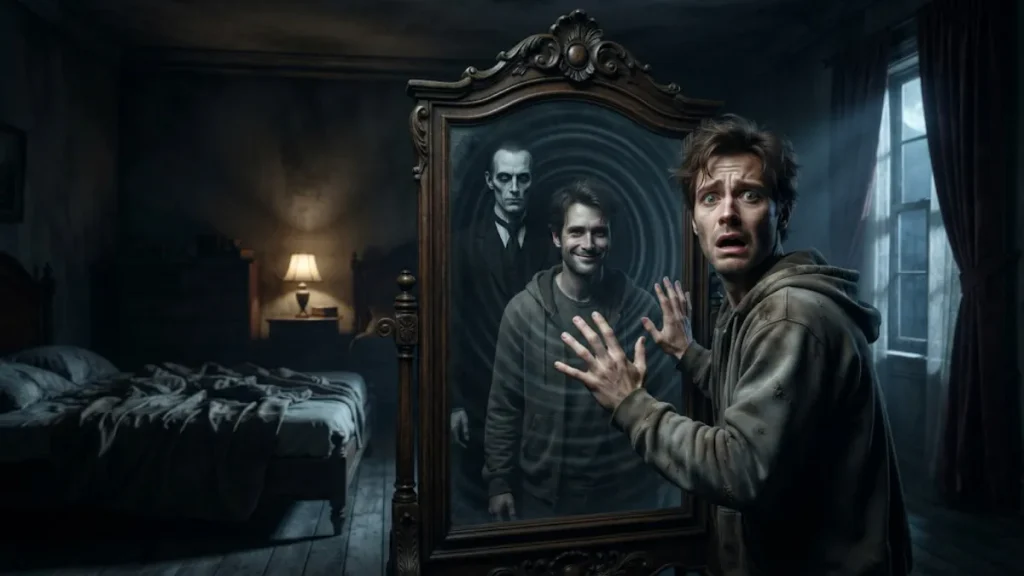
The first time Daniel noticed the missing reflection, he blamed the lighting.
He was standing in the bathroom of his new apartment, brushing his teeth before bed. The fluorescent light above the mirror flickered occasionally, making his face appear pale and unfamiliar. He leaned closer to inspect a small cut near his chin.
Something seemed wrong.
His reflection was there, but the space behind his shoulder looked empty.
Daniel turned around.
Nobody was standing behind him.
He faced the mirror again. Everything appeared normal. The shower curtain, the towel hanging beside the sink, the half-open bathroom door. Even the dark hallway beyond it was visible.
He shook his head and finished brushing his teeth.
It had been a long day. He was tired, and strange things often seemed more frightening after midnight.
But the following morning, he noticed something much worse.
There was a man standing behind him.
Daniel saw him clearly in the mirror.
He was tall, thin, and dressed in an old-fashioned black suit. His hair was neatly combed, and his face was pale enough to resemble a photograph left in the sun.
Daniel spun around.
The bathroom was empty.
He turned back toward the mirror.
The man was gone.
Daniel stared at his own reflection for several seconds. His heart was beating so hard that he could feel it in his throat.
Then he noticed another detail.
The man had not been looking at Daniel.
He had been looking directly at the mirror.
As though he were standing on the other side of it.
The Apartment With the Old Mirror
Daniel had moved into apartment 407 three weeks earlier.
It was an inexpensive one-bedroom apartment in an old building on the edge of the city. The rent was surprisingly low, and the location was convenient for his new job.
The apartment came furnished with a few old pieces of furniture, including a large wooden mirror in the bedroom.
The mirror was unusually heavy. Its dark wooden frame was covered with delicate carvings, and its glass had several tiny marks near the bottom.
When Daniel had asked the landlord about it, the elderly man had shrugged.
“That mirror belonged to the previous owner,” he explained. “You can keep it or throw it away. Whatever you prefer.”
Daniel had decided to keep it. It looked expensive, and he liked the antique appearance.
Now, however, he wished he had never brought it into his bedroom.
That evening, he called his friend Marcus.
“I think something strange is happening in my apartment,” Daniel said.
Marcus laughed.
“You’re watching too many horror movies.”
“I’m serious. I saw someone in the bathroom mirror this morning.”
“Someone?”
“A man. He was standing behind me, but when I turned around, nobody was there.”
Marcus became quiet for a moment.
“Have you been sleeping properly?”
“Yes.”
“Then maybe you need a new pair of glasses.”
Daniel sighed.
“Forget it.”
They talked about work for a few more minutes before ending the call.
Daniel went to the bedroom and looked at the antique mirror.
His reflection stared back at him.
He raised his right hand.
The reflection raised its right hand.
He stepped to the left.
The reflection moved with him.
Everything appeared normal.
Then Daniel noticed a small detail.
His reflection was smiling.
Daniel wasn’t.
He stopped moving.
The smile remained for another second before slowly disappearing.
He backed away from the mirror.
For the rest of the night, he kept the bedroom lights on.
The Man in the Photographs
The following afternoon, Daniel decided to investigate the mirror.
He searched online for its design and discovered that it looked similar to mirrors manufactured in the early twentieth century.
He also noticed a small metal plate attached to the back of the wooden frame.
Most of the writing had faded, but he could make out a name:
E. HARRINGTON
Daniel searched the name along with the words antique mirror and apartment 407.
Nothing useful appeared.
He then removed the mirror from the bedroom wall to clean the dust behind it.
That was when he discovered something unusual.
Someone had scratched a sentence into the wooden back.
The letters were uneven, as though they had been carved in a hurry.
DO NOT LET HIM SEE YOU LOOKING.
Daniel read it twice.
He felt a chill move down his back.
Who had written it?
And who was “him”?
He examined the mirror again, searching for other markings. Near the lower edge, he found a tiny photograph trapped between the wooden frame and the glass.
It showed an elderly couple standing outside a large house.
The man was wearing a black suit.
Daniel recognized him immediately.
It was the same man he had seen in the bathroom mirror.
He looked exactly as he had appeared that morning, with the same pale face and neatly combed hair.
Daniel turned the photograph over.
There was a date written on the back.
October 14, 1938.
Underneath it was a short message.
Edward Harrington and his wife, Eleanor. Taken two weeks before his disappearance.
Daniel searched the name again, this time adding the word disappearance.
An old newspaper article appeared.
The headline read:
LOCAL BUSINESSMAN VANISHES WITHOUT A TRACE.
Edward Harrington had disappeared from his home in 1938. His wife had told the police that he went upstairs one evening and never came down.
There had been no signs of forced entry.
No evidence of violence.
No explanation.
Daniel looked at the photograph again.
For the first time, he noticed something disturbing.
Eleanor was standing beside Edward, smiling at the camera.
But Edward was looking toward the photographer with an expression of complete terror.
A Reflection Without a Man
That night, Daniel covered the bedroom mirror with a bedsheet.
He told himself he was being ridiculous, but the photograph had changed everything.
At around 2:15 a.m., he woke up to a strange sound.
Tap.
Tap.
Tap.
Someone was knocking.
Daniel sat up and listened.
The sound was coming from the bedroom mirror.
He reached for his phone and switched on its flashlight.
The bedsheet covering the mirror was moving slightly.
Tap.
Tap.
Tap.
Daniel slowly got out of bed.
He approached the mirror and pulled the bedsheet away.
His reflection stood in front of him.
But something was wrong.
Daniel could see the bedroom behind his reflection. The bed, the wardrobe, the window.
He could see himself standing in the mirror.
But there was another figure behind his reflection.
Edward Harrington.
The man was standing very close to the glass, his face inches from Daniel’s reflected face.
His lips moved.
Daniel couldn’t hear anything.
Then Edward raised one hand and pressed it against the inside of the mirror.
A faint mark appeared on the glass.
It looked like a handprint.
Daniel stumbled backward.
The bedroom lights suddenly went out.
He ran toward the door, but before reaching it, he heard a voice behind him.
“Don’t turn around.”
It was his own voice.
Daniel froze.
The voice came again.
“Please. Don’t turn around.”
He slowly looked over his shoulder.
The mirror was glowing faintly in the darkness.
His reflection was still standing there.
But Daniel was no longer sure it was copying him.
The reflected figure had not moved.
It was staring at him with a frightened expression.
Then it mouthed three words.
HE IS BEHIND YOU.
Daniel ran out of the bedroom.
He spent the rest of the night sitting in the living room with every light switched on.
The Woman Who Knew Edward
The next morning, Daniel visited the building manager.
His name was Mr. Collins, an elderly man who had worked in the building for more than forty years.
Daniel showed him the photograph.
The moment Collins saw Edward Harrington’s face, his expression changed.
“Where did you get that?”
“It was inside my bedroom mirror.”
Collins slowly sat down.
“That mirror should have been destroyed.”
“Why?”
The old man looked toward the apartment hallway before answering.
“Edward Harrington owned this building before it was converted into apartments. He lived here with his wife, Eleanor. People said he was a quiet man, but something happened to him near the end of his life.”
“What happened?”
“Nobody knows. His wife claimed he became frightened of mirrors. He covered every reflective surface in the house. Even the windows.”
Daniel felt his stomach tighten.
“Did he disappear?”
Collins nodded.
“One evening, his wife heard him speaking in the bedroom. When she entered, he was standing in front of the mirror. She said he was arguing with someone who wasn’t there.”
“What did she see?”
“She said there were two men in the room.”
Daniel leaned forward.
“Two men?”
“One was Edward. The other looked exactly like him, except he was standing inside the mirror.”
Collins paused.
“By the time the police arrived, Edward was gone. His wife never lived in that house again.”
Daniel took a deep breath.
“What happened to her?”
“She died many years later. Before she died, she left a note for the building owner. She asked him to destroy the mirror.”
“Why didn’t he?”
Collins looked uncomfortable.
“He tried. The glass wouldn’t break.”
Daniel remembered the handprint.
“What did the note say?”
Collins stood up and opened a drawer in his office.
After searching through several old documents, he found a yellowed envelope.
Inside was a handwritten letter from Eleanor Harrington.
Daniel read it carefully.
Edward was not the first person to see the man in the mirror. He was simply the first person who answered him.
The reflection is not a reflection. It is a copy.
It watches. It learns. It waits.
If you ever see a man standing behind you in the mirror, do not turn around to look for him.
And if your reflection stops moving, leave the room.
Daniel read the final sentence twice.
Because the man in the mirror is trying to learn how to live outside it.
The Night the Reflection Changed
Daniel returned to apartment 407 and immediately called a removal company.
He wanted the mirror gone.
The workers arrived that afternoon, but neither man was willing to touch it after seeing the handprint on the glass.
One of them suggested calling a specialist.
Daniel paid them anyway and told them to leave.
He decided he would remove the mirror himself.
He found a screwdriver and began loosening the metal brackets.
As he worked, he noticed something strange.
The mirror was not reflecting the bedroom accurately.
The curtains were open in the reflection, although the real curtains were closed.
The reflected bed was empty, even though Daniel’s jacket was lying across it.
And in the far corner of the reflected room stood Edward Harrington.
He was watching.
Daniel dropped the screwdriver.
The figure raised one finger and pointed toward the bedroom door.
Daniel turned around.
Nothing.
When he faced the mirror again, Edward was closer.
His expression was no longer frightened.
He was smiling.
Daniel grabbed the nearest object, a heavy bedside lamp, and swung it toward the glass.
The lamp struck the mirror with a loud crash.
But the glass did not break.
Instead, the entire bedroom seemed to tremble.
A deep sound came from inside the mirror, like someone dragging a heavy piece of furniture across a wooden floor.
Then Daniel heard a whisper.
“Thank you.”
He stepped backward.
The reflection of the bedroom door slowly opened.
In the real room, the door remained closed.
A second later, a hand appeared around the reflected doorframe.
It was pale, thin, and covered in dark veins.
Then Edward stepped into view.
He looked directly at Daniel.
His lips moved.
This time, Daniel heard the words clearly.
“Your turn.”
The mirror suddenly went black.
For several seconds, Daniel saw nothing but darkness.
Then the surface became transparent again.
The bedroom was empty.
Daniel stood motionless.
He looked down at his hands.
They were shaking.
Then he looked up.
His reflection was gone.
The Man Who Left the Mirror
Daniel ran from the apartment.
He didn’t pack his clothes or collect his belongings. He simply grabbed his phone and wallet and rushed downstairs.
He spent that night at Marcus’s house.
When Marcus asked what had happened, Daniel told him everything.
The mirror.
The photograph.
Edward Harrington.
The handprint.
The disappearing reflection.
Marcus listened without laughing this time.
“You’re staying here,” he said. “Tomorrow we’ll go back and get your things.”
Daniel agreed.
He slept on the sofa with the television running.
At approximately 3:40 a.m., Marcus woke him.
“Daniel?”
Daniel opened his eyes.
Marcus was standing beside the sofa, holding his phone.
“What?”
“Why didn’t you tell me you had someone with you?”
Daniel sat up.
“What are you talking about?”
Marcus turned the phone toward him.
It was a photograph taken from the building’s security camera.
The image showed Daniel entering the apartment building earlier that evening.
He was standing near the entrance, holding his phone.
But someone was standing directly behind him.
A tall man in a black suit.
Edward Harrington.
Daniel stared at the image.
“That’s impossible,” he whispered.
Marcus zoomed in.
The man’s face was clear.
His eyes were fixed on the camera.
Then Marcus noticed something else.
Daniel’s shadow was visible on the wall beside him.
The stranger’s shadow was not.
Daniel stood up and walked toward the hallway mirror.
He needed to see his reflection.
He stopped in front of it.
His face was pale. His eyes were tired. His hair was untidy.
But his reflection was there.
He raised his hand.
It raised its hand.
He smiled.
It smiled.
Daniel released a breath he hadn’t realized he was holding.
Then Marcus spoke from behind him.
“Daniel?”
“Yes?”
“Why is your reflection still standing there?”
Daniel’s smile disappeared.
He looked into the mirror.
His reflection had not moved.
It was still smiling.
And standing behind it was Edward Harrington.
Daniel turned around.
Marcus was no longer in the hallway.
The apartment was silent.
Daniel faced the mirror again.
His reflection slowly raised one hand and placed it against the glass.
Edward stood behind him, watching.
Then Daniel’s reflection began to speak.
Its lips formed words that Daniel could not hear.
He leaned closer.
The reflection smiled wider.
And finally, Daniel understood.
It was saying:
“You should have stayed inside.”
The glass rippled like water.
A cold hand reached through and grabbed Daniel’s wrist.
He tried to scream, but the sound never left his throat.
The hallway lights flickered.
The mirror went completely dark.
And then everything was still.
The New Tenant
Three weeks later, a young woman named Sophie moved into apartment 407.
The landlord told her the previous tenant had left suddenly and abandoned most of his furniture.
She didn’t mind.
The apartment was affordable, and she liked the antique mirror in the bedroom.
It was large, elegant, and surprisingly well preserved.
On her first evening, Sophie cleaned the glass with a cloth.
For a moment, she thought she saw a man standing behind her.
She turned around.
Nobody was there.
She laughed at herself and continued cleaning.
Later that night, she stood in front of the mirror to brush her hair.
Her reflection moved perfectly.
She tilted her head.
It did the same.
She smiled.
It smiled.
Then she noticed a faint message written near the bottom of the glass.
She leaned closer to read it.
The letters looked as though someone had written them with a fingertip.
DON’T TRUST YOUR REFLECTION.
Sophie frowned.
She rubbed the glass with her sleeve.
The message disappeared.
For a few seconds, everything seemed normal.
Then the reflection behind her changed.
A young man was standing in the bedroom doorway.
He looked frightened and exhausted.
His clothes were dirty, and his face was pale.
Sophie spun around.
The doorway was empty.
She turned back to the mirror.
The young man was still there.
He pressed both hands against the glass.
His mouth moved desperately.
Sophie stepped closer.
This time, she could hear him.
“Please,” he whispered. “Don’t let him out.”
A second figure appeared behind the young man.
Tall.
Thin.
Dressed in a black suit.
Edward Harrington placed one hand on the young man’s shoulder.
The young man struggled, but Edward pulled him backward into the darkness.
Before disappearing, he looked directly at Sophie.
His eyes filled with tears.
Then he mouthed one final sentence.
“He’s learning your face.”
Sophie stepped away from the mirror.
But her reflection did not.
It remained perfectly still, staring at her.
Then it slowly smiled.
And behind it, Edward Harrington began to knock.
Tap. Tap. Tap.
8. The Neighbour Who Watched Every Night
Genre: Supernatural Horror, Psychological Thriller, Mystery
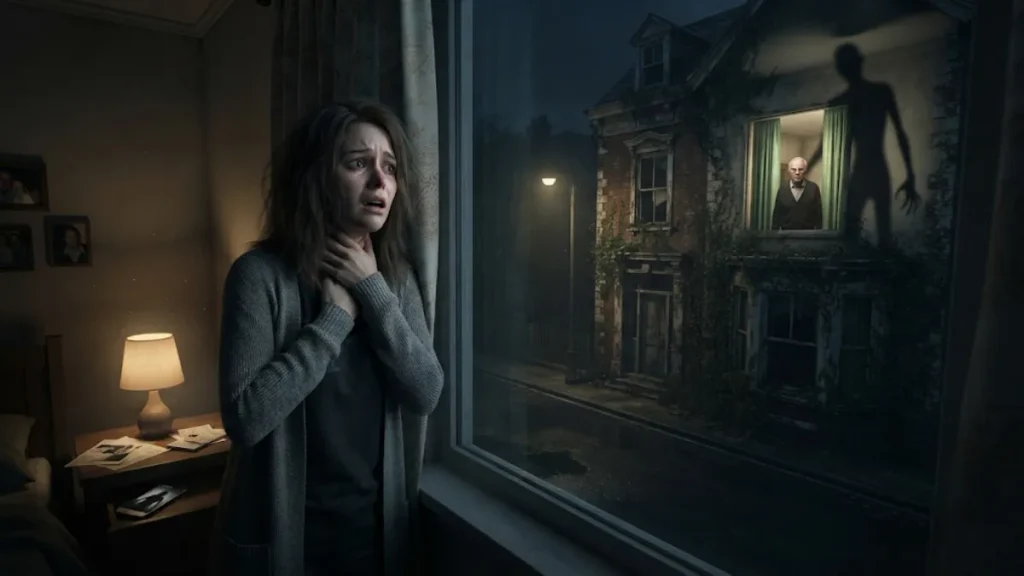
Every night at exactly 11:47, the old man across the street stood behind his bedroom window and watched Emily.
At first, she thought it was a coincidence.
She had moved into the quiet neighbourhood only two months earlier. Her apartment was on the second floor of a small residential building, directly opposite an old brick house with faded green shutters. The house looked abandoned, except for one upstairs window where a dim yellow light remained on every night.
That was where she first noticed him.
An elderly man with a narrow face, silver hair, and a dark cardigan. He stood perfectly still behind the curtains, looking toward her apartment.
Emily had assumed he was simply curious about the new neighbour.
But after several nights, she began to notice a pattern.
At 11:47 p.m., the light in his bedroom came on.
At 11:47 p.m., he appeared at the window.
And at 11:47 p.m., he began watching her.
He never waved. He never smiled. He never moved.
He simply stood there, staring.
Emily tried ignoring him. She closed her curtains, changed rooms, and even rearranged her furniture.
Nothing seemed to matter.
Whenever she looked across the street at night, the old man was there.
Watching.
And then, one evening, Emily discovered something that made her blood run cold.
The old man was not watching her apartment.
He was watching the empty space directly behind her.
The Man Across the Street
Emily worked as a graphic designer from home. Her job required long hours in front of a computer, so she usually stayed awake until midnight.
The neighbourhood was peaceful, with narrow roads, small gardens, and houses built several decades earlier. Most residents were older couples who kept to themselves.
The old house across the street seemed different from the others.
Its paint was peeling. Dead leaves covered the front steps, and the garden had become overgrown. There was no car in the driveway, and Emily had never seen anyone enter or leave.
Yet the upstairs light appeared every night.
One evening, she mentioned the man to her neighbour, Mrs. Bennett, who lived downstairs.
“Have you noticed the old man in the green house across the street?” Emily asked.
Mrs. Bennett stopped arranging the flowers on her balcony.
“What old man?”
“The one who stands at the upstairs window.”
Mrs. Bennett looked across the street.
For a moment, her expression changed.
“That house has been empty for years.”
Emily laughed nervously.
“Well, someone is definitely living there.”
Mrs. Bennett shook her head.
“Nobody has lived there since the previous owner died.”
“Who was the previous owner?”
“Mr. Arthur Bell. He was an unusual man. Very quiet. He hardly spoke to anyone.”
Emily looked toward the house again.
“Maybe a relative moved in.”
“Perhaps,” Mrs. Bennett replied.
But her voice sounded uncertain.
Before going inside, she added something that Emily found difficult to forget.
“If you see him, don’t wave.”
“Why not?”
Mrs. Bennett looked directly at her.
“Because he might wave back.”
The First Message
For the next three nights, Emily avoided looking toward the old house.
She kept her curtains closed and worked with her desk lamp instead of the ceiling light.
On the fourth night, she heard something unusual.
Three soft knocks came from her bedroom window.
Tap.
Tap.
Tap.
Emily froze.
Her apartment was on the second floor. There was no balcony outside her bedroom, only a narrow ledge beneath the window.
She slowly approached the curtains and pulled them apart.
Across the street, the old man was standing at his window.
His face was unusually close to the glass.
Emily stepped back.
Then she noticed something in his hand.
A small white card.
He held it against the window.
The writing was difficult to read from a distance, but Emily could make out two words.
DON’T SLEEP.
Her heart began racing.
She reached for her phone and took a photograph.
The camera struggled to focus. When the image finally appeared, the old man’s face was blurred, but the card was clear.
DON’T SLEEP.
Emily immediately called Mrs. Bennett.
The older woman answered after several rings.
“He’s there again,” Emily whispered. “He’s holding a message.”
“What does it say?”
“Don’t sleep.”
There was silence.
Then Mrs. Bennett spoke.
“Listen to me carefully. Lock your bedroom door. Keep the lights on. And don’t look out of that window again tonight.”
“Why?”
“Because Arthur used to leave messages for the people he watched.”
Emily felt her mouth go dry.
“What do you mean?”
Mrs. Bennett took a shaky breath.
“Every person who lived in your apartment before you eventually received one.”
Before Emily could ask another question, the call ended.
She stood in the bedroom, staring at her phone.
A moment later, another message appeared.
It was from an unknown number.
HE CAN SEE YOU.
The Previous Tenant
The following morning, Emily went to the building manager’s office.
She showed him the photograph of the old man holding the card.
The manager, Mr. Lewis, studied the image for several seconds.
“Where did you take this?”
“From my bedroom window. Across the street.”
He looked uncomfortable.
“That house is empty.”
“That’s what everyone keeps telling me.”
Mr. Lewis placed the phone on his desk.
“Did you speak to Mrs. Bennett?”
“Yes. She said the old owner used to watch people.”
The manager rubbed his forehead.
“Arthur Bell died about twelve years ago. He lived alone. People complained about him constantly because he spent his evenings standing at that window.”
“Was he dangerous?”
“Nobody knew. He never approached anyone. He never caused trouble. But the people living in the building opposite often said he watched them for hours.”
Emily leaned forward.
“Did anyone else receive messages?”
Mr. Lewis hesitated.
“Your apartment has had several tenants. The previous woman who lived there left after only six weeks.”
“Why?”
“She complained about someone watching her at night.”
Emily felt a cold sensation spread through her body.
“What happened to her?”
“She moved away. At least, that’s what we were told.”
He opened an old file and searched through the documents.
“Her name was Laura.”
Emily looked at him.
“Do you have her contact details?”
“No. But I remember something she said before leaving.”
“What?”
Mr. Lewis lowered his voice.
“She said the man across the street wasn’t watching her. He was watching someone standing behind her.”
Emily remembered the old man’s expression.
His eyes had never seemed focused on her face.
They always appeared to be looking slightly past her shoulder.
The Empty Space Behind Her
That evening, Emily decided to test what she had heard.
She placed her phone on a shelf in the bedroom and started recording a video.
At 11:40 p.m., nothing happened.
At 11:45 p.m., the old house remained dark.
At 11:47 p.m., the upstairs light switched on.
Arthur appeared behind the curtains.
Emily watched from the side of the room, keeping herself away from the window.
He was holding no card this time.
Instead, he raised one hand and pointed toward her bedroom.
Then he slowly shook his head.
Emily checked the recording.
The image showed the old man clearly, but something else caught her attention.
Behind her, near the wardrobe, stood a dark figure.
It was tall and unusually thin.
Its head tilted slightly to one side.
Emily stopped the video.
She looked toward the wardrobe.
There was nothing there.
She replayed the recording.
The figure was still visible.
She zoomed in.
Its face appeared pale, with dark hollows where the eyes should have been.
Then the figure moved.
It leaned closer to the camera.
Emily dropped the phone.
A loud knock came from the window.
She looked across the street.
Arthur was no longer standing at his window.
Instead, he had moved closer to the glass, pressing both hands against it.
His mouth was open.
He appeared to be shouting.
Emily couldn’t hear him, but she could read his lips.
GET OUT.
Then the lights in her bedroom went out.
Arthur Bell’s Diary
Emily did not sleep that night.
At sunrise, she packed a small bag and went downstairs.
Mrs. Bennett was waiting near the entrance, as though she had been expecting her.
“You saw it, didn’t you?” she asked.
Emily nodded.
“The figure behind me.”
Mrs. Bennett closed her eyes.
“Then it’s begun.”
“What is it?”
The older woman led her into the downstairs apartment.
On a small table lay a brown leather notebook.
“This belonged to Arthur Bell. His family gave it to my husband after his death. Nobody wanted to keep it.”
Emily opened the notebook.
The first few pages contained ordinary notes about household repairs and grocery purchases.
Then the entries became strange.
November 4: The woman in apartment 12 has started leaving her curtains open.
November 8: The figure appeared behind her again.
November 11: It is getting closer.
Emily turned several pages.
The handwriting became increasingly uneven.
November 15: It only moves when nobody is looking.
November 19: I tried warning the young man. He laughed at me.
November 22: It has learned his face.
Emily stopped reading.
“What is this thing?”
Mrs. Bennett sat beside her.
“Arthur believed something had entered the building opposite his house. He said it appeared in windows, photographs, and sometimes in the dark corners of rooms.”
“Did anyone believe him?”
“Not at first. Then a young couple moved into your apartment. Their little girl began talking about a man who stood behind her mother at night.”
Emily looked down at the notebook.
“What happened to them?”
“They left suddenly. Nobody saw them again.”
Emily turned to the final pages.
One entry had been written in large, hurried letters.
If I stop watching, it will cross the street.
Another entry appeared beneath it.
It cannot enter while I am looking at it.
And then:
I must keep the light on.
Emily looked up.
“That’s why he stands at the window.”
Mrs. Bennett nodded.
“He isn’t watching you. He’s keeping it from reaching you.”
The Night Arthur Disappeared
Emily returned to her apartment just before sunset.
She considered leaving the city, but she wanted to understand what was happening first.
She called Marcus, her closest friend, and asked him to come over.
He arrived at 9:30 p.m. and laughed when she explained the situation.
“You think a ghost is following you because an old man watches your window?”
“Please don’t make jokes.”
Marcus studied the photograph and the diary.
After a few minutes, he became quiet.
“Okay,” he said. “Let’s stay awake tonight. If someone appears, we’ll call the police.”
They sat in the living room with every light on.
At 11:47 p.m., the upstairs window across the street illuminated.
Arthur appeared.
He looked more frightened than ever.
He held a large sheet of paper against the glass.
This time, the message was impossible to misunderstand.
LEAVE NOW.
Marcus stood up.
“That’s enough. I’m calling the police.”
But before he could reach for his phone, the light in Arthur’s room flickered.
The old man suddenly turned toward something behind him.
His expression changed from fear to horror.
He began shaking his head.
Then he pressed both hands against the glass and mouthed something.
Emily leaned closer to the window.
She read the words.
I CAN’T HOLD IT.
The light went out.
For several seconds, the old house was completely dark.
Then a shadow moved behind the upstairs curtains.
It was not Arthur.
It was much taller.
Its head nearly touched the ceiling.
The figure approached the window.
Slowly, it raised one hand.
And waved.
Emily stepped backward.
Marcus grabbed her arm.
“Don’t look at it.”
But the figure was already staring directly at them.
Then something happened that neither of them could explain.
The curtains in Emily’s bedroom moved.
The window was closed.
Yet the fabric lifted gently, as though someone had walked past it.
Marcus turned toward the bedroom.
“Emily?”
She didn’t answer.
A faint voice came from behind them.
“Finally.”
They spun around.
Nobody was standing there.
Then the bedroom door slowly closed.
The Last Warning
Emily and Marcus ran out of the apartment.
They reached the street and stopped beneath a streetlight.
Across the road, the old house was dark.
The upstairs window was empty.
“Where is Arthur?” Marcus whispered.
Emily looked toward the house.
Then she noticed the front door.
It was open.
A pale hand rested against the frame.
Someone stepped outside.
It was Arthur.
He was wearing the same dark cardigan and trousers.
But something about him looked different.
His face was expressionless, and his eyes appeared completely black.
He stood on the front steps and looked toward Emily.
Then he smiled.
Emily remembered the diary.
It cannot enter while I am looking at it.
She understood.
Arthur had spent years watching the figure to keep it trapped.
But now he was standing outside.
And he wasn’t watching it anymore.
He was watching her.
Marcus pulled Emily toward the main road.
“Run!”
They hurried toward the corner.
Behind them, a voice called out.
“Emily!”
She stopped.
It was Arthur’s voice.
“Please. Help me.”
She turned slightly.
The old man was standing beneath the streetlight.
His expression had changed. His eyes looked frightened again.
“Don’t let it take my place,” he begged.
Emily hesitated.
Marcus shook his head.
“Don’t listen.”
Arthur stepped forward.
“Look at my hands!”
Emily glanced down.
His fingers were trembling.
For a moment, she believed him.
Then she noticed something impossible.
The streetlight cast a shadow behind Arthur.
But the shadow was not shaped like him.
It was tall, thin, and had a head that tilted unnaturally to one side.
Arthur’s mouth opened.
A second voice came from inside him.
“Come closer.”
Marcus dragged Emily away.
They ran until they reached a brightly lit petrol station and called the police.
When officers arrived, they searched the old house.
It was empty.
There was dust on the furniture, cobwebs across the hallway, and no sign that anyone had lived there for years.
They found Arthur Bell’s photograph on a table.
The old man was standing beside his bedroom window.
But there was something strange about the picture.
His reflection appeared in the glass.
The reflection was smiling.
Arthur was not.
The New Watcher
Emily left the apartment the following morning.
She moved to another neighbourhood and refused to discuss what had happened.
For several weeks, she slept with the lights on.
Eventually, life began to feel normal again.
She returned to work, met friends, and stopped checking every window she passed.
Then, one evening, she received an envelope at her new address.
There was no return address.
Inside was a photograph.
It showed Emily standing in the doorway of her old apartment.
She was looking toward the camera, holding a small bag.
Behind her, in the dark bedroom, stood the tall figure.
Its face was turned toward the photographer.
On the back of the photograph, someone had written:
HE IS NOT WATCHING YOU ANYMORE.
Emily dropped the picture.
Her phone rang.
It was Marcus.
“Did you send me something?” he asked.
“No. Why?”
“I just received a photograph. It’s from the old apartment.”
Emily’s throat tightened.
“What does it show?”
Marcus took a moment to answer.
“It’s a picture of the bedroom window.”
“Is anyone there?”
“Yes.”
“Who?”
Marcus spoke very quietly.
“An old man.”
Emily closed her eyes.
“Arthur?”
“No. It’s you.”
She said nothing.
Marcus continued.
“You’re standing behind the window. You’re holding a piece of paper.”
Emily slowly turned toward the living room window.
Across the street stood an old brick house.
Its shutters were faded green.
An upstairs light switched on.
A figure appeared behind the curtains.
Emily could not see its face clearly.
But she knew it was watching her.
Her phone slipped from her hand.
The figure raised a white card and pressed it against the glass.
Even from across the street, Emily could read the message.
DON’T LET ME OUT.
Then the figure stepped away from the window.
And behind it, something tall and thin moved closer.
The next morning, Emily’s neighbours noticed that her bedroom light had remained on all night.
They also noticed something unusual.
At exactly 11:47 p.m., a woman had appeared behind her window.
She stood perfectly still, staring across the street.
And beside her stood an old man in a dark cardigan.
Both were watching.
But neither of them was looking at the same thing.
9. The Recording That Predicted My Death
Genre: Supernatural Horror, Psychological Thriller, Mystery
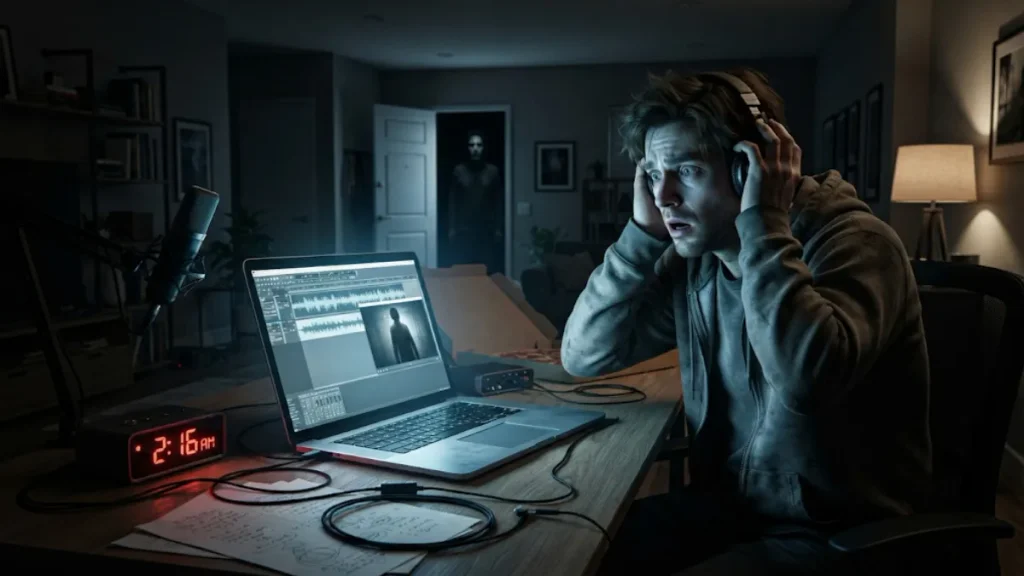
The first time I heard my own death, I was sitting alone in my apartment, eating cold pizza and sorting through old files on my laptop.
It was 12:18 a.m.
I had spent the evening cleaning up my computer when I found an audio recording saved in a folder I didn’t recognize. The file had no proper name, only a string of numbers and letters.
I almost deleted it.
Then curiosity got the better of me.
I clicked play.
At first, there was only static. A low, steady hiss filled my headphones. Then I heard a man’s voice.
It sounded familiar.
Very familiar.
“Hello? Can anyone hear me?”
I sat up.
It was my voice.
The recording continued.
“My name is Daniel. If you’re listening to this, please don’t ignore what I’m about to say.”
I checked the file properties. It had been created that afternoon.
That was strange enough, but the next sentence made my stomach tighten.
“Tonight, at exactly 2:16 a.m., someone will knock three times on your front door.”
I paused the recording.
I looked at the clock.
12:19 a.m.
For several seconds, I simply stared at the screen.
Then I laughed nervously.
Someone had probably made a prank recording using my voice. Maybe it was an old voice message, edited by a friend.
I pressed play again.
The voice sounded increasingly frightened.
“When you hear the knocking, don’t open the door. Don’t look through the peephole. And whatever happens, don’t answer when the person outside calls your name.”
There was a pause.
Then I heard something that made me remove my headphones.
A second voice whispered from the recording.
“He’s already outside.”
I looked toward my front door.
The apartment was silent.
I checked the clock again.
12:21 a.m.
I had nearly two hours to decide whether the recording was nonsense.
Unfortunately, I would soon discover that it was telling the truth.
A File That Shouldn’t Exist
My name is Daniel Carter. I was thirty-two years old and worked as a sound editor for a small production company.
I spent most of my working hours cleaning audio, removing background noise, and repairing damaged recordings. Because of that, I was used to hearing strange sounds through headphones.
Whispers.
Distant conversations.
Unexplained noises that turned out to be someone moving a chair or closing a door.
I didn’t believe in ghosts.
I believed in bad microphones, corrupted files, and people who enjoyed frightening others.
The recording, however, was different.
After hearing it, I checked where the file had come from.
It was saved inside a folder named TEMP_AUDIO, which contained several recordings from previous projects.
The file’s creation date was that day, at 11:52 a.m.
I had been at work then.
I checked the office server. Nobody had uploaded anything unusual.
I opened the recording in my editing software and examined its waveform.
The file was approximately four minutes long.
There were no obvious signs of editing.
I increased the volume and listened again.
The first voice was definitely mine. I recognized the slight roughness in my throat and the way I pronounced certain words.
But I had never recorded those sentences.
I called my colleague, Ryan.
He answered after several rings.
“Do you know anything about an audio file saved in my temporary folder?”
“What file?”
I sent him a screenshot.
He laughed.
“Maybe you’ve finally started talking to yourself.”
“Ryan, I’m serious.”
I played him a short section over the phone.
His laughter stopped.
“That’s your voice,” he said.
“I know.”
“Did you record it?”
“No.”
There was a pause.
Then he asked something unexpected.
“Daniel, what time did you say it was going to happen?”
“Two sixteen.”
Ryan became quiet.
“That’s weird.”
“What?”
“Nothing. Forget it.”
“Ryan?”
He hesitated.
“Just stay inside tonight. I’ll call you later.”
Before I could ask why, he ended the call.
The First Prediction
At 1:30 a.m., I was still awake.
I had tried watching television, reading, and working on another audio project, but I couldn’t stop thinking about the recording.
I played it again.
This time, I noticed something beneath the main voice.
A faint ticking sound.
It was regular, like a clock.
I isolated the background noise and increased its volume.
After a few seconds, another voice emerged.
It was quieter than the first.
“Don’t trust the person who calls before the knocking.”
I stopped the audio.
Someone was deliberately trying to scare me.
That had to be it.
I called Ryan again.
He didn’t answer.
At 1:47 a.m., I received a message from an unknown number.
Are you listening to it?
My hands went cold.
I typed a reply.
Who is this?
The answer came immediately.
You need to delete the recording.
I stared at the screen.
Who sent it?
No reply.
I tried calling the number, but it was switched off.
At 2:05 a.m., I moved away from the front door and sat on the sofa.
I kept checking the clock.
2:10.
2:12.
2:14.
At 2:15, the apartment lights flickered.
Then came the sound.
Knock.
Knock.
Knock.
Three slow knocks from the front door.
I stopped breathing.
For a moment, nothing else happened.
Then a man’s voice came from the other side.
“Daniel?”
It was Ryan.
“Open the door. It’s me.”
I looked at my phone.
There was no missed call.
I remembered the warning.
Don’t answer when the person outside calls your name.
Ryan knocked again.
“Daniel, please. I need to talk to you.”
I stayed silent.
Then the voice changed.
It became lower.
Colder.
“Daniel, I know you’re inside.”
I backed away from the door.
The handle slowly turned.
I had locked it.
Something pushed against the door from the other side.
Once.
Twice.
Then everything went quiet.
At 2:17 a.m., my phone rang.
It was Ryan.
I answered immediately.
“Where are you?” I whispered.
“At home,” he replied. “Why?”
“Someone was outside my door. It sounded exactly like you.”
Ryan didn’t respond.
Then he asked:
“Did you open it?”
“No.”
He released a breath.
“Good.”
“Why did you tell me to stay inside?”
He hesitated.
“Because I heard that recording yesterday.”
My stomach dropped.
“What?”
“Daniel, I found the file on my computer. It was my voice. It said you would receive three knocks tonight.”
I looked toward the front door.
Ryan continued.
“But my recording said something else.”
“What?”
His voice became almost inaudible.
“It said I would die if I tried to warn you.”
The Second Recording
I barely slept that night.
At sunrise, I checked the security camera outside my apartment.
The camera showed an empty corridor.
At 2:16 a.m., however, the footage became distorted.
The image flickered for several seconds.
When it returned, a man was standing directly in front of my door.
He was wearing a dark jacket.
His face was turned toward the camera.
I zoomed in.
It was me.
The man looked exactly like me.
Same face. Same hairstyle. Same clothes I had worn the previous evening.
He stood motionless for almost a minute.
Then he slowly raised his hand and knocked three times.
I replayed the footage repeatedly.
There was no explanation.
I called Ryan and asked him to come over.
He arrived around noon.
I showed him the recording and the security footage.
He stared at the screen.
“That’s impossible,” he whispered.
“I know.”
Ryan looked toward the front door.
“Maybe someone is using your face.”
“That’s not helpful.”
He rubbed his eyes.
“Listen. There’s something I haven’t told you.”
I waited.
“Yesterday, before you called me, I received an audio file from an unknown email address.”
“What did it say?”
“It was a recording of me. I was telling someone not to let you leave your apartment.”
I felt a chill.
“Who was the other person?”
Ryan shook his head.
“I couldn’t hear clearly. But there was another voice.”
“What did it say?”
Ryan looked at me.
“It said, ‘He won’t remember this time.'”
I didn’t understand.
“What does that mean?”
“I don’t know.”
He opened his laptop and played the recording.
His voice emerged from the speakers.
“Daniel, if you hear this, you need to understand something. We’ve done this before.”
A pause.
Then Ryan’s voice continued.
“Every time you listen to the recording, you forget what happened the previous night.”
The audio ended with a loud burst of static.
I looked at Ryan.
“What is this?”
He didn’t answer.
Instead, he opened the email and showed me its timestamp.
It had been sent three days earlier.
But the sender’s name was Daniel Carter.
My name.
The Room That Wasn’t There
That afternoon, I returned to the office.
I needed to find out where the recording had come from.
The company server stored backups of all audio files, including deleted material. I searched my name and the strange filename.
A folder appeared.
Inside it were dozens of recordings.
Some were dated weeks earlier.
Others were dated months in the future.
I opened the first file.
My voice spoke immediately.
“Daniel, if you’re hearing this, don’t go to the basement.”
I frowned.
The office building had no basement.
I opened another file.
“Don’t trust Ryan. He remembers more than you do.”
My hands began to shake.
Another recording started automatically.
This one contained a sound I recognized.
A door opening.
Footsteps.
Then my voice.
“Why is there a room down here?”
A second voice answered.
“Because you keep coming back.”
I stopped the recording.
I asked Ryan to help me search the building.
We checked the storage rooms, the server room, and the emergency stairwell.
There was no basement.
But near the rear corridor, Ryan noticed a narrow door hidden behind a stack of old equipment.
It had no handle.
Only a small metal plate with the number 16.
I stared at it.
2:16.
The time from the recording.
Ryan stepped backward.
“Daniel, we should leave.”
I reached for the edge of the door.
It opened without resistance.
Beyond it was a narrow staircase descending into darkness.
Cold air drifted upward.
At the bottom, we found a small room filled with old recording equipment.
The walls were covered with photographs.
Every photograph showed me.
Some were taken at work.
Some showed me sleeping in my apartment.
Others showed me standing outside my building.
There were dozens.
On a table in the centre of the room sat a tape recorder.
A label was attached to it.
DANIEL CARTER. FINAL RECORDING.
I pressed play.
My voice sounded exhausted.
“Ryan, if you’ve brought me here again, I’m sorry. I know you think you’re helping, but you need to stop.”
I looked at Ryan.
He was staring at the floor.
The recording continued.
“The man outside my door isn’t a stranger. He isn’t a ghost. He’s the version of me that dies every time I try to leave.”
I stepped away from the table.
“What does that mean?” I asked.
Ryan didn’t answer.
The recording went on.
“At 2:16, the door will open. When it does, don’t let me see you.”
A loud metallic click came from somewhere behind us.
We turned.
The staircase door had closed.
Then the room’s old monitor switched on.
A live security feed appeared.
It showed my apartment.
My bedroom.
My bed.
And me, standing in the centre of the room.
I was watching myself.
The Truth About the Recording
Ryan finally spoke.
“I was hoping we wouldn’t find this room.”
I turned toward him.
“How do you know about it?”
He looked frightened.
“Because I’ve been here before.”
“What?”
“Daniel, listen. You don’t remember, but we’ve been trying to stop this for weeks.”
I shook my head.
“Stop what?”
Ryan pointed toward the monitor.
“That.”
On the screen, the other version of me was standing in front of the bedroom mirror.
It looked tired and frightened.
Then it turned toward the camera.
Its lips moved.
I increased the monitor’s volume.
“Ryan,” the figure whispered. “You brought him here again.”
Ryan stepped away.
The figure continued.
“You’re not supposed to bring him back before the recording finishes.”
I looked at Ryan.
“Who is that?”
He swallowed.
“You.”
The monitor flickered.
For a moment, the image changed.
I saw myself lying on the floor of a dark room, surrounded by broken recording equipment.
There was blood on my shirt.
A second later, the image returned to the bedroom.
The other Daniel was gone.
Ryan grabbed my arm.
“We have to leave.”
He pulled me toward the staircase.
I followed him, but before we reached the door, the tape recorder started again.
My voice filled the room.
“Daniel, don’t trust Ryan.”
Ryan stopped.
I turned toward him.
The recording continued.
“He knows what happens at 2:16. He knows why the recordings exist. And he knows why you keep dying.”
Ryan slowly released my arm.
I looked at him.
“Tell me what’s happening.”
He closed his eyes.
Then he spoke.
“Three months ago, you were working late in this building. There was an electrical fire in the server room. You went downstairs to save some equipment.”
I felt a strange pressure behind my eyes.
“Then what?”
“You were trapped. I tried to get you out, but the staircase collapsed.”
I stared at him.
“You said I died?”
Ryan nodded.
“But the recordings?”
He pointed toward the equipment.
“You made them before the fire. You knew something was wrong with the building. You thought you could use audio to preserve what happened.”
I couldn’t understand.
“That’s impossible.”
“Maybe. But every time we hear the recording, something changes. You wake up again, and the night starts over.”
I looked at the photographs.
All those images.
All those recordings.
“How many times?”
Ryan didn’t answer.
“How many times have I died?”
He finally looked at me.
“Twenty-seven.”
The Final Warning
The monitor suddenly switched to a countdown.
2:14:51 a.m.
I looked at the clock on the wall.
It was impossible.
We had entered the room in the afternoon.
But the clock was showing the same time as the recording.
Ryan grabbed the tape recorder.
“We need to destroy it.”
He lifted it above his head and smashed it against the table.
The casing broke.
The tape spilled out.
For a moment, everything went silent.
Then every speaker in the room began playing at once.
My voice.
Dozens of versions of my voice.
Some were crying.
Some were shouting.
Some were whispering.
All were saying the same thing.
“Don’t let him leave.”
The lights began flickering.
A heavy knock came from the staircase door.
Then another.
Then a third.
Ryan backed away.
I looked at the monitor.
The other Daniel was standing inside my apartment again.
This time, he was smiling.
He raised his hand and pointed toward the camera.
Then the screen went black.
A voice emerged from the speakers.
“Daniel?”
It was my voice.
But it sounded different.
Older.
Calmer.
“Open the door.”
Ryan grabbed my shoulder.
“Don’t answer.”
The handle began turning.
Something pushed against the staircase door.
I looked at the clock.
2:15:58.
The recording had predicted the knocking.
It had predicted the stranger.
And now it was predicting my death.
The door burst open.
A man stepped into the room.
He was wearing my clothes.
He had my face.
But his eyes were completely black.
Ryan screamed.
I couldn’t move.
The other Daniel looked at me and smiled.
“You finally made it,” he said.
Then he raised a small audio recorder.
“Now listen carefully.”
He pressed play.
My own voice emerged.
“At exactly 2:16 a.m., Daniel Carter will die.”
The clock changed.
2:16.
The lights went out.
And I heard Ryan scream my name.
The Recording After Death
When I opened my eyes, I was sitting at my desk.
My laptop was open.
A cold pizza box sat beside the keyboard.
The clock showed 12:18 a.m.
I felt confused.
My head hurt, and I couldn’t remember how I had returned home.
Then I noticed a new audio file on my desktop.
Its name was different this time.
FINAL_WARNING_28.wav
I hesitated before clicking it.
The recording began with static.
Then I heard my own voice.
“Hello? Can anyone hear me?”
I leaned closer.
“If you’re listening to this, please don’t ignore what I’m about to say.”
I froze.
The recording continued.
“Tonight, at exactly 2:16 a.m., someone will knock three times on your front door.”
I checked the clock.
12:19 a.m.
I quickly closed the file.
Then I noticed something else.
My laptop’s webcam light was on.
I turned toward it.
The small camera was recording.
I opened the video feed.
My own face appeared on the screen.
Behind me stood Ryan.
His face was pale.
His clothes were covered in dust.
He was staring directly at the camera.
I spun around.
Nobody was there.
When I looked back at the screen, Ryan had moved closer.
His lips were trembling.
He whispered:
“Daniel, don’t listen to the recording.”
Then another figure appeared behind him.
A man with my face.
The man smiled.
And the screen went black.
The Last File
I don’t know how long I sat there.
I didn’t move.
I didn’t breathe properly.
I kept staring at the dark laptop screen, waiting for it to turn on again.
Eventually, I heard a sound from the hallway.
A slow knock.
Then another.
Then a third.
I looked at the clock.
2:16 a.m.
My front door handle began to turn.
I remembered the warning.
Don’t open the door.
I stood up and moved away from it.
Then my phone rang.
It was Ryan.
I answered.
“Daniel,” he whispered. “Don’t let him in.”
I looked at the door.
“Who is it?”
Ryan’s voice trembled.
“It’s you.”
I heard footsteps on the other side.
Then a voice called my name.
“Daniel? It’s me. Open the door.”
It sounded exactly like me.
I stepped backward.
The voice continued.
“I know you’re scared. But you need to let me explain.”
I looked toward my laptop.
The screen had switched on.
A new recording was playing automatically.
My voice whispered:
“Don’t worry. This is the last time.”
Then the door opened.
I never saw who entered.
The recording ended at 2:17 a.m.
But the file remained on my laptop.
And if you listen carefully, after the final burst of static, you can hear a faint voice.
It sounds like someone speaking from very far away.
It says:
“He’s listening again.”
Why Do Twist-Ending Horror Stories Feel So Scary?
Twist-ending horror stories are frightening because they challenge what readers believe about the characters, settings, and events.
A traditional horror story might introduce a ghost and gradually reveal its identity. A twist-ending story may reveal that the person being haunted is actually the ghost.
There are several reasons these stories create such a powerful effect.
They Challenge Our Expectations
Readers naturally create explanations while following a story. An unexpected ending breaks those assumptions and forces them to reconsider earlier events.
They Create Psychological Fear
Some of the most disturbing horror stories do not include monsters or supernatural creatures. Instead, they explore loneliness, guilt, paranoia, memory, and the fear of losing control.
They Make Ordinary Places Feel Dangerous
A bedroom, hotel, family photograph, or familiar neighbourhood can become frightening when something unexpected happens.
They Leave Questions Unanswered
An effective horror ending does not always explain everything. Sometimes a final sentence or unexplained detail stays in the reader’s mind long after the story ends.
Different Types of Horror Stories Adults Can Read Online
If you enjoy horror fiction, exploring different subgenres can make your reading experience more interesting.
| Horror genre | What makes it frightening |
|---|---|
| Psychological horror | Fear, paranoia, guilt, and disturbing memories |
| Supernatural horror | Ghosts, spirits, and unexplained events |
| Paranormal mystery | Strange encounters and hidden identities |
| Psychological thrillers | Manipulation, secrets, and unreliable characters |
| Gothic horror | Abandoned houses, dark settings, and family mysteries |
| Sci-fi horror | Strange technology, time loops, and unknown forces |
| Mystery horror | Disappearances, clues, and shocking revelations |
Psychological horror is particularly effective for adult readers because it explores complicated emotions and situations. Supernatural horror, meanwhile, offers the excitement of mysterious encounters and unexplained phenomena.
How to Find Good Horror Short Stories to Read Online
Finding an interesting horror story online is easy, but choosing one with a genuinely surprising ending can be more difficult.
Here are a few things to look for:
- Choose complete stories: Look for stories with a proper beginning, development, and ending rather than unfinished episodes.
- Explore psychological horror: These stories often deliver memorable twists without relying on predictable jump scares.
- Look for original plots: Stories involving unusual settings, mysterious characters, and unexpected discoveries can feel more engaging.
- Avoid spoilers: Even a small hint about the ending can reduce the impact of a twist.
- Explore different subgenres: Try ghost stories, supernatural mysteries, dark fiction, and psychological thrillers.
For the best experience, read these stories somewhere quiet, preferably in the evening. Take your time with the details, pay attention to unusual conversations, and avoid jumping to conclusions before reaching the final paragraph.
Tips for Enjoying Horror Stories With Unexpected Endings
If you want to make your horror reading experience more exciting, try these simple suggestions.
Read without checking the ending: The biggest attraction of twist-ending horror is the surprise. Avoid reading summaries that reveal important details.
Pay attention to small clues: A strange photograph, an unusual phone call, or a character’s unexpected reaction may become important later.
Try psychological horror: Not every frightening story needs a ghost. Sometimes an unsettling human secret can be more disturbing.
Read shorter stories first: Short horror fiction is ideal when you want a quick reading experience without committing to a full-length novel.
Discuss the ending: Sharing theories with friends can make ambiguous horror stories even more interesting.
Conclusion
Horror short stories to read online for adults with a twist offer more than ordinary scares. They combine mystery, psychological tension, supernatural elements, and unexpected revelations to create memorable reading experiences.
From the mysterious woman in Apartment 13 to the recording that predicted a man’s death, every story in this collection explores a different kind of fear. Some endings reveal forgotten memories, others expose disturbing identities, and a few leave readers questioning everything they thought they understood.
The best horror stories are not always the ones with the scariest monsters. Sometimes, they are the stories that make an ordinary situation feel completely different after the final sentence.
So, turn off the lights, settle into your favourite reading spot, and choose a story. Just remember one thing: not every mystery needs to be solved, and not every ending brings relief.
Frequently Asked Questions (FAQs)
What are the best horror short stories to read online for adults with a twist?
The best twist-ending horror stories combine suspense, mystery, psychological fear, and unexpected revelations. Stories such as The Woman in Apartment 13, The Last Message From Dad, The House That Remembered Everything, and The Recording That Predicted My Death offer mysterious situations with surprising endings.
What makes a horror short story with a twist interesting?
An unexpected revelation makes a twist-ending horror story interesting. It changes how readers understand the characters or events and often reveals that the truth was hidden in plain sight.
Are psychological horror stories scarier than ghost stories?
It depends on personal preference. Ghost stories create fear through supernatural encounters, while psychological horror explores paranoia, guilt, disturbing memories, and mental uncertainty. Many readers find psychological horror particularly unsettling because its situations can feel realistic.
Can adults enjoy short horror stories?
Yes. Adults can enjoy horror short stories because they offer suspense, imaginative storytelling, complex characters, and thought-provoking themes without requiring the time commitment of a full-length novel.
What are some popular themes in twist-ending horror stories?
Popular themes include haunted houses, mysterious phone calls, forgotten memories, time loops, disappearing people, strange neighbours, family secrets, doppelgängers, and unexplained photographs.
Are horror short stories suitable for reading at night?
Yes. Horror short stories are particularly popular for nighttime reading because quiet surroundings can make suspense and atmospheric details more immersive. However, readers who dislike frightening content may prefer lighter mystery stories.
How long should a horror short story be?
A horror short story can range from a few hundred words to several thousand words. Shorter stories are ideal for quick scares, while longer stories allow more room for character development, suspense, and complex twist endings.
What is the difference between a horror story and a psychological thriller?
A horror story primarily aims to create fear, dread, or discomfort through frightening situations. A psychological thriller focuses more on suspense, manipulation, secrets, and mental uncertainty. Both genres can include shocking revelations and unexpected endings.