Genre: Space Exploration | Cosmic Science Fiction | Future Mystery
The first rule of the universe was simple:
Nothing lasts forever.
Stars are born and die.
Planets change.
Civilizations rise and disappear.
Even galaxies eventually fade into darkness.
But somewhere beyond the edge of known space, humanity discovered something that seemed to break that rule.
A library.
Not a building.
Not a spacecraft.
Not a machine.
A library that floated between galaxies, surrounded by nothing but endless darkness.
Inside it were the stories of everything that had ever existed.
Every civilization.
Every discovery.
Every war.
Every dream.
Every forgotten voice.
It was called:
The Library at the End of the Universe.
The Greatest Discovery in History
In the year 2317, humanity had traveled farther than anyone had imagined.
The first explorers had reached distant planets.
The first colonies had been established beyond the Milky Way.
Humans had encountered strange worlds, unknown species, and mysteries that challenged everything they understood.
But nothing compared to the discovery made by the explorer ship Celestia.
The ship was traveling beyond the outer edge of the universe’s mapped regions when its sensors detected something impossible.
A structure.
Floating in empty space.
No planet.
No star.
No source of energy.
Yet it existed.
For three hundred years, scientists had searched for evidence of advanced alien civilizations.
They expected weapons.
Machines.
Technology.
Instead, they found books.
The Guardian of Knowledge
Mira Voss was a historian, not an explorer.
She had spent her life studying civilizations that disappeared before humanity discovered them.
She believed every society left behind something valuable.
Not their technology.
Not their weapons.
Their stories.
When humanity discovered the mysterious library, Mira was chosen as one of the first researchers allowed inside.
Her mission was simple:
Understand what the library was.
And discover who created it.
Entering the Impossible Library
The entrance had no doors.
No security system.
No instructions.
When Mira approached, the walls changed.
A passage appeared.
As if the library already knew she was coming.
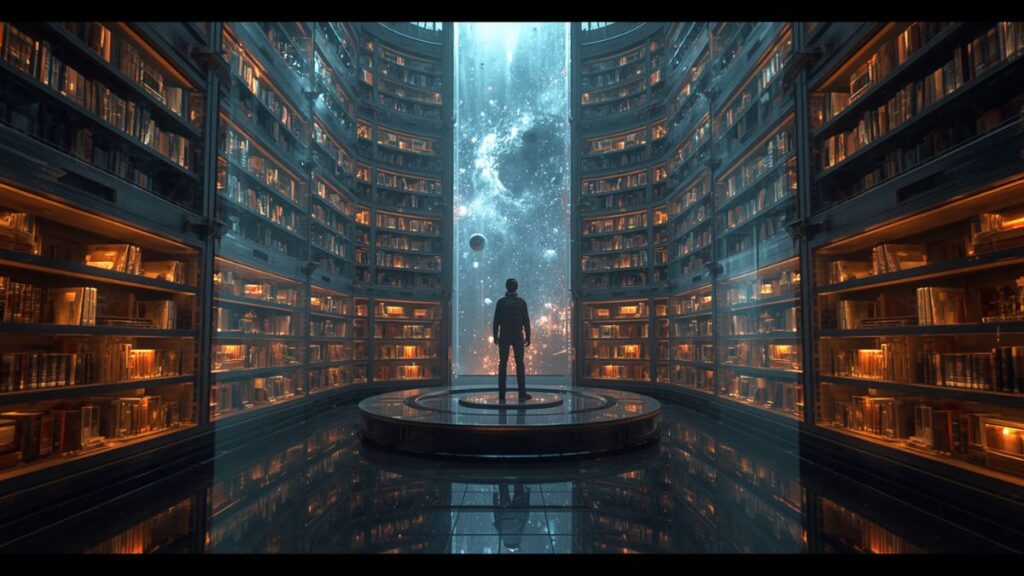
Inside, she found something beyond imagination.
Endless halls stretched in every direction.
Shelves continued farther than the eye could see.
Some contained physical books.
Others contained glowing memories.
Some contained entire simulated worlds.
Mira realized the library was not storing information.
It was preserving experiences.
The Stories of Lost Worlds
Mira spent months exploring the library.
She discovered civilizations that humans had never heard of.
The Aruvi, who created cities beneath the surface of their planet.
The Velarians, who communicated through music instead of language.
The Norian species, who lived for only seven years but created incredible works of art.
Each civilization had one section.
Each story had one purpose.
To prove they existed.
The Question of the Library
After studying thousands of records, Mira noticed something strange.
Every civilization had a section.
Every species had a history.
Every planet had a story.
But something was missing.
Humanity.
There was no human section.
No records.
No history.
No future.
Mira searched for days.
Nothing.
The universe had preserved countless civilizations.
But it had forgotten humanity.
Meeting the Library’s Intelligence
Deep inside the library, Mira discovered a central chamber.
At its center was a glowing sphere.
A voice spoke.
“Welcome, Mira Voss.”
She froze.
“Who are you?”
“I am the Keeper.”
“The creator of this library?”
“No.”
“Then who created it?”
The voice paused.
“Everyone.”
Mira did not understand.
The Keeper explained that the library was not built by one civilization.
It was created by countless species working together across billions of years.
Every civilization contributed knowledge.
Every species added its story.
The library was a gift from life itself.
Why Humanity Was Missing
Mira finally asked the question that troubled her.
“Why is humanity not recorded?”
The Keeper answered:
“Because your story is incomplete.”
Mira was confused.
“Every civilization has a history.”
“Yes.”
“But history is not the same as a story.”
The Keeper continued:
“Your species has not reached its final chapter.”
The Empty Section
The Keeper guided Mira to a forgotten area.
A completely empty section of the library.
No books.
No memories.
No records.
A single label appeared.
Humanity.
Mira stared.
“Why is it empty?”
The Keeper answered:
“Because the future cannot be remembered until it happens.”
She finally understood.
The library contained the past of every civilization.
But humanity’s future was still being written.
The Choice of Humanity
When Mira returned to Earth, she shared her discovery.
The reaction was overwhelming.
People were amazed.
But they were also afraid.
Humanity had always searched for answers.
Now they discovered something unexpected.
The universe did not know their ending.
Nobody knew what would happen next.
For the first time, humanity understood that its future was not predetermined.
It was a choice.
A New Mission
The discovery changed human exploration.
For centuries, humans had searched the universe looking for knowledge.
Now they had a different purpose.
They wanted to contribute.
Scientists recorded discoveries.
Artists created new works.
Explorers documented new worlds.
Every human experience became part of a growing story.
The empty section of the library slowly began to change.
The First Human Book
Years later, Mira returned to the library.
She carried a small book.
Not a scientific report.
Not a historical document.
A collection of ordinary human moments.
A child’s first words.
A parent’s love.
A friendship.
A dream.
A goodbye.
The Keeper asked:
“What is this?”
Mira smiled.
“This is humanity.”
The Keeper scanned the pages.
Then something incredible happened.
The empty shelves began filling.
Humanity’s Story
The library did not preserve humanity because of its technology.
It did not preserve humanity because of its achievements.
It preserved humanity because of its experiences.
The universe had seen countless advanced civilizations.
But every species had something unique.
Humans created meaning from ordinary moments.
They looked at stars and wondered.
They faced impossible challenges and continued.
They loved despite knowing they could lose.
The Last Explorer
Hundreds of years later, Mira’s name was remembered throughout the galaxy.
Not because she discovered the library.
But because she helped humanity understand its purpose.
Before her final journey into space, she recorded one last message.
“The universe is not a place filled with answers.”
“It is a place filled with stories.”
“Every planet has one.”
“Every civilization has one.”
“And ours is still being written.”
The Final Chapter
Millions of years later, the Library at the End of the Universe still existed.
Stars disappeared.
Galaxies changed.
New civilizations emerged.
But one section continued growing.
Humanity.
The shelves were filled with countless stories.
Explorations.
Discoveries.
Failures.
Triumphs.
Dreams.
And at the very end of the human section, one final page remained blank.
Waiting.
Because the greatest story was not the one humanity had already written.
It was the one still waiting to happen.
Moral of the Story
The future is not something we discover. It is something we create through every choice, every action, and every story we leave behind.
Humanity’s greatest legacy is not the worlds it conquers, but the memories, ideas, and emotions it contributes to the universe.