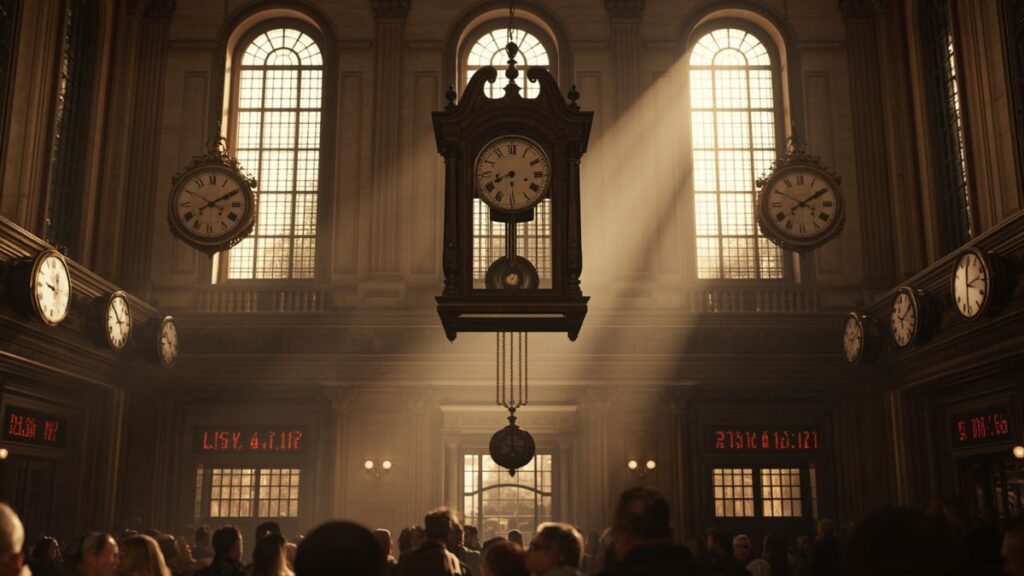
On the wall of the old Willow Street Town Hall hung a large wooden clock that had faithfully kept time for nearly eighty years.
Its polished oak frame had faded with age.
Its brass pendulum no longer gleamed as brightly as it once had.
Tiny scratches marked its surface, and the numbers on its face had become slightly worn.
Yet every second, without fail, it continued to tick.
Tick.
Tock.
Tick.
Tock.
The townspeople had grown so accustomed to its steady rhythm that they hardly noticed it anymore.
Children passed beneath it on their way to school.
Shopkeepers glanced at it before opening their stores.
Farmers checked it before heading to their fields.
For decades, it had quietly guided the entire town.
One spring morning, workers entered the Town Hall carrying several sleek digital clocks.
“They’re finally replacing the old one,” someone whispered.
“The new clocks are faster.”
“They’re brighter.”
“They’re more accurate.”
Within an hour, shiny digital displays appeared throughout the building.
They showed the time in glowing blue numbers.
People immediately admired them.
“Look how easy they are to read.”
“They even show the date.”
“The old clock belongs in a museum.”
Hanging high on the wall, the wooden clock listened silently.
For the first time in many years, it felt old.
Perhaps the townspeople were right.
Perhaps its time had passed.
That evening, after everyone had gone home, the digital clocks proudly admired one another.
“We’re the future.”
“We’re modern.”
“We’ll make everyone’s life easier.”
One digital clock looked toward the old wooden clock.
“You’re still ticking?”
The old clock smiled gently.
“I’ve always ticked.”
The digital clock laughed.
“You’ve been replaced.”
“You should probably stop.”
The wooden clock looked thoughtfully across the quiet room.
“I wasn’t built to compete.”
“I was built to keep time.”
The digital clocks didn’t understand.
The next morning, the Town Hall became busy again.
People hurried in and out.
Meetings began on schedule.
Visitors checked the glowing digital displays.
Hardly anyone looked up at the old clock.
Days turned into weeks.
The wooden clock continued its steady rhythm.
It no longer worried about being the newest or the brightest.
It simply focused on doing the job it had always done.
One afternoon, a violent thunderstorm swept through the valley.
Lightning flashed across the sky.
Rain poured in heavy sheets.
Suddenly, the power went out.
The Town Hall fell silent.
Every digital clock went dark.
Their glowing numbers disappeared.
The building became unusually quiet.
Except for one familiar sound.
Tick.
Tock.
Tick.
Tock.
People instinctively looked up.
There, hanging on the wall, the old wooden clock continued keeping perfect time.
Its pendulum swung calmly.
Its hands moved steadily.
The mayor smiled.
“I suppose some things never stop working.”
The power remained out for two full days.
During that time, every meeting, appointment, and community event relied on the old clock.
People gathered beneath it once again.
Children asked about its history.
Grandparents shared stories.
“It was here before I was born.”
“My father used to wind it every Sunday.”
“I learned to tell time by watching those hands.”
The old clock realized something important.
Its value had never depended on being noticed.
It depended on being dependable.
When electricity returned, the digital clocks lit up again.
One of them quietly spoke.
“We didn’t realize how much everyone trusted you.”
The wooden clock smiled kindly.
“We all have our purpose.”
The digital clock hesitated.
“I thought being newer made us better.”
The old clock gently replied,
“Being new is temporary.”
“Being reliable lasts.”
The younger clocks never forgot those words.
As the years passed, the Town Hall became even more modern.
Computers replaced filing cabinets.
Electronic calendars replaced paper schedules.
Automatic doors replaced heavy wooden ones.
Still, the old clock remained.
Visitors often stopped to admire it.
School groups came to hear its story.
Teachers used it as an example during history lessons.
One autumn afternoon, a young apprentice clockmaker named Noah visited the Town Hall.
He had recently begun learning the craft from his grandfather.
When he looked up at the old clock, he was fascinated.
“I’ve never seen one this old.”
The caretaker smiled.
“It still keeps excellent time.”
Noah climbed a ladder and carefully examined its gears.
“They’re worn.”
“But beautifully made.”
The caretaker nodded.
“It has never missed a day.”
Noah looked amazed.
“Not even once?”
“Not once.”
Inspired, Noah asked if he could help maintain the clock.
Every Saturday morning, he carefully cleaned the gears.
He polished the pendulum.
He oiled the moving parts.
As he worked, he often spoke to the old clock.
“I hope one day I build something that lasts as long as you.”
The clock quietly continued ticking.
Years later, Noah became one of the country’s finest clockmakers.
People admired his beautiful handcrafted clocks.
Whenever customers asked what inspired his work, he always smiled.
“An old clock that never stopped ticking.”
His reputation spread far beyond the town.
One day, a famous museum invited him to display his finest creations.
Instead of bringing his newest clock, Noah carried a photograph of the old Town Hall clock.
During his speech, he said,
“The greatest lesson I ever learned wasn’t about gears.”
“It was about consistency.”
“True greatness isn’t measured by applause.”
“It’s measured by faithfully doing your job every single day.”
The audience applauded.
Back in Willow Street, the old clock continued marking every passing hour.
Children who once rushed past it now stopped to listen.
Parents pointed toward it.
“Do you hear that?”
“What?”
“The sound of consistency.”
The children smiled.
Tick.
Tock.
Years became decades.
The Town Hall celebrated its one-hundredth anniversary.
A large ceremony was held.
The mayor stood before hundreds of guests.
“We’ve modernized many things.”
“But one symbol has remained unchanged.”
He pointed toward the old clock.
“It reminds us that reliability never goes out of style.”
The crowd applauded.
A beautiful plaque was placed beneath the clock.
It read:
Consistency Turns Ordinary Effort Into Extraordinary Results.
Visitors often paused to read those words.
Many carried the lesson into their own lives.
Students remembered it while studying.
Athletes remembered it while training.
Artists remembered it while practicing.
Business owners remembered it while building their dreams.
Years later, when Noah himself became an old man, he brought his young granddaughter to Town Hall.
She looked up with wide eyes.
“Grandpa, why is everyone looking at that old clock?”
Noah smiled.
“Because it teaches something important.”
“What?”
He listened quietly to the familiar rhythm.
Tick.
Tock.
“It reminds us that success isn’t about doing something amazing once.”
“It’s about doing the right thing over and over again.”
His granddaughter thought carefully.
“So every tick matters?”
Noah nodded.
“Every single one.”
She smiled.
“I think I’m going to remember that.”
As the afternoon sunlight streamed through the tall windows, the old clock continued doing exactly what it had always done.
Not seeking attention.
Not competing with others.
Simply moving forward, one second at a time.
Its steady rhythm reminded everyone who heard it that lasting success is rarely built through dramatic moments.
Instead, it grows through small, faithful actions repeated day after day, year after year.
Long after newer clocks had been replaced, upgraded, or forgotten, the old wooden clock still hung proudly on the wall.
Not because it was the newest.
Not because it was the most impressive.
But because it had proven something far more valuable.
Reliability, patience, and consistency never grow old.
They become the foundation upon which lasting legacies are built.
And with every quiet tick, the old clock continued teaching a lesson that no passage of time could ever erase.
Moral: Success is not built by occasional bursts of effort but by consistent, reliable actions repeated every day. Patience and perseverance create a legacy that lasts far longer than temporary achievements.