On the first day of school, a shiny pink eraser sat proudly inside a brand-new pencil case.
Everything about it was perfect.
Its edges were sharp.
Its surface was spotless.
Not a single mark covered it.
Beside the eraser rested a bright yellow pencil.
The pencil smiled warmly.
“We’re going to help someone learn this year.”
The eraser looked puzzled.
“I hope not.”
The pencil blinked.
“What do you mean?”
“I don’t want to be used.”
“I like looking brand new.”
The pencil laughed softly.
“If neither of us is used, we won’t be much help.”
Before the eraser could answer, the pencil case zipped open.
A cheerful fourth-grade student named Ava picked up both supplies.
“Today is going to be great,” she whispered.
The classroom buzzed with excitement.
Students introduced themselves.
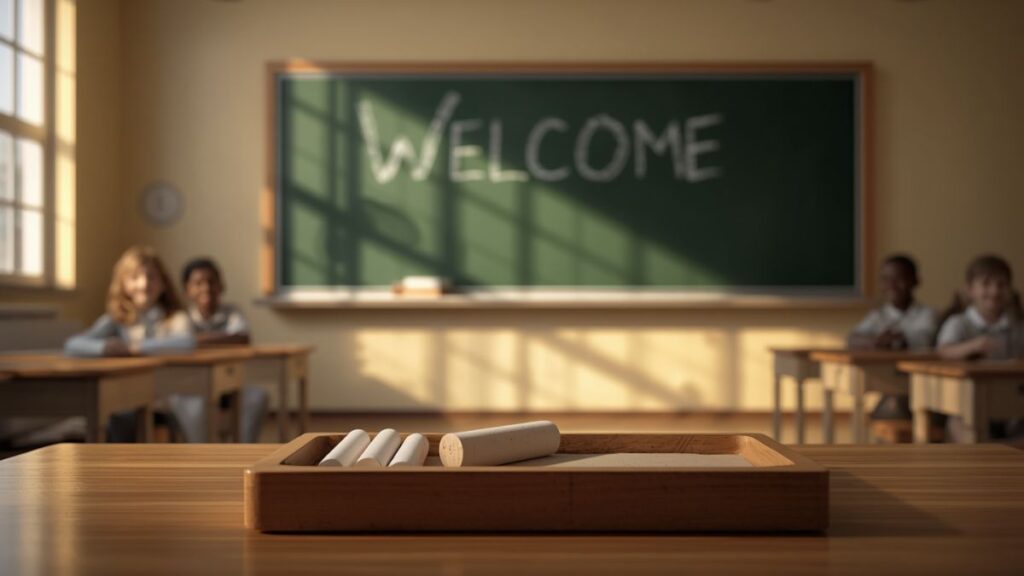
The teacher, Mr. Harris, welcomed everyone with a smile.
“We’re going to learn many new things this year.”
“And remember something very important.”
He wrote across the board:
Mistakes are proof that you’re trying.
The eraser quietly read those words.
It didn’t understand.
Soon the first mathematics lesson began.
Ava carefully solved several addition problems.
Then she stopped.
“Oh no.”
“I made a mistake.”
She picked up the eraser.
The eraser became nervous.
“I’m going to lose part of myself.”
As it gently rubbed across the page, the incorrect answer disappeared.
In its place, Ava wrote the correct one.
She smiled.
“I got it.”
The eraser looked at the clean page.
It had expected something terrible.
Instead, it had helped.
Later that afternoon, the pencil smiled.
“See?”
“You didn’t erase success.”
“You helped create it.”
The eraser quietly thought about those words.
Over the next several days, Ava continued learning.
Some lessons were easy.
Others were difficult.
Every time she made a mistake, she reached for the eraser.
Sometimes it corrected spelling.
Sometimes multiplication.
Sometimes grammar.
Each correction made Ava’s work stronger.
Still, the eraser noticed something strange.
Every time it was used, it became slightly smaller.
Tiny pink crumbs appeared across the desk.
One evening, the eraser sighed.
“I keep disappearing.”
The pencil nodded kindly.
“So do I.”
The eraser looked surprised.
“My point keeps getting shorter every day.”
“But look at Ava’s notebook.”
The eraser glanced at the pages.
They were filled with neat handwriting, solved equations, creative stories, and colorful ideas.
The pencil smiled.
“We’re becoming smaller.”
“But her knowledge is becoming greater.”
The eraser remained silent.
Perhaps getting smaller wasn’t something to fear.
Weeks passed.
One Friday afternoon, the class worked on persuasive essays.
Ava stared at her paper.
“I can’t do this.”
She wrote one sentence.
Erased it.
Wrote another.
Erased that too.
Soon the page was filled with faint marks.
The eraser worried.
“I’m making such a mess.”
Mr. Harris noticed Ava’s frustration.
He knelt beside her desk.
“Can I show you something?”
He opened his own notebook.
Inside were crossed-out words.
Erased paragraphs.
Corrections everywhere.
Ava looked surprised.
“You make mistakes too?”
Mr. Harris smiled.
“Every single day.”
“The difference is…”
“I don’t let them stop me.”
He gently tapped the eraser.
“This little tool reminds us that mistakes are temporary.”
“What matters is what we learn after correcting them.”
Ava smiled.
She began writing again.
This time she finished the entire essay.
It later earned one of the highest grades in the class.
The eraser felt proud.
Not because it had removed mistakes.
Because it had helped someone keep going.
As autumn turned into winter, new supplies arrived for several students.
One brand-new eraser looked proudly at the older one.
“You’ve become so small.”
“And you’re covered with pencil marks.”
The older eraser smiled.
“I’ve been busy.”
“I hope I stay perfect all year.”
The older eraser chuckled gently.
“I used to think that too.”
The new eraser looked confused.
“Isn’t staying perfect the goal?”
“No.”
“Helping people grow is.”
The new eraser didn’t fully understand.
But it remembered those words.
One snowy afternoon, the class prepared for the annual science fair.
Ava wanted to build a model windmill.
Her first design collapsed.
Her second didn’t spin.
Her third barely stood upright.
Each failure filled several notebook pages with sketches, calculations, and erased ideas.
The eraser worked harder than ever.
At one point Ava sighed.
“I’ll never figure this out.”
Mr. Harris gathered the class.
He carried an old wooden box.
Inside were dozens of unusual objects.
A cracked ruler.
A worn-out paintbrush.
A broken measuring tape.
An almost-empty glue bottle.
And a tiny eraser, much smaller than Ava’s.
“What are those?” a student asked.
“My favorite teaching tools.”
Everyone laughed.
Mr. Harris picked up the little eraser.
“This belonged to my teacher when I was your age.”
“She kept it to remind us that every expert once made countless mistakes.”
He carefully placed it back.
“These tools aren’t valuable because they stayed new.”
“They’re valuable because they were used to help someone learn.”
The classroom became very quiet.
The older eraser smiled.
Someone understood.
Inspired, Ava kept improving her windmill.
After many corrections, it finally worked.
At the science fair, her project won first place.
As reporters interviewed students, one asked Ava,
“How did you come up with such a successful design?”
She smiled.
“By making lots of mistakes.”
The older eraser nearly laughed aloud.
Exactly.
Months passed.
The school year slowly approached its end.
The eraser had become tiny.
Barely large enough to hold.
The pencil had become short too.
One afternoon, Ava carefully placed both inside a small memory box at home.
Her mother noticed.
“Why are you saving old school supplies?”
Ava smiled.
“They helped me learn.”
Years passed.
Ava grew older.
She eventually became an inventor.
People admired her creative designs.
Newspapers often praised her ability to solve difficult problems.
Whenever young students visited her workshop, they asked,
“Were you always this good?”
Ava laughed.
“Not even close.”
She opened the same little memory box she had kept since fourth grade.
Inside rested the tiny eraser and worn pencil.
“I made hundreds of mistakes.”
She held up the little eraser.
“This was my most important school supply.”
The children looked puzzled.
“It erased mistakes?”
Ava smiled.
“No.”
“It reminded me that mistakes aren’t permanent.”
“They’re simply part of learning.”
Inspired, one child asked,
“So we shouldn’t be afraid of getting answers wrong?”
Ava shook her head.
“We should only be afraid of refusing to try.”
Many years later, Mr. Harris retired.
Former students gathered to celebrate his career.
As gifts were presented, Ava stepped onto the stage carrying a beautifully framed display.
Inside rested a tiny pink eraser beneath a simple inscription:
Every Great Achievement Begins with the Courage to Correct a Mistake.
Mr. Harris smiled warmly.
“I remember that little eraser.”
Ava nodded.
“I do too.”
“It taught me as much as any textbook.”
The audience applauded.
Teachers often receive credit for the lessons they explain.
But sometimes ordinary classroom tools quietly reinforce those lessons every single day.
The little eraser had never written a sentence.
Never solved a problem.
Never answered a question.
Yet through every correction, it encouraged persistence.
Through every erased mistake, it made room for improvement.
As the celebration ended, children visiting the classroom noticed the framed display.
One little boy read the inscription aloud.
Then he looked at his own brand-new eraser.
“I hope mine gets really small.”
His teacher smiled.
“Why?”
“Because that means I’ll have learned a lot.”
The teacher nodded proudly.
“That’s exactly right.”
From that day forward, every new class heard the story of the little eraser that loved mistakes.
Students stopped hiding their errors.
Instead, they corrected them with confidence.
They understood that every erased answer was another step toward understanding.
And little by little, the classroom became a place where curiosity mattered more than perfection.
Because mistakes are not the end of learning.
Very often, they are where learning truly begins.
Moral: Mistakes are not signs of failure. They are opportunities to learn, improve, and grow. Those who embrace their mistakes with courage often achieve the greatest success.