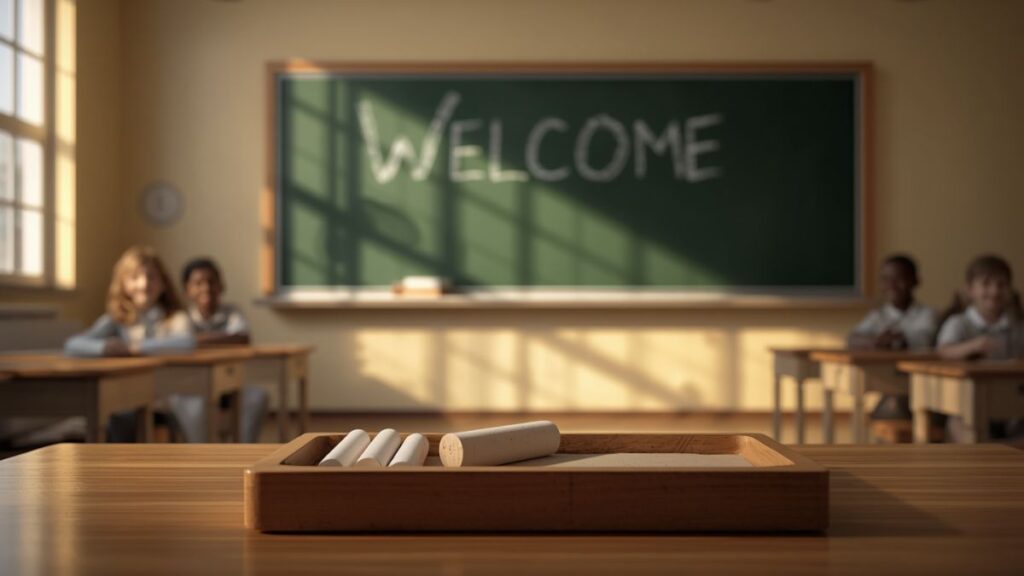
On the corner of a wooden classroom desk sat a brand-new box of white chalk.
Every stick inside was perfectly straight.
They were smooth, bright, and proud of how clean they looked.
The classroom had been freshly painted.
The desks shone in the morning sunlight.
The blackboard stretched across the front wall like a blank canvas waiting for ideas.
Inside the box, the chalk pieces whispered excitedly.
“I hope the teacher chooses me first.”
“I want to write the biggest words.”
“I hope I last all year.”
Among them sat one tiny stick of chalk that had accidentally been left behind from the previous school year.
It was barely two inches long.
Its edges were worn.
A few small cracks covered its sides.
Compared to the new chalk, it looked old and tired.
One of the fresh chalk sticks noticed it.
“Were you forgotten?”
The little chalk smiled politely.
“I don’t think so.”
“You look too small to be useful.”
Another piece laughed.
“You’ll probably snap the first time someone picks you up.”
The tiny chalk didn’t argue.
It simply rested quietly in the corner of the box.
A few minutes later, the classroom door opened.
Mrs. Lewis entered carrying a stack of books.
She smiled as she looked around her classroom.
“Another year,” she whispered.
“I wonder what we’ll learn together.”
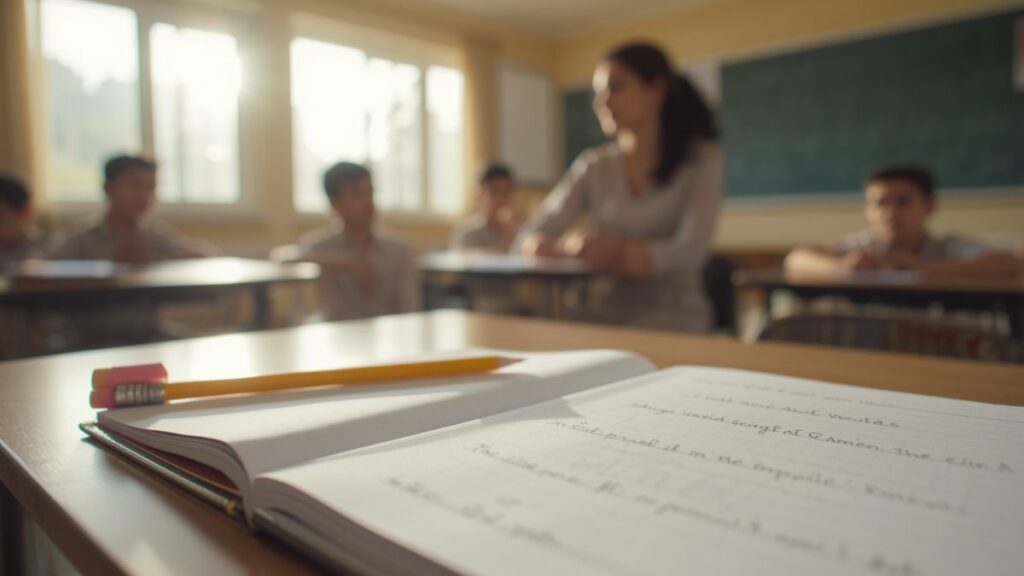
Soon the students arrived.
Their laughter filled the room.
Backpacks landed beside desks.
Notebooks opened.
The first lesson began.
Mrs. Lewis reached into the chalk box.
The new sticks held their breath.
Surely she would choose one of them.
Instead, her fingers gently picked up the tiny piece of chalk.
The new chalk stared in surprise.
“Why would she choose that one?”
Mrs. Lewis smiled as she wrote one word across the board.
WELCOME
The tiny chalk glided smoothly.
Although it was small, every letter appeared bright and clear.
The students smiled.
“It looks like it’s going to be a great year.”
The little chalk quietly rested on the chalk tray.
One of the new pieces whispered,
“I didn’t think it could still write.”
The tiny chalk smiled.
“I’ve learned that usefulness isn’t measured by size.”
Day after day, Mrs. Lewis continued using the little chalk.
Sometimes it wrote spelling words.
Sometimes math equations.
Sometimes encouraging messages.
One Monday morning, she wrote,
Mistakes Help Us Learn.
The students copied the sentence into their notebooks.
One boy sighed.
“I make too many mistakes.”
Mrs. Lewis pointed gently toward the board.
“Then you’re learning every day.”
The little chalk felt proud.
Its words had made someone smile.
As the weeks passed, the tiny chalk became even shorter.
The newer sticks watched carefully.
“You’re disappearing.”
“Doesn’t that bother you?”
The little chalk looked toward the students busily solving problems.
“Every bit of me becomes part of a lesson.”
“I think that’s a wonderful reason to become smaller.”
The other chalk pieces didn’t understand.
They still hoped to stay long and perfect.
One rainy afternoon, Mrs. Lewis announced an art lesson.
The students would draw their biggest dreams.
The classroom buzzed with excitement.
One child drew a rocket.
Another sketched a hospital.
Someone else imagined a bakery.
Emma quietly stared at her blank paper.
She didn’t know what to draw.
Mrs. Lewis noticed.
“What are you thinking about?”
“I don’t know what I’m good at.”
Mrs. Lewis gently picked up the tiny chalk.
She walked to the board and wrote,
You don’t discover your gifts by waiting.
You discover them by trying.
Emma looked at the words.
Slowly, she smiled.
She began drawing herself surrounded by books.
“I think I’d like to become a writer.”
The little chalk felt warm inside.
Perhaps those words would stay with Emma forever.
Months passed.
The little chalk was now only a tiny stub.
The new sticks had finally begun taking turns on the blackboard.
They quickly realized teaching wasn’t as easy as they had imagined.
Each lesson wore them down a little.
Each word left them slightly smaller.
One afternoon, a new chalk stick sighed.
“I’m already half my original size.”
“I thought I would last much longer.”
The tiny chalk smiled.
“What have you written?”
The larger stick thought for a moment.
“The alphabet.”
“Fractions.”
“Poems.”
“Science diagrams.”
“History dates.”
The tiny chalk nodded.
“And where are those lessons now?”
The larger chalk looked toward the students.
“They’re inside their notebooks.”
“And inside their minds.”
The little chalk smiled.
“So perhaps none of us truly disappear.”
Those words echoed quietly through the box.
The other chalk began seeing their work differently.
Instead of worrying about becoming shorter, they focused on writing clearly.
They celebrated each lesson.
Each encouraging sentence.
Each solved problem.
One winter afternoon, the principal visited the classroom.
She watched as Mrs. Lewis patiently explained a difficult math concept.
Several students struggled at first.
Then understanding slowly spread across their faces.
The principal smiled.
“You always make difficult lessons seem simple.”
Mrs. Lewis laughed.
“I don’t.”
“The students do.”
“I simply write where they can see.”
The tiny chalk quietly appreciated those words.
Teachers guide.
Students discover.
Everyone grows together.
By spring, the little chalk had become so short that it was difficult to hold.
One of the newer pieces asked,
“Aren’t you afraid your time is almost over?”
The tiny chalk looked around the classroom.
Student artwork covered the walls.
Books filled the shelves.
Laughter echoed through the room.
“No.”
“I’ve spent my whole life helping ideas appear.”
“What better ending could there be?”
The next morning, Mrs. Lewis carefully picked up the tiny chalk one final time.
She wrote only one sentence before placing it gently on the tray.
Believe in what you can become.
The students copied the words into their journals.
Later that afternoon, the little chalk finally became too small to use.
Mrs. Lewis looked at it thoughtfully.
Instead of throwing it away, she placed it inside a small glass jar sitting on her bookshelf.
The label read:
Lessons That Changed Lives.
Several students noticed.
“Why did you keep that little piece?”
Mrs. Lewis smiled.
“It helped teach hundreds of lessons.”
“It earned its place.”
The remaining chalk looked proudly toward the jar.
For the first time, none of them feared becoming smaller.
Years passed.
The classroom welcomed hundreds of new students.
The little glass jar remained on the bookshelf.
Occasionally someone asked about it.
Mrs. Lewis always shared the same story.
“People sometimes think value comes from staying new.”
“But real value comes from being useful.”
One afternoon, many years later, a former student named Emma returned to visit.
She was now a successful children’s author.
While talking with Mrs. Lewis, she noticed the familiar jar.
“The little chalk.”
Mrs. Lewis smiled.
“You remember it?”
Emma nodded.
“You once wrote something that changed my life.”
She pointed toward the blackboard.
“You wrote that we discover our gifts by trying.”
“I was afraid to write.”
“Now I write books for children.”
Mrs. Lewis looked surprised.
“I had forgotten writing that.”
Emma laughed.
“I never did.”
She reached into her bag and handed Mrs. Lewis her newest book.
Inside the front cover she had written:
“For the teacher who taught me that every small lesson can become a lifelong story.”
Mrs. Lewis carefully placed the book beside the glass jar.
The tiny piece of chalk had long since stopped writing.
Yet its lessons continued appearing in classrooms, libraries, and children’s imaginations.
As the afternoon sun shone through the classroom windows, the little chalk seemed almost to glow inside the jar.
It had once worried about becoming smaller.
Now it understood the truth.
It had never truly disappeared.
Part of it lived inside every lesson it had helped create.
Inside every student who had learned to believe in themselves.
Inside every dream that began with a simple word written across a classroom board.
Sometimes the greatest purpose is not to last forever.
Sometimes it is to leave behind something that does.
And in that classroom, every stick of chalk eventually learned the same beautiful lesson.
The more they gave of themselves, the more knowledge remained in the hearts and minds of others.
Moral: True value is not measured by how long we last but by the positive difference we make. Every effort we give to help others learn leaves a lasting mark that can never be erased.