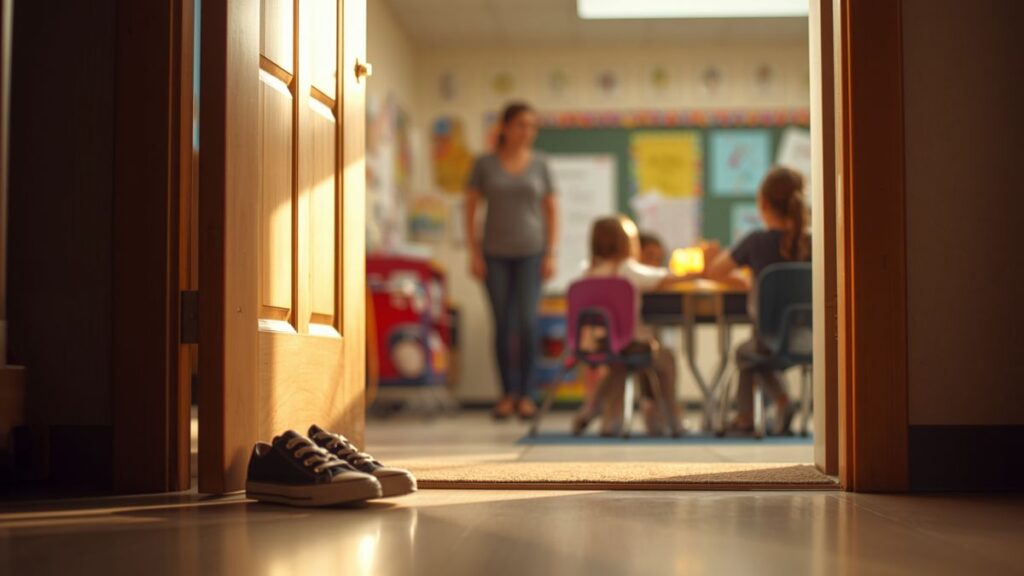
The final bell of the school year had rung only three days earlier, and Maple Ridge Middle School was unusually quiet.
The once-busy hallways echoed with silence.
Colorful student artwork had been taken down from bulletin boards.
Classroom doors stood open while teachers packed away another year’s worth of memories.
Some sorted papers.
Some boxed supplies.
Others rearranged desks in preparation for a new group of students arriving after summer vacation.
Mrs. Carter remained in Room 12.
She had taught language arts for twenty-eight years.
Every June, she followed the same routine.
She cleaned every bookshelf, organized every cabinet, and inspected every classroom textbook before placing it neatly back on the shelves.
“It’s like saying goodbye,” another teacher once told her.
Mrs. Carter smiled.
“I think it’s more like getting ready to say hello.”
That afternoon, she lifted an old literature textbook from the bottom shelf.
Its cover was worn.
Its corners had softened after passing through countless students’ hands.
As she flipped through the pages, something slipped onto the floor.
A small folded piece of notebook paper.
She assumed it was an old homework assignment.
Perhaps a forgotten bookmark.
Curious, she unfolded it.
Inside, written in careful blue ink, were only a few sentences.
“Dear Mrs. Carter,
You probably won’t remember this moment.
But one afternoon you told me I wasn’t a bad student. You said I was simply having a hard season.
Nobody had ever separated my mistakes from who I was before.
Those words kept me from giving up on school.
Thank you for believing in me before I believed in myself.
I hope one day I can encourage someone the way you encouraged me.”
There was no signature.
Only one small drawing of a tiny maple leaf in the corner.
Mrs. Carter stared quietly at the note.
She searched her memory.
Who had written it?
The maple leaf looked familiar.
She remembered a student years earlier who loved sketching leaves in the margins of every notebook.
His name was Owen.
Could it have been him?
She wasn’t sure.
The note contained no date.
No class period.
No clues except those heartfelt words.
She carefully folded the paper and placed it inside her planner.
For the rest of the afternoon, she found herself thinking about it.
Teaching often felt like planting seeds without knowing which ones would grow.
Some days students eagerly participated.
Other days they seemed distracted or discouraged.
Teachers rarely knew which conversations students would remember years later.
Mrs. Carter often wondered whether her encouragement truly made a difference.
Now, somehow, this forgotten note had answered that question.
When the new school year began, Room 12 once again filled with nervous faces.
New students.
New personalities.
New challenges.
Among them was a quiet seventh grader named Lily.
Unlike most students, Lily never volunteered answers.
She avoided group discussions.
She submitted assignments without making eye contact.
When classmates laughed across the room, she often assumed they were laughing at her.
One afternoon, Mrs. Carter noticed Lily crumpling a writing assignment before quietly throwing it into the recycling bin.
She retrieved it after class.
The essay wasn’t poor.
It was thoughtful, creative, and full of vivid descriptions.
Only a few spelling mistakes appeared.
The next morning, Mrs. Carter asked Lily to stay for a moment after class.
Lily looked worried.
“I’m sorry,” she whispered.
“I know my essay wasn’t very good.”
Mrs. Carter handed it back with a smile.
“I disagree.”
Lily looked surprised.
“It isn’t perfect.”
“Neither is any first draft.”
She paused before continuing.
“You’re not struggling because you can’t write.”
“You’re struggling because you’re afraid your writing won’t be perfect.”
Lily quietly looked down.
Mrs. Carter continued gently.
“Those are very different things.”
Lily didn’t respond immediately.
But she carefully unfolded the essay and slipped it back into her notebook instead of throwing it away.
Weeks passed.
Slowly, Lily began participating more often.
She volunteered to read one paragraph aloud during literature circles.
She smiled during classroom discussions.
She even entered the school’s annual creative writing contest.
Although she didn’t win, her confidence continued growing.
One rainy afternoon, Mrs. Carter opened her desk drawer and noticed the old thank-you note again.
She reread it.
Then carefully placed it back.
It reminded her that encouragement often worked quietly.
Like sunlight nourishing roots hidden beneath the soil.
Months later, the school organized a family literacy night.
Students displayed essays, poems, and short stories around the library.
Parents wandered from table to table reading their children’s work.
Mrs. Carter noticed Lily standing nervously beside her display.
Very few visitors had stopped.
Mrs. Carter quietly walked over.
“I’d like to read your story again.”
Lily smiled.
As Mrs. Carter complimented specific details, several parents nearby became curious.
Soon a small crowd gathered around Lily’s display.
People praised her creativity.
Asked questions.
Encouraged her to keep writing.
Lily beamed.
Sometimes confidence begins with just one person stopping to notice.
Years passed.
Mrs. Carter continued teaching.
Every summer she found forgotten pencils, homework pages, and old bookmarks inside classroom books.
But never another thank-you note.
Still, she kept the first one safely tucked inside her planner.
Whenever teaching became difficult, she reread it.
It reminded her why she had chosen the profession.
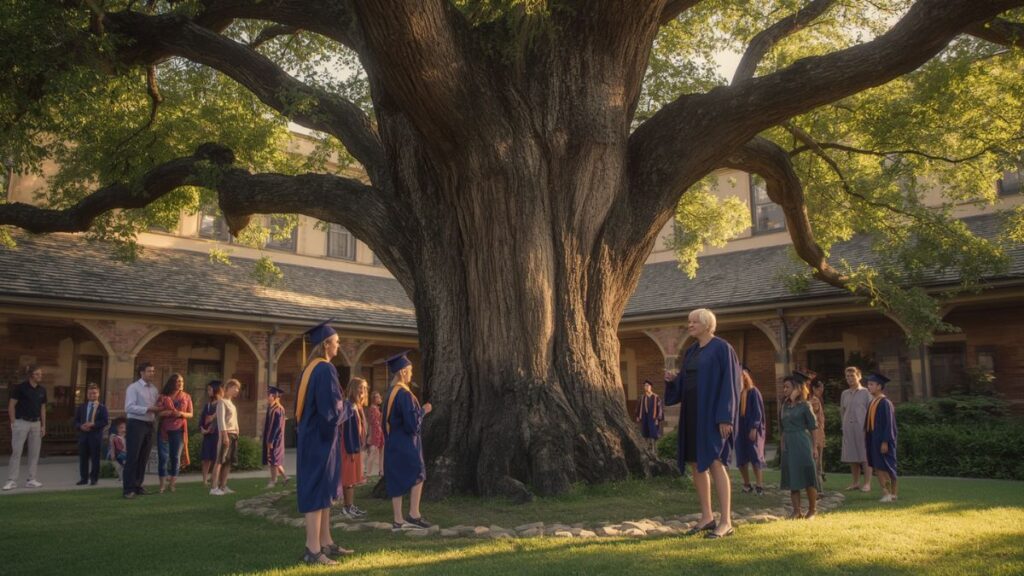
Nearly fifteen years later, Maple Ridge Middle School celebrated its fiftieth anniversary.
Former students returned from across the country.
The school gymnasium buzzed with conversations and laughter.
Gray-haired teachers reunited with adults they still remembered as children.
Mrs. Carter greeted dozens of former students.
Doctors.
Mechanics.
Artists.
Business owners.
Parents.
Each carried different memories from Room 12.
Late that afternoon, a young man approached holding a small leather journal.
“Mrs. Carter?”
She smiled.
“Owen?”
He laughed.
“You remembered.”
“I remember the maple leaves.”
He looked surprised.
“You remembered those too?”
Mrs. Carter nodded.
“You drew them everywhere.”
Owen smiled warmly.
“I still do.”
They talked for several minutes about life after school.
Owen had become a youth counselor, helping teenagers overcome anxiety and self-doubt.
“I always wanted students to hear what I needed to hear when I was younger,” he explained.
Mrs. Carter suddenly remembered the note.
Her eyes widened.
“Wait…”
She reached into her purse.
Carefully unfolding the faded paper, she handed it to him.
“Did you write this?”
Owen looked at the note.
His smile slowly grew.
“I thought I’d lost that forever.”
“You wrote it?”
“I hid it inside a textbook after graduation.”
“Why?”
He looked thoughtful.
“I wasn’t brave enough to hand it to you.”
“I figured someday you’d find it.”
Mrs. Carter laughed softly.
“It took nearly twelve years.”
“I’m glad you found it.”
She looked at him.
“You really remembered that conversation?”
“I remember every word.”
Mrs. Carter tried to recall the moment.
“What exactly happened?”
Owen smiled.
“I failed a history test.”
“I thought I was a failure.”
“You sat beside me after school.”
“You said something I’ve never forgotten.”
He paused.
“A difficult season does not define who you are.
You’re not a bad student.
You’re simply facing a challenge.
And challenges can be overcome.”
Mrs. Carter smiled.
“I almost don’t remember saying it.”
“I know.”
“But I never forgot hearing it.”
He opened his leather journal.
Inside were dozens of handwritten letters from teenagers he had helped over the years.
“They thank me for believing in them.”
He smiled.
“But really…”
He gently handed Mrs. Carter the journal.
“Every one of these letters belongs to you too.”
Mrs. Carter felt tears filling her eyes.
A single encouraging conversation had reached far beyond one student.
It had echoed into countless other lives.
Before leaving, Owen placed another folded note inside one of the classroom textbooks displayed during the anniversary celebration.
Mrs. Carter laughed.
“Another hidden message?”
He smiled.
“Maybe another teacher will need it someday.”
After everyone had gone home, Mrs. Carter quietly returned to Room 12.
She looked at the rows of neatly arranged books waiting for another school year.
Every textbook would eventually become worn.
Every desk would be occupied by another student.
Every classroom would witness moments no report card could ever measure.
Teachers spend countless hours preparing lessons, grading assignments, and explaining difficult concepts.
Those things matter.
But sometimes the greatest lesson isn’t found inside a textbook at all.
Sometimes it lives inside a sentence spoken with kindness.
A few words offered at exactly the right moment.
Words that remind a struggling student they are more than their mistakes.
Words that quietly change the direction of a life.
As Mrs. Carter turned off the classroom lights, she smiled.
Somewhere, another teacher was encouraging another student.
Somewhere, another hidden thank-you note was waiting to be discovered.
And somewhere, another small act of kindness was already beginning a story that would be remembered for decades.
Because teachers rarely know how far their words will travel.
But the kind ones have a remarkable way of finding their way home.
Moral: A teacher may never realize which words a student will remember forever. Genuine encouragement given at the right moment can inspire confidence, shape a future, and create a ripple of kindness that reaches far beyond the classroom.