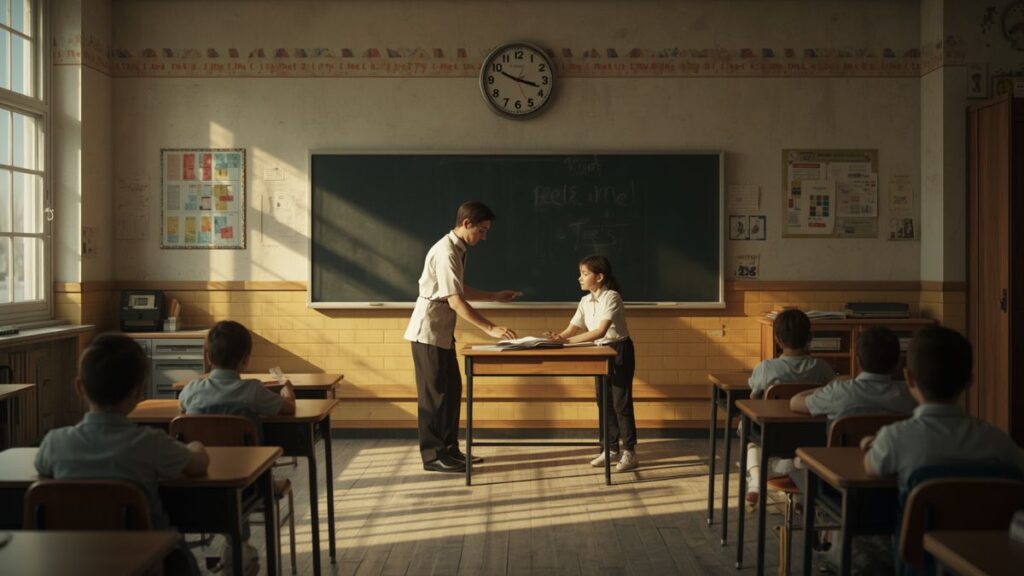
Every school day at Pine Grove Elementary began the same way.
At exactly 7:45 each morning, the front doors opened, and students poured into the hallways. Some rushed to meet their friends. Others carried heavy backpacks while talking excitedly about homework, sports, or weekend adventures.
Standing just outside Room 18 was Mrs. Reynolds.
Rain or shine, cold mornings or warm spring days, she greeted every student with the same warm smile.
“Good morning, Ava!”
“Welcome back, Ethan!”
“I’m glad you’re here today, Maya.”
She didn’t simply wave to the class.
She greeted every child by name.
Some students answered with enthusiastic smiles.
Some offered sleepy nods.
Others hurried past, distracted by conversations with friends.
Mrs. Reynolds never minded.
She believed every child deserved to hear their name spoken with kindness before the first lesson of the day.
Many teachers admired her habit.
Some joked that she must have the best memory in the school.
“What if you forget someone’s name?” one teacher asked.
Mrs. Reynolds smiled.
“Then I learn it again.”
To her, greeting students wasn’t a routine.
It was a promise.
A promise that every child would begin the day knowing someone was happy they had arrived.
One October morning, a new student joined the class.
His name was Caleb.
He had transferred from another city after his family moved unexpectedly.
When he walked into the hallway for the first time, he kept his head down and clutched his backpack tightly.
“Good morning, Caleb,” Mrs. Reynolds said with a smile.
“We’re happy you’re here.”
Caleb looked surprised.
He quietly whispered,
“Good morning.”
It was only two words.
But Mrs. Reynolds noticed something important.
He smiled for just a moment.
Over the next several weeks, Caleb remained quiet.
He completed his assignments.
He followed classroom rules.
He rarely spoke unless someone asked him a direct question.
At recess, he often sat alone on a bench reading library books.
The other students were polite, but friendships take time.
Every morning, however, one thing never changed.
Mrs. Reynolds greeted him.
“Good morning, Caleb.”
“I hope today is a wonderful day.”
“I’m glad to see you.”
Sometimes she added,
“How’s your drawing going?”
“Did your soccer game go well?”
“How’s your grandmother feeling?”
She remembered little details from previous conversations.
To Caleb, it seemed almost impossible.
No adult had ever remembered such small things about him before.
One rainy Tuesday, the students were asked to write about someone who made them feel important.
Most children chose parents.
Some wrote about grandparents.
A few wrote about older brothers or sisters.
Caleb stared at his blank paper for several minutes.
Finally, he began writing.
Mrs. Reynolds quietly collected the papers that afternoon.
When she reached Caleb’s essay, she paused.
It began with one sentence.
“The person who notices when I arrive is my teacher.”
She continued reading.
“At my old school, I felt invisible.
Teachers were busy.
Students already had friends.
Sometimes I wondered if anyone would notice if I stayed home.
Mrs. Reynolds says my name every morning.
She smiles even when she has a hundred things to do.
When she says she’s glad I’m here, I believe her.
It makes me want to come back tomorrow.”
Mrs. Reynolds quietly folded the paper.
She placed it inside her desk drawer.
She never mentioned it to Caleb.
She simply continued greeting every student as she always had.
As winter arrived, Caleb slowly began changing.
He raised his hand during discussions.
He volunteered to help organize classroom books.
He joined a group during science activities.
One afternoon, another student forgot his lunch.
Without hesitation, Caleb offered to share his own.
Mrs. Reynolds smiled.
Kindness had begun to spread.
Near the end of the school year, the principal announced a schoolwide talent showcase.
Students could sing, dance, perform magic tricks, play instruments, or display artwork.
Mrs. Reynolds noticed Caleb staring thoughtfully at the announcement.
“Are you thinking about participating?”
He shook his head.
“I’m not good enough.”
“What would you do if you entered?”
He hesitated.
“I like drawing.”
“Then perhaps you should share your drawings.”
“No one would care.”
Mrs. Reynolds smiled gently.
“Sometimes people don’t know they’ll care until someone has the courage to show them.”
Those words stayed with Caleb.
A week later, he quietly handed Mrs. Reynolds a folder filled with sketches.
They were extraordinary.
Detailed landscapes.
Wild animals.
Portraits.
City streets.
Each drawing was carefully shaded with incredible patience.
“You made all of these?” she asked.
Caleb nodded.
“I’ve been drawing since I was little.”
Mrs. Reynolds looked at him.
“I think other people deserve to see these.”
With encouragement, Caleb entered the showcase.
His artwork covered an entire display wall.
Parents stopped to admire every picture.
Teachers gathered around discussing his talent.
Several local artists attending the event complimented his work.
Caleb couldn’t believe it.
For the first time, strangers weren’t overlooking him.
They were stopping because of him.
After the showcase, the principal invited Caleb to design the cover for the school’s annual yearbook.
The quiet boy who once believed nobody noticed him had become one of the most recognized students in the school.
Years passed.
Mrs. Reynolds continued greeting students every morning.
Some graduated and moved away.
Others returned years later to visit.
She treasured every reunion.
One spring afternoon, the school announced that a special guest would speak during Career Day.
Students filled the auditorium with excitement.
When the guest walked onto the stage, Mrs. Reynolds immediately recognized him.
It was Caleb.
Now an award-winning illustrator whose artwork appeared in children’s books around the world.
The students eagerly listened as Caleb explained how stories and pictures worked together.
After the presentation, he asked if he could say one more thing.
The principal nodded.
Caleb turned toward the audience.
“When people ask how I became an artist, they expect me to talk about drawing.”
“They expect me to mention practice.”
“They expect me to mention talent.”
He smiled.
“But that’s not where my story really began.”
He looked toward Mrs. Reynolds.
“It began with two words.”
The audience waited quietly.
“‘Good morning.'”
Students looked confused.
Caleb continued.
“When I transferred schools, I didn’t believe anyone would notice me.”
“Every morning, Mrs. Reynolds looked me in the eye, smiled, and said my name.”
“She remembered little things about my life.”
“She made me feel like I belonged before I believed it myself.”
“I didn’t become confident because someone praised my drawings.”
“I became confident because someone first convinced me I mattered.”
The auditorium became silent.
Several teachers quietly wiped away tears.
After the assembly, Caleb handed Mrs. Reynolds a framed illustration.
It showed a classroom doorway.
A teacher stood smiling while children entered one by one.
Above the doorway were the words:
“Every Great Journey Begins With Feeling Welcome.”
On the back, Caleb had written,
“Thank you for greeting the student who believed he could disappear without anyone noticing.
You reminded me every single morning that I belonged.
Because of that, I found the courage to share the gifts I had been hiding from the world.”
Mrs. Reynolds carefully held the frame.
She remembered the essay Caleb had written years earlier.
She still kept it safely tucked inside her desk.
The next school year, nothing changed.
At exactly 7:45 every morning, she stood outside Room 18 once again.
“Good morning, Emma.”
“Welcome back, Lucas.”
“I’m glad you’re here today, Sofia.”
Some students smiled.
Some hurried past.
Some barely responded.
But Mrs. Reynolds greeted every one of them just the same.
She knew something they did not.
A simple greeting lasts only a few seconds.
Yet those few seconds can stay with a child for a lifetime.
Teachers rarely know which small moment will become the memory a student carries forever.
It may not be a lesson on fractions.
It may not be a science experiment.
It may simply be hearing their own name spoken with kindness on a morning when they needed it most.
And sometimes, that simple act is enough to save a dream that was quietly slipping away.
Moral: A teacher’s smallest daily habits often leave the greatest impact. A warm greeting, genuine attention, and consistent kindness can help a child believe in themselves long before they discover their own potential.