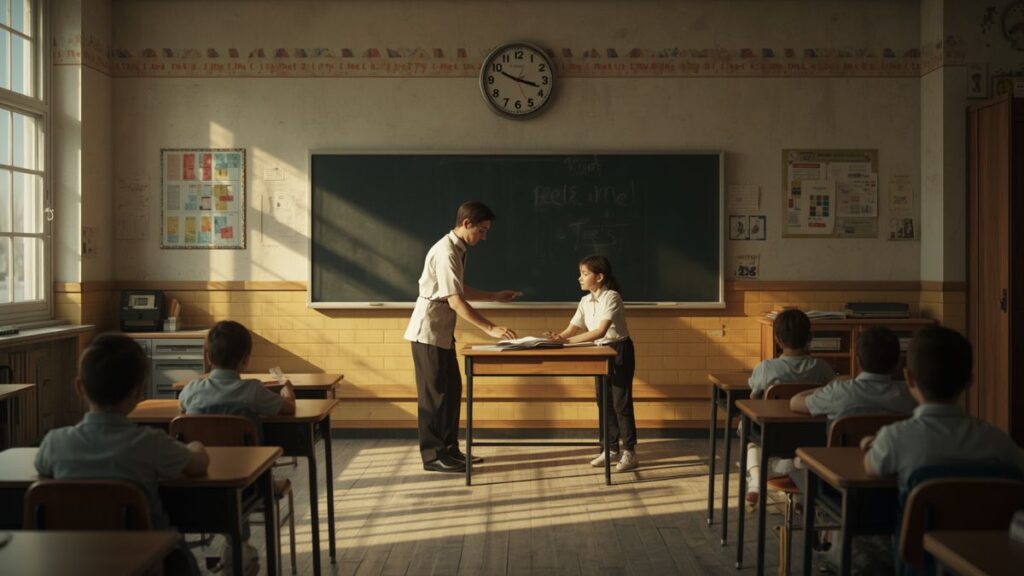
Every Monday morning, Mrs. Bennett welcomed her fourth-grade students with the same cheerful smile.
“Good morning, everyone!”
The classroom always came alive with excited chatter. Backpacks landed beside desks, notebooks opened, and sharpened pencils tapped gently against wooden tables as students prepared for another week of learning.
Everyone seemed ready.
Everyone except Liam.
Every single day, Liam had the same problem.
His pencil never stayed sharp.
Sometimes the tip broke before the lesson even began. Other times, the pencil became so short that he could barely hold it. On many mornings, he didn’t have a pencil at all.
Mrs. Bennett noticed that Liam visited the classroom sharpener more than anyone else.
The loud buzzing interrupted lessons several times a day.
At first, she assumed he simply pressed too hard while writing.
Then she wondered if he was careless.
Perhaps he liked using the sharpener because it gave him an excuse to leave his seat.
Some classmates certainly believed that.
“There goes Liam again.”
“He always breaks his pencils.”
“My little brother writes better than he does.”
Although the comments weren’t meant to be cruel, Liam heard every one of them.
He never argued.
He simply lowered his head and quietly returned to his desk.
One afternoon, while grading spelling tests, Mrs. Bennett noticed something unusual.
Liam’s answers were mostly correct.
The mistakes weren’t caused by a lack of understanding.
His handwriting, however, became messier as the page continued.
Some letters faded until they were almost impossible to read.
She looked closer.
Several words had been written, erased, rewritten, and erased again.
The paper had tiny holes where the eraser had rubbed too hard.
It wasn’t carelessness.
It looked more like someone afraid of making mistakes.
The next morning, Mrs. Bennett walked around the classroom while students worked on a writing assignment.
She stopped beside Liam’s desk.
His pencil was almost gone.
Only a tiny piece remained, barely longer than his thumb.
The eraser had disappeared completely.
“Liam,” she asked gently, “would you like a new pencil?”
He immediately shook his head.
“I’m okay.”
“But this one is so small.”
“It still works.”
Mrs. Bennett smiled.
“If you’re sure.”
He nodded without looking up.
After school, she found the school counselor, Mr. Davis.
“Have you noticed anything unusual about Liam?” she asked.
Mr. Davis thought for a moment.
“He’s quiet.”
“He never causes trouble.”
“He often stays after school waiting for someone to pick him up.”
“That’s about all I know.”
Mrs. Bennett couldn’t stop thinking about him.
The following Friday, the class worked on an art project.
Mrs. Bennett placed containers filled with brand-new colored pencils on every table.
The students rushed toward them with excitement.
Everyone eagerly selected bright colors.
Everyone except Liam.
He continued using the same tiny gray pencil.
Mrs. Bennett quietly walked over.
“You can use these.”
Liam smiled politely.
“I don’t want to wear them out.”
Those words surprised her.
“Wear them out?”
He nodded.
“If I use them too much, they’ll get smaller.”
It was such an unusual answer that Mrs. Bennett said nothing more.
Instead, she simply watched.
When the art period ended, Liam carefully returned every colored pencil exactly as he had found it.
Not one was missing.
Not one had been sharpened.
That evening, Mrs. Bennett reviewed Liam’s student records.
His grades had dropped during the past two years.
Attendance was good.
Behavior was excellent.
There were no notes explaining why he struggled.
She decided it was time to visit his home.
The following week, after speaking with the principal, she arranged a home visit.
Liam lived with his grandmother in a small apartment across town.
The building was old but clean.
His grandmother welcomed Mrs. Bennett warmly.
“I’m so glad you came.”
As they talked, pieces of Liam’s story slowly came together.
His grandmother worked two part-time jobs to support them.
Money was always tight.
Every expense mattered.
School supplies had to last the entire year.
Whenever Liam received new pencils, he treated them like treasures.
He sharpened them only when absolutely necessary.
He worried about wasting them.
If one broke, he blamed himself.
Mrs. Bennett finally understood.
The problem had never been the pencils.
It was fear.
Fear of running out.
Fear of needing something his grandmother couldn’t easily replace.
Before leaving, Mrs. Bennett noticed a small notebook lying on the kitchen table.
Inside were dozens of detailed drawings.
Birds.
Mountains.
Cars.
Trees swaying in the wind.
The sketches were beautiful.
“Liam drew these?” she asked.
His grandmother smiled proudly.
“Every single one.”
“He draws whenever he has a little extra paper.”
Mrs. Bennett looked at Liam.
“You have real talent.”
He shrugged.
“They’re just pictures.”
“No,” she replied.
“They’re stories without words.”
The next Monday, Mrs. Bennett introduced something new to the class.
On a shelf near the classroom door sat a colorful wooden box.
A sign above it read:
The Community Supply Station
Inside were pencils, erasers, notebooks, rulers, crayons, markers, glue sticks, and sharpeners.
Mrs. Bennett smiled.
“From today forward, these supplies belong to everyone.”
“If you need something, take it.”
“If you have extra someday, you can give back.”
“No questions.”
“No embarrassment.”
“No permission needed.”
The students loved the idea.
At first, Liam hesitated.
He walked past the box several times without taking anything.
Finally, one afternoon, his pencil snapped in half.
He stared at it silently.
Mrs. Bennett simply nodded toward the supply station.
Liam slowly walked over.
He picked up one new pencil.
Nothing more.
When he returned to his seat, he whispered,
“Thank you.”
Over the next few weeks, something changed.
Liam stopped visiting the sharpener every few minutes.
His handwriting became steadier.
He erased less often.
He smiled more.
Most importantly, he began raising his hand.
One afternoon, the class entered a district poster contest about protecting nature.
Students eagerly brainstormed ideas.
Mrs. Bennett encouraged Liam to enter.
“I’m not good enough,” he said quietly.
She smiled.
“Remember Daniel Boone?”
Liam looked confused.
“The famous explorer?”
She nodded.
“People remember him because he kept moving forward, not because he believed he was perfect.”
Liam thought about those words.
That evening, he stayed after school working on his poster.
He drew a forest filled with animals, rivers, and children planting trees.
Every detail was carefully shaded.
Every line reflected patience and hope.
Weeks later, the contest winners were announced.
Third place.
Second place.
Then the judge smiled.
“First place goes to Liam Bennett.”
The classroom erupted with applause.
Liam stood frozen.
Mrs. Bennett smiled from the back of the room.
“You earned this.”
Later that afternoon, several classmates gathered around his desk.
“Can you teach me to draw trees?”
“How did you make the river look real?”
“I didn’t know you were this good.”
For the first time, Liam didn’t feel invisible.
As the school year continued, another surprise appeared.
Students began placing extra supplies into the Community Supply Station.
One donated rulers.
Another brought unused notebooks.
Someone added colorful erasers.
Without being asked, parents quietly contributed too.
The small wooden box stayed full all year.
No child ever worried about having enough supplies again.
On the final day of school, Mrs. Bennett asked each student to write one lesson they would never forget.
Most mentioned multiplication.
Some wrote about science experiments.
Liam’s paper contained only one sentence.
“A sharp pencil helps you write, but a kind teacher helps you believe you can.”
Mrs. Bennett carefully folded the note and placed it inside her desk drawer.
Years passed.
Students graduated.
Many returned to visit.
One autumn afternoon, the school welcomed a special guest.
A successful children’s book illustrator had volunteered to speak during Reading Week.
Mrs. Bennett looked at the name on the schedule.
Liam Brooks.
When he entered the classroom, she recognized him immediately.
He carried a sketchbook under one arm.
After speaking with the students, Liam walked toward her with a smile.
“I still remember that supply station.”
Mrs. Bennett laughed.
“I remember your tiny pencils.”
“They weren’t really about pencils,” Liam admitted.
“They were about believing there might not be another one.”
He paused before continuing.
“You taught me something far more valuable.”
“What’s that?”
“That asking for help isn’t weakness.”
“It’s trust.”
Before leaving, Liam handed her a beautifully illustrated children’s book.
Inside the front cover he had written:
“For the teacher who saw beyond a broken pencil and discovered a dream waiting to be drawn.”
Mrs. Bennett closed the book with tears in her eyes.
She looked toward the familiar wooden supply station, still standing in the corner of her classroom.
Hundreds of students had taken pencils from that box over the years.
Most would never remember the pencils themselves.
But many would remember how it felt to know someone had quietly prepared what they needed before they even had to ask.
And sometimes, that simple act of kindness was enough to sharpen something far more important than a pencil.
It sharpened hope.
Moral: Great teachers look beyond a student’s behavior to understand the story behind it. A little compassion can give a child the confidence to achieve more than they ever imagined.