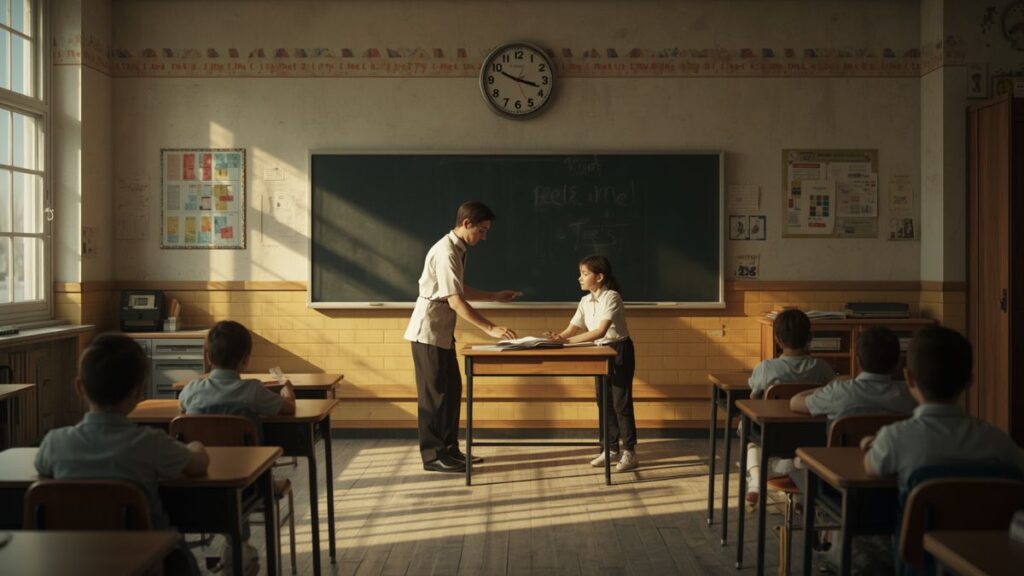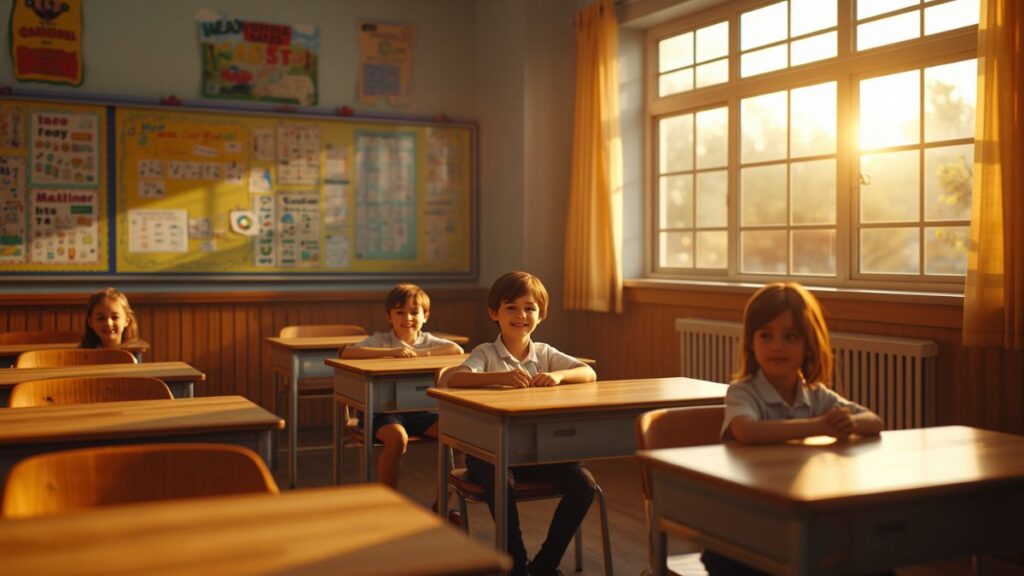
The first thing anyone noticed when they walked into Room 12 wasn’t the colorful bulletin board or the shelves filled with books. It wasn’t the science projects hanging from the ceiling or the cheerful artwork covering the walls.
It was an empty desk by the window.
The desk looked no different from the others. It was made of smooth wood, with a small compartment underneath for books and notebooks. Sunlight poured through the nearby window each morning, making it one of the brightest spots in the classroom.
Yet no student ever wanted to sit there.
Every September, when Mrs. Carter welcomed a new class of fifth graders, excitement filled the room. Children hurried inside, laughing as they searched for seats next to their friends.
“I’ll sit here!”
“Save that seat for me!”
“I want the one in the back!”
Within moments, nearly every desk was taken.
Only one remained.
The desk by the window.
Mrs. Carter watched the same scene unfold year after year.
Whenever she asked someone to take the last available seat, the reactions were almost identical.
“Do I have to?”
“Can I move later?”
“Can I trade with someone?”
No one could explain why.
“It just feels strange.”
“I don’t know.”
“I’d rather sit somewhere else.”
At first, Mrs. Carter thought it was simply one of those mysterious classroom traditions children invent. But after seeing the same behavior for six consecutive years, she knew there had to be a story behind it.
One rainy afternoon after school, she stayed late to organize old classroom supplies. While moving a stack of dusty boxes, she noticed Mr. Harris, the retired custodian, visiting the school to help clean out the storage room.
He smiled as he noticed her looking toward the empty desk.
“You’ve been wondering about that desk, haven’t you?” he asked.
Mrs. Carter laughed.
“Is it that obvious?”
“It is when someone keeps looking at it.”
She nodded.
“Every year, children avoid it. No one even knows why.”
Mr. Harris slowly walked over and rested one hand on the desk.
“This wasn’t always the desk no one wanted.”
Mrs. Carter looked curious.
“It wasn’t?”
He shook his head.
“Years ago, this was Daniel’s desk.”
Mrs. Carter had never heard the name before.
“Who was Daniel?”
Mr. Harris smiled gently before beginning the story.
Daniel had arrived at the school halfway through the year.
He was quiet, shy, and rarely spoke unless a teacher asked him a question.
During lunch, he usually ate by himself.
At recess, he often sat beneath a tree with a sketchbook in his lap.
Many students assumed he simply preferred being alone.
The truth was much different.
Daniel’s parents moved frequently because of work. Every time he finally made friends, they packed their belongings and started over in another town.
After years of saying goodbye, Daniel stopped trying to make new friends.
The desk by the window became his favorite place because he loved watching birds gather in the trees outside. Whenever he felt nervous, he would glance through the window for a few seconds before returning to his schoolwork.
One afternoon, Mrs. Lewis, his teacher, noticed a notebook filled with detailed drawings tucked inside his backpack.
She asked if she could look.
Inside were hundreds of beautiful sketches.
Towering castles.
Peaceful forests.
Flying birds.
Friendly animals.
Entire imaginary villages.
Daniel had an incredible gift.
Mrs. Lewis encouraged him to enter the regional student art competition.
Daniel immediately refused.
“No one’s going to like my drawing.”
Mrs. Lewis smiled.
“You’ve already decided the ending before anyone has even seen the beginning.”
Those words stayed with him.
After several weeks of encouragement, Daniel finally submitted one of his drawings.
To everyone’s surprise, it won first place.
The school celebrated his achievement during an assembly.
Students who had barely noticed him suddenly congratulated him.
For the first time since arriving at the school, Daniel smiled with genuine confidence.
Sadly, only a few months later, his family moved once again.
When the classroom returned after summer vacation, another student was assigned to Daniel’s desk.
Something felt different.
One child quietly whispered, “It doesn’t seem right.”
Another agreed.
“That was Daniel’s seat.”
No teacher thought much about the comment.
But children remembered.
As new students joined the school over the years, the story slowly changed.
Daniel’s name faded from memory.
Eventually, students simply called it “the lonely desk.”
They didn’t know why.
They only knew no one wanted to sit there.
Mrs. Carter listened quietly until Mr. Harris finished.
“It’s amazing,” she said softly.
“A story survived all these years.”
Mr. Harris smiled.
“Children don’t always remember facts.”
“They remember feelings.”
Those words stayed with Mrs. Carter long after he left.
The next morning, she looked around her classroom with fresh eyes.
Most students chatted happily with friends before class began.
Only one child sat quietly.
Her name was Emily.
She had transferred from another school only two weeks earlier.
Although everyone treated her politely, she still spent recess reading alone.
Mrs. Carter noticed something else.
Emily had been assigned to the lonely desk.
Suddenly, an idea began to form.
Instead of moving Emily somewhere else, perhaps she could change what the desk represented.
The following Monday, the students entered the classroom and immediately noticed something different.
A small wooden sign rested neatly on top of the desk.
It read:
The Courage Desk
Hands shot into the air.
“What happened?”
“Why did you change the name?”
Mrs. Carter smiled.
“Because every classroom needs a place that reminds us what courage really looks like.”
The room fell silent.
She continued.
“This desk won’t belong to just one student anymore.”
“Every day, someone will earn the chance to sit here.”
“Not for getting the highest test score.”
“Not for finishing homework first.”
“But for showing courage.”
The students looked puzzled.
Mrs. Carter explained.
“Courage isn’t only about doing something big.”
“It’s asking a question when you’re confused.”
“It’s standing beside someone who’s alone.”
“It’s admitting you’ve made a mistake.”
“It’s helping someone without expecting a reward.”
“If I see those things, you’ll earn the Courage Desk the next day.”
The classroom buzzed with excitement.
Later that afternoon, Oliver raised his hand during reading class.
Normally, he avoided speaking in front of everyone because reading aloud made him nervous.
He stumbled over a few words.
Nobody laughed.
Instead, the class applauded his effort.
Mrs. Carter smiled.
“Oliver, you’ve earned tomorrow’s Courage Desk.”
His face lit up.
The next day, Sophia spent her recess helping another student understand long division.
She earned the desk after Oliver.
Soon, something remarkable began happening.
Students weren’t competing to be the smartest.
They were looking for opportunities to help each other.
Children invited classmates into games during recess.
They shared supplies without being asked.
They complimented each other’s work.
Kindness slowly became part of the classroom culture.
One afternoon, Emily quietly noticed a new student standing alone during lunch.
Without hesitation, she walked over and invited him to join her table.
Mrs. Carter watched from across the cafeteria.
The following morning, she announced,
“Emily has earned today’s Courage Desk.”
The class applauded loudly.
Emily looked completely surprised.
“No one’s ever clapped for me before,” she whispered.
As the months passed, the old desk became the most meaningful seat in the classroom.
Students decorated it with colorful bookmarks.
They placed handwritten notes inside the desk drawer.
One note read,
“You matter more than you know.”
Another said,
“Keep being kind.”
A third simply read,
“Thank you for making someone smile today.”
The desk that once represented loneliness had become a symbol of belonging.
Parents began noticing changes at home.
Children talked less about grades and more about kindness.
“I helped someone today.”
“My friend earned the Courage Desk.”
“I want to make someone feel included tomorrow.”
Mrs. Carter realized the classroom itself had changed.
Students celebrated effort instead of perfection.
They noticed character instead of popularity.
Near the end of the school year, the principal stopped by during dismissal.
She smiled as several students carefully wiped dust from the old desk.
“Why are they cleaning it?” she asked.
Mrs. Carter laughed softly.
“They say heroes deserve a clean desk.”
The principal smiled.
“I’ve never seen children volunteer to clean furniture.”
Mrs. Carter looked at the desk.
“It stopped being furniture a long time ago.”
On the final day of school, every student wrote an anonymous reflection about what they had learned that year.
Mrs. Carter expected answers about math, reading, science, and history.
Instead, nearly every paper mentioned the Courage Desk.
One student wrote,
“I learned that bravery isn’t about being fearless.”
Another wrote,
“I learned that everyone wants to feel included.”
A third wrote,
“The best reward is knowing you helped someone.”
Mrs. Carter carefully placed every reflection inside a folder.
Years passed.
New students entered Room 12.
The Courage Desk remained.
Teachers from neighboring schools heard about the tradition and created similar ideas in their own classrooms.
Some introduced a Kindness Chair.
Others created a Friendship Table.
Each one encouraged students to value compassion as much as achievement.
Nearly a decade later, Mrs. Carter received a letter with no return address.
Inside was a photograph of a beautiful new children’s library.
Standing proudly in front of it was a smiling young woman.
It was Emily.
The letter read:
“Dear Mrs. Carter,
You may not remember me, but I will never forget your classroom.
Before I came to your school, I believed being invisible was normal. When you recognized me for including someone else, you changed the way I saw myself.
Today, I design libraries where every child feels welcome.
Inside our reading room is one special chair.
We call it the Courage Chair.
Children earn it by showing kindness, perseverance, and compassion.
Every week I watch another child discover that they matter.
It all began with one old desk by a classroom window.
Thank you for seeing me when I thought no one did.
With gratitude,
Emily.”
Mrs. Carter folded the letter carefully and placed it inside the same drawer where students had once left encouraging notes.
She looked at the old wooden desk beside the window.
The wood carried scratches from years of eager hands.
Its edges had softened with time.
It still looked ordinary.
But she knew the truth.
A classroom is never transformed by furniture.
It is transformed by the meaning a teacher gives to ordinary moments.
One desk had once reminded children of loneliness.
Now it reminded generations of students that courage often begins with kindness, that every person deserves to feel seen, and that the smallest acts of encouragement can echo for a lifetime.
Mrs. Carter smiled as sunlight streamed across the desk once more.
The seat by the window was no longer empty.
It was filled with hope.
Moral: The greatest lessons teachers leave behind are not always found in textbooks. They are found in the kindness, courage, and sense of belonging they inspire in every child.