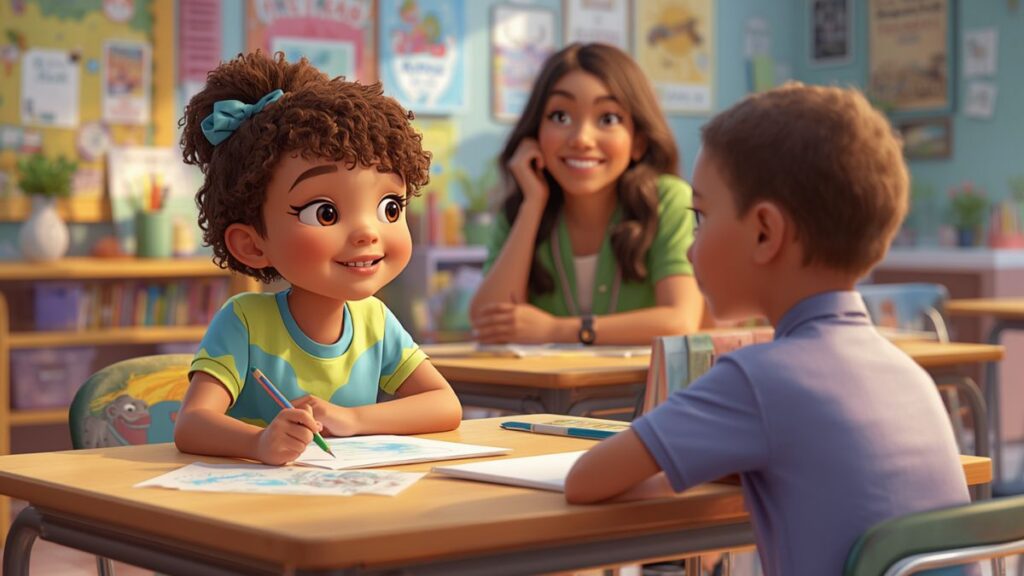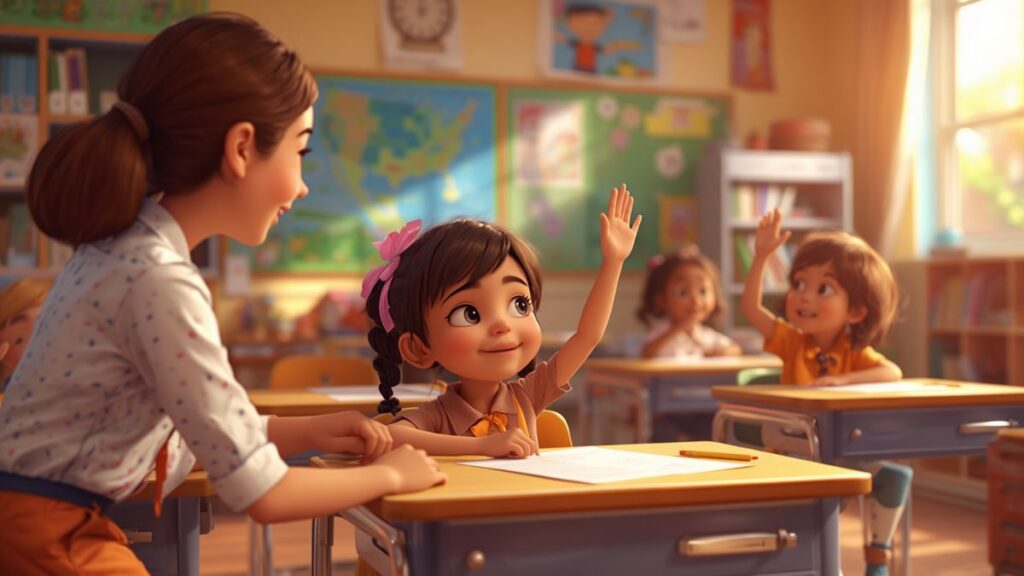
Ella was a cheerful seven-year-old who loved school. Every day she walked into her classroom with a big smile, ready to learn something new. She especially enjoyed reading stories, solving math puzzles, and participating in classroom discussions.
Ella was full of ideas.
Whenever Mrs. Wilson asked a question, Ella almost always knew the answer.
The problem was that she became so excited to share her thoughts that she often called out before anyone else had a chance to answer.
“I know!”
“It’s a butterfly!”
“The answer is twelve!”
Her classmates sometimes looked disappointed because they hadn’t been given enough time to think.
Mrs. Wilson knew Ella wasn’t trying to be rude.
She simply wanted to share her excitement.
One Monday morning, Mrs. Wilson held up a picture of a caterpillar.
“Who can tell me what this caterpillar will become?” she asked.
Before anyone could think, Ella shouted,
“A butterfly!”
Mrs. Wilson smiled kindly.
“That’s the correct answer, Ella.”
Ella grinned proudly.
Then Mrs. Wilson continued,
“Next time, let’s remember to raise our hands first.”
Ella nodded.
“I forgot.”
After the lesson, Mrs. Wilson invited Ella to talk for a few minutes.
“You have wonderful ideas,” she said warmly.
“I love hearing them.”
Ella smiled.
“Really?”
“Of course.”
“But your classmates have wonderful ideas too.”
Mrs. Wilson picked up a colorful classroom poster.
It showed three simple pictures.
A hand raised in the air.
A child waiting quietly.
A smiling student speaking.
“These are our discussion steps,” Mrs. Wilson explained.
Raise your hand.
Wait patiently.
Speak when your teacher calls your name.
“When everyone follows these steps, everyone gets a chance to participate.”
Ella looked carefully at the pictures.
“I can do that.”
The next day, the class read a story about penguins.
Mrs. Wilson asked,
“Why do penguins huddle together during winter?”
Ella immediately knew the answer.
Her hand almost shot into the air.
She remembered the poster.
She quietly raised her hand.
Then she waited.
Mrs. Wilson called on Noah first.
“They stay warm,” Noah answered.
Mrs. Wilson smiled.
“Excellent.”
Then she called on Ella.
“They also protect each other from the cold wind.”
“Wonderful addition,” Mrs. Wilson said.
Ella noticed something.
Waiting hadn’t made her answer less important.
Instead, it gave everyone a chance to contribute.
Later that morning, the class worked in small reading groups.
Each student took turns reading aloud.
Normally Ella sometimes jumped in to help classmates pronounce difficult words.
This time she waited patiently.
When her friend Mia paused on a tricky word, Mrs. Wilson gently helped her sound it out.
Afterward, Mia smiled.
“I figured it out.”
Ella smiled too.
She realized waiting allowed her classmates to learn on their own.
During art class, Mrs. Wilson explained how to make paper flowers.
Ella wanted to ask several questions immediately.
Instead, she raised her hand.
Mrs. Wilson answered each student’s question one at a time.
The lesson felt calm and organized.
Everyone understood the instructions before beginning.
That afternoon, Ella told her parents about the classroom poster.
Her dad smiled.
“Raising your hand is another way of showing respect.”
Her mom added,
“It lets everyone know you’re ready to share.”
The following day, Mrs. Wilson introduced a classroom game called Question Time.
Students sat in a circle.
Mrs. Wilson asked interesting questions like,
“If you could visit any place in the world, where would you go?”
Everyone who wanted to answer raised a hand.
Ella noticed something wonderful.
Because everyone waited patiently, she heard many interesting ideas she had never considered before.
Some children wanted to visit the beach.
Others dreamed of exploring space.
One classmate hoped to visit a rainforest.
When it was finally Ella’s turn, she said,
“I’d like to visit Antarctica to see penguins.”
Her classmates smiled.
“That sounds exciting!”
Ella enjoyed listening just as much as speaking.
Later that week, a substitute teacher visited the class.
Before the lesson began, the teacher explained,
“Please raise your hand if you’d like to answer.”
Several students followed the rule immediately.
Ella did too.
At the end of the day, the substitute teacher thanked the class.
“You were wonderful listeners.”
“And you waited patiently to speak.”
Ella felt proud.
One rainy afternoon, the class worked together on a science experiment.
Mrs. Wilson explained each step carefully.
Many students had questions.
Instead of everyone speaking at once, hands quietly went up around the room.
Because everyone waited their turn, Mrs. Wilson answered every question clearly.
The experiment went smoothly.
Ella realized that raising hands helped everyone learn.
A few weeks later, a new student named Leo joined the class.
He was shy and rarely volunteered answers.
Mrs. Wilson asked a question about animals.
Ella knew the answer immediately.
She raised her hand and waited.
Mrs. Wilson noticed Leo’s hand had slowly gone up too.
She smiled.
“Leo?”
Leo answered correctly.
The class applauded.
After class, Leo quietly thanked Ella.
“If everyone had called out, I don’t think I would have answered.”
Ella smiled.
“I’m glad you did.”
She understood that waiting patiently helped quieter classmates feel confident enough to participate.
One morning, Mrs. Wilson introduced a new classroom challenge.
Each time the class remembered to raise hands and wait politely throughout the lesson, they earned a colorful star.
When they collected twenty stars, they would enjoy a special reading picnic.
The students worked together.
Sometimes someone forgot and called out.
Mrs. Wilson simply smiled and reminded them.
Little by little, everyone improved.
Soon the classroom chart filled with bright stars.
When the class finally earned the reading picnic, they spread blankets across the school lawn.
Everyone enjoyed books, fruit, and fresh air.
Mrs. Wilson smiled.
“This happened because everyone worked together.”
Ella looked around.
The classroom had become calmer.
Everyone had opportunities to speak.
Everyone listened respectfully.
Near the end of the school year, Mrs. Wilson asked one final question.
“What have you learned this year?”
Hands quietly rose across the classroom.
Mrs. Wilson smiled at Ella.
Ella waited patiently.
When her turn came, she answered,
“I learned that waiting my turn helps everyone learn.”
Mrs. Wilson nodded proudly.
“That’s a wonderful lesson.”
On the last day of school, every student received a certificate celebrating a personal strength.
Ella’s certificate read:
“Respectful Classroom Communicator.”
Mrs. Wilson smiled warmly.
“Ella has learned that sharing ideas is important, and waiting her turn helps everyone feel included.”
The class applauded.
Ella smiled proudly.
Looking back, she realized she still loved answering questions.
She still enjoyed sharing ideas.
She still became excited whenever she learned something new.
But now she understood that learning wasn’t only about speaking.
It was also about listening.
It was about giving classmates time to think.
It was about respecting everyone’s chance to participate.
From then on, whenever Ella wanted to answer a question, she remembered three simple steps.
Raise your hand.
Wait patiently.
Speak when it’s your turn.
Those small actions made the classroom a place where every student could learn, participate, and feel valued.
And every time Mrs. Wilson smiled and called her name, Ella knew her patience had made the conversation even better.
Moral: Raising your hand and waiting your turn shows respect, gives everyone a chance to participate, and helps create a positive classroom where everyone can learn together.