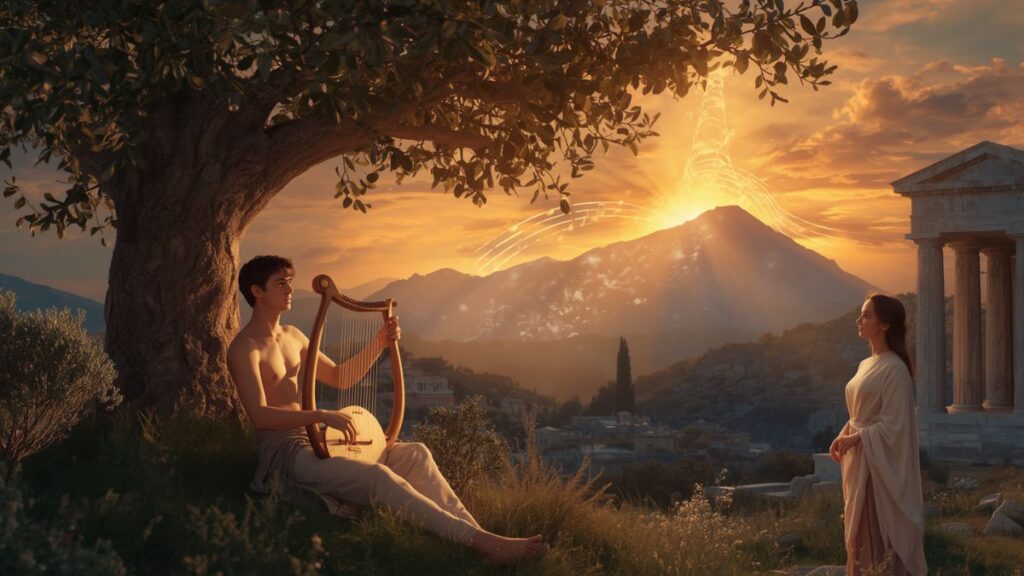
On the sunlit island of Kythera, where gentle waves kissed white sandy shores and fragrant olive trees covered the hills, stood the most beautiful garden in all of Greece. Hidden behind marble walls and blooming with thousands of roses in shades of crimson, ivory, pink, and gold, it was known as the Rose Garden of Aphrodite.
The people believed the garden had been planted by Aphrodite herself, the goddess of love and beauty. Every rose was said to bloom from an act of genuine love rather than admiration or desire. Couples often visited the garden to offer prayers, while poets sought inspiration among its winding paths.
Yet one ancient legend remained largely forgotten.
It was said that somewhere within the garden grew a single silver rose.
Unlike the others, it could bloom only when two hearts loved each other with complete honesty, patience, and selflessness.
Many had searched for it.
None had ever found it.
In the nearby village lived an eighteen-year-old gardener named Lysander. Unlike famous warriors or wealthy merchants, Lysander had little interest in glory. He spent his days caring for vineyards, planting olive trees, and tending flowers that brightened the village square.
People admired his kindness more than his appearance.
Whenever storms damaged a neighbor’s garden, Lysander quietly helped replant it.
Whenever elderly villagers struggled with heavy baskets, he carried them home without expecting thanks.
His mother often smiled.
“Flowers grow where kindness is planted.”
Not far away lived Helena, the daughter of a respected sculptor. Helena possessed remarkable artistic talent. From simple blocks of marble, she carved graceful statues that seemed almost alive.
Travelers praised her work, but Helena remained humble.
She believed beauty was meaningful only when it reflected goodness.
Although Lysander and Helena had known each other since childhood, they rarely spoke beyond friendly greetings.
Lysander admired her creativity.
Helena admired his gentle nature.
Neither found the courage to express their feelings.
One spring morning, as the annual Festival of Aphrodite approached, the High Priestess announced troubling news.
The sacred rose garden had begun to fade.
Flowers that had bloomed for centuries slowly lost their color.
Leaves curled beneath the warm sun.
Even the sweet fragrance that once filled the air had nearly disappeared.
The villagers gathered anxiously.
The elderly High Priestess prayed before Aphrodite’s marble statue.
As the first evening star appeared, a soft golden light surrounded the altar.
A single white dove descended from the sky carrying a silver rose petal.
The priestess gently caught it.
Then she spoke.
“The goddess has given us a message.”
She read the glowing words that slowly appeared upon the petal.
“The garden reflects the hearts of those who seek love. Only love given freely, without pride or reward, can restore what has faded.”
The villagers exchanged puzzled glances.
Many assumed the message referred to married couples.
Others believed expensive offerings would please the goddess.
Lysander quietly studied the fading flowers.
“There must be more to it,” he whispered.
The following morning, Helena arrived at the garden carrying fresh water and gardening tools.
To her surprise, Lysander was already there clearing dead branches.
“You came too,” she said.
“I couldn’t ignore the garden.”
“Neither could I.”
Together they began caring for the roses.
Day after day they watered the dry soil, removed weeds, repaired broken stone paths, and gently tied damaged stems to wooden supports.
Yet despite all their efforts, the flowers continued fading.
One afternoon, an elderly traveler approached the entrance carrying a heavy walking stick.
“I have journeyed many days to see Aphrodite’s garden.”
Seeing the exhausted visitor, Helena offered him fresh bread.
Lysander filled his water flask.
They spent the afternoon showing him the most beautiful corners of the garden, even though few flowers remained in bloom.
As the old man prepared to leave, he smiled.
“You cared more for a stranger than for your own task.”
Before they could respond, he disappeared beyond the marble gate.
Moments later, one wilted rose unexpectedly blossomed again.
The two friends looked at each other in amazement.
Several days later, children from a nearby village visited the garden.
Disappointed by the fading flowers, they quietly prepared to leave.
Instead, Helena gathered them together.
She taught them how to plant young rose bushes.
Lysander showed them how to care for fragile seedlings.
By sunset, laughter filled the garden.
Although only a few flowers had opened, hope returned.
That evening, another row of roses burst into bloom.
The garden seemed to respond not to careful gardening alone, but to kindness shared with others.
Curious, Lysander and Helena continued working together.
Whenever they helped someone without expecting anything in return, another section of the garden flourished.
They repaired a widow’s broken fence.
They rescued an injured dove caught among thorny bushes.
They planted fruit trees for families whose orchards had been destroyed by storms.
With every selfless act, more roses bloomed.
Yet neither realized the greatest lesson still awaited them.
As summer approached, a wealthy nobleman arrived from Athens.
After admiring Helena’s sculptures, he offered her an extraordinary opportunity.
“Come to my estate.”
“I will build you the finest workshop in Greece.”
“Your art will be admired by kings.”
The offer promised everything an artist could dream of.
Helena looked toward the rose garden.
She also thought of Lysander.
“I need time to decide.”
That evening she walked alone through the garden.
There, beside the oldest fountain, Aphrodite herself appeared.
The goddess wore flowing robes the color of sunrise, and every flower around her bloomed instantly.
“You are troubled,” Aphrodite said gently.
Helena bowed respectfully.
“I don’t know which path is right.”
Aphrodite smiled.
“Love should never imprison dreams.”
“Nor should ambition silence the heart.”
Before Helena could answer, the goddess vanished among the roses.
The next morning, Lysander learned about the nobleman’s offer.
His heart sank.
He wanted Helena to remain.
Yet he remembered Aphrodite’s lesson, though he had not heard it himself.
When they met beneath an olive tree, Helena spoke quietly.
“I may leave.”
Lysander smiled, though it was difficult.
“If that is where your dreams lead, then you should go.”
“You wouldn’t ask me to stay?”
“I would want you to stay.”
“But love should never ask someone to abandon who they are.”
Helena looked at him with surprise.
For the first time, she understood how deeply he cared.
Not because he wished to keep her close.
Because he wished for her happiness.
At that very moment, the entire garden shimmered with golden light.
Every rose burst into magnificent bloom.
The air filled with their sweet fragrance.
Birds sang from every tree.
From the center of the garden emerged a single silver rose.
Its petals sparkled beneath the morning sun like polished moonlight.
The High Priestess, who had witnessed the miracle, smiled through joyful tears.
“The Silver Rose.”
“It has finally bloomed.”
Aphrodite appeared once more.
“This flower grows only where love asks for nothing in return.”
The goddess gently picked the silver rose and handed it to Helena.
“It does not belong to one person.”
She then turned to Lysander.
“Nor to the other.”
“It belongs to the love you have both chosen.”
Helena looked at the silver flower.
Then she looked at Lysander.
“The nobleman’s workshop will still exist next year.”
“But some moments should not be delayed.”
She smiled warmly.
“I choose to stay.”
Lysander’s eyes filled with quiet happiness.
Not because she had given up her dream.
But because she had made her own decision freely.
Months later, Helena continued creating beautiful sculptures, this time within the village.
Travelers visited from distant lands to admire both her art and the restored Rose Garden.
Lysander expanded the gardens, planting thousands of new roses throughout the island.
Together they welcomed visitors, taught children how to care for flowers, and reminded young couples that love was not measured by expensive gifts or grand promises.
It was revealed through everyday acts of patience, generosity, and understanding.
Years passed.
The Silver Rose bloomed every spring.
Not because Aphrodite returned each year, but because the spirit of selfless love remained alive within the garden.
Young visitors often asked the elderly couple whether the famous silver flower truly possessed magical powers.
Helena would smile.
“It reminds people what love looks like.”
Lysander would gently add,
“It blooms whenever two people choose kindness over pride.”
Generations later, the Rose Garden of Aphrodite became one of the most treasured places in Greece.
Poets wrote songs about the mysterious silver flower.
Artists painted its glowing petals.
Travelers crossed seas hoping to find it.
Some searched only for beauty and left disappointed.
Others discovered something far more valuable.
They learned that true love is not built in a single grand moment.
It grows slowly through trust, patience, sacrifice, encouragement, and the quiet decision to place another person’s happiness alongside your own.
Even today, it is said that somewhere within Aphrodite’s eternal garden, the Silver Rose still blooms.
Not for those who seek admiration.
Not for those who chase perfection.
But for hearts that love with honesty, humility, and generosity.
For while beauty may capture attention, it is selfless love that continues to blossom through every season of life.
Moral of the Story
True love is not measured by beauty, wealth, or grand gestures. It grows through kindness, patience, trust, and the willingness to support one another without expecting anything in return.