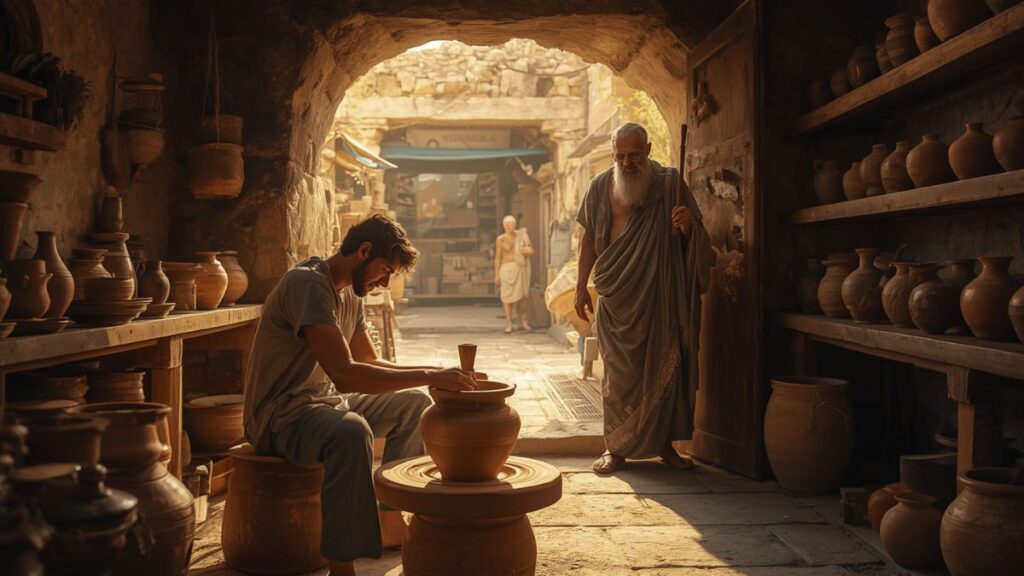
In the bustling city of Corinth, where merchants from every corner of Greece gathered to trade spices, wine, silk, and precious metals, there lived a young potter named Dorian.
Unlike the wealthy craftsmen who owned grand workshops, Dorian worked alone.
His shop stood at the edge of the marketplace, tucked between a blacksmith’s forge and an elderly woman’s weaving stall. It was small, with whitewashed walls, a wooden roof covered in clay tiles, and shelves lined with pots of every shape and size.
Some were simple water jars.
Others were bowls, pitchers, lamps, and flower pots.
None of them were covered in gold.
None displayed elaborate paintings of heroes or gods.
Yet every piece Dorian created was carefully shaped by hand.
His father had taught him a lesson before passing away many years earlier.
“Clay remembers every touch.”
As a child, Dorian had laughed at those words.
But as he grew older, he understood.
If the potter rushed, the clay revealed it.
If he became impatient, tiny flaws appeared.
If he worked with care and honesty, the vessel became strong.
That lesson guided not only his hands but also his heart.
Every morning before sunrise, Dorian walked to the riverbank to gather fresh clay.
He thanked Gaia, the Earth Mother, for her gifts.
Then he carried heavy baskets back to his workshop.
He kneaded the clay until it became smooth and soft.
He mixed it with water.
He removed every pebble.
He prepared each batch with the patience of a man who believed that excellence could never be hurried.
His neighbors often teased him.
“You spend half the day preparing clay,” laughed Nikos, another potter.
“I spend half the day making pottery,” Dorian replied with a smile.
Nikos shook his head.
“And I sell twice as much.”
That was true.
Nikos decorated his jars with bright colors and impressive patterns.
From a distance they looked magnificent.
But hidden beneath the paint were thin walls and poorly fired clay.
Many cracked after only a few months.
Still, travelers rarely returned to complain.
They had already continued their journeys.
Dorian refused to imitate him.
“If a pot cannot hold water,” he often said, “its beauty is meaningless.”
Business was difficult.
Some days he sold only one small bowl.
Other days he sold nothing at all.
At night he counted his coins carefully.
Sometimes there was barely enough to buy bread and olives for supper.
His closest friend, a carpenter named Leon, worried about him.
“You are too honest.”
Dorian smiled.
“Is that a fault?”
“It is if it leaves your purse empty.”
“An empty purse can be filled.”
“And a damaged reputation?”
“That is much harder.”
Leon sighed.
“I wish more people thought like you.”
One summer afternoon, a wealthy merchant entered the marketplace.
His robes were made of expensive linen.
Gold rings covered his fingers.
Several servants followed behind carrying chests.
He stopped before Dorian’s shop.
“I need twenty large storage jars.”
Dorian bowed politely.
“I can make them.”
The merchant examined several finished pieces.
“They seem sturdy.”
“They are.”
“How quickly can you finish twenty?”
Dorian thought carefully.
“Three weeks.”
The merchant frowned.
“My ship sails in ten days.”
“I cannot promise what I cannot complete.”
The merchant crossed his arms.
“The other potter says he can make twenty in five days.”
“Then perhaps he is the better choice.”
The merchant looked surprised.
“You are sending away business?”
“I will not promise excellence if I know I cannot deliver it.”
The merchant laughed.
“You are a strange craftsman.”
He walked away and placed his order with Nikos.
Five days later, the merchant loaded the jars onto his ship.
Within a month, many had cracked during the voyage.
Wine leaked across the cargo hold.
Several valuable goods were ruined.
When the merchant returned to Corinth, he stormed into Nikos’s workshop.
“You cheated me!”
“They were fine when they left.”
“They failed because you rushed them.”
The merchant demanded compensation.
Nikos denied responsibility.
Their argument became the talk of the marketplace.
Meanwhile, Dorian quietly continued shaping clay.
Autumn arrived.
Business remained slow.
One rainy evening, Dorian noticed an elderly traveler approaching his shop.
The man wore a dusty cloak.
His sandals were worn.
He carried only a walking staff and a leather satchel.
Rain dripped from his hood.
“May I come inside?” the traveler asked.
“Of course.”
Dorian lit another oil lamp.
The warm glow filled the workshop.
“You look exhausted.”
“I have walked many miles.”
“Then sit near the fire.”
The traveler smiled gratefully.
While Dorian prepared warm barley soup, the old man quietly observed the workshop.
Every tool was neatly arranged.
Finished pottery stood in careful rows.
Broken pieces had been swept away.
Nothing was hidden.
Nothing exaggerated.
After supper, the traveler looked around.
“I need a water jar.”
Dorian nodded.
“There are several to choose from.”
The traveler picked up a beautifully painted vessel.
Its surface gleamed in the firelight.
“This one is magnificent.”
Dorian immediately stepped forward.
“I should tell you something.”
“What is it?”
“Yesterday, while polishing it, I noticed a tiny hairline crack near the base.”
The traveler looked closely.
“I cannot even see it.”
“You probably won’t.”
“Then why mention it?”
“Because after many weeks of travel, the crack may grow.”
The traveler smiled slightly.
“Would it fail immediately?”
“No.”
“Perhaps after months?”
“Perhaps.”
The old man waited.
“You could have sold it without saying a word.”
“I could have.”
“And earned more silver.”
“Yes.”
“So why didn’t you?”
Dorian lifted another jar from the shelf.
It was plain.
No painted decorations.
No carved patterns.
Only smooth, perfectly shaped clay.
“This one costs less.”
The traveler frowned.
“You recommend the cheaper one?”
“I recommend the better one.”
The traveler laughed quietly.
“You are unlike any merchant I have met.”
“I am not a merchant.”
“What are you?”
“A craftsman.”
The old man purchased the plain jar.
As he prepared to leave, he asked one final question.
“If honesty brings hardship, why continue practicing it?”
Dorian answered without hesitation.
“Because dishonesty brings something worse.”
“What is that?”
“A person who can no longer trust himself.”
The traveler nodded thoughtfully.
“I hope the gods reward such wisdom.”
After he disappeared into the rain, Dorian cleaned his workshop and went to sleep.
He never imagined who the traveler truly was.
That traveler was Hermes.
Messenger of the gods.
Protector of travelers.
Patron of merchants.
Known for cleverness, speed, and the ability to see beyond appearances.
Hermes had wandered Greece disguised as an ordinary man.
He had visited kings, merchants, judges, and craftsmen.
Most claimed to value honesty.
Few actually practiced it when profit tempted them.
Dorian had passed the test without realizing one existed.
The next morning, something extraordinary happened.
When Dorian entered his workshop, he stopped in amazement.
Neatly stacked beside his workbench were several large baskets.
Each overflowed with the finest clay he had ever seen.
It was soft.
Pure.
Free from stones or impurities.
Beside the baskets lay a small bronze coin engraved with winged sandals.
Dorian picked it up.
Instantly he understood.
Only one god carried such a symbol.
“Hermes…”
He looked toward the open doorway.
No one was there.
Attached to the coin was a small piece of parchment.
Only one sentence was written.
“The hands that honor truth deserve the finest clay.”
Tears filled Dorian’s eyes.
He carefully placed the coin beside his father’s old pottery wheel.
From that day forward, everything changed.
The new clay responded beautifully.
It spun smoothly beneath his fingers.
His pots became lighter without losing strength.
They held water perfectly.
No cracks formed during firing.
Customers noticed immediately.
A farmer bought two jars.
Months later he returned.
“I have never owned stronger pottery.”
He purchased four more.
A fisherman carried Dorian’s water jugs on long voyages.
They survived rough seas.
Word spread from village to village.
Soon travelers specifically searched for Dorian’s workshop.
“Where can we find the honest potter?”
“The one whose jars never fail?”
Even the wealthy merchant who had once ignored him returned.
“I owe you an apology.”
“You owe me nothing.”
“I chose cheaper promises over honest work.”
“We all learn.”
“I would like fifty storage jars.”
Dorian smiled.
“When do you need them?”
The merchant answered.
“In two months.”
Dorian nodded.
“That I can promise.”
Years passed.
The little workshop expanded.
Dorian hired apprentices.
Before allowing them to touch the pottery wheel, he taught them one lesson.
“Clay remembers every touch.”
The apprentices repeated the words.
One curious boy asked, “Is that truly about clay?”
Dorian smiled.
“No.”
“It is about people.”
He explained.
“When you deceive someone, even if they never discover the truth, your own character remembers.”
“When you act honestly, your heart remembers that too.”
The apprentices carried those lessons throughout Greece.
One day, a talented young apprentice named Philippos approached Dorian.
“I made a mistake.”
“What happened?”
“I fired six water jars too quickly.”
“Can they be sold?”
“They look perfect.”
“But?”
“They may crack after some time.”
“What do you think should be done?”
Philippos looked down.
“We should break them.”
Dorian smiled proudly.
“Then you have truly learned.”
Together they shattered every flawed jar.
A passing merchant watched in disbelief.
“You are destroying valuable pottery!”
Dorian replied calmly.
“I am protecting something more valuable.”
“What could be worth more?”
“The trust of those who buy from us.”
The merchant walked away shaking his head.
Years later, he returned as one of Dorian’s most loyal customers.
Eventually, Dorian’s pottery became known throughout Greece.
His jars reached Athens.
His bowls appeared in Sparta.
Even temples ordered ceremonial vessels from his workshop.
People admired the beautiful craftsmanship.
But those who knew Dorian understood that his greatest creation was something invisible.
Trust.
One spring morning, many years after Hermes had visited, another traveler appeared.
This one was young, cheerful, and carried a familiar walking staff.
He examined several pots.
“They are still excellent.”
Dorian looked closely at the stranger.
Something about his smile seemed familiar.
“You’ve been here before.”
The traveler grinned.
“Long ago.”
Realization dawned.
“Hermes.”
The god nodded.
“You have used my gift wisely.”
“It was never the clay.”
“No?”
“It was the lesson.”
Hermes laughed.
“Exactly.”
“You gave me better clay.”
“I merely revealed what was already inside you.”
The workshop filled with gentle light.
None of the apprentices noticed.
Only Dorian could see the god’s true form.
Golden sandals shimmered.
A winged helmet glowed softly.
Hermes placed a hand on the old potter’s shoulder.
“Remember this.”
“What is it?”
“The world often rewards cleverness first.”
He paused.
“But in the end, it always depends upon trust.”
With that, Hermes disappeared as quietly as he had arrived.
Dorian never saw him again.
Many generations later, travelers still spoke of the Honest Potter of Corinth.
His pottery eventually wore away.
His workshop crumbled into history.
But his story endured because it reminded people of a truth greater than wealth.
Gold could be stolen.
Buildings could collapse.
Fame could fade.
But a reputation built on honesty became a legacy that outlived its creator.
Parents told the tale to their children.
Craftsmen repeated it to their apprentices.
Merchants remembered it before making difficult choices.
And somewhere on Mount Olympus, Hermes smiled whenever another honest soul chose integrity over easy profit.
For the gods admired many qualities in mortals.
Strength.
Wisdom.
Courage.
Skill.
But few virtues shone brighter than a person who chose to tell the truth, even when no one would have known otherwise.
Moral of the Story
Honesty may not bring immediate rewards, but it builds trust, earns lasting respect, and opens doors that deception can never unlock.