Some of the most powerful stories in the Bible do not involve kings, armies, or dramatic battles.
Instead, they focus on ordinary people facing extraordinary circumstances.
One such story is the account of the widow of Zarephath, found in 1 Kings 17.
At first glance, it appears to be a simple story about food during a famine. Yet beneath the surface lies a remarkable lesson about faith, sacrifice, generosity, obedience, and God’s provision.
The widow was not wealthy.
She was not influential.
She was not a prophet or a ruler.
She was simply a mother trying to survive one of the most difficult seasons of her life.
Her resources had nearly disappeared.
Her future seemed hopeless.
Yet through an unexpected encounter with the prophet Elijah, she experienced one of the most memorable miracles recorded in Scripture.
For adults today, her story serves as a powerful reminder that God can provide even when circumstances seem impossible.
A Time of Severe Drought
The story takes place during the reign of King Ahab, one of Israel’s most wicked rulers.
The nation had drifted far from God.
Idolatry had become common.
People worshiped false gods and ignored God’s commands.
Because of this widespread disobedience, God declared that there would be no rain for several years.
The result was devastating.
Without rain, crops failed.
Rivers dried up.
Food became scarce.
Animals died.
Entire communities struggled to survive.
What began as a drought soon became a famine.
Every day became a battle for survival.
Families searched desperately for food.
Resources became increasingly limited.
Fear spread throughout the region.
It was during this crisis that God sent Elijah on a special mission.
Elijah’s Journey
Earlier in the famine, God had provided for Elijah in miraculous ways.
At one point, ravens brought him food.
Later, he stayed near a brook that supplied water.
Eventually, however, the brook dried up because of the drought.
God then instructed Elijah to travel to a town called Zarephath.
There, God said, a widow would provide for him.
This command probably seemed unusual.
Widows were often among the poorest members of society.
They typically had very limited resources.
Yet God specifically chose a widow as part of His plan.
This detail reveals an important truth.
God often works through unexpected people and situations.
A Desperate Mother
When Elijah arrived in Zarephath, he found a woman gathering sticks near the town gate.
She appeared ordinary.
Nothing about her suggested she would soon become part of a miraculous story.
Yet this widow was facing a heartbreaking situation.
The famine had nearly exhausted her supplies.
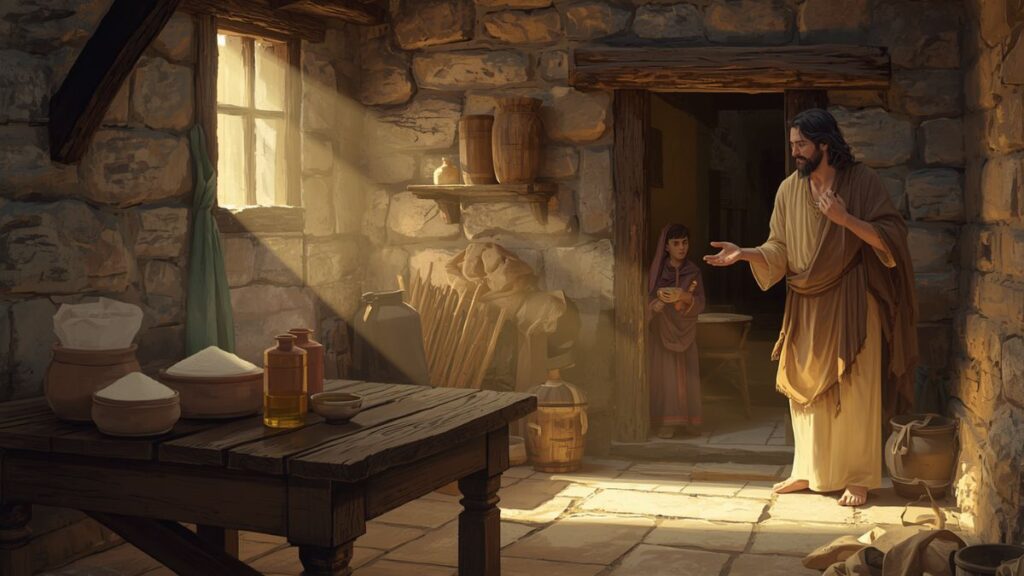
Only a tiny amount of flour remained.
Just a little oil was left in her jar.
She had reached the end of her resources.
As she collected sticks, she planned to prepare one final meal for herself and her son.
After that, she saw no hope.
The food would be gone.
The future looked bleak.
She expected starvation.
Few situations are more painful for a parent than being unable to provide for a child.
The widow carried that burden every day.
Elijah’s Request
As the widow gathered sticks, Elijah approached her.
First, he asked for a drink of water.
Despite the drought, she agreed to help.
Then Elijah made an even more surprising request.
He asked for a piece of bread.
The widow responded honestly.
She explained her situation.
She was not refusing out of selfishness.
She simply had almost nothing left.
Her words reveal the depth of her despair.
She explained that she only had enough flour and oil for one final meal.
After that, she expected that she and her son would die.
The statement paints a tragic picture.
This was not a woman with extra resources.
This was someone standing at the edge of survival.
An Unusual Instruction
After hearing her story, Elijah gave an unexpected response.
He told her not to be afraid.
Then he instructed her to prepare a small loaf of bread for him first.
Only afterward should she prepare food for herself and her son.
At first, the request seems difficult to understand.
How could Elijah ask such a thing from someone who had so little?
Yet Elijah also delivered a promise from God.
The flour jar would not become empty.
The oil jar would not run dry.
God would continue providing until rain returned to the land.
The widow now faced a decision.
Would she trust God’s promise?
Or would she cling to the little she had left?
Choosing Faith
This moment represents the heart of the story.
The widow had every reason to doubt.
Her circumstances suggested hopelessness.
Her supplies were nearly gone.
The future seemed uncertain.
Yet she chose faith.
She prepared food for Elijah exactly as he requested.
This decision required tremendous courage.
Faith often involves acting before seeing results.
The widow did not possess proof that the miracle would occur.
She only had God’s promise.
Nevertheless, she obeyed.
Many adults face similar situations.
There are moments when people must decide whether to trust God despite uncertainty.
The widow’s example demonstrates what genuine faith looks like.
The Miracle Begins
After preparing the meal, something remarkable happened.
The flour did not run out.
The oil did not disappear.
Day after day, enough remained.
Every time the widow reached into the jar, she found what she needed.
Every time she poured oil, there was still more available.
The miracle did not arrive as a massive warehouse full of supplies.
Instead, God provided daily.
Enough for each meal.
Enough for each day.
Enough for each need.
This pattern reflects how God often works.
Rather than providing everything at once, He supplies what is needed one day at a time.
Learning to Trust Daily
The widow’s miracle required ongoing faith.
Each morning she likely wondered whether the flour and oil would finally be gone.
Yet each day she discovered fresh evidence of God’s faithfulness.
Her trust grew through experience.
Faith is often strengthened in this way.
People witness God’s provision repeatedly over time.
Small miracles accumulate.
Confidence develops.
Trust deepens.
The widow’s household survived because God continued providing exactly what was needed.
A New Challenge
The story could have ended there.
The miracle of the flour and oil would have been remarkable enough.
Yet another challenge soon emerged.
The widow’s son became seriously ill.
His condition worsened until he eventually stopped breathing.
The tragedy devastated the widow.
After experiencing God’s provision, she now faced overwhelming grief.
She struggled to understand why this had happened.
Many people can relate to her confusion.
Life often contains unexpected difficulties even after seasons of blessing.
Faith does not eliminate every hardship.
The widow discovered this reality firsthand.
Elijah’s Response
When Elijah learned what had happened, he took the boy to an upstairs room.
There he prayed earnestly.
He cried out to God on the child’s behalf.
Elijah trusted that God could intervene even in this seemingly impossible situation.
His actions demonstrate another important lesson.
Faith does not ignore pain.
Faith brings pain directly to God.
Elijah did not pretend everything was fine.
He prayed honestly and passionately.
Another Miracle
God answered Elijah’s prayer.
The boy’s life returned.
He was restored to health.
Elijah then brought him back to his mother.
Imagine her joy.
The son she thought she had lost was alive again.
The miracle confirmed what she had already begun learning.
God could be trusted completely.
He was not only the provider of food.
He was the giver of life.
This experience transformed her faith.
What began as a desperate act of obedience became a personal testimony of God’s power.
The Widow’s Sacrifice
One reason this story remains so meaningful is the widow’s willingness to sacrifice.
She gave when she had almost nothing.
Most people find it easier to be generous during times of abundance.
Generosity becomes much harder during seasons of scarcity.
Yet the widow chose to trust God rather than fear.
Her sacrifice was not measured by the size of her gift.
It was measured by what it cost her.
She gave from her need rather than her surplus.
That kind of faith continues to inspire readers today.
Stories of Sacrifice in the Bible
Among all stories of sacrifice in the Bible, the widow of Zarephath stands out because her sacrifice was deeply personal.
She sacrificed:
- Her limited food supply
- Her sense of security
- Her control over the future
- Her fear of scarcity
In return, she discovered God’s provision.
The story teaches that sacrifice is not always about giving large amounts.
Sometimes it involves trusting God with the little we have.
Bible Stories for Adults
This account remains one of the most relevant Bible stories for adults because it addresses everyday concerns.
Adults often worry about:
- Financial security
- Family responsibilities
- Future uncertainty
- Unexpected hardships
The widow faced all these challenges.
Her story reminds readers that God sees those struggles and cares about them.
It also demonstrates that God’s provision may appear in unexpected ways.
Lessons About Faith
Faith Acts Before Seeing Results
The widow obeyed before witnessing the miracle.
Her faith was demonstrated through action.
Faith Requires Courage
Trusting God during a famine was not easy.
The widow moved forward despite uncertainty.
Faith Grows Through Experience
Each day the flour and oil remained, her confidence increased.
Faith became stronger through repeated evidence of God’s faithfulness.
Lessons About Generosity
The widow teaches that generosity is not determined by wealth.
People often assume they must have abundance before they can give.
The widow’s example challenges that assumption.
She gave while facing need herself.
Her story reveals that generosity is ultimately an issue of trust rather than resources.
Lessons About God’s Provision
One of the most encouraging aspects of the story is God’s provision.
The miracle did not remove every challenge instantly.
Instead, God provided exactly what was needed day by day.
This pattern appears throughout Scripture.
God often supplies strength, wisdom, resources, and encouragement one step at a time.
The widow learned to depend on Him daily.
Why This Story Still Matters
Thousands of years later, readers continue connecting with the widow’s experience.
Many people understand what it feels like to face uncertainty.
Many know the fear of not having enough.
Many wonder how future needs will be met.
The widow’s story offers hope.
It reminds readers that difficult circumstances do not limit God’s ability to provide.
Conclusion
The story of the widow’s last meal is far more than an account about flour and oil.
It is a powerful lesson about faith, sacrifice, generosity, and divine provision.
Faced with overwhelming circumstances, the widow chose trust instead of fear.
She obeyed God’s instruction when it seemed risky.
As a result, she witnessed miracles that sustained her family and transformed her faith.
Her story continues inspiring readers because it speaks directly to real-life challenges.
It reminds us that God often works through ordinary people.
It shows that generosity can exist even in seasons of scarcity.
Most importantly, it demonstrates that God’s provision is not limited by human circumstances.
When resources seem exhausted and hope appears distant, the story of the widow of Zarephath offers a timeless reminder:
God is able to provide, often in ways we never expect, and His faithfulness remains constant even during life’s most difficult seasons.