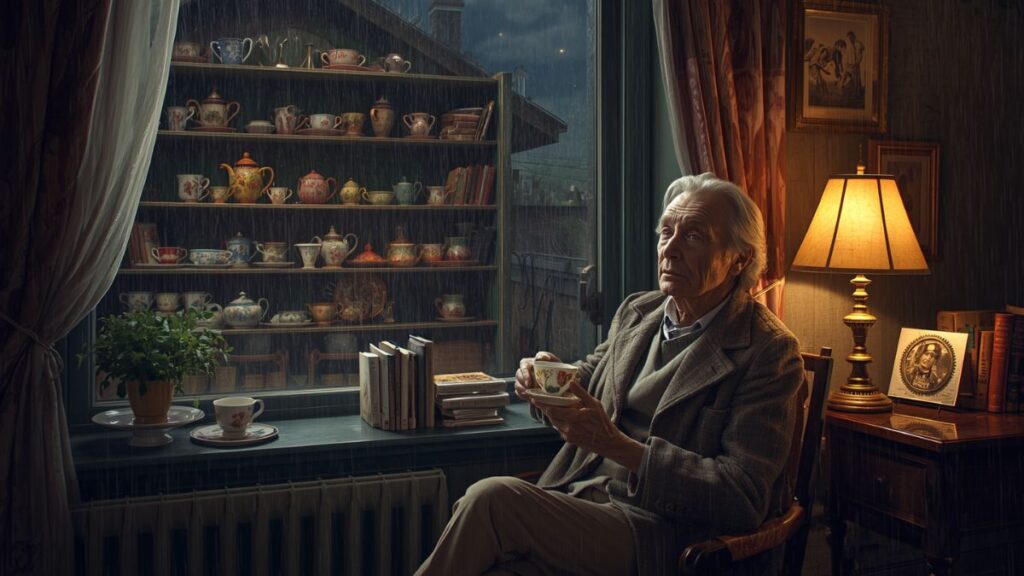
Walter’s kitchen cabinet contained thirty-seven teacups.
Most people considered that excessive.
Walter considered it just enough.
Every cup had a story.
Every chip, pattern, and faded design carried a memory.
And at seventy-six years old, Walter had learned that memories were worth keeping.
Especially the good ones.
His small cottage sat at the edge of a quiet village surrounded by rolling hills and narrow country roads. It wasn’t large, but it felt welcoming.
Books filled the shelves.
A grandfather clock stood in the hallway.
Photographs decorated the walls.
And inside the kitchen cabinet rested his treasured collection.
Visitors often asked the same question.
“Why do you keep so many teacups?”
Walter always smiled before answering.
“Because throwing them away would feel like forgetting.”
The answer usually puzzled people.
Until he explained.
The first teacup came from his grandmother.
It was small and delicate, decorated with tiny blue flowers around the rim.
When Walter was a boy, he spent many afternoons sitting at her kitchen table listening to stories.
She told him about growing up in a different era.
About horses replacing automobiles.
About snowy winters that seemed endless.
About ordinary moments that somehow became extraordinary memories.
Whenever she served tea, she used the same blue-flowered cup.
Years later, when she passed away, the cup became Walter’s.
The object itself wasn’t valuable.
The memory attached to it was priceless.
Over time, other cups joined the collection.
A striped cup purchased during a seaside holiday.
A green ceramic mug from a mountain village.
A hand-painted cup given by an old friend.
A simple white teacup that once belonged to his wife, Margaret.
Each one represented a chapter of life.
Together they formed a collection of stories.
Every evening, Walter followed the same routine.
He selected a teacup.
Prepared tea.
Sat near the window overlooking his garden.
Then spent an hour reading or reflecting while the sun slowly disappeared.
The ritual brought comfort.
Partly because of the tea.
Mostly because of the memories.
One rainy autumn evening, thunder rolled gently across distant hills.
Raindrops tapped against the windows.
The cottage felt especially cozy.
Walter opened the cabinet and considered his options.
Thirty-seven choices.
Thirty-seven stories.
After a moment, he selected a pale yellow cup decorated with tiny daisies.
The sight immediately transported him backward in time.
The cup came from a summer market nearly forty years earlier.
He remembered the day clearly.
Margaret spotted it first.
They had spent the afternoon exploring stalls filled with handmade crafts, baked goods, and antiques.
Margaret picked up the cup and smiled.
“It looks cheerful.”
Walter laughed.
“You’ve chosen a teacup based entirely on personality.”
“Of course.”
She bought it immediately.
For years afterward, it became her favorite.
Now, every time Walter used it, he remembered that summer afternoon.
The memory felt warm.
Comforting.
Like sunlight stored inside a teacup.
As he sipped his tea, he watched rain fall across the garden.
The flowers swayed gently in the wind.
The world seemed peaceful.
One of the advantages of growing older, Walter believed, was learning how to appreciate quiet moments.
When he was younger, he often rushed.
Always focused on the next task.
The next destination.
The next goal.
Now he understood the value of slowing down.
Of paying attention.
Of enjoying simple pleasures.
A cup of tea.
A good book.
A rainy evening.
The following evening, Walter chose a different cup.
This one was painted deep green with tiny gold details.
The cup reminded him of a train journey through the countryside many years earlier.
He and Margaret had spent a week exploring small villages.
One afternoon, they discovered a tiny pottery shop hidden on a side street.
The owner created every piece by hand.
Margaret insisted they purchase something.
The green cup became their souvenir.
Every time Walter held it, he remembered winding train tracks, village bakeries, and afternoons spent wandering without a schedule.
The cup transformed ordinary tea into a small journey through memory.
That was the magic of the collection.
Objects became stories.
Stories became companions.
And companions made solitude feel less lonely.
Several weeks later, Walter’s granddaughter Lily visited.
At ten years old, she found the collection fascinating.
Children often notice details adults overlook.
She stood in front of the cabinet studying the rows of cups.
“Which one is your favorite?” she asked.
Walter smiled.
The question always seemed impossible.
Choosing a favorite felt like choosing a favorite memory.
Instead, he opened the cabinet.
“You choose one.”
Lily considered carefully.
After nearly a minute, she selected a bright red cup.
“This one.”
Walter nodded.
“A good choice.”
“What story belongs to it?”
The question delighted him.
He prepared tea for both of them.
Then they sat by the window.
The red cup had a wonderful story.
Years earlier, during a winter storm, Walter’s car broke down while traveling.
A stranger invited him into a small roadside café until help arrived.
The owner served tea in bright red cups.
The unexpected kindness stayed with him.
Before leaving, he purchased one as a reminder.
The cup represented generosity.
Hospitality.
The kindness of strangers.
Lily listened carefully.
When the story ended, she smiled.
“That’s a nice memory.”
“It is.”
Then she asked another question.
“Do all the cups have stories?”
Walter nodded.
“Every single one.”
The realization seemed to amaze her.
For the rest of the afternoon, they explored the collection.
One cup at a time.
One story at a time.
The experience brought Walter tremendous happiness.
Because stories become more meaningful when shared.
Months passed.
Seasons changed.
Winter arrived.
Then spring.
The collection remained unchanged.
Yet Walter appreciated it more with each passing year.
Not because new cups appeared.
Because the memories grew richer.
One particularly beautiful spring evening, sunlight filled the kitchen.
The garden outside burst with color.
Birds sang from nearby trees.
Walter selected the simplest cup in the collection.
Plain white.
No decorations.
No special design.
Most visitors ignored it completely.
Yet it might have been his favorite after all.
The cup belonged to Margaret.
For decades, she used it every morning.
Coffee.
Tea.
Hot chocolate.
The cup accompanied countless conversations.
Countless breakfasts.
Countless ordinary moments.
After she passed away, Walter couldn’t bring himself to store it away.
Instead, he kept using it.
The cup reminded him that the most meaningful memories are often the simplest.
Not grand adventures.
Not dramatic events.
Just shared mornings.
Shared laughter.
Shared lives.
As evening settled over the cottage, Walter sat quietly by the window.
The white cup rested comfortably in his hands.
Outside, the garden glowed beneath the fading sunlight.
Everything felt calm.
Content.
Peaceful.
He thought about how strange it was that ordinary objects could carry so much meaning.
A teacup was just a teacup.
Until memories attached themselves to it.
Then it became something more.
A doorway.
A reminder.
A story waiting to be remembered.
Years later, when people asked about the collection, Walter still gave the same answer.
“Throwing them away would feel like forgetting.”
The statement remained true.
Because every cup represented someone.
Some place.
Some moment.
And those things mattered.
Not because they were perfect.
Not because they were extraordinary.
But because they were part of a life well lived.
As the stars appeared outside, Walter finished his tea.
The cup sat empty.
The memory remained full.
And tomorrow evening, another story would be waiting inside another teacup.
Reflection
Cute bedtime stories often celebrate the beauty hidden within everyday objects. The Teacup Collection reminds us that memories give meaning to ordinary things. A simple cup, photograph, or keepsake can hold years of laughter, friendship, love, and gratitude, turning small objects into treasured pieces of our personal story.