The students of Greenwood Public School took their Diwali celebrations very seriously.
Perhaps a little too seriously.
Every year, the school organized a Diwali Decoration Competition. Each class was given one week to transform its classroom into the most festive, creative, and beautiful space possible.
The winning class would receive a trophy, certificates, and, most importantly, bragging rights for the entire year.
To adults, it sounded like a harmless school activity.
To students, it was the equivalent of the World Cup.
This year, Class 7-B was determined to win.
They had come close the previous year, losing by a single point to Class 7-A.
The defeat had been painful.
For months afterward, students from 7-A casually reminded them.
Whenever they passed in the corridor.
Whenever sports teams were announced.
Whenever someone mentioned Diwali.
And sometimes for absolutely no reason at all.
This year, Class 7-B wanted revenge.
Academic revenge.
Decorative revenge.
Festive revenge.
The planning meeting began immediately after the competition was announced.
Their class teacher, Mrs. Verma, wrote a simple message on the board:
DIWALI DECORATION COMPETITION: ONE WEEK TO PREPARE
The room exploded with ideas.
“We should create a giant rangoli!”
“We should make paper lanterns!”
“We should build a model temple!”
“We should hang lights everywhere!”
“We should bring a life-sized elephant!”
That suggestion was rejected immediately.
Mostly because nobody had access to an elephant.
Within minutes, the classroom became louder than a marketplace.
Everyone had an idea.
Nobody wanted to listen to anyone else’s.
Finally, Mrs. Verma raised her hand.
“If you spend the entire week arguing,” she said, “you’ll have nothing to decorate.”
The students reluctantly agreed to form a planning committee.
After much discussion, two groups naturally emerged.
The first group called themselves The Planners.
The second group called themselves The Creatives.
The Planners believed success came from organization.
They created schedules.
Lists.
Budgets.
Backup plans.
Backup plans for their backup plans.
Their leader was Meera, a student who treated school projects like military operations.
The Creatives had a very different philosophy.
Their leader, Rohan, believed inspiration was more important than planning.
His favorite sentence was:
“We’ll figure it out.”
Unfortunately, this sentence usually created more problems than solutions.
The Planners immediately began calculating materials.
The Creatives immediately began imagining grand artistic visions.
By the end of the first meeting, both groups were convinced the other group had no idea what it was doing.
The next few days were surprisingly productive.
Students brought colored paper.
Cardboard.
Paint.
Decorative lights.
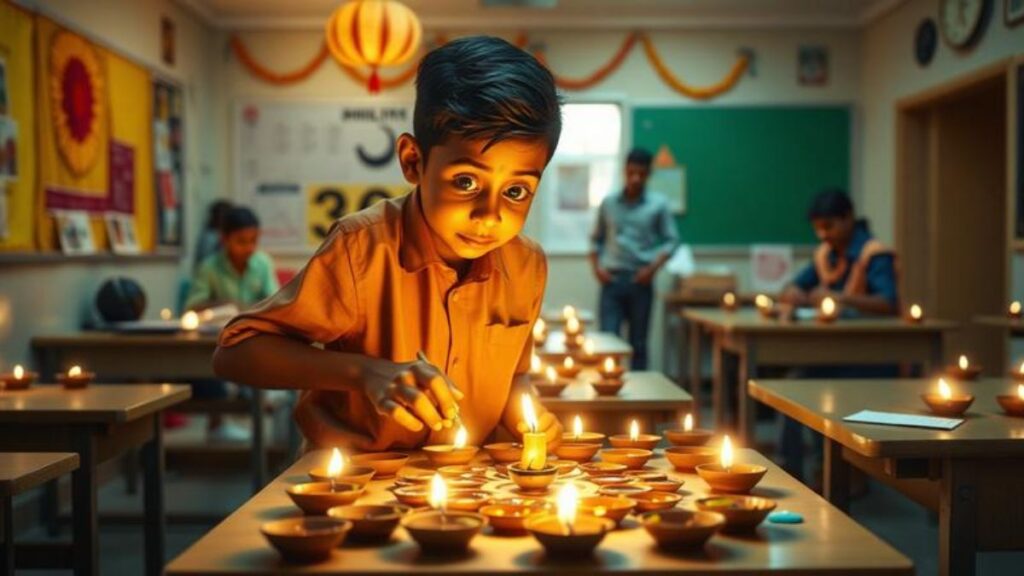
Clay diyas.
Craft supplies.
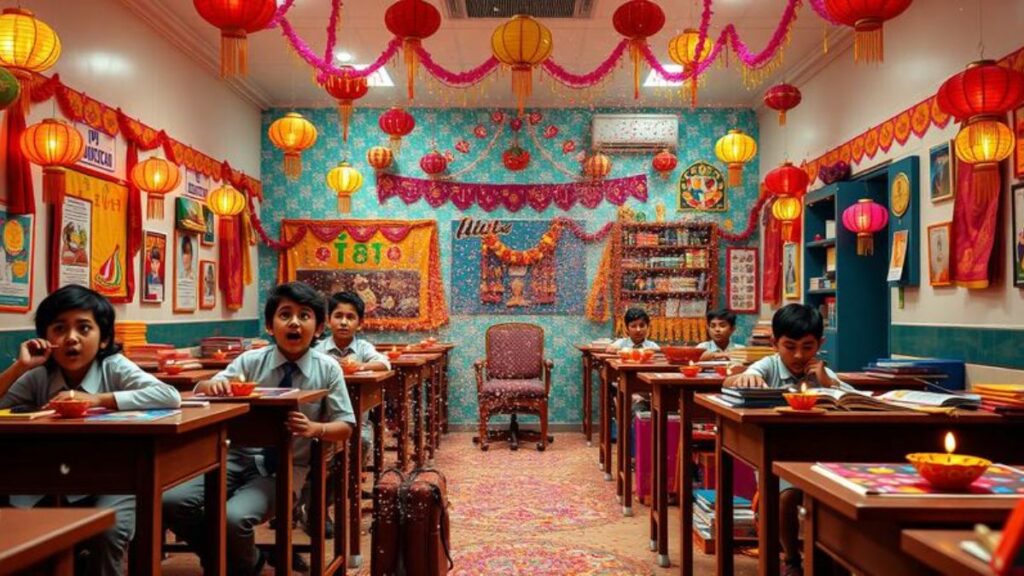
The classroom slowly transformed into a workshop.
Paper lanterns appeared.
Beautiful wall decorations were created.
Handmade greeting banners covered the notice boards.
Even Mrs. Verma was impressed.
For a brief moment, it looked like teamwork might actually prevail.
Then someone discovered glitter.
Nobody remembers exactly who brought it.
Some blame Rohan.
Others suspect the art club.
A few believe glitter simply appears whenever students become overconfident.
Regardless of its origin, glitter changed everything.
At first, it seemed harmless.
A little sparkle here.
A little sparkle there.
The decorations certainly looked better.
Then one student suggested adding more.
Another student agreed.
A third student suggested covering the lanterns entirely.
By lunchtime, glitter usage had increased dramatically.
By the next day, the situation had become dangerous.
Not physically dangerous.
Decoratively dangerous.
Every project seemed to require glitter.
Every decoration received glitter.
Every available surface acquired glitter.
The Planners became concerned.
Meera examined a lantern.
“It already has glitter.”
“Not enough glitter,” replied Rohan.
She pointed at another decoration.
“That one has glitter too.”
“Still not enough.”
Meera stared at him.
“How much glitter do you think we need?”
Rohan considered the question seriously.
“All of it.”
This answer worried everyone.
The classroom gradually entered what historians would later describe as The Glitter Phase.
Students accidentally carried glitter into the corridor.
The library.
The computer lab.
Even the staff room.
Nobody could explain how.
Teachers began noticing sparkles on their desks.
On attendance registers.
On coffee mugs.
One teacher found glitter on exam papers that had never entered the classroom.
The mystery deepened.
Meanwhile, the competition deadline approached.
The decorations looked spectacular.
At least from a distance.
Up close, nearly everything reflected light like a disco ball.
Even the class pet plant somehow contained glitter.
No one knew how.
Competition day finally arrived.
Judges began touring classrooms.
Students stood proudly beside their decorations.
The atmosphere was tense.
Class 7-A looked impressive.
They had created an elegant and traditional theme.
Class 7-C had focused on eco-friendly decorations.
Class 7-D had built an incredible model village.
Then the judges entered Class 7-B.
The students smiled confidently.
The decorations certainly attracted attention.
Possibly too much attention.
One judge paused near a lantern.
“Very creative.”
Another examined the rangoli.
“Excellent craftsmanship.”
Everything seemed perfect.
Then disaster struck.
A ceiling fan was switched on.
Nobody knows who did it.
Some suspect a student.
Others blame pure fate.
The moment the fan started spinning, a glitter-covered banner began shedding tiny particles.
Thousands of glitter pieces launched into the air.
The classroom instantly transformed into a sparkling storm.
Students watched in horror.
Judges blinked repeatedly.
Teachers looked confused.
Glitter floated everywhere.
Through the classroom.
Into the corridor.
Onto neighboring displays.
Across the judging sheets.
One judge sneezed and released an entirely new cloud of glitter.
The scene was unforgettable.
By the time the fan was switched off, everyone looked slightly festive.
Including people who had never entered the classroom.
The competition continued.
Barely.
The judges completed their evaluations.
Students waited anxiously for results.
The following day, the entire school gathered in the auditorium.
The principal stepped onto the stage holding the results envelope.
The tension was unbearable.
Third place went to Class 7-D.
Applause.
Second place went to Class 7-A.
Louder applause.
Class 7-B exchanged nervous looks.
Could it be?
Had they actually won?
The principal smiled.
“First place in this year’s Diwali Decoration Competition goes to…”
A dramatic pause followed.
“Class 7-C.”
The auditorium erupted.
Class 7-C celebrated wildly.
Class 7-B sat stunned.
Again.
They had lost.
Again.
Rohan sighed.
“Maybe we used too much glitter.”
The entire class stared at him.
“Maybe?”
Mrs. Verma laughed.
To everyone’s surprise, the principal continued speaking.
“However, we have created a special award this year.”
The students looked up.
“Award for Most Memorable Classroom.”
The audience immediately knew what was coming.
“And the winner is Class 7-B.”
The auditorium burst into laughter and applause.
Even the judges were smiling.
The class proudly accepted their certificate.
The official citation read:
For Outstanding Creativity and Unprecedented Glitter Distribution Across School Property.
The award quickly became legendary.
Years later, students still talked about the Glitter Competition.
New students heard stories about it.
Teachers remembered it.
Even the school janitors remembered it.
Especially the janitors.
Most importantly, Class 7-B learned something valuable.
Planning matters.
Creativity matters.
But moderation matters too.
Because sometimes the difference between success and chaos is only one container of glitter.
Or ten.
Moral of the Story
Creativity can achieve amazing results, but the best projects balance imagination with planning. Too much enthusiasm without control can turn even a great idea into a memorable disaster.