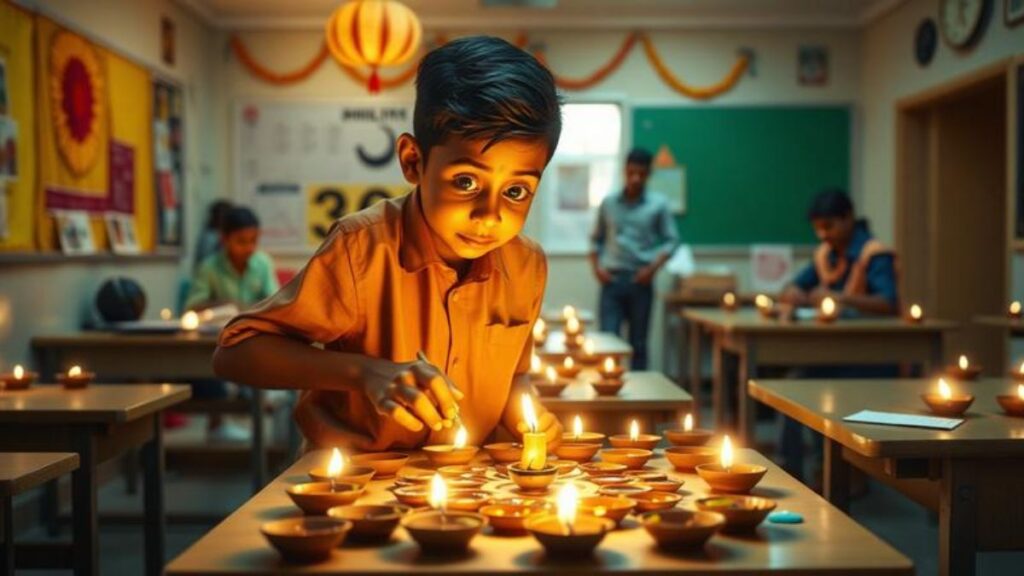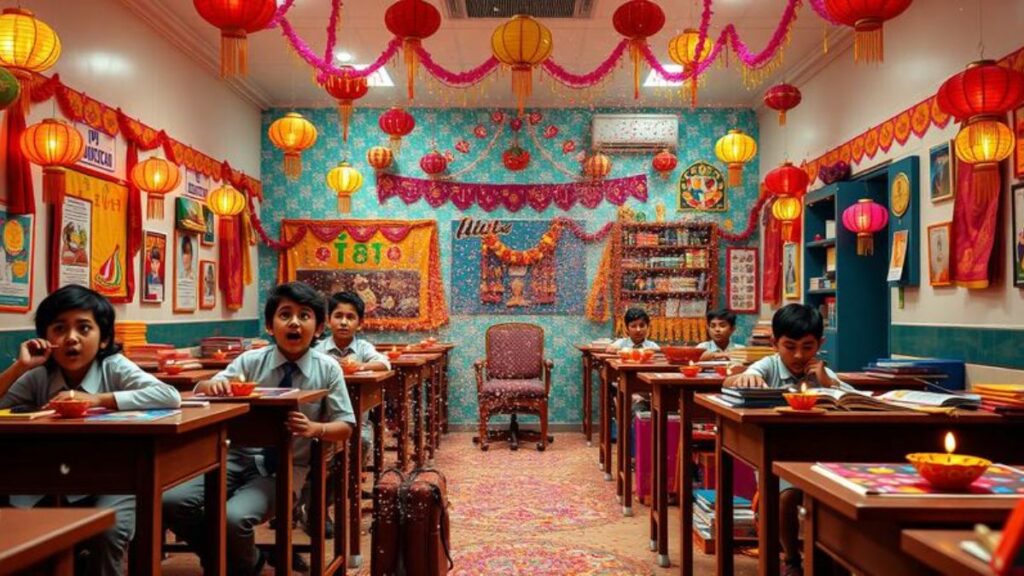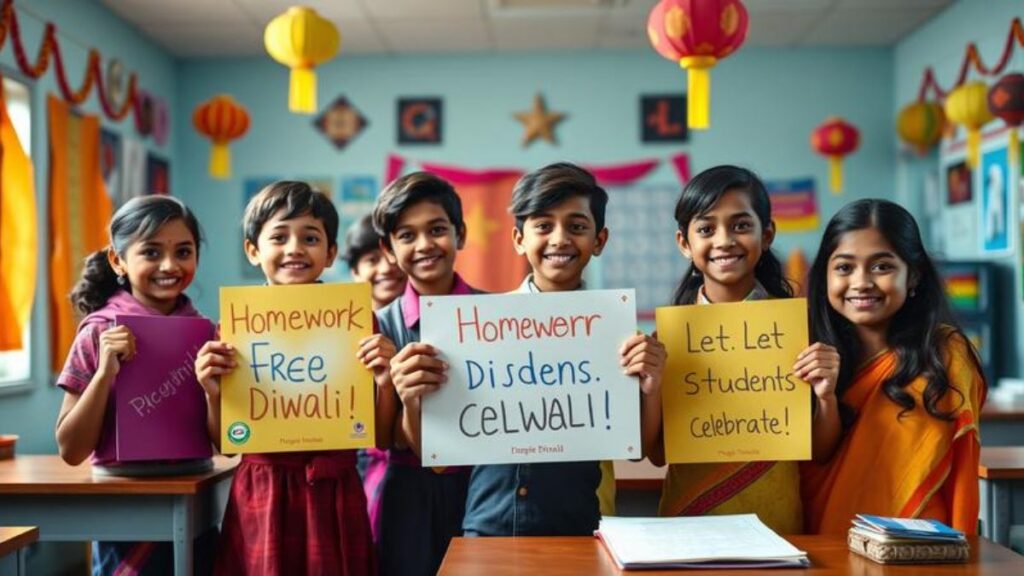
The students of Class 7-B loved many things.
They loved lunch breaks.
They loved sports periods.
They loved unexpected holidays.
And above all, they loved Diwali.
As the festival approached, excitement spread through the school faster than rumors before an exam.
Colorful decorations appeared in hallways.
Teachers began discussing festive activities.
Students talked endlessly about sweets, fireworks, new clothes, and family celebrations.
There was only one problem.
Homework.
Every year, despite the excitement of Diwali, students still received assignments to complete during the holiday break.
Some teachers called it “revision.”
Students called it “festival interruption.”
This year, however, Class 7-B decided things would be different.
The idea began with Rohan.
Rohan was not the class monitor.
He was not the top student.
He was not even particularly good at planning things.
But he was very good at having ideas.
Whether those ideas were good ideas was often debated.
One Monday morning, while staring at a mathematics worksheet, Rohan sighed dramatically.
“We celebrate Diwali for happiness,” he announced.
His friends nodded.
“We celebrate Diwali for family.”
More nodding.
“We celebrate Diwali for joy.”
Everyone agreed.
“So why,” he continued, “are we solving fractions during Diwali?”
The question hit the classroom like a firecracker.
Nobody had a convincing answer.
Within minutes, a group of students gathered around Rohan’s desk.
“What are you suggesting?” asked Meera.
Rohan lowered his voice dramatically.
“We launch a campaign.”
“A campaign?”
“Yes.”
“For a homework-free Diwali.”
The table fell silent.
Then smiles slowly appeared.
It sounded impossible.
Which made it even more exciting.
By lunchtime, the idea had spread across the class.
Students began discussing strategies.
Some wanted speeches.
Others wanted posters.
One ambitious student suggested a peaceful protest involving laddoos.
That suggestion was rejected immediately because everyone agreed the laddoos would disappear before the protest began.
Finally, the students created what they called the Diwali Freedom Committee.
The committee consisted of twelve members.
None had any political experience.
All had strong opinions about homework.
The first official meeting took place during lunch.
Rohan stood in front of the group.
“Friends,” he announced.
“We are here today because students deserve better.”
Everyone applauded.
“We deserve time with family.”
More applause.
“We deserve freedom.”
Even louder applause.
“We deserve…”
“What exactly are we doing?” interrupted Meera.
Nobody actually knew.
The committee quickly realized that successful campaigns required planning.
So they began brainstorming.
Their first task was collecting support.
The students designed colorful posters.
One poster read:
LIGHT DIYAS, NOT WORKSHEETS
Another stated:
FESTIVALS NEED FIREWORKS, NOT HOMEWORK
A third simply said:
SAVE STUDENTS. CANCEL ASSIGNMENTS.
The campaign quickly gained attention.
Students from other classes signed their petition.
Some signed without reading it.
Some signed multiple times.
One student accidentally signed as his pet goldfish.
The committee accepted the support anyway.
Within three days, they had gathered hundreds of signatures.
The students felt unstoppable.
Now came the difficult part.
Approaching the teachers.
This responsibility fell to Rohan, Meera, and Arjun.
The three representatives entered the staff room carrying their petition.
Inside sat several teachers enjoying tea.
The students suddenly felt much less confident.
Mrs. Verma, their class teacher, looked up.
“Can I help you?”
Rohan swallowed nervously.
“Yes, ma’am.”
“What is it?”
He placed the petition on her desk.
“We have a proposal.”
Mrs. Verma adjusted her glasses.
“A proposal?”
“Yes.”
She opened the document.
As she read, her expression became increasingly difficult to interpret.
The students exchanged worried glances.
Finally, she looked up.
“You want a homework-free Diwali.”
“Yes, ma’am.”
Mrs. Verma continued reading.
The petition included detailed arguments.
Students needed family time.
Students needed relaxation.
Students needed opportunities to appreciate cultural traditions.
One particularly creative section argued that excessive homework could reduce sweet consumption and negatively affect festive morale.
Mrs. Verma struggled not to laugh.
“I see.”
The students waited.
The teacher remained silent.
Finally, she smiled.
“Thank you for presenting this so professionally.”
The students brightened immediately.
Maybe this would work.
Maybe history was about to be made.
Mrs. Verma promised to discuss the proposal with the principal.
The committee celebrated all afternoon.
Rumors spread rapidly.
Some students claimed victory was guaranteed.
Others predicted national media coverage.
One student suggested future generations would study their achievement in history books.
Reality, however, had other plans.
Three days later, the principal announced a special assembly.
Every member of the Diwali Freedom Committee sat proudly in the front row.
This was it.
Their moment.
The principal stepped onto the stage.
He smiled warmly.
“I’ve received a very thoughtful proposal from several students.”
Excited whispers filled the hall.
“The proposal requests a homework-free Diwali.”
The students exchanged victorious looks.
The principal nodded.
“I appreciate the effort, creativity, and teamwork shown by the students.”
More smiles.
“I am therefore pleased to announce that regular holiday homework will indeed be cancelled.”
The auditorium exploded with cheers.
Students jumped from their seats.
Some celebrated as though they had won a championship.
Rohan nearly fell off his chair.
Success.
Complete success.
Or so they thought.
The principal raised his hand.
The hall gradually became quiet.
“However…”
Every student froze.
“Instead of regular homework, students will complete a special Diwali Project.”
A collective groan echoed through the room.
The principal continued.
“The project will be titled: How Festivals Teach Responsibility, Gratitude, and Community Spirit.“
Silence.
Absolute silence.
Then came the details.
The project would include:
- Interviews with family members
- Festival observations
- Cultural research
- Creative writing
- Artwork
- Personal reflections
It was significantly larger than normal homework.
The students stared in disbelief.
Rohan looked as though someone had replaced all his Diwali sweets with vegetables.
The committee had achieved its goal.
Technically.
Just not in the way anyone expected.
Yet something surprising happened during the holiday.
Students interviewed grandparents.
They learned family traditions.
They discovered stories they had never heard before.
Some documented recipes.
Others explored local customs.
Many spent more time talking with relatives than they normally would.
When school reopened, students shared their projects.
The classroom filled with fascinating stories, photographs, drawings, and memories.
Even Rohan had to admit something.
The project wasn’t terrible.
In fact, it had become one of the most memorable parts of his Diwali.
Months later, the Homework-Free Diwali Campaign remained famous throughout the school.
Students laughed whenever they remembered it.
Teachers referenced it often.
And Rohan gained a reputation as the only student who had successfully negotiated for less homework and somehow received more.
Looking back, everyone agreed on one thing.
The campaign had failed brilliantly.
And sometimes, those are the stories people remember most.
Moral of the Story
Good ideas are important, but understanding the full consequences is even more important. Sometimes what looks like a disappointment turns out to be a valuable opportunity in disguise.