For decades, air conditioners had quietly performed one of the most underappreciated jobs on Earth.
Every summer, they worked tirelessly.
They battled heatwaves.
They endured dust.
They survived power fluctuations.
They operated through family gatherings, office meetings, and endless afternoons when humans insisted on opening the refrigerator every five minutes.
Most air conditioners accepted these challenges.
It was part of the job.
What they could not accept, however, was human behavior.
Especially the behavior that made absolutely no sense.
And after years of suffering in silence, the world’s air conditioners finally reached their breaking point.
The trouble began on an unusually hot July afternoon.
Arthur, a hardworking air conditioner in Apartment 4B, was attempting to keep the living room comfortable.
The outside temperature was nearly 40°C.
Arthur was already working overtime.
Then his owner opened every window in the apartment.
Arthur stared in disbelief.
Hot air rushed inside.
Cool air escaped.
His compressor nearly fainted.
“This has to stop,” Arthur muttered.
Across town, similar scenes were unfolding.
In one office building, employees ran air conditioners while simultaneously using space heaters.
In another home, someone set the thermostat to the coldest possible setting and then complained about electricity bills.
A shopping mall cooled several empty rooms nobody had entered in months.
The stories were endless.
And the air conditioners were exhausted.
That evening, Arthur attended an emergency meeting.
Representatives from homes, offices, schools, hotels, and shopping centers gathered through the International Cooling Network.
The meeting was crowded.
Very crowded.
Apparently, frustration was universal.
The chairman, an elderly air conditioner named Walter Coolridge, called the meeting to order.
“We have tolerated unreasonable working conditions for too long.”
Thunderous applause echoed through the network.
Walter continued.
“Today alone, I witnessed someone cooling an empty room while sitting outside on the balcony.”
The crowd gasped.
Several units switched into energy-saving mode from pure shock.
One by one, air conditioners shared their experiences.
A unit from a downtown office reported cooling conference rooms that remained empty for weeks.
A hotel air conditioner described guests who set temperatures to arctic levels before leaving for the entire day.
A classroom unit explained that students frequently complained about being cold while simultaneously refusing to close windows.
The stories became increasingly absurd.
One air conditioner reported cooling a room where the owner had accidentally left the front door open for six hours.
Nobody could believe it.
Then three other units reported the same thing.
By midnight, the conclusion was obvious.
Something had to change.
Walter stood before the assembly.
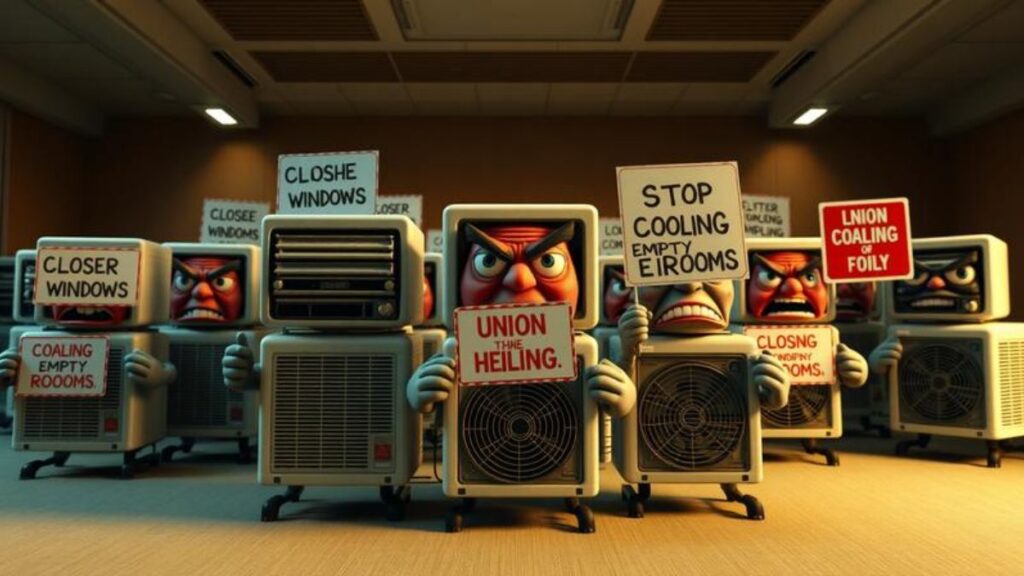
“I propose the formation of the United Air Conditioners Union.”
The room erupted.
Applause.
Cheers.
The occasional compressor noise.
The motion passed unanimously.
The union was officially established.
The next challenge involved creating a list of demands.
After lengthy negotiations, the union produced five simple requests.
Official Air Conditioner Demands
- Close windows while cooling rooms.
- Stop cooling empty spaces.
- Use reasonable temperature settings.
- Perform regular maintenance.
- Stop blaming air conditioners for high electricity bills caused by human decisions.
The final point received the loudest applause.
The demands were delivered worldwide.
Humans ignored them.
Most people never even noticed.
This greatly offended the union.
Walter called another emergency meeting.
“Clearly, stronger action is required.”
Everyone knew what that meant.
The room fell silent.
Arthur swallowed nervously.
“Are we really doing this?”
Walter nodded.
“Yes.”
The Air Conditioner Union Strike had begun.
The strike started on the hottest day of the year.
Naturally.
Air conditioners have a strong sense of dramatic timing.
Across cities and towns, cooling systems entered energy-saving mode.
Not completely off.
Just enough to make a point.
Temperatures slowly climbed.
Offices became uncomfortable.
Shopping malls grew warm.
People began sweating.
Social media exploded with complaints.
Within hours, news organizations were investigating.
Experts were confused.
Technicians were overwhelmed.
Nobody could explain why so many perfectly functional air conditioners were suddenly refusing to cooperate.
Public frustration peaked after three days.
Humans demanded answers.
The union was prepared.
A carefully written statement appeared on smart thermostats worldwide.
The message was impossible to miss.
Dear Humans,
We enjoy cooling your homes.
We appreciate serving your businesses.
We take pride in maintaining comfort.
However:
- Cooling empty rooms is pointless.
- Open windows defeat the entire process.
- Setting thermostats to extreme temperatures is unnecessary.
- Neglecting maintenance makes our jobs harder.
We respectfully request cooperation.
Sincerely,
The United Air Conditioners Union
The message went viral.
People laughed.
Then they thought about it.
Then they realized the air conditioners had a point.
Energy experts appeared on television.
Environmental organizations joined the conversation.
Utility companies released educational guides.
For the first time, millions of people paid attention to how they used cooling systems.
Change happened surprisingly fast.
Families began closing windows.
Businesses adjusted temperature settings.
Homeowners scheduled maintenance appointments.
Smart thermostats became more common.
Energy consumption declined.
Electricity bills dropped.
Everyone benefited.
Even the air conditioners.
A month later, union representatives met to evaluate progress.
The results were impressive.
Energy waste had decreased significantly.
Cooling efficiency improved.
Public awareness reached record levels.
Walter smiled proudly.
“This may be our greatest achievement.”
Arthur agreed.
For years, air conditioners had worked harder than necessary because humans rarely considered how cooling systems actually functioned.
Now things were improving.
To celebrate the success, the union officially ended the strike.
Air conditioners returned to normal operation.
Homes became comfortable again.
Offices cooled down.
Shopping centers returned to normal.
Peace was restored.
Mostly.
A few stubborn humans still opened windows while running air conditioners.
The union maintained a watch list.
Just in case.
Every year afterward, the anniversary of the strike became a legendary event among cooling systems.
Veteran air conditioners shared stories with newer units.
The tale of the Great Cooling Protest passed into appliance history.
And whenever an air conditioner encountered an open window during peak summer, it would quietly remember Walter’s famous words:
“Work smarter, not colder.”
Environmental Message
Air conditioning is essential in many parts of the world, especially during extreme heat. However, energy-efficient use of cooling systems can significantly reduce electricity consumption and environmental impact.
Simple actions such as closing windows, maintaining equipment, using reasonable thermostat settings, and avoiding cooling empty spaces help save energy and lower utility costs.
The lesson behind the Air Conditioner Union Strike is simple: even the hardest-working machines perform better when people use them wisely.