Short detective stories for kids are a fun way to combine reading, mystery, problem-solving, and imagination. Instead of simply reading about a character’s daily activities, children get to follow clues, ask questions, notice details, and try to solve a mystery before the ending is revealed.
A good children’s detective story does not need to involve serious crime or frightening situations. The mystery can be something simple and age-appropriate, such as a missing classroom object, a mysterious note, a misplaced library book, a strange sound, a disappearing snack, or a school puzzle.
These stories can be especially useful for developing reading comprehension because children have to pay attention to details and connect information from different parts of the story.
What Are Short Detective Stories for Kids?
Short detective stories for kids are brief mystery stories designed around a problem that needs to be solved. The main character usually acts like a detective by observing what happened, collecting clues, asking questions, and forming a logical explanation.
The mystery may involve:
- A missing object
- A mysterious message
- A strange footprint
- A forgotten item
- A secret hiding place
- An unexplained sound
- A classroom mystery
- A library mystery
- A playground puzzle
- A series of unusual events
- A misplaced school project
- A mystery involving several possible suspects
The goal is usually not to create fear. Instead, the story should encourage children to think carefully and enjoy the process of discovering what happened.
Why Kids Enjoy Detective Stories
Children naturally enjoy asking questions.
What happened?
Who did it?
Where did the missing object go?
Why was that clue there?
What does this note mean?
Could this person be responsible?
Detective stories turn these questions into an interactive reading experience. Children are not simply receiving information from the story. They are actively trying to understand it.
This makes the reading experience more engaging and gives children a reason to remember small details.
A well-written mystery can make a child think:
“I think I know what happened!”
That feeling of discovery can encourage children to continue reading.
7 Short Detective Stories for Kids
The Mystery of the Missing Class Mascot
Mia loved solving puzzles.
She was the kind of student who noticed things other people often ignored. If a pencil moved from one desk to another, Mia noticed. If a classroom poster was hanging slightly crooked, she noticed. If someone left a door open that was usually closed, she noticed that too.
Her teacher, Mrs. Carter, often joked that Mia would make an excellent detective someday.
“You notice everything,” Mrs. Carter told her one morning.
Mia smiled.
“I just like figuring things out.”
That Monday, something happened that gave Mia a chance to put her observation skills to work.
The Class Mascot
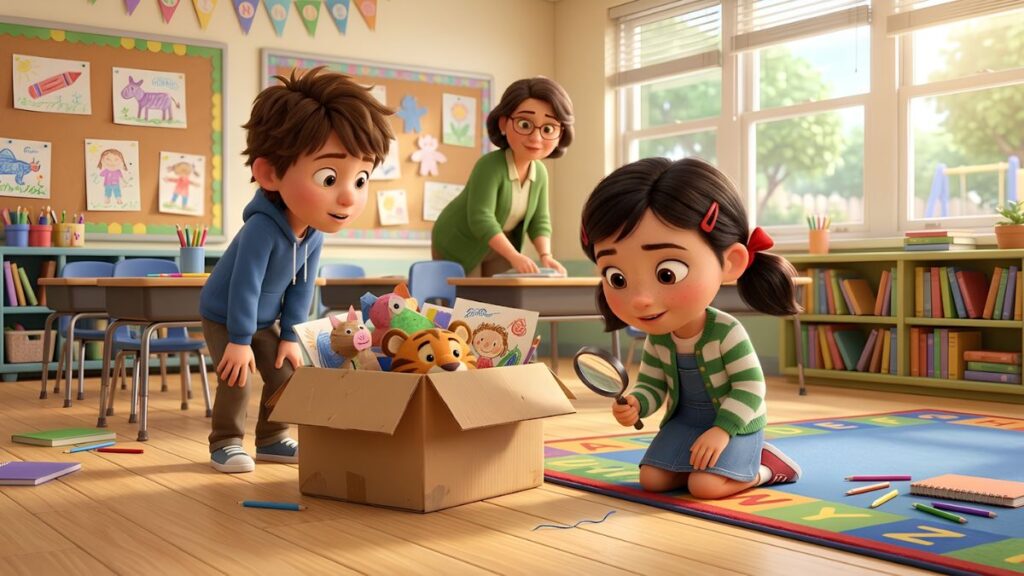
Mia’s classroom had a small stuffed tiger named Tiger Tom.
Tiger Tom was the class mascot.
The students had won him during a school reading challenge several years earlier. Since then, he had become an important part of the classroom.
Every Monday morning, Tiger Tom sat on a small chair beside the classroom library.
Sometimes students read books to him.
Sometimes he appeared on someone’s desk as a reward for good work.
During special events, the class took photographs with him.
On this particular Monday, Mrs. Carter walked into the classroom carrying a stack of papers.
“Good morning, everyone.”
“Good morning, Mrs. Carter!” the students replied.
Mrs. Carter placed the papers on her desk.
Then she looked toward the reading corner.
She stopped.
“Where is Tiger Tom?”
Everyone looked toward the little chair.
It was empty.
The classroom became quiet.
“He was there on Friday,” said Noah.
“I remember,” said Mia.
Mrs. Carter looked around the room.
“Has anyone moved him?”
Nobody answered.
The class photo was scheduled for that afternoon.
Tiger Tom was supposed to be in the photograph.
“We need to find him,” Mrs. Carter said.
Several students immediately started looking around.
Mia stayed still for a moment.
A good detective, she thought, should not start searching randomly.
First, she needed to understand what had happened.
The Investigation Begins
Mia walked over to the empty chair.
She examined it carefully.
There was nothing on the seat.
She looked underneath it.
Nothing.
Then she noticed something.
A small piece of blue thread was caught on the side of the chair.
Mia gently pulled it loose.
She looked at it.
“That’s interesting.”
“What is?” Noah asked.
Mia showed him the thread.
“It could be from someone’s clothing.”
Noah looked around.
“Do you think someone took Tiger Tom?”
“I don’t know yet.”
Mia placed the thread carefully on her desk.
Then she looked at the floor.
There were several marks near the chair.
They were not footprints exactly.
They looked more like faint lines where something had been dragged.
Mia followed them with her eyes.
The marks went toward the classroom door.
She walked slowly in that direction.
At the doorway, the marks disappeared.
Mia frowned.
“Maybe Tiger Tom was moved.”
Checking the Classroom
Mia decided to ask questions.
She first spoke to Noah.
“Did you see Tiger Tom after school on Friday?”
“Yes,” Noah said.
“When?”
“Right before I left.”
“What was he doing?”
“He was sitting on the chair.”
“Did you touch him?”
“No.”
Mia thanked him.
Next, she asked Emma.
“Did you see Tiger Tom?”
Emma thought for a moment.
“Yes. I remember Mrs. Carter putting him on the chair.”
“Did you see anyone near him?”
“I think Ben was cleaning the reading corner.”
Mia looked toward Ben.
Ben was sitting at his desk.
She walked over.
“Ben, can I ask you something?”
“Sure.”
“Did you clean the reading corner on Friday?”
“Yes.”
“Did you move Tiger Tom?”
Ben looked surprised.
“No.”
“Did you see him?”
“Yes. He was sitting on the chair.”
“Did anything unusual happen?”
Ben thought.
“I remember the chair was moved a little.”
“Why?”
“I don’t know. I was sweeping around it.”
Mia nodded.
That was useful information.
A New Clue
Mia returned to the reading corner.
She examined the floor again.
Then she noticed something underneath a nearby bookshelf.
It was a tiny piece of yellow paper.
She pulled it out.
There was a handwritten number on it.
3
Mia stared at it.
“What does that mean?”
Noah came over.
“Maybe it’s a clue.”
Mia smiled.
“Maybe.”
She looked around the classroom.
What was numbered three?
There were three bookshelves.
There were three windows.
There was also a storage cabinet with numbered sections.
Mia walked toward the cabinet.
Section three was slightly open.
She pulled the door open.
Inside were art supplies, old folders, and several classroom decorations.
No Tiger Tom.
But Mia noticed something else.
There was a small blue thread caught on the edge of the cabinet.
It looked exactly like the thread she had found on the chair.
Following the Evidence
Mia called Mrs. Carter over.
“I think Tiger Tom may have been moved to the storage area.”
Mrs. Carter looked inside the cabinet.
“He isn’t here.”
Mia examined the floor.
There were more faint dragging marks.
They continued toward the back of the classroom.
Then they stopped near a large cardboard box.
The box was labeled School Projects.
Mia looked at Mrs. Carter.
“Can we check this?”
“Of course.”
They opened the box.
Inside were old posters, drawings, cardboard models, and craft projects.
Mia moved several items carefully.
Then she saw something orange.
She pulled it out.
It was Tiger Tom.
The class cheered.
“We found him!”
Mrs. Carter laughed.
“But how did he get inside the box?”
Mia thought about the clues.
She remembered Ben cleaning the reading corner.
She remembered the chair being moved.
She remembered the dragging marks.
Then she noticed the blue thread on the box.
“Ben,” Mia said.
Ben looked nervous.
“Did you put Tiger Tom here?”
Ben shook his head.
“No.”
Mia looked confused.
Then Ben suddenly smiled.
“Oh! I remember.”
“What?”
“On Friday, Mrs. Carter asked me to move the old art projects away from the reading corner because the class needed more space.”
Mrs. Carter nodded.
“I remember that.”
“I moved the box near the reading corner,” Ben continued.
“And Tiger Tom?”
“I think the chair bumped into the box when I moved it.”
Mia looked at the box.
The top flap was partly open.
“So Tiger Tom fell inside when the box moved.”
Ben nodded.
“I didn’t notice.”
The Mystery Solved
Mia looked at the clues again.
The blue thread had probably come from Tiger Tom’s scarf.
The dragging marks came from the box being moved.
The number three was actually part of an old classroom label that had fallen from the storage cabinet.
The mystery was not a theft at all.
Tiger Tom had simply fallen into a box while the classroom was being cleaned.
Mrs. Carter smiled.
“Excellent investigation, Mia.”
Mia smiled.
“I almost thought someone had taken him.”
Noah laughed.
“So did I.”
Mrs. Carter placed Tiger Tom back on his chair.
Then she looked at the class.
“Does anyone know what this mystery teaches us?”
Mia raised her hand.
“Look carefully before making a conclusion.”
Mrs. Carter nodded.
“Exactly.”
The Class Photograph
That afternoon, the photographer arrived.
The students lined up.
Tiger Tom sat in the center.
Mia stood beside him.
The photographer raised the camera.
“Everyone smile!”
Click.
The photograph was taken.
Afterward, Noah whispered to Mia:
“You really are a detective.”
Mia laughed.
“Maybe someday.”
She looked at Tiger Tom.
“But next time, we should probably keep him away from the boxes.”
Everyone laughed.
And from that day forward, the class had a new rule:
Tiger Tom always stays in his chair.
Useful Vocabulary
- Mascot – A character, animal, or object that represents a group.
- Clue – A piece of information that helps solve a mystery.
- Observe – To watch or examine something carefully.
- Investigate – To carefully look for information about something.
- Evidence – Information or objects that help prove what happened.
- Conclusion – An idea or decision reached after thinking about information.
- Storage – A place where things are kept until they are needed.
- Dragged – Pulled something along a surface.
- Notice – To see or become aware of something.
- Mystery – Something that is difficult to explain or understand until it is solved.
Reading Comprehension Questions
- What was the name of the classroom mascot?
- When did the students last remember seeing Tiger Tom?
- What did Mia find on the chair?
- Why did Mia talk to Ben?
- What was inside the storage box?
- Where was Tiger Tom eventually found?
- Why had Tiger Tom ended up inside the box?
- Was Tiger Tom actually stolen?
- What did Mia learn from the investigation?
- Why was Tiger Tom important to the class?
Discussion Questions
- Would you enjoy being a detective?
- What would you do if something disappeared from your classroom?
- Why is it important to look for evidence before blaming someone?
- Which clue helped Mia the most?
- What other explanation could you have imagined for Tiger Tom’s disappearance?
Lesson From the Story
The Mystery of the Missing Class Mascot teaches children that careful observation and patience can help solve problems. Mia did not immediately blame anyone. Instead, she examined the evidence, asked questions, and connected the clues.
Sometimes the simplest explanation is the correct one, but we need to look carefully before we can find it.
The Secret Note in the Library Book
Noah loved the school library.
While many students preferred the playground during their free time, Noah often chose to sit quietly between the bookshelves and read.
He especially enjoyed mystery books.
He liked stories about detectives who found hidden clues, solved puzzles, and discovered secrets that other people had missed.
One Tuesday afternoon, Noah’s teacher gave the class twenty minutes of free reading time.
“Choose any book you like,” Mrs. Wilson said.
Noah walked toward the mystery section.
He ran his fingers along the shelves.
There were books about missing treasures, secret rooms, mysterious houses, and clever detectives.
Then he noticed an old blue book sitting between two newer books.
Its cover was worn.
There was no picture on the front.
Noah pulled it from the shelf.
The title was The Hidden Garden.
“That looks interesting,” he thought.
He opened the book.
Several pages had yellowed with age.
Noah turned the pages slowly.
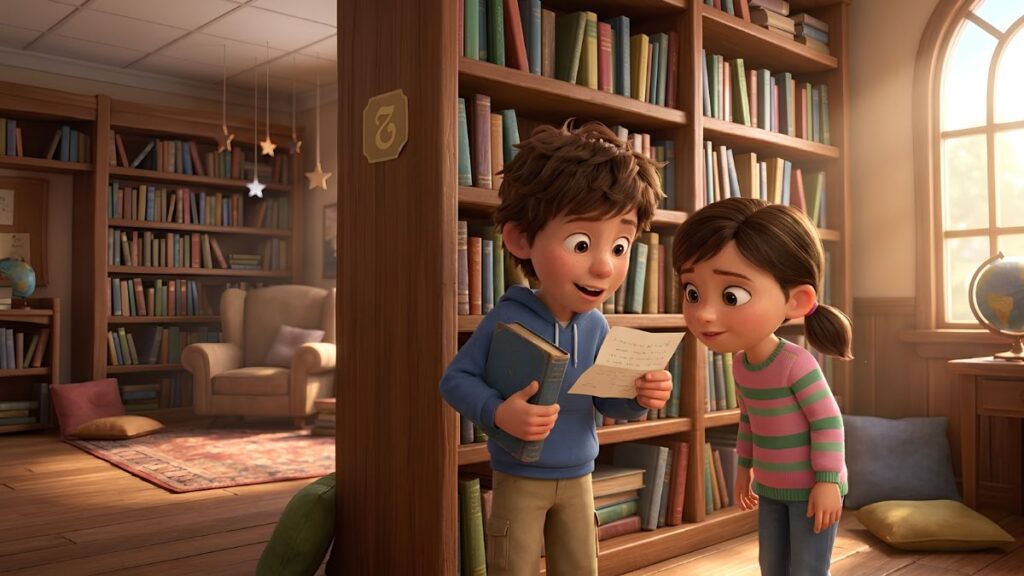
Then something fell onto the floor.
It was a small piece of folded paper.
Noah picked it up.
He looked around.
Nobody seemed to have noticed.
He unfolded the paper.
There was a handwritten message.
Look where the sun enters first.
Noah stared at the words.
“What does that mean?”
He immediately thought about his favorite mystery stories.
Maybe he had discovered a real mystery.
The First Clue
Noah looked at the note again.
There was no name.
No date.
Nothing else.
He thought about the library.
Where did the sun enter first?
The library had several large windows.
One was on the east side of the room.
Another was near the reading area.
Noah looked toward the windows.
The morning sun usually entered through the large eastern window.
But it was already afternoon.
He walked toward it.
Under the window was a small table.
There were several books on the table.
Noah checked them.
Nothing unusual.
He looked underneath the table.
Nothing.
He sighed.
Maybe the clue meant something else.
He returned to the book.
He looked at the first page.
Inside was a small library stamp.
The book had been added to the school library many years ago.
Noah wondered who had written the note.
Perhaps another student had left it there.
But why?
Asking for Help
Noah decided to show the note to his friend Emma.
Emma was sitting at a nearby table reading a science book.
“Emma, look at this.”
She read the message.
“Look where the sun enters first.”
She looked at Noah.
“What does it mean?”
“I don’t know.”
“Maybe it’s a treasure hunt.”
Noah smiled.
“I was thinking the same thing.”
Emma looked around.
“Maybe there are more clues.”
“That was my thought.”
They decided to investigate together.
They first examined the area near the eastern window.
Emma noticed something unusual.
“There.”
She pointed toward the wall.
A small golden sticker was attached to the bottom corner of a bookshelf.
Noah walked over.
The sticker had a number written on it.
7
“Seven,” he said.
Emma looked at the shelves.
“There are seven sections on this bookshelf.”
Noah smiled.
“Maybe we’re supposed to look at section seven.”
They counted the sections.
One.
Two.
Three.
Four.
Five.
Six.
Seven.
Noah examined the books in the seventh section.
Most were adventure stories.
He pulled out several books.
Nothing.
Then Emma noticed a book with a small piece of green ribbon sticking out from between its pages.
“Try that one.”
Noah pulled the book from the shelf.
He opened it.
Another folded piece of paper fell out.
The Second Message
Noah unfolded the paper.
It said:
Where stories begin, look beneath the stars.
Emma smiled.
“This is definitely a mystery.”
Noah looked around.
“Where do stories begin?”
“The beginning of a book,” Emma said.
“No. Maybe somewhere else.”
They thought for a moment.
Then Emma pointed toward the children’s reading area.
“There are stars painted on the ceiling there.”
Noah looked up.
The ceiling above the reading corner was decorated with small silver stars.
They walked over.
There was a large circular rug beneath the stars.
Noah looked under the rug.
Nothing.
Emma checked the nearby cushions.
Nothing.
Noah looked at the ceiling.
“I don’t think we can look beneath the stars.”
Emma laughed.
“Maybe there’s something underneath something shaped like a star.”
They searched the reading area.
Finally, Noah noticed a small star-shaped cushion.
He picked it up.
Underneath it was another piece of paper.
The Third Clue
The message said:
Find the book that has traveled farther than any other.
Noah frowned.
“What does that mean?”
Emma looked thoughtful.
“Maybe the oldest book?”
“Maybe.”
They returned to the shelves.
Noah looked at the library records attached to the inside covers of some books.
One book had a very old date.
It had been donated to the school more than twenty years earlier.
But had it traveled farther than any other?
Noah wasn’t sure.
They decided to ask the librarian.
Meeting the Librarian
Mrs. Green was the school librarian.
She had worked at the school for many years and knew almost every book in the building.
Noah approached her.
“Mrs. Green, can I ask you something?”
“Of course.”
“Do you know which book in the library has traveled the farthest?”
Mrs. Green looked surprised.
“That’s an interesting question.”
She thought for a moment.
“There is one book that was donated by a former student who lived in another country.”
“Where?”
“Australia.”
Noah’s eyes widened.
“That’s far away.”
Mrs. Green smiled.
“The book is called The World Around Us.”
Noah and Emma looked at each other.
They thanked Mrs. Green and hurried to find it.
The book was in the geography section.
Noah opened it.
At first, there was nothing unusual.
Then he noticed a small envelope tucked into the back cover.
His heart beat faster.
“This must be it.”
The Envelope
Noah opened the envelope.
Inside was another note.
This one was longer.
It said:
If you have found this message, you have followed the clues carefully. Now go to the place where readers sit and dreams begin.
Emma read it twice.
“Where readers sit?”
Noah immediately knew.
“The reading corner.”
They hurried back.
The reading corner had several comfortable chairs and a large wooden table.
Noah looked at the chairs.
Nothing.
He looked at the table.
Nothing.
Then he noticed a small wooden box underneath the table.
He had seen it many times before but never paid much attention to it.
He pulled it out.
It was locked.
The Final Puzzle
There was a small combination lock on the box.
Emma looked at Noah.
“We need a number.”
Noah thought about all the clues.
The first note had led them to the eastern window.
The sticker had shown the number seven.
The second clue had led them to the star cushion.
The third clue had led them to the book from Australia.
Maybe the numbers formed a combination.
Noah remembered the sticker.
Seven.
Then he remembered the year printed inside the old geography book.
There were four digits.
Could that be the combination?
He tried the number.
Click.
The lock opened.
Emma gasped.
“We solved it!”
Noah slowly lifted the lid.
Inside was a collection of old photographs, letters, and small cards.
There was also a notebook.
Noah opened it.
The first page contained a message.
To the next library detective.
Noah smiled.
The Secret
The notebook explained everything.
Years earlier, a group of students had created a secret library challenge.
They had hidden clues throughout the library.
The goal was to see whether another student could follow all the clues and find the box.
The challenge had been forgotten over time.
The old blue book had been part of the original puzzle.
Noah looked at Emma.
“So this isn’t a new mystery.”
“No,” Emma said.
“It was created years ago.”
They showed the notebook to Mrs. Green.
She looked surprised.
“I remember this!”
“You do?”
Mrs. Green laughed.
“It was created by a group of students when I first started working here.”
“Why didn’t you tell anyone?”
“I had completely forgotten about it.”
Noah smiled.
“So we found something that had been hidden for years.”
Mrs. Green nodded.
“And you solved it.”
A New Library Tradition
Mrs. Green decided that the old mystery should not be forgotten again.
She placed the notebook in a special display case.
Then she created a new library challenge for students.
Every month, students could solve a small mystery involving books and clues.
Noah and Emma were invited to help create the first new challenge.
Noah was excited.
“I already have an idea.”
Emma laughed.
“Of course you do.”
“What is it?”
“A missing bookmark.”
“That doesn’t sound very mysterious.”
“It will.”
Noah smiled.
He had always enjoyed reading mystery stories.
But now he had discovered something even better.
He could create mysteries of his own.
As he walked out of the library that afternoon, he looked back at the old blue book.
He wondered how many other secrets might be hidden inside the school.
Maybe there were more mysteries waiting to be discovered.
And Noah was ready.
Useful Vocabulary
- Mystery – Something that is difficult to understand or explain.
- Clue – A piece of information that helps solve a mystery.
- Detective – A person who investigates a mystery or problem.
- Investigate – To carefully search for information.
- Envelope – A paper container used to hold a letter or note.
- Combination – A group of numbers or symbols used to open a lock.
- Hidden – Something that has been placed where it cannot easily be seen.
- Library – A place where books and other reading materials are kept.
- Challenge – Something that requires effort or skill to complete.
- Discover – To find something that was not known or noticed before.
Reading Comprehension Questions
- Where did Noah find the first note?
- What did the first message say?
- Who helped Noah investigate the clues?
- What number did Noah find on the bookshelf?
- Where did Noah find the second message?
- Why did Noah speak to Mrs. Green?
- Which book had traveled to the library from Australia?
- What was inside the locked wooden box?
- Who had created the original mystery?
- What did Mrs. Green decide to do after Noah solved the mystery?
Discussion Questions
- Would you enjoy solving a mystery in a library?
- What would you do if you found a mysterious note inside a book?
- Which clue was the most interesting?
- Would you rather solve a mystery alone or with a friend?
- What kind of library mystery would you create?
Lesson From the Story
The Secret Note in the Library Book teaches children the importance of curiosity, observation, teamwork, and careful thinking. Noah does not simply guess the answer. He examines each clue, discusses ideas with Emma, asks the librarian for information, and connects the clues until he can solve the mystery.
The story also shows that old objects can contain interesting stories and that forgotten ideas can sometimes become exciting new adventures.
The Mystery of the Vanishing Lunchbox
Ethan was usually very organized.
Every morning, he packed his school bag carefully.
Homework went into the large pocket.
Pencils went into the front pocket.
His water bottle went into the side pocket.
And his lunchbox always went into the main compartment.
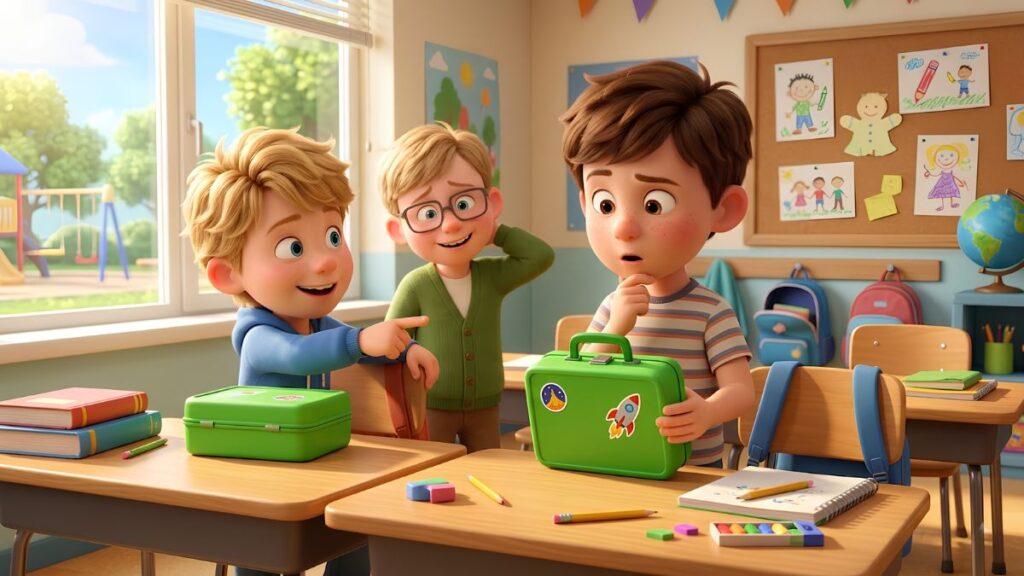
His lunchbox was easy to recognize.
It was bright green with a small rocket printed on the front.
Ethan’s father had given it to him at the beginning of the school year.
Ethan liked it because it kept his food fresh and because the rocket reminded him of his favorite subject, science.
But one Wednesday morning, something strange happened.
His lunchbox disappeared.
Lunchtime
The school bell rang at noon.
The students packed away their books and prepared for lunch.
Ethan reached into his school bag.
His hand touched his notebook.
Then his pencil case.
Then his science book.
But there was no lunchbox.
He checked again.
Nothing.
He opened every pocket.
Still nothing.
Ethan looked under his desk.
No lunchbox.
He looked beside his chair.
Nothing.
“Where is it?” he wondered.
His friend Lucas noticed him searching.
“What are you looking for?”
“My lunchbox.”
“Maybe you left it at home.”
Ethan shook his head.
“No. I remember putting it in my bag this morning.”
He was certain.
He had seen the green rocket lunchbox on the kitchen table.
He had packed it himself.
Then he had placed it inside his school bag.
So how could it be gone?
A Strange Discovery
Ethan told his teacher, Mrs. Brown.
“I’m sure I packed it,” he explained.
Mrs. Brown smiled.
“Let’s think carefully. When did you last see it?”
“This morning at home.”
“And did you open your bag after arriving at school?”
“Yes.”
“When?”
“During reading time.”
“Did you see the lunchbox then?”
Ethan thought.
“No. I didn’t look inside the main compartment.”
Mrs. Brown nodded.
“Then let’s check the places you’ve been today.”
Ethan began to retrace his steps.
First, he checked the classroom reading corner.
Nothing.
Then he checked the art table.
Nothing.
Then he remembered something.
“I went to the science room before class.”
Mrs. Brown looked at him.
“Why?”
“We had a science project.”
“Let’s check there.”
The Science Room
Ethan and Lucas walked to the science room.
The teacher, Mr. Adams, was preparing materials for the afternoon lesson.
“Mr. Adams, did you see my lunchbox?”
“What does it look like?”
“Green. It has a rocket on it.”
Mr. Adams thought.
“I don’t think so.”
Ethan looked around.
There were tables covered with science equipment.
Magnifying glasses.
Plastic containers.
Paper models.
Small rocks.
A large box of building blocks.
No green lunchbox.
Ethan felt disappointed.
“Maybe someone moved it.”
Lucas pointed toward a table.
“What’s that?”
Ethan walked over.
It was a green plastic container.
His heart jumped.
But it wasn’t his lunchbox.
“It looks similar,” Lucas said.
“But it’s not mine.”
Ethan sighed.
They returned to the classroom.
Looking for Clues
Ethan sat at his desk.
He tried to remember everything he had done that morning.
He arrived at school at 8:30.
He put his school bag beside his desk.
Then he took out his homework.
After that, he went to the reading corner.
Then he went to the science room.
After science, he returned to class.
Then he had math.
Then English.
Then lunch.
“Wait,” Ethan said.
Lucas looked at him.
“What?”
“After science, I went to the hallway.”
“Why?”
“I needed to get a tissue.”
“Did you take your bag?”
“No.”
“Did you leave anything in the hallway?”
Ethan thought.
“No.”
Then he remembered something else.
“I stopped at the water fountain.”
Lucas pointed toward the hallway.
“Let’s look there.”
The Water Fountain
They walked to the water fountain.
There were several backpacks nearby.
Students had left them against the wall during a class activity.
Ethan looked around.
Nothing.
Then he noticed something underneath a bench.
A small green strap was sticking out.
“Look!”
He crouched down.
He pulled the object out.
It was a green lunchbox.
But it didn’t have a rocket on it.
It belonged to another student.
Ethan put it back.
“This is getting confusing.”
Lucas laughed.
“There are a lot of green lunchboxes.”
Ethan suddenly noticed something.
The lunchbox had a blue sticker on the side.
He remembered his own lunchbox had a blue sticker too.
But his had a rocket.
“Maybe someone took mine by mistake.”
The Lunchbox Mix-Up
Ethan looked at the backpacks near the bench.
One belonged to a student named Oliver.
Oliver was in the same class.
Ethan remembered that Oliver also had a green lunchbox.
He found Oliver in the classroom.
“Oliver, can I ask you something?”
“Sure.”
“Did you bring your green lunchbox today?”
Oliver looked confused.
“Yes.”
“Where is it?”
“I don’t know.”
They both looked at each other.
“That’s strange,” Ethan said.
Oliver opened his backpack.
Inside was a green lunchbox.
It had a rocket on the front.
Ethan’s eyes widened.
“That’s mine!”
Oliver looked surprised.
“No, I thought it was mine.”
He picked it up.
Then he looked at the bottom.
There was a small name label.
It said Ethan.
“Oh.”
Oliver laughed.
“I took the wrong lunchbox.”
Ethan laughed too.
“But where is yours?”
Oliver checked his bag again.
He found another lunchbox underneath his books.
It was green.
It had a blue sticker.
But there was no rocket.
“That one is mine.”
The Mystery Solved
Ethan finally understood what had happened.
The two lunchboxes looked almost identical.
Both were green.
Both had blue stickers.
Both were the same size.
Oliver had accidentally picked up Ethan’s lunchbox earlier that morning.
He had put it in his own backpack.
Ethan had searched his own bag but couldn’t find it because it was in Oliver’s bag.
Nobody had stolen anything.
It was simply a mix-up.
Ethan opened his lunchbox.
His sandwich was still inside.
His apple was still there.
His father had also packed his favorite cookies.
Ethan smiled.
“Everything is here.”
Oliver looked embarrassed.
“Sorry.”
“It’s okay.”
They exchanged lunchboxes.
Lucas laughed.
“So the great mystery was just two lunchboxes getting confused.”
Ethan smiled.
“Every detective needs an easy case sometimes.”
A New System
After lunch, Ethan had an idea.
He went home and told his father what had happened.
His father laughed.
“How did you solve the mystery?”
“We looked for clues.”
“That sounds serious.”
“It was.”
His father smiled.
“Maybe you should put your name somewhere easier to see.”
Ethan thought about it.
The next day, he brought a bright name tag to school.
He placed it on the front of his lunchbox.
Oliver did the same.
Now their lunchboxes looked almost identical except for their names.
During lunch the next day, Ethan picked up his lunchbox.
He checked the name.
Ethan.
He smiled.
“No mystery today.”
A Detective’s Lesson
Later that week, Mrs. Brown asked the class what they had learned from Ethan’s lunchbox mystery.
Ethan raised his hand.
“Sometimes things disappear because someone moved them by mistake.”
Mrs. Brown nodded.
“Good.”
Lucas added:
“And checking your name helps.”
Everyone laughed.
Mrs. Brown smiled.
“Exactly. Before assuming something has been stolen or lost, think about where it might have gone.”
Ethan nodded.
That lesson stayed with him.
He realized that solving a mystery was not always about discovering something dramatic.
Sometimes it was about remembering small details.
Sometimes it was about asking questions.
And sometimes the answer was much simpler than expected.
Useful Vocabulary
- Organized – Arranged carefully and neatly.
- Disappear – To become impossible to see or find.
- Retrace – To go back over the same places or steps you have already taken.
- Clue – A piece of information that helps solve a mystery.
- Similar – Almost the same in appearance or nature.
- Mistake – Something done incorrectly by accident.
- Confused – Unsure about what something means or what happened.
- Identical – Exactly the same.
- Mix-up – A situation in which things or people are accidentally confused.
- Assume – To believe something is true before checking the facts.
Reading Comprehension Questions
- What color was Ethan’s lunchbox?
- What picture was printed on it?
- When did Ethan realize his lunchbox was missing?
- Who helped Ethan investigate?
- Where did Ethan and Lucas search first?
- Why did Ethan think someone might have moved his lunchbox?
- Who had Ethan’s lunchbox?
- Why had Oliver taken it?
- How did Ethan and Oliver prevent the same problem from happening again?
- What lesson did Ethan learn?
Discussion Questions
- Have you ever accidentally taken something that belonged to someone else?
- What would you do if your lunchbox disappeared?
- Why is it important to check the facts before blaming someone?
- What clues helped Ethan solve the mystery?
- How could you make your school supplies easier to identify?
Lesson From the Story
The Mystery of the Vanishing Lunchbox teaches children not to jump to conclusions when something goes missing. Ethan could have assumed that someone had taken his lunchbox, but instead he retraced his steps, asked questions, and looked for clues.
The mystery turned out to be a simple mix-up between two similar lunchboxes. The experience taught Ethan the value of careful observation, communication, and checking the facts before making assumptions.
The Mystery of the Missing Classroom Key
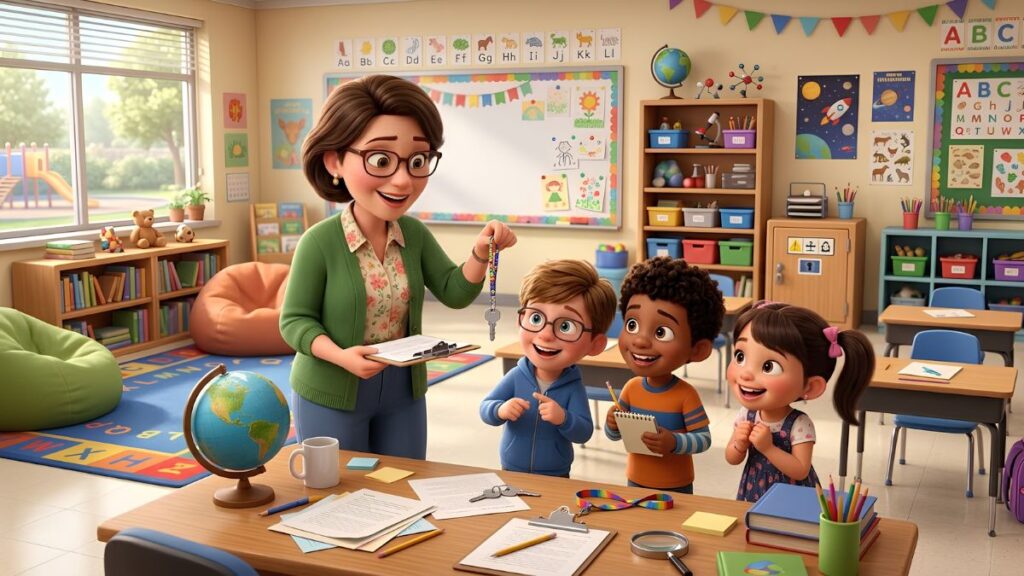
Every morning, Mrs. Carter unlocked Room 12 at exactly 8:00.
Inside the classroom were twenty-four desks, a large whiteboard, several bookshelves, a reading corner, and a small science table near the window.
The room also had a locked storage cabinet.
Inside the cabinet, Mrs. Carter kept art supplies, science equipment, extra notebooks, and materials for classroom projects.
The cabinet key was small and silver.
Mrs. Carter usually kept it on a hook beside her desk.
Everyone in the class knew the rule.
Only Mrs. Carter could use the key.
But one Monday morning, something strange happened.
The key was gone.
The Missing Key
Mrs. Carter arrived early and opened the classroom door.
She placed her bag beside her desk and began preparing the day’s lessons.
When she reached for the cabinet key, she stopped.
The hook was empty.
She checked her desk.
Nothing.
She looked inside her bag.
Still nothing.
Mrs. Carter frowned.
“That’s strange.”
A few minutes later, the students began arriving.
Ethan, Lucas, Mia, and several other students noticed that their teacher looked worried.
“Is everything okay?” Mia asked.
“I can’t find the cabinet key.”
Lucas looked toward the empty hook.
“Maybe you left it somewhere else.”
“That is possible,” Mrs. Carter said.
She began searching carefully.
She checked every drawer.
She looked under papers.
She checked her coat pockets.
Nothing.
The key had disappeared.
The First Clue
Mrs. Carter thought about the previous afternoon.
On Friday, the class had worked on a science project.
The students had built small models of bridges.
Mrs. Carter had opened the storage cabinet several times to get materials.
After class, she remembered locking the cabinet.
But she couldn’t remember exactly where she had placed the key afterward.
Ethan raised his hand.
“I saw you near the science table on Friday.”
Mrs. Carter thought.
“Yes, I was cleaning up there.”
“Maybe the key is still there.”
Mrs. Carter nodded.
“That could be our first place to check.”
The students became interested.
It suddenly felt like a mystery.
Searching the Science Table
Mrs. Carter and the students searched the science table.
There were pieces of cardboard.
Small wooden sticks.
Glue bottles.
Scissors.
String.
A ruler.
But there was no key.
Lucas looked underneath the table.
Nothing.
Mia checked the nearby shelf.
Nothing.
Ethan looked inside a box of craft materials.
Still nothing.
“It’s not here,” he said.
Mrs. Carter nodded.
“Let’s think about what happened after the science project.”
The students became quiet.
They tried to remember.
The Reading Corner
Mia raised her hand.
“After science, you read us a story.”
“That’s right,” Mrs. Carter said.
“Maybe you took the key with you.”
They walked to the reading corner.
There were several cushions on the floor.
A small wooden bookshelf stood against the wall.
Mrs. Carter checked the cushions.
Nothing.
She checked the bookshelf.
Nothing.
Then Ethan noticed something.
“There are papers underneath the chair.”
Mrs. Carter moved the chair.
There were several worksheets underneath it.
But no key.
“Good observation,” Mrs. Carter said.
Ethan smiled.
A Strange Sound
Suddenly, the students heard a small metallic sound.
Clink.
Everyone looked around.
“What was that?” Lucas asked.
Mrs. Carter listened.
Nothing.
Then they heard it again.
Clink.
It seemed to come from somewhere near the classroom door.
The students walked toward it.
There was a large box beside the door.
It contained old classroom decorations.
Mia opened the box.
Inside were paper pumpkins, birthday decorations, colorful posters, and several rolls of tape.
No key.
Lucas moved the box slightly.
Clink.
Everyone stopped.
“There it is again!”
Mrs. Carter looked underneath the box.
Something shiny was visible.
She moved the box away from the wall.
But it wasn’t the key.
It was a small metal ruler.
Lucas laughed.
“We found another clue, but not the right one.”
The Investigation Continues
Mrs. Carter decided to retrace her steps.
She had arrived at school at 7:45 on Friday.
She unlocked the classroom.
She opened the cabinet.
She prepared the science materials.
She taught the morning lessons.
After lunch, the students worked on their bridge models.
Then she cleaned the science table.
After that, she read a story to the class.
Then the students went home.
Finally, she locked the cabinet.
“What did you do after locking the cabinet?” Mia asked.
Mrs. Carter thought carefully.
“I remember carrying some books to the library.”
“Did you take the key with you?”
“I don’t think so.”
“But you could have,” Ethan said.
Mrs. Carter nodded.
“That’s possible.”
The Library
The class walked with Mrs. Carter to the library.
The librarian was arranging books on a cart.
“Did you see me here on Friday afternoon?” Mrs. Carter asked.
“Yes,” the librarian said.
“You brought a stack of books.”
“Did you notice if I had anything else?”
The librarian thought.
“You had your classroom clipboard.”
Mrs. Carter remembered.
“And my key?”
“I don’t remember seeing a key.”
They checked the library table.
Nothing.
They checked the book cart.
Nothing.
The mystery seemed to be getting harder.
An Important Detail
Back in the classroom, Mrs. Carter sat at her desk.
She looked at the empty hook.
Then she looked at her clipboard.
She suddenly remembered something.
“Wait.”
The students turned toward her.
“What’s wrong?”
“I remember using my clipboard after I locked the cabinet.”
“What did you do with it?” Lucas asked.
“I put it inside my desk drawer.”
Mrs. Carter opened the drawer.
Inside were papers, pencils, sticky notes, and a calculator.
She picked up the clipboard.
Nothing.
But underneath it was a small notebook.
She moved the notebook.
Still nothing.
Then Mia noticed a tiny piece of silver sticking out from between two papers.
“Mrs. Carter!”
Mrs. Carter reached down.
She pulled out the missing key.
Everyone cheered.
“We found it!”
The Mystery Solved
Mrs. Carter laughed.
“I can’t believe it.”
She looked at the key.
Now she remembered what had happened.
On Friday afternoon, after locking the cabinet, she had placed the key on her clipboard while carrying books to the library.
When she returned to the classroom, she put the clipboard into her desk drawer.
The key had slipped underneath the papers.
She had forgotten about it.
Nobody had stolen the key.
Nobody had moved it.
It had simply been hidden in a place Mrs. Carter had not thought to check.
Lucas smiled.
“So the mystery wasn’t really about someone taking the key.”
“No,” Mrs. Carter said.
“It was about remembering what happened.”
A Detective’s Method
Mrs. Carter looked at the students.
“What helped us solve the mystery?”
“Looking for clues,” Ethan said.
“Checking different places,” Mia added.
“Remembering what happened,” Lucas said.
Mrs. Carter nodded.
“Exactly.”
She wrote three words on the whiteboard:
Look. Think. Check.
“These are useful skills for solving problems,” she explained.
“You shouldn’t guess too quickly. First, look carefully. Then think about what might have happened. Finally, check your idea.”
The students copied the three words into their notebooks.
A New Rule
Mrs. Carter decided to make one small change.
She attached a bright red tag to the cabinet key.
She also placed a small key hook directly beside the cabinet.
“From now on,” she said, “the key goes here immediately after we use it.”
Lucas smiled.
“That should make it easier to find.”
“I hope so.”
Everyone laughed.
Another Mystery
The next morning, Mrs. Carter arrived at school.
She unlocked the classroom.
She looked at the cabinet.
The key was exactly where it should be.
She smiled.
But then she noticed something else.
One of the classroom plants was missing from the windowsill.
Mrs. Carter stared at the empty space.
“Oh, no.”
The students arrived a few minutes later.
Lucas noticed the empty windowsill.
“What’s missing?”
Mrs. Carter smiled.
“I think we have another mystery.”
The students looked at one another.
Ethan picked up his notebook.
“Let’s investigate.”
And the search began.
Useful Vocabulary
- Cabinet – A piece of furniture with doors or shelves used for storing things.
- Key – A small object used to lock or unlock something.
- Hook – A curved piece used for hanging an object.
- Clue – Information that helps someone solve a mystery.
- Investigate – To carefully search for information and discover what happened.
- Retrace – To go back through the places or steps you visited before.
- Observe – To look at something carefully.
- Clipboard – A flat board used to hold papers.
- Hidden – Kept out of sight or difficult to find.
- Solve – To find the answer to a problem or mystery.
Reading Comprehension Questions
- What was missing from Mrs. Carter’s classroom?
- Where did Mrs. Carter normally keep the key?
- What activity had the students done on Friday?
- Why did the students search the science table?
- What sound did they hear near the classroom door?
- Why did they go to the library?
- Where did Mrs. Carter eventually find the key?
- How had the key gotten into the desk drawer?
- What three words did Mrs. Carter write on the whiteboard?
- What new mystery appeared at the end of the story?
Discussion Questions
- What would you do if something important disappeared?
- Why is it useful to retrace your steps?
- Should you accuse someone before you have evidence?
- What makes someone a good detective?
- Which clue helped solve this mystery?
- What would you investigate first if something disappeared from your classroom?
Lesson From the Story
The Mystery of the Missing Classroom Key teaches children to stay calm and think carefully when something goes missing. Instead of immediately blaming someone, the students retraced Mrs. Carter’s steps, searched different locations, listened for clues, and remembered important details.
The mystery was solved because they used observation and logical thinking. Children can apply the same approach to everyday problems: look carefully, think about what happened, and check the evidence before making a conclusion.
The Mystery of the Footprints in the Garden
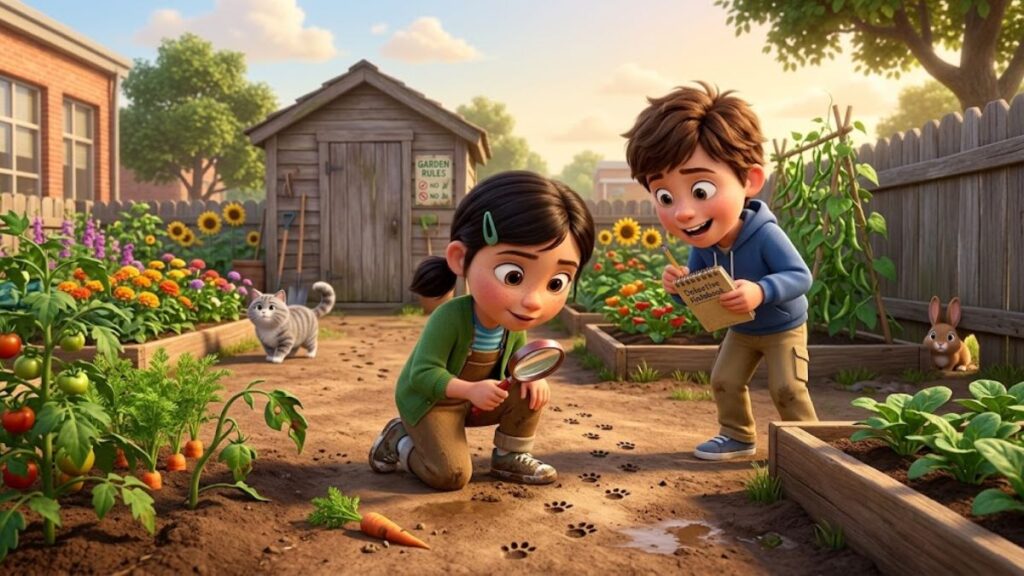
Mia loved spending time in her school’s garden.
The garden was behind the main classroom building.
It had flowers, vegetables, small trees, and a narrow path made of flat stones.
Every Wednesday afternoon, Mrs. Green took the students outside to care for the plants.
The students watered the vegetables, removed weeds, checked the flowers, and measured how much the plants had grown.
Mia especially liked the vegetable garden.
She kept a small notebook where she recorded what she observed.
She wrote down the height of the plants, the number of flowers, and anything unusual she noticed.
One Wednesday morning, Mia noticed something very unusual.
There were footprints in the garden.
Strange Footprints
Mia stood near the vegetable garden and looked carefully at the ground.
The soil was soft because it had rained the night before.
Several footprints crossed the garden.
They started near the fence.
Then they went between the tomato plants.
After that, they disappeared near the shed.
Mia called her friend Noah.
“Come look at this.”
Noah walked over.
“What happened?”
“Look at the ground.”
Noah stared at the footprints.
“Those weren’t there yesterday.”
“I know.”
They both looked at the garden.
Some of the soil had been pushed aside.
A few small leaves had been bent.
But none of the plants were badly damaged.
Noah crouched down.
“What made these?”
Mia shook her head.
“I don’t know.”
The First Investigation
Mia took out her notebook.
She drew a picture of the footprints.
Then she wrote:
Clue 1: Footprints near the fence.
Noah smiled.
“You’re making a detective report.”
“Of course.”
They examined the footprints more closely.
The marks were small.
They were not the size of an adult’s shoe.
They were also not the size of a child’s shoe.
There were three small marks at the front of each footprint.
Noah pointed at them.
“Maybe it’s an animal.”
Mia nodded.
“That makes sense.”
They looked around for more clues.
The Broken Plant
Near the middle of the garden, Mia noticed a tomato plant leaning to one side.
One of its leaves had been broken.
She carefully looked around it.
There were more footprints.
Mia wrote:
Clue 2: Something moved through the tomato plants.
Noah looked toward the fence.
“Maybe the animal came from outside.”
“Let’s check.”
They walked along the fence.
There was a small gap underneath it.
It wasn’t very large.
Mia crouched down.
“Something small could fit through here.”
Noah nodded.
“But what kind of animal?”
Asking for Help
Mia and Noah decided to tell Mrs. Green.
Mrs. Green walked over and looked at the footprints.
“Interesting.”
“Do you know what made them?” Mia asked.
“Not yet.”
“Could it be a dog?”
Mrs. Green shook her head.
“The footprints are too small.”
“A cat?”
“Possibly.”
“A rabbit?”
“Also possible.”
Mia looked excited.
“How can we find out?”
Mrs. Green smiled.
“You can investigate.”
“Really?”
“Of course. But remember, don’t disturb the garden while you’re looking for clues.”
Mia nodded.
“We’ll be careful.”
A New Clue
The students returned to the garden.
They noticed something near the shed.
A small piece of carrot was lying on the ground.
Noah picked it up.
“That’s strange.”
Mia looked at it.
“Was this here yesterday?”
“I don’t think so.”
She wrote:
Clue 3: A piece of carrot near the shed.
Noah thought for a moment.
“What animals eat carrots?”
“Rabbits.”
“Exactly.”
Mia looked toward the fence.
“Maybe a rabbit came into the garden.”
They followed the footprints.
The marks went from the fence to the vegetable garden.
Then toward the shed.
Then back toward the fence.
Mia smiled.
“It looks like the animal came in, walked around, found food, and left.”
The Missing Carrots
Mia checked the vegetable garden.
She noticed something else.
Three carrots were missing.
She counted them again.
One.
Two.
Three.
There should have been more.
“Look!”
Noah came closer.
“Are those carrots missing?”
“Yes.”
Mia wrote:
Clue 4: Three carrots are missing.
Now they had a strong idea.
“A rabbit,” Noah said.
“Probably.”
But Mia wasn’t completely convinced.
“We need more evidence.”
The Footprint Experiment
The students wanted to know what kind of footprints a rabbit made.
Mrs. Green helped them find a picture in a gardening book.
They compared the picture with the marks in the garden.
The shapes looked similar.
Mia was excited.
“I think we’ve solved it.”
But Noah noticed something.
“Wait.”
“What?”
“The footprints near the shed are different.”
Mia looked carefully.
He was right.
Some footprints were small and round.
Others were longer.
“Could there be two animals?” Mia asked.
Mrs. Green came over.
“That’s possible.”
They followed the second set of footprints.
They went toward the flower garden.
Then they stopped beside a bush.
Mia looked under the bush.
Something moved.
She jumped back.
“What was that?”
Noah leaned closer.
A small gray shape appeared.
Then it quickly disappeared.
“A cat!”
The Garden Visitor
The students watched quietly.
A small gray cat slowly came out from under the bush.
It looked around.
Then it walked toward the fence.
Mia smiled.
“So the cat made the second set of footprints.”
Mrs. Green nodded.
“That seems likely.”
“But what about the carrots?” Noah asked.
The cat stopped.
Then it jumped over the fence.
The students looked at each other.
The mystery still wasn’t completely solved.
One More Investigation
Mia decided to check the garden again.
She looked near the carrots.
There were small footprints.
They were different from the cat’s footprints.
They were smaller.
Mia followed them.
They went toward the fence.
She crouched down.
There was the same small gap underneath.
Then she noticed something on the other side of the fence.
A rabbit was sitting in the grass.
It was holding a small piece of carrot.
Mia smiled.
“There!”
Noah laughed.
“The rabbit!”
The rabbit quickly hopped away.
The Mystery Solved
Mia returned to the garden.
She explained everything to Mrs. Green.
“The rabbit came through the gap in the fence,” she said.
“It walked through the vegetable garden and ate some carrots.”
“And the cat?” Mrs. Green asked.
“It came later and walked around the flower garden.”
Mrs. Green smiled.
“Excellent investigation.”
Mia opened her notebook.
She had collected four important clues.
- Small footprints near the fence.
- A broken plant.
- A piece of carrot.
- Missing carrots.
Together, the clues showed what had probably happened.
Protecting the Garden
Mrs. Green decided to fix the gap underneath the fence.
She placed a small piece of wire mesh along the bottom.
“We don’t want to hurt the animals,” she explained.
“We just want to protect the vegetables.”
Mia nodded.
“What about the cat?”
“The cat can still walk around outside the garden.”
“And the rabbit?”
“It can find food somewhere else.”
The students helped clean up the garden.
They carefully fixed the bent tomato plant.
They watered the vegetables.
They removed a few weeds.
The garden looked normal again.
A Surprise Visitor
The following Wednesday, Mia checked the garden.
There were no new footprints.
The carrots were still there.
The tomato plants were growing.
Everything looked peaceful.
Then Mia noticed something near the fence.
A tiny white feather.
She picked it up.
Noah walked over.
“What did you find?”
Mia held up the feather.
“I think we might have another mystery.”
Noah laughed.
“Again?”
Mia smiled.
“That’s what detectives do.”
Useful Vocabulary
- Footprint – A mark left on the ground by a person’s or animal’s foot.
- Investigate – To carefully search for information about something.
- Clue – Something that helps you understand or solve a mystery.
- Evidence – Information or objects that help show what happened.
- Fence – A structure used to separate or protect an area.
- Gap – An open space between two things.
- Observe – To watch or examine something carefully.
- Disturb – To interfere with something or change its normal condition.
- Evidence – Facts or objects that help prove what happened.
- Protect – To keep someone or something safe from harm.
Reading Comprehension Questions
- Where did Mia find the footprints?
- Why was the soil useful for the investigation?
- What was the first clue Mia recorded?
- What food was found near the shed?
- What vegetables were missing?
- What animal made the small footprints?
- What animal made the second set of footprints?
- How did the rabbit enter the garden?
- What did Mrs. Green do to protect the garden?
- What new clue did Mia discover at the end?
Discussion Questions
- Have you ever seen animal footprints?
- What clues would you look for if you found strange footprints?
- Why is it important to observe something carefully before making a conclusion?
- What animals might visit a garden?
- How can people protect plants without hurting animals?
- Would you enjoy being a detective like Mia?
Lesson From the Story
The Mystery of the Footprints in the Garden teaches children how observation and evidence can help solve a mystery. Mia does not immediately decide what caused the footprints. Instead, she studies the marks, looks for additional clues, asks questions, and compares the evidence.
The mystery also teaches children that animals are part of the environment. Instead of trying to harm the animals, Mrs. Green finds a safe way to protect the garden while allowing the animals to remain outside it.
The Mystery of the Missing Library Book
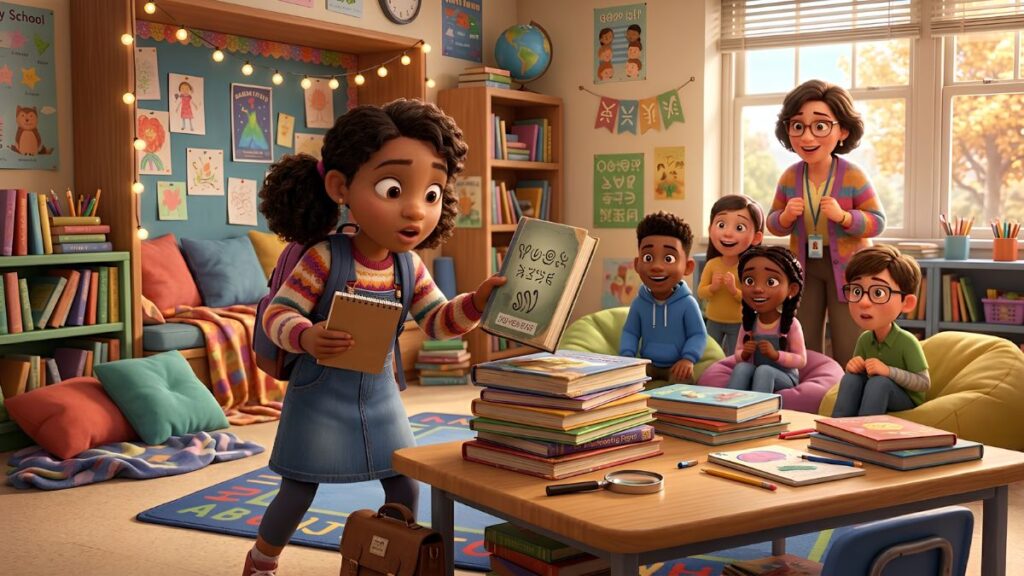
It was a quiet Monday morning at Maplewood Elementary School. The students in Room 4B were getting ready for their weekly reading period.
Ms. Carter placed a stack of library books on the table.
“Before we begin,” she said, “I have some disappointing news.”
The students looked at her.
“Our class copy of The Secret Garden is missing.”
Everyone started talking at once.
“That was my favorite book!”
“I saw it yesterday!”
“Maybe someone took it home!”
Ms. Carter raised her hand.
“Let’s not blame anyone. We just need to figure out where the book went.”
Among the students was ten-year-old Maya, who loved solving mysteries. She had a small notebook that she called her Detective Journal.
Maya looked at Ms. Carter.
“Can I help?”
Ms. Carter smiled.
“Of course. But remember, a good detective looks for clues before making a guess.”
Maya nodded.
She opened her notebook and wrote:
Case: The Missing Library Book
Clue 1: The Empty Shelf
The book normally stayed on a special shelf beside the classroom reading corner.
Maya walked over and examined the shelf.
There was a small empty space between two books.
She noticed something interesting.
A thin layer of dust covered most of the shelf, but the empty space looked cleaner.
“That means the book was probably here recently,” Maya said.
She wrote it down.
The book was on the shelf recently.
Then she looked underneath the shelf.
Nothing.
She checked behind the nearby chair.
Nothing.
Clue 2: The Reading Corner
Maya walked around the reading corner.
There were several cushions on the floor.
She lifted them one by one.
Under the third cushion, she found a pencil.
But no book.
She checked behind the bookshelf.
Still nothing.
Then she noticed something on the floor.
A small piece of green paper.
Maya picked it up.
It looked like part of a bookmark.
She showed it to Ms. Carter.
“Does this belong to the missing book?”
Ms. Carter looked at it.
“It might. The bookmark in that book was green.”
Maya carefully placed the paper in her notebook.
Clue: A piece of the green bookmark was found near the reading corner.
Clue 3: The Reading List
Maya asked Ms. Carter who had used the book most recently.
Ms. Carter checked her classroom reading list.
“According to my notes, three students read it during Friday’s free-reading period.”
Maya wrote down their names:
Ethan.
Sophie.
Leo.
Maya knew all three students.
Ethan loved adventure stories.
Sophie liked mystery books.
Leo usually preferred science books.
Maya decided to speak with each student.
Talking to Ethan
Maya found Ethan drawing at his desk.
“Ethan, can I ask you something?”
“Sure.”
“Did you read The Secret Garden on Friday?”
“Yes.”
“Where did you read it?”
“In the reading corner.”
“Did you put it back on the shelf?”
Ethan thought for a moment.
“I think so.”
“Are you sure?”
“Yes. I remember putting it on the shelf because Ms. Carter told us to clean up before lunch.”
Maya wrote this down.
“Did you see anyone else reading it?”
“Sophie was reading it after me.”
That was interesting.
Talking to Sophie
Maya walked over to Sophie.
“Did you read The Secret Garden on Friday?”
“Yes.”
“Where did you read it?”
“Outside.”
“Outside?”
Sophie nodded.
“It was sunny, so Ms. Carter let us read in the courtyard.”
Maya wrote that down.
“Did you bring the book back inside?”
“Yes.”
“When?”
“Before lunch.”
“Did you put it on the shelf?”
Sophie paused.
“I think I did.”
“You think?”
“I remember carrying it inside, but I don’t remember putting it on the shelf.”
Maya thanked her.
Then she asked one more question.
“Did you use the green bookmark?”
“Yes.”
Maya looked at the small piece of green paper in her notebook.
Another clue.
Talking to Leo
Leo was sitting at his desk reading a science magazine.
“Leo, did you read The Secret Garden on Friday?”
“Yes.”
“Where?”
“At my desk.”
“Did you move the book anywhere?”
“No.”
“Did you see someone else carrying it?”
Leo thought for a moment.
“Actually, yes.”
“Who?”
“I saw Sophie carrying it toward the classroom door.”
Maya wrote that down.
She now had several clues.
The book had been on the shelf recently.
Sophie had used the green bookmark.
A piece of the bookmark had been found near the reading corner.
Sophie had carried the book outside and later brought it back inside.
But Maya didn’t want to accuse Sophie.
There could be another explanation.
The Important Question
Maya returned to Ms. Carter.
“I have a theory, but I need to check something.”
“What do you think happened?”
“I think the book may not have been stolen. Someone might have put it somewhere else.”
Ms. Carter nodded.
“That is a good possibility.”
Maya looked around the classroom.
If Sophie had returned the book but didn’t remember putting it on the shelf, where could she have placed it?
Maya thought about what students did after reading.
They often returned books to the reading table.
She walked over to the table.
There were several books stacked there.
She checked the first one.
A math book.
The second.
A history book.
The third.
A science book.
Then she noticed something underneath the stack.
A corner of a green cover.
Maya’s eyes widened.
She carefully moved the books.
There it was.
The Secret Garden.
“I found it!”
Ms. Carter walked over.
Everyone gathered around.
Maya held up the book.
The class cheered.
The Mystery Solved
Maya opened her notebook.
“So what happened?”
She explained her reasoning.
“Sophie returned the book after reading it outside. She probably placed it on the reading table instead of the shelf. Later, other students put more books on the table, covering it.”
Sophie looked relieved.
“I guess I forgot.”
Maya smiled.
“That happens.”
Ms. Carter nodded.
“And that’s why we don’t accuse people without evidence.”
Sophie apologized for not remembering where she had placed the book.
Ms. Carter wasn’t angry.
“Let’s just remember to return books to their proper places.”
Maya closed her notebook.
She had solved another mystery.
But before she sat down, she noticed something.
The green bookmark was still inside the book.
The torn piece Maya had found was actually from an old paper bookmark lying near the reading corner.
It wasn’t even connected to the mystery.
Maya laughed.
“So that clue wasn’t important after all.”
Ms. Carter smiled.
“That’s another lesson for detectives. Not every clue is useful.”
Maya wrote one final sentence in her notebook:
A good detective doesn’t just find clues. A good detective knows which clues matter.
And with that, the class began their reading period.
Useful Vocabulary
- Mystery – Something that is difficult to explain or understand.
- Clue – A piece of information that helps solve a mystery.
- Evidence – Facts or objects that help prove what happened.
- Detective – Someone who investigates a mystery or problem.
- Missing – Something that cannot be found.
- Shelf – A flat surface used for storing books or other objects.
- Bookmark – Something placed inside a book to remember a reading position.
- Theory – An idea about what may have happened.
- Investigate – To carefully look for information to discover the truth.
- Proper – Correct or suitable for a particular purpose.
Reading Comprehension Questions
- What book was missing?
- Where was the book normally kept?
- Which three students had read the book?
- Where did Sophie read the book?
- What did Leo see Sophie doing?
- Where did Maya find the book?
- Why was the book difficult to see?
- Was Sophie trying to steal the book?
- What did Maya learn about clues?
- Why is it important not to accuse someone without evidence?
Discussion Questions
- Have you ever lost a book or another important item?
- What would you do if something disappeared from your classroom?
- Why should detectives look for evidence before making conclusions?
- Can a clue sometimes be misleading?
- What qualities make someone a good detective?
Lesson From the Story
The Mystery of the Missing Library Book teaches children that solving problems requires patience, careful observation, and logical thinking. Maya does not immediately blame anyone. Instead, she collects clues, asks questions, considers different possibilities, and checks the evidence before reaching a conclusion.
The story also shows that not every clue is important. Good problem-solvers learn to separate useful information from details that may have nothing to do with the mystery.
The Mystery of the Vanishing Science Project
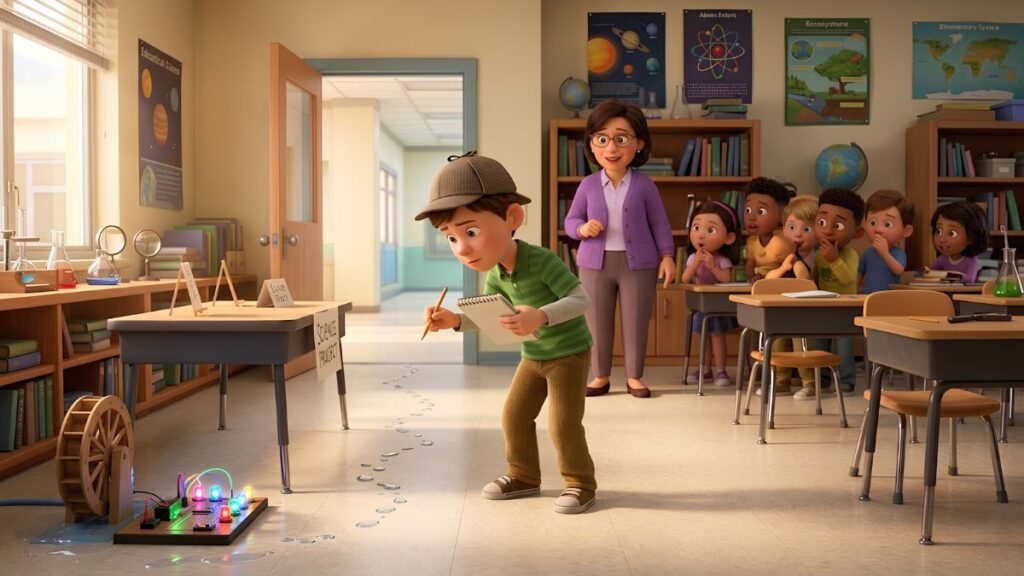
It was Thursday afternoon at Oakwood Elementary School, and the students in Ms. Brown’s class were excited.
The school science fair was only two days away.
For the past three weeks, the students had been preparing projects about plants, animals, weather, and simple machines.
One of the most impressive projects belonged to eleven-year-old Daniel.
Daniel had built a small model showing how a water wheel could generate electricity. His project included a miniature water wheel, a tiny generator, wires, and a small LED light.
When water flowed over the wheel, the wheel turned and powered the light.
Daniel had spent many afternoons working on it.
He had carefully painted the base blue and green.
He had labeled every part.
He had even made a small sign that said:
HOW WATER CAN MAKE ELECTRICITY
On Thursday morning, Daniel brought the project to school.
Ms. Brown placed all the science projects on a long table at the back of the classroom.
“Everyone should leave their projects here until the science fair,” she said.
Daniel smiled.
He was proud of his work.
At lunchtime, the students left the classroom.
When they returned, Daniel immediately noticed something strange.
His project was gone.
He looked at the table.
Every other project was still there.
His water wheel was missing.
Daniel froze.
“Ms. Brown!”
The teacher walked over.
“What happened?”
“My project is gone.”
Ms. Brown looked surprised.
“Are you sure you left it here?”
“Yes. I put it right there this morning.”
She looked around the classroom.
“Did anyone see someone move it?”
The students began looking at one another.
Nobody answered.
Daniel felt worried.
The science fair was only two days away.
He couldn’t build the entire project again in time.
Starting the Investigation
Ms. Brown asked everyone to remain calm.
“We’re going to find it,” she said. “But we’re not going to accuse anyone.”
Daniel remembered something he had read about detectives.
Start with what you know.
He took out his notebook.
At the top of the page, he wrote:
Case: The Missing Water Wheel
Then he wrote the first clue.
Clue 1: The project was on the table before lunch.
Daniel thought carefully.
“If nobody moved it before lunch, someone must have moved it during lunch.”
He looked at the classroom door.
The door was usually locked when the students went to lunch.
But today, Ms. Brown remembered something.
“I left the door open because I was going to return to the classroom for my notebook.”
Daniel wrote that down.
The classroom was unlocked during lunch.
That meant someone could have entered.
But who?
Clue 2: The Wet Floor
Daniel walked toward the science table.
He noticed something on the floor.
There were three small drops of water.
He pointed at them.
“Look.”
Ms. Brown bent down.
“Those weren’t there this morning.”
Daniel followed the drops.
They led toward the classroom door.
He became excited.
“Maybe the person who moved my project spilled some water.”
But where did the drops lead?
Daniel followed them carefully.
The drops stopped near the hallway.
He looked around.
There were no more drops.
“That’s strange.”
Ms. Brown nodded.
“It could be an important clue, but we need more evidence.”
Daniel agreed.
Clue 3: The Science Supplies
Daniel remembered that his project had a small plastic container attached to the water wheel.
The container held water during demonstrations.
He checked the science supply table.
The container was missing too.
Daniel looked at Ms. Brown.
“Someone took the water container with the project.”
“That makes sense,” she said.
Daniel wrote:
The water container is missing too.
That suggested that whoever moved the project probably understood how it worked.
Talking to the Students
Daniel decided to ask his classmates what they had seen.
He first spoke to Olivia.
“Did you see my project after we came back from lunch?”
“No.”
“Did you see anyone near the science table?”
Olivia thought.
“I saw Marcus.”
“When?”
“Just before lunch.”
Daniel wrote it down.
Then he spoke to Marcus.
“Did you go near the science projects?”
“Yes.”
“Why?”
“I wanted to look at the volcano project.”
“Did you touch my water wheel?”
“No.”
Marcus looked worried.
“I wouldn’t take it.”
Daniel nodded.
“I believe you. I’m just trying to find out what happened.”
Marcus relaxed.
Then he remembered something.
“Actually, I saw someone carrying a box toward the hallway.”
“Who?”
“I couldn’t see clearly. The person was carrying it with both hands.”
Daniel wrote that down.
“Was it my project?”
“I don’t know.”
Another Clue
Daniel returned to the science table.
He looked carefully at the floor.
Under the table, he found a small piece of blue paper.
He picked it up.
It had part of a handwritten word on it.
…LECTRICITY
Daniel recognized it immediately.
It was from the sign attached to his project.
He had found another clue.
But this clue created another question.
If the project had been carried toward the hallway, why was the piece of paper underneath the table?
Maybe the sign had fallen off when someone lifted the project.
Daniel looked at the classroom door.
Then he looked at the hallway.
“Let’s check where the water drops stopped.”
The Hallway
Daniel and Ms. Brown walked into the hallway.
The floor was dry.
They looked left.
Nothing.
They looked right.
Nothing.
Then Daniel noticed something near the end of the hallway.
A small blue piece of tape was stuck to the floor.
He recognized it.
He had used blue tape to secure the wires underneath his project.
He followed the direction of the tape.
It led toward the school library.
Daniel looked at Ms. Brown.
“Why would my project be in the library?”
“I don’t know.”
They walked toward the library.
The librarian, Mrs. Green, was arranging books.
“Mrs. Green, did anyone bring a science project in here?”
She thought for a moment.
“Yes.”
Daniel’s eyes widened.
“When?”
“About twenty minutes ago.”
“Who brought it?”
Mrs. Green pointed toward the reading area.
“A student named Ethan.”
Daniel knew Ethan.
Ethan was one of the youngest students in their class.
“Why did he bring it here?”
Mrs. Green smiled.
“He said he needed a quiet place to finish something.”
Daniel looked confused.
“Was he carrying my project?”
Mrs. Green nodded.
“Yes.”
Daniel immediately felt relieved.
But he still had questions.
The Final Clue
Daniel and Ms. Brown walked into the library’s reading area.
There was Ethan.
And beside him was the missing water wheel.
Daniel’s project was completely safe.
But Ethan was sitting beside it with a piece of paper and a pencil.
Daniel walked over.
“Ethan?”
Ethan looked up.
“Oh.”
He suddenly looked nervous.
“I’m sorry.”
Daniel looked at his project.
“Why did you take it?”
Ethan lowered his head.
“I didn’t want to steal it.”
“Then why?”
Ethan pointed to the project.
“I wanted to understand how it worked.”
Daniel listened.
“I saw your water wheel yesterday. It made the light turn on, and I thought it was really cool.”
“So you took it?”
“I wanted to ask you about it, but I was too shy.”
Ethan explained that he had carried the project to the library because he wanted to study it without disturbing anyone.
“I should have asked first,” he said.
Daniel nodded.
“You definitely should have.”
Ethan looked worried.
“Are you angry?”
Daniel looked at his project.
Everything was still there.
“No. I’m mostly glad it’s okay.”
Ms. Brown walked over.
“Ethan, you should never take someone else’s belongings without permission.”
“I know.”
“But I understand that you were curious.”
Ethan nodded.
“I’ll ask next time.”
Daniel smiled.
“If you want, I can explain how the water wheel works.”
Ethan’s face brightened.
“Really?”
“Sure.”
Daniel explained how the moving water turned the wheel.
The wheel turned the small generator.
The generator produced electricity.
The electricity powered the LED light.
Ethan listened carefully.
“That is amazing.”
Daniel smiled.
Mystery Solved
Daniel returned his project to the classroom.
The mystery was finally solved.
He wrote the final clues in his notebook:
- The project disappeared during lunch.
- The classroom door had been left open.
- Water drops were found on the floor.
- The water container was missing.
- A piece of the project sign was found under the table.
- Blue tape led toward the library.
- Ethan had taken the project because he wanted to learn how it worked.
Daniel closed his notebook.
He had learned something important.
A mystery does not always involve a crime.
Sometimes, the answer is much simpler.
Sometimes, someone makes a bad decision because they are curious or afraid to ask for help.
Ethan apologized to Daniel again.
Daniel accepted his apology.
“Next time, just ask.”
“I will.”
The Science Fair
Two days later, the science fair began.
Daniel placed his water wheel on a table.
A group of students gathered around it.
He demonstrated how the water made the wheel turn.
The small LED light came on.
Everyone clapped.
Ethan stood nearby.
He smiled proudly.
When a visitor asked Daniel how he had learned so much about water power, Daniel laughed.
“I had an unexpected mystery this week.”
Ethan smiled.
After the science fair, Ethan approached Daniel.
“Can I build something like this?”
“Of course.”
“Will you help me?”
“Sure.”
Daniel realized that solving the mystery had led to something unexpected.
He had not only found his missing project.
He had also gained a new science partner.
Before leaving school, Daniel wrote one final sentence in his detective notebook:
The best mysteries don’t just help you find answers. They help you learn something new.
Useful Vocabulary
- Investigation – The process of carefully looking for information to discover what happened.
Example: Daniel started an investigation when his project disappeared. - Evidence – Information or objects that help prove something.
Example: The water drops were useful evidence. - Generator – A device that produces electricity.
Example: The small generator powered the LED light. - Curious – Wanting to learn or know more about something.
Example: Ethan was curious about Daniel’s project. - Permission – Approval to do something.
Example: Ethan should have asked for permission before taking the project. - Hallway – A passage inside a building that connects different rooms.
Example: The water drops led into the hallway. - Secure – To hold something firmly in place.
Example: Daniel used tape to secure the wires. - Apologize – To say that you are sorry for something you did wrong.
Example: Ethan apologized for taking the project. - Demonstrate – To show how something works or is done.
Example: Daniel demonstrated how the water wheel produced electricity. - Mystery – Something that needs to be explained or solved.
Example: The missing science project became a mystery.
Reading Comprehension Questions
- What kind of project did Daniel make?
- When did Daniel discover that his project was missing?
- Why was the classroom door unlocked?
- What did Daniel find on the classroom floor?
- What happened to the water container?
- Who had seen someone carrying a box toward the hallway?
- Where did the blue tape lead?
- Why had Ethan taken Daniel’s project?
- What did Ethan promise to do in the future?
- What did Daniel learn from solving the mystery?
Discussion Questions
- Have you ever been curious about something that belonged to someone else?
- Why is it important to ask permission before using someone else’s things?
- What would you do if something important disappeared?
- Which clue in the story was most useful?
- Do you think Ethan made a serious mistake? Why?
- Would you help a friend build a science project?
Lesson From the Story
The Mystery of the Vanishing Science Project teaches children to stay calm, gather evidence, and avoid making quick accusations. Daniel solves the mystery by carefully examining clues and asking questions rather than blaming someone immediately.
The story also teaches an important lesson about curiosity and permission. Ethan was genuinely interested in Daniel’s science project, but he should have asked before taking it. His mistake was corrected through an honest conversation and an apology.
For children, the story combines detective skills with lessons about responsibility, communication, curiosity, honesty, and respecting other people’s belongings.
Benefits of Short Detective Stories for Kids
They Encourage Critical Thinking
Detective stories require children to examine information and decide which details are important.
A character may discover several clues, but not every clue will have the same importance. Children learn to compare information and think about how different clues might be connected.
This encourages reasoning rather than simple memorization.
They Improve Reading Comprehension
Children need to remember what they have read in order to solve a mystery.
For example, an important detail may appear near the beginning of the story but become meaningful later.
Reading detective stories can encourage children to:
- Remember important details
- Identify key information
- Understand cause and effect
- Make predictions
- Draw conclusions
- Recognize relationships between events
They Build Observation Skills
A detective needs to notice things that other people might ignore.
Children can practice looking carefully at:
- Objects
- Locations
- Characters’ actions
- Time
- Sounds
- Descriptions
- Conversations
- Changes in the environment
This can help children understand that small details can sometimes provide important information.
They Encourage Problem-Solving
Every mystery presents a problem.
The main character must find a solution using the information available.
Children can practice asking:
- What do we know?
- What don’t we know?
- What evidence do we have?
- What could explain these clues?
- What should the detective investigate next?
These questions help children approach problems systematically.
They Develop Prediction Skills
A good mystery gives children enough information to make predictions without revealing the answer immediately.
While reading, children can stop and predict what might happen next.
They might think:
- The missing object is probably somewhere nearby.
- This character may know something important.
- The strange sound probably has a simple explanation.
- The clue may be connected to something mentioned earlier.
Prediction makes reading more interactive.
They Introduce Cause and Effect
Mystery stories often follow a clear chain of events.
Something happens.
The detective notices it.
A clue is discovered.
The detective investigates.
Another clue appears.
The mystery is eventually explained.
This structure can help children understand how one event can lead to another.
What Makes a Good Detective Story for Kids?
Not every mystery is automatically suitable for children. A strong children’s detective story should be understandable, engaging, age-appropriate, and logically structured.
A Clear Mystery
The story should introduce a problem fairly early.
For example, something may disappear, a strange message may appear, or an unusual event may occur.
The reader should understand what needs to be solved.
A Curious Detective
The main character should have a reason to investigate.
The detective does not necessarily have to be an adult professional detective. A child, group of friends, sibling, teacher, librarian, or curious student can solve the mystery.
The most important quality is curiosity.
Manageable Clues
Children should be able to understand the clues.
Avoid making every clue extremely complicated.
Simple clues can be very effective when they are connected logically.
A Logical Solution
The solution should make sense based on information provided earlier in the story.
Children should ideally be able to look back and say:
“That clue explained everything!”
A solution that appears completely unrelated to the clues can make the story feel unfair.
A Satisfying Ending
The mystery should eventually be explained clearly.
The ending can also include a small lesson about:
- Honesty
- Teamwork
- Patience
- Observation
- Responsibility
- Communication
- Helping others
Age-Appropriate Detective Mysteries
Detective stories can be adapted for different age groups.
Detective Stories for Ages 5–7
Younger children generally benefit from simple mysteries with familiar settings and obvious clues.
Good settings include:
- Home
- Classroom
- Playground
- Library
- Park
- Birthday party
The mystery should have a small number of characters and a straightforward solution.
The language should also be simple and supported by clear descriptions.
Detective Stories for Ages 8–10
Children in this age range can usually handle more clues and several possible explanations.
Mysteries can include:
- School projects
- Secret notes
- Missing books
- Treasure hunts
- Classroom puzzles
- Strange footprints
- Neighborhood mysteries
The solution can require children to connect two or three separate clues.
Detective Stories for Ages 10–12
Older children can handle more complex plots.
Stories can include multiple suspects, misleading clues, hidden messages, timelines, and more detailed investigations.
However, the mystery should still remain age-appropriate and avoid unnecessarily frightening or violent material.
Popular Themes for Kids’ Detective Stories
There are many ways to create a child-friendly mystery.
Missing Object Mysteries
Something disappears and the detective needs to discover where it went.
Examples include:
- A missing library book
- A lost classroom key
- A missing toy
- A disappeared lunchbox
- A misplaced science project
- A missing trophy
These mysteries are easy for children to understand and can encourage practical problem-solving.
Classroom Mysteries
A classroom provides an excellent setting because children already understand the environment.
A teacher might discover that something has moved, disappeared, or changed.
Students can investigate clues around the classroom.
Library Mysteries
Libraries naturally create a mysterious atmosphere without needing anything scary.
A mystery could involve a missing book, an unusual bookmark, an anonymous note, or a book that keeps appearing in unexpected places.
School Playground Mysteries
A playground can provide many possible clues.
Children can investigate footprints, objects, notes, unusual markings, or missing equipment.
Neighborhood Mysteries
A neighborhood allows children to explore familiar locations such as parks, stores, apartment buildings, and community centers.
These stories can also introduce positive themes about helping neighbors and working together.
Animal Mysteries
Animals can become part of a mystery without making the story frightening.
A pet might disappear temporarily, an animal might repeatedly visit a particular location, or something unusual might be found near an animal’s home.
Treasure Mysteries
Treasure hunts are naturally appealing to children.
The treasure does not have to be valuable. It could be a box of old photographs, a collection of childhood toys, a time capsule, or a special family keepsake.
The mystery comes from figuring out where it is hidden.
How to Structure a Short Detective Story
A simple structure can make a children’s mystery easier to follow.
Introduce the Detective
Begin by introducing the main character.
Show something about their personality.
Perhaps they are curious, observant, patient, or good at remembering details.
Present the Mystery
Introduce the problem.
Something unexpected has happened.
The reader should immediately understand what needs to be investigated.
Discover the First Clue
The detective notices something that may help solve the mystery.
This clue should move the investigation forward.
Investigate
The detective searches for more information.
They may ask questions, examine objects, visit different locations, or talk with other characters.
Add More Clues
Additional clues gradually help the detective understand what happened.
Some clues can be obvious while others may require more careful thinking.
Create a Prediction
The detective forms a theory about what happened.
The reader can also make their own prediction.
Reveal the Solution
The detective connects the clues and explains the mystery.
The explanation should be logical and easy for children to understand.
End With a Positive Message
A short reflection can reinforce the story’s theme.
For example, children might learn that paying attention, asking questions, and working together can help solve problems.
How to Make Detective Stories Interactive
One of the best ways to use detective stories with children is to make them interactive.
Instead of immediately revealing the solution, ask questions during the story.
Ask Prediction Questions
Pause and ask:
What do you think happened?
Who do you think knows something?
Where should the detective look next?
Create a Clue Hunt
Give children a list of clues to watch for while reading.
They can write down each clue as they discover it.
Ask Children to Become Detectives
Encourage children to create their own theories.
They can explain:
- What happened
- Which clues support their idea
- Which character they suspect
- What they would investigate next
This transforms passive reading into active problem-solving.
Detective Story Activities for Kids
Short detective stories can also be turned into classroom or home activities.
Clue Cards
Write individual clues on cards.
Give children the cards one at a time and ask them to determine what each clue might mean.
Mystery Worksheets
A worksheet can include:
- The mystery
- Suspects
- Clues
- Important details
- The child’s theory
- Final solution
This is particularly useful for reading comprehension.
Who, What, Where, and Why
After reading, ask children to identify:
Who was involved?
What happened?
Where did it happen?
When did it happen?
Why did it happen?
This simple framework helps children organize information.
Create a Detective Notebook
Children can maintain a notebook where they record:
- Clues
- Suspects
- Questions
- Predictions
- Important details
- Final conclusions
This can make repeated mystery reading more engaging.
Draw the Mystery
Children can draw the setting of the mystery and mark where important clues were discovered.
This activity can be particularly useful for visual learners.
How Parents Can Use Detective Stories at Home
Parents can make mystery reading part of a regular reading routine.
After reading a story, instead of asking only whether the child liked it, ask questions about the investigation.
For example:
- What was the mystery?
- What was the first clue?
- Which clue was most important?
- Did you predict the ending?
- What would you have done?
- Was the solution fair?
- What could the detective have done differently?
These questions encourage children to think beyond basic story recall.
Parents can also ask children to create their own simple mysteries.
How Teachers Can Use Detective Stories in the Classroom
Detective stories can work across several subjects.
Reading
Use mysteries to practice:
- Main idea
- Supporting details
- Sequencing
- Prediction
- Inference
- Vocabulary
- Reading comprehension
Writing
Ask students to create their own mystery.
They can begin with:
“When I opened the classroom door, something was missing…”
Then they can develop clues and a solution.
Science
Some mysteries can involve observation and evidence.
For example, children might investigate why a plant looks different or what caused an object to change.
The emphasis should be on observing evidence and forming reasonable explanations.
Social Studies
Mysteries can introduce historical objects, locations, maps, or community settings.
Children can investigate clues connected to a particular time or place.
Art
Children can draw detective characters, mystery settings, clue boards, or story scenes.
Vocabulary Children Can Learn From Detective Stories
Detective stories naturally introduce useful vocabulary.
Depending on the child’s age, words may include:
- Detective
- Mystery
- Clue
- Evidence
- Suspect
- Investigate
- Search
- Discover
- Observe
- Notice
- Question
- Solve
- Explain
- Secret
- Hidden
- Missing
- Footprint
- Message
- Theory
- Conclusion
Teachers and parents can introduce these words before reading and then ask children to identify them during the story.
Keeping Detective Stories Safe for Kids
Children’s detective stories should be exciting without becoming unnecessarily frightening.
A mystery does not need violence, serious crime, or dangerous situations to be interesting.
Safer alternatives include:
- Missing objects
- Lost pets that are found safely
- Secret notes
- School puzzles
- Treasure hunts
- Strange but harmless sounds
- Misunderstandings
- Hidden objects
- Classroom mysteries
- Neighborhood puzzles
The focus should remain on curiosity, reasoning, discovery, and problem-solving.
For younger children, avoid intense descriptions of danger or frightening situations.
Common Mistakes When Writing Detective Stories for Kids
Making the Mystery Too Complicated
Too many characters and clues can make a short story difficult to follow.
Keep the central mystery clear.
Hiding Important Information
Children should have a reasonable opportunity to solve the mystery.
Avoid introducing the key evidence only in the final paragraph.
Making the Solution Random
The answer should be supported by the clues.
A surprise ending is enjoyable when it makes sense.
Making the Story Too Scary
A detective story can be mysterious without being frightening.
For younger readers, focus on harmless everyday problems.
Using Difficult Vocabulary
The language should match the reader’s age.
New vocabulary is useful, but too many unfamiliar words can interrupt comprehension.
Forgetting the Detective’s Reasoning
The detective should not magically know the answer.
Show how they reach their conclusion.
How to Choose the Right Detective Stories for Kids
When selecting a story, consider the child’s age and reading level first.
Look for stories with:
- Clear language
- A manageable plot
- Age-appropriate themes
- Logical clues
- Interesting characters
- A satisfying ending
- Positive or constructive themes
- Opportunities for prediction
- Opportunities for discussion
A short mystery is especially useful when the goal is to keep children focused on one central problem.
Short Detective Stories vs. Long Mystery Stories
Short detective stories are often easier for younger readers because they usually have fewer characters, fewer locations, and a simpler mystery.
Longer mysteries can provide more complicated investigations, but they require greater attention and memory.
Short stories are particularly useful for:
- Classroom reading sessions
- Bedtime reading
- Independent reading
- Reading comprehension practice
- Family reading activities
- Quick literacy lessons
- Discussion activities
They can also serve as an introduction to the mystery genre before children move on to longer detective books.
Tips for Writing Your Own Detective Stories for Kids
If you want to create your own children’s detective stories, start with a simple mystery.
Ask yourself: What is missing or unusual?
Then decide: Who will investigate it?
Next, create three to five useful clues.
Make sure each clue contributes something to the investigation.
Then decide what the solution will be.
Finally, work backward and make sure the clues support that solution.
A simple formula is: Mystery → Clue → Investigation → More Clues → Theory → Solution
This structure is easy for children to follow and provides enough suspense without making the story confusing.
Final Thoughts
Short detective stories for kids can turn ordinary reading into an exciting investigation. They encourage children to pay attention, ask questions, make predictions, connect clues, and think logically about problems.
The best children’s mysteries do not need complicated crimes or frightening situations. A missing book, a secret note, a misplaced object, or an unusual event can be enough to create an engaging story.
When combined with questions, clue hunts, detective notebooks, prediction activities, and creative writing exercises, detective stories can become much more than entertainment. They can support reading comprehension, vocabulary development, critical thinking, observation, problem-solving, and confident communication.
Most importantly, a good children’s mystery gives readers a chance to become part of the investigation. Instead of simply asking “What happens next?”, children begin asking “What happened, and can I figure it out?”