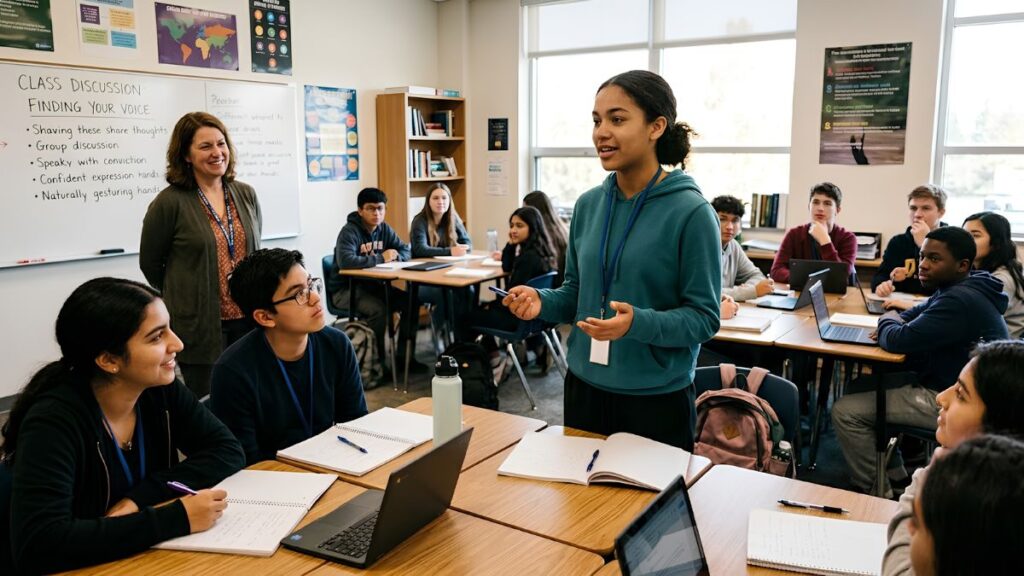
Aarav was the kind of student most teachers described as “quiet but thoughtful.” He was not shy because he disliked people. He enjoyed conversations, liked helping his classmates, and often had creative ideas. The problem was that he rarely shared those ideas.
Whenever he had something to say, a small voice inside his head would stop him.
“What if my answer is wrong?”
“What if everyone laughs?”
“What if people think my idea is silly?”
Because of these thoughts, Aarav usually stayed silent, even when he knew he could contribute something valuable.
At school, he was known as the student who always listened carefully but rarely raised his hand. During group discussions, he would write suggestions in his notebook but hesitate to speak. During conversations with friends, he often allowed others to lead while he simply agreed.
Most people around him did not realize how much he thought about things. They only saw his silence.
The Boy Behind the Silence
Aarav had always been a careful person.
Since childhood, he preferred observing situations before reacting. When his friends played games, he would notice the rules and strategies. When teachers explained topics, he would think deeply about how things worked.
His parents often told him:
“You notice things that other people miss.”
Aarav liked hearing that, but he still struggled to express himself.
At home, he was comfortable sharing his thoughts with his family. He could talk about movies, science, technology, and his hobbies for hours.
But school was different.
In school, he worried about how others saw him.
One day during a science class, his teacher asked a question about renewable energy.
“Can anyone explain why solar energy is becoming more popular?” the teacher asked.
Aarav immediately knew the answer. He had recently watched a documentary about solar panels and had read several articles about clean energy.
He slowly lifted his hand halfway.
Then he looked around the classroom.
Some students were already raising their hands confidently. Others were talking quietly.
Aarav lowered his hand.
A few seconds later, another student answered.
The answer was correct, but Aarav realized he had thought of an additional point that could have improved the discussion.
As he wrote in his notebook, he wondered:
“Why didn’t I just say it?”
Always Thinking, Rarely Speaking
This pattern continued.
During English class, Aarav had interesting interpretations of stories but kept them to himself.
During mathematics discussions, he found easier ways to solve problems but waited for someone else to explain.
During group projects, he often completed his assigned work but avoided taking leadership roles.
His classmates sometimes misunderstood him.
“Does Aarav even have any ideas?” one student asked during a group activity.
The comment was not meant to be cruel, but it stayed in his mind.
The truth was the opposite.
Aarav had many ideas.
He just did not know how to share them confidently.
A New Challenge
One Monday morning, Aarav’s teacher announced a new assignment.
“The class will be divided into groups. Each group will prepare a presentation about solving a real-world problem.”
The students immediately started discussing topics.
Some groups chose environmental issues.
Others selected technology and education topics.
Aarav’s group decided to create a presentation about reducing food waste in schools.
The team included Aarav, his friend Rohan, and two other classmates, Meera and Kabir.
At their first meeting, everyone started sharing ideas.
“We should talk about how much food gets wasted in the cafeteria,” Rohan suggested.
“We can create posters encouraging students not to waste food,” Meera added.
Aarav listened carefully.
He had an idea.
He thought the presentation could include a simple mobile app concept where students could report extra food availability so others could use it.
He believed it would make the project more interesting.
But once again, hesitation appeared.
“They might think it is too complicated.”
“Maybe it is not a good idea.”
“Someone else probably has a better suggestion.”
He stayed quiet.
A Missed Opportunity
Over the next few days, the group worked on the presentation.
However, they struggled.
They had collected information but did not have a unique approach.
During a meeting, everyone looked frustrated.
“We have facts, but our presentation feels ordinary,” Meera said.
“We need something different,” Kabir agreed.
Aarav looked at his notebook.
His app idea was written on the page.
He had drawn a simple design showing how it could work.
He wanted to share it.
But fear stopped him again.
After the meeting ended, Rohan noticed that Aarav looked disappointed.
“You seem quiet today,” Rohan said.
“I’m fine,” Aarav replied.
Rohan smiled.
“You always say that.”
Aarav looked surprised.
“What do you mean?”
“I mean you always have something to say, but you keep it inside.”
Aarav did not know how to respond.
Rohan continued:
“I’ve noticed that. You write great ideas in your notes, but you never share them.”
A Small Conversation That Changed Everything
That evening, Aarav thought about Rohan’s words.
He opened his notebook and looked at all the ideas he had written but never shared.
He realized something important.
His problem was not that he had nothing valuable to say.
His problem was that he was waiting for a perfect moment when he would feel completely confident.
But maybe confidence did not come before speaking.
Maybe confidence came from speaking.
The next day, Aarav decided to try something small.
Not a huge speech.
Not standing in front of the entire school.
Just one idea in a group conversation.
During their next meeting, everyone was discussing how to improve the presentation.
Aarav took a deep breath.
“I have an idea,” he said.
The group became quiet.
For a moment, he felt nervous.
But he continued.
“What if we create a simple app concept that helps students share information about extra food in the cafeteria? It could reduce waste because students who need food can know when something is available.”
There was silence for a few seconds.
Aarav immediately worried.
“They don’t like it.”
Then Meera smiled.
“That’s actually a really interesting idea.”
Kabir nodded.
“It makes our project different.”
Rohan smiled proudly.
“I knew you had something good.”
Aarav felt something he had not felt before.
Relief.
His idea was not perfect.
But it was useful.
And he had finally shared it.
Learning That Mistakes Are Normal
After that day, Aarav started practicing speaking more often.
He did not suddenly become the most talkative person in the class.
He was still thoughtful.
He still enjoyed listening.
But he started giving himself permission to participate.
During discussions, he raised his hand more often.
During group projects, he shared suggestions.
When he disagreed with someone, he respectfully explained his opinion instead of staying silent.
Sometimes his ideas were accepted.
Sometimes they were not.
At first, rejection still felt uncomfortable.
But Aarav learned something important:
Someone disagreeing with an idea did not mean the idea was worthless.
A conversation was not a competition.
Sharing thoughts was a way to learn from others.
The Day of the Presentation
Finally, presentation day arrived.
Aarav’s group stood in front of the classroom.
Normally, speaking in front of everyone would have made him extremely nervous.
His hands would shake.
His voice would become quiet.
But this time was different.
He was still nervous, but he was prepared.
When it was his turn to explain the app concept, he looked at the class and spoke clearly.
He explained the problem, the solution, and how students could benefit.
After the presentation, the teacher smiled.
“This was an excellent example of creative thinking,” she said.
“Everyone contributed well, but I especially appreciate how this group developed a practical solution.”
Aarav felt proud.
Not because he received praise.
But because he had allowed himself to be heard.
A New Version of Himself
Over the following months, Aarav continued improving.
He joined discussions.
He asked questions.
He volunteered for small responsibilities.
He even helped other quiet students share their ideas.
One day, a younger student told him:
“I have ideas, but I am afraid to say them.”
Aarav smiled because he understood exactly how that felt.
He replied:
“I used to feel the same way. But remember, an idea cannot help anyone if it stays only in your mind.”
Lesson From Aarav’s Story
Many teenagers struggle with confidence and fear of judgment. Being quiet does not mean you have nothing valuable to contribute.
Your thoughts, opinions, and ideas matter.
You do not need to become the loudest person in the room. Confidence is not about speaking all the time. It is about knowing when your voice can add something meaningful.
Start small.
Share one idea.
Ask one question.
Express one opinion.
Each time you speak, you become a little more confident.
Because finding your voice is not something that happens overnight.
It is something you build, one moment at a time.