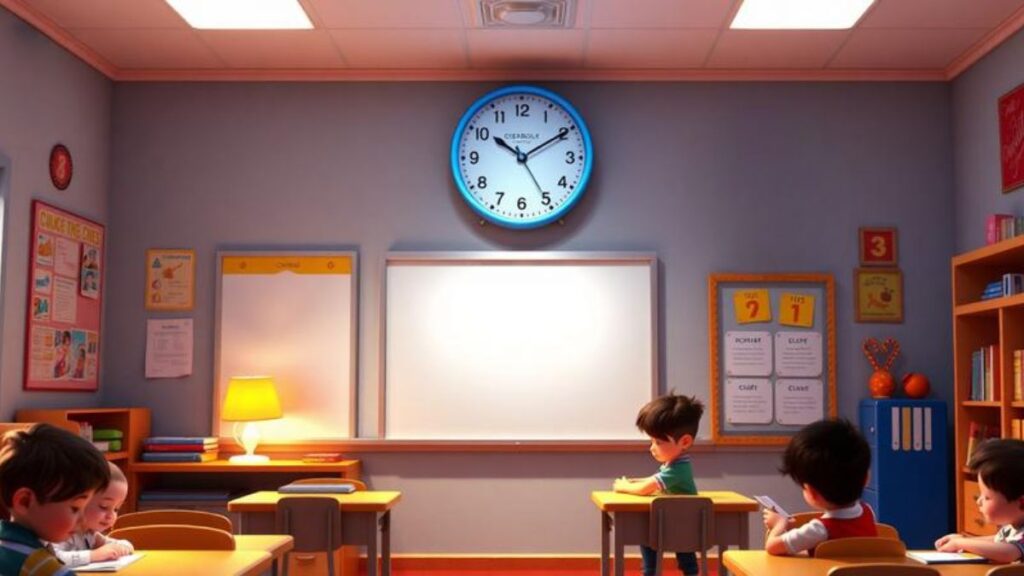
Every classroom at Maple Grove Elementary School had something special.
Some classrooms had colorful reading corners.
Others had large fish tanks or shelves filled with plants.
But Room 7 had something everyone noticed the moment they walked inside.
Hanging above the whiteboard was a small round clock with a bright blue frame.
Its name was Toby.
Unlike digital clocks that flashed glowing numbers, Toby had two simple hands and made a quiet sound every second.
Tick.
Tock.
Tick.
Tock.
The students rarely paid attention to him.
They simply looked up whenever they wanted to know the time.
Still, Toby loved his job.
Every second mattered.
Every minute helped someone learn.
Every hour brought new opportunities.
One Monday morning, a shiny new digital clock was installed on the opposite wall.
It had bright red numbers that glowed across the room.
When the lights were turned off for a science presentation, everyone could still read it clearly.
The students gasped.
“Wow!”
“It looks amazing!”
“It even shows the date!”
The digital clock smiled proudly.
“My name is Flash.”
“I’m the fastest and smartest clock in the school.”
Toby greeted him politely.
“Welcome.”
Flash glanced across the classroom.
“So…”
“You’re the old clock?”
Toby smiled kindly.
“I’ve been here for many years.”
Flash laughed.
“I can change displays.”
“I show seconds.”
“I have an alarm.”
“I even have a thermometer.”
“What can you do?”
Toby answered softly.
“I keep time.”
Flash chuckled.
“That’s all?”
Toby simply continued ticking.
The next few weeks, Flash became the center of attention.
Students admired him every morning.
Teachers used his timer during quizzes.
Visitors complimented his bright display.
Flash enjoyed every moment.
Occasionally he looked toward Toby.
“You still move so slowly.”
Toby smiled.
“I move one second at a time.”
“Just like time itself.”
Flash rolled his numbers dramatically.
“You’re old-fashioned.”
One rainy afternoon, Mrs. Carter announced a classroom project.
Each student would plant a sunflower seed in a small pot.
Every day they would water it and record its growth.
The children became excited.
Some expected flowers within days.
Others measured their plants every morning.
When nothing happened immediately, a few students became impatient.
“They’re growing too slowly.”
Mrs. Carter smiled.
“Some of the best things in life cannot be rushed.”
Toby quietly listened.
The lesson sounded familiar.
Every day he watched the children.
Some remembered to water their plants.
Some forgot.
Some became discouraged because their flowers hadn’t appeared yet.
But Toby noticed something important.
The students who cared patiently for their plants eventually saw tiny green sprouts.
Steady effort brought steady results.
Weeks later, another surprise arrived.
The school purchased brand-new smart boards for every classroom.
Electricians spent an entire afternoon upgrading the building.
The lights flickered several times.
Flash proudly displayed the new time settings.
“I’m connected to the school’s power system.”
“I’ll always stay accurate.”
That evening, however, a powerful thunderstorm swept across town.
Lightning struck a transformer nearby.
The entire neighborhood lost electricity.
The school became completely dark.
The next morning, teachers arrived early.
Nothing worked.
The computers remained off.
The smart boards wouldn’t turn on.
Even Flash’s glowing numbers disappeared.
“I…”
“I can’t see anything,” he whispered nervously.
Without electricity, his screen stayed black.
Meanwhile…
High above the classroom…
Toby continued his familiar rhythm.
Tick.
Tock.
Tick.
Tock.
His battery kept him running perfectly.
Mrs. Carter looked up and smiled.
“Good morning, Toby.”
She adjusted the classroom schedule using his hands.
Throughout the day, teachers from other classrooms visited Room 7.
“Can we check your clock?”
“Our digital clocks aren’t working.”
Soon students from different grades quietly stepped inside to see the time.
For the first time, everyone noticed Toby.
Not because he was flashy.
But because he was dependable.
Flash watched silently.
He felt embarrassed.
“I thought being modern made me better.”
Toby smiled warmly.
“It simply made you different.”
Later that week, electricity returned.
Flash lit up once again.
But something had changed.
He no longer boasted.
Instead, he asked Toby,
“How do you stay so calm?”
Toby replied,
“I’ve learned that keeping time isn’t about racing.”
“It’s about never stopping.”
Flash thought about those words.
Days turned into months.
The classroom remained busy.
Children learned multiplication.
Read novels.
Solved science experiments.
Performed plays.
Celebrated birthdays.
Through every lesson…
Toby continued ticking.
One second.
One minute.
One hour at a time.
A new student named Emma joined the class halfway through the year.
She struggled with reading.
Whenever reading time began, she became nervous.
Some classmates finished quickly.
Emma often needed much longer.
One afternoon she sighed.
“I’ll never get better.”
Mrs. Carter pointed toward Toby.
“What does that clock do?”
Emma looked confused.
“It keeps time.”
“Does it ever skip minutes?”
“No.”
“Does it ever rush?”
“No.”
“It simply keeps moving.”
Mrs. Carter smiled.
“Learning works the same way.”
“You don’t have to become better all at once.”
“You just have to keep going.”
Emma looked up at Toby.
From that day forward, she stopped comparing herself to others.
She read one page every evening.
Then two.
Then five.
Little by little, her confidence grew.
By the end of the school year, she volunteered to read aloud in front of the entire class.
When she finished, everyone applauded.
Emma looked toward Toby and smiled.
He answered with another quiet…
Tick.
Tock.
Years passed.
Students graduated.
New children filled Room 7.
Teachers came and went.
Technology continued changing.
Computers became faster.
Projectors became brighter.
Tablets replaced many textbooks.
Several digital clocks were upgraded again.
Yet Toby remained on the classroom wall.
Still ticking.
Still patient.
Still dependable.
One summer, the principal suggested replacing all the older classroom clocks.
“They’re outdated.”
The teachers disagreed.
Mrs. Carter spoke first.
“That clock has taught more lessons than any machine.”
Another teacher nodded.
“My students always notice it.”
“It reminds them that progress takes time.”
The principal smiled.
“Perhaps we should keep it.”
Years later, former students returned for the school’s anniversary celebration.
Many adults walked through the familiar classroom.
One man suddenly pointed toward the wall.
“Toby!”
“I remember that clock.”
A woman laughed.
“It helped me during math tests.”
Another smiled.
“It reminded me not to give up.”
None of them remembered every worksheet they completed.
None remembered every homework assignment.
But they all remembered the little blue clock that quietly taught patience without saying a word.
As the celebration ended, the classroom grew quiet once more.
Flash looked across the room.
“I finally understand.”
Toby smiled.
“What did you learn?”
Flash answered softly,
“People don’t remember the loudest clock.”
“They remember the one they could always depend on.”
Toby’s hands continued moving.
Not faster.
Not slower.
Exactly as they always had.
Because real success doesn’t come from rushing ahead of everyone else.
It comes from moving forward with patience, consistency, and determination, one step at a time.
And somewhere inside every classroom, every home, and every dream, there is a little clock reminding us that steady progress always wins over hurried shortcuts.
Tick.
Tock.
The lesson continues.
Moral: Success doesn’t come from rushing. Small, consistent efforts made every day lead to the greatest achievements.