Every evening, just as the sun disappeared behind the hills, the lights in the small village flickered once or twice before going out completely.
It happened so often that the families barely reacted anymore.
Children closed their notebooks.
Parents lit candles or kerosene lamps.
Some simply waited for the electricity to return.
Sometimes it came back within an hour.
Other times, the entire night passed in darkness.
For most people, it was an inconvenience.
For fourteen-year-old Maya, it felt like a race she was slowly losing.
Maya loved learning.
She dreamed of becoming an engineer one day, designing better roads, safer bridges, and stronger schools for villages like hers.
She knew education was the bridge between her dreams and reality.
But dreams are difficult to chase when darkness arrives every evening.
Her father worked as a farmer, leaving home before sunrise and returning after sunset.
Her mother stitched clothes for neighbors to earn extra income.
Together, they worked tirelessly, yet there was never enough money to buy a generator or solar lights.
Every evening, Maya spread her books across the kitchen table before the electricity disappeared.
She tried to study as much as possible while daylight lasted.
When darkness arrived, she continued reading beneath the dim glow of a small kerosene lamp.
The flame flickered constantly.
Smoke filled the room.
Her eyes burned after only a short time.
Some nights, the lamp ran out of fuel altogether.
Those were the hardest evenings.
One night, while staring sadly at her unfinished homework, Maya looked through the front window.
Across the road stood a tall streetlight.
Unlike the homes nearby, it remained on because it was connected to the town’s emergency power supply.
An idea crossed her mind.
She quietly gathered her books and walked outside.
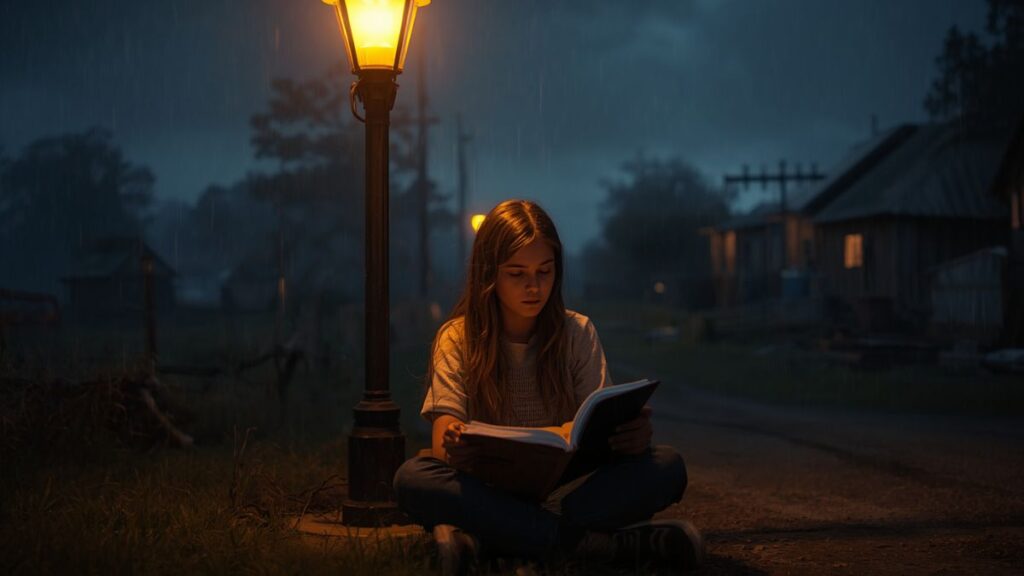
She sat beneath the streetlight and opened her notebook.
The light was bright enough to read comfortably.
Cars passed occasionally.
Neighbors looked at her with curiosity.
But Maya barely noticed.
She was too busy solving algebra problems.
The next evening, she returned.
Then the next.
Soon, studying beneath the streetlight became part of her daily routine.
At first, people smiled as they walked past.
“Still studying?”
“Working hard again?”
Maya always smiled politely.
“Just finishing my homework.”
One evening, Mr. Patel, the owner of the nearby grocery store, noticed her reading despite a chilly wind.
“You’ll catch a cold sitting out here.”
“I’m okay,” Maya replied.
“Would you like to study inside my shop?”
She smiled gratefully.
“Thank you, but I don’t want to disturb your customers.”
Mr. Patel nodded.
He admired her determination.
Word slowly spread through the village.
Children began pointing toward the streetlight.
“That’s the girl who studies outside.”
Parents talked about her while waiting in line at the market.
Teachers heard the story too.
One morning, Maya’s mathematics teacher asked,
“Is it true you study under a streetlight every night?”
She looked embarrassed.
“Only when the power goes out.”
The teacher smiled.
“I’ve never heard a single complaint from you.”
“There wasn’t much to complain about,” Maya replied.
“I still had light.”
The class became quiet.
Those simple words stayed with everyone.
Weeks later, exam season arrived.
Students felt nervous.
Many complained about the long hours of studying.
Maya quietly continued her evening routine beneath the streetlight.
One rainy night, strong winds swept through the village.
Most people stayed indoors.
As Mr. Patel locked his grocery store, he glanced toward the streetlight.
Maya was there.
She had placed a plastic sheet over her books while continuing to study.
He walked over carrying a large umbrella.
“You really aren’t giving up, are you?”
Maya smiled.
“My dreams aren’t taking the night off.”
The next morning, Mr. Patel spoke with several shop owners.
By evening, they had placed a sturdy wooden bench beneath the streetlight.
Someone else added a small waterproof shelter.
Another neighbor donated a comfortable chair.
Within a week, the lonely study spot had become a cozy outdoor reading corner.
Children passing by often stopped to ask questions.
“What are you learning?”
“Can you help me with fractions?”
Maya happily explained whenever she could.
Slowly, other students began bringing their own books.
At first, there were only three children.
Then six.
Then ten.
Soon, every evening beneath the streetlight looked like a tiny outdoor classroom.
Parents started bringing drinking water.
Some donated extra notebooks.
Others offered snacks for the students.
Even retired teachers occasionally stopped by to answer questions.
Without anyone planning it, the village had created its own evening study center.
The local newspaper soon heard the story.
A reporter visited to write an article.
The headline read:
“One Student’s Determination Lights the Way for an Entire Community.”
The story spread far beyond the village.
Readers were inspired.
A local business donated solar-powered reading lamps.
An educational charity provided new books.
Volunteers painted the shelter and built additional benches.
For the first time, children had a comfortable place to study together every evening.
Maya smiled as she watched younger students arrive carrying backpacks almost as big as they were.
“This is much nicer than the sidewalk,” one little boy said.
She laughed.
“It certainly is.”
Months later, examination results were announced.
Maya achieved the highest score in the district.
The school held a special assembly to celebrate.
When asked how she managed to succeed despite so many challenges, Maya simply replied,
“I never focused on what I didn’t have.”
“I focused on what I could use.”
Her answer received a standing ovation.
Years passed.
Maya earned a scholarship to study civil engineering.
College brought new opportunities and new challenges.
Whenever coursework became difficult, she remembered the streetlight.
If she could solve equations sitting on a sidewalk during rainstorms, she could certainly overcome difficult lectures and demanding projects.
She graduated with honors.
After several years working as an engineer, Maya returned to her hometown.
The village had changed.
New houses stood where empty fields once stretched.
Roads were smoother.
Schools had expanded.
Yet one thing remained exactly the same.
The old streetlight.
Its paint had faded.
Its metal pole carried signs of age.
But every evening, children still gathered beneath it.
Some read books.
Others completed homework together.
Several parents waited nearby, chatting while their children studied.
Maya smiled.
The streetlight had become more than a source of light.
It had become a symbol of determination.
That afternoon, the village organized a special celebration.
The mayor invited Maya to unveil a new community learning center built beside the streetlight.
The building included classrooms, computers, a library, and solar-powered study rooms that remained open long after sunset.
As everyone applauded, Maya quietly walked toward the old streetlight.
She gently placed one hand against its weathered pole.
A young girl approached her.
“Were you really the one who used to study here?”
Maya nodded.
“Weren’t you lonely?”
She smiled.
“Only at first.”
“What changed?”
“Someone noticed.”
“And then someone else.”
“And then another.”
“Soon I realized that determination inspires people faster than complaints ever could.”
The little girl looked thoughtfully at the streetlight.
“I want to become a doctor.”
Maya smiled warmly.
“Then start learning today.”
“You don’t have to wait for perfect conditions.”
That evening, the mayor dedicated a small plaque beneath the streetlight.
It read:
This light reminds us that determination shines brightest when circumstances are darkest.
As the crowd slowly dispersed, Maya stood quietly watching children open their books beneath the familiar glow.
She realized education had never depended on perfect classrooms, expensive equipment, or comfortable surroundings.
Those things certainly help.
But the true power of education begins with a decision.
The decision to keep learning.
To keep asking questions.
To keep moving forward despite obstacles.
One determined student had inspired an entire community to value education more deeply.
Not through speeches.
Not through promises.
But through quiet persistence repeated every evening beneath a single streetlight.
Long after the electricity became reliable and the village modernized, people continued telling the story of the girl who refused to let darkness stop her dreams.
Because sometimes the brightest light in a community isn’t the one hanging from a pole.
It’s the determination burning inside someone who believes education can change everything.
Moral: Education does not depend on perfect circumstances. With determination, perseverance, and a willingness to learn, even the smallest opportunity can become the beginning of an extraordinary future.