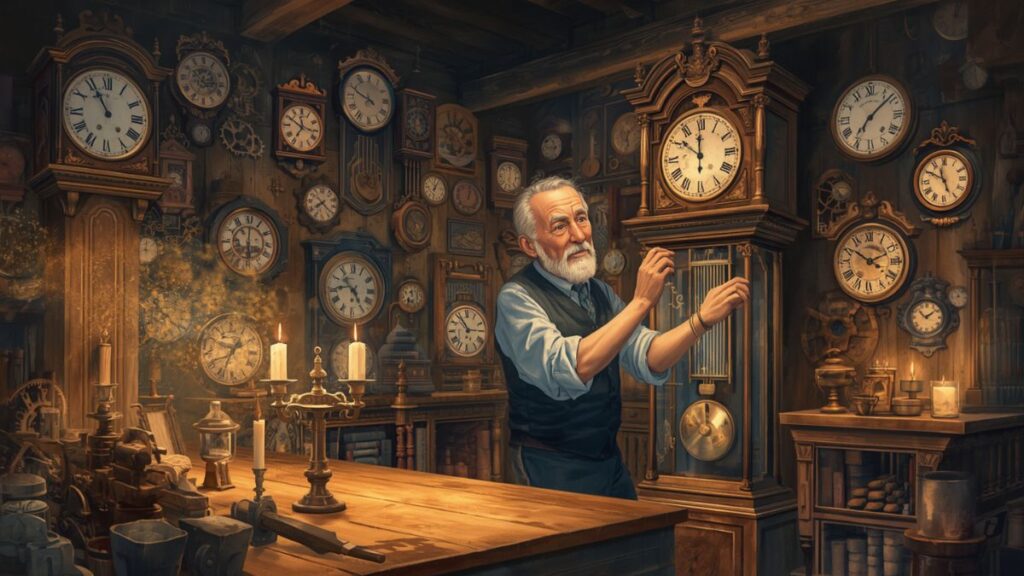
In the quiet village of Willowbrook, life moved at the steady rhythm of ticking clocks.
Every home had one. Some were large grandfather clocks that echoed through spacious hallways. Others were tiny brass timepieces resting on wooden shelves beside family photographs. Every morning, every meal, every market opening, and every evening prayer followed the clocks’ faithful hands.
At the very center of the village stood a small clock shop with faded blue windows and a wooden sign that simply read:
Elias, Clockmaker.
No one remembered when Elias had first arrived.
The oldest villagers claimed he had repaired their grandparents’ clocks. Children believed he had always been old. Travelers often stopped just to admire the hundreds of ticking clocks displayed behind the shop windows.
But there was one secret that no one knew.
Every single night, just before midnight, Elias quietly stopped every clock in Willowbrook.
Only for five minutes.
To everyone else, those five minutes passed unnoticed.
But to two people in love, they became the most precious moments of the day.
Many miles away, a young man named Oliver worked as a lighthouse keeper along a rocky coastline. Every evening he climbed the winding stairs, lit the great lantern, and watched ships safely cross the sea.
Far inland, in a peaceful town surrounded by lavender fields, lived Amelia, an illustrator who spent her days filling books with beautiful drawings of forests, birds, and quiet little cottages.
Years earlier, they had met during a summer festival.
One conversation had become many.
One visit had become countless letters.
Eventually, life led them in different directions.
Oliver accepted his dream job at the lighthouse.
Amelia received an opportunity she could never refuse.
Distance separated them.
Love never did.
Every evening, just before midnight, they spoke over the phone.
Sometimes for an hour.
Sometimes only for a few minutes.
No matter how difficult the day had been, they always ended it together.
Unknown to them, Elias watched over these moments.
Long ago, he had discovered something extraordinary.
Love changed time.
Not in the way stories often imagined.
It didn’t stop clocks or reverse years.
Instead, it made ordinary moments feel endless.
He simply gave love a little help.
Every night, he gently adjusted the great village clock.
Its hands rested between eleven fifty-nine and midnight.
Only five minutes.
Five borrowed minutes.
Five peaceful minutes where rushed hearts slowed down.
Five minutes where apologies found the courage to be spoken.
Five minutes where laughter lasted just a little longer.
Then the clocks continued as though nothing had happened.
No one noticed.
Except love itself.
One rainy evening, Oliver sounded unusually quiet.
“Long day?” Amelia asked softly.
“The sea was rough.”
“You kept everyone safe.”
“I tried.”
She smiled even though he couldn’t see it.
“You always say ‘I tried.’ You never say, ‘I did.'”
Oliver laughed.
“I suppose I don’t.”
“You should.”
Silence followed.
Comfortable silence.
Not every quiet moment needed filling.
“I wish we could watch the rain together,” Oliver whispered.
“We will.”
“When?”
“When time decides to be kind.”
Neither realized that somewhere, an old clockmaker smiled.
Because for just a little while each night, time already had.
As the seasons changed, their nightly conversations became a tradition neither ever missed.
They celebrated birthdays over warm tea.
Read books aloud.
Watched the same moon from different places.
Shared recipes that rarely turned out exactly right.
Dreamed about a small cottage with climbing roses.
Spoke about future children.
Future gardens.
Future holidays.
Future mornings together.
Sometimes they fell asleep before saying goodbye.
The phone remained connected until sunrise.
Neither minded.
One winter evening, snow covered Willowbrook.
Elias carefully wound every clock inside his shop.
His hands trembled more than usual.
Age had finally begun catching him.
He quietly whispered to the clocks.
“I may not have many borrowed minutes left.”
For the first time in decades, the clocks seemed almost sad.
The following week, Oliver received unexpected news.
The lighthouse would close for repairs lasting several months.
His position would be temporarily suspended.
Meanwhile, Amelia’s publisher offered her a year-long project in another country.
Both opportunities seemed wonderful.
Yet both created uncertainty.
“What if this changes everything?” Oliver asked during their nightly call.
Amelia answered gently.
“It will.”
He grew quiet.
“But not necessarily for the worse.”
“I worry.”
“So do I.”
Another pause.
Then Amelia said something simple.
“Love has already survived distance.”
“It has.”
“It can survive change too.”
Those words stayed with Oliver long after the call ended.
Late that same evening, Elias struggled to climb the stairs leading to the village clock tower.
Each step felt heavier than the last.
At the top waited the enormous brass mechanism that had quietly protected countless evenings.
He placed both hands upon it.
“I’ve borrowed enough time.”
The clock ticked softly beneath his fingers.
“But someone else must continue.”
The next morning, the villagers discovered a handwritten notice hanging outside the clock shop.
Closed Today.
No explanation.
Only those two words.
Days passed.
The sign remained.
Concern spread quietly through the village.
Finally, young Noah, an apprentice carpenter known for repairing old furniture, knocked gently on Elias’s door.
No answer.
He entered carefully.
Inside, every clock still ticked.
Elias sat peacefully beside the workshop window, asleep in his favorite chair.
Or so it seemed.
On the table rested a sealed envelope.
It simply read:
For the one who understands that love deserves more time.
Inside the letter, Noah found careful instructions.
Not for repairing clocks.
For protecting moments.
The letter explained how every night, five quiet minutes had been gifted to the world.
Not through magic.
Not through impossible machines.
But through a simple reminder.
People always believed they had less time than they truly did.
If someone encouraged them to pause, breathe, forgive, and stay just a little longer with the people they loved, those five minutes became real.
Time hadn’t actually changed.
People had.
The final sentence read:
“The greatest clockmaker never controls time. He simply reminds people not to waste it.”
Noah never adjusted the village clocks.
Instead, every evening before midnight, he rang the old church bell exactly once.
The sound carried across fields, forests, and quiet streets.
Villagers slowly developed a new habit.
Conversations didn’t end immediately.
Families lingered around dinner tables.
Parents finished one more bedtime story.
Friends stayed for one final laugh.
Couples shared one extra hug before saying goodnight.
Five peaceful minutes.
No one called them that.
Yet everyone seemed happier.
Months later, Oliver visited Amelia.
For the first time in nearly two years, they no longer needed a phone call to end the day together.
Instead, they sat on the porch of a little rented cottage overlooking rolling hills.
Fireflies danced above the grass.
The evening breeze carried the scent of lavender.
Oliver checked his watch.
“It feels later than midnight.”
Amelia leaned against his shoulder.
“Maybe.”
“But I don’t want tonight to end.”
She smiled.
“Then let’s not rush it.”
Neither spoke for several minutes.
The silence itself became part of the conversation.
Comfortable.
Safe.
Complete.
Years passed.
Oliver and Amelia eventually built the cottage they had always imagined.
Its walls were covered with climbing roses.
Its windows overlooked a quiet meadow.
Every evening before bed, they made tea.
Sometimes they talked.
Sometimes they read aloud.
Sometimes they simply watched the stars.
They always gave each other five uninterrupted minutes before saying goodnight.
No phones.
No chores.
No distractions.
Just presence.
When friends asked why they seemed so peaceful together after so many years, Amelia would smile.
“We never let the day end too quickly.”
Oliver would nod.
“And we always save five minutes for each other.”
Neither knew where the habit had truly begun.
But somewhere beyond memory, an old clockmaker would have smiled.
Because the finest gift he ever gave the world was never extra time.
It was the gentle reminder that love isn’t measured by grand gestures or expensive gifts. It’s found in the quiet moments we choose not to hurry, the conversations we allow to linger, and the peaceful silence we share with someone who makes us feel at home.
And perhaps, even now, somewhere in a quiet village where clocks still tick faithfully through the night, an old workshop stands with its windows glowing softly. The clocks continue their steady rhythm, whispering the same timeless lesson to anyone willing to listen.
Love is never asking for hours.
Sometimes, all it needs is five more minutes before saying goodnight.