Sophie was an enthusiastic eight-year-old who loved learning new things. She enjoyed reading stories, solving puzzles, drawing colorful pictures, and exploring educational games. One of her favorite times at school was technology class because she had the opportunity to use a classroom tablet.
The tablet could do so many exciting things.
It could display interactive books, play math games, help students practice spelling, and even allow them to create digital artwork.
Every time Mrs. Carter announced, “Today we’ll be using our tablets,” Sophie smiled from ear to ear.
She couldn’t wait to begin.
There was only one problem.
Sophie became so excited that she often forgot to slow down.
Sometimes she tapped many buttons before reading the instructions.
Other times she accidentally closed the learning app because she was curious about what another button did.
If a classmate was using a tablet nearby, Sophie sometimes leaned over to see what they were doing instead of focusing on her own assignment.
Mrs. Carter knew Sophie wasn’t trying to cause problems.
She simply needed to learn how to use technology responsibly.
One Monday morning, Mrs. Carter placed a tablet on every desk.
Before anyone touched them, she smiled and said,
“Today we’re going to learn about being responsible digital learners.”
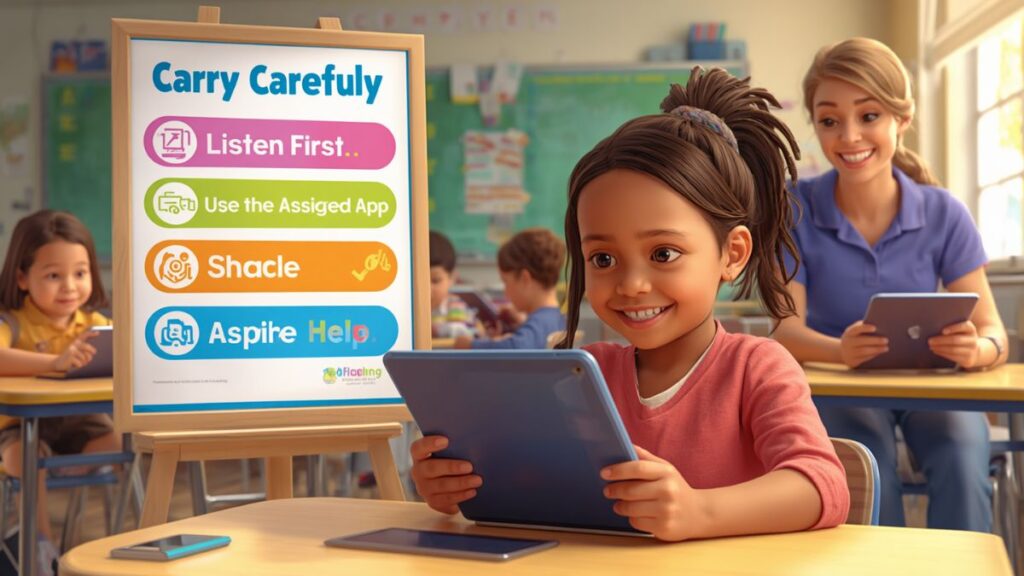
She pointed to a colorful poster at the front of the classroom.
The poster showed five simple steps.
Carry the tablet carefully.
Listen to directions first.
Use only the assigned app.
Take turns if sharing.
Ask for help when needed.
Mrs. Carter smiled.
“These habits help us learn and keep our devices safe.”
Sophie carefully read every step.
“I can do that,” she thought.
The first activity was a reading lesson.
Mrs. Carter explained how to open the storybook app.
Normally Sophie would begin tapping immediately.
This time she waited until all the instructions were finished.
Then she slowly opened the correct app.
Everything worked perfectly.
She smiled.
Listening first had made the activity much easier.
Later that morning, the class completed a math game.
Each student solved addition and subtraction puzzles.
Halfway through, Sophie noticed another colorful game icon.
She became curious.
“I wonder what that game is,” she whispered.
Her finger almost tapped it.
Then she remembered the classroom poster.
Use only the assigned app.
She smiled and returned to her math lesson.
When class ended, Mrs. Carter said,
“I noticed many students stayed focused today.”
Sophie felt proud.
The following week, students worked in pairs to create digital artwork.
Sophie partnered with her friend Liam.
They shared one tablet.
At first Sophie wanted to hold it the entire time.
Then she remembered another classroom rule.
Take turns if sharing.
She smiled.
“You choose the background first.”
Liam grinned.
“Then you can add the animals.”
Together they created a beautiful forest scene with birds, butterflies, trees, and flowers.
Mrs. Carter admired their teamwork.
“You both shared wonderfully.”
That afternoon, Sophie told her parents about the digital art project.
Her dad smiled.
“Sharing technology is an important skill.”
Her mom added,
“Being responsible with devices shows respect for others and for the equipment.”
A few days later, the class watched an educational science video on their tablets.
Before pressing play, Mrs. Carter reminded everyone,
“Hold the tablet with both hands when carrying it.”
Sophie carefully picked up her tablet and carried it slowly back to her desk.
As she walked, another student accidentally bumped into her.
Because she was holding the tablet correctly, it stayed safe.
Mrs. Carter smiled.
“Excellent job carrying it carefully.”
Sophie realized that following simple directions helped prevent accidents.
One rainy afternoon, the internet connection became slow.
Some students grew impatient and repeatedly tapped the screen.
Sophie almost did the same.
Then she remembered another important habit.
Be patient.
She quietly waited.
A few seconds later, the page loaded.
Mrs. Carter smiled.
“Sometimes technology needs a little time.”
The following month, a new student named Ava joined the class.
It was her first time using the classroom tablets.
Mrs. Carter asked Sophie to explain the classroom rules.
Sophie proudly pointed to the poster.
“We listen first.”
“We use the right app.”
“We carry the tablet carefully.”
“We share.”
“And we ask for help if something doesn’t work.”
Ava smiled.
“Thank you.”
Mrs. Carter nodded proudly.
“Sophie has become a wonderful digital role model.”
Sophie felt happy.
One afternoon, students created digital storybooks.
They added pictures, words, and colorful backgrounds.
Sophie accidentally tapped the wrong button and couldn’t find her story.
For a moment she felt worried.
Instead of pressing random buttons, she remembered the final classroom rule.
Ask for help when needed.
She quietly raised her hand.
Mrs. Carter walked over.
With just a few taps, the story appeared again.
“There it is,” Mrs. Carter smiled.
Sophie laughed.
“I’m glad I asked.”
She realized asking for help saved time and prevented bigger mistakes.
At home, Sophie also began practicing responsible technology habits.
Before using the family tablet, she asked permission.
She handled it carefully.
She closed learning apps when she finished.
She placed the tablet back in its charging spot after using it.
Her parents noticed the change.
One Saturday, Dad smiled.
“I didn’t even have to remind you.”
Sophie grinned.
“I remembered.”
A few weeks later, the class participated in a Digital Learning Day.
Students rotated through several educational activities.
Coding games.
Reading practice.
Math puzzles.
Drawing projects.
Every station required careful tablet use.
Sophie followed every classroom rule.
She listened.
She shared.
She stayed on task.
She asked questions politely.
At the end of the day, every activity had gone smoothly.
Mrs. Carter gathered the class together.
“What makes someone a responsible digital learner?” she asked.
Hands went up around the room.
“They follow directions.”
“They take care of the device.”
“They share.”
“They ask before using something different.”
When it was Sophie’s turn, she answered,
“They use technology to learn.”
Mrs. Carter smiled.
“Exactly.”
Near the end of the school year, students completed one final digital project.
Each child created a presentation about their favorite animal.
Sophie carefully followed every instruction.
She added pictures.
She typed neat sentences.
She checked her work before submitting it.
Her presentation about sea turtles was colorful, organized, and easy to understand.
Mrs. Carter smiled proudly.
“You’ve become a thoughtful and responsible technology user.”
On the last day of school, every student received a special certificate.
Sophie’s certificate read:
“Outstanding Digital Learner.”
Mrs. Carter smiled warmly.
“Sophie has learned that responsible technology use helps everyone learn safely, respectfully, and successfully.”
The class applauded.
Sophie proudly accepted her certificate.
Looking back, she realized she still loved using tablets.
She still enjoyed exploring educational games and digital books.
But now she understood that technology worked best when it was used responsibly.
Listening before tapping.
Following directions.
Sharing fairly.
Taking care of the device.
Asking for help when needed.
Those simple habits helped her become more confident every time she used technology.
From then on, whenever Sophie picked up a tablet, she remembered one important thought.
“Technology is a tool for learning, and I can use it responsibly.”
That simple reminder helped her become a careful learner, a respectful classmate, and a positive digital citizen both at school and at home.
Moral: Using technology responsibly means following directions, caring for digital devices, sharing fairly, and using technology as a tool to learn and grow.