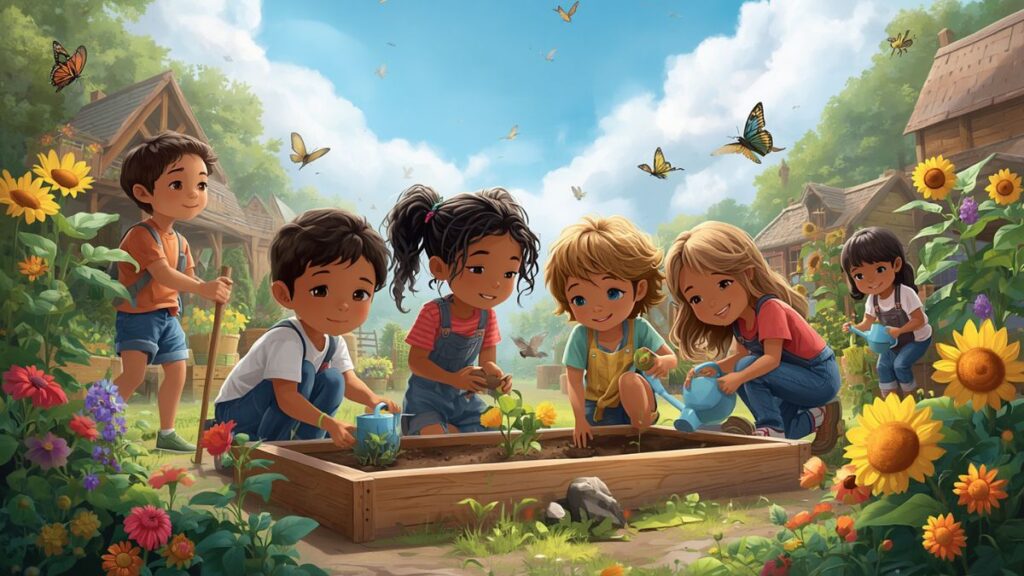
On the edge of a small town, between a cheerful school and a quiet library, stood an old community garden. Many years ago, it had been the pride of the neighborhood. Bright sunflowers stretched toward the sky, rows of colorful vegetables filled the beds, butterflies danced among blooming flowers, and families gathered every weekend to work side by side.
But as the years passed, people became busy.
Some families moved away.
Others had little free time.
Slowly, the garden was forgotten.
The flower beds became covered with weeds. Wooden fences leaned to one side. Empty pots collected rainwater, and the once-colorful paths disappeared beneath tall grass.
Most people simply walked past without noticing.
“It’s too much work,” they would say.
One warm spring afternoon, a ten-year-old girl named Mia stopped outside the rusty garden gate on her way home from school.
She peered through the fence.
“I wonder what this place used to look like.”
Her grandfather, who was walking beside her, smiled.
“When I was your age, children laughed here every afternoon. We planted flowers, picked vegetables, and shared everything we grew.”
Mia looked surprised.
“It doesn’t look like that anymore.”
“No,” Grandfather replied.
“But every beautiful place begins with someone willing to care.”
Those words stayed in Mia’s mind.
The next Saturday morning, she returned to the garden carrying a small pair of gardening gloves, a watering can, and a broom.
She wasn’t sure where to begin.
So she simply picked up a few pieces of litter near the entrance.
After a while, she pulled several weeds growing between the stones.
Then she swept part of the main path.
It wasn’t much.
But the entrance already looked brighter.
As Mia worked, her friend Ben rode past on his bicycle.
“What are you doing?” he asked.
“Cleaning the garden.”
“By yourself?”
“For now.”
Ben parked his bicycle.
“I can help for a little while.”
Together they cleared another section of the path.
Soon Emma joined them after seeing them work.
She brought a rake from home.
Then Noah arrived with a wheelbarrow.
Before long, six children were working together.
Some removed weeds.
Others gathered fallen branches.
A few carefully swept the stone walkways.
By lunchtime, the garden already looked different.
The old gate opened easily again.
The walking paths were visible.
The flower beds could finally be seen beneath the weeds.
When nearby neighbors noticed the children working, several smiled with surprise.
One elderly woman walked over carrying cold lemonade.
“You’ve earned a break.”
The children thanked her happily.
Another neighbor arrived with flower seeds.
“I’ve been saving these.”
A retired carpenter offered to repair the broken benches.
Little by little, more helping hands appeared.
The following weekend, even more families joined the project.
One group painted the garden fence.
Another repaired raised planting beds.
Parents spread fresh soil while children planted colorful flowers.
The local librarian donated books about gardening.
The science teacher visited to explain how bees, butterflies, and earthworms helped plants grow.
Every person contributed something different.
No job was too small.
One morning, while planting tomato seedlings, Ben accidentally knocked over an entire tray of young plants.
He looked worried.
“I’m sorry.”
“I ruined them.”
Instead of becoming upset, Mia smiled.
“Let’s see what we can save.”
The children gently replanted each seedling.
Almost all of them survived.
Ben learned that mistakes could often be fixed when friends worked together.
As the weeks passed, the garden slowly came back to life.
Tiny green sprouts pushed through the soil.
Bright marigolds lined the entrance.
Butterflies returned to visit colorful flowers.
Birds built nests in nearby trees.
Even bees seemed happy to discover new blossoms.
The garden became full of life once again.
One afternoon, the children noticed an elderly man standing quietly near the gate.
“I used to care for this garden,” he said softly.
“My name is Mr. Harris.”
He smiled as he looked around.
“I never thought I’d see it bloom again.”
The children invited him inside.
From that day forward, Mr. Harris became their gardening teacher.
He showed them how to grow healthy vegetables.
He explained why some flowers attracted helpful insects.
He taught them how to collect rainwater to conserve water during dry weeks.
Most importantly, he reminded them,
“A garden grows best when everyone shares the work.”
By midsummer, rows of carrots, lettuce, beans, peppers, pumpkins, and tomatoes filled the raised beds.
Apple trees produced their first fruit in years.
Sunflowers stood taller than the children.
The garden looked more beautiful than anyone had imagined.
Soon another question arose.
“What should we do with all these vegetables?”
Some children suggested taking them home.
Others wanted to sell them.
Mr. Harris smiled.
“Who do you think needs them most?”
The children thought carefully.
The next weekend, they packed baskets filled with fresh vegetables.
They delivered them to elderly neighbors.
They shared flowers with the local hospital.
They donated extra produce to the community food pantry.
Families smiled with gratitude.
The children discovered that sharing made the harvest even more meaningful.
One afternoon, a heavy summer storm swept across the town.
Strong winds knocked over several young plants.
Rain washed away part of one flower bed.
The children felt disappointed when they saw the damage.
“We worked so hard,” Ben sighed.
Mr. Harris placed a gentle hand on his shoulder.
“What do gardens teach us?”
“To keep growing,” Mia answered.
The next morning, everyone returned.
They repaired broken fences.
Replanted flowers.
Straightened tomato stakes.
Added fresh soil where the rain had washed it away.
Within days, the garden looked healthy once again.
The storm had tested them.
Their teamwork made them stronger.
As autumn approached, the town held its annual Harvest Festival.
This year, the celebration was moved into the restored community garden.
Families enjoyed homemade food.
Children played games among the flower beds.
Musicians performed beneath colorful trees.
Visitors admired the vegetables, flowers, and neatly painted fences.
The mayor stood before the crowd.
“This garden is more than a beautiful place.”
“It reminds us what can happen when neighbors help one another.”
He presented the children with a simple wooden sign.
Together, they hung it beside the entrance.
It read:
The Garden of Helping Hands
Everyone who visited understood its meaning.
The garden had not been restored by one person.
It had grown through hundreds of small acts of kindness.
Years passed.
The children grew older.
Some became teachers.
Some became gardeners.
Others became architects, nurses, artists, and scientists.
Whenever they returned to visit their hometown, they always stopped by the garden.
Many brought their own children.
They told them the story of how a forgotten place had become beautiful again.
Not because someone had been paid to fix it.
But because people cared enough to work together.
The garden continued changing with every season.
Spring filled it with colorful flowers.
Summer brought fresh vegetables.
Autumn painted the trees golden and red.
Winter gave the soil time to rest before another season of growth.
Through every season, one lesson remained the same.
Kindness grows much like a garden.
It begins with one small act.
One helping hand.
One caring heart.
Then it spreads until everyone around it begins to flourish.
Even today, anyone who walks through the Garden of Helping Hands notices more than flowers and vegetables.
They notice smiling faces.
Neighbors talking together.
Children laughing while planting seeds.
And they discover that the greatest thing growing there has never been the plants.
It has always been the community itself.
Moral of the Story
Kindness and teamwork help everyone grow stronger. Even the biggest challenges become easier when people work together and care for one another.