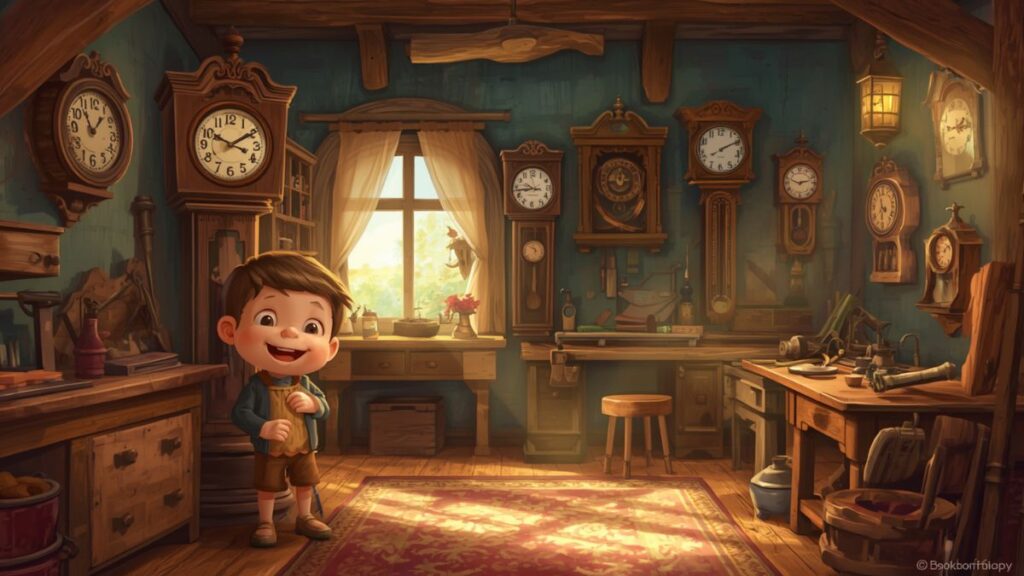
In a peaceful village surrounded by green hills, colorful flower fields, and winding stone paths, there lived a cheerful boy named Eli. The village was known for its friendly people, beautiful gardens, and an annual Lantern Festival that filled the streets with hundreds of glowing lights.
Every family carefully decorated a lantern before the festival. Some painted colorful flowers, others drew stars, birds, or mountains. When evening arrived, everyone carried their lanterns through the village, creating a beautiful river of light.
Eli loved the festival more than any other day of the year.
His grandfather was the village’s oldest lantern maker. Every lantern he crafted was unique, carefully built from smooth wood, clear glass, and strong paper that could withstand both wind and rain.
One autumn afternoon, just before the festival, Grandfather called Eli into his workshop.
“I have something special for you.”
He gently placed a small wooden lantern on the table.
Unlike the other lanterns, it had no colorful paint or fancy decorations. It was simple, with smooth maple wood and clear glass.
Eli looked surprised.
“It’s beautiful, but why is it so plain?”
Grandfather smiled.
“This is no ordinary lantern.”
“What makes it special?”
“It shines brightest when carried by someone who always tells the truth.”
Eli laughed softly.
“Really?”
Grandfather nodded.
“You’ll soon discover.”
That evening, Eli lit the lantern.
A warm golden light filled the room.
It wasn’t the brightest lantern he had ever seen, but it glowed gently and peacefully.
The next morning, Eli carried it while helping his parents at the village market.
His first test came sooner than he expected.
While arranging apples at a fruit stand, Eli accidentally bumped a basket.
Several apples rolled across the ground.
The shopkeeper turned around.
“What happened?”
For a moment, Eli thought about staying quiet.
No one had actually seen him.
Then he remembered the lantern.
“I accidentally knocked them over.”
The shopkeeper smiled kindly.
“Thank you for telling me.”
Together they gathered the apples.
As Eli picked up his lantern, he noticed something.
The light had become brighter.
That evening he told his grandfather.
“The lantern really changed.”
Grandfather simply smiled.
“Truth has its own light.”
Over the next several days, Eli noticed the lantern responding whenever he made honest choices.
One afternoon, his friend Noah proudly showed everyone a wooden toy boat he had built.
While playing near the stream, Eli accidentally stepped on it.
The tiny mast snapped.
His friends looked around.
“Who broke it?”
Eli felt nervous.
He knew Noah would be disappointed.
“It was me,” Eli admitted quietly.
“I’m sorry.”
Instead of becoming angry, Noah smiled.
“Thank you for telling me.”
“We can repair it together.”
That evening, the lantern glowed even more warmly than before.
As the Lantern Festival drew closer, excitement filled the village.
Children practiced songs.
Families hung colorful decorations.
Artists painted signs welcoming visitors from nearby towns.
The village square sparkled with preparations.
Then, two days before the festival, something unexpected happened.
The winner’s lantern for the annual decorating contest disappeared.
Everyone searched the workshop.
No one could find it.
The village became worried.
“It must have been stolen,” someone whispered.
Soon rumors spread from house to house.
Some people blamed travelers.
Others suspected neighborhood children.
No one knew the truth.
That afternoon, Eli remembered seeing something unusual.
Earlier that morning, while collecting flowers, he had noticed strong wind blowing through the workshop’s open window.
He also remembered seeing colorful paper caught high in the branches of a nearby oak tree.
“I think I know where it is,” he said.
Several adults followed him.
There, tangled safely among the branches, hung the missing lantern.
The wind had carried it outside.
Everyone laughed with relief.
The lantern had never been stolen.
The villagers thanked Eli for speaking up before false accusations hurt someone’s feelings.
His own lantern glowed brighter than ever.
On the evening of the festival, hundreds of lanterns illuminated the streets.
Some were large.
Some were tiny.
Some displayed colorful paintings.
Others sparkled with beautiful patterns.
When Eli lit his simple lantern, something amazing happened.
Its gentle golden light became one of the brightest in the entire celebration.
Children gathered around.
“Why does yours shine so much?”
Eli smiled.
“My grandfather says honesty gives it light.”
Some children laughed.
Others looked thoughtfully at their own lanterns.
Later that evening, the village elder announced one final activity.
“I have placed three sealed boxes in the square.”
“Inside one box is a beautiful prize.”
“The other two are empty.”
“Each child may choose one.”
The children rushed forward excitedly.
Eli picked the smallest box.
When he opened it, it was empty.
Several children quickly hid their empty boxes, pretending they had won something special.
One boy even announced,
“I found the prize.”
Everyone clapped politely.
The elder smiled gently.
“Would anyone like to tell us honestly what they found?”
The square became quiet.
Eli stepped forward.
“My box was empty.”
Soon another child spoke.
“So was mine.”
Then another.
Within moments, nearly every child admitted they had found empty boxes.
Only one boy remained silent.
Finally, he lowered his head.
“I didn’t win either.”
“I was embarrassed.”
The elder smiled warmly.
“There was never a prize inside any box.”
The children looked confused.
“The real prize was discovering who would choose honesty even when it felt difficult.”
He turned toward Eli.
“Your lantern already showed us.”
As everyone looked toward Eli’s lantern, its warm golden glow filled the village square.
It wasn’t dazzling.
It wasn’t magical in the way stories often describe magic.
Instead, its light felt comforting.
Peaceful.
Trustworthy.
People smiled simply by standing near it.
Grandfather quietly joined Eli.
“You understand now.”
Eli nodded.
“The lantern doesn’t create honesty.”
“It reflects it.”
Grandfather smiled proudly.
“Exactly.”
Years passed.
Eli grew into a respected teacher in the village.
Whenever children visited his classroom, they noticed the same little lantern resting near the window.
They often asked,
“Does it still shine?”
Eli would light it each morning.
Its warm glow filled the room.
Then he would tell the story of the Lantern Festival.
He explained that honesty wasn’t only about admitting mistakes.
It also meant keeping promises.
Speaking kindly.
Being truthful even when no one was watching.
The children carried those lessons home.
Some admitted mistakes to their parents.
Others returned borrowed toys.
Friends forgave one another more quickly because trust grew stronger.
The little lantern became a symbol throughout the village.
Whenever someone faced a difficult decision, they often asked themselves,
“What choice would make the lantern shine?”
Generations later, the original lantern rested safely inside the village library.
Visitors admired its simple design.
Children smiled whenever they heard its story.
Although its wood had grown older and its glass carried tiny marks from many years of use, the lantern still glowed softly whenever it was lit.
Not because it possessed magical powers.
But because every generation remembered the lesson it represented.
True honesty brightens lives in ways no ordinary light ever can.
Just as one lantern can brighten a dark room, one honest choice can inspire countless others.
And every year, during the Lantern Festival, families still carried glowing lanterns through the village streets, reminding children that the brightest light anyone can carry comes from a truthful heart.
Moral of the Story
Honesty builds trust, strengthens friendships, and lights the way for others. Even when telling the truth feels difficult, it is always the brightest choice.