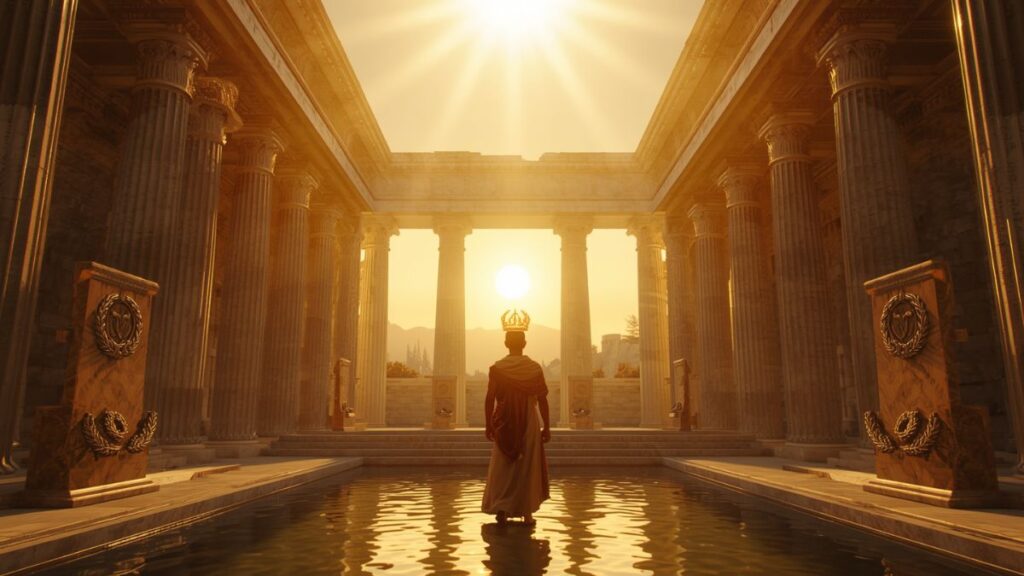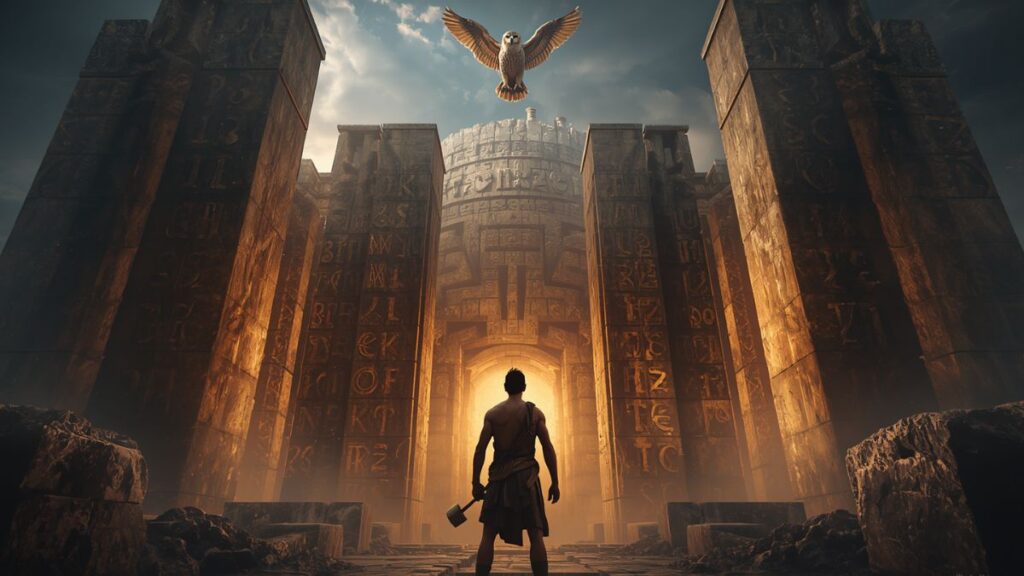
Long before marble cities covered the hills of Greece, a quiet river flowed between the sacred valleys of Arcadia. Unlike every other river, its waters were said to carry more than reflections. The ancient Greeks believed it remembered every truth people refused to face.
The river was called Aletheia, named after the spirit of truth.
Legends claimed that anyone who crossed its waters while hiding lies, guilt, or regret would hear whispers from the current until they found the courage to confront them. Many dismissed the tale as an old myth, but the wisest philosophers believed the river did not punish people. Instead, it offered them a chance to become better than they had been before.
Near its banks stood the peaceful town of Lykora, where a seventeen-year-old student named Theron dreamed of becoming one of Greece’s greatest scholars.
Theron loved learning. His room was filled with scrolls about mathematics, astronomy, philosophy, and poetry. Teachers admired his sharp mind, and his classmates often sought his help before examinations or debates.
Yet beneath his reputation was a secret that troubled him.
Theron feared failure.
More than anything else, he wanted people to believe he was the smartest student in the academy. Whenever someone praised another student, jealousy quietly crept into his heart.
His closest friend, Alexios, possessed a gift for solving difficult philosophical problems. Instead of celebrating his friend’s success, Theron often compared himself to him.
Their teacher, Master Pindor, noticed the growing rivalry.
“Knowledge is meant to be shared,” he often reminded his students.
“It loses its purpose when it becomes a contest.”
Theron nodded politely, but the words never truly settled in his heart.
One autumn, the academy announced the Festival of Wisdom, where students from across Greece would compete in debates, mathematics, and philosophy. The winner would receive a silver laurel crown and an invitation to study in Athens.
For Theron, it seemed like the opportunity he had always wanted.
Days before the competition, Master Pindor assigned every student a difficult philosophical essay to prepare.
Alexios completed a brilliant piece exploring justice and compassion.
When Theron secretly read it, he realized it was better than anything he had written.
For several minutes, he wrestled with temptation.
Finally, he copied several of Alexios’ strongest ideas into his own work, convincing himself that no one would notice.
After all, they had often studied together.
Perhaps it wasn’t truly wrong.
The next morning, before the essays could be presented, a mysterious old woman arrived at the academy carrying a silver staff carved with flowing water.
She spoke quietly with Master Pindor.
Soon every student gathered in the courtyard.
“The Festival of Wisdom has changed,” the teacher announced.
“This year, every contestant must first cross the River Aletheia.”
Uneasy whispers spread through the crowd.
Even those who laughed at old legends grew strangely quiet.
The following morning, dozens of students reached the riverbank.
The water was unusually calm.
Mist drifted across its surface, and ancient willow trees leaned gently over the current.
One by one, students crossed the old stone bridge without difficulty.
When Theron’s turn came, he stepped onto the bridge confidently.
Halfway across, the river began whispering.
“Borrowed words…”
He froze.
The voice was soft, almost like the wind.
“Truth hidden beneath pride…”
Theron looked around.
No one else seemed to hear it.
He continued walking.
The whispers became louder.
“You fear failure more than dishonesty.”
His heartbeat quickened.
He reached the opposite bank, but the whispers followed him.
Throughout the day they echoed in his thoughts.
During the opening debate, he struggled to concentrate.
When judges praised his arguments, the river’s voice returned.
“Whose words earned that praise?”
That evening, unable to sleep, Theron walked back to the river alone.
The moon reflected perfectly across its still waters.
The old woman waited beside the shore.
“I wondered when you would return,” she said gently.
“Who are you?”
“Only a guardian.”
“Why does the river keep speaking to me?”
“It speaks only what already lives inside your heart.”
Theron looked down.
“I didn’t steal an entire essay.”
“I only borrowed a few ideas.”
The guardian smiled sadly.
“Truth has never measured guilt by quantity.”
She touched the water with her staff.
The river shimmered.
Suddenly Theron saw countless reflections.
A merchant returning extra coins to a customer.
A child admitting he had broken a vase.
A king confessing a mistake before his people.
None of them appeared weaker after telling the truth.
Each seemed freer.
“The river carries forgotten truths,” the guardian explained.
“Not to shame people.”
“To help them release what weighs them down.”
Theron remained silent for a long time.
Finally he whispered,
“I’m afraid everyone will think less of me.”
“They might.”
“But what will you think of yourself if you remain silent?”
The question lingered through the night.
The next morning, the academy gathered for the final round of the Festival of Wisdom.
Before the judges announced the results of the written essays, Theron stepped forward.
“I have something to confess.”
The courtyard became silent.
“I included ideas in my essay that belonged to Alexios.”
“No one forced me.”
“I feared losing more than I valued honesty.”
Gasps spread among the students.
Alexios looked shocked.
Master Pindor said nothing.
Theron removed his entry from the competition and handed it to the judges.
“I do not deserve to win with work that is not entirely my own.”
For several moments, no one spoke.
Then Alexios stepped forward.
“I accept your apology.”
“I should have trusted you enough to discuss our ideas together.”
The two friends shook hands.
The tension that had grown between them quietly disappeared.
That afternoon, Master Pindor surprised everyone.
“The purpose of this festival was never to discover the smartest student.”
“It was to discover who valued wisdom.”
He looked toward Theron.
“Knowledge without integrity is incomplete.”
Although Theron no longer qualified for the competition, the judges honored him with something unexpected.
A simple olive branch.
Not for academic excellence.
For honesty.
That evening, Theron crossed the River Aletheia once more.
This time the waters remained silent.
The whispers had disappeared.
The old guardian smiled from the opposite bank.
“You finally heard what the river wanted to teach.”
Theron bowed respectfully.
“It wasn’t judging me.”
“No.”
“It was inviting you to become the person you wished others believed you already were.”
The following year, Theron returned to the Festival of Wisdom.
He wrote every essay himself.
Whenever he struggled with difficult ideas, he sought help openly instead of hiding his uncertainty.
Alexios became his closest study partner once again.
Together they challenged one another, shared ideas freely, and celebrated each other’s success.
Their friendship became stronger than any competition.
Years later, Theron became a respected philosopher whose students admired him not because he always knew the right answers, but because he never pretended to know what he did not.
Whenever young scholars feared making mistakes, he shared the story of the River Aletheia.
One student once asked,
“Master, does the river truly remember forgotten truths?”
Theron smiled.
“Perhaps.”
“Or perhaps the river simply reminds us that our conscience remembers even when we try to forget.”
As generations passed, travelers continued visiting the peaceful river.
Some claimed they heard whispers.
Others heard only flowing water.
Wise people understood that both experiences carried the same lesson.
Every person makes mistakes.
Every person carries regrets.
But those who face the truth with courage discover something greater than success.
They discover peace.
Long after Theron was gone, parents, teachers, and philosophers continued telling the story of the River That Carried Forgotten Truths.
It reminded young people that intelligence alone does not define greatness.
Character does.
For truth may be difficult to speak, but once spoken, it clears the path toward trust, wisdom, and genuine self-respect.
And whenever the morning sun sparkled across the gentle waters of the River Aletheia, people remembered that honesty is not about being perfect. It is about having the courage to admit mistakes, learn from them, and become better because of them.
Moral of the Story
True wisdom requires honesty. Admitting mistakes may be difficult, but integrity, accountability, and the courage to face the truth build lasting character and genuine respect.