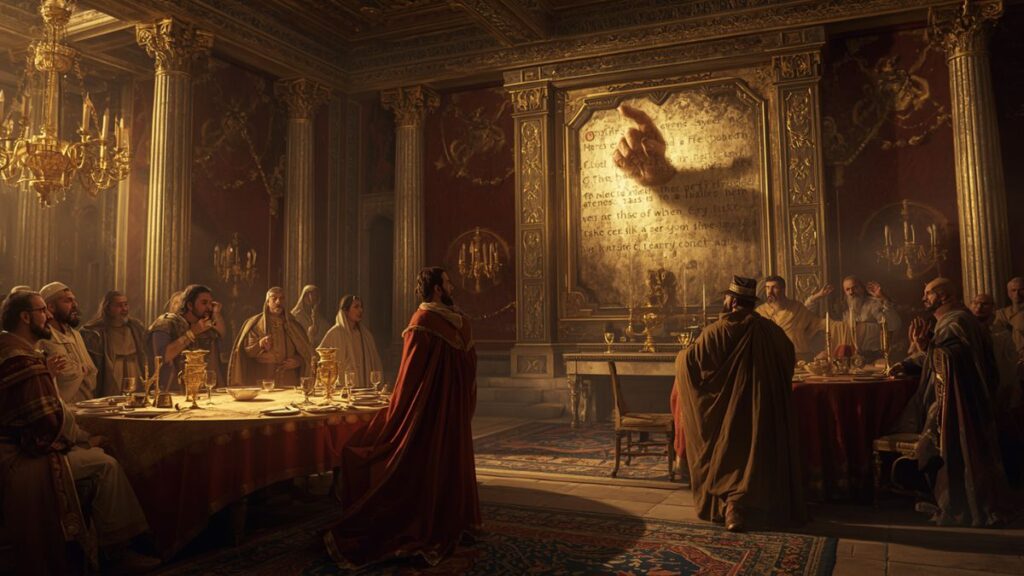
Among the Bible’s strangest and most mysterious stories is the account of a royal banquet interrupted by a supernatural hand that appeared and wrote a message on a palace wall.
Imagine attending a lavish feast filled with music, laughter, and celebration.
Suddenly, a hand appears from nowhere.
No body.
No person.
Only a hand.
In complete silence, it begins writing words onto the wall for everyone to see.
The king turns pale with fear.
The guests stop celebrating.
No one can understand the message.
And an entire kingdom’s future hangs on the meaning of those mysterious words.
This dramatic event is recorded in the Book of Daniel and remains one of the Bible’s most unusual stories. It is a story about pride, power, judgment, and the importance of respecting God.
The phrase “the handwriting on the wall” has even become a common expression used today when people recognize that trouble is coming.
But the original story is far more fascinating than the expression itself.
The Kingdom of Babylon
To understand the story, we first need to understand the setting.
The events took place in Babylon, one of the most powerful empires of the ancient world.
Babylon was famous for its wealth, massive walls, impressive buildings, and military strength.
Its rulers believed their city was nearly impossible to conquer.
The empire had already defeated many nations, including Judah.
As a result, many Israelites had been taken captive and brought to Babylon.
One of those captives was Daniel.
Years earlier, Daniel had become known for his wisdom, integrity, and ability to interpret dreams.
Although he lived in a foreign land, he remained faithful to God.
His reputation would soon become important once again.
A New King
By the time this story begins, a ruler named Belshazzar was governing Babylon.
Belshazzar enjoyed luxury, power, and influence.
Like many rulers before him, he believed his kingdom was secure.
The city’s enormous walls seemed unbeatable.
Its defenses appeared strong.
Its wealth seemed endless.
Because of this confidence, Belshazzar became careless.
Instead of showing humility, he displayed pride.
And pride would become the central issue of the story.
The Great Feast
One evening, Belshazzar decided to host an enormous banquet.
Thousands of important guests attended.
Nobles.
Officials.
Military leaders.
Members of the royal court.
The palace was filled with celebration.
Food covered the tables.
Music echoed through the halls.
People laughed, talked, and enjoyed themselves.
The atmosphere felt festive and carefree.
No one expected the evening to become one of the most famous nights in Babylonian history.
A Disrespectful Decision
As the feast continued, Belshazzar made a decision that revealed his arrogance.
Years earlier, Babylon’s armies had taken sacred gold and silver vessels from the Temple in Jerusalem.
These objects had been dedicated to the worship of God.
They were considered holy.
Rather than treating them with respect, Belshazzar ordered servants to bring them into the banquet hall.
The king and his guests began drinking from them during the celebration.
The action was more than poor judgment.
It was an act of disrespect.
Belshazzar treated sacred objects as ordinary party decorations.
He showed no reverence for God.
Instead, he mocked what was holy.
Celebration Turns to Terror
Then something happened that nobody expected.
Without warning, a human hand appeared.
The Bible specifically describes only the hand.
No body accompanied it.
No person entered the room.
The mysterious hand moved toward a wall near a lampstand where everyone could see clearly.
Then it began writing.
The room fell silent.
The music stopped.
Conversations ended.
Every eye focused on the wall.
The king watched in horror.
Words appeared one by one.
A message was being written.
But nobody understood what it meant.
The King’s Fear
Belshazzar’s reaction was immediate.
The Bible describes him becoming terrified.
His face lost its color.
His thoughts troubled him.
His legs became weak.
His knees knocked together.
The proud king who had been confidently leading a celebration moments earlier was now overwhelmed with fear.
Power and wealth offered no comfort.
His palace guards could not explain what was happening.
His advisors had no answers.
The mysterious message remained on the wall for everyone to see.
But no one could read its meaning.
Calling the Wise Men
Desperate for help, Belshazzar summoned Babylon’s wisest advisors.
Astrologers.
Magicians.
Scholars.
Experts.
The king offered great rewards.
Anyone who could explain the message would receive wealth, honor, and a high position in the kingdom.
The wise men examined the writing carefully.
They studied the symbols.
They discussed possibilities.
Yet none could explain it.
The mysterious words remained a puzzle.
The king’s fear only increased.
The Queen Remembers Daniel
As confusion spread throughout the palace, the queen remembered someone.
She recalled Daniel.
Years earlier, Daniel had interpreted difficult dreams and solved mysteries that others could not understand.
His wisdom had become famous throughout Babylon.
The queen advised Belshazzar to send for him immediately.
The king agreed.
Messengers hurried to find Daniel.
Soon, the elderly prophet arrived at the palace.
Daniel Enters the Banquet Hall
Daniel entered a room filled with frightened nobles and confused advisors.
The mysterious writing still remained visible on the wall.
Belshazzar explained the situation.
He promised Daniel rewards if he could interpret the message.
Riches.
Power.
Honor.
Yet Daniel was not interested in rewards.
He told the king he could keep his gifts.
Daniel’s concern was not personal gain.
His concern was speaking God’s truth.
This immediately separated him from the others in the room.
Daniel Confronts the King
Before interpreting the message, Daniel reminded Belshazzar of an important lesson from history.
He spoke about King Nebuchadnezzar, Belshazzar’s predecessor.
Nebuchadnezzar had once been filled with pride.
He believed his achievements were entirely his own.
As a result, God humbled him.
Only after learning humility did Nebuchadnezzar regain his position.
Belshazzar knew this history.
He had heard the stories.
Yet he ignored the lesson.
Instead of becoming humble, he repeated the same mistake.
Daniel pointed directly at the king’s pride.
He explained that Belshazzar had dishonored God despite knowing better.
The Mysterious Words
Now Daniel turned his attention to the writing itself.
The message contained four words:
Mene, Mene, Tekel, Parsin
To most people in the room, the words meant nothing.
But Daniel understood their significance.
Each word carried a message from God.
And none of the messages were good news for Babylon.
Mene
The first word was Mene.
Daniel explained that it meant God had numbered the days of Belshazzar’s kingdom.
The empire’s time was running out.
Its future had already been determined.
The kingdom would not continue indefinitely.
Its end was near.
The repetition of the word emphasized certainty.
The decision was final.
Tekel
The second word was Tekel.
Daniel explained that it meant the king had been weighed on God’s scales and found lacking.
Belshazzar had failed.
His character did not measure up.
His pride, arrogance, and disrespect had revealed serious flaws.
The king who considered himself powerful had been evaluated by a higher authority.
And he had failed the test.
Parsin
The final word carried another alarming message.
Daniel explained that the kingdom would be divided and given to others.
Babylon’s power would not remain in its current hands.
Another empire would take control.
The kingdom Belshazzar believed was secure would soon belong to someone else.
An Uncomfortable Truth
The interpretation shocked everyone.
The message was not symbolic encouragement.
It was a warning of judgment.
The mysterious handwriting announced that Babylon’s days were numbered.
The kingdom’s downfall was approaching.
And there was nothing Belshazzar could do to stop it.
The Prophecy Comes True
What makes the story even more remarkable is what happened next.
That very night, Babylon fell.
Enemy forces entered the city.
Belshazzar was killed.
The kingdom changed hands exactly as Daniel had predicted.
The message on the wall had not been an empty threat.
It had been a declaration of events already set in motion.
The mighty empire that seemed invincible collapsed.
The prophecy was fulfilled almost immediately.
Why This Story Is So Strange
This account stands out among Bible stories for several reasons.
A Hand Appears from Nowhere
The image of a hand writing on a wall without a visible person is unforgettable.
It is one of Scripture’s most mysterious supernatural events.
A Message Nobody Could Understand
The words were visible to everyone.
Yet only Daniel could explain their meaning.
The mystery created tension and fear throughout the story.
Judgment During a Celebration
The warning came during a party.
While people celebrated their security, danger was already approaching.
The contrast makes the story especially dramatic.
Lesson One: Pride Can Be Dangerous
One of the biggest lessons involves pride.
Belshazzar believed his position made him untouchable.
He trusted in wealth, power, and military strength.
Yet none of those things protected him.
The story reminds readers that pride often leads people to make poor decisions.
Humility is far safer than arrogance.
Lesson Two: God Sees Beyond Appearances
Belshazzar appeared successful.
His kingdom seemed strong.
His banquet looked impressive.
Yet God saw deeper.
God evaluated the king’s character rather than his outward achievements.
The story teaches that appearances can be misleading.
True success involves integrity and humility.
Lesson Three: Actions Have Consequences
Belshazzar treated sacred things carelessly.
He ignored lessons from history.
He refused to respect God.
Eventually, those choices produced consequences.
The story reminds readers that decisions matter.
Choices often shape future outcomes.
Lesson Four: Earthly Power Doesn’t Last Forever
Babylon seemed unstoppable.
Its walls appeared invincible.
Its leaders felt secure.
Yet the empire eventually fell.
The story serves as a reminder that human power is temporary.
Even the strongest kingdoms eventually fade.
Bible Stories for Adults
Although younger readers are fascinated by the mysterious hand, adults often appreciate the deeper themes.
The story addresses:
- Pride
- Leadership
- Accountability
- Responsibility
- Character
- Humility
- Consequences
These issues remain relevant today.
People in positions of authority can learn valuable lessons from Belshazzar’s mistakes.
Stories of Sacrifice in the Bible
While this story is primarily about judgment rather than sacrifice, it highlights the importance of surrendering pride.
True spiritual growth often requires sacrificing arrogance and embracing humility.
Throughout Scripture, people who humble themselves before God experience blessing, while those who elevate themselves often encounter trouble.
Belshazzar’s story demonstrates the consequences of choosing the opposite path.
Why Readers Still Remember This Story
Thousands of years later, the handwriting on the wall remains one of the Bible’s most famous stories.
Its imagery is unforgettable.
A mysterious hand.
A frightened king.
A cryptic message.
A prophecy fulfilled within hours.
Yet beyond the drama lies a timeless lesson about pride, humility, and accountability.
The story reminds readers that success alone does not guarantee security.
Character matters.
Wisdom matters.
Humility matters.
Conclusion
The story of the handwriting on the wall is one of the Bible’s most mysterious and memorable accounts.
A proud king hosted a lavish banquet.
He dishonored sacred objects and celebrated without concern.
Then a supernatural hand appeared and wrote a message that no one could understand.
Only Daniel could reveal its meaning.
The words announced judgment, exposed the king’s pride, and predicted the fall of an empire.
Before the night ended, the prophecy came true.
More than a strange Bible story, the handwriting on the wall serves as a powerful warning about pride and a reminder that true wisdom begins with humility.
That is why this mysterious account continues to fascinate readers thousands of years after the words first appeared on a palace wall.