A mother and daughter share a special bond that grows stronger with every passing year. From the first time a mother holds her little girl in her arms to the day she watches her daughter build a life of her own, every moment carries love, sacrifice, happiness, and sometimes tears. A mother’s love often remains hidden in small gestures, silent prayers, and sacrifices that her daughter may not understand until she grows older.
A heart touching story of mother and daughter reminds us that behind every daughter’s smile, there is often a mother who has quietly worked to make her dreams possible. Sometimes, a mother’s greatest gift is not something she gives but something she gives up for her child’s happiness.
In this collection, you will discover emotional mother-daughter stories about unconditional love, childhood memories, difficult choices, forgiveness, family relationships, and the beautiful connection that lasts a lifetime. Each story carries a meaningful message about appreciating our mothers and understanding the depth of their love.
What Makes the Bond Between a Mother and Daughter So Special?
The relationship between a mother and daughter is built through countless little moments. A mother is often her daughter’s first teacher, closest guide, emotional support, and lifelong well-wisher.
As a child, a daughter may see her mother as someone who prepares meals, helps with homework, tells bedtime stories, and protects her from every difficulty. As she grows older, she begins to understand the sacrifices behind those ordinary activities.
A mother may hide her worries to keep her daughter happy. She may postpone her dreams to support her child’s education. She may stay awake all night when her daughter is sick and smile the next morning as if nothing happened.
The relationship is not always perfect. Mothers and daughters may disagree, misunderstand each other, or struggle to express their feelings. However, genuine love often brings them back together.
The following heart touching stories explore different sides of this beautiful relationship.
Heart Touching Story of Mother And Daughter
1. The Lunchbox She Never Opened
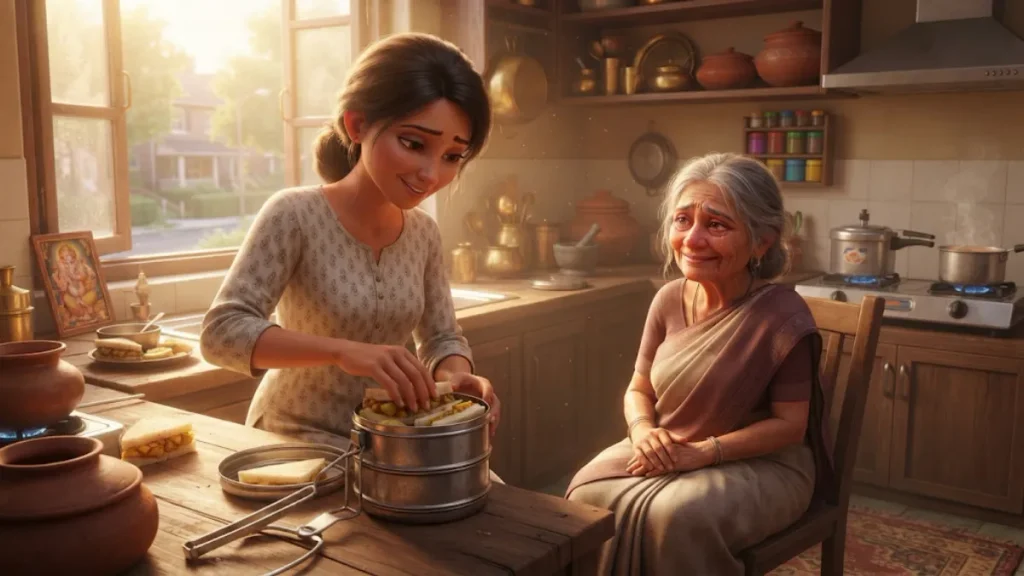
Priya always wanted to be like the other girls in her school.
She wanted fashionable clothes, pretty school accessories, expensive stationery, and the kind of lunchboxes that made her classmates gather around with excitement.
Unfortunately, her mother, Meera, could not afford to give her everything she wanted.
Meera worked as a receptionist at a small medical clinic. Her salary was enough to manage the household, pay the school fees, and buy groceries, but there was rarely anything left for luxuries.
Every morning, she woke up before sunrise to prepare breakfast and pack Priya’s lunch.
Sometimes it was vegetable paratha with homemade pickle. On other days, she packed lemon rice, potato sandwiches, or small containers of fresh fruit.
She always made sure the food was warm, fresh, and carefully arranged.
But Priya rarely appreciated it.
She preferred the colorful packaged snacks her classmates brought to school.
One Monday morning, Meera placed a stainless-steel lunchbox inside Priya’s schoolbag.
“Today I’ve made your favorite potato sandwiches,” she said.
Priya barely looked at it.
“Again? Mama, why can’t you buy those chocolate-filled biscuits like everyone else?”
Meera smiled gently.
“Because homemade food is healthier, sweetheart.”
Priya sighed.
“Everyone laughs at my lunchbox. It looks so old-fashioned.”
Meera looked at the small steel container. It had been used for years, but it was still clean and perfectly functional.
“I’ll try to get you a new one next month,” she promised.
Priya picked up her bag and left without saying goodbye.
Meera watched her walk toward the school bus, holding a cup of tea in her hands.
She wondered when her little girl had started feeling embarrassed by the simple things she did for her.
The lunchbox that came back untouched
At school, Priya usually sat with three friends: Rhea, Ananya, and Simran.
They often exchanged snacks during lunch.
Rhea brought chocolate muffins. Ananya carried cheese sandwiches in a colorful insulated box, while Simran usually had noodles or pasta.
Whenever Priya opened her steel lunchbox, she noticed their eyes.
One afternoon, Rhea looked inside and asked, “Is that homemade paratha again?”
Priya nodded reluctantly.
“You should ask your mother to buy something interesting,” Rhea said.
The comment embarrassed Priya.
She closed her lunchbox and pretended she wasn’t hungry.
When she returned home that afternoon, Meera was waiting at the dining table.
“How was lunch today?”
“Fine.”
“Did you like the sandwiches?”
Priya shrugged.
“I wasn’t hungry.”
Meera opened the lunchbox and discovered that almost everything was untouched.
“Why didn’t you eat?”
Priya became irritated.
“Because I don’t like eating the same things every day!”
Meera quietly closed the lid.
“All right. I’ll make something different tomorrow.”
But Priya had already walked away.
That evening, Meera searched online for affordable lunchbox recipes. She watched videos about colorful vegetable rolls, homemade pizza pockets, and baked snacks.
She wanted her daughter to feel happy when she opened her lunchbox.
For the next few weeks, she experimented with different recipes.
Sometimes Priya ate a little. Sometimes she brought everything back.
Meera never complained.
She simply washed the lunchbox and prepared something else the following morning.
A new city and an old habit
Years passed.
Priya grew into a confident young woman. She completed her education, found a job in a marketing company, and moved to another city.
Her mother was proud of her.
On the day Priya left home, Meera packed several containers of homemade food.
“Keep these in the refrigerator. They should last a few days.”
“Mama, I can order food whenever I want.”
“I know. But you’ll enjoy something homemade after a long day.”
Priya laughed.
“You’re still worried about feeding me!”
Meera smiled.
“Some habits never disappear.”
Priya hugged her before leaving.
During her first few months in the new city, she enjoyed her independence.
She ordered restaurant meals, attended office parties, and explored different cafés with her colleagues.
Her life was busy and exciting.
But gradually, something changed.
She began missing the comfort of home.
The food she once considered boring suddenly seemed more appealing than expensive restaurant meals.
She tried making potato sandwiches using an online recipe, but they never tasted like her mother’s.
She called Meera one evening.
“Mama, how did you make those sandwiches I used to take to school?”
Meera laughed.
“Which ones? You complained about all of them!”
Priya smiled.
“I was foolish.”
“You were a child.”
“Still, tell me the recipe.”
Meera explained every step patiently.
For the first time, Priya carefully wrote down the instructions.
The unexpected visit
Nearly two years later, Priya received an unexpected message from her mother.
I’m coming to your city next week. I have some work nearby. Can I stay with you for two days?
Priya immediately called her.
“Of course! Why are you even asking?”
Meera arrived on Friday afternoon carrying a small suitcase and a cloth bag.
Priya welcomed her warmly.
After they settled down, Meera went into the kitchen.
“What are you doing?” Priya asked.
“Nothing. I brought some vegetables. I thought I’d prepare something for dinner.”
“Mama, you’re a guest. Sit down. I’ll order something.”
Meera laughed.
“Let me cook just once.”
Priya watched her mother move around the kitchen.
She noticed how carefully Meera washed the vegetables, arranged the ingredients, and checked the cooking temperature.
It felt strangely familiar.
That evening, they ate together.
Meera had prepared the same potato sandwiches Priya once refused to eat.
Priya took one bite and smiled.
“They’re perfect.”
Meera looked surprised.
“Really?”
“Yes. I think I’ve forgotten how good homemade food can be.”
Her mother smiled proudly.
But Priya noticed something else.
Meera had barely eaten.
She kept encouraging Priya to take another sandwich while quietly drinking water.
“Why aren’t you eating, Mama?”
“I’m not very hungry.”
Priya looked at her mother’s plate.
There were only two small pieces left.
She remembered how often Meera had said the same thing when she was growing up.
Perhaps her mother had always been more concerned about feeding her than filling her own stomach.
The old lunchbox
On Saturday morning, Priya decided to organize a storage cupboard.
While moving some boxes, she found an old schoolbag.
It was the one she had used during her final years of school.
She opened it and discovered several forgotten items: a pencil case, an old notebook, a broken ruler, and a stainless-steel lunchbox.
The lunchbox was still in surprisingly good condition.
Priya picked it up and smiled.
“Mama, look what I found!”
Meera came into the room.
“Oh, you still have that?”
Priya opened the lid.
The familiar smell of old steel brought back memories of countless school mornings.
“Do you remember how I used to complain about this?”
Meera nodded.
“Of course.”
“I’m sorry.”
Meera looked at her daughter.
“For what?”
“For making you feel that your food wasn’t good enough. You spent so much time preparing everything, and I didn’t even appreciate it.”
Meera gently touched her daughter’s shoulder.
“You were young. You wanted to fit in with your friends. I understood.”
“But you never stopped trying.”
“Because I loved you. It was never a burden.”
Priya looked down at the lunchbox.
For years, she had thought it was simply a container for food.
Now she understood that it represented something much bigger.
It carried her mother’s early mornings, tired hands, quiet worries, and countless attempts to make her daughter’s day a little better.
A different kind of lunch
The following Monday, Meera was preparing to return home.
Priya woke up early and entered the kitchen.
Her mother was surprised to see her.
“Why are you awake so early?”
“I have something to do.”
Priya took out the old lunchbox and began preparing breakfast.
She made potato sandwiches using the recipe her mother had taught her.
They weren’t perfectly shaped, and one of them had slightly burned edges.
But she arranged them carefully inside the steel container.
She also added a small box of fruit and a handwritten note.
When Meera entered the kitchen, Priya handed her the lunchbox.
“What’s this?”
“Your lunch.”
Meera laughed.
“Why would I need a school lunchbox?”
“Because you always packed mine. Today, I wanted to pack yours.”
Meera opened the lid.
Inside, the sandwiches were still warm.
She noticed the small note placed underneath them.
It read:
For the woman who never let me go hungry, even when I didn’t understand how much effort it took. I hope you enjoy this lunch as much as I enjoy remembering all the ones you made for me.
Meera’s eyes filled with tears.
She hugged Priya tightly.
For a few moments, neither spoke.
Then Meera smiled.
“You’ve become a wonderful cook.”
Priya laughed.
“I learned from the best.”
Before Meera left, Priya placed the old lunchbox in her mother’s bag.
“Take it with you.”
Meera looked confused.
“I thought you wanted to keep it.”
“I do. But I want you to use it now. And whenever I visit, I’ll pack your lunch.”
Meera smiled.
That morning, Priya finally understood something she had overlooked throughout her childhood.
Her mother’s love had never arrived in expensive gifts or grand celebrations.
It had arrived in small containers, warm sandwiches, carefully cut fruit, and meals prepared before the rest of the world had even awakened.
And sometimes, the most precious things in life are the very things we fail to appreciate until they become memories.
Moral of the Story
A parent’s love often hides inside ordinary daily routines. Never underestimate the small acts of care that make someone feel loved, protected, and remembered.
2. The Red Sweater on the Hospital Chair

There are some things a mother never stops doing, no matter how old her children become.
She worries when they are late. She reminds them to eat properly. She notices when their voices sound different over the phone. And even when they are old enough to take care of themselves, she still wants to protect them from every difficulty life brings.
For Ananya, this became clear during a cold winter night in a hospital room.
She was twenty-eight years old, independent, financially stable, and confident that she could handle almost anything life placed in front of her.
But when she opened her eyes in a hospital bed and saw her mother sleeping uncomfortably on a plastic chair, she realized how little she understood about the sacrifices that had shaped her life.
It all began with an ordinary journey home.
An unexpected accident
Ananya worked as a graphic designer at a private advertising company. She lived in a busy city, rented a small apartment, and visited her mother, Sushma, whenever her work schedule allowed.
Her mother lived in their hometown, about four hours away.
Sushma had raised Ananya alone after her husband passed away when Ananya was just twelve. She worked as a school librarian and managed the household with a modest salary.
Life had never been particularly easy for them, but Sushma had always tried to give her daughter a comfortable childhood.
Ananya remembered her mother’s constant encouragement.
Whenever she wanted to join a drawing competition, her mother found money for the registration fee. When she needed a new school uniform, Sushma quietly adjusted the household budget. When she wanted to attend college in another city, her mother supported her decision even though it meant spending most of her savings.
Ananya appreciated these things, but as she grew older, she became increasingly busy with her own life.
Her calls became shorter. Her visits became less frequent.
Whenever Sushma asked whether she was eating properly, Ananya laughed.
“Ma, I’m not a child anymore.”
“I know,” Sushma would reply. “But that doesn’t mean I stop worrying.”
One Friday evening, Ananya was travelling back to her apartment after visiting her mother.
It was raining heavily.
The roads were slippery, and visibility was poor. While crossing a busy intersection, another vehicle suddenly changed lanes.
Ananya tried to avoid it, but her car skidded.
Within seconds, everything became a blur.
When she regained consciousness, she was inside an ambulance.
Her forehead hurt, her shoulder was painful, and she could barely understand what had happened.
A paramedic reassured her that help was on the way.
At the hospital, doctors diagnosed a fractured arm and several minor injuries. Fortunately, there was no serious internal damage.
But someone needed to be informed.
Ananya gave the nurse her mother’s number.
The woman who arrived before sunrise
Sushma received the call shortly after midnight.
For a moment, she couldn’t speak.
The nurse explained that Ananya had been in an accident but was stable and receiving treatment.
Sushma immediately gathered her handbag and left home.
She didn’t bother changing her clothes properly. She simply put on her old slippers, wrapped a shawl around herself, and hired an auto-rickshaw to the railway station.
The next available train was early in the morning.
She waited impatiently, checking her phone every few minutes.
When the train finally arrived, she boarded and sat near the window.
Throughout the journey, she kept looking at the photographs of Ananya saved on her phone.
One showed her daughter wearing a graduation gown. Another showed her smiling at a family gathering.
Sushma whispered a small prayer.
“Please let my daughter be all right.”
By the time she reached the city, the sun had risen.
She took a taxi directly to the hospital.
Ananya was resting when her mother entered the room.
“Ananya!”
She opened her eyes.
“Ma?”
Sushma hurried to the bedside and gently touched her daughter’s forehead.
“How are you feeling? Does anything hurt? Did the doctors say anything?”
Ananya tried to smile.
“I’m fine, Ma. It’s just a fracture.”
Sushma’s eyes filled with tears.
“Don’t ever say it’s just a fracture. You frightened me so much.”
Ananya reached for her mother’s hand.
“I’m sorry.”
Sushma sat beside her and held her fingers.
For the first time in a long while, Ananya felt like the little girl who used to fall asleep holding her mother’s hand.
The red sweater
The hospital room was unusually cold.
The air conditioner was running continuously, and the blanket provided by the hospital did little to make Ananya comfortable.
Sushma noticed her daughter shivering.
“Are you cold?”
“A little.”
Sushma opened her handbag.
She had brought a few necessary items from home, including medicines, a water bottle, a towel, and a red knitted sweater.
It was an old sweater she had worn for many winters.
The sleeves had become slightly loose, and a few threads were visible near the cuffs.
Sushma took it out and gently placed it over Ananya.
“This should help.”
Ananya looked at it.
“Ma, isn’t this your sweater?”
“Yes.”
“Then what will you wear?”
“I have my shawl.”
Ananya smiled.
“You always bring half the house whenever I need something.”
Sushma laughed.
“Someone has to look after you.”
Ananya closed her eyes again.
She assumed her mother would find another blanket or ask the nurse for one.
But when she woke up later that night, she noticed something unusual.
The red sweater was no longer covering her.
It had been folded carefully and placed over the back of the plastic chair.
Her mother was sitting beside the bed, wearing only a thin cotton shawl.
The hospital room felt cold even under the blanket.
Ananya watched her mother rub her hands together.
“Ma, why aren’t you wearing the sweater?”
Sushma looked up.
“You needed it more.”
“But you’re freezing.”
“I’m fine, sweetheart. Don’t worry.”
Ananya wanted to argue, but the medication made her sleepy.
She turned toward the wall and slowly drifted back to sleep.
A night of quiet sacrifices
During the next few days, Sushma barely left the hospital.
She arranged Ananya’s medicines, spoke to the doctors, helped her eat, and made sure the nurses knew about every small discomfort.
Whenever Ananya needed something, her mother was already there.
But Sushma never complained.
She slept on the uncomfortable chair beside the bed. She washed her face in the hospital bathroom and ate simple food from the cafeteria.
Sometimes, she even skipped meals because she didn’t want to leave Ananya alone.
One afternoon, Ananya noticed her mother struggling to stand.
“Ma, your back must be hurting. Go home and rest.”
Sushma smiled.
“I’ll rest when you’re better.”
“You can’t keep sitting here all day.”
“I have spent twenty-eight years worrying about you. A few days in a hospital won’t change anything.”
Ananya laughed.
But when her mother turned away, she noticed the tired expression on her face.
There were dark circles beneath her eyes. Her hair was untidy, and her hands looked unusually dry.
Ananya suddenly remembered something.
Her mother had been complaining about knee pain for several months.
Yet she had travelled for hours, spent nights on a plastic chair, and barely taken care of herself.
“Ma, have you taken your medicines?”
Sushma paused.
“Yes, yes.”
Ananya wasn’t convinced.
“Show me.”
Sushma opened her handbag and searched for the small medicine strip.
It was still there, untouched.
“You haven’t taken them?”
“I forgot.”
“How can you forget your own medicines?”
Sushma smiled.
“Sometimes there are more important things to remember.”
Ananya became quiet.
For years, she had thought her mother was simply strong.
Now she was beginning to understand that strength often came at a cost.
The conversation with the nurse
On the fourth evening, Ananya was feeling better.
The doctor had confirmed that she could be discharged within two days if her recovery continued smoothly.
Sushma was sitting outside the room, speaking to a nurse.
Ananya could hear their conversation through the partially open door.
“Your daughter is lucky to have you,” the nurse said.
Sushma smiled.
“She is my only child.”
“You have been here almost every night. You should take care of yourself too.”
Sushma lowered her eyes.
“I know. But she gets uncomfortable whenever I leave.”
The nurse glanced at her.
“Why don’t you ask someone to bring you warmer clothes? It gets very cold at night.”
Sushma laughed softly.
“I brought a sweater. But my daughter needs it.”
The nurse looked toward the red sweater hanging on the chair.
“That old one?”
“Yes. I’ve had it for years.”
“Why don’t you buy another one?”
Sushma remained silent for a moment.
Then she replied, “I will. But right now, I’d rather spend that money on her medicines and recovery.”
Ananya closed her eyes.
She felt something tighten inside her chest.
Her mother had travelled to the city, stayed in a hospital, and spent money on food and transportation.
Yet she was still thinking about how to save a little more for her daughter’s treatment.
Ananya remembered the expensive handbag she had purchased only a few weeks earlier.
She remembered the new phone she had bought because the previous one looked outdated.
She remembered how often she had told her mother that she was too busy to visit.
Suddenly, those memories felt different.
The sweater on the chair
That night, Ananya couldn’t sleep.
She watched the red sweater resting on the chair.
It was old, slightly faded, and had a small patch near the left sleeve.
She remembered wearing it as a child.
One winter, when she was in school, she had forgotten her jacket at home. Sushma had taken her own sweater off and wrapped it around her daughter before walking back through the cold streets.
Ananya had complained that the sweater was too large.
Her mother had laughed.
“Then grow into it.”
Another memory came back.
During her college years, Ananya had once returned home with a fever. Sushma had stayed awake beside her all night, checking her temperature and changing the wet cloth on her forehead.
The sweater had been there too, folded near the bed.
Perhaps it had always been there during the difficult moments of her life.
The next morning, Ananya asked her mother to sit beside her.
“Ma, can I ask you something?”
“Of course.”
“Why do you always give me your things?”
Sushma looked confused.
“What do you mean?”
“Your sweater, your blanket, your food, your time. You always give me whatever you have.”
Sushma smiled.
“That’s what mothers do.”
“But who looks after you?”
Her mother laughed.
“I look after myself.”
Ananya shook her head.
“No, you don’t. You haven’t taken your medicines properly. You haven’t slept comfortably. You’ve barely eaten since you arrived.”
Sushma reached for her hand.
“Please don’t worry about me. You need to recover.”
Ananya’s eyes filled with tears.
“I don’t want you to keep sacrificing everything for me.”
Sushma looked at her daughter for a long moment.
Then she said something Ananya would never forget.
“I don’t give you everything because I expect something in return. I do it because seeing you comfortable makes me happy. But that doesn’t mean you should stop caring about yourself or forget to care for me.”
Ananya leaned forward and hugged her.
“I’m sorry, Ma.”
Sushma gently stroked her hair.
“There is nothing to be sorry about. Just get better.”
A different kind of recovery
The following morning, Ananya insisted that her mother visit a nearby medical clinic.
At first, Sushma refused.
“It’s unnecessary.”
“Ma, you came all this way to make sure I was healthy. Now it’s my turn.”
After some persuasion, Sushma agreed.
The doctor examined her and advised her to follow her prescribed treatment for knee pain and take proper rest.
Ananya made sure her mother collected her medicines before returning to the hospital.
She also arranged a more comfortable chair for Sushma and requested an additional blanket from the nursing staff.
When her mother returned, Ananya smiled.
“Now you have everything you need.”
Sushma looked at the chair.
“You have become very bossy.”
Ananya laughed.
“I learned from you.”
Over the next two days, Ananya’s condition improved.
She could move around with assistance and was finally ready to go home.
Before leaving the hospital, she asked her mother to wait outside the room.
Then she picked up the red sweater.
She folded it carefully and placed it inside a shopping bag.
“What are you doing?” Sushma asked.
“I’m taking this home.”
“Why? It’s old.”
“Exactly. That’s why I want to keep it.”
Sushma looked puzzled.
Ananya smiled.
“This sweater has protected me more times than I can remember. I don’t want to lose it.”
Her mother gently touched the sleeve.
“Then keep it safe.”
Ananya nodded.
“But next winter, I’m buying you a new one. A really warm one.”
Sushma laughed.
“I don’t need anything expensive.”
“It doesn’t have to be expensive. It just has to keep you warm.”
The surprise at home
A month later, Ananya had recovered enough to return to work.
She was living with her mother temporarily because she wanted to help her recover from the exhausting hospital experience.
One evening, Sushma returned from the market and found a large package on the dining table.
“What’s this?”
Ananya came out of the kitchen.
“Open it.”
Inside was a beautiful woollen sweater in a deep maroon shade.
It was soft, warm, and comfortable.
Sushma smiled.
“This is lovely. But why did you buy it?”
“Because winter is coming.”
“I already have enough clothes.”
Ananya shook her head.
“You have spent so many winters making sure I never felt cold. Now I want you to have something warm too.”
Sushma ran her fingers over the fabric.
Then she noticed a small handwritten card inside the package.
It read:
To the woman who gave me her warmth whenever life became cold. I may never be able to return every sacrifice, but I promise I will never stop caring for you.
Sushma’s eyes filled with tears.
She hugged her daughter.
For a long moment, they stood together in the middle of the living room.
Later that evening, Ananya brought out the old red sweater.
She had washed it, carefully repaired the loose thread, and folded it inside a transparent storage box.
She placed it on the top shelf of her cupboard.
Her mother watched her.
“Why are you keeping it there?”
Ananya smiled.
“Because I want to remember something.”
“What?”
“That even when I thought I was old enough to manage everything alone, you were still quietly protecting me.”
Sushma smiled and placed a hand on her daughter’s shoulder.
“You don’t have to remember every sacrifice, Ananya. Just remember that you are loved.”
Ananya hugged her again.
That winter, the two women often sat together in the evenings, drinking tea and talking about ordinary things.
Sometimes they laughed about old memories. Sometimes they discussed the future.
And sometimes Ananya simply looked at her mother and felt grateful that she still had the opportunity to sit beside her.
The red sweater remained safely folded in her cupboard.
It was no longer just an old piece of clothing.
It was a reminder that a mother’s love does not become smaller as her children grow older. It simply finds new ways to keep them warm.
Moral of the Story
A mother’s sacrifices often go unnoticed because she makes them without expecting recognition. But love should never be a one-way responsibility. As children grow older, they should learn to protect, support, and care for the parents who once cared for them.
3. The Recipe That Was Almost Forgotten
A Heartwarming Family Story About Love, Memories, and the Taste of Home
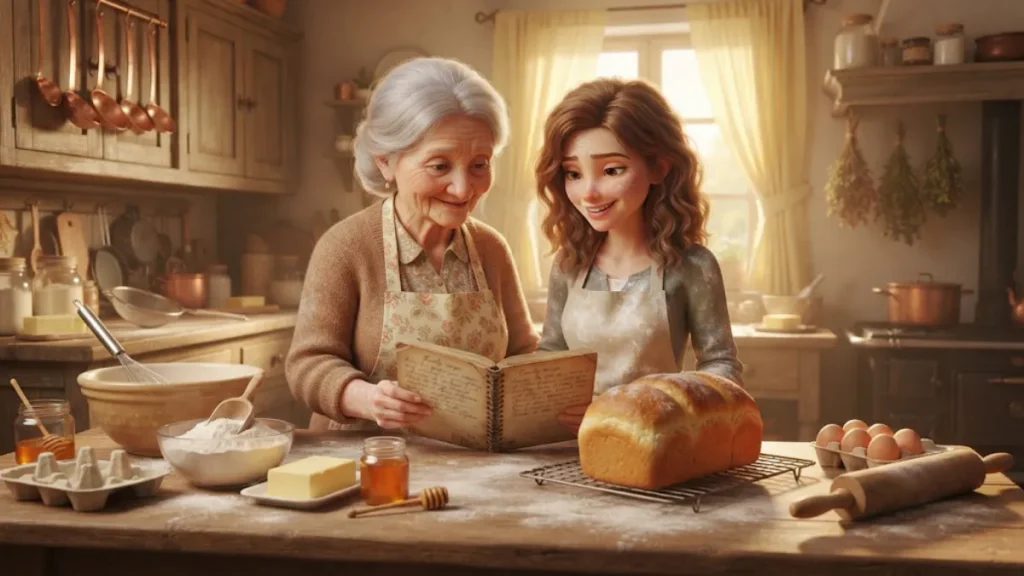
Some recipes are more than instructions written on a piece of paper. They carry memories of childhood, family traditions, forgotten conversations, and the love of people who once gathered around the same dining table.
This is the story of a young woman who discovers an old family recipe hidden inside her grandmother’s kitchen drawer. What begins as an ordinary attempt to prepare a traditional meal slowly becomes a journey into her family’s past. Along the way, she learns that some of the most precious things in life are not expensive possessions but simple traditions passed from one generation to another.
Chapter 1: The Kitchen That Smelled Like Childhood
Emma had not visited her grandmother’s house in nearly three years.
Life had become busy. Between her office responsibilities, weekend plans, and the endless notifications on her phone, she always found a reason to postpone the visit.
Her grandmother, Margaret, lived in a small countryside house with white wooden windows, a red front door, and a garden filled with roses. It was the same house where Emma had spent almost every summer of her childhood.
Whenever she remembered those days, one place came to mind first.
The kitchen.
It was a warm, slightly old-fashioned room with wooden cupboards, copper pots hanging above the stove, and a large dining table near the window. The curtains were always pale yellow, and sunlight entered through them every afternoon.
Most importantly, the kitchen always smelled wonderful.
Sometimes it smelled of freshly baked bread. On other days, it carried the comforting aroma of cinnamon, butter, roasted vegetables, and homemade soup.
Her grandmother had a special way of making ordinary meals feel unforgettable.
“Food tastes better when you make it with patience,” Margaret often told her.
As a little girl, Emma never understood what that meant. She was usually too busy stealing pieces of cookie dough or asking when dinner would be ready.
Now, at twenty-nine, she understood that her grandmother had been teaching her something much bigger than cooking.
She had been teaching her how to slow down.
When Emma finally arrived at the house on a quiet Saturday morning, Margaret welcomed her with a long hug.
“Look at you,” Margaret said, smiling. “I was beginning to think you had forgotten the way to this house.”
Emma laughed.
“I haven’t forgotten. I’ve just been busy.”
“Everyone is busy, sweetheart. But we still have to make time for the people we love.”
Emma smiled and followed her grandmother into the kitchen.
The familiar smell of the room immediately brought back memories she thought she had forgotten.
Chapter 2: An Old Notebook
After lunch, Margaret asked Emma to help organize the kitchen cupboards.
“I have too many things in here,” she said, opening a drawer filled with old utensils, folded napkins, and kitchen accessories.
Emma began sorting through everything.
She found a wooden spoon with a cracked handle, a small collection of faded recipe cards, and an old photograph of her grandmother standing beside a large birthday cake.
Then she noticed something tucked beneath a stack of linen napkins.
It was a small brown notebook.
Its cover was worn, its corners were damaged, and several pages had turned yellow with age.
Emma carefully opened it.
Inside were handwritten recipes, shopping lists, and little notes written in her grandmother’s familiar handwriting.
Some recipes had titles such as Sunday Apple Pie, Honey Butter Biscuits, and Summer Vegetable Stew.
But one page immediately caught her attention.
At the top, written in slightly faded ink, were the words:
Grandmother’s Special Sunday Bread
Emma smiled.
“Grandma, what’s this?”
Margaret looked over her shoulder.
For a moment, her expression changed.
“Oh,” she whispered. “I haven’t seen that notebook in years.”
Emma turned the page.
There were ingredients written in a neat list, followed by a few cooking instructions.
But the recipe seemed incomplete.
Some measurements were missing. A few words had faded, and the final instructions stopped halfway through a sentence.
“Did you write this?” Emma asked.
“Not exactly,” Margaret replied. “That recipe belonged to your great-grandmother, Eleanor.”
Emma had heard stories about Eleanor but had never met her.
“She used to make this bread every Sunday?” Emma asked.
“Almost every Sunday. Your grandfather loved it. Your mother loved it. And when you were little, you loved it too.”
Emma looked surprised.
“I did?”
Margaret laughed softly.
“You used to sit on that chair near the counter and ask for the smallest piece before the bread was even ready.”
Emma looked at the notebook again.
“Why don’t you make it anymore?”
Margaret became quiet.
“Because I forgot a few things. And after your great-grandmother passed away, I never quite managed to make it taste the same.”
She gently touched the notebook.
“Some recipes disappear when nobody remembers how they were made.”
Chapter 3: A Forgotten Family Tradition
Emma sat down at the dining table with the notebook in front of her.
She studied the recipe carefully.
The ingredients were simple:
- Four cups of flour
- One cup of warm milk
- Two tablespoons of butter
- One spoon of sugar
- A little salt
- Yeast
- Two eggs
But the most important part seemed to be missing.
The instructions mentioned something about adding a special mixture, allowing the dough to rest, and brushing the bread before placing it in the oven.
Unfortunately, the writing had faded.
“Can we try making it?” Emma asked.
Margaret shook her head.
“I’m not sure it will work. We don’t have the complete recipe.”
“We have most of it. We can figure out the rest.”
Her grandmother smiled.
“That sounds exactly like something your great-grandmother would have said.”
Emma placed the notebook on the counter.
For the next hour, they searched through the kitchen.
They opened cupboards, checked old recipe boxes, and looked through folders filled with handwritten notes.
They found recipes for cakes, cookies, sauces, and desserts.
But nothing explained the missing instructions.
Eventually, Margaret remembered something.
“Wait a minute. Your grandfather used to keep old photographs in the wooden box in the living room. Perhaps there are some pictures from those Sunday afternoons.”
Emma went to retrieve the box.
Inside were dozens of photographs.
Some showed family celebrations. Others captured holidays, birthdays, and ordinary afternoons in the garden.
Emma and Margaret spent nearly an hour looking through them.
Then Emma found something interesting.
It was an old photograph of Eleanor standing in the kitchen.
She was wearing a white apron, smiling beside a large wooden table.
In front of her was a freshly baked loaf of bread.
Emma turned the photograph over.
There was a handwritten note on the back.
The secret is not in the flour. It is in what you add when nobody is watching.
Emma read it twice.
“What do you think that means?”
Margaret studied the handwriting.
“Your great-grandmother always said that cooking required more than following instructions.”
“That’s not very helpful,” Emma joked.
Margaret laughed.
“No, but it sounds like her.”
Chapter 4: The First Attempt
The following morning, Emma decided they would make the bread.
Margaret watched as she measured the flour into a large mixing bowl.
“Not too much,” her grandmother advised.
“I’ve measured it exactly.”
“Recipes are guides, sweetheart. Sometimes you have to use your hands.”
Emma mixed the flour, yeast, sugar, and salt.
She warmed the milk and added the butter.
Then she poured the liquid into the bowl.
The mixture looked promising at first, but the dough became too sticky.
Emma added more flour.
Then a little more.
Soon, the mixture became dry and difficult to knead.
Margaret watched with an amused expression.
“I think you’re trying to convince the dough to behave through force.”
Emma laughed.
“Isn’t that what cooking is?”
“No. Sometimes you have to give things a little time.”
They started again.
This time, Emma added the liquid slowly and mixed everything gently.
She kneaded the dough until it became soft and smooth.
Then they placed it inside a bowl and covered it with a clean kitchen towel.
“How long should we leave it?” Emma asked.
Margaret shrugged.
“Until it rises.”
Emma looked at the clock.
“That’s not a very precise instruction.”
“Neither is life.”
They laughed together.
While waiting, Margaret made tea.
She told Emma stories about Eleanor, describing how she used to wake up before sunrise to prepare Sunday meals.
Eleanor had never measured every ingredient.
She cooked by experience, adjusting the recipe according to the weather, the ingredients available, and the number of people sitting around her table.
“She believed every meal should be enough for one unexpected guest,” Margaret explained.
“Why?”
“Because someone might arrive hungry. And she never wanted anyone to leave her home without eating.”
Emma smiled.
It was a beautiful thought.
When they returned to the dough, it had barely risen.
They waited another hour.
This time, it had grown almost twice its original size.
Margaret nodded.
“Now we’re getting somewhere.”
Chapter 5: The Missing Ingredient
Emma shaped the dough into a loaf.
She placed it in a baking pan and prepared to put it into the oven.
But Margaret stopped her.
“Wait. Your great-grandmother always brushed something over the top.”
“An egg wash?”
“Perhaps. But I remember something different. It had a little sweetness.”
They searched the notebook again.
Near the bottom of the page, Emma noticed a faint sentence.
It was almost impossible to read.
She moved the notebook closer to the window, allowing sunlight to fall across the paper.
Slowly, the faded writing became clearer.
It said:
Brush gently with melted butter and honey before baking.
Emma looked up.
“Grandma! I found it.”
Margaret leaned closer.
Her eyes widened.
“Of course. Honey.”
She smiled as if an old memory had suddenly returned.
“Your great-grandmother used honey from the little jars your grandfather brought home from the countryside.”
Emma melted a little butter and mixed it with honey.
Together, they brushed the mixture over the dough.
The kitchen began to smell wonderful.
They placed the bread in the oven and waited.
For the next thirty minutes, Emma found herself watching the oven as if something extraordinary were about to happen.
Margaret sat beside her with a cup of tea.
“Do you know something?” she said.
“What?”
“I haven’t made this bread in almost fifteen years.”
Emma turned toward her.
“Why not?”
Margaret looked down at her hands.
“After your grandfather passed away, Sundays became different. I stopped inviting everyone over. Your mother moved away, and eventually the house became very quiet.”
She paused.
“I suppose I stopped making the things that reminded me of those days.”
Emma gently held her grandmother’s hand.
“Maybe we can bring them back.”
Margaret smiled.
“Maybe we can.”
Chapter 6: The Smell of Old Memories
When the timer rang, Emma carefully opened the oven.
A beautiful golden loaf sat inside the baking pan.
Its surface was slightly crisp, and a delicate sweetness filled the kitchen.
Margaret stood up immediately.
For several seconds, she simply looked at it.
Then she smiled.
“Oh, my goodness.”
Emma placed the bread on the counter.
“Does it look right?”
Margaret nodded slowly.
“It looks exactly like hers.”
They waited for the bread to cool before cutting it.
Emma took the first slice.
The inside was soft, warm, and fluffy. The outside had a delicate buttery crust with a hint of honey.
She handed a piece to her grandmother.
Margaret took a small bite.
Then she closed her eyes.
For a moment, she did not speak.
Emma watched her carefully.
“Grandma?”
Margaret opened her eyes.
A tear rolled down her cheek.
“It tastes like Sunday morning.”
Emma smiled.
“Is that good?”
Margaret laughed through her tears.
“It’s perfect.”
She took another bite.
Then she began remembering things.
She remembered Eleanor standing beside the old oven. She remembered her grandfather cutting the first slice. She remembered children running around the dining table and adults talking about ordinary things.
And she remembered how the entire family used to gather around one loaf of bread.
The bread had never been extraordinary because of its ingredients.
It was extraordinary because of the people who shared it.
Chapter 7: A Table Full of People
Emma had an idea.
“Grandma, what if we invited everyone for Sunday lunch?”
Margaret looked surprised.
“Everyone?”
“Your children, the cousins, the neighbors you used to invite. We can make the bread again.”
For a moment, Margaret seemed uncertain.
“It’s been so long. I don’t know whether everyone will come.”
“We won’t know unless we ask.”
Emma took out her phone.
She called her mother first.
Then her uncle.
Then two cousins who lived nearby.
Everyone was surprised to hear that Margaret was planning a family lunch.
But they were even more surprised when Emma mentioned the old Sunday bread.
“That bread?” her uncle asked.
“I haven’t tasted it since I was a child.”
“Tell Grandma I’ll be there,” her mother said.
By Sunday morning, the house was filled with activity.
Margaret prepared vegetables while Emma worked on another loaf of bread.
Her uncle arrived carrying a basket of apples.
Her mother brought a homemade dessert.
The cousins arrived with flowers for Margaret.
Soon, the kitchen was filled with laughter and familiar voices.
Margaret stood near the dining table, watching everyone gather.
She had not seen the house this lively in years.
When lunch was ready, Emma placed the golden loaf in the center of the table.
Everyone immediately recognized it.
“Is that Eleanor’s bread?” her mother asked.
Emma nodded.
“We found the old recipe.”
Her uncle broke off a piece.
He took one bite and smiled.
“I remember this taste.”
Soon, everyone was sharing stories about Eleanor.
Some remembered her cooking. Others remembered her garden, her funny expressions, and the way she always packed extra food for guests.
Even the younger children listened with curiosity.
They had never met Eleanor, but through those stories, they began to understand what she meant to the family.
Chapter 8: Passing It On
After lunch, Emma returned to the kitchen.
She carefully cleaned the old notebook and placed it on the dining table.
Then she opened a fresh notebook.
At the top of the first page, she wrote:
The Sunday Bread Recipe
Below it, she recorded the ingredients and instructions.
But she also added a few notes.
Mix slowly. Do not rush the dough.
Add the honey and butter before baking.
Give the bread enough time to rise.
And at the bottom, she wrote:
Always make enough to share with someone unexpected.
Margaret watched her writing.
“What are you doing, sweetheart?”
“Saving the recipe.”
Margaret smiled.
“You know, your great-grandmother never wanted her recipes to be secret. She wanted people to enjoy them.”
Emma nodded.
“Then we’ll make sure more people learn them.”
She placed the old notebook beside the new one.
One was faded and worn.
The other was clean and bright.
Together, they represented something beautiful.
The past had not disappeared.
It had simply been waiting for someone to remember it.
Before leaving that evening, Emma promised her grandmother that she would return the following Sunday.
Not because she had a special occasion to celebrate.
Not because someone had asked her to visit.
But because she wanted to.
And the following Sunday, she returned.
They made the bread again.
This time, Margaret allowed Emma to prepare most of it herself.
A few weeks later, Emma taught the recipe to her younger cousin.
The following month, her mother made it for a family gathering.
Eventually, the bread became part of their Sunday tradition once again.
The notebook was no longer hidden in a kitchen drawer.
It had a special place on the dining table.
And whenever someone asked about the recipe, Margaret told them the story of Eleanor, the woman who believed that a kitchen should always have enough food for one more person.
Chapter 9: The Real Secret of the Recipe
Months passed, but Emma never forgot that Saturday morning.
She continued visiting her grandmother regularly.
Sometimes they baked bread. Sometimes they prepared soup or made simple apple pies.
They also began writing down other forgotten family recipes.
One afternoon, Emma asked Margaret a question.
“Grandma, do you think great-grandmother would be happy that we brought her recipe back?”
Margaret smiled.
“I think she would be happier that it brought everyone together.”
Emma looked at the notebook.
For years, she had believed that family traditions were simply old habits people followed because they had always existed.
Now she understood something different.
Traditions survived because people chose to continue them.
A recipe could be written down, but its meaning came from the hands that prepared it and the people who gathered to enjoy it.
The ingredients might be ordinary.
The instructions might be imperfect.
And sometimes, important details might even be forgotten.
But love had a way of filling the spaces that were missing.
That evening, Margaret wrapped a small loaf of bread in a clean kitchen towel and handed it to Emma.
“Take this home.”
Emma smiled.
“You don’t have to give me the whole loaf.”
“I know. But I want to.”
Emma hugged her grandmother.
As she drove home, the smell of warm bread filled her car.
She thought about the old notebook, the faded handwriting, and the photograph of Eleanor standing beside the kitchen table.
She realized that the recipe had never truly been lost.
It had simply been waiting for another generation to bring it back to life.
And perhaps that was the real secret of family traditions.
They did not survive because they were written perfectly.
They survived because someone cared enough to remember.
The End.
Moral of the Story
Family traditions are precious because they connect generations through shared memories and experiences. Sometimes, the simplest things, such as an old recipe, a familiar meal, or a Sunday gathering, carry the deepest meaning.
Never underestimate the value of preserving family memories. A recipe may feed the body, but the love and stories behind it can nourish the heart for generations.
4. The Day Mother Became a Student
A Heart Touching Family Story About a Mother’s Dreams, Education, and the Courage to Begin Again

Chapter 1: A Dream She Had Buried Long Ago
Every evening, after finishing her household responsibilities, sixty-year-old Margaret sat near the living room window with a cup of tea.
She enjoyed watching children walk home from school.
Their colorful backpacks bounced against their shoulders, their shoes made little sounds against the pavement, and their conversations filled the quiet street with laughter.
Sometimes, she watched them until they disappeared around the corner.
Then she would look at the small bookshelf beside her chair.
It contained a few old novels, religious books, cookbooks, and several newspapers. Margaret enjoyed reading, although she often struggled with difficult words.
There was something she had never told her family.
She had always wanted to study.
When Margaret was a young girl, her family had not been wealthy. Her father worked long hours, and her mother managed a small household with four children.
Education was important, but circumstances were difficult.
Margaret attended school until she was thirteen. She was a bright student who particularly enjoyed English and mathematics.
Her teachers often praised her handwriting and encouraged her to continue studying.
One teacher, Mrs. Collins, had once told her, “Margaret, you have a wonderful mind. Never stop learning.”
Those words stayed with her.
Unfortunately, life had other plans.
Her father became ill, and Margaret had to help her mother look after the younger children. She gradually stopped attending school.
At first, she believed the break would last only a few months.
Then months became years.
She learned sewing, cooking, budgeting, and countless household skills. Eventually, she married, raised two children, and built a loving home.
She never regretted caring for her family.
But somewhere inside her heart, the little girl who wanted to become a teacher still existed.
And every time she watched children walking home from school, she remembered the dream she had left behind.
Chapter 2: The Question at Dinner
Margaret lived with her daughter, Emily, who worked as a graphic designer.
Emily was thirty-two and had always admired her mother’s intelligence.
Whenever she faced a difficult personal decision, she called Margaret.
Her mother had a way of listening without interrupting and offering advice without making anyone feel small.
One evening, while they were having dinner, Emily noticed her mother reading a newspaper.
Margaret was moving her finger beneath each line, quietly sounding out a few unfamiliar words.
“Mom, what are you reading?” Emily asked.
“An article about a new community library.”
“Do you like it?”
“Yes. But some of the words are difficult.”
Emily smiled.
“You can ask me whenever you want.”
Margaret folded the newspaper.
“I know, sweetheart.”
There was a short silence.
Then Margaret said something unexpected.
“Emily, do you think it is strange for someone my age to go back to school?”
Emily looked up from her plate.
“Why would you ask that?”
“Just curious.”
“Of course not. Learning doesn’t have an age limit.”
Margaret smiled faintly.
“I suppose people might laugh.”
“Who?”
“People who think an old woman should spend her time knitting sweaters and looking after grandchildren.”
Emily laughed.
“Mom, you can do those things and study too.”
Margaret looked down at her hands.
“I sometimes wish I had continued my education.”
Emily put down her fork.
“Why didn’t you tell me before?”
“I don’t know. It always seemed too late.”
Emily reached across the table and held her mother’s hand.
“Mom, what would you study if you could start again?”
Margaret hesitated.
Then she answered quietly.
“English. I would love to improve my English. And perhaps learn how to use a computer properly.”
Emily smiled.
“Then why don’t you?”
Margaret laughed nervously.
“At my age?”
“Especially at your age.”
Chapter 3: The Decision
For the next several days, Emily noticed that her mother seemed unusually thoughtful.
She often sat near the window with the newspaper open.
Sometimes she searched for unfamiliar words in an old dictionary.
One morning, Emily found her mother watching an educational video on a tablet.
“Are you studying?” Emily asked.
Margaret quickly turned off the screen.
“I was just looking at something.”
Emily smiled.
“You don’t have to hide it.”
Margaret laughed.
“I feel a little foolish.”
“Why?”
“Because children usually learn these things. I am supposed to know them already.”
Emily sat beside her.
“Mom, nobody knows everything. That’s why we learn.”
Margaret remained quiet.
Then Emily suggested something.
“There is an adult learning center near the community library. They offer evening classes in English and basic computer skills.”
Margaret looked surprised.
“Adults can attend?”
“Of course.”
“Even older people?”
“Yes.”
“Would I have to take an examination?”
Emily laughed.
“I don’t think they will ask you to solve complicated mathematics problems at the entrance.”
Margaret smiled.
But the idea frightened her.
She imagined walking into a classroom filled with strangers. She imagined being asked questions she could not answer. She imagined younger students whispering about her.
Most of all, she feared making mistakes.
After thinking about it for two days, she finally agreed to visit the center.
On Saturday morning, Emily accompanied her.
The building was small but welcoming. Posters about reading, language learning, and computer education covered the walls.
A friendly woman named Helen greeted them at the reception desk.
“How can I help you?”
Margaret took a breath.
“I would like to join an English class.”
Helen smiled.
“Wonderful. We have several classes for adult beginners.”
Margaret looked uncertain.
“I haven’t studied for many years.”
“That’s perfectly fine. Many of our students are returning to education after a long break.”
Helen handed her a registration form.
Margaret held the paper carefully.
For the first time in decades, she was filling out a form as a student.
Chapter 4: Her First Day in Class
On Monday morning, Margaret woke up earlier than usual.
She ironed a light blue blouse and selected a comfortable pair of shoes.
Then she packed a notebook, two pens, a dictionary, and a small water bottle into her handbag.
Emily watched from the kitchen doorway.
“You look beautiful, Mom.”
Margaret smiled.
“I feel like a little girl going to school for the first time.”
“That’s a good feeling.”
“Do you think I should take some snacks?”
“Mom, it’s a classroom, not a picnic.”
They both laughed.
Emily drove her to the learning center.
At the entrance, Margaret suddenly became nervous.
“What if I cannot understand anything?”
“Then you ask the teacher to explain it again.”
“What if everyone is younger than me?”
“Then you will have more life experience than everyone else.”
Margaret smiled.
Emily hugged her before she entered the building.
Inside, a classroom was already filling with students.
There were people of different ages.
A young man preparing for a career change sat near the window. A woman in her forties was arranging her notebooks. Two retired men were discussing the weather.
Margaret chose a seat near the middle.
A woman sitting beside her introduced herself.
“Hello. I’m Susan.”
“Margaret.”
“Is this your first class?”
Margaret nodded.
“Yes. I’m a little nervous.”
Susan laughed gently.
“Me too. I haven’t studied since my children were in school.”
Margaret felt better immediately.
Their teacher, Mr. James, entered a few minutes later.
He was a cheerful man in his early forties.
“Good morning, everyone. Welcome to your first lesson.”
He wrote three words on the board:
Learning. Patience. Confidence.
“These three things will help you throughout this course,” he said.
Then he asked everyone to introduce themselves.
When it was Margaret’s turn, she stood up.
“My name is Margaret. I am sixty years old. I want to improve my English because I have always loved reading, and I want to understand books more easily.”
The teacher smiled.
“That’s a wonderful reason to learn.”
Margaret sat down.
Her hands were still trembling slightly, but she felt proud.
She had done it.
She had entered a classroom again.
Chapter 5: The First Mistake
The first lesson was about simple sentence construction.
The teacher wrote several examples on the board.
Margaret followed carefully, writing everything in her notebook.
At first, she understood most of the lesson.
But when the teacher asked the class to complete an exercise, she became confused.
She wrote an answer, erased it, and tried again.
Her sentence still looked wrong.
She looked at Susan’s notebook.
Susan seemed equally confused.
Eventually, Mr. James walked around the classroom to check everyone’s work.
When he reached Margaret’s desk, he looked at her sentence.
“Good attempt,” he said. “There is just one small mistake here.”
He explained the correction.
Margaret nodded.
Then he moved to another student.
But she continued staring at her notebook.
One mistake.
It was such a small thing.
Yet she felt embarrassed.
She remembered being a young student and worrying about disappointing her teachers.
After class, she quietly packed her books.
Susan noticed her expression.
“What’s wrong?”
“I made several mistakes.”
Susan laughed.
“So did I.”
“But you seemed to understand everything.”
“Margaret, I wrote the wrong answer three times. I was just better at pretending I wasn’t confused.”
Margaret smiled.
Susan continued.
“That’s why we are here. If we already knew everything, we wouldn’t need classes.”
Those words stayed with Margaret during the journey home.
That evening, she told Emily about the lesson.
“I made mistakes,” she said.
Emily looked up.
“How many?”
“Several.”
“Excellent.”
Margaret frowned.
“Excellent?”
“Yes. It means you tried something new.”
Margaret began laughing.
Perhaps her daughter was right.
Chapter 6: The Notebook Beside Her Bed
Over the next few weeks, Margaret developed a new routine.
Every morning, she spent twenty minutes reading.
In the afternoon, she practiced writing sentences.
In the evening, she attended her classes twice a week.
Her notebook became her most important possession.
She wrote unfamiliar words on one page and their meanings on another.
Sometimes she practiced spelling while preparing dinner.
Sometimes she read short paragraphs aloud while folding laundry.
Emily noticed that her mother was becoming more confident.
One evening, Margaret entered the living room carrying her notebook.
“Listen to this,” she said.
Emily put down her phone.
Margaret read a paragraph about a small village.
Her pronunciation was not perfect, but she read every sentence without stopping.
When she finished, Emily applauded.
Margaret laughed.
“Don’t clap as if I have won an award.”
“You deserve it.”
Margaret sat beside her.
“You know, I used to think studying was something I had missed forever.”
Emily nodded.
“But now?”
“Now I think I was only waiting for the right time.”
She paused.
“I wish I had started earlier.”
Emily smiled.
“Perhaps. But you started today, and that matters more.”
That night, Margaret placed her notebook beside her bed.
For the first time in many years, she looked forward to waking up because she had something new to learn.
Chapter 7: The Computer That Frightened Her
After a month, Margaret began attending basic computer classes.
This was more challenging than English.
She had used a mobile phone for years, but computers seemed complicated.
The classroom contained several desktop computers.
Each student had to learn how to use the keyboard, mouse, internet browser, and basic applications.
Margaret stared at the screen.
“Where do I begin?” she asked.
Her instructor, David, smiled.
“Let’s start with the mouse.”
He demonstrated how to move the cursor and click an icon.
Margaret tried.
The cursor moved too far.
She tried again.
This time, she clicked the wrong button.
She sighed.
“This machine doesn’t seem to like me.”
David laughed.
“Computers don’t have feelings, Margaret. They are just waiting for instructions.”
“Then perhaps I am not giving them very good instructions.”
The instructor patiently showed her how to practice.
Over several lessons, she learned to type her name, open a document, save a file, and search for information online.
One afternoon, she managed to type an entire paragraph without assistance.
It took her almost twenty minutes.
But when she clicked the save button successfully, she smiled as if she had completed something extraordinary.
That evening, she called Emily.
“I have something to show you.”
“What is it?”
“I wrote a letter on the computer.”
Emily visited her mother’s room.
Margaret opened the document.
At the top, it read:
Dear Emily,
Today I learned how to use a computer. I am still slow, but I can do it without help. I am proud of myself.
Love, Mom.
Emily read it twice.
Then she hugged her mother.
“Mom, this is wonderful.”
Margaret smiled.
“I know. I wrote it myself.”
Chapter 8: The Day She Wanted to Give Up
Not every day was easy.
As the weeks passed, the lessons became more difficult.
Some students learned faster than Margaret.
She struggled with spelling, grammar, and remembering computer shortcuts.
Sometimes she forgot things she had practiced the previous day.
One evening, after a particularly difficult class, she returned home looking upset.
Emily was preparing dinner.
“How was class?”
Margaret placed her handbag on the chair.
“Terrible.”
“What happened?”
“I couldn’t finish the exercise. Everyone else completed it before me.”
Emily turned off the stove.
“Did the teacher say anything?”
“No. But I could see the others waiting.”
Margaret sat down.
“Perhaps I am too old for this.”
Emily pulled a chair beside her.
“Mom, do you remember when I learned to ride a bicycle?”
Margaret smiled faintly.
“Of course. You fell so many times that I thought you would never learn.”
“And what did you tell me?”
Margaret thought for a moment.
“That falling was part of learning.”
“Exactly.”
Emily continued.
“You never told me I was too old or too slow to ride a bicycle. You helped me try again.”
Margaret looked down.
“I suppose I should do the same for myself.”
Emily nodded.
“Yes. Give yourself the same patience you gave me.”
For a few moments, they sat quietly.
Then Margaret opened her handbag and removed her notebook.
“All right. Let’s practice.”
Emily smiled.
“Now?”
“Yes. I have a lesson to finish.”
That night, mother and daughter spent an hour practicing English sentences.
Margaret made mistakes.
Emily corrected them.
They laughed, tried again, and slowly worked through the exercises.
Before going to bed, Margaret placed a small star sticker beside the day’s lesson.
It was her way of celebrating the effort.
Chapter 9: A Surprise From the Teacher
Three months after joining the learning center, Margaret’s confidence had changed dramatically.
She could read short articles, write simple letters, and use a computer to search for information.
She had also made several friends.
Susan had become her closest classmate.
They often arrived early and sat together before lessons began.
One afternoon, Mr. James announced that the class would have a small presentation day.
Each student would speak for three minutes about something meaningful.
Margaret immediately became nervous.
“I cannot do that,” she whispered to Susan.
Susan smiled.
“Why not?”
“I don’t like speaking in front of people.”
“Neither do I. But we can practice together.”
For the next few days, Margaret prepared a short speech.
She decided to talk about returning to education after many years.
She wrote it carefully in her notebook and practiced reading it aloud.
On presentation day, the classroom was filled with students and a few family members.
Margaret sat nervously near the front.
When her name was called, she slowly walked toward the board.
She held her notebook with both hands.
Then she began.
“My name is Margaret. I am sixty years old, and three months ago, I became a student again.”
The room became quiet.
She continued.
“When I was young, I wanted to study. But life became difficult, and I had to leave school. I thought that dream was finished.”
She paused and looked at the audience.
“For many years, I told myself that I was too old to learn. I thought classrooms belonged to young people.”
A few students smiled.
“But I was wrong.”
Margaret took a breath.
“Now I understand that learning does not belong to any particular age. We can learn when we are young, when we are working, when we are raising families, and even when our hair has turned grey.”
Someone in the audience laughed warmly.
Margaret smiled.
“I still make mistakes. Sometimes I forget things. Sometimes I need more time than others. But every day, I learn something new.”
She looked toward Emily, who was sitting near the back.
“And I want to thank my daughter for reminding me that it is never too late to begin again.”
Margaret finished her speech.
For a moment, the room remained silent.
Then everyone applauded.
Mr. James stood up.
“Margaret, that was a wonderful presentation.”
She smiled, her eyes filled with tears.
For the first time, she felt that the little girl who had left school decades ago had finally returned to complete something important.
Chapter 10: A Daughter’s Greatest Gift
After the presentation, Emily approached her mother.
“Mom, you were amazing.”
Margaret laughed.
“I nearly forgot my second paragraph.”
“But you didn’t.”
“I was shaking.”
“Nobody noticed.”
Margaret hugged her daughter.
“Thank you for encouraging me.”
Emily shook her head.
“You did all the hard work yourself.”
They walked toward the exit together.
On the way, Margaret stopped beside a noticeboard.
A new announcement had been placed there.
Volunteer Reading Program: Helping Children Develop a Love for Books.
Margaret read the notice twice.
“Emily, look at this.”
“What is it?”
“They need volunteers to help children with reading.”
Emily smiled.
“Would you like to apply?”
Margaret looked uncertain.
“I don’t know if I am ready.”
“You don’t have to decide today.”
Margaret studied the announcement for another moment.
Then she nodded.
“Perhaps I could help someone else learn.”
A few weeks later, she joined the reading program.
Every Saturday morning, she visited the community library and helped young children read simple stories.
She was patient with them.
When a child struggled with a word, she never rushed them.
She remembered exactly how it felt to be afraid of making mistakes.
“Take your time,” she would say. “We are learning together.”
One little girl named Lily often came to her reading sessions.
Lily was shy and rarely spoke in front of others.
Margaret would sit beside her and read slowly.
Gradually, Lily began reading entire paragraphs herself.
One Saturday, after finishing a story, Lily looked up.
“Can I read another one next week?”
Margaret smiled.
“Of course, sweetheart. I will be waiting.”
As Lily ran toward her mother, Margaret felt a happiness she had not experienced in years.
She had wanted to become a teacher as a young girl.
Although life had taken her in another direction, she had finally found a way to share her love of learning.
Chapter 11: The Certificate
Six months after joining the learning center, Margaret completed her beginner English and computer courses.
The center organized a small graduation ceremony.
Students wore simple formal clothes and gathered in the main hall.
Their names were called one by one.
When the instructor announced Margaret’s name, the room filled with applause.
She walked to the stage and accepted her certificate.
Her hands trembled slightly as she held it.
The certificate was not a university degree or a professional qualification.
It was a simple document confirming that she had completed a beginner-level course.
But to Margaret, it represented something much greater.
It represented courage.
It represented every difficult lesson, every forgotten word, every evening spent practicing, and every moment when she had considered giving up.
Emily was sitting in the audience with a small bouquet of flowers.
She stood up and applauded loudly.
After the ceremony, Margaret showed her the certificate.
“Look what I have done.”
Emily smiled.
“You did more than complete a course, Mom.”
“What do you mean?”
“You proved to yourself that your dreams still matter.”
Margaret looked at the certificate again.
Then she hugged her daughter.
“I think I want to study something else now.”
Emily laughed.
“Already?”
“Yes. Perhaps creative writing.”
“Then we should find another class.”
Margaret smiled.
“I have a feeling this is only the beginning.”
Chapter 12: The Student Who Never Stopped Learning
A year later, Margaret still attended classes.
She had improved her English and become comfortable using a computer.
She could send emails, write documents, search for books online, and even make video calls with relatives living far away.
She also began keeping a small journal.
Every evening, she wrote a few sentences about her day.
Sometimes she described something she had learned.
Sometimes she wrote about her childhood.
And sometimes she simply recorded a memory she did not want to forget.
One afternoon, Emily found her mother sitting at the dining table, writing in her journal.
“What are you writing?”
Margaret looked up.
“A story.”
“About what?”
“About a woman who thought her dreams had expired.”
Emily pulled out a chair.
“Sounds interesting.”
Margaret smiled.
“She spent years taking care of everyone else. Then one day, she decided to do something for herself.”
Emily nodded.
“And what happened?”
“She discovered that she was still capable of learning, growing, and becoming someone new.”
Emily smiled.
“Is it a happy ending?”
Margaret looked at her daughter.
“I think it is a beginning.”
Outside, children were returning home from school.
Margaret watched them for a moment.
She no longer felt sadness when she saw their backpacks and notebooks.
Instead, she smiled.
She had finally understood that her education had not ended when she left school as a young girl.
It had continued through motherhood, work, relationships, mistakes, and countless experiences.
The classroom had simply given her another place to grow.
And although she was sixty-one now, she still felt the excitement of a student discovering something for the first time.
She closed her journal and wrote one final sentence:
It is never too late to become the person you once dreamed of being.
Then she placed her pen beside the notebook and smiled.
Tomorrow, she had another lesson.
And she could hardly wait.
The End.
Moral of the Story
Age should never be a reason to abandon learning or personal dreams. Life may interrupt our plans, but it does not have to end our ambitions.
Sometimes, the most courageous thing we can do is begin again. Whether someone is twenty, forty, sixty, or eighty, there is always something new to discover.
The story also reminds us that encouraging our parents to follow their dreams can be one of the most meaningful gifts we give them. They spent years supporting our growth. They deserve the opportunity to grow, too.
5. Two Tickets to the Sea
A Heartwarming Short Story About Love, Second Chances, and the Beautiful Memories We Create Together

Some journeys are not measured by the distance we travel but by the memories we create along the way. Sometimes, the smallest surprise can remind us of the love we have carried for decades.
This is the story of an elderly couple who discover two forgotten train tickets in an old drawer. What begins as a simple discovery becomes an unexpected journey to the seaside, where they find that love does not grow old, dreams do not have an expiration date, and it is never too late to make new memories.
Chapter 1: The Drawer of Forgotten Things
The rain had been falling since early morning.
Outside the small house on Willow Street, water trickled down the windows, and the branches of the old apple tree moved gently in the wind.
Inside, seventy-two-year-old Arthur Bennett was sitting at the dining table, trying to repair a broken table clock.
He had been working on it for nearly an hour.
His wife, Eleanor, watched him from the kitchen.
“Arthur, I think the clock has finally given up.”
Arthur adjusted his glasses.
“It hasn’t given up. It just needs a little encouragement.”
Eleanor laughed.
“You’ve been encouraging it for an hour.”
“Some things require patience.”
“Like husbands?”
Arthur looked up and smiled.
“Especially husbands.”
They had been married for forty-six years.
Their home was not particularly large or luxurious, but it was filled with memories. There were photographs on the walls, books stacked beside the sofa, and a collection of ceramic birds Eleanor had purchased over the years.
Their children had grown up and moved to different cities.
Their youngest daughter, Sophie, lived three hours away with her husband and two children. Their son, Daniel, lived abroad.
Arthur and Eleanor enjoyed their quiet life, although sometimes the silence became a little too noticeable.
Their days followed a familiar routine.
Arthur woke early, prepared coffee, and read the newspaper.
Eleanor watered the plants, prepared breakfast, and listened to the radio.
They walked through the neighborhood in the afternoon and watched television after dinner.
It was a comfortable life.
But lately, Eleanor had been thinking about something.
She missed travelling.
Not expensive holidays or luxurious hotels.
She missed the simple excitement of going somewhere together, sitting beside a train window, sharing sandwiches, and watching unfamiliar landscapes pass by.
They had not taken a proper trip in almost twelve years.
That afternoon, Eleanor decided to organize the old bedroom cupboard.
She opened drawers filled with photographs, greeting cards, letters, and forgotten belongings.
While moving a stack of old envelopes, she noticed a small brown box.
She had not seen it in years.
Curious, she opened it.
Inside were several postcards, a faded photograph, two old cinema tickets, and something that made her stop.
Two train tickets.
She picked them up carefully.
They were yellowed with age, but the printed destination was still readable.
Seabrook Bay.
Eleanor stared at them.
Then she smiled.
She remembered everything.
Chapter 2: The Journey That Never Happened
Forty-six years earlier, Arthur and Eleanor had been newly married.
They were young, hopeful, and constantly making plans.
They lived in a small rented apartment and had very little money.
But they were happy.
One evening, Arthur returned home carrying two train tickets.
He placed them on the kitchen table.
“Guess where we’re going?”
Eleanor picked them up.
“Seabrook Bay?”
Arthur nodded proudly.
“I’ve been saving for weeks.”
Eleanor was delighted.
She had always wanted to visit the sea.
As a child, she had lived far inland and had only seen the ocean in photographs.
Arthur promised her that they would spend an entire weekend by the water.
They would walk along the beach, eat fresh seafood, collect seashells, and watch the sunset.
Eleanor hugged him.
“Are you serious?”
“Absolutely.”
But life had other plans.
Three days before their journey, Arthur’s father suffered a serious accident.
Arthur had to travel to another town to help his family.
The trip was postponed.
At first, they planned to reschedule it for the following month.
Then Eleanor discovered she was expecting their first child.
Their expenses increased, and the little money they had saved was needed for the baby.
The tickets were placed inside the brown box.
Years passed.
They bought a house, raised their children, managed financial difficulties, celebrated birthdays, and experienced the ordinary challenges of married life.
The seaside trip slowly disappeared from their conversations.
Neither of them forgot it completely.
But they stopped mentioning it.
Now, standing in the bedroom with those two faded tickets in her hands, Eleanor felt a strange mixture of happiness and sadness.
She carried the tickets into the living room.
“Arthur?”
He looked up from the clock.
“Yes?”
“Do you remember these?”
She placed the tickets on the table.
Arthur adjusted his glasses and leaned closer.
For several seconds, he said nothing.
Then his face brightened.
“Seabrook Bay!”
Eleanor laughed.
“You remember?”
“Of course I remember. I promised you the sea.”
She looked at him.
“You did.”
Arthur picked up the tickets.
“I suppose we never made it.”
“No,” Eleanor replied gently. “We didn’t.”
Arthur studied the faded paper.
Then he looked at his wife.
“Perhaps we should.”
Chapter 3: A Question Neither Expected
Arthur was not a man who made sudden decisions.
He liked planning things carefully.
He checked weather forecasts before going outside, compared prices before purchasing anything, and preferred knowing exactly where he was going.
But that evening, he surprised Eleanor.
“What about next weekend?”
She looked confused.
“What?”
“Seabrook Bay. We could go next weekend.”
Eleanor laughed.
“Arthur, those tickets are almost fifty years old.”
“I know. We will need new ones.”
She sat beside him.
“Do you think we can manage the journey?”
“Why wouldn’t we?”
“We haven’t travelled like that in years.”
Arthur smiled.
“Then it will be an adventure.”
Eleanor looked at him for a long moment.
There was something familiar about his expression.
It was the same excitement she had seen when he had first shown her those original tickets.
“All right,” she whispered.
Arthur reached for her hand.
“Two tickets to the sea?”
“Two tickets to the sea.”
The following morning, Arthur searched for train services to Seabrook Bay.
He discovered that a direct train was available on Saturday morning.
They booked two comfortable seats beside the window.
Eleanor was delighted.
She immediately began planning what to pack.
Arthur made a list.
- Two sweaters
- Comfortable walking shoes
- Medicines
- Sunglasses
- A camera
- Snacks for the journey
Eleanor added one more item.
“Don’t forget the old photograph.”
Arthur looked at her.
“Which photograph?”
“The one from our wedding.”
He smiled.
“Why?”
“Because I want to take another one at the sea.”
Chapter 4: The Night Before the Journey
On Friday evening, Eleanor found herself unable to sleep.
She had packed her small suitcase twice.
She checked the train tickets three times.
Then she opened her wardrobe and changed her mind about what to wear.
Arthur watched from the bedroom doorway.
“Are you planning to take the entire wardrobe?”
Eleanor laughed.
“I haven’t travelled in so long. I don’t know what to pack.”
“Pack something comfortable.”
“I know that.”
“Then you’re ready.”
She looked at him.
“Arthur, are you excited?”
He pretended to think.
“Not particularly.”
Eleanor raised an eyebrow.
“Really?”
Arthur smiled.
“I’ve only checked the train schedule six times.”
She laughed.
He sat beside her on the bed.
For a moment, they remained quiet.
Then Arthur said something unexpected.
“I wish we had gone all those years ago.”
Eleanor looked at him.
“Why?”
“Because you wanted to see the sea so badly. I always felt I had disappointed you.”
Eleanor gently touched his arm.
“You never disappointed me.”
“But I made a promise.”
“And you kept a thousand others.”
Arthur looked confused.
Eleanor continued.
“You promised to build a home with me. You promised to stand beside me when things became difficult. You promised to raise our children together.”
She smiled.
“Those promises mattered much more than a weekend trip.”
Arthur held her hand.
“Still, I’m glad we’re finally going.”
“So am I.”
That night, they went to bed with the excitement of two young people preparing for their first holiday.
Chapter 5: The Train Ride
Saturday morning arrived with clear skies.
Arthur woke before sunrise.
He prepared tea and toast while Eleanor got dressed.
They left home early and reached the railway station with plenty of time.
The station was busier than Arthur remembered.
People hurried across platforms carrying suitcases, backpacks, and shopping bags.
Children ran toward their parents.
Announcements echoed through the building.
Eleanor stood beside Arthur, holding his arm.
“Look at all these people,” she said.
Arthur smiled.
“Everyone is going somewhere.”
“And we are too.”
Their train arrived at the platform.
They found their seats beside the window.
Eleanor placed her handbag on the rack and settled into her chair.
When the train began moving, she looked outside.
Buildings slowly disappeared.
Fields, small villages, and green hills passed by.
Arthur opened a newspaper.
But Eleanor noticed that he kept looking at her.
“What?” she asked.
“Nothing.”
“You’re staring.”
“I’m just happy.”
She smiled and leaned against his shoulder.
After an hour, Arthur opened the small bag he had brought.
Inside were homemade sandwiches, two apples, and a packet of biscuits.
Eleanor laughed.
“You packed food as if we were going on an expedition.”
“Travelling makes people hungry.”
They shared their breakfast while watching the scenery.
At one point, a little girl sitting across the aisle noticed their wedding photograph.
Eleanor had placed it on her lap.
“Is that you?” the girl asked.
Eleanor smiled.
“Yes. A very long time ago.”
The girl studied the photograph.
“You look different.”
Arthur laughed.
“That happens when you live with someone for forty-six years.”
The girl’s mother smiled.
“That’s lovely.”
Eleanor looked at Arthur.
He was still smiling.
And for a moment, she felt as if they were twenty-five again.
Chapter 6: The First Sight of the Sea
After several hours, the train approached the coast.
Eleanor was looking out of the window when she suddenly noticed something blue in the distance.
She leaned forward.
“Arthur!”
He looked up.
“What happened?”
“Look!”
Beyond the small coastal houses, the ocean stretched toward the horizon.
Eleanor covered her mouth.
It was beautiful.
The sunlight danced across the water, and white waves moved gently toward the shore.
She had imagined this moment for decades.
But the real thing was even more beautiful.
Arthur watched her instead of the sea.
“Well?” he asked.
Eleanor turned toward him.
“It’s worth the wait.”
He smiled.
“Forty-six years?”
“Every single one.”
They stepped off the train and walked toward the station exit.
The salty breeze touched their faces.
Eleanor closed her eyes and breathed deeply.
She could hear the distant sound of waves.
“Arthur, we’re finally here.”
He took her hand.
“Yes, my love. We are.”
Chapter 7: The Little Café by the Beach
They checked into a small seaside guesthouse.
It was not luxurious, but it had a beautiful balcony overlooking the ocean.
After resting for a while, they walked toward the beach.
The sand felt soft beneath their shoes.
Eleanor removed her sandals and stepped closer to the water.
A small wave touched her feet.
She laughed.
Arthur stood nearby, holding her shoes.
“Careful,” he said.
“Don’t worry. I’m not going to disappear.”
They walked along the shoreline.
Eleanor collected a few small shells while Arthur took photographs.
Eventually, they found a little café overlooking the beach.
They ordered tea and a slice of apple cake.
The café owner, a cheerful woman named Grace, noticed the couple looking through an old photograph.
“Are you celebrating something?” she asked.
Arthur smiled.
“We’re completing a journey that began forty-six years ago.”
Grace looked curious.
Eleanor explained the story of the forgotten tickets.
Grace listened with a warm smile.
“That’s wonderful. You know, most people come here to celebrate anniversaries. But I think celebrating an old promise is even more special.”
She brought them two extra pieces of cake.
“These are on the house.”
Eleanor thanked her.
As they ate, Arthur reached across the table.
“May I ask you something?”
“Of course.”
“Would you have been happy if we had never taken this trip?”
Eleanor looked surprised.
“Arthur, why would you ask that?”
“Because I sometimes think about the things we never did.”
Eleanor held his hand.
“We cannot do everything in life. But we can appreciate what we have done.”
She looked toward the sea.
“And today, we are doing something we once dreamed about.”
Arthur nodded.
For the rest of the afternoon, they talked about their younger years, their children, and the little moments that had made their marriage special.
They discovered that they remembered some events differently.
Arthur remembered their first apartment as a comfortable home.
Eleanor remembered the leaking kitchen roof.
Eleanor remembered their first family holiday as a disaster.
Arthur remembered it as the funniest weekend of his life.
They laughed until their tea became cold.
Chapter 8: The Photograph at Sunset
As evening approached, the sky began changing colors.
The sun slowly descended toward the horizon, painting the clouds in shades of orange, pink, and gold.
Arthur took the old wedding photograph from Eleanor’s handbag.
“Are you ready?”
She smiled.
“Ready for what?”
“Another photograph.”
They found a quiet place near the water.
Arthur asked a young couple nearby to take their picture.
He held the old photograph in one hand while Eleanor stood beside him.
The young man adjusted the camera.
“Are you ready?”
Arthur placed his arm around Eleanor.
“Always.”
The camera clicked.
Then another photograph was taken.
This time, Eleanor held the old wedding picture against her chest.
They looked toward the camera and smiled.
The two photographs were taken forty-six years apart.
In the first, they were young, uncertain, and full of dreams.
In the second, their hair had turned grey, their faces carried the marks of time, and their smiles were softer.
But their hands were still holding each other.
Eleanor looked at the new photograph.
“I think I like this one better.”
Arthur laughed.
“Even though we’ve both aged?”
“Especially because we’ve both aged.”
He kissed her forehead.
The ocean continued moving behind them.
And neither felt the need to say anything more.
Chapter 9: A Promise for Tomorrow
The following morning, Arthur and Eleanor sat on their balcony with cups of coffee.
The sea was calm.
A few boats moved slowly across the water.
Eleanor opened the small notebook she had brought.
“What are you writing?” Arthur asked.
“A list.”
“Of what?”
“Places we should visit.”
Arthur raised his eyebrows.
“More travelling?”
“Why not?”
She showed him the notebook.
There were several destinations written on the page.
A quiet mountain village.
A beautiful garden in the countryside.
A small town famous for its old bookshops.
And a lake she had once seen in a magazine.
Arthur read the list carefully.
“That’s quite ambitious.”
Eleanor smiled.
“Do you think we can do it?”
He looked at her.
“We don’t have to do everything at once.”
She nodded.
“One journey at a time.”
Arthur took the notebook and added something at the bottom.
A second visit to Seabrook Bay.
Eleanor laughed.
“We haven’t even gone home yet!”
“I enjoyed this trip.”
“So did I.”
He closed the notebook.
“Then we should come back.”
Eleanor leaned against his shoulder.
For years, they had believed that their travelling days were behind them.
They had convinced themselves that holidays belonged to younger people with more energy and fewer responsibilities.
But this journey had taught them something important.
Adventure did not require youth.
It required curiosity, companionship, and the willingness to say yes.
Chapter 10: The Journey Home
On Sunday afternoon, they boarded the train back home.
Eleanor sat beside the window, holding a small bag of seashells.
Arthur placed their luggage overhead.
As the train began moving, she looked back toward the coast.
The sea slowly disappeared behind the buildings.
She felt a little sad.
But it was a pleasant sadness.
The kind that comes after experiencing something beautiful.
Arthur noticed her expression.
“What’s wrong?”
“Nothing. I just wish we could stay a little longer.”
He smiled.
“We can always return.”
Eleanor looked at him.
“Promise?”
“Promise.”
She took his hand.
After a while, she rested her head against his shoulder.
Arthur looked through the photographs on his phone.
There were pictures of the beach, the café, the guesthouse, the sunset, and Eleanor laughing beside the water.
He stopped at the final photograph.
It showed them standing together with the old wedding picture.
He looked at it for a long moment.
Then he saved it as the wallpaper on his phone.
Eleanor noticed.
“Why that one?”
“Because it reminds me of something.”
“What?”
Arthur smiled.
“That I still have my favourite travelling companion.”
Eleanor laughed softly.
“And I still have my favourite person to travel with.”
The train continued toward home.
Outside, the landscape changed from coastal villages to green fields and familiar towns.
But something inside them had changed too.
They had returned with more than photographs and seashells.
They had returned with a renewed excitement for life.
Chapter 11: The Box That Became a Treasure
A few days after returning home, Eleanor placed the two new train tickets inside the old brown box.
She also added the photograph from the beach.
Then she placed the original faded tickets beside them.
Arthur watched her from the doorway.
“Keeping everything?”
“Of course.”
“Why?”
Eleanor smiled.
“Because these are not just tickets.”
She picked up one of the new ones.
“They remind me that we can still make memories.”
Arthur nodded.
The box was no longer filled only with forgotten things.
It contained the story of a promise made by two young people and fulfilled by two older ones.
Eleanor placed the box on the bookshelf.
Whenever their grandchildren visited, she showed them the photographs.
She told them about the long train journey, the little café, and the beautiful sunset.
But she always ended the story with the same words.
“Never stop making plans with the people you love.”
One afternoon, their granddaughter Lily asked a question.
“Grandma, why did you wait so long to visit the sea?”
Eleanor thought for a moment.
“Because life became busy, sweetheart. We had responsibilities, and sometimes we forgot to make time for ourselves.”
Lily looked at the photograph.
“But you went eventually.”
Eleanor smiled.
“Yes. And that’s what matters.”
Chapter 12: Two Tickets Were Never Just Two Tickets
A year later, Arthur and Eleanor returned to Seabrook Bay.
This time, they did not wait for an anniversary or a special occasion.
They simply wanted to go.
They visited the same café.
Grace recognized them immediately.
“You’re back!”
Arthur smiled.
“We promised we would return.”
Grace brought them their favorite tea and apple cake.
Afterward, they walked along the beach.
Eleanor stopped near the water and looked at the horizon.
Arthur stood beside her.
“Do you remember the first time I showed you those tickets?” he asked.
“Of course.”
“I thought we would go within a few days.”
Eleanor laughed.
“Life had other ideas.”
Arthur took her hand.
“But we got here.”
She nodded.
“Yes, we did.”
They stood quietly as the waves touched the sand.
Eleanor thought about all the years that had passed.
The young couple they once were.
The children they had raised.
The difficult days they had survived.
The ordinary mornings they had shared.
And the beautiful moments they had never planned.
She realized that their marriage was not made special by grand gestures or extraordinary holidays.
It was made special by thousands of small decisions to stay, listen, forgive, laugh, and care for each other.
The sea was beautiful.
The journey was unforgettable.
But the greatest gift had been having someone beside her through every season of life.
Arthur gently squeezed her hand.
“Ready to go home?”
Eleanor smiled.
“In a little while.”
He nodded.
They sat together on the wooden bench and watched the sun disappear beyond the water.
Two people.
One lifetime.
And countless journeys still waiting to happen.
The End.
Moral of the Story
Love is not measured by the number of expensive gifts, grand holidays, or extraordinary experiences shared by two people. It is measured by the promises they keep, the patience they show, and the memories they create together.
Life can make us postpone our dreams, but we should never assume that every opportunity has passed. Sometimes, the most beautiful journeys begin when we finally decide to make time for the things that matter.
Most importantly, never stop making memories with the people you love. Even an ordinary train journey can become a lifelong treasure when shared with the right person.
6. The Garden Behind the Kitchen
A Heartwarming Short Story About Family, Healing, and Finding Happiness in Simple Things

Sometimes, the most beautiful things in life are hidden behind ordinary doors. We become so busy chasing happiness in distant places that we forget to notice the little wonders waiting just outside our homes.
This is the story of a young woman who discovers a forgotten garden behind her grandmother’s kitchen. What begins as a simple attempt to clean an overgrown backyard becomes a journey of healing, family memories, and rediscovering the joy of living slowly.
Chapter 1: The House That Had Become Quiet
When Sophie returned to her grandmother’s house after almost five years, she noticed how much everything had changed.
The white paint on the front door had begun to peel. The wooden windows looked older, and the garden near the entrance was filled with weeds.
Even the familiar little wind chime hanging beside the porch seemed quieter than she remembered.
She stood outside for a moment, holding her suitcase.
This was the house where she had spent countless summer holidays as a child.
She remembered running through the hallway, hiding beneath the dining table, and helping her grandmother bake apple pies.
But most of all, she remembered the kitchen.
It was always warm, welcoming, and filled with delicious smells.
Her grandmother, Rose, had a special talent for making ordinary days feel important.
A simple breakfast became a celebration. An afternoon cup of tea became an opportunity for long conversations. Even rainy evenings felt pleasant when Rose was nearby.
Now, at thirty-one, Sophie had returned because her grandmother needed some help around the house.
Rose was seventy-eight and had recently stopped doing many of the household chores she once enjoyed.
Her health was generally stable, but she had become less active.
Sophie had taken a few weeks off work and decided to spend some time with her.
When Rose opened the front door, her face brightened.
“Look who’s finally remembered us!”
Sophie laughed and hugged her.
“I missed you, Grandma.”
“Then you should have visited sooner.”
“I know.”
Rose gently touched her granddaughter’s cheek.
“Come inside. I’ve made your favorite vegetable soup.”
Sophie smiled.
The house still smelled like home.
But something was missing.
She couldn’t immediately explain what it was.
Chapter 2: A Door Behind the Kitchen
The following morning, Sophie woke up early.
She walked into the kitchen and found Rose preparing tea.
“Good morning, sleepyhead,” Rose said.
“Good morning.”
Sophie looked around the familiar room.
The wooden cupboards were still there. The old clock continued ticking above the refrigerator, and the small window overlooked the backyard.
But when Sophie looked through the glass, she noticed something unusual.
Behind the kitchen was a small wooden door.
She remembered it from childhood.
“Grandma, is that door still working?”
Rose turned around.
“Which one?”
“The little door behind the kitchen.”
Rose looked toward the window.
“Oh, that.”
“Where does it go?”
Rose smiled faintly.
“To the garden.”
Sophie looked surprised.
“The garden? I thought that area was just an empty backyard.”
“It used to be a garden.”
“Used to be?”
Rose placed the teapot on the table.
“I haven’t taken care of it for a long time.”
Sophie became curious.
“Can I see it?”
“Of course. But don’t expect much.”
Rose handed her a small key.
Sophie opened the door.
It made a long creaking sound.
Beyond it was a narrow stone pathway covered with fallen leaves.
Tall grass had grown between the stones, and several branches stretched across the walkway.
There were old flowerpots, a broken wooden bench, and a rusty watering can near the fence.
But something else caught her attention.
Despite the neglect, a few colorful flowers were still blooming.
A pink rose climbed along the wooden fence.
Yellow daisies grew near a stone wall.
And in one corner, a small lemon tree stood quietly.
Sophie stepped outside.
“It’s beautiful!”
Rose laughed.
“Beautiful? It’s a mess.”
“Maybe. But look at these flowers.”
Rose stood at the doorway.
For a moment, she said nothing.
Then she whispered, “Your grandfather planted those roses.”
Sophie turned toward her.
“Really?”
Rose nodded.
“He loved this little garden.”
Chapter 3: A Garden Full of Memories
Sophie had heard many stories about her grandfather, William.
He had passed away when she was twelve.
She remembered him as a gentle man who enjoyed reading newspapers, fixing broken household objects, and spending hours outdoors.
But she had never known that he had created the garden behind the kitchen.
“Did Grandpa plant everything here?” Sophie asked.
“Almost everything.”
Rose walked slowly along the pathway.
“He planted the roses when we first moved into this house. The lemon tree came a few years later. Those daisies were your mother’s favorite.”
Sophie smiled.
“Mom loved daisies?”
“She still does. When she was little, she used to make tiny flower crowns and wear them around the garden.”
Rose pointed toward an old wooden bench.
“Your grandfather built that bench himself.”
Sophie looked at it.
The wood was weathered, and one leg appeared slightly damaged.
“He used to sit there every evening,” Rose continued. “Sometimes he read. Sometimes he simply watched the birds.”
“Why did you stop coming here?”
Rose looked toward the rose bushes.
“After William passed away, I found it difficult to spend time here.”
She paused.
“Everything reminded me of him.”
Sophie understood.
Sometimes, memories could be beautiful and painful at the same time.
She gently touched one of the rose petals.
“Would you like us to bring it back?”
Rose looked at her.
“What do you mean?”
“The garden. We could clean it, plant new flowers, repair the bench, and make it beautiful again.”
Rose smiled politely.
“That sounds like a lot of work.”
“It might be. But we can do it together.”
Rose looked around the garden.
For a few seconds, she seemed to consider the idea.
Then she nodded.
“All right, sweetheart. Let’s see what we can save.”
Chapter 4: The First Morning of Work
Sophie began the garden project the following morning.
She found a pair of old gardening gloves, a small shovel, and a collection of empty flowerpots in the shed.
Rose watched from the kitchen window.
“Be careful with that rose bush!” she called.
Sophie looked up.
“Why?”
“Your grandfather planted it on our tenth anniversary.”
“I’ll be gentle.”
She began removing the weeds from around the flower beds.
The work was harder than she expected.
Some weeds had deep roots, and the soil was dry and compact.
She spent nearly two hours clearing a small section.
By lunchtime, her back hurt, her hands were dirty, and her hair was full of leaves.
Rose brought her a glass of lemonade.
“You look like you’ve been fighting the garden.”
Sophie laughed.
“I think the garden is winning.”
Rose sat beside her on the old bench.
“Gardening teaches patience.”
“Does it?”
“Of course. You cannot pull a flower out of the ground and demand that it bloom tomorrow.”
Sophie smiled.
“That sounds like something Grandpa would say.”
Rose laughed.
“He said it often.”
They spent the afternoon discussing which flowers they should plant.
Sophie wanted colorful flowers that would bloom throughout the year.
Rose preferred simple plants that required little maintenance.
Eventually, they agreed on lavender, daisies, marigolds, and a few new rose bushes.
They also decided to grow tomatoes, mint, and coriander near the kitchen door.
“It will be wonderful to have fresh herbs,” Rose said.
Sophie nodded.
“And we can cook together.”
Rose smiled.
“Now you’re speaking my language.”
Chapter 5: The Old Gardening Notebook
A few days later, Sophie was cleaning the garden shed when she discovered a small wooden cabinet.
Inside it were gardening tools, seed packets, and an old notebook.
Its cover was green, and the pages were filled with handwritten notes.
Sophie carried it into the kitchen.
“Grandma, look what I found.”
Rose immediately recognized it.
“Oh, William’s gardening book.”
Sophie opened it.
The first page contained a handwritten title:
Our Little Garden.
Below it was a date from almost forty years earlier.
The notebook contained planting schedules, sketches, and small observations.
Some pages described how to care for roses.
Others explained when to plant vegetables.
But Sophie found something more interesting near the back.
There were short notes about the family.
One entry read:
April 12. Emily planted daisies today. She says they look like little suns.
Another said:
June 3. Rose made lemonade while I repaired the bench. A perfect afternoon.
Sophie smiled.
She continued turning the pages.
Then she found an entry written in slightly uneven handwriting.
September 18. The garden is growing beautifully. I hope the children remember that happiness does not always need to be purchased. Sometimes it grows quietly in the soil.
Sophie read the sentence twice.
Rose sat down beside her.
“He loved writing little things like that.”
Sophie turned another page.
There was a small drawing of the kitchen door, with flowers growing along both sides.
Below it, William had written:
One day, this garden will be full of grandchildren.
Sophie felt a lump in her throat.
She remembered running through the garden as a little girl.
Her grandfather had been right.
The garden had been full of grandchildren.
And although the flowers had been forgotten, the memories were still alive.
Chapter 6: A Difficult Afternoon
Over the next two weeks, Sophie and Rose worked together every morning.
They cleared the pathways, removed dead branches, prepared the soil, and planted new flowers.
The garden gradually began to change.
The roses were trimmed.
The daisies spread across the flower bed.
Fresh herbs grew beside the kitchen door.
Even the old wooden bench looked better after Sophie repaired it and applied a new coat of paint.
Rose seemed happier.
She began spending more time outside.
Sometimes she watered the flowers while Sophie prepared breakfast.
Sometimes she sat on the bench and watched the birds.
But one afternoon, something unexpected happened.
Sophie was moving a large flowerpot when she noticed Rose standing very still near the rose bushes.
Her grandmother was holding an old pair of gardening scissors.
Her eyes were filled with tears.
“Grandma? Are you all right?”
Rose shook her head.
“I was just remembering something.”
Sophie walked closer.
“What happened?”
Rose pointed toward a rose bush.
“Your grandfather planted this one shortly before he became ill.”
She paused.
“He told me that he wanted to see it grow for many more years.”
Sophie gently held her hand.
Rose continued.
“When he died, I couldn’t bring myself to touch it. I thought if I changed anything in this garden, I would somehow be leaving him behind.”
Sophie looked at the rose bush.
Its branches were old, but several new leaves had appeared.
“Grandma, I don’t think he would want you to stop enjoying something he created for you.”
Rose looked at her.
Sophie smiled.
“Maybe the garden doesn’t need to remain exactly as he left it. Maybe it needs to keep growing.”
Rose looked down at the scissors.
Then she nodded slowly.
“Perhaps you’re right.”
Together, they trimmed a few dry branches.
It was a small action.
But for Rose, it felt like opening a window that had been closed for years.
Chapter 7: The Unexpected Visitors
One Saturday morning, Sophie received a phone call from her mother, Emily.
“How is Grandma doing?”
“She’s wonderful. We’ve been working on the garden.”
“Garden?”
Sophie laughed.
“You remember the little garden behind the kitchen?”
“Of course. I haven’t seen it in years.”
“Well, it’s coming back to life.”
Emily sounded delighted.
“I wish I could visit.”
“Why don’t you come next weekend?”
Emily agreed.
Sophie also invited her brother, James, who lived nearby.
By Sunday afternoon, the house was filled with family members.
Emily arrived carrying a basket of flowers.
James brought a small wooden birdhouse he had made.
The grandchildren came running through the kitchen.
“Grandma Rose! Can we see the garden?”
Rose laughed.
“Of course you can.”
She opened the little wooden door.
The children hurried outside.
They were amazed by the flowers, the vegetable beds, and the small lemon tree.
“Did you grow all these?” Lily, the youngest granddaughter, asked.
Rose smiled.
“Your grandfather started this garden a very long time ago. Sophie and I have been helping it grow again.”
Lily noticed the old wooden bench.
“Can I sit here?”
“Certainly.”
The children began exploring.
James installed the birdhouse near the fence.
Emily helped Rose arrange fresh flowers in a small vase.
Sophie prepared lunch using mint, tomatoes, and coriander from the garden.
For the first time in many years, the backyard was filled with voices.
Rose stood near the kitchen door, watching everyone.
She felt something warm inside her.
The garden was no longer simply a place filled with memories of the past.
It was becoming a place where new memories were being created.
Chapter 8: The Lemon Tree
As the afternoon progressed, Lily noticed the lemon tree.
“Grandma, why are there lemons on this tree?”
Rose laughed.
“Because it’s a lemon tree, sweetheart.”
Lily looked confused.
“Who planted it?”
“Your great-grandfather.”
“Why?”
“Because he loved fresh lemonade.”
Lily picked up a fallen lemon.
“Can we make lemonade?”
Rose smiled.
“That’s an excellent idea.”
They collected a few lemons and carried them into the kitchen.
Rose showed Lily how to wash them, cut them, and squeeze the juice into a jug.
Sophie added water and a little sugar.
James brought ice from the freezer.
Soon, they had a large jug of homemade lemonade.
Everyone gathered around the dining table.
Rose poured the drinks into glasses.
Lily took the first sip.
“It’s delicious!”
Rose smiled.
“Your great-grandfather would have loved this.”
Emily looked at her mother.
“You know, Mom, I remember this taste from my childhood.”
Rose nodded.
“Your father made lemonade every summer.”
Emily smiled.
“He always added too much sugar.”
Everyone laughed.
For a moment, the kitchen felt exactly as it had decades earlier.
The same table.
The same lemon tree.
The same family.
Only the faces had grown older, and the children had become parents.
Chapter 9: A Letter Hidden in the Soil
Several days later, Sophie was planting lavender near the fence.
While digging a small hole, her shovel touched something hard.
She carefully removed the soil.
It was a small metal box.
Curious, she opened it.
Inside was a folded piece of paper wrapped in plastic.
She unfolded it gently.
The handwriting was familiar.
It belonged to William.
The note was dated almost twenty years earlier.
Sophie read it quietly.
To Rose,
If you ever find this note, I hope the garden is still growing.
I know I spend too much time outside and sometimes forget to come inside for tea. But I love this little place because it reminds me of everything we have built together.
The flowers remind me of the beautiful days. The vegetables remind me of the hard work. The trees remind me that time keeps moving, even when we wish it would slow down.
If I am no longer here someday, please don’t let this garden become a place of sadness.
Water the flowers. Plant something new. Invite the children. Make lemonade.
And whenever you sit on our old bench, remember that the best part of this garden was never the flowers.
It was you.
With all my love, William.
Sophie stood still.
She read the letter again.
Then she carried it into the house.
Rose was sitting near the window, reading a magazine.
“Grandma, I found something.”
Rose took the paper.
As she recognized the handwriting, her hands began trembling.
She read the letter slowly.
By the time she reached the final sentence, tears were running down her cheeks.
Sophie sat beside her.
Rose held the letter against her chest.
“He always knew what to say.”
Sophie gently hugged her.
For several minutes, they sat together.
Then Rose smiled through her tears.
“Well, I suppose he has given us our instructions.”
Sophie laughed softly.
“Water the flowers. Plant something new. Invite the children. Make lemonade.”
Rose nodded.
“And we have done all four.”
Chapter 10: The Garden Party
Inspired by William’s letter, Rose decided to organize a small garden party.
She wanted to invite family, old neighbors, and a few friends who had known William.
Sophie helped her prepare.
They made sandwiches, apple cake, lemonade, and small vegetable pies.
Rose decorated the garden with simple paper lanterns.
Emily arranged fresh flowers on the tables.
James placed a few chairs near the old bench.
By Saturday afternoon, the garden looked beautiful.
People arrived carrying small gifts and sharing memories.
An elderly neighbor named Peter stood near the rose bushes.
He smiled when he saw them.
“Rose! I haven’t seen this garden looking so lovely in years.”
Rose laughed.
“Neither have I.”
Peter looked toward the old bench.
“William used to sit there every evening.”
“He did,” Rose replied.
“He once helped me grow tomatoes. I managed to kill every plant except one.”
Rose laughed.
“William always said you were better at eating vegetables than growing them.”
Peter laughed loudly.
Soon, other neighbors joined the conversation.
They shared stories about William’s kindness, his terrible singing, and his habit of giving away vegetables to anyone who passed by.
Sophie watched her grandmother.
Rose was laughing more than she had in months.
The garden seemed to have brought something back into her life.
Not the past itself.
But the warmth that had once filled it.
Chapter 11: Something New Begins
As the evening approached, Sophie found Rose sitting alone on the wooden bench.
She carried two glasses of lemonade and sat beside her.
“Are you tired?”
“A little. But it’s a good kind of tired.”
Sophie smiled.
“Everyone had a wonderful time.”
Rose nodded.
“I haven’t heard this much laughter in the garden for years.”
They watched the flowers move gently in the evening breeze.
After a while, Rose spoke.
“You know, I used to think that growing old meant slowly losing the things you loved.”
Sophie listened.
“But today I realized something. We may lose some things, but we can still make room for new ones.”
She looked toward the lavender plants.
“I never thought I would enjoy gardening again.”
Sophie smiled.
“Neither did I.”
Rose laughed.
“You didn’t even know how to hold a shovel properly when you arrived.”
“Excuse me. I was learning.”
“And now you’re quite good.”
Sophie leaned against her grandmother’s shoulder.
“Thank you for teaching me.”
Rose gently touched her hair.
“Your grandfather would be proud of you.”
Sophie looked at the old rose bush.
“I think he would be proud of both of us.”
They remained there until the sky became dark.
The garden was quiet again.
But it no longer felt empty.
Chapter 12: The Garden That Never Really Disappeared
Three months later, Sophie returned to the city.
She had to resume her work, but she promised to visit her grandmother regularly.
Before leaving, she gave Rose a small gift.
It was a framed photograph of the garden party.
The picture showed Rose sitting on the old wooden bench, surrounded by her children, grandchildren, and friends.
Everyone was smiling.
Rose placed the photograph on the kitchen shelf.
Then she handed Sophie a small packet of lavender seeds.
“Take these with you.”
Sophie looked surprised.
“Why?”
“Plant them near your apartment. You should have a little garden too.”
Sophie smiled.
“I’ll try.”
Rose held her granddaughter’s hands.
“And remember something.”
“What?”
“Gardens need care. So do people.”
Sophie nodded.
She hugged her grandmother and walked toward the front door.
Before leaving, she turned around.
“Grandma?”
“Yes, sweetheart?”
“Promise me you’ll keep watering the flowers.”
Rose laughed.
“Only if you promise to visit.”
“I promise.”
That evening, Rose walked into the kitchen.
She opened the little wooden door and stepped outside.
The roses were blooming.
The lavender had begun spreading.
The lemon tree carried several small fruits.
She picked up the watering can and slowly moved between the flower beds.
When she reached the old bench, she stopped.
She thought about William.
She remembered their first home, their children, their laughter, and all the ordinary days they had shared.
Then she looked at the garden.
For years, she had believed that caring for it would make her miss him more.
But now she understood something.
The garden was not a reminder of what she had lost.
It was a reminder of what they had built together.
And every flower that bloomed was another reason to keep living, loving, and growing.
She watered the last rose bush and smiled.
Behind the kitchen, where an old garden had once been forgotten, a new chapter of family life had quietly begun.
The End.
Moral of the Story
Sometimes, healing begins when we reconnect with the things that once brought us happiness. Memories of loved ones should not become reasons to stop enjoying life. Instead, we can honor them by continuing the beautiful traditions and activities they shared with us.
The story also reminds us that happiness does not always require expensive experiences or extraordinary achievements. A garden, a family gathering, a glass of homemade lemonade, and time spent with loved ones can bring more joy than we imagine.
Most importantly, life continues to offer new beginnings, even when we think our happiest days are behind us.
7. The Photograph With No Daughter in It
An emotional family story about a mother’s memories, a daughter’s quiet sacrifices, and the love that sometimes goes unnoticed.
Chapter 1: The Old Photograph Album
When Clara Bennett turned sixty-five, her children decided to organize a small birthday celebration at her home.
Her son, Daniel, arrived with his wife and two children. Her younger son, Michael, came from another city, carrying a large chocolate cake. Her daughter, Rebecca, arrived early to help decorate the living room.
The house was filled with laughter, balloons, and the smell of freshly baked food. Clara sat in her favorite armchair, smiling as her grandchildren ran around her.
After dinner, Daniel suggested looking through some old family photographs.
“Mom, where do you keep those albums?” he asked.
“Somewhere in the cupboard upstairs,” Clara replied. “There must be several of them.”
Rebecca went upstairs and returned with a large brown album. Its corners were worn, and the plastic covering had turned slightly yellow with age.
“Look what I found!” she announced.
Everyone gathered around the dining table.
The first few pages contained photographs from Clara and her husband’s wedding. There were pictures of their first home, their holidays, and the children’s early birthdays.
“Look at Dad’s hairstyle!” Michael laughed.
Daniel pointed at a photograph of himself wearing a school uniform. “I thought I looked handsome back then.”
“You thought so too,” Rebecca teased.
Everyone laughed.
As they turned the pages, they found photographs from different stages of family life. There were Christmas celebrations, school functions, picnics, and summer holidays.
But after a while, Rebecca noticed something strange.
There were hundreds of photographs of her brothers.
Daniel appeared in pictures holding trophies, celebrating birthdays, graduating from college, and playing football.
Michael appeared in photographs from school trips, family vacations, and his first day at work.
There were also dozens of pictures of Clara.
Yet Rebecca could barely find herself.
She turned another page.
Then another.
There was a photograph of her first birthday, but she was sitting on her mother’s lap. There was one from a school performance, but only the back of her head was visible behind her brother.
She found a family holiday photograph where everyone stood together.
Everyone except her.
Rebecca looked at the empty space beside her mother.
“Mom, where was I in this picture?”
Clara leaned forward.
“Oh, that was the holiday when you stayed home with Grandma because you had a fever.”
Rebecca nodded.
She turned another page.
There was a picture of Daniel receiving his school award. Another showed Michael celebrating his graduation.
“Where are my school photographs?” Rebecca asked quietly.
Clara looked confused.
“Of course we have some. You were always taking pictures.”
Rebecca smiled faintly.
“Maybe.”
But something inside her had already begun to hurt.
Chapter 2: The Missing Years
After everyone went to bed, Rebecca stayed in the living room.
The album remained open on the table.
She slowly turned its pages again, searching for herself.
She remembered many of those days.
She remembered the family picnic where she had spent the afternoon helping her mother prepare sandwiches.
She remembered Daniel’s birthday parties, when she had helped decorate the house.
She remembered Michael’s school events, where she had sat quietly in the audience while her parents took photographs.
She remembered her own graduation day.
Her mother had been ill that morning, and her father had been away for work. Rebecca had collected her certificate, taken a bus home, and placed it on the kitchen table.
She had hoped someone would notice.
But Daniel had returned home with an important football achievement that evening, and the family had celebrated him.
Nobody had asked about her graduation.
It was not that her parents had been cruel. They had loved her in their own way. They had provided food, education, and a safe home.
But somehow, Rebecca had become the child who needed the least attention.
Daniel was ambitious and outspoken. Michael was playful and often got into trouble.
Rebecca was responsible.
If something needed doing, she did it.
If someone needed help, she offered it.
If her mother was tired, Rebecca made dinner.
If her brothers argued, she found a way to calm them.
Her parents often praised her for being mature.
“Rebecca never gives us any trouble,” her father used to say.
As a child, she had considered it a compliment.
As an adult, she understood that being easy to overlook was not the same as being happy.
She closed the album and sat silently for a long time.
Then she noticed a small envelope tucked between two pages.
It contained a photograph.
Rebecca pulled it out carefully.
It showed a little girl sitting on the steps of their old house. She was wearing a yellow dress, holding a small bunch of flowers, and smiling directly at the camera.
Rebecca recognized herself immediately.
On the back, someone had written:
Rebecca, age seven. The day she planted her first flowers.
She stared at the photograph.
For the first time that evening, she smiled.
Someone had taken this picture.
Someone had remembered.
But who?
Chapter 3: The Daughter Who Was Always There
Rebecca was forty years old.
She lived in a small apartment across town and worked as a primary school teacher. She had never married, although she had once been engaged.
Her life was peaceful, but it was not always easy.
For years, she had been the person her family called whenever something went wrong.
When Daniel needed someone to look after his children, he called Rebecca.
When Michael needed help moving apartments, he called Rebecca.
When Clara had a doctor’s appointment, Rebecca rearranged her schedule.
When her father, George, became ill, Rebecca spent several nights at the hospital.
Nobody had formally asked her to become the family’s caretaker.
It had happened gradually.
She had simply become the person who was always available.
Her brothers loved her, but they rarely noticed how much she adjusted her own life around theirs.
Daniel once told her, “You are lucky. You don’t have children or a husband to worry about.”
Rebecca had laughed at the time.
But later, she wondered whether anyone understood that she had responsibilities too.
She had students who depended on her. She had bills, friendships, dreams, and personal disappointments.
She had once wanted to travel through Europe.
She had planned to study further.
She had even considered opening a small children’s library.
But every time she made a plan, someone in the family needed her.
She kept postponing her own life.
And because she rarely complained, everyone assumed she was content.
The photograph album had brought back memories she had carefully buried.
It was not the missing photographs themselves that hurt.
It was what they represented.
She had been present in so many moments, yet somehow absent from the family’s memories.
Chapter 4: A Conversation With Her Mother
The following morning, Rebecca found Clara sitting near the kitchen window.
Her mother was drinking tea and watching the sunlight fall across the garden.
Rebecca placed the old photograph on the table.
“Mom, do you remember this?”
Clara picked it up.
Her expression changed immediately.
“Oh, my little girl. You were so proud of those flowers.”
“I remember planting them.”
“You spent the whole afternoon digging in the garden. Your father complained that you had made a mess.”
Rebecca laughed softly.
“Who took this photograph?”
Clara looked at it more carefully.
“I think it was your grandmother. She used to carry a little camera everywhere.”
Rebecca nodded.
For a few seconds, neither spoke.
Then Rebecca asked, “Mom, why are there so few photographs of me in the family album?”
Clara looked surprised.
“What do you mean?”
“I looked through the whole album last night. There are hundreds of pictures of Daniel and Michael. Their birthdays, school events, holidays, everything. But hardly anything of me.”
Clara frowned.
“That cannot be right. We took photographs of all three of you.”
“Maybe. But most of them never made it into the album.”
Clara put down her cup.
“Rebecca, you know we loved you just as much.”
“I know you loved me, Mom.”
“Then why are you saying this?”
Rebecca took a deep breath.
“Because I don’t think you noticed how often I was missing from things.”
Clara stared at her daughter.
Rebecca continued.
“When Daniel had a school event, everyone came. When Michael played football, you and Dad sat in the front row. But when I had my events, I usually went alone. I learned not to expect anyone.”
Clara looked down.
“I don’t remember it that way.”
“I know.”
Rebecca’s voice remained gentle.
“I’m not trying to blame you. I just want you to understand that I noticed.”
Clara did not answer.
She looked at the photograph of the little girl in the yellow dress.
For years, she had remembered Rebecca as the easy child, the helpful daughter, the one who never demanded anything.
She had never considered what that description might have cost her.
Chapter 5: The Birthday Nobody Remembered
Clara remained quiet for the rest of the morning.
Later, she went upstairs and opened an old wooden box containing letters, certificates, and personal belongings.
She found Rebecca’s school report cards.
She found a certificate from a drawing competition.
She even found a small medal from a spelling contest.
Clara held the medal in her palm.
She remembered the day Rebecca had won it.
She had been busy preparing dinner because Daniel had invited several friends home. Rebecca had returned from school carrying the medal and a bright smile.
“Mom, I won!”
Clara had glanced at it.
“That’s wonderful, sweetheart. Put it somewhere safe. Now, can you help me with the plates?”
Rebecca had placed the medal in a drawer.
Clara had forgotten about it.
She continued searching through the box.
Then she found a birthday card.
It was handmade, decorated with small purple flowers.
On the front, Rebecca had written:
Happy Birthday, Mom. I hope you always smile.
Inside were a few simple lines.
I wanted to make you a special breakfast, but Daniel needed help with his homework and Michael had lost his school shoes. I will make it for you tomorrow.
Clara sat down.
She remembered that birthday.
She had been upset because George had forgotten to buy a gift. Daniel had been preparing for an exam, and Michael had been complaining about his shoes.
Rebecca had spent the morning helping everyone.
Clara had received the card late in the evening.
She had thanked her daughter and put it away.
She had never asked whether Rebecca had enjoyed the day herself.
Now she wondered how many small moments she had missed.
She placed the card beside the photograph.
For the first time, Clara began to see the difference between a daughter who never asked for attention and a daughter who never received enough of it.
Chapter 6: The Photograph Behind the Frame
That afternoon, Clara called her sister, Helen.
“Do you remember Rebecca’s childhood photographs?” she asked.
Helen laughed.
“Of course. She was always carrying flowers or drawing pictures.”
“Do you remember taking photographs of her?”
“Yes. I have some old ones. Why?”
Clara explained what had happened.
Helen became quiet.
“Clara, I remember something,” she said.
“What?”
“Your mother used to worry that Rebecca was always helping everyone. She once told me that the girl should be allowed to be a child.”
Clara closed her eyes.
“Why didn’t you tell me?”
“I think we all assumed you knew. You were busy, George was working, and the boys always needed something.”
Helen paused.
“Your mother used to take Rebecca into the garden. She said it was the only place where the child could spend time doing something just for herself.”
Clara looked at the little photograph again.
“Do you have any pictures?”
“I might. Let me check.”
An hour later, Helen called back.
“I found one.”
She sent Clara a photograph through her phone.
It showed Rebecca standing beside her grandmother in the garden. Both were wearing old gardening gloves. Rebecca held a watering can almost as large as her body.
Behind them were rows of small plants.
Clara enlarged the photograph.
There was another detail.
Rebecca was laughing.
Not the polite smile she often wore in family photographs, but a carefree laugh.
Clara had not seen that expression in years.
“Look at her,” Helen said over the phone. “She was so happy with your mother.”
Clara swallowed.
“Why don’t I remember this?”
“Because you were busy taking care of everyone else, too.”
The words stayed with Clara long after the call ended.
Chapter 7: The Daughter’s Quiet Dream
A few days later, Clara visited Rebecca’s apartment.
She had brought a box of old photographs and the handmade birthday card.
Rebecca opened the door, surprised.
“Mom? You didn’t tell me you were coming.”
“I wanted to see you.”
Rebecca smiled and invited her inside.
They sat at the small dining table.
Clara placed the photographs between them.
“I found these while looking through the old box.”
Rebecca picked them up one by one.
There was a picture of her holding a school certificate. Another showed her sitting beside her grandmother. One photograph captured her first day at school.
She looked at each picture carefully.
“I thought these were lost.”
“I am sorry,” Clara said.
Rebecca looked up.
“For what?”
“For not seeing you properly when you were growing up.”
Rebecca did not respond immediately.
Clara continued.
“I always thought you were happy because you never complained. I thought you were independent because you managed everything yourself.”
She looked at her daughter.
“But perhaps I made you feel that you had to manage everything alone.”
Rebecca’s eyes became wet.
“I didn’t want to make things difficult for you.”
“You were my child. You were never supposed to worry about making things difficult.”
Rebecca looked down at the photographs.
After a moment, Clara asked, “What did you want to do when you were younger?”
Rebecca smiled sadly.
“Many things.”
“Tell me.”
“I wanted to study art. I wanted to travel. I wanted to open a little library where children could read books for free.”
“Why didn’t you?”
Rebecca shrugged.
“Life happened. There was always something more important.”
Clara reached across the table and held her daughter’s hand.
“Your dreams were important too.”
Rebecca looked at her mother.
It was a simple sentence.
But it was one she had waited many years to hear.
Chapter 8: A New Kind of Family Photograph
The following Sunday, Clara invited the entire family for lunch.
Daniel arrived with his children. Michael brought dessert. Rebecca came with a small box of photographs.
After lunch, Clara placed the old brown album on the table.
“I want to show everyone something,” she announced.
The family gathered around.
Clara opened the album to the first page.
Then she turned to the photographs of Daniel and Michael.
“We have many beautiful memories here,” she said. “But I realized something while looking through this album.”
She paused.
“We have forgotten to remember Rebecca.”
Daniel looked confused.
“What do you mean?”
Clara explained what she had discovered.
She talked about the missing photographs, the forgotten school achievements, and the years Rebecca had spent helping everyone.
Daniel’s expression slowly changed.
Michael looked at his sister.
“Rebecca, I never realized.”
Rebecca tried to smile.
“It’s all right.”
But Clara shook her head.
“No, sweetheart. It isn’t something we should dismiss by saying it’s all right.”
She turned to her sons.
“Your sister was always there for us. We became so used to her help that we stopped noticing how much she gave.”
Daniel looked down at the table.
“I remember you helping me with my school projects,” he said. “I don’t think I ever thanked you properly.”
Michael nodded.
“And you used to wait outside my football practice because Mom and Dad couldn’t always come.”
Rebecca looked at him.
“You were terrible at football.”
Everyone laughed.
The tension softened.
Then Clara suggested something.
“Let’s take a photograph today. A proper family photograph. Not because it is my birthday, but because all of us are here.”
They moved to the garden.
Daniel arranged the children in front. Michael stood beside George’s old garden chair. Clara took Rebecca’s hand.
“Come here,” she said. “Stand beside me.”
Rebecca looked at her mother.
“Are you sure?”
Clara smiled.
“I have spent too many years forgetting to stand beside you. I don’t want to do that anymore.”
They gathered together.
Daniel’s wife held the camera.
“Everyone ready?”
Rebecca stood in the middle, with her mother on one side and her brothers on the other.
The camera clicked.
For once, she was not behind the camera.
She was not holding someone’s bag, arranging someone’s clothes, or making sure everyone else looked good.
She was simply there.
And everyone wanted her there.
Chapter 9: The Dream That Had Waited
A week after the family gathering, Clara called Rebecca.
“Do you still want to open that little library?”
Rebecca laughed.
“Mom, that was a childhood dream.”
“Does that mean you don’t want it anymore?”
Rebecca became quiet.
“I don’t know. It would take money, time, and a lot of work.”
“Would you like to try?”
Rebecca thought about it.
“I suppose I would.”
“Then let’s begin.”
Clara suggested using the unused room behind her house. It had once been a storage space, but it was large enough for bookshelves and a small reading area.
Rebecca visited the room the next day.
It needed cleaning, painting, and repairs.
But she could already imagine what it might become.
There would be colorful bookshelves, comfortable cushions, small tables, and a reading corner near the window.
Children from the neighborhood could come after school.
Some could read quietly. Others could attend storytelling sessions.
Rebecca began making a list of things she needed.
Daniel offered to help with the shelves.
Michael promised to arrange donated books.
Clara volunteered to prepare tea and snacks for the children.
For the first time in years, the family was helping Rebecca build something that belonged to her.
Nobody treated her dream as unimportant.
Nobody told her she was wasting time.
They simply asked what they could do.
The room slowly changed.
The old walls received a fresh coat of paint. Wooden shelves were installed. A small sign was placed near the entrance.
It read:
Rebecca’s Little Reading Room
When Rebecca saw the sign, she became emotional.
“Are you sure you want my name on it?” she asked.
Clara smiled.
“Whose name should it carry?”
Rebecca ran her fingers over the wooden letters.
For years, she had helped everyone else create memories.
Now she was creating something of her own.
Chapter 10: The Photograph That Finally Belonged
Three months later, Rebecca’s reading room opened.
Children from the neighborhood arrived with their parents. Some carried schoolbags, while others held their favorite books.
Clara stood near the entrance, watching Rebecca welcome each child.
She had never seen her daughter so happy.
Rebecca read stories aloud, helped children choose books, and showed them how to care for the shelves.
Daniel took photographs of the opening.
Michael recorded a short video.
This time, nobody needed to remind them to include Rebecca.
They took pictures of her cutting the ribbon, arranging books, and sitting with the children.
After the guests left, Rebecca found her mother sitting beside the window.
“Are you tired?” she asked.
“A little,” Clara replied. “But it was a wonderful day.”
Rebecca sat beside her.
Clara reached into her handbag and took out a small frame.
Inside it was the photograph from the family gathering.
Everyone was smiling.
Rebecca stood in the middle.
Clara handed it to her.
“I thought you should have this.”
Rebecca looked at the photograph.
“Thank you, Mom.”
Clara smiled.
“I also want you to keep something else.”
She took out the old picture of Rebecca in the yellow dress.
“I am putting this one in the family album. Right at the beginning.”
Rebecca laughed softly.
“Why the beginning?”
“Because your story was always part of our family’s story. We just didn’t give it enough space.”
Rebecca held both photographs.
One showed a little girl who had once been happy in a garden.
The other showed a grown woman who had finally found a place for her dreams.
She placed the two frames together.
For years, Rebecca had wondered why there were so few photographs of her.
Now she understood that the missing pictures had never meant she was unimportant.
But she also understood something else.
Love should not always be measured by what people feel privately. It should be shown through attention, appreciation, and the simple act of making someone feel included.
Her mother had learned that lesson late.
But she had learned it.
And Rebecca had finally allowed herself to be seen.
Chapter 11: A Promise for the Future
On the evening of the reading room’s first anniversary, the family gathered again.
This time, they did not need a birthday or a special occasion.
They simply wanted to celebrate.
The children had prepared a handmade card for Rebecca. It showed a drawing of a woman surrounded by books and smiling children.
Inside, they had written:
Thank you for giving us a place where stories live.
Rebecca read the message twice.
Then she hugged them.
Clara watched from across the room.
She had begun keeping a small notebook of family memories. Every week, she wrote down something meaningful about each of her children and grandchildren.
It was a simple habit, but it helped her pay attention.
She wrote about Daniel’s patience with his children.
She wrote about Michael’s kindness toward an elderly neighbor.
And she wrote about Rebecca’s reading room, her laughter, and the way she made shy children feel welcome.
One evening, Rebecca noticed the notebook on the kitchen table.
“What’s this, Mom?”
Clara smiled.
“Something I should have started a long time ago.”
Rebecca opened it.
She found a page with her name.
It contained a few lines:
Rebecca has always been the quiet strength of this family. I used to think she needed less because she asked for less. I understand now that she deserved to be noticed, celebrated, and encouraged just as much as anyone else. I am proud of the woman she has become, and I hope she never stops making room for her own dreams.
Rebecca closed the notebook.
Her eyes filled with tears.
She hugged her mother.
“You don’t have to write these things down, Mom.”
Clara held her close.
“I want to. I want to remember properly.”
Outside, the evening light faded over the garden.
Inside, two generations of women sat together, surrounded by books, photographs, and memories.
There were still many years ahead of them.
Many birthdays.
Many family gatherings.
Many photographs yet to be taken.
And this time, Rebecca would not have to wonder whether anyone remembered to include her.
Because she had finally learned to take her place in the picture.
And her family had learned to make room for her.
The End.
Moral of the Story
Sometimes, the person who asks for the least attention is the one who needs to be appreciated the most. Never assume that someone is happy simply because they rarely complain. Love is not only about caring for people; it is also about noticing them, celebrating their achievements, listening to their dreams, and making them feel that they belong.
8. The First Dance With Mother
An emotional story about a son who discovers that sometimes the most beautiful moments in life are the ones we almost miss.

Chapter 1: The Wedding Invitation
When Ethan Miller received his wedding invitation from his childhood friend, he smiled at the thought of seeing old friends again.
The wedding was scheduled for a Saturday evening at a beautiful countryside hotel. There would be music, dancing, dinner, and a large gathering of people Ethan had not seen in years.
He showed the invitation to his mother, Margaret, while she was preparing tea in the kitchen.
“Daniel is getting married?” she asked.
“Yes, Mom. He finally found someone willing to put up with him.”
Margaret laughed.
“That’s wonderful. You must go.”
“I was thinking of taking you with me.”
Margaret stopped stirring her tea.
“Me?”
“Of course. You know Daniel. He used to visit us every summer.”
She smiled, but her expression quickly became thoughtful.
“I haven’t attended a wedding in years.”
“Then it’s time you attended one.”
Margaret was sixty-eight years old. She had been a widow for almost twelve years, and since her husband’s death, she had rarely attended social gatherings.
She preferred quiet mornings, gardening, reading, and spending time with her grandchildren.
She still enjoyed music, but she seldom danced.
When Ethan was little, she used to dance with him in their living room. She would hold his tiny hands and move around the carpet while an old radio played cheerful songs.
Ethan barely remembered those moments.
To him, his mother was now someone who walked carefully, complained about her knees, and needed help carrying heavy shopping bags.
He did not realize that Margaret still remembered every song they had danced to.
Chapter 2: The Woman Who Stopped Dancing
The week before the wedding, Ethan found his mother sitting in the garden with an old music player.
She was listening to a slow song.
“Mom, what are you listening to?”
Margaret quickly lowered the volume.
“Nothing special. Just an old song.”
Ethan sat beside her.
“You look like you’re remembering something.”
She smiled.
“Your father loved this song.”
Ethan looked toward the garden.
“What was Dad like when you danced together?”
Margaret laughed.
“Terrible.”
“Really?”
“He had two left feet. He would step on my toes, turn in the wrong direction, and then blame the music.”
Ethan laughed.
“I wish I had seen that.”
“You would have laughed even more if you had.”
For a moment, Margaret’s eyes became distant.
She remembered the evenings when George returned from work, loosened his tie, and invited her to dance in the kitchen.
They had never needed a special occasion.
Sometimes they danced while dinner was cooking. Sometimes they danced after the children had gone to bed.
And sometimes, when life became difficult, they danced simply to remind themselves that they were still together.
After George died, Margaret stopped playing those songs.
The music reminded her too strongly of everything she had lost.
Ethan noticed her silence.
“Would you like to dance at the wedding?” he asked.
Margaret looked at him.
“Oh, no. My dancing days are over.”
“Why?”
“I’m too old for that.”
“Mom, you’re going to a wedding, not a dance competition.”
She smiled.
“Let’s see how I feel.”
But Ethan noticed something in her expression.
She had not said no because she disliked dancing.
She had said no because she had forgotten what it felt like to enjoy it.
Chapter 3: The Old Dancing Shoes
Two days before the wedding, Ethan went into the storage room looking for a pair of shoes.
Behind an old suitcase, he found a cardboard box containing family photographs, letters, and several forgotten belongings.
At the bottom lay a pair of black dancing shoes.
They were small, elegant, and slightly worn.
Ethan carried them into the living room.
“Mom, are these yours?”
Margaret looked up from her book.
For a moment, she did not speak.
Then she smiled.
“My dancing shoes.”
“You still have them?”
“I suppose I never found a reason to throw them away.”
She took one shoe in her hands.
“Your father bought these for our tenth wedding anniversary. We went to a small restaurant where there was a dance floor.”
“Did you dance all night?”
“Almost. Your father was so nervous that he spilled water on his shirt before we even reached the table.”
Ethan laughed.
Margaret turned the shoe over, gently touching its worn sole.
“After he passed away, I couldn’t bring myself to wear them again.”
Ethan sat beside her.
“Maybe you should bring them to the wedding.”
She shook her head.
“They won’t fit comfortably anymore.”
“Then we’ll find you something comfortable.”
Margaret smiled.
“You are becoming very persuasive.”
“I’m learning from the best.”
She placed the shoes back in the box.
But that evening, Ethan noticed that the box was no longer in the storage room.
It was sitting beside her wardrobe.
Chapter 4: A Small Practice in the Living Room
On Friday evening, Ethan returned home with a surprise.
He had bought a pair of comfortable low-heeled shoes for his mother.
Margaret looked at them and shook her head.
“You really didn’t need to do this.”
“I know. But I wanted to.”
She tried them on.
They fitted perfectly.
Ethan then connected his phone to the living room speaker.
A gentle old song began playing.
Margaret looked at him suspiciously.
“What are you planning?”
“One practice dance.”
“Absolutely not.”
“Just one.”
“Ethan, I haven’t danced in years.”
“Neither have I. We can both be terrible together.”
Margaret laughed.
Before she could object again, Ethan held out his hand.
She looked at it.
For a moment, she saw a little boy standing in front of her, wearing his school uniform and asking her to dance while she prepared dinner.
She took his hand.
Ethan placed one hand gently on her shoulder.
“Ready?”
“Not even slightly.”
The music continued.
They began moving slowly across the living room.
At first, Margaret felt awkward. She was unsure where to place her feet, and she worried that she might lose her balance.
Ethan moved carefully, matching her pace.
“You’re doing great, Mom.”
“You’re saying that because you don’t want me to step on your feet.”
“That is also true.”
She laughed.
Then something changed.
Her shoulders relaxed.
Her steps became more natural.
She began humming along with the song.
For a few minutes, the living room seemed to become a different place.
There were no bills, no appointments, no worries about aging.
There was only a mother and her son dancing together.
When the song ended, Margaret looked at Ethan.
“That wasn’t so bad.”
He smiled.
“Should we try another?”
She pretended to think about it.
“Perhaps tomorrow.”
Chapter 5: The Wedding Evening
On Saturday, Ethan helped his mother get ready.
Margaret wore a beautiful navy-blue dress that she had not worn since her sister’s anniversary celebration several years earlier.
She brushed her silver hair and wore a small pair of pearl earrings.
Ethan stood in the doorway.
“Mom, you look wonderful.”
Margaret smiled.
“You say that because you’re my son.”
“No. I say it because it’s true.”
She looked at herself in the mirror.
For a moment, she felt nervous.
She had not dressed up for a large gathering in years. She wondered whether people would notice her age, whether her knees would hurt, or whether she would feel uncomfortable among younger guests.
Ethan noticed her hesitation.
“Everything okay?”
“Do I look too old-fashioned?”
He shook his head.
“You look like yourself. That’s better than anything else.”
Margaret smiled.
They left the house shortly afterward.
During the drive, she asked Ethan whether Daniel would recognize her.
“Of course. He used to eat half our biscuits every time he visited.”
Margaret laughed.
“I had forgotten about that.”
As they approached the hotel, music could be heard from the entrance.
Warm lights decorated the trees, and guests were gathering near the doors.
Margaret took a deep breath.
“Here we go,” she whispered.
Ethan reached over and gently squeezed her hand.
Chapter 6: A Familiar Face
Daniel was delighted to see Margaret.
He hugged her warmly and introduced her to his bride, Olivia.
“Mrs. Miller, I cannot believe you came!”
“Of course I came. I wouldn’t miss your wedding.”
Olivia smiled.
“Daniel has told me so many stories about you.”
“Then I hope he told you the good ones.”
Everyone laughed.
The evening passed pleasantly.
Margaret met old neighbors, spoke with friends she had not seen in years, and enjoyed a delicious dinner.
She even laughed when Daniel’s uncle told a story about a disastrous family picnic from twenty years earlier.
Ethan watched her from across the table.
He was pleased to see her enjoying herself.
But he also noticed that whenever the music became louder and guests moved toward the dance floor, Margaret looked away.
She seemed happy to watch others dance, but she did not consider joining them.
Ethan remembered their practice in the living room.
He wondered whether she was still waiting for someone to invite her.
Chapter 7: The Song That Brought Back Everything
Later that evening, the music slowed.
The band announced that it was time for a special dance.
Daniel and Olivia walked onto the floor.
The guests gathered around them as a soft romantic melody began.
Margaret recognized it immediately.
It was the song she and George had danced to on their tenth anniversary.
Her smile disappeared for a moment.
She looked down at her hands.
The memories came back with surprising clarity.
George’s nervous smile.
His badly polished shoes.
The way he had held her hand.
The way he whispered that he was lucky to have her.
Margaret blinked away a tear.
Ethan noticed.
“Mom?”
She nodded.
“It’s your father’s song.”
Ethan looked toward the musicians.
He had never heard the song before, but he understood what it meant to her.
“Would you like to dance?”
Margaret shook her head.
“Not this one.”
“Why not?”
“Because your father should have been here.”
Ethan looked at her.
He did not try to tell her that everything happened for a reason. He did not tell her to forget the sadness or enjoy the evening.
Instead, he gently took her hand.
“Mom, I know I can’t bring Dad back. But I can dance with you.”
Margaret looked at him.
For a few seconds, she could not speak.
Then she stood up.
Chapter 8: The First Dance With Mother
Ethan led Margaret toward the dance floor.
A few guests turned to look.
He did not mind.
He placed one hand gently on her shoulder and held her other hand.
“Just like yesterday,” he whispered.
Margaret smiled through her tears.
“Don’t step on my toes.”
“I’ll try my best.”
The music continued.
They began moving slowly.
Ethan was careful with every step. He watched his mother’s feet, making sure she was comfortable.
Margaret followed him.
At first, she looked embarrassed.
Then she looked up.
Her son was smiling.
Not the polite smile he used at work or the quick smile he gave when checking his phone.
It was the same bright smile she remembered from his childhood.
Suddenly, she felt as if she were holding the little boy who once danced with her in the kitchen.
Only now he was a grown man.
His shoulders were broader. His hands were stronger. His voice was deeper.
But when he looked at her, she could still see the child who had once fallen asleep against her shoulder during long car journeys.
“You’re a good dancer,” she whispered.
Ethan laughed.
“You’re a better one.”
They moved gently across the floor.
Around them, other couples continued dancing. Some guests smiled, and a few quietly wiped their eyes.
Margaret stopped worrying about how she looked.
She forgot about her age.
She forgot about the people watching.
For the first time in many years, she allowed herself to enjoy the music without feeling that it belonged only to the past.
As the song reached its final moments, she rested her head lightly against Ethan’s shoulder.
“Thank you, sweetheart,” she whispered.
Ethan held her a little closer.
“Thank you for teaching me how to dance.”
Margaret closed her eyes.
The song ended.
But neither of them moved immediately.
Chapter 9: The Words She Had Never Said
When they returned to their table, Margaret looked unusually peaceful.
Ethan brought her a glass of water.
“Are you all right?”
She nodded.
“Better than all right.”
They sat quietly for a while.
Then Margaret spoke.
“When you were little, I used to think these days would last forever.”
Ethan looked at her.
“What days?”
“The days when you would ask me to dance, ask me to read you a story, or ask me to sit beside you until you fell asleep.”
She smiled.
“I thought there would always be time for everything.”
Ethan lowered his eyes.
“I didn’t know you missed those things.”
“Every mother misses something about her children being little. But I don’t want you to feel guilty. You grew up. That is what children are supposed to do.”
She paused.
“I only wish we had more evenings like this.”
Ethan took her hand.
“We can have them.”
Margaret smiled.
“You have your own life now.”
“And you are part of it.”
She looked at him.
“I know you are busy. I don’t expect you to come every day.”
“I know.”
“But sometimes, I would love to have dinner with you. Or listen to music. Or simply sit together without looking at the clock.”
Ethan felt something tighten in his chest.
He had always believed he was a good son because he called regularly, paid attention to her needs, and visited when possible.
But he realized that his mother wanted more than practical help.
She wanted his time.
She wanted ordinary moments.
She wanted to feel that she was still part of his everyday life.
“Then let’s make a promise,” he said.
“What promise?”
“One evening every month. Just you and me. No work calls, no rushing, no excuses.”
Margaret smiled.
“That sounds wonderful.”
Chapter 10: A Photograph of Two Generations
Before leaving the wedding, Daniel approached them.
“That was beautiful,” he said.
Margaret laughed.
“Your mother has always been a good dancer. I was only following her.”
Daniel shook his head.
“You both looked wonderful.”
Olivia offered to take a photograph.
Ethan stood beside Margaret.
She placed one hand on his arm.
The camera clicked.
Later, when Ethan looked at the photograph, he noticed something special.
His mother was smiling with her whole face.
Her eyes were bright, and her expression was peaceful.
She did not look like someone who had been trying to escape loneliness.
She looked like someone who had rediscovered a small piece of happiness.
Ethan sent the photograph to his phone and then showed it to her.
“Look, Mom. We should frame this.”
Margaret studied the picture.
“I look happy.”
“You were happy.”
She nodded.
“Yes. I really was.”
On the drive home, Margaret became quiet.
Ethan thought she might be tired.
But after a few minutes, she spoke.
“Your father would have liked tonight.”
Ethan smiled.
“I think he would have.”
“He would probably have complained about my dancing.”
“Then he would have been jealous because I got the first dance.”
Margaret laughed.
For the rest of the journey, she kept looking at the photograph on her phone.
Chapter 11: The Monthly Dance
The promise Ethan made that evening did not remain just a promise.
The following month, he arrived at Margaret’s house on a Friday evening with a small speaker and a box of pastries.
Margaret was watering the plants.
“You’re early,” she said.
“I thought we could have dinner together.”
She smiled.
“I was wondering when you would arrive.”
They ate at the kitchen table.
After dinner, Ethan connected the speaker.
Margaret recognized the first few notes.
It was their wedding song.
She looked at him.
“Again?”
“Of course.”
He held out his hand.
This time, she did not hesitate.
They danced in the living room.
There was no wedding, no audience, no expensive decorations.
Only a mother and her son.
The next month, they danced again.
Sometimes they chose an old romantic song. Sometimes they played something cheerful and laughed at their imperfect steps.
They also began doing other things together.
They visited the local market, watched old films, and occasionally went for short walks in the park.
Ethan discovered stories about his parents that he had never heard before.
Margaret learned about the challenges he faced at work and the dreams he still hoped to pursue.
Their relationship changed.
They were no longer simply a mother and an adult son exchanging updates about health, bills, and family responsibilities.
They became friends in a new way.
One evening, Margaret told him something that stayed with him.
“When you were a little boy, I used to dance with you because I wanted you to be happy.”
Ethan smiled.
“And now?”
“Now I dance with you because it makes me happy too.”
Chapter 12: The Dance That Never Ended
A year later, Ethan and his wife hosted a small family gathering for Margaret’s birthday.
The living room was decorated with flowers and photographs.
One photograph stood out.
It showed Ethan and Margaret dancing at Daniel’s wedding.
Margaret had asked for it to be enlarged and framed.
When guests arrived, several people admired it.
“That is such a beautiful picture,” one of her friends said.
Margaret smiled.
“It was a beautiful evening.”
Ethan walked over and stood beside her.
“Would you like to dance again?”
She looked at him.
“Right now?”
“Why not?”
He started the music.
The same familiar song filled the room.
Ethan offered his hand.
Margaret accepted it.
Her movements were slower now, and she occasionally needed to pause. But she was smiling.
The family gathered around them.
Daniel took out his phone.
Michael clapped along with the music.
The grandchildren giggled as Ethan made a playful turn.
Margaret laughed so hard that she had to hold his arm.
For a moment, the room was filled with the kind of happiness that does not need expensive gifts or grand celebrations.
When the song ended, Ethan kissed his mother’s forehead.
“Happy birthday, Mom.”
Margaret looked at him with affection.
“Thank you for that first dance.”
Ethan smiled.
“Which one?”
“The one at the wedding. The one that reminded me I still had so many beautiful moments ahead of me.”
He held her hand.
“That wasn’t the last one.”
“I know.”
She looked around the room at her family.
Then she looked back at her son.
“Promise me something.”
“Anything.”
“Never wait for a special occasion to spend time with the people you love.”
Ethan nodded.
“I promise.”
Margaret smiled.
She had spent many years believing that her dancing days were behind her.
But she had discovered that happiness did not disappear with age, and love did not have to remain trapped in old memories.
Sometimes, all it needed was a familiar song, a little courage, and someone willing to hold your hand.
And for Margaret, the most beautiful dance of her life was not the one she shared with her husband decades earlier.
It was the first dance she shared with her grown-up son.
The End.
Moral of the Story
Never wait for a special occasion to spend meaningful time with your parents. As children grow older, parents quietly miss the simple moments they once shared with them. A phone call, a walk, a meal together, or even a small dance can become a precious memory. The people who cared for us throughout our childhood deserve our time, attention, and love as they grow older.
Important Lessons We Can Learn From Mother-Daughter Stories
The stories above highlight different experiences, but they share one important message: the love between a mother and daughter deserves appreciation, understanding, and care.
Here are some meaningful lessons these stories teach us.
Appreciate Your Mother While She Is With You
Many daughters understand their mothers’ sacrifices only after becoming adults. Instead of waiting for a special occasion, express your love through small everyday gestures.
A Mother’s Sacrifice Is Not Always Visible
Mothers often give up personal comfort, time, money, and opportunities to support their children. Their sacrifices may go unnoticed, but they can shape a daughter’s entire future.
Spend Quality Time Together
A short phone call, a shared meal, or a simple conversation can make a mother feel valued. Being physically present is not always possible, but staying emotionally connected matters.
Understand Each Other’s Feelings
Mothers and daughters may have different opinions about relationships, careers, marriage, and lifestyle choices. Listening patiently can prevent small disagreements from becoming lasting misunderstandings.
5Love Should Be Expressed, Not Just Felt
Many people assume their parents already know how much they are loved. However, hearing the words “I love you, Ma” can make an ordinary day unforgettable.
How Can a Daughter Make Her Mother Feel Special?
A daughter does not need expensive gifts or grand celebrations to make her mother happy. Simple gestures often carry the deepest meaning.
- Call her regularly: Even a short conversation can brighten her day.
- Listen to her stories: Give her time to share childhood memories and personal experiences.
- Celebrate her birthday: Make her feel special on a day that may have gone unnoticed for years.
- Help with daily responsibilities: Give her time to rest and enjoy her interests.
- Appreciate her efforts: Thank her for the little things she has done throughout your life.
- Spend time together: Go shopping, cook a meal, take a walk, or simply sit and talk.
- Respect her individuality: Remember that your mother has dreams, interests, and feelings beyond her responsibilities as a parent.
These small actions can strengthen the mother-daughter relationship and create beautiful memories.
Frequently Asked Questions About Heart Touching Stories of Mother and Daughter
What is the most heart touching story about a mother and daughter?
A heart touching mother-daughter story is one that highlights unconditional love, sacrifice, forgiveness, and emotional connection. Stories such as The Old Saree That Held a Thousand Dreams and The Letter Hidden in the Drawer show how a mother’s love continues to influence her daughter’s life.
Why is the relationship between a mother and daughter special?
The mother-daughter relationship is special because it often combines emotional support, friendship, guidance, shared experiences, and unconditional love. A mother helps shape her daughter’s childhood, while a daughter can become an important source of companionship and support as her mother grows older.
What can daughters learn from their mothers?
Daughters can learn patience, kindness, resilience, responsibility, compassion, and the importance of family from their mothers. They can also learn from their mothers’ experiences, mistakes, and achievements.
How can I express my love to my mother?
You can express your love by spending quality time with her, calling regularly, helping her with daily tasks, celebrating important occasions, and telling her how much she means to you. A sincere hug or a simple thank-you can also make a difference.
Why do mother-daughter stories make people emotional?
Mother-daughter stories often remind readers of their childhood, family memories, personal sacrifices, and relationships with their parents. Their emotional impact comes from familiar experiences that many people have shared in their own lives.
What is the moral of a mother-daughter story?
The central moral of most mother-daughter stories is that love should never be taken for granted. Mothers and daughters should appreciate each other, communicate honestly, forgive mistakes, and make time for one another.
Conclusion: A Mother’s Love Stays in Her Daughter’s Heart Forever
A mother and daughter may experience disagreements, misunderstandings, distance, and difficult moments, but the memories they create together remain precious.
A daughter may eventually grow up, move to another city, build a career, and start her own family. Yet, somewhere in her heart, she will always carry the lessons, kindness, and love her mother gave her.
The most beautiful part of this relationship is that love does not need grand gestures. Sometimes, it lives in an old saree, a repaired pair of shoes, a birthday cake, a phone call, or an umbrella held over someone during the rain.
These heart touching stories of mother and daughter remind us that our mothers are not just part of our past. They are an important part of who we become.
So, if your mother is still with you, take a moment to call her, hug her, or simply tell her how much you love her. You may not realize it, but these ordinary moments could become the most beautiful memories of your life.