When people think about obedience to God, they often imagine serious lessons, powerful testimonies, and life-changing moments of faith. While those experiences are certainly important, not every lesson about obedience arrives wrapped in seriousness.
Sometimes, the most memorable lessons arrive with a smile.
Throughout everyday life, people frequently find themselves in funny situations while trying to do what they believe is right. Good intentions collide with misunderstandings. Simple acts of faith become unexpected adventures. Plans go sideways in ways nobody could have predicted.
These moments remind us that spiritual growth does not always happen during dramatic events. Sometimes it happens while carrying too many loaves of bread, chasing runaway chickens, or accidentally creating chaos while trying to help someone.
Funny stories about obedience to God teach important lessons without feeling heavy. They show that people are imperfect, that mistakes are normal, and that valuable wisdom can emerge from unexpected circumstances.
The following stories are fictional, but they reflect real-life experiences many people can relate to. Each story highlights how obedience, even when accompanied by confusion and laughter, can lead to meaningful lessons.
Why Humor Makes Spiritual Lessons Memorable
Humor has a remarkable way of helping people remember important lessons. While lengthy explanations and serious discussions can be valuable, stories that make us laugh often stay in our minds much longer.
A humorous situation creates an emotional connection. It allows readers to relate to the characters, recognize their own mistakes, and reflect on valuable truths without feeling judged or criticized.
This is one reason funny stories about obedience to God can be so effective. They combine entertainment with meaningful life lessons, making spiritual principles easier to understand and remember.
Many faith journeys include moments that are unintentionally amusing. People may:
- Misunderstand instructions
- Overcomplicate simple situations
- Act too quickly without thinking
- Become stubborn when they should listen
- Worry about problems that never happen
- Create confusion while trying to do the right thing
Although these situations often lead to laughter, they also provide opportunities for growth.
Humor reminds us that spiritual maturity is not about being perfect. Everyone makes mistakes, encounters setbacks, and occasionally finds themselves in awkward situations. What matters is the willingness to learn, grow, and continue moving forward.
Sometimes the lessons we remember best are not the ones that made us cry or worry.
They are the ones that made us laugh while teaching us something valuable at the same time.
Funny Stories About Obedience to God
Sometimes obedience leads to unexpected blessings… and sometimes it leads to runaway chickens, lost envelopes, and hilarious misunderstandings. These funny stories show how faith, kindness, and a sense of humor often go hand in hand.
Story 1: The Great Bread Distribution

Samuel Parker was known throughout the town for one thing above all else.
Organization.
If something needed planning, Samuel had a plan.
If the plan failed, he had a backup plan.
If the backup plan failed, he had another backup plan waiting behind that one.
His neighbors joked that Samuel probably had emergency plans for situations that had never happened in human history.
Need a flashlight during a power outage?
Samuel had three.
Need extra batteries?
He had an entire drawer dedicated to them.
Need a raincoat because the weather forecast predicted a ten percent chance of rain?
Samuel had already packed one.
He wasn’t controlling.
He simply liked being prepared.
His carefully organized lifestyle made him dependable and trustworthy.
People knew that if Samuel promised something, it would get done.
What nobody knew was that one ordinary Saturday morning would completely destroy his reputation as the town’s most organized man.
Ironically, it would happen while he was trying to obey what he believed was a simple prompting from God.
A Simple Idea
The morning began peacefully.
Samuel sat near the kitchen window with a cup of coffee and his Bible.
Sunlight streamed through the curtains.
Birds chirped outside.
The entire day stretched before him with no major responsibilities.
As he read, his thoughts drifted toward Mrs. Henderson.
She was an elderly widow who lived three houses away.
Everyone in the neighborhood liked her.
She was kind.
Friendly.
And always willing to share stories about the town’s history.
Recently, however, Samuel had noticed that she seemed lonely.
Her children lived in different states.
Visits were infrequent.
Most days she spent her time gardening or reading on her porch.
As Samuel thought about her, an idea came to mind.
Bake her a loaf of bread.
Nothing complicated.
Just a simple gesture.
A small act of kindness.
Samuel smiled.
It seemed like the perfect Saturday project.
The Famous Recipe
Samuel wasn’t a professional baker.
Far from it.
However, he possessed one bread recipe that never failed.
The recipe belonged to his grandmother.
She had written it decades earlier on a faded recipe card covered with flour stains and handwritten notes.
Every time Samuel made it, the bread turned out wonderfully.
Soft.
Warm.
Delicious.
He gathered the ingredients.
Flour.
Yeast.
Salt.
Sugar.
Water.
Everything was measured carefully.
As always.
Within an hour, the dough was rising beautifully.
The smell alone made the entire house feel welcoming.
While waiting, Samuel thought again about Mrs. Henderson.
Then another thought appeared.
Why stop at one loaf?
His next-door neighbor had recently recovered from surgery.
Perhaps she would appreciate fresh bread too.
That seemed reasonable.
Two loaves.
Not difficult.
So he doubled the recipe.
The Mistake
This is where everything went wrong.
Or perhaps everything went right.
Depending on how you look at it.
Samuel adjusted the ingredient amounts.
At least he thought he did.
Unfortunately, he became distracted by a phone call.
While speaking with a friend, he accidentally doubled the doubled recipe.
Then, believing he had not doubled it yet, he doubled it again.
Several minutes later, he stared at the mixing bowl.
Something seemed strange.
Very strange.
The dough looked enormous.
Suspiciously enormous.
The bowl looked completely full.
In fact, the dough appeared to be attempting an escape.
Samuel reviewed his calculations.
Then checked them again.
Then checked them a third time.
His eyes widened.
“Oh no.”
He had created enough dough for approximately sixteen loaves of bread.
The Kitchen Takeover
At first, Samuel considered starting over.
But throwing away perfectly good ingredients seemed wasteful.
Besides, perhaps he could still use the bread somehow.
So he continued.
The dough expanded.
And expanded.
And expanded.
Soon every available baking pan was occupied.
Every cooling rack was occupied.
Every countertop was occupied.
Even the dining room table became temporary bakery space.
The situation became increasingly ridiculous.
At one point, Samuel used a folding chair as a bread storage station.
Later, he placed cooling loaves on clean towels spread across the floor.
When additional space disappeared, he briefly considered using the bathtub.
Thankfully, common sense returned before that happened.
The kitchen smelled incredible.
But it looked like a bakery had exploded.
A New Mission
As the first loaves cooled, Samuel faced a problem.
What exactly was he supposed to do with sixteen loaves of bread?
He certainly couldn’t eat them himself.
Freezing some was possible.
But sixteen?
That seemed excessive.
Then he remembered why he started baking in the first place.
Kindness.
Helping someone.
Perhaps the extra bread wasn’t a problem.
Perhaps it was an opportunity.
So he packed two loaves into baskets.
One for Mrs. Henderson.
One for his recovering neighbor.
Then he began walking.
The First Deliveries
Mrs. Henderson answered her door with surprise.
“Samuel?”
“I brought you something.”
When she saw the fresh bread, her face lit up.
“Oh my goodness.”
The smile alone made the effort worthwhile.
The second delivery produced a similar reaction.
His neighbor was delighted.
For a moment, Samuel felt satisfied.
Mission accomplished.
Then he remembered there were still fourteen loaves waiting at home.
Fourteen.
The mission was far from accomplished.
Word Begins to Spread
As Samuel returned home carrying empty baskets, another neighbor spotted him.
“What’s in the basket?”
“Fresh bread.”
The neighbor laughed.
“You made bread?”
An hour later, that neighbor also received a loaf.
Then another neighbor heard about it.
And another.
Soon word spread throughout the neighborhood.
People began joking that Samuel had opened a bakery without telling anyone.
Children rode bicycles down the street shouting, “The Bread Man is here!”
The nickname stuck immediately.
Samuel hated it.
Everyone else loved it.
The Community Event
What began as individual deliveries soon became something larger.
People invited him inside for brief conversations.
Some shared coffee.
Others introduced him to relatives visiting from out of town.
One family invited him to stay for lunch.
Every stop created new connections.
Neighbors who barely knew one another suddenly started talking.
Several families gathered outside comparing bread recipes.
Children played together.
People laughed.
Conversations happened that might never have occurred otherwise.
The bread became an unexpected excuse for community.
And Samuel found himself enjoying every minute.
The Bakery Rumor
By mid-afternoon, a rumor spread that Samuel was opening a bakery.
Nobody knew where the rumor originated.
One shop owner congratulated him.
A retired teacher asked if he planned to hire employees.
Another resident wanted to place an order.
Samuel spent much of the afternoon explaining that he was not starting a business.
Yet somehow, the explanation only made the rumor stronger.
By evening, nearly everyone in town seemed aware of the mysterious bread situation.
The Final Loaf
As sunset approached, only one loaf remained.
Samuel considered keeping it.
After all, he had earned it.
Then he noticed an elderly man sitting alone on a park bench.
The man often visited the park but rarely spoke to anyone.
Samuel walked over.
“Would you like some bread?”
The man’s eyes widened.
“Fresh bread?”
Samuel nodded.
The man smiled.
And for the next thirty minutes, they sat together discussing life, family, and faith.
It turned out the man had recently lost his wife.
Loneliness weighed heavily on him.
The conversation meant far more than the bread.
When Samuel finally returned home, every loaf was gone.
The Lesson
That night, Samuel sat in his now-empty kitchen.
The counters were visible again.
The chairs had returned to their proper purpose.
The house looked normal.
Yet something felt different.
A mistake had created an opportunity.
An accidental overproduction of bread had connected neighbors.
Encouraged strangers.
Created conversations.
Generated laughter.
And reminded people that kindness still existed.
Samuel realized something important.
Obedience does not always unfold exactly as planned.
Sometimes mistakes become part of the blessing.
Sometimes unexpected complications create unexpected opportunities.
And sometimes a simple loaf of bread becomes the beginning of something much bigger than anyone imagined.
For years afterward, people remembered “The Great Bread Distribution.”
Whenever someone mentioned it, laughter followed.
So did gratitude.
Because what started as a baking mistake became one of the most beloved stories in town.
Moral of the Story
Good intentions do not always go according to plan, but God can often use our mistakes in ways we never expected. A willing heart, even when accompanied by imperfect execution, can still become a blessing to many people.
Story 2: The Lost Donation Envelope

Margaret Wilson considered herself a responsible person.
She paid her bills on time.
She kept important documents organized.
She maintained detailed shopping lists.
And unlike many members of her family, she rarely misplaced anything.
That reputation would make what happened next particularly embarrassing.
It all began on a quiet Sunday morning.
During the church service, the pastor announced a special fundraising project.
The church planned to renovate a community center that provided meals, tutoring, and support for families in need.
The congregation responded enthusiastically.
Many members promised donations.
Margaret felt inspired to contribute as well.
She carefully calculated the amount she wanted to give.
It wasn’t an enormous sum.
But it was meaningful.
She placed the money inside an envelope, sealed it, and wrote the project name neatly across the front.
Everything seemed perfectly organized.
Unfortunately, Margaret made one critical mistake.
She decided to place the envelope somewhere “safe.”
The Safe Place
Most people have experienced this problem.
They place an important item in a location so secure that nobody will accidentally find it.
Including themselves.
Margaret was determined not to forget the donation.
The church planned to collect contributions over the next few weeks.
She wanted to make sure the envelope remained protected until then.
So she searched her home for the ideal location.
Not the kitchen.
Too obvious.
Not the bedroom.
Too ordinary.
Not her desk.
Too much clutter.
After careful consideration, she selected what seemed like a brilliant hiding place.
A location she felt absolutely certain she would remember.
She placed the envelope there.
Closed the container.
Walked away.
And immediately forgot where it was.
The Search Begins
Three days later, Margaret decided it was time to deliver the donation.
She opened the drawer where she thought she had stored it.
Nothing.
She checked another drawer.
Nothing.
A third drawer.
Still nothing.
At first, she wasn’t concerned.
Surely she would remember in a few minutes.
She made a cup of tea and sat down.
The answer would come eventually.
It didn’t.
By evening, she had searched half the house.
The envelope remained missing.
The Family Investigation
Margaret called her daughter.
“Have you seen an envelope around the house?”
Her daughter laughed.
“That narrows it down.”
“The donation envelope.”
“What donation envelope?”
Margaret sighed.
The conversation was not helping.
Soon other family members became involved.
Her son suggested checking the kitchen.
Her daughter recommended looking through books.
A grandson wondered whether the dog had eaten it.
The dog became an official suspect despite having absolutely no evidence against him.
For several days, family members offered increasingly ridiculous theories.
None solved the mystery.
Operation Find the Envelope
Margaret approached the situation like a detective.
She created a list of possible locations.
Then she systematically investigated each one.
The kitchen cabinets.
The pantry.
The desk drawers.
The bedroom closet.
The laundry room.
The garage.
Every location was examined.
Every container was opened.
Every shelf was inspected.
At one point she found:
Three missing pens.
A grocery list from two years earlier.
A flashlight she thought had disappeared forever.
And an instruction manual for a microwave she no longer owned.
The only thing she didn’t find was the donation envelope.
The Growing Reputation
News of the missing envelope gradually spread through the family.
Whenever relatives visited, someone asked:
“Any luck finding it?”
Margaret would shake her head.
Everyone laughed.
One nephew created a joke reward poster.
“Missing: One Envelope. Last seen in the possession of a responsible adult.”
The poster remained on her refrigerator for months.
Even Margaret eventually started laughing.
Although she still wanted to find the envelope.
The Replacement Donation
Several weeks passed.
The church project continued moving forward.
Margaret finally accepted reality.
The original envelope was gone.
At least temporarily.
Rather than delaying her contribution, she prepared a new donation.
This time she delivered it immediately.
No hiding place.
No waiting.
No opportunity for disaster.
Problem solved.
Or so she thought.
The Mystery Deepens
Months passed.
Then nearly a year.
The missing envelope became a family legend.
People referenced it during holidays.
Birthdays.
Family reunions.
Whenever anyone misplaced something, someone inevitably asked:
“Did you hide it with Margaret’s envelope?”
The joke never seemed to get old.
At least not for everyone else.
Meanwhile, Margaret occasionally continued searching.
A drawer here.
A cabinet there.
A quick inspection whenever she cleaned.
Nothing.
The envelope appeared determined to remain hidden forever.
Christmas Decorations
Late one autumn afternoon, Margaret decided it was time to prepare for the holiday season.
She climbed into the attic and began sorting through storage boxes.
Christmas ornaments.
Artificial wreaths.
Holiday lights.
Decorations accumulated over decades.
One by one, she carried boxes downstairs.
Then she noticed a small container labeled:
Christmas Lights
The label seemed familiar.
For reasons she couldn’t explain, she stared at it longer than necessary.
A strange feeling appeared.
Like a distant memory attempting to return.
Curious, she opened the box.
Inside were several strands of lights.
And beneath them sat a plain white envelope.
Margaret froze.
Then she laughed.
A loud, uncontrollable laugh that echoed throughout the house.
After nearly a year, she had finally solved the mystery.
The Discovery
The envelope looked exactly as she remembered.
Same handwriting.
Same seal.
Same contents.
Perfectly preserved.
Apparently, during a moment of organizational inspiration, she had decided Christmas decorations represented the ideal hiding place.
Why?
She couldn’t remember.
What mattered was that the mystery was over.
She immediately called her daughter.
“Guess what I found.”
“The envelope?”
Margaret blinked.
“How did you know?”
“Because that’s the answer to every question involving lost objects.”
Family Celebration
That evening, the entire family received the news.
Reactions varied.
Some laughed.
Some cheered.
One grandson pretended to organize a formal recovery ceremony.
Another suggested contacting local newspapers.
“The Missing Envelope Case Solved After Twelve Months.”
The story became even funnier because everyone knew how proud Margaret had been of her organizational skills.
The person least likely to lose something had managed to hide an envelope from herself for nearly a year.
The Church Story
Eventually, the story reached church members.
People loved it.
Several admitted they had done similar things.
One person lost a passport.
Another misplaced a birthday gift.
Someone else accidentally stored car keys inside a freezer.
Suddenly Margaret didn’t feel embarrassed.
She felt normal.
Human.
Everyone had their own version of the story.
The details changed.
The lesson remained the same.
The Lesson Behind the Laughter
As funny as the situation became, Margaret eventually recognized something important.
The missing envelope never prevented the real purpose behind her gift.
Her willingness to give remained unchanged.
The church project still received support.
The community center still benefited.
The only difference was that the journey included a great deal more comedy than expected.
Sometimes people become discouraged when things don’t unfold perfectly.
Plans fail.
Mistakes happen.
Memories fail.
Yet good intentions still matter.
Faithfulness still matters.
And occasionally those unexpected mistakes become stories that bring joy to others.
The New Family Rule
From that day forward, Margaret established a personal rule.
Important items would either be used immediately or placed somewhere obvious.
No more secret hiding places.
No more “perfectly safe” locations.
No more Christmas-light storage solutions.
The family fully supported this policy.
In fact, they insisted upon it.
Years later, whenever someone misplaced an item, the joke continued.
“Have you checked the Christmas lights?”
Everyone laughed.
Especially Margaret.
Because she knew exactly what they meant.
A Story Worth Remembering
The envelope eventually became more than a misplaced object.
It became a family story.
One of those stories repeated during gatherings.
Retold during holidays.
Shared with new family members.
Not because of the money.
Not because of the mistake.
Because it reminded everyone of something important.
People are imperfect.
Even organized people.
Even responsible people.
Everyone forgets things.
Everyone makes mistakes.
And sometimes those mistakes become the source of laughter that families remember for decades.
Moral of the Story
Obedience requires faithfulness, but human forgetfulness is part of life. Even when plans go wrong or mistakes occur, good intentions still matter, and sometimes the most memorable lessons arrive through unexpected laughter.
Story 3: The Runaway Chicken Ministry
Tom Henderson loved helping people.
If a neighbor needed assistance moving furniture, Tom volunteered.
If someone needed help repairing a fence, Tom arrived with tools.
If a family faced a difficult season, Tom looked for practical ways to support them.
He believed faith should be visible through actions.
Not just words.
That belief would eventually lead him into one of the most ridiculous situations of his life.
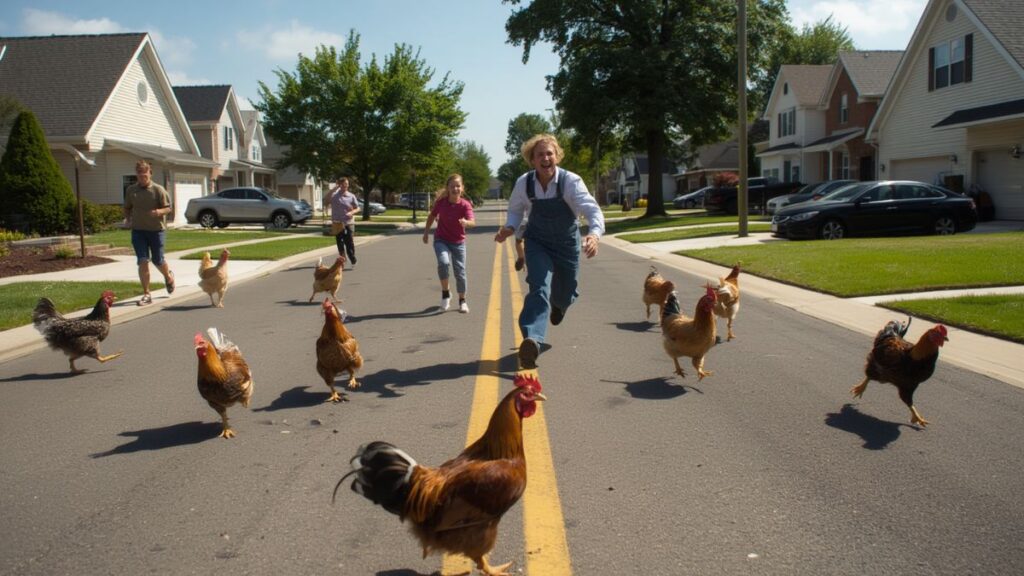
A situation involving six chickens.
Three neighborhoods.
A dozen volunteers.
And one very determined rooster.
For years afterward, people in town would remember the event simply as:
The Runaway Chicken Ministry.
A Simple Opportunity
Tom owned a small farm on the edge of town.
It wasn’t large.
Just enough land for a vegetable garden, a few fruit trees, and several chickens.
He enjoyed farm life.
The animals provided eggs, the garden supplied fresh produce, and the quiet countryside offered peace after busy days.
One spring, Tom learned about a family in his church facing financial difficulties.
The Johnson family had recently experienced medical expenses and job interruptions.
Money was tight.
Everyone in the church wanted to help.
Some donated groceries.
Others offered meals.
Tom decided to contribute something different.
He would give the family several healthy laying hens.
The chickens could provide fresh eggs for years.
It seemed practical.
Generous.
And relatively simple.
At least, that’s what Tom thought.
The Plan
The plan was straightforward.
Wake up early.
Load six chickens into travel crates.
Drive across town.
Deliver them to the Johnson family.
Return home.
The entire project should take less than an hour.
Tom loved simple plans.
Unfortunately, chickens rarely cooperate with simple plans.
The First Escape
Early Saturday morning, Tom entered the chicken coop carrying several crates.
The birds immediately sensed trouble.
Anyone who has worked with chickens knows they possess a remarkable ability to become suspicious at exactly the wrong moment.
Tom successfully caught the first chicken.
Then the second.
Then the third.
Everything seemed under control.
Then chicken number four escaped.
The bird darted between his legs, squeezed through a partially open gate, and sprinted into the yard.
Tom stared in disbelief.
The chicken ran surprisingly fast.
Much faster than any chicken had a right to run.
Tom chased it.
The chicken zigzagged.
Tom zigzagged.
The chicken changed direction.
Tom nearly ran into a wheelbarrow.
After fifteen exhausting minutes, he finally caught the escapee.
By then he was sweaty, tired, and questioning several life decisions.
The delivery hadn’t even started.
The Suspicious Rooster
Among the birds selected for transport was a rooster named Winston.
Winston considered himself the ruler of the farm.
He walked confidently.
Acted important.
And distrusted everyone.
Especially Tom.
The moment Winston saw the travel crate, he became deeply offended.
Tom eventually managed to secure him inside.
But Winston expressed his dissatisfaction through loud, dramatic crowing.
The noise continued during the entire loading process.
And throughout the entire drive.
Trouble on the Road
The first part of the trip went smoothly.
Tom relaxed.
Perhaps the difficult part was over.
Then he heard a strange sound.
A scratching noise.
Followed by another.
Then another.
He glanced in the rearview mirror.
One crate appeared partially open.
His stomach dropped.
Before he could stop the vehicle, two chickens squeezed through the opening.
Suddenly, live chickens were wandering around the back of his truck.
Tom pulled over immediately.
What followed was one of the most chaotic ten minutes of his life.
The Parking Lot Incident
Tom happened to stop near a small shopping center.
The moment he opened the truck, one chicken jumped out.
Then another.
Both landed in the parking lot.
Customers stared.
Children pointed.
A cashier standing outside burst into laughter.
Tom chased the first chicken between parked cars.
The second chicken headed toward a landscaping area filled with decorative bushes.
The situation quickly attracted an audience.
Several strangers volunteered to help.
One teenager attempted a dramatic diving catch.
He missed.
An elderly man offered advice despite contributing no actual assistance.
After considerable effort, both chickens were finally recovered.
The crowd applauded.
Tom bowed dramatically.
The applause increased.
Then he returned to the truck and continued driving.
Arrival at the Johnson House
When Tom finally reached the Johnson family’s home, he felt relieved.
The adventure was nearly over.
He parked.
Opened the truck.
And prepared to unload the birds.
That’s when another chicken escaped.
Tom could hardly believe it.
The bird launched itself from the crate and landed in the Johnson family’s front yard.
Then it ran.
Fast.
Very fast.
Directly toward the neighborhood.
The Great Chicken Chase
The Johnson family immediately joined the pursuit.
So did several neighbors.
Children abandoned bicycles.
Parents left porches.
Dog walkers changed direction.
Within minutes, nearly twenty people participated in an organized chicken chase.
The bird crossed driveways.
Ran through gardens.
Dodged attempts at capture.
At one point it briefly entered someone’s garage before changing its mind.
People laughed so hard they struggled to continue running.
The chicken seemed delighted by the attention.
Winston’s Rebellion
Meanwhile, Winston the rooster decided to create additional problems.
As volunteers chased the first escapee, Winston escaped from his own crate.
The self-appointed king of the farm marched confidently down the sidewalk.
Completely unconcerned.
Unlike the hens, Winston refused to run.
Instead, he walked slowly.
Deliberately.
As if conducting an inspection tour.
Whenever someone approached, he changed direction.
Not quickly.
Just enough to remain unreachable.
His behavior somehow made the situation even funnier.
Social Media Fame
Several teenagers recorded the entire event.
Videos appeared online before the chickens were even captured.
Titles included:
- “Neighborhood vs. One Chicken”
- “The Great Poultry Escape”
- “Chicken Ministry Gone Wrong”
- “Rooster Refuses Authority”
The clips spread rapidly throughout town.
By evening, hundreds of people had watched them.
Tom became unexpectedly famous.
Success at Last
After nearly an hour of chasing, laughing, and negotiating with stubborn poultry, every chicken was finally recovered.
The Johnson family received their gift.
The hens settled into their new home.
Even Winston eventually accepted his new surroundings.
Tom collapsed into a lawn chair.
Exhausted.
Sweaty.
And slightly embarrassed.
The Johnson family thanked him repeatedly.
The gift meant a great deal to them.
Fresh eggs would help reduce expenses and provide long-term support.
Suddenly all the chaos felt worthwhile.
The Nickname
The following Sunday, Tom arrived at church.
Several people greeted him.
None used his actual name.
“Good morning, Chicken Missionary.”
“How’s the poultry ministry?”
“Any new converts among the chickens?”
The nickname spread quickly.
Within weeks, nearly everyone referred to him as “The Chicken Missionary.”
Tom initially resisted.
Eventually he accepted defeat.
The name wasn’t going away.
An Unexpected Impact
Months later, something surprising happened.
The Johnson family reported that the chickens were thriving.
They produced eggs regularly.
The children enjoyed caring for them.
Expenses became slightly easier to manage.
The gift continued providing benefits long after the chaos ended.
Even more surprising, the story inspired others to help people in practical ways.
Several church members started community projects.
Others donated supplies or offered services.
One humorous event had encouraged a wave of generosity.
Looking Back
Years later, Tom could laugh about the experience.
In fact, it became one of his favorite stories.
Whenever someone talked about serving others, he remembered the chickens.
Whenever a project became more difficult than expected, he remembered Winston.
Whenever plans fell apart, he remembered that parking lot.
The memory always made him smile.
Because despite all the confusion, the mission had succeeded.
Not in the way he expected.
But in the way that mattered.
The family received help.
People came together.
Laughter filled the neighborhood.
And kindness accomplished its purpose.
The Lesson
Tom learned that obedience is often messier than expected.
People imagine simple plans.
Life introduces complications.
Sometimes those complications have feathers.
Sometimes they run surprisingly fast.
Sometimes they become local celebrities.
Yet the important thing is not whether everything unfolds perfectly.
The important thing is remaining willing to continue.
Even when circumstances become ridiculous.
Even when mistakes occur.
Even when chickens disagree with the plan.
Moral of the Story
Sometimes obedience requires persistence, flexibility, and a sense of humor. Even when things go completely off schedule, a willing heart can still accomplish meaningful good. And occasionally, the journey becomes far more memorable than the destination.
Story 4: The Wrong House Surprise
Rachel Bennett loved baking.
For her, baking was more than a hobby.
It was a way to show kindness.
Whenever someone in the neighborhood celebrated a birthday, Rachel baked cupcakes.
When a family welcomed a new baby, she delivered muffins.
When someone was sick, she arrived with homemade soup and fresh cookies.
People often joked that Rachel could solve most problems with baked goods.
Rachel didn’t disagree.
She believed small acts of kindness could make a big difference.
One spring morning, that belief inspired her to welcome a family that had recently moved into town.
The idea seemed simple.
Bake cookies.
Deliver cookies.
Introduce herself.
Return home.
Instead, the day would become one of the funniest stories the neighborhood had ever heard.
New Neighbors
The Carter family had recently purchased a house near Rachel’s street.
Everyone in the community was excited to welcome them.
The town was known for its friendliness, and new residents were often greeted warmly.
Rachel decided she wanted to be among the first to introduce herself.
The night before her planned visit, she baked her famous chocolate chip cookies.
The recipe had been passed down through three generations.
Soft centers.
Golden edges.
Just enough chocolate chips to make people immediately ask for a second cookie.
By the time the final batch cooled, the entire house smelled wonderful.
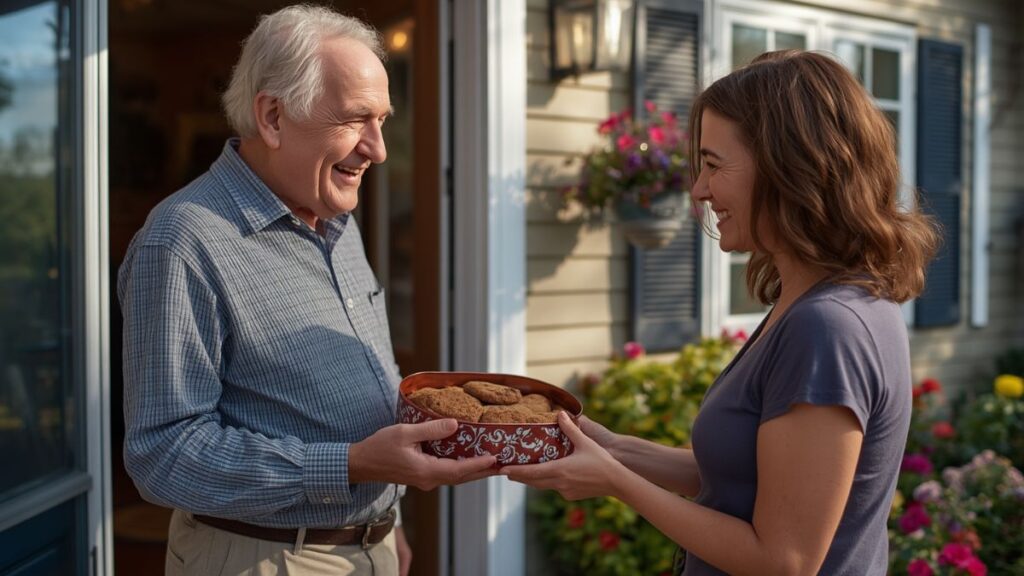
Rachel carefully packed the cookies into a decorative tin and attached a handwritten note.
“Welcome to the neighborhood. We’re happy you’re here!”
Everything was ready.
Or so she thought.
The Address
The following afternoon, Rachel searched for the address she had written down several days earlier.
The paper was still sitting on her kitchen counter.
At least, she believed it was.
Unfortunately, she couldn’t find it.
She checked beneath magazines.
Inside recipe books.
Under a fruit bowl.
The paper seemed to have vanished.
After several minutes of searching, she remembered most of the address.
Or at least she believed she did.
House number 218.
Blue mailbox.
White fence.
How hard could it be?
Confident she had the correct information, Rachel loaded the cookie tin into her car and began driving.
The Friendly House
A few minutes later, Rachel spotted a house matching her memory.
White fence.
Blue mailbox.
Neatly maintained yard.
Everything appeared correct.
She parked.
Grabbed the cookies.
Walked to the front door.
And rang the bell.
Several moments later, the door opened.
Standing there was an elderly gentleman with silver hair and a warm smile.
Rachel hesitated.
This wasn’t exactly what she expected.
She assumed the new family would be younger.
Still, perhaps this was a grandfather visiting relatives.
She smiled.
“Hello. Welcome to the neighborhood.”
The man looked pleasantly surprised.
“Thank you.”
Rachel continued.
“I wanted to bring you some cookies.”
The man’s eyes widened.
“Cookies?”
“Freshly baked.”
The smile that appeared on his face could have illuminated the entire street.
An Unexpected Conversation
The elderly man invited Rachel inside.
She hesitated briefly before accepting.
The home felt cozy.
Family photographs covered the walls.
Books lined several shelves.
A grandfather clock ticked quietly in the corner.
Rachel introduced herself.
The man introduced himself as Harold.
For the next twenty minutes, they chatted comfortably.
Harold shared stories about the town.
Rachel described neighborhood events.
Everything felt natural.
The only unusual detail was that Harold seemed slightly confused by certain parts of the conversation.
Whenever Rachel mentioned moving into town, Harold nodded politely but looked puzzled.
Eventually, Rachel decided to ask.
“So how are you settling into the neighborhood?”
Harold blinked.
“Settling in?”
“After moving here.”
Harold stared at her.
Then laughed.
“Oh my goodness.”
The Realization
Rachel suddenly felt nervous.
“What?”
Harold continued laughing.
“I’ve lived in this house for thirty-seven years.”
Silence.
A very long silence.
Rachel’s eyes widened.
Harold’s smile grew even larger.
Rachel felt her face turning bright red.
“You mean…”
“I’m definitely not the new family.”
Rachel covered her face with her hands.
“Oh no.”
The entire situation finally became clear.
Wrong address.
Wrong house.
Wrong recipient.
Right cookies.
The Embarrassment
For a moment Rachel wanted to disappear completely.
She replayed the entire conversation in her mind.
Every welcome comment.
Every reference to moving.
Every assumption.
Harold, meanwhile, seemed thoroughly entertained.
In fact, he appeared happier than ever.
Rachel apologized repeatedly.
“I am so sorry.”
Harold waved dismissively.
“Please don’t apologize.”
“I brought cookies to the wrong house.”
“And that makes this one of the best afternoons I’ve had all month.”
Rachel couldn’t help laughing.
Soon both of them were laughing.
The awkwardness disappeared almost immediately.
Harold’s Story
As they continued talking, Rachel learned something unexpected.
Harold lived alone.
His wife had passed away several years earlier.
His children lived in different states.
Most days were quiet.
He enjoyed reading and gardening, but visitors were relatively rare.
The surprise visit had brightened his entire week.
Suddenly Rachel realized something.
Although she had delivered the cookies to the wrong address, perhaps they had arrived exactly where they were needed.
Finding the Right House
Eventually Rachel left Harold’s home.
After receiving more directions, she finally located the actual Carter residence.
It turned out she had confused two different streets.
The real house sat nearly half a mile away.
This time, she delivered a second batch of cookies.
Fortunately, Rachel always baked extra.
The Carter family welcomed her warmly.
They appreciated both the cookies and the introduction.
Rachel considered leaving out the earlier mistake.
Unfortunately, Harold had already called a neighbor.
The story spread quickly.
By evening, everyone seemed to know.
The Neighborhood Reaction
The next morning, Rachel discovered that her accidental delivery had become local entertainment.
Neighbors smiled knowingly.
Several people asked whether she planned to welcome anyone else incorrectly.
One resident joked that he would leave his front door open in case surprise cookies arrived.
Another suggested creating a town-wide program called:
“Random Acts of Misdelivered Baking.”
The joke continued for weeks.
Rachel took it well.
After all, the situation really was funny.
A Growing Friendship
Something even more unexpected happened.
Rachel and Harold became friends.
She visited occasionally.
Sometimes she brought cookies.
Sometimes she brought muffins.
Sometimes she simply stopped by to talk.
Harold enjoyed the company.
Rachel enjoyed hearing his stories.
What began as a mistake evolved into a meaningful friendship.
Many afternoons were spent discussing life, family, and faith.
Neither of them would have predicted it.
The Annual Cookie Tradition
A year later, the neighborhood celebrated the anniversary of the famous cookie mix-up.
Someone jokingly suggested making it an annual tradition.
To everyone’s surprise, Rachel agreed.
Each year she baked a special batch of cookies and delivered the first tin to Harold.
Then she visited the Carter family afterward.
The tradition became a symbol of how unexpected mistakes can create unexpected blessings.
The Lesson Behind the Cookies
Looking back, Rachel realized the experience had taught her something important.
People often become frustrated when plans go wrong.
Mistakes feel inconvenient.
Embarrassing.
Uncomfortable.
Yet not every mistake leads to a negative outcome.
Sometimes a wrong turn leads to the right conversation.
Sometimes a misunderstanding creates a new friendship.
Sometimes a box of cookies arrives at exactly the house where it is needed most.
The goal had been simple.
Show kindness.
And despite the mistake, kindness still reached people.
In fact, it reached more people than Rachel originally intended.
A Story That Lived On
Years later, new residents still heard the story.
People laughed every time it was retold.
Harold loved sharing his version.
Rachel loved sharing hers.
The details varied slightly depending on the storyteller.
But the lesson remained the same.
Good intentions matter.
Kindness matters.
And occasionally, even wrong addresses can produce the right results.
Moral of the Story
Even when our plans miss the intended target, kindness often finds the place where it is needed most. A simple mistake can become an unexpected blessing when it is guided by a willing heart and genuine care for others.
Story 5: The Prayer List Mix-Up
George Walker had many wonderful qualities.
He was dependable.
Honest.
Kind-hearted.
Always willing to help.
If the church needed volunteers, George was usually the first person to raise his hand.
Unfortunately, George also possessed one very serious weakness.
His handwriting was terrible.
Not merely difficult to read.
Not slightly messy.
Truly terrible.
Some people compared it to ancient symbols.
Others claimed it resembled a spider that had walked through wet ink while having an emotional crisis.
George preferred to describe it as “creative.”
Everyone else disagreed.
For years, his handwriting had caused minor confusion.
Nothing serious.
A grocery list once resulted in fourteen cans of peaches instead of peas.
A birthday card had accidentally wished someone a “happy retirement” instead of a happy birthday.
But those incidents were nothing compared to what happened during the annual church prayer gathering.
A gathering that would forever be remembered for one unforgettable phrase:
“The Turkey Prayer.”
The Volunteer
The church hosted a monthly prayer night.
Members gathered to share requests, encourage one another, and pray together.
The system was simple.
People wrote prayer requests on small cards.
Volunteers collected them.
Then someone organized the requests before the group discussion began.
One evening, the usual organizer became sick.
A replacement was needed.
George immediately volunteered.
“How hard can it be?” he asked.
Those words would soon prove dangerous.
Collecting the Requests
Everything began normally.
Church members submitted cards.
George collected them in a neat stack.
The requests covered familiar topics.
Health concerns.
Family situations.
Job opportunities.
Travel plans.
Nothing unusual.
George sat at a table near the front of the room and began organizing the cards.
Most were easy to read.
Some required extra effort.
A few looked like they had been written during an earthquake.
Still, George worked patiently through the pile.
Then he reached one particular card.
And everything changed.
The Mysterious Request
George squinted.
Then tilted the card.
Then held it closer.
Then farther away.
The handwriting was challenging.
After several attempts, he believed he understood the message.
The request appeared to say:
“Please pray for trouble with a turkey.”
George blinked.
He read it again.
Same result.
Trouble with a turkey.
Interesting.
Unusual.
But not impossible.
People requested prayer for many different situations.
Perhaps someone owned an aggressive turkey.
Maybe a turkey had escaped.
Maybe Thanksgiving preparations had become unusually complicated.
Who was George to judge?
He added the request to the list.
Sharing Time
A few minutes later, the prayer meeting officially began.
The pastor welcomed everyone.
Then George stepped forward with the collected requests.
One by one, he read them aloud.
People listened respectfully.
Several nodded.
Others took notes.
Everything proceeded smoothly.
Then George reached the mysterious card.
He cleared his throat.
“One member would like prayer regarding… trouble with a turkey.”
Silence.
Complete silence.
The room froze.
Several people exchanged confused glances.
Someone blinked repeatedly.
One child started giggling.
The pastor looked puzzled.
George continued confidently.
“Apparently, there is some kind of issue involving a turkey.”
The Discussion Begins
To everyone’s surprise, people immediately started offering suggestions.
One man raised his hand.
“Could it be an aggressive turkey?”
A woman nodded seriously.
“My cousin had a turkey that chased people.”
Another person added, “Those birds can be surprisingly dangerous.”
The conversation became increasingly detailed.
People shared turkey stories.
Turkey encounters.
Turkey-related warnings.
Within minutes, the entire prayer meeting had become an unexpected poultry conference.
George remained completely convinced the discussion was appropriate.
The Owner of the Request
Meanwhile, Sarah Thompson sat near the back of the room looking increasingly confused.
She had submitted one of the prayer cards earlier.
Her request had asked for prayer regarding upcoming travel.
Specifically:
“Please pray for travel safety.”
Not turkey problems.
Travel safety.
At first, she assumed George was reading someone else’s request.
Then she recognized her handwriting.
Horror slowly appeared on her face.
George had somehow transformed “travel safety” into “trouble with a turkey.”
Sarah tried to remain quiet.
She failed.
Laughter escaped before she could stop it.
The Discovery
The pastor noticed.
“Sarah, are you alright?”
Between laughs, she managed to speak.
“I think that’s my prayer request.”
The room became quiet.
George smiled.
“You’re the one with the turkey?”
Sarah laughed even harder.
“No.”
She held up her copy of the original note.
“It says travel safety.”
George stared.
Then stared again.
Then compared the card with Sarah’s copy.
His expression changed slowly.
Very slowly.
Finally, realization arrived.
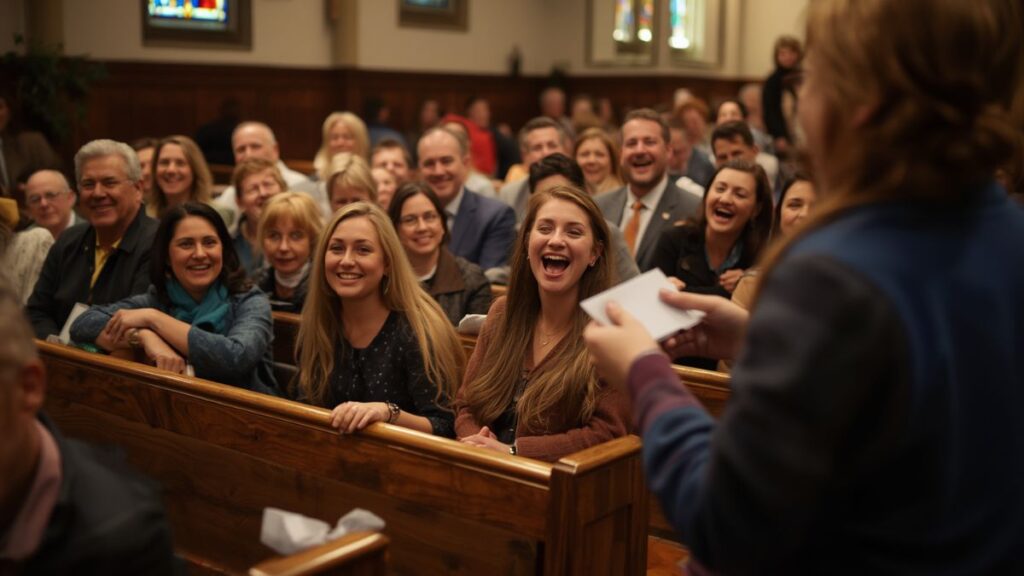
The room exploded with laughter.
The Great Turkey Prayer
People laughed so hard that several needed tissues.
Others struggled to breathe.
Even the pastor wiped tears from his eyes.
George examined the card repeatedly.
“To be fair,” he said.
“It really looks like turkey.”
The statement only made everyone laugh harder.
For several minutes, the meeting completely lost all structure.
Nobody could recover.
Every attempt to resume seriousness failed immediately.
Someone would whisper “turkey” and the entire room would start laughing again.
George Becomes Famous
The story spread quickly.
By the following Sunday, nearly everyone in the church had heard about the incident.
Visitors heard about it.
Former members heard about it.
Relatives heard about it.
People greeted George with smiles.
Some even asked for updates regarding the turkey situation.
George accepted his new reputation with good humor.
What else could he do?
The story wasn’t going away.
The Turkey Gifts
A few weeks later, things became even worse.
Or better.
Depending on perspective.
Someone anonymously placed a small stuffed turkey on George’s desk.
The following week, another appeared.
Soon turkey-themed gifts arrived regularly.
Turkey magnets.
Turkey stickers.
Turkey greeting cards.
One friend gave him a coffee mug that read:
“Still Praying for the Turkey.”
George displayed it proudly.
Thanksgiving Complications
As Thanksgiving approached, church members found endless opportunities for jokes.
Every turkey-related announcement generated laughter.
Every Thanksgiving decoration reminded people of the story.
One church member suggested creating a special prayer group for poultry emergencies.
Another proposed naming the annual Thanksgiving dinner after George.
The pastor wisely rejected that idea.
A Humble Response
What made the situation memorable wasn’t the mistake itself.
It was George’s reaction.
He never became defensive.
Never blamed anyone.
Never complained.
Instead, he laughed along with everyone else.
He admitted the mistake.
Accepted the teasing.
And continued volunteering.
His humility turned an embarrassing moment into a beloved church memory.
An Unexpected Lesson
Months later, George reflected on the experience.
At first, he had felt embarrassed.
Nobody enjoys making mistakes in front of an entire room.
Yet something positive had emerged.
The laughter brought people together.
The story created joy.
And perhaps most importantly, it reminded everyone that nobody is perfect.
People make mistakes.
People misunderstand.
People occasionally transform travel safety into turkey trouble.
Life continues.
The Legend Lives On
Years passed.
New church members arrived.
Old members moved away.
Yet the story survived.
Every time prayer requests were collected, someone inevitably mentioned the turkey.
Whenever handwriting became difficult to read, people referenced George.
The phrase “turkey prayer” became part of church history.
Even Sarah eventually received a framed copy of her original request as a joke.
The Real Message
Looking back, George realized something important.
Faith communities aren’t strengthened only by serious moments.
They are strengthened by shared experiences.
Shared laughter.
Shared memories.
Shared grace.
The turkey incident reminded everyone that mistakes happen.
What matters is how people respond.
Kindness.
Humility.
Patience.
And a willingness to laugh at ourselves can transform an awkward moment into something meaningful.
The Final Turkey Reference
Several years later, during another prayer gathering, George volunteered once again.
As he stepped forward, someone called out:
“Need help with the turkeys?”
The room erupted with laughter.
George grinned.
“Not today.”
Then he added:
“At least I hope not.”
The laughter returned immediately.
Some stories never get old.
Moral of the Story
Communication matters, but humility matters too. Everyone makes mistakes, and sometimes those mistakes become the stories that bring people together. A willingness to laugh at ourselves can turn embarrassment into joy and confusion into connection.
Story 6: The Garden of Unexpected Blessings

The Prayer List Mix-Up
George Walker had many wonderful qualities.
He was dependable.
Honest.
Kind-hearted.
Always willing to help.
If the church needed volunteers, George was usually the first person to raise his hand.
Unfortunately, George also possessed one very serious weakness.
His handwriting was terrible.
Not merely difficult to read.
Not slightly messy.
Truly terrible.
Some people compared it to ancient symbols.
Others claimed it resembled a spider that had walked through wet ink while having an emotional crisis.
George preferred to describe it as “creative.”
Everyone else disagreed.
For years, his handwriting had caused minor confusion.
Nothing serious.
A grocery list once resulted in fourteen cans of peaches instead of peas.
A birthday card had accidentally wished someone a “happy retirement” instead of a happy birthday.
But those incidents were nothing compared to what happened during the annual church prayer gathering.
A gathering that would forever be remembered for one unforgettable phrase:
“The Turkey Prayer.”
The Volunteer
The church hosted a monthly prayer night.
Members gathered to share requests, encourage one another, and pray together.
The system was simple.
People wrote prayer requests on small cards.
Volunteers collected them.
Then someone organized the requests before the group discussion began.
One evening, the usual organizer became sick.
A replacement was needed.
George immediately volunteered.
“How hard can it be?” he asked.
Those words would soon prove dangerous.
Collecting the Requests
Everything began normally.
Church members submitted cards.
George collected them in a neat stack.
The requests covered familiar topics.
Health concerns.
Family situations.
Job opportunities.
Travel plans.
Nothing unusual.
George sat at a table near the front of the room and began organizing the cards.
Most were easy to read.
Some required extra effort.
A few looked like they had been written during an earthquake.
Still, George worked patiently through the pile.
Then he reached one particular card.
And everything changed.
The Mysterious Request
George squinted.
Then tilted the card.
Then held it closer.
Then farther away.
The handwriting was challenging.
After several attempts, he believed he understood the message.
The request appeared to say:
“Please pray for trouble with a turkey.”
George blinked.
He read it again.
Same result.
Trouble with a turkey.
Interesting.
Unusual.
But not impossible.
People requested prayer for many different situations.
Perhaps someone owned an aggressive turkey.
Maybe a turkey had escaped.
Maybe Thanksgiving preparations had become unusually complicated.
Who was George to judge?
He added the request to the list.
Sharing Time
A few minutes later, the prayer meeting officially began.
The pastor welcomed everyone.
Then George stepped forward with the collected requests.
One by one, he read them aloud.
People listened respectfully.
Several nodded.
Others took notes.
Everything proceeded smoothly.
Then George reached the mysterious card.
He cleared his throat.
“One member would like prayer regarding… trouble with a turkey.”
Silence.
Complete silence.
The room froze.
Several people exchanged confused glances.
Someone blinked repeatedly.
One child started giggling.
The pastor looked puzzled.
George continued confidently.
“Apparently, there is some kind of issue involving a turkey.”
The Discussion Begins
To everyone’s surprise, people immediately started offering suggestions.
One man raised his hand.
“Could it be an aggressive turkey?”
A woman nodded seriously.
“My cousin had a turkey that chased people.”
Another person added, “Those birds can be surprisingly dangerous.”
The conversation became increasingly detailed.
People shared turkey stories.
Turkey encounters.
Turkey-related warnings.
Within minutes, the entire prayer meeting had become an unexpected poultry conference.
George remained completely convinced the discussion was appropriate.
The Owner of the Request
Meanwhile, Sarah Thompson sat near the back of the room looking increasingly confused.
She had submitted one of the prayer cards earlier.
Her request had asked for prayer regarding upcoming travel.
Specifically:
“Please pray for travel safety.”
Not turkey problems.
Travel safety.
At first, she assumed George was reading someone else’s request.
Then she recognized her handwriting.
Horror slowly appeared on her face.
George had somehow transformed “travel safety” into “trouble with a turkey.”
Sarah tried to remain quiet.
She failed.
Laughter escaped before she could stop it.
The Discovery
The pastor noticed.
“Sarah, are you alright?”
Between laughs, she managed to speak.
“I think that’s my prayer request.”
The room became quiet.
George smiled.
“You’re the one with the turkey?”
Sarah laughed even harder.
“No.”
She held up her copy of the original note.
“It says travel safety.”
George stared.
Then stared again.
Then compared the card with Sarah’s copy.
His expression changed slowly.
Very slowly.
Finally, realization arrived.
The room exploded with laughter.
The Great Turkey Prayer
People laughed so hard that several needed tissues.
Others struggled to breathe.
Even the pastor wiped tears from his eyes.
George examined the card repeatedly.
“To be fair,” he said.
“It really looks like turkey.”
The statement only made everyone laugh harder.
For several minutes, the meeting completely lost all structure.
Nobody could recover.
Every attempt to resume seriousness failed immediately.
Someone would whisper “turkey” and the entire room would start laughing again.
George Becomes Famous
The story spread quickly.
By the following Sunday, nearly everyone in the church had heard about the incident.
Visitors heard about it.
Former members heard about it.
Relatives heard about it.
People greeted George with smiles.
Some even asked for updates regarding the turkey situation.
George accepted his new reputation with good humor.
What else could he do?
The story wasn’t going away.
The Turkey Gifts
A few weeks later, things became even worse.
Or better.
Depending on perspective.
Someone anonymously placed a small stuffed turkey on George’s desk.
The following week, another appeared.
Soon turkey-themed gifts arrived regularly.
Turkey magnets.
Turkey stickers.
Turkey greeting cards.
One friend gave him a coffee mug that read:
“Still Praying for the Turkey.”
George displayed it proudly.
Thanksgiving Complications
As Thanksgiving approached, church members found endless opportunities for jokes.
Every turkey-related announcement generated laughter.
Every Thanksgiving decoration reminded people of the story.
One church member suggested creating a special prayer group for poultry emergencies.
Another proposed naming the annual Thanksgiving dinner after George.
The pastor wisely rejected that idea.
A Humble Response
What made the situation memorable wasn’t the mistake itself.
It was George’s reaction.
He never became defensive.
Never blamed anyone.
Never complained.
Instead, he laughed along with everyone else.
He admitted the mistake.
Accepted the teasing.
And continued volunteering.
His humility turned an embarrassing moment into a beloved church memory.
An Unexpected Lesson
Months later, George reflected on the experience.
At first, he had felt embarrassed.
Nobody enjoys making mistakes in front of an entire room.
Yet something positive had emerged.
The laughter brought people together.
The story created joy.
And perhaps most importantly, it reminded everyone that nobody is perfect.
People make mistakes.
People misunderstand.
People occasionally transform travel safety into turkey trouble.
Life continues.
The Legend Lives On
Years passed.
New church members arrived.
Old members moved away.
Yet the story survived.
Every time prayer requests were collected, someone inevitably mentioned the turkey.
Whenever handwriting became difficult to read, people referenced George.
The phrase “turkey prayer” became part of church history.
Even Sarah eventually received a framed copy of her original request as a joke.
The Real Message
Looking back, George realized something important.
Faith communities aren’t strengthened only by serious moments.
They are strengthened by shared experiences.
Shared laughter.
Shared memories.
Shared grace.
The turkey incident reminded everyone that mistakes happen.
What matters is how people respond.
Kindness.
Humility.
Patience.
And a willingness to laugh at ourselves can transform an awkward moment into something meaningful.
The Final Turkey Reference
Several years later, during another prayer gathering, George volunteered once again.
As he stepped forward, someone called out:
“Need help with the turkeys?”
The room erupted with laughter.
George grinned.
“Not today.”
Then he added:
“At least I hope not.”
The laughter returned immediately.
Some stories never get old.
Moral of the Story
Communication matters, but humility matters too. Everyone makes mistakes, and sometimes those mistakes become the stories that bring people together. A willingness to laugh at ourselves can turn embarrassment into joy and confusion into connection.
Story 7: The Choir Practice Confusion
David Mitchell had many talents.
He was an excellent carpenter.
A reliable volunteer.
A dedicated friend.
And one of the most helpful members of his church.
Unfortunately, singing was not one of his talents.
That fact was obvious to almost everyone.
Including David himself.
In fact, if there had been an international competition for singing slightly off-key, David might have won first place.
Yet despite his limited musical abilities, David had a sincere desire to serve.
So when the church choir announced it needed additional members, he made a decision that would eventually become one of the funniest stories in church history.
A decision that would teach him an important lesson about obedience, humility, and the value of showing up even when you don’t feel qualified.
The Announcement
It began during a Sunday service.
The choir director stepped forward with an announcement.
“We need additional volunteers for the Easter choir.”
Several people immediately showed interest.
The choir had grown smaller over the years, and extra voices would be helpful.
David listened from the middle row.
A quiet thought entered his mind.
Maybe you should help.
He quickly dismissed it.
Surely there were more qualified people.
People who actually understood music.
People who knew the difference between alto, tenor, and soprano.
David barely knew the difference between a hymn book and a recipe book.
Yet the thought returned.
Volunteer.
The idea seemed ridiculous.
Which somehow made it harder to ignore.
The Decision
After the service, David approached the choir director.
“I’d like to help.”
The director smiled warmly.
“Wonderful.”
David hesitated.
“You should probably know something first.”
“What?”
“I can’t really sing.”
The director laughed.
“We’ll figure it out.”
Those words sounded encouraging.
They would later prove overly optimistic.
First Practice
The first choir rehearsal took place on Wednesday evening.
David arrived early.
Everyone else appeared confident and experienced.
People discussed sheet music.
Musical notes.
Vocal techniques.
Terms David had never heard before.
He immediately felt out of place.
The director handed everyone a folder.
David opened his.
The pages looked complicated.
Lines.
Symbols.
Numbers.
Instructions.
It resembled advanced mathematics disguised as music.
The Language Problem
The first challenge appeared immediately.
The choir director used musical vocabulary constantly.
“Let’s begin at measure twenty-four.”
David looked around.
What was a measure?
Everyone else appeared to know.
“Now let’s repeat the bridge.”
A bridge?
There was a bridge?
Where?
David searched the pages.
No bridge appeared.
The confusion continued.
Despite his best efforts, David understood approximately twenty percent of what was happening.
Following Everyone Else
David quickly developed a strategy.
Watch everyone else.
If they stood, he stood.
If they sat, he sat.
If they turned a page, he turned a page.
If they sang loudly, he sang slightly less loudly.
The system worked reasonably well.
At least during practice.
Public performances would present additional challenges.
The Growing Confidence
After several weeks, David improved.
Not dramatically.
But noticeably.
He learned basic choir routines.
Recognized musical cues.
And became familiar with the songs.
The director encouraged him.
Fellow choir members supported him.
Gradually, his confidence increased.
For the first time, he believed he might survive the Easter performance without causing a major incident.
Unfortunately, confidence can sometimes arrive immediately before disaster.
Easter Morning
The church was packed.
Families filled every seat.
Visitors lined the back rows.
The choir gathered near the front.
Everyone looked prepared.
Everyone except David.
His stomach felt nervous.
His hands felt nervous.
Even his shoes somehow felt nervous.
The performance began.
At first, everything went surprisingly well.
The choir sang beautifully.
David followed carefully.
No major mistakes occurred.
Then came the second song.
And everything changed.
The Page Turn
Halfway through the song, the choir turned to a new page.
Everyone turned together.
Except David.
He missed the cue.
While the choir moved forward, David remained on the previous page.
He continued singing confidently.
Unfortunately, he was now singing an entirely different section.
The result sounded unusual.
Very unusual.
Several nearby singers glanced toward him.
David smiled politely.
They smiled back.
With concern.
Verse One Returns
Moments later, the choir reached verse three.
David, still lost, somehow returned to verse one.
Nobody knows how.
Even David couldn’t explain it afterward.
One moment he was attempting to follow the music.
The next he was enthusiastically singing completely unrelated lyrics.
The contrast was impossible to ignore.
The choir moved in one direction.
David moved in another.
Musically speaking, they were living in different countries.
The Standing Incident
Things became worse.
The choir received a signal to stand.
Everyone stood immediately.
David missed the signal.
He remained seated.
For several seconds, he was the only seated person in the entire choir.
The audience noticed.
Children noticed.
The pastor noticed.
David eventually noticed.
Realizing his mistake, he jumped up quickly.
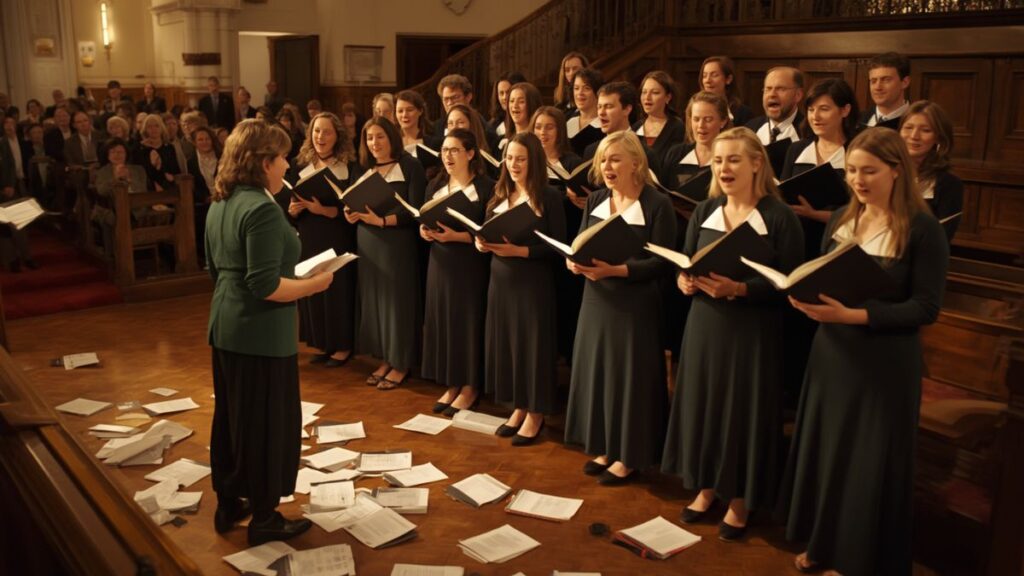
Unfortunately, he stood so suddenly that his folder slipped from his hands.
Music sheets scattered across the floor.
The Great Sheet Music Rescue
Several choir members attempted to help.
Unfortunately, everyone was still singing.
This created an awkward situation.
People bent down while continuing the performance.
David scrambled to gather papers.
The audience tried very hard not to laugh.
Many failed.
The scene looked less like a choir presentation and more like a coordinated paper-retrieval exercise.
Eventually, the music was recovered.
The performance continued.
The Final Song
By this point, David had accepted reality.
Perfection was no longer possible.
Survival became the goal.
Oddly enough, this realization helped.
Once he stopped worrying about mistakes, he relaxed.
The final song went smoothly.
Not perfectly.
But smoothly.
The choir finished.
The congregation applauded enthusiastically.
And David felt relieved.
Very relieved.
The Unexpected Response
After the service, David prepared for embarrassment.
Surely people had noticed.
Surely people would discuss his mistakes.
They did.
But not in the way he expected.
Instead of criticism, he received encouragement.
People thanked him for participating.
Several complimented his effort.
Others shared stories about their own embarrassing experiences.
One elderly member smiled and said:
“You looked exactly like the rest of us trying to figure out life.”
The comment stayed with David.
The Choir Family
David continued singing with the choir.
Week after week.
Month after month.
Gradually, his skills improved.
He learned musical terminology.
Followed page turns correctly.
Stood at the appropriate times.
Most importantly, he developed friendships.
The choir became a second family.
People encouraged one another.
Supported one another.
And occasionally laughed together.
Especially when someone mentioned Easter.
The Annual Reminder
For years afterward, choir members remembered the performance.
Not because it was disastrous.
Because it was human.
Whenever new members felt nervous, someone told David’s story.
The story always produced laughter.
It also produced comfort.
People realized they didn’t need to be perfect.
They simply needed to be willing.
The Lesson Behind the Confusion
Looking back, David recognized something important.
Many people wait until they feel completely prepared before serving.
Completely confident.
Completely qualified.
Completely capable.
The problem is that those feelings rarely arrive.
Growth often begins before confidence.
Learning often begins before competence.
Sometimes the only way to improve is to step forward despite uncertainty.
That is exactly what David had done.
The experience wasn’t flawless.
But it was valuable.
A Better Singer
Years later, David became a genuinely good choir member.
Not professional.
Not extraordinary.
But dependable.
Capable.
Confident.
The same people who once laughed about the Easter performance now enjoyed hearing him sing.
The improvement didn’t happen overnight.
It happened through practice.
Patience.
And a willingness to keep showing up.
A Story Worth Sharing
Whenever David met someone afraid to volunteer, he shared his choir story.
People laughed.
Then they listened.
Because beneath the humor existed an important truth.
Everyone starts somewhere.
Everyone feels uncertain.
Everyone makes mistakes.
The difference is whether they continue anyway.
David had continued.
And because he did, one embarrassing morning eventually became one of his favorite memories.
Moral of the Story
Obedience often begins before confidence arrives. You do not need to be perfectly prepared to serve. A willing heart, a positive attitude, and the courage to keep trying can accomplish far more than fear ever will.
Story 8: The Unexpected Car Wash

Kevin Brooks was known for his enthusiasm.
If a volunteer project needed workers, Kevin showed up early.
If someone needed help moving furniture, Kevin arrived with energy and optimism.
If a community event required support, Kevin usually signed up before anyone else.
His enthusiasm was admirable.
Unfortunately, it occasionally moved faster than his attention to detail.
That particular combination would create one of the funniest stories his neighborhood had ever witnessed.
A story involving a bucket.
A hose.
A shiny blue car.
And one very important mistake.
For years afterward, whenever someone talked about serving others, someone inevitably mentioned:
The Unexpected Car Wash.
Inspired to Serve
The story began on a Sunday morning.
Kevin attended church as usual.
During the service, the pastor delivered a message about kindness and practical service.
The message was simple.
Helping others doesn’t always require grand gestures.
Sometimes small acts of kindness make the biggest difference.
The sermon resonated deeply with Kevin.
As he drove home, he kept thinking about ways to help someone.
Then he thought about his elderly neighbor, Mr. Thompson.
Mr. Thompson lived alone and had recently undergone knee surgery.
Simple tasks had become more difficult.
Kevin wanted to do something useful.
Something practical.
Something that would brighten Mr. Thompson’s day.
Then inspiration struck.
He would wash Mr. Thompson’s car.
The Perfect Plan
The idea seemed ideal.
Mr. Thompson’s car often sat in the driveway.
A clean vehicle would save him effort and show kindness at the same time.
Kevin became excited immediately.
In fact, he became so excited that he decided to begin first thing the next morning.
He gathered supplies before going to bed.
Buckets.
Soap.
Sponges.
Towels.
Everything was ready.
Kevin felt pleased with himself.
He imagined Mr. Thompson’s gratitude.
He imagined the surprise.
He imagined how happy the gesture would make him.
He did not imagine washing the wrong car.
Early Morning Energy
The next morning, Kevin woke before sunrise.
The neighborhood remained quiet.
Birds chirped softly.
Most people were still asleep.
Kevin loaded his supplies into a wheelbarrow and walked next door.
There it was.
A blue sedan parked in the driveway.
Perfect.
Without hesitation, he got to work.
Water sprayed.
Soap foamed.
Sponges moved quickly.
Kevin attacked the project with remarkable enthusiasm.
Within minutes, he was fully committed.
Professional-Level Effort
Kevin wasn’t performing a quick rinse.
He was performing a masterpiece.
Every window received special attention.
Every tire was cleaned.
Every mirror sparkled.
The vehicle gradually transformed from dusty to dazzling.
Kevin even cleaned areas most people ignored.
Door handles.
Wheel rims.
The space beneath the windshield wipers.
If a professional car wash competition had existed, Kevin might have entered.
And possibly won.
The Curious Neighbor
About halfway through the project, another neighbor walked past.
She slowed down.
Looked at Kevin.
Looked at the car.
Then continued walking.
Her expression seemed unusual.
Kevin noticed but ignored it.
A few minutes later, another neighbor appeared.
He stared at the car.
Then at Kevin.
Then at the house.
Again, something seemed strange.
Kevin assumed they were simply impressed by his dedication.
The reality was slightly different.
Mr. Thompson Appears
Nearly an hour later, the front door opened.
Mr. Thompson stepped outside.
He looked surprised.
Then confused.
Then amused.
Kevin smiled proudly.
“Good morning!”
Mr. Thompson stared at the car.
Then at Kevin.
Then back at the car.
Finally, he started laughing.
Not a small laugh.
A genuine, uncontrollable laugh.
The kind that makes it difficult to speak.
Kevin felt slightly concerned.
“What?”
Mr. Thompson wiped tears from his eyes.
“Kevin…”
“Yes?”
“That’s not my car.”
The Silence
Everything stopped.
The hose.
The scrubbing.
The smiling.
Even the birds seemed quieter.
Kevin stared at the vehicle.
Then at Mr. Thompson.
Then back at the vehicle.
His brain slowly processed the information.
Not his car.
Not his car?
How could it not be his car?
The blue sedan sat exactly where Mr. Thompson’s vehicle usually sat.
At least Kevin thought it did.
Then realization arrived.
Mr. Thompson’s actual car was silver.
Not blue.
The blue sedan belonged to a visiting relative.
The Relative
As if the situation weren’t awkward enough, the owner appeared.
A woman stepped outside carrying a cup of coffee.
She immediately noticed Kevin.
And the sparkling clean vehicle.
And the buckets.
And the soap.
She looked puzzled.
Kevin looked embarrassed.
Mr. Thompson continued laughing.
The woman finally asked:
“What’s happening?”
Mr. Thompson answered before Kevin could.
“Kevin accidentally washed your car.”
Silence followed.
Then she started laughing too.
The Neighborhood Learns
Unfortunately for Kevin, several neighbors had already noticed the situation.
News spread quickly.
Very quickly.
Within an hour, multiple households knew about the accidental car wash.
By lunchtime, people were stopping by to hear the story directly.
Some laughed.
Others congratulated the relative on receiving free detailing services.
One neighbor jokingly asked Kevin if appointments were available.
The teasing had officially begun.
An Unexpected Reaction
Kevin expected embarrassment.
Instead, he received gratitude.
The visiting relative was delighted.
Her car looked fantastic.
Mr. Thompson appreciated the effort.
Even though the intended target had been missed.
Nobody seemed upset.
In fact, everyone seemed unusually happy.
The situation was funny.
But it was also kind.
Kevin had made a mistake.
A harmless one.
And the good intention behind it remained obvious.
The Second Car Wash
Determined to complete his original mission, Kevin offered to wash Mr. Thompson’s actual car as well.
Mr. Thompson agreed.
This time Kevin verified the vehicle carefully.
Twice.
Possibly three times.
The second car wash proceeded smoothly.
No confusion.
No mistaken identity.
No accidental detailing.
Just a clean car and a grateful neighbor.
Yet somehow, the first wash remained the more memorable event.
The Running Joke
For months afterward, neighbors referenced the story.
Whenever Kevin carried a bucket, someone asked:
“Whose car is it today?”
Whenever visitors parked nearby, jokes followed.
One family even left a note on their windshield:
“Please wash if inspired.”
Kevin laughed along with everyone else.
The story had become too funny to resist.
A Small Community Tradition
The following year, the neighborhood organized a community service day.
Volunteers helped elderly residents with yard work, minor repairs, and cleaning projects.
Kevin participated enthusiastically.
During the event, someone presented him with a toy bucket labeled:
Official Neighborhood Car Washer.
The crowd applauded.
Kevin accepted the award with mock seriousness.
The laughter lasted several minutes.
Looking Beyond the Mistake
As time passed, Kevin reflected on what happened.
The experience reminded him of something important.
People often focus on mistakes.
The wrong address.
The wrong timing.
The wrong choice.
The wrong car.
Yet sometimes those mistakes don’t prevent good outcomes.
Sometimes kindness still reaches someone.
Sometimes generosity still helps.
Sometimes an unintended recipient benefits from a well-intentioned action.
That had certainly happened here.
The Real Lesson
The most important part of the story wasn’t the mistake.
It was the willingness.
Kevin saw an opportunity to help and acted on it.
Yes, he should have checked the vehicle more carefully.
Everyone agreed on that.
Especially Kevin.
But his desire to serve remained genuine.
And genuine kindness tends to leave a positive impact, even when details go slightly wrong.
Or completely wrong.
Years Later
Years later, people still remembered the accidental car wash.
New residents heard the story.
Children who witnessed the event grew up hearing it retold.
The relative still joked that it was the best surprise she had ever received.
And Kevin?
He learned an important habit.
Before helping someone with a vehicle, he always confirmed ownership first.
A simple precaution.
One learned through experience.
Very public experience.
A Story Worth Remembering
The Unexpected Car Wash became more than a neighborhood joke.
It became a reminder.
A reminder that kindness matters.
That intentions matter.
That mistakes happen.
And that sometimes the stories people remember most are the ones that combine generosity with a little harmless confusion.
Because while Kevin never intended to wash the wrong car, he did manage to brighten several people’s day.
And in the end, that’s what service is really about.
Moral of the Story
Good intentions can still make a positive difference, even when they are accidentally directed toward the wrong destination. A willing heart, combined with kindness and humility, often creates blessings in ways we never expect.
Why These Stories Matter?
At first glance, these funny stories may seem like simple tales about everyday mishaps involving bread, chickens, cookies, tomatoes, and even car washes. They are lighthearted, entertaining, and often filled with unexpected twists that make readers smile.
However, beneath the humor lies a much deeper message.
Each story demonstrates that obedience to God is rarely a perfect process. Even when people genuinely want to do the right thing, mistakes can happen along the way. Instructions may be misunderstood, plans may fall apart, and unexpected complications may arise.
Yet these imperfections do not necessarily prevent positive outcomes.
In many cases, the most memorable lessons emerge from situations that did not go according to plan.
These stories remind us that faith is not about flawless execution. God does not expect perfection from people. Instead, He values a willing heart, sincere intentions, and a desire to serve others.
The characters in these stories may stumble, create confusion, or find themselves in humorous situations, but they continue moving forward with good intentions. Their willingness to help, give, serve, and obey ultimately leads to valuable lessons and unexpected blessings.
Key Lessons These Stories Teach
- Obedience often begins with simple actions.
- Mistakes do not automatically cancel good intentions.
- Humility helps us learn from embarrassing moments.
- God can use imperfect people to accomplish meaningful things.
- A sense of humor can make challenges easier to navigate.
- Faithfulness matters more than perfection.
Perhaps the most encouraging lesson of all is that God can work through ordinary people with ordinary flaws.
Since every person makes mistakes, that is comforting news.
These stories show that even when life becomes messy, confusing, or unexpectedly funny, valuable lessons can still emerge. Sometimes the very moments that make us laugh are the same moments that teach us the most about faith, obedience, and trust.
Practical Lessons About Obedience
While these stories are filled with humor, they also contain valuable lessons that can be applied to everyday life. Each situation demonstrates important principles about faith, service, and personal growth.
Start With Good Intentions
Most acts of obedience begin with a sincere desire to do what is right. Whether it is helping a neighbor, serving a community, or supporting a friend, positive actions often start with simple intentions. Even if things do not go exactly as planned, a willing heart remains important.
Accept Imperfection
No one follows every instruction perfectly. Mistakes, misunderstandings, and unexpected challenges are part of being human. Rather than becoming discouraged by imperfections, people can view them as opportunities to learn and grow.
Stay Humble
Humility allows people to laugh at themselves when things go wrong. Admitting mistakes and accepting correction with a positive attitude often leads to greater wisdom and stronger character.
Keep Going Despite Setbacks
Obedience is not always easy. Sometimes plans fail, obstacles appear, or efforts produce unexpected results. The key is to remain faithful and continue moving forward instead of giving up at the first difficulty.
Focus on Serving Others
The goal of obedience is not personal recognition. It is about helping others, showing kindness, and acting in ways that reflect positive values. When service becomes the priority, even imperfect efforts can make a meaningful difference.
Trust the Process
Not every act of obedience produces immediate results. Sometimes the impact becomes visible only later. Trusting the process and remaining faithful can lead to outcomes that are greater than expected.
Maintain a Sense of Humor
Life rarely unfolds exactly as planned. Being able to smile during awkward situations and laugh at honest mistakes can make challenges easier to handle. A sense of humor often helps people maintain perspective and continue their journey with joy.
These practical lessons remind us that obedience is not about achieving perfection. It is about having the willingness to act, learn from mistakes, and continue doing what is right even when the journey becomes unexpectedly funny.
Conclusion
Funny stories about obedience to God remind us that faith is not always expressed through dramatic miracles or life-changing events. Often, it is revealed through ordinary moments, simple acts of kindness, and everyday decisions to do what is right.
Sometimes obedience leads to a kitchen overflowing with bread.
Sometimes it results in chasing runaway chickens across a neighborhood.
Other times it involves delivering cookies to the wrong house, planting too many tomatoes, or creating confusion while trying to help others.
These situations may be humorous, but they carry meaningful lessons.
What makes these stories memorable is not the comedy itself. Rather, it is the heart behind the actions. Each person in these stories made a choice to serve, give, help, or act on a positive intention. Even when mistakes occurred, their willingness to do good created opportunities for learning, growth, and unexpected blessings.
One of the most encouraging messages these stories offer is that obedience does not require perfection. People make mistakes. Plans change. Misunderstandings happen. Yet God can still work through imperfect efforts and imperfect people.
Final Takeaways
These stories remind us that:
- Faith often grows through everyday experiences.
- Good intentions can lead to meaningful outcomes.
- Mistakes do not erase the value of obedience.
- Humility allows us to learn from our failures.
- A joyful attitude makes challenges easier to navigate.
- God can use ordinary people to accomplish extraordinary things.
Ultimately, obedience is less about flawless performance and more about a willing heart. It is the decision to take a step in the right direction, even when the outcome is uncertain.
And sometimes, the lessons that stay with us the longest are not the ones that made us cry or worry.
They are the ones that made us laugh, smile, and recognize that faith can be both meaningful and wonderfully human at the same time.