Short Stories About Money are powerful because they sit at the intersection of two universal parts of human life: emotion and financial reality. Every person interacts with money every day, whether it is for food, education, family needs, travel, or basic survival. But in storytelling, money becomes more than a tool for exchange. It becomes a reflection of human behavior, relationships, and emotional depth.
What makes Short Stories About Money especially meaningful is that they do not rely on dramatic events or complex plots. Instead, they focus on small, familiar moments. A folded note passed quietly, a birthday envelope, a grocery bill, or a simple sacrifice made without recognition can carry an entire emotional world.
In many ways, Short Stories About Money are not about finance at all. They are about people, and how they behave when resources are limited and emotions are real.
Why Short Stories About Money Feel So Real
The emotional strength of Short Stories About Money comes from recognition. Readers do not just observe these stories; they remember their own experiences within them.
Almost everyone has experienced situations such as:
- Receiving money that carried emotional meaning beyond its value
- Watching parents manage limited income with quiet strength
- Making difficult choices between needs and wants
- Understanding financial sacrifice only after growing up
- Feeling gratitude for small but meaningful financial help
Because these moments are so universal, Short Stories About Money feel immediately familiar. They do not need explanation or setup. The emotional connection is already there.
Even a simple scene, like a child holding a ten-dollar bill, can trigger deep emotional reflection in Short Stories About Money, because it reminds readers of similar moments in their own lives.
Short Stories About Money
Money comes and goes, but the stories behind it often stay with us forever. These Short Stories About Money reveal the sacrifices, struggles, and acts of love hidden behind everyday moments.
1. The Folded Ten
Riya woke up earlier than usual that morning.
Not because she had to.
Not because of alarm.
But because something about the air felt different.
It was quiet in a way that felt intentional, like the world was holding its breath for something small but important.
She turned to her side, staring at the ceiling for a moment before sitting up slowly. The fan above her made a soft creaking sound, repeating the same lazy motion it had for years. Her room was simple, not too big, not too small, filled with schoolbooks stacked unevenly and a small desk near the window.
Everything looked normal.
But birthdays always made things feel slightly different.
Today was Riya’s birthday.
She was not a child who expected grand celebrations. She had learned early that life in their home was careful, measured, and quiet. Her mother worked long hours at a tailoring shop nearby, stitching clothes for others while often repairing their own life piece by piece.
There were no surprises usually.
But there was always care.
And that mattered more than anything else.
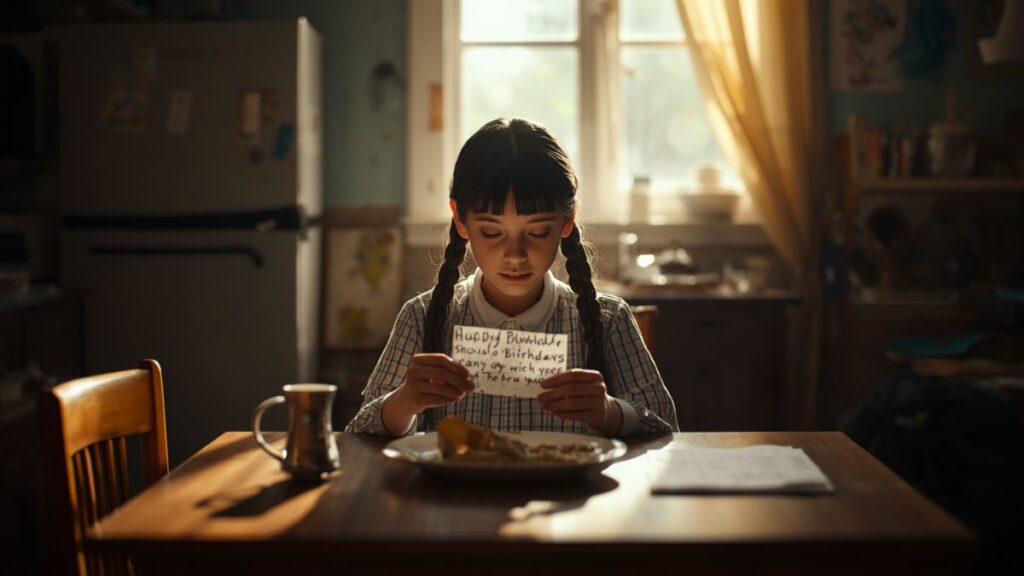
When Riya walked into the kitchen, she noticed something immediately.
A plate of toast.
A small cup of tea.
And a folded piece of paper resting beside it.
It was not fancy.
Not decorated.
Just simple handwriting on a slightly crumpled notebook page.
She picked it up first.
Inside, there was a ten-rupee note carefully folded once.
Not casually placed.
Not thrown.
Folded neatly, as if it had been prepared with thought.
And beneath it, a message.
“Happy Birthday, Riya. Eat something good today. Love you always.”
Her fingers stayed on the paper longer than necessary.
The ten rupees felt heavier than they should have.
Not because of value.
But because of meaning.
To most people, ten rupees was nothing.
Not even enough for a proper snack.
But to Riya, it felt different.
It felt like planning.
Like thought.
Like effort squeezed into something very small.
She looked around the kitchen, half expecting her mother to still be there. But the room was empty except for the faint smell of tea and detergent.
Her mother had already left for work.
Early shift.
Same as always.
Riya sat at the table slowly.
Her legs barely reached the floor.
She looked at the folded note again.
There was something strange about it. It wasn’t just money. It felt like a message wrapped in silence. Like someone had chosen not to say more, but still wanted to say everything.
She ran her fingers over the edges of the bill.
Smooth.
Careful.
Almost protective.
And then she noticed something she had missed earlier.
The handwriting looked slightly shaky.
Not because it was unclear.
But because it was rushed.
As if it had been written between tasks.
Between responsibilities.
Between life.
She finished her toast slowly.
But her mind was elsewhere.
Thinking.
Always thinking.
About the ten rupees.
About the note.
About her mother leaving early again.
At school, the day felt unusually long.
Her friends talked about gifts.
New clothes.
Cake.
Celebrations.
Riya smiled when she had to.
Nodded when needed.
But inside, she kept thinking about the folded note in her pocket.
She had decided to bring it with her.
Not to spend it.
Just to keep it close.
It felt wrong to leave it at home.
Like it might disappear.
Or lose its meaning.
During lunch break, she sat alone for a while.
Not because she didn’t have friends.
But because she wanted to think.
She took out the ten-rupee note again.
Unfolded it slowly.
Looked at it.
Then folded it again.
The same way her mother had.
Once.
Carefully.
As if repetition preserved meaning.
That’s when she saw her mother.
Outside the school gate.
Standing quietly near a tea stall.
Watching from a distance.
Not coming in.
Not calling out.
Just there.
For a few seconds.
Riya almost stood up.
Almost waved.
But something stopped her.
Her mother looked tired.
More tired than usual.
There was a cloth bag in her hand.
Probably work materials.
Probably more orders for the day.
And then, without entering the gate, her mother turned and walked away.
Riya sat back down.
Slowly.
Something inside her shifted, even though she didn’t fully understand it yet.
Why didn’t she come in?
Why just stand there?
Why not say anything?
The questions stayed with her all day.
Even during classes.
Even during conversations.
Even during silence.
When she reached home that evening, her mother was not back yet.
The kitchen looked the same.
The plate was gone.
The cup washed.
But something new was there.
Another folded note.
On her desk.
She picked it up immediately.
Same handwriting.
Same careful folding.
Another ten-rupee note inside.
And this time, a short message.
“Had to work extra today. Don’t worry about anything. Just be happy.”
Riya stood still.
Longer than before.
Now she understood something without it being said.
The ten rupees were never about money.
They were about presence.
About effort.
About trying, even when there wasn’t much to give.
That night, she placed both folded notes inside a small metal box she kept under her bed.
She didn’t spend them.
Didn’t move them.
Just kept them.
Safe.
Quiet.
Like memories.
Days turned into weeks.
Weeks into months.
The notes continued.
Sometimes ten rupees.
Sometimes a small chocolate.
Sometimes just paper with words.
But always folded.
Always careful.
Always there.
Riya stopped asking for things she didn’t need.
Not because she stopped wanting them.
But because she started noticing something else.
Her mother was already giving everything she could.
Just not always in ways that looked big.
Years later, when Riya grew older, she found that box again.
Dusty.
A little worn.
She opened it slowly.
Inside were dozens of folded notes.
Each one different.
Each one small.
Each one meaningful.
And suddenly, she understood something deeply.
Love doesn’t always arrive loudly.
Sometimes it comes folded.
Quiet.
And small enough to be missed.
But heavy enough to stay forever.
2. The Bus Fare Change
Arjun hated carrying coins.
Every morning before school, his mother would hand him bus fare and remind him to keep the change safely in his pocket.
But Arjun never liked dealing with small coins.
They jingled when he walked.
They made his pockets heavy.
And worst of all, the bus conductor almost never returned the exact amount.
“Keep the change,” the conductor would often say when he didn’t have the right coins.
The amount was never much.
One rupee.
Two rupees.
Sometimes three.
Still, it annoyed Arjun.
Every day, he complained about it.
The school bus route was long.
It passed through crowded markets, residential neighborhoods, and narrow streets lined with tea stalls and small shops.
Most passengers knew one another.
Workers boarded early in the morning.
College students filled the middle seats.
Schoolchildren squeezed into the remaining space.
The conductor moved constantly through the aisle, collecting fares and handing out tickets.
His name was Ravi.
At least that was what everyone called him.
Arjun never knew much about him beyond that.
To Arjun, Ravi was simply the man who never seemed to have exact change.
“Again?” Arjun muttered one morning.
He handed over twenty rupees.
The fare was eighteen.
Ravi searched his pouch briefly.
“No coins. I’ll give it tomorrow.”
“You always say that,” Arjun replied.
Ravi smiled tiredly.
“I’ll remember.”
Arjun rolled his eyes and took his ticket.
By the time he reached school, he had already forgotten about the conversation.
But he would complain about it again the next day.
And the next.
And the next.
His friends often laughed.
“It’s only a few rupees,” one of them said.
“A few rupees every day becomes a lot,” Arjun replied.
His argument seemed reasonable.
After all, money was money.
Why should he lose it?
The conductor should simply do his job properly.
At least that was what Arjun believed.
One afternoon, school ended earlier than usual.
Instead of taking his regular bus home, Arjun decided to wait near the bus stand where many local buses stopped between routes.
The area was busy.
Vendors sold snacks from small carts.
People hurried from one bus to another.
Drivers gathered in groups discussing schedules and traffic.
The smell of fried food drifted through the air.
Arjun bought a bottle of water and sat on a bench to wait.
That was when he noticed Ravi.
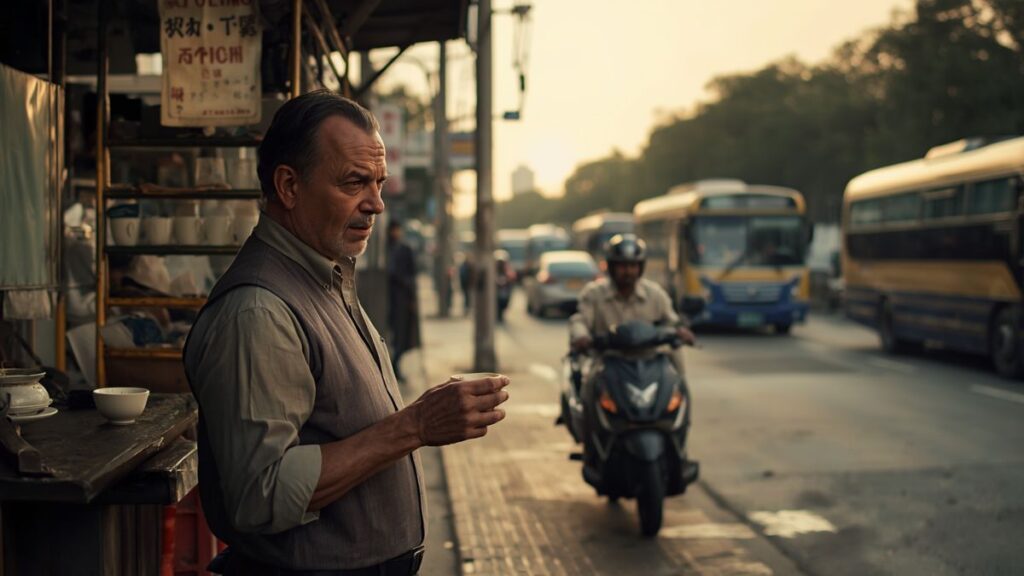
The conductor was standing near a roadside food stall.
At first, Arjun paid little attention.
But after a few moments, something caught his eye.
Ravi ordered a cup of tea.
Nothing else.
No meal.
No snacks.
Just tea.
The stall owner pointed toward several food items displayed nearby.
Ravi smiled and shook his head.
Then he stepped aside and quietly drank his tea alone.
Arjun watched.
It seemed strange.
The man had been working all day.
Surely he must be hungry.
Yet he bought only tea.
Nothing more.
The same thing happened the next day.
And the day after that.
Whenever Ravi stopped near the stall, he bought tea.
Never food.
Never lunch.
Never anything substantial.
Just tea.
Eventually, curiosity got the better of him.
One afternoon, Arjun approached the stall owner after Ravi had left.
“Does he never eat here?” he asked.
The owner looked up.
“Who?”
“The conductor.”
“Oh, Ravi?”
The owner nodded.
“He eats sometimes.”
“Sometimes?”
The owner shrugged.
“Not often.”
“Why?”
The stall owner hesitated.
Then he spoke quietly.
“He’s trying to save money.”
Arjun frowned.
“For what?”
The owner wiped the counter with a cloth.
“His daughter.”
“What about her?”
“School fees.”
Arjun stood silently.
The answer felt surprisingly heavy.
The stall owner continued.
“Good student. Very smart.”
He smiled.
“Ravi talks about her all the time.”
That evening, Arjun couldn’t stop thinking about it.
A few rupees.
That’s what he had been arguing about for months.
A few rupees.
The amount suddenly seemed different now.
Still, he wasn’t entirely convinced.
Lots of people had expenses.
That didn’t explain everything.
The conductor should still return the correct fare.
Shouldn’t he?
A week later, Arjun received another answer.
This time, directly.
The bus was unusually empty because of heavy rain.
Only a handful of passengers sat scattered throughout the vehicle.
Ravi finished collecting fares and settled briefly into a seat nearby.
For once, he looked exhausted.
Not just tired.
Exhausted.
His phone rang.
He answered immediately.
A smile appeared on his face.
Arjun couldn’t hear the entire conversation.
Only fragments.
“Yes.”
“Did you finish the test?”
“Really?”
“That’s wonderful.”
“I’m proud of you.”
The smile never left Ravi’s face.
When the call ended, he looked happier than Arjun had ever seen him.
A few moments later, another driver sitting nearby asked a question.
“How did she do?”
“First in her class,” Ravi replied.
The pride in his voice was impossible to miss.
Then came a sentence Arjun never forgot.
“I’ll do whatever it takes to keep her there.”
The conversation moved on.
But Arjun remained silent.
For the first time, he saw Ravi not as a conductor.
Not as the man handling tickets.
Not as the person who sometimes failed to return exact change.
He saw him as a father.
A father working long days.
Skipping meals.
Saving every possible coin.
Trying to create opportunities for someone he loved.
The realization changed something.
Not immediately.
But gradually.
The next morning, Arjun boarded the bus as usual.
The fare was eighteen rupees.
He handed over a twenty.
Ravi searched for change.
“No coins right now.”
Before he could continue, Arjun shook his head.
“It’s okay.”
The conductor looked surprised.
“Are you sure?”
“Yeah.”
Ravi smiled.
“Thank you.”
It was a small moment.
Almost insignificant.
Yet it felt different.
Over the following weeks, Arjun began paying more attention.
Not just to Ravi.
To everyone.
The tea vendor opening before sunrise.
The driver working through traffic all day.
The cleaner sweeping the station floor.
People carried stories he had never considered.
Responsibilities he never saw.
Sacrifices he never noticed.
One day, Arjun did something unexpected.
Instead of leaving his spare coins scattered around his room, he started collecting them in a jar.
One rupee.
Two rupees.
Five rupees.
Nothing dramatic.
Just whatever remained at the end of the day.
Months passed.
The jar slowly filled.
Not quickly.
But steadily.
The way meaningful things often do.
Near the end of the school year, Arjun emptied the jar.
The total wasn’t huge.
But it wasn’t small either.
For a moment, he stared at the pile of coins.
Then he smiled.
The next morning, he boarded the bus carrying a small envelope.
As he got off at school, he handed it to Ravi.
“What’s this?” the conductor asked.
“Just something.”
Ravi looked confused.
Arjun simply shrugged.
“You can use it for your daughter’s books.”
The conductor opened the envelope later.
Inside were coins.
Lots of them.
Carefully collected over months.
Along with a short note.
“For someone who’s working hard too.”
That evening, Ravi waited until Arjun boarded the bus again.
He walked over quietly.
“Thank you.”
Arjun smiled.
“No problem.”
Neither of them said much after that.
They didn’t need to.
Some things were understood without long conversations.
Years later, Arjun would remember the bus conductor.
Not because of the missing change.
Not because of the tickets.
Not because of the daily commute.
He remembered him because of the lesson.
A lesson that had nothing to do with money and everything to do with perspective.
Sometimes we see only the transaction.
We see the coins.
The fare.
The numbers.
But behind every small financial decision, there may be a story we know nothing about.
A dream.
A sacrifice.
A responsibility.
A family.
And sometimes, understanding that story changes the value of everything.
The few rupees Arjun once complained about never really disappeared.
They simply became part of something much larger.
A father’s determination.
A daughter’s future.
And a lesson worth far more than the change itself.
3. The Birthday Candle

Meera loved birthdays.
Not because of presents.
Not because of parties.
Not even because of cake.
She loved birthdays because, for one day each year, everything felt a little brighter.
The house seemed warmer.
The food tasted better.
People smiled more.
Even ordinary moments felt special.
As her twelfth birthday approached, she found herself imagining how the day might unfold.
Nothing extravagant.
Just something memorable.
Maybe a cake from the bakery near the market.
Maybe a few candles.
Maybe a photo to look back on later.
The thought alone made her smile.
Their life was simple.
Meera lived with her father in a small rented apartment above an old grocery store.
The building was worn and creaked whenever someone walked down the hallway.
The paint on the walls had faded years ago.
The kitchen window refused to close properly.
And during the rainy season, buckets occasionally appeared beneath stubborn leaks.
Still, it was home.
And for Meera, that was enough.
Most of the time.
Her father worked at a furniture workshop across town.
The job was demanding.
Long hours.
Heavy lifting.
Constant deadlines.
By the time he returned home each evening, his clothes carried the scent of sawdust and varnish.
His hands were rough.
His shoulders often ached.
Yet he never complained.
At least not in front of her.
A few days before her birthday, Meera noticed him studying a small notebook at the dinner table.
He would flip through pages quietly.
Write numbers.
Cross some out.
Then write more.
Whenever she entered the room, he would close the notebook and smile.
She never asked questions.
But she understood enough.
Money was tight.
It usually was.
The week before her birthday brought unexpected expenses.
The refrigerator stopped working properly.
A utility bill arrived that was larger than expected.
And one morning, her father discovered a problem with his bicycle, the same bicycle he used to get to work every day.
Repairs couldn’t wait.
Neither could bills.
Every expense seemed to arrive at the same time.
Meera noticed the changes immediately.
Her father skipped buying tea from his favorite stall.
He walked instead of taking the local bus.
He delayed replacing a shirt that had become badly worn.
Small things.
The kind of things adults often think children don’t notice.
But she noticed.
Children often see more than people realize.
The night before her birthday, she overheard part of a phone conversation.
Her father was speaking with an old friend.
“No, it’s fine,” he said.
“I’ll manage.”
A pause.
Then a small laugh.
“Of course I wanted to get her a cake.”
Another pause.
“I know. But some months are harder than others.”
Silence followed.
Then:
“She’s a good kid. She’ll understand.”
Meera quietly returned to her room.
She didn’t feel disappointed.
Not exactly.
She simply felt something she couldn’t fully describe.
A mixture of sadness and understanding.
The next morning arrived.
Her birthday.
She woke up early.
Sunlight streamed through the curtains.
For a moment, she forgot everything.
Then reality returned.
The apartment looked exactly the same.
No decorations.
No wrapped gifts.
No surprises.
Just another ordinary morning.
Her father wished her happy birthday before leaving for work.
He smiled warmly.
But she noticed the exhaustion in his eyes.
The past few weeks had clearly been difficult.
Still, he kissed the top of her head before leaving.
“Tonight,” he said.
“We’ll celebrate.”
The day moved slowly.
School felt longer than usual.
Friends talked about birthday parties they had attended.
Huge cakes.
Balloons.
Fancy decorations.
Meera listened politely.
But she kept thinking about her father.
Working.
Worrying.
Trying.
When she finally returned home, the apartment was empty.
Her father wasn’t back yet.
She completed her homework.
Read a book.
Checked the clock repeatedly.
The hours seemed endless.
It was almost evening when she heard footsteps outside the door.
Then the familiar sound of keys.
The door opened.
And there he was.
Tired.
Sweaty.
Exhausted.
But smiling.
In his hands was a small white bakery box.
Not large.
Not elaborate.
Just a simple cardboard box.
Her heart lifted immediately.
Not because of what might be inside.
But because she knew what it represented.
Effort.
Planning.
Love.
Her father carefully placed the box on the table.
“Happy Birthday,” he said.
His voice was soft.
Almost apologetic.
He opened the lid.
Inside sat a single cupcake.
Chocolate frosting.
Simple decoration.
One small candle.
Nothing more.
For a brief moment, silence filled the room.
Then her father looked down.
“It’s all I could manage today.”
The words weren’t dramatic.
He didn’t sound embarrassed.
Just honest.
Completely honest.
Meera stared at the cupcake.
Then at her father.
She noticed things she had overlooked before.
The worn fabric on his shirt.
The tiny tear near one sleeve.
The roughness of his hands.
The fatigue in his posture.
And his shoes.
The same shoes he had been wearing for years.
Their edges were frayed.
The soles visibly worn.
Suddenly, the cupcake looked different.
It wasn’t small anymore.
It felt enormous.
Because she understood what it had cost.
She smiled.
A genuine smile.
“It’s perfect.”
Her father looked relieved.
The tension in his shoulders softened.
“Really?”
“Really.”
They placed the cupcake in the center of the table.
He lit the candle.
The tiny flame flickered gently.
Not impressive.
Not dramatic.
Yet somehow beautiful.
He sang the birthday song.
Completely off-key.
Just like every year.
Meera laughed.
Her father laughed too.
And for a few minutes, the apartment felt brighter than any party hall.
Afterward, they shared the cupcake.
Half for her.
Half for him.
They talked about school.
Friends.
Books.
Movies.
Nothing particularly important.
Yet everything felt important.
Later that evening, her father fell asleep in his chair while watching television.
The long workday had finally caught up with him.
The remote rested loosely in his hand.
The television played softly in the background.
Meera stood to switch it off.
As she reached for the remote, something on the table caught her attention.
A receipt.
From the bakery.
She glanced at it casually.
Then paused.
The amount printed at the bottom was small.
Much smaller than a birthday cake would have cost.
Yet somehow it felt larger than she expected.
Because she knew their situation.
She knew recent bills had been difficult.
She knew every expense mattered.
The cupcake had not been expensive.
But it had still cost more than her father could comfortably spare.
For several seconds, she stared at the receipt.
Then she folded it gently and placed it back exactly where she found it.
She looked across the room.
Her father was asleep.
Still wearing work clothes.
Still wearing those worn-out shoes.
Too tired even to change.
A lump formed in her throat.
Not from sadness.
From gratitude.
She walked quietly toward him.
Knelt beside the chair.
And wrapped her arms around him.
The movement woke him slightly.
“What happened?” he asked sleepily.
“Nothing.”
She hugged him tighter.
Longer than usual.
Long enough for him to understand there was something behind it.
Even if neither of them said it aloud.
After a moment, he smiled and rested a hand on her shoulder.
Neither spoke.
Neither needed to.
Years later, Meera would celebrate birthdays in different places.
Some were larger.
Some included beautiful cakes.
Some included gifts.
Some included parties.
But whenever people asked about her most memorable birthday, she always thought of the cupcake.
The single candle.
The worn-out shoes.
The bakery receipt.
And the hug.
Because that birthday taught her something important.
A celebration is not measured by the size of the cake.
Or the number of gifts.
Or the amount of money spent.
Sometimes the most meaningful celebrations come from sacrifice.
From effort.
From someone doing the very best they can with what they have.
The cupcake disappeared years ago.
The candle burned out long ago.
The receipt eventually faded.
But the memory never did.
Because what Meera remembered wasn’t the dessert.
It was the love behind it.
And that made it priceless.
4. The Lost Wallet
Karan almost missed it.
The wallet was lying near the edge of the sidewalk, partially hidden beneath a bench outside the market. People walked past it without noticing. Some were busy carrying grocery bags. Others were rushing to catch buses or finish errands before the afternoon heat became unbearable.
It looked ordinary.
Old brown leather.
Slightly worn around the corners.
Nothing about it stood out.
Karan would have walked past it too if a gust of wind hadn’t flipped it over.
For a brief moment, sunlight reflected off the clear plastic pocket inside.
That was enough to catch his attention.
He stopped walking.
Looked around.
Nobody seemed to be searching for anything.
Nobody appeared concerned.
The crowd continued moving as if the wallet didn’t exist.
Karan bent down and picked it up.
The leather felt soft and aged.
Used for years.
Maybe decades.
His first instinct was simple.
Find the owner.
But first he needed to know who the owner was.
He opened the wallet carefully.
Inside were a few folded notes.
Some coins.
A couple of receipts.
Nothing unusual.
Certainly not enough money to make the wallet valuable.
At least not financially.
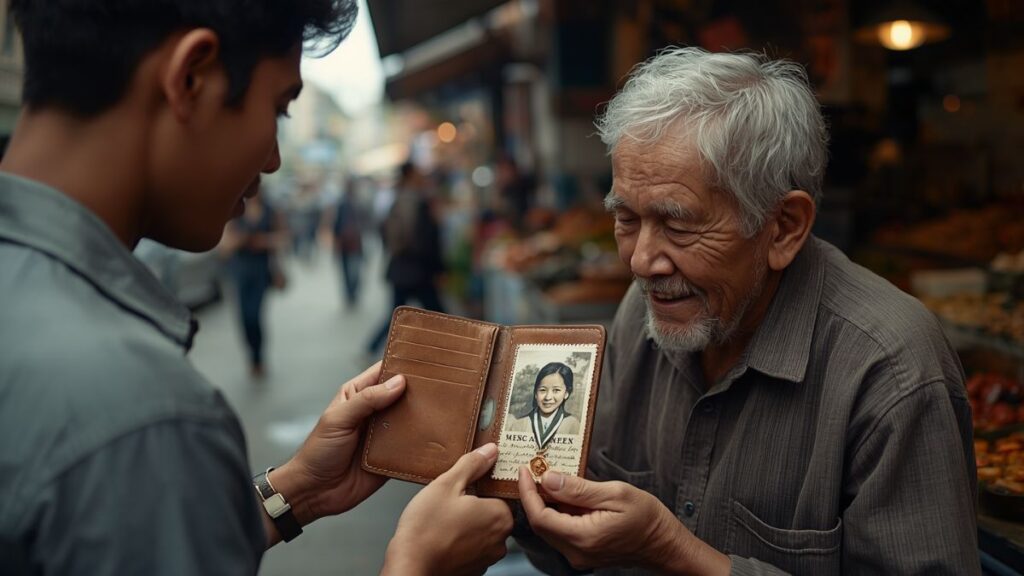
Then he noticed a photograph.
It was tucked into a transparent pocket near the center.
A little girl smiled at the camera while holding a school medal around her neck.
She couldn’t have been older than ten.
Her smile was enormous.
The kind of smile children have when they are genuinely proud of themselves.
The photo was slightly faded.
Its edges were worn from being handled repeatedly.
Clearly, someone looked at it often.
Karan stared at the picture for a moment.
Something about it felt important.
More important than the money.
He searched for identification.
Eventually he found an old card with a name and address.
Unfortunately, the address was several years old.
The card looked outdated.
It might not even be useful anymore.
Karan glanced around the market again.
The owner couldn’t have gone far.
At least he hoped not.
People usually realize quickly when they’ve lost a wallet.
So he started looking.
He walked past fruit vendors.
Past clothing stalls.
Past small grocery shops.
Every few minutes he scanned the crowd for someone searching pockets or looking worried.
Nothing.
Almost twenty minutes passed.
Still nothing.
Most people would have given up.
After all, the wallet contained very little money.
The effort hardly seemed worthwhile.
But Karan kept thinking about the photograph.
The way it had been protected inside the wallet.
The way its edges showed years of use.
Someone cared deeply about that picture.
So he continued searching.
Near the bus stand, he finally noticed an elderly man sitting alone on a bench.
The man looked distressed.
Not panicked.
Not angry.
Just worried.
His hands moved repeatedly through the pockets of his shirt and trousers.
Then he searched a cloth bag resting beside him.
Then his pockets again.
The cycle repeated every few minutes.
Karan slowed down.
Something told him he had found the owner.
He approached carefully.
“Excuse me, sir.”
The old man looked up.
“Yes?”
“Were you looking for something?”
The man’s expression changed immediately.
“My wallet.”
The answer came quickly.
Almost desperately.
“My wallet is missing.”
Karan felt a small sense of relief.
“What does it look like?”
The old man described it perfectly.
Brown leather.
Worn corners.
Old stitching along one side.
Karan smiled and held it out.
“Is this it?”
For a moment, the man simply stared.
As if he wasn’t completely sure what he was seeing.
Then he grabbed the wallet carefully.
Almost reverently.
Karan expected him to open it immediately and check the money.
Most people would.
After all, that’s usually the first concern.
But that wasn’t what happened.
The old man opened the wallet.
Ignored the cash.
Ignored the coins.
Ignored everything else.
His fingers moved directly to the photograph.
The little girl with the school medal.
He stared at it for several seconds.
His shoulders visibly relaxed.
A deep breath escaped his chest.
The kind of breath people take when a heavy weight finally disappears.
Only then did he look at Karan.
“Thank you.”
The words were simple.
But the emotion behind them was impossible to miss.
Karan smiled.
“No problem.”
The old man held the photograph gently.
Almost protectively.
“That’s my granddaughter,” he said quietly.
Karan looked at the picture again.
“She looks very happy.”
The old man’s face brightened instantly.
“She was so proud that day.”
There was warmth in his voice.
The kind that appears when someone talks about a person they love deeply.
“First medal she ever won.”
He looked down at the photograph again.
“I carry this everywhere.”
Karan nodded.
Now he understood.
The wallet had never really been about money.
The few notes inside could be replaced.
The coins could be earned again.
Even the wallet itself could eventually be replaced.
But the photograph was different.
Some objects become valuable because of what they represent.
Not because of what they cost.
The old man slipped the wallet safely into his pocket.
This time checking twice to make sure it was secure.
Then he smiled.
A genuine smile.
One filled with relief.
“Thank you,” he said again.
Karan simply nodded.
They exchanged a few more words before parting ways.
Nothing remarkable.
Nothing dramatic.
Yet something about the encounter stayed with him.
As he walked home, he kept thinking about the photograph.
If he had found the wallet a few years earlier, he might have focused entirely on the money.
He might have assumed that was the important part.
After all, that’s what wallets are for.
Holding money.
Holding cards.
Holding practical things.
But now he realized something different.
Sometimes the most valuable thing inside a wallet isn’t money at all.
Sometimes it’s a memory.
A reminder.
A connection to someone important.
The little girl’s smile wasn’t worth anything financially.
Yet it was clearly priceless to her grandfather.
That realization followed Karan throughout the evening.
When he arrived home, he noticed framed photographs around the house.
Pictures he had seen thousands of times before.
Family vacations.
School events.
Birthday celebrations.
Simple moments frozen in time.
For the first time, he stopped to look at them properly.
Each photograph told a story.
Each one represented a memory someone wanted to keep.
A moment someone didn’t want to lose.
And suddenly, the old man’s reaction made perfect sense.
The wallet had contained very little money.
Yet losing it had clearly caused genuine distress.
Not because of the cash.
Because of what else was inside.
Days passed.
Then weeks.
Most people would have forgotten a small encounter like that.
But Karan didn’t.
Every now and then, he found himself remembering the relief in the old man’s eyes.
Not the wallet.
Not the money.
The relief.
It was the kind of expression that can’t be faked.
The kind that appears only when something truly important is returned.
Years later, Karan would struggle to remember exactly how much money was inside the wallet.
The amount simply wasn’t important.
What he remembered clearly was the photograph.
The smiling granddaughter.
The school medal.
And the way an old man’s face transformed when he realized it wasn’t lost forever.
That day taught him something simple but meaningful.
People often assume value is measured in money.
But some of the most valuable things in life cannot be counted.
A photograph.
A memory.
A connection.
A reminder of someone we love.
The wallet eventually became just another object.
The money was probably spent long ago.
The receipts were likely thrown away.
The coins disappeared into everyday life.
But the lesson remained.
Because sometimes what people fear losing isn’t what they own.
It’s what those things represent.
And sometimes the smallest act of kindness is simply helping someone hold on to a memory they cannot replace.
5. The Overtime Slip

Suresh’s father was rarely home before sunset.
For as long as Suresh could remember, that had simply been part of life.
Every evening followed the same pattern.
His mother would prepare dinner.
The clock would slowly move past six.
Then seven.
Sometimes even later.
Eventually the front door would open, and his father would walk in looking tired but smiling.
Whenever Suresh asked why he was late, the answer never changed.
“Just extra work today.”
Nothing more.
No complaints.
No long explanations.
Just extra work.
As a child, Suresh never thought much about it.
Adults worked.
That was normal.
His father worked longer than most.
That seemed normal too.
Children often accept things exactly as they are.
They don’t always ask why.
His father worked at a warehouse on the edge of town.
The job involved unloading trucks, organizing shipments, and moving heavy boxes throughout the day.
It wasn’t glamorous.
It wasn’t easy.
But it paid the bills.
At least most of them.
Every morning, his father left before sunrise.
Every evening, he returned exhausted.
Yet somehow he always found energy for his family.
He asked about school.
He listened to stories.
He attended parent meetings whenever possible.
And despite his long hours, he rarely missed important moments.
Suresh admired him.
But like many children, he didn’t fully understand him.
Not yet.
One evening, Suresh sat at the dining table finishing homework.
His mother was preparing dinner.
The house was unusually quiet.
His father had not returned yet.
A sheet of paper rested near the edge of the table.
At first, Suresh ignored it.
But after a while curiosity got the better of him.
He glanced down.
The paper appeared official.
Numbers.
Dates.
Hours.
Signatures.
It was an overtime slip.
He wasn’t trying to snoop.
He simply looked.
And then looked again.
The document listed several weeks of overtime hours.
Extra shifts.
Late evenings.
Additional weekends.
More hours than he expected.
Far more.
Suresh stared at the numbers.
His father had worked dozens of extra hours.
Yet the payment listed at the bottom seemed surprisingly small.
He checked again.
Maybe he misunderstood.
Maybe he read it incorrectly.
But the numbers remained the same.
Long hours.
Modest pay.
For the first time, Suresh realized something.
Those late evenings weren’t just “extra work.”
They were sacrifices.
Real sacrifices.
Hours that could have been spent resting.
Hours that could have been spent at home.
Hours exchanged for relatively little money.
The front door opened.
Suresh quickly placed the paper exactly where he found it.
A few moments later, his father entered.
Tired as usual.
Smiling as usual.
“How was school?” he asked.
“Good.”
“Homework finished?”
“Almost.”
His father nodded.
Then sat down carefully.
The exhaustion in his face seemed more visible now.
More real.
As if Suresh were seeing it for the first time.
Dinner passed normally.
Nobody mentioned the overtime slip.
Nobody mentioned money.
Nobody mentioned long work hours.
But something had changed.
At least for Suresh.
That night he couldn’t stop thinking about the paper.
The numbers.
The hours.
The effort.
He thought about all the evenings his father had arrived late.
All the weekends spent working.
All the small things he quietly gave up.
And suddenly, memories began connecting.
The repaired school shoes instead of new ones.
The old phone his father continued using.
The vacations they postponed.
The restaurant meals they skipped.
At the time, these things seemed ordinary.
Now they looked different.
Now they looked intentional.
His father wasn’t simply working longer.
He was working harder so the family could move forward.
The realization stayed with him long after everyone else went to sleep.
The next morning, Suresh woke earlier than usual.
The house was still dark.
His father was already preparing for work.
Their eyes met briefly.
“You’re awake early,” his father said.
“Couldn’t sleep.”
His father laughed softly.
“Enjoy it while you’re young.”
Suresh smiled.
But he didn’t explain what he was thinking.
Because he wasn’t sure how to explain it.
How do you tell someone you’ve suddenly realized how much they sacrifice?
How do you put that into words?
So he said nothing.
Instead, he made a decision.
A quiet one.
The kind that changes things gradually.
That afternoon, he studied a little longer.
The next day, he reviewed notes more carefully.
The day after that, he completed assignments before being reminded.
Nobody told him to do it.
Nobody forced him.
His motivation came from somewhere else.
Every time he felt lazy.
Every time he considered postponing work.
Every time he thought about taking shortcuts.
He remembered the overtime slip.
The image stayed clear in his mind.
Extra hours.
Small pay.
Endless effort.
Slowly, studying stopped feeling like an obligation.
It started feeling like respect.
Respect for everything his father was doing.
Months passed.
Then years.
Teachers noticed changes first.
His grades improved steadily.
His focus improved.
His confidence improved.
Friends assumed he had become naturally disciplined.
But discipline wasn’t really the reason.
Understanding was.
He finally understood something many children learn only much later.
Success is rarely built alone.
Someone often sacrifices behind the scenes.
Someone often works harder than anyone notices.
Someone often carries burdens quietly so others can have opportunities.
For Suresh, that person was his father.
One evening, several years later, Suresh returned home holding an academic award.
The result of years of effort.
Years of studying.
Years of persistence.
His father examined the certificate carefully.
A smile slowly appeared.
The kind of smile that starts in the eyes.
“This is wonderful,” he said.
Suresh nodded.
For a moment, neither spoke.
Then Suresh remembered the overtime slip.
The one that had changed everything.
“I never told you this,” he said.
His father looked up.
“A few years ago, I saw one of your overtime slips.”
The older man seemed surprised.
“You did?”
Suresh nodded.
“I wasn’t trying to look.”
His father laughed softly.
“It’s okay.”
For a moment, silence filled the room
Then Suresh spoke again.
“That’s when I understood.”
His father waited.
“Every extra hour.”
The room became very quiet.
His father didn’t say anything immediately.
He didn’t need to.
Because he understood exactly what Suresh meant.
The overtime slip had never been intended as a lesson.
It was just paperwork.
A routine document.
One sheet among many.
Yet somehow it revealed something important.
Not the value of money.
The value of effort.
Years later, Suresh would struggle to remember the exact numbers printed on that slip.
The amount earned.
The hours worked.
The dates listed.
Those details eventually faded.
But one thing never disappeared.
The realization.
The understanding that every opportunity often rests on someone else’s sacrifice.
Every achievement often contains unseen effort.
Every success story usually includes people whose contributions are rarely celebrated.
His father’s name never appeared on report cards.
Never appeared on certificates.
Never appeared on awards.
Yet a part of him existed within every accomplishment.
Because those late evenings.
Those extra shifts.
Those overtime hours.
Helped create the future standing before him.
The overtime slip eventually disappeared.
Perhaps thrown away.
Perhaps lost during a move.
Perhaps forgotten in a drawer somewhere.
But its lesson remained.
Because sometimes the most important things we learn don’t come from books.
They come from moments of understanding.
Moments when we finally see the effort someone has been making all along.
And once we see it, we are never quite the same again.
Money as an Emotional Language in Short Stories About Money
In Short Stories About Money, money often replaces spoken emotion. Characters may not express their feelings directly, but their financial actions communicate everything.
A single financial gesture can silently mean:
- “I care about you”
- “I am struggling, but I will manage”
- “I want to help without being noticed”
- “I am sacrificing something important for you”
This makes Short Stories About Money deeply expressive without needing dialogue-heavy storytelling.
For example, a parent quietly placing money into a purse, or a child returning a small bill without explanation, can carry more emotional weight than a long conversation. The silence itself becomes meaningful.
Core Themes in Short Stories About Money
Although every story is different, Short Stories About Money often revolve around a few powerful emotional themes that repeat across cultures and generations.
Invisible Sacrifice in Short Stories About Money
One of the most important themes in Short Stories About Money is sacrifice that is never spoken aloud.
This includes situations like:
- Parents skipping meals to ensure children are fed
- Guardians working extra shifts without complaint
- Families cutting personal expenses to manage priorities
- Individuals hiding financial stress to protect loved ones
What makes this theme powerful is that the sacrifice is invisible. No one announces it. No one demands recognition. It simply exists in everyday life.
In Short Stories About Money, this silence often becomes the most emotional part of the story.
Childhood Understanding in Short Stories About Money
Many Short Stories About Money explore how children perceive money differently from adults.
Children often see money as:
- Something simple and limitless
- A source of happiness and immediate reward
- A gift without understanding its cost
As they grow older, they begin to understand:
- Money represents effort and time
- Financial decisions involve trade-offs
- Small amounts can represent big sacrifices
This shift from innocence to understanding is a key emotional turning point in Short Stories About Money.
A childhood memory that once seemed ordinary often becomes deeply emotional when revisited in adulthood.
Emotional Realization in Short Stories About Money
Another important pattern in Short Stories About Money is delayed emotional understanding.
Characters often experience a financial moment early in life but only understand its meaning years later.
For example:
- A child receives money and spends it happily
- Later learns it came from sacrifice
- Realizes the emotional cost behind it
This delayed realization adds depth to Short Stories About Money, because it mirrors how people actually process memories in real life.
Understanding does not always happen immediately. Sometimes it takes years for meaning to fully appear.
Quiet Love Expressed Through Short Stories About Money
In many Short Stories About Money, love is not expressed through words or affection but through actions involving money.
These include:
- A carefully prepared meal during financial difficulty
- A hidden envelope left without explanation
- A bill quietly paid to ease someone’s burden
- A small gift given despite personal struggle
These gestures are powerful because they are practical rather than emotional declarations.
In Short Stories About Money, love is often shown, not said. And that makes it more believable and deeply felt.
Financial Struggle in Short Stories About Money
Not all Short Stories About Money are about comfort or stability. Many explore financial struggle and resilience.
These stories often include:
- Managing limited income carefully
- Choosing between essential needs
- Facing unexpected expenses
- Trying to maintain dignity during hardship
The emotional focus in Short Stories About Money is not just poverty or struggle itself, but how people continue to live with strength, patience, and dignity despite it.
Symbolism in Short Stories About Money
One of the most interesting aspects of Short Stories About Money is how simple objects become emotional symbols.
A single bill
Represents sacrifice, memory, or responsibility. It often carries emotional weight far beyond its value, becoming a reminder of effort, care, or a meaningful moment in someone’s life.
A birthday envelope
Represents care, love, and emotional effort behind celebration. It shows how even a small gesture can hold deep personal meaning when it is given with intention and affection.
A grocery purchase
Represents survival, planning, and prioritization. It reflects everyday responsibility and the quiet decisions people make to manage limited resources in real life.
A hidden note
Represents unspoken understanding or emotional connection. It often expresses feelings that are never directly said, making silence itself part of the story.
These symbols allow Short Stories About Money to transform ordinary life into meaningful storytelling.
Emotional Structure of Short Stories About Money
Most effective Short Stories About Money follow a simple emotional structure:
Ordinary Beginning
A normal financial situation is introduced. Life appears simple on the surface, often showing everyday routines where money is present but not yet emotionally significant.
Emotional Event
Something involving money happens, often simple but meaningful. It could be a gift, a payment, a sacrifice, or a small decision that quietly changes the emotional direction of the story.
Hidden Context
The reader begins to understand deeper emotional layers behind the action. What seemed ordinary starts to reveal sacrifice, intention, or unspoken struggle connected to money.
Realization
The character or reader understands the emotional truth of the moment. The financial act is no longer just about money, but about meaning, relationships, or memory.
This structure makes Short Stories About Money feel natural and relatable while still emotionally impactful.
Why Readers Connect With Short Stories About Money
Readers connect deeply with Short Stories About Money because they reflect real human experiences in a simple and emotional way. Almost everyone has:
Witnessed financial sacrifice in their family
Often seen parents or guardians quietly managing expenses, making compromises, and putting others first without explanation. These moments are not always spoken about, but they are deeply felt and remembered over time.
Experienced emotional meaning behind small money-related moments
A small gift, a folded note, a birthday envelope, or a simple purchase can carry emotional weight that is remembered far longer than its actual value. These moments often become personal memories linked with love or care.
Learned the value of money through real-life situations
Understanding often comes through experience, when people slowly realize how effort, time, and responsibility are connected to every amount earned or spent. This realization changes how they view even small financial decisions.
Remembered financial gestures that carried emotional weight
Moments like receiving help during difficult times, seeing someone give despite having little, or noticing silent sacrifices often stay in memory for years and shape how people think about relationships and gratitude.
Because of this, Short Stories About Money often feel less like fiction and more like memory. Even fictional stories can trigger real emotional reflection, making readers connect their own life experiences with what they read.
Writing Effective Short Stories About Money
To write strong Short Stories About Money, the focus should always be on emotional truth rather than financial detail. The strength of these stories comes from how realistically they capture human feelings connected to money, not from complicated financial situations.
Keep the story simple
A single moment is enough to carry emotional weight. A small interaction, like receiving money, giving help, or noticing a quiet sacrifice, can form the entire foundation of Short Stories About Money.
Focus on emotion instead of numbers
The meaning of money matters more than its exact value. Whether it is a small amount or a large one, what truly matters in Short Stories About Money is the emotion attached to it.
Show through actions
Let behavior reveal emotion instead of explaining it directly. In Short Stories About Money, a glance, a pause, or a quiet decision often communicates more than long explanations.
Use small details
Objects like envelopes, bills, meals, and receipts often carry emotional significance in Short Stories About Money. These simple details help ground the story in real-life experience.
End with reflection
Many Short Stories About Money end with understanding rather than resolution. The final moment often leaves the reader with a thought or realization instead of a complete conclusion, making the story linger longer in memory.
Real-Life Reflection in Short Stories About Money
One of the strongest qualities of Short Stories About Money is how closely they mirror real life.
They remind readers of:
- Parental sacrifices that were not understood earlier
- Childhood misunderstandings that gain meaning later
- Quiet generosity that was never acknowledged
- Emotional moments attached to small financial acts
Because these experiences are universal, Short Stories About Money feel timeless and deeply human.
Conclusion
Short Stories About Money are not really about financial transactions. They are about people, emotions, and relationships expressed through money.
They show how small actions can carry deep meaning, how silence can express love, and how sacrifice often goes unnoticed but never unfelt.
A simple bill, a quiet meal, or a hidden envelope can represent an entire emotional journey.
In the end, Short Stories About Money remind us of a simple truth:
Money may be counted in numbers, but its true value is measured in human emotion, memory, and connection.
And that is why Short Stories About Money continue to resonate across generations, cultures, and experiences, staying meaningful long after the story ends.